Abstract: Soft Computing has become popular in developing systems that encloses human expertise. Imaging technologies and clinical cytology has improved in disease diagnosis. Exact detection is extremely important for proper treatment and cure of disease. Two soft computing technique Neural Network and Support Vector Machine are used for classification of Caridotocography data set. This paper clearly explains the advantages of hybrid technique, when Fuzzy is combined with Neural Network and Support Vector Machine it is clearly noticed that there is an increase in accuracy of classification rate.
Keywords: Neural Network, SVM, Fuzzy Neural Network, Fuzzy SVM.
I. INTRODUCTION
Neural Networks(NN) are regression machines that associate i/ps with o/ps. The black box effect of Neural
network contains an i/p of N values namely,
x
1,...
x
Nwhich forms the characteristic vector x that suggests the class, group, pattern, and related output(o/p) vector y for the corresponding input(i/p) vector x. A trained NN is a computational machine that apply an algorithm which is specified by the i/p nodes, o/p nodes, hidden layers and the connecting lines between them, transforming node
functions, and weight multipliers
w
1,...
w
R , here, weights are denoted as vector w, then NN is given byy = f(x ; w) (1) Here x is any i/p vector and y is the resultant o/p vector that should match best a label t (q) for some q.
One of the disadvantages of Neural Network is, learning of one weight tends to unlearn the other weights, so epochs are continued until the SSE is sufficiently small. Another problem is that the learned set of weights yields a local minimum, of which it has been shown that there are many [1] so that the learning is very likely to not be optimal. This reduces the accuracy when other feature vectors are put through the NN that have different noise values. Fusion of Fuzzy logic and neural network is very efficient.
Revised Manuscript Received on August 05, 2019.
S. Leoni Sharmila,Asst. Professor, Department of Mathematics, SRM IST, Ramapuram, Chennai.
C. Dharuman, Professor, Department of Mathematics, SRM IST, Ramapuram, Chennai.
P.Venkatesan, Professor, Faculty of Research, Sri Ramachandra
SVM is a statistics based machine learning technique which is used for classification or regression analysis that aims to find the most optimal hyper plane. The important duty of SVM is to find an optimal solution and used as approximating functions and classifications at the current level of development. Decision-making process is quick and for this cause SVM can be used in real time applications.
Suppose [2] [3] [4]:
);
,
)...(
,
(
u
1v
1u
nv
nu
i
R
d;
v
i
1
,
1
(2) Sample components are obtained from two classes. The components of xi ϵ Rd from class A1 then use yi =1, from class A2 then use yi = −1. Linearly separable training set contains elements of class A1, and elements of class A2 on both sides of hyper plane [2] [3] [4]So ,we have
u
,
c
(3)hyper plane is linearly separable, if
c
u
i,
if vi = 1, (4)c
u
i,
, if vi = −1, (5)Where
R
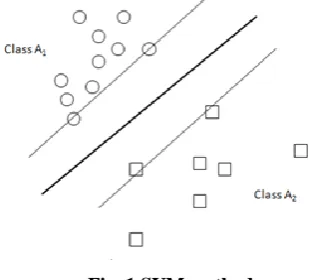
d inner product between a and b is a unit [image:1.595.341.496.488.628.2]vector and ∈ R 〈a, b〉. SVM examines the most optimal hyper plane continuously. Figure 1 show a SVM method. [2] [3] [4]
Fig. 1 SVM method
Figure 1 illustrates as, thin line means the boundaries or margins and thick line in the centre is called band limit. Support vectors are the points found on top of the margin. These support vectors are near to optimal hyper plane and separating hyper plane are far away from the sample points. [2] [3] [4] [5]
SVM has one detriment that is, its training stage is insubstantial to handle corrupt and existing outliers data[6].
A Fuzzy Based Classification – An
Experimental Analysis
In reality, data set belongs to this category, to overcome this Fuzzy is being associated with SVM. In FSVM , fuzzy membership is associated to each data point [7]. The distance between fixed point and its fixed class centre is defined by membership function. However the class centre is very accessible to noise. Compare to SVM, FSVM performs better in confront to noises.
II. PREVIOUS WORK
In medical field, there are many studies related to hybrid technology in recent times. [8] Introduced a new training algorithm in FSVM, [9] created a FSVM with a new fuzzy membership function. A comparative study is made using Fuzzy Neural Network in diagnosing Thyroid and Breast cancer Disease. [11] gives A Novel Neuro- Fuzzy System for disease Classification [12] gives a comparative study of disease classification using Machine learning algorithms [13] A new method is developed for classification of Heart disease Prediction using ANFIS method.
III. FUZZY NEURAL NETWORK
Let F be a Fuzzy set represented as an ordered pair
))
(
,
(
f
fx
, on a space X. where the membershipfunction
f(
x
)
is
f(
x
)
:
2
f
[
0
,
1
]
at given pointX
f
.
(
X
)
represents the family of fuzzy sets in space X and each point of X is represented by f vector.For fuzzy sets with membership function
]
1
,
0
[
2
:
)
(
f
f
x
are defined by the followingoperations:
;
,
)
,
(
min
)
,
(
1 2 1 2 1 2
j
m
j
m
j
m
;
,
)
,
(
max
)
,
(
1 2 1 2 1 2
j
m
j
m
j
m
where
j
m
shows all j-sized subsets of m-sized set is
always a subset of
2
f ). The primary operations are :union:
P
Q
,
PQ(
x
)
(
P(
x
),
Q(
x
))
intersection:
P
Q
,
PQ(
x
)
(
P(
x
),
Q(
x
))
A fuzzy relation R on a Cartesian product
n
Z
Z
Z
1
2
...
i.e.R
Z
1
Z
2
....
Z
n
isdefined by the membership function
]
1
,
0
[
2
:
)
(
(Z1Z2...Zi)
R
x
. The compositionbetween the fuzzy set Z and the relation R is defined as
)).
,
(
)
(
(
)
(
,
y
x
x
y
R
Z
ZR
RA fuzzy neural network can be defined as:
)))
(
(
)),
1
(
(
(
)
(
i
R
f
Z
i
f
V
i
Z
N N
N (1)))
1
(
),
(
),
(
(
(
)
(
i
R
f
Z
i
V
i
V
i
V
L N (2)Where
Z
(i
)
,Z
(
i
1
)
are fuzzy sets of neural networkstate defined in the space Z i.e.
)
(i
Z
,Z
(
i
1
)
(
X
)
.V
(
i
)
(
X
)
are the weights on the i-th learning phase. RNis a fuzzy relation describingthe activation function and RLis a fuzzy relation describing
the learning algorithm.
IV. FUZZY SUPPORT VECTOR MACHINE (FSVM)
Available information's in the real world problems are very often insufficient, vague and inaccurate. One of the important tool to handle these data is Fuzzy regression analysis, this is effectively applied in various real time problems. In this section, fuzzy hypothesis is joined with SVM regression method. The parameters which are fuzzified in SVM regression will make it more flexible. The
given o/p data, denoted by
P
~
i
(
p
i,
c
i)
, are symmetrictriangular fuzzy numbers, where
p
i is a center andc
iis awidth. The membership function of
P
~
i is given byi i P
c
p
p
p
i
1
)
(
~
(3)For handling the fuzzifized training data, bias term and weight of the components that are used in SVM regression model are also set as fuzzy numbers. Let Fuzzy weight vector be V ={v, e} and fuzzy bias term
B = {b, d}, V ={v, e} is the fuzzy weight vector, here each components within it are fuzzy numbers. Let this be
denoted as
v
v
1,...,
v
n
t,
ande
e
1,...,
e
n
t,
This means "approximation v" described by the center v and the width e. Likewise, B={b, d} is the fuzzy bias term, which means “approximation b”, described by the center b and the width d. Fuzzy parameters used here are triangular membership function.
,
)
(
)
(
...
)
(
11
x
V
x
B
V
x
B
V
P
n
n
0
y
0,
x
0
0
y
0,
x
1
0
,
)
(
)
)
(
(
1
)
(
x
d
x
e
b
x
w
p
y
t t
P
(5)
where
(
x
)
(
x
)
1,...
..,
(
x
)
n
t,
n is thedimension of feature space, and
P(
p
)
0
whenb
x
v
p
d
x
e
t
(
)
(
t
(
)
.V. RESULTS AND DISCUSSIONS
Here, fuzzy set theory concepts are integrated into Neural Network and SVM. A fuzzy neural network gains implicit knowledge from experts which can easily included in fuzzy neural network, and this knowledge helps to learn from training samples which in turn enhances the accuracy of the o/p. The fuzzy neural network learns by training set which has an i/p values
X
[
0,1]
and targetst
[
0,1]
with theprimary weights
W
[
0,1]
. Alternatively, SVM regression [image:3.595.79.520.371.694.2]model must recognize the parameters, that is components of weight vector and biased term that are fuzzy numbers. In addition to it the desired o/ps are also fuzzy number in the training sample. When the concept of fuzzy set theory is incorporated into SVM, it safeguards the goodness of SVM. Finally, the fuzzy Support Vector Machine and Fuzzy Neural Network may be very useful in classifying biological data. The data set cardiotocographic consists of 2126 instances with 23attributes is taken from UCI machine learning repository.
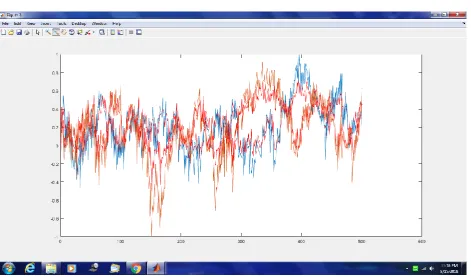
Fig. 3 SVM model
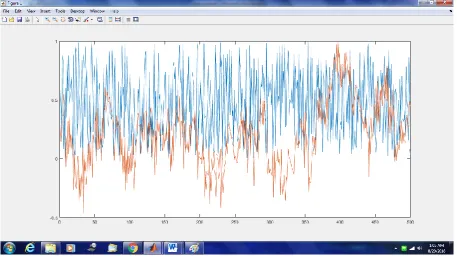
[image:4.595.64.536.417.694.2]Fig. 5 FSVM
VI. CONCLUSION
This paper shows a comparative study of Fuzzy Neural Network and Fuzzy SVM technique for classification of cardiotocographic data set helping patients to predict and reliable diagnosis at the earliest. Fuzzy Neural Network has been used for classification which has both the advantages of fuzzy logic and neural network. In this, the data set shows a classification rate of 77% for Neural Network and 75 % for SVM. Investigational study of fuzzy neural network shows significantly improved classification of 96% and also speed over back propagation algorithm. So this neural network is very appropriate to be applied in training of large-sized neural networks. Similarly Fuzzy SVM shows an accuracy of 94% of classification compared to regression SVM, which are very satisfying. Therefore the results clearly show that hybrid technology has high accuracy and speed in classifying biological data set.
REFERENCES
1. Carl G. Looney, “Pattern Recognition Using Neural Networks”, Oxford University Press, Oxford/NY, 1997.
2. I.Fazekas: Neural Networks, University of Debrecen, Faculty of Informatics, TÁMOP- 4.1.2.A/1-11/1-2011-0103 (2013)
3. T. Borsavölgyi, T. Mankovits, I. Kocsis: The Application of SVM for the Optimization of Technical Tasks, Technical Science in the Eastern Hungarian Region (2011) pp. 499-507.
4. V. N. Vapnik: Statistical Learning Theory, AT&T Research Laboratories, A Wiles-Intercience Publication, John Wiles & Sons In., 1998, ISBN 0-471-03003-1.
5. E. Spyrou, G. Stamou, Y. Avrithis, S. Kollias: Fuzzy Support Vector Machines for Image Classification fusion MPEG-7 visual descriptors url: http://doras.dcu.ie/353/1/lncs_3697.pdf Download: 2015.01.17 6. X.G. Zhang, “Using class-center vectors to build support vector
machines”, In Proc.IEEE Signal Process. Soc. Workshop. NewYork: IEEE Press, (1999) 3–11.
7. C.F. Lin, S.D. Wang, “Fuzzy support vector machines”, IEEE
8. C .F. Lin, S.D. Wang, “Training algorithms for fuzzy support vector machines with noisy data”, Pattern Recognition Letters. 25(14) (2004) 1647–1656.
9. X.F. Jiang, Y. Zhang, J.C. Lv, “Fuzzy SVM with a new fuzzy membership function”,Neural Comput. Appl. 15 (2006) 268–276. 10. C. Senol, T.Yildirim, “Thyroid and Breast Cancer Disease Diagnosis
using Fuzzy-Neural Networks”, IEEE transcations on Electrical and Electronics Engineering, 2009, p. II 390 - II393.
11. Leoni Sharmila. S, Dharuman. C , Venkatesan. P, A Novel Neuro- Fuzzy System for Classification, Global Journal of Pure and Applied Mathematics , 2016;12:267-270.
12. Leoni Sharmila. S, Dharuman. C , Venkatesan. P, Disease Classification Using MachineLearning Algorithms - A Comparative Study, International Journal of Pure and Applied Mathematics , 2017;114 No.6,1-10.
13. [13] NegarZiasabounchi, ImanAskerzade “ANFIS Based Classification Model for Heart Disease Prediction”, International Journal of Electrical & Computer Sciences (IJECS- IJENS), Vol.14, No.2, April 2014.
14. Jyh-Shing and Jang, R. “ANFIS: Adaptive-Network-Based Fuzzy Inference System, computer methods and programs in biomedicine”, IEEE Transactions on Systems, 1993.
15. P.M. Patil and T.R. Sontakke, “Rotation, scale and tanslation invariant handwritten Devanagari numeral character recognition using general fuzzy neural network,” Pattern Recognition 40, 2110-2117, 2007.
16. X. Zhang, S. Tan, C.-C. Hang, and P.-Z. Wang, “An efficient computational algorithm for min-max operations,”Fuzzy Sets and Systems 14, 297-304, 1999.
17. C.T. Lin, C.-M. Yeh, S.-F. Liang, J.-F. Chung and N.Kumar, “Support vector based fuzzy neural network for pattern classification,” IEEE Trans. Neural Networks14(1),31-41, 2006. 18. B. Gabrys and A. Burgiela, “General fuzzy min-max neural network
for clustering and classification,” IEEE Trans. Neural Networks 11(3), 769-783, 2000.
19. H. M. Lee, C. M. Chen and Y. L. Jou, “An efficient fuzzy classifier with feature selection based on fuzzy entropy,” IEEE Trans. SMC-B 31(3), 426-432, 2001.
20. C.F. Lin, S.D. Wang, “Fuzzy support vector machines”, IEEE Transaction on Neural Networks. 13(2) (2002) 464–471.