ISSN: 2278-3075, Volume-8, Issue-9S3, July 2019
An Empirical Analysis of using Blockchain
Tech-nology with Internet of Things and its
Applica-tion
Aditya Tandon
Abstract. Blockchain technology uses the cryptographic tech-nique to create expanding list of data records called blocks. Along with transaction and timestamp data, each block holds a hash value obtained using cryptographic technique. Blockchain gains importance for its decentralized data trans-action and authorization without the need for third-party in-tervention. Although, it is mostly used in Finance sector these days, due to its inherent ability to protect data it can be applied to every field of computation especially in fields where data transaction is voluminous. Internet of Things (IoT) is one such area where it involves collection, transfer and processing of real time data from objects, humans and sensors to auto-mate various tasks. Hence, this paper reviews the blockchain technology, and how it can be coupled with IoT to overcome the privacy and security issues. This paper first systematically introduces the concept of blockchain technology, its applica-tions along with the need for IoT devices and its implementa-tion. Finally, it discusses the blockchain based IoT (BIoT) its architecture, advantages, challenges in implementation.
Keywords: Blockchain, IoT, Review, BIoT, Applications
1 INTRODUCTION
Technological innovations take a quantum leap once in every few decades, which opens new horizons of innovation, tech-niques and applications. Blockchain technology and Internet of Things are such paradigms, which has already started prov-ing its pivotal presence in many fields. The future of these emerging technologies is inevitably a major factor that would influence the human life for years to come. On one hand, Internet of Things is expanding at a faster rate [1] and there is a prediction [2] that by the year 2020 Internet of Things will surge our lives with more than 50 billion devices apart from the gadgets what we use in our daily life like laptops, tablets and smartphones. However, research [3] has pointed out that security issues like privacy, authorization, data management and access control as major pitfalls in the IoT implementa-tion. Studies [1, 4, 5] have discussed that usage of blockchain technique in IoT applications can help overcome the impedi-ments of security issues and privacy concerns.
Revised Manuscript Received on July 22, 2019.
Aditya Tandon, Department of Computer Science and Engi-neering, Krishna Engineering College, Ghaziabad, U.P., India
This paper conducts a systematic review of using blockchain technology with Internet of Things along with the areas of application. The remaining section of the paper is structured as follows. Sect. 2, describes the blockchain technology, its basic functioning, types and applications. Sect. 3, introduces the Internet of Things, its application, future market trend and the various challenges in implementing IoT. Using blockchain with IoT and its architecture, advantages are discussed in Sect. 4. Sect. 5, deals with the challenges in implementing BIoT and gives an overview of widely used commercial BIoT products available in the market. Finally, in Sect. 6, conclud-ing remarks are provided.
2 BLOCKCHAIN TECHNOLOGY AN OVERVIEW
2.1 Basic Functioning of Blockchain
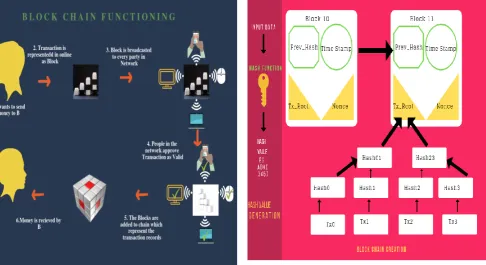
1470 Fig. 1. Functioning of Blockchain
Ethereum allowed for the implementation of blockchain as executable unit using high-level programming languages [1, 9] for various applications. As all the transaction on the blockchain database is authorized by the participating users, trusted third party verification is not needed [6] and hence works in a decentralized environment. Fig. 1 shows the dia-grammatic representation of the working of the blockchain. As an example, let us see a scenario in which ‘A’ wants to send money to ‘B’. The transaction is represented as blocks through online. The block is broadcasted to all the associated parties in the network. People in the network approve the transaction as valid. The blocks are combined to form a chain of records, which represent the transaction history. Finally, the money is sent to ‘B’.
How Blockchain Works. More like a traditional ledger a blockchain is a sequential list of blocks, which contains all the transactions records [8, 10]. Fig. 2 shows an example of a blockchain and the application of hash function to input data to obtain the hash value. The first block in any blockchain has no parent block and therefore it is called genesis. In Ethereum, the successive blocks are linked with one another using hash value.
Block. A block composed of the block header and the block body as shown in Fig 2. In general, the block header contains: (i) Block version: This specifies the set of validation rules to be followed [8,11].
Fig. 2. Implementation of Blockchains
(ii) Merkle Tree Root Hash: This contains all the hash value associated transactions in the block [8, 10].
(iii) Timestamp: It holds the then current time up to seconds in Universal time during the block creation [8, 10].
(iv) Nonce: It is a 4-byte field, which initially has a value 0 and is incremented after the calculation of every hash func-tion [1, 8, 11].
(v) Parent block hash: It is a 256-bit hash value, which links to the previous block in the block chain [8].
The body of the block contains the transactions and transac-tion counter, which is incremented for each transactransac-tion [8]. Size of the block and size of the individual transactions de-termines the maximum number of transactions a block can hold. The validation and authorization of the transactions in a block is carried out by using asymmetric cryptography tech-niques. As most of the transactions are vulnerable to security attacks the Digital Signature, technique using the asymmetric cryptography is applied to counter the security attacks [12, 8].
[image:2.595.44.310.55.324.2]2.2 Different Types of Blockchain
Blockchain can be divided in to three main categories viz. Public blockchain, Private blockchain and Consortium blockchain [8].
Public Blockchain. As the name suggests this type of blockchain is public and hence nobody controls the network. Anybody who is a part of network can read, write or verify the transactions in the decentralized environment. As there is no central authority, algorithm like proof of work or proof of stake, [8]are used to authenticate the transactions carried out. This type of blockchain is very transparent and anybody who participates in the network can view or evaluate anything at a particular point of time [8, 13]. Typical examples of this type of blockchain include Bitcoin, Litecoin, and Ethereum etc.
Private Blockchain. Though the working mechanism of private blockchain is similar to public blockchain, the main feature that distinguishes it from public block chain is the access control by a central agent [1]. Hence, it is more like a centralized data base system, where a central authority de-cides about giving access to other entities in the network [13]. This type of blockchain is privately owned by organizations. Though it is centralized and the rights are delegated through a trusted party what makes it effective is the usage of crypto-graphic techniques to carry out the transactions. Bankchain, Hyperledger are examples of private blockchain.
Consortium or Federated Blockchain. This type of blockchain ecosystem is characterized by the use of group companies in delegating the rights and formulating the stand-ards. This is more like private blockchain, except for the in-clusion of group of organizations or their representative indi-viduals who take a collective decision to improvise the stand-ard of the blockchain operation [14]. This group of organiza-tions is called consortium or federation therefore this type of blockchain is also called federated blockchain. R3, EWF blockchains fall under this category.
2.3 Applications of Blockchain
However, blockchain technology was devised mainly for crypto currency this state of art technology due to its potential for extendibility, scalability and inclusiveness has been stud-ied for applications in various fields. For instance, banking, smart contracts, distributed storage are some of the new areas where blockchain application is very useful. Studies have associated the advantages of using block chain in Human resource management [15], Smart governance [9], improving security in distributed system [16], E-Governance [4] and IoT [17]. Blockchain can be applied to any field where there is a need for decentralized, unsupervised transaction. Apart from providing authorization, blockchain provides privacy and security to the collected data.
2.4 Blockchain and Crypto Currencies
Blockchain is the enabling technology for the operation of crypto currency. Crypto currency is a digital asset, which uses the strong cryptographic algorithms for its operations such as asset transfer, control and audit [9]. As the functioning of crypto currencies uses a decentralized and distributed ledger, it is well supported by the blockchain concept. The process of verifying and validating various transactions and adding them to the digital ledger is called mining [6]. For carrying out this task successful miners are rewarded with crypto currency. The reward reduces the transaction fees through the genera-tion of incentive by providing increased processing capacity of the network [16]. Some of the miners pool resources, by allowing their processing capacity to be shared over a net-work. They are rewarded based on their contribution in find-ing a probable block. When a proof-of-work is presented, a share is allotted to the mining pool members. Some of the major crypto currencies are Bitcoin, Ethereum, Litecoin, Stel-lar and Dogecoin [16].
3 Internet of Things An Introduction
3.1 Need for IoT Devices
Bagha defines Internet of Things as a network and intercon-nection of various devices such as vehicles, sensors, software that allows collection and transfer of data among themselves through which objects can be operated and monitored remote-ly [23]. The need for IoT is inevitable as it helps in automa-tion of tasks in industries, home, parking, hospitals and many other fields [24]. IoT will have a strong presence in the future, because of its ability to do ubiquitous computing and control objects remotely through internet connection. The advantages IoT can provide are limitless; the application of IoT in various fields would change our working way and life style by opti-mizing resource utilization and saving time. IoT has already opened new possibilities for market, growth, and exchange of information among various entities.
3.2 IoT –Market Perspective
1472 Internet of Things has started proving its efficiency in utiliz-ing consumer households. Automated Door Bells, Smart Home, Smart Baby Monitoring, Tracking Energy Usage, Controlling Switches are some of the areas where IoT is being used widely and becoming affordable for usage. IoT has a strong presence in the industrial automation process, which could provide both monetary benefits and process optimiza-tion. The connected devices in IoT use sensors and the Inter-net to collect and transfer data among one another and with users, associating the physical and virtual worlds inside homes [25]. One of the main applications of IoT is in the medical field where critically ill patients can be monitored for vital signs even from a remote place. Other applications in-clude movement tracking using GPS, tracking energy con-sumption at home, tracking the route of vehicles etc. [26].
3.4 Challenges in IoT Implementation
However, IoT provides many advantages it comes with the price of privacy risk [27]. The security and privacy risks in IoT need to be addressed to provide better solutions [28]. When the vulnerabilities in IoT environment are exploited, there will be a great loss in terms of authenticity, integrity, security and confidentiality [29]. While implementing IoT the privacy and security of the data must be the prime concern [30]. Providing appropriate notice and choice mechanism is also a challenge in IoT devices [31].
4 Blockchain and IoT Platform
4.1 Use of Blockchain Technology in IoT Devices When the traditional client-server model is used in IoT envi-ronment, it can create problems in synchronization, security and privacy. To overcome these issues blockchain can be incorporated with the IoT systems [32]. Dorri et. al proposed that when blockchain is used with IoT, especially in Smart Home it resolved the security relates issues like confidentiali-ty, integrity and availability [33]. Because of the decentral-ized mechanism when blockchain is used within IoT ecosys-tem it helps to handle configuration of devices, help in stor-age of sensor related data and enable micro payments in a secure way [34].
4.2 Advantages of Using Blockchain with IoT
Using blockchain with IoT has many inherent advantages [35]. Some of the major advantages are listed below.
Adaptability. The fusion of blockchain technology with IoT applications is compartively easy and does not require com-plicated intermediate blocks. The cross platform communica-tion among devices with blockchain can be easily implement-ed with middle ware technologies [35].
es with the extension of blockchian features [1].
Security. This is the prime motive behind the combination of blockchain and IoT technologies [7]. Researches have proved that blockchain provides solutions for security issues in IoT like Denial of Service (DoS) [33], Authorization [19], Identity management [28] and data protection [33].
Consistency. When the blockchain is used with IoT the data is throughout the system is consistent. Hence, it assures the integrity of the data. Blockchain can also be used in autono-mous administrative IoT system or domains. Adhering to the blockchain rules every domain in the network can act inde-pendently to manage the IoT devices [17, 35].
4.3 Architectures for Blockchain IoT (BIoT)
Researches [36, 37] have devised blockchain based IoT lightweight architectures to reduce the communication in-duced overhead in the network. These architectures concen-trated more on smart homes. This architecture was divided in to three layers: Home Layer, Network Layer and Cloud. The home layer has sensors, interconnected devices and storage system for locally collected data along with blockchain fea-tures. The network layer has provisions for connection of devices with the internet. Cloud is used for storage of the collected data. Li and Zhang proposed a multi-layered IoT architecture based on Blockchain [38]. As an improvement some changes were made in this architecture and the use of fog computing was proposed to attain better optimization [34]. A different architecture incorporating edge computing in the blockchain based IoT was proposed by [39]. Further re-search that is being carried to control the distributed automa-tion control systems grounded on a distributed, hierarchical architecture, which is based on the IEC 61499 standard is described [1, 36].
4.4 Applications of BIoT
Blockchain can be used with many IoT applications that in-cludes Health Care [30], Smart Home [25, 33, 34], Smart Contract [1], Smart City [20], Supply Chain [25], E-Governance [4]etc. Industrial automation is one of the major areas where BIoT finds its application. Some researchers have proposed the need for inclusion of Big Data with the BIoT solutions to control and effectively use the massive amounts of data collected in IoT ecosystem [40].
5 Implementation of BIoT 5.1 Different Consortium for BIoT
Chain of Things. It is a consortium, which is aimed to pro-vide security for IoT applications using blockchain [42].
Trusted IoT alliance. It is an open source foundation formed to create, secure, cross-platform application which is easily scalable using blockchain in a trustworthy IoT ecosys-tem [43].
5.2 Commercial Products on BIoT
There are many commercial BIoT products available in the market [44]. Some of the important BIoT products with its purpose and area of applications are listed below.
Waltonchain. It is an application created with the combina-tion of RFID and blockchain technology. It is used for data sharing in business environment with extreme transparency and provides a trustworthy IoT ecosystem.
Ambrosus. This application is centered on the food and pharmaceutical industries. It aims to optimize the supply chain by providing secure and seamless floe information among sensors, distributed ledger and servers, thus providing effecient transactions.
IoT Chain. IoT Chain (ITC) is designed as a lightweight Operating System using the blockchain, which allows the transaction using layered architecture, and allows the data storage in a decentralized environment also provides data protection.
Power Ledger. This is focused on the energy sector and pro-vides an interoperable trading platform, which focuses exclu-sively on the energy sector applications.
Block Mesh. It is a platform, which concentrates on the communication among IoT devices. It supports the mesh-based devices connected in the IoT environment.
IoTeX. The focus of this product is on improving the privacy of the IoT applications using blockchain. It provides solutions for decentralized transactions on IoT devices.
5.3 Challenges of Implementing BIoT
Though there are many benefits in using blockchain with IoT, there are some challenges in the development and deployment of the BIoT applications [1]. Technical integration with rela-tion to scalability, cryptographic algorithm overhead, stand-ardized development of products is the foremost challenge [3]. Interoperability is another major challenge, which re-quires various amendments and consensus among all the stakeholders involved in the BIoT landscape. Legal compli-ance and government regulations will be a great challenge in
be developed, real time testing to ferret out the possible mal-functioning will be an impediment [37].
CONCLUSION AND FUTURE SCOPE
This review presented the overview of blockchain technology with its functioning, and how it can be combined with Inter-net of Things to overcome security and privacy issues in the IoT environment. This review also discussed the architecture, challenges and applications of BIoT applications. As this state of art, technology is booming various other factors needs to be studied. For instance, the user perception of the BIoT ap-plications, long-term effect of the process optimization in industries and the effect of government regulations in shaping the BIoT applications needs a thorough study. This work can be extended by narrowing down its area of research to Smart Homes. Smart homes are one of the promising areas of appli-cation of IoT. As discussed in this paper the security in the smart homes is one of the major bottlenecks, which limits its usage. Hence, in future this paper aims to provide innovative and novel system for smart homes using blockchain and IoT to overcome the existing issues.
REFERENCES
1. T. M. Fernández-Caramés, P. Fraga-Lamas.: A Review on the Use of Blockchain for the Internet of Things. IEEE Access (6), 32979-33001 (2018). https://doi.org/10.1109/ACCESS.2018.2842685
2. Ioannis Andrea, Chrysostomos Chrysostomou, George Hadjichristofi. Internet of Things: Security vulnerabilities and challenges. In: IEEE Symposium on Computers and Communication (ISCC), pp. 180-187.
IEEE, Larnaca, Cyprus (2015).
https://doi.org/10.1109/iscc.2015.7405513
3. Qi Jing, Athanasios V. Vasilakos, Jiafu Wan, Jingwei Lu, Dechao Qiu.: Security of the Internet of Things: Perspectives and Challenges.
Wire-less Networks 20(8), 2481–2501 (2014).
https://doi.org/10.1007/s11276-014-0761-7
4. Heng Hou.: The Application of Blockchain Technology in E-Government in China. In: 26th International Conference on Computer Communication and Networks (ICCCN), pp. 1-4. IEEE, Vancouver, BC, Canada (2017). https://doi.org/10.1109/ICCCN.2017.8038519 5. Abid Sultan, Muhammad Sheraz Arshad Malik, Azhar Mushtaq.:
Inter-net of Things Security Issues and Their Solutions with Blockchain Technology Characteristics: A Systematic Literature Review. Am J
Compt Sci Inform Technol 6(3), 1-5 (2018).
https://doi.org/10.21767/2349-3917.100027
6. Arshdeep Bahga, Vijay Madisetti.: Blockchain Applications: A Hands-On Approach. 1st edn. VPT, Delhi (2017).
7. Daniel Drescher.: Blockchain Basics: A Non-Technical Introduction in 25 Steps. 1st edn. Apress, Germany (2017).
8. Zibin Zheng, Shaoan Xie, Hongning Dai, Xiangping Chen, Huaimin Wang.: An Overview of Blockchain Technology: Architecture, Consen-sus, and Future Trends. In: IEEE International Congress on Big Data (BigData Congress), pp. 557-564. IEEE, Honolulu, HI, USA (2017). https://doi.org/10.1109/BigDataCongress.2017.85
9. Svein Ølnes.: Beyond Bitcoin Enabling Smart Government Using Blockchain Technology. In: H.J.
1474 Ponomarev, Xiwei Xu.: Comparing Blockchain and Cloud Services for Business Process Execution. In: 2017 IEEE International Conference on Software Architecture (ICSA), pp. 257-260. IEEE, Gothenburg, Sweden (2017). https://doi.org/10.1109/ICSA.2017.44
11. Lakshmi Siva Sankar, M. Sindhu, M. Sethumadhavan.: Survey of con-sensus protocols on blockchain applications. In: 4th International Con-ference on Advanced Computing and Communication Systems (ICACCS), pp. 250-255. IEEE, Coimbatore, India (2017). https://doi.org/10.1109/ICACCS.2017.8014672
12. Quoc Khanh Nguye.: Blockchain - A Financial Technology for Future Sustainable Development. In: 3rd International Conference on Green Technology and Sustainable Development (GTSD), pp. 51-54. IEEE, Kaohsiung, Taiwan (2016). https://doi.org/10.1109/GTSD.2016.22 13. Ashiq Anjum, Manu Sporny, Alan Sill.: Blockchain Standards for
Compliance and Trust. IEEE Cloud Computing 4(4), 84-90 (2017). https://doi.org/10.1109/MCC.2017.3791019
14. Coin Sutra Homepage, https://coinsutra.com/different-types-blockchains/, last accessed 2019/03/26.
15. Xin Wang, Libo Feng, Hui Zhang , Chan Lyu, Li Wang, Yue You.: Human Resource Information Management Model based on Blockchain Technology. In: IEEE Symposium on Service-Oriented System Engi-neering (SOSE), pp. 168-173. IEEE, San Francisco, CA, USA (2017). https://doi.org/10.1109/SOSE.2017.34
16. Qun Lin, Hongyang Yan, Zhengan Huang, Wenbin Chen, Jian Shen, Yi Tang .: An ID-Based Linearly Homomorphic Signature Scheme and Its Application in Blockchain. IEEE Access (6), 20632 - 20640 (2018). https://doi.org/10.1109/ACCESS.2018.2809426
17. Seyoung Huh, Sangrae Cho, Soohyung Kim.: Managing IoT devices us-ing blockchain platform. In: 19th International Conference on Ad-vanced Communication Technology (ICACT), pp. 464-467. IEEE,
Bongpyeong, South Korea (2017).
https://doi.org/10.23919/ICACT.2017.7890132
18. Block Chain Homepage, https://blockchain.wtf/what-the-faq/blockchain-cryptocurrency-difference/, last accessed 2019/03/26.
19. The Motley Fool.
https://www.fool.com/investing/general/2015/02/06/17-internet-of-things-statistics-you-dont-know.aspx, last accessed 2019/03/26. 20. New Gen Apps.
https://www.newgenapps.com/blog/iot-statistics-internet-of-things-future-research-data, last accessed 2019/03/26. 21. Forbes.
https://www.forbes.com/sites/gilpress/2014/08/22/internet-of-things-by-the-numbers-market-estimates-and-forecasts/#1050cf63b919, last accessed 2019/03/26.
22. Intel. https://www.intel.com/content/www/us/en/internet-of-things/infographics/guide-to-iot.html, last accessed 2019/03/26. 23. Arshdeep Bahga, Vijay Madisetti.: Internet of Things: A Hands-On
Ap-proach. 1st edn. Universities Press, Delhi (2014).
24. Ala Al-Fuqaha, Mohsen Guizani, Mehdi Mohammadi, Mohammed Aledhari, Moussa Ayyash.: Internet of Things: A Survey on Enabling Technologies, Protocols, and Applications. IEEE Communications Surveys & Tutorials 17(4), 2347 - 2376 (2015). https://doi.org/10.1109/COMST.2015.2444095
25. Zheng, S., Apthorpe, N., Chetty, M. and Feamster, N.: User Perceptions of Smart Home IoT Privacy. In: Proceedings of the ACM on Human-Computer Interaction. ACM, 2(CSCW), pp. 1-20. IEEE, New York, NY, USA (2018). https://doi.org/10.1145/3274469
26. Siboni, S., Shabtai, A., Tippenhauer, N. O., Lee, J., Elovici, Y.: Ad-vanced Security Testbed Framework for Wearable IoT Devices. In: CM Transactions on Internet Technology, pp. 1-25. ACM, New York, NY, USA (2018). https://doi.org/10.1145/2981546
27. Meredydd Williams, Louise Axon, Jason R. C. Nurse, Sadie Creese.: Future scenarios and challenges for security and privacy. In: IEEE 2nd International Forum on Research and Technologies for Society and In-dustry Leveraging a better tomorrow (RTSI), pp. 28-36. IEEE, Bologna, Italy (2016). https://doi.org/10.1109/RTSI.2016.7740625
In: 15th Annual Conference on Privacy, Security and Trust (PST), pp.
181-190. Calgary, AB, Canada (2017).
https://doi.org/10.1109/PST.2017.00029
29. Ching K. W., Singh M. M.: Wearable Technology Devices Security and Privacy Vulnerability Analysis. International Journal of Network Security & Its Applications (IJNSA) 8(3), 25-32 (2018). https://doi.org/10.5121/ijnsa.2016.8302
30. Wencheng Sun, Zhiping Cai, Fang Liu, Shengqun Fang, Guoyan Wang.: A survey of data mining technology on electronic medical rec-ords. In: 19th International Conference on e-Health Networking, Appli-cations and Services (Healthcom), pp. 205-220. Dalian, China (2017). https://doi.org/10.1109/ HealthCom.2017.8210774
31. The Federal Trade Commission.
https://www.ftc.gov/system/files/documents/reports/federal-trade- commission-staff-report-november-2013-workshop-entitled-internet-things-privacy/150127iotrpt.pdf, last accessed 2019/03/26.
32. Seyoung Huh, Sangrae Cho, Soohyung Kim.: Managing IoT devices us-ing blockchain platform. In: 19th International Conference on Ad-vanced Communication Technology (ICACT), pp. 464-467. IEEE,
Bongpyeong, South Korea (2017).
https://doi.org/10.23919/ICACT.2017.7890132
33. Ali Dorri, Salil S. Kanhere, Raja Jurdak, Praveen Gauravaram.: Blockchain for IoT security and privacy: The case study of a smart home. In: International Conference on Pervasive Computing and Communications Workshops (PerCom Workshops), pp. 235-240. IEEE,
Kona, HI, USA (2017).
https://doi.org/10.1109/PERCOMW.2017.7917634
34. Mayra Samaniego, Ralph Deters.: Blockchain as a Service for IoT. In: International Conference on Internet of Things (iThings) and IEEE Green Computing and Communications (GreenCom) and IEEE Cyber, Physical and Social Computing (CPSCom) and IEEE Smart Data (SmartData), pp. 433-436. IEEE, Chengdu, China (2017).
https://doi.org/10.1109/iThings-GreenCom-CPSCom-SmartData.2016.102
35. Oscar Novo.: Blockchain Meets IoT: An Architecture for Scalable Ac-cess Management in IoT. IEEE Internet of Things Journal 5(2), 1184 - 1195 (2018). https://doi.org/10.1109/JIOT.2018.2812239
36. Ali Dorri, Salil S. Kanhere, Raja Jurdak.: Towards an Optimized BlockChain for IoT. In: Second International Conference on Internet-of-Things Design and Implementation (IoTDI), pp. 173-178. IEEE, Pittsburgh, PA, USA (2017). https://doi.org/10.1145/3054977.3055003 37. Chun-Feng Liao, Sheng-Wen Bao, Ching-Ju Cheng, Kung Chen.: On
design issues and architectural styles for blockchain-driven IoT ser-vices. In: International Conference on Consumer Electronics - Taiwan (ICCE-TW), pp. 351-353. IEEE, Taipei, Taiwan (2017). https://doi.org/10.1109/ICCE-China.2017.7991140
38. Cheng Li, Liang-Jie Zhang.: A Blockchain Based New Secure Multi-Layer Network Model for Internet of Things. In: International Congress on Internet of Things (ICIOT), pp. 33-41. IEEE, Taipei, Taiwan (2017). https://doi.org/10.1109/IEEE.ICIOT.2017.34
39. Alexandru Stanciu.: Blockchain Based Distributed Control System for Edge Computing. In: 21st International Conference on Control Systems and Computer Science (CSCS), pp. 667-671. IEEE, Bucharest, Romania (2017). https://doi.org/10.1109/CSCS.2017.102
40. Elena Karafiloski, Anastas Mishev.: Blockchain solutions for big data challenges: A literature review. In: 17th International Conference on Smart Technologies (EUROCON), pp. 763-768. IEEE, Ohrid, Macedoniaa (2017). https://doi.org/10.1109/EUROCON.2017.8011213 41. Ana Reyna, Cristian & Martín, Jaime Chen, Enrique Soler, Manuel
42. Chain of Things. https://www.chainofthings.com/, last accessed 2019/03/26.
43. Trusted IoT Alliance. https://www.trusted-iot.org/, last accessed 2019/03/26.