International Journal of Innovative Technology and Exploring Engineering (IJITEE) ISSN: 2278-3075, Volume-9 Issue-1, November 2019
Abstract: The modern interconnected digital world is a result of the rapid growth of information and communication technology (ICT.) A smart city aims to provide a single technological platform through integrating all its services, devices, interfaces, and infrastructure, allowing the city to operate in an intelligent way that can support social and benefit from the user experience. In this context, one of the critical issues associated with fast urbanization is traffic management, which needs intelligent infrastructures. In this paper, aiming to enhance public security, improve user experience, and ensure smooth traffic flow, a road traffic signal control mechanism is proposed to automatically control the duration of a green light signal at the signalized road intersections by using an intelligent fuzzy rule-based system (FRBS). This can assist traffic signal plan, which dynamically adjusts the time required for switching between green and red lights. For this purpose, the concept of traffic context based on user experience is proposed to define the context in terms of the number of vehicles, the number of pedestrians, time of day, and the weather conditions as the inputs for the fuzzy control system. The proposed system was designed keeping in view the busy junctions joining important and busy areas; the system is effective for traffic congestion control, energy saving, and enhancing public security and comfort. Also, the FRBS-assisted system is very flexible and not limited to the defined antecedents; consequently, it can be easily extended to accommodate other variables on demand, making it adaptive to any road intersection scenario.
Keywords : Fuzzy Rule-Based System, Intelligent Transportation Systems, Traffic Context, User Experience.
I. INTRODUCTION
T
he Internet-of-Things (IoT) is one of the top intriguing future technologies aiming to transfer intelligence to heterogeneous objects. Some IoT-based real-life systems include smart homes [1], smart buildings [2], smart industry [3], smart cities [4], smart transportation systems [5], smart health care [6], and so on. In this context, the smart city is a popular slogan used to enhance the safety and comfort of citizens by mitigating the issues caused by rapid population growth. This concept has attracted the attention of researchers from all across the world over the last several years, and it is characterized by the integration of logistics processes, smart objects, citizen participation, and intelligent management, along with amalgamating the physical and virtual worlds. Furthermore, these days, government officials involved in urban planning must consider economic and technical aspects as well as citizens’ comfort and safety.Revised Manuscript Received on November 05, 2019.
* Correspondence Author
Reem Alnanih*, Department of Computer Science, Faculty of Computing and Information Technology, King Abdulaziz University, Jeddah, Saudi Arabia, [email protected].
The modern interconnected digital world is a result of the rapid growth of information and communication technology (ICT) [7]. There are many trends that have pushed the current industries into this new paradigm, and for the real-world implementation of this idea, proper metrics must be adopted and realistic goals set to provide a new taste of living to citizens. Although there have been extensive discussions on IoT and smart cities, further academic efforts are required to bring together these two areas. One necessary step is to obtain in-depth knowledge of conventional installations and innovations to smartly aggregate traditional and modern techniques [8].
Because of rapid urbanization, traffic jams and road accidents have been regarded as some of the most critical problems faced by crowded cities, especially during peak hours. Just a few of the negative impacts of traffic congestion include pollution from carbon dioxide emissions, loss of human life and productive time, wasting fuel, delayed access for emergency vehicles (ambulances, fire brigade, etc.), the late delivery of goods, and so on [9]. Moreover, pedestrian crossings are considered among the most dangerous places in the transportation system. In densely populated cities, pedestrian crossings affect traffic flows, with most accidents happening here.
Driving is a dynamic activity in which drivers experience continuous variations in their required attention level. The primary factors involved in driving are road geometry, type of vehicle, pedestrian crossings, and traffic mobility patterns. In addition, there are several other factors that psychologically affect a driver’s behavior. These factors include the driver’s profile (age, gender, driving experience, etc.), weather conditions (clear sky, rain, dust, etc.), and time of day (daytime, sunset hours, night, etc.). Both the primary and psychological factors represent the cognitive workload (mental workload) and dictate driver behavior. According to ISO 17488 of the international standards, a cognitive load refers to the demand of cognitive control that a particular task imposes on the driver [10].
Another important factor is the weather condition, which significantly affects the visibility of drivers and pedestrians, as well as traffic signal operations. Adverse weather conditions, such as fog, rainstorms ,and dust storms, reduce road capacity by causing damage to road infrastructure and increase traffic delays and speed variability. Inclement weather conditions raise a
question regarding the
effectiveness of traffic signal timing plans designed under
Characterizing Traffic Context-based User
Experience for Public Safety
normal weather conditions [11]. Weather-responsive signal timing plans are usually designed and executed based on the close monitoring of the type and intensity of weather conditions; they are then followed by knowledge and judgment of the operator, who must manually modify the signal timing, such as increasing the cycle length until the weather conditions return to normal and then restoring the normal signals [12]. Furthermore, the effect of adverse weather conditions on traffic operations is amplified in the event of congestion.
The above issues have gained a lot of attention from the research community when it comes to developing advanced and automated traffic management systems, especially for busy road intersections. Conventionally, the duration of the signaling intervals at traffic junctions is invariably fixed, regardless of the traffic pattern at different times of the day; at most, the duration of a green light can be increased as the number of cars at the junction increases, which is done at the expense of the duration of red light.
Thus, aiming to achieve smooth traffic flow and enhance the safety of the drivers and pedestrians while taking into account the weather conditions in different regions and the randomness of users’ behaviors, there is a clear need for intelligent systems capable of smartly and dynamically controlling the duration of traffic signals through observation of the traffic context, that is, the number of vehicles, number of pedestrians, and weather conditions.
An intelligent transportation system (ITS) can provide excellent support to cater to the above challenges to achieve smooth traffic flow and has become a hot area of research [13]. An ITS includes many fields, such as pedestrian protection systems, emergency vehicle notification systems, automatic license plate recognition, traffic light control systems, and collision avoidance systems [14]. Among the above-mentioned ITS implementations, traffic light control systems perform the most important and critical role of regulating the traffic flow, which is accomplished through the dynamic control of traffic lights; this, though, highly depends on understanding the traffic context, which must include weather condition and the number of pedestrians crossing the road junction at different times of the day.
The concept of fuzzy logic, first proposed by L.A. Zadeh in 1965, has flourished as a soft computing tool capable of the intelligent handling of environmental uncertainties. Fuzzy logic can smartly handle the problems that classical logic cannot address because the latter deals with binary values (0 or 1) only; however, fuzzy logic deals with a range of values, for instance, the current traffic context. A range of values allows more states representing different degrees of truth on a scale, thus making accurate decisions with more information [15]. The fuzzy rule-based system (FRBS) is an efficient tool from the family of artificial intelligence (AI) tools that provides a knowledge representation of human thinking. It involves learning, interpretation, thinking, and decision making based on reasoning [16]; it is capable of dealing with ambiguous and vague data; thus, it is a versatile technique for dealing with user experience through its set of fuzzy rules.
Fuzzy logic optimization has been extensively applied for intelligent problem solving in diverse domains, including the stock exchange [17], robotics [18], radar signal processing [19], cognitive radio networks [20], vehicular ad hoc networks [21], and so on. Motivated by the concept of smart cities to improve the quality of life, security, and comfort of
citizens, FRBS-assisted optimization can provide significant contributions in the context of smart traffic management, which will be discussed in the next section.
The rest of the current paper is organized as follows: Section 2 summarizes the related work on traffic management and control, whereas Section 3 highlights the contributions of the current work, explaining how the proposed scheme differs from the existing techniques. Section 4 explains the scenario for the dynamic traffic signal plan. The FRBS-assisted dynamic traffic signal control system is proposed in Section 5. Section 6 discusses the proposed system with the help of the output surface map and highlights the limitations and future directions. Section 7 concludes the work.
II. RELATEDWORK
Traffic signals are used to control the flow of traffic at road intersections and pedestrian crossings. A standard traffic light controller is programmed using a pattern of colors that are displayed for a prescribed amount of time.
Only a limited amount of research exists in the context of designing weather-responsive traffic signal management systems. The optimality of traffic signal timing plans designed for clear and dry weather may not be guaranteed for inclement weather, especially for arterial routes, and the same is true for different seasons as well [12]. In [13], the authors focused on a dynamic traffic environment in smart cities and proposed an FRBS-assisted traffic congestion detection technique that can consider three traffic attributes, such as vehicular speed, brake frequency, and rain or fog. All of the inputs were collected through different sensors and then fed to the fuzzy control system to estimate the congestion level; the authors considered rain or fog together and did not treat them as two distinct weather conditions. Furthermore, any prevailing weather condition highly depends on the time of day (morning, evening, or night); however, this fact was ignored.
In [14], Zaid et al. proposed an automatic traffic light control mechanism to adjust the duration of a green light based on the number of cars waiting at the junction. In [22], Horng et al. proposed a fuzzy-logic-based multiphase traffic signal control system to prioritize traffic. Priority-based vehicles include police cars, fire brigade, and ambulances. The proposed system dynamically controlled the duration of green light and assigned an extended time to the green light when detecting a priority vehicle. The primary inputs to the systems were upstream and downstream vehicles and the queue lengths of the vehicles. Another fuzzy-logic-based scheme for the fast arrival of emergency vehicles was proposed in [23]. Based on the severity of the emergency event, along with the traffic conditions, the proposed system decided which traffic control parameters and protocols should be modified to ensure the fastest arrival of the desired vehicle.
In [24], Pau et al. presented a fuzzy-logic-based approach to control the duration of green lights by taking into account the number of pedestrians
International Journal of Innovative Technology and Exploring Engineering (IJITEE) ISSN: 2278-3075, Volume-9 Issue-1, November 2019
author stated the factors that have a major impact on the operation of a traffic system: road structure, pedestrian crossing, and other equipment the system works with. The control of the system was based on the inputs from various sensors around the traffic lights.
In [26], Kumar et al. proposed an approach for the detection of moving vehicles and an estimation of their speeds by either using a single camera in daylight or taking advantage of a properly illuminated environment. Their proposed system was based on limited variables and did not consider the number of pedestrians.
A high-resolution data system with video monitoring at a road intersection was proposed in [27]. The system was capable of gathering information about the location, speed, and turning movement of each vehicle entering the junction, along with the movements of pedestrians and bicycles. The proposed system resulted in improved mobility and safety at the cost of high computational complexity and the need for powerful hardware.
All the above contributions focused on dynamic traffic control based on the number of vehicles and/or pedestrians; very few, though, considered the time of day. However, in addition to these factors, a very important factor has been ignored in this context: the weather conditions. As a matter of fact, the traffic pattern usually changes significantly at different times of the day, and unusual weather conditions such as fog reduce the visual comfort of drivers. These two factors play a significant role in traffic control, especially at busy road intersections. In the current paper, hence, we introduce the concept of traffic context to specify four input variables that can improve driver experience and safety. We have focused on a busy road intersection that shows a high variation in the traffic pattern over a 24 hour period and that experiences different weather conditions.
III. CONTRIBUTIONOFTHECURRENTWORK In the current paper, aiming to enhance public security, improve user experience, and ensure smooth traffic flow, a road traffic signal control mechanism is proposed to automatically control the duration of a green light signal at the signalized road intersections by using the FRBS. The proposed system is based on the use experience and uses the traffic context, here monitoring the number of vehicles, number of pedestrians, and all kinds of weather conditions at any time. Indeed, weather conditions severely affect traffic flow through variations in the visual comfort level, resulting in traffic jams and road accidents. Thus, weather cannot be ignored.
To overcome the limitations of mathematical modeling and classical logic in providing a model for integrating the above four input variables, FRBS was employed to solve the problem because of its ability to efficiently handle environmental uncertainties and diverse input and output variables. Furthermore, in contrast to the classical control methods, the FRBS can intelligently solve nonlinear systems with little or no involvement of mathematical equations, even with incomplete knowledge [28].
To the best of the authors’ knowledge, working with a traffic context comprising four inputs and an FRBS-based implementation has never been considered for a traffic signal control plan. Furthermore, the proposed FRBS-assisted system is very flexible and not limited to the defined
antecedents; consequently, it can be easily extended to accommodate other variables on demand, making it adaptive to any road intersection scenario. Finally, the proposed system does not rely on the roadside unit or detecting traffic congestion.
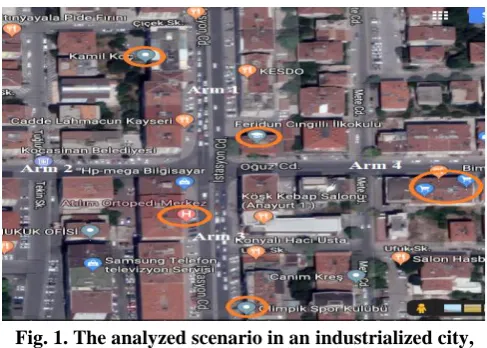
IV. THEANALYZEDTRAFFICSCENARIO Broadly speaking, intelligent traffic signal control is a two-phase methodology. In the first phase, sensing and data/image processing techniques are used to collect the input data, capture the images of vehicles/pedestrians, record the weather conditions at different times of the day, and then process these data to extract the required information in real time. In the second phase, based on the observations and measurements, a traffic signal management plan can be conducted. The focus of the current work is on the second phase: designing an FRBS-assisted dynamic traffic management and control plan based on the proposed traffic context principle. For different schemes for image capturing and processing, readers can refer to [9], [13]-[14]. Special sensors need to be installed to record the respective inputs. The proposed system is focused on the number of vehicles and pedestrians, along with the weather conditions, over the course of 24 hours at a busy intersection of an industrialized city: Kayseri, Turkey. The analyzed scenario is a four-arm intersection, as illustrated in Fig. 1. It is composed of the main road, namely Istasyon Road, with Arms 1 and 3, which are both two-way, two-lane roads. The other road, namely Oguz Road with Arms 2 and 4, is a two-way, one-lane road. The intersection is surrounded by several business activities, including Feridun Cingilli Primary School, the Olympic Sports Club, Kamil Koc Transportation Service, Atılım Ortopedi Hospital, offices, a supermarket, a hotel, and many restaurants. Therefore, this intersection shows extreme diversity and fluctuating behavior in terms of the number of vehicles and pedestrians crossing the intersection throughout the day.
The next important factor to consider for the proposed plan is the varying weather conditions. Kayseri experiences hot summers and cold, snowy winters. Furthermore, rainfall is observed throughout the year, especially during autumn, spring, and summer. In the context of public safety, the dynamic traffic signal plan should be adaptive to all of the above critical weather conditions.
The major flow is the traffic from Arms 1 and 3; thus, these arms require a longer duration for their green lights compared with Arms 2 and 4. Furthermore, because of the presence of businesses and recreation activities, weekends and weekdays have similar traffic patterns. The peak traffic period is mainly observed at the opening and closing times of the activities around office hours, hospital visiting hours , and the market’s busy hours.
Fig. 1. The analyzed scenario in an industrialized city, Kayseri, Turkey
Furthermore, real case studies have shown that around 10% of pedestrians do not wait for the red interval of traffic lights to cross the road, and here, females are usually observed to behave more aggressively than males [29]. To design an FRBS-assisted controller for optimizing traffic flow, the membership functions (MFs) for the “number of vehicles” and the “number of pedestrians” will be defined, as shown in the next section, based on this estimation.
The variation in the traffic flow behavior depicted in Fig. 2 for one complete day is associated with the nature of activities located around the road intersection. In peak hours, some flows can reach 1000 vehicles/hour and 300 pedestrians/hour, while at other times, these values fall to one-half or one-third of the maximum. Therefore, a dynamic traffic control infrastructure is required to optimize traffic flow management at different times of the day.
[image:4.595.334.518.68.129.2]Based on Fig. 2, Table I and Table II provide the data for the maximum number of vehicles (1000 vehicles/hour) and pedestrians (300 pedestrians/hour) distributed in both directions of each arm during peak hours. Each percentage is related to the maneuvers (crossing, diverging, and merging operation) occurring within the investigated intersection.
Fig. 2. Traffic trends of vehicles and pedestrians Table I Percentage of vehicles in different arms
Arm 1 Arm 2 Arm 3 Arm 4
Arm 1 0% 55% 35% 10%
Arm 2 30% 0% 50% 20%
Arm 3 60% 16% 0% 24%
Arm 4 47% 23% 30% 0%
Table II Percentage of pedestrians in different arms
Arm 1 Arm 2 Arm 3 Arm 4
Arm 1 0% 30% 50% 20%
Arm 2 40% 0% 35% 25%
Arm 3 60% 20% 0% 20%
Arm 4 50% 20% 30% 0%
V. FRBS-ASSISTEDPROPOSEDFRAMEWORK
Fig. 3 illustrates the block diagram of the proposed framework, showing the entire process. The proposed framework is divided into three layers: data collection, data processing, and actuators. Each layer depends on the others. The data collection layer contains the sensors that collect data from four inputs. The data processing layer consists of the fuzzy control system, which processes the data and makes decisions. The architecture of the fuzzy control system will be explained below with the help of Fig. 3. Actuators receive the decisions and route them to the target output interface, that is, the traffic signal.
In further detail, a clear understanding of the technical meaning of the term “traffic context” in smart cities can help system and software engineers achieve their goals of more efficient and safe streets. Our proposed approach distinguishes the system view from the user view. The traffic context is defined as a set of attributes that need to be intelligently handled for smooth and uninterrupted traffic flow. The primary attribute is the number of vehicles, that is, the driver. From the user’s perspective, the other traffic attributes are time (24-hour clock), weather (clement weather or foul (inclement) weather), and number of pedestrians at the junction waiting for a red light to cross the road. All four inputs are captured by Layer 1 devices and fed into Layer 2 for processing.
[image:4.595.64.266.515.663.2]As stated above, an FRBS is used to relate the above antecedents for controlling the duration of the traffic signals; it evaluates the combination of the inputs based on fuzzy rules and generates an output that is the duration of the green signal. FRBS-assisted optimization mainly involves four steps, which are explained below in Fig. 4 [30].
[image:4.595.310.541.523.827.2]International Journal of Innovative Technology and Exploring Engineering (IJITEE) ISSN: 2278-3075, Volume-9 Issue-1, November 2019
In Fig. 4, the fuzzifier defines the linguistic representation of the input variables. The rule base contains the rules to relate the input–output variables through the implication operator. It is critically important to define a rule for every possible input combination to satisfy the completeness of the rules. Rules in the rule base are described by a) universe or domain within which the values are defined, b) a qualitative representation, and c) MFs. Inference or the fuzzy inference engine (FIE) is the heart of a fuzzy control system, relating the input and output variables through if-then fuzzy rules. If conditions are formed by binding logic connectors and predicates, then the statements indicate the most appropriate MF for the output variable.
For a better understanding, suppose
X
andY
are the input variables,Z
is the output variable, and
X X
1,
2
,
Y Y
1,
2
and
Z Z
1,
2
are the MFs covering the whole range ofX
,Y
, andZ
, respectively. Then, our rule base will consist of2 2
4
rules of the following form:1 2 1
:
,
,
Rule if X is X
Y is Y Then Z is Z
Finally, the defuzzifier maps the fuzzified outputs from the FIE into actual crisp outputs of the system. The center of gravity (COG) method is used here for defuzzification, taking advantage of its computational simplicity. For the above rule, the process of the rule base and FIE pick the most appropriate MF
Z z
( )
for the output. The standard equation to generate a crisp output by the COG defuzzifier is given by the following: Z
Z
z z dz
z
z dz
1where,
Z
z dz
represents the area of the region bounded by the curveZ. After calculating the COG, we obtain the actions to be performed. The whole process of the FRBS-assisted optimization is summarized as follows: Identification of variables
[image:5.595.311.540.312.709.2] Defining MFs for the input variables Defining MFs for the output variables If-then fuzzy rules formulation Applying the rule base Generating crisp outputs
Fig. 4. Block diagram of the fuzzy plan system
VI. RESULTANDDISCUSSION
In this section, the proposed framework is analyzed in terms of the input–output relationship with the help of rule surfaces, which clearly demonstrate the response of the output based on the entire span of the input set. The Mamdani fuzzy engine is used to take advantage of its dynamics of rule generation because it allows programmers to describe the problem in a human-like manner [31-32].
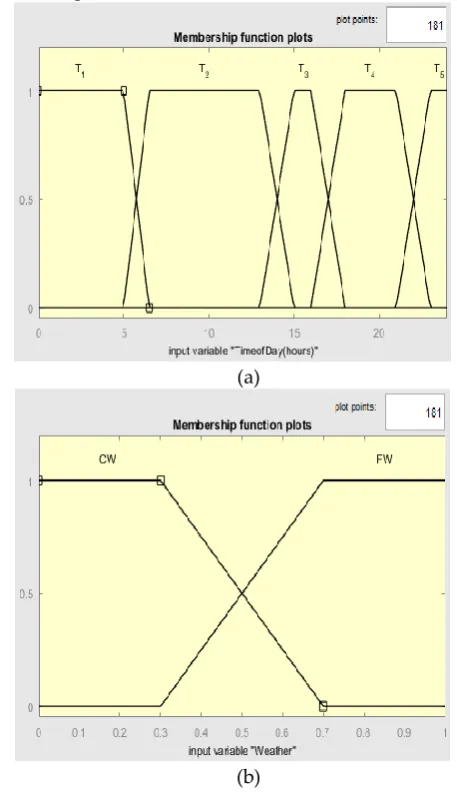
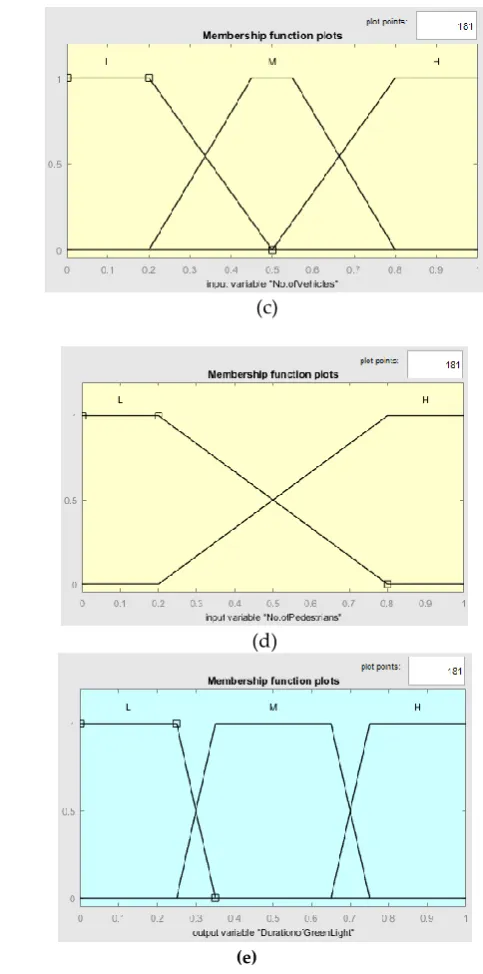
Fig. 5 (a-e) illustrates the fuzzified linguistic parameters for each input. The interval for weather condition, number of vehicles, number of pedestrians, and duration of green signal are each normalized to 1, whereas time of day is defined based on a 24-hour time interval to illustrate the traffic pattern over one complete day. For any fuzzy set
J
, MF in auniverse U is defined as:-
J:
U
0,1
. Trapezoidal MFs have been used to define the complete range of inputs and outputs. All the attributes presented in our work are based on the traffic context. To define a fuzzy rule, all the four traffic attributes are combined together, that is, weather, time, number of pedestrians, and number of vehicles.(a)
(c)
(d)
[image:6.595.45.287.47.535.2](e)
Fig. 5. Membership functions
The MFs of the traffic context are listed in Table III. Each traffic attribute and its corresponding MF are explained as follows:
Time of Day: Because the traffic pattern in Fig. 2 shows fluctuating behavior throughout the day, five trapezoidal MFs T1 to T5 of unequal widths have been defined for one complete day from 00:00 to 23:59, as shown in Fig. 5 (a). The unequal widths are because of variations in traffic patterns at different times of the day at the intersection under consideration, as given in Table IV below.
Weather:Two trapezoidal MFs, namely clement weather (CW) and foul (inclement) weather (FW), have been defined on a normalized scale between 0 and 1. FW refers to unfavorable and harsh weather conditions detected by the sensors. Partially cloudy or low rain conditions that do not significantly affect the visibility level will receive a degree of membership from CW, whereas fog, rainstorm,
or dust storm will receive degree of membership from FW because they highly effect the visibility level. The average monthly weather of Kayseri shows a static behavior; therefore, it reasonable to define two MFs in the proposed model, as given in Table V below.
Number of Vehicles:Based on the traffic pattern observed in Fig. 2, three trapezoidal MFs labeled L (Low), M (Medium), and H (High) are defined to represent the number of vehicles on a normalized scale between 0 and 1, per Table VI below.
The number of vehicles at the intersection includes the vehicles that are stopped when the signal turns red and the additional vehicles queued up with them until the signal turns green.
Number of Pedestrians: Fig. 2 shows that the average response of the number of pedestrians over one complete day is approximately 150; thus, we can safely consider it a threshold value to categorize the number of pedestrians as L (Low) or H (High). Therefore, two trapezoidal MFs for the number of pedestrians have been defined on a normalized scale between 0 and 1, per Table VII below.
Table III Traffic context features
Traffic Context
Attributes Value (Condition)
Time of Day (hours) T1 to T5
Weather Clement Weather (CW), Foul (Inclement) Weather (FW)
Number of vehicles Low (L), Medium (M), High (H)
Number of Pedestrians Low (L), High (H)
Duration of Green
Light Low (L), Medium (M), High (H)
Table IV Traffic pattern at different times of the day
MFs for Time of Day MFs for no.
of Vehicles
MFs for no. of
Pedestrians
T1: 00:00 – 6:00 L L
T2: 6:00 – 14:00 H H
T3: 14:00 – 17:00 M L
T4: 17:00 – 22:30 H H
T5: 22:30 – 23:59 M L
Table V Membership functions for weather conditions
Membership Function Weather
CW Clement weather
FW Foul weather
International Journal of Innovative Technology and Exploring Engineering (IJITEE) ISSN: 2278-3075, Volume-9 Issue-1, November 2019
Based on the output of an FRBS-assisted controller, the duration of a red light for each road will be determined from the following equation:
One cycle = Duration of Green Light + Duration of Red Light
2In Eq. (2), the duration of the red light is inclusive of the duration of the yellow light because the yellow light usually has a fixed duration of 3 seconds, independent of the traffic pattern. Furthermore, for any other location, the total duration of one cycle of traffic signals will change with the traffic pattern. Table VIII illustrates the crisp output in seconds corresponding to each MF of the output.
The above table defines three sets of traffic light cycles, that is, 84 sec, 100 sec, and 120 sec. For instance, considering the 120 sec cycle, Arm 1 will have 40 sec for green and 80 sec for red + yellow, Arm 2 will have 20 sec for green and 100 sec for red + yellow and so on. The same mechanism applies to the MF of L and M. The overall increase in the duration of green light time from L to H is approximately 43%.
Table VI Membership functions for the vehicles
Membership Function Number of Vehicles
L ≤ 329
M 330-659
H ≥660
Table VII Membership functions for the pedestrians
Membership
Function Number of Pedestrians
L < 150
H ≥150
As stated above, the weather does not show sudden changes at the location under consideration and affects traffic crossing the intersection in the same manner. Thus, for a particular weather condition, the duration of the green light for each road is set based on its number of vehicles and pedestrians because the roads meeting the intersection have different capacities, as explained in the traffic scenario in Section 4. To verify the completeness of the set of rules specified, the number of MFs covering the whole range of inputs in Fig. 5 illustrates that we have
5 3 2 2
60
rules in the rule base, with each th
j
rule of the form asfollows:
1
:
,
, .
, .
,
jR If Time of Day is T Weatheris CW No of Vehicles is L No of Pedestrians is L
Then Duration of Green Light is L
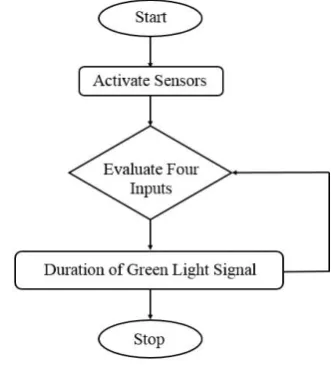
[image:7.595.340.506.53.236.2]The above rule states that because the number of vehicles is very low at the intersection during the late night or early morning hours and almost no pedestrians are present, if the weather is clear, there is no need to keep the vehicles waiting long for a green signal. A flow chart of the steps involved in the dynamic control of traffic lights is illustrated in Fig. 6.
Fig. 6. Flow chart of proposed algorithm
Fig. 7 illustrates the rule surface for the proposed system. Fig. 7(a) shows the relationship between the number of vehicles at the intersection and the time of day. The variation in the number of vehicles at different times of a day is obvious, revealing the importance of dividing the time into five MFs for smoother traffic flow. It can also observed from the figure that if the number of vehicles is low at any particular time, there is no reason to unnecessarily stop the vehicles on any road. As the number of vehicles increases, the duration of the green light is increased accordingly between the two extreme durations, per Table VIII. Table IX provides sample rules of the proposed plan for clarity of the concept and better understanding.
[image:7.595.61.278.306.401.2]Fig. 7 (b) shows a constant increase in the green interval as the number of pedestrians increases at different times. However, concerning the number of pedestrians, the duration of the green light is set to either “low” or “medium” because it is also linked with the number of vehicles at the same time. For instance, if the number of vehicles is high and the number of pedestrians is low, the time for a green light will be set to H. In contrast, for a higher number of pedestrians and lower number of vehicles, the time for a green light will be set to either low or medium, keeping in mind the weather condition. Fig. 7 (c) and (d) illustrate the relationship of weather with vehicles and pedestrians, respectively. For both cases, the duration of the green signal is increased for unfavorable weather conditions to ensure public safety.
Table VIII Variation of traffic lights Membership
Function
One Cycle (sec)
Duration of Green Light (sec)
Arm 1 Arm 2 Arm 3 Arm 4
L 84 sec. 28 14 28 14
M 100 sec. 33 17 33 17
H 120 sec. 40 20 40 20
Table IX. Sample Rules of the Proposed Plan
Inputs Output Time
of Day
Weather No. of Vehicles
No. of Pedestrians
Duration of Green Light
T1 CW L L L
T2 CW M L L
T3 FW H L H
T4 CW H H H
T5 FW L H M
[image:7.595.314.547.581.833.2](a)
(b)
(c)
[image:8.595.64.273.46.783.2](d)
Fig. 7. Rule surface
Comparing Fig. 7(b) and (d), the input combination of weather and pedestrians needs more sophisticated handling compared with the combination of pedestrian number and time of day. The fuzzy control system provides the benefits of adaptability and flexibility to cater to changing weather conditions. For any change detected in the inputs by the respective sensors, the FRBS-assisted plan can automatically adapt to the change and adjust the duration of the green signal accordingly.
VII. CONCLUSIONANDFUTUREWORK
Modern traffic management and control systems are critically important in densely populated cities. The current work proposed a fuzzy rule-based system that can assist with the dynamic control of the duration of the green light of traffic signals at the road intersection. The proposed model is based on the traffic context, including the number of vehicles, number of pedestrians, time of day, and weather conditions. These four attributes have never been considered simultaneously for traffic management and public safety. The current research focused on the first step, that is, integrating four diverse traffic attributes using fuzzy logic for enhanced public safety and a smooth traffic flow.
It is obvious that a FRBS-assisted dynamic traffic signal plan intelligently handles the complexities involved in relating four diverse inputs that were not possible to relate to through mathematical expressions alone.
In future work, to evaluate the performance of the proposed framework for public safety, extensive simulative assessments will be provided to validate the response of the queues of vehicles and pedestrians on all sides of the intersection at different times of the day under different weather conditions. Furthermore, we aim to prioritize the vehicles. For instance, ambulances, fire brigade, and police cars are high-priority vehicles, hence ensuring their timely arrival. Furthermore, because this work is IoT-based, publishing the valued data to the IoT platforms could result in enhancing this model.
REFERENCES
1. Fend, S.; Setoodeh, P.; Haykin, S. Smart Home: Cognitive Interactive People-Centric Internet-of-Things. IEEE Communications Magazine, 2017, 55, 34-39.
2. Weng. T.; Agarwal, Y. From Buildings to Smart Buildings-Sensing and Actuation to Improve Energy Efficiency. IEEE Design and Test of Computers, 2012, 29, 36-44.
3. Chiwewe, T.M.; Mbuya, C.F.; Hancke, G.P. Using Cognitive Radio for Interference-Resistant Industrial Wireless Sensor Networks: An Overview. IEEE Transactions on Industrial Informatics, 2015, 11, 1466-1481.
4. Vlacheas, P.; Glaffreda, R.; Stavroulakl, V.; Kelaidonis, D.; Foteinos, V.; Poulios, G.; Demestichas, P. Enabling Smart Cities through a Cognitive Management Framework for the Internet of Things. IEEE Communication Magazine, 2013, 51, 102-111.
5. Foschini, L.; Taleb, T.; Corradi, A.; Bottazzi, D. M2M based Metropolitan Platform for IMS-enabled Road Traffic Management in IoT. IEEE Communications Magazine, 2011, 49, 50-57.
6. Amendola, S.; Lodato, R.; Manzari, S.; Occhiuzzi, C.; Marrocco, G. RFID technology for IoT-based Personal Healthcare in Smart spaces. IEEE Internet of Things Journal, 2014, 1, 144-152.
International Journal of Innovative Technology and Exploring Engineering (IJITEE) ISSN: 2278-3075, Volume-9 Issue-1, November 2019
8. Sultan, K. Fuzzy Rule Based System (FRBS) assisted Energy Efficient Controller for Smart Streetlights: An Approach Towards Internet-of-Things (IoT). Journal of Communications, 2018, 13, 518-523.
9. Patil, R.; Srinivasaraghavan, A. Smart Traffic Controller Using Fuzzy Inference System (STCFIS), in Proceedings of the 2nd International Conference on Next Generation Computing Technologies, Dehradun, India, Oct. 14-16, 2016.
10. ISO. Road Vehicles – Transportation information and control system – Detection Response Task (DRT) for assessing attentional effects of cognitive load in driving. International Standard, ISO 17488, 2016. 11. Perrin, J.; Martin, P; Hansen, B. Modifying Signal Timing during
Inclement Weather, in Proceedings of the ITE Annual Meeting and Exhibit, Philadelphia, PA, USA, 2002.
12. Pisano, P.; Goodwin, L. Surface Transportation Weather Applications, in Proceedings of the ITE Annual Meeting and Exhibit, Philadelphia, PA, USA, 2002.
13. Bhanja, U.; Kumar, R.; Routroy, A.; Behura, S.; Mahapatra, S. Dynamic Traffic Congestion Detection in VANETS using a Fuzzy Rule-Based System and K-means Clustering, in Proceedings of the IEEE International Conference on Advanced Networks and Telecommunications Systems (ANTS), Bhubaneswar, India, Dec. 17-20, 2017, 1-6.
14. Zaid, A.; Suhweil, Y.; Yaman, M. Smart Controlling for Traffic Light Time, in Proceedings of the IEEE Jordan Conference on Applied Electrical Engineering and Computing Technologies (AEECT), Aqaba, Jordan, Oct. 11-13, 2017, 1-5.
15. Cueva-Fernandez, G.; Pascual Espada, J.; García-Díaz, V.; Gonzalez-Crespo, R. Fuzzy Decision Method to Improve the Information Exchange in a Vehicle Sensor Tracking System. Appl. Soft Comput. 2015, 35, 708-716.
16. Blond, S.L.; Aggarwal, R. A Review of Artificial Intelligence Techniques as Applied to Adaptive Autoreclosure, with Particular Reference to Deployment with Wind Generation, in Proceedings of the Universities Power Engg. Conference, 2009.
17. Jiang, J.; Syue, C.; Wang, C.; Wang, J.; Shieh, J. An Interval Type-2 Fuzzy Control System for Stock Index Forecasting based on Fuzzy Time Series and A Fuzzy Logical Relationship Map. IEEE Access, 2018, 6, 69107-69119.
18. Yang, C.; Jiang, Y.; Na, J.; Li, Z.; Cheng, L.; Su, C. Finite-time Convergence Adaptive Fuzzy Control for Dual-Arm Robot with Unknown Kinematics and Dynamics. IEEE Trans. Fuzzy Systems, 2019, 27, 574-588.
19. Qinghua, H.; Minghai, P.; Wucai, Z.; Zhiheng, L. Time Resource Management of OAR Based on Fuzzy Logic Priority for Multiple Target Tracking. J. Systems Engineering and Electronics, 2018, 29 (4), 742-755.
20. Sultan, K.; Qureshi, I.M.; Atta-ur-Rahman, Zafar, B.A.; Zaheer, M. CSI Based Multiple Relay Selection and Transmit Power Saving Scheme for Underlay CRNs Using FRBS and Swarm Intelligence. Int. J. Applied Metaheuristic Computing, 2019, 10, 2.
21. Soleymani, S.A.; Abdhullah, A.H.; Zareeri, M.; Anisi, M.H.; Rosales, C.V.; Khan, M.K.; Goudarzi, S.A. Secure Trust Model based on Fuzzy Logic in Vehicular Ad Hoc Networks with Fog Computing. IEEE Access, 2017, 5, 15619-15629.
22. Horng, G.J.; Li, J.P.; Cheng, S.T. Traffic Congestion Reduce Mechanism by Adaptive Road Routing Recommendation in Smart City, in Proceedings of the 3rd Int. Conf. on Consumer Electronics, Communications and Networks, Xianning, China, Nov. 20-22, 2013. 23. Dhajel, S.; Smith, N.; Wang, S.; Murphy, J. Reducing Emergency
Services Response Time in Smart Cities: An Advanced Adaptive and Fuzzy Approach, in Proceedings of the IEEE 1st Int. Smart Cities Conference, Guadalajara, Mexico, Oct. 25-28, 2015.
24. Pau, G.; Campisi, T.; Canale, A.; Severino, A.; Collotta, M.; Tesoriere, G. Smart Pedestrian Crossing Management at Traffic Light Junctions through a Fuzzy-Based Approach. Future Internet, 2018, 10, 1-19. 25. Alkestrup, R. Smart City Traffic Management. Department of Applied
Mathematics and Computer Science, 2017.
26. Kumar, T.; Gupta, S.; Kushwaha, D.S. An Efficient Approach for Automatic Number Plate Recognition for Low Resolution Images, in Proceedings of the 5th Int. Conference on Network, Communication and Computing, Kyoto, Japan, Dec. 17-21, 2016.
27. Muralidharan, A.; Coogan, S.; Flores, C.; Varaiya, P. Management of Intersections with Multi-modal High-Resolution Data. Transp. Res. Part C Emerg. Technol., 2016, 68, 101-112.
28. Wadi, M.; Shobole, A.; Tur, M.; Baysal, M. Smart Hybrid Wind-Solar Street Lighting System Fuzzy Based Approach: Case Study Istanbul-Turkey, in Proceedings of the 6th International Istanbul Smart Grids and Cities Congress and Fair (ICSG), Istanbul, Turkey, April 25-26, 2018.
29. Giuffre, T.; Campisi, T.; Tesoriere, G. Implications of Adaptive Traffic Light Operations on Pedestrian Safety. IOSR J. Mech. Civ. Eng., 2017, 13, 58-63.
30. Fang, G. A Survey on Analysis and Design of Model-based Fuzzy Control Systems. IEEE Trans. Fuzzy Systems, 2006, 14, 676-697. 31. Mamdani, E.H. Application of Fuzzy Logic to Approximate Reasoning
using Linguistic Synthesis. IEEE Transactions on Computers, C-26, 1977, 1182-1191.
32. Keneni, B.M.; Kaur, D.; Bataineh, A.; Devabhaktuni, V.K.; Javaid, A.Y.; Zaientz, J.D.; Marinier, R.P. Evolving Rule-Based Explainable Artificial Intelligence for Unmanned Aerial Vehicles. IEEE Access, 2019, 7, 17001-17016.
AUTHOR