International Journal of Innovative Technology and Exploring Engineering (IJITEE) ISSN: 2278-3075, Volume-8 Issue-12, October 2019
Lightweight Security Algorithm on PMIPV6
Protocol for IOT Based Wireless Sensor Networks
A. Anandhavalli, A. Bhuvaneswari
Abstract: Nowadays Wireless Sensor Networks are using Internet-of-Thing (IoT) technology-based nodes because of the wide usance and cost effectiveness. Many of the Wireless sensor nodes are battery powered devices with limited computational and communication resources. The algorithm of the conventional wireless sensor networks are designed for small closed group network communications with better power management and reasonable security strategies. When using IoT based Wireless sensor networks, the nodes are used to communicate with the internet, where there is a need for more secured algorithm. The internet protocols are having powerful security authentication systems those require more computational resources, thus they can drain a battery operated little wireless sensor node. This work is indented to introduce a legacy power-security balanced algorithm to use in the IoT based Wireless Sensor Network environments. Proxy Mobile Internet Protocol version 6 (PMIPv6) is selected as the base protocol in which the proposed security authentication mechanism is used instead of inbuilt Diffie-Hellman authentication scheme. A customized Media Access Control (MAC) address-based session key initialization procedure along with seed based random number session key update mechanism is proposed and verified in this work.
Keywords: Internet-of-Things (IoT), Wireless Sensor Networks (WSN), Communication Protocols, PMIPv6, Security schemes, Authentication mechanisms
I. INTRODUCTION
Wireless sensor networks are used to collect and monitor environmental data which is mandatory for several applications such as healthcare, natural resource management, industrial monitoring and natural calamity detections / predictions. Recent advancements in communication science introduced Internet-of-Things (IoT) makes it possible to connect merely all electronic devices with the internet. Present Wireless sensor networks are using IoT to communicate between the nodes and with the internet. Since internet is public and highly vulnerable to intruder attacks, the standard internet communication protocols follow a strong resource consuming high security authentication schemes to initialize, clustering and the routing processes[1][2].
Revised Manuscript Received on October 05, 2019.
Ms.A.Anandhavalli , Assistant Professor in department of Computer Science, Cauverycollege for Women, Trichy,Tamilnadu
Dr A. Bhuvaneswari, Cauvery College for Women (under the affiliation of Bharathidasan University), Trichy, Tamil Nadu, India.
Security protocols developed for conventional wireless sensor networks are targeted in power management rather than security because of the closed nature of the network. The energy efficiency of these protocols is used to extend the battery dependent nodes life and so as the network. Security is compromised here to provide better power management [3].
The challenging part of the protocol design for IoT based wireless sensor network is to assert a balance between Power consumption and Security. The complexity is significantly increased while there are different types of nodes involved in the heterogeneous network environments [4][5].The prominent part of designing a Power-Security balanced algorithm for heterogeneous wireless sensor network relies on its security authentication system. The key generation and session key update process is vital for the authentication procedure.
There are several keys involved such as private signature key, Public signature verification key, Symmetric Authentication Key, Private Authentication Key, Public Authentication Key, Symmetric Data Encryption Key, Symmetric Key Wrapping Key, Symmetric and Asymmetric Random Number Generation Keys, Symmetric Master Key, Private Key Transport Key, Public Key Transport Key, Symmetric Key Agreement Key, Private Static Key Agreement Key, Private Ephemeral Key Agreement Key, Public Ephemeral Key Agreement Key and Symmetric Authorization Key are used in existing Wireless authentication schemes such as Wired Equivalent Privacy (WEP), Wi-Fi Protected Access (WPA) and Wi-Fi Protected Access version 2 (WPA2). These authentication keys are used widely in IEEE 801.xx standards. Since the IoT technology is relatively new, the developers are drafting new standards labeled as IEEE P2413, IEEE 804.15.4 and IEEE 1451-99 [6].
II. EXISTING METHODS
There are many developments in-progress in the IoT field. Several attempts are performed by the researchers to ameliorate in IoT based wireless sensor network experiences. Many of them are commercial success and already used widely in resource monitoring and management. A crisp analysis of some of the renowned methods are analyzed here to compare the performance with the proposed method. The existing methods taken for analysis are Aggregated-Proof based Hierarchical Authentication Scheme for the Internet-of-Things (APHA) [8], Edge Mesh: A New Paradigm to Enable Distributed Intelligence in Internet of Thing (DIIOT) [9], Graph Theory Applications in Network Security (GTANS) [10], Secure and Efficient Protocol for Route Optimization in PMIPv6-based Smart Home IoT Network (SEPRP-SHIOT) [11], An Ultra-lightweight Authentication Scheme for Heterogeneous Wireless Sensor Networks in the Context of
Internet-of-Things (ULASHWSN) [12] and A New Security
Authentication Method in the Internet of Things based on PID and Design Impedance Mismatch Physical Unclonable Functions for IoT security (SAMPID) [13].
A. Aggregated-proof based Hierarchical Authentication Scheme for the Internet-of-Things (APHA)
This work defines two new protocols to cover Homomorphism function-based System Initialization, Authentication protocol in Unit IoT, Backward aggregated proof challenge, Forward aggregated proof response, The authentication protocol in Ubiquitous IoT, Data confidentiality, Data integrity, Hierarchical access control, Mutual Authentication, Privacy Preservation. The APHA procedure is analyzed by the Burrows-Abadi-Needham (BAN) logic. The work concentrates only on security and other important network quality assessment metrics such as Throughput, Communication delays, Packet Delivery Ratio and Power consumption are not included in the study. The proposed method is not tested with any Network Simulator or with Protocol Definition Language (PDL).
B. Edge Mesh: A New Paradigm to Enable Distributed Intelligence in Internet of Things (DIIOT)
Edge devices are capable of processing the data which pass through it. The distribution nature of Edge technology shares the computational load among the devices. The process distribution sagely avoids overloading of specific nodes in the network. DIIOT work is referred here due to this load distribution nature which prevents power supply drains in specific nodes. Energy saving is the only motive of the work DIIOT and other essential network metrics are not discussed in this work. The challenges of applying DIIOT in IoT real-time environments are heterogeneous node connectivity, frequent packet loss, communication stability in low data rates and random channel variations[14].
C. Graph Theory Application in Network Security (GTANS) Four Color Graph Theorem is used as the base of this GTANS work. GTANS is created to create the least possible communication traffic and high-speed execution. The
challenges in Four color graph theorem such as Elimination of no-coverage spots and Allocation of different channel in overlapping spots are well handled in GTANSusing a node coloring algorithm. GTANS is a coarse procedure that is applicable for Cellular Relay Networks, Mobile ad-hoc Networks, Wireless Mesh Networks wireless sensor networks. GTANS is added here due to its less traffic operation in wireless sensor network environments. The traffic reduction mechanism is used to improve the throughput and packet delivery ratio by reducing the data congestion and packet loss. Energy, Time and Resource optimizations are achieved by GTANS but security is not discussed. A proof-of-concept by simulation or implementation results are not carried out in this work. D. Secure and Efficient Protocol for Route Optimization in PMIPv6-based Smart Home IoT Network (SEPRP-SHIOT)
SEPRP-SHIOT is developed to provide security and performance enhancements for Smart Home Internet of Things (SH-IoT). SEPRP-SHIOT has the ability to handle heterogeneous nodes in a Smart Home Network Environment. PMIPv6 is selected as the base protocol in SEPRP-SHIOT. The security of SEPRP-SHIOT is proved by using BAN Logic. Standard performance metrics such as Throughput, End-to-End Delay, Transmission Rate and Packet loss are analyzed in this work using Network Simulator-2 and AVISPA – an automated tool which can analyze a communication protocol defined in High-Level Protocol Specification Language (HLPSL). SEPRP-SHIOT achieved better results in terms of stand metrics. The power consumptions of nodes in different network conditions are not covered in SEPRP-SHIOT.
E. An Ultra-lightweight Authentication Scheme for Heterogeneous Wireless Sensor Networks in the Context of Internet-of-Things (ULASHWSN)
ULASHWSN work is about to achieve secured
International Journal of Innovative Technology and Exploring Engineering (IJITEE) ISSN: 2278-3075, Volume-8 Issue-12, October 2019
F. A New Security Authentication Method in the Internet of Things based on PID and Design Impedance Mismatch Physical Unclonable Functions for IoT security (SAMPID)
SAMPID introduced a new Pseudo Identifier to annihilate security problem during data transfer between tags and servers in IoT environment. The legal ID of tag is saved in the protocol to provide authentication between database server and IoT tag. Anonymity of the Tags, Position trailing attacks, Forward security, Mutual authentication, Relay attack, DoS and Synchronization
problems are analyzed in this work. SAMPID is tested in the RFID tag authentication where the throughput and
communication delays are bearable to certain amount. The security is analyzed with the BAN logic and there is no simulation or implementation results provided in the work. SAMPID is brought here for comparison due to its simple authentication scheme, faster performance than hash-based protocolsand the Pseudo ID requires lesser storage space in IoT environment.
[image:3.595.45.550.232.519.2]The advantages and limitations of the existing methods are given below in Table 1.
Table 1: Advantages and Limitations of Existing Methods
II.RELATED WORKS
Understanding Key exchange procedures and Random Number Generation are cardinal for proposed Lightweight PMIPv6 based Security Algorithm for IoT Wireless Sensor Networks (LPSAIW). Diffie-Hellman Key Exchange procedure is used the standard PMIPv6 protocol. Random number generation is widely used in many key exchange methods to select the initial keys or prime numbers.
A. Diffie-Hellman Key Exchange (DHKE)
Diffie-Hellman Key exchange procedure is one of the quondam procedures used to establish a shared secret key secured communication in the public communication channels. The steps involved in exchanging keys in DHKE are given below
Step 1. Both Sender and Receiver are agreed to use a finite cyclic group 𝐺 with the generating element 𝑔 in Order 𝑛
Step 2. Sender selects a random number 𝑎 which satisfies the condition 1 ≤ 𝑎 < 𝑛 and sends 𝑔𝑎 to Receiver
Step 3. Similarly, Receiver selects a random number 𝑏 and sends 𝑔𝑏 to the Sender
Step 4. Sender computes the shared secret key 𝑔𝑎𝑏 as 𝑔𝑏 𝑎
Step 5. Receiver computes the shared secret key 𝑔𝑎𝑏 as 𝑔𝑎 𝑏
This five-step simple and straight-forward method is famed in the shared secret key based public channel communications. A simple pictorial representation DHKE is given below as Figure 1 for the betterment of understanding.
Author Work Method Advantages Limitations
Huansheng Ning et.al.
Aggregated-proof based Hierarchical Authentication Scheme for the Internet-of-Things
U2IoT Authentication
High Security
Moderate Performance and High energy consumption
Yuvraj Sahni et.al.
Edge Mesh: A New Paradigm to Enable Distributed Intelligence in Internet of Things
EDGE Distribution
Load Balance and Energy efficient
Lagging heterogeneous node
connectivity Jonathan
Webb
et.al. Graph Theory Application in Network Security
Four Color Theorem
High
Performance Low Security
Daemin Shin et.al.
Secure and Efficient Protocol for Route Optimization in PMIPv6-based Smart Home IoT Network
PMIPv6 Authentication
High performance with high security
High Power and resource demand
Hamza Khemissa et.al.
An Ultra-lightweight Authentication Scheme for Heterogeneous Wireless Sensor Networks in the Context of Internet-of-Things
User to sensor node
Authentication High Security with Low Power Consumption
Low Performance
Jinsha Yuan et.al.
A New Security Authentication Method in the Internet of Things based on PID and Design Impedance Mismatch Physical Unclonable Functions for IoT security
Pseudo Identifier based
Authentication
Moderate Security with High performance
Figure 1: Pictorial Representation of DHKE Though the DHKE procedure seems simple, calculating prime numbers and exponential values are complicated for the limited computational resource devices such as wireless sensor network. Therefore, selecting a low-computational complexity key exchange procedure is required in the IoT based Wireless sensor networks Nodes.
B. Random Number Generation
Random Number Generation is an important process in cryptography and security key generation. There are many random number generation procedures are used currently in security key management process. Some procedures require a prime random number whereas other methods are just fine with any random integer. Repeatability and randomness are required as the vital characteristics of a random number generation procedure un security schemes. Repeatability refers the ability of generating same sequence for same initial seeds. This property is used for debugging and in mutual key authentication systems. Randomness refers that the generated random numbers should be uniformly distributed independent numbers which can pass randomness statistical tests.
Linear Congruential Method is widely used to generate random numbers for many applications. It produces a sequence of random numbers between 0 and 𝑚𝑎𝑥 − 1 such as𝛾1, 𝛾2, … 𝑚𝑎𝑥 − 1 based on the equation 𝛾𝑖+1 = 𝑎𝛾𝑖+ 𝑐 𝑚𝑜𝑑 𝑚𝑎𝑥 , 𝑖 = 1,2 …. Here the initial value 𝛾0 is
the seed of the sequence, 𝑎 is a constant multiplier, 𝑐 is the increment and 𝑚𝑎𝑥 is the modulus. If 𝑐 ≠ 0 then the method is called mixed congruential method. Otherwise it is called as Multiplicative congruential method. Combined Linear Congruential Method is introduced to extend the cyclic length of the random number repetitive sequences. It also increases the prediction complexity which is achieved by combining more than one multiplicative congruential generator. The Equation for Combined Linear Congruential Method is 𝛾𝑖+1,𝑗 = 𝑎𝑗𝛾𝑖+ 𝑐𝑗 𝑚𝑜𝑑 𝑚𝑎𝑥𝑗.
Hardware random number generators are more powerful and can make complex random number sequences than the arithmetic algorithm based random number generators. Hardware random number generators use
Real-Time-Clock (RTC), Environmental Temperature,
[image:4.595.329.523.198.342.2]Environmental Noise or accumulated values from random scratchpad memory as their seeds which provides complete unpredictable randomness. Some Hardware random number generators are using light intensity as the source of seeds [15]. The operating model of hardware random number generator is explained in Figure 2.
Figure 2: Hardware Random Number Generator
III.PROJECTED WORK
A. Lightweight Security Algorithm on PMIPv6 protocol for IoT based Wireless Sensor Networks (LSA)
LSA consists of two primary functional modules. The first module MAC Address XOR key exchange authentication (MAXOR) is used to initialize the communication session between the nodes. The second module Legacy Random number Generator (LRG) is used for key annihilation of session keys and key updates. These two modules combined together to form the LSA for IoT based Wireless sensor networks.
a. MAC Address XOR Key exchange authentication (MAXOR)
MAC address is an unique identifier for the communication devices. MAC-48 is the latest addressing scheme which can point 281474976710656 different devices. IPv6 protocol treats MAC-48 as EUI-48 (Extended Unique Identifier) which is represented in six 2-digit hexadecimal numbers noted as 00:00:00:00:00:00. Since these addresses are unique for all communication devices, MAXOR uses it as the base in initial authentications.
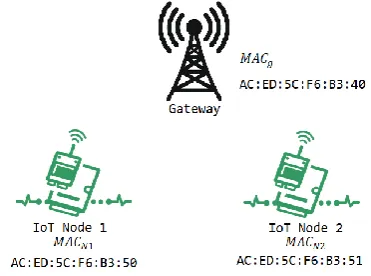
Let 𝑀𝐴𝐶𝑔 is the MAC address of the gateway, 𝑀𝐴𝐶𝑁1is
the MAC address of IoT Node 1 and 𝑀𝐴𝐶𝑁2 is the MAC
International Journal of Innovative Technology and Exploring Engineering (IJITEE) ISSN: 2278-3075, Volume-8 Issue-12, October 2019
Gateway recognize the Node 1 since its MAC address is already registered and calculates the value of 𝛾𝑁1 using the
following equation.
𝛾𝑁1= 𝑀𝐴𝐶𝑁1′ ⊕ 𝑀𝐴𝐶𝑁1 Equation(1)
Similarly, the random number 𝛾𝑁2 which is selected by
Node 2 can be calculated using the following Equation 𝛾𝑁2= 𝑀𝐴𝐶𝑁2′ ⊕ 𝑀𝐴𝐶𝑁2 Equation(2)
Here 𝑀𝐴𝐶𝑁2′ is received by a ping request sent by
gateway to Node 2 and 𝑀𝐴𝐶𝑁2 is already available to
gateway since Node 2 is also registered in the same network. Then the gateway calculates 𝐾𝑁1 as 𝛾𝑁2⊕ 𝑀𝐴𝐶𝑁1 and 𝐾𝑁2 as 𝛾𝑁1⊕ 𝑀𝐴𝐶𝑁2. Then 𝐾𝑁1 is sent to Node 1 and 𝐾𝑁2
is sent to Node 2 by the gateway.
Now it is possible to know the secret key of Node 2 to Node 1 using Equation 3 given below
𝛾𝑁2= 𝐾𝑁1⊕ 𝑀𝐴𝐶𝑁1 Equation(3)
Similarly, Node 2 can calculate the secret key of Node 1 using the following Equation
𝛾𝑁1= 𝐾𝑁2⊕ 𝑀𝐴𝐶𝑁2 Equation (4)
Now Node 1 and Node 2 can calculate the shared secret key 𝛿𝑁1𝑁2 by
using following equation
𝛿𝑁1𝑁2= 𝛾𝑁1⊕ 𝛾𝑁2 Equation(5)
[image:5.595.68.254.428.566.2]The justness of the above equations is explained using the following illustration
Figure 3: MAXOR – Gateway and Nodes information
Let 𝑀𝐴𝐶 𝑔 = AC:ED:5C:F6:B3:40 =
[10101100:11101101:1011100:11110110:10110011:100000 0]b
Let 𝑀𝐴𝐶𝑁1 = AC:ED:5C:F6:B3:50 =
[10101100:11101101:1011100:11110110:10110011:101000 0]b
Let 𝑀𝐴𝐶𝑁2 = AC:ED:5C:F6:B3:51 =
[10101100:11101101:1011100:11110110:10110011:101000 1]b
The Secret Key of Node 1 𝛾𝑁1= 0x45 = 1000101 b 𝑀𝐴𝐶𝑁1′ = E9:A8:19:B3:F6:15
Gateway receives 𝑀𝐴𝐶𝑁1′ from Node 1 and calculates 𝛾𝑁1
by Equation 1
𝛾𝑁1= [E9:A8:19:B3:F6:15] ⊕ [AC:ED:5C:F6:B3:50] =
[45:45:45:45:45:45] := 0x45
Node 2 selects its secret key 𝛾𝑁2 = 0x34 = 110100 b
Node 2 Calculates 𝑀𝐴𝐶𝑁2′ = 98:D9:68:C2:87:65 after
getting the ping request from gateway
Gateway receives 𝑀𝐴𝐶𝑁2′ from Node 2 and calculates 𝛾𝑁2
by Equation 2
𝛾𝑁2 = [98:D9:68:C2:87:65] ⊕ AC:ED:5C:F6:B3:51 =
[34:34:34:34:34:34] := 0x34
Now gateway can calculate 𝐾𝑁1 =
[98:D9:68:C2:87:64],𝐾𝑁2= [E9:A8:19:B3:F6:14] and sends
them to Node 1 & 2 respectively.
Node 1 calculates 𝛾𝑁2 as follows by Equation 3
𝛾𝑁2 = [98:D9:68:C2:87:64] ⊕ [AC:ED:5C:F6:B3:50] =
[34:34:34:34:34:34] := 0x34
Similarly, Node 2 can calculate the secret key 𝛾𝑁1 of Node 1
using Equation 4
𝛾𝑁2= [E9:A8:19:B3:F6:15] ⊕ [AC:ED:5C:F6:B3:50] =
[45:45:45:45:45:45] := 0x45
Now Node 1 and Node 2 calculates the shared secret key as follows by Equation 5
𝛿0𝑁1𝑁2= 45: 45: 45: 45: 45: 45
⊕ 34: 34: 34: 34: 34: 34 = [71: 71: 71: 71: 71: 71]
By this way the Session key initialization process is performed in proposed LSA without power starving exponential operation and complicated calculations. Since the logical XOR operation is inbuilt in the processors architecture itself, the session initializations start seamlessly.
B. Legacy Random number Generator (LRG)
Generating random numbers with complete randomness is an important task in security procedures. Generating same random number in different devices is also a crucial task in a network environment. When two nodes are communicating each other, they have to generate random numbers in same order to maintain the harmony in session key updates. Session key update is required in situations such as end of session timing, long jitter or latency, too much of packet drops and during intruder attacks. Session key update during the intruder attacks ensure the security of the network. LRG uses Combined Linear Congruential Method with legacy seeds. When two nodes - Node 1 and Node 2 are in the communication with the shared secret key δ0N1N2 with
the value [71:71:71:71:71:71] the next secret key δ1N1N2
Let the synchronized network session time is 𝑡ℎ: 𝑡𝑚: 𝑡𝑠: 𝑡𝑖 in Hour : Minute : Second : Millisecond
sequence
The seed 𝜉 for random number generation is calculated as 𝜉 = 𝑡𝑛+ 𝑡𝑚+ 𝑡𝑠 × 𝑡𝑖
Then a set of 6 random numbers
𝛤 = 𝛤0, 𝛤1, 𝛤2, 𝛤3, 𝛤4, 𝛤5 is generated using the
Combined Linear Congruential Method
The for any new session 𝑛 + 1, the session key will be calculated as follows
𝛿1𝑁1𝑁2= 𝛿0𝑁1𝑁2⊕ 𝛤 Equation (6)
For the existing key 𝛿0𝑁1𝑁2= [71: 71: 71: 71: 71: 71], new session key 𝛿1𝑁1𝑁2 is calculated as
[71 ⊕ 𝛤0: 71 ⊕ 𝛤1: 71 ⊕ 𝛤2: 71 ⊕ 𝛤3: 71 ⊕ 𝛤4: 71 ⊕ 𝛤5]
The main purpose of introducing LRG is to obscure the random number seed generation process from the intruders to ensure security.
IV.EXPERIMENTAL SETUP
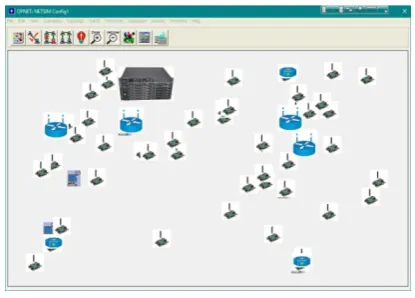
[image:6.595.320.534.100.269.2]OPNET – one of the best network simulation and evaluation tools of the decade which is developed by OPNET Technologies Inc. and acquired by Riverbed Technology. OPNET uses graphical representations of different network nodes and network environments[16][17]. It has the provision to inherit the real-world network environments by defining the latitude and longitude details.
Table 2: Simulation Parameters S.N
o Entity Details
1 Simulation Area 10000 Square meters
2 Number of Nodes 100 to 1000 in step 100
3 IoT-Node types ESP-32, ESP-8266, LoRa (Uniform
Distribution)
4 Number of Routers Automatic Selection
5 Node Placement Random distribution
6 Network density Default
7 RF Range of
IoT-WSN Nodes
Based on the type from 100 meters to 1000 meters
8 Frequency bands Auto-select
9 Simulation Time 168 real-world hours
OPNET permits to define and override the default network node types, protocols and network communication strategies. OPNET has an advanced property of processing C++ codes to define the network strategies such as in Automatic Validation of Internet Security Protocols and Applications (AVISPA) [18]with High Level Protocol Specification Language (HLPSL).
Experiments are carried out in OPNET repeatedly with different number of nodes for existing and proposed methods. The Simulation world details are provided in Table 2.
Visual Studio is one of the Industry leading Integrated Development Environments (IDE) from Microsoft. Visual
Studio[19]is used to code the Network scripts and a dedicated UI is designed to perform repeated OPNET simulations, acquire results and to plot the comparison graphs. User Interface screen image is given in Figure 4.
Figure 4: Dedicated User Interface
[image:6.595.323.531.311.460.2]Network node placement in OPNET Simulator is given in Figure 5.
Figure 5: Node placements OPNET
V. RESULT AND ANALYSIS
Standard network evaluation metrics such as Throughput, Communication Delays, Packet Delivery Ratio, Security and Energy consumption are measured through the OPNET Simulation. Observed values are given as tables and graphs below.
A. Throughput
International Journal of Innovative Technology and Exploring Engineering (IJITEE) ISSN: 2278-3075, Volume-8 Issue-12, October 2019
Table 3 : Throughput (Kbps) Throughput (Kbps)
Nod es
ABHAS
IOT DIIOT
GTAN S
SEPRP -SHIOT
ULAS HWS N
SAMP
ID LSA
100 20963 25985 31013 33151 29578 32636 34248
200 18317 23574 28206 31072 26958 30152 34438
300 17143 21995 26657 26304 25108 27511 32344
400 15809 20068 22671 24314 22816 25545 32398
500 14446 18057 21474 21722 20337 23541 30100
600 12886 17178 18454 19313 18438 20704 30342
700 9920 15377 17078 15571 16619 19353 28239
800 8319 12221 13140 13295 13918 17049 28198
900 5784 11603 11970 10417 11700 13929 26465
[image:7.595.296.556.274.476.2]1000 4505 9803 7981 7027 8714 12219 26373
[image:7.595.66.273.278.430.2]Figure 6: Throughput (Kbps)
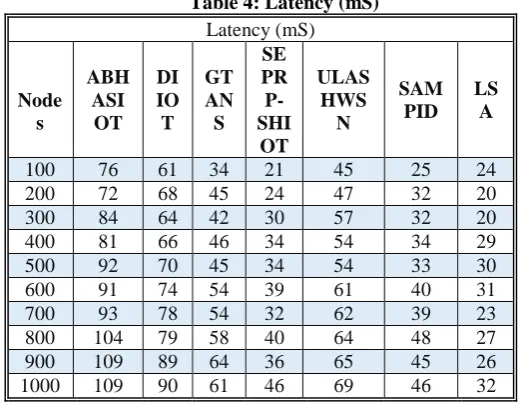
Table 4: Latency (mS)
It is observed that the increase in node count causes a decrement in the throughput. While observing the slope, proposed LSA has a shallow slope than the other methods. SEPRP-SHIOT scored the throughput value of 33151 kbps for 100 nodes and 7027 kbps for 1000 nodes – causes a deep slope. Proposed LPSP scored higher throughput values in all experiments with different node counts.
B. Latency
Latency is the duration between a data transfer request and the beginning of the data transfer. If the latency is higher, then the overall response time of the network will be high. Therefore, a good communication protocol should take fewer latency values. Latency values are measured for existing and proposed methods and given in Table 4.
Latency (mS)
Node s
ABH ASI
OT DI IO T
GT AN S
SE PR P-SHI
OT
ULAS HWS N
SAM PID
LS A
100 76 61 34 21 45 25 24
200 72 68 45 24 47 32 20
300 84 64 42 30 57 32 20
400 81 66 46 34 54 34 29
500 92 70 45 34 54 33 30
600 91 74 54 39 61 40 31
700 93 78 54 32 62 39 23
800 104 79 58 40 64 48 27
900 109 89 64 36 65 45 26
1000 109 90 61 46 69 46 32
[image:7.595.321.533.520.687.2]From the table, it is understood that the latency slightly increases with the increase in number of nodes. Table values are plotted as graph and given in the following Figure 7.
Figure 7: Latency (mS)
It is 24 mS for 100 number of nodes and 32 mS for 1000 number of nodes. SEPRP-SHIOT gets the lowest latency of 21 mS for 100 nodes, but it takes higher latency than LSA for more than 100 number of nodes. Therefore, LSA is recommended to use where there are more than 100 number of IoT nodes in a network.
C. End-to-End delay
[image:8.595.307.546.52.405.2]End-to-End delay is the time duration between the beginning of a data packet transfer from the source node and ending in the destination node. It consists of all communication delays such as latency, IP delay, system delay and jitter. End-to-End delay also should be kept in control to design a better network protocol. End-to-End delay is measured in Milliseconds. Since End-to-End delay is the accumulated value of all communication delays, it is also increasing when the number of nodes is increased. Measured values and Comparison graph of End-to-End delay values are given in Table 5 and Figure 8.
Table 5: End-to-End delay(mS) End-to-End Delay (mS)
Node s
ABH A SIOT
DI IO T
GT A NS
SEPRP -SHIOT
ULAS HWS
N SA
M PID
LS A
100 186 178 150 125 158 145 102
200 222 207 178 136 191 166 102
300 244 237 196 152 223 180 112
400 282 266 226 160 252 210 114
500 307 301 257 176 279 230 118
600 334 323 280 190 301 244 119
700 367 353 313 200 331 268 125
800 395 387 333 211 362 293 128
900 426 417 361 223 397 315 123
1000 457 448 388 232 420 334 131
Figure 8: End-to-End delay (mS) D. Packet Delivery Ratio
Packet Delivery Ratio (PDR) is the ratio between number of transmitted data packets from the source node and number of successfully received data packets by the destination node. Higher value of PDR refers low number data collisions and packet drops. Measured PDR values are given in table 6 and plotted as graph in Figure 9 – given below.
Table 6: Packet Delivery Ratio (%) Packet Delivery Ratio (%)
Nodes AB HA SIO T
D II O T
G T A NS
SE PR P- SH IO T
ULA SHW SN
SA MPI
D LS
A
100 94 94 97 98 96 97 99
200 91 90 95 97 92 96 98
300 88 88 92 97 90 95 98
400 87 88 91 96 90 92 96
500 84 84 87 95 86 89 95
600 83 83 87 93 84 87 95
700 79 81 85 92 84 87 94
800 77 78 82 91 81 83 92
900 73 75 80 90 80 83 92
1000 73 73 79 90 78 79 90
Figure 9: Packet Delivery Ratio (%)
Based on the PDR results, SEPRP-SHIOT is the close competitor for the proposed LSA – which has the highest PDR Value 99% for 100 number of nodes. For 1000 number of nodes, both LSA and SEPRP-SHIOT are scoring 90% PDR.
E. Security
[image:8.595.47.293.321.632.2]International Journal of Innovative Technology and Exploring Engineering (IJITEE) ISSN: 2278-3075, Volume-8 Issue-12, October 2019
Table 7: Security (%) Security (%)
Nodes AB HA SIO T
D II O T
G T A NS
SE PR P- SH IO T
UL AS HW
SN SA MP ID
LS A
100 98 93 91 98 96 94 99
200 98 94 91 98 97 94 98
300 97 94 92 98 97 94 98
400 98 93 91 97 96 95 99
500 98 93 91 98 97 94 98
600 98 93 92 97 97 94 98
700 97 94 92 98 97 95 98
800 98 93 91 98 96 95 99
900 97 93 91 98 96 94 99
1000 97 93 92 97 96 95 98
[image:9.595.320.533.108.270.2]Security levels of procedures are plotted as graph in figure 10.
Figure 10: Security (%)
LSA manages the security level between 98% to 99% for the number of nodes from 100 to 1000. ABHASIOT and SEPRP-SHIOT are closely following with their security range from 97% to 98% for 100 to 1000 number of nodes.
F. Energy
Energy consumption is one of the prime factors where there are a notable number of battery-powered network nodes. As the IoT based wireless sensor network nodes are primarily battery-operated devices, Energy consumption is a vital parameter here. Energy is measured in Micro-Joules (uJ), The energy consumption values are given in Table 8.
Energy (uJ)
Nodes AB HA SIO T
D II O T
GT A NS
SE PR P-SH IO T
ULA SHW SN
SA MPI
D LSA
100 984 1157 1119 901 403 907 378
200 1005 1159 1128 918 442 942 373
300 1015 1183 1165 941 471 978 397
400 1044 1223 1181 979 489 997 391
500 1062 1231 1229 1029 514 1006 424
600 1078 1250 1227 1037 543 1049 420
700 1074 1254 1271 1075 552 1059 467
800 1114 1272 1272 1090 588 1082 445
900 1116 1280 1293 1138 607 1113 476
1000 1127 1297 1333 1180 619 1126 487
The energy consumed to complete successful network transactions are calculated and the average value is
calculated. The average energy consumption represents the requirement to complete a network transaction from source to destination. The table values are plotted as graph in Figure 11.
Figure 11: Energy (uJ)
Based on the observed results, proposed LSA consumes an average of 378 uJ while the number of nodes is 100 and 487 uJ while the number of nodes is 1000. ULASHWSN consumes a little more energy of 403 uJ for 100 nodes and 619 uJ for 1000 nodes.
VI.CONCLUSION
Network performance, Security and Energy efficiency are the vital deciding factors in the evaluation of a communication protocol. While analyzing the existing communication protocols for this research work, it is understood that many of the procedures breaks in either one or two key factors while trying to improve one key factor. Improving or sustaining one key factor while improving the another is a challenging task. In this proposed work LSA, a Lightweight security algorithm is designed and evaluated which shows improved results in Network performance, Security and Energy efficiency. Therefore, the proposed work will support upcoming IoT based wireless sensor network applications from constructing Smart home to Smart city. On account of its property of improved security and energy efficiency without compromising the network performance, LSA is desirable to use with many kinds of IoT Wireless Sensor Network Applications.
REFERENCES
1. Meenakshi Munjal and Niraj Pratap Singh, "QoS and Cost-Aware Protocol Selection for Next Generation Wireless Network" in Journal of Network and Systems Management - Volume 27 issue 2, Springer 2019, pp.327-350
2. Kuinam J. Kim and Kyung-Yong Chung, "IT Convergence and Security 2012" in Lecture Notes in Electrical Engineering book serie - Volume 215, Springer 2018, pp. 685 – 693
3. Ivana Tomić and Julie A. McCann, "A Survey of Potential Security Issues in Existing Wireless Sensor Network Protocols" in IEEE Internet of Things Journal - Volume: 4 Issue: 6, IEEE 2017, pp. 1910-1923
4. Qi Yuan, Chunguang Ma, Xiaorui Zhong, Gang Du and Jiansheng Yao, "Optimization of key predistribution protocol based on supernetworks theory in heterogeneous WSN" in Tsinghua Science and Technology - Volume: 21 Issue:
[image:9.595.64.274.260.423.2]5. HyungukYoo and Taeshik Shon, "Challenges and research directions for heterogeneous cyber–physical system based on IEC 61850: Vulnerabilities, security requirements, and security architecture" in Future Generation Computer SystemsVolume 61, Elsevier 2016, pp. 128-136
6. Marco Centenaro, Lorenzo Vangelista, Andrea Zanella and Michele Zorzi, "Long-range communications in unlicensed bands: the rising stars in the IoT and smart city scenarios" in IEEE Wireless Communications Volume: 23 Issue: 5, IEEE 2016, pp. 60-67
7. Malay Bhayani, Mehul Patel and Chintan Bhatt, "Internet of Things (IoT): In a Way of Smart World" in Proceedings of the International Congress on Information and Communication Technology, Springer 2016, pp. 343-350
8. Huansheng Ning, Hong Liu and Laurence T. Yang, "Aggregated-Proof Based Hierarchical Authentication Scheme for the Internet of Things" in IEEE Transactions on Parallel and Distributed Systems Volume: 26 Issue: 3, IEEE 2014, pp. 657-667
9. Yuvraj Sahni, Jiannong Cao, Shigeng Zhang and Lei Yang, "Edge Mesh: A New Paradigm to Enable Distributed Intelligence in Internet of Things" in Mobile Edge Computing for Wireless Networks - IEEE Access Volume: 5, IEEE 2017, pp. 16441-16548
10. Jonathan Webb, Fernando Docemmilli and Mikhail Bonin, "Graph Theory Applications in Network Security" in Cryptography and Security, arXiv 2015, pp. 1-7
11. Daemin Shin, Vishal Sharma, Jiyoon Kim, Soonhyun Kwon and Ilsun You, "Secure and Efficient Protocol for Route Optimization in PMIPv6-Based Smart Home IoT Networks" in ecurity and Privacy in Applications and Services for Future Internet of Things - IEEE Access Volume: 5, IEEE 2017, pp. 11100-11117
12. Hamza Khemissa, Djamel Tandjaoui and SamiaBouzefrane, "An Ultra-Lightweight Authentication Scheme for Heterogeneous Wireless Sensor Networks in the Context of Internet of Things' in International Conference on Mobile, Secure, and Programmable Networking, Springer 2017, pp 49-62
13. Jinsha YUAN, Yang XU and Huisheng GAO, "A New Security Authentication Method in the Internet of Things Based on PID" in International Journal of Simulation -- Systems, Science & Technology Volume 17 Issue 44, EBSCO 2016, pp. 9.1-9.6
14. Tiago P. C. de Andrade, Carlos A. Astudillo, Luiz R. Sekijima and Nelson L. S. da Fonseca, "The RandomAccess Procedure in Long Term Evolution Networks for the Internet of Things" in IEEE Communications Magazine Volume: 55 Issue: 3, IEEE 2017, pp. 124-131
15. MarialenaAkriotou, Charis Mesaritakis, EvaggelosGrivas, CharidimosChaintoutis, Alexandros Fragkos and Dimitris Syvridis, "Random Number Generation from a Secure Photonic Physical Unclonable Hardware Module" in Security in Computer and Information Sciences, Springer 2018, Pages: 28-37
16. Zheng Lu and Hongji Yang, "Unlocking the Power of OPNET Modeler" in Cambridge University Press
17. Maryam Pahlevan and Roman Obermaisser, "Evaluation of Time-Triggered Traffic in Time-Sensitive Networks Using the OPNET Simulation Framework" in Euromicro International Conference on Parallel, Distributed and Network-based Processing (PDP), IEEE 2018, Pages: 283 - 287
18. David Basin, Cas CremersandCatherine Meadows, "Model Checking Security Protocols" in Handbook of Model Checking, Springer 2018, Pages: 727-762
19. Sun-Ju Kim, Ji-Hyun Min and Han-Na Kim, "The Development of an IoT-Based Educational Simulator for Dental Radiography" in Healthcare Information Technology for the Extreme and Remote Environments, IEEE 2019, Pages: 12476 - 12483
AUTHOR PROFILE
Ms.A.Anandhavalli, pursued Master of Computer Application from bharathidasan University in the year 2003. She is currently pursuing Ph.D and working as Assistant Professor in department of Computer Science, Cauverycollege for Women, Trichy,Tamilnadu, India. She is a life member ISSE. Her main research work focus on Internet of Things. She has 12 years of teaching experience.