Abstract: The main aim of this research work is to present a reliability and availability analysis of a three-unit system (A, As,
B) under the provision of replacement of a unit using the Genetic algorithm. One unit is in standby mode so that after the failure of one unit it can be active. But one unit which is dissimilar to the previous one can be replaced with the new one after the failure. It has been considered that there is only one repair man availability within the organization. Here in this paper we have used the Genetic algorithm for finding out the optimized availability of the systemand also with the assistance of numbers of graphs we have analyzed reliability characteristics, availability of the framework, so the result of the paper will be very useful for the industry people.
Keywords: Availability, Genetic Algorithm.
I. INTRODUCTION
M
athematically, the term reliability is stated as the probability that any framework will do its expected work under specified environment conditions over a specified interval of time.R(t) = P (T ≥ t).
Reliable functioning of any complex systems is of extremely concern to the millions of end users that directly or indirectly connected with these systems. But still most of the systems fall short of user's expectation of reliability. Using the concept of redundancy is one of the important techniques to increase the reliability of the systems. This type of systems that are using the concept of standby redundancies have been frequently analyzed by number of authors with different assumptions be-cause of their crucial existence in
Revised Manuscript Received on November 05, 2019.
* Correspondence Author
Mohit Kumar Kakkkar, Chitkara University Institute of Engineering and Technology, Chitkara University, Punjab, India. Email: mohit.kakkar@chitkara,edu.in
Jasdev Bhatti*, Chitkara University Institute of Engineering and Technology, Chitkara University, Punjab, India. Email: [email protected].
Reetu Malhotra, Chitkara University Institute of Engineering and Technology, Chitkara University, Punjab, India. Email: [email protected]
Manpreet Kaur, Chitkara University Institute of Engineering and Technology, Chitkara University, Punjab, India. Email: [email protected]
Deepika Goyal, Chitkara University Institute of Engineering and Technology, Chitkara University, Punjab, India. Email: [email protected]
organizations and modern industries. In the past decades, many articles related to the availability, non- availability, profit function analysis, analysis regarding visit of repair personal and other characteristics considering reliability of three-unit systems have been published. Several studies including Gupta et al. (1986) have analyzed a two-similar unit parallel system with facilities of preventive maintenance (P.M.), inspection and two types of repair. Tuteja and Taneja (1992) discussed the profit analysis of a two-servers including two-units standby framework under many failures. Jansen and Schouten (1995) examined the ideal preventive-upkeep plan for a generation framework comprising of n- indistinguishable parallel production units. In this paper they supposed that the unit’s lifetimes were IFR-distributed, also the assumed that the important expenses were because of generation misfortunes, which were expanding and arched in the quantity of units that were out of operation at the same time. Genuine maintenance expenses were thought to be immaterial when contrasted with the expenses because of those production losses.
In the paper written by Xie and Lai (1996) they both studied a mathematical model which was based on two Weibull functions.
Jardine et al. (1997) discussed minimized replacement strategy or plan and the framework of software which is under
the condition-based maintenance environment. They
presented a preventive maintenance (PM) policy depends upon the results of inspections. Barbera et al. (1999) presented a restriction-based maintenance framework with failures under exponential distribution and settled review interims for a two-unit framework series. The state of every unit, for example, vibration or warmth, was observed at similar time interims. The statistical variables for every unit were utilized to pick whether to repair a specified unit or to change the whole framework. At the end of the maintenance, variable takes on its initial figures. They assumed that every unit can fall flat just once inside of an investigation interim and when one or both units fizzle the framework comes up short. Goldberg (2001) made a study on G.A. technique, and examined three basic operators: reproduction, crossover and mutation. Castro and Cavalca (2003) published the work on an availability optimization problem of an industrial system, they used the concept of Genetic Algorithm for getting the maximum availability of the system.
Noortwijk et al. (2004) delivered a research paper which was based on probabilistic life-cycle maintenance models for deteriorating civil infrastructures. they compared the two maintenance models of civil
infrastructures that was used to achieve the optimum level of
Availability Analysis of an Industrial System
under the Provision of Replacement of a Unit
using Genetic Algorithm
reliability at minimal life-cycle cost. Pandey et al. (2005) shown a model with replacement policy for optimizing the reliability based on stochastic gamma process of aging structural components. They claimed that their method is better than previous traditional method used in reliability analysis. Dhillon and Liu (2006) presented a review on Human error during maintenance and given the idea of effect of Human error during maintenance on the reliability as well as on availability of the system. Srinivasan and Subramanian (2006) discussed the stochastic analysis of a reliability framework having more than two units standby redundant framework. By using regenerating points technique, they got the reliability, availability and other characteristics related to reliability. Parashar and Taneja (2007) delivered a paper on availability of the framework with the cost benefit analysis of a PLC framework which was based on an idea of master-slave and also, they considered more than one kind of repair facilities.
Wang et al. (2007) explained the availability and sensitivity analysis of a framework which was repairable having some warm standbys unit and also having some service platform, but these were unreliable. they also considered some operative and some warm standby units. When the service platform was active, they considered the failure time as Poisson distribution. But When the platform become non available repair times considered as to follow the negative exponential process Papageorgiou and Kokolakis (2010) discussed the Reliability analysis under the consideration of a framework having more than one parallel unit with (n-2) standbys. In this work they both discussed a non-series (2, n-2) framework in which only two units start their working side by side and one out of these two can be replaced by one of the (n-2) standbys it its fails during the working any time. Rizwan et al. (2010) presented a paper where they provided a study of a standby framework. In that paper they assumed that standby unit may also fails with lower failure rate than the active unit. They also considered four types of failure. They had given the idea of scanning to finding out the type of failure. Meng et al. (2011) also analysed a standby repairable framework having two unidentical units. In this paper, they assumed both the distributions for the repair time are poisson but here in this our work we are having correlated failure and repair.
Bhatti et al. (2011) shown the interest in discussing the analysis regarding profit of two-unit standby framework with more than one kind of failure under different testing policy for non-active or failed units and most importantly they used discrete distribution. Berrade et al. (2013) presented a research work which was based on the analysis of reliability under the assumption that inspection of the unit is not perfect, and replacement is required. They discussed a model under maintenance including periodic inspections for checking the state of the framework, where inspections may be incorrect. They considered the following scenario, replacement occurred after wrong inspections (without any need) and when replacement is required, inspection gives another result so both of the cases are not acceptable as far as reliability of the system is concerned.
Bhatti et al. (2014) also outlines the Stochastic analysis of framework having parallel units. In that paper, two similar parallel units had been considered with the help of discrete distribution and regenerative point technique they were able to find the profit function and other reliability related
characteristics. Bhardwaj and Kaur (2014) analysed a reliability model where the failure of standby unit depends limited redundancy time. The failed unit went for inspection just after the failure for check the status of its renewal. They considered that If renewal of the unit is not possible, it should be replaced by new one. So, they used the replacement policy but after the inspection whether the unit is replaceable or not. In that paper they used exponential distribution for failure but arbitrary distribution for repair and inspection times. Kakkar et al. (2015) investigated the stochastic analysis of a standby unit framework under the assumption of correlated life time and varying demand of the product. The main purpose of that work was to discuss the profit analysis of a standby framework with variations in production and demand, because production of a product is directly depending on the Demand in the market of that product.
Kakkar et al. (2015) explained and analyzed the availability of two unidentical unit repairable industrial framework. The main purpose of that work was to discuss the reliability analysis of a model where they assumed that one working unit could not fail after testing and replacement. They had considered just one repair personal to be present in the organization. Kakkar et al. (2016) also presented a work on Reliability analysis where the framework is repairable, and they also assumed that a unit in that framework could be fail during the preventive maintenance activity. It had been assumed that one repair personal was quite enough to do the all repair work.
We can see that the work on reliability of different number of systems have been published in the above-mentioned research papers, but up to some extent the results shown by these works were bounded to some essential conditions or constraints. The main motive behind this research is to investigate a real-life model existing in a sugar industry located at northern part of India. Where we observed that only one repair personal is working so he/she has to do all the repair work if needed. In this industry we had observed that there existed two different units A and B, one unit, similar (from reliability point of view) to unit A is also there in the system which is in standby mode initially, one of the unit A is initially operating. Unit B may be replaced by new one if it has been found that it is taking so much time to repair. So in this paper under the concept of correlated failure and repair time we consider a system which comprises of two dissimilar units (A and B) but one unit similar to A is in standby mode. System remains in working only if both the unit (A and B) is in operating mode. Unit B goes for inspection after failure it may be repaired or may be replaced by new one. It has been assumed that each repaired unit works as good as new. If both the units fail simultaneously the preference of inspection/repair given to unit B. As depicted in Figure1 there are some states S0, S1, S2, S3, S4, S5 and S6 in the transition Diagram. Out of these seven states only two of them are up-states namely S0 and S1 but others are down-sates.
II. SYSTEMDESCRIPTIONANDNOTATIONS The following description of system is as follows: 1.Our Framework having of two identical units (Ao and
As), operative and in standby mode respectively and also a different unit B is also there
2. Initial state is denoted by So in which in the starting one out of two units of A is active but unit B (which is parallel to A) is in active mode.
3.Preference has been given to unit B for repair over the failure of both units A and B.
For describing the states of the frame work we are having the following notations:
Ao : A is in active phase
As : A is in cold stand by phase
Bo : B is in active phase
Afr : A is in Fizzled state(phase)
Afw A is in waiting for repair personal
Bfr: B is in Fizzled state(phase)
Bfw: B is in waiting for repair personal
AfR : A is in failure mode from previous state
Bfi : After failure B is in testing phase
Brep : After inspection B is in replacement phase
a : After inspection, Probability of replacement of B
b : Probability of successful repair of B
: Constant rate of replacement of B
fi(x,y)
:
Joint pdf of (xi,yi);i=1,2
ki(Y/
X):
Conditional pdf of Yi given Xi=x is given
by
=
gi(.): Marginal pdf of Xi=
hi(.): Marginal pdf of Yi=
pdf & cdf of transition time from
regenerative state Si to Sj.
Mean sojourn time (MST) in state Si.
[image:3.595.317.529.49.244.2]III. TRANSITIONPROBABILITIESANDSOJOURN TIMES
Figure 1: Transition Table
Probabilities regarding state transition can be mentioned as follows
,
’
’
’
(1-9) From the above-mentioned equation, it is clear that
(10-15) Mean sojourn time
The average time taken by the framework to transit for
any state j into state i mathematically it can be expressed
as:
(16)
IV AVAILABILITY ANALYSIS
We are assuming that is the probability when framework is in active phase at time t, so we get the following equations regarding the availability which is based on the regenerating point technique
(17-20) where
(21-22)
From maintenance and repair sheet (of last five years) of unit A and B of sugar industry plant we have collected useful data of failure and repair rate of all units after meeting with the plant Engineers and managers. Using this data then we generate availability matrices. All these are very important for future decision making, as these availability models are developed under the real-world environment and this would be useful for implementing the proper maintenance decisions for the system.
Availability Optimized Using Genetic Algorithm Genetic algorithm is a probabilistic search procedure that computationally recreates the procedure of natural evolution or development. It mimics evolution in nature by frequently changing a population of candidate solutions until an ideal arrangement or configuration is found. The evolutionary cycle (developmental cycle) proceeds until a worthy arrangement is found in the present generation of populace, or some control parameter, for example, the quantity of generations is surpassed.
Genetic Algorithm:
Generate n random solutions for the initial generation. Iteration strat for the following steps upto N
Select the Best (nb )(best fitted ) solutions for the new Generation
Apply crossover (for different crossover rate) for new solution generation.
Apply mutations (for specified mutation rate) to the new generated solutions.
[image:4.595.305.548.503.835.2] The best fittest solution obtained (final generation).
Figure 2: Algorithm Evolutionary Cycle
Genetic Algorithms are modernized pursuit and optimization calculations dependent on the mechanics of common Genetic qualities and natural phenomena of selection. Genetic Algorithms have turned out to be significant in light of the fact that they are seen as advance optimization techniques for complex designing enhancement issues. The availability investigation of the system is exceptionally affected by the failure and repair rate parameters of every unit of the system. These parameters guarantee elite of the availability of the system. Genetic Algorithm is thus proposed to facilitate the
failure and repair rate parameters of every unit of the system for stable unit execution, for example high accessibility. We have considered 6 genes (parameters) (α1, α2, β1, β2, λ, a) for the chromosomes. We are also using the mutation rate and crossover rate in genetic algorithm which are defined as follows
Mutation Rate: It is a very significant parameter of GA algorithm. The mutation rate can be defined as how frequently mutation ought to be applied e.g, if this mutation rate is 0.4. This implies, when presented with a chromosome each bit has only one chance in 4000 of being mutated.
Crossover Rate: This is also a very important parameter of GA, the crossover rate can be defined as how frequently crossover ought to be applied. For example, if this rate is 0.4. This implies when given two parents there is a 40% possibility that they will breed.
To utilize Genetic Algorithm for taking care of the given issue, the chromosomes are to be coded in genuine structures. Not at all like, unsigned fixed point whole number coding parameters are mapped to a predetermined interim [Xmin , Xmax], where Xmin and Xmax are the most extreme and least estimations of framework parameters. Constraints for parameters are as follows:
Parameters α1 α2 β1 β2 a λ
Maximum value
0.006 0.006 0.60 0.50 0.80 0.005
Minimum value
0.001 0.001 0.10 0.10 0.10 0.001
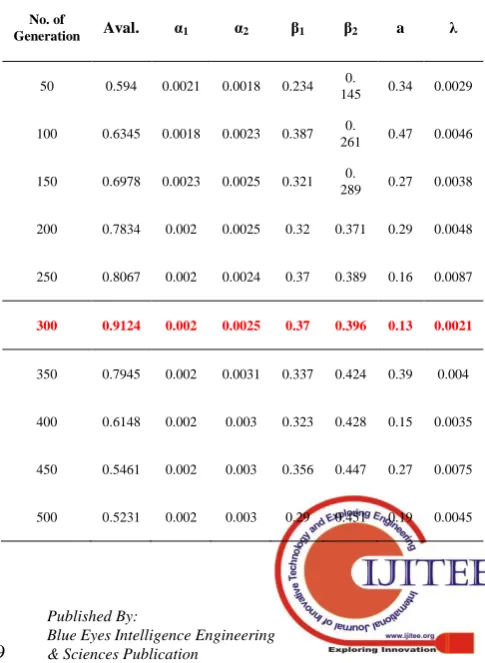
To examine the proposed technique, failure and repair rates are resolved all the while for ideal estimation of system availability. We can see the impact of GA parameters (like mutation rate, generations, crossover probability) on the accessibility of the system as appeared in Table -1.
Table-1: Effect of number of generations on availability of the system using genetic algorithm.
(Mutation Probability = 0.010, Population Size = 40, Crossover Probability = 0.50, r=0.50)
No. of
Generation Aval. α1 α2 β1 β2 a λ
50 0.594 0.0021 0.0018 0.234 0.
145 0.34 0.0029 100 0.6345 0.0018 0.0023 0.387 0.
261 0.47 0.0046 150 0.6978 0.0023 0.0025 0.321 0.
289 0.27 0.0038 200 0.7834 0.002 0.0025 0.32 0.371 0.29 0.0048 250 0.8067 0.002 0.0024 0.37 0.389 0.16 0.0087
300 0.9124 0.002 0.0025 0.37 0.396 0.13 0.0021
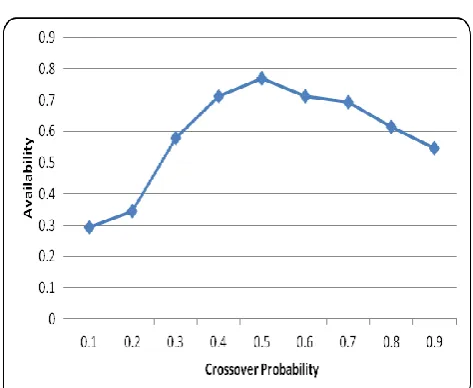
[image:4.595.70.273.521.647.2]The simulation is done to maximum number of generations, which is varying from 50 to 500. The effect of number of generations on availability of the system is shown in Figure 3.Similarly Figure 4 depicts the effect of crossover probability on availability of the system and we can see that Availaability lies in the interval (07,0.8) if crossover probability belongs to interval [0.4,0.6]. The optimum value of system’s availability is 91.24%, for which the best possible combination of failure ,repair rates and other parameters are (α1= 0.0020, α2=0.0025, β1= 0.3700, β2=0.396, λ =0.0021, a=0.13) at number of generations 50, as shown in Table 1.
Figure 3: Effect of Number of Generation on Fitness (System Availability)
Figure 4: Effect of Crossover Probability on Fitness (system Availability)
IV. CONCLUSION
In this paper the Availability analysis of the system has been carried out and we also analyzed the optimized availability using different values of failure and repair rate by Genetic Algorithm (G.A.), as this algorithm is very useful for getting the best feasible solution of parameters for optimized availability. By varying the parameters like crossover probability, mutation and population size of GA the optimum system availability is approximately 91% with best arrangements of failure rate, repair rate and other parameters of different units in the system.
Though, the most ideal accessibility level got with the assistance of semi -Markov procedure was about 79%. At that point, the output of this work has been discussed with the concerned plant managerial board. Such outcomes may be exceptionally advantageous with the end goal of availability improvement of the unit or system in the industry.
REFERENCES
1. F. Barbera, H. Schneider, and E. Watson, “A condition based maintenance model for a two-unit series system”, European Journal of Operational Research, vol. 116(2), pp. 281-290, 1999.
2. M. D. Berrade, P. A. Scarf, C. A. V. Cavalcante, and, R. A. Dwight,
“Imperfect inspection and replacement of a system with a defective state: A cost and reliability analysis,” Reliability Engineering & System Safety, vol. 120, pp. 80-87, 2013.
3. J. Bhatti, A. K. Chitkara, and M. K. Kakkar, “Stochastic analysis of parallel system with two discrete failures,” Model assisted statistics and applications, vol. 9(3), pp. 257-265, 2014.
4. R. K. Bhardwaj and K. Kaur, “Reliability and profit analysis of a redundant system with possible renewal of standby subject to inspection,” International Journal of Statistics and Reliability Engineering, vol. 1(1), pp. 36-46, 2014.
5. J. Bhatti, A. Chitkara, and N. Bhardwaj, “Profit analysis of two unit cold standby system with two types of failure under inspection policy and discrete distribution,” International Journal of science and engineering research, vol. 2(2), pp. 1-7, 2011.
6. B. S. Dhillon and Y. Liu, “Human error in maintenance: a review,” Journal of quality in maintenance engineering, vol. 12(1), pp. 21-36, 2006.
7. L. R. Goel, G. C. Sharma and P. Gupta, “Reliability analysis of a system with preventive maintenance, inspection and two types of repair,” Microelectronics Reliability, vol. 26(3), pp. 429-433, 1986. 8. J. Jansen and V. D. D. Schouten, “Maintenance optimization on
parallel production units,” IMA Journal of Management Mathematics, vol. 6(1), pp. 113-134, 1995.
9. A. K. S. Jardine, D. Banjevic and V. Makis, “Optimal replacement policy and the structure of software for condition-based maintenance,” Journal of Quality in Maintenance Engineering, vol. 3(2), pp. 109-119, 1997.
10. M. Kakkar and J. Bhatti, “Reliability and Profit analysis of a standby unit system with correlated life time in an industry,” Advanced Studies in Contemporary Mathematics, vol 25(3), pp. 333-340, 2015. 11. M. Kakkar, A. K. Chitkara, and J. Bhatti, “Reliability analysis of two
unit parallel repairable industrial system,” Decision Science Letters, vol. 4(4), pp. 525-536, 2015.
12. M. Kakkar, A. K. Chitkara, and J. Bhatti, “Reliability analysis of two dissimilar parallel unit repairable system with failure during preventive maintenance,” Management Science Letters, vol. 6(4), pp. 285-296, 2016.
13. M. D. Pandey, X. Yuan and J. M. Van Noortwijk, “Gamma process
model for reliability analysis and replacement of aging structural components,” Proceed. ICOSSAR, Rome, Italy, Paper, (311), 2005. 14. E. Papageorgiou and G. Kokolakis, “Reliability analysis of a two-unit
general parallel system with (n-2) warm standbys,” European Journal of Operational Research, vol. 201(3), pp. 821-827, 2010.
15. B. Parashar and G. Taneja, “Reliability and profit evaluation of a PLC hot standby system based on a master-slave concept and two types of repair facilities,” IEEE Transactions on reliability, vol. 56(3), pp. 534-539, 2007.
16. S. M. Rizwan, V. Khurana and G. Taneja, “Reliability analysis of a hot standby industrial system,” International Journal of Modelling and Simulation, vol. 30(3), pp. 315-322, 2010.
17. S. K. Srinivasan and R. Subramanian, “Reliability analysis of a three unit warm standby redundant system with repair,” Annals of Operations Research, vol. 143(1), pp. 227, 2006.
18. R. K. Tuteja, and G. Taneja, “Cost-benefit analysis of a two-server, two-unit, warm standby system with different types of failure,” Microelectronics reliability, vol. 32(10), pp. 1353-1359, 1992. 19. K. H. Wang, J. B. Ke and W. C. Lee, “Reliability and sensitivity
analysis of a repairable system with warm standbys and R unreliable service stations,” The International
[image:5.595.46.283.413.607.2]20. J. M. Van Noortwijk and D. M. Frangopol, “Two probabilistic
life-cycle maintenance models for deteriorating civil
infrastructures,” Probabilistic Engg. Mechanics, vol. 19(4), pp. 345-359, 2004.
21. M. Xie and C. D. Lai, “Reliability analysis using an additive Weibull model with bathtub-shaped failure rate function,” Reliability Engineering & System Safety, vol. 52(1), pp. 87-93, 1996.
22. L. Yuan and X. Y. Meng, “Reliability analysis of a warm standby repairable system with priority in use,” Applied Mathematical Modelling, vol. 35(9), pp. 4295-4303, 2011
23. Castro H.F., Cavalca K. (2003), Availability optimization with Genetic Algorithm; International Journal of Quality and Reliability Management 20(7); 847-863
24. Goldberg D.E. (2001), Genetic Algorithm in Search; Optimization and Machine Learning, Pearson Edition; Asia.
25. Kalyanmoy Deb (1995), Optimization for Engineering Design: Algorithms and examples; Prentice Hall of India, New Delhi; India.
AUTHORSPROFILE
Mohit Kumar Kakkkar, MCA, M.Sc., M.Phil., Ph.D (Mathematics), Professor Chitkara University Institute of Engineering and Technology, Chitkara University, Punjab, India. Email: mohit.kakkar@chitkara,edu.in
Jasdev Bhatti, M.Sc., M.Phil., Ph.D (Mathematics), Associate Professor, Chitkara University Institute of Engineering and Technology, Chitkara University, Punjab, India. Email: jasdev.bhatti@chitkara,edu.in
Reetu Malhotra, M.Sc., M.Phil., Ph.D (Mathematics), Associate Professor, Chitkara University Institute of Engineering and Technology, Chitkara University, Punjab, India. Email: [email protected]
Manpreet Kaur, M.Tech (CSE), M.Sc. (Mathematics), Assistant Professor Chitkara University Institute of Engineering and Technology, Chitkara University, Punjab, India. Email: manpreet,[email protected].