International Journal of Innovative Technology and Exploring Engineering (IJITEE) ISSN: 2278-3075, Volume-9 Issue-1, November 2019
Composite Materials Based on Twaron and Nano
Materials
Omnia Hamdy, Remon A. Mankarious, M. A. Radwan, M. A. Sadek,
Hany A. Elazab
Abstract: This research aims to participate in producing body shield that can overcome pervious drawbacks using behaviour of shear thickening fluid. Initially, the rheological behaviour of silica-polyethylene glycol shear thickening fluid is examined at different concentrations. Then, ballistic fabric samples are impregnated into silica-polyethylene glycol shear thickening fluid at various concentrations of silica and tested using gas gun simulating real ballistic threat. After that, the impact of rubbery hot water pack filled with around 66.67 wt% starch in water is tested using gas gun. Results showed as the concentration of silica increases, the indentation depth in the impregnated fabric decreases which may result in improving performance of ballistic fabric to 12.5 % in case of using 60 wt% silica, 7.35 % in case of using 30 wt% silica and 3.31 % in case of using 7.5 wt% silica with respect to plain sample. As it showed that no indentation depth is formed in modelling clay when rubbery hot water pack filled with around 66.67 wt% starch in water is tested using gas gun causing improvement percentage to be 100% compared to plain sample of Twaron (CT 714).
Index Terms: Composite materials, Twarone, Nanomaterials.
Ⅰ.
INTRODUCTION
Body armours were used and developed along the years with many conflicts which make their development and improvement necessary. Each type of body armours that are currently used is suitable in some points and unsuitable in others. The main disadvantages are rigidity, lack of adequate protection, inflexibility and heavy weight provided by usage of hard ceramic plates in most of usable body armours nowadays (Centre for the protection of national infrastructure, 2018).
Accordingly, studies and examinations were done to attain a new scientific concept that can improve body shields such as, shear thickening fluid which has grabbed attention due to its ability to resist different impacts such as, bullets and stabs when high performance fabrics such as, Kevlar and Twaron impregnated into it counteracting most of drawbacks associated with pervious armours (Fahool & Sabet, 2016).
The purpose is to produce body shield with high strength and better performance against shots using behaviour of shear thickening fluid by impregnating Twaron fabric impregnated fumed silica nanoparticles and polyethylene glycol (PEG) shear thickening fluid.
Revised Manuscript Received on November 05, 2019.
Omnia Hamdy, Department of Chemical Engineering, The British University in Egypt, El-Shorouk City, Cairo, Egypt.
Remon A. Mankarious, Department of Chemical Engineering, The British University in Egypt, El-Shorouk City, Cairo, Egypt.
M. A. Radwan, Department of Chemical Engineering, The British University in Egypt, El-Shorouk City, Cairo, Egypt.
M. A. Sadek, Department of Chemical Engineering, The British University in Egypt, El-Shorouk City, Cairo, Egypt.
Hany A. Elazab, Nanotechnology Research Centre (NTRC), the British University in Egypt (BUE), El-Sherouk City, Suez Desert Road, Cairo, 11837, Egypt.
This body shield should be economical to some extent, provide flexibility to wearer and characterized by its light weight. Shear thickening fluid (STF) is a type of non-Newtonian fluid which is characterized by its sudden and unexpected rise in its viscosity at specific shear rate. This phenomenon can be
observed in suspensions and colloids. STF consists of solid particles such as, silica and calcium carbonate with carrier liquid such as, polyethylene glycol (PEG), water and ethylene glycol. Shear thickening fluid (STF) becomes thin at low shear rates and thick with an increase in its viscosity when applied to loadings with high shear rates. It shows a phase similar to solid phase for a few seconds when maximum level of load is reached returns back to liquid phase when loads removed. From this point, STF was suggested to be used in ballistic soft body armours (Fahool & Sabet, 2016). Shear thickening fluid (STF) are usually reported as a suspension of nanoparticles. If nanoparticles involved in the suspension with high percentage, hydroclusters formed under high shear stress as a result of suspended colloidal particles. Consequently, very thick liquid that is highly viscous and shows solid behaviour is obtained (Na, et al., 2016). Figure 1 below shows viscosity behaviour of shear thickening and thinning in suspensions at different shear rates. The schematic diagram shows that particles remain at equilibrium until shear rate increases as a result of applied loads. As the shear rate increases, separate structured layers are formed showing a thinning performance until reach the critical shear rate where hydroclusters (random layered structures) starts to form accompanied by a dramatic rise in viscosity showing a thickening behaviour of the suspension (Gurgen, Kushan, & Li, 2017).
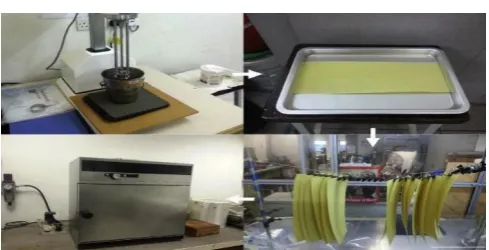
Ballistic fabric sample impregnated in a shear thickening fluid (STF) is prepared as following:
•
Solid particles such as, silica or calcium carbonate is mixed with carrier liquid such as, polyethylene glycol (PEG), water and ethylene glycol by using either ultrasonic, magnetic, mechanical stirrer to disperse the colloidal particles homogenously in suspensions (Gurgen, Kushan, & Li, 2017).•
Fabrics such as Kevlar or Twaron are then steeped in the prepared shear thickening fluid (STF) for a reasonable time to allow STF to permeate through the fabric (Gurgen, Kushan, & Li, 2017).•
Impregnated fabrics are then placed in a vacuum oven to evaporate the alcohol. Figure 2 below illustrates the preparationprocess (Gurgen, Kushan, & Li, 2017).ⅠⅠ.
EXPERIMENTALSECTIONThe rheological behaviour of starch-water mixture was initially tested. Then, rheological behaviour of silica-polyethylene glycol shear thickening fluid is examined at different concentrations of silica. Then, tool steel bullet is manufactured, and its speed is determined using Arduino control system software (IDE). Thereafter, ballistic fabric samples are impregnated into silica-polyethylene glycol shear thickening fluid at various concentrations of silica and tested using gas gun simulating real ballistic threat. Afterwards, the impact of rubbery hot water pack filled with starch-water mixture is examined using gas gun.
Shear thickening fluid samples made up of 50 wt% starch in water was prepared and placed in VG rheometer applying different shear rates to the sample recording their corresponding measured shear stress. Then, viscosity of the sample was calculated at different shear rates in order to plot shear rate versus viscosity for each sample. This test is usually used to characterize shear thickening fluid.
Three shear thickening fluid samples made up of different concentrations of silica (60 wt%, 30 wt% and 7.5 wt%) in polyethylene glycol (PEG) were prepared and placed in VG rheometer applying different shear rates to the sample recording their corresponding measured shear stress. Then, viscosity of the sample was calculated at different shear rates in order to plot shear rate versus viscosity for each sample. This test is usually used to characterize shear thickening fluid.
The speed of manufactured 9 mm tool steel bullet with weight of 44 gm was determined using gun gas by adjusting pressure of air gauge at 2 bar which is connected to a pipeline where the manufactured bullet is placed at the end of it. Then, laser emitter was placed at the tip of the pipeline while laser receiver was placed 15 cm away from the emitter. This laser detector system is connected by a cable to Arduino control system software (IDE) on PC device which has the ability to read input and convert it into output. In this case, distance between two lasers is added to Arduino control system software (IDE) on PC and IDE reads the time taken between cutting both laser beams and convert it into Δt on the PC. Then, software calculates the speed of the bullet directly.
Three different samples consisting of five layers Twaron (CT 714) impregnated into shear thickening fluid samples made up of various concentrations of fumed silica (60 wt%, 30 wt% and 7.5 wt%) in polyethylene glycol (PEG) were prepared and placed in a steel mould which was filled with a modelling clay. This modelling clay is used as a backing material behind treated ballistic fabric to simulate human body regarding tissue response and determine the extent of expected deformation during ballistic test. The bullet was placed at the end of 120 cm pipeline connected to an air compressor and air pressure gauge. The bullet was then
treated fabric, which is under examination, to be approximately zero for safety precautions. Finally, the bullet was launched based on NIJ standards 2 more times at different positions in the fabric provided it were not in the same line as the first one.
[image:2.595.306.551.137.262.2]ⅠⅠⅠ. RESULTS SECTION
Figure 1. The preparation process of a ballistic fabric sample impregnated in a shear thickening fluid (STF)
(Gurgen, Kushan, & Li, 2017)
Figure 2 demonstrates viscosity versus shear rate for a sample of 50 wt% starch in water.
[image:2.595.317.536.459.558.2]The obtained results in Figure 2 showed that as the shear rate increases, the viscosity of 50 wt% starch in water decreases. However, at some point an extraordinary jump in viscosity is observed as the shear rate increases because, separate structured layers are formed showing a thinning performance until reach the critical shear rate where hydroclusters (random layered structures) starts to form accompanied by a dramatic rise in viscosity showing a thickening behaviour of the suspension. This clarified behaviour is usually used to characterize shear thickening fluid (Gurgen, Kushan, & Li, 2017).
Figure 2. Viscosity versus shear rate for a sample of 50 wt% starch in water
International Journal of Innovative Technology and Exploring Engineering (IJITEE) ISSN: 2278-3075, Volume-9 Issue-1, November 2019
When nanoparticles involved in the suspension with high percentage, hydroclusters formed rapidly under high shear stress as a result of suspended colloidal particles. Consequently, very thick liquid that is highly viscous (Na, et al., 2016).
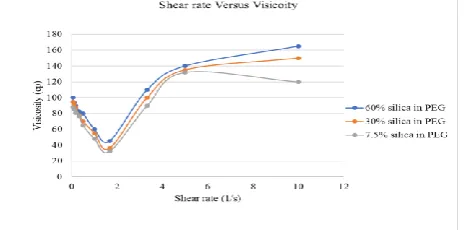
The rheological behaviour of silica in polyethylene glycol (PEG) sample was examined to measure viscosity and flow as a function of speed to determine the suitable concentration of silica in PEG to be used against applied loads and in improving body armours. Besides, from Figure 4 above the highest concentration of silica in polyethylene glycol (PEG) which is 60 wt% is expected to have the best performance in improving body armours and against applied loads (YILDIZ, 2013).
Figure 3 Viscosity versus shear rate for samples of 7.5 wt%, 30 wt% and 60 wt% of silica in polyethylene glycol
(PEG)
Velocity of tool steel bullet was determined to be 40 m/s using Arduino control system software (IDE). Then, kinetic energy of bullet can be determined as following:
Where m is the mass of tool steel bullet which is equal to 44 gm. v is the velocity of the bullet which is equal to 40 m/s. The obtained velocity was determined using tool steel bullet with outer diameter (Do) of 9 mm to simulate real 9 mm FMJ bullet (Type II-A). However, the distance between bullet and the barrier which consists of several layer of Twaron fabric (CT 714) was set to be approximately 0 cm which does not fulfil National Institute of Justice 0101.06 standard which is usually set distance as 5 m. In addition to weight of the bullet, the used tool steel bullet weighs 44 gm while weight of 9 mm FMJ bullet (Type II-A) is 8 gm. This big difference between conditions of the impact test and National Institute of Justice 0101.06 standard can be referred to the following reasons:
To ensure safety conditions for the test based on university regulations. Due to availability of materials since walls of the lab are not bulletproof. The main aim of the project is to confirm concept that shear thickening fluid improves resistance against bullets. As a result of difference in weight of the bullet and shooting distance, the obtained kinetic energy for 9 mm tool steel bullet is different from kinetic energy of real 9 mm FMJ bullet (Type II-A) which is normally set to be 556.516 ± 0.324 J (National Criminal Justice Reference Service, 2008).Table 1 below shows depth of indentation marks in the modelling clay backing material for different samples result from impact test using gas gun.
Table 1 Depth of indentation marks in the modelling clay for different samples
Then, improvement percentage of each sample can be calculated with respect to plan sample as following:
[image:3.595.49.283.215.330.2]Figure 4 below illustrates bar chart for average indentation depth in the modelling clay of three shoots versus sample number with its silica concentration.
Figure 4 Average indentation depth Versus sample number
The attained results for the impact test using gas gun shown in Table 1 and Figure 5 showed that depth of indentation marks in the modelling clay backing material results in case of using Twaron (CT 714) impregnated into silica-polyethylene glycol shear thickening fluid in sample 2,3 and 4 (2.63 cm, 2.52 cm and 2.38 cm) are smaller than depth of indentation marks obtained in case of using plain Twaron (CT 714) in sample 1 (2.72 cm). Moreover, it was noticed that depth of indentation marks decreases as concentration of silica increases (0%,7.5%,30% and 60%) as shown in sample 4 compared to 3,2 and 1. Thereafter, the improvement percentage for different samples was calculated
in order to determine approximately the percentage at which shear thickening fluid (STF) can improve ballistic performance against bullet. This improvement is referred to phase similar to solid phase formed by the shear thickening fluid (STF) for a few seconds when maximum level of load is reached returns back to liquid phase when load is removed. From this point, STF was suggested to be used in ballistic soft body armours (Fahool & Sabet, 2016).
The number of shots performed per panel at 0˚ was 3 based on National Institute of Justice 0101.06 standard. As the maximum indentation depth obtained in the modelling clay was 3 cm (3rd indentation mark in sample 1) which does not conflict with National Institute of Justice 0101.06 standard that considers body armour reliable when depth of
[image:3.595.310.548.267.390.2]Consequently, silica-polyethylene glycol shear thickening fluid can be used to modify body armours extensively (National Criminal Justice Reference Service, 2008). Results also approves expectations of rheological test for silica-polyethylene glycol shear thickening fluid shown in Figure 4 above that better performance for impregnated ballistic fabrics against gas gun shots is expected at higher concentrations of silica in the polyethylene glycol (PEG) as shown in case of 60 wt% compared to 30 wt% and 7.5 wt%.
Ⅳ. CONCLUSIONS
This project strives to exploit this behaviour in enhancing performance of body armours. This was done through testing rheological behaviour of shear thickening fluid made up of polyethylene glycol and different concentrations of fumed silica using VG rheometer in order to notice ultimate rise in its viscosity when applied to high shear rates and the effect of concentration of silica on this rise. After that, tool steel bullet (9 mm) was manufactured to simulate real 9 mm FMJ bullet (Type II-A) and its speed was determined using Arduino control system software (IDE). Thereafter, different samples of Twaron (CT 714) impregnated into shear thickening fluid consists of polyethylene glycol and different concentrations of fumed silica (same concentrations used in rheological test) were prepared and impact test was performed on them using gas gun was taking into accounts National Institute of Justice 0101.06 standard significantly. Then, the impact of rubbery hot water pack filled with around 66.67 wt% starch in water was tested using gas gun. Results showed that the depth of indentation marks in the modelling clay backing material decrease as the concentration of silica used in shear thickening increases with respect to plain Twaron (CT 714) sample.
Subsequently, the improvement percentage for different samples was calculated using average indentation depth for the 3 shots in order to determine approximately the percentage at which shear thickening fluid (STF) can improve performance of ballistic fabric against bullets. It was found out that impregnating Twaron (CT 714) in 60 wt% silica-polyethylene glycol can enhance ballistic performance by 12.5% while using 30 wt% silica-polyethylene glycol improves ballistic performance of fabric by 7.35% and when using 7.5 wt% silica-polyethylene glycol it promotes the ballistic performance by 3.31%. Moreover, the improvement percentage of using rubbery hot water pack filled with around 66.67 wt% starch in water was achieved to be 100% with respect to plain sample of Twaron (CT 714).
Consequently, the dissertation has fulfilled its hypothesis in developing performance of ballistic fabrics using shear thickening fluid technology which can be participated in developing body shields on large scale.
However, the distance between bullet and the examined Twaron fabric (CT 714) sample was set to be approximately 0 cm which does not fulfil National Institute of Justice 0101.06 standard which is usually set distance as 5 m. In addition to weight of the bullet, the used tool steel bullet weighs 44 gm while weight of 9 mm FMJ bullet (Type II-A) is 8 gm. This big difference between conditions of the impact test and National Institute of Justice 0101.06
To ensure safety conditions for the test based on university regulations. Due to availability of materials since walls of the lab are not bulletproof. The main aim of the project is to confirm concept that shear thickening fluid improves resistance against bullets.The difference in weight of the bullet and shooting distance, lowers velocity of the tool steel bullet and hence, obtained kinetic energy for 9 mm tool steel bullet is different from kinetic energy of real 9 mm FMJ bullet (Type II-A) which is normally set to be 556.516 ± 0.324 J (National Criminal Justice Reference Service, 2008). Thus, it is recommended to use this initial results in modifying body armours extensively taking into consideration to manufacture tool steel 9 mm bullet with mass of 8 gm similar to weight of 9 mm FMJ bullet (Type II-A), perform impact test in a bulletproof room for safety and set distance between 9 mm manufactured bullet and the examined Twaron fabric (CT 714) sample to be 5 m based on National Institute of Justice 0101.06 standard.
Moreover, it is suggested to employ shear thickening behaviour of starch-water mixture in developing performance of ballistic fabrics in presence antifungal medium such as, bacteria to avoid rot of starch water mixture. It is recommended to use starch-water fluid due to its ability to resist penetration of tool steel bullet much greater than shear thickening fluid which consists of silica and polyethylene glycol (PEG). In addition to, its dramatic rise in viscosity at high shear rates which is greater than corresponding rise in silica-polyethylene glycol.
ACKNOWLEDGEMENTS
We are grateful to the support of British University in Egypt (BUE), VCU, EAF, EPRI, and STCE.
REFERENCES
1. Baruwati, B., Magnetically recoverable supported ruthenium catalyst for hydrogenation. Tetrahedron Letters, 50(11): p. 1215-1218, 2009. 2. Tarek M. Aboul-Fotouh, Sherif K. Ibrahim, M. A. Sadek, Hany A.
Elazab, International Journal of Innovative Technology and Exploring Engineering (IJITEE), 2019.
3. Yan, J.M., Magnetically recyclable Fe-Ni alloy catalyzed dehydrogenation of ammonia. Journal of Power Sources, 194(1): p. 478-481, 2009.
4. Hany A. Elazab, Tamer T. El-Idreesy, Bulletin of Chemical Reaction Engineering and Catalysis, 2019.
5. Hany A. Elazab, The Canadian Journal of Chemical Engineering, 2019. 6. Hany A. Elazab, Mamdouh Gadall, M. A. Sadek, Tamer T. El-Idreesy,
, Biointerface Research in Applied Chemistry, 2019.
7. M. A. Radwan, Mohamed Adel Rashad, M. A. Sadek, Hany A. Elazab, Journal of Chemical Technology and Metallurgy, 2019.
8. W. Mohsen, M. A. Sadek, H. A. Elazab International Journal of Applied Engineering Research, 12, 14927-14930.
9. R. A. Mankarious, M. A. Radwan, M. Shazly, H. A. Elazab Journal of Engineering and Applied Sciences, 12, 2697-2701.
10. Marwa M. Naeem, M. A. Radwan, M. A. Sadek, H. A. Elazab Journal of Engineering and Applied Sciences, 12, 1179-1185.
11. Hany A. Elazab, S. Moussa, B. Gupton, M. El-Shall Journal of Nanoparticle Research. 2014, 16, 1-11.
12. Hany A. Elazab, S. Moussa, A. Siamaki, B. Gupton, M. El-Shall Catalysis Letters, 147, 1510-1522.
13. Hany A. Elazab, A. R. Siamaki, S. Moussa, B. F. Gupton, M. S. El-Shall Applied Catalysis A: General. 2015, 491, 58-69.
14. Hany A. Elazab, S. Moussa, K. W. Brinkley, B. Frank Gupton, M. Samy El-Shall Green Processing and Synthesis, 6, 413-424.
International Journal of Innovative Technology and Exploring Engineering (IJITEE) ISSN: 2278-3075, Volume-9 Issue-1, November 2019
16. M. A. Radwan, Mohamed Adel Rashad, M. A. Sadek, Hany A. Elazab, Journal of Chemical Technology and Metallurgy, 2019.
17. Hany A. Elazab, S. A. Hassan, M. A. Radwan, M. A. Sadek, International Journal of Innovative Technology and Exploring Engineering (IJITEE), 2019.
18. Hany A. Elazab, M. M. Seleet, Said M. A. Hassanein, M. A. Radwan, M. A. Sadek, International Journal of Innovative Technology and Exploring Engineering (IJITEE), 2019
19. Hany A. Elazab, M. M. Seleet, Said M. A. Hassanein, M. A. Radwan, M. A. Sadek, International Journal of Innovative Technology and Exploring Engineering (IJITEE), 2019.
20. Hany A. Elazab, M. M. Seleet, Said M. A. Hassanein, M. A. Radwan, M. A. Sadek, International Journal of Innovative Technology and Exploring Engineering (IJITEE), 2019.
21. Hany A. Elazab, M. A. Sadek, Tamer T. El-Idreesy, Journal of Chemical Technology and Metallurgy, 2019.
22. Sherif Elbasuney, M. A. Radwan, Hany A. Elazab, Journal of Chemical Technology and Metallurgy, 2019.