Abstract: Blockchain innovation has as of late increased far reaching consideration by media, organizations, open division offices, and different worldwide associations, and it is being viewed as possibly significantly more troublesome than the Internet. In spite of noteworthy enthusiasm, there is a shortage of scholastic writing that depicts key parts of blockchains and talks about potential applications. This paper expects to address this hole. This paper shows a review of blockchain innovation, distinguishes the blockchain's key utilitarian attributes, assembles a formal definition, and offers a talk and order of present and developing blockchain applications. .
Keywords:application, Blockchain, bitcoin, key.
I. INTRODUCTION
Over the most recent couple of days, we had seen the capability of IoT’s to convey energizing administrations over a few areas, from online networking, business, astute transportation and brilliant urban communities to an enterprise [1], [2], [3]. IoT consistently interconnects various gadgets among various functionalities in the person - driven and device - driven systems to meet the advancing necessities of the prior specified divisions. By the by, the significant number of associated gadgets and huge information traffic turn into the congestion in gathering the necessary Quality-of-Services (QoS) due to the computational, stockpiling, and data transfer capacity compelled IoT gadgets. Most as of late, the blockchain [4], [5], [6], [7], a change in outlook, is changing all the real application territories of Internet of Things by empowering a separate situation with unknown and trustful exchanges. Joined with the blockchain innovation, IoT frameworks benefit from the lower operational cost, decentralized asset administration, vigor against dangers and assaults, et cetera. Thusly, the assembly of above innovation plans to defeat the significant difficulties of understanding the IoT stage sooner rather than later. Blockchain, a disseminated add just open record innovation, was at first planned for the cryptographic forms of money, e.g., Bitcoin1. In [8] a man presented the plan of blockchain that has pulled in a great deal consideration greater than earliertime as a rising distributed (P2P) innovation for conveyed registering and decentralized information sharing. Because of the selection of cryptography innovation and without an incorporated control performing artist or brought together information stockpiling,
Revised Manuscript Received on June 05, 2019
V.Usha, Computer Science and Engineering, Vel Tech Rangarajan Dr.Sagunthala R&D Institute of Science and Technology, Chennai, India.
N.Rajkumar, Computer Science and Engineering, Vel Tech Rangarajan Dr.Sagunthala R&D Institute of Science and Technology, Chennai, India.
C.SaranyaJothi, Computer Science and Engineering, Vel Tech Rangarajan Dr.Sagunthala R&D Institute of Science and Technology, Chennai, India.,
the blockchain can keep away from the assaults that need to get authority above the framework. Afterward, in 2013, Ethereum, an exchange base status engine, was displayed to plan the blockchain innovations. Strikingly, because of its one of a kind and alluring highlights, for example, value-based protection, security, the changelessness of information, audit ability, honesty, approval, framework straightforwardness, and adaptation to non-critical failure, block chain is being connected in a few divisions past the digital forms of money. A portion of the territories are character administration, smart transportation ,supply-chain management, mobile-swarm detecting, agribusiness ,Industry Internet of vitality and security in mission basic frameworks The Block, which is incorporated by the excavator, is communicated once more into the system. In the wake of approving the communicate Block, which contains the exchange, and hash-coordinate it with the past Block in the block chain, the communicate chunk is annexed into the block chain.
II. METHODOLOGY
A.Bitcoin
[image:1.595.341.517.519.570.2]Bitcoin (BTC) is computerized money, which is utilized and disseminated electronically. Bitcoin is a decentralized distributed system. No single establishment or individual controls it. Bitcoins can't be printed and their sum is extremely constrained – just 21 mln Bitcoins can ever be made.
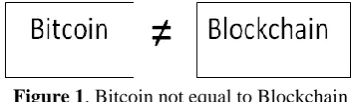
Figure 1. Bitcoin not equal to Blockchain
Blockchain isn't Bitcoin, however this innovation after Bitcoin It is the computerized token and blockchain is the record to monitor who claims the advanced tokens both or together .
B.Block
A Block is a collected arrangement of information. Information are gathered and prepared to fit in a Block through a procedure called mining. Each Block could be distinguished utilizing a cryptographic hash (otherwise called an advanced unique mark). The Block framed enclose a mix up of the past Block, with the goal that Blocks are shape a chain from the primary Block at any point (known as the Genesis Block) to the
shaped Block. Along these lines, every one of the information could be
Emerging Technology of Block chain: Design,
Consensus and Future Trends
associated through a connected rundown structure.
[image:2.595.94.262.122.219.2]Blocks are information structures whose reason for existing is to package sets of exchanges and be disseminated to all hubs in the system. Blocks are made by mineworkers (examined in more detail beneath).
Figure 2.Block representation
C.Block Chain Architecture
With the development of Bitcoin, Blockchain came into acknowledgment and after that actualized in 2009. Satoshi Nakamoto establishes and executes it as a center segment of Bitcoin. It turned into the primary advanced cash which tackled the issue of twofold spending.
In the first papers of Satoshi, the names "Block" and "Chain" were utilized independently yet it got well known by 2016 as a solitary word "Blockchain."
Prologue to crypto currencies (Bitcoin) brought the idea of Block chain into the feature; it is a database that shields us from altering and modification of the information. The block chain is as yet a rising innovation, so it is troublesome for us to comprehend its working without getting into the codes or by diving profound into software engineering.
A Blockchain is a series of blocks which hold data. The information is put away within a chunk. Each Block have Hash, Item(Data),Previous block hash.
Figure 3. Block chain
D. Blockchain representation
A visual delineation of block chain
Blocks contain a Block header, which is the metadata that confirms the legitimacy of a Block. Run of the mill Block metadata contains:
Adaptation - the present rendition of the Block structure .past Block header hash - the reference this current Block's parent Block.
Merkle root hash - a cryptographic hash of the majority of the exchanges incorporated into this Block .
Time - the time that this Block was made.
nBits - the present trouble that was utilized to make this Block nonce ("number utilized once") - an arbitrary esteem that the maker of a Block is permitted to control anyway they so pick
These 6 fields establish the Block header. Whatever remains of a Block contains exchanges that the digger has incorporated into the Block that they made. Clients make exchanges and submit them to the system, where they sit in a pool holding up to be incorporated into a Block.
A hash resembles the unique mark that through a calculation, transforms information into a yield of settled length which is one of a kind for each and every exchange.
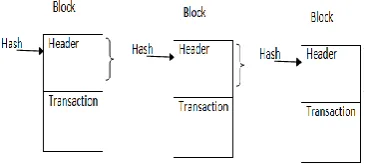
[image:2.595.336.519.293.375.2]Each block can be isolated into two sections. The top incorporates the past block's mix up and it references. It additionally stores the hash of the present exchange which is intended to be interface the following block when included. The blockchain is disseminated and refreshed among the fresh block included. Accordingly thusly different areas can keep on keeping up it if any of the duplicate of blockchain is endangered. This form the blockchain changeless. By looking at the hash of the information the realness of the information can be checked which used in accomplishing an autonomously evident framework.
Figure 4.Visual delineation of block chain
Blockchains are probabilistic frameworks, by plan. Hubs, or the PCs in the system, freely choose and agree whereupon "chain of Blocks" is the longest and generally legitimate. As a Block is made and set around the system, every hub forms the Block and chooses where it fits into the current overall blockchain record.
Inside the setting of a blockchain, there are a couple of various kinds of Blocks. Most Blocks just expand the present primary blockchain. These are classified "primary branch Blocks".
A few Blocks reference a parent hinder that isn't at the current blockchain tip. These Blocks are designated "side branch Blocks".
Side branch Blocks are especially fascinating. They may not as of now exist in the principle branch, but rather if more work is done on them (which means different Blocks are mined that reference them as a parent), there is the likelihood that that a specific side branch will be revamped into the primary branch.
This redesign happens in light of the fact that the "principle" part of the blockchain is the one that has had the most work done on it.
As latest block added to the blockchain, it turns away to be progressively hard to "overwrite" existing Blocks in light of the fact that the most legitimate chain is the one that has had the most work done on it.
E.Blockchain Transaction Works
[image:2.595.78.281.482.577.2]pertinent to any exchange occurring on the web
1. A person in the Blockchain arranges demands for an exchange.
2. This ask for the exchange is then shown to the next members (i.e. - Nodes).
3. The system of Nodes by checked calculations at that point affirms the exchange.
4. After the endorsement of the demand by the hubs, they finish the exchange.
5. Instantly after the exchange, another block is added to Blockchain organize which is changeless.
6. That checked exchange includes with other exchange making another block of information.
Any individual who needs to include data in the Blockchain must have an open location and a novel key to sign in, private key signs the exchange. Each time you purchase or offer Bitcoin, Bitcoin Blockchain includes that record. This data is very secure as it copies a great many time and any programmer need to control over 51% of the hubs to make any adjustment.
F. Highlights and individuality of Blockchain
1. Decentralized systems:Decentralized innovation empowers us to stock up resources in a system to facilitatepreservelive gotten to above the web. The benefits can be anything extending structure a token, an agreement, chain-of-proof archives, or property library reports. Through decentralized innovation, the proprietor has coordinate control by means of their private key, which is straightforwardly connected to the benefit. The proprietor can exchange the advantage at whatever point wanted and to anybody.
a) Empowered clients: Decentralized frameworks enables the clients to keep control of all their data and exchanges.
(b)Burden flexibility: Distribute frameworks are more averse to bomb incidentally on the grounds that they depend on many separate parts that are not likely.
c) ) Strength and attack restriction: Because blockchain does not have a basic issue of control and is better prepared to endure a noxious ambush, the decentralized systems are all the more exorbitant to strike and destroy or control.
(d)Open from exercises: It is fundamentally harder for customers in decentralized systems to appreciate an alternate ways that will benefit them by making hurt diverse customers.
(e)Removing pariah perils: This development enables customers to make an exchange without the intermediation of an outcast, thusly taking out danger.
(f)High exchange rate: Blockchain exchanges can diminish exchange times to minutes and they can be handled whenever when contrasted with the current methods for exchange during banks which require any longer time to be prepared.
(g)Lesser exchange expenses: Killing outsider middle people and overhead expenses for trading resources, blockchains can possibly enormously diminish exchange charges
(h)Transparency: Changes to open blockchains are freely distinguishable by all gatherings making straightforwardness, and all exchanges are unchanging, which means they can't be
modified or erased.
(i)Authenticity: Because of the decentralized framework the blockchain information is finished, predictable, convenient, exact, and generally accessible.
G. A distributed ledger
A blockchain is a public ledger that provides information of all the participants and all digital transactions that have ever been executed. A block is the “prevailing” part of a blockchain which is supposed to keep the record of the recent transactions, and once they are completed, it goes into the blockchain.
Each client in the system can approve exchanges and has an indistinguishable duplicate of the record, to which the scrambled exchanges can be included. Any progressions to the record are reflected in all duplicates in minutes, or at times, seconds. Using 'keys' and marks the security and exactness of benefits is kept up cryptographically and are controlled by the member.
The final product is a profoundly effective and secure technique for performing exchanges and it fills in as an online record care evidence of exchanges that can't be changed.
Benefits of distributed ledger are (a)Consafety
(b)Easing the management: (c)Assures ownership:
(d)Cut off intermediary and gaitawake the method
H. Blockchain technology
Blockchain is the general population record of all the Bitcoin exchange that will occur and which are now executed. It is developing at a consistent rate as diggers add new blocks to it in at regular intervals with a specific end goal to record every one of the exchanges which occurred as of late. The blocks are constantly added to the Blockchain in a direct and in a sequential request. Each full hub comprises duplicate of the Blockchain, which gets download consequently when the mineworker joins the bitcoin arrange. Blockchain innovation contains all the vital data about the equalizations and the addresses from the beginning block that is, the plain first exchanges executed to the most as of late finished block. The Blockchain as an open record which implies for any of the block wayfarers for exchanges associated with a specific Bitcoin address.
As such, it is a solitary Linked List of a block, each block contains various exchanges and gives a decentralized store that is obvious around the world by the entire system of clients and goes about as a method of exchange of records of exchange offering an awesome straightforwardness. The Blockchain Technology is permanent and the data stays in a similar state.
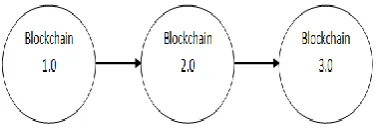
Figure 6. Blockchain version)
Blockchain 1.0: Currency
Distributed Ledger Technology prompted initial and evident appliance: digital currencies. This permits money related exchanges within light of blockchain innovation. It is utilized in money and installments
Blockchain 2.0: Smart Contracts
Tiny PC program that "survive" in the blockchain. They are open PC plans that perform consequently, and check conditions characterized before like help, confirmation or requirement.
Blockchain 3.0: DApps:
Decentralized Application. It used in decentralized distributed system
Blockchain Variants
Figure 7.Block chain variants
Every client possesses a couple of private key and open key. The confidentialinput is utilized to sign the exchanges. The advanced marked exchanges are spread all through the entire system and after that are gotten to by open keys, which are obvious to everybody in the system. Figure 3 demonstrates a case of advanced mark utilized in blockchain. The common advanced mark is included with two stages: the marking stage and the verification stage. Hash function working principle both Alice and Bop message transfer.
The regular computerized signature calculations utilized in blockchains incorporate elliptic bend advanced mark calculation (ECDSA)
Public:Records are obvious to everybody on the web. It enables anybody to confirm and add a square of exchanges to the blockchain. Anybody can utilize an open blockchain arrange.
Private: It permits just particular individuals of the association to confirm and include exchange blocks. Be that as it may, everybody on the web is for the most part permitted to see.
Consortium: Collections of associations can check and add exchanges. The record release or limited to choose gatherings. Syndicate blockchain is utilized cross-associations. It is just prohibited by first approved nodes.
[image:4.595.317.527.86.241.2]J.Blockchain equipmentused in special sectors
Figure 8. Block chain use Markets
• Cash counting, observing and information shift
• Share administration in the
deliverseriessystem,administration area.
• Worldwide customized administration administrations • Voting, recommendations P2P bond,
• Digitization of reports/contracts and confirmation of proprietorship for exchanges
• Registry and Identify • Tele-lawyer benefit • IP enrollment and trade
• Tax receipts Notary administration and report library IOT
• Agricultural and automaton sensor systems • Smart home systems
• Integrated smart city. • Smart home sensors • Person - pouring auto • Robots, automated segment • Digital Assistants
Health
• Data administration
• Worldwide EMR healthiness databanks • Huge wellbeing information stream analytic • Digital wellbeing case elegant assets • Health Token
• Private advancement contract Science and Art • Mass examination
• Point to point assets
• Digital intellectin shape administrations Fund and Accounting
• Digital moneyimbursement • Costs and allowance • Inside bookkeeping
• Reimbursement and trade and derivative • Accounting.
K. Restrictions of Blockchain innovation
[image:4.595.60.283.331.463.2]business which deal with the guideline of Supply and Demand
Slower exchanges: Nodes organize exchanges with senior prizes, excesses of exchanges develop
Littler record: It unrealistic to a full duplicate of the Blockchain, conceivably which can influence unchanging nature, accord, and so on.
Exchange costs, arrange rapidity: The exchanges cost of Bitcoin is very high subsequent to being touted as 'about free' for the initial couple of years.
Danger of blunder: There is dependably a danger of mistake, as long as the human factor is included. On the off chance that a blockchain fills in as a database, all the approaching information must be of high caliber. Nonetheless, human association can rapidly resolve the blunder.
Inefficient: Every hub that runs the blockchain needs to keep up accord over the blockchain. This offers low downtime and makes information put away on the blockchain everlastingly unmovable. Be that as it may, this is inefficient, in light of the fact that every hub rehashes an errand to achieve accord.
III. CONCLUSION
This paper offers a calculated review of blockchains through a depiction of its fundamental innovative capacities and a discourse of its potential business applications. As delineated, contemporary and future blockchain-based advancements length a heap of utilization cases and businesses past computerized money and the budgetary part. Mulling over this, we offer a demonstrative definition that indicates the center components of blockchain innovation autonomous of Bitcoin. Moreover, we depict different practical attributes of blockchain instruments, and offer precedents of business applications where these components can possibly be helpful.
Blockchain innovation looks appealing for IoT. Likewise different innovations which are basically expansion of the conventional blockchain are being created, for example, Tangle which seems extremely appealing. Anyway it is in early stage. Numerous applications have been proposed. Anyway these are as yet confirmation of idea. Many built up associations and new businesses are getting into blockchain and different DLTs in zones, for example, IoT. The reception of blockchain and comparative DLTs in IoT would requires a solid biological system with legitimate and administrative structures and other innovation viewpoints, for example, versatility, preparing power, stockpiling, protection and security and gauges.
Block chain has exposed its latent for transforming usual commerce with its input uniqueness: transference, persistency, shadows and audit ability. This paper first give an outline of blockchain innovationscontains itdesign and input attributes of blockchain. We at that point talk about the commonplace accord calculations utilized in blockchain. We dissect and look at these conventions in various regards. We additionally examine regular blockchain applications. Besides, we show a few difficulties and issues that will upset blockchain improvement and condense some current methodologies for tackling these issues. Some conceivable
future bearings are likewise discussed. Recent days more application developed within short period. Be that as it may, as there are as yet numerous imperfections and points of confinement in savvy contract dialects, numerous imaginative applications are difficult to actualize as of now. We intend to take a top to bottom examination on shrewd contract later on.
REFERENCES
1. Mohamed Amine Ferrag, Makhlouf Derdour, Mithun Mukherjee,Abdelouahid Derhab, Leandros Maglaras, Helge Janicke “Blockchain Technologies for the Internet of Things: Research Issues and Challenges”, arXiv:1806.09099v1 [cs.CR] 24 Jun 2018.
2. ZibinZheng, Guangzhou, China,”
BlockchainChallengesandOpportunities:ASurvey”, Int. J. Web and Grid Services 2017 Inderscience Enterprises Ltd.
3. “IDC, Worldwide Internet of Things Forecast, 2015–2020,” IDC #256397.
4. “IDC, Worldwide Internet of Things Forecast Update 2015–2019,” Feb. 2016, Doc #US40983216.
5. D. Miorandi, S. Sicari, F. De Pellegrini, and I. Chlamtac, “Internet of things: Vision, applications and research challenges,” Ad Hoc Netw., vol. 10, no. 7, pp. 1497–1516, Sept. 2012. D. Puthal, N. Malik, S. P. Mohanty, E. Kougianos, and G. Das, “Everything you wanted to know about the blockchain: Its promise, components, processes, and problems,” IEEE Consumer Electronics Mag., vol. 7, no. 4, pp. 6–14, July 2018.
6. M. Mukherjee, R. Matam, L. Shu, L. Maglaras, M. A. Ferrag, N. Choudhury, and V. Kumar, “Security and privacy in fog computing: Challenges,” IEEE Access, vol. 5, pp. 19293–19304, 2017.
7. M. Swan, Blockchain: blueprint for a new economy, 1st ed. ÓReilly Media, Jan. 2015.
8. F. Tschorsch and B. Scheuermann, “Bitcoin and beyond: A technical survey on decentralized digital currencies,” IEEE Commun. Surveys & Tut., vol. 18, no. 3, pp. 2084–2123, Mar. 2016.
9. IBM (2017) IBM Study: C-Suite Executives Exploring Blockchain Aim to Disrupt, Not Defend.
10. McKendrick J (2017) Blockchain as Blockbuster: Still Too Soon to Tell, But Get Ready, Forbes.
11. Prisco G (2016) Move Over Uber: Blockchain Technology Can Enable Real, Sustainable Sharing Economy.
12. Tasca P, Aste T, Pelizzon L, Perony N (2017) Banking beyond banks and money :springer international publications
13. https://www.pwc.in/assets/pdf/publications/2018/blockchain.pdf
AUTHORSPROFILE
Mrs.V.Usha, Assistant Professor, Vel Tech Rangarajan Dr.Sagunthala R& D Institute of Science and Technology, Avadi, Chennai, India.
Mr. N. Rajkumar,Associate Professor, Vel Tech Rangarajan Dr.Sagunthala R& D Institute of Science and Technology, Avadi, Chennai, India.He was aJava SE 6 Programmer.