International Journal of Innovative Technology and Exploring Engineering (IJITEE) ISSN: 2278-3075, Volume-9 Issue-2, December 2019
Abstract: Recommendation systems play a crucial role in e-commerce by recommending products that suit for the consumers also providing exact information to users. For the past few decades, researchers used many machine learning techniques on recommender system. In recommender system ML based algorithms providing a better detection of user preferences, item features and users-items. In this way deep learning play an increasingly vital role in review recommender systems, since they used a bunch of discrete values for review. However, a problem arises regarding that feedbacks. Discrete values are those which are hard to describe user’s interests. This problem makes it impossible to specifically model user’s choice for recommendation. Purpose of this paper is to introduce a new novel SNN (Sentiment Neural Network) framework for effective recommendation system. SNN frameworks consider two phases. In first phase of SNN framework, this work introduces NLP techniques for converting unstructured data into structured data. This technique includes pre-processing data, feature extraction, word scoring, polarity classification and sentiment analysis. The second phase of SNN framework used for verifying the polarity classes with the real world examples. SNN structures are not only among the best models with reference to prediction accuracy, they also consider the weighting factor on classifier to reduce the training time. A novel Sentiment Neural Network along with knowledge recommender system is suggested for review features extraction, text classification and analyzing review features in the various domains.
Keywords: NLP; Recommender system; SNN; Optimization.
I. INTRODUCTION
Recommender systems had developed a lot of importance in both academic and industry research communities. RS works as a recommendation of products to customers which would destined to their interest. The growth of an efficient Recommender System is crucial in both company and the consumer perspective. Nowadays, people always search the Internet to discover the proper products and services that they need. Recommender system provides the best result for the data encumber problems, by giving more dynamic and personalized information assistance to the users. RS is used in a bulk number of e-commerce sites to personalize the knowledge for their customers. Although the RS suggests products that are calculated on the person‟s taste, they can
Revised Manuscript Received on December 05, 2019. * Correspondence Author
S. Prasanna Priya *, Assistant Professor, Thiru A. Govindasamy Govt Arts College, Tindivanam, Tamilnadu, India.
Email-id: [email protected].
Dr. M.Karthikeyan, Assistant Professor, Department of Computer and Information Science, Faculty of Science, Annamalai University, Annamalainagar, Tamilnadu, India.
Email-id: [email protected].
also be adopted in a more general way to make each website more user-centric. Recommender system collect the opinion and suggestion from the people who are familiar with the options that they faced and also it values their perspectives and recognizes them as the experts. Two basic body which appear in any RS are the user (recommendation provider or recommendation seeker) and the item.
A product user is someone who uses the RS by giving their opinion about number of products and obtains recommendation about the new product through the system. For representing the opinion of the user, the inputs are collected together. These inputs will be in the mode of matrix with item ratings which are like data structure. They combine both content and rating information. The system will at last evaluate the recommendations using these “user profiles” and “recommendation seeker profiles.” Recommender system normally produces two kinds of output namely, forecast and recommendation. Forecast represents a guess: how a user could rate the product for which no evaluation would be made, this requires a highly numerical approach and, as such, the methods that apply best to making predictions are the statistical methods. However, in most e-commerce environments making hard numerical predictions is superfluous. Instead, what is required is a Top-N list. The idea of a Top-N list produces a series of a certain size that contains the user‟s probable most favorite items and also it can be provided to the user as a recommendation list. If it is capable to guess, then it is easy to generate a Top-N list sorting and selecting the n highest prediction. The Product-Product similarity method does not attempt to return the best results, yet it is good and quick. The aim is to forecast the usefulness of a specific product for every user in recommender system.
Collaborative and Content-filtering are the popular recommended techniques in RS domain. The hybrid method and collaborative filter techniques employ various criteria to propose the user fit items particularly. Because of the security apprehensions in CB techniques such as information collection on user profile, methods on collaborative filtering grow into common for personalized recommendations. Of all CF based methods, Matrix Factorization is commonly used method and is based on communication of user-item, in which communication may be rendering as inner latent vectors product.
These techniques are mainly based on three kinds of filtering methods that are Content based, Demographic and Collaborative. The present work mentions about a novel algorithm same as the mode of Sentiment Neural Network. The prime objective of the
recommended work is to analyse the data user feedbacks
Sentiment Neural Network(SNN)-for
Knowledge based Recommender System
with a bunch of discrete values to explain users‟ interests. For accomplishing it, the encoder which was proposed need to remove the noise among the generated continuous data and minimize the training time.
The major contribution that was provided in the proposed work to accomplish the potent encoder for the online user is as follows:
Proposing a Sentiment Neural Network algorithm for recommender system and thus to enhance it. The encoder is focused on all type of feedbacks in
the field of big data.
The proposed encoder prevents the short term association on online recommender systems. The present work on knowledge recommender system with encoder includes the below mentioned sections: Section 2 describe the relevant works on recommender system. Section 3 discusses methodology of the SNN. The design and architecture of encoder is elaborated in this Section. Section 4 explains about the experimental setup and obtained results from the analysis. Section 5 ends the paper with conclusion and explains about the future works.
II. RELATEDWORKS
Recommendation is a common procedure that is performed by people to define their appreciation degrees about something or someone. Recommender System in computer originated to perform during 90‟s. Traditional Recommender System is mostly employed to recommend services, products, or people. The recommendations system provide recommendation movie, letters, and reviews of book printed in magazines and newspapers. For designing a system for recommendation by opinion mining some key points are considered. Several researchers contributed different research kinds of work that are described briefly in this section.
In [1] provide a very robust backup which enhanced the neural networks usage on observed data for addressing the issues regarding CF in which the emphasis was added on the explicit ratings. Consequently, they might not be successful in reflecting the preferences of user due to the positivity of implicit data.
In [2] the author suggests a system that recommends the best restaurant with ratings, preferences and demographic features of a user. The profile of user was based on 3 forms of information: demographic, content and user ratings on restaurant pages. The execution is done by the method of clustering amongst others
In [3] proposed classification algorithm on recommender system. Similarity techniques and procedures for recommendation are the required instruments for generating recommendations. CF and Classification techniques are used to discover users with same behaviors. The system provided the benefit that yields improved accuracy and lower means absolute error values on rating prediction.
In [4], the strategy of integrating the customer‟s description with their behavioral and preferences features in a hybrid recommender system is analyzed. The preferences of user worked as a filter to yield recommendations on job that removed the inappropriate user jobs. On applying these approaches, a crucial growth in forecasting the recommender
system accuracy was achieved.
The work of [5] was on extracting the relevant terms from the reviews of the user and item explanations with importance and sentiment scores. The vector of items is constructed for all distinct users from the similar users‟ reviews and ratings. For all users, a binary model of classification was studied from the vectors derived for recommendation of item [10].
In [6] proposed sentiment and popularity scores on item profile and the items with a shallow NLP method to extract its features as single nouns and bigram phrases, and an opinion pattern mining technique to discover the opinions assigned to the features.
In [7] a novel work was proposed as the classification framework was not appropriate and an innovative inclusive framework was necessary for better research knowledge. Deep learning based RS provide a popularity. A systematic study in this field will results in high scientific and better experimental values. Here the author examined the works from multiple points and furnished a different insights concerning this area.
In [8] the author analyzed recommendation based on deep learning methodologies under the limited conditions and generated the framework of classification that classifies the input procedures and output features.
In [9] they used classification methods to determine the sentiment of tweets about movies. They gathered tweets about six movies from different places in the world and classified them into either positive sentiment, negative sentiment or cognitive sentiment. The cognitive sentiment category was adopted to allocate tweets that did not strictly express positivity or negativity about a movie. The methods which were adopted for classification were Naıve Bayes and Max Entropy. They found that Max Entropy gave the best results with 84% accuracy.
III. RESEARCHMETHODOLOGY
A. SNN-Sentiment Neural Network framework
International Journal of Innovative Technology and Exploring Engineering (IJITEE) ISSN: 2278-3075, Volume-9 Issue-2, December 2019
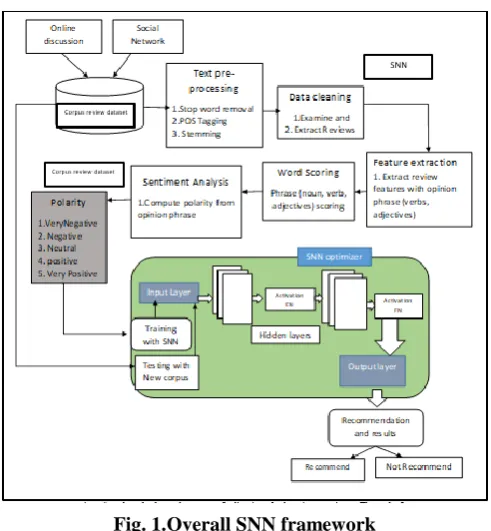
Fig. 1.Overall SNN framework
The first phase explains a simple review in the form of a sentence. Secondly, removing stop words from a review. The third step is applying lemmatization/stem on that sentence. The fourth step is using the Stanford POS (Parts of Speech) tagger which is used extract the important and useful POS in the context. Another tagger of SentiWordNet POS tagger is used immediately after applying POS tagging. Fifth step of POS tagging, used another tagger which is almost same as that of the POS tagger but it calculates the score of that POS words by its weights. Here, by applying some constraints, it only calculates the score of adjectives in the given reviews. The only focus on the adjective based reviews is, adjective is a quality word. It is the word that expresses a noun, which clearly represents the sentiment behind the reviews.
In the sixth step, sentence token score was found out by using Equation (1) it finds adjective words scores in the text. In the seventh step, the sum of all sentiment words in the given sentence is identified by using score sum method. The eighth step shows the most important feature of sentiment analysis, the sentence type of the review. The review is considered positive, very positive, neutral, negative or very negative based upon the review‟s sentence type. The sentence type of this review is obtained by using SentiWordNet dictionary. 1) Data collection
The research data for the present work is related to Amazon and Movie review data. ITS office reports and social network platforms are employed as the source for data collection. This work started with the collection of the reviews of the users, their comments, their posts and the tweets regarding a particular product from different sources such as social media, shopping websites, etc. In this approach, dataset from Facebook and AMAZON.com website is collected. The data are collected for a particular product suggested by the user. In this study, the customers‟ views and reviews are collected from Apple products. The user provides dependent reviews of their experience or emotions or item like and dislike. In this research 3500 reviews were collected from social media and Amazon‟s website.
a) ITS Reports Data:
The online amazon and movie review reports comprised of numerous sentences that are fragmented into simple sentences. Mechanisms for matching keyword are implemented over the collected sentences.
b) Facebook Data:
Specific pages are selected that contain amazon products and movie data. All user posts with emotions and reactions between 2018-March and 2019- January in those pages are gathered that were published.
c) Twitter Data:
Amazon product information is collected from Twitter APIs, like Streaming and REST APIs. Formulate queries were based on keywords 500 keywords associated to Amazon products are used for the queries construction. Although, for every minutes 350 user queries are allowed through REST APIs, and from latest tweets around 3400 tweets were gathered per user query.
Each review in the data set is individually processed. The review preprocessing starts with the tokenization that divides a review piece into smaller units such as tokens. A typical tokenization process can confiscate punctuation from the assigned text and generate text tokens with the NLP PENN TREEBANK. A token can be any word or else a symbol, etc. and it form simple sentences from reviews to make a review file.
2) Data Filtering
Several techniques had been suggested in the sentiment analysis field to filter the noise data. Some are, proximity function, multiple noise filtering system, and manual filtering. Mostly, steps in preprocessing are need in proximity function-based filtering, which may give the results consumes the process time. By using multiple noise filters, each filter can perform a definite task, with respect to detecting the special corrector and misspelling in the text. In manual filtering mode, each sentence in a document should be checked by the experts in order to identify the required text. This Data filtering eliminates all information to enhance rate of classification.
3) Tokenization
Each review in the data set is individually processed. A classic tokenization process [3] can remove the punctuation marks which were there in the input text and generate tokens of the sentences. A token can be anything like a word, symbol, etc.
4) Stop Words Removal
A bunch of meaningless or irrelevant words in a piece of text can seriously affect the accuracy of the output. Hence, removal of such stop words which are there in the input text is an important phase in text‟s sentiment analysis. In the user collected reviews, a stop word can be a preposition,a number, or a person‟s name, a product‟s name, etc. After tokenization each review goes through this phase. NLP library identify list of all stop words from the given text.
5) Lemmatization
common word. The lemmatization technique extract prime word form of a token to get best exact results in further phase that is sentiment analysis phase [3]. It has an ability to drive the words which are in linked forms to a mutual base. A large number of textual documents use words which are in dissimilar forms e.g., mobile, mobiles, mobiles are all attributed to „mobile‟.
6) Parts-of-Speech Tagging
After the lemmatization, the product review‟s text is POS tagged to discover the lexical word location and substance of those words in every sentence. Such lexical position and significance helps in identifying the impact of those in the sentence. The adopted method performs POS tagging along with Stanford POS tagger which is a part of the Stanford CoreNLP library [3]. In these POS tagging phase, each word which was there in a review text about a product, gives a list of its parts of speech. It can tokenize the sentence which means it splits the sentences for the quick understanding and it can fragment the text into pieces.
7) Polarity Analysis of Reviews Document Polarity Score Measuring polarity of a customer‟s review is a key phase in the approach. SentiWordNet 3.0.0 library is used to calculating the polarity score of each word in a review data. Normally it is measuring review‟s polarity score. Polarity of a customer‟s review is a key phase in the used approach. The SentiWordNet 3.0.0 library [5] is used in order to find out each word‟s polarity score in a user‟s review. Each Review polarity score is bought by checking the polarity score of every word in review text. It can be formed by understanding an automated classifier Φ which is used to coordinate to each synsets of WordNet. It produces three types of numerical scores namely, Φ (s, p) (for p P = {Positive, very positive, Negative, very negative, Neutral}) notify the word strength in s, which incorporates each of these five score values. All three Φ (s, p) scores covers from 0.0 to 1.0, and their sum is 1.0 for each synsets. The above classes in synset having non-zero scores which identify the similar terms in the synset. Therefore, it showed that SentiWordNet is employed for detecting and extracting polarity for sentences subjects which showed POS output tag process. By applying all the procedures and techniques of sentiment analysis process, the results are obtained
The equation 1 shows, Positive score of each word is subtracted from the negative scores of each word:
Score (Word sense) = [PosScore]-[NegScore] (1) The equation 2 shows the final score of each word by calculating the average values of every review.
(sense)
=
sense)
i(2)
a) Sentiment analysis and polarity computation
Internal process of Polarity calculation steps elaborately explained in this section.
Tweet review‟s filtration
The SNN uses various user queries to retrieve extremely related reviews and tweets. Various queries are considered for retrieval of tweet, and queries with recall of more than 85 % are used. Subsequently the reviews and tweets retrieved, the rate of accuracy is reduced. The proposed scheme works particular functions to detect the each tweet value.
(3)
(4)
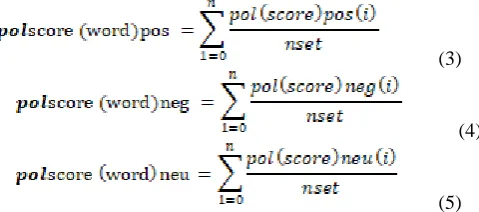
(5) where “Pol,” “pos,” “neg,” and “neu,” show “polarity,” “positive,” “negative,” and “neutral,” respectively. Five kinds of score are obtain when using synsets namely, positive, very positive, negative, very negative and Neutral. It also shows the total number of word synsets.
B. SNN (Sentiment Neural Network) for learning
The proposed model should be able to (1) capture nonlinearities in user interactions, and (2) model user preference dynamics from online data. Therefore, we selected SNN as the basis for the model. They are a class of neural networks which are able to take non-linear relationship complexities in data, and model the sequential on long-term dependencies. SNN used to mitigate the gradient problem or popular vanishing. It might successfully use in many application areas. SNN contains many cell states with chain of repeating modules in each module. And each cell module can store some important information at each input samples. C. Model complexity
[image:4.595.307.547.51.157.2]The SNN model contains Input layer, optimizer layer and output layer. In the input layer all the input data are converted into matrix format. Furtherly, dimensionality of the input data m is first mapped into “k” hidden layer dimensionality and mapped for input data rebuilding. As the SNN model was trained on every users, the retraining and generation of networks complexity are O ((mk + km)) = O(mk). In the hidden layer, the dimensionality of the input data m was adjusted to dimensionality of the output data m over mapping function. So that the distillation complexity layer is O(nm).
International Journal of Innovative Technology and Exploring Engineering (IJITEE) ISSN: 2278-3075, Volume-9 Issue-2, December 2019
1) SNN based Opinion Detection and Sentiment Analysis In this phase each term is classified into appropriate opinion like very positive, positive, neutral, negative, and Very negative. In order to classify various aspects into opinions, a new novel algorithm SNN was used, which is the combination collaborative RNN classification and encoding where the better Classification Accuracy and performance are obtained than Normal RNN LSTM.
Word embedding has increased text mining performance, like sentiment analysis. In the proposed system, a word vector is transverse with the activation function through the hidden layer and generates the words probability distribution in the original words context. The model description is shown in Equation.
t+j)\
w
t)
(6)In the above equation (6), c and T symbolize the total unique words in the dataset employed in training and the words window size correspondingly. wt is the given word and wt+j are its surrounding words. Given word wt, is maximizing average log probability. The outcome of the framework is a semantic vectors array and the semantic correlation among words.
Sentiment Neural Network (SNNs) provides a best accuracy in the task of sequence modeling, like time series, NLP. The predictive model design for the SNN excellence creates planned usage of Review related data in text form. The SNN input and output layers functionality and forward neural network is the similar. Consequently, the current word is simply reflected in the training process. Both time and traditional domain SNN models are presented in Figure 2. The SNN forward propagation is defined in the subsequent equations (7) and (8).
t = f ( W
IXt+WRht-1+bh ) (7)
t=f ( w
yht + by )
(8)
2) Activation functions
SNN prediction accuracy is entirely built on the total amount of Hidden layers and activation function type used. The SNN predictive power is defined by the activation type functions used. Several intricate neural networks exploit the non-linear function activation. NN without an optimization function defined, is just a linear regression model where the predicted output is same as the given input. This is even same as the SNN with defined linear activation function, where the output is same as the input fed with an error. The linear activation function boundary is linear and the network can adjust to only the linear input variations. Hence most of the SNN prefer the usage of non-linear activation functions. The SNN algorithm is accomplished in numerous epochs.
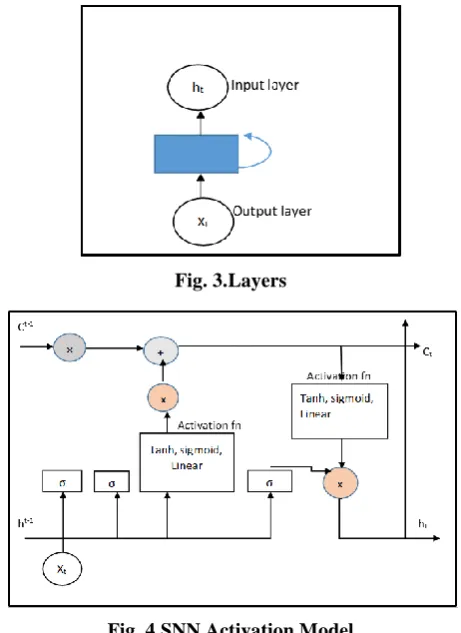
[image:5.595.311.542.49.366.2]The biases and weights are divided among the layer. In this work three activation functions namely tanh, sigmoid and linear are taken for analyzing accuracy. In the layer of output, the softmax activation function that permits the probability on output to be read is employed.
Fig. 3.Layers
Fig. 4.SNN Activation Model
Figure.4. SNN Activation architecture displays great accomplishment in learning dependencies in long distance. The Optimizer unit is displayed in Figure.4 and it was particularly formulated for storing preceding information as a memory cell. The SNN output optimizer can be designed with subsequent phases: Initially, the data along with the preceding network cell weight was to be determined. So, conferring to the formula of SNN, the value of memory cell Ct, Wxc, Whc are calculated at the current state
t
= tanh (WxcX t
+Whch t-1
+bc) (9) It is significant to regulate the current information flow on the state value of memory cell. Therefore, input gate value was calculated to regulate the impact of present information.
t
= xiX
t
+Whih t-1
+WciC t-1
+bi ) (10)
The value of forget gate is computed to control the historical data effect on the memory cell status value
t=
xfXt+Whfht-1+WcfCt-1+bf) (11)
Subsequently the computation of the forget gate value, the current memory cell status value Ct is computed by using Equation
t=ft ʘ Ct-1 + it ʘ Ct
(12)
The output gate value Ot is computed to control the memory cell status value using Equation (13)
Ot=σ (WxoXt + Whoht-1+WcoCt-1+b0) (13)
Lastly, the last optimizer unit of SNN output is computed through the Equation as
t
=Ot ʘ tanh (Ct)
(14) Let yjl(n) be the neuron j signal output in first layer at n epoch, and wjil(n) be the weight of layer among the neuron j at first layer and the preceding layer l−1 at neuron i and it contains neurons (m). During
un-altered and the output signals are calculated on every neuron as
jl
=
jl(n))
(16) Where ∅ is the Activation function and vjl is defined asV
jl(n)=
jily
il-1(n)
(17) The hyperbolic tangent function (tanh) is a commonly defined asj
(n))
(18) The function of rectifier linear unit (ReLU) is additionally broadly used function for activation [11]. In the current work, the signal output range is restricted to 0 and 1 for representing SC. The clamped ReLU function is defined asmin (1, max(0, v
j(n)))
(19) The final output of the SNN is ℎ, which is calculated by by the cell state matrix of input feature and the output gate in output feature matrix at the current time. The SNN model has input data as xt . Its parameters are Wxc ,Whc , Wxi , bi ,Wxf , bf, Wx0 and b0 . The SNN model output layer is accumulated with the softmax function to estimate the output probabilities in (0, 1) and showed that the feature of transportation enclosed in the text of social media and reports from ITS office might be negative or positive.kt
=
(15)In the equation, c and Xkt represent the category of emotion and the time step input k, correspondingly. A series of parameters and text vectors are employed as SNN model input. The parameters are employed in the SNN network layers to accomplish learning of text feature, thus creating and updating suitable sentiment classification results.
3) Sentiment analysis
In the presented work Sentiment Analysis can automatically obtain structured data from the unstructured data of other topic using public opinion that people can express opinions about. In commercial applications this type of data plays an important role, these may cover the areas like, marketing analysis, public relations, product reviews, net promoter scoring, product feedback, and customer service. So in this section the sentiment of a given review getting.
SNN network obtains an input vector x(t) at each step t, that result in y(t) the output vector. This process is repeated until x(n), n being the number of words in the review. Let's fix n=30 words. Until x(n) the SNN network produced y(n) output vectors. Each of these 30 vectors represents something, but not looking the sentiment here. Rather the 30 different vectors y is a encoded review feature representation of s that will be significant in defining the sentiment. y (14) represents the features the sentimental neural networks recognized for the first 14 words of the review. y (30), on the other hand, represents the features for the whole review. However, y (30) vector it is sufficient to use in practice, this wok found that it leads to more accurate results if we use all vectors y (0) — y (30) for sentiment determining. This may be attained by calculating the overall mean value of vectors (y_mean). Lastly, the review feature representation is encoded in y_mean that can be employed to classify the review into the positive or negative categories. For doing that it is essential to increase a finishing classification layer, that is unknown than
the dot product between another weight matrix W and y_mean.
Recommendation of products:
In that phase SNN classifier will calculating the overall positive and negative values for given any product. The product should have recommended, if the product id with cumulative product reviews having, higher positive value. Similarly, the particular product should not have recommended if the product id with cumulative product reviews having, higher negative value.
D. Performance metrics
Evaluating the proposed system performance in terms of four metrics: precision, recall, f-measure, and f-measure that are defined as follow:
Precision (P)
It is a measure of recommended amazon produce relevant to the target user and it is represented in percentage (%). In other words, known positive predictive value is known as precision. It is computed as follows:
(16) Where u represents the target user, T(u)represents the recommended movie reviews to the target user and t(u) represents the relevant movies list for the target user.
Recall (R)
It is a measure of the most relevant amazon product that are recommended for a target user is called recall. It is also referred as sensitivity. It is computed as follows:
(17) F-measure (F)
It is the Harmonic mean value from computed recall and precision. It is computed as follows:
(18) Accuracy (A)
It is one of the important metric that consider for decision making. Here the accuracy for recommendation system is calculated based on the recommendation found during ranking. It is computed as follows:
A =
(19)where ∑TP represents the total true positives, ∑TN represents the total of true negatives, ∑FP represents the total false positives, and ∑FN represents the total false negatives.
Receiver Operating Characteristic (ROC)
The ROC curve is a 2D graph that plots the true positive rate against the false positive rate at Y axis and X-axis respectively.
IV. EXPERIMENTATION
International Journal of Innovative Technology and Exploring Engineering (IJITEE) ISSN: 2278-3075, Volume-9 Issue-2, December 2019
In SNN classification algorithm, three optimization functions namely, SIGMOID, TANH and LINEAR are used. For each time of SNN training values of weighting factor is changed in Neural Network. The quality measure is calculated using percentage of correctly classified instances.
V. RESULTSANDDISCUSSION
The results obtained using the above SNN framework, with different optimizers is presented in this section. The performance of a classifier on the amazon product reviews can be evaluated by looking at the fraction of correctly classified reviews from the test set. The following values obtained from three optimizers, as well as the results of hyper-parameter tuning. For hyper-parameter tuning perform by hold-out cross validation.
Firstly, the performance metrics which are used in this work are described which is followed by validation of the proposed work with previous works. Performance measures for existing system. Sigmoid, tanh and linear optimizers were performed on the Data set.
A. Proposed SNN Performance Metrics
Performance measures for proposed SNN system for various optimizer function shown below. Sigmoid, tanh and linear optimizers were performed on the Data set. Results are presented in the form of figures and tables as shown below. Best accuracy was given by the TANH optimizer function algorithm.
1) Performance Matrix for Optimizer 1: SIGMOID Confusion Matrix:
Table.1 confusion matrix for SNN with Optimizer 1 for 2 different classes
Class A B
Recommended 9 0
Not-Recommended 1 40
Table.2 performance values for sigmoid optimizer with 2 different classes.
Class TP
Rate FP Rate
P Recall F-Measure ROC Area
Recommended 1 0.024 0.9 1 0.947 1
Not
Recommended 0.976 0 1 0.976 0.988 1
Weighted
Avg. 0.98 0.004 0.982 0.98 0.98 1
2) Performance Matrix for Optimizer 2: TANH Confusion Matrix:
Table.3 confusion matrix for SNN with Optimizer 2 for 2 different classes
Class A B
Recommended 9 0
Not-Recommended 1 41
Table.4 performance values for TANH optimizer with 2 different classes.
Class TP
Rate FP Rate
P Recall F-Measure ROC Area
Recommended 1 0 1 1 1 1
Not
Recommended 1 0 1 1 1 1
Weighted
Avg. 1 0 1 1 1 1
3) Performance Matrix for Optimizer 3: LINEAR Confusion Matrix:
Table.5 confusion matrix for SNN with Optimizer 3 for 2 different classes
Class A B
Recommended 8 0
[image:7.595.300.552.183.424.2]Not-Recommended 2 39
Table.6 performance values for linear optimizer with 2 different classes.
Class TP
Rate Rate FP P Recall F-Measure ROC Area
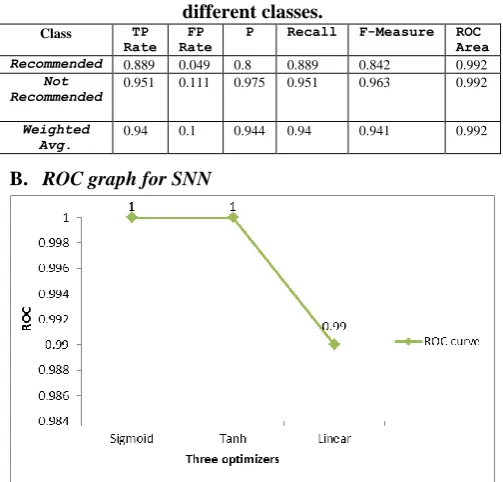
Recommended 0.889 0.049 0.8 0.889 0.842 0.992
Not
Recommended 0.951 0.111 0.975 0.951 0.963 0.992 Weighted
Avg. 0.94 0.1 0.944 0.94 0.941 0.992
[image:7.595.34.542.237.792.2]B. ROC graph for SNN
[image:7.595.314.537.450.677.2]Fig. 5.Graph of ROC curve for Three optimizers Table.7 Accuracy values for SIGMOID, TANH and
LINEAR optimizers SNN framework.
Optimizers Accuracy
SIGMOID 0.9800
TANH 1.0000
LINEAR 0.9400
Fig. 6.Accuracy comparison of different optimizers
C. RMSE for various optimizers on SNN:
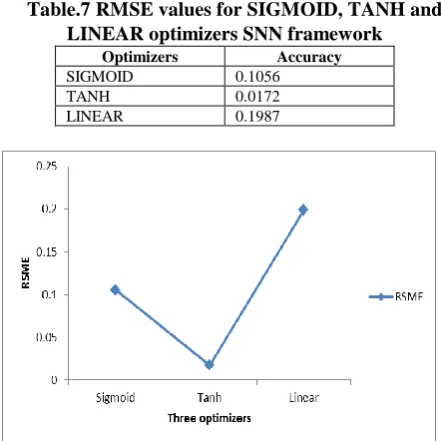
Table.7 RMSE values for SIGMOID, TANH and LINEAR optimizers SNN framework
Optimizers Accuracy
SIGMOID 0.1056
TANH 0.0172
LINEAR 0.1987
Fig. 7.Graph of RMSE for SIGMOID, TANH and LINEAR optimizers
VI. CONCLUSION
In this project, we used different SNN framework in order to reduce the limitations of other machine learning algorithm. While comparing with other existing models, these models works better. The presented models are simple and generic that can be applied or extended to multiple types of recommendation problems. In addition to this, we adopt novel additional contexts including three different optimizer functions for SNN weighting factor to help the model. The result after conducting experiments clearly explains that proposed method is superior to other algorithms. Finding the polarity of the reviews can help in various domains. Intelligent systems can be developed which can provide the users with comprehensive reviews of movies, products, services etc. without the user‟s requirement to go through individual reviews; such that, the user can directly take decisions from the results provided by the intelligent systems.
REFERENCES
1. He X, Du X, Wang X, Tian F, Tang J, Chua TS. “Outer product-based neural collaborative filtering”. arXiv preprint arXiv:1808.03912. 2018 Aug 12.
2. He X, He Z, Du X, Chua TS. “Adversarial personalized ranking for recommendation”. In The 41st International ACM SIGIR Conference on Research & Development in Information Retrieval 2018 Jun 27, pp. 355-364.
3. Devooght R, Bersini H. “Collaborative filtering with recurrent neural networks”. arXiv preprint arXiv:1608.07400. 2016 Aug 26. 4. Dong X, Yu L, Wu Z, Sun Y, Yuan L, Zhang F. “A hybrid
collaborative filtering model with deep structure for recommender systems”. InThirty-First AAAI Conference on Artificial Intelligence 2017 Feb 12.
5. Zhang S, Yao L, Sun A, Tay Y. “Deep learning based recommender system: A survey and new perspectives”. ACM Computing Surveys (CSUR). 2019 Feb 25;52(1):5.
6. Hu B, Shi C, Zhao WX, Yu PS. “Leveraging meta-path based context for top-n recommendation with a neural co-attention model”. In Proceedings of the 24th ACM SIGKDD International Conference on Knowledge Discovery & Data Mining 2018 Jul 19, pp. 1531-1540. ACM.
7. Cai X, Han J, Yang L. “Generative adversarial network based heterogeneous bibliographic network representation for personalized
citation recommendation”. In Thirty-Second AAAI Conference on Artificial Intelligence 2018 Apr 26.
8. He X, Liao L, Zhang H, Nie L, Hu X, Chua TS. “Neural collaborative filtering”. In Proceedings of the 26th international conference on world wide web, International World Wide Web Conferences Steering Committee, 2017 Apr 3, pp. 173-182.
9. Chen J, Zhang H, He X, Nie L, Liu W, Chua TS. "Attentive collaborative filtering: Multimedia recommendation with item-and component-level attention." Proceedings of the 40th International ACM SIGIR conference on Research and Development in Information Retrieval. ACM, 2017.
10. Chen X, Zhang Y, Ai Q, Xu H, Yan J, Qin Z. "Personalized key frame recommendation." Proceedings of the 40th International ACM SIGIR Conference on Research and Development in Information Retrieval. ACM, 2017.
11. Covington, Paul, Jay Adams, and Emre Sargin. "Deep neural networks for youtube recommendations." Proceedings of the 10th ACM conference on recommender systems. ACM, 2016.
AUTHORS PROFILE
S. Prasanna Priya, Assistant Professor, P.G and Research Department of Computer Science, Thiru A. Govindasamy Govt Arts College , Tindivanam, Tamilnadu, India. Email-id: [email protected]
Dr. M.Karthikeyan , Assistant Professor, Department of Computer and Information Science, Faculty of Science, Annamalai University, Annamalainagar, Tamilnadu, India