Int. J. Electrochem. Sci., 9 (2014) 1784 - 1790
International Journal of
ELECTROCHEMICAL
SCIENCE
www.electrochemsci.org
Determination of Electrochemical Parameters for Electrode
Reaction of La(III)/La(0) Redox Couple in a High-Temperature
Molten Salt Solution
Tack-Jin Kim1, Eun Hee Kim2, Do-Hee Ahn1, Kwang-Rak Kim1, Seung-Woo Paek1, Yongju Jung2,*
1
Korea Atomic Energy Research Institute, P.O. Box 105, Yuseong Daejeon 305-353 Republic of Korea
2
Department of Chemical Engineering, Korea University of Technology and Education (KOREATECH), Cheonan, 330-780, Korea
*
E-mail: [email protected]
Received: 7 November 2013 / Accepted: 22 December 2013 / Published: 2 February 2014
The electrochemical parameters on the electrodeposition of lanthanum ions in the LiCl-KCl eutectic salts were determined by linear sweep voltammetry and curve fitting program. Thermodynamic and kinetic data for the electrodeposition of lanthanum ions were successfully extracted by the simultaneous nonlinear regression analysis of several linear sweep voltammograms. The formal potential, the transfer coefficient and the standard rate constant for the La(III)/La(0) redox system were estimated to be -2.13 V vs. Ag/Ag+, 0.61~0.65 and 0.15~0.25 cm/s, respectively.
Keywords: Electrodeposition, Molten salts, La(III), Kinetic parameter, Standard rate constant
1. INTRODUCTION
lanthanide contamination[4,11-12]. To achieve a high-quality SFR fuel, precise understanding on the electrochemical behavior of lanthanide elements is required. So far, most of researchers have paid attention to elucidating thermodynamic properties on the electrochemical reaction of lanthanides [13-16]. Actually, study on kinetic properties has been overlooked for reasons of complexity in data interpretation. Recently, we developed analysis program to be able to extract the kinetic data such as the standard rate constant (ko) and the transfer coefficient () for electrodeposition of lanthanide and actinide elements[17]. For the first time, the methodology was applied to determination of kinetic parameters for the electrodeposition of Ce(III) ions. In this work, the electrodeposition of La(III) ions was studied and relevant electrochemical parameters were calculated from the interpretation of linear sweep voltammetric curves.
2. EXPERIMENTAL SECTION
The high-temperature electrochemical cell containing the LiCl-KCl eutectic salt was well described elsewhere[4]. To make the eutectic salt in a quartz cell, anhydrous LiCl (purity = 99.9%, Aldrich) and KCl (purity = 99.9%, Aldrich) were used. A 0.1 M La(III) solution was prepared by adding solid LaCl3 (purity = 99.99%, Aldrich) to the molten salt. Electrochemical experiments were
performed with a conventional three-electrode system at 7332 K. An inert tungsten (W) and a glassy carbon rod were used as the working and counter electrode, respectively. A silver-silver chloride (Ag/Ag+) redox couple in Pyrex tube was used as the reference electrode[16].
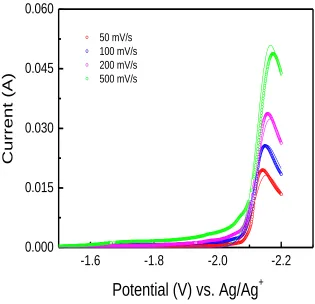
To determine the characteristic parameters (Eo, ko, ) for the electrodeposition of the La(III), linear sweep voltammetry (LSV) was carried out at various scan rates between 50 and 500 mV/s in the potential range of -1.50 to -2.20 V with VMP3 potentiostat (BioLogic Science Instruments). For getting reproducible data, surface of the working electrode was cleaned by electrochemically dissolving La deposits after each experiment. For this, reverse LSV to -1.5 V was performed. To avoid multiple answers which commonly occur in a single LSV curve fitting, simultaneous nonlinear regression analysis for several LSV curves was carried out by using homemade fitting program developed on the basis of the Butler-Volmer kinetic model and the Crank-Nicholson method[18-20]. To simplify the curve fitting of LSV curves, the diffusion coefficient of La(III) was determined from chronoamperometric data measured in the same LiCl-KCl eutectic solution with 0.10 M La(III). Pure faradaic chronoamperometric response for the determination of diffusion coefficient was obtained by subtracting the charging currents due to the electrical double layer on the surface of working electrode. The chronoamperometric current data taken less than 2.0 sec was used to ensure linear diffusion at the rod-type working electrode. For the determination of diffusion coefficient of La(III), linear regression analysis for the chronoamperometric response was performed.
3. RESULTS AND DISCUSSION
i (t ) = nFAD1 / 2C- 1 / 2t- 1 / 2,
where F, A, D and C are the Faraday constant, the electrode area, the diffusion coefficient and concentration, respectively[19]. Diffusion coefficient of La(III) was calculated from the plots of faradaic current vs. t-1/2.
0.0 0.5 1.0 1.5 2.0 2.5 3.0
0.00 0.01 0.02 0.03 0.04 0.05
C
ur
re
nt (
A
)
t-1/2 (s-1/2)
Figure 1. Chronoamperometric current (○) for the electrodeposition of La(III) in the LiCl-KCl eutectic salt at 723 K and the corresponding linear regression line (−).
-1.6 -1.8 -2.0 -2.2
-0.06 -0.04 -0.02 0.00 0.02
Dissolution
C
u
rr
e
n
t (A
)
Potential (V) vs. Ag/Ag
+ [image:3.596.136.432.180.402.2]Deposition
[image:3.596.114.440.467.709.2]
Fig. 1 shows the regression analysis result for the chronoamperometric response of La(III) in the LiCl-KCl eutectic salt. Most of experimental data were excellently fitted to the regression line (R2 > 0.999). Diffusion coefficient of La(III) ions was 1.3210-5 cm2/s, which was very similar to that (1.2610-5 cm2/s) reported by Yamana group[21].
0.0 0.1 0.2 0.3 0.4 0.5 0.6 0.00
0.02 0.04 0.06 0.08 0.10
Q
ox
/Q
red
(%
)
C
a
p
a
c
ity (
C
)
Scan Rate (V/s)
0 20 40 60 80 100
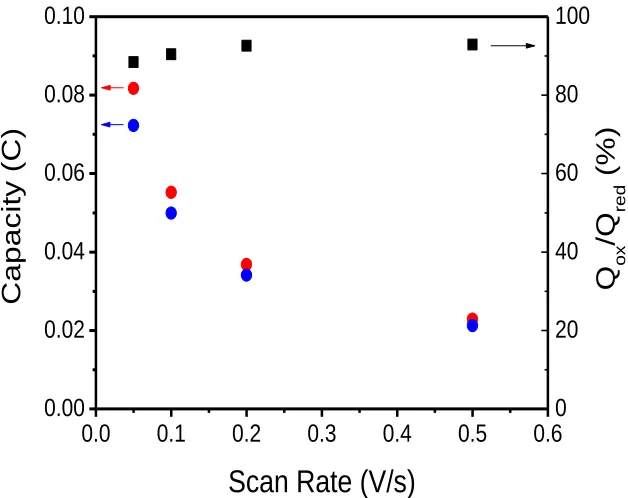
Figure 3. Plots of both deposition capacity (Qred) and dissolution capacity (Qox) vs. scan rate. Plot of
Qred/Qox vs. scan rate
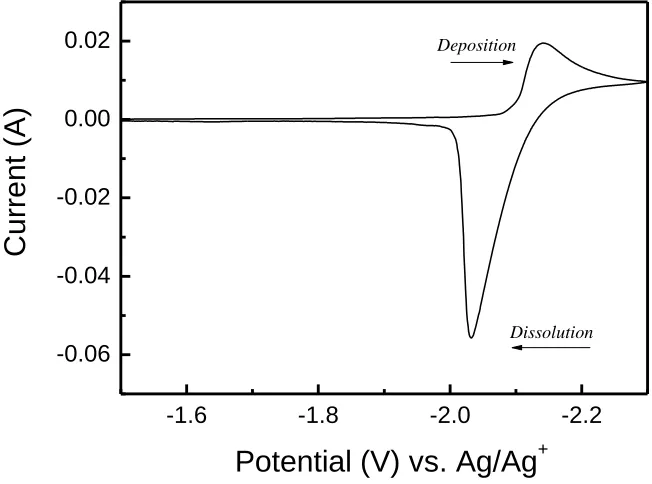
Fig. 2 shows the typical CV curve of La(III)/La redox couple. Both deposition capacity (Qred)
and dissolution capacity (Qox) were measured from the CV curves taken at various scan rates.
Reduction curves are similar to those of general electrode reactions (O + e- → R), where both O and R exist in a solution, but oxidation curves are quite different. Dissolution process of La deposits to La(III) occurs in relatively narrow potential range, resulting in sharp anodic peak current.
Fig. 3 shows the plots of both deposition capacity (Qred) and dissolution capacity (Qox) vs. scan
rate. Both Qred and Qox decreased as scan rate increased, while Qred/Qox slightly increased with scan
rate. At even higher scan rate of 0.5 V/s, a certain amount of La deposits remained on the working electrode at the end of CV experiment. To remove remaining La deposits, initial potential (-1.5 V) was applied to the working electrode for 1 min before next LSV experiment.
[image:4.596.144.458.162.411.2]
1.010-3cm/s is far from the experimental data. This indicate that kinetics of La(III)/La(0) redox couple should be so rapid[19]. Through a number of trial and error, three initial value sets were chosen for nonlinear regression analysis (Table 1).
Table 1. Summary of nonlinear regression analysis for LSV curves of the electrodeposition of La(III) in the LiCl-KCl eutectic salt.
Initial values Curve fitting results
Eo′ (V vs. Ag/Ag+)
α ko
(cm/s)
Eo′ (V vs. Ag/Ag+)
α ko
(cm/s)
-2.10 0.60 0.1 -2.13 0.63 0.23
-2.15 0.55 0.1 -2.13 0.65 0.25
-2.15 0.60 0.1 -2.13 0.61 0.15
-1.6 -1.8 -2.0 -2.2
0.00 0.01 0.02 0.03
exp. data
ko = 10-3 cm/s
ko = 10-2 cm/s
ko = 10-1 cm/s
C
u
rr
e
n
t (A
)
Potential (V) vs. Ag/Ag
+Figure 4. Linear sweep voltammogram (○) for the electrodeposition of lanthanum ions at a scan rate of 0.5 V/s and the theoretical curves (−) simulated under the following conditions: E0'
= 2.15; α = 0.5; ko = 0.1 to 1.0×10⁻³ cm/s; D = 1.32×10⁻⁵ cm2/s; T = 723 K, scan rate = 0.1 V/s.
[image:5.596.113.453.249.568.2]
the charge transfer step controls the process. The value of the transfer coefficient () for the La(III)/La(0) redox couple was 0.61~0.65, implying that the energy barrier for activation was asymmetric and the chemical nature or shape of activated complex resembles that of La(III) ions rather than La elements[19].
-1.6
-1.8
-2.0
-2.2
0.000
0.015
0.030
0.045
0.060
50 mV/s 100 mV/s 200 mV/s 500 mV/s
C
u
rr
e
n
t (A
)
Potential (V) vs. Ag/Ag
+Figure 5. Comparison of nonlinear regression results (−) with experimental LSV curves (○) taken at the various scan rates of 50, 100, 200, 300 and 500 mV/s. Initial values of fitted parameters: E0' = 2.15; α = 0.5; ko = 0.1 cm/s.
4. CONCLUSION
[image:6.596.120.435.182.486.2]
ACKNOWLEDGMENTS
This work was supported by the Education and Research Promotion Program of KOREATECH and the Nuclear R&D program of the Korea Ministry of Education, Science and Technology (MEST).
References
1. P. Masset, C. Apostolidis, R. J. M. Konings, R. Malmbeck, J. Rebizant, J. P. Glatz, J. Electroanal. Chem. 603 (2007) 166.
2. K. Kinoshita, M. Kurata, T. Inoue, J. Nucl. Sci. Technol. 37 (2000) 75.
3. D. Kook, D. K. Cho, M. Lee, J. Lee, H. Choi, Y. Kim, Nucl. Eng. Technol. 44 (2012) 483. 4. T. J. Kim, Y. Jung, S. H. Kim, S. W. Paek, D. H. Ahn, Bull. Korean Chem. Soc. 32 (2011) 863. 5. Y. Castrillejo, M. R. Bermejo, R. Pardo, A. M. Martinez, J. Electroanal. Chem. 522 (2002) 124. 6. T. Kato, T. Inoue, T. Iwai, Y. Arai, J. Nucl. Mater. 357 (2006) 105.
7. O. Shirai, H. Yamana, Y. Arai, J. Alloy Comp. 408-412 (2006) 1267.
8. T. J. Kim, Y. Jung, S. H. Kim, S. W. Paek, D. H. Ahn, Bull. Korean Chem. Soc. 32 (2011) 863. 9. K. Uozumi, M. Iizuka, T. Kato, T. Inoue, O. Shirai, T. Iwai, Y. Arai, J. Nucl. Mater. 325 (2004) 3
4.
10. H. P. Nawada, K. Fukuda, J. Phys. Chem. Solids 66 (2005) 647.
11. J. N. Mathur, M. S. Murali, K. L. Nash, Ion Exch. Solvent Extr. 19 (2001) 357.
12. L. Cassayre, C. Caravaca, R. Jardin, R. Malmbeck, P. Masset, E. Mendes, J. Serp, P. Soucek, J. P. Glatz, J. Nucl. Mater. 378 (2008) 79.
13. G. Cordoba, C. Caravaca, J. Electroanal. Chem. 572 (2004) 145.
14. J. J. Roy, L. F. Grantham, D. L. Grimmett, S. P. Fusselman, C. L. Krueger, T. S. Storvick, T. Inou e, Y. Sakamura, N. Takahashi, J. Electrochem. Soc. 143 (1996) 2487.
15. V. Smolenski, A. Novoselova, A. Osipenko, C. Caravaca, G. Cordoba, Elctrochim. Acta 54 (2008) 382.
16. T. J. Kim, Y. K. Jeong, J. G. Kang, Y. Jung, D. H. Ahn, H. S. Lee, J. Radioanal. Chem. 286 (2010 ) 283.
17. T. J. Kim, D. H. Ahn, S. W. Paek, Y. Jung, Int. J. Electrochem. Sci. 8 (2013) 9180.
18. K. Huebner, E. A. Thornton, The Finite Element Method for Engineers, John Wiley and Sons, Inc. , New York, 1982.
19. A. J. Bard, L. R. Faulkner, Electrochemical Methods, Fundamentals and Applications, John Wiley and Sons, New York, 1980.
20. M. Rudolph, D. P. Reddy, S. W. Feldberg, Anal. Chem. 66 (1994) 589.
21. D. Yamada, T. Murai, K. Moritani, T. Sasaki, I. Takagi, H. Moriyama, K. Kinoshita, H. Yamana, J. Alloy Comp. 444-445 (2007) 557.