http://eprints.whiterose.ac.uk/129156/
Version: Published Version
Proceedings Paper:
Brucker, A.D. orcid.org/0000-0002-6355-1200 and Herzberg, M. (2018) A Formal
Semantics of the Core DOM in Isabelle/HOL. In: WWW '18 Companion Proceedings of the
The Web Conference 2018. The Web Conference 2018, 23-27 Apr 2018, Lyon, France.
International World Wide Web Conferences Steering Committee , pp. 741-749. ISBN
978-1-4503-5640-4
https://doi.org/10.1145/3184558.3185980
[email protected]
https://eprints.whiterose.ac.uk/
Reuse
This article is distributed under the terms of the Creative Commons Attribution (CC BY) licence. This licence
allows you to distribute, remix, tweak, and build upon the work, even commercially, as long as you credit the
authors for the original work. More information and the full terms of the licence here:
https://creativecommons.org/licenses/
Takedown
If you consider content in White Rose Research Online to be in breach of UK law, please notify us by
A Formal Semantics of the Core DOM in Isabelle/HOL
Achim D. Brucker
Department of Computer Science The University of Sheield
Sheield, UK [email protected]
Michael Herzberg
Department of Computer Science The University of Sheield
Sheield, UK [email protected]
ABSTRACT
At its core, the Document Object Model (DOM) deines a tree-like data structure for representing documents in general and HTML documents in particular. It is the heart of any modern web browser. Formalizing the key concepts of the DOM is a prerequisite for the formal reasoning over client-side JavaScript programs and for the analysis of security concepts in modern web browsers.
We present a formalization of the core DOM, with focus on the
node-treeand the operations deined on node-trees, in Isabelle/HOL. We use the formalization to verify the functional correctness of the most important functions deined in the DOM standard. Moreover, our formalization is (1)extensible, i.e., can be extended without the need of re-proving already proven properties and (2)executable, i.e., we can generate executable code from our speciication.
CCS CONCEPTS
·Information systems→Markup languages; Document struc-ture; ·Software and its engineering→Software veriication;
Semantics;Formal software veriication;
KEYWORDS
Document Object Model; DOM; Formal Semantics; Isabelle/HOL
ACM Reference Format:
Achim D. Brucker and Michael Herzberg. 2018. A Formal Semantics of the Core DOM in Isabelle/HOL. InWWW’18 Companion: The 2018 Web Conference Companion, April 23ś27, 2018, Lyon, France.ACM, New York, NY, USA, 9 pages. https://doi.org/10.1145/3184558.3185980
1
INTRODUCTION
In a world in which more and more applications are ofered as services on the internet, web browsers start to take on a similarly central role in our daily IT infrastructure as operating systems. Thus, web browsers should be developed as rigidly and formally as operating systems. While formal methods are a well-established technique in the development of operating systems (see, e. g., Klein [15] for an overview), there are few proposals for improving the development of web browsers using formal approaches [2, 9, 12, 17]. As a irst step towards a veriied client-side web application stack, we model and formally verify the Document Object Model (DOM) in Isabelle/HOL. The DOM [21, 23] isthecentral data structure of all modern web browsers. At its core, the Document Object
This paper is published under the Creative Commons Attribution 4.0 International (CC BY 4.0) license. Authors reserve their rights to disseminate the work on their personal and corporate Web sites with the appropriate attribution.
WWW’18 Companion, April 23ś27, 2018, Lyon, France
© 2018 IW3C2 (International World Wide Web Conference Committee), published under Creative Commons CC BY 4.0 License.
ACM ISBN 978-1-4503-5640-4/18/04. https://doi.org/10.1145/3184558.3185980
Model (DOM) deines a tree-like data structure for representing documents in general and HTML documents in particular. Thus, the correctness of a DOM implementation is crucial for ensuring that a web browser displays web pages correctly. Moreover, the DOM is the core data structure underlying client-side JavaScript programs, i. e., client-side JavaScript programs are mostly programs that read, write, and update the DOM.
In more detail, we formalize the core DOM as a shallow embed-ding [14] in Isabelle/HOL. Our formalization is based on a typed data model for thenode-tree, i. e., a data structure for representing XML-like documents in a tree structure. Furthermore, we formalize a typed heap for storing (partial) node-trees together with the nec-essary consistency constraints. Finally, we formalize the operations (as described in the DOM standard [23]) on this heap that allow manipulating node-trees.
Our machine-checked formalization of the DOM node tree [23] has the following desirable properties:
(1) It provides aconsistency guarantee.Since all deinitions in our formal semantics are conservative and all rules are derived, the logical consistency of the DOM node-tree is reduced to the consistency of HOL.
(2) It serves as atechnical basis for a proof system.Based on the derived rules and speciic setup of proof tactics over node-trees, our formalization provides a generic proof en-vironment for the veriication of programs manipulating node-trees.
(3) It isexecutable, which allows to validate its compliance to the standard by evaluating the compliance test suite on the formal model and
(4) It isextensiblein the sense of [5], i. e., properties proven over the core DOM do not need to be re-proven for object-oriented extensions such as the HTML document model.
Finally, we show the correctness of the functions for manipulat-ing the DOM w.r.t. the assumptions made in the standard.
After introducing Isabelle and higher-order logic in Sect. 2, we introduce the formal data model of the DOM and operations over the DOM in Sect. 3. In Sect. 4, we formalize the requirements for a valid heap, followed by the discussion of the veriication of important properties of DOM operations in Sect. 5. Finally, we discuss related work (Sect. 6) and draw conclusions (Sect. 7).
2
FORMAL AND TECHNICAL BACKGROUND
In this section, we will outline the underlying logical and method-ological framework of our formalization of the DOM node-tree.
2.1
Higher-Order Logic and Isabelle
of Isabelle supporting Higher-order logic (HOL) [1, 8]. It supports conservativity checks of deinitions, datatypes, primitive and well-founded recursion, and powerful generic proof engines based on rewriting and tableau provers.
HOL is a classical logic with equality enriched with total poly-morphic higher-order functions. HOL is strongly typed, i.e., each expressionehas a type'a, writtene::'a. In Isabelle, we denote type variables with a prime (e. g.,'a) instead of Greek letters (e. g.,
α) that are usually used in textbooks. The type constructor for the function space is written using inix notation:'a ⇒ 'b. HOL is centered around the extensional logical equality↓ − ↓with type
'a ⇒ 'a ⇒ bool, whereboolis the fundamental logical type. Functions in HOL are curried and pure, i.e., they take exactly one argument, return exactly one result, and cannot produce side-efects. To simulate functions with more than one argument, we let these functions again return a function, until it will inally return a non-function. Therefore, when reading curried function deinitions, it can be helpful to interpret the chain of function deinitions in the following way: the last type deinition represents the łreturn valueł of the function, whereas the other types in the chain represent arguments to the function. When modeling stateful functions, such as in our case, we usually deine functions that take an argument that represents the state and return an updated version (i.e., a map that contains an additional entry) that represents the state change. The type discipline rules out paradoxes such as Russel’s para-dox in untyped set theory. Sets of type'a Setcan be deined iso-morphic to functions of type'a ⇒ bool; the element-of-relation
↓∈ ↓has the type'a ⇒ 'a set ⇒booland corresponds basi-cally to the function application; the set comprehension{↓ . ↓}
(usually written{_|_}in textbooks) has type'a set ⇒('a ⇒
bool)⇒ 'a setand corresponds to theλ-abstraction.
Isabelle/HOL allows for deining abstract datatypes. For example, the following statement introduces the option type:
datatype'a option − None | "Some 'a"
Besides theconstructorsNoneandSome, there is the match-operation
case x of None ⇒F | Some a ⇒G a. The option type allows
us to representpartial functions(oftencalled maps) as total functions of type'a ⇒ 'b option. For this type, we introduce the short-hand'a ⇀'b. We deinedom f, called thedomainof a partial functionf, by the set of all arguments offthat do not yieldNone. We also make use of the sum type,'a + 'b, and the product type,
'a ×'b. With the sum type, it is possible to express tuples, which, for example, can be used to achieve a similar result to returning a tuple from a function. The product type represents either'aor
'b, and is useful to model errors, as it allows to let functions return either some result on a successful calculation, or return an error.
When extending logics, two approaches can be distinguished: theaxiomatic methodon the one hand andconservative extensions
on the other. Extending the HOL core via axioms, i.e., introducing new,unprovenlaws seems to be the easier approach but it usually leads easily to inconsistency; given the fact that in any major theo-rem proving system the core theories and libraries contain several thousand theorems and lemmas, the axiomatic approach is worth-less in practice. In contrast, a conservative extension introduces new constants (viaconstant deinitions) and types (type deinitions)
only via a particular schema of axioms; the (meta-level) proof that axioms of this schema preserve consistency can be found in [10].
2.2
Shallow Embeddings vs. Deep Embeddings
We are now concerned with the questionhowa language is rep-resented in a logic. Two techniques are distinguished: First,deep embeddingsrepresent the abstract syntax as a datatype and deine a semantic functionIfrom syntax to semantics. Second,shallow em-beddingsdeine the semantics directly; each construct is represented by some function on a semantic domain.
Assume we want to embed a simple logical language BOOL, consisting of the two logical operators _and_ and _or_, into HOL. The semanticsI : expr → env → boolis a function that maps BOOL expressions and environments tobool, whereenvironments env=var→boolmaps variables toboolvalues. Using a shallow embedding, we deine directly:
xandy≡λ e•x e∧y e xory≡λ e•x e∨y e
Shallow embeddings allow for direct deinitions in terms of seman-tic domains and operations on them. In a deep embedding, we have to deine the syntax of BOOL as a recursive datatype:
expr=varvar | exprandexpr | exprorexpr and the explicit semantic functionI:
IJvarxK = λ e•e(x)
IJxandyK = λ e•IJxKe∧IJyKe
IJxoryK = λ e•IJxKe∨IJyKe
This example reveals the main drawback of deep embeddings: the language is more distant to the underlying meta language HOL, i.e. semantic functions represent obstacles for deduction. However; for analyzing certain meta-theoretic analysis, deep-embeddings have advantages. Since we are interested in a concise semantic description of the DOM and eicient proof support (and we are not interested in meta-theoretic proofs), we chose a shallow embedding.
3
FORMALIZING THE DOM
In this section, we will present our formalization of the core DOM which follows the WHATWG speciication [23], the updated version of the W3C DOM 4 standard [21]. This includes the deinition of the tree-like data structure for representing documents and a set of functions for creating and modifying a document.
3.1
The Core DOM Data Model: The Node-Tree
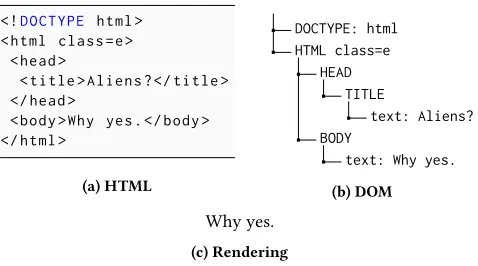
[image:3.612.346.505.351.402.2]The main purpose of the DOM is to provide the data structure for managing tree-structured documents, e. g., following the HTML or XML standard. Fig. 1 illustrates a small example: Fig. 1a shows the textual representation of a simple document (using HTML as syntax), Fig. 1b shows the visualization of the DOMnode-tree, and Fig. 1c shows the rendered output (e. g., in a web browser).
As the DOM models a tree-like data structure, it is not a surprise that the core datatypes of the DOM speciications areDocument
and the datatypeNodewith the two specializationsElementand
<!D O C T Y P E html > < html class − e >
< head >
< title > A l i e n s ? </ title > </ head >
< body > Why yes . </ body > </ html >
(a) HTML
DOCTYPE: html
HTML class−e HEAD
TITLE
text: Aliens?
BODY
text: Why yes.
(b) DOM
Why yes.
[image:4.612.54.293.85.218.2](c) Rendering
Fig. 1: A simple example of a DOM: (a) shows a textual rep-resentation using HTML syntax, (b) a visualization of the node-tree of the DOM, and (c) shows the result of rendering this DOM, e.g., by a rendering engine of a web browser.
the inverse relation already represented by thechildNodesand
documentElementattributes.
While the core idea of formalizing object-oriented data models in an extensible way1follows the construction presented in [3, 5], we difer signiicantly in aspects such as the modeling of typed pointers (references) and late binding of method invocations. Due to space constraints, we will not discuss this in this paper.
First, we start by deining abstract datatypes for typed pointers for the common super-classObjectand the classesNode,Element,
CharacterData, andDocument:
datatype
'object↓ptr object↓ptr − Ext 'object↓ptr 'node↓ptr node↓ptr − Ext 'node↓ptr
'element↓ptr element↓ptr − Ref ref | Ext 'element↓ptr 'character↓data↓ptr character↓data↓ptr − Ref ref
| Ext 'character↓data↓ptr 'document↓ptr document↓ptr − Ref ref | Ext 'document↓ptr
The pointers to the abstract classesobject↓ptrandnode↓ptronly support a constructor for extensions; regular classes also have a con-structor for the reference of the object itself. We use these datatypes to introduce type synonyms representing the actual pointer types for our DOM model (see Fig. 2).
The type polynomials are constructed in such a way that the HOL types for pointers of sub-classes in the object-oriented model are instances of the HOL type of their super-class. This is the key construction allowing an extensible formalization. For details, we are referring the reader to [5].
In the rest of this paper, we will use an underscore to denote the tuple of type variables of the type constructors for pointer and object types. For example, we will write↓ node↓ptrCore↓DOM instead of
('node↓ptr, 'element↓ptr,
'character↓data↓ptr) node↓ptrCore↓DOM
and assume that type variables of the same name are instantiated with the same types.
1This object-oriented form of extensibility allows us, e.g., to later extend the DOM model to a formal model of standards based on the DOM standard, such as HTML, without the need to re-prove properties over the DOM.
Second, we deine HOL types representing objects using the record-package provided in Isabelle. Overall, we use the same con-struction of type polynomials to represent inheritance in HOL. Due to space reasons, we omit the technical details of the type construc-tion. We refer interested readers to the Isabelle formalization [4]. For each class, we deine one record:
record Object −
nothing :: unit record Node − Object +
nothing :: unit record ↓ Element − Node +
tag↓name :: tag↓type
child↓nodes :: "↓ node↓ptrCore↓DOM list" attributes :: attributes↓type
record CharacterData − Node + data :: DOMString
record ↓ Document − Object + doctype :: doctype
document↓element :: "↓ element↓ptrCore↓DOM option" disconnected↓nodes :: "↓ node↓ptrCore↓DOM list"
Due to technical constraints of the record package, we need to introduce an attributenothingfor classes that do not deine at least one attribute themselves. Given these deinitions, we can, e.g., deine aCharacterDataobject as follows:
definition
"CharacterDataExample − (|Object.nothing − (), Node.nothing − (),
data − ''Why yes.'' |)"
Essentially, this models an object-oriented data model of a tree-like data structure, callednode-treein the DOM standard, where (1) the root of the tree is an instance ofDocument, (2) instances of the classElementcan be internal nodes or leaves, and (3) instances of the classCharacterDatacan only appear as leaves.
Finally, we deine a heap for storing node-trees, i.e., instances of our DOM data model. A DOM heap is a map from object pointers to objects:
type_synonym ↓ heapCore↓DOM
− "↓ object↓ptrCore↓DOM ⇀↓ ObjectCore↓DOM"
Where↓ ObjectCore↓DOMis the type synonym for the instantiated super-type of object (similar to the construction for pointers).
Fig. 3 illustrates how the simple document from our example in Fig. 1 can be expressed in our formal DOM heap.
3.2
Operations and Queries on Node-Trees
In the following, we will deine the core DOM methods for creating, querying, and modifying the node-trees that are stored in a DOM heap. We deine the following functions formally in Isabelle/HOL. Fig. 4 provides an overview of their formal type signatures.
All operations are deined over the DOM heap, i.e., they take a heap as input and return either an exception or a tuple containing the return value and a new heap:
type_synonym (↓, 'result) dom↓prog − "↓ dom↓heapCore↓DOM
type_synonym
('object↓ptr, 'node↓ptr, 'element↓ptr, 'character↓data↓ptr, 'document↓ptr, 'shadow↓root↓ptr) object↓ptrCore↓DOM − "(('element↓ptr element↓ptr + 'character↓data↓ptr character↓data↓ptr + 'node↓ptr) node↓ptr
+ 'document↓ptr document↓ptr + 'shadow↓root↓ptr shadow↓root↓ptr + 'object↓ptr) object↓ptr" ('node↓ptr, 'element↓ptr, 'character↓data↓ptr) node↓ptrCore↓DOM
− "('element↓ptr element↓ptr + 'character↓data↓ptr character↓data↓ptr + 'node↓ptr) node↓ptr" 'element↓ptr element↓ptrCore↓DOM − "'element↓ptr element↓ptr"
'character↓data↓ptr character↓data↓ptrCore↓DOM − "'character↓data↓ptr character↓data↓ptr" 'document↓ptr document↓ptrCore↓DOM − "'document↓ptr document↓ptr"
Fig. 2: The HOL types of our extensible, typed pointers for the core DOM. The type polynomials ensure that pointers for sub-classes in the object-oriented data model are instances of the HOL type of the pointer of their super-class.
definition"test↓heap − map↓of [
(cast (document↓ptr.Ref 1), cast (|Object.nothing − (), doctype − ''html'', document↓element − Some (element↓ptr.Ref 1), disconnected↓nodes − [] |)), (cast (element↓ptr.Ref 1), cast (|Object.nothing − (), Node.nothing − (),
tag↓name − ''html'', child↓nodes − [cast (element↓ptr.Ref 2), cast (element↓ptr.Ref 4)], attributes − map↓of [(''class'', ''e'')], shadow↓root↓opt − None |)),
(cast (element↓ptr.Ref 2), cast (|Object.nothing − (), Node.nothing − (), tag↓name − ''head'', child↓nodes − [cast (element↓ptr.Ref 3)], attributes − empty, shadow↓root↓opt − None |)),
(cast (element↓ptr.Ref 3), cast (|Object.nothing − (), Node.nothing − (), tag↓name − ''title'', child↓nodes − [cast (character↓data↓ptr.Ref 1)], attributes − empty, shadow↓root↓opt − None |)), (cast (character↓data↓ptr.Ref 1), cast (|Object.nothing − (), Node.nothing − (), data − ''Aliens?'' |)), (cast (element↓ptr.Ref 4), cast (|Object.nothing − (), Node.nothing − (), tag↓name − ''body'',
child↓nodes − [cast (character↓data↓ptr.Ref 2)], attributes − empty, shadow↓root↓opt − None |)), (cast (character↓data↓ptr.Ref 2), cast (|Object.nothing − (), Node.nothing − (), data − ''Why yes.'' |)) ]"
Fig. 3: The formal representation of a heap containing our simple example DOM (recall Fig. 1).
All operations result in an exception if an argument is invalid, e. g., a pointer that does not represent a valid object in the current heap. We use a heap and error monad for modeling exceptions. This allows us to deine composite methods similar to stateful program-ming in Haskell, but also to stay close to the oicial speciication.
The functioncreate↓elementtakes an (owner)document and the tag name of the new element. It returns the updated heap that includes the new element with no children and no attributes along with a reference to the new element, which is stored in the irst free location in the heap. This ensures that it will not change any existing locations in the heap, which we will prove later. Additionally, the new element is added to the list of disconnected nodes of the given document, as it is not yet part of the node tree.
The functionget↓child↓nodestakes a heap and a pointer to a node and returns a list of pointers to its children. For elements, it returns the children list that is stored in the datatype. For text nodes, it returns the empty list. For documents, we convert their document element into the appropriate node list.
The functionget↓attributelooks up the given attribute in the element’s attribute map. It returnsSome attrif there exists an attribute with the given key, andNoneotherwise. The oicial speciication also has a concept called łrelected content attribute,ž which basically returns the stored attribute of the same name, but returns the empty string if the attribute is not present.
The functionset↓attributeupdates the given attribute of the pointer in the heap. In the oicial speciication, it is not allowed to set the attribute toNoneor null, respectively, to delete the attribute. We generalize this deinition by allowing this.
The functionget↓parent↓nodetakes a pointer to a node and returns a pointer to its parent, orNone, if the node does not have a parent. The case where a node does not have a parent can only occur indisconnectednode-trees, which we will discuss later. Our API does not acceptdocuments, since they can never have a parent. Having the types as narrow as possible will enable easier proofs. The functionget↓parent↓nodeis an example of a method where the oicial speciication leaves much room for interpretation regarding the implementation. It neither provides an algorithm explaining to how obtain a parent, given a node, nor does it specify that the parent reference should be stored in the objects. To avoid specifying additional consistency constraints that would be needed if both children and parent references were to be stored, we implemented
get↓parent↓nodeby searching the whole heap for any node whose
get↓child↓nodescontains the given reference.
create_element :: "tag↓type ⇒↓ document↓ptrCore↓DOM ⇒↓ dom↓prog"
get_attribute :: "↓ element↓ptrCore↓DOM ⇒attributes↓key ⇒↓ dom↓prog"
set_attribute :: "↓ element↓ptrCore↓DOM ⇒attributes↓key ⇒attributes↓value option ⇒↓ dom↓prog"
get_child_nodes :: "↓ object↓ptrCore↓DOM ⇒↓ dom↓prog"
get_parent :: "↓ node↓ptrCore↓DOM ⇒↓ dom↓prog"
remove_child :: "↓ object↓ptrCore↓DOM ⇒↓ node↓ptrCore↓DOM ⇒↓ dom↓prog"
get_element_by_id :: "↓ object↓ptrCore↓DOM ⇒attributes↓value ⇒↓ dom↓prog"
adopt_node :: "↓ document↓ptrCore↓DOM ⇒↓ node↓ptrCore↓DOM ⇒↓ dom↓prog"
[image:6.612.59.558.80.179.2]insert_before :: "↓ object↓ptrCore↓DOM ⇒↓ node↓ptrCore↓DOM ⇒↓ node↓ptrCore↓DOM option ⇒↓ dom↓prog"
Fig. 4: The formal type signatures of the methods for creating, querying, and modifying the core DOM.
The functionget↓element↓by↓idsearches in tree order (depth-irst, left-to-right) for the irst element with the given id. Our dei-nition is more general than the oicial speciication, as we dropped the requirement thatget↓element↓by↓idshould only be available on documents, which is a legacy requirement.
3.2.1 Adopting Nodes. The methodadopt↓noderemoves a node from its previous parent, if it had any, and assigns it to the new
ownerDocument. First, it tries to retrieve the parent of the node to be adopted. If the node has a parent node, it removes the node from the children list, otherwise it removes it from the list of disconnected nodes of the previous owner document. Finally, the node is now added to the disconnected nodes of the new document.
definitionadopt↓node ::
"↓ document↓ptrCore↓DOM ⇒↓ node↓ptrCore↓DOM
⇒ ↓ dom↓prog"
where
"adopt↓node document node − do { parent↓opt ←get↓parent node; (case parent↓opt of
Some parent⇒remove↓child parent node | None ⇒do {
old↓document←get↓owner↓document (cast node); remove↓from↓disconnected↓nodes old↓document
node});
add↓to↓disconnected↓nodes document node
}"
3.2.2 Inserting Nodes.Usinginsert↓before, one can insert arbitrary nodes (i.e., not necessarily in the same node-tree) from the heap into a node-tree:
definitioninsert↓before ::
"↓ object↓ptrCore↓DOM ⇒↓ node↓ptrCore↓DOM ⇒ ↓ node↓ptrCore↓DOM option ⇒↓ dom↓prog"
where
"insert↓before ptr node child − do {
ensure↓pre↓insertion↓validity node ptr child; reference↓child ←(if Some node − child
then next↓sibling node else return child);
owner↓document ←get↓owner↓document ptr; adopt↓node owner↓document node;
insert↓node ptr node reference↓child
}"
Document
Element
Element Element
Element CharacterData CharacterData
Element
Element CharacterData
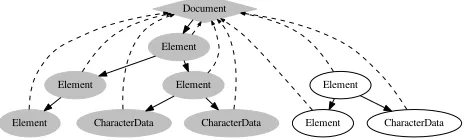
Fig. 5: DOM with a visible document (gray) and a runtime tree (white)
A node that should be inserted needs to fulill cer-tain well-formedness criteria. This is checked using the
ensure↓preinsertion↓validityfunction which formalizes the
concept ofpre-insertion validityfrom the DOM standard. Then, the reference child needs to be determined, which is that node before which the to-be-inserted node should be placed. Then, we adopt the node into the (possibly new) node-tree and actually insert the node into either thechild↓nodesordocument↓elementattributes.
4
WELL-FORMEDNESS OF THE DOM HEAP
Our DOM heap is a map from object pointer to object. While a map alone would allow numerous łillegalž heaps, two features of our formalization already rule out many misconigurations: Our data model is typed and, thus, rules out illegal heaps such as one that contains a document that contains a character data object as its only child. Additionally, our data model omits some ields of the standard, such asparentNode, which we calculate by using the heap andget↓child↓nodes.
Still, some possible illegal heap conigurations remain, such as one with a cyclicget↓child↓nodesrelationship. Thus, we need further well-formedness constraints and we need to show that the DOM methods preserve the well-formedness. We will now introduce predicates that validate whether a given heap conforms to the standard.
4.1
The Owner Document
[image:6.612.323.557.214.284.2]Fig. 5 illustrates this relationship for an example: the gray nodes (connected by solid arrows that visualize theget↓child↓nodes -relation) represent the visible document. The white nodes (con-nected by dotted arrows that visualize theget↓owner↓document
relationship) are forming a temporaryruntime tree. Runtime trees are not serialized (e. g., in an HTML or XML document) and only exist at runtime.
We deineget↓owner↓documentof a node to be the root, if the root is an document; otherwise, we return that document whose
disconnected↓nodescontains said node. In order for this
deini-tion to be well-formed, we need the following predicate:
definitionowner↓document↓valid :: "↓ heapCore↓DOM ⇒bool"
where "owner↓document↓valid h − ( {node↓ptr. ∀doc↓ptr disc↓node↓ptrs.
(h ⊢ get↓disconnected↓nodes doc↓ptr →r disc↓node↓ptrs)
−→node↓ptr∈set disc↓node↓ptrs} − {node↓ptr. ∀ptr.
(h ⊢ get↓root↓node (cast node↓ptr) →r ptr)
−→ ¬is↓document↓ptr↓kind ptr})"
This predicate guarantees us that the set of nodes in all
disconnected↓nodesields is exactly the set of nodes that do not have a document as their root.
4.2
Restricting DOMs to Trees
So far, we do not restrict the relation given byget↓child↓nodes
to beacyclic, which is possible since we use pointers. To prevent this, we can use the following predicate:
definitionacyclic↓heap :: "↓ heapCore↓DOM ⇒bool"
where "acyclic↓heap h − acyclic {(parent, child). ∀children. (h ⊢ get↓child↓nodes parent →r children)
−→child∈cast‘set children}"
We leverage the deinition of acyclicity on relations, i.e., a set of tuples. Our relation contains all pointersparentandchildwhere
childis in the set of children ofparent.
4.3
Node Sharing
The DOM standard assumes that a node cannot be the child of more than one node. This property of heaps is informally implied by the oicial standard, and all tree-modifying methods ensure that such a DOM cannot be built. We, however, must deal with all heaps that conform to our heap type. Therefore, in addition to our heap predicate that guarantees us that all trees in our heap are acyclic, we need a predicate that prevents the nodes from having more than one parent. Therefore, we formally deine another heap predicate:
definitionmaximal↓one↓parent :: "↓ heapCore↓DOM ⇒bool"
where "maximal↓one↓parent h − (∀node↓ptr. (length (sorted↓list↓of↓set {parent. ∀children.
(h ⊢ get↓child↓nodes parent →r children)
−→node↓ptr∈set children})) ≤1)"
The deinition checks whether for any node, the set of possible parents (i.e., pointers whose children contains said node), contains exactly zero or one parents.
4.4
Pointer Validity
Moreover, we need to ensure that objects do not contain invalid pointers (e. g., pointers that do not point to an object stored in the heap of the same type). Otherwise, whenever we work with our pointers, we would have to deal with the possibility of a łnull-pointer exceptionž. Thus, we require:
definition all↓ptrs↓in↓heap :: "↓ heapCore↓DOM ⇒bool"
where "all↓ptrs↓in↓heap h − ((∀ptr children. (h ⊢ get↓child↓nodes ptr→r children)
−→set children ⊆node↓ptr↓kinds h)
∧(∀doc↓ptr disc↓node↓ptrs.
(h ⊢ get↓disconnected↓nodes doc↓ptr →r disc↓node↓ptrs)
−→set disc↓node↓ptrs ⊆node↓ptr↓kinds h))"
The only place where we can ind pointers (without arbitrar-ily constructing them, which should be avoided) is in one of the datatype ields. Therefore, for all pointers in the heap, we re-trieve the corresponding object, and check whether all pointers stored in applicable ields (childNodes,document↓element, and
disconnected↓nodes) are present in the heap.
4.5
Heaps are Strongly Typed
As we model typed pointers and objects, we want to assure that a pointer of a certain type actually maps to an object of the related type in a given heap, e. g., that adocument↓ptractually maps to a document. The following predicate assures us that this holds for the whole heap:
definition matches↓heapCore↓DOM :: "↓ heapCore↓DOM ⇒bool"
where "matches↓heapCore↓DOM −
(∀doc↓ptr∈document↓ptr↓kinds heap.
the (get (cast doc↓ptr) is↓document↓kind heap)))
∧. . .
Similarly to document, the deinition also contains checks for the other classes, which we omitted here due to space constraints. The deinition checks whether for all, e.g., document pointers, the heap actually returns and object for whichis↓document↓kindholds.
4.6
No Multi-Edges
ThechildNodesanddisconnected↓nodesattributes are of type
list. Thus, they may contain duplicates, i.e., the same pointer mul-tiple times. This can lead to strange efects, such as that after
remove↓childhas been called, the pointer still is in the list. This behavior is not addressed by the oicial speciication. We make this requirement explicit:
definition distinct↓lists :: "↓ heapCore↓DOM ⇒bool"
where "distinct↓lists h − ((∀ptr children. (h ⊢ get↓child↓nodes ptr→r children)
−→distinct children)
∧(∀doc↓ptr disc↓node↓ptrs.
(h ⊢ get↓disconnected↓nodes doc↓ptr →r disc↓node↓ptrs)
−→distinct disc↓node↓ptrs))"
We retrieve the lists for every pointer in the heap and require that they are distinct. In Sect. 5.2, we will show a formal proof of the fact thatinsert↓nodeactually can never lead to achildNodes
Table 1: Well-formedness properties of core heap methods
side-efect modiies preserves free only well-formedness
get↓child↓nodes ✓ get↓parent↓node ✓ get↓element↓by↓id ✓ get↓attribute ✓
create↓element ✓ ✓
set↓attribute ✓ ✓
remove↓child ✓ ✓
adopt↓node ✓ ✓
insert↓before ✓ ✓
4.7
Well-Formed Heaps
To put it all together, we deine a well-formed heap as a heap that satisies all discussed constraints:
definitionheap↓is↓wellformed :: "↓ heapCore↓DOM ⇒bool"
where "heap↓is↓wellformed h ←→
finite (object↓ptr↓kinds h) ∧matches↓heapCore↓DOM h ∧
owner↓document↓valid h ∧acyclic↓heap h∧
all↓ptrs↓in↓heap h ∧maximal↓one↓parent h∧
distinct↓lists h"
5
REASONING OVER THE DOM
So far we only deined the DOM data structure, a heap for storing DOM instances, and methods over them. We now discuss the verii-cation of these methods in the sense of formally proving that they preserve the well-formedness of the heap.
5.1
Properties of DOM Methods
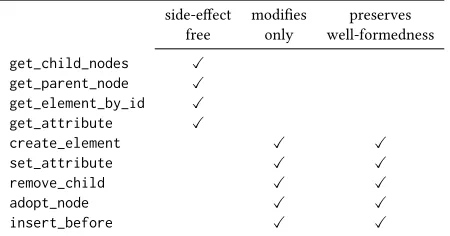
5.1.1 Well-formedness of the Heap Methods. The DOM methods (see Sect. 3.2 and Table 1) can be divided into two categories: All query functions (starting with the preixget↓) use the heap to compute a value, but do not modify the heap. It is therefore easy to show that they preserve the well-formedness of the heap. For all other function, we have to formally prove their correctness w.r.t. preserving the well-formedness of the heap. If all methods preserve the well-formedness then we have shown that any exception-free sequence of DOM methods creates a well-formed DOM heap.
For all methods, we need to prove a lemma of this form:
lemma insert↓before↓preserves↓wellformedness: assumes "heap↓is↓wellformed h"
and "h ⊢insert↓before ptr new↓child ref↓child →h h'"
shows "heap↓is↓wellformed h'"
All variables in lemmas are all-quantiied, meaning they can take all possible values of the corresponding type, only re-stricted by the statements in the assumption. As the predicate
heap↓is↓wellformedis a conjunction of more speciic predicates
(e. g.,acyclic↓heap), we can split the proof for these lemmas into separate proofs that the methods are preserving those more speciic conditions. We will discuss such a proof in more detail at the end of this section. Due to space limitations we will omit most proofs, for which we refer the reader to our full formalization.
5.1.2 Heap Modifications are Local.We want to ensure that heap-modifying functions do not modify the heaparbitrarily. Thus, we irst introduce two predicates that characterize a function by specifying which locations (pointers) and ields are being read or written, respectively:
definition reads :: "(↓ object↓ptrCore↓DOM
×(↓ object↓ptrCore↓DOM ⇒↓ heapCore↓DOM ⇒ ↓ heapCore↓DOM ⇒bool)) set
⇒ ↓ dom↓prog ⇒bool"
where "reads S f←→(∀h h' x. (h ⊢f →r x)
−→(∀(ptr, P)∈S. P ptr h h') −→(h' ⊢f→r x))"
definition writes :: "(↓ object↓ptrCore↓DOM
×(↓ object↓ptrCore↓DOM ⇒↓ heapCore↓DOM ⇒ ↓ heapCore↓DOM ⇒bool)) set
⇒ ↓ dom↓prog ⇒bool"
where "writes S f←→(∀h h'. (h ⊢f →h h')
−→(∀ptr. ∀get∈Sg. (ptr, get) <S −→get ptr h h'))"
Both predicates take a set of pointers and predicates that assert something about the speciied heap location in both the old and new heap. This will be, for example, a predicate checking whether the
attributesield ofElementwill have the same value in both heaps. Thewritespredicate is characterized by these getter predicates that remain unafected, which is why it references a setSg, which contains all such getter predicates for the getters of our classes. For example, for theget↓attributeandset↓attributeDOM methods we prove the following:
lemma get↓attribute↓reads:
"reads {(cast element↓ptr,
element↓getter↓preserved attributes)}
(get↓attribute element↓ptr k)"
lemma set↓attribute↓writes: "writes {(cast element↓ptr,
element↓getter↓preserved attributes)} (set↓attribute element↓ptr k v)"
5.1.3 Exceptions.All our functions can throw exceptions, i. e., they return a sum type ofexceptionand their real return type, which is a common way to model exceptions in functional lan-guages. Therefore, we can provide lemmas that show under which preconditions our functions will return their normal result and not throw an exception. Most functions will throw an exception under exactly one circumstance: if they try to resolve a pointer on the given heap, but the heap does not have an object of the same type stored in that location, i. e., the lookup returnsNone. This is not surprising, since most functions will need to do something with the object, and not just the pointer to the object. For example, we show:
lemma set↓attribute↓ok:
lemmaadopt↓node↓removes↓child:
assumeswellformed: "heap↓is↓wellformed h" andparent↓known: "Óparent.
h ⊢ get↓parent node↓ptr →r Some parent=⇒
is↓known↓ptrCore↓DOM parent"
andadopt↓node: "h⊢adopt↓node owner↓document node↓ptr→h h2" andknown↓ptr: "is↓known↓ptrCore↓DOM ptr"
andchildren: "h2⊢get↓child↓nodes ptr →r children" shows"node↓ptr <set children"
Fig. 6: The methodadopt_noderemoves the node that is to be adopted (proof in formalization document).
lemmaadopt↓node↓children↓remain↓distinct: assumeswellformed: "heap↓is↓wellformed h"
andparent↓known: "Óparent.
h ⊢ get↓parent node↓ptr →r Some parent
=⇒is↓known↓ptrCore↓DOM parent"
andadopt↓node: "h ⊢adopt↓node owner↓document node↓ptr→h h2" andptr↓known: "is↓known↓ptrCore↓DOM ptr"
andchildren: "h2 ⊢get↓child↓nodes ptr→r children" shows"distinct children"
Fig. 7: After usingadopt_node, all children lists remain dis-tinct (proof in formalization document).
5.2
Proving Properties Over DOM Methods
Our DOM model allows us to prove properties of our speciied DOM methods over arbitrary heaps. In proofs, the general line of arguing will usually utilize the fact that heap-modifying methods consist of a series of heap updates in single locations, whose proven properties we can utilize. We will show one example of such a proof to demonstrate how one can work with the formalization.
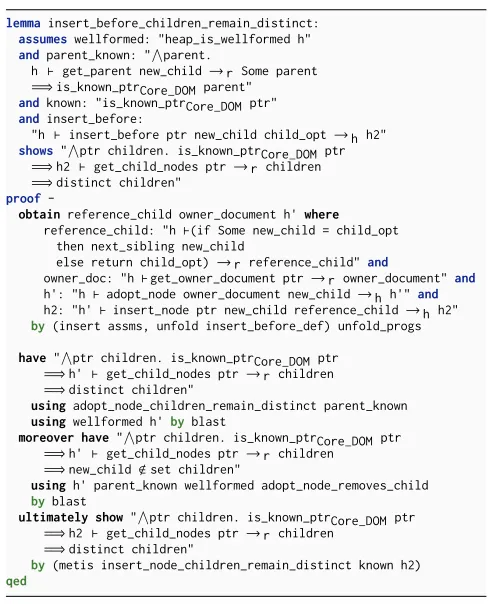
For example, we can prove that usinginsert↓beforedoes cer-tainly never lead to duplicates in the node’s children list, even if a pointer is being inserted that is already in this node’s children. We express this property in our formalization as follows:
lemma insert↓before↓children↓remain↓distinct:
assumes wellformed: "heap↓is↓wellformed h" and parent↓known: "Óparent.
h ⊢ get↓parent new↓child →r Some parent =⇒is↓known↓ptrCore↓DOM parent" and known: "is↓known↓ptrCore↓DOM ptr" and insert↓before:
"h ⊢ insert↓before ptr new↓child child↓opt →h h2"
shows "Óptr children. is↓known↓ptrCore↓DOM ptr
=⇒h2 ⊢ get↓child↓nodes ptr →r children =⇒distinct children"
We irst assume that we start with a wellformed heap. The next two assumptions guarantee us thatptr and the parent, if any,
ofnew↓childare of a known type Ð so either aelement↓ptr,
character↓data↓ptr, ordocument↓ptr. These two assumptions
are necessary to prove something about one of our late-bound functions,get↓child↓nodes and set↓child↓nodes, later. The last assumption introducesh2as the heap after an application of
insert↓before.
The conclusion is to be read as follows: After the use of
insert↓before(h2), all lists of children of all known pointers will be distinct. Fig. 9 shows a formal proof sketch (i.e., a simpliied excerpt of a formal proof using Isabelle’s proof language Isar [22]).
lemmainsert↓node↓children↓remain↓distinct: assumesptr↓known: "is↓known↓ptrCore↓DOM ptr"
andinsert↓node: "h ⊢insert↓node ptr new↓child reference↓child↓opt
→h h2"
and"Óchildren. h⊢get↓child↓nodes ptr→r children
=⇒new↓child<set children"
and"Óptr children. is↓known↓ptrCore↓DOM ptr
=⇒h ⊢ get↓child↓nodes ptr →r children=⇒distinct children" shows "Óptr children. is↓known↓ptrCore↓DOM ptr
[image:9.612.315.559.220.522.2]=⇒h2 ⊢ get↓child↓nodes ptr→r children =⇒distinct children"
Fig. 8: After usinginsert_node, all children lists remain dis-tinct if the child is not already in the children list into which it will be inserted (proof in formalization document).
lemmainsert↓before↓children↓remain↓distinct: assumeswellformed: "heap↓is↓wellformed h" andparent↓known: "Óparent.
h ⊢ get↓parent new↓child→r Some parent
=⇒is↓known↓ptrCore↓DOM parent" andknown: "is↓known↓ptrCore↓DOM ptr" andinsert↓before:
"h ⊢ insert↓before ptr new↓child child↓opt→h h2" shows "Óptr children. is↓known↓ptrCore↓DOM ptr
=⇒h2 ⊢ get↓child↓nodes ptr→r children
=⇒distinct children" proof
-obtain reference↓child owner↓document h'where reference↓child: "h ⊢(if Some new↓child − child↓opt
then next↓sibling new↓child
else return child↓opt)→r reference↓child"and
owner↓doc: "h⊢get↓owner↓document ptr→r owner↓document"and h': "h ⊢adopt↓node owner↓document new↓child →h h'"and h2: "h'⊢insert↓node ptr new↓child reference↓child →h h2" by(insert assms, unfold insert↓before↓def) unfold↓progs
have"Óptr children. is↓known↓ptrCore↓DOM ptr
=⇒h' ⊢ get↓child↓nodes ptr →r children
=⇒distinct children"
usingadopt↓node↓children↓remain↓distinct parent↓known usingwellformed h'by blast
moreover have "Óptr children. is↓known↓ptrCore↓DOM ptr
=⇒h' ⊢ get↓child↓nodes ptr →r children
=⇒new↓child<set children"
usingh' parent↓known wellformed adopt↓node↓removes↓child
byblast
ultimately show "Óptr children. is↓known↓ptrCore↓DOM ptr
=⇒h2 ⊢ get↓child↓nodes ptr →r children
=⇒distinct children"
by(metis insert↓node↓children↓remain↓distinct known h2)
qed
Fig. 9: A formal proof thatinsert_beforepreserves the dis-tinctness of the child nodes list
5.2.1 Proof Structure.Recall the deinition ofinsert↓before
in Sect. 3.2, which consists of two heap-modifying functions:
adopt↓node, which removes the new child from its old parent and updates the owner document, andinsert↓node, which appends the new child to the actual children list. The proof is therefore structured as follows:
it). For this proof, we can use two properties of adopt↓node
that we proved earlier,adopt↓node↓removes↓child(Fig. 6) and
adopt↓node↓children↓remain↓distinct(Fig. 7).
Third, since we know that before the use ofinsert↓nodeall children lists are distinct and do not contain the node that is to be in-serted, we can prove that all children list will remain distinct, as we only insert the given node and nothing else. Again, for this proof, we can use a property that we have already proven aboutinsert↓node,
insert↓node↓children↓remain↓distinct(Fig. 8).
6
RELATED WORK
To our knowledge, there are only very few formalizations of data structures for manipulating XML-like document structures avail-able. Sternagel and Thiemann [19] present an łXML libraryž for Isabelle/HOL. The purpose of this library is to provide XML pars-ing and pretty printpars-ing facilities for Isabelle. As such, it is not a formalization of XML or XML-like data structures in Isabelle/HOL. Our DOM typed formalization shares several design decision with the type-safe DOM API of Thiemann [20]. The most closely related works are [9, 17, 18] in which the authors present a non-executable, non-extensible, and non-mechanized operational se-mantics of a minimal DOM and show how this sese-mantics can be used for Hoare-style reasoning for analyzing heaps of DOMs. The authors focus on providing a formal foundation for reasoning over client-side JavaScript programs that modify the DOM.
A more informal model of the DOM that focuses on the needs of building a static analysis tool for client-side JavaScript programs is presented by Jensen et al. [13]. This model does not focus on the DOM as such, instead the authors focus on the representation of HTML documents on top of the DOM.
Finally, there are several works, e. g., [2, 11, 12] on formalizing parts of web browsers for analyzing their security. These works use high-level speciications of web browsers and do not contain a formalization of the DOM itself.
7
CONCLUSION AND FUTURE WORK
We presented a typed formalization of the Document Object Model (DOM) in Isabelle/HOL. Technically, our formalization is an ex-ecutable shallow embedding of the oicial speciication of the WHATWG [23] and the W3C.
We see several lines of future work. We consider tightening the link between the formal speciication and the actual implementa-tions used by various web browsers as the most important line of future work. One promising approach to achieve this goal is the systematic generation of test cases from the formal speciica-tion using test case generaspeciica-tion techniques hat are integrated into Isabelle/HOL [6, 7]. The generated test cases can, as the already existing manually developed test cases, be used for validating the compliance of actual browser implementation.
Furthermore, there are two promising areas w.r.t. extending the scope of our formalization: irst, formalizing and analyzing the łDOM with Shadow Roots,ž i. e., the new component model proposed as part of the DOM standard of the WHATWG [23]. Sec-ond, using the extensibility of our formalization to add support for
HTMLElement(and its sub-types such asHTMLIFrameElement). As
the concept of iframes is fundamental for restricting information
low between parts of a website originating from diferent security domains, such a formalization would allow us to reason over web security properties in Isabelle/HOL.
Availability. The formalization is available under a 2-clause BSD license in the Archive of Formal Proofs [4]. A copy is also available at https://git.logicalhacking.com/afp-mirror/Core_DOM.
REFERENCES
[1] Peter B. Andrews. 2002.Introduction to Mathematical Logic and Type Theory: To Truth through Proof. Kluwer Academic Publishers.
[2] Aaron Bohannon and Benjamin C. Pierce. 2010. Featherweight Firefox: For-malizing the Core of a Web Browser. InUsenix Conference on Web Application Development (WebApps).
[3] Achim D. Brucker. 2007.An Interactive Proof Environment for Object-oriented Speciications. Ph.D. Dissertation. ETH Zurich. ETH Dissertation No. 17097. [4] Achim D. Brucker and Michael Herzberg. 2018.Archive of Formal Proofs(2018).
http://www.isa-afp.org/entries/Core_DOM.shtml, Formal proof development. Submitted.
[5] Achim D. Brucker and Burkhart Wolf. 2008. An Extensible Encoding of Object-oriented Data Models in HOL.Journal of Automated Reasoning41 (2008), 219ś249. Issue 3. https://doi.org/10.1007/s10817-008-9108-3
[6] Achim D. Brucker and Burkhart Wolf. 2009. HOL-TestGen: An Interactive Test-case Generation Framework. InFundamental Approaches to Software Engineering, Marsha Chechik and Martin Wirsing (Eds.). Number 5503 in LNCS. Springer-Verlag, 417ś420. https://doi.org/10.1007/978-3-642-00593-0_28
[7] Achim D. Brucker and Burkhart Wolf. 2013. On Theorem Prover-based Testing. Formal Aspects of Computing (FAC)25, 5 (2013), 683ś721. https://doi.org/10.1007/ s00165-012-0222-y
[8] Alonzo Church. 1940. A formulation of the simple theory of types.Journal of Symbolic Logic5, 2 (June 1940), 56ś68.
[9] Philippa Gardner, Gareth Smith, Mark J. Wheelhouse, and Uri Zarfaty. 2008. DOM: Towards a Formal Speciication. InProgramming Language Technologies for XML.
[10] Mike J. C. Gordon and Tom F. Melham. 1993.Introduction to HOL: a theorem proving environment for higher order logic. Cambridge University Press. [11] Arjun Guha, Matthew Fredrikson, Benjamin Livshits, and Nikhil Swam. 2011.
Veriied Security for Browser Extensions. InIEEE Symposium on Security and Privacy. 115ś130. https://doi.org/10.1109/SP.2011.36
[12] Dongseok Jang, Zachary Tatlock, and Sorin Lerner. 2012. Establishing Browser Security Guarantees through Formal Shim Veriication. InUSENIX Security Sym-posium, Tadayoshi Kohno (Ed.). USENIX Association, 113ś128.
[13] Simon Holm Jensen, Magnus Madsen, and Anders Mùller. 2011. Modeling the HTML DOM and Browser API in Static Analysis of JavaScript Web Applications. InACM SIGSOFT Symposium and European Conference on Foundations of Software Engineering (ESEC/FSE). ACM, New York, NY, USA, 59ś69. https://doi.org/10. 1145/2025113.2025125
[14] Jefrey J. Joyce and Carl-Johan H. Seger (Eds.). 1994.Higher Order Logic Theorem Proving and Its Applications (HUG). LNCS, Vol. 780. Springer-Verlag, Heidelberg. https://doi.org/10.1007/3-540-57826-9
[15] Gerwin Klein. 2009. Operating System Veriication Ð An Overview.S¯adhan¯a34, 1 (Feb. 2009), 27ś69.
[16] Tobias Nipkow, Lawrence C. Paulson, and Markus Wenzel. 2002.Isabelle/HOLÐA Proof Assistant for Higher-Order Logic. LNCS, Vol. 2283. Springer-Verlag, Heidel-berg. https://doi.org/10.1007/3-540-45949-9
[17] Azalea Raad, José Fragoso Santos, and Philippa Gardner. 2016. DOM: Speciication and Client Reasoning. InProgramming Languages and Systems (LNCS), Atsushi Igarashi (Ed.), Vol. 10017. 401ś422. https://doi.org/10.1007/978-3-319-47958-3_21 [18] Gareth David Smith. 2011.Local Reasoning about Web Programs. Ph.D.
Disserta-tion. Imperial College London, London, UK.
[19] Christian Sternagel and Renè Thiemann. 2014. XML.Archive of Formal Proofs (Oct. 2014). http://isa-afp.org/entries/XML.shtml, Formal proof development. [20] Peter Thiemann. 2005. A Type Safe DOM API. InDatabase Programming
Lan-guages (LNCS), Gavin M. Bierman and Christoph Koch (Eds.), Vol. 3774. Springer, 169ś183. https://doi.org/10.1007/11601524_11
[21] W3C. 2015. W3C DOM4. (19 Nov. 2015). https://www.w3.org/TR/dom/ [22] Markus Wenzel and Lawrence C. Paulson. 2006. Isabelle/Isar. InThe Seventeen
Provers of the World, Foreword by Dana S. Scott (LNCS), Freek Wiedijk (Ed.), Vol. 3600. Springer, 41ś49. https://doi.org/10.1007/11542384_8