The Basicness of Knowing,
Where Semantics meets Philosophy:
The
KNOW
prime of Natural Semantic Metalanguage
and its philosophical implications
Dominie Dessaix
Bachelor of Arts, Honours in Linguistics
The Australian National University
This thesis is submitted in partial fulfilment of the requirements for the degree of Honours in Linguistics in the College of Arts and Social Sciences.
I hereby declare that, except where it is otherwise acknowledged in the text, this thesis represents my own original work.
Table of Contents
List of Tables ... iv
Linguistic Abbreviations ... iv
Abstract ... v
Chapter 1. An Introduction ... 1
1.1 Introduction to the thesis ... 1
1.2 Introduction to NSM ... 5
1.3 The psychological interpretation of NSM ... 8
Chapter 2. The KNOW prime ... 10
2.1 The advent of KNOW ... 10
2.2. The “Grammar” of KNOW ... 12
2.2.1 Syntactic Frames ... 12
2.2.2 Canonical Sentences ... 14
2.3 Which know concept? ... 16
2.3.1 ‘Know’ vs. ‘Knowledge’ ... 17
2.3.2 The analysis of propositional and experiential knowing ... 17
2.3.3 The analysis of know-how ... 22
Chapter 3. Challenges to the universality of KNOW ... 23
3.1 Mparntwe Arrernte ... 23
3.2 Acehnese ... 26
3.3 Dalabon ... 30
3.3.1 Morphological vs. semantic complexity and the issue of “resonance” ... 30
3.3.2 Two further challenges: polysemy of bengkan? ... 33
3.4 East Cree ... 36
3.5 Kalam ... 38
3.5.1 A more “general” mental predicate? ... 38
3.5.2 Responding to Pawley ... 42
3.5.3 “Interprime” polysemy of nŋ-? ... 45
3.6 Other unresolved issues ... 48
Chapter 4. The (un)analysability of ‘know(s)’ in analytic epistemology ... 49
4.1 Williamson’s knowledge-first thesis ... 50
4.1.1 Background: The analytic project and the Gettier challenge ... 50
4.1.2 Williamson (2000) on the irreducibility of 'know(s)’ ... 53
4.2Comparing approaches: Knowledge-first and KNOW ... 57
4.2.1 Some striking similarities ... 57
4.2.2 Criticisms of Williamson from an NSM perspective ... 59
4.3 Does knowing entail truth? ... 62
Chapter 5. Cultural variation in ‘knows’ in experimental philosophy ... 63
5.1 Weinberg, Nichols & Stich (2001) ... 63
5.2 Method and metalanguage ... 66
5.2.1 General methodological issues and non-epistemic sources of variation ... 66
5.2.2 Linguistic-specific methodological issues ... 68
5.3 A non-semantic explanation: Epistemic norms and cultural scripts ... 71
5.4 The importance of metalanguage: using NSM in experimental philosophy ... 75
Chapter 6. Conclusion and directions for further research ... 77
References ... 79
Appendix I. NSM Primes, English Exponents (2015) ... 88
List of Tables
Table 1. Syntactic Frames for the mental predicates (KNOW, THINK, and WANT)
Table 2. Some canonical sentences for KNOW
Table 3. Mental predicate primes in East Cree (intransitive/transitive pairs)
Linguistic Abbreviations
1,2.. 1st person, 2nd person …
A Agent (of transitive verb)
DAT Dative
DEM Demonstrative DU Dual
F Future LOC Locative
NEG Negative
NEGBE A compound of negation and copular
NPP Non-past progressive P Past
PC Past completive
Poss Possessive
PR Progressive
PRIOR Prior action to next verb
S Subject (of intransitive verb) SG Singular
SS Same subject as next verb
Abstract
The topic of this thesis is the semantic prime KNOW of Natural Semantic Metalanguage (NSM) theory. I take an in-depth look at this NSM prime, proposed to be a fundamental concept found in all the world’s languages, considering both linguistic and broader philosophical issues in relation to the KNOW hypothesis, i.e. the proposal that the concept represented by KNOW is a
legitimate NSM prime. After introducing NSM and defending a specific “psychological” interpretation of the theory (Chapter 1), I outline the KNOW proposal, including discussion of the
combinatorial properties ascribed to it and how they have evolved in recent years (Chapter 2). I then look at would-be counterexamples to the universality of KNOW from a handful of languages (Chapter 3). I argue that overall the prime stands up well to these challenges, though the case of Kalam (Pawley 1994) does raise some issues that require further investigation and possibly novel kinds of testis to resolve. Then in the first part of the “philosophical” side to the thesis, I draw a comparison with the KNOW hypothesis and Timothy Williamson’s (2001) view that
knowing is a conceptually fundamental concept, finding both striking similarities and instructive differences between the positions (Chapter 4). Lastly, I consider the “experimental philosophy” findings made by Weinberg et al. (2001) on what looks like cultural variation in concepts of knowing, addressing the question of whether such results are problematic for the universality of the KNOW prime (Chapter 5). Here I contend that such studies do not pose a threat to KNOW,not least because they come with a multitude of methodological issues, including specifically linguistic issues, many of which could be prevented by constructing NSM-based questionnaires. In Chapter 6, I conclude, pointing to several important avenues for further research brought up by the discussion, both on the subject of continued research on the KNOW prime and in relation
Chapter 1. An Introduction
1.1 Introduction to the thesis
The subject of this thesis is the semantic prime KNOW1 of Natural Semantic
Metalanguage (NSM). NSM is a theory of meaning originally due to Anna Wierzbicka (1972), which has since flourished into a fully-fledged research program (e.g. Goddard & Wierzbicka 1994, 2002). According to the NSM view, there exists a small set of cross-linguistically universal and semantically unanalysable concepts, the semantic primes, in terms of which all other concepts of all the world’s languages are hypothesised to be definable, in the form of “reductive paraphrases” called explications.2 There are currently 65 proposed semantic primes, each
hypothesised to have lexicalised counterparts (exponents) in all languages, and each accompanied by a set of combinatorial rules (syntactic frames) specifying how it can combine with the other primes. The NSM approach has significant practical applications wherever cross-cultural communication is involved (Goddard 2002a, 2010; Wierzbicka 1997). But quite apart from its considerable usefulness in applied contexts, NSM is also of enormous theoretical interest, not only because it makes substantial universalist and variationist claims about language (Goddard 2001) but because of what I see as its far reaching implications for other disciplines, such as philosophy and the cognitive sciences.
The purpose of this thesis is essentially to take an in-depth look at KNOW,
examining both the NSM proposal itself, and how that proposal bears on some
1 Small capitalisation is always used for the NSM primes.
2 Both here and elsewhere in the thesis, the process of explication is described as “reductive” just because it involves
philosophical literature. On the linguistics side of things, I outline the NSM proposal about KNOW, discussing some of the ways in which it has evolved in recent years,
and I address several possible challenges to the cross-linguistic universality of the prime. In the philosophical part of the thesis, I consider how the KNOW hypothesis3
relates to some branches of analytic epistemology, i.e. the philosophy of knowledge within the analytic tradition. But why look in such detail at what is essentially one sixty-fifth of a theory of meaning? I have two reasons. The first is a general one: it is my contention that every NSM prime deserves (at least) the kind of attention that this thesis aims to give to KNOW. For while NSM can and should be evaluated as a
whole, each NSM prime is also an independent hypothesis about the presence of a semantically simple concept in all languages, and as such requires in-depth consideration of its properties, defence from any would-be counterexamples, and discussion of any specific implications that it may have outside of semantics proper. The second reason is related specifically to the KNOW prime.At risk of displaying a
little favouritism, I believe this prime is one of the most interesting proposed NSM primes, not least because the claim that ‘knowing’ is a fundamental concept of human languages directly bears on an entire foundational field of contemporary analytic philosophy.
The thesis will proceed as follows. In what remains of this introductory chapter, I give a brief overview of NSM, then I argue for what I am calling the “psychological” interpretation of the theory, which involves the idea that NSM is best understood as a substantial psychological claim, rather than “just” a heuristically valuable methodology for comparing concepts across languages and
3 Note that throughout the thesis I willrefer to “the
cultures. I also defend the idea that in certain cases, behavioural evidence of the kind sought in the psychological sciences may be necessary to properly support specific NSM claims. In Chapter 2, I look at the KNOW proposal in detail, both setting out its
current grammar, and discussing some of ways this grammar has evolved over recent years. For example, I discuss the recently proposed explication for the commonly lexicalised concept of “experiential” or “familiarity” knowledge, e.g. French connaître and German kennen (Goddard & Wierzbicka 2013), thereby eliminating the problems with earlier attempts to treat those concepts as basic instantiations of the KNOW prime. In Chapter 3, I move to the subject of the proposed
challenges to the universality of KNOW. I consider five languages in some detail:
Arrernte (Harkins & Wilkins 1994), Acehnese (Durie et al. 1994), East Cree (Junker 2008), Dalabon (Evans 2007), and Kalam (Pawley 1994). The first three cases are not presented as counterexamples to KNOW,but the identification of the prime in
each of these languages presents some instructive obstacles; in the case of Dalabon and Kalam, however, the respective authors do argue that the language lacks a distinct exponent of the prime. I show that only in the case of Kalam is there any problem with disambiguating KNOW,due to the presence of “interprime polysemy”
between primes of a similar conceptual category, and I argue that the best way to answer to this problem is to conduct more rigorous testing, not just language-internal tests of the kind that is typical of NSM research, but behavioural experiments designed to try to get at speakers’ semantic representations from another angle.
Chapters 4 and 5 are concerned with the intersection between the NSM and philosophy. Here I will consider how each of the two claims that are involved in the
relate to parts of the analytic epistemological literature. Thus Chapter 4 will be concerned with the “analytic project”, i.e. the traditional project to reductively define the concept of knowledge in philosophy, especially as it has evolved in response to Gettier cases, which are hypothetical cases that are thought to show the insufficiency of the once standard analysis of knowing as ‘justified, true belief’ (Gettier 1963). More specifically, I discuss Williamson’s (2001) alternative view of epistemology, the “knowledge first” thesis, essentially a rejoinder to the analytic project, whereby ‘knows’ is instead proposed to be fundamental and irreducible. Here I argue that there is an interesting consonance between this view and the KNOW
hypothesis, but I also outline several ways in which, from an NSM perspective, Williamson’s argumentation falls short. I also suggest how NSM may be helpful in testing some residual questions in relation to philosophers’ intuitions about the constituent conditions of ‘knows’, in particular, the apparent entailment between ‘knows’ and ‘true’. Chapter 5 centers on how newer work in epistemology, part of the so-called “experimental philosophy” movement, relates to the other main claim involved in the KNOW claim, viz. its universality. Here I critique the findings of
KNOW is a universal semantic prime. I also show how NSM could be immensely
useful in constructing more rigorous experiments for testing epistemic intuitions cross-culturally and cross-linguistically. In Chapter 6, I offer some concluding remarks and point to some of the most promising lines of further research on KNOW.
I take the upshot of the thesis to be threefold. Firstly, the NSM proposal that
KNOW is a semantic prime stands up well, overall, to the purported challenges to its
universality, particularly in light of developments in the proposal of the last few years. Secondly, if we are willing to embrace the consequences of the psychological interpretation of NSM, there is a promising way forward for dealing with residual issues in difficult cases like that of Kalam’s apparent interprime polysemy, namely the construction of behavioural tests to support standard language-internal investigation. And thirdly, the KNOW hypothesis is rich in implications for
philosophy, and further exploration into the many points of intersection should be rewarding on all sides.
1.2 Introduction to NSM
As I have said, NSM is a theory of meaning and a methodological approach to the study of linguistic meaning. Originally due to Wierzbicka (1972), NSM has since developed in leaps and bounds, having been studied in dozens of languages, over a good range of language families (Goddard & Wierzbicka 1994; Wierzbicka 1996; Goddard & Wierzbicka 2002; Goddard 2008).4 As I have said, the current proposal consists of 65 primes (Appendix I), each with its own combinatorial syntax, the
syntactic frames, essentially the rules specifying how a prime can combine with the other primes. The idea is that all the other concepts of all the world’s languages are
reducible to (and at some basic psychological level, can only be understood in terms of) the primes plus their associated syntax, resulting in reductive definitions called
explications (Appendix II).
For the approach to be successful, then, all languages need to be shown to have exponents (lexical instantiations) of all the primes, which need not be single words, and may instead be bound morphemes or phrasemes. Sometimes a language will have two or more realisations of one prime, with the choice dictated by some local grammatical feature, such as case, as in English I~ME exponents.5 This is
called (syntactically-constrained) allolexy and does not present a problem provided 1) there is no specifiable difference in meaning between the two forms, and 2) the grammatical constraint can be clearly identified. And finally, an exponent of a prime may be polysemous, that is, it may have some additional, non-prime meanings specific to that language. Each case of polysemy is taken seriously by NSM researchers, but the general point is that it does not constitute a challenge to the existence of the prime in that language provided the prime meaning can be differentiated from the non-prime meanings. Standard tests for polysemy are used for this, such as 1) identifying disambiguating grammatical contexts, where one sense of the word can be forced by a given grammatical environment; and 2) locating what could be dubbed constrained antonymy, cases where only one of several senses of a word can be contrasted with another concept.
Another central tool in NSM research are the primes’ canonical sentences, i.e. basic sentences couched predominately in NSM,6 the attempted translation of
which is used to establish the existence and behaviour of a prime in a given language
5 Where the tilde indicates allolexy.
6 I say ‘predominately’ because other non-prime elements can be slotted into a canonical sentence. For example,
(Goddard & Wierzbicka 2015, 2014b). Canonical sentences are supposed to capture the proposed universal meaning of the concept and, ideally, to exclude any extended, metaphorical or other possible meanings that the exponent of the prime may have in some, but not all, languages. The idea is that if such sentences can be translated without the addition or loss of any paraphrasable meaning, then the hypothesis that the prime exists in that language is supported. Note that canonical sentences were first used in a heuristic capacity in NSM research but have since evolved to have a theoretically significant role (Goddard & Wierzbicka 2002: 42). Canonical sentences are now seen to do the important job of “exemplify[ing] hypothetical combinatorics of the primes” (loc. cit.). That is, they are the “filled in” versions of the basic combinatorial possibilities available for the prime.
It must also be stressed that it is not the prime’s lexical form simpliciter that is supposed to be unanalysable and universal across languages, but rather the prime
plus its combinatorial properties and valency options, as specified by the syntactic frames posited for the prime. In fact, it could argued that it is the prime only as it appears in its syntactic frames that is proposed to be basic and universal.
a whole range of broadly “pragmatic” features of language use that do not pertain to the fixed meaning of the concepts involved (Goddard & Wierzbicka 2004).
1.3 The psychological interpretation of NSM
As I have intimated, NSM can be interpreted in a variety of “strengths”, anything from a heuristically helpful approach to cross cultural communication, to a full-blown metaphysical claim about what constitutes the “alphabet of human thought”7,
or to put the latter more plainly, as a claim about our psychological resources or capacities. I believe that this latter the best way to make sense of NSM theory. On this view, NSM is not just a practically valuable approach to studying meaning across cultures. Rather, the primes and their associated grammar are proposed to be psychologically real elements of human cognition. This interpretation of NSM is close to that expressed in Goddard et al. (2014), who align NSM with a sort of “language of thought” hypothesis.8 Part and parcel with this kind of “realist” view of NSM is the idea that the primes are somehow realised in the brain, and thus must ultimately be given both ontogenetic (developmental) and phylogenetic
(evolutionary) explanations.
Whether or not all NSM researchers would be happy to accept this interpretation of the theoretical underpinnings of the approach is an open question, but I would argue that the psychological interpretation of NSM just described falls out quite naturally from the theory’s claims. After all, NSM theory is the hypothesis
7 An idea associated with seventeenth century thinkers, especially Leibniz (e.g. 1961[1903]) as often cited by
Wierzbicka, e.g. in her (1997: 22) and (1972: 8).
8 A term popularised by Fodor (1975). But while the NSM view is reminiscent of Fodor’s ideas in very rough outline –
that the (final list of) primes are the only concepts found in all languages that aren’t understood in terms of other concepts and via which all other concepts must be understood. But why should this be true? Unless it is by some great accident, the most ready explanation is that the NSM primes are psychologically real conceptual atoms that are “inherent in the cognitive apparatus of Homo Sapiens” (Goddard et al. 2014: 61).9
A final point is that if the psychological interpretation of NSM is right, this suggests that behavioural evidence of the kind strived for in the discipline of psychology could play an important role in supporting conclusions of NSM research. That is, I think NSM researchers should be open to using controlled behavioural experiments into speakers’ semantic intuitions, in addition to the language-internal tests discussed in §1.2 – whether it is to support the distinctness of two primes that share some morphological material (§3.3), or to help settle a particularly problematic case of polysemy (§3.5). This may involve what might be dubbed “button-pushing” tests,10 or verbal questionnaires that avoid the method of
direct elicitation. What is important about such tests is that, when conducted properly, they may point more directly to speakers’ semantic representations than language-internal tests could ever be expected to. Of course, designing sophisticated and well-controlled experiments of this kind is no easy feat, but nevertheless, I think the incorporation of such methods constitutes an important part of setting NSM claims on the strongest possible theoretical and empirical foundations.
9 The term “innate” knowledge springs to mind here, but I avoid using this term due to its rather hairy application in the
sciences. See Mameli & Bateson (2006), and Samuels (2004) for discussion.
Chapter 2. The
KNOW
prime
In this chapter we delve into the subject of the thesis proper: the proposal that a concept of ‘knowing’ is a universal semantic primitive.
2.1 The advent of
KNOWKNOW is now an established member of the NSM inventory, but it was not one of
the original fourteen proposed by Wierzbicka (1972). Wierzbicka’s original idea was that ‘know’ (or rather Polish wiedzieć) could be defined in terms of ‘can say’, as in the following example, applied to an instance of propositional knowledge:11
(1) Ja wiem, że stolicą Portugalii jest Lizbona.
= Ja mogę powiedzieć, jakie miasto jest stolicą Portugalii: Lizbona.
I know that Lisbon is the capital of Portugal.
= I can say what town is the capital of Portugal: Lisbon.
In Lingua Mentalis (1980: 156), however, Wierzbicka discussed an objection that threatened this analysis, in the form of an argument from Andrzej Bogusławski (1979) on the attribution of ‘knowing’ and ‘saying’ to animals. In brief, Bogusławski argued that while it doesn’t make sense to talk of animals ‘saying’ things, it is intelligible to talk of their ‘knowing’ things. According to Wierzbicka (1980), if this were correct, the analysis of ‘knowing’ in terms of what one ‘can say’ would be undermined, and absent a viable analysis, would suggest that the concept may in fact be best treated as basic and unanalysable (as per Bogusławski’s view)12.
11 As analysed in her Dociekania Semantyczne (1969) (Anna Wierzbicka, personal communication, February 2016). 12 See Bogusławski (2007) on the idea that knowing, or in particular, knowing that, is a primitive or “key” concept, a
Is Bogusławski right? There certainly does seem to be a widely-held folk belief that “higher” animals (at least) can know things. Testament to this is the fact that many epistemologists will reject an analysis of knowledge that does not allow for animal knowers, on the grounds that it is too demanding (e.g. Dretske 1985: 177; Bonjour 2005: 242).Behavioural ecologists also talk seriously about animals know things, beyond a mere anthropomorphic metaphor (e.g. Bekoff 2003; see also Kornblith 1999).13 As to whether animals can be regarded as ‘saying’ things, I would tend to agree with Bogusławski that (with the exception of our pets, perhaps) it does sound odd to talk of animals ‘saying’ things.14 Leaving aside this argument,
however, (1) falls short for other reasons. For one thing, it cannot account for certain non-propositional or non-verbalisable knowledge, in particular ‘know how’ meanings, such as ‘I know how to swim’. Such a sentence simply cannot be reduced to what the subject ‘can say’: my knowing how to swim does not mean I can say
anything about what it is that I know.15
Wierzbicka (1980: 37, 156) indicated her sympathy to Bogusławski’s argument, and to the possibility that ‘knowing’ might be best considered a primitive concept. By the time of Lexical and Semantic Universals (Goddard & Wierzbicka 1994), KNOW had taken its place in the NSM inventory, with its existence being
attested in a wide variety of languages in this volume, among them French, Polish, Chinese, Longgu, Yankunytjatjara, and Ewe.Since then, it has been tested in tens of other languages, including, for example, Malay (Goddard 2002b), Italian (Farese
13 At least, Bekoff talks of “higher” animals such as orcas and monkeys knowing things (2003: 5, 57). I am unsure to
what extent it is common among biologists to talk about “lower” animals (e.g. insects) knowing things in a non-metaphorical sense.
14 Though the extent to which saying is equated with verbal communication is important here; the meaning of the NSM
prime SAY is not exclusively verbal (a meaning which can be expressed in NSM as ‘say with words’). While animals obviously cannot say things with words, perhaps they can be regarded as saying things with their bodies. It is still my feeling that this would be odd to say of animals besides our pets, but the intuition needs further investigation.
15 To be clear, as we will see later “knowledge how” is not seen as reducible to “knowledge that” on the current view
2015), Amharic (Amberber 2008), East Cree (Junker 2008), and Wolof (Bondéelle 2015). Thus I think it is fair to that the KNOW hypothesis has significant empirical
support, having been tested in a significant number of languages, drawn from a reasonably wide range of language families. Of course, one can always counter, à la Evans and Levinson (2009), that the number of languages spoken far exceeds the number of languages tested, by several orders of magnitude. But I think it would be excessive to suggest that we need to test each and every language in order to say that a prime is cross-linguistic universal; it is methodical sampling of a considered variety of language families that is required, and this is what NSM research is aimed at. Of course, as ever in linguistics, investigating more languages is desirable, but the incompleteness of the NSM program does not constitute an argument against its plausibility.
Now that I have traced how KNOW came to enter the NSM inventory and the
extent of the testing so far, it is time to consider the proposal in more detail. In the following section I will outline the “grammar” currently ascribed to the prime.
2.2. The “Grammar” of
KNOW2.2.1 Syntactic Frames
The valency options of KNOW, then, are similar to those available for the
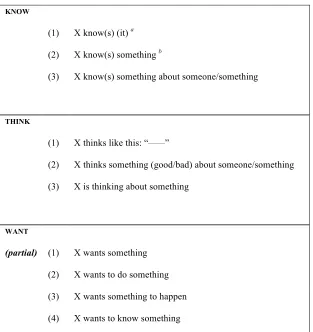
other mental predicates, THINK and WANT (Table 1). Firstly, KNOW takes a
“psychological subject”, i.e. I, YOU, SOMEONE,and PEOPLE (Wierzbicka 1996: 119).
It also allows a “substantive topic” (realised in English as “know about something”) and a “substantive complement” (realised in English as simply “know something”). These combinatorial possibilities are summarised as follows (with the options for
[image:18.595.114.427.316.648.2]THINK and some of those for WANT included for comparison):
Table 1. Syntactic Frames for mental predicates (KNOW, THINK, and WANT)16
KNOW
(1) X know(s) (it) a
(2) X know(s) something b
(3) X know(s) something about someone/something
THINK
(1) X thinks like this: “ ”
(2) X thinks something (good/bad) about someone/something (3) X is thinking about something
WANT
(partial) (1) X wants something (2) X wants to do something (3) X wants something to happen (4) X wants to know something
a X stands for any psychological subject (e.g. I, SOMEONE, PEOPLE) or permutation thereof (e.g.‘THIS SOMEONE’,
‘MANY PEOPLE’)
16 Adapted from Goddard & Wierzbicka (2002: 60f), updated to conform to recent thinking, e.g. the option “(X) knows
Note that ‘SOMEONE’ and ‘SOMETHING’ in the above sentences have their own
syntactic properties and thus can be altered by the quantifiers (MANY, ALL etc.) and
determiners (THIS, SAME, OTHER), creating permutations such as ‘MANY THINGS’and
‘SOME PEOPLE’. Furthermore, like a number of the primes, KNOW combines with the
so called meta-predicatesNOT and CAN (Goddard 2008: 15).
2.2.2 Canonical Sentences
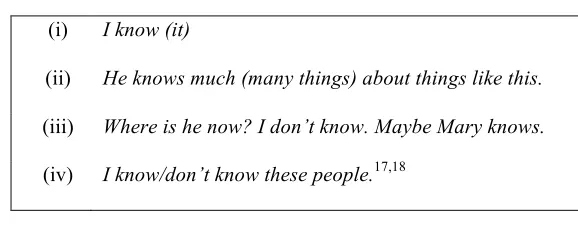
I argued in the Chapter 1 that each NSM prime constitutes an independent hypothesis, a claim that has to be independently assessed, and its existence in the languages of the world independently tested. As I also discussed there, the central tool for testing the existence and behaviour of a prime in a given language is the attempted translation of canonical sentences. So what are the proposed canonical sentences used for testing the existence of KNOW in other languages? The current
[image:19.595.108.397.497.615.2]proposal includes the following (from Goddard & Wierzbicka 2015):
Table 2. Some canonical sentences for KNOW:
(i) I know (it)
(ii) He knows much (many things) about things like this.
(iii) Where is he now? I don’t know. Maybe Mary knows.
(iv) I know/don’t know these people.17,18
17 Note that this is a slightly altered version of G&W’s (2015a) original canonical sentence ‘I know that person’. This
version is preferable because PEOPLE and not ‘person’ is an NSM prime.
18 I have reservations about using this “experiential” or “familiarity” construction as a canonical sentence of KNOW. As
Note that (i) is a combination of the I and KNOW primes, i.e. ‘I know (it)’, where the
object ‘it’ stands in for some sentence, which may or may not be expressed depending on the language (Wierzbicka in press). As for (ii)–(iii), note that they involve non-prime elements in the form of third person pronouns and names.19
It is important to note that, just as is the case with the proposed primes and their syntactic frames, the canonical sentences are partly a matter of discovery; that is, they are negotiated in light of the available empirical evidence. For this reason, it is always possible that a given proposed canonical sentence could be found to be untranslatable in some language, and would thus have to be adjusted or even discarded. Depending on the canonical sentence, such a finding may also alter (typically reduce) what valency options are available for that prime. For example, if it were discovered that some language(s) didn’t permit the exponent of KNOW to
be combined with a substantive topic and therefore (ii) was found to be untranslatable, then not only would (ii) be discarded as a canonical sentence for
KNOW, but the valency options for KNOW listed in Table 1 would be reduced or
changed. Thus it should be clear that testing the prime, its grammar, and its canonical sentences are projects necessarily undertaken together.
Also note here that idiomaticity problems can arise when negotiating what the right canonical sentences are. In fact, there is something of an outstanding issue on this point in the case of (ii)in English:neither ‘He knows many things about things like this’ or ‘He knows much about things like this’ sound ideal in English; it is much more natural for say “He knows a lot about things like this”.20 Is this merely
one of those cases in which NSM phrasing sounds unfamiliar, or is ‘knowing many
19 See note 6 above.
20 Though a further issue is that ‘I know a lot’ and ‘I know many things’ may not be equivalent in meaning, unlike in
things’ not a permissible string of ordinary English? And if the latter is true, does that mean that this canonical sentence needs to be discarded, or rather that ‘a lot’ should be considered an allolex of MANY?
Answering these questions, and analogous ones for the canonical sentences translated into other languages, are essential for determining both whether or not (ii) is the right canonical sentence for the purposes of testing the existence and behaviour of the prime. For my part, I am inclined to think that this case is simply one of those cases of NSM sounding marked, rather than there being any genuine incompatibility between KNOW and MANY THINGS. In support of this idea is the fact
that ‘know(s) many things’is reasonably well-attested in English, at least in poetry and lyrics.21 Furthermore, I think there may be a more general idiomaticity issue
here, given that English ‘many things’ can sound somewhat “aphoristic” in the object slot of other verbs (e.g. “She saw many things on her travels”, “I learnt many things at the lecture today”). Nevertheless, it may be worth trying out another possible canonical sentence for KNOW, using SOMETHING/SOME THINGS instead of MANY THINGS, such as “He knows something about this” or “He knows some things
about things like this”.
2.3 Which
know
concept?
I will now address the question of exactly what concept is being proposed to be a universal and irreducible semantic primitive.
21 For example, in the title of the poem Men Say They Know Many Things by Henry Thoreau, and in a line of the song A
2.3.1 ‘Know’ vs. ‘Knowledge’
The first thing to be clear on is that the relevant concept is ‘know(s)’, or ‘knowing’ and not ‘knowledge’. The issue here is not simply that in English, the ordinary way to express the prime happens to be via a verb and not a noun, for it is possible that in other languages its expression involves a nominal (or adjectival etc.) form. Rather, the claim is that the concept represented by the English abstract noun ‘knowledge’ is neither plausibly unanalysable nor universal. As Wierzbicka (in press) discusses, some languages, such as the Australian language, Walpiri, appear to lack any serviceable equivalent to ‘knowledge’,22 and even in a nearby language like French, the concepts of connaissance and savoir cut across the English concept in different ways, without either having a sense quite equivalent to it (op.cit.: 10f). Thus the claim is not that ‘know(s)’ is basic and universal for some apriori reason (though it may be a prima facie better candidate for a prime, given its greater frequency in ordinary language), rather it is precisely because of the evidence unearthed by cross-linguistic semantic analysis that English ‘knowledge’ is not a credible candidate for an NSM prime, whereas ‘know(s)’ is.23
2.3.2 The analysis of propositional and experiential knowing
Now I will discuss how KNOW, as it is currently conceived, relates to (1)
propositional knowledge (as in “I know that p”), and (2) what may be dubbed “experiential” knowledge, a concept that is lexicalised in various languages. Here we will see the most significant changes that the KNOW proposal has undergone. I
will begin with (2), the concept of experiential knowledge.
22 Laughren et al. (2006) cited in Wierzbicka (in press).
23 But note that like Wierzbicka (in press), I will not hesitate to use English word ‘knowledge’ when discussing the issues
In many languages, including Romance languages, Polish,24 German,25 and Chinese,26 there is a lexically marked distinction between propositional knowledge (so-called “knowledge that”), and knowledge based on experience or familiarity, e.g. knowledge of people and places. In Italian, for example, we have sapere and
conoscere, both translated as ‘know’ in English, yet clearly distinct in their uses, as the following examples show:
(2) John sa che Oslo è la capitale della Norvegia.
‘John knows that Oslo is the capital of Norway.’
(3) Luisa sa che le droghe sono pericolose.
‘Luisa knows that drugs are dangerous.’
(4) John conosce bene Mosca.
‘John knows Moscow well.’
(5) Luisa conosce Igor.
‘Luisa knows Igor.’
As these examples show, sapere is used to express propositional knowledge, whereas conoscere indicates a kind of knowledge from experience or familiarity. Similar contrasts are possible in other languages, including French (savoir/connaître), German (wissen/kennen), Polish (wiedzieć/znać) and Chinese
(zhīdao/rènshi).27 How does NSM deal with this contrast found in some languages but non-existent in others28? The original position was to treat the experiential knowing lexemes as syntactically-constrained allolexes of the KNOW prime. And
indeed, if one looks to the examples above, a syntactic difference is obvious: sapere
is followed by a clausal complement introduced by the complementiser che, while
conoscere is followed by a nominal expression. This analysis doesn’t work, however, for at least two reasons. For one thing, it is possible to combine sapere
with a nominal, as in the following:29
(6) Non so i dettagli.
‘I don’t know the details.’
A further problem with the allolex account is simply that ‘knowing someone X’ and ‘knowing some place Y’ (as in (4) and (5) above) is intuitively quite different in meaning from ‘knowing that p’. Knowing a person or place involves some kind of
non-verbalisable knowledge, perhaps akin to an ability to recognise or conjure up a mental image of the person or places. Propositional knowledge, by contrast, is verbalisable almost by definition.30 And while Wierzbicka (2002: 95) suggested that
(in the case of Polish wiedziec/znać) this apparent difference in meaning may be due to the contribution of meaning of ‘someone’ (or ‘some place’) rather than any semantic difference between the verbs themselves, it was still perceived to be a problem (e.g. Goddard 2007: 15). But it was not until 2013 that explications of
27 Chappell (1994: 117f) equates the distinction with that of French savoir/connaître and German wissen/kennen. 28 Other languages in which propositional and experiential knowing are expressed using the same lexical form are
Mangaaba-Mbula (Bugenhagen 2002: 12) and Amharic (Amberber 2008: 93f), and of course, English.
29 Note that “Non conosco i dettagli” is also possible.
‘knowing someone’ and ‘knowing a place’ (and thus of those uses of Italian
conoscere etc.) was proposed (Goddard & Wierzbicka 2013). This analysis does not rely on the concept of propositional knowledge at all, but rather on the substantive topic frame, as follows:31
(7) I know these people (conosco questa gente, ich kenne diese Leute etc.).
I know some things about these people
like people can know some things about some people if they have been with them
before
because of this, I can think like this:
“these people are like this”
(8) I know this place (conosco questo posto, ich kenne diesen Platz etc.).
I know some things about this place
like people can know some things about a place if they have been in this place
before
because of this, I can think like this:
“this place is like this”
With the availability of such an analyses in (7) and (8), English ‘knowing a person’ and ‘knowing a place’, and the analogous senses of Italian conoscere
(French connaître, German kennen, etc.), no longer needed to be treated as allolexes of the KNOW (SAPERE/SAVOIR/WISSEN etc.) prime. They can instead be seen as
31 (7) and (8) are adapted from Wierzbicka (in press). This version had a ‘because’ clause in the first line (i.e. ‘I know
independent and semantically complex concepts, with the KNOW prime as their
central component.
Arguably what prevented the above analyses from coming to light earlier was the focus on trying to reduce such constructions to propositional knowledge, i.e. to the syntactic frame ‘X know(s) that ’, which was, until recently, proposed to be basic syntactic frame of KNOW (e.g. Goddard 2007: 16). That is, sentences such as
those in (2) and (3) were treated as basic instantiations of KNOW. This treatment has
since been abandoned, however, and an explication of know-that constructions has been proposed, based on the syntactic frame ‘X know(s) (it)’, (from Wierzbicka in press):
(9) John knows that Oslo is the capital of Norway.
it is like this: Oslo is the capital of Norway
John knows it
Of course, the material after ‘it is like this:’ remains unexplicated, but the idea is that (9) serves as the explication of the frame (essentially of the “propositional attitude”, minus its content). I would argue that this explication is plausible in that it captures an important feature of know-that claims: that they both set out some state of affairs and assert someone’s knowledge of it. That is, when I tell Luisa “John knows that Oslo is the capital of Norway”, it seems plausible that I am communicating to Luisa both that Oslo is the capital of Norway (“it is like this”),
2.3.3 The analysis of know-how
Finally, I would like to point to one other type of ‘know’ construction for which an NSM explication has been put forward, viz. “X knows how (to do something)”. This construction is interesting not least because “knowledge-how” (seen in opposition to “knowledge-that”) has an entire philosophical literature to its name, in which the central debate is whether or not knowledge-how can be reduced to knowledge-that
(Fantl 2016). According to the NSM perspective, these are independent concepts, semantically analysable in terms of different basic constructions of the prime KNOW,
as follows (from Wierzbicka in press):
(10) She knows how to do it.
she can do it if she wants because she knows some things about it,32
like people can know some things about something if they have done it before
Note that this (10) is much closer to the explications of the experiential knowing concepts ‘knowing someone’ and ‘knowing a place’ than it is to the explication of ‘knowing that’, in that both refer to (non-necessary) personal experience (‘…like people can know…if they have done it before’).
It is not possible here to give anywhere near an exhaustive treatment of all the constructions centred on KNOW, but it is worth handwaving to a few other
examples of “epistemic” concepts and constructions that have been analysed in terms of the prime. For one example, consider that Wierzbicka (in press) offers explications of various (English) constructions involving ‘know’ plus a wh-word (e.g. when, where) via KNOW, including both direct wh-questions (‘Where does
32 I have slightly altered Wierzbicka’s (in press) version, changing ‘…because she knows something’ to ‘…because she
Mary live?’) and so-called “embedded” wh-questions (‘John knows where Mary lives’). Another important reach of explications involving KNOW is in the analysis
of evidential markers, a feature of some languages in which information relating to the evidence or source of some piece of knowledge is grammaticalised (e.g. the source of knowledge being directly seen by the speaker vs. being heard about from other people) (Wierzbicka 1994b).
Chapter 3. Challenges to the universality of
KNOW
In this chapter I look at problematic cases that have been encountered in the search for exponents of KNOW in other languages.
3.1 Mparntwe Arrernte
The first case I will consider is that of Mparntwe Arrernte (a variety of Arrernte spoken around Alice Springs), as analysed by Harkins and Wilkins (1994; henceforth H&W). This case demonstrates the relatively “easy” problem of establishing which of several candidates is the exponent of a prime. In Mparntwe Arrernte, then, there are two candidates for the exponent of KNOW: the adjectival
form kaltye, which H&W define as‘know (stative)’ and itelare-, which they define as ‘know (actively)’ (p. 289). Here is an example of each:
(1) Ayenge kaltye unte kurne mpware-ke
‘I know you did something bad’ (i.e. I am knowledgeable of the fact that you did
something bad’)
(2) Ayenge itelare-me unte-rle kurne mpware-ke
1SG:S know-NPP 2SG:A-that bad make/do-PC
‘I know you did something bad’ (i.e. I am actively aware that you did something
bad’)
As we see in this pair of examples, kaltye and itelare- exhibit different syntactic behaviour. Whereas kaltye is a predicative nominal that takes dative, purposive, and sentential complements (p. 289), itelare- is clearly verbal, evident from its taking a non-past progressive TAM marker. Does this mean that kaltye and
itelare- could be treated as syntactically-constrained allolexes of the Mparntwe Arrernte exponent of KNOW? This is a possibility, but I don’t think the authors
clearly identify the specific grammatical contexts that condition the use of kaltye
and itelare-.33 Instead, their suggestion to “regard both kaltye and itelare- as equivalents of KNOW with the choice conditioned by the active/stative distinction”
(1994: 289) invokes what sounds more like a semantic distinction, given that “active” and “stative” grammatical labels generally encode substantial information about the participants’ level of activity or intention (doing or wanting). In other words, Harkins and Wilkins do not provide a clear case for syntactic environments conditioning the occurrence of kaltye and itelare-, but rather refer to what is essentially a contrast in the semantics of the two verbs, a contrast that they try to
33 Compare English
convey in the free translations via the phrases ‘knowledgeable of’ versus ‘actively aware’ in (1) and (2) above.
In fact, if the free translations above are anything to go by, the most likely exponent of KNOW in Mparntwe Arrernte is kaltye. For whereas kaltye is translated
as simply ‘know’/’knowledgeable’, H&W’s reference to “active awareness” in their translation of itelare- suggests that there is some extra semantic content involved in this concept, in addition to KNOW. In support of this analysis is the fact that Van
Valin and Wilkins (1993: 523) define kaltye as ‘know (x,y)’, while attributing a more complex meaning to itelare- involving both ‘know’ and ‘think’.34
Furthermore, note that there is an example appearing later in H&W’s paper which contains a construction conforming to basic syntactic frame of KNOW, and here
kaltye is used (p. 294):
(3) [...] kele unte kaltye anteme ane-me ingkirreke-ke
OK 2SG:S know now be-NPP all-DAT
‘… “so now you know everything”’
Thus while H&W aren’t prepared to deliver a verdict on the issue (pp. 289, 308), I would argue that the evidence they present is sufficient to support the idea that kaltye is the Mparntwe Arrernte exponent of KNOW prime, and itelare- definable
in terms of it (possibly with the addition of a component involving THINK, given
Van Valin and Wilkins’ (1993) suggestion). This case shows us that when faced with two or more possibilities for the exponent of a prime, and where there is no strong case for syntactic allolexy, two things should be done to attempt to identify
the exponent: 1) determine which form is used in translations of the proposed canonical sentences (or other basic sentences instantiating the proposed syntactic frames of the prime); and 2) consider whether one of the concepts conveys more semantic content than the other, and if so, attempt to explicate it in terms of the seemingly more basic concept. Not until both of these proved unsuccessful might there be cause for concern for the existence of KNOW in the language.
3.2 Acehnese
According to Durie, Bukari and Mawardi (1994, henceforth DBM), there is a problem with the identification of KNOW in Acehnese, an Austronesian language
from Aceh, Indonesia. The perceived problem consists in the fact that certain “epistemological classifiers” – suffixes translated into English via wh- words, who,
what, when etc. – are obligatorily present on what the would-be exponent of KNOW
in this language, the verbal stem tu-. Thus the issue according to these authors is that while tu- is a prima facie good candidate for the Acehnese exponent of KNOW,
this form never appears alone, but is instead always accompanied by such markers, which often cannot be formally isolated from the tu- form, for example:
(4) Lôn-tu-ho geu-jak.
I-know-whither 3-go
‘I know which way he/she went.’
(5) Lôn-tusoe ureueng nyan.
‘I know who that person is.’ (or ‘I know that person’)35
(6) … hana soe toepeue rasia nyan.
NEGBE who know:what secret that
‘… no-one would have known that secret.’
(7) … Na ta-tujan kapay bungka?
NEGBE you-know:when ship leave
‘Do you know when the ship leaves?’
As DBM put it, these examples show that Acehnese “always require[s] one to say more than just KNOW” (p. 175). Why is this a problem? Well, DBM argue that if
other languages do not exhibit the same “epistemological classification of KNOW”,
then we are faced with “a classic type of non-translatability, but at the most primitive level in the metalanguage” (loc. cit.). As I understand it, the argument is that because the only way to use tu- is via the above forms (tuho, tusoe etc.), we have reason to think Acehnese has a basic conceptual division between different kinds of knowing (knowing what, knowing who etc.), which doesn’t necessarily exist in other languages, and therefore it is problematic to think of Acehnese tu- as representing the more minimal concept of KNOW.
I will argue that while it is still not entirely clear which form(s) represent the Acehnese exponent(s) of KNOW, the data presented by DBM (1994) don’t give
us reason to worry, especially in light of certain advances in the grammar proposed for KNOW. But before going on, a preliminary point on morphological complexity
35 This alternative translation is offered by Xie (2016): according to his Acehnese consultants, such sentences “are
should be made. The existence of obligatory markers on the tu- stem does not, in and of itself, constitute a reason against the idea that tu- is the Acehnese exponent of the KNOW prime. This is no different from the many languages (including familiar
European languages) in which person and number are obligatorily marked on many forms of the verb. There is no general reason to treat different forms of a verb as instantiating different basic concepts, rather than regarding the stem as carrying one meaning, and any markers as carrying others; this points holds whether the markers convey person, number, or indeed “epistemological” features.
As I see it, then, the reason DBM considered this feature of Acehnese to be problematic comes down to the primacy that was afforded to the ‘know that’ frame then proposed to exist for KNOW, but which has since been discarded. That is, I think
the authors were trying to reconcile the fact that tu-, taken alone (i.e. minus any epistemological classifiers), appeared to be the prima facie best candidate for the exponent of KNOW (because it is the common denominator in a whole host of
constructions translated with ‘know’), with the fact that one of its marked forms,
tupeue (‘know+whether’), is used in ‘know that’ constructions (p. 176). Because the know-that construction was then hypothesised to be one of the universal syntactic frames of the KNOW prime, tupeue had to be treated as an instantiation of KNOW, in
concepts ‘knowing (someone/these people)’ and ‘knowing (this place)’ have been proposed, this is no longer an issue.
So there is no need to regard the forms used in the Acehnese equivalents of ‘knowing that ’, ‘knowing (someone/these people)’ and ‘knowing (this place)’ as basic instantiations of KNOW.Which form, then, should be considered the exponent
of know? To establish this, we need to know which form(s) would be used in translating canonical sentences. While none of the examples in DBM (1994) involve such sentences, one example appears in Durie (1985: 162) that may be telling:
(8) Jih hana i teu-pue sa pue
He NEGBE 3 know-what one what
‘He doesn’t know a thing’
This example broadly fits the syntactic frame ‘X knows something’, so assuming it isn’t a marked way to express ‘X doesn’t know anything’, it can be regarded as close to a canonical sentence. And if this is right, then teupue must be regarded as an instantiation of the Acehnese exponent of the prime. Now whether or not the bare stem tu- or indeed the form tupeue (‘know+whether’) should be considered (an) allolex(es) of the prime depends on what forms occur in the other syntactic frames, such as in the canonical sentence ‘He knows much (many things) about things like this’. At this stage, then, it seems to me that the best bet is to identify teupueas instantiating the Acehnese exponent of KNOW, with an open question as to whether
it has one or more allolexes.36
36 Note that Zhiguo Xie, who has worked with Acehnese speakers on the epistemological classifiers, has the intuition
The case of Acehnese reveals two important points. One is that language-specific morphological complexity does not necessarily correlate with semantic complexity, a point I will return to presently in consideration of Evans’ (2007) analysis of Dalabon. Another is that, just as we saw with Arrernte, it is the canonical sentences, i.e. basic sentences that obey the syntactic frames of the prime, must be our guide in testing for the existence of that prime in a given language.
3.3 Dalabon
3.3.1 Morphological vs. semantic complexity and the issue of “resonance”
Dalabon is a Gunwinyguan language spoken in Arnhem Land, Australia. Unlike in the previous two cases, Evans (2007, 2010) explicitly presents this case as a counterexample to the universality of the KNOW (and THINK)primes, stating that
“neither ‘think’ nor ‘know’ should be treated as semantic primitives in Dalabon” (p. 91), and that “there are no verbs that exactly represent 'think' or 'know'” in the language (p. 92). The central thread of Evans’ (2007) challenge is as follows: because the most obvious candidates for the Dalabon exponents of KNOW and THINK,
bengkan and bengdi, are built up from a bound root √beng (which, according to Evans, is the equivalent of English ‘mind’; p. 76) it is mistaken to regard Dalabon as having semantically unanalysable exponents of the KNOW and THINK primes.
The main line of evidence Evans offers in support of his analysis that √beng is conceptually basic is the existence of a range of meanings that are built on this root, not only bengkan and bengdi but other broadly “cognitive” concepts, such as
benghbengkan (‘recognise, identify’), bengyihbon (‘pay attention’) and
bengwudjmú (‘(neglectfully) forget about’). The idea seems to be that the existence of a wide variety of cognitive concepts that are based on √beng constitutes evidence for this root playing a pivotal role in the Dalabon conception of the cognitive domain, and thus it is via √beng that bengkan (‘know’)and bengdi (‘think’) must be understood. Evans (2007) thus uses morphological features of Dalabon cognitive verbs to argue for a semantic analysis of the concepts they stand for.
Goddard & Wierzbicka’s (2014b: 16ff) respond in some detail to this challenge. The main thrust of their argument is that contra Evans, we cannot be guided by language-specific morphology in our assessment of whether a language has distinct exponents of the NSM primes. This position might be summed up by the dictum “morphological complexity does not entail semantic complexity”. That is, the fact that a lexeme is made up of formally divisible elements is not sufficient evidence for its conceptual complexity. Thus for example, the fact that the English exponent SOMEONE appears to have formally distinguishable elements, ‘some’ and
such an analysis, and on the grounds that SOMEONE has so far been found to be
cross-translatable, it is taken an NSM prime, and the ‘some’ and ‘one’ elements that appear in the English exponent are deemed to be (semantically) irrelevant.
What is also crucial about this response is that it doesn’t deny that speakers may notice when two or more primes share part of their morphological form, and may consequently judge there to be a certain connection between the concepts. This is an example of what is called resonance in the NSM literature, which broadly describes the ways in which exponents of a prime can “feel” different in different languages, whether due to their form or to local polysemies (Wierzbicka 1996: 30; Goddard & Wierzbicka 1994: 35f). Thus just as the exponents SOMEONE and SOMETHING have a certain resonance for English speakers because of the shared
element ‘some’, so Dalabon speakers may feel that there is a similarity between
bengkan and bengdi, on account of their common root. But the idea is that such matters are not strictly semantic, just as the feeling of relatedness we may get from two words that rhyme is explained by their shared phonological features, and has nothing to do with their meanings. In the case of shared morphological form, however, the feeling of resonance may lead us to the intuition that the concepts are interdefinable, or that they are both definable in terms of the shared element plus other material. From the NSM point of view, however, this intuition is mistaken. And it is mistaken simply because there is no reductive and fully cross-translatable way of explaining the meaning of ‘someone’ and ‘something’ in terms of ‘some’ plus other material, nor, it is hypothesised, the meaning of bengkan and bengdi in terms of √beng.
KNOW and THINK primes in this language. That said, I do think much more needs to
be said on the issue of resonance. In particular, it seems to me that we need richer answers to questions about the significance of local polysemies and about cases of shared morphological form of two or more primes. If such similarities are not indicative of compositional semantic relationships, why do they happen? Are there similar types of morphological complexity of the primes found across languages, and if so, what do such typological facts tell us? It seems to me that even if we agree that language-specific polysemy or formal complexity cannot steer semantic analysis, answering such questions is important and interesting.
3.3.2 Two further challenges: polysemy of
bengkan
?
But it seems to me that Evans (2007) has another reason for claiming that in Dalabon “there are no verbs that exactly represent ‘think’ or ‘know’”(p. 92), namely the fact that both bengkan and bengdi each appear to have a wide range of meanings (i.e. beyond that of ‘know’ and ‘think’), some of which seem to partially overlap. For example, Evans lists ‘remember’, and ‘think’ as other possible translations of
bengkan, and ‘attend to’ and ‘remember’ as additional meanings bengdi (p. 73). In this section, I aim to show why this polysemy, if such it is, is unproblematic for the claim that bengkan is the Dalabon exponent of KNOW.First let’s consider some of
Evans’ (2007) examples of bengkan in its ‘know’ capacity:
(9) Nunh ngah-dja-bengka-n, mak nga-bengmukm-iyam,
DEM 1-just-keep.in.mind-PR NEG 1-forget-F
mak nga-bengmukm-ú, ngah-dja-yidjnja-n kanum-ngan-kah.
‘I still know that, I haven’t forgotten. I still hold it in my memory / in my mind’
(lit. ‘in my ear’) (p. 78).
(10) Mak nunh keninjh burra.bengka-n barrah-bomung,
NEG DEM what 3DU/3-keep.in.mind-PR 3DU-be.ignorant
burrah-karrú-warhwa-n.
3du/3-culture-not.have.in.mind-P
‘…they don’t know anything, they are forgetting their culture’ (p. 87).
Interestingly, though Evans glosses bengkan as ‘keep in mind’ (in keeping with his analysis that √beng is a semantically primitive concept in Dalabon), he translates it as ‘know’ in each case here. As Goddard & Wierzbicka (2014b:17f) argue, it is unclear why ‘keep in mind’ should be preferred over ‘know’ in such cases.37 Nevertheless, there are other uses of the word that appear to be quite different, such as some examples that Evans translates as ‘remember’ (2007: 88):
(11) Nunh ngah-dja-bengka-n, mak nga-bengmukm-iyan,
DEM 1/3-just-keep.in.mind-PR NEG 1/3-forget-F
mak nga- bengmukm-û.
NEG 1/3-forget-PR
‘I still remember his face, I’ll never forget it.’
(12) Ngah-die-bukirribo-ng bah kodj-ngan-kah ngah-dja-bengka-n
1/3-face-dream-P but head-1SG.Poss-LOC 1/3-just-keep.in.mind-PR
37 Of course, Evans (2007) would cite the morphology of the verb as the reason (the element -kan derives from a word
mak nga-kodj-mukmu.
NEG 1-head-be.buried
‘I saw a face when I woke up and I keep thinking about it / keep remembering
it, I can’t forget the face.’
Goddard & Wierzbicka (2014b: 18) argue that there isn’t good evidence for bengkan
having a distinct sense of ‘remember’, suggesting that an alternative translation of (11), “I still know his face. I’ll never forget it”, works just as well. I am not sure this is satisfactory, given that the contrast with ‘forget’ in both (11) and (12) suggests to me that there may be extra semantic content here, more than just KNOW (perhaps
involving a component like ‘I am thinking about it (=his face)’). Furthermore, I am unsure whether it generally makes sense (in English at least) to talk of “still knowing”, in the sense of continuing to know something, which seems to be the sense conveyed by (11). Perhaps, then, bengkan is genuinely polysemous, contra
Goddard & Wierzbicka (2014b), having a meaning somewhat similar to English ‘remember’ (the explication of which involves both KNOW and THINK, see
Wierzbicka 2007). But what must be understood is that this does not present a problem for the hypothesis that Dalabon has a distinct exponent of the KNOW prime.
Of course, bengkan having other meanings than those ascribed to the KNOW prime
distinguished, by using the canonical sentences to isolate the prime, as well as the standard tests of polysemy discussed in §1.2.38
There is one final challenge to address, hinted at in Evans (2007) and alluded to again in his (2010): the idea that bengkan can also mean ‘think’, and thus that the concepts ‘know’ and ‘think’ are not discrete in Dalabon. Specifically, Evans claims that bengkan “covers both ‘know’ and ‘think’, with the exact sense coloured by aspect and context” (2010: 516). In his original study of (2007), however, though ‘think’ is listed as one of the possible glosses of bengkan (pp. 73, 77), there is only
one example presented where it is actually translated as such, viz. example (12) above. However, it isn’t clear that‘think’ is the besttranslation here, given that both ‘keep thinking about it’ and ‘keep remembering it’ are offered in Evans’ free translations. Without clearer examples, I don’t see cause to worry about the distinctness of THINK or KNOW primes. And note that if, as I suggested in relation to
example (11), there is another meaning of bengkan that is akin to English ‘remember’, then (12) could just as well be taken as instantiating that complex meaning, and not as an instance of the prime KNOW, nor indeed, of THINK.
3.4 East Cree
Junker’s (2008) analysis of East Cree, an Algonquian language spoken in Quebec, presents a possible challenge for the identification of the KNOW prime, analogous to
the case of Dalabon. But unlike in the case of Evans (2007), Junker (2008) does not see the matter as showing that East Cree has no exponent of KNOW. The issue, then,
involves the fact that East Cree has a verbal element occurring in all the East Cree
38 Space does not permit me to discuss bengdi, but the same goes for any additional meanings that this lexeme may be
exponents of the mental predicate primes, THINK, WANT and KNOW, which might call
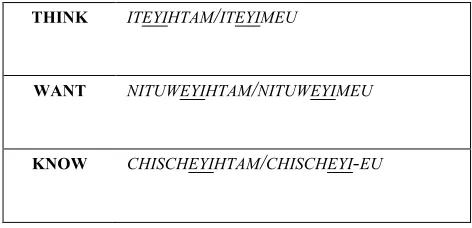
[image:42.595.112.348.238.352.2]into question whether such concepts aretruly conceptually basic in this language. Consider the following East Cree exponents of the mental predicate primes (from Junker 2003: 181):
Table 3. Mental predicate primes in East Cree (intransitive/transitive pairs)
THINK ITEYIHTAM/ITEYIMEU
WANT NITUWEYIHTAM/NITUWEYIMEU
KNOW CHISCHEYIHTAM/CHISCHEYI-EU
As underlined above, the exponents of East Cree mental predicates all contain the morpheme -eyi-, which Junker describes as “act[ing] like a classifier of mental activities” (p. 182). Nevertheless, according to Junker (2003: 181), speakers “refuse to decompose” the above forms, supporting the idea that they are semantically primitive. And Junker (2008) actually cites canonical sentences of the primes, such as ‘Ekun ka iteyihtahk: “…”’ (‘X thought like this: “…”’), ‘Chinituweyimitin’ (‘I want you to do it’), and Nichischeyihten (‘I know it’), which shows the distinctness of these meanings in the East Cree language.
However, there is one prima facie puzzling finding made by Junker (2003). In surveying East Cree speakers about the meaning of verbs containing -eyi- (of which there are many more than the three exponents above), she found that all speakers “agreed that some element of iteyimuu ‘she/he is thinking’ […] is involved in all the -eyi- verbs”, including the exponents of KNOW, WANT and FEEL (2003: 182).