A processability approach to the L2 acquisition of
Chinese syntax
Bo Liu
A thesis submitted for the degree of Doctor of Philosophy of The Australian National University
i
Statement: on originality
I declare that the research presented here, unless otherwise acknowledged, is my own original work and has not been submitted to any other institution for the award of a degree.
ii
Acknowledgment
Before I was engaged in this PhD project, I thought doing a research was mostly a personal commitment. However, after I actually embarked on the hard journey of the PhD project, I realized that had there been no supports from my family, friends and academics, accomplishing a PhD study would be definitely a ‘mission impossible’. I want to give my big-heart thanks to those helping ‘hands’, that guided me, pushed me, ‘pinched’ me, and comforted me through my hard PhD journey.
My life-long gratitude goes to my supervisor and mentor, Dr. Yanyin Zhang. She unfolded before me this wonderful land of research on language acquisition. For the first time, I was able to see through the surface linguistic phenomena down to the internal mechanism which constrains and drives the acquisition process of a language. These phenomena cannot be comprehended solely through teaching activities. Under her guidance, I gradually transformed from a language teacher to a language researcher, being able to unveil the mystery of language acquisition. Her clear goal-driven guidance saved me from unnecessary struggling in the mud of trivial and insignificant issues. I also thank for her patience, her consideration and her mental support when I was struggling for a balance between research and other obligations. I was able to see the essence of life through research.
iii Through Dr. Linda Li’s course of thesis writing workshop and her feedback and
comments on my thesis drafts, I gained the knowledge on how to write for an academic purpose and how to write concisely and convincingly. Dr. Fengyuan Ji taught me how to strike a balance between research and other duties and gave me the confidence that I was the true master of my PhD project.
Besides my supervisory panel, I also wish to thank other researchers who spared their precious time and lent me supports in one way or the other, contributing to shapping up my thesis. My special thanks go to Dr. I Wanyan Arka, who gave me his invaluable expert input in LFG-related issues.
I thank my informants, or friends per se for their ‘free’ talking and sharing, which amounted to rich speech data and laid a solid foundation for my study. Without their contribution, the completion of my thesis would have been impossible.
iv
Abstract
This study explores L2 Chinese acquisition at syntactic level with Processability Theory (PT) (Pienemann, 1998b; Pienemann, Di Biase, & Kawaguchi, 2005) as its theoretical framework. The research aim was to document the acquisition process of L2 Chinese sentence structures ranging from basic word order (declaratives and interrogatives), to word order variations (adjunct and object topicalization/fronting), and to complex structures (passive, existential and causative). They were six word order patterns: SVO, ADJUNCTTOPIC+SVO, NPTOPIC+SVO, OSV, SOV and SOBAV, and three structures with complex lexical operations: passive, existential and causative. The documentation was conducted under the guidance of PT. Two PT-based processing principles, i.e.
information exchange (Pienemann, 1998b) and the mapping of three parallel levels of structure (argument structure, constituent structure and functional structure)
(Pienemann, Di Biase, & Kawaguchi, 2005) were employed to propose two processing hierarchies respectively for the acquisition of word order and complex structures. The study aimed to address two research questions: (1) what were the observed sequences for the acquisition of word order and complex structures; (2) whether the observed sequences were consistent with the two proposed PT-based processing hierarchies.
To achieve the research aims, a longitudinal investigation over one academic year was conducted on the acquisition sequence of the targeted sentence structures by six Chinese L2 learners of different language backgrounds and of three different proficiency levels (beginning, intermediate and advanced). The six learners were enrolled in a Chinese language program in a Chinese university. Interviews with each of the six informants were conducted on a regular basis to record their learning progress through free
vi
Table of contents
Chapter 1 Introduction ... 1
Chapter 2 Theoretical background: Processability Theory ... 6
2.1 Early interlanguage research ... 6
2.2 Processability Theory (PT) ... 10
2.2.1 Theoretical bases for PT ... 11
2.2.2 Information exchange ... 14
2.2.3 The mapping principles ... 18
Chapter 3 Chinese syntax from a processability perspective ... 32
3.1 The typological features of Chinese language ... 32
3.2 Chinese syntax from processability perspective ... 38
3.2.1 Canonical structures ... 39
3.2.2 XP + Canonical structures ... 41
3.2.3 Non-canonical structures ... 44
3.2.4 Complex structures ... 50
3.3 Empirical studies on L2 Chinese syntax from a processing perspective ... 56
3.4 Processing hierarchies for L2 Chinese syntax and research questions ... 67
Chapter 4 Research methodology ... 70
4.1 Research design ... 70
4.2 Informants ... 70
4.3 Data collection ... 73
4.3.1 Data collection schedule... 73
4.3.2 Data elicitation procedures ... 75
4.4 Data analysis ... 78
4.5 Acquisition criteria ... 81
Chapter 5 The acquisition process of L2 Chinese syntax: a description ... 82
5.1 An overview of the observed sequences... 82
5.1.1 Acquisition sequence of word order... 82
5.1.2 Acquisition sequence of complex structures ... 85
5.1.3 Summary ... 87
5.2 Acquisition process of word order: beginners ... 88
5.2.1 Acquisition of Canonical structures ... 88
vii
5.2.3 Acquisition of non-canonical structures ... 94
5.3 Acquisition process of word order: non-beginners... 101
5.3.1 Acquisition of canonical structures ... 101
5.3.2 Acquisition of XP + Canonical structures ... 102
5.3.3 Acquisition of non-canonical structures ... 105
5.4 Acquisition process of complex structures: beginners ... 113
5.4.1 The existential structure ... 113
5.4.2 The passive structure ... 115
5.4.3 The causative structure ... 118
5.5 Acquisition process of complex structures: non-beginners ... 120
5.5.1 The existential structure ... 120
5.5.2 The passive structure ... 122
5.5.3 The causative structure ... 126
5.6 Conclusion ... 127
Chapter 6 The acquisition of L2 syntax and Processability Theory: A discussion .. 129
6.1 Acquisition of word order... 130
6.1.1 The SVO, ADJ TOP and SOBAV structures ... 133
6.1.2 The NP TOP and OSV structures ... 136
6.1.3 The OSV and SOV structures ... 142
6.2 Acquisition of complex structures ... 146
6.2.1 The existential structure ... 147
6.2.2 The passive structure ... 153
6.2.3 The causative structure ... 159
6.3 Conclusion ... 162
Chapter 7 Conclusion ... 164
viii List of Tables
Table 2-1. The Topic Hypothesis (adapted from Pienemann, Di Biase, & Kawaguchi,
2005, p. 239) ... 25
Table 2-2. The Lexical Mapping Hypothesis (adapted from Pienemann, Di Biase, & Kawaguchi, 2005) ... 29
Table 3-1. Chinese syntactic structures ... 39
Table 3-2: Predictions of Topic development (adopted from Gao, 2005, p. 174) ... 61
Table 3-3. Processing Hierarchy of L2 Chinese syntax (Zhang 2007, p154) ... 65
Table 3-4. Development of L2 Chinese syntax (Zhang 2007, p.164) ... 66
Table 3-5. Processing Hierarchy of L2 Chinese word order ... 68
Table 3-6. Processing Hierarchy of L2 Chinese complex structures ... 69
Table 4-1. Informants’ background-information ... 73
Table 4-2. Interview schedule: beginners ... 74
Table 4-3: interview schedule: non-beginners ... 74
Table 5-1. Observed sequence of word order: beginner group ... 84
Table 5-2. Observed sequence of word order: intermediate group ... 85
Table 5-3. Acquisition of word order: the advanced learner ... 85
Table 5-4. Observed sequence of complex structures: beginner group ... 86
Table 5-5. Observed sequence of complex structures: intermediate group ... 87
Table 5-6. Observed sequence of complex structures: advanced learner ... 87
Table 5-7: Occurrences of canonical structures: beginners ... 89
Table 5-8. Occurrences of ADJ TOPs: beginners ... 89
Table 5-9. Distribution of time and location ADJs: beginners ... 90
Table 5-10. The number and percentage of ADJ placement: beginners ... 91
Table 5-11. Emergence of ADJ TOPs: beginners ... 91
Table 5-12. Occurrences of NP TOPs: beginner ... 92
Table 5-13. Occurrences of three types of NP TOPs: beginners ... 92
Table 5-14. Emergence of NP TOPs: beginners ... 94
Table 5-15. Occurrences of OSV: beginners ... 95
Table 5-16. Emergence of OSV: beginners ... 98
Table 5-17. Occurrences of SOV: beginners ... 98
Table 5-18. Emergence of SOV: beginners ... 99
Table 5-19. Occurrences of SOBAV: beginners ... 99
Table 5-20. Occurrences of SOBAV: beginners ... 101
Table 5-21. Emergence of OSV: beginners ... 101
Table 5-22: occurrences of canonical structures: non-beginners ... 102
Table 5-23. Occurrences of ADJ TOPs: non-beginners ... 102
Table 5-24. Occurrences of NP TOPs: non-beginners ... 103
Table 5-25. Occurrences of the three types of NP TOPs: non-beginners ... 103
Table 5-26. Emergence of NP TOPs: non-beginners ... 105
Table 5-27: Occurrences of OSV: non-beginners ... 105
Table 5-28: Emergence of OSV: non-beginners ... 106
Table 5-29. Occurrences of SOV: non-beginners ... 107
ix
Table 5-31. Occurrences of SOV: Mitsu... 110
Table 5-32. Emergence of SOV: non-beginners ... 110
Table 5-33. Occurrences of SOBAV: non-beginners ... 111
Table 5-34. Occurrences of SOBAV: non-beginners ... 113
Table 5-35. Occurrences of existential structures: beginners ... 114
Table 5-36. Emergence of the existential structure: beginners ... 115
Table 5-37. Occurrences of passive structures: beginners ... 116
Table 5-38. Emergence of the passive structures: beginners ... 118
Table 5-39. Occurrences of causative structures: beginners ... 118
Table 5-40. Emergence of causative structures: beginners ... 119
Table 5-41. Emergence of non-canonical complex structures: beginners ... 120
Table 5-42. Occurrences of existential structures: non-beginners ... 120
Table 5-43. Emergence of the existential structures: non-beginners ... 122
Table 5-44: Occurrences of passive structures: non-beginners ... 123
Table 5-45: Emergence of passive structures: Non-beginners ... 126
Table 5-46. Occurrences of causative structures: non-beginners ... 127
Table 5-47. Emergence of causative structures: non-beginners ... 127
x List of Figures
Figure 2-1. Feature unification in the S-procedure (Pienemann, Di Biase, & Kawaguchi,
2005, p. 200) ... 13
Figure 2-2. Salience and canonical schema (Pienemann, 1998b, p. 85) ... 15
Figure 2-3. Three parallel structures in LFG (Pienemann, Di Biase, & Kawaguchi, 2005, p. 200) ... 19
Figure 2-4. Three parallel structures in LFG (Pienemann, Di Biase, & Kawaguchi, 2005, p. 226) ... 20
Figure 2-5. Canonical mapping (after Pinker, 1984, p. 297) ... 21
Figure 2-6. Universal Scales (after Lee 2001, p. 97) ... 22
Figure 2-7. One-to-one correspondence (Pienemann, Di Biase, & Kawaguchi, 2005, p. 230) ... 23
Figure 2-8. The f-structure of English canonical SVO ... 25
Figure 2-9. The f-structure of ADJ TOPs ... 26
Figure 2-10. XP-adjunction in interlanguage (after Pienemann, Di Biase, & Kawaguchi, 2005, p. 234) ... 26
Figure 2-11. The f-structure of OSV ... 27
Figure 2-12. Non-default mapping of OSV ... 27
Figure 2-13. The f-structure of ‘What did he buy?’ ... 28
Figure 2-14. Default mapping of a- to f-structure ... 29
Figure 2-15. Non-default mapping of a- to f-structure (exceptional verbs) ... 30
Figure 2-16. Non-default mapping of a-, and f-structure (passive) ... 30
Figure 2-17. Complex mapping of a- to f-structure (causative) (adapted from Pienemann, Di Biase, & Kawaguchi, 2005) ... 30
Figure 3-1. The f-structure of canonical SVO structures ... 40
Figure 3-2. The f-structure of ADJ TOPs ... 42
Figure 3-3. The f-structure of NP TOPs ... 43
Figure 3-4. The f-structure of NP TOPs ... 44
Figure 3-5. The f-structure of OSV ... 45
Figure 3-6. The f-structure of OV ... 46
Figure 3-7. The f-structure of SOV ... 47
Figure 3-8. The unmarked alignment of SOV ... 47
Figure 3-9. The f-structure of SOBAV ... 50
Figure 3-10. Non-default a- to f-structure mapping of passive structures ... 51
Figure 3-11. The non-default mapping of existential structures ... 54
Figure 3-12. The f-structure of causative structures ... 55
Figure 3-13. Complex mapping of causative structure (after Pienemann, Di Biase, & Kawaguchi, 2005, p. 244) ... 56
Figure 3-14. The f-structure of OSV ... 65
Figure 6-1. The f-structure of the external TOPs... 137
Figure 6-2. The f-structure of the external TOPs... 137
Figure 6-3. The f-structure of OSV ... 137
xii
Abbreviations
ADJ adjunct
BA marker of the BA-structure
BEI marker of the passive BEI-structure CL classifier
COMP complement XPCOMP open complement
DE verbal complement particle DF discourse function
DUR durational marker of –zhe
EXP experiential marker of –guo
GEN genitive marker of -de
GF grammatical function
LFG the Lexical Functional Grammar OBJ object
OBJθ indirect object OBLθ oblique
PF perfect marker
POSS possessive marker of -de
PP preposition phrase PRED predicate
PT Processability Theory QUE question marker SUBJ subject
1
Chapter 1
Introduction
This PhD study investigates the acquisition of L2 Chinese1 syntactic structures through a processability approach. The research aims to document six word order patterns: SVO, ADJUNCTTOPIC+SVO, NPTOPIC+SVO, OSV, SOV and SOBAV, and three structures with complex lexical operations (complex structures hereafter): passive, existential and causative. The documentation is conducted under the guidance of Processability Theory (PT) (Pienemann, 1998b; Pienemann, Di Biase, & Kawaguchi, 2005). The study
addresses two research questions: (1) what are the observed sequences for the
acquisition of word order and complex structures; (2) whether the observed sequences are consistent with the two proposed PT-based processing hierarchies.
Since the 1970s, second language acquisition (SLA) researchers have been investigating learner language. They endeavor to explain L2 competence and L2 development. L2 competence refers to “the nature of the mental representations comprising the internal grammar of learners”, and L2 development refers to “the processes and mechanisms by which those representations and the ability to use them change over time” (Ortega, 2009b, p. 110). This study follows the latter line of research to investigate how L2 acquisition proceeds in terms of language use, and adopts Processability Theory as its theoretical basis. The theoretical motivations and their significance for this thesis are outlined in the following paragraphs.
Processability Theory (PT) proposes a set of universal L2 processing procedures, which describe, explain and predict the interlanguage development of morphology and syntax. Therefore, PT is an appropriate SLA theory to examine the developmental features of a L2 grammar. Empirical studies on a range of typologically different languages have
1 The term ‘Chinese’ used in this thesis refers to putonghua, which literally means “common language” in the
2 provided ample evidence to support the PT-based universal hierarchy of the
developmental sequence of L2 grammar, for languages such as German, Italian, Japanese, English, and Chinese to name a few. Moreover, a theory-driven study will contribute to the development of SLA as a discipline. Zhao (2011) reviewed a number of studies in L2 Chinese research and found that most research is descriptive in nature without reference to relevant SLA theories. Zhao states, “although description and hypothesis generation are fundamental, they are not enough if L2 Chinese studies are to play a role in SLA theory structure” (p. 568). He further points to a future direction for L2 Chinese studies—“to explore problems in L2 Chinese acquisition within the
framework of SLA research in general” (p. 568). The current research on how L2 Chinese syntactic acquisition develops is theoretically motivated by PT, a SLA theory, and will thus contribute to the discipline of SLA in exploring the developmental problem of how language learning proceeds.
The original framework of Processability Theory (Pienemann, 1998b) has been extended to include a pragmatic-structural interface (Pienemann, Di Biase, & Kawaguchi, 2005) to expand PT’s explanatory and predictive dimension. Three
hypotheses, the Unmarked Alignment Hypothesis, the Topic Hypothesis and the Lexical Mapping Hypothesis, take discourse-pragmatic factors into consideration and utilize the mapping principles of word order, complex structure and functional structure to predict, describe and explain the L2 syntactic development. Empirical studies from different languages have provided evidence to support the three PT-based hypotheses. However, compared to the original framework of PT, more evidence is needed to lend further support to the three hypotheses, which is especially the case for the Lexical Mapping Hypothesis. This hypothesis has not yet been tested for many languages and not for L2 Chinese syntax.
3 investigating development” (Ortega, 2009b, p. 111). Zhao (2011) identified a lack of longitudinal studies in L2 Chinese research. He points out, “longitudinal studies are rare, probably because they are time-consuming. However, longitudinal studies complement cross-sectional studies and are indispensable to understanding the natural process of L2 acquisition” (p. 568). Three PT-based empirical studies on L2 Chinese (Charters, 2005; Gao, 2005; Zhang, 2005, 2007)2 are longitudinal studies and they were conducted in a foreign language setting. My study will provide speech data collected in the target language environment over one academic year.
One goal of SLA research is to inform the learning process and contribute to pedagogy. Processability Theory advocates teaching processable grammar, because teaching will be beneficial if it focuses on structures that are processable or ready to be processed by L2 learners. Therefore, a comprehensive understanding of how L2 grammatical
acquisition proceeds is essential to language pedagogy in terms of syllabus design, classroom instruction, and language testing, to improve teaching and learning efficiency.
To sum up the theoretical motivations and significance of the current study, to
investigate the developmental problem under the guidance of a well-tested theory will make a contribution to the exploration of the development problem in SLA and L2 Chinese pedagogy and provide further empirical evidence for the applicability of Processability Theory to L2 Chinese syntax.
The following are the key terms used in this thesis:
(1) Processing procedures (Pienemann, 1998a)
Processing procedures are the prerequisites for the production of L2 morpho-syntatic
2 Gao (2005) conducted both longitudinal and cross-sectional investigations. Her longitudinal investigation was in a
4 forms. Processing procedures are activated successively from lower levels to higher levels of processing hierarchy.
(2) Acquisition sequence
The acquisition of L2 forms does not take place randomly. Instead, the acquisition proceed in an orderly and sequential manner, with structure A proceeding B and structure B activating C.
(3) Word order
Word order is the language specific ways of structuring the sentence constituents, such as NP, VP and PP.
(4) Lexical mapping (Bresnan, 2001)
The linking/mapping of the argument roles, such as agent and patient to universal units of grammatical functions, such as SUBJ and OBJ is lexically driven.
In Chapter 2, the theoretical background for the current study is discussed. Major approaches in the SLA literature addressing developmental issues are reviewed, with a focus on the theoretical basis of the current study, Processability Theory, including its major processing principles, its theoretical bases and its universal processing hierarchies for L2 grammar.
5 the research questions.
Chapter 4 presents the research methodology of the current research, including the methods of informants’ selection and data collection and analysis. Chapter 5 gives a detailed description of the developmental sequences of Chinese syntax in terms of six word order patterns and three complex structures. Chapter 6 discusses the observed acquisition sequences of L2 Chinese syntax within and beyond Processability Theory and in comparison with other studies. The results and findings are summed up in
6
Chapter 2
Theoretical background: Processability Theory
This chapter presents the theoretical background for the current study. Major approaches in the SLA literature to address developmental issues are reviewed, with a focus on the theoretical basis of this study, i.e., Processability Theory. The major processing
principles of PT are presented, together with its theoretical bases, its universal processing hierarchies for L2 grammar and its empirical support.
Early SLA studies from the 1940s to the 1960s focused on the systematic comparison between L1 and L2 to explore the L2 acquisition process, which is known as
Contrastive Analysis (CA). This line of research assumed that similarities between two languages facilitated language learning, while differences incurred negative L1 transfer and these differences could be used to predict learner difficulties and errors (Lado 1957 and Weinreich 1953, cited in Larsen-Freeman & Long, 1991). However, when CA-based predictions were subject to empirical tests, cases of under prediction and over prediction were found, indicating that CA was not born out of facts (Larsen-Freeman & Long, 1991). Partly grown out of CA, Error Analysis started to focus on learner errors. Errors, from a CA perspective, are regarded as the intrusion of a L1 habit over which learners have no control. EA researchers took errors as a sign that “learners are not passive recipients of target language input, but rather they play an active role, processing input, generating hypotheses, testing them and refining them” (Larsen-Freeman & Long, 1991, p. 61).This view on errors is a contribution to SLA research in that learners are active in constructing gradually target-like languages, indicating the necessity to study the learner language in its own right. This leads to the study of learner language, termed as ‘interlanguage’ (Selinker, 1972).
2.1 Early interlanguage research
7 linguistic studies of L2 acquisition and interlanguage studies. Researchers from the former tradition seek to explain L2 competence. They believe that “an innate Universal Grammar would constrain L2 acquisition, as it was believed to constrain L1
acquisition” and they aim to “describe the universal and innate bounds of the mental representations of grammar that learners build” (p. 111). Researchers from the latter tradition were motivated by the L1 research findings on the existence of a natural order in L1 acquisition of English morphemes in the 1970s (e.g. Brown, 1973). They seek to explain L2 development and believe that “the same general cognitive learning
mechanisms that help humans learn and process any other type of information help them extract regularities and rules from the linguistic data available in the surrounding environment” (Ortega, 2009b, p. 111). They base their analysis on the spontaneous L2 speech and try to find out how their actual uses of the L2 evolve over time and why. The current study follows this tradition. The following sections present an overview of the major theories and empirical research of interlanguage.
Interlanguage research began with early morpheme studies (e.g. Bailey, Madden, & Krashen, 1974; Dulay & Burt, 1974), which investigated the L2 acquisition of English morphemes (e.g. past tense -ed ) by both child and adult learners with different L1 backgrounds. These studies provided early empirical evidence of the existence of L1-neutral acquisition order for a subset of English grammatical morphemes and led to subsequent research on developmental sequences. Later studies went beyond the acquisition of morphology to include syntax, such as English negation and
WH-questions (Ravem, 1968, 1970), English interrogatives (Cazden, Cancino, Rosansky, & Schumann, 1975) and English negation (Milon, 1974; Wode, 1976). The main findings were that L2 learners of different L1s tended to travel along a similar path of acquisition of the observed structures and there were some similarities between L1 and L2
8 (a) language-specific, thus precluding cross-linguistic generalizations; (b) lack of
theoretical motivation and in need of explanation for observed acquisition order or sequences (Larsen-Freeman & Long, 1991).
One of the early attempts to explain the observed sequence in SLA was made by a group of German researchers in the early 1980s (Meisel, Clahsen, & Pienemann, 1981). These researchers conducted a cross-sectional study of 45 adults and a two-year
longitudinal study of 12 adults of the naturalistic acquisition of German as a second language by speakers of Spanish and Italian. They found a five-stage developmental sequence for L2 German word-order rules, summarized in (Pienemann, 1998b, p. 45):
Stage X: canonical order (SVO) 2.1 die kinder spielen mim ball
‘the children play with the ball’
Stage X+1: Adverb preposing (ADV) 2.2 da kinder spielen
‘there children play’
Stage X+2: Verb separation (SEP) 2.3 alle kinder muB die pause machen
‘all chidren must the break have’
Stage X+3: Inversion (INV)
2.4 dann hat sie wieder die knoch gebringt ‘then has she again the bone bringed’
Stage X+4: Verb Final (V-END)
2.5 er sagt, daB er nach hause kommt ‘he said that he home comes’
9 strategies, which are abandoned successively during the course of interlanguage
development.
(1) The Canonical Order Strategy (COS)
Based on the NVN strategy (Bever, 1970), movement into or out of the fixed canonical string is blocked.
(2) The Initialization-Finalization Strategy (IFS)
This strategy is based on the fact in perception and memorization that the first and the final position of a stimulus are more salient than stimulus-internal positions. Therefore movements of sentence constituents to internal positions are blocked.
(3) The subordinate Clause Strategy (SCS)
This strategy is based on experimental evidence that subordinate clauses are processed differently from main clauses.
At stage X, no German word order rules are utilized. Sentence constituents appear in the fixed linear order: NP (AUX/MOD) V (NP) (PP). At stage X+1, adverbials are moved into sentence salient initial positions. At stage X+2, nonfinite parts of discontinuous verbal elements are moved into sentence-final position. The Canonical order Strategy is abandoned. At stage X+3, following the proposed complements, the SUBJ appears after the finite verb. Adverbials appear optionally between the finite verb and the OBJ. The Initialization-Finalization Strategy is abandoned. At stage X+4, the finite verb appears in clause-final position in embedded sentences. The subordinate Clause Strategy is abandoned.
These strategies were ordered in a sequence relating to the notions of psychological complexity and permutation, thus having potential generalizability to other
10 observed sequence. However, two major limitations were identified by Pienemann (1998). One was that this approach lacked a set of explicit grammatical rules for the specification of linguistic forms. The other was that, due to its connection to
Transformational Grammar, which does not take into account psychological plausibility, it cannot be used to explain acquisition in terms of language processing.
2.2 Processability Theory (PT)
Processability Theory (Pienemann, 1998b, 2005a) endeavors to describe, explain and predict a universal interlanguage developmental trajectory from a processing
perspective. The original framework of PT was proposed by Pienemann (1998b), and it was later extended to include discourse-pragmatic aspects (Pienemann, Di Biase, & Kawaguchi, 2005). The underlying logic of PT is that “at any stage of development learners can produce and comprehend only those L2 forms which the current state of their language processor can handle” (summarized in Pienemann, 2007, p. 137). Following this logic, PT proposes that learning a second language is to develop processing procedures or routines underlining oral production of L2 structures in the course of communication. Based on these processing procedures, PT proposes a universal L2 developmental sequence. These processing procedures constitute an
implicational scale, that is, the presence of one procedure implies the presence of earlier procedures in the sequence, but not later ones. The following are the major claims made by PT.
(a) PT accounts for both universal stages of L2 development and individual variation within stages. The Hypothesis Space proposed within the PT framework
(Pienemann, 1998b) specifically accounts for the possible range of interlanguage variation under the leeway of processability available at a given point in L2 development.
11 formulated as the Teachability Hypothesis (Pienemann, 1984, 1987, 1989, 1998b).
(c) L1 transfer is developmentally moderated (Pienemann, Di Biase, Kawaguchi, & Håkansson, 2005). When certain grammatical structures are identical in both L1 and L2, the relevant L1 processing procedures cannot be utilized in L2 until certain processing prerequisites have been acquired in L2.
2.2.1 Theoretical bases for PT
Two theoretical bases are essential in PT. One is Levelt’s (1989) Speech Production Model and the other is the Lexical Functional Grammar (LFG) (Bresnan, 1982, 2001).
Levelt’s model adopts a lexicalist’s approach to offer a psycholinguistic account of speech production from intention to articulation in native speakers. The model was originally proposed by Levelt (1989) and was further developed by Levelt, Roelofs, and Meyer (1999). The model inherited its lexicalist approach from LFG. As pointed out by Kormos (2006), “based on Bresnan’s (1982) lexical theory of syntax, Levelt (1989) assumed that the selection of the lemma activates its syntax, which, in turn, triggers syntactic building procedures” (p. 10). Three strata of lexical system are necessary for language processing: the conceptual level (lexical meanings), the lemma level
(grammatical features and their values in words, such as number plural and tense +/-past), and the lexeme level (the morphological and phonological shape of words). Speech production starts from formulating a preverbal message in the ‘conceptualiser’ at the conceptual level, from which relevant expressions from the mental lexicon are selected to realise communicative goals. Then the preverbal message is passed on to the ‘formulator’, which translates the conceptual structures into a linguistic structure in two steps: grammatical encoding at the lemma level and phonological encoding at the lexeme level.
12 such as word access and memory are imposed on grammatical encoding. When storage for grammatical information is needed, the matching of underlying meaning onto surface form is no longer linear. This is linearization problems (Levelt, 1983, as cited in Pienemann 1998). For example, to produce the sentence ‘Peter sees a dog’, the
grammatical information in the SUBJ ‘Peter’ (+singular, +3rd person) needs to be stored temporarily in a memory buffer and be compared with the verb features (+ singular, +3rd person, +present), before the 3rd person singular morpheme –s is inserted after the verb is selected. The need to store grammatical information on PERS and NUM during sentence generation creates the non-linear morphological process. The information matching (‘feature unification’ in LFG terms and ‘information exchange’ in PT terms) at different morpho-syntactic levels (e.g. within a phrase and across phrases) necessitates the temporary information storage in a memory buffer and cause different degrees of linguistic-linearity in the surface structure, thus imposing different degrees of
processing complexity on speech production.
To describe the target grammar in a formal way and model the different degrees of linguistic linearity in the surface structure, PT relies on Lexical Functional Grammar (LFG). LFG is a lexically driven and psychologically and typologically plausible theory of grammar. It offers a psychologically plausible grammar that explains how speakers arrive at morpho-syntactically correct utterances by means of a lexically driven grammar. Three major reasons account for why PT adopts LFG as its grammatical formalism. First, LFG adopts a lexicalist’s approach, hence is compatible with Levelt’s model; second, “LFG has a constraint-based, parallel correspondence architecture; it has no serial derivations (unlike transformational grammar)” (Bresnan, 2001, p. vii). This non-derivational nature of sentence construction endows LFG with psycholinguistic plausibility. Pickering, Branigan, and McLean (2002) conducted four syntactic priming experiments on sentence generation. They found that “construction of syntactic
structure takes place in a single stage” (p. 603), as suggested by the title of their paper
13 extensively applied to and tested against diverse languages.
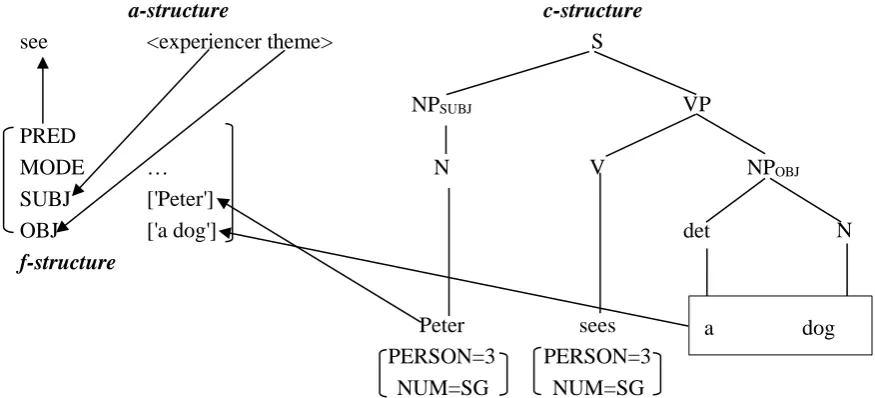
Two major LFG-based concepts are adopted in PT: one is the lexically driven feature unification (information exchange in PT’s terms) and the other is the correspondence of three LFG levels of structure: argument structure, constituent structure and functional structure. For example, the non-linear morphological process in ‘Peter sees a dog’ can be formally presented in Figure 2-1, which shows the features’ (PERS and NUM) unification of SUBJ and PRED in c-structure. The grammatical information exchange happens across phrases, i.e. the noun phrase and the verb phrase, thus requiring the S-procedure.
S
NPSUBJ VP
N V NPOBJ
det N
Peter sees a dog
PERSON=3 PERSON=3
[image:26.595.93.386.315.501.2]NUM=SG NUM=SG
Figure 2-1. Feature unification in the S-procedure (Pienemann, Di Biase, & Kawaguchi, 2005, p. 200)
14 2.2.2 Information exchange
PT (1998b) proposes a staged morpho-syntactic development based on the processing principle of information exchange and salience. Processing complexity is measured by the syntactic level of information exchange (e.g. the phrase level or inter-phrasal level) and whether the salience principle is utilized, thus defining the progressive sequence of L2 morpho-syntactic development. PT (1998b) predicts a six-stage developmental hierarchy for L2 morpho-syntactic acquisition (Pienemann, 1998b, p. 87).
At the first lemma access stage, single words (e.g. ‘bus’) and formulaic expressions
(e.g. ‘My name is Peter’; ‘How are you’) are processed as invariant forms and formulaic expressions without analysis. No grammatical encoding is evolved and no grammatical information exchange takes place.
At stage 2, the category procedure is activated. Lexical morphemes, such as English past tense marker –ed, the generic plural marker –s (I like flowers) and progressive –ing
(He singing), are processable, because these morphemes are read directly off the conceptual structure and only access the category procedure to identify lexical categories of words (e.g. N, V). Therefore, no information exchange is involved in lexical morphemes.
At the syntactic level, identification of lexical categories makes it possible to map semantic roles (e.g. agent/patient ) directly onto surface form in a strictly serial word order, similar to Bever’s (1970) NVN strategy, therefore no information exchange is required.
At stage 3, the phrasal procedure is in position when grammatical information exchange occurs within a phrase. For example, in a NP ‘these flowers’, the grammatical
15 In terms of syntax, the phrasal procedure makes it possible to identify the positions, defined as phrases (e.g. noun phrases and verb phrases). PT proposes that the adherence to strictly serial word order, i.e. the canonical schema, would be active after the salient position has been processed on the basis general cognitive principle of salience, i.e., sentence initial and final positions are perceptually more salient than sentence internal position (see Figure 2-2).
INITIAL agent action patient FINAL PP/Wh NP V NP
Figure 2-2. Salience and canonical schema (Pienemann, 1998b, p. 85)
Pienemann follows Rutherford (1989) to term the use of salience principle in
conjunction with canonical word order as ‘pragmatic’ word order options. These options allows L2 leaners to “imitate a range of L2 syntactic phenomena without full access to L2 procedures” (Pienemann, 1998b, p. 85). For example, in ‘yesterday I bought a book’
and ‘where they are?’, the initial salient positions are occupied by an adverbial ‘yesterday’ and a Wh-word ‘where’ respectively, and the rest of the sentences are still canonical.
At stage 4, the simplified sentence procedure is active, which allows information exchange between constituents in sentence internal and salient positions. This stage is called ‘simplified’ sentence procedure, because one of the constituents that needs to exchange information is at a salient position, either initial or final position. German verb separation is a case in point. In sentence (2.6), the auxiliary, hat ‘has’ , is treated as V and takes VP-complements, ein Bier getrunken ‘a beer drunk’ . The two verbs (i.e. hat ‘has’ and getrunken ‘drunk’) need to exchange information on tense (i.e.
16 2.6 er hat ein Bier getrunken
he has a beer drunk
‘He has drunk/drank a beer.’ (Pienemann, 1998b, p. 100)
At stage 5, the sentence procedure is active. In terms of morphology, information distribution goes beyond phrasal boundaries, such as SUBJ-verb agreement in English. In ‘Peter sees a dog’, the grammatical information in the SUBJ ‘Peter’ (+singular, +3rd person) needs to be exchanged with the verb features (+ singular, +3rd person, +present) to ensure the 3rd person singular morpheme –s inserted after the verb.
At the syntactic level, the sentence procedure allows information exchange at the inter-phrasal level without resorting to the pragmatic word order options (the use of salience principle in conjunction with canonical word order). That means “word order can be structured syntactically according to L2 constraints; i.e. the pragmatic word order principles can be replaced by syntactic ones” (Pienemann, 1998b, p. 85).
At the final stage 6, subordinate clause procedure is in position, which allows
information exchange between the matrix and the subclasses. For example, in order to produce ‘I don’t know where they are’, the learners need to identify the matrix ‘I don’t
know…’ and the subclause ‘…where they are’ in order to cancel the inversion of the auxiliary in the subclause. It is called the ‘cancel inversion’ rule in PT.
17 Two major limitations were identified by Pienemann (2005b) when he reviewed the original PT framework. The first limitation concerns the inclusion of the general cognitive principle of salience, which is critically reviewed by Hammarberg (1996), Hulstijn (1987, 1998) and Jordan (2004). Pienemann (2005b) summarizes the problems as follows: (1) this principle is included in PT on an ad hoc basis and it is not related to an LFG-specific modularity assumption, upon which everything else in PT rests; (2) it is not formally defined and presented. Pienemann (2005b) points out two areas where the original PT utilized the salience principle: (a) the German split verbs (see the
reproduced sentence 2.6); (b) ADJ-preposing in German and related phenomena in other languages. Pienemann argues that the case of (a) German split verbs could be very well explained relying solely on feature unification of the information ‘PART=PART’, that is present in both verb entries, in VP. This explains why German S-V agreement is one stage higher on the developmental hierarchy, in which case the feature unification of SUBJ and VERB occurs at S(entence)-node, one level higher than VP. Therefore the reliance on salience is unnecessary.
2.6 er hat ein Bier getrunken he has a beer drunk ‘He has drunk/drank a beer.’
However, feature unification alone cannot explain ADJ-preposing in German and related phenomena in other languages, in which cases serial word order and saliency were originally utilized. In the extended PT (Pienemann, Di Biase, & Kawaguchi, 2005), this limitation is remedied by the Topic Hypothesis (see section 2.2.3.2).
18 sentence before S-procedure, although the concept goes back to a long time ago and has empirical support. Pienemann summarizes the problems as: (1) no formal detail of the direct mapping processes in the context of an overall theory; (2) no formal (Lee, 2001) interface with the architecture of the proposed theory of language development. This limitation is remedied by the Unmarked Alignment Hypothesis in the extended PT (see section 2.2.3.1).
2.2.3 The mapping principles
Pienemann (1998b) attributes one source of linguistic non-linearity at the morpho-syntactic level to the necessity of storing grammatical information, which need to be exchanged in or across sentence constituents. This process of information exchange can be modelled by feature unification within word order (c-structure) within the original framework of LFG.
Pienemann, Di Biase, and Kawaguchi (2005) incorporate two elements in the revised architecture of LFG (Bresnan, 2001; Bresnan & Mchombo, 1987) into the extended PT. One is that the discourse roles (e.g. TOP and FOC) are regarded as syntacticised
functions and are represented in f-structure. The second is the Lexical Mapping Theory (Bresnan, 2001), which puts forward the guiding principles in the mapping of argument structure to functional structure. These two elements enable PT to capture other sources of linguistic non-linearity at the syntactic level, which are beyond the transfer of
grammatical information within c-structure and can be mapped onto the processability hierarchy. The non-linearity can be modelled by different kinds of mapping among the three levels of structures: argument structure, constituent structure and functional structure (Bresnan, 2001).
19 Jackendoff, 1972), Bresnan (2001) uses a thematic hierarchy which demonstrates the ordering of the argument roles in an a-structure based on their relative prominence from left to right: agent > beneficiary > experiencer/goal > instrument > patient/theme > locative (p. 307). This hierarchy explains why the experiencer (a more prominent thematic role) is ordered to the left of theme in the a-structure in Figure 2-3.
Constituent structure (c-structure) refers to language-specific word orders. For example, the basic word order for English is SVO, as demonstrated in c-structure in Figure 2-3, while for Japanese it is SOV.
Functional structure (f-structure) consists of universal units of grammatical functions, including core functions as SUBJ, OBJ, non-core functions as oblique and complement, and discourse functions as TOP and FOC. These functions are related to word order in a language-specific way and serve to connect a-structure and c-structure.
a-structure c-structure
see <experiencer theme> S
NPSUBJ VP
PRED
MODE … N V NPOBJ
SUBJ ['Peter']
OBJ ['a dog'] det N
f-structure
Peter sees a dog
PERSON=3 PERSON=3
[image:32.595.86.524.411.610.2]NUM=SG NUM=SG
Figure 2-3. Three parallel structures in LFG (Pienemann, Di Biase, & Kawaguchi, 2005, p. 200)
According to LFG, the three structures are independently motivated and need to be mapped onto each other, giving rise to two mapping processes: a-structure to f-structure mapping and c-structure to f-structure mapping, as the arrows show in the above Figure 2-3. Both argument roles (experiencer and theme) in the a-structure and the sentence constituents (the initial NP ‘Peter’ and the second NP ‘a dog’) in c-structure are mapped
20 onto their corresponding grammatical functions (SUBJ and OBJ). This corresponding mappings are demonstrated in the following simplified Figure 2-4.
agent patient … argument roles
SUB OBJ … grammatical functions
NPSUBJ NPOBJ … c-structure
Figure 2-4. Three parallel structures in LFG (Pienemann, Di Biase, & Kawaguchi, 2005, p. 226)
In psycholinguistic terms, Pienemann, Di Biase, and Kawaguchi (2005) argue that the mapping cannot be assumed to be always linear, as shown in Figure 2-4. They state, “semantic predicate-argument relationships could not be only expressed by fixed surface word and phrase configurations” (p. 201). Otherwise, surface structure variations would not be possible. This is because, in discourse, native speakers of a language use various linguistic devices to guide the listener’s attention, such as topicalization and passivization (Levelt, 1989). These attention-direction devices are necessitated by the nature of the comprehension process and give rise to structural variations. However, Pienemann et al. point out that these devices come at a cost in terms of processing, because they change the relationship between either a-structure and f-structure or between c-structure and f-structure. These changes lead to linguistic non-linearity and can be mapped onto processability hierarchy.
21 2.2.3.1 The Unmarked Alignment Hypothesis
It has been pointed out that one limitation of the original PT is that it does not offer a formal account of the direct mapping process, which is taken as an alternative or simplified procedure to form sentences before sentence procedure develops. This limitation is remedied in the extended PT by formally presenting the direct mapping process based on the revised architecture of LFG. Pienemann, Di Biase, and Kawaguchi (2005) formulate the direct mapping process into the Unmarked Alignment Hypothesis on the basis of two key sources. One is Pinker’s (1984) characterization of the direct links between grammatical functions and thematic functions and the other is Lee’s (2001) proposal of a Universal Scale of unmarked mapping within the framework of Optimality Theory (OT)-LFG.
Pinker (1984) presents the canonical mapping as non-crossing links between two ordered tiers (i.e. grammatical functions and thematic relations, see Figure 2-5) and characterizes the canonical mapping as follows:
In a language’s ‘basic forms’ (roughly, simple, active, affirmative, declarative, minimally presuppositional and pragmatically neutral sentences; see Keenan 1976), agents (if present) are realized as subjects, themes are realized as subjects if there is no agent and as objects otherwise, and sources, locations, and goals are realized as oblique objects if there is an agent or a theme or both, or as objects if there is only a theme (Pinker, 1984, p. 297).
SUBJ OBJ OBLIQUE (grammatical functions)
| | |
agent theme goal/source/location (thematic relations) Figure 2-5. Canonical mapping (after Pinker, 1984, p. 297)
22 the structure position (see Figure 2-6). According to the Universal Scales, SUBJ is less marked than Non-SUBJ, nominative case is less marked than oblique case and the initial position is less marked than the non-initial position. Therefore an initial nominative-marked SUBJ is more harmonic (less marked) than a non-initial oblique-marked SUBJ.
GF: SUBJ > NonSUBJ (from the grammatical function scale)
Case: NOM > OBL (from the case scale)
Position: Initial > Noninital (from the structural position scale)
Figure 2-6. Universal Scales (after Lee 2001, p. 97)
Based on the above two sources, Pienemann et al. (2005) formulate the direct mapping into the Unmarked Alignment Hypothesis as the following:
In second language acquisition learners will initially organize syntax by mapping the most prominent semantic role available onto the subject (i.e. the most prominent grammatical role). The structural expression of the subject, in turn, will occupy the most prominent linear position in c-structure, namely the initial position
(Pienemann, Di Biase, & Kawaguchi, 2005, p. 229).
Figure 2-7 shows the unmarked alignment of a-, c-, and f-structure. For instance, in the example sentence ‘I ate an apple’. The most prominent argument role (i.e. the agent ‘I’)
is mapped directly onto the most prominent functional role (i.e. the SUBJ). The structural expression of the SUBJ, in turn, occupies the most prominent position in c-structure, namely the initial position. The less prominent argument role (i.e. the patient
23
Lexical Mapping Theory
a-structure agent patient/theme locative
default default default
f-structure SUBJ OBJ, OBJθ OBLθ
default default default
S
c-structure NPSUBJ NPOBJ […]
[image:36.595.94.449.54.264.2]
Figure 2-7. One-to-one correspondence (Pienemann, Di Biase, & Kawaguchi, 2005, p. 230)
The one-to-one correspondence between a-structure and f-structure and between c-structure and f-c-structure results in entirely linear c-structures and “guarantee the computationally least costly manner of organizing L2 syntax and rely entirely on aspects of the syntactic machinery that are not language-specific, including f-structure, the thematic hierarchy and universal aspects of c-structure” (Pienemann, Di Biase, & Kawaguchi, 2005, p. 230).
Pienemann, Di Biase, and Kawaguchi (2005) reviewed a number of corpus-based studies and found that the initial hypothesis of syntax is based on canonical word order, for example, children language processing (e.g. Bever, 1970; Bloom, 1994; Strohner & Nelson, 1974) and adult language processing (e.g. Bates & MacWhinney, 1981, 1982, 1987; Weyerts, Penke, Münte, Heinze, & Clahsen, 2002). Within the PT framework, a number of empirical studies have provided evidence for the learner’s initial reliance on the canonical word order of the target language, such as SVO in L2 Italian (Di Biase, 2007), L2 Chinese (Zhang, 2007), L2 English (Yamaguchi, 2010) and SOV in L2 Japanese (Kawaguchi, 2005).
24 following two hypotheses, the Topic Hypothesis and the Lexical Mapping Hypothesis.
2.2.3.2 The Topic Hypothesis
In the revised architecture of LFG (Bresnan, 2001; Bresnan & Mchombo, 1987), the discourse roles (i.e. TOP and FOC) are treated as syntacticised discourse functions and they need to be presented in f-structure under the constraint of the Extended Coherence Condition: FOCUS and TOPIC must be linked to the semantic predicate complex structure of the sentence in which they occur, either by functionally or by anaphorically binding an argument.
This revision of the LFG architecture allows PT to add a pragmatic-discourse dimension to its processing hierarchy and capture one source of non-linearity of mapping
c-structure onto f-c-structure. The non-linearity, according to Pienemann, Di Biase, and Kawaguchi (2005), is “created by the addition of adjuncts to canonical structure and the assignment of discourse functions (FOC and TOP) to dislocated elements in c-structure” (p. 223). The Topic Hypothesis is formulated as follows to capture the development of syntacticised discourse functions in L2 acquisition:
25 Table 2-1. The Topic Hypothesis (adapted from Pienemann, Di Biase, & Kawaguchi, 2005, p. 239)
Stage Discourse principle
c- to f- mapping Structural outcomes English examples
3 Topicalization
of core arguments
TOP=OBJ Topicalization of core
argument other than SUBJ
Books I like. What did he buy?
2 XP adjunction TOP=ADJ ADJ+canonical word
order
Yesterday I read a book.
1 Canonical
order
SUBJ=default TOP Canonical word order (SVO or SOV)
I like books.
Stage 1: SUBJ=TOP
At stage 1, L2 beginners are constrained by the unmarked alignment, and three levels of structure are mapped one to each other in a strictly one-to-one manner. The first and most prominent position in c-structure is occupied by the most prominent syntactic function (i.e. the SUBJ) representing the most prominent argument available (i.e. the agent). At this stage, the SUBJ occupies the first position as the default TOP. The close association between SUBJ and TOP, i.e. the universal default that optionally identifies SUBJ and TOP, is reflected in the typological perspective of LFG. Therefore, the syntacticised discourse function TOP is not differentiated from SUBJ in the initial interlanguage. For example, in the sentence ‘I like books’, ‘I’ can be SUBJ and/or TOP,
as shown in Figure 2-8 by the optional or default link between the TOP and the SUBJ.
TOP [PRED‘I’]
SUBJ
PRED ‘like<(SUBJ)(OBJ)>’
OBJ [PRED‘books’]
Figure 2-8. The f-structure of English canonical SVO
Stage 2: TOP=ADJ
When the first position is occupied by a non-SUBJ constituent, the mapping between c- to f-structure becomes non-default. This breaks the default link between the first
26 be assigned one of the non-argument functions TOP, FOC or ADJ. The Topic
Hypothesis predicts that the XP-adjunction is first applied to non-core arguments, such as ADJ, because “the rest of c-structure is mapped canonically onto the universal
hierarchy of grammatical core functions” (Pienemann, Di Biase, & Kawaguchi, 2005, p. 238). For instance, Figure 2-9 shows that in ‘Today I study English’, the ADJ ‘today’ is
the TOP, indicated by the link. Figure 2-10 shows that the initial position is occupied by the ADJ TOP ‘today’, with the rest of the sentence constituents mapped canonically onto the universal hierarchy of grammatical core functions, i.e. SUBJ ‘I’ >OBJ
‘English’.
TOP [PRED‘today’]
ADJ
SUBJ [PRED ‘I’]
PRED ‘study <(SUBJ)(OBJ)>’
[image:39.595.93.497.405.614.2]OBJ [PRED‘English’]
Figure 2-9. The f-structure of ADJ TOPs
Lexical Mapping Theory
a-structure agent > patient/theme > locative
f-structure SUBJ > OBJ, OBJθ > OBLθ, … ADJ
S
c-structure
XP ADJ FOC TOP
S
AP […]NPSUBJ […]NPOBJ […]
Figure 2-10. XP-adjunction in interlanguage (after Pienemann, Di Biase, & Kawaguchi, 2005, p. 234)
Pienemann, Di Biase, and Kawaguchi (2005) reported that “the assumption that in the presence of XP-adjunction the rest of the canonical pattern can nevertheless be
27 languages, such as German and Swedish, XP-adjunction constrains the verb into second position while in English, the XP-adjunction of non-SUBJ Wh-words constrains an auxiliary into second position. However, empirical evidence shows that the XP-adjunction constraints are always violated by L2 beginners, who produce
ungrammatical interlanguage forms, with XP followed by the canonical patterns. Bettoni and Di Biase (2011) reported that in the L2 acquisition of Italian Wh-questions, L2 Italian leaners also violated the constraint of XP-adjunction on SUBJ to the final position in mature Italian grammar and produced the ungrammatical interlanguage form of Wh+SV.
Stage 3: TOP=OBJ
When the initial position is occupied by a core-argument, such as OBJ and OBJθ, the canonical string that SUBJ precedes OBJ is broken. In the sentence ‘Books I like’, the OBJ ‘Books’ is promoted to the sentence initial position to receive the prominence and is bound by the discourse function of TOP, required by the Extended Coherence
Condition, as demonstrated in Figure 2-11. The non-default mapping of less prominent grammatical function (i.e. the OBJ) preceding the most prominent grammatical function (i.e. the SUBJ) is demonstrated in Figure 2-12.
TOP [PRED‘books’]
SUBJ [PRED‘I’]
PRED ‘like<(SUBJ)(OBJ)>’ OBJ [ … ]
Figure 2-11. The f-structure of OSV
OBJTOP SUBJ […] … f-structure
↑ ↑Non-default mapping
NPOBJ NPSUBJ [...] … c-structure
Figure 2-12. Non-default mapping of OSV
28
did he buy’, in order to meet the completeness and coherence conditions, the discourse function FOC is allowed to satisfy the unsatisfied argument function, i.e. OBJ, as illustrated by the link in the f-structure in Figure 2-13. Pienemann, Di Biase, and Kawaguchi (2005) also refer to information exchange to explain this non-default mapping. They point out, “information about the link between FOC and OBJ needs to be exchanged between the two grammatical functions, and this information exchange creates one aspect of non-linearity that is present in WH-questions” (p. 236).
FOC [PRED‘what’]
SUBJ [PRED‘he’]
TENSE PAST
MOOD INTERROGATIVE
PRED ‘buy<(SUBJ)(OBJ)>’ OBJ [ … ]
Figure 2-13. The f-structure of ‘What did he buy?’
Empirical evidence for the Topic Hypothesis has been provided from a number of studies of typologically different languages, such as L2 Japanese (Kawaguchi, 2005, 2010), L2 Italian (Bettoni & Di Biase, 2011; Di Biase, 2007), L2 English (Yamaguchi, 2010), L2 Chinese (Zhang, 2007) and Japanese-English bilingual first language acquisition (Itani-Adams, 2009).
2.2.3.3 The Lexical Mapping Hypothesis
The Topic Hypothesis shows that, after the initial one-to-one mapping, c- to f-structure mapping becomes non-linear (non-default) when non-SUBJ constituents are assigned discourse functions. In terms of a- to f-structure mapping, it can be non-linear as well. “Here non-linearity is caused by exceptional lexical entries with intrinsic non-canonical a-structure (e.g. ‘receive’ or ‘please’) and non-default verb forms (e.g. passive,
29 Lexical Mapping Theory formulates some guiding principles that systematically explain how the argument structure mediates the mapping of conceptual representation of thematic roles onto the grammatical functions. Based on the relevant mapping principles of a- to f-structure mapping, Pienemann, Di Biase, and Kawaguchi (2005) propose the Lexical Mapping Hypothesis to explain how L2 learners go through the default mapping of a- to f-structure to non-default mapping and finally to complex mapping, as summarized in Table 2-2.
Table 2-2. The Lexical Mapping Hypothesis (adapted from Pienemann, Di Biase, & Kawaguchi, 2005)
Stage a- to f- structure mapping Structural outcomes English Examples
3 Complex mapping Causative She made her son wash the car.
2 Non-canonical mapping Passive The apple was eaten by him.
Lexically uncanonical mapping Exceptional verbs He received a letter from John.
1 Canonical mapping Canonical Order He ate an apple.
At stage 1, L2 Learners are constrained by one-to-one mapping and follow the default AGENT-to-SUBJ mapping. The most prominent role (i.e. the agent), is mapping onto the most prominent grammatical function (i.e. the SUBJ) in their respective prominence hierarchies. In ‘He ate an apple’, the most prominent role, the agent ‘He’, is mapped
onto the SUBJ, the most prominent grammatical function (see Figure 2-14).
Active: eat <agent, patient> a-structure
| |
SUBJ OBJ f-structure
| |
He an apple c-structure
Figure 2-14. Default mapping of a- to f-structure
When non-agent argument, i.e. less prominent roles such as patient or recipient, are mapped onto the SUBJ, the one-to-one correspondence, in terms of prominence, of AGENT-to-SUBJ and PATIENT-to-OBJ is disrupted and the mapping is non-default. In ‘He received a letter from John’, the recipient role ‘He’ is mapped onto the SUBJ,
30
eaten by him’, the patient ‘the apple’ is mapped onto the SUBJ, which is required by passivization (see Figure 2-16).
Recipient Theme Agent a-structure
↓ ↓ Non-default mapping
SUBJ OBJ ADJ f-structure
↑ ↑ Default mapping
NPSUBJ NPOBJ PPADJ c-structure
He a letter from John
Figure 2-15. Non-default mapping of a- to f-structure (exceptional verbs)
Patient Agent a-structure
↓ ↓ Non-default mapping
SUBJ ADJ f-structure
↑ ↑ Default mapping
NPSUBJ PPADJ c-structure
The apple by him
Figure 2-16. Non-default mapping of a-, and f-structure (passive)
After the stage of non-default mapping, learners are able to do complex mapping, as in “She made her son wash the car”, where the OBJ “her son” assumes two argument
roles: one is the patient of the main verb “made” and the other is the agent of the verb
“wash” (see Figure 2-17).
‘cause <[Agent] [Patient] wash <[Agent] [Patient]>>’ a-structure
↓ ↓ ↓Complex mapping
SUBJ OBJ OBJPATIENT f-structure
↑ ↑ ↑ ↑Default mapping
She her son the car c-structure
Figure 2-17. Complex mapping of a- to f-structure (causative) (adapted from Pienemann, Di Biase, & Kawaguchi, 2005)
31 empirical study on L2 Chinese has been conducted to apply the Lexical Mapping
Hypothesis.
32
Chapter 3
Chinese syntax from a processability perspective
The previous chapter laid out the theoretical basis for this thesis. In particular, a detailed account was given to the PT-based processing principles, i.e. information exchange and mapping principles. The current chapter is to utilize these principles to propose two processing hierarchies for L2 Chinese syntax. The general typological features of Chinese language are presented first, with a focus on topic-prominence features and word order of Chinese syntax. Then the Chinese syntactic structures under investigation are described according to PT-based processing principles, together with a formal description of these structures within the framework of Lexical Functional Grammar (Bresnan, 2001). The description of Chinese syntax is followed by a review of four empirical studies on L2 Chinese syntax from a processing perspective. Lastly, two PT-based processing hierarchies for L2 Chinese syntactic structures are hypothesized and research questions for the current study are reiterated.
3.1 The typological features of Chinese language
The Chinese language is known as an isolating or analytic language, because the words of Chinese do not have morphological complexity in terms of grammar. A typical word is made up of a single morpheme. As a result, many of the grammatical relationships that involve morphological markers (e.g., plural, tense, gender, case, agreement) in inflectional languages, either do not exist or are expressed through the lexicon,
independent particles or word order (Norman, 1988). Three major typological features are reviewed in the following paragraphs.
33
3.1 他 每天 学习 汉语
ta meitian xuexi hanyu he everyday study hanyu ‘He studies Chinese everyday.’
3.2 他 去 了 北京 ta qu le Beijing he go PF Beijing ‘He went to Beijing.”
The second typological feature is that no internal changes is involved in the Chinese words themselves. The verb xuexi ‘study’ in (3.1) does not need to agree with the third person singular SUBJ ta ‘he’ and the verb qu ‘go’ does not need to change its form to reflect the past tense. In comparison, these two instances require corresponding changes of verb forms in English, as indicated in the translations (the 3rd singular present
morpheme ‘–s’ and the irregular past tense form ‘went’).
The third typological feature is that Chinese is regarded as a topic-prominent language from a functional point of view (e.g. Chu, 1995; C. N. Li & Thompson, 1976; C. N. Li & Thompson, 1981; Tsao, 1990). In topic-prominent languages, a sentence often starts with a nominal representing a TOP that names what the sentence is about. The TOP is definite or generic and refers to something that a speaker assumes the listener knows about (C. N. Li & Thompson, 1981). Li and Thompson (1976) point out that the major difference between SUBJ and TOP is that SUBJ is a sentence-internal notion and the TOP is a discourse notion. SUBJ can be understood best in terms of its functions within the sentence structure; thus SUBJ is normally determined by the verb, and is
selectionally related to the verb. TOP can be understood best in terms of the discourse; thus TOP is discourse-dependent, serves as the centre of attention of the sentence, and must be definite.
Li and Thompson (1981) classify Chinese simple declarative sentences into the
34 (1) In the first type (see 3.3), the SUBJ and the TOP are identical, which is wo ‘I’
(underlined).
3.3 我 喜欢 吃 苹果
wo xihuan chi pingguo I like eat apple ‘I like to eat apples.’
(2) The second type (3.4) has both a TOP (i.e. nashi gou ‘that dog’) and a SUBJ (i.e. wo ‘I’).
3.4 那 只 狗 我 已经 看 过 了
na zhi gou wo yijing kan guo le that CL dog I already see EXP PF ‘The dog, I have seen already.’
(3) The third type has a TOP only (see na ben shu ‘that book’ in 3.5). The SUBJ is absent because it is understood from the context or because it is unnecessary and unimportant. In this case, the unmentioned SUBJ is ‘someone’.
3.5 那 本 书 出版 了
na ben shu chuban le that CL book publish PF
‘That book, (someone) has published it.’
(4) The fourth type is the sentence without both TOP and SUBJ. This type often occurs in answers to questions, as in sentence 3.6, the TOP/SUBJ wo ‘I’ is understood from the context and therefore is omitted.
3.6 Question-你 看 过 李四 没有
ni kan guo lisi meiyou you see EXP Lee not ‘Have you seen Lee?’
Answer-(我) 没 看 过
(wo) mei kan guo (I) not see EXP ‘(I) haven’t.’
35 properties of Chinese TOPs. The major properties are: (1) TOP is always definite; (2) TOP may, and often does, extend its semantic domain to more than one clause; (3) TOP is in control of the pronominalisation or deletion of all the coreferential NPs, when it extends its semantic domain to more than one clause; (4) TOP, except in clauses in which it is also SUBJ, plays no role in such processes as true reflexivization, Equi-NP deletion, and imperativization; (5) TOP can occupy the sentence-initial positon and the preverbal position.
According to Tsao’s list of TOP proterties, a TOP is not restricted only to the sentence-initial position. It also appears in the preverbal position. This view is share by Chu (1993, 1998). Tsao (1990) distinguishes the primary TOP and the secondary TOP. For example, sentence (3.7) contains a fronted OBJ in the preverbal position. Tsao labels the SUBJ ta’he’ as the primnary TOP and the fronted OBJ na ben shu ‘that book’ as the secondary TOP.
3.7 他i 那 本 书j 看 完, ___i___________j 就 还 给 我 了 tai na ben shuj kan wan, ___i___________j jiu huan gei wo le hei that CL bookj read finish, ___i___________j then return to me PF ‘He finished reading the book and then (he) returned (it) to me immediately.’
Tsao argues that, except for its non-sentence-initial position, the fronted OBJ has three major semantic and syntactic properties of the sentence-initial TOP. First, a secondary TOP is definite or generic in reference. If the definite OBJ NP, na ben shu ‘that book’ in (3.7), is replaced by an indefinite OBJ NP yi ben shu ‘one book’, the sentence will be ungrammatical. Second, a secondary TOP extends its semantic domain to more than one clause, as evident in i and j in sentence (3.7). Third, a secondary TOP controls the
coreferential NP deletion and pronominalisation when it extends its semantic domain to more than one clause, evident in the English translation of sentence (3.7).