This is a repository copy of
Demonstration of Baird’s Rule Complementarity in the Singlet
State with Implications for Excited-State Intramolecular Proton Transfer
.
White Rose Research Online URL for this paper:
http://eprints.whiterose.ac.uk/145580/
Version: Published Version
Article:
Lampkin, Bryan, Nguyen, Yen, Karadakov, Peter Borislavov
orcid.org/0000-0002-2673-6804 et al. (1 more author) (2019) Demonstration of Baird’s
Rule Complementarity in the Singlet State with Implications for Excited-State
Intramolecular Proton Transfer. Physical Chemistry Chemical Physics. ISSN 1463-9084
https://doi.org/10.1039/C9CP02050K
[email protected]
https://eprints.whiterose.ac.uk/
Reuse
This article is distributed under the terms of the Creative Commons Attribution-NonCommercial (CC BY-NC)
licence. This licence allows you to remix, tweak, and build upon this work non-commercially, and any new
works must also acknowledge the authors and be non-commercial. You don’t have to license any derivative
works on the same terms. More information and the full terms of the licence here:
https://creativecommons.org/licenses/
Takedown
If you consider content in White Rose Research Online to be in breach of UK law, please notify us by
Cite this:DOI: 10.1039/c9cp02050k
Demonstration of Baird’s rule complementarity
in the singlet state with implications for
excited-state intramolecular proton transfer†
Bryan J. Lampkin, ‡aYen H. Nguyen,‡aPeter B. Karadakov band
Brett VanVeller *a
The aromatic character of an arene is proposed to switch from aromatic in the ground state (S0) to antiaromatic
in the S1and T1excited states. This behavior is known as Baird’s rule and has been invoked to explain
excited-state properties, primarily in the triplet excited-state, whereas rationalization of antiaromaticity in the singlet excited-state is less developed. This work demonstrates the first application of Baird’s rule to rationalize previously unexplained experimental behavior of the singlet state process known as excited-state intramolecular proton transfer (ESIPT). Further, by analyzing the variations in isotropic magnetic shielding around the base arenes (benzene and naphthalene) of ESIPT fluorophores in the S0 and S1 electronic states,
different shielding distributions indicate a complementarity to Baird’s rule: greater aromaticity in S0leads
to greater antiaromaticity in S1andvice versa. These findings have immediate application in the design
of functional ESIPT fluorophores and, more generally, for photochemical reactions that are driven by the relief of antiaromaticity in the excited state. Notably, a tenet of traditional chromophore design states that expansion of conjugation generally leads to a red-shift in absorbance and emission wavelengths. The results of this study show that ESIPT fluorophores run contrary to those conventional design principles and this behavior can only be rationalized by considering Baird’s rule.
Introduction
Aromaticity plays a major role in the chemical and electronic properties of molecules in the ground state following Hu¨ckel’s rules.1–3 Alternatively, the concepts of aromaticity and anti-aromaticity have also been shown to influence the properties of singlet and triplet excited states. In general, an annulene with [4n + 2] p-electrons in its aromatic ground state (S0) can be
regarded as antiaromatic in its S1 and T1 excited states. The converse is similarly true for annulenes with a 4n p-electron
antiaromatic ground states possessing aromatic character in the excited state.4–9This inversion of aromaticity between the ground and excited states has colloquially come to be known as Baird’s rule.10,11 Baird originally proposed the inversion of Hu¨ckel’s rules between S0and T1,4but subsequent theoretical work suggested Baird’s rule to be applicable to S1 states as well.12–15 While numerous studies10 have been conducted to
investigate the excited-state aromaticity of various annulenes— establishing Baird’s rule as a useful convention for under-standing electronic states—the application of excited-state aromaticity to rationalize and design photochemical properties is less developed and predominantly focused on triplet aromaticity.16–19
The goal of this work was to apply Baird’s rules to interpret the unconventional behavior of benzoxazole fluorophores that undergo excited-state intramolecular proton transfer (ESIPT), where traditional strategies to red-shift the fluorescent wave-length instead lead to blue-shifted emission.20,21In doing so, we demonstrate the complementarity of Baird’s rule, where lower aromaticity in S0 leads to lower antiaromaticity in S1. These results provide a deeper understanding of excited-state potential energy surfaces for applications in the design of functional chromophores and photochemical pathways.
Excited-state intramolecular proton transfer (ESIPT) is a photo-chemical process that leads to a dramatically large Stokes shift of the wavelength of fluorescence.20Briefly, the 2-(20 -hydroxyphenyl)-benzoxazole derivative (Fig. 1) exists in its phenolic enol formE
in the ground state. After excitation of E, direct fluorescence
fromE*can produce an emitted photon with a relatively small
Stokes shift. Alternatively, the structure of E* is such that an
excited-state tautomerization can occur to produce the keto form
aDepartment of Chemistry, Iowa State University, Ames, Iowa, 50011, USA.
E-mail: [email protected]
bDepartment of Chemistry, University of York, Heslington, York, YO10 5DD, UK.
E-mail: [email protected]
†Electronic supplementary information (ESI) available. See DOI: 10.1039/ c9cp02050k
‡These authors contributed equally to this manuscript.
Received 11th April 2019, Accepted 30th April 2019
DOI: 10.1039/c9cp02050k
rsc.li/pccp
PAPER
Open Access Article. Published on 30 April 2019. Downloaded on 6/5/2019 9:19:13 AM.
This article is licensed under a
Creative Commons Attribution-NonCommercial 3.0 Unported Licence.
View Article Online
K*(Fig. 1, ESIPT step). The isomerization fromE*toK*is fast
(Bps) and highly favorable. Emission then takes place fromK*
to the ground-state keto formK—where the quinoidal character
of K places it higher in energy in the ground state than E
(an example of Hu¨ckel [4n+ 2] aromatic stability). The net result is that a stabilizedK*and destabilizedKcloses the energy gap
(S10-S00) such that fluorescence fromK*can be4150 nm red-shifted relative to fluorescence fromE*(S1-S0).
The ESIPT process has been applied to the design of new functional molecules for biosensing and imaging.20,21Thus, insights into the factors that govern the isomerization and wavelength of emission are immensely valuable to the design and optimization of novel chemical tools based on ESIPT. While the excited-state behavior of derivatives based onE has been extensively studied,
one aspect of their emissive behavior has eluded explanation.22–24 Consider the behavior of two benzoxazole derivatives HBO andNAP(Fig. 2 and Table 1). In general, expansion of conjugation
leads to a red-shift in the absorption and emission of a chromo-phore. Accordingly, the absorbance maximum ofNAPisB40 nm
longer thanHBO. In contrast, however, the emission wavelength of NAPis not similarly red-shifted and the Stokes shift is far smaller
than for HBO. The origins of this odd behavior have not been
adequately explained.22–24 Additionally, for NAP, two emissive bands are observed. The predominant band is ascribed to emission fromNAP-K*(460 nm) with a weaker, poorly defined band from NAP-E*(400 nm).22
From the spectral data ofHBOandNAPin Table 1, we can
develop the potential energy diagrams in Fig. 3.23Based on the higher energy of emission fromNAP-K*(460 nm)versusHBO-K*
(508 nm),HBO-K*is more stabilized relative toHBO-E*than for NAP-K* relative toNAP-E* (eHBO4 eNAP). Similarly, the smaller
energy difference betweenNAP-E*andNAP-K*(eNAP) means that a
detectable amount of NAP-E*exists and a minor band for enol
emission is observed.25Overall, these results are congruent with the notion that tautomerization ofNAP-E*toNAP-K*is not as
energe-tically stabilizing as tautomerization ofHBO-E*toHBO-K*despite
the larger conjugated system in NAP. Given the utility of ESIPT
probes for a variety of sensing and imaging applications,20,21it is essential to understand the factors that contribute to the photo-chemical mechanism to establish reliable design criteria.
It has been proposed theoretically that aromaticity may play a role in the tautomeric proton transfer of phenolic derivatives in the excited state.26,27 Similarly, according to Baird’s rule, the aromatic phenol (E) is antiaromatic in the excited state, and
isomerization to the quinoidal keto form (K) can be conceptually
understood to relieve the destabilizing effects of antiaromaticity. Naphthalene is generally understood to be less aromatic than benzene in the ground state.28–31We therefore propose that naphthalene is less antiaromatic than benzene in the excited state. This complementarity of greater aromaticity in the ground state leading to greater antiaromaticity in the excited state (and vice versa) is an aspect of Baird’s rule that
has not been experimentally demonstrated.
Thus,NAP-E*is less antiaromatic relative toHBO-E*, which
creates a lower driving force to form NAP-K*. Consequently, NAP-K*is less stabilized in the excited state and a larger energy
gap must exist between NAP-K* and NAP-K relative to the
energy gap between HBO-K* and HBO-K. As an aside, the
reduced Stokes shift ofNAPlikely also derives from the lower
energetic bias between the enol and keto tautomers in the
Fig. 1 Excited-state intramolecular proton transfer (ESIPT). Isomerization to the keto form closes the energy gap, red-shifts emission and create a large Stokes shift.
[image:3.595.48.289.49.166.2]Fig. 2 Absorbance and emission traces of HBO (solid) and NAP (dashed) in toluene.
Table 1 Spectral data of ESIPT fluorophores in toluene
Abslmax(nm) Emlmax(nm) Stokes shift (nm)
335 508 173
378 400, 460 22, 82
Fig. 3 Excited-state intramolecular proton transfer (ESIPT). Isomerization to the keto form closes the energy gap, red-shifts emission and create a large Stokes shift.
Paper PCCP
Open Access Article. Published on 30 April 2019. Downloaded on 6/5/2019 9:19:13 AM.
This article is licensed under a
Creative Commons Attribution-NonCommercial 3.0 Unported Licence.
[image:3.595.304.552.59.291.2] [image:3.595.45.291.579.691.2]ground state (gHBO andgNAP, Fig. 3). The lower ground-state
aromaticity of naphthaleneversusbenzene means thatgHBO4gNAP.
Thus, becauseNAP-Kis not as destabilized relative toNAP-Edue to
this reduced aromaticity, the energy gap betweenNAP-KandNAP-K*
is necessarily larger than forHBO.
Results and discussion
The proposed role that the reduced excited-state antiaromaticity of naphthalene plays in the photophysics of NAP is supported by
calculations off-nucleus isotropic magnetic shielding isosurfaces of benzene and naphthalene in the ground and excited state (Fig. 4–6). The comparison of ground and excited-state aromaticity is well-served by this computational approach15 because the off-nucleus magnetic isotropic shielding, displayed as a function of position in the contour plots of Fig. 4–6, addresses important drawbacks associated with single-point nucleus-independent chemical shift (NICS) values.32Mainly, the arbitrary position at which a single-point NICS value is calculated may not possess sufficient infor-mation to fully characterize the aromaticity of ap-system.33,34
Additionally, geometric indices of aromaticity are often not applicable for excited-state aromaticity. For example, bond-length alternation is often invoked as an indication of reduced aromaticity in the ground state,35but benzene maintains the same
[image:4.595.308.546.189.416.2]D6h symmetry across S0 and S1.36–38 Thus, off-nucleus isotropic magnetic shielding isosurfaces provide one of the most insightful and succinct means of comparing aromaticity between molecules. The contour plots in Fig. 4–6 display the spatial variation in the values of the off-nucleus isotropic magnetic shielding,siso(r). The shape of the isotropic shielding surfaces and contour plots in Fig. 4–6 show profoundly different isotropic shielding distributions between the S0and S1 of both benzene and naphthalene, where positivesiso(r) values indicate more shielded regions that can be associated with stronger bonding (aromatic) and negativesiso(r) values indicate more deshielded regions corresponding to weaker bonding (antiaromatic). Such contour plots have been referred to as ‘‘fingerprints’’ of aromaticity that allow for unambiguous classifica-tion of the degree of aromaticity and antiaromaticity in the electronic states of benzene and naphthalene.15
The isotropic shielding is represented by three plotting plane orientations (Scheme 1) to provide a more comprehensive picture of the spatial variation ofsiso(r).
In general, the contour plots in Fig. 4–6 reveal that benzene is more aromatic relative to naphthalene in the ground state and, conversely, benzene is more antiaromatic relative to naphthalene in the excited state.
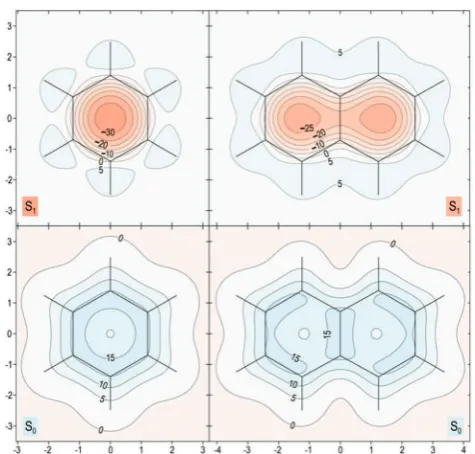
The S0of benzene in Fig. 4 displays a shielded ring inside of which the isotropic shielding, siso(r), is above 15 ppm. In contrast, the regions wheresiso(r) exceeds 15 ppm in each of the six-membered rings in S0of naphthalene are smaller and discontinuous, indicating a lower aromaticity compared with S0 of benzene. The S1 contour plots reveal a complimentary relationship to the aromaticity in S0. The S1of benzene shows siso(r) going down to under 30 ppm in a sizeable central circular region, which indicates that it is more antiaromatic than S1of naphthalene where the contour line surrounding the corresponding deshielded regions hassiso(r) of 25 ppm.
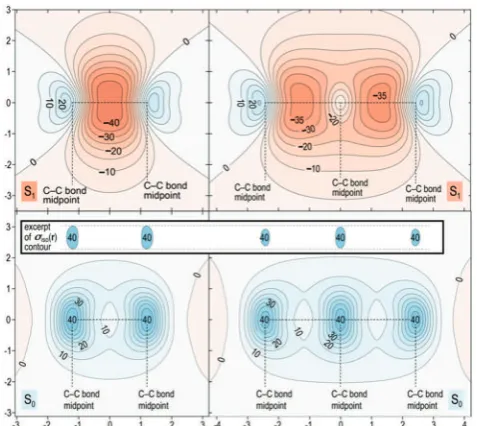
The spatial variation ofsiso(r) represented in Fig. 5 reinforces the conclusions from Fig. 4. The areas of strong bonding exhibiting siso(r) over 40 ppm, are larger in the S0 of benzene than for naphthalene (see inset). Here we have another confirmation that the greater aromaticity of benzene in S0 leads to greater anti-aromaticity in S1compared with naphthalene: the most deshielded region extending above and below the central parts of the benzene ring features siso(r) below 40 ppm whereas the corresponding regions in naphthalene are less deshielded by about 5 ppm.
The in-plane variation insiso(r) represented in Fig. 6 is less indicative of differences in aromaticity in S0. We do note, however, that the area wheresiso(r) falls to under 10 ppm at the center of each ring is smaller for benzene than for naphthalene, which shows that benzene possesses higher values of siso(r) overall compared with naphthalene. The S1contour plots rein-force the observations made in relation to Fig. 5: the central region of the benzene ring features more extensive deshielding that the central regions of the six-membered rings in naphtha-lene, which is an indication of greater antiaromaticity.
Scheme 1 Planes of contour plots in Fig. 4–7.
Fig. 4 Isotropic shielding contour plots 1 Å above the molecular (horizontal) plane for the S0and S1states of benzene (left) and naphthalene (right).siso(r)
values were obtained using state-optimizedp-space CASSCF(6,6)-GIAO/ 6-311+G* and CASSCF(10,10)-GAIO/6-311+G* wavefunctions for benzene and naphthalene respectively,siso(r) in ppm, axes in Å.
Open Access Article. Published on 30 April 2019. Downloaded on 6/5/2019 9:19:13 AM.
This article is licensed under a
[image:4.595.47.294.556.642.2]Finally, we introduce a new ‘‘fingerprint’’ of aromaticity switching in Fig. 7, which displays the difference contour plots that result from subtracting siso(r) for S0 from siso(r) for S1. Fig. 7 confirms that the overall change in aromatic character from ground to excited state is greater for benzene than for naphthalene by 4–7 ppm.
The overall conclusion from all of the contour plots is that differences in aromaticity and bonding between benzene and naphthalene are smaller in S0relative to S1. Indeed, differences in ground-state aromaticity are small (these are more obvious
in the S0 shielding plots 1 Å above the molecular plane, see Fig. 4, whereas the S0shielding plots in Fig. 5 and 6 display very similar bonding patterns). This finding, albeit based on a single comparative example, may imply that small differences in ground state aromaticity can lead to much larger differences in antiaromaticity in the excited state.
Collectively, these results affirm the greater aromaticity of benzene compared with naphthalene in S0.28–31 Conversely, benzene is more antiaromatic in S1than naphthalene. There-fore, the greater aromaticity of benzene in S0similarly leads to greater antiaromaticity in S1relative to naphthalene (Dsiso(r) of about 5 ppm). These results demonstrate that, when applied to singlet states, Baird’s rule is complimentary between S0 and S1, where greater aromaticity in S0 leads to greater antiaromaticity in S1. The implications of this observation build a compelling case for the role that aromaticity effects play in the ESIPT process ofHBOandNAP.
The greater antiaromaticity in the phenol ofHBO-E*creates
a larger energetic difference betweenHBO-E*and the quinoidal HBO-K*(which could be considered nominally nonaromatic by
Hu¨ckel’s rules). In contrast, the reduced antiaromaticity of
NAP-E*relative to HBO-E*creates a smaller energetic driving Fig. 6 Isotropic shielding contour plots in the molecular (horizontal)
plane for the S0and S1states of benzene (left) and naphthalene (right).
Same wavefunctions as for Fig. 4,siso(r) in ppm, axes in Å.
Fig. 7 Isotropic shielding difference plots between S1–S0for benzene
(left) and naphthalene (right) in three orientations described by Scheme 1: (A) same as for Fig. 4; (B) same as for Fig. 5; (C) same as for Fig. 6. Same wavefunctions as for Fig. 4,siso(r) differences in ppm, axes in Å. Fig. 5 Isotropic shielding contour plots in the vertical plane slicing through
the C–C bonds for the S0and S1states of benzene (left) and naphthalene
(right). Same wavefunctions as for Fig. 4,siso(r) in ppm, axes in Å.
Paper PCCP
Open Access Article. Published on 30 April 2019. Downloaded on 6/5/2019 9:19:13 AM.
This article is licensed under a
Creative Commons Attribution-NonCommercial 3.0 Unported Licence.
[image:5.595.48.287.48.261.2] [image:5.595.309.547.48.391.2] [image:5.595.48.288.309.547.2]force to formNAP-K*. We therefore propose that these aromaticity
effects are responsible for the reduced Stoke’s shift for NAP.
Similarly, the smaller energetic bias betweenNAP-E*andNAP-K*
means that enol emission fromNAP-E*can be detected relative to
keto emission.
Finally, we note that Baird’s rules of excited-state aromaticity have primarily been validated in arenes with (p,p*) excited
states.10The ESIPT process similarly occurs in the (p,p*) excited state,24which justifies our application of Baird’s rule to explain the behavior ofNAP.
The potential energy diagrams in Fig. 3 were constructed based on the observable spectral properties ofHBOandNAP.
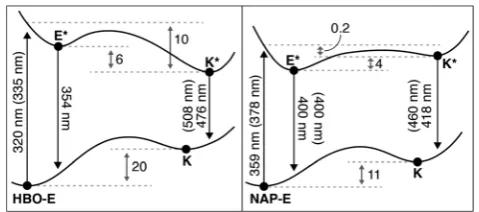
To gain further insight into the ESIPT process, we calculated the energetic parameters defined in Fig. 8.
The computed wavelengths of absorption and emission correspond to the Frank–Condon vertical transitions from the ground state and the optimized excited state geometry for both
HBOandNAP. All electronic energies were normalized to the
ground state energy of the enol form (E) for bothHBOandNAP.
As anticipated, based on the lower aromaticity of naphthalene
versus benzene discussed above, there is a smaller energy difference between theEandKspecies ofNAPrelative toHBO.
Alternatively, in the excited state, the analysis in Fig. 4–7 predict a greater stabilization of HBO-K* compared with HBO-E*,
in accord with Baird’s rule. Indeed, we compute a favorable stabilization (6 kcal mol 1) ofHBO-K*following ESIPT, whereas the energetic stabilization ofNAP-K*was computed to be
energe-tically uphill (4 kcal mol 1) relative toNAP-E*. The spontaneous formation of NAP-K* has been spectroscopically confirmed,22
implying an exothermic ESIPT process to formNAP-K*. We
there-fore conclude that our computed endothermic process likely arises from error associated with excited-state geometry optimization ofK*. TD-DFT geometry optimizations have been characterized
to significantly underestimate CO bond lengths and as a result, will give inaccurate emission energies.39,40 Nevertheless, the reported gas phase transition energies (in nm) match experimental observables within documented TD-DFT errors (0.2–0.3 eV),41 where emission fromNAP-K*shows the most inaccurate computed
value (418 nm) relative to experiment (460 nm). This inaccuracy further suggests that an error in the computed geometry is responsible for the discrepancy in energy between theory and experiment ofNAP-E*andNAP-K*.
Conclusion
We present compelling evidence that aromaticity plays a key role in determining the energetic difference between tautomeric species in the excited state. This result has immediate implications for the design of ESIPT chromophores based onHBO. The ESIPT process
has been applied to the development of new functional molecules and sensors.20,21,42Thus, an understanding of how structure relates to spectral features is critical to the design of novel ESIPT materials. This work reveals that expansion of conjugation is not a viable strategy to red-shift the emissive properties of ESIPT fluorophores unless expansion of thep-system leads to a more aromatic phenolic
partner than the base phenol in HBO. Notably, this result
runs contrary to traditional chromophore design principles in which expansion of conjugation generally leads to a red-shift in absorbance and emissive properties. These results can only be rationalized by considering Baird’s rule (see below).
We propose that the aromaticity of the phenolic ring should be given strong consideration during the design of novel ESIPT chromophores as it can dramatically impact the Stokes shift of keto emission. Further, we predict that strategies centered around using electron-donating and electron-withdraw substi-tution (so called ‘‘push–pull’’ chromophores) may provide more fruitful avenues to increase the Stokes shift of keto emission, as has been demonstrated.43 To date, however, a systematic investigation of the role that substitution of the HBO core
can play in tuning the absorbance and enolvs.keto emission
features ofHBOhas not been experimentally demonstrated.25
More generally, this work corroborates the tenets of Baird’s rule that [4n+ 2] Hu¨ckel aromatic character in the ground state
flips to antiaromatic character in the excited state.10 Further-more, experimental evidence for Baird’s rule operating in the singlet excited state is lacking.12–15This report provides experi-mental demonstration of Baird’s rule in the singlet state, where the excited-state isomerization observed inHBOcan be rationalized to
be a process by which excited-state antiaromaticity is alleviatedvia
intramolecular proton transfer to a quinoidal isomer.
Finally, this work proposes and demonstrates a largely intuitive concept within Baird’s rule that greater aromaticity in S0leads to greater antiaromaticity in S1, and presumablyvice
versain terms of antiaromaticity in S0.
Computational details
All complete-active-space self-consistent field calculations with gauge-including atomic orbitals (CASSCF-GIAO) on benzene and naphthalene reported in this paper were carried out using the MCSCF-GIAO (multiconfigurational SCF with GIAOs) methodology44,45and implemented in the Dalton 2016.2 pro-gram package,46within the 6-311+G* basis set.
The S0(1 1A1g) and S1(11B2u) electronic states of benzene were described using state-optimized p-space CASSCF(6,6)
wavefunctions (with ‘6 electrons in 6 orbitals’), at the experi-mental D6h gas-phase ground-state geometry established through analysis of the n4 vibration–rotation bands of C6H6 and C6D6.47 The geometry of benzene chosen for the current
Fig. 8 Computed TD-DFT potential energy diagram for HBO and NAP (at the TD-DFT B3LYP 6-311+G(d,p) level). All vertical transitions are reported in nm with experimentally determined values from Table 1 provided in brackets. Adiabatic energy differences reported in kcal mol 1.
Open Access Article. Published on 30 April 2019. Downloaded on 6/5/2019 9:19:13 AM.
This article is licensed under a
[image:6.595.47.287.48.154.2]calculations is identical to that used in previous shielding studies.12,15,48
In the calculations on the S0(11Ag) and S1(11B3u) electronic states of naphthalene we employed state-optimized p-space
CASSCF(10,10) wavefunctions (with ‘10 electrons in 10 orbitals’), at theD2hgas-phase ground-state geometry determined through a combination of ultrahigh-resolution laser spectroscopy and
ab initiocalculations.49
As ground-state geometries were used in excited state calcu-lations, the comparisons between the properties of the S0and S1 electronic states of benzene and naphthalene are in the context of vertical excitations.
siso(r) contour plots for the S0 and S1 electronic states of benzene and naphthalene were constructed using regular grids of points with a spacing of 0.05 Å. To reduce computational effort, for each grid siso(r) values were calculated within one quadrant of the respective grid only and replicated by symmetry. The CASSCF(6,6)/6-311+G* and CASSCF(10,10)/6-311+G* S1’S0vertical excitation energies of 4.98 eV and 4.22 eV that we obtained for benzene and naphthalene, respectively, agree well with experimental data and other theoretical results.12,50
Additional data on NICS and magnetic susceptibilities for the S0 and S1 electronic states of benzene and naphthalene, calculated at the CASSCF(6,6)-GIAO/6-311+G* and CASSCF(10,10)-GIAO/6-311+G* levels of theory, respectively, are reported in Table 2. The selection of NICS indices includes the original NICS index, NICS(0),51defined as s
iso(at ring center), NICS(1) = siso (at 1 Å above ring center),52,53 NICS(0)zz = szz (at ring center)54,55 and NICS(1)
zz = szz (at 1 Å above ring center).56 The magnetic susceptibility data is comprised of the isotropic magnetic susceptibilities,wiso, and the out-of-plane components of the magnetic susceptibility tensor,wzz.
The comparison between the CASSCF-GIAO NICS values for the S0 and S1 electronic states of benzene and naphthalene shows clearly that whereas, in the electronic ground states, the membered ring in benzene is more aromatic than a six-membered ring in naphthalene, in the first singlet excited states a six-membered ring in naphthalene is less antiaromatic (or, more aromatic) than the six-membered ring in benzene. The NICS(0)zzand NICS(1)zzindices suggest more pronounced differences between the aromaticities of the six-membered rings in the two molecules in each electronic state than do NICS(0) and NICS(1). The CASSCF(6,6)-GIAO/6-311+G* NICS values for the S0 and S1electronic states of benzene are in good agreement with the corresponding CASSCF(6,6)-GIAO/6-311++G(2d,2p) NICS data from literature,12 which is an indication that the accuracy afforded by the 6-311+G* basis is sufficient for the purposes of
the current investigation. As expected, the NICS data in Table 2 fully supports the conclusions following from the analyses of Fig. 4–7.
When comparing the isotropic magnetic susceptibilities and the out-of-plane components of the magnetic susceptibility tensor for the two molecules, it is important to remember that these are ‘entire molecule’ and not ‘per ring’ values, so each of wisoand wzz for naphthalene needs to be divided by 2 before juxtaposing it with the correspond value for benzene. A com-parison of this type leads to conclusions analogous to those derived from the NICS values, with one exception: due to the larger differences between the diagonal components of the S1 magnetic susceptibility tensor for naphthalene, the corres-ponding wiso value turns out to be higher than the corres-ponding value for benzene.
Finally, we note thatHBOandNAPpossess largep-systems
making calculation of the fullp-space by CASSCF impractical.
For this reason, we chose TD-DFT to analyze these molecules in Fig. 8 (see ESI†for details). TD-DFT allowed for computation
of these systems in a straightforward manner, introducing correlation effects for both core and valence electrons. How-ever, TD-DFT cannot be used to describe singlet excited state (anti)aromaticity as the required methodology has not been developed and implemented in code.
Conflicts of interest
There are no conflicts to declare.
Acknowledgements
We are grateful for support of this work by Iowa State University of Science and Technology and a Pfizer Global ASPIRE Award (WI241789).
Notes and references
1 R. Gleiter and G. Haberhauer, Aromaticity and Other Con-jugation Effects, Wiley-VCH, Weinheim, Germany, 2012. 2 N. Martin, M. M. Haley and R. Tykwinski, Aromaticity: A
Web Themed Issue,Chem. Commun., 2012,48, 10471.
3 P. v. R. Schleyer,Chem. Rev., 2005,105(10), 3433–3435.
4 N. C. Baird,J. Am. Chem. Soc., 1972,94, 4941–4948.
5 J. Aihara,Bull. Chem. Soc. Jpn., 1978,51, 1788–1792.
6 F. Fratev, V. Monev and R. Janoschek,Tetrahedron, 1982,38,
2929–2932.
7 B. Wrackmeyer, H. J. Schanz, M. Hofmann and P. V. R. Schleyer,Angew. Chem., Int. Ed., 1998,37, 1245–1247.
8 M. Kataoka,J. Chem. Res., 2004, 573–574.
9 A. Soncini and P. W. Fowler,Chem. Phys. Lett., 2008,450,
431–436.
10 M. Rosenberg, C. Dahlstrand, K. Kilsa and H. Ottosson,
Chem. Rev., 2014,114, 5379–5425.
11 H. Ottosson,Nat. Chem., 2012,4, 969–971.
[image:7.595.42.292.72.135.2]12 P. B. Karadakov,J. Phys. Chem. A, 2008,112, 7303–7309. Table 2 NICS values (ppm) and magnetic susceptibilities (ppm cm3mol 1)
for the S0and S1states of benzene and naphthalene
NICS(0) NICS(1) NICS(0)zz NICS(1)zz wiso wzz
C6H6 S0 8.3 9.9 11.3 27.2 59.7 99.8
S1 44.4 33.3 143.1 100.1 1.3 76.6
C10H8 S0 8.1 9.8 8.2 25.4 99.3 176.2
S1 37.7 28.3 127.8 87.9 9.9 147.2
Paper PCCP
Open Access Article. Published on 30 April 2019. Downloaded on 6/5/2019 9:19:13 AM.
This article is licensed under a
Creative Commons Attribution-NonCommercial 3.0 Unported Licence.
13 P. B. Karadakov,J. Phys. Chem. A, 2008,112, 12707–12713.
14 F. Feixas, J. Vandenbussche, P. Bultinck, E. Matito and M. Sola,Phys. Chem. Chem. Phys., 2011,13, 20690–20703.
15 P. B. Karadakov, P. Hearnshaw and K. E. Horner, J. Org. Chem., 2016,81, 11346–11352.
16 M. Ueda, K. Jorner, Y. M. Sung, T. Mori, Q. Xiao, D. Kim, H. Ottosson, T. Aida and Y. Itoh,Nat. Commun., 2017,8, 346.
17 L. J. Fischer, A. S. Dutton and A. H. Winter,Chem. Sci., 2017,
8, 4231–4241.
18 R. Ayub, R. Papadakis, K. Jorner, B. Zietz and H. Ottosson,
Chem. – Eur. J., 2017,23, 13684–13695.
19 J. Oh, Y. M. Sung, H. Mori, S. Park, K. Jorner, H. Ottosson, M. Lim, A. Osuka and D. Kim,Chem, 2017,3, 870–880.
20 J. Zhao, S. Ji, Y. Chen, H. Guo and P. Yang,Phys. Chem. Chem. Phys., 2012,14, 8803–8817.
21 A. C. Sedgwick, L. Wu, H. H. Han, S. D. Bull, X. P. He, T. D. James, J. L. Sessler, B. Z. Tang, H. Tian and J. Yoon,
Chem. Soc. Rev., 2018,47, 8842–8880.
22 T. Iijima, A. Momotake, Y. Shinohara, T. Sato, Y. Nishimura and T. Arai,J. Phys. Chem. A, 2010,114, 1603–1609.
23 T. Kanda, A. Momotake, Y. Shinohara, T. Sato, Y. Nishimura and T. Arai,Bull. Chem. Soc. Jpn., 2009,82, 118–120.
24 H. Roohi, F. Hejazi, N. Mohtamedifar and M. Jahantab,
Spectrochim. Acta, Part A, 2014,118, 228–238.
25 C. Azarias, S. Budzak, A. D. Laurent, G. Ulrich and D. Jacquemin,Chem. Sci., 2016,7, 3763–3774.
26 L. Gutierrez-Arzaluz, F. Cortes-Guzman, T. Rocha-Rinza and J. Peon,Phys. Chem. Chem. Phys., 2015,17, 31608–31612.
27 N. Nishina, T. Mutai and J. I. Aihara,J. Phys. Chem. A, 2017,
121, 151–161.
28 D. Setiawan, E. Kraka and D. Cremer,J. Org. Chem., 2016, 81, 9669–9686.
29 M. Giambiagi, M. S. de Giambiagi, C. D. D. Silva and A. P. de Figueiredo,Phys. Chem. Chem. Phys., 2000,2, 3381–3392.
30 E. Clar,The Aromatic Sextet, Wiley, London, NY, 1972.
31 T. M. Krygowski and M. K. Cyranski,Chem. Rev., 2001,101,
1385–1419.
32 Z. Chen, C. S. Wannere, C. Corminboeuf, R. Puchta and P. Schleyer,Chem. Rev., 2005,105, 3842–3888.
33 S. Fias, P. W. Fowler, J. L. Delgado, U. Hahn and P. Bultinck,
Chem. – Eur. J., 2008,14, 3093–3099.
34 S. Van Damme, G. Acke, R. W. A. Havenith and P. Bultinck,
Phys. Chem. Chem. Phys., 2016,18, 11746–11755.
35 T. M. Krygowski, H. Szatylowicz, O. A. Stasyuk, J. Dominikowska and M. Palusiak,Chem. Rev., 2014,114, 6383–6422.
36 I. J. Palmer, I. N. Ragazos, F. Bernardi, M. Olivucci and M. A. Robb,J. Am. Chem. Soc., 1993,115, 673–682.
37 J. Dreyer and M. Klessinger, Chem. – Eur. J., 1996, 2,
335–341.
38 E. J. P. Malar and K. Jug,J. Phys. Chem., 1984,88, 3508–3516.
39 E. Bre´mond, M. Savarese, C. Adamo and D. Jacquemin,
J. Chem. Theory Comput., 2018,14, 3715–3727.
40 D. Jacquemin, J. Chem. Theory Comput., 2018, 14,
1534–1543.
41 A. D. Laurent and D. Jacquemin, Int. J. Quantum Chem., 2013,113, 2019–2039.
42 B. J. Lampkin, C. Monteiro, E. T. Powers, P. M. Bouc, J. W. Kelly and B. VanVeller,Org. Biomol. Chem., 2019,17,
1076–1080.
43 J. Seo, S. Kim and S. Y. Park,J. Am. Chem. Soc., 2004,126,
11154–11155.
44 K. Ruud, T. Helgaker, R. Kobayashi, P. Jørgensen, K. L. Bak and H. J. r. A. Jensen,J. Chem. Phys., 1994,100, 8178–8185.
45 K. Ruud, T. Helgaker, K. L. Bak, P. Jørgensen and J. Olsen,
Chem. Phys., 1995,195, 157–169.
46 K. Aidas, C. Angeli, K. L. Bak, V. Bakken, R. Bast, L. Boman, O. Christiansen, R. Cimiraglia, S. Coriani, P. Dahle, E. K. Dalskov, U. Ekstro¨m, T. Enevoldsen, J. J. Eriksen, P. Ettenhuber, B. Ferna´ndez, L. Ferrighi, H. Fliegl, L. Frediani, K. Hald, A. Halkier, C. Ha¨ttig, H. Heiberg, T. Helgaker, A. C. Hennum, H. Hettema, R. Hjertenæs, S. Høst, I.-M. Høyvik, M. F. Iozzi, B. Jansı´k, H. J. Jensen, D. Jonsson, P. Jørgensen, J. Kauczor, S. Kirpekar, T. Kjærgaard, W. Klopper, S. Knecht, R. Kobayashi, H. Koch, J. Kongsted, A. Krapp, K. Kristensen, A. Ligabue, O. B. Lutnæs, J. I. Melo, K. V. Mikkelsen, R. H. Myhre, C. Neiss, C. B. Nielsen, P. Norman, J. Olsen, J. M. H. Olsen, A. Osted, M. J. Packer, F. Pawlowski, T. B. Pedersen, P. F. Provasi, S. Reine, Z. Rinkevicius, T. A. Ruden, K. Ruud, V. V. Rybkin, P. Sałek, C. C. M. Samson, A. Sa´nchez de Mera´s, T. Saue, S. P. A. Sauer, B. Schimmelpfennig, K. Sneskov, A. H. Steindal, K. O. Sylvester-Hvid, P. R. Taylor, A. M. Teale, E. I. Tellgren, D. P. Tew, A. J. Thorvaldsen, L. Thøgersen, O. Vahtras, M. A. Watson, D. J. D. Wilson, M. Ziolkowski and H. Ågren, The Dalton Quantum Chemistry Program System,
Wiley Interdiscip. Rev.: Comput. Mol. Sci., 2014,4, 269–284,
Dalton, a Molecular Electronic Structure Program, Release Dalton 2016.2, 2016.
47 A. Cabana, J. Bachand and J. Gigue`re,Can. J. Phys., 1974,52,
1949–1955.
48 P. B. Karadakov and K. E. Horner, J. Phys. Chem. A, 2013, 117, 518–523.
49 M. Baba, Y. Kowaka, U. Nagashima, T. Ishimoto, H. Goto and N. Nakayama,J. Chem. Phys., 2011,135, 054305.
50 T. Hashimoto, H. Nakano and K. Hirao,J. Chem. Phys., 1996,
104, 6244–6258.
51 P. v. R. Schleyer, C. Maerker, A. Dransfeld, H. Jiao and N. J. R. van Eikema Hommes,J. Am. Chem. Soc., 1996,118,
6317–6318.
52 P. v. R. Schleyer, H. Jiao, N. J. R. v. E. Hommes, V. G. Malkin and O. L. Malkina, J. Am. Chem. Soc., 1997, 119,
12669–12670.
53 P. v. R. Schleyer, M. Manoharan, Z.-X. Wang, B. Kiran, H. Jiao, R. Puchta and N. J. R. van Eikema Hommes,Org. Lett., 2001,3, 2465–2468.
54 I. Cernusak, P. W. Fowler and E. Steiner,Mol. Phys., 2000, 98, 945–953.
55 E. Steiner, P. W. Fowler and L. W. Jenneskens, Angew. Chem., Int. Ed., 2001,40, 362–366.
56 H. Fallah-Bagher-Shaidaei, C. S. Wannere, C. Corminboeuf, R. Puchta and P. v. R. Schleyer,Org. Lett., 2006,8, 863–866.
Open Access Article. Published on 30 April 2019. Downloaded on 6/5/2019 9:19:13 AM.
This article is licensed under a