On 12 December 2003, the Heads of State or Government of the EU met in Brussels to discuss the draft Constitution which had been submitted to the Intergovernmental Conference by the European Convention. This text had been prepared after nearly 17 months work by 105 national and European parliamentarians, representatives of 28 national governments and the European Commis-sion. Yet it proved impossible to reach final agreement, mainly due to strong divergences over voting arrange-ments in the Council, and negotiations were postponed. What is the problem? The simple version is the following. Spain and Poland refused to accept the draft Constitution because of the changes it proposes in the arrangements for qualified-majority voting (QMV). The Nice Treaty had introduced a new system stipulating three conditions for a positive decision: a simple majority of states, a qualified majority of votes based on a reweighting of votes, and the possibility of verifying that a winning coalition of states represents at least 62% of the total population of the EU. These arrangements, which will come into force for EU 25 in November 2004, were particularly favourable to Spain and Poland. Most obviously, with populations of just under 40 million, they had secured 27 votes each, whereas the Big Four countries, including Germany with a population of just over 80 million, had been allotted 29 votes each.
Germany and France championed the Convention’s proposal for a simpler system in which there would no longer be weighted votes at all; a qualified majority would require a simple majority of states representing 60% of population. They insist that the principles of democracy on which the Union rests require that there
should be a more proportionate distribution of voting power in the Council. The Spanish and Polish Govern-ments, on the other hand, argue not only that they were given those terms at Nice and have received public support from their electorates for enlargement on that basis, but also that there are good reasons of a broader nature why the Nice system should be retained.
Neither side showed any inclination of giving in at the beginning of 2004. Moreover, the public debate has tended to turn this confrontation into a rather superficial polemic. On the one hand, this is cast as a clash between two countries who are known to be stout defenders of their national interests, and the higher general interest of the Union. On the other, Nice is said to be necessary to stop Europe being run by a ‘directorate’ of big Member States. This article aims to put the voting issue into per-spective and to identify what is really at stake. The first section briefly looks back at the evolution of the qualified-majority voting system, the options for reform which were considered in the IGC 2000, and the specific political deals which explain the final outcome at Nice. It is suggested that the Nice arrangements can partly be seen as a product of nocturnal political bargaining in December 2000 which does not have much basis in general principle of any sort, and that they do give Spain and Poland a disproportionate advantage. However, it is also argued that the insistence on more direct pro-portionality of representation needs to be moderated in view of the actual characteristics of the EU system. Finally, the article addresses a number of basic questions regarding future options, independently of the simplicity and efficiency of decision-making procedures. Does the
Abstract
The December 2003 Brussels summit failed to agree on the draft Constitution for the EU which had been proposed by the European Convention. Spain and Poland rejected the proposal to move from the new voting arrangements agreed at Nice, which were still based mainly on weighted votes, to a system in which decisions could be adopted by a simple majority of states representing 60% of total population. The Nice arrangements are unnecessarily complex, whereas the dual majority is simpler and more efficient. Moreover, Spain and Poland have a special interest. They are very favourably treated under Nice, but are relative losers, compared to Germany and small states, in any move to a dual majority. Yet these countries’weighting under Nice is not quite so disproportionate or inappropriate as is alleged, taking into account the characteristics of the EU system. Moreover, there are broader issues at stake. Does the EU still need weighted votes in order to maintain a balance between states? Are EU citizens ready for a system based largely on relative population? The best outcome on balance is to move to a dual majority, but only in November 2009 as proposed in the draft Constitution. This is not optimal from the perspective of efficiency. However, the EU can make use of this time to digest enlargement, establish its limits more clearly and conduct a more serious public debate, before introducing what would indeed be a major shift in the underlying premises of its institutional arrangements.
Analysis
What is Really at Stake in the Debate over Votes?
EU still need a system based on weighted votes in order to maintain a balance between states? And are EU citizens ready for a system based largely on relative population?
It is argued by way of conclusion that the best outcome on balance for the EU is to accept the move to a dual majority, but only in November 2009, as is already proposed by way of compromise in the draft Constitution. This delay is not optimal from the perspective of efficiency. However, the Union can make good use of this time to digest enlargement, establish its limits more clearly and conduct a more serious public debate, before introducing what would be a major shift in the underlying premises of its institutional arrangements.
A Brief Look Back
The voting arrangements of the European Economic Community were based on a formula giving a balance between states, not a direct reflection of populations. The main principle proposed at first was that the three Benelux countries jointly should not be able to block what Germany, France or Italy could not block indivi-dually. Moreover, the vote of Luxembourg alone should not be enough to permit a veto, whereas an agreement between either the Netherlands or Belgium and one large country should be enough to oppose a decision. The resulting formula was a qualified majority of 12 out of 17, with 4 votes each to Germany, France and Italy; 2 each to Belgium and the Netherlands; and 1 to Luxembourg.1 The Chairman of the IGC rejected a system based on ‘objective criteria’ such as economic strength, national income or the importance of Com-munity trade, on the grounds that such a system would lead to solutions that would vary over time and not be acceptable to all parties. The choice was between solutions in which decisions could be taken by a weighted majority which did not imply a numerical majority, and solutions in which a qualified majority did imply a numerical majority. In either case, the result could be achieved by one of various means: a corres-ponding calculation of weights and thresholds2 or a weighting by population.3 A compromise proposal dropped the idea of using population directly as a
criterion. Instead, it defined as the basic principle the equality of voting weight between any one big country and the combination of Belgium and the Netherlands, such that (if the threshold for a first reading were to be set at 13 votes out of 17) either a big country or the Belgium-Netherlands combination would only require the support of Luxembourg to avoid being in a minority.4 The Dutch openly opposed the weighting of votes, arguing that, in view of the ‘guarantee of objectivity’ provided by the Commission’s right of initiative, there was no reason for one country to have more weight than another.5 In the end, a threshold of 12 out of 17 votes was agreed where the Council acted on the basis of a Commission proposal but, to achieve a compromise between the Netherlands and the other five, it was agreed that the votes of four out of six Member States, as well as 12 out of 17 votes, would be required in cases where the Council would be able to decide other than on the basis of a Commission proposal.6
The principle of weighting of votes remained unques-tioned for decades, in part because it was irrelevant so long as unanimity remained the rule in practice. From the first major adjustment in 1973 until the 1995 enlarge-ment, the system was basically extrapolated, with the acceding countries being slotted into their respective ‘clusters’.7 By this time, however, the situation was already entering into crisis.
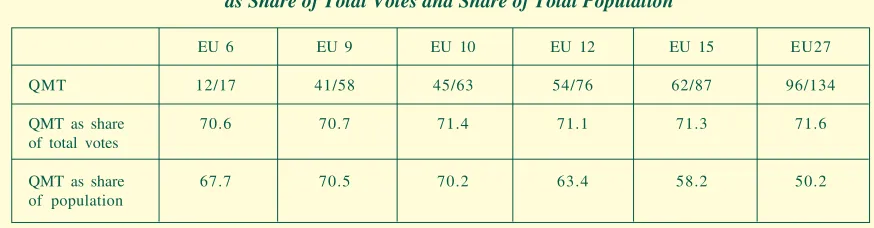
[image:2.595.63.500.645.759.2]First, the balance between big and small countries was felt to be slipping too far in favour of the small. The share of votes of each big country was constantly being reduced. The allocation of votes to each of the Big Four countries was raised to 10 votes with the first enlargement, and has stayed there ever since even as the total number votes has increased – to 58 in EU 9, 63 in EU 10, 76 in EU 12 and 87 in EU 15. And the overall balance was changing. Until the mid-1980s the basic balance was accepted to be that ‘no more than one big Member State could be out-voted, but that the big Member States could not by themselves out-vote the smaller Member States’.8 Since the Iberian enlargement, it has been possible for two of the biggest Member States to be out-voted. Simple extrapolation of the current system to EU 27 would mean that three could be out-voted.
Table 1
Comparison of the Qualified Majority Threshold (QMT) as Share of Total Votes and Share of Total Population
EU 6 EU 9 EU 10 EU 12 EU 15 EU27
QMT 12/17 41/58 45/63 54/76 62/87 96/134
QMT as share 70.6 70.7 71.4 71.1 71.3 71.6
of total votes
QMT as share 67.7 70.5 70.2 63.4 58.2 50.2
of population
Second, these concerns about balance started to be openly translated into comparisons between the share of votes and the share of citizens. Population had not been explicitly measured or mentioned before. In 1994, however, figures began to be produced by the Council Secretariat and others demonstrating the increasing gap between the proportion of votes required for a qualified majority decision and the share of the total population which was represented by a minimum winning coalition under these terms (see Table 1).
Third, the clusters of Member States were called into question. This first came to the surface between Belgium and the Netherlands, the 10 million Belgians having always had the same five votes as the 16 million Dutch. The Dutch request to be given an additional vote met with strong Belgian opposition at Amsterdam in 1997. The largest problem, however, concerns Germany. Following unification, Germany had received recog-nition of its increased population in the European Parliament. The Big Four had each had 81 MEPs pre-viously. Germany received 18 new MEPs, a figure which coincided with the sum of 6 extra French, 6 extra British and 6 extra Italians (while, after several decades, the seat of the Parliament was finally agreed to be in Stras-bourg…). However, the Germans had, for most of the 1990s, kept quiet about their new situation vis-à-vis the other Big countries when it came to Council votes. By 1999, however, German attitudes were changing. On the one hand, major challenges which might have been upset by quarrels over votes had been dealt with: the Euro was in place; enlargement was on course. On the other hand, Germany’s growing self-confidence com-bined with increasing domestic sensitivity about the size of its contribution to the EU budget. Consequently, in the run-up to the 2000 IGC, Germany made it clear that it really did now want to revise the arrangements to reflect its real weight within the system.
On top of all this, the reform of the voting system was explicitly linked at Amsterdam to the composition of the Commission. With the next enlargement still seeming fairly far away and likely to be of manageable propor-tions, and amid concern that wrangling over votes might complicate other urgent negotiations, decisions over voting arrangements were left over to next time. The ‘Protocol on the Institutions’ stated that the principle of one Commissioner per Member State would only be confirmed if voting arrangements were found which were satisfactory to all. Most of the countries having two Commissioners were anxious to be compensated, but this linkage was of particular importance to Spain. The principle of one Commissioner per Member State would mean undoing the package by which it had been agreed that Spain would have only 8 votes in the Council compared to the 10 enjoyed by each of the Big Four, in exchange for having the same number as them (two) of Members of the Commission. Spain insisted on finding some means to maintain its medium-big status.
Nice Options
In the run-up to Nice, several options were on the table
as possible starting points for the final round of negotiations.9
• the Portuguese proposal for limited reweighting, which doubled the number of votes of all countries and gave the biggest five countries another five votes in addition to this in order to compensate the loss of a second Commissioner. This would more or less maintain the existing relationships – for example, the ratio between the number of votes allocated to the biggest countries and the smallest countries would only slightly increase from the present situation (25:4 compared to 10:2).
• the Italian proposal for a generalised reweighting on the basis of a more political approach, which would maintain the existing clusters but stretch the distri-bution further such that a) all countries would have more votes – and could thus present the outcome in a favourable light – but some would gain more than others by way of compensation (the ratio between the biggest and the smallest would double – 33:3 as compared to compared to 10:2) ; and b) the stretching would permit additional differentiation to take account of the enlarged membership.
• the Swedish proposal for a generalised reweighting on the basis of an arithmetical approach, giving states a number of votes equal to double the square root of its population, which naturally gives Germany more votes than others.
• two variants of a double majority requiring votes as states and as populations: the model pursued at Amsterdam by Germany combining a weighted vote as states with a qualified majority requirement in terms of population, and the Commission’s proposal for a dual simple majority of states and of populations. The dual majority was seen to favour Germany at one end and the smallest countries at the other, and was then as now resisted by the other big and the middle countries. The starting point for the final agreement was generalised reweighting as under the ‘Italian’proposal. This proposal, however, had to be adjusted first to principle and then to politics.
The immediate question of principle was that, the more the votes were stretched in the direction of propor-tionality in order to satisfy the biggest countries, the more likely it became that a qualified majority of votes could be obtained by a minority of states, which is generally agreed to be unacceptable. The principle has not needed to be spelled out before, since so far the distribution of votes and the threshold for a qualified majority have made such an outcome arithmetically impossible. Already before Nice it was therefore accepted that this provision would have to be made explicit for the future.
the decision reached at Amsterdam to set a ceiling of 700 MEPs. The proposal which had been presented by the Parliament, with widespread support, was for a genera-lised reduction in numbers per Member State. The ‘democratic minimum’ would go down from six to four, and the gradient by which additional representation was granted would be flattened. Consequently, in an inverse logic to that underlying the generalised reweighting proposed for the Council, everyone would lose, but the bigger countries more than the smaller ones. As part of the deal over voting, it was agreed that, uniquely, Germany would retain its existing allocation of 99 Members (but no more, what ever happened in the transitional adjustments). On the other hand, an additional population criterion was added in the Council. The minimum share of population in EU 27 represented by a winning coalition on the basis of weighted votes as agreed at Nice (255 out of 345) would be 58%, as at present. The additional criterion stipulated that any Member State could request verification that a qualified majority represented 62% of the total population of the EU. This increase would mean that Germany could be the determinant element in more coalitions than France. The second deal concerned Belgium. The Belgian Prime Minister was in a position of considerable negotiating strength, stating that the Belgians would be quite happy to see the
Dutch receive an extra vote in recognition of their de-mographic difference…. so long as the French would do the same for the Ger-mans. The resulting pack-age included the provision that the combined vote of the three Benelux coun-tries (13 + 12 + 4) should be the same as any one of the Big Four (29), as well as an increase in the number of Belgian MEPs (and some further gestures in the di-rection of Brussels).
And then there was
Spain. Since Spain could not seriously be given the same number of votes as the Big Four, a formula was devised which would give Spain the same blocking power as any one of those Four. If
a) the Big Four have 29 votes each and Spain has 27, and
b) a blocking minority is set at 88, then
c) any three of the Big Four plus even the country with the least votes (Malta) can block a decision (29+29+29+3 = 90), and so can any two of the Big Four plus Spain (29 + 29+ 27 + 3 = 88);
ergo Spain has the same blocking power as Germany. This definition of the blocking minority at 88, however, was opposed by Belgium and several others, who saw this as making it too easy to stop decisions. A
Declaration was therefore attached, stating that the blocking minority threshold would be raised from 88 to 91 once the EU had reached 27 members.
In EU 25, with a blocking minority of 90 out of 321, the equation more or less holds. Both Big 3 and two-plus-Spain only need one more country to block, but in the case of two-plus Spain, this other country has to have at least five votes.
Table 2 gives an overview of Member States’ populations, the distribution of votes under the arran-gements agreed at Nice and under the draft Constitution, and the transitional arrangements from 1 May to 31 October 2004 based on an extrapolation of the present distribution. The system proposed by the draft Con-stitution is illustrated for EU 27, although it does not depend on any particular number of Member States.
How Disproportionate are the Spanish and Polish Votes?
There is not, therefore, much principle beneath the numbers of Nice, and the system is certainly very favourable to Spain and Poland. Yet the German insis-tence on more proportional representation needs to be examined more closely. The allocation of 27 votes to 40 million Spanish or Polish certainly seems wildly dis-proportionate compared to the 29 votes for 80 million Germans if the reference standard is that of direct proportionality.
However, it has never been the case that the prin-ciple underlying the re-presentation of states in the EU system qua states is that of direct proportio-nality.
As noted above, the ‘Founding Fathers’ of Eu-rope explicitly rejected ‘objective’ keys and po-pulation, in favour of a distribution of votes re-flecting a balancing act between states. This ba-lance was conceived in terms of clusters of states and responded to a general principle of ‘degressive propor-tionality’ (which figures explicitly in the text of the draft Constitution with regard to the European Parliament) by which the larger units are under-represented compared to the smaller ones. This in turn has loosely reflected the belief that, in such a diverse and sensitive union as the European Community, the pursuit of consensus and the protection of minorities are more important principles than simple majority rule.
The comparison of figures should therefore not be made in absolute terms but in the context of the overall pattern of under- and over-representation of states in the voting system.10 The relationship can be shown graphical-ly in terms of the share of total votes divided by the share of total population. A ratio below 1 means relative
under-The issue is not that Spain
or Poland is over-represented
in absolute terms.
In EU 25, theirs is in fact the
only ratio which is of almost
exactly direct proportionality
representation and a ratio above 1 means over-represen-tation. The present situation gives Germany a ratio of 0.5, the other three of the Big Four have 0.7, Spain 0.9 and so on upwards. Figure 1 compares the present ratios with the situation of the present 15 Member States in EU 25 under Nice rules (it is obviously impossible to make such a comparison for the 10 new Member States).
Seen in this perspective, the picture seems rather different. The main element of ‘disproportionality’ of Nice in EU 25 is that Spain is the only country which goes up, whereas the ratio remains the same for each of the Big Four, and it comes down for all other countries. In EU 27 the situation is more or less the same, although the Big Four go down very slightly and Spain goes up slightly less. The issue is not that Spain is over-represented in absolute terms. The resulting ratio in EU 25 is in fact the only one which is of almost exactly direct proportionality between share of votes and share of population.
In this respect, it is hard to resist the temptation to compare this pattern of weighted intergovernmental bargaining with the only comparable experience – which is Germany itself.
Weighting is quite unusual in arrangements for
decision-making among independent states outside the UN Security Council, international financial organi-sations11 and regional common funds.12 Unequal weighting is also infrequent in territorially-based systems of representation within federal states. Some allocate representatives to a second chamber on a proportional basis, but the members then act individually. Germany is unique in that the Bundesrat is composed of representatives of the Länder governments in numbers equal to the weighted votes given to their Land, who must act jointly: ‘Each Land may delegate as many members as it has votes. The vote of each Land may be cast only as a block vote.’13
If one applies the same calculation of under- and over-representation to the distribution of the 69 votes in the Bundesrat to the distribution of votes in the EU after Nice one finds that the relation of votes to population of the German Länder in fact follows a very similar curve (see Figure 2).
[image:5.595.86.539.107.493.2]The point can also be made that the Germans themselves group the Länder in clusters even where large differences in population are involved. The four Länder with populations over seven million thus have
Table 2
Overview of Member States’ Populations and the Distribution of Council Votes in EU 15, EU 25 and Alternative Proposals for EU 27
Population EU 15 Extra- EU 25 EU 25 EU 27 EU 27
polation (01/05/04) Nice Nice Draft
(01/11/04) Constitution
Germany 82.2 1 0 1 0 1 0 2 9 2 9 1
UK 59.6 1 0 1 0 1 0 2 9 2 9 1
France 58.7 1 0 1 0 1 0 2 9 2 9 1
Italy 57.7 1 0 1 0 1 0 2 9 2 9 1
Spain 39.4 8 8 8 2 7 2 7 1
Poland 38.7 8 8 2 7 2 7 1
Romania 22.5 6 1 4 1
Netherlands 15.9 5 5 5 1 3 1 3 1
Greece 10.6 5 5 5 1 2 1 2 1
Czech Rep. 10.3 5 5 1 2 1 2 1
Belgium 10.2 5 5 5 1 2 1 2 1
Hungary 10.0 5 5 1 2 1 2 1
Portugal 10.0 5 5 5 1 2 1 2 1
Sweden 8.9 4 4 4 1 0 1 0 1
Bulgaria 8.2 4 1 0 1
Austria 8.1 4 4 4 1 0 1 0 1
Slovakia 5.4 3 3 7 7 1
Denmark 5.3 3 3 3 7 7 1
Finland 5.2 3 3 3 7 7 1
Ireland 3.8 3 3 3 7 7 1
Lithuania 3.7 3 3 7 7 1
Latvia 2.4 3 3 4 4 1
Slovenia 2.0 3 3 4 4 1
Estonia 1.4 3 3 4 4 1
Cyprus 0.8 2 2 3 3 1
Luxembourg 0.4 2 2 2 3 3 1
Malta 0.4 2 2 3 3 1
TOTAL 481.6 8 7 134 124 321 345 2 7
Qualified 6 2 9 6 8 8 232 + 255 +
Majority 13 MS + 14 MS + 14 MS +
Nice Bundesrat
0 1 2 3 4 5 6
N-W Bay B-W NS Hes S R-P B S-H Bra S-A Thü M-V Ham Saa Bre
six seats each, which means that Nordrhein-Westfalen, with a population of some 18 million, has the same representation as Lower Saxony, with around 8 million. There can of course be no simple comparisons between the two situations. The EU remains a union of nation states as well as – most would say, more than – a union of citizens, whereas Germany is a federal state with a very high degree of cultural homogeneity and common identity. The organ of territorially represen-tation is the main decision-making body in the EU (compared to the directly-elected Parliament) whereas it is the second chamber in Germany.
And yet, if anything, such a comparison would tend to favour the maintenance of weighting and clusters in the EU system. If the Germans organise territorial representation in such a way even where the cultural and historical context permits a system based primarily on
majority rule between representatives of citizens, then the arguments in favour would seem to be all the stronger where such a context does not exist, as in the EU.
The Nice System versus the Convention’s Proposal: What is Really at Stake?
The opposition of Spain and Poland to the Convention’s proposal is in large part, of course, rooted in self-interest. This ‘class’ of Member States benefitted particularly strongly from the Nice arrangements, but would be particularly affected in a negative way by a dual majority in terms of relative weight compared to the Big Four. Moreover, it is quite clear that Spain, for example, is thinking in terms of the impact of different voting systems on specific coalitions of direct interest to it. Candela thus points out that the NATO 19 would have 94% of the population in EU 25; the Big 6 would have
0 0,5 1 1,5 2 2,5 3 3,5 4
D UK F I E NL GR B P S A DK FIN IRL
[image:6.595.56.515.87.288.2]Nice EU 15 Figure 1
Under- and over-representation of present Member States in Council votes in EU 15 and in EU 25 under Nice rules
(share of total votes divided by share of total population)
74.6%; the Eurogroup 12 would have 67%; the Mediter-ranean 7 would have 39.4%; and the Cohesion 12 only 30,6%. If the blocking threshold in terms of population were to be raised from the Nice 38% to the Constitution’s 40%, then Spain would not be able to defend its interests even in a full Mediterranean bloc.14
Yet there are certainly also broader issues at stake. In the first place, the weakness of the Nice system does not lie only in the proportionality of the votes given to Spain and Poland. The proclamation of three criteria for a qualified majority makes
the whole thing even harder for people to under-stand, but this apparent complexity is in fact almost meaningless from the point of the view of the Union. To fix a population threshold of 62% certain-ly means that Germany can be the determinant ele-ment in more individual coalitions than can, say, France. With its larger
population, Germany will in general need to find fewer partners in order to reach a blocking minority. However, it is virtually meaningless for the operation of the system as a whole, as is the provision for a majority of states. Out of some 3 million possible winning coalitions on the basis of weighted votes, only 16 would be nullified by the simple majority provision and seven by the population criterion.15 Moreover, all such calculations can be very quickly thrown out of balance with the additional accession either of a small state (Croatia, FYROMacedonia) or the very big state waiting in the wings, namely Turkey.
Beneath all the detailed debates over numbers of votes and percentages of people, Nice essentially means the decision to maintain a system of weighted votes, and a balance based on classes of states. In other words, independently of French sensitivities, it means retaining a logic of clusters, with the aim precisely of obscuring rather than highlighting differences between national weights. And independently of Spanish and Polish interests, it means retaining a system in which the lesser ‘orders’ of states are intentionally over-endowed in the decision-making system precisely in order to prevent the biggest powers from being able to dominate the system.
As seems appropriate given the tone of the current debate, this can be illustrated by comparing two systems of states in Europe in the first half of the nineteenth century. At continental level, one had the Congress System and the Concert of Europe, in which the Quadruple Alliance took it on themselves to order things – which is what many in smaller countries today consider to be the aim of the EU’s own Big Three. And then there was the only example before the EU of weighting of votes between independent states in a political union, namely the Deutsche Bund (German
Confederation) created by the Federal Act of 1815 and the Vienna Final Act of 1820, which lasted until 1866. The Bund was composed of 41 states, of which two, Austria and Prussia, were larger than all the others, together representing some 58% of the total population. The Inner Council of the Diet in Frankfurt decided by simple majority out of a total 17 votes. The eleven larger states had one vote each. The remaining votes were held by six curiae of states.16 In the Plenary Assembly, 69 votes were distributed roughly in proportion to population. All had a minimum of one, but Austria, Prussia, and the four kingdoms of Bavaria, Saxony, Hanover and Wurtemburg each had four; five states each had three; and three had two.17 The basic rule was that deci-sions were taken by two-thirds majority. The pur-pose of all this was ‘to make it impossible for Austria and Prussia, even if they acted together with the four kingdoms of Bavaria, Saxony, Hanover and Wurtemburg, to outvote the rest’.18 Sound familiar?
The Convention’s proposal has, in principle, many advantages compared to Nice. It is likely to be more efficient in terms of decision-making (although, as the Spanish Foreign Minister has rightly pointed out, it will not be that simple for Member States to agree on the definition of the population of a country).19 The double majority is easier for people to understand and clearly reflects the dual nature of the European Union as both a union of states and a union of citizens. And it provides, at least in theory, for a simple and effective system of checks and balances: the biggest countries cannot impose a decision based on their demographic weight alone; nor can a coalition of small countries impose a decision based only on their numerical majority as states. In that respect, it may be argued that this does in fact correspond to the same kind of logic which underlay the original deal in the Treaty of Rome. The main difference is that, with enlargement to 25 and more Member States, it is no longer possible to come up with an explicit formula which specifies the balance between all individual countries, as could be done with the Founding Six. The only viable alternative is to move to a more generalised formula based on a mixture of sovereign equality and demographic weight.
Yet it is clear that not everyone feels comfortable or confident that this system will be sufficient to ensure a real balance. It is no longer just a matter of the Franco-German axis – although talk last autumn of an outright Franco-German union seems to have fed Polish concerns in November that a population-based voting formula would ‘risk a unipolar EU’ with the Franco-German axis at its heart.20 Fears of a de facto ‘directorate’ have been strengthened recently by what appear to be renewed
The opposition of Spain and
Poland to the Convention’s
proposal is in large part
rooted in self-interest.
Yet there are certainly also
British moves to try to join Germany and France in a triple alliance at the heart of Europe. The three countries together represent over 40% of the population of EU 27 (at the moment) and are therefore in a position to block anything. Moreover, financial pressures are increasingly bluntly being brought to bear, while the immediate response of Germany and France to the ‘failure’ of the Brussels summit was to threaten to move ahead with a core European group of states.
On top of all this, there has been a clear weakening of the Commission within the ‘institutional balance’. Historically, the smaller EU members have not had to rely only upon a putative strength of numbers to ensure that rules are reasonably adopted and equally applied. The original deal by which weighted votes and majority voting were accepted rested partly on the role of the Commission in guaranteeing fair play. If, as has seemed to be confirmed by a series of recent incidents culminating in the suspension of the Stability and Growth Pact, the Commission is not going to be in a position to defend anyone or anything, then there may well be broader interest in finding other means to ensure a reasonable balance of power.
Beyond this – indeed particularly because of this atmosphere – questions have to be asked more generally as to the appropriateness at this time of a Union-wide population criterion for majority decision-making. This requires a very high degree of common identity and ‘we-feeling’ which may well not be felt to exist by many people across the Member States.
What to Do?
At the time of writing, it is hard to see what can unblock an apparently intractable confrontation. The Govern-ments of Germany, Spain
and Poland have all staked considerable credibility on their positions. Indeed it is not impossible that there will be no solution in the short term and that the draft Constitution will simply be frozen, at least in the present form, for some time to come.
What could change? One possible outcome is a deal by which one side drops its demands over voting in exchange for something else. In the
current climate, however, it is unlikely that this will take the form of a side-payment in financial terms, and there are not many obvious (or appropriate) substitutes.
Another outcome would be to adopt an obvious compromise between the two. There are various logical alternatives to either simple maintenance of Nice or acceptance of the Convention’s proposal, which would allow Spain and Poland to show that they were being compensated and Germany to show that it was not
giving in. The Nice arrangements could be revised in the interests of simplicity by dropping the provision for possible verification of 62% population, in exchange for a reweighting of votes: for example, a reduction of the Spanish and Polish quota to 25 or 26. This, however, would not solve the German-French question. Another possibility would be to increase the population in the Convention’s proposal, to at least 62%. This, however, will be opposed by all the countries concerned to ensure that it is not too easy to block decisions in the enlarged Union.
However, what happens next will depend not only on the flexibility of those countries, but also on other actors. Spain and Poland, despite all the contrary pressures, could find new allies: in November 2003, it was reported that Austria, Malta and Estonia were supportive and that the British were more or less sympathetic to their position. Many questions have also arisen over the position of France. Why, after such a battle to maintain parity of votes with Germany at Nice, has the French Government adopted a position of suppor-ting the double majority proposed in the draft Constitution? The German superiority in population was already recognised at Nice in two ways – through the provision for verifying the 62% population threshold and through the further differentiation in representation in the European Parliament. To get rid of weighted votes completely may be seen as a way to avoid backing down over the principle so strongly defended at Nice vis-à-vis Germany, while gaining a stronger position vis-à-vis the smaller countries as part of a strengthened core group of the Big Three. Alternatively, as various reports have suggested, the French may have been quite happy to let the Brussels summit crash – perhaps with the idea of pursuing some completely new system based on diffe-rentiation between (core and non-core) groups of members.
This article has argued that there are no simple truths, nor absolute rights and wrongs, in the current debate. To be sure, national self-interest is involved (on both sides), but there are also different positions of principle (on both sides). So what should be done in the interests of the Euro-pean Union? It is suggested here that the best outcome on balance is to adopt the proposal of the draft Constitution, bearing in mind that this proposal is already to some extent a compromise, in that it was agreed within the Convention that the new system would only be introduced in November 2009. This proposal is relatively simple, clear and efficient as a decision-making procedure, which is a good and necessary thing. It may also contribute to greater legitimacy of the EU system if citizens can feel that they
The proclamation at Nice of
three criteria for a qualified
majority makes the whole thing
even harder for people to
understand, but this apparent
can understand a bit more clearly how decisions are taken. Nice, on the other hand, is unnecessarily, even meaninglessly, complex. It will prove even harder to explain to the public – which will have a negative impact on legitimacy just at a time of political and practical strain on the system – without increasing decision-making efficiency. In these terms, there would seem to be little room for serious discussion, at least if one wants European integration to continue to work. The draft Constitution’s
proposal should be appro-ved – and suitably explai-ned to national consti-tuencies – even if indivi-dual Member States may feel that they are not getting the best possible deal for their own direct interests.
And yet things are not quite so simple. There are some very good reasons for caution and perhaps also for delay. In the first place, as indicated above, there are some very serious grounds for reflecting about what is really at stake in moving from a
system of weighted votes among clusters of states to one in which relative weights of national populations are measured – and felt – in so simple, clear and efficient a way. To move to a system which is primarily based on relative shares of overall population, albeit with a formal requirement to have a majority of states in favour of decisions, supposes a very high degree of ‘we-feeling’ – that is, a strong perception of common identity as well as of common interest. The problem is not only that this may not exist in Member States today. It is not even clear
who ‘we’ may actually end up being. Informed decisions about basic constitutional rules in any democratically-oriented political system can only be taken if the composition of the unit in which binding common rules are to be applied is felt to be appropriate. This can obviously only happen if the composition of the unit is at least known for a foreseeable future. There seems to be a growing consensus that the EU does need to come quite soon to a clear agreement about its limits. Beyond a certain point, it is no longer possible to con-tinue simultaneously dis-cussing what we do and how we do it – while won-dering who ‘we’ will be. It is usually not the best solution simply to post-pone a decision, but there may be no better option here than delay. The aim is not only to put off a con-frontation of positions. It is already too late to introduce a simpler and more efficient decision-making system before enlargement takes place. This is the fundamental failure of Nice. So why not try to make the best of things and take advantage of the delay? In the longer run, the Union may actually benefit from having some time both to come to terms with the immediate enlargement and to establish its borders more clearly, before introducing such a shift in the balance between the EU’s character as a union of states and as a union of citizens. And there is a very simple reason for waiting. The experience of living with such a system may well be seen, even by those who now defend it, as an irresistible argument for changing it.
There are serious grounds
for reflecting about what is
really at stake in moving from a
system of weighted votes among
clusters of states to one in which
relative weights of national
populations are measured
NOTES
1 Conférence Intergouvernementale pour le Marché Commun
et l’Euratom (CIMCE). Comité des Chefs de Délégation.
Proposition concernant la pondération des voix au sein du Conseil des Ministres. (extrait de l’Annexe au document nº 6 sur les institutions) (MAE 39/56 du 13 février 1956) MAE 295 f/56 dvl Bruxelles, le 19 septembre 1956 Ch. Del. 32 See also Bibliothèque de la Fondation Paul-Henri Spaak, Pour une Communauté Politique européenne. Travaux prépa-ratoires (1955-1957) (Bruxelles: Bruylant, 1987).
2 Without numerical majority, 4 for each of the three big
countries, 2 for Belgium and the Netherlands and 1 for Luxembourg, with a qualified majority set at 12 out of 17. With a numerical majority, 3 for each of the three big countries, 2 for Belgium and the Netherlands and 1 for Luxembourg, with a qualified majority set at 10 out of 14.
3 The votes in favour of 4 countries having more than 5 million
inhabitants or 3 countries having more than 40 million; or alternatively, with the votes against not including those of a country with more than 40 million and those of one country with more than 5 million.
4 CIMCE. Comité des Chefs de Délégation. Note sur la procédure de vote au Conseil (Marché commun) établie par M.Uri sur mandat des Chefs de délégation. MAE 634 f/56 dvl. Bruxelles, le 26 novembre 1956. Ch. Del. 70.
5 CIMCE. Comité des Chefs de Délégation. Note présentée par la délégation néerlandaise sur les principales objections à l’égard du texte du Rapport des Chefs de délégation aux Ministres des Affaires étrangères MAE 294 f/56 mb Bruxelles, le 19 septembre 1956 Ch. Del. 31.
6 Conférence des Ministres des Affaires Etrangères Note concernant les aspects institutionnels et financiers des deux Traités.MAE 354 f/57 gd. Bruxelles, le 31 janvier 1957.
7 The British and Spanish, however, opposed a corresponding
extrapolation of the blocking minority from 23 to 26, resulting in the so-called Ioannina compromise by which, if countries representing from 23 to 25 votes oppose a proposal, discus-sions should continue.
8 J.A.Usher, EC Institutions and Legislation (London & New
York: Longman, 1998) p.23.
9 For discussions of these options, see Axel Moberg, ‘The
Nice Treaty and Voting Rules in the Council’, Journal of Common Market Studies 40:2 (2002) pp. 259-282; Bela Plechanonová, ‘The Treaty of Nice and the Distribution of Votes in the Council – Voting Power Consequences for the EU after the Oncoming Enlargement’, European Integration online Papers 7:6 (2003).
1 0 There is a continuing debate over the measurement of voting
power. It is rightly pointed out by proponents of ‘power indices’ that what really matters is the relative ability of each state to determine (to be ‘pivotal’ in) the success or failure of coalitions under different voting systems. This is most
commonly measured by using the so-called ‘Banzhaf index’. Spain and Poland did obtain a notable increase in voting power at Nice also in this sense. In the present discussion, I consider the simpler measurement of relative vote/population representation to be more appropriate.
1 1 Voting power is directly linked to capital share in the
International Monetary Fund and in regional bodies such as the Inter-American Development Bank.
1 2 A system of weighting was agreed for the Euratom research
and investment budget, in which the share of the total vote corresponded approximately to the agreed distribution of total financial contributions. Germany and France each had 30% share and 30 votes out of 100; Italy 23% and 23 votes; Belgium 9.9% and 9 votes; Netherlands 6.9% and 7 votes; and Luxembourg 0.2% and 1 vote. The qualified majority was set at 67 out of 100. Similar arrangements were established for the Social Fund: Germany and France 32 votes each out of 100, Italy 20, Belgium 8, Netherlands 7, Luxembourg 1. Voting in the Committee which assists the Commission in managing the European Development Fund is weighted in rough proportion to each State’s share of the contributions. Thus, under EDF VII, Germany had 52 votes, France 49 and Italy only 26.
1 3 Article 51(3) of the Basic Law.
1 4 José Candela Castillo, ‘El poder de España en la UE’, La Vanguardia, 10 diciembre 2003, p.26. The Cohesion 12 are the present four (Spain, Portugal, Ireland Greece) plus all the new Member States except Cyprus and Malta.
1 5 Frédéric Bobay, ‘Political Economy of the Nice Treaty:
Rebalancing the EU Council’. French-German Economic Forum, 9th meeting, June 25-26 2001.
1 6 These were the Saxon duchies and archduchies; Braunschweig
and Nassau; the two Mecklenburgs; Oldenburg, the three Anhalts and both Schwarzburgs; the two Hohenzollerns, Liechtenstein, the various Reuss, Schaumburg-Lippe and Lippe; and the four free cities of Lübeck, Frankfurt, Bremen and Hamburg.
1 7 E.R. Huber, Deutsche Verfassungsgeschichte Band I
(Stuttgart: W.Kohlhammer, 1957) pp.589-590.
1 8 Murray Forsyth, Unions of States. The Theory and Practice of Confederation (Leicester University Press/New York: Holmes & Meier, 1981) pp.46-47.
1 9 ‘Do you count citizens or residents? What about citizens
living in third countries, or illegal residents? Do you adjust figures to take account of natural demographic trends, if so how often, and on the basis of which statistics?’ Ana Palacio, interview with BBC NEWS, 6 October 2003: http:// news.bbc.co.uk/go/pr/fr/-/2/hi/europe/3168218.stm.