ETF YEARBOOK 2004
LEARNING MATTERS
T
A
-A
E
-0
4
-0
0
1
-E
N
SUPPORTING VOCATIONAL EDUCATION AND TRAINING
REFORM IN THIRD COUNTRIES IN THE CONTEXT OF
THE EU EXTERNAL RELATIONS PROGRAMMES
HOW TO CONTACT US
Further information on our activities, calls for tender and job opportunities can be found on our web site: www.etf.eu.int.
For any additional information please contact:
External Communication Unit European Training Foundation Villa Gualino
Viale Settimio Severo 65 I – 10133 Torino
T+39 011 630 2222
F+39 011 630 2200
Peter Grootings (Editor)
(http://europa.eu.int).
Cataloguing data can be found at the end of this publication.
Luxembourg: Office for Official Publications of the European Communities, 2004.
ISBN 92-9157-373-6 – ISSN 1725-9061
Reproduction is authorised, provided the source is acknowledged.
FOREWORD 7
PREFACE 9
1. LEARNING MATTERS (PETER GROOTINGS) 13
Introduction 13
A framework for understanding VET reform in transition countries 14
Learning from VET reform experiences in transition countries 23
Learning matters 33
2. VET REFORMS IN CENTRAL AND EASTERN EUROPE: ACHIEVEMENTS AND
CONSTRAINTS (SØREN NIELSEN) 39
Introduction 39
Different backgrounds for VET reforms in Central and Eastern Europe 40
Characteristics of VET common to all Central and Eastern European countries 40
Features common to three very different groupings of countries in VET 42
A review of VET reform achievements and challenges 44
VET reform strategies: future challenges and constraints 50
Sources for future policy learning 52
Conclusion 53
3. VOCATIONAL EDUCATION AND TRAINING REFORMS IN SOUTH EASTERN EUROPE
(ANASTASIA FETSI) 55
Introduction 55
Historical and institutional context of VET in South Eastern Europe 56
A review of VET reform experiences 58
Successful formulation of VET reform policies in the region 66
Underdeveloped strategies for implementation of VET reform policies 67
Insufficient capacities and resources 69
4. EASTERN EUROPE AND CENTRAL ASIA: FROM SURVIVAL TO SYSTEM REFORM
(SØREN POULSEN) 71
Introduction 71
Survival of the system 72
Labour market developments 73
Weakness of vocational education and training systems 75
VET reform policy aims 76
Implementation strategies 77
The problem of capacities and resources 78
Future challenges 80
5. VOCATIONAL EDUCATION AND TRAINING REFORM IN THE MIDDLE EAST AND
NORTH AFRICA (ELENA CARRERO PÉREZ) 81
Introduction 81
Background and context 82
Key challenges for VET reforms 85
From the identification of challenges to implementation strategies 88
Partners in reform 89
The road ahead 91
Five key strategic areas for future reform 93
6. LIFELONG LEARNING: A REFERENCE FOR TRANSITION COUNTRIES?
(MADELEINE GUNNY) 95
Introduction 95
Convergence and divergence in approaches to lifelong learning 97
Transforming education and training in a lifelong learning perspective 101
Challenges of lifelong learning 102
Lifelong learning in VET 108
Conclusion 108
7. INSTITUTION BUILDING IN TEMPUS: A SUCCESS STORY? (EWA KOLANOWSKA) 111
Introduction 111
Why institution building projects were launched in Tempus:
more or less specific challenges in broader contexts 112
The approach adopted: one action for a double benefit 113
How it worked in practice: from pure institution building to some
misunderstandings 115
How much was achieved: training or teaching capacity of providers,
know-how of trainees, …and what else? 116
Why some achieved more than others: joint effort in an encouraging
environment 119
How much did, and is likely to, remain: a short story or a lasting success? 121
Demography and economy 125
Labour markets 128
Public employment services 134
Continuing vocational training 136
Initial education and training 141
General notes for tables 148
Glossary of main definitions 148
9. A ROLE FOR ETF: FACILITATING POLICY LEARNING (PETER GROOTINGS AND
VINCENT McBRIDE) 151
Introduction 151
International assistance to policy development in partner countries 152
A learning process 153
Policy learning 154
Linking different kinds of learning 155
Sources of learning 157
ETF as a policy learning facilitator 158
STATISTICAL ANNEX 163
LIST OF ABBREVIATIONS 173
This Yearbook is the first of a new series that the European Training Foundation intends to publish annually. The aim is for ETF staff to present analyses and insights based on their experience developed across single projects or country activities.
To date the ETF has always published the results of its thematic and country projects separately. It has been felt for some time that a regular publication, bringing together what can be learned from our work in different countries and from different development projects, would be very useful. Readers could get a quick insight in a number of critical issues related to the reform of vocational education and labour markets in transition countries. ETF project and country managers would have an incentive to reflect on their daily practice and engage in comparative review and analysis beyond their more operational activities.
Assisting partner countries in the reforms of their vocational education and training and labour market systems is still, after almost 10 years, exciting work that is of high relevance from an EU perspective. The work is interesting because we have come to realise that it is full of
uncertainties: there is no fixed model of a perfect VET system, there is no
one-best-way of reforming policies, and even the outcomes of well-designed single projects are often unpredictable. Those who are involved are therefore learning all the time. The work is tremendously
rewarding because, even if not immediately visible, we know that through our
involvement we do make a difference. National policymakers and other
stakeholders, both inside and outside the
EU, learn to look differently at their own institutions and practices. Based on
experiences from elsewhere they are better informed to take decisions, they have often also become more aware of important issues that were not included in national policy agendas, and sometimes they have even reached consensus on how to address these issues.
There is an increasing need and
willingness to share experiences among EU Member States and partner countries and among the partner countries
themselves. The Yearbook series, therefore, fits well into the ETF policy of strengthening internal and external knowledge sharing. However, the
contributions in this Yearbook 2004 do not pretend to present the ultimate wisdom. They convey what we have learned so far and what we have learned is obviously open for discussion. Our partners may agree or disagree with our approach and also with our conclusions, but only through open debate will we be able to make progress.
The role of vocational education and training for fostering economic
development, social cohesion and political stability has become increasingly
recognised. Assisting partner countries in reforming their systems so that they can live up to their potential remains as important as it was 10 years ago. I hope that this first edition of the ETF Yearbook, and the other issues that follow, will provide some more added value to this process.
This Yearbook 2004 contains a number of papers originally prepared for discussion at the ETF plenary Advisory Forum
conference which was held in November 2003 in Turin. During the Learning Matters conference, ETF staff discussed with some 300 colleagues from the European
Commission services, partner countries and the international research community some of the lessons that could be learned from more than 10 years of vocational education reform in partner countries. The main lesson drawn from a review of past experiences was the need for sharing a new paradigm for reform and reform assistance based on the principles of context fitness, local ownership and sustainability.The participants at the conference shared this conclusion.
The reform experience from ETF partner countries suggests that too often too much reform and reform assistance has taken place without due attention to the suitability of new policies to the context of partner countries, their history, institutional setting, capacities and daily practices. Much was copied and/or imported from elsewhere, based on models of apparent best practice, or simply concluded from theoretical assumptions. The result has often been the dependency of policy implementation on foreign assistance – financially and conceptually – limited ownership from the side of local policymakers and other stakeholders, and hence short-lived unsustainable reform initiatives without too much impact. Many reforms came and disappeared with the donors that initiated them. Only those countries that managed to integrate foreign donor projects within a clear national reform policy have been successful. There are however, only few such countries. Most countries are still struggling with their reform of vocational
education and training. This negative chain of external dependency, lack of local ownership and absence of context fit needs to be turned around. This can be done by appreciating the systemic nature of VET reforms in transition countries.
We argued during the Learning Matters conference that the nature of VET reforms in transition countries has often not been properly understood. Insufficient attention
has been given to analysing the contextin
which, and therefore also the reasonsfor
which, VET reform is to take place. Local policy makers have often concluded that what was really needed were just
additional resources to enable a long-due modernisation of the vocational education and training system. The system used to be good but has become outdated and sometimes even impoverished because of a lack of investment (in teaching materials, workshop equipment and teacher
knowledge and skills). While most
policymakers would initially argue for mere financial resources, some, in particular after the initial phase of reform, would also call for investments in capacity building, acknowledging the fact, that as a result of under investment in the past, local capacities were insufficient to bring modernisation forward.
Donors and their international policy advisers or technical assistance would easily buy the modernisation approach but would often add that structural changes would be required as well, in particular in terms of governance and financing. Existing state domination, it is normally argued, causes inefficiency and
governance and funding arrangements has been offered. These have usually been based on the national or ideological background of the policy advisers themselves: from a modern public sector approach (combining input and output standards), a shared public-private partnership (tripartite or neo-corporatist sharing of responsibilities and funding), towards the other extreme of a fully private sector-based system. Most of the structural change advocates have failed to cope with the lack of interest and capacity of the private sector to play any role at all, however.
Both local policymakers and external policy advisers, in limiting themselves to the need for modernisation and structural change, have fundamentally underestimated that reforms in transition countries are also systemicin nature. Reforms of vocational education and training systems in transition countries are related to radical changes in the way in which human resources are deployed in the employment system. The transition towards a market-based economy has radically changed, or is radically changing, the ways in which companies produce goods and deliver services. It is also changing the ways in which companies recruit and employ as well as how people find work and
employment. Labour markets are replacing political and administrative labour
allocation mechanisms. Vocational education and training, as the institution that provides people with the qualifications through which they find employment, has to change accordingly. The case for systemic reform is as simple as that.
We also argue that systemic reform has system-wide and system-deep
implications. Reform covers not only modernisation and structural change of the various building blocks of existing
institutional frameworks of vocational education and training systems (from governance to delivery) but also a change in the roles of key actors (from policy makers to practitioners) and of the belief systems, attitudes and behaviour of individuals (including parents, employers and students) who are involved in the system. It is because of the system deep
implications that reforms in transition countries are different from those taking place in developed market economies.
Individual countries cannot simply copy from each other; neither in terms of WHAT their VET system should be like, nor in terms of HOW to achieve a new system. But they can very well learn from each other. They can share experiences on what are currently agreed to be the main
characteristics of a successful VET system. They can also share experiences
concerning the steps to be taken in order to make reforms successful. There is a huge wealth of experience from the attempts made in EU Member States over the last twenty years or so to modernise their VET systems. There is also almost fifteen years of experience in the transition countries of Central and Eastern Europe, including that of the new Member States. There is additional reform experience from the Mediterranean region and the countries of the former Soviet Union. This learning
potential is captured by the ETF’spolicy
learningapproach and by the policy learning facilitating role that the ETF has adopted.
The conference papers presented in this Yearbook 2004 have been thoroughly revised on the basis of the discussions at the conference.
Chapter 1 by Peter Grootings presents the conceptual framework for the ‘Learning Matters’ argument. It summarises the international discussions that have led to a growing awareness of the need for policy learning, provides a brief review of reform experiences in ETF partner countries and identifies a number of open challenges that need to be addressed. It is argued that the main challenge for partner countries will be to secure ownership for the reform
process, embed international assistance into national contexts, and make further VET development sustainable,
independent from foreign assistance. The best way to face the challenge is by adopting a policy learning approach.
regions that ETF operates in: Central and Eastern Europe, South Eastern Europe, Eastern Europe and Central Asia, and the Middle East and North Africa. Cooperation with these regions is framed by the EC Phare, CARDS, Tacis and MEDA
Programmes respectively. The reviews are an attempt to apply the conceptual
framework of Chapter 1. This has not always been possible, which makes clear the fact that we still know very little about our partner countries. The regional reviews come to different conclusions as to where the countries of the region currently are with respect to their reforms.
Whereas most countries in Central and Eastern Europe, now already new Member States, have profited very much from the accession driven reform policies in giving focus to national reforms, Søren Nielsen argues that their main challenge will be to bring the unfinished VET reform forward with a national policy framework, freed from the Phare reform legacy. Countries of South Eastern Europe have, according to Anastasia Fetsi, managed more or less to define their reform objectives, profiting much from the experience of their
neighbouring countries. However, they face insufficient capacities and resources to transform policy objectives into
implementation strategies. The perspective of future integration in the European education space, and indeed the European Union, as such may provide an important incentive to further invest in vocational education and training reform, to exchange experiences with other European transition countries and to foster regional
cooperation. Søren Poulsen argues that most countries of the former Soviet Union have been preoccupied with the survival of their inherited VET systems and are only recently addressing modernisation and reform. They will need to define their own national systemic reform priorities in order to be able to successfully integrate international donor assistance and avoid becoming driven by donors. Many countries in the Middle East and North Africa have a long experience of donor assistance. That assistance, however, has changed its priorities and modalities over time, and the situation is currently
characterised by attempts on both sides to
come to terms with each other. Elena Carrero Perez writes that the recent donor assistance agenda includes such issues as governance, financing, quality, the informal sector and an increased role of the private sector. Individual countries respond differently while there is still insufficient interest in regional cooperation. The diagnosis exists and has been accepted by all stakeholders. The road ahead is how to tackle the key issues and how to create the tools and approaches for supporting the countries in the policy learning process necessary for the future generation of reforms.
Chapters 6-8 present slightly different ‘Learning Matters examples’. Chapter 6, written by Madeleine Gunny, reviews the international debate on lifelong learning and seeks to find an answer to the question of whether this debate has any relevance for transition countries. Lifelong learning is a key driver for educational reforms in developed market-based economies and it is no surprise that all international organisations have developed their own position, and not always in a completely identical way. The identification of how the European Commission, the OECD, UNESCO, ILO and the World Bank differ or converge is important for policy makers to bear in mind while engaging in debates with these organisations. The clear message from the international organisations is that lifelong learning is a matter of survival and that it is the best way for all countries, developing, transition and developed economies alike, to maintain the knowledge and competences needed in the global knowledge economy and information society, and for individuals to remain employable in a fast changing labour market where employment is increasingly unpredictable and where the acquisition of new competences is necessary to keep abreast of rapid technological change. Since lifelong learning is for all, not just for an elite, developing people’s competences supports social inclusion objectives and contributes to the wider challenge of reducing poverty.
universities from Member States and partner countries. Tempus has focused on the reform of higher education and in so doing has always had a strange
relationship with EU programmes supporting vocational education and training reform. Often they have been in competition with each other depending on priorities in partner countries for education reform. Only rarely has there been
cooperation, complementarity or synergy. The review is a rare attempt to draw lessons from the Tempus programme that may be relevant for VET reform assistance projects. The focus is on institution building and the review analyses how Tempus has contributed to institution building and what the effects have been of the Tempus approach. There are plusses and minuses. The chapter is based on a detailed analysis of the experience of four Central and Eastern European countries but has been enriched by information from other countries.
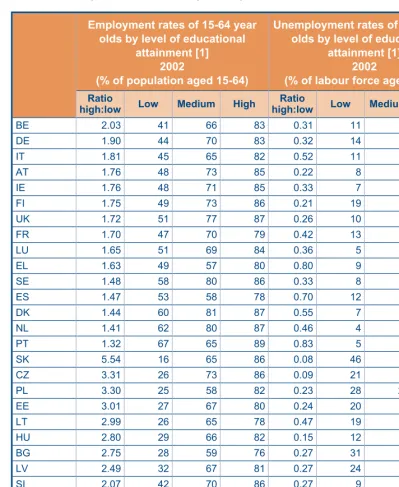
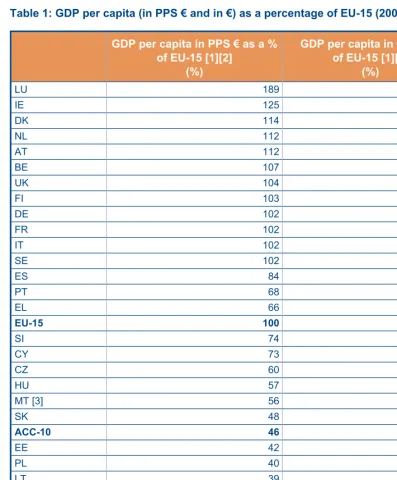
Chapter 8 prepared by Alison Kennedy and Mircea Badescu presents a comparative review of key employment and training statistics from new and ‘old’ Member States, and candidate countries. Comparing statistical data allows the positioning of acceding and candidate countries both on an EU scale and in comparison to each other. Using the best performing EU Member States or EU-15 averages as the benchmark the
cross-country comparison is useful in determining a country’s situation, identifying major challenges and
developing policies for approximation. The chapter brings some hard statistics to the discussion about VET reforms, but also reminds us that statistics need to be placed within a wider – and more qualitative – understanding of a country’s context. More statistics for all ETF partner countries, as far as available, are included in an annex.
The last chapter, Chapter 9, by Peter Grootings and Vincent McBride presents a further elaboration of the policy learning approach and identifies ways in which ETF can effectively develop a role of policy
learning facilitator. Issues dealt with in this chapter are currently under intensive debate among ETF staff.
The chapters in this book are written by ETF staff members. They reflect a process of reflection on the future direction of our work that started some time ago and in which all ETF colleagues have played a role. In a way, therefore, the Yearbook contains the collective wisdom of the ETF. In preparing the conference papers we have benefited much from discussions with the members of an external reference group consisting of Boualem Tatah (Algeria), Munther Masri (Jordan), Melis Junushaliev (Kyrgyzstan), Ivan Svetlik (Slovenia), Jerzy Wisniewski (Poland), Bozidar Sisevic (Montenegro), Ben Hovels (Netherlands), Johanna Lasonen (Finland), Oriol Homs i Ferret (Spain), Merete
Pedersen (Denmark), Luis Guillermo Hakim (World Bank) and Stavros Stavrou (Cedefop). We have also benefited from consultations, at different stages, with many colleagues in the European
Commission. We are, in particular, grateful to Sergio Piccolo and Dorthe Schmidt of EuropeAid and Fredrik Svedang and Jose-Antonio Torres Lacasa of DG RELEX for comments on the regional papers.
This is the first publication that has been thoroughly reviewed by the new ETF Editorial Board and we would like to thank Galina Borisova, Munther Masri, Cesar Birzea and Steve Bainbridge for their advice. But most of all, of course, we are grateful to all the participants of the Advisory Forum conference for sharing with us their knowledge from the past for a frank discussion on the challenges of the future.
Sabina Nari has skillfully coordinated the work of the authors and Joanna Anstey and Dominique Nongo-Adidi have done a great job in getting the Yearbook 2004 ready for publication.
Peter Grootings
1INTRODUCTION
Many countries have recognised the importance of learning for individuals and societies, and most are reviewing and changing their education and training systems in order to be better able to cope with the challenges posed by globalisation
and the Knowledge Society.2Countries
show a wide variety of approach and success. This chapter looks at the particularities of vocational education and training (VET) reform in ETF partner countries. As transition countries they have had to combine fundamental changes of their overall political and economic systems with preparing society at large for the future. They have also been dependent on external assistance for their reforms. This chapter reviews the experiences with VET reforms against the background of recent debates on the contribution of VET for social and economic development, and reflects on the role that international assistance has played. The main conclusion is that learning also
matters for VET reform policymakers simply because there are no ready-made, fit-for-all solutions that can be copied from elsewhere, or, indeed, be imposed by others. Policy analysts, advisers, decision-makers, researchers and practitioners involved in reforming educational systems will be more successful through understanding the influences that existing institutions have on reform initiatives, at home and abroad. Learning about policy in a broad sense therefore is the key to successful reform.
The next section will present the main conceptual issues and will summarise the international discussion that has led to a growing awareness of the need for policy learning. The third section will contain a global review of vocational education and training reforms in ETF partner countries summarising more detailed regional analyses that will be presented in other chapters. Policymaking and strategy development also need to be informed by a
1
1 Peter Grootings is the ETF’s Expertise Development Coordinator.
clear understanding of future challenges.3 But countries have different ways for dealing with future challenges, and it is their own past that provides the constraints and opportunities for doing so. Based on lessons that can be drawn from the past, a number of learning challenges that partner countries are still facing will therefore also be identified. These challenges need to be taken into account when developing scenarios and strategies for the future. Overall, the challenge for partner countries will be to secure ownership of the reform process, embed international assistance into national contexts, and make further VET development sustainable,
independent of foreign assistance. The challenge can best be faced by adopting a policy learning approach.
A FRAMEWORK FOR
UNDERSTANDING VET
REFORM IN TRANSITION
COUNTRIES
A broad concept
Vocational education and training (VET) will be used throughout this chapter in the broadest possible meaning. It includes formal, non-formal and informal
work-oriented learning delivered by public and/or private providers. Within ‘formal’ education, secondary and tertiary (post-secondary and higher) vocational education will be included, but secondary general and university level academic education not. This concept of VET therefore includes training in the more narrow sense of skills development (for young and adults, initial and continuing, for employed and unemployed), but it is not limited to this. Vocational education and training in a European sense seeks to provide qualifications that enable access to employment, give entry to higher levels of education (not necessarily academic) and empower people to act as responsible citizens in the community. VET also plays a role in knowledge transfer and socialisation
(personality development). The notion of a vocational education and training system will be used rather loosely to include all the actors and organisations involved in any aspect of vocational education, and the institutions that regulate their behaviour and relations.
Vocational education and training is a complex field as it sits at the intersection of several institutions and policy areas, in particular education and the labour market. It has to be responsive to changes and developments in these areas and also proactively create conditions for developments to take place, such as to develop a skilled labour force in order to attract local or foreign investment, for example. It also has to offer a valuable alternative to general and academic education in order to avoid becoming a second choice type of education. In doing so it is confronted with different interests and different claims for priorities. More fundamentally, in partner countries, VET reform has to combine immediate responses to economic and social crises resulting from the transformation process, with laying the foundations for sustainable mid- and long-term socio-economic development. Therefore, the reform of vocational education and training systems is always the combined result of changes
of the VET system (however defined)per
seand of changes and interventions in
related domains. In partner countries it is part of the overall social and economic transformations. It is therefore impossible to deal with vocational education and
training in an isolated manner.4
Thus, the understanding of VET adopted throughout this chapter, and indeed throughout this Yearbook, is that it serves more than merely providing job related knowledge, skills and competencies. Vocational education and training is potentially relevant for most, if not all, the key policy objectives that policymakers in transition countries are confronted with, such as production of a qualified labour
3 Future challenges for VET systems were dealt with in a joint Cedefop/ETF project on Scenarios and Strategies in VET (Sellin et al, 2001 and Van Wieringen et al, 2003). While the scenario project focused on ‘learning the future’, this Yearbook will focus on the lessons that can be learned from the past for the future. Reviews and scenarios are complementary approaches.
force, employability of the population, mobility on flexible labour markets, social inclusion of disadvantaged groups, poverty reduction, and local or regional economic development. On occasion, these different objectives may pose conflicting demands on the vocational education and training system.
Diversity of national vocational education and training systems
Countries differ in the way they have organised their vocational education and
training systems.5These differences are
often rooted in long traditions and are related to how countries have organised their overall education and employment systems. Countries may give different priority to public or private provision, or give prominence to formal education and training to the neglect of non-formal and informal ways of learning. They may also have developed multiple and open pathways within an overall flexible system or merely allow for single highly specialised tracks in closed subsystems. They may enable horizontal and vertical transfer or provide dead-end routes. They may deliver education and training in schools or in companies (or indeed in a combination of both), with a subject-based or a
competence-based curriculum, and with internal or external assessment of learning outcomes. They may govern their VET system centrally by ministries or give autonomy to schools and involve social partners. They may give a prominent role to teachers and trainers in development or limit their role to delivery, and have specialised experts doing research and development. Each ETF partner country VET system has its own particularities as well. They have been developed over time in response to past opportunities and constraints specific to the country and have come under severe strain during the transition.
The key issues in the international debates about reforms of vocational education and training systems are about the changing relationships between the various elements (or building blocks) of VET systems in view
of globalisation and the increasing role of knowledge in society. Additionally, ETF partner countries are reorganising their systems in order to be better able to cope with (i) the educational aspirations of their populations which have been largely unmet by the education provision of the past (ii) the fast changing skill requirements on the labour market and (iii) limited public resources. While countries are faced with finding proper answers to increasingly similar challenges, evidence so far shows that this does not mean that countries will also become similar in how they organise their VET systems. Apparently, the existing institutional and organisational diversity provides opportunities – or leads policymakers to opt – for very
country-specific changes. This is so even though there is also a growing consensus on the main principles that a modern VET system should be based on in order to face the challenges of the future: accessible and of high quality, transparent with open pathways, learner and labour market relevant, flexible and able to adapt and innovate, qualifying for education, employment and citizenship, and be sustainable.
The concept of transition countries
ETF partner countries include all former socialist countries of Central and Eastern Europe, South Eastern Europe, the New Independent States and Mongolia, as well as the countries of the Mediterranean basin. All these countries have in common the fact that they are undergoing a
fundamental transformation of their economic systems with dramatic
implications for their social fabric. Partner countries therefore can also be called transition countries. The simultaneous combination of economic and political transformation, characteristic of the Central and Eastern European countries, is not shared by all partner countries and will therefore create quite divergent reform policy contexts.
The concept of transition does not imply that the outcome of the transition process is a priori known, as earlier discussions
about transition economies seemed to have implicated. Even if all transition countries are introducing market principles in their economies there are many ways of doing so. What has been said about differences in national vocational and education systems is also true for how countries organise their economies: there are as many differences among developed market economies as there have been differences among centrally-led
economies. The challenge for transition countries was to rebuild and/or restore destroyed and/or obsolete economies and institutions (including vocational education and training systems), rather than develop new ones from scratch. Countries in the Mediterranean region, most of which had developed their VET systems with considerable international assistance during the 1970s and 1980s, face the challenge of redefining their systems and policies in a context of changing priorities and objectives for international assistance, in particular the introduction of markets and the development of a private sector. Thus, Central and Eastern European and Southern Mediterranean countries, though perhaps starting from different
backgrounds, basically share similar transition challenges. They also share a basic uncertainty concerning the outcome of the transition with respect to the shape of their institutions.
The systemic nature of vocational education and training reforms in transition countries
The reform of vocational education and training in ETF partner countries is part of an overall transformation process and is
therefore fundamentallysystemicin nature.
It is necessary to distinguishsystem-wide
andsystem-deepchanges.
System-widechanges relate to the need for a comprehensive change of practically all aspects of the VET system, from governance and financing to delivery and assessment. The building blocks of a national VET system are closely related to each other. For example, the decision to make VET more demand-oriented may lead to a policy aimed at making schools more relevant for local labour markets,
which not only implies curricular changes but also requires decentralisation of decision-making and involvement of social partners. A change in one aspect of the VET system will therefore trigger a whole chain of related changes in order to make that particular change work. If the wider implications of change have not been considered or are not allowed to happen, such partial change is likely to remain isolated and be short-lived. The need for system-wide changes in transition
countries stems from long periods of under funding and neglect, as a result of which most systems have not kept pace with quality standards of modern education and training systems. It also results from the transformation process, as new principles and organisational structures have to be introduced in order to make the VET system produce qualifications relevant for labour markets, further education and citizenship.
System-deepchanges refer to the need to radically redefine the role of vocational education and training following the introduction of political democracy and market principles. From being part of a largely administrative system of labour force preparation and allocation, VET now has to prepare for uncertain labour markets and compete with general education. Systemic change affects in particular the daily routines of vocational organisations and the attitudes, expectations, roles and behaviour of the people involved.
Stakeholders have to develop a new view of vocational education and training, understand that it operates differently from how it used to do before, and that these changes also require a redefinition of their own roles. Stakeholders will not develop understanding and acceptance of new roles if they do not have ownership of the reform process itself. It is the need for system-deep changes that makes the VET reforms in partner countries fundamentally different from ongoing reforms in EU Member States.
Some observers argue that the current developments in VET systems of EU Member States also resemble
substantial in improving the relevance of VET systems for economic growth and social cohesion, these are nevertheless taking place within VET systems that have been firmly operating in a market economy context. By our definition they are therefore not system-deep but rather system-wide. However, the changes in EU Member States’ VET systems make us even more aware of the challenges that transition countries are facing in having to combine system-deep reforms with radical
system-wide changes that should
effectively bridge several waves of missed modernisation in one go.
VET systems in transition countries were responsive to skill needs of enterprises that operated in an environment shaped by a centralised and state dominated economy which guaranteed employment. This role has caused VET systems to become passively responsive institutions and has deprived them of the opportunity to actively contribute to the modernisation of
enterprises through transfer of new technological knowledge. Academic research institutions were responsible for knowledge transfer. Being responsive to enterprises that were increasingly unable to catch up with international standards of production processes and products has made VET systems themselves become more and more obsolete. This vicious cycle was further strengthened by a lack of funds for innovation and development, both in enterprises and the VET system. The combination of increasing technological backwardness and reduced state
resources under which VET systems had to operate makes it easy to understand why VET policymakers and practitioners always insisted with donors on the modernisation of their VET systems, largely understood in terms of updating curricula and supplying new training
equipment.6Generally, transition countries,
including those in North Africa and the Middle East, often continue to formulate
their needs for assistance in terms of equipment, implying that the problem is one of funding not of policy. In doing so, many transition countries have, for a very long time, seriously underestimated the need for more comprehensive system-wide and system-deep reforms. This remains a recurrent issue in discussions with donors.
Changing perspectives for international assistance
One of the contributions of this chapter is to propose a conceptual framework that may enable us to undertake a
comprehensive review of VET reform experiences in transition countries. Going beyond the mere description of good or bad practices, such a framework should improve our understanding of what ETF partner countries have achieved with their VET reforms and which factors account for these achievements. A better
understanding of past and present will contribute to developing a more realistic approach towards future VET reforms in transition countries and the role that international assistance can play.
In this context, three major changes in the debates about vocational education and training reforms seem to be of particular interest. The first one results from discussions since the early 1990s about the nature of development aid. The second results from the insights provided by comparative research done since the late 1970s on the relations between education and the labour market. A wider notion of human and social capital, developed more recently, is the third source of change. While the debate about development aid has been much influenced by a revival of institutional and political economic approaches in reaction to the then dominant neo-classical and neo-liberal
approaches7, the second debate has been
the result of truly interdisciplinary work among economists, social scientists and
6 Participants at the first series of meetings between Polish and Hungarian policymakers and donors at the end of the 1980s, for example, were presented with long lists of very detailed requests for modern equipment and textbooks. The EU has gradually shifted its assistance, at least in Central and Eastern Europe, towards providing funds for policy development, implying that funding of infrastructure and equipment should come from national budgets or from World Bank loans.
organisational researchers.8The debate on human and social capital brings economic, social and educational sciences again
together.9In the words of Claudio de
Mauro Castro, one of the participants in this debate:
Economists took the lead and proposed ‘no demand, no training’. [..] Following the new trend, training becomes a black box. What is inside does not matter. One just checks how much it costs and what comes out the other end. It is my contention that we need to understand the process, we need to open the black box and peek inside, if nothing else, because we do not know how to measure very well its outcomes and we risk missing some of its most important consequences because they are not well
captured by numbers.10
In combination, these three international discussions indicate a growing awareness among policy analysts and policymakers that single disciplines are no longer able to capture all the relevant issues related to education reform. From a policy-making point of view, these debates signal that education reform policies need to be more broadly informed. They need to take into account economic, institutional,
organisational and educational insights, and not be guided by only one of these. In the following, the three international debates will be briefly summarised.
Markets and institutions
The international assistance approach of the early 1990s, also known as the
‘Washington Consensus’, focused primarily on establishing free and private markets within an overall context of
macro-economic stabilisation and reduced state intervention. The free market
approach, supported by neo-liberal economics, had already received considerable popularity since the end of
the 1970s among policymakers in developed market economy countries. Since then market principles have been introduced in almost all policy areas everywhere. The free market approach also formed the basis for conditional structural adjustment programmes during the 1980s in countries receiving foreign aid. These programmes sought to establish macro-economic stability through a
reduction of government spending, balancing budgets and the fight against inflation. The approach was further reinforced by the collapse of state-led and centralised economies in socialist countries at the end of the 1980s. Structural
adjustment proved to be a necessary but insufficient condition for developing a functioning market-based economy.
Following early critical reviews of its impact on developing and transition economies, this narrow economic approach was gradually replaced by a broader
institutional economic approach that also takes into account the social and political
dimensions of transformation.11The reform
objective could no longer be a particular – ideological or theoretical – model of an economic system ruled by the market to replace economic systems up until now ruled by states. It became acknowledged that not only states fail but markets as well, even within an environment of structural adjustment. Initial attempts to introduce privatisation and open financial markets indicated that appropriate regulations and organisations capable of enforcing these regulations were needed to make markets work. This then led to giving priority to good governance and the rule of law. Reform strategies would need to include the development of institutions that can
handle both market and state failures.12
The shift in priorities for reform
policy-making continues as policymakers and their advisers get to grips with the unexpected consequences of policies,
8 Maurice, Sellier and Silvestre, 1979; Maurice and Sorge, 2000.
9 OECD, 2002a.
10 In Schaack and Tippelt, 2000, p 71. See also the problems of evaluation of training outcomes, Grubb and Ryan, 1999.
11 See, for example, the report of the US National Research Council reviewing aid to the Russian Federation prepared in 1994 at the joint request of the US Agency for International Development, the CIA and Congress (Nelson, Tilly and Walker, 1997). The report is also available online at http://www.nap.edu.
indicating that there is no blueprint for economic and social reform. Why is this so?
The return of institutions in a policy context, which was dominated earlier by what
Stiglitz13has called ‘market
fundamentalism’, has led to a gradual change of paradigm in international development assistance, in particular among economists who had dominated the debate until then. Issues of institution building and problems of institutional change have entered the assistance agenda. With these is an increased attention to the difficulties that are connected to changing institutions that already exist and which are embedded in a specific context, and therefore are likely to be resistant to change. Institutional
economists have used the concept of ‘path dependency’ to argue that countries’ choice for reforms are restricted by their own institutional heritage. Others have argued that existing institutions do not just constrain change but can provide assets
that can be built on.14In reality,
policymakers are working within institutional environments that are both constraining and enabling. The tensions between these forces largely influence the reform possibilities even when striving for their own specific policy objectives.
Thus, transition countries have more options open to them than the completely free market, but these options are framed by the existing institutional set up. There is always space for policy-making. Assistance to reform policies should build on the inherited and existing institutional settings of partner countries. A good understanding of constraints and opportunities in the existing institutional context is a prerequisite for any sustainable reform
initiative.15
National patterns of vocational education systems
Comparative research on the relationships between education and employment in developed countries has provided further evidence for the relevance of context and institutions to reform policies. It has demonstrated that there is no single ‘best-way’ to organise firms or vocational
education and training systems.16
Research has shown the existence of different national patterns indicating that how firms are organised in terms of distribution of qualifications and hierarchy is, to a great degree, dependent on how national education and training systems are organised and the type of qualifications
they produce for the labour market.17
Research has also indicated that VET systems that rely on some kind of public institution involving authoritative business representation, instead of relying either on the state or on the market, are better able to secure the necessary trust and
communication needed for the
development of skills and competences that are relevant for a modern and rapidly
changing economy.18Countries will not
become more successful in skills formation by simply copying successful foreign policies and systems, or by taking individual aspects of them. Countries will have to develop the institutions that fit their own particular context.
The debates in development aid circles have resulted in a paradigm shift
acknowledging (again) the importance of institutions in general and the relevance of existing institutional arrangements in particular. They have insisted on embeddingpolicy reform objectives and strategies in national contexts. The results of comparative research on the
relationships between education and employment in developed countries have provided a better understanding of the
nature of the‘embeddedness’or
13 Stiglitz, 1998.
14 North, 1990.
15 Bohle, 1999; Crouch and Farrell, 2002.
16 This has long been a debate in organisational studies since the 1970s. For more recent evidence with regard to VET see, amongst others, Crouch, Finegold and Sako, 1999.
17 Lutz, 1976; Maurice, Sellier and Silverstre, 1979; Maurice and Sorge, 2000.
‘context-relatedness’of institutions, such as the vocational education and training system, within overall institutional
arrangements of countries.19These
debates help us to better understand how national policymakers identify and
formulate their objectives from within their own particular institutional context, even when they wish to introduce radical changes and reforms of a more general nature.
Human and social capital
The international debates reviewed so far also show that national reform policies need to be, at the same time, internally coherent and externally consistent with widely agreed overall principles of what kind of skills need to be developed and how learning processes could be
organised.20There is a general consensus
about the key building blocks that any modern VET system should consist of, and in an earlier section we have already referred to overall principles. The current debate about a wider human capital concept adds a number of additional considerations. Empirical evidence suggests that alongside skills that directly enhance productive capacity, a wider set of attributes play an important role in human capital, namely the capacity to develop, manage and deploy one’s own knowledge skills and competences to create personal,
social and economic well-being.21This new
emphasis is as much the result of developments in learning theories as it is the result of changes in the nature of knowledge and skills in modern enterprises.
For a longer time, educationalists have promoted the idea of key competences, such as the ability to communicate, learn
and work in teams, that would enable students to prepare for further learning,
work and citizenship.22They have also
insisted that these kinds of competences would require different ways of learning. There should be a change from
subject-based to problem-oriented learning, from passive knowledge transfer to active learning, and for teachers and trainers to be organisers of learning processes instead of deliverers of expert knowledge. Learning theories have been moving away from behaviourist and cognitive conceptions and towards
constructivist approaches.23Instead of
assuming an objective external reality to which people respond through behaviour which relies on particular reinforcers that are independent of individual learners (behaviourists), or insisting that knowledge about the external reality comes to learners as input that only needs to be properly stored and processed depending on methods and capacities to do so (cognitivists), constructivist approaches argue that individual learners construct knowledge as they try to make sense of their experiences, and they do so in a context of meaningful activity and in negotiation with other learners. Constructivist approaches also give prominence – as opposed to behaviourists and cognitivist ones – to the process of learning rather than the products and
outcomes of learning.24In so doing, they
have greatly contributed to understanding how people learn, and how therefore learning processes can best be
organised.25
Fundamental changes in the nature of work resulting from technological and
organisational changes in enterprises require competences that go far beyond the type of knowledge and technical skills
19 For an interesting institutional analysis of education reforms based on a neo-institutional economic approach in Latin American countries see Burki and Perry, Chapter 5, 1998. For an institutional analysis of VET systems in seven OECD countries, based on a political economy and sociological approach, see Crouch, Finegold and Sako, 1999. For a more general analysis of different institutional forms of capitalism, Crouch and Streeck, 1997.
20 OECD, 1994.
21 OECD, 2002a.
22 Cedefop, 2000, 2001.
23 For an historical overview of learning theories, Driscoll, 2000.
24 Driscoll, 2000, pp 373-396.
that vocational education has traditionally provided. Recently, the OECD has identified the following core or key competences: interacting in socially heterogeneous groups, acting autonomously, and using tools
interactively.26Changes in technology and
work organisation also imply a different notion of the integration of work and learning. The integration of work and learning is no longer a matter of knowing how to ‘apply’ knowledge, as it used to be, but rather – or increasingly also – a matter of being able to ‘theorise’ concrete work and to understand the wider implications of discrete work activities. This is especially the case with work within complex technological, organisational or quickly changing client-market environments that characterise modern work organisations.
While all VET policymakers are trying to find a better balance between theory learning and developing practical skills and competences, and make VET overall more relevant to labour market and individual learner needs, there is often a genuine reluctance to let VET systems only respond to the immediate labour market skill needs
of individual enterprises.27One argument is
that enterprises are not able to define their skill needs. Another more serious
argument is that such immediate needs tend to become increasingly more rapidly obsolete and therefore there is a need for more general core skills that would allow workers to adapt to continuous change. This will only be possible when workers understand the overall context of their own work activities, which they should have
learned to do before.28
It is now widely understood that firms for many reasons are not able (and often even
less willing) to provide wider and future-oriented aspects of skills development as implied by the wider human capital concept. The market will not automatically secure that the knowledge, skills and competences required will be available. Therefore, there is a strong and active role for the state and public
institutions to play. According to some, the role for the state is also to secure (and perhaps even to oblige, much as was the case for basic education) young people to achieve a basic qualification allowing them not only to enter, but also to maintain a position on the labour market. Young people themselves will not necessarily take
that decision themselves.29In fact, this role
is reflected in many national policies which ensure that school leavers only enter the labour market with a full secondary level qualification.
A growing realism with respect to the strengths and weaknesses of both governments and markets for developing skills an competencies needed in a modern economy has also led to an interest in the
issue of social capital.30Bowles and Gintis
explain the social capital boom with the fact that many came to believe market failures are the rule rather than the exception, and that governments are neither sufficiently informed nor sufficiently accountable to correct market failures. Social capital was swept to prominence not on its merits but
on the defects of its alternatives.31While
some define social capital as individual capacities to make use of social
networks,32much in the sense of a wider
human capital concept, more often social capital is described as relationships among people, referring to what people do rather
than what they own.33Others, within a
neo-institutional economics approach,
26 Rychen and Salganik, 2003.
27 Claudio de Maura Castro has repeatedly pointed to the short-sightedness of purely demand driven VET systems, op. cit., pp 49 -52. Crouch, Finegold and Sako, 1999, pp vii-viii.
28 De Maura Castro, 2000.
29 Streeck, 1988.
30 See for a brief survey of the theoretical and empirical literature of social capital, de la Fuente and Cicone, 2002, pp.88-98.
31 Bowles and Gintis, 2000, p 2.
32 Putman: “By ‘social capital’ I mean features of social life – networks, norms, and trust – that enable participants to act together more effectively to pursue shared objectives. (Whether or not their shared goals are praiseworthy is, of course, entirely another matter.”), Putman, 1996.
would argue that social capital can be considered as comparable to informal institutions that are based on personal trust
rather than on agreed rules.34
Bowles and Gintis, speak of communities as groups of people who are “connected”, interact directly, frequently and in
multifaceted ways often address and solve certain issues that cannot be handled either by individuals acting alone or by
markets and governments.35Communities
can sometimes do what governments and markets fail to because their members, but not outsiders, have crucial information about other members’ behaviour,
capacities and needs.36But communities
also fail. They have a limited scope, are normally not very innovative because they are highly protective with regard to outside influences, and tend to be ‘closed’, creating in-group and out-group distinctions. Alone, therefore, communities or social capital will also not provide solutions to all problems that governments or market failures create. Nor for that matter can there be a blueprint
for community-based governance.37Thus,
an approach that would seek to analyse governments, markets and social capital in their complementarity, could both avoid the limitations inherent to each individually and lead to developing institutions and
organisations that can be more efficient,
and not only in an economic sense.38
From early on, education has been related to social capital. Coleman, who introduced the concept of social capital, had argued that the same basic individual skills have much better chances of being well cultivated and developed in a socially rich
environment.39But the reverse relation has
also been suggested, for example by Putnam, who has calculated that, at least in America, the higher one moves up the education ladder the higher the effect of
education on social capital is.40In other
words, promoting social capital enhances human capital and the other way around.
An institutional approach to VET reforms
A review of VET reform experiences in transition countries may profit from bringing insights from these debates together. The fact that vocational education and training has to be seen in terms of an institution derives from the observation that market
failures in skills formation are frequent41, in
that the institution of vocational education and training is needed to ensure that a country develops the public good of high quality skills and competences needed for economic growth and social cohesion that individual firms are unable to provide for themselves, and certainly not for everybody.
But leaving vocational education and training completely to the state will create other types of failure, particularly in terms
of relevancy of skills provision.42In fact this
is a major challenge facing many transition countries with a legacy of state-centred vocational education and training systems. Therefore, VET should also take measures to avoid uninformed governments
developing skills and competences that are
irrelevant for enterprises.43This implies
that governments establish appropriate communication with business
34 World Bank, 2002a. The World Bank has a dedicated social capital website: www.worldbank.org/poverty/scapital
35 Bowles and Gintis, 2000, p 2.
36 Bowles and Gintis, 2000, p 5.
37 Bowles and Gintis, 2000, p 13.
38 The introduction of social capital and community thinking is of high relevance for VET system reform in countries such as in the Balkans and Central Asia where economic and social development is largely dependent on local initiatives.
39 Coleman, 1988.
40 Putnam: “So, well-educated people are much more likely to be joiners and trusters, partly because they are better off economically, but mostly because of the skills, resources, and inclinations that were imparted to them at home and in school.”, Putman, 1996.
41 Streeck, 1988.
42 Therefore, the challenge for modern VET institutions is wider than matching skills to markets and budgets. See Gill, Fluitman and Dar (2000).
representatives (employers and unions) through social partnership bodies. But VET cannot be reduced to responding to labour market needs only. For achieving its wider societal objectives (such as social inclusion and poverty eradication) it should also rely on the social capital or community
resources that are available in society. These include extended family networks, parent-teacher organisations, professional teacher communities, local networks of firms, trade organisations and traditional school-enterprise connections and so on.
Often social capital is not fully covered by formal institutions and their organisations, but sometimes it is part of these without necessarily being recognised. Indeed, it has often been argued that the failure of production and distribution institutions of former socialist countries has led to the development of informal networks of factory managers (barter arrangements), of workers (informal work organisations) and consumers (black markets), creating a society and a market within the state. The social capital that was developed during this period proved to be extremely
important for enabling (certain) individuals and groups to fare through the initial
transition period.44Stark speaks in this
context of “recombinant property relations” to describe what has happened in the restructuring of state-owned enterprises in
former socialist countries.45Enterprise
restructuring has in practice been the outcome of recombining resources inherited from the past – including networks and contacts (social capital), rather than straightforward privatisation, even when formal privatisation policies have been applied.
Many vocational schools in transition countries have survived the early years of transformation because of their insertion into local networks. This, for example explains why employment offices have often called on schools to provide retraining for the unemployed. In many transition countries, local schools have at an early stage opened their doors to the
local community. However, they did so rather because of market considerations only and more in particular, to mobilise
additional sources of income.46But schools
can also contribute to increasing social capital, for example by opening up to the non-formal and informal learning processes that are happening in local communities, and supporting skill needs from people who have found employment in the informal sector.
The current debate about the crucial role of context-bound institutions in society, the continued need for (redefined) public intervention and regulation in vocational education, and the potential
complementary resources provided by social capital, provide a fruitful conceptual framework for reviewing what has so far happened in terms of reforming vocational education and training systems in partner countries. The framework may also serve to better identify how VET reforms in transition countries can be supported in the future. In the next section we will provide a first review of experiences in VET reform in ETF partner countries in which the notions presented so far will be illustrated with descriptions from the various partner countries and regions.
LEARNING FROM VET
REFORM EXPERIENCES IN
TRANSITION COUNTRIES
In general, with only a few notable
exceptions, reform of vocational education and training has not been a high priority for policymakers in ETF partner countries, certainly not during the first years of transition. Basic, secondary general and higher education have received far more attention from the beginning. Most Mediterranean partner country VET systems have been developed with donor funding. What has happened in each country in the area of vocational education and training in fact depended very much on the presence of donors and international funds. This has often created problems of
44 See for examples from Eastern European firms during the 1980s, Grootings, Gustavson and Hethy, 1989.
45 Stark, 2003.
ownership and sustainability, which only in a following phase of reforms became properly addressed.
However, independent of national policy, in all countries, schools and their teachers had to be very inventive and flexible to secure some form of continuity in provision and delivery to students within an overall uncertain, and indeed sometimes chaotic, environment. Some have managed and others not, but it is obvious that in handling the dramatic changes around them
individual schools must have relied on resources from the past and/or must have identified new opportunities. Foreign assistance has been one of these new opportunities but has only been available to very few schools and teachers. However, not all new opportunities seized by individual schools, including foreign assistance, have always contributed to
reforming the VET system at large.47
Donors, for their part, have had their own agenda for providing assistance and have not always shown a proper understanding of context. Often this has also been true for policymakers and practitioners from
transition countries who have often showed very unrealistic expectations of what donors would and could provide. Furthermore, they often had little
understanding of the contexts from which donors came and have not always been able to properly assess the fitness of donor proposals. Most often, policymakers were interested in funding as such, and did not really bother much about underlying policy assumptions at all. Donors have gradually given up their initial strategy to go for
single, highly visible48, projects and have
moved towards overall policy support. In
doing so, they have also appliedpolicy
negotiationas an approach to balance
local ownership and donor objectives.49
Reform policies face a serious
contradiction: they must at the same time break with the past but also fit in with it.
Reform policies must also take into account what the country is able to do in view of its own resources and capacities, including those that are needed to make good use of external assistance. They must avoid dependence on external assistance and secure sustainability. Donors and local policymakers in transition countries have gradually come to share this understanding. The full implications of this development are still not very clear, and certainly not in the daily practice of consultants and project managers on the ground. One implication, in our view, is that donors and stakeholders in transition countries should, more consciously than they have done so far, frame their
cooperation within apolicy learning
approach. We shall return to this issue of policy learning in the final chapter of this Yearbook.
In Central and Eastern Europe and the former Soviet Union, the state-led economies collapsed at the end of the 1980s, together with the political system and institutional arrangements that supported them. All have now gone through more than a decade of
transformation and most have managed to steer rather peacefully through these turbulent times. Most countries in Central and Eastern Europe have even managed
to adopt the complete Europeanacquis
during these years,or at least the formal
part of it. In some countries, however, the collapse of the economic and political systems has been accompanied by armed conflict (The Balkans, Central Asia and the Caucasus) and/or led to dramatic
impoverishment of the populations. As a result, some Balkan, Caucasian and Central Asian countries are now
characterised by poverty levels similar to developing countries in the South. Here, in the context of World Bank initiated Poverty Reduction Strategies, the building up of reformed VET systems has only recently begun or, in some cases, not yet begun at all. Countries in North Africa are
47 See, for example, the reviews of Phare projects by Parkes, Nielsen, Gronwald and Grootings, 1999 and Viertel and Grootings, 2000.
48 Also, the first Phare projects for Hungary and Poland had to produce visible results, in the sense of being clearly EU financed and initiated. Each single piece of furniture or equipment financed from EU funds needed to be identified with a Phare sticker.
transforming their state-directed economies and institutions largely without
accompanying political changes, but they are also retaining many characteristics of developing countries, including high levels of poverty and the presence of a large informal sector. Most ETF partner countries in the Middle East are facing the challenge of having to build up modern economies and institutions on the remnants of economies that have been destroyed during decennia of conflicts.
ETF partner countries, even if they all had some form of centralised and state-led economic system, differ widely in terms of their history, culture and institutions, including, of course, the arrangement of their VET systems. But it is not only the formal and organisational aspects of VET institutions and organisations that it is important to take into account. People in the different partner countries look very differently at vocational education and training, as they look differently at education and work as such. Some see their future in government service and others in private enterprise. Some go for general education as a step towards university studies, others see more value in vocational education and training in
preparation for a job. Many have no choice at all. The ways in which people view formal institutions and value the
organisational forms they take are deeply rooted in culture and tradition, and influence the role that institutions and organisations play.
Partner countries also differ in terms of their relationship with the EU, and that relationship in turn fundamentally frames the type and nature of assistance and cooperation that ETF can offer to them. The relevant EU assistance programmes are Phare, Tacis, CARDS and MEDA, each being different and also undergoing change over time in terms of principles, priorities and ways of management and delivery. The EU programmes define important parameters for transition reform policies – at least as far as EU assistance is involved – but of course do not fully determine them. There are other factors that have an impact on the course of reforms in partner
countries, such as assistance provided by
other donors and, most of all, the country’s own agenda – hidden and apparent. In the following chapters we shall present detailed reviews of VET reforms in the different regions covered by EU assistance programmes. In this section we will briefly summarise some of the key aspects from regional reviews of experiences with VET reforms in partner countries. We shall organise the review around five basic questions that follow from the conceptual framework we have developed before:
n What is the historical and institutional
context for VET reform?
n What are the policy objectives for VET
reform?
n What is the strategy for
implementation?
n What are the resources and capacities
for implementation?
n Where do partner countries stand in
their VET reforms?
The historical and institutional context
VET systems, labour markets and
enterprises are at the heart of post-socialist transformation as they cover the
preparation, the allocation, utilisation and reward of human resources needed for the current and future production of goods and delivery of services. The institutional environment in which these processes took place and the institutional arrangements in which they were organised made the socialist system different from
market-based systems. The environment was characterised by centralised political and economic control, protected markets and soft budgets. The institutional arrangement was based on centralised planning and administrative allocation of resources within single sectoral
bureaucratic structures, governed by political guidelines. These guidelines were formally defined by a political elite, but were practically the outcome of bargaining and lobbying processes.
In European socialist countries, systemic resource shortage problems, low
![Table 2: Average annual GDP growth rates (%) (1995 to 2003) [1]](https://thumb-us.123doks.com/thumbv2/123dok_us/1849075.141409/129.667.85.482.246.699/table-average-annual-gdp-growth-rates.webp)
![Table 3: Labour market activity rates (% of the population aged 15 to 64) [1]](https://thumb-us.123doks.com/thumbv2/123dok_us/1849075.141409/130.667.113.517.237.667/table-labour-market-activity-rates-population-aged.webp)
![Table 4: Employment rates (% of the population aged 15 to 64) [1]](https://thumb-us.123doks.com/thumbv2/123dok_us/1849075.141409/131.667.86.482.237.698/table-employment-rates-population-aged.webp)
![Table 5: Unemployment rates (% of the labour force aged 15 and over) [1]](https://thumb-us.123doks.com/thumbv2/123dok_us/1849075.141409/132.667.115.517.249.697/table-unemployment-rates-labour-force-aged.webp)
![Table 6: Long-term unemployment rate (% of the labour force aged 15 and over) [1]](https://thumb-us.123doks.com/thumbv2/123dok_us/1849075.141409/133.667.85.482.262.707/table-long-term-unemployment-rate-labour-force-aged.webp)
![Table 7: Youth unemployment rates (% of the labour force aged 15 to 24) [1]](https://thumb-us.123doks.com/thumbv2/123dok_us/1849075.141409/134.667.114.518.237.699/table-youth-unemployment-rates-labour-force-aged.webp)