Web-based or Paper-based: An Investigation
of Information Users’ Perceptions and
Utilisation of Financial Reporting Methods
Lairi Z hang
A thesis submitted for the degree of
Doctor of Philosophy
The Australian National University
Declaration
T his thesis contains all my individual works. To my b est know ledge and belief, it contains no m aterial w hich has been published in the nam e of other persons except w here due acknow ledgem ent has b een m ade. N o r does it include m aterial that has b een accepted for the aw ard of any diplom a or degree in any university.
Acknowledgements
I would like to thank my supervisors, Dr. Dennis Hart, Dr. Mike Kend and advisor Dr. Derek Bopping for their valuable help and guidance during my candidature. In particular, I would like to thank my chief supervisor Dr. Dennis Hart, without whose help it would be impossible for me to have gone this far.
Others to whom I owe my thanks are Qiuping Chen Lin, Carmen Lane, Don and Jennie Hewitt, Joy Carprio, Pyone Myat Thu, Rose Berdin, Beng Khoo, Alexey Glushenkov, Hossein Fallahi, whose friendship has made this research journey a much enjoyable one. In addition, I would also like to thank ANU Graduate Research School for offering me the opportunity and scholarship to conduct this research. Thanks must also go to Professor Shirley Gregor, Kate Gilchrist, Shufen Lin and other staff members at ANU School of Accounting and Business
Information Systems who have helped me one way or the other.
Abstract
The Internet has emerged as an important medium for distributing corporate
information online. Currently, the Internet and paper print are two media used by
reporting entities to disseminate corporate information to their stakeholders.
Regulators such as the Australian Securities and Investments Commission
(ASIC), the Australian Securities Exchange (ASX) and brokers also largely use
their websites to facilitate the information flow in the market. This study
investigates how and why information users utilise two different financial
reporting methods: Internet financial reporting and paper-based financial
reporting. Specifically, it examines information users’ perceptions and usage
patterns of financial reporting methods, and more importantly, the underlying
drivers of information users’ utilisation of Internet financial reporting. In recent
years, both the number of retail shareholders and household usage of computers
and the Internet have increased. This study is the first to investigate Internet
financial reporting from users’ perspective using participants from the real
business world. The Technology Acceptance Model (TAM, Davis 1986) is used
as the theoretical underpinning of this study and the research method is
descriptive/interpretive research. Data collection method is semi-structured in-
depth interviews.
It was found that many participants have been using Internet financial reporting
together with paper-based financial reporting. Internet financial reporting is
mainly used to get information quickly and to do research on companies. Most
paper-based financial reporting and that the risk associated with Internet financial
reporting is low. Major advantages of Internet financial reporting include: speed
of delivery and quick access to company information. In contrast, paper-based
financial reporting is more portable and convenient and facilitates reading long
documents without causing fatigue to eyes.
Users’ unitisation of Internet financial reporting is jointly determined by multiple
factors. Among them, information needs, system limitation, perceived usefulness,
perceived ease of use, attitude towards usage, computer self-efficacy, personal
innovativeness, perceived risk, relative advantage of paper systems, economic
gain and loss all directly influence the utilisation. In addition, task nature, system
limitation, document length, reading patterns, and facilitating conditions directly
influence perceived ease of use, whereas system limitation and task nature
directly influence perceived usefulness. Users’ information needs are determined
by their investment characteristics, including their trading frequencies, portfolio
compositions, investment type/goal, investment amount, and whether they are
chartists or fundamentalists.
The contributions of this study fall into three areas: theory, practice, and policy
and standard setting. Theoretically, this study developed a new theoretical model
of factors affecting users’ utilisation of Internet financial reporting. It identified
several new antecedent variables that can affect perceived usefulness and
perce:ved ease of use, including information needs, task nature, system limitation,
document length, reading patterns and investment characteristics. In addition,
system/IT, including economic gain and loss and tendency to print. Practically,
this study identified several issues of corporate website designing and usage,
including the contents of information and presentation of the information on
corporate websites. Companies are urged to update information timely on their
websites, provide clear and legible reports online, provide user-friendly print
setup, and reduce using high resolution pictures on their websites. With regard to
policy and standard setting, this study identified the need for future regulations
and standardisation on the presentation, updating, contents, layout, and usage of
Internet financial reporting by companies.
The limitations of this study are that the sampling does not have a good balanced
population in terms of age and gender differences, and that the focus is in
Australia, a country with good corporation law and reporting environment.
Therefore, findings might not be generalised to countries lacking of good
corporation law and reporting environment.
Table of Contents
Chapter 1 Introduction...1
1.1 Background and Scope of Study... 1
1.2 A New World of Challenge... 3
1.3 Motivation... 5
1.3.1 Motivation from the Reality... 5
1.3.2 Motivation from Prior Studies... 8
1.4 Research Questions...13
1.5 Research Design...14
1.6 Structure of this Thesis...15
Chapter 2 Literature Review...17
2.1 Introduction...17
2.2 User Acceptance of Information Technology...17
2.2.1 Competing Models...17
2.2.1.1 Theory of Reasoned Action... 18
2.2.1.2 Motivational Model...19
2.2.1.3 Theory of Planned Behaviour... 19
2.2.1.4 Combined TAM and TPB... 20
2.2.1.5 Model of Personal Computer Utilisation... 20
2.2.1.6 Innovation Diffusion Theory... 21
2.2.1.7 Social Cognitive Theory... 22
2.2.1.8 Expectation-Confirmation Model... 22
2.2.1.9 Unified Theory of Acceptance and Use of Technology (UTAUT) ...23
2.2.2 TAM and Internet Related Studies... 23
2.3 Review of TAM Studies... 24
2.3.1 Overview... 24
2.3.2 Perceived Usefulness and Perceived Ease of Use... 27
2.3.3 Antecedents of PU and PEOU... 27
2.3.4 Perceived Credibility... 30
2.3.5 Perceived Risk... 32
2.3.6 Computer Self-efficacy... 34
2.3.7 Personal Innovativeness... 37
2.3.8 Subjective Norm ... 39
2.3.9 Image... 40
2.3.10 Cost / Economic Benefit... 41
2.3.11 Other Variables Affecting Behavioural Intention and Usage... 43
2.3.12 Usage... 44
2.3.13 Weaknesses of Prior Research... 50
2.4 Summary... 50
Chapter 3 Method... 53
3.1 Introduction... 53
3.2 Philosophical Perspective of this Research...53
3.2.1 Qualitative Approach... 53
3.3 Research Method...60
3.3.1 Descriptive/Interpretive Research and Phenomenology... 64
3.4 Data Collection Method...67
3.4.1 Semi-structured Interview... 67
3.4.2 Sampling and Subjects... 70
3.5 Data Analysis Method and Procedures... 79
3.5.1 Data Analysis Method...79
3.5.2 Procedures...81
3.5.2.1 Data File Preparation...81
3.5.2.2 Coding...81
3.5.2.3 Linkage between Nodes and Pattern Finding... 84
3.5.2.4 Within-case and Cross-case Displays...84
3.6 Research Soundness...85
3.6.1 Descriptive Validity...86
3.6.2 Interpretive Validity...88
3.6.3 Theoretical Validity...89
3.6.4 Coding Validity...90
3.7 Summary...91
Chapter 4 Usage Patterns and Perceptions...92
4.1 Introduction...92
4.2 Usage Patterns and Perceptions...93
4.2.1 Choice of Reporting Method(s)... 93
4.2.2 Details of Usage in Specific Areas... 96
4.2.3 Perceptions of Financial Reporting Methods... 99
4.2.3.1 Perceived Credibility...99
4.2.3.2 Perceived Risk... 100
4.2.3.3 Relative Advantage... 102
4.3 Summary... 104
Chapter 5 Reasons for Usage... 105
5.1 Introduction... 105
5.2 Overview of the M odel... 105
5.3 Information Need... 106
5.3.1 Information Need Affects Perceived Usefulness... 108
5.3.2 Information Need Affects Utilisation of IFR... 109
5.3.3 Information Need and Investment Characteristics... 110
5.3.4 Information Need Affects Source of Information... 113
5.4 Impact of Perceived Usefulness... 114
5.4.1 Perceived Usefulness Affects Usage... 115
5.4.2 Perceived Usefulness Affects Attitude towards Using... 116
5.4.3 Perceived Usefulness Affects Behavioural Intention to U se... 117
5.4.4 Perceived Usefulness Affects Perceived Ease of Use... 118
5.5 Impact of Perceived Ease of U se... 119
5.5.2 Perceived Ease of Use Affects Attitude towards Using...121
5.5.3 Perceived Ease of Use Affects Perceived Usefulness...122
5.5.4 Perceived Ease of Use Affects Perceived Risk...123
5.6 Impact of Domain Complexity through Document Length... 124
5.6.1 Document Length Affects Perceived Usefulness...125
5.6.2 Document Length Affects Perceived Ease of Use...126
5.6.3 Task Nature Affects Perceived Usefulness... 128
5.6.4 Task Nature Affects Perceived Ease of U se... 129
5.7 Impact of System Limitation... 130
5.7.1 System Limitation Affects Perceived Ease of U se...131
5.7.2 System Limitation Affects Perceived Usefulness...132
5.7.3 System Limitation Affects Attitude towards Using...133
5.7.4 System Limitation Affects Usage...134
5.8 Perceived Risk Marginally Affects Usage... 135
5.9 Facilitating Conditions Affect Perceived Ease of Use... 135
5.10 Impact of Economic Considerations... 136
5.11 Impact of Subjective Norm... 139
5.12 Impact of Image... ...140
5.13 Impact of Personal Innovativeness... 140
5.14 Impact of Computer Self Efficacy... 142
5.15 Impact of Perceived Credibility... 143
5.15.1 Impact of Legal Requirement...144
5.15.2 Impact of Reporting Environment...145
5.15.3 Impact of Management Integrity...146
5.16 Impact of Reading Patterns... 146
5.17 Impact of Tendency to Print... 147
5.18 Impact of Perceived Advantages of Paper System... 148
5.19 Impact of Attitude towards Using on Behavioural Intention to Use...149
5.20 Impact of Attitude towards Using on Usage... 150
5.21 Summarisation and Reporting of the Detailed Results...151
5.21.1 System Beliefs... 151
5.21.2 Antecedents of System Beliefs...153
5.21.3 Direct Influences of Utilisation... 155
5.22 Summary... 156
Chapter 6 Discussion... 158
6.1 Introduction... 158
6.2 Model Revisited... 158
6.2.1 Theory of Explanation...159
6.3 Discussion of Findings... 160
6.3.1 Findings Consistent with the Literature...160
6.3.2 Findings Contradictory to the Literature...163
6.3.2.2 Computer Self-Efficacy... 165
6.3.2.3 Subjective Norm ... 167
63.2.4 Image... 168
6.3.3 Findings New to the Literature... 169
6.33.1 Co-existence... 169
6.33.2 Information Needs... 173
6.3.33 Investment Characteristics - Chartist vs. Fundamentalist...179
6.3 3.4 Sources of Information... 181
6.33.5 System Limitation... 182
6.33.6 Task Nature... ...186
6.33.7 Reading Patterns... 190
6.33.8 Document Length... 191
6.33.9 Tendency to Print... ...192
6.3.3.10 Perceived Credibility... 193
6.3.3.11 Economic Consideration... 197
6.3.3.12 Relative Advantages of Paper System... 200
6.3.3.13 Facilitating Conditions...201
6.3.3.14 Perceived Usefulness...202
6.4 Summary...202
Chapter 7 Conclusion and Recommendations... 204
7.1 Introduction...204
7.2 Answers to Research Questions...204
7.2.1 Answer to Question 1... 204
7.2.2 Answer to Question 2... 205
7.3 Implications of this Research...206
7.3.1 Implication to Research... 206
7.3.2 Implication to Practice... 211
7.3.3 Contribution to Policy and Standard Setting...214
7.4 Limitations of the Study...215
7.5 Recommendations for Future Research... 216
7.6 Summary...218
References:...220
Appendix 1: Extractions Describing Usage of Internet-based Financial Reporting by Information Users...241
Appendix 2: Extractions Describing Usage of Paper-based Financial Reporting by Information Users...249
Appendix 3: Extractions Describing Perceived Advantage of Internet Financial Reporting by Information Users...253
Appendix 4: Extractions Describing Perceived Risk of Internet Financial Reporting by Information Users...266
Appendix 5: Extractions Supporting the Node: Perceived Usefulness... 280
Appendix 6: Extractions Supporting the Node: Perceived Ease of U se...310
Appendix 7: Extractions Supporting the Node: Domain Complexity/Document Length...335
Appendix 8: A Theoretical Model of Factors Affecting Acceptance and Usage of Internet Financial Reporting...347
Appendix 10: Extractions Supporting the Node Perceived Credibility...353 Appendix 11: Examples Supporting Perceived Usefulness Affecting Usage... 359 Appendix 12: Examples Supporting Perceived Usefulness Affecting Attitude towards Usage...363 Appendix 13: Examples Supporting Perceived Ease of Use Affecting Usage....366 Appendix 14: Examples Supporting Perceived Usefulness Affecting Attitude towards Usage...372 Appendix 15: Examples Supporting Perceived Ease of Use Affecting Perceived Usefulness...374 Appendix 16: Examples Supporting Document Length Affecting Perceive
Usefulness... 375 Appendix 17: Examples Supporting the Influence of Document Length on
Perceived Ease of Use... 377 Appendix 18 Examples Supporting the Influence of Task Nature on Perceived Usefulness...381 Appendix 19 Examples Supporting the Influence of Task Nature on Perceived Ease of Use...385 Appendix 20: Examples Supporting the Influence of System Limitation on
Perceived Ease of Use...389 Appendix 21: Examples Supporting the Influence of System Limitation on Usage
...394 Appendix 22: Examples Supporting Facilitating Conditions Affecting Perceived Ease of Use...395 Appendix 23: Examples Supporting the Influence of Economic Loss on
Utilisation of IFR...397 Appendix 24: Examples Supporting the Influence of Economic Gain on
Utilisation of IFR... 401 Appendix 25: Example Supporting the Influence of Subjective Norm on Usage of IF R ...402 Appendix 26: Examples Supporting the Impact of Image on the Utilisation of IFR ... 404 Appendix 27: Examples Supporting the Influence of Personal Innovativeness on Utilisation of IFR... 406 Appendix 28: Examples Supporting the Influence of Computer Self-efficacy on Utilisation of IFR... 412 Appendix 29: Examples Supporting the Lack of Influence of Perceived Credibility on Utilisation of IFR... 416 Appendix 30: Examples Supporting Legal Requirement Affecting Perceived Credibility of IFR... 422 Appendix 31: Examples Supporting Reporting Environment Affecting Perceived Credibility of IFR... 423 Appendix 32: Examples Supporting Attitude towards Using Affecting
List of Figures
Figure 1.1: Household Home Computer or Internet Access from 1998 to 2005-067
Figure 2.1 TAM model (Davis, Bagozzi & Warshaw, 1989)... 25
Figure 2.2 TAM and Four Categories of Modifications... 26
Figure 2.3: A Research Model for Online Application Acceptance... 33
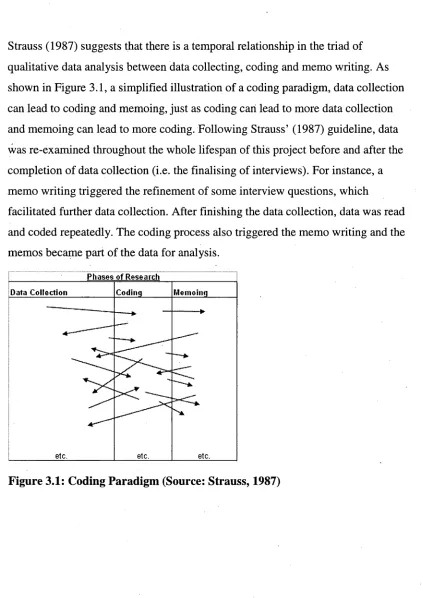
Figure 3.1: Coding Paradigm (Source: Strauss, 1987)... 83
Figure 4.1: Graphical Representation of Participants’ Utilisation of Internet Financial Reporting and Paper-based Financial Reporting... 95
Figure 5.1: A Theoretical Model of Factors Affecting the Utilisation of Internet Financial Reporting... 106
Figure 5.2: Impacts of Information Need and Investment Characteristics... 108
Figure 5.3: Impact of Perceived Usefulness... 115
Figure 5.4: Impact of Perceived Ease of Us... 120
Figure 5.5 Impact of Document Length... 124
Figure 5.6 Impact of System Limitation... 131
Figure 5.7 Impact of Perceived Risk... 135
Figure 5.8 Impact of Facilitating Conditions... 136
Figure 5.9: Impact of Economic Gain and Loss on Utilisation of IFR... 138
Figure 5.10: Impact of Subjective Norm on Utilisation of IFR... 139
Figure 5.11 Impact of Image... 140
Figure 5.12: Impact of Personal Innovativeness on Utilisation of IFR ...142
Figure 5.13: Impact of Computer Self-efficacy on Utilisation of IFR...143
Figure 5. 14: Determinants of Perceived Credibility... 144
Figure 5.15: Impact of Reading Patterns on Perceived Ease of Use...147
Figure 5.16: Impact of Tendency to Print on Utilisation... 148
Figure 5.17: Impact of Attitude towards Using on Behavioural Intention...150
Figure 5.18: Impact of Attitude towards Using on Usage of IFR... 151
Figure 6.1 The User/Customer-Centric SDLC Model (Russell & Yilmaz, 2006) ...177
Figure 6.2 Concept Model for CASE Adoption Behaviour (Rai & Patnayakuni 1996)... 177
Figure 6.3 Revised Conceptual TAM Model Based on Findings of this Study... 179
List of Tables
Table 2.1 Summary of TAM Literature... 44
Table 3.1 Essential Characteristics of Alternative Inquiry Paradigms... 59
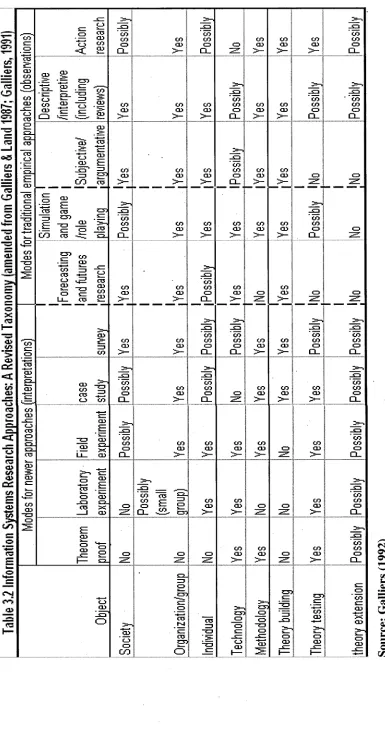
Table 3.3 Information Systems Research Approaches... 60
Table 3.2 Information Systems Research Approaches: A Revised Taxonomy....62
Table 3.4 The Continuum of Interviews (Source: Punch, 1998)... 67
Table 3.5 Sampling Decisions in the Research Process (Source: Flick, 2002).... 71
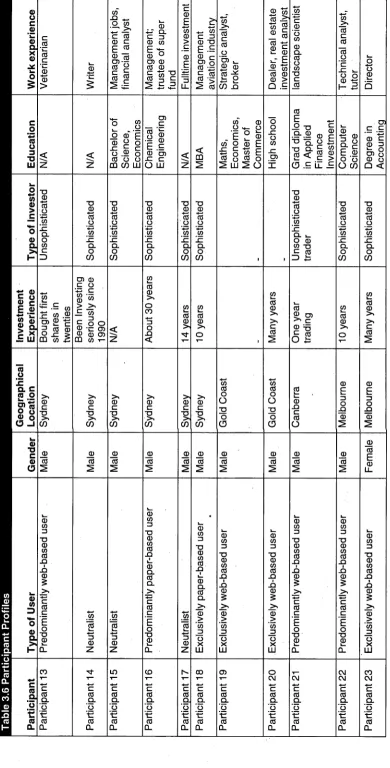
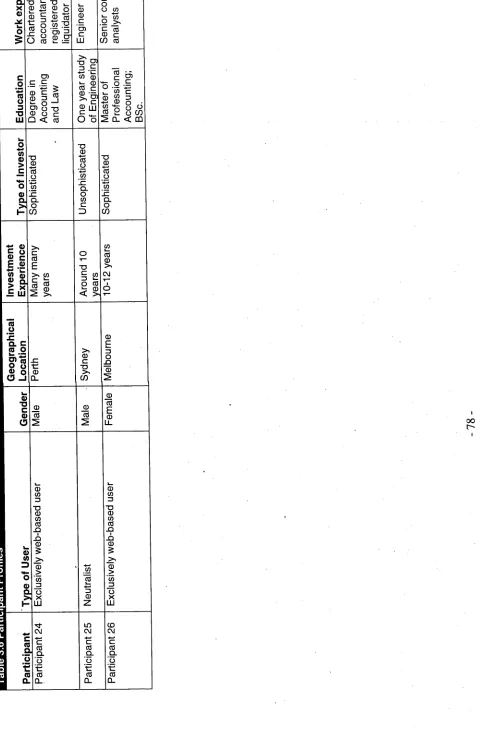
Table 3.6 Participant Profiles... 75
Table 4.1 Examples Supporting the Node, Co-existence... 96
Table 4.2 Examples Supporting the Node— Perceived Credibility... 100
Table 4.3 Examples Supporting the Node— Perceived Risk...102
Table 4.4 Examples Supporting the Node— Perceived Advantage... 103
Table 5.1 Examples Supporting the Node, Information Need, and its Relationship with other Constructs... 107
Table 5.2 Examples Supporting the Node, Information Need, and its Relationship with Investment Characteristic...111
Table 5.3 Examples Supporting Perceived Usefulness Affecting Usage... 116
Table 5.4 Examples Supporting Perceived Usefulness Affecting Attitude towards Using... 117
Table 5.5 Examples Supporting Perceived Ease of Use Affecting Usage... 121
Table 5.6 Examples Supporting Perceived Ease of Use Affecting Attitude towards Using... 122
Table 5.7 Examples Supporting Perceived Ease of Use Affecting Perceived Usefulness...123
Table 5.8 Examples Supporting Document Length Affecting Perceived Usefulness... 126
Table 5.9 Examples Supporting Document Length Affecting Perceived Ease of U se... 128
Table 5.10 Examples Supporting Task Nature Affecting Perceived Usefulness. 129 Table 5.11 Examples Supporting Task Nature Affecting Perceived Ease of Use ... 130
Table 5.12 Examples Supporting System Limitation Affecting Perceived Ease of U se... 132
Table 5.13 Examples Supporting System Limitation Affecting Usage...134
Table 5.14 Examples Supporting Facilitating Conditions Affecting Perceived Ease of Use... 136
Table 5.15 Examples Supporting Economic Loss Affecting Usage... 138
Table 5.16 Examples Supporting Economic Gain Affecting Usage... 139
Table 5.17 Examples Supporting the Lack of Influence of Perceived Credibility on Usage... 144
Table 5.18 Examples Supporting the Influence of Reading Patterns on Perceived Ease of Use... 147
Table 6.1 Factors Affecting Individual Investors' Information Needs...174
Chapter 1 Introduction
1.1 Background and Scope of Study
Corporate reporting is the process of disseminating financial and non-financial
information about the resources and performance of a reporting entity to its
stakeholders and other information users (Accounting Standards Steering
Committee, 1975). Lodhia, Allam and Lymer (2004) define corporate reporting as
an important constituent of the accounting process aiming to “provide decision-
useful information and extend accountability” to interested stakeholders.
According to them, corporate reporting includes financial reporting, social and
environmental reporting and corporate governance as well as other general issues
related to the reporting organisation. Traditionally, corporate reporting is done
using paper as a presentation medium. With the advancement of
telecommunication and information technology, the Internet has emerged as a
new and popular presentation medium mainly for listed companies to disseminate
information to their stakeholders such as investors, shareholders and the public at
large (Hussey & Sowinska, 1999; Xiao, Jones, & Lymer, 2002). For instance, as
early as 2000 the IASC surveyed 660 companies in 22 countries across Europe,
Asia-Pacific, and South and North America. They found that 86 percent of the
studied companies had corporate websites and around two-thirds of them
disseminated financial information on their websites. In many countries with
developed equity markets, the use of Internet technology for corporate reporting
has become a well-established practice (Lymer & Debreceny, 2003). Pike and
Lanis (2003) argue that corporate disclosure, regulation and dissemination of
Internet financial reports are the most significant business issue today, despite the
unsophisticated approach to its usage by many companies and some users’
perception of its relatively low usefulness (Xiao, Jones, & Lymer, 2002).
Like those reporting entities who have adopted the Internet to disseminate
corporate information, stock exchanges, brokers and third party service providers
are also using the Internet to facilitate the information flow in the equity, futures
Internet can easily obtain real time market information such as the latest
announcement of a company or the movement statistics of a particular share on a
broker’s website.
This study investigates the use of two financial reporting methods — Internet
financial reporting and paper-based financial reporting, by information users
such as investors, traders, analysts and members of the accounting profession. In
recent years, Internet financial reporting has been made available to these
information users as a new medium for getting information and achieving other
tasks. Especially in Australia, the Australian Bureau of Statistics reported an
increasing trend in both the number of retail shareholders and the household
usage of home computers and the Internet. However, very few published studies
have linked Internet financial reporting to its users. This study is the first to
investigate Internet financial reporting from the users’ perspective using
participants from the business world. To my knowledge, it is also the first study
to investigate how and why users utilise Internet financial reporting as opposed
to paper-based financial reporting.
Debreceny, Gray and Rahman (2002, p. 372) define Internet financial reporting
as “the distribution of corporate financial and performance information using
Internet technologies such as the World Wide Web”. However, despite its name
of Internet financial reporting, information being distributed includes not only
financial information but also a range of non-financial information that is also
sought by information users, as clearly described in the definition. This conflicts
with the common conception that Internet financial reporting only deals with
financial information. As indicated by Debreceny, Gray and Rahman (2002),
Internet financial reporting has a larger boundary than its paper-based
counterpart and it “is comprised of a variety of corporate information.. .including
material, such as press releases, that is available from other sources”.
Following Debreceny, Gray and Rahman (2002), Internet financial reporting in
this study refers to the use of the Internet as a channel for the dissemination of
corporate financial and performance information. Likewise, paper-based
and performance information. It is receivers or users of the information, rather
than preparers of the information, that are the subjects of this study. For instance,
the use of Internet-financial reporting by an investor does not mean the investor
disseminates the information, but rather utilises electronically distributed
information to perform a series of tasks to facilitate his or her decision making.
1.2 A New World of Challenge
Xiao, Jones and Lymer (2002) posit that the Internet has four major impacts on
corporate financial reporting: access, dissemination, interaction and presentation.
According to them, the Internet has some characteristics that are relevant to
financial reporting. First, on the Internet, text and/or multimedia can be linked in
a non-linear way1 thus changing the way that corporate information is presented.
Second, the Internet is capable of more than one-way communication2, which
can change the provider-dominated one-way reporting process. Third, the
Internet is capable of both real-time and delayed communications. Finally, the
Internet has a global reach and creates difficulty for cross-border regulation of
corporate reporting. With the Internet, more types of disaggregated information
can be presented in more user-friendly, timely, and accessible ways (Lymer,
Debreceny & Rahman, 1999; Pike & Lanis, 2003).
Jones and Xiao (2003) depict the Internet as “a potentially revolutionary method
of financial communication ”. Using the Internet in corporate reporting can
benefit companies in several ways. It reduces the production and distribution
costs of paper annual reports (Fisher, Oyelere & Laswad, 2002; Lymer, 1999;
Jones & Xiao, 2003; Debreceny, Gray & Rahman, 2002). It improves the
accessibility of corporate information and serves as a new access mechanism for
corporate data (Fisher, Oyelere & Laswad, 2002; Lymer, 1999; Jones & Xiao,
2003), enabling companies to reach a wider audience and communicate with a
large number of users (Ettredge & Scholz, 2001; Debreceny, Gray & Rahman,
iii---1 Information on corporate websites can be linked in and out of documents in a non-linear way.
For example, a press release in video format can be linked to a text message in an annual report. In contrast, in a paper-based reporting environment, information flows in a sequential order.
2 For instance, Internet chat room can provide a real-time multi-way communication between a
2002). It is instant and convenient for users to access real-time information
(Fisher, Oyelere & Laswad, 2002; Lymer, 1999). Moreover, the Internet can also
be used to enhance corporate images by creating interest among potential
investors (Noack, 1997).
Corporate reporting on the Internet, however, has the latent capacity to deceive
(Lanis & Groen, 2001). On the Internet, financial and non-financial information,
corporate and non-corporate information, audited information and unaudited
information can be explicitly linked together using hypertext links or other
techniques (Xiao, Jones & Lymer, 2002). Hyperlinks can create greater scope for
fraud and/or loss (Upton, 1998) and tend to blend the audited and unaudited
information together, a phenomenon known as the credibility inflation effect
(Hodge, 2001; Xiao, Jones and Lymer, 2002). For instance, a company can link its
website to an analyst’s report containing misleading information. If a retail
shareholder follows the link and makes an investment decision based on that piece
of information, chances will arguably be greater that the investor will make a loss
or, at least, has made a less well justified decision than might otherwise have been
the case. Hyperlinks can also prevent users readily identifying whether or not the
information being examined is externally verified (Xiao, Jones and Lymer, 2002).
The use of the Internet and hyperlinks has eliminated the physical boundary of
each piece of information, be it audited or unaudited. Without the physical
boundary as a reminder, even an experienced user might not be able to keep
adequately vigilant about all of the information throughout his/her task
performance.
Another concern is that the Internet is capable of delivering not only texts, but
also pictures, voices, video clips, odour4, and so on. The richness of information
on a corporate website is greatly enhanced, compared with that of traditional
paper-based reporting, which can only convey information in text or picture
format in paper print. Moreover, information, be it positive or negative, can be
iv---3 According to Hodge (2001), hyperlinking unaudited information to optimistic audited information can increase the perceived credibility of unaudited information, resulting in users placing higher values on a firm’s earning potential.
transmitted instantly on the Internet, making communication more frequent,
salient, and peripheral and core information can be more closely connected
together. For instance, Rose (2001) found that multimedia has become an
important component of financial reporting and multimedia-induced mood states
can influence decision-making.
The Internet and paper print have become two media that can be utilised by
information users to achieve their goals. Because the Internet and paper print
differ significantly in their features, characteristics, and functionality, Internet
financial reporting and traditional paper-based financial reporting also differ
significantly from each other. For instance, hyperlinks and multimedia are
exclusive to Internet financial reporting. So is the speed of delivery of
information. In the presence of the two different financial reporting methods,
how do information users such as investors and analysts react to them? How do
they perceive each method? Do they use one or the other, or both? How do they
use them? And why do they use them? To date, no study has been done to
answer these questions. The purpose of this study is to investigate how
information users perceive Internet financial reporting and paper-based financial
reporting, and how and why they use these different reporting methods,
particularly Internet financial reporting.
1.3 Motivation
The motivation of this study comes from two broad perspectives: the importance
of the Internet financial reporting in reality and the gap in the extant literature,
identified above, regarding Internet financial reporting.
1.3.1 Motivation from the Reality
The Internet has emerged as an important disclosure vehicle for reporting entities.
As pointed out by Pike and Lanis (2003), corporate disclosure, regulation and
dissemination of Internet financial reports has become the most significant
business issue today. It is envisaged that the Internet will have a more and more
important position in corporate reporting in the future. As Fisher, Oyelere, and
paper print to become the primary medium for disclosing financial reports to
stakeholders. Lymer, Debreceny, and Rahman (1999), on behalf of the
International Accounting Standards Committee (IASC), also predict that future
business reporting will use the World Wide Web as the primary mode for
information dissemination and the hard-copy print will function as the secondary
mode. Some annual report specialists, such as the Swish Group, have also
predicted that annual reports might only be available online within ten years
(Ralvic & Stretton, 2000). In Xiao, Jones, and Lymer’s (2002) study, some
technological determinists also foresaw the abandonment of paper-based annual
reports and the adoption of real-time reporting and continuous auditing.
In Europe, the European Commission has included corporate websites as a means
for listed companies in European exchanges to disseminate corporate information
to their stakeholders (European Commission, 2002). In Australia, some
companies, such as Qantas Airways for example, have launched annual report
election and email notification services to enable Internet-capable shareholders to
view annual reports online instead of receiving hard copies from companies in
which they have invested. At the same time, other third party websites such as
those of brokers play an important role in the information flow on the Internet.
For instance, according to the latest study done by the Australian Securities
Exchange, the largest retail brokers in Australia include ABN Amro Morgans,
Bell Potter Securities, CommSec, E*Trade Australia Securities, Goldman Sachs
JB, HSBC Stockbroking, Macquarie Retail, Smith Barney Citigroup, and
Westpac Securities, all have corporate websites that provide users with easy
access to market information. In fact, in Australia, shareholders can only trade
through brokers, which also contributes to the use of brokers’ websites. As
Debreceny, Gray and Rahman (2002) argue, Internet financial reporting is an
important issue for securities regulators, accounting standard setters and the
accounting community. Given the potentially important role of Internet financial
reporting now and in the future, it is worthwhile to research this area to help
researchers, regulators and practitioners better understand and address issues
Another concern is that retail shareholders in Australia are increasing. According
to the latest study of share investors done by the Australian Securities Exchange
in 2004, in recent years, due to corporate floats, privatisation and demutualisation,
the number of Australian adults who directly or indirectly own shares has
increased tremendously. In the late 1980s, only nine percent of the Australian
adult population directly owned shares. In 1997, direct share ownership soared to
20 percent of the adult population (Australian Securities Exchange, 2004). The
number doubled in November 1999 when 41 percent of the Australian adult
population (around 5.7 million Australians) directly held shares. In 2004, 55% or
approximately 8 million of Australian adults own shares. From 1997 to 2004, the
overall increment in total share ownership was approximately 3.3 million or 71%
(Australian Securities Exchange, 2004).
Commensurate with the increase in number of retail shareholders, use of
computers and the Internet by Australian households has increased steadily
recently. Figure 1.1 shows the increasing trend, according to the latest statistics
released by Australian Bureau of Statistics in December 2006. During 2005-06,
70% of Australian adults used a computer at home and 60% accessed the Internet
at home. Personal or private purposes was found to be the most popular purpose
of computer or Internet use at home, with 96% of those Australian adults who
use computers using them at home for personal and private purposes and 97% of
them using the Internet at home for the same purpose. In addition, home was
reported to be the most popular location of Internet use in 2005-06 (Australian
Bureau of Statistics, 2006).
%
100 « Computer accessInternet access
80
1998 l« x i 2000 2301 2002 2303 2004 05 2005 06
(Source: Australian Bureau of Statistics, 2006)
The increase in both the number of direct shareholders and the usage of
computers and the Internet might serve as key drivers for retail investors to
search for financial and non-financial information online. For instance, retail
investors can visit a company’s website for more information about the company
when the need arises. Some experts also believe that investors would use the
Internet for share transactions and the Internet will serve as a useful source of
information for users (Jones & Xiao, 2003). In fact, it is a common practice
nowadays that many companies advertise their corporate websites on their paper-
based annual reports in order to broaden public awareness, visit and usage of
their corporate websites.
1.3.2 Motivation from Prior Studies
In recent years, as the Internet has gained in popularity, corporate reporting on
the Internet has been increasingly studied by many researchers. Many of these
studies have focused on the preparation and dissemination of financial reports on
corporate websites by the reporting entities in specific countries or geographical
regions, e.g., Austria by Pirchegger and Wagenhofer (1999), New Zealand by
Oyelere, Laswad and Fisher (2003), the United Kingdom by Craven and Marston
(1999) and Hussey and Sowinska (1999), Europe by Lymer (1999), and Japan by
Marston (2003).
Pirchegger and Wagenhofer (1999) studied the use of the Internet for corporate
disclosure by Austrian companies listed on the Vienna Stock Exchange. By using
time series data and testing the influence of company size and ownership
structure on companies’ use of the Internet, they found that companies differed in
the way they used the Internet. They also found that the quality of Austrian
websites improved significantly from 1997 to 1998 and that the quality was
positively related to company size and percentage of free float.
Lymer (1999) did a thorough literature review on the academic and professional
response to Internet financial reporting in Europe. He identified several issues
standard-setters. These issues included the forms and quantity of financial
information, third-party disclosures, the process of online financial reporting, and
liability of reporting errors, etc. Lymer claimed that these issues must be
addressed so that the accounting profession could maintain their reputation
created in the traditional reporting environment.
Craven and Marston (1999) surveyed 206 large companies listed on the London
Stock Exchange in the UK in 1998. They found that larger companies tended to
use the Internet to disclose corporate information. However, industry type had no
relationship with the extent of Internet disclosure. Similar research was
conducted by Marston in Japan. Marston (2003) surveyed the top 99 Japanese
companies and found that company size was positively related to the existence of
a corporate website. However, the extent of financial disclosure on the corporate
web sites was not related to company size.
Hussey and Sowinska (1999) examined financial disclosures on the Internet by
FTSE 100 companies in the UK from June 1997 to January 1998. Their findings
were that these companies rapidly adopted Internet technology for financial
disclosures over a short period of time, and that few companies had their interims,
prelims, summary statements or highlights audited before they disclosed them on
their website. They also pointed out that information online might contain errors
and omissions and recommended some solutions to address the security and
integrity of the information on the Internet.
While some researchers focused on the adoption of Internet disclosure by
companies, others studied the determinants of Internet financial reporting. For
instance, Debreceny, Gray and Rahman (2002) studied the determinants of
Internet financial reporting by examining the presentation and content of Internet
financial reports of 660 large companies across 22 countries. They found that
firm size, public listing and technology were firm specific determinants of
Internet financial reporting.
In another study, Oyelere, Laswad and Fisher (2003) studied the determinants of
liqaidity, industrial sector and spread of shareholding were the key drivers of
coiporate Internet financial reporting. However, firms’ profitability,
internationalisation and leverage had no effect on companies’ adoption of Internet
financial reporting.
Some researchers have studied the information disclosed online by companies.
Ettredge, Richardson and Scholz (2002) suggested that corporate financial
disclosures could be divided into two categories: filings required by the SEC and
adlitional voluntary disclosures by the companies. By studying 220 firms, of
which 193 owned corporate websites, they found that firm size and a proxy for
information asymmetry were related to compulsory disclosure on the corporate
web sites, while voluntary disclosure was related to variables proxying for size,
information asymmetry, demand for external capital, and firms’ traditional
disclosure reputations.
In another study, Ashbaugh, Johnstone and Warfield (1999) examined the use of
the Internet by 290 non-financial companies to increase the relevance of their
firancial reporting. They found that these firms differed substantially in the
quality of the information they posted on their corporate websites. Specifically,
seme firms updated their financial disclosures regularly while others provided
outdated financial information such as two year old annual reports online.
Beattie and Pratt (2003) studied the various views of the interested parties of
web-based business reporting. They found that while both companies and users
saw the advantages of Internet financial reporting, their views differed
significantly in regard of the scope, structure and frequency of Internet financial
reporting. In contrast, auditors’ views fell in between those of companies and
users.
Many researchers also linked Internet financial reporting to auditing and the
audit profession. For example, Lymer and Debreceny (2003) studied the audit
guidance for Internet financial reporting provided by securities regulators and
audit standard setters across three countries: the USA, Australia and the UK.
addressed by authorities in these countries while some wider implications of the
impact of Internet financial report on auditing had not been addressed.
Debreceny and Gray (1999) surveyed 45 large listed public companies in France,
Germany and the UK who provided their annual reports online on their corporate
websites. They advocated that the audit profession address four issues regarding
auditing and Internet financial reporting: the ease of modification of auditor’s
report, the meaning of the look and feel of the auditor’s report, the implications
of hyperlinks to and from web-based auditors’ reports, and the location and
placement of the auditors’ reports.
Fisher, Oyelere and Laswad (2002) examined the audit implications of Internet
financial reporting through a content analysis of 123 corporate websites of listed
New Zealand companies. They found that quite a lot of companies post their
audited financial reports online without the presence of the corresponding
auditor’s reports. Also, disclosing auditors’ scanned signatures online or
presenting auditor’s reports on auditor’s websites was not a common practice. In
addition, the reporting entities made very little effort to distinguish the audited
information from the unaudited information.
Ettredge, Richardson and Scholz (2001) studied 402 corporate websites across 17
industries. They found that established firms were more likely to disclose
information at a higher level than smaller firms. They also found that financial
news releases and quarterly reports were the most common financial and
accounting data, respectively. They also pointed out that presenting excerpts of
annual reports on company’s websites might cause omissions and uncertainty,
thus increase the disclosure risk and this issue needed to be addressed by the
auditing profession.
Hodge (2001) and Dull, Graham and Baldwin (2003) are among the few who
have studied the impact of Internet financial reporting on users of the reports.
Hodge (2001) investigated the effects of hyperlinking unaudited information to
audited financial statements in a web-based environment on individual investors’
hyperlinks could inflate the credibility of the information by blending the
unaudited information with the audited information.
Dull, Graham and Baldwin (2003) explored the effect of hyperlinking financial
statements to the footnotes on users’ decisions. Using undergraduate students as
surrogates, they found that hyperlinking a small company’s financial statement to
the footnotes impacted on participants in respect of their predictions, amount of
information assessed and the time to make decisions. In contrast, hyperlinking a
large company’s financial statement to the footnotes had no impact on
participants’ decisions5.
As summarised above, prior literature on Internet financial reporting shows that
most studies focus on the preparers’ side of Internet financial reporting on
corporate websites. Only very few studies have investigated the impact of Internet
financial reporting on information users’ decision making. Clearly, current and
future research should focus more on users’ side of Internet financial reporting.
More important, the review of literature also reveals that to date, no study has
investigated how and why actual users utilise Internet financial reporting. One
study did look at the determinants of firms’ adoption of Internet financial
reporting, but it is from the companies’ perspective. It is a fact that many
companies, especially large public listed companies, use the Internet to
disseminate corporate information. However, it can not be assumed that just
because Internet financial reporting has emerged as a new medium of corporate
reporting, users will use it and it will be used in the same way as traditional paper-
based financial reporting. There is a need to understand how and why information
users utilise Internet financial reporting. In this sense, this study fills a gap in the
extant literature on Internet financial reporting.
As aforementioned Internet financial reporting and paper-based financial
reporting are two different reporting methods. To date, no prior study has
investigated how information users perceive them, how they utilise each
xii---5 The difference might result from the size of the companies, sheer number of notes, relative
reporting method, and why they use Internet financial reporting. Given that in the
near future, Internet Financial Reporting is likely to become the primary
reporting practice, it is imperative to investigate factors that contribute to
information users’ acceptance (or lack of it) of Internet financial reporting. Apart
from the theoretical implication, identifying these factors is arguably important
to those firms who want to maximise their benefits from using Internet financial
reporting, as they can then address issues arising from this study.
Finally, current regulations and laws on Internet financial reporting are still
unsophisticated. According to Fisher, Oyelere and Laswad (2002), only two
countries, UK and Australia, currently have auditing guidance to address the
issues associated with Internet financial reporting. In Australia, the Australian
Accounting Research Foundation points out in its Auditing Guidance Statement
No. 10506 that regulations of Internet financial reporting are not yet well-
established in law (AARF, 2002). Given that current regulations on corporate
reporting on the Internet are unsophisticated, it is important to investigate how
investors perceive financial reporting on the Internet and why they use it so as to
bring it to the attention of accounting professionals, regulators, standard setters
and users, as well as to enable the development of preventive regulations and
control where necessary.
1.4 Research Questions
The objective of this research is:“to investigate how information users perceive and use Internet financial
reporting and paper-based financial reporting and to identify factors that
contribute to their acceptance and usage (or lack of it) of Internet financial
reporting ” .
The study attempts to achieve this by answering the following research questions:
Question 1;
] In the presence of both Internet financial reporting and paper-based financial
lreporting, how do information users perceive and utilise each reporting method?
Question 2:
lln the presence of both Internet financial reporting and paper-based financial
] resorting, why do information users utilise Internet financial reporting, if they do?
1.5 Research Design
This study takes a qualitative approach to answer the research questions. This is
l because information users’ perceptions and beliefs are the key determinants of
how well the research questions can be answered. Using a qualitative approach is
the best choice as it can minimise the information loss, as suggested by Kaplan
and Maxwell (1994), in understanding users’ acceptance of Internet financial
reporting. The nature of the research problem also determines that the qualitative
approach is the most appropriate in this study. This is consistent with Strauss and
Corbin’s (1998) guidance that the nature of the research problem should exert the
most impact on choosing a research method. Using a qualitative approach is also
one of the novelties of this study, as prior research has mostly used quantitative
methods in TAM studies. This study is one of the few studies to adopt a
qualitative approach to investigate the research questions.
The research method for this study, under Galliers’ (1992) taxonomy, is
descriptive/interpretive research, or phenomenology. Using this method, the
researcher reads the transcripts after data collection, dwells with descriptions,
identifies and extracts themes, and integrates the themes into meaningful
descriptions of the nature of the phenomenon under study.
Semi-structured interviewing was chosen as the data collection method for this
study because it can provide rich contextual information about participants’
perceptions and usage of Internet and paper-based financial reporting. Participants
of this study come from a diverse background and include investors, traders, client
advisors, technical analysts and accounting professionals. Direct content analysis
the data collection and analysis were carried out in parallel and the data analysis
was facilitated with the aid of the computer software package NVivo.
1.6 Structure of this Thesis
This thesis is presented in seven chapters, structured as follows.
Chapter 1 - Introduction
This chapter describes the background and scope of the study. Also covered in
this chapter are the motivation, objective, research questions, and research design
of this study as well as the structure of thesis.
Chapter 2 - Literature Review
This chapter reviews prior research on technology acceptance with a special focus
on the technology acceptance model. It includes a brief introduction to competing
theories, explanation of why TAM is appropriate as a theoretical underpinning of
this study, and a review of prior TAM studies using a concept-centric approach as
suggested by Webster and Watson (2002).
Chapter 3 - Research Method
This chapter first describes and justifies in more detail why a qualitative approach
was taken in this study, followed by a discussion of the philosophical stance of
this research and the research paradigm adopted in this study to solve the research
problem. It also describes how data were collected and analysed to achieve
maximum research validity and reliability. Also covered in this chapter are
descriptions of subjects, research designs, data analysis methods, as well as a
general discussion of research soundness in qualitative research.
Chapter 4 - Usage Patterns and Perceptions
This chapter presents findings about information users’ usage patterns and
perceptions of Internet financial reporting and paper-based financial reporting. It
provides the answer to the first research question from three angles: choice of
reporting methods, details of usage in specific areas, and perceptions of each
financial reporting method.
Chapter 5 - Reasons for Usage
This chapter presents findings regarding why information users utilise Internet
financial reporting in the way described in Chapter 4. It provides the answer to
the second research question of this study. A theoretical model of factors
Chapter 6 - Discussion
This chapter discusses the findings of this study in the context of extant IS and
accounting literature. Apart from discussing findings of this study in three
streams: findings consistent with prior studies, findings contrary to prior studies
and findings new to the literature, it also presents conceptual models proposed in
this study.
Chapter 7 - Conclusion and Recommendation
This chapter concludes the findings of this research and revisits the answers to
the research questions of this study. It also discusses the theoretical and practical
implication of this study. Limitations of this study are also acknowledged in this
chapter, followed by recommendations for future research and a summary of this
Chapter 2 Literature Review
2.1 Introduction
This study seeks to answer the question of how users perceive and use Internet
financial reporting and paper-based financial reporting and why they utilise
Internet financial reporting, if they do. The interdisciplinary nature of this study
implies that its theoretical contribution falls into two aspects: accounting and
information systems. Moreover, since this study involves the usage of a new
technology, i.e., the Internet in the financial reporting arena, prior research on user
acceptance of information technology, with a special focus on the technology
acceptance model, is reviewed. This is consistent with the view of Gefen,
Karahanna and Straub (2003, p. 53), who state that a website is essentially an
information technology and imply that the technology acceptance model can be
used to explain users’ intention to use it.
Webster and Watson (2002) state that literature reviews can be concept-centric
where concepts drive the organising framework of a review, or it can take an
author-centric approach where a summary of the relevant articles are presented.
In this study, the review of users’ acceptance of information technology takes a
concept-centric approach.
2.2 User Acceptance of Information Technology
2.2.1 Competing Models
Information technology acceptance research has been widely studied since the
1980s and has produced a few rival models. A review of the Information Systems
literature shows that at least ten competing models have been developed or used
to explain information technology acceptance. These competing models are:
• Theory of Reasoned Action (TRA) (Fishbein & Ajzen, 1975)
• Technology Acceptance Model (TAM) (Davis, 1986)
• Motivational Model, (MM) (Davis, Bagozzi & Warshaw, 1992)
• Theory of Planned Behaviour (TPB) (Ajzen, 1991)
• Model of PC Utilisation (MPCU) (Thompson, Higgins & Howell, 1991)
• Innovation Diffusion Theory (IDT) (Rogers, 1983)
• Social Cognitive Theory (SCT) (Bandura, 1986)
• Unified Theory of Acceptance and Use of Technology (UTAUT) (Venkatesh et al., 2003)
• Expectation-Confirmation Model (ECM) (Bhattacherjee, 2001)
All the models, except TAM, are briefly introduced in the following paragraphs.
TAM will be introduced in detail in the next section.
2.2.1.1 Theory of Reasoned Action
Fishbein and Ajzen’s (1975) theory of reasoned action predicts that a belief-
attitude-intention-behaviour relationship exists in users’ acceptance of
information technology. Specifically, users’ behaviour is determined by their
behavioural intention (BI) to perform the behaviour, which is jointly determined
by their attitude (A) towards and subjective norm (SN) about the behaviour. Ajzen
and Fishbein (1980) further suggest that social behaviour is determined by the
intention to perform, and social behaviour is motivated by:
• an individual’s attitude to performing the behaviour in question;
• an individual’s beliefs about the outcomes of the proposed behaviour; and
• an individual’s evaluation of the outcomes (Lymperopoulos &
Chaniotakis, 2005, p. 488)
The relationship between the variables in TRA can be expressed in the following
formula (Davis, Bagozzi & Warshaw, 1989):
BI = (A) + XnbimCi (SN)
Where: bj = beliefs, individual’s subjective probability that performing the target behaviour will result in consequence i.
ej = implicit evaluative response to the consequence
nbj= one’s normative beliefs
2.2.1.2 Motivational Model
According to motivation theorists, e.g., Calder and Staw (1975), extrinsic
motivation and intrinsic motivation are two types of motivation for people to
perform an activity. Extrinsic motivation refers to the performance of an activity
to achieve valued outcomes that are different from the activity itself, e.g.,
improved job performance, pay, or promotions (Davis, Bagozzi & Warshaw,
1992). An example of extrinsic motivation is perceived usefulness. Intrinsic
motivation refers to “the pleasure and inherent satisfaction derived from a specific
activity” (Deci, 1975). An example of intrinsic motivation is enjoyment. Deci
(1975) suggests that intrinsic and extrinsic motivation jointly influence a person’s
intention to perform an activity and actual performance.
Davis, Bagozzi and Warshaw, (1992) were the first to adapt motivation theory to
the information systems discipline. In their study, the motivational model was
used to predict workers’ use of computers in the workplace. They found that
people’s intentions to use computers in the workplace were jointly determined by
their extrinsic and intrinsic motivations. Specifically, the usage was primarily
affected by their extrinsic motivation - perceptions of the usefulness of the
computers in improving their job performance, and secondarily influenced by
their intrinsic motivation - the degree of enjoyment they experience in using the
computers.
2.2.1.3 Theory of Planned Behaviour
The theory of planned behaviour (TPB) is an extension of the theory of reasoned
action (Ajzen, 1991). According to TPB, an individual’s intention to perform a
task is jointly determined by three conceptually independent constructs: attitude
toward the behaviour, subjective norm, and perceived behavioural control.
Attitude toward the behaviour refers to “the degree to which a person has a
favourable or unfavourable evaluation or appraisal of the behaviour in question”
(Ajzen, 1991). Subjective norm refers to “the perceived social pressure to perform
perceived ease or difficulty of performing the behaviour and it is assumed to
reflect past experience and anticipated impediments and obstacles” (Ajzen, 1991).
Generally, a more positive attitude, more favourable subjective norm with respect
to a behaviour, and greater perceived behavioural control will result in an
individual having stronger intention to perform the behaviour (Ajzen, 1991).
However, the relative powers of attitude, subjective norm, and perceived
behavioural control in predicting intention vary across different behaviours (Ajzen,
1991).
2.2.1.4 Combined TAM and TPB
Combined TAM and TPB, as its name suggests, is a model developed by Taylor
and Todd (1995) which integrates the predictors of the theory of planned
behaviour with perceived usefulness from TAM. Taylor and Todd (1995) used the
model to predict experienced and inexperienced potential users of a student
computing information resource centre.
There are five major constructs in the combined model of TAM and TPB:
perceived usefulness, ease of use, attitude, subjective norm and perceived
behavioural control. Combined TAM and TPB predicts that perceived usefulness
and ease of use affect users’ attitude. Perceived usefulness, subjective norm and
perceived behavioural control together affect behavioural intention. In addition,
perceived behavioural control also directly affects behaviour. However, attitude
does not affect behavioural intention.
2.2.1.5 Model of Personal Computer Utilisation
The model of personal computer (PC) utilisation was based on a subset of
Triandis’ (1980) theory of attitudes and behaviour, and was developed by
Thompson, Higgins and Howell (1991) to explain knowledge workers’ usage of
personal computers in optional use environments. The model has six constructs.
The first three constructs - social factors, affect, and facilitating conditions, come
directly from Triandis’ (1980) theory of attitudes and behaviour, whereas the rest
three constructs: complexity, job fit and long-term consequences of use, were
dimensions of perceived consequences, a construct in Triandis’ (1980) theory of
attitudes and behaviour.
In the model of PC utilisation, the construct complexity refers to “the degree to
which an innovation is perceived as relatively difficult to understand and use”
(Thompson, Higgins & Howell, 1991). Job fit refers to “the extent to which an
individual believes that using a PC can enhance the performance of his or her
job” (Thompson, Higgins & Howell, 1991), a construct similar to perceived
usefulness in the technology acceptance model. Affect refers to “the feelings of
joy, elation, or pleasure, or depression, disgust, displeasure, or hate associated by
an individual with a particular act” (Triandis, 1971).
The model of PC utilisation predicts that social factors, complexity, job fit, and
long-term consequences significantly influence PC use. However, neither affect
nor facilitating conditions affects PC use.
2.2.1.6 Innovation Diffusion Theory
Rogers’ (1983) innovation diffusion theory (IDT) states that innovation adoption
is a process of uncertainty reduction and information gathering. An individual’s
decision to accept or reject an innovation is based upon five major perceptions
about the characteristics of the innovation: relative advantage, compatibility,
complexity, trialability, and observability. Relative advantage refers to the
benefits and costs associated with an innovation (Rogers, 1995). Compatibility
refers to “the degree to which an innovation is consistent with the individual’s
values, past experiences, and needs” (Rogers, 1995). Trialability is “the degree an
innovation may be experimented with on a limited basis” and observability refers
to “the degree to which the results of an innovation are visible to others” (Rogers,
1995).
According to the innovation diffusion theory, there are five-stage adoption
decision processes in innovation adoption: knowledge, persuasion, decision,
implementation, and confirmation (Rogers, 1995). An innovation that is perceived
trialabililty, observability and less complexity will be more quickly accepted and
adopted by users (Rogers, 1995).
2.2.1.7 Social Cognitive Theory
Social cognitive theory (SCT) is one of the most powerful theories in explaining
human behaviour (Venkatesh et al., 2003). There are three elements in social
cognitive theory: environment, behaviour, and person. According to SCT, the
three elements are reciprocally determined (Bandura, 1986). That is,
environmental factors such as social pressures can influence personality and
demographic characteristics and behaviour, just as personality and behaviour can
influence environment. Thus, individuals are influenced by the environment but
also can choose the environment in which they exist. Their behaviours in certain
situations are influenced by environmental or situational characteristics, which, in
return, also influence their behaviours. Also, behaviours influence and arc
influenced by individuals’ cognitive and personal factors (Bandura, 1986).
Bandura (1986) refers the relation between person, environment and behaviour as
‘ ‘tria die recip roc a l i ty’ ’ .
Compeau and Higgins (1995) applied social cognitive theory to users’ acceptance
of computers and found that self-efficacy strongly influenced individuals’ feelings
and behaviours. High self-efficacy was associated with more computers usage as
well as more enjoyment from usage and less computer anxiety. In addition,
outcome expectations, affect and anxiety also significantly affected computer use.
2.2.1.8 Expectation-Confirmation Model
The expectation-confirmation model (ECM) is adapted from the expectation-
disconfirmation theory (EDT) in the consumer behaviour literature that has a
focus on consumer satisfaction, post-purchase behaviour and service marketing in
general (Bhattacherjee, 2001). In the marketing discipline, EDT predicts that
consumers go through a series of processes to form their re-purchase intention
(Oliver, 1980). First, initial expectation of a product or service is formed before
making a purchase. Then after accepting and using the product or service for a
perceived performance of the product or service is assessed against the initial
evaluation. Next the extent to which the perceived performance matches the
original expectation is confirmed, which serves as the basis of satisfaction. Finally,
satisfaction leads to repurchase intentions.
Applying this to information systems, ECM predicts that user’s satisfaction is
determined by the expectation of the IS and the confirmation of the expectation
after the actual use. Bhattacherjee (2001) applied EDT to the IS area to explain IS
continuance and found that both satisfaction with IS use and perceived usefulness
were determinants of IS continuance intention. However, the impact of
satisfaction was more salient than perceived usefulness.
2.2.1.9 Unified Theory of Acceptance and Use of Technology (UTAUT)
Venkatesh et al. (2003) developed and empirically validated the Unified Theory
of Acceptance and Use of Technology (UTAUT) which is based on eight user
acceptance models from the extant IS literature. According to UTAUT, three
constructs: performance expectancy, effort expectancy, and social influence
directly influence users’ behavioural intention to use a new technology and
facilitating conditions directly affect their use behaviour. Gender, age, experience,
and voluntariness of use are four moderating variables which directly influence
the four constructs.
2.2.2 TAM and Internet Related Studies
There is overlapping of some constructs in the aforementioned models. Some
constructs appear in several models. For instance, facilitation conditions appear
both in the model of PC utilisation and combined TAM and TPB. This is due to
theory integration or adaptation. Quite a few models were adapted from the theory
of reasoned action and the theory of planned behaviour. All the above models can
be used to explain and/or predict IS acceptance and usage. However, it is