This is a repository copy of Fixing tropical forests.
White Rose Research Online URL for this paper: http://eprints.whiterose.ac.uk/131961/
Version: Accepted Version
Article:
Batterman, SA (2018) Fixing tropical forests. Nature Ecology and Evolution, 2 (7). pp. 1059-1060. ISSN 2397-334X
https://doi.org/10.1038/s41559-018-0583-6
This Article is protected by copyright. This is an author produced version of a paper published in Nature Ecology and Evolution. Uploaded in accordance with the publisher's self-archiving policy.
[email protected] https://eprints.whiterose.ac.uk/ Reuse
Items deposited in White Rose Research Online are protected by copyright, with all rights reserved unless indicated otherwise. They may be downloaded and/or printed for private study, or other acts as permitted by national copyright laws. The publisher or other rights holders may allow further reproduction and re-use of the full text version. This is indicated by the licence information on the White Rose Research Online record for the item.
Takedown
If you consider content in White Rose Research Online to be in breach of UK law, please notify us by
Biogeochemistry
Fixing tropical forests
An extensive dataset indicates that nitrogen-fixing trees are most abundant in young, dry tropical forests. The finding expands the potential for natural nitrogen fertilization and carbon dioxide sequestration in areas recovering from land use.
Sarah A. Batterman
Tropical forests recovering from deforestation, degradation and agriculture have the potential to remove a significant amount of carbon dioxide from the atmosphere, helping countries meet their climate goals. Recovery of tropical forest is often limited by soil nitrogen availability and can be enhanced by native trees in the legume family that fix nitrogen. But our understanding of the conditions affecting the presence of nitrogen-fixing trees in tropical forests has been biased towards the wet tropics. Writing in Nature Ecology and Evolution, Gei and colleagues1 provide evidence that, relative to wet
tropical forests, legume trees are particularly abundant in dry tropical forests
regenerating following recent disturbance. They suggest that high legume abundances in dry tropical forests can be explained by key traits for avoiding nitrogen limitation and heat and water stress.
Understanding the abundance of nitrogen-fixing trees is central to resolving their current and future role in tropical forests. Trees rapidly growing in regenerating tropical forests require large quantities of nitrogen, which is often in limited supply from degraded tropical soils2. Nitrogen-fixing trees can supplement insufficient soil nitrogen by
unlocking nitrogen directly from the atmosphere with the help of beneficial bacteria. They use this fixed nitrogen to build nitrogen-rich leaf tissue that is eventually made available to neighboring trees during the decomposition of fallen leaves. In theory, a higher abundance of nitrogen-fixing trees means more new nitrogen available to support tree growth, and thus faster forest recovery.
Previous work suggested that nitrogen fixation rates are particularly high in the early stages of tropical forest recovery3, but whether that translates to higher fixer
abundances has only been examined at a few wet tropical forest sites (for example, refs 3-6). Additionally, a handful of studies suggest fixers have an advantage in drier
conditions, with higher abundances under aridity in tropical savanna compared to forest biomes7, greater water use efficiency for trees with higher leaf nitrogen content8, and
ability to either maintain growth during drought or compensate growth following drought through fixation9,10.
America. The dataset contains basal area of trees from 1,207 0.008-1.3 hectare plots that range in age from 2 to 100 years old and that are grouped by location to make up 42 chronosequences. The authors analysed how the relative abundance of legume trees changes across the chronosequences with successional age and rainfall, and the contribution of trees capable of nitrogen fixation and with bipinnate leaves to changes in legume abundance.
They find that legumes, 93.5% of which they find are nitrogen fixers, are twice as
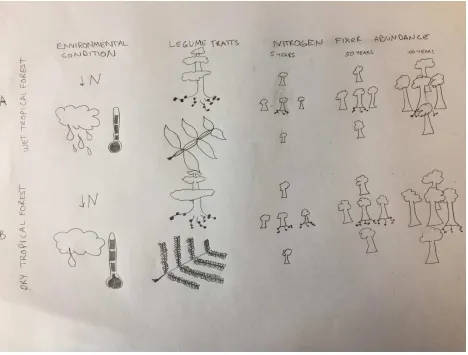
abundant in dry tropical forests than wet tropical forests (Fig. 1). Their analysis indicates this is because dry forest legumes benefit from traits that offer a dual advantage: they can fix nitrogen when the nutrient is scarce; and they have bipinnate leaves that, due to their small size, allow for efficient leaf temperature regulation, less water loss during transpiration and the ability to shed individual leaflets when severely moisture stressed.
Gei and colleagues also find that changes in abundance of nitrogen fixers during tropical forest regeneration differ in dry and wet tropical forest biomes. In wet tropical forests, legumes take up around 18% of the area occupied by trees, regardless of time after forest disturbance (Fig. 1a). But in dry tropical forests, legumes comprise on average 37% of tree-covered area, sometimes reaching 100% in the early phases of recovery, and the abundance of legumes declines as forests recover further (Fig. 1b).
This pattern of abundance for wet forests contrasts with the observed pattern of fixation rates, which start high and decline as forests age3. However, the finding is consistent
with theory that tropical fixers that use facultative fixation (adjusting fixation rates to their nitrogen balance) would remain present and abundant in the community as tropical wet forests recover, even as nitrogen fixation rates decline to low levels11.
The findings on dry forests suggest that species in the diverse legume family have more traits than just fixation that help explain their evolutionary success, especially in dry forests. Overall, the authors’ results provide the cautionary message that tropical fixers may not all function similarly, whether across recovery ages or tropical forest types.
This study substantially boosts our understanding of the patterns of abundance of nitrogen-fixing trees in tropical forests, but there are several avenues for further
exploration. It is not clear why fixers decline in abundance as forests recover in dry but not in wet tropical forest biomes. It will be interesting to explore whether there are fundamental differences in the evolutionary strategies of fixers in the wet versus dry tropics. We also do not now how much nitrogen is actually being fixed in dry tropical forests. With regard to the 83% of variation in fixer abundance that is not resolved by rainfall and forest age, Gei and colleagues show that 45% of this is explained by site (45%), but what differs between sites and what underlies the rest of the variation? Differences in soil nutrients, small-scale forest disturbances like treefalls, seed sources or herbivory levels are all possible contributing factors.
during forest regeneration in both wet and dry tropical biomes. Ensuring the protection of diverse nitrogen-fixing species will promote resilience of tropical forests to changes in climate, atmospheric carbon dioxide and human disturbance now and into the future.
Figure 1 | Nitrogen-fixing trees in wet and dry tropical forests. Legume trees in wet
tropical forests (a) and dry tropical forests (b) differ in traits associated with the
environmental conditions in which they grow, including the capacity for nitrogen fixation to overcome nitrogen limitation and pinnate vs. bipinnate leaves to avoid stress from heat and drought. Gei et al.1 show that, in wet tropical forests recovering from
disturbance, the proportion of legume trees remains fairly static (on average 18%), regardless of the time after disturbance. However, in dry tropical forests, the proportion of legumes is high in the early phases of recovery (on average 37%) before declining again.
Author information
School of Geography and
Priestley International Centre for Climate University of Leeds
Leeds, United Kingdom, LS2 9JT
and
Smithsonian Tropical Research Institute Ancon, Panama
Citations
1. Gei, M. et al. Legume Abundance Along Successional And Rainfall Gradients In Neotropical Forests, Nature Ecology & Evolution XXX (2018).
2. Davidson, E. A. et al. Recuperation of nitrogen cycling in Amazonian forests following agricultural abandonment. Nature 447, 995-998,
doi:10.1038/nature05900 (2007).
3. Batterman, S. A. et al. Key role of symbiotic dinitrogen fixation in tropical forest secondary succession. Nature 502, 224-227, doi:10.1038/nature12525 (2013). 4. Sullivan, B. W. et al. Spatially robust estimates of biological nitrogen (N) fixation
imply substantial human alteration of the tropical N cycle. P Natl Acad Sci USA
111, 8101-8106, doi:10.1073/pnas.1320646111 (2014).
5. Menge, D. N. L. & Chazdon, R. L. Higher survival drives the success of nitrogen-fixing trees through succession in Costa Rican rainforests. New Phytologist 209, 965-977, doi:10.1111/nph.13734 (2016).
6. Lai H. R., Hall J. S., Batterman S. A., Turner B. L., van Breugel M. Nitrogen fixer abundance has no effect on biomass recovery during tropical secondary forest succession. J Ecol. In press, https://doi.org/10.1111/1365-2745.12979 (2018). 7. Pellegrini, A. F. A., Staver, A. C., Hedin, L. O., Charles-Dominique, T. & Tourgee,
A. Aridity, not fire, favors nitrogen-fixing plants across tropical savanna and forest biomes. Ecology 97, 2177-2183, doi:10.1002/ecy.1504 (2016).
8. Adams, M. A., Turnbull, T. L., Sprent, J. I. & Buchmann, N. Legumes are different: Leaf nitrogen, photosynthesis, and water use efficiency. P Natl Acad Sci USA 113, 4098-4103, doi:10.1073/pnas.1523936113 (2016).
9. Wurzburger, N. & Miniat, C. F. Drought enhances symbiotic dinitrogen fixation and competitive ability of a temperate forest tree. Oecologia 174, 1117-1126, doi:10.1007/s00442-013-2851-0 (2014).
10. Minucci, J. M., Miniat, C. F., Teskey, R. O. & Wurzburger, N. Tolerance or avoidance: drought frequency determines the response of an N-2-fixing tree. New Phytol 215, 434-442, doi:10.1111/nph.14558 (2017).