by
Jeffery Edward Malpas
A thesis submitted for the degree of Doctor of Philosophy at the Australian National University
March 1986
DECLARATION
Except where otherwise indicated this thesis is my own work
ABSTRACT
ACKNOWLEDGEMENTS
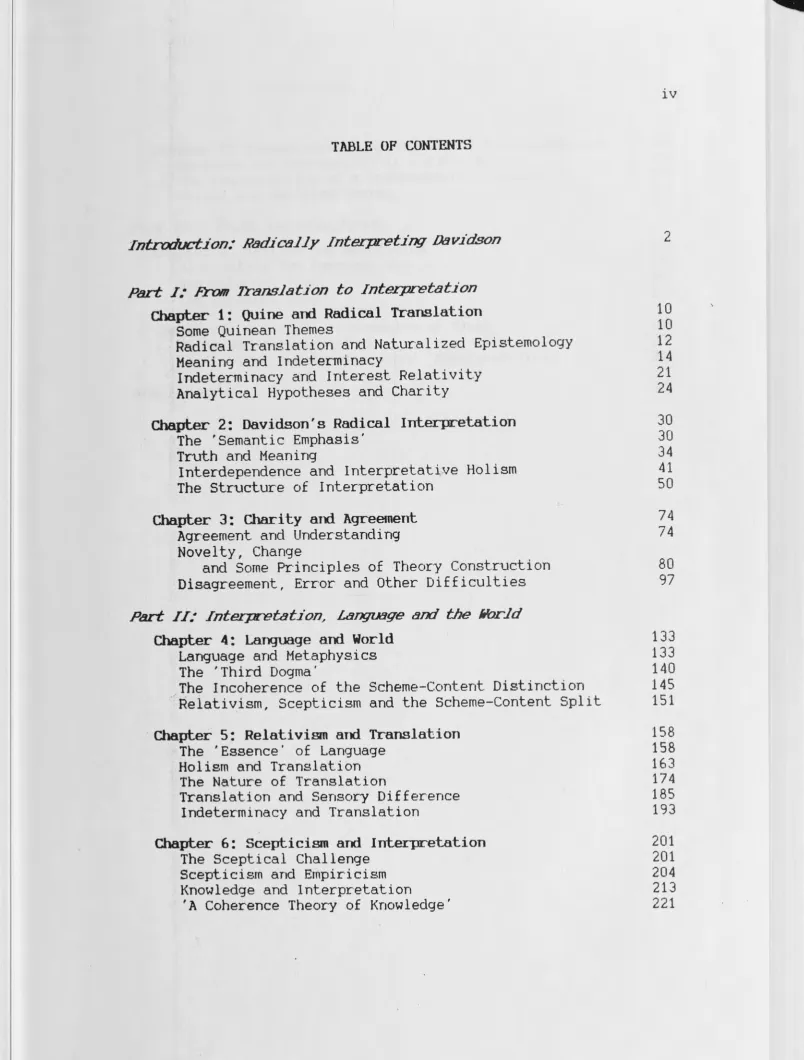
TABLE OP CONTENTS
Int.rrxluction: .Nad.iet1l Jy Interpret.inq Dav1'dson 2
Part I : .FrOJn Jranslation to Interpretation
Chapter 1: Quine arxl Radical Translation 10
Some Quinean Themes 10
Radical Translation and Naturalized Epistemology 12
Meaning and Indeterminacy 14
Indeterminacy and Interest Relativity 21
Analytical Hypotheses and Charity 24
Chapter 2: Davidson's Radical Interpretation 30
The 'Semantic Emphasis' 30
Truth and Meaning 34
Interdependence and Interpretat~ve Holism 41
The Structure of Interpretation 50
Chapter 3: Charity arrl Agreement 74
Agreement and Understancli ng 7 4
Novelty, Change
and Some Principles of Theory Construction 80 Disagreement, Error and Other Difficulties 97 Part II: InterpretDt1·on., l.c1nguege and the f,lor]d
Chapter 4: Language arxl World l 3 3
Language and Metaphysics 133
The 'Third Dogma' 140
The Incoherence of the Scheme-Content Distinction 145 Reiativism, Scepticism and the Scheme-Content Split 151
Chapter
5: Relativism and Translation '158The 'Essence' of Language 158
Hol ism and Translation 163
The Nature of Translation 174
Translation and Sensory Difference 185
Indeterminacy and Translation 193
Chapter 6: Scepticism and Interpretation 201
The Sceptical Challenge 201
Scepticism and Empiricism 204
Knowledge and Interpretation 213
[image:5.831.21.826.31.1092.2]Chapter 7: Transcemental Argunents arrl Verificationism 231 Davidson and Transcendental Argumentation 231 The Impossibility of a Transcendental Deduction 240
Holism and Verif icationism 270
Part II.I: Jruth and OhJ'ectivity
Chapter 8: Realism and Relativism Reconciling Two Perspectives The External View
The Internal View
Chapter 9: A Holistic Conception of Truth Truth and Interpretation
Relativity, Indeterminacy and 'Absolute'
Iii.bl iograft'ly
Truth
The methodology of interpretation is ... nothing but epistemology seen in the mirror of meaning.
- Donald Davidson1
Introduction
RADICALLY INTERPRETING DAVIDSON
The work of Donald Davidson has hitherto appeared, in its published forrn, in a very piecemeal fashion. Recently Davidson's
otherwise fairly scattered writings have been collected into two volumes: Es&9ys on Act.ions and Events (Oxford, 1980); and Jnqu.i.ries
.into Truth and Interpretation (Oxford, 1984). 2 For most philosophers this division would reflect a twofold orientation in Davidson's work itself: towards the philosophy of action (and philosophy of mind) and the philosophy of language. Certainly Davidson's major philosophical contributions would typically be classified as being in these two areas - indeed most discussions of Davidson's work are undertaken from one of these two perspectives.
The apparent bifurcation of Davidson's work into philosophy of action and philosophy of language and the fact that he has generally dealt with issues piecemeal, rather than in any single extended and unified treatment, belies the underlying unity of his work as a whole. This unity is suggested by the appearance
of certain basic themes through much of Davidson's work. So often 1n reading Davidson one comes upon the same familiar points being deployed in slightly different contexts (a similiar repetition of
ideas will not be entirely absent from this dissertation) Davidson's frequent appeal to the principle of charity and the interdependence of meaning and belief are cases in point. Such .repetition is symptomatic of the 'holistic' nature of Davidson's thought itself: his 'philosophy of action' is not separate from but part and parcel of his 'philosophy of language'. Indeed I suggest
\
that· an illuminating way of looking at all but the most technical of Davidson's work is to see it neither as philosophy of action nor as philosophy of language (even though Davidson would most likely see his work in that way himself) but as having a primary, if not always explicit, orientation towards what I shall call the philosophy of interpretation. Such an orientation is most appropriate with respect to those essays collected together in
Inquiries into Trut.b and Interpretation, as the title itself suggests, but it can also be seen as providing the .background for much of Davidson's thought elsewhere - especially his 'anomalous monism' .
My own approach to Davidson has been from within the philosophy of social science. Indeed the focus on interpretation is perhaps a natural one from this point of view. For what must be central to the philosophy of social science is the problem of interpreting the actions, utterances and attitudes of the human beings who are the primary subjects for social scientific inquiry. But the problem of interpretation as it arises in social science 1s
interpretation: how to interpret other persons and the nature and limits of such interpretation is a matter which is fundamental to any attempt to understand language, truth, knowledge - fundamental to an understanding of understanding itself. This interconnection
is something that will become increasingly evident as Davidson's holistic account of interpretation is developed in the succeeding pages. For one of the claims advanced here is that one cannot separate off questions about meaning from questions about truth and knowledge; one cannot separate belief and desire from one another or 'from meaning or from truth. All come together within the holistic structure of interpretation. Holism is what characterizes the account of interpretation and understanding which is to be found in Davidson's work and, indeed, holism seems to characterize Davidson's thought itself. His account of action and of mind cannot be separated from his account of meaning, belief and desire - from the account of understanding implicit in the idea of radical
interpretation.
fall between is itself blurred by the holistic approach which is taken here. The idea that there are clear distinctions between different areas within philosophy is itself undermined by the idea of interpretative holism. Certainly the questions which are pursued here are questions which are not confined just to epistemology or philosophy of language - but which cut across such distinctions.
Perhaps talk of a 'philosophy of interpretation' or 'philosophy of understanding' will seem to be strange and
.
contrived. Strange, maybe, but not contrived. Certainly the idea '
wi 11. sound neither contrived nor strange to the ears of those familiar with the work of French or German philosophers. Reflection on the nature of understanding and on the problems of
interpretation or 'hermeneutics' has a well established place 1n the philosophical tradition to which philosophers such as H.-G.Gadamer, Paul Ricouer, or Marlin Heidegger belong. In fact there is much in Davidson which seems to parallel the ideas of such 'continental' philosophers Gadamer especially. Davidson's interpretative holism and his emphasis on the need for agreement echo similar ideas in Gadamer's philosophical hermeneutics. To some extent also the fundamental role played by truth in the Davidsonian conception of interpretation may even turn out to have an ontological significance not entirely unlike that which Heidegger gives to truth as alet/Jeia. However I will have little more to say on this latter point due to the obscurity which is often thought to surround Heidegger's account of truth and because I have neither the time nor the space to deal adequately with the matter here.
continental philosophers such as Gadamer has already been suggested by Dagfinn Fi>llesdal 3 and also by Richard Rorty's appropriation of the ideas of philosophers such as Gadamer and Heidegger, together with ideas found in Davidson, Wittgenstein and others, in his Ph.ilosop/Jy and t.he H.irror oI Nature. 4 However the claim has also been made that any such similarities can be no more than super£ icial 5 and this seems to be a not uncommon reaction to the attempt to draw parallels between such as Davidson and Gadamer - a reaction most often coming from philosophers interested 1n
\
'continental' philosophy rather than from those on the 'analytic· side of the fence.
The distinction between these two philosophical 'traditions' is a distinct ion I use here with some reluctance; indeed part of the reason for pointing to the apparent similarities between Davidson and others 1s to break down, just a little, the idea that there is or should be a sharp boundary between different 'sorts· of philosophy. Admittedly there are differences but such differences should not blind us to the similarities which are there
3 ' Experience and Meaning ' ,
H.ind and .lanquaqe, ed. Samue 1 G~ttenplan, Oxford, 197S, p.38.
Princeton, 1980. 5
see Herbert Dreyfus, 'Holism and Henoeneutics', lr'ev.iew oI Hetap/Jys.ics, 34 ( 1980) pp. 3-12. Dreyfus recognises the holistic element in Quine's and Davidson's thought but distinguishes what he calls their 'theoretical' holism from the supposedly 'practical' holism of Heidegger et al. Much of Dreyfus' criticism focuses on the Quinean approach rather than considering Davidson in any detail and while there is some substance to these criticisms when directed at Quine they have less force against Davidson. However Dreyfus' emphasis on a level of practical activity and skill as the basis for understanding relies on the notion of there being a determinacy at that level which is absent elsewhere· it also seems to miss the
'
point that practical activities can be embedded in 'theoretical ' understanding as much as the other way around. We do not need to
also. Moreover it must al ways be an open question just how to assess the significance of the differences and similarities which we do seem to find. Perhaps, in some cases, differences which seem to be major and intractable points of disagreement at first will be found to diminish in importance or dissolve entirely according to how we read the philosophers concerned. Here is indeed a foretaste of the interpretative holism which is the central idea of this dissertation. In any case the similarities I may draw between Davidson and, for example, Gadamer are not central to my task here.
'
Gadamer provides a useful point of reference in the discussion of Davidson's ideas but is not essential to that discussion. After all
it is Davidson's account of interpretation which is the focus, not Gadamerian hermeneutics.
In many respects, however, it 1s a thoroughly 'hermeneuticized' Davidson who appears in the pages of this dissertation: this is perhaps a predictable consequence of my view of Davidson as a 'philosopher of interpretation'. Such a figure may seem scarcely recognizable to those who are familiar mainly with the Davidson of papers such as 'Truth and Meaning'. And naturally this raises an important question as to where mere exegesis ends and the expression of my own views begins - how much of this dissertation is me and how much is Davidson?
the usual uncertainty which is an element in all interpretation. ) Yet my aim in looking at Davidson is not to provide a simple recounting of his views anyway. Instead I want to try and draw out what seem to be the important (and sometimes merely implicit) themes in the Davidsonian corpus and to weave those themes together in such a way that the underlying unity of those themes is made clear. The picture which results is not a picture which I would necessarily claim to be a totally accurate representation of
\
Davidson's thought as he would regard it but is rather an attempt at an integrated account of interpretation founded 1n the Davidsonian conception of radical interpretation. Wherever possible I have tried to find support for that account in Davidson's own words but where he has expressed himself in such a way as to
conflict with that account I have tried to indicate the
Part I
FROM TRANSLATION TO INTERPRETATION
From the structure of translation was indicated the general problem of making what is alien our own
1 - H.-G.Gadamer
1
Chapter 1
QUINE AND RADICAL TRANSLATION
Radica.l Trans.lat.ion.: Some {Juinean Them£!s
The work of W.V.Quine forms the background for the Davidsonian development of the idea of radical interpretation and
it is Quine' s conception of the project of radical translation
which marks Davidson's starting point. Radical translation 1s
characterised by four important notions:
1. Epistemic /Joi.ism according to which beliefs are to be seen as part of a network of beliefs ('the web of belief') within which beliefs are identified and individuated;
2. Tile .inseparalJ.il.ity of meaninq and .information according to which we cannot clearly separate
out the meanings of utterances from information about the world which bears on those
utterances;
3. T/Je indeterm.inac_y o.[ translation according to which there is no uniquely correct way of translating any utterance or set of utterances;
4. T/Je principle oI charity according to which we assume certain basic similarities between our home language and the language to be translated or more generally between ourselves and our translatees.
In Quine the connections between these ideas are not explicitly drawn out. It is in Davidson's work that we begin to see
the framework of radical interpretation. In this respect what is crucial in Davidson's work is the reorganization of the ideas of
indeterminacy and charity around the notion of the inseparability of meaning and information - which in Davidson is transformed into the interdependence of meaning and belief. The thesis of epistemic holism also carries over into Davidson but in Davidson's work the idea is developed in a much more all-encompassing fashion - as I will put it: Quine' s epistemic hol ism becomes Davidson's
interpretative holism. 2 It 1s such holism which in fact underlies the interdependence of meaning and belief just as Quine's epistemic holism underlies the inseparability of meaning and information.
Holism about the relation between beliefs and between beliefs and meanings is the fundamental notion in both Quine and Davidson3 but 1n Davidson's work it 1s tied to the equally fundamental idea that a theory of truth can also serve as a theory of meaning. This latter notion, when seen in the context of interpretative holism (from which it derives), gives rise to some important consequences for truth - but more on this in Part III.
The aim of this first chapter will be to elaborate on these ideas as they appear in Quine and insofar as they are relevant to Davidson. The focus of my attention will be the Quinean project of radical translation - £or it is from there that I will move to Davidsonian radical .interpretation.
2
Al though I wi 11 also talk about Davidson's '-t:ttt.itud.inal hol ism -s
3
e chap~er two. .Rad.ica.l Trans.lat.ion and .Natural.ized Ep.istemo.logy
In fiord and Object Quine presents the problems of the
philosophy of language in an explicitly anthropological setting. As
the title of the work suggests Quine' s interest there is in the
relation between language and the world - but in Quine's work this
1s as part or ,.. the more general project of a 'naturalized epistemology'. This naturalistic project 1s concerned with the
epistemological problem - the problem of knowledge - reformulated
as the problem of "how surface irritations generate, through
language, one's knowledge of the world". 4
Quine's epistemological question 1s put in terms of the
relation between 'surface irritations' and 'knowledge of the world'
- the relation between 'meagre input' and 'torrential output· 5
-and his investigation of language -and translation is undertaken
from the same point of view. The chapter of fiord and (J.bject which
deals with the problem of translation has as its avowed aim the
consideration of "how much of language can be made sense of in
terms of its stimulus conditions", that is, in terms of "the past
and present barrage of non-verbal stimulation". 6
Language 1s conceived by Quine as "the complex of
present dispositions to verbal behaviour" 7 and thus he presents the
general task of translation as one which involves the
reconstruction of the connections between present dispositions and
past and present stimulations:
: f+lord and Object, Cambridge, Mass. , 1 960, p. 26.
As Quine puts it in 'Epistemology Naturalized', Ontoloq.ical
The recovery of a man's current language from his currently observed responses is the task of the linguist who, unaided by an interpreter, is out to penetrate and translate a language hitherto unknown. All the objective data he has to go on are the forces that he sees impinging on the native' s surfaces and the observgtle behaviour, vocal and otherwise, of the native ...
One of the two quotations placed at the begining of fiord and ObJ'ect is the slogan ··ontology recapitulates philology". 9 Certainly it is clear that for Quine translation recapitulates epistemology: translation is seen as essentially concerT1ed with uncovering the connections between surface stimulations (the 'meagre input') and verbal and non-verbal behaviour (the 'torrential output') - the same connections which the naturalized epistemologist seeks to unravel. 1 O Of course this 'essential' ta2.k of translation is often obscured in practice by the translator's reliance on his prior linguistic knowledge by his prior acquaintance with his own and other languages. Thus Quine's interest in translation is restricted to cases of what he calls 'radical' translation - where no such prior knowledge can be relied upon:
Translation between kindred languages, eg. , Fri~.ian and Eng 1 ish, is aided by resemblance of cognate word forrns. Translation between unrelated languages, eg., Hungarian and English, may be aided by traditional equations that have evolved in step with a shared culture. What is relevant rather to our purposes is rlld.ical translation, i.e. , translation of the language of a hitherto untouched people. the task is one that is not in practice undertaken in its extreme f orrn, since a chain of interpreters of a sort can be recruited of mff"Jinal persons across even the darkest archipelago ...
~.Ibid., p. 28.
The notion of radical translation is thus an idealization
of the project of translation which exhibits that project in its purest form. However in Quine's case we might want to say that the
purification has gone too far: I think it is certainly reasonable to suggest that though reliance on prior linguistic knowledge is
not essential to the translator's ta~t it is harder to conceive of that task as consisting solely· in the correlation of behaviour (narrowly conceived) wit.h perceptual stimulations. There is surely
more evidence on which to translate than purely behavioural
evidence. However more of this later. 12
Ker:1n.inq and Indeterm.inacy
It is out of the consideration of the problems faced by
the radical translator that Quine develops his thesis of the
indeterminacy of translation. Quine claims that:
... manuals for translating one language into another can be set up in divergent ways, all compatible with one another. In countless places they will diverge in giving, as their respective translations of a sentence of the one language, sentences of the other language · which stand to each other in no plausible sort of equivalence however loose. The firmer the direct links of a sentence with non-verbal stimulation, of course, the less drastically its translatif~s can diver-ge from one another from manual to manual.
Quine's claim that there is this indeterminacy 1n
translation might be thought to be an unsurprising consequence of
his restriction of the evidence which is available to the linguist.
11
-l ') !Yord i.CJnd lJ_b_7ect, p. 28.
Yet the thesis does not depend, in any crucial way, on the paucity of evidence here. In fact the real reason behind the indeterminacy thesis is suggested in some remarks Quine makes on the problems associated with the clarification of the notion of stimulus
meaning.
The stimulus meaning of a sentence for a speaker 1s specified, in word and Object, as the class of all stimulations which would prompt assent, in the case of affirmative stimulus
meaning, and dissent, in the case of negative stimulus meaning.14 '
However such a definition fails to exclude from the stimulus
meaning of a sentence stimulations which prompt assent (or dissent, as the case may be) in situations where such assent is dependent upon some collateral information. Quine gives as an e:>{ample the case of a speaker who assents to the sentence 'Gavaqa.i? '
(tentatively translated as "Rc.9.b.b.it? ') on the occasion of some half-glimpsed movements in the grass, just because he had earlier seen rabbits 1n the spot. Similar problems arise where the speaker's response is dependent upon some prior, socially shared information which the linguist is ignorant of. Intuitively it seems that the solution:
... would be to accord to the affirmative meaning of ' Gavaqa.i ' just thosf:! .:: , rnulat1ons that would prompt assent to 'Gavaqa.ii 011 ute __ strength purely of an understanding
rt •
G.9vaqa.i" unaided by collateral inf onnation ...But such a solution is not possible since we have no way in which to strip away the effects of collateral information so that just
i:
.I.bid. I pp. 31-35 •the 'pure meaning' will stand revealed. To do this would already
presuppose that the meaning had been established di2,tinct from the
effects of collateral information. Quine claims that:
. . . we have made no general experimental sense of a distinction between what goes into a native's learning to apply an expression and what goes into his learn
1 ing supplementary matters about the objects concerned. 6
This comment connects with a point Quine makes earlier in
IYord and ObJect where he discusses how we might come to unders.tand
some theory - a theory concerning a particular sort of object - say
atomic or molecular theory. We might suppose that we could
distinguish two stages in our understanding of the theory: first,
we come to understand rv1/Jat the objects a.re which the theory is
about, and second, we understand w/Jat the theory says about them.
While such a distinction might hold water in some limited sense it
1s generally the case that no clear distinction of this sort will
be possible:
. . . our coming to understand what the objects are .is for the most part just our mastery of what the theory says about them. We do not learn
ff
7
st what to talk about and then what to say about it.One cannot, then, separate off the meaning of a sentence
from the collateral information which bears on that sentence. If we
cannot separate meaning from information in such a way, then the
notion that translation aims to capture meanings i2. seriously
undermined - there can be no distinct, determinate 'something',
which is the meaning, to be captured. Here is the tie-up with the
indeterminacy thesis. As Dagfinn F~llesdal points out:
16 .l."J... .d 17 .LJ..1 •
What we are after [in translating] is a way of separating out, in every sentence of our theory, one component, its meaning, which can then be correlated 1 with corresponding meaning components in another's theory. Quine claims in 'Two Dogmas' and, with more detail and argument, in word and Object that there is no distinction to be ·drawn, generally, between meaning and infonnation. They are inseparably intertwined and this inseparability of meaning and information is the crux of what 2uine calls indetenninacy of
translation. 1
The idea that one cannot clearly separate facts about
language - about meanings - from facts about the world is certainly
at the heart of the Quinean attack on the analytic-synthetic
distinction in 'Two Dogmas of Empiricism·. 19 The whole point of
Quine' s argument there is to undermine the idea that particular
statements could be said to relate to some particular empirical
content. In developing his famous metaphor about science as a
"field of force whose boundary conditions are experience" Quine
says:
. . . the total field 1s so unclerdeterrninecl by its boundary condi lions, experience, that there is much latitude of choice as to what statements to reevaluate in the light of any single contrary experience. No particular experiences are linked with any particular
statements in the interior of the field, except indirectly . . . it is misleading to speaJ{ of the empirical content of an individual statement ... Furthermore it becomes folly to seek a boundary between synthetic statements, which hold contingently on experience, and analytic statements, which hold come what may. Any statement can be held true come what may, if ~ make drastic enough changes elsewhere
in the system.
Quine himself has pointed to the unclercletennination of
theory by experience as the main ground for the indeterminacy
l B 'M . d E . ' '"'9 30 19 ean1ng an xper1ence, pp. L - .
thesis. 21 Underdeterrni nation and indeterminacy are thus
distinguished by Quine. Underdetermination is seen as primarily an
epistemological thesis, a thesis about the relationship between
evidence and theory, and Quine does not see it as impugning the
claim that there is something to be right or wrong about 1n
physical theory. Indeterminacy, on the other hand, is an
ontological thesis insofar as it involves the claim that there 1s
no real fact of the matter as to the right or wrong way to
translate an utterance. 22
If underdeterrnination gives rise to indeter1ninacy , then,
in its own turn, underdeterrnination seems to arise largely out of
Quine's holistic conception of theory and its relation to
experience. It is just such 'epistemic' holism which is involved 1n
the above quotation from 'Two Dogmas' - in the idea of ~.cience as
'a field of force·. In this respect Quine's epistemic holism (what
has been called the 'Quine-Duhem' thesis) can indeed be seen as
providing the basis for .both the indeterminacy of interpretation
(insofar as it underlies the inseparability of meaning and
information) and the underdetermination of theory by data.
Yet perhap~. one might argue that in its own turT1 the
holistic nature of belief can itself be seen as a product of the
inseparability of meaning and information. Fi>llesdal characterizes
21 '0n the Reason for Indeterminacy of Translation', Journal oI
Pi/losop/JJ?, 67 (1970).
£.See Dagfinn Fe.Sllesdal's account of the di.stinction in 'Meaning and Experience', pp.32-33. The Quinean distinction between the two theses has not gone unchallenged. See Noam Chomsky, 'Quine's Empirical Assumptions·, words and Object.ions: Essays on tile {Jlorlf oI
the indeterminacy thesis 1n relation to the underdetermination
thesis thus:
The gist of Quine's argument 1s that given the
,under-determination of our theory of nature, some sentences, at least, in our theory are not tied up with any particular pieces of evidence, or experience, but relate via the whole intervening theory to all of them. Thus such a sentence . . . 'has no fwd of experiential implications it can call its own'.~'"
One might claim that it is just because the meaning of such a sentence cannot be separated from the information bound up with it that no direct link can be forged between the sentence, taken on its own, and any particular piece of experiential evidence. It 1s not merely that sentences within a theory are implied by or imply other sentences, but that sentences cannot be separated out, 1 n terms of their meanings, from other sentences. Yet of course, as F0llesdal says, this 1s so ''qiven t./Je underdeterminat.ion of our
theory of nature''and that underdetermination seems to arise out of
the holistic nature of belief. In other words it is Quine's epistemic holism which is still at the bottom of things even here. Perhaps the correct way to view the matter is to see the
inseparability of meaning and information as one aspect of a more general holism. Indeed I think it is possible to show how the inseparability of meaning and information does derive from Quine's
fundamental holi~.m about beliefs.
To start with I think it ought to be clear that the
inseparability of meaning from information entails an interdependence between them. This interdependence arises . 1nsorar . ,..
as it is not possible to determine the meanings of utterances apart
from determining the inforrnation or beliefs which bear on those
utterances: how we translate depends on our assessment of
collateral inforrnation, that is, on our assessment of beliefs; 24
equally our assessment of the relevant collateral information will
be influenced by how we translate utterances. This is so just
because the utterance to be translated is indicative of - or
expressive of or the embodiment of - some belief or beliefs. 25
Translation is as much a matter of finding out what beliefs (or
'
desi_res - for they must be implicated here also) utterances can be
used to express as it 1s about anything else. If we accept the
thesis of epistemic holism such beliefs are of course part of a
network a 'web' - of other beliefs. Insofar as they are part of
such a network then they must stand in a relationship of
interdependence with the other beliefs which make up that epistemic
structure. Thus meanings are seen to be interdependent with beliefs
- with 'information· - in virtue of the holistic nature of the
belief system.
24This 1s already to presage the Davidsonian account of the
inseparability of meaning and information as the interdependence of rne.gning and belief
2
Irxietenn.inacy
am
Interest Relat.iv.ityThe dependence of the indeterminacy thesi~. on the idea of
the inseparability of meaning and information sheds interesting
light on a claim made by Hilary Putnam that:
... what Quine calls the 'indeterminacy of translation' is, in so far as it exists, explained by
the interest-relativity of explanation ...
indeterminacy of translation is plausible to t./Je e.xtentthat
~t
follows from the interest relativity of explanation.LThe 'interest-r elativity of explanation' 1s an idea
which Alan Garfinkel has developed 1n his book Forms of
. I f ' 27
£vp .. Ll1na . .1 on. Putnam illustrates the idea with a number of
exarnples28 but generally speaking the notion is captured by the
point that whether an explanation counts as adequate or not depends
on the parameters set up by that question which the e~<planation
purports to answer - it depends on the sort of question being asked
and on our interests in asking. Putnam's suggestion 1s that the
indeterminacy of translat ion ought to be seen as a case of
explanatory relativity (so on Putnam's account we should talk of
the relativity of translation, rather than indeterminacy).
Certainly translation is tied up with the explanation of behaviour
it 1s part of a~ r.i1der w ex !J..Lu.,.-' ·--.J.. - -~ --. - - ' , the
understanding of persons29 - and thus we would certainly expect
~~Hean.inq and t./Je Horal Sciences, London, 1978, pp.41 and 45. ~
8New H~ven and London, 198~.
29This is an important Jtean.1nq and t./Je Horal Sc.1ences, pp.41-44.
that if explanation is relative to interest (or to anything else)
then, as Putnam claims, translation manuals will differ as
explanatory interests differ.
However the whole idea of the interest relativity of
·explanation can itself be taken as explained by the more
fundamental notion of the inseparability of meaning and information
(and ultimately by a more general holism). Depending on our
assessment of the influence of collateral information we will
interpret the meaning of an utterance, and thus of a question,
dif~erently. If 'collateral information' is understood widely
enough so as to encompass beliefs in general (and perhaps desires
and intentions also) then the inseparability of meaning and
information will yield a very similar conclusion to that embodied
in the idea of interest. relativity. In this respect the Quinean
inseparability thesis can happily accommodate Putnam, indeed the
idea of interest-relativity will fit very well with the Davidsonian
idea of interpretative holism which we will come to in the next
chapter: interest-relativity should be seen as a necessary
consequence of the interdependence of beliefs (and other attitudes)
with meanings.
However the difficulty with the" way 1n which Putnam takes
the notion of interest-relativity is that it leads him to a
conclusion which is quite at odds with the indeterminacy thesis and
the associated inseparability thesis. Putnam writes:
I think that the reason Quine's doctrine of the 'indeterminacy of translation' ... appears so implausible is that we think of the doctrine from the point of view of our interests, explanation-spaces, etc. Given all of this, it is indeed unclear that there is any 'indeterminacy' . There may we 11 be a
(mo
30
-or-less) unique 'correct' translation for usPutnam goes on to argue that indeterminacy will arise primarily in cases where we have "two cultures ,~.it/J different interests
translating the same Jungle language''. Here I think it is clear that Putnam has indeed transformed the indeterminl1cy of translation into a relativity of translation - translation is now relative to a culture.
In a way this might seem a natural consequence of understanding indeterminacy in terms of interest-relativity - not
'
just because that itself involves a relativization to interests but also because we might think of interests as fairly determinate
beasts. Yet what we interpret the interests of a speaker to be, and indeed what we interpret our own interests to be, is dependent on our overall interpretative theory. Consequently such interpretations are always open to reinterpretation. We cannot escape the difficulty here by supposing that we can separate off
interests from, say, expressions of interest in order to preserve some determinacy of interests de re. For as becomes quite cl ear in Davidson (but is not so clear in Quine) there can be no determinacy
in the ascription of attitudes just because such attitudes are implicated in a wider network comprising both attitudes and expressions of attitudes (utterances). To repeat a familiar Quinean point: the indeterminacy thesis is an ontoloq.ical thesis not just
an epistemological one - there is no unique 'fact of the matter' in translation or interpretation. 31 Thus Quine and Davidson can agree
3
?
.lb.id., p. 45.31 This is not to say that a speaker does not know what his desires, interests, or beliefs are. Insofar as he knows what his
with the idea of interest-relativity - indeed it is an interesting and important consequence of the holism concerning beliefs, desires and meanings which Davidson in particular espouses (it is indeed a notion which I shall come back to) - but they cannot accept Putnam's attempt to use the notion to transmute the indeterminacy of translation into a relativity of translation. 32
.Ana.lyt.ica.l .Hypotheses
am
Giar.ityAt the outset the linguist's task consists in just the passive observation and correlation of stimulation and response. At some point he will adopt the more active role of querying native sentences for assent or dissent from the native speaker. Quine claims that this procedure will result in: (1) translation of observation sentences - though not without some uncertainty; ( 2) translation of truth functions; (3) recognition of stimulus analytic and stimulus contradictory sentences i.e. sentences which, respectively, command assent or dissent "come what stimulation may" 33 and (4) resolution of questions of intrasubjective stimulus synonomy - sameness of stimulus meaning - of native occasion sentences but without translation of such sentences. 34
Yet in order to get even this far, the linguist has to
31 (continued)
words mean so he knows what he believes or desires as it 1s
expressed in what he says. But this does not mean that there is only one way of interpreting what he knows even for himself. There w~ll be many such ways.
LAlthough such a notion is not entirely absent from Quine - see c~1pter nine.
34 This summary of results fiord and Oluect, p. 66.
make certain a priori assumptions about the native language -certain charitable assumptions, one might say. One such assumption
will be that, as Davidson puts it:
. . . when the interpreter f i ncls a sentence of the
speaker the speaker assents to regularly under
conditions he recognizes, he takes these condition~5to be the truth conditions of the speaker's sentence.'"
A more obvious application of charity 1n interpretation is with
respect to the translation of truth functions. What Quine claims is
that we cannot but assume that the truth functional connectives of
the native language are identical with our own - we identify
negation, conjunction and alternation in the native language just
as we do at home. 36 As Quine says "This approach ill accords with
a doctrine of 'pre-logical mentality"' 37 for it will not allow the
translation of some native sentence on the model of 'p <.'lnd not-p '.
Yet Quine argues that we have no choice about the adoption of such
an approach to translation:
... what criteria [for translation] might one prefer?
Wanton translation can make natives sound as queer as
one pleases. Better translation imposes our logic upon them, and would beg the question of pre-logicality if
there were a question to beg ... That fair translation
preserves logical laws is implicit in practice even
where, to speak paradoxically, no foreign language is
involved. Thus when to our querying of an English
sentence an Engl i~.h speaker answerE', 'Yes t9nr..i no', we assume that the query is meant differently in the
af firrnation and negation; this rather than that he
would be so silly as to affirm and deny the same
thing ... The maxim of translation underlying all this
is that assertions startlingly false on the face of
them are likely to turn on hidden differences of
language ... The common sense behind the maxim is that one's interlocutor's silliness, beyond a certain
point, is less likely than bad translation - or, in
35
'A Coherence Theory of Truth and Knowledge', 1!~11nt cfder Heqel?, eg
6 Dieter Heinrich, Stuttgart, 1983, p.434.
1. ' t . d ' 38 the domestic case, 1ngu1s 1c 1vergence.
This maxim of translation, which has elsewhere appeared
as a 'principle of charity' , 39 is obviously crucial to translation
at this level, i et it has a role at a higher level also. For the
mere observation of connections between stimulations and responses,
even coupled with the active queryiD1 vf the natives, will not get
us very far down the path of translation. The way in which the
Quinean linguist does move further toward his goal is by the
employment of what Quine calls 'analytical hypotheses' and it i2, in
the discussion of these hypotheses that what is perhaps the central
aspect of the trans.lator's work is dealt with: for the development
of a set of analytical hypotheses is the development of a manual
for translation:
Taken together, the analytical hypotheses and ··. ·auxiliary definitions constitute the linguist's
jungle-to-English dictionary and grammar. 40
Thus the analytic hypotheses give a syntactic and semantic analysis
of the native language in accordance with the results 1 isled as
( 1 )-( 4) above. The requirement of accordance with these previous
findings is not a 2.trict requirement. however and some tolerance is
allowed. Here the principle of charity, already introduced at the
level of observation s.entences and truth functions, will have some
part to play once again; we need to exercise a certain degree of
judgement in attributing beliefs of a bizarre or strange sort to
~~
.I.bid. , p. 59.Originally in the work of N.L.Wilson, 'Substances Without Substrata', Rev.ierv oI Het'-9J7hy; ... c:ics, 12 (1959) p.532; also in his
'Grice on Meaning: The Lil timate Counter-Example', Not)s, 4 ( 1970)
P
4doo.
-
.
the natives. As Quine comments:
For certainly, the more absurd or exotic the beliefs imputed to a people, the more susp1c1ous we are entitled to be of the translations; the myth of the prelogical people marks only the extreme. For transiftion theory, banal messages are the breath of
life.
Yet in a way the application of charity extends a little
further still, playing a role in the very formulation of the
analytical hypotheses:
. . . there is reason to draw particular attention to the simple form of analytical hypotheses which equates a native word or construction to a hypothetical English equivalent. :-0r hypotheses need thinking up, and the typical case of thinking up is the case where the linguist apprehends a parallelism in function between some component fragment of a translated whole native sentence and some component word of the translation of the sentence. Only in some such way can we account for anyone's ever thinking to translate a native locution radically into English as a plural ending, or as the identity predicate · =' , or as a categorical copula , or as any other part of our domestic apparatus of objective reference. It is only by such outright projection of prior linguistic habits that the linguist can find general terms in the native language at all, or having found them, mat.ch them with his own: stimulus meanings never suffice to determine even what words are terms, if any, much 1 ess what terms are coextensive. 4L
And Quine goes on, 1n this context, to characterize the method of
analytical hypotheses 1n a way which also stands as a good
characterization of the operation of charity:
The method of analytical hypotheses 1s a way of catapulting oneself into the jungle language by the momentum of the home language. It 1s a way of gra{~ing exotic shoots on to the old familiar bush
:~.lb.id., p.69. 4~ .I.bid. , p. 70 .
It is commonplace to observe that Quine applies charity with respect only to observation sentences and truth functional
logic. In fact it seems that there is, implicit in Quine, a rather wider application of charity than just that. This must make the transition to Davidson's across-the-board application of the principle of charity - which we will be coming to shortly - much
less abrupt. What I would want to suggest further however is that, if the inseparabil.1ty of meaning and information 1s taken seriously, then one cannot limit the principle of charity to
'
anything less than an across-the-board application. For as Quine indicates, with respect to the analytical hypotheses:
... stimulus meanings never suffice to determine even what words are terms, if any, much less what terms are coextensive . . . From the point of view of a theory of translational meaning the most notable thing about the analytical hypotheses is that they exceed anything
impli~it in
4JfftY native's dispositions to speech behaviour ...
Davidson has said that it is because he can find no use for Quine's notion of stimulus meaning that he opts for the application of charity across-the-board. 45 Given that the development of analytical hypotheses is what translation is all
. . about, then the redundancy of the notion of stimulus
already suggested in Quine's own comments - to repeat:
meaning is
... stimulus meanings never suffice to determine even what words are terms, if any, much less what terms are coextensive.
The rejection of the notion of stimulus meaning is the maJor point of difference between Quine and Davidson; it is tied up with
44
Ibid.
Davidson"s attack on Quine·s notion of ontological relativity and
it is rejected, as we shall see, together with the notion, also in
Quine, of a distinction between conceptual scheme and empirical
content. Perhaps I would add that it is Davidson's development of
the notion of the inseparability of meaning and information into
the interdependence of meaning and belief which must force the
abandonment of the notion of stimulus meaning. Taken to its logical
conclusion in Davidson's work (where it is transformed into the
interdependence of meaning and belief) the inseparability of
meaning from information decisively undermines the notion of
determinacy of meaning whether of stimulus meaning or anything
else. Without any determinacy stimulus meaning can be of little use
Chapter 2
DAVIDSON'S RADICAL INTERPRETATION
rhe 'SemilntJc BnJ»:l,S.is'
The collection of Davidson's essays titled .lnqu.ir.ies into Truth and .Interpretation has a dedication which reads "To W. V. Quine Without whom not11
• Without doubt Davidson is very much a student of
Quine yet he has not of course remained merely a student but has developed Quine's work in ways which are significantly his own. Davidson's interest is, like Quine's, originally in the philosophy of language but whereas for Quine this has been in the context of developing a canonical language for science, Davidson is much more interested in the theory of meaning as such. It is the development of such a semantic theory which Davidson has pursued under the heading of a theory of radical interpretation. Davidson himself has said that the term 'radical interpretation· "is meant to suggest a strong kinship with Quine's 'radical translation'". 1 Yet although there is indeed a familial connection here:
The question which Davidson sets for himself 1s "What ld .- . t t t . ?" 3 th t
knowledge wou serve ror 1n erpre a 10n. , a 1s, for the interpretation4 of utterances. Put another way, what would we need to know to be able to understand the words of another? To this question a translation manual cannot be the answer. For, as Davidson argues, when we aim to understand, a translation manual will not necesarily suffice, providing only correlations between two languages neither of which we may understand. Of course sometimes the translation may be into a language we do know but
'
then· the translation manual will suffice for interpretation only because of the additional knowledge we bring to bear the knowledge of how to interpret the language we do know. Moreover, there is a further difficulty embedded here: it is not just that a translation manual will not always enable us to understand but it cannot do this insofar as it offers only correlations between utterances - a sort of highly sophisticated phrase book. To be capable of understanding the J<-9ngvaqe rather than specific utterances we need a theory which will give us insight into the structure of alien utterances. Only if we have a grasp of how the meanings of sente~ . .:cs in a language depend on the meaning of words will we have a learT1able and usable theory of interpretation. Davidson writes:
1'Radical Interpretation', TJ, p.126n.1.
~
ibid.4 Jb.id.
... the method of translation leaves tacit and beyond the reach of theory what we need to know that al 1 ows us to interpret our own language. A theory of translation must read some sort of structure into sentences, but there is no reason to expect that it will provide any insight into ho~ the meanings of sentences depend on their structure.
Thus Davidson claims that a theory of interpretation may best be seen as:
. . . the result of a merger between a structurally revealing theory of interpretation for a known language, and a system of translation from the unknown language into the known. The merger makes all reference to the known language otiose; when this reference is dropped, what is left is a structurally revealing theory of interpretation for the ogject
language - couched, of course, in familiar words.
While Davidson does reject the notion that a translation manual can be adequate t o provide a theory of meaning it is nevertheless the case that Davidson's fundamental conception of the manner in which understanding operates 1s by way of an essentially translative process - "interpretation 1s essentially translation" writes Davidson. 7 Thus a theory of interpretation of understanding - takes the basic form of a theory of translation (a theory of translation which translates into a language we already understand). Moreover in a sense it is also the case that, while not every translation manual will yield a theory of interpretation for the individual interpreter, every translation manual could be employed, by · the right interpreter, as a theory to yield understanding of the utterances it translates - all that is required is that the translation theory be in a language which the
~
J.b.id. I p e 13 0 •Ibid. 7
interpreter understands. In fact it is important to recognize that
translation is not independent of interpretation; translation, as
we shall see shortly, can never be undertaken independently of the
more general project of understanding speakers. Translation is
always part of a larger holistic enterprise. In this sense then
every t.rdnsldtion is also an .interpretation. 8
Davidson says 1n 'Radical Interpretation' that his
rejection of the notion of a tran2.lat.ion manual as adequate for
interpretation ·· is not a criticism of any doctrine of Quine' s". 9
For, as Davidson himself says, "Quine did not intend to answer the
questions I have set··. 10 The difference on this point, at least, is
very much 1n terms of Davidson's "greater emphasis on the
explicitly 2.emantical". Unlike Quine, Davidson is interested in
the development of a theory of interpretation which he believes
will fill the role of a theory of meaning rather than in the
elaboration of a 'naturalised epis.temology'. It is thus semantics
that is Davidson's primary concern. One might say that while Quine comes from epistemology to the problems of translation and
interpretation. David2,on begins with interpretation, to go from
there to the problems of epistemology.
8
As H. -G. Gadamer claims, Truth and }fethod, trans. Wi 11 iam Glen-Doepel, ed. John Cumming and Garrett Barden, 2nd ed., London,
1~79, p.346.
Jzvth tmd Hean.inq
Davidson'8 primary insight, and .his major contribution to semantic theory, has been in adapting a Tarskian theory of truth to the problem of developing a theory of meaning for natural
languages. As Quine says:
That meaning and truth were somehow closely related was evident before Russell's eponymous Inquiry and after, but it was left to Davidson to recognize Tarski' s theory of truth as the very structure of a theory of meaning. This insight was a major advance in semantics. Tarski had indeed called his theory of truth a study in semantics, but one felt constrained to add that it was semantics only in a broad sense, belonging more specifically to the theory of reference and not
tf
the theory of meaning. That constraint now lapses.Tarski's theory of truth12 offers an account of truth for a language by means of which an infinity of so-called T-sentences can be generated such that for each sentence in the object language (the language for which the theory is a theory of) there will be a corresponding sentence in the metalanguage (the language in which the theory is given) of the form:
( T ) The sentence s of language L is true if and only if p
Where 's ' names a sentence 1n the object language L and 'p ' is a translation of that sentence into the metalanguage. (The sentence of the object language is thus mentioned - but not used - on the left hand side while the sentence of the metalanguage is used on
11
'On the Very Idea of a Third Dogma' , Theories and T/J.inqs, ~~ridge, Mass. and London, 1981, p.38.
the right hand side. ) The translation of the object language
sentence into the metalanguage provides a specification of the
truth conditions for that sentence. Tarski's Convention Tis just
the requirement that, for any sentence in the object language, the
theory should recursively generate a corresponding T-sentence of
the form ( T ) . Such a theory wi 11 not of course provide a
definition of truth simplic.iter but a definition of trut/J-.in-L,
that is, a definition of truth as it applies within the object
language.
Tarski, of course, was interested in truth rather than
meaning and, indeed, Tarski assumes meaning to get at truth - for
one of the constraints on T-sentences is that the sentence on the
right hand side should be a translation of the sentence on the
left. Davidson inverts Tarski, using truth to get at meaning. This
is a point Davidson himself makes. In the Introduction to Inquiries
.into Trut..h c.7nd Interpretation he writes:
One thing that only gradually dawned on me was that while Tarski intended to analyse the concept of truth by appealing ( in Convention T) to the concept of meaning ( in the guise of sameness of meaning, or translation), I have the reverse in mind. I considered truth to be the central primitive concept, and hoped by detailing truth's structure, to get at meaning. These are remarks a.bout theorie
13
of truth, of course, not remarks to be found in them. ~Yet why should we use truth to get at meaning? It seems
obvious that what we want a theory of meaning to do is to generate
theorems of the form:
(HJ) s means that p
Yet obvious though it may seem the 'means that' locution is not a
promising candidate for formalization 1n a theory. Apart from
anything else it is inherently ambiguous but it also introduces an
intensional element which is just what we want our theory of
meaning to provide an account of, rather than to presuppose. So,
what we need is a theory that will somehow match up sentences in
the object language with sentences in the metalanguage in such a
way that the metalanguage sentences 'give the meanings' of the object language sentences. What we want are of course t..n.7nslat.ions
from the object to the metalanguage but how to provide
translations without relying on the notion of sameness of meaning?
The problem seems to be finding the right filling to
replace the troublesome 'means that' in our schema ( HJ ) above.
Davidson's 'bold' solution to the problem is to:
. . . try treating the position occupied by 'p ' extensionally: to implement this, sweep away the obscure 'means that', provide the sentence that replaces ' p ' with a proper sentential connective and
supply the description that replaces ' s ' with its own
predicate.
lRe
plausible result is . . .s
is T if and only if p .What we are after in translation are of cour2.e equivalences between
sentences - hence the use of the biconditional. Yet equally we do
not want such equivalences to be stated in an intensional form and
so the biconditional has to be interpreted materially (it was just
this point that made the 'means that' locution inappropriate). What
might be more contentious is the interpretation of 'is T ' in terms
of the Tarskian truth predicate - for this is of course Davidson's
suggestion. Obviously we need some predicate to complete the left
hand side of the schema. The sentence 's if and only if p ' is no
different in this respect to the sentence 'Fred if and only if snow
1s white' hardly well-formed. In support of the Tarskian
interpretation of 'is T' Davidson argues that:
What we require of a theory of meaning for a language Lis that without appeal to any (further) semantical notions it place enough restrictions on the predicate 'is t ' to entail all sentences got from [the] schema ... when 's ' is replaced by a structural description of L and 'p · by that sentence. Any two predicates satisfying this condition have the same extension, so if the metalanguage is rich enough, nothing stands in the way of putting what I am calling a theory of meaning into the form of an explicit definition of a predicate 'is T ' .•. it is clear that the sentences to which the predicate · is T · applies will be just the true sentences of L, for the condition we have placed on satisfactory theories of meaning is in essence Tarski' s Convention T that tests thl.
5adequacy of a formal semantical definition of truth.
In other words having arrived at the schema
(H2) s is T if and only if p
the claim 1s that we can now see that the constraints which must be
satisfied by the schema are just the constraints which must be
satisfied by a Tarskian T-sentence. Our theory of meaning 1s
exhibited as taking the form of a Tarski-like truth theory.
However Davidson· s comments in support of the Tarskian
interpretation still leave the crucial connection between truth and
meaning obscure; it is this connection which John McDowell sheds a
little more light on within the framework of a similar Davidsonian
account. McDowell begins with a claim about what it is that a
theory of meaning or sense is supposed to do:
The job of a theory of sense should be to fix the content of speech-acts which a total theory of the language concerned would warrant ascribing to speakers . . . in the case of any sentence whose uttP~~JiCe
command of the ~anguage would make fully comprehensible as a saying any indicative sentence -a theory of sense mus~ fix the content of the s-aying which an intentiona
16
L~terance of the sentence could be understood to be.McDowell suggests that a theory of meaning should be seen as part
of an overall theory of ur.derstanding for speakers, a theory encompassing the linguistic and non-linguistic behaviour of speakers as well as their a:.titudes and environment. The theory would be tested by its adec;:--1acy in describing those actions of speakers which would constit.·Jte speech-acts in the language and describing them in such a way that those items of behaviour could generally be seen to be intelligible in respect of speakers' attitudes which would in tur7 have to make sense in the light of speakers' behaviour ( lin;uistic and non-linguistic) and environment. I said that McD wel 1 's account was in the spirit of Davidson and indeed we can s.ee that McDowell's account of how the adequacy of a theory of meaning is to be tested is, in essence, based what we have already c~me to know as the interdependence of meaning and inforrnation (or .t:elief) - on what I shall be calling the thesis of interpretative holism.