
SOME TOPICS IN STATISTICAL PHYSICS
Lee R. White
A thesis submitted for the degree of
Doctor of Philosophy
at the Australian National University
Pr e f a c e
This dissertation is an account of work carried out from January 1972 to November 1974 at the Department of Applied Mathematics, Research School of Physical Sciences, the
Australian National University for the degree of Doctor of Philosophy.
The work discussed in Part One was supervised by Dr J.W. Perram. It is concerned with examining the role of the angle-averaged potential in theories of the molecular-liquid state. New results are presented.
The work discussed in Part Two on the rigorous statistical mechanics of model polymers was supervised by Professor B.W. Ninham and was carried out in collaboration with Dr D.J. Mitchell and Mr D.Y. Chan.
None of the work reported here has been submitted to any other institute of learning for any degree.
P
u b l i c a t i o n s1.
The Evaluation of Thermodynamic Functions from Aqueous
Solubility Measurements Aiut.
J .
C
hem
.
,
24_, 1143
(197/)
(with D. Alexander and D.J.T. Hill).
2.
A New Expansion in the Theory of Polar Liquids
Mof.ec.
Pky*
.
,
24_, 1
1 33
(
7 9 7 2 )
(with J.W. Perram) .
3.
The Effect of Van der Waals Forces on the Alignment of
Nematic Liquid Crystals in Magnetic Fields
M ot. Cnyttalb and Liquid Cnyt>talt>, in pte-64 ( 1974)
(with P. Richmond).
4.
Perturbation Theory for the Angular Correlation Function
Motec.
Pky6. , 2S_,
52 7 (19 7
4)
(with J.W. Perram).
5.
The Regulation of Surface Potential at Amphoteric Surfaces
during Approach
J.Chem.Soc., Faraday II, in pAc-6-6 (?
974
)
(with D. Chan, T.W. Healy and J.W. Perram).
6.
The Electrostatic Interaction between Surfaces bearing
Amphoteric Ionizable Groups in 1:1 Electrolyte
J
. Theotiei. Bi
ot. ,
47_, in pticAA,
(7 974 )
(with D. Chan).
7.
The Configuration of a Non-Interacting Polymer near a
Sticky Wall J .
Cfiem.
Soc
.
,
Faraday II, in p>
ie-6-6
(with D. Chan, D.J. Mitchell, B.W. Ninham).
8.
Phase Transitions in Adsorbed Polymer Systems
V
i-6 c . F atiad .Soc. •
Physical AdAosiption in C o n d e n s e d Pk
a^e*
(7975)
(with D. Chan and D.J. Mitchell).
9.
The Structure of Liquid/Vapour and Liquid/Solid Interfaces
ViAC. Fafiad, Soc.
:
Physical Kdbouption in Condensed PhaACA
(7975)
(with J.W. Perram).
10. The Role of Soft Core Repulsion in the Structure of
Liquids
Chem.Pky6.Lett*., submitted [1974]
(with
Ackn ow ledg em ents
I would like to thank the Department of Applied
Mathematics, Research School of Physical Sciences, Australian
National University, and all who sail in her for creating
what, for me, were ideal conditions in which to undertake that
most tedious of union tickets, the PhD degree.
The conditions have been such that, apart from the
production of the traditional kilogram of bound A4, I find
that I still have an interest in Science.
This is due not
only to the charms of the broad field of Chemical Physics in
which I wallow but to the peripheral stimulation of the
Department's vision theorists, Allan Snyder, Colin Pask,
John Love, Peter McIntyre, Roland Sammut, Ian White and Dave
Carpenter.
A complicated mixture of interesting physics,
excited voices and thin walls makes for an interdisciplinary
interaction of an almost involuntary nature.
In my field, let me-thank Barry Ninham, John Mitchell,
John Perram, Peter Richmond, Jacob Israelachvili and Derek
Chan for the sharpening of my physical insight and scientific
method. My supervisors, John Perram and Barry Ninham, I
thank for their guidance, advice and my introduction to their
brands of chemical physics.
I would especially thank my
fellow student and collaborateur, Derek Chan, for his
inscrutability in the face of my periodic diatribes and
outbursts.
Thanks also to Dr Tom Healy of Melbourne University
for his collaboration and friendship.
Many thanks to Bente
.scholars and saints are forgotton soon but great drunkards are immortal...
A
b s t r a c t
The thesis is in two parts.
In Part One, the role of the angle-averaged potential
in the theory of non-simple liquids is investigated. Analytic
expressions for the angle-averaged potential are obtained and
their asymptotic approximations are derived and compared with
the exact expressions.
The additivity of the angle-averaged
potential is discussed.
The angle-averaged potential is shown
to provide a basis for the expression of the thermodynamic
properties of an angle-dependent system.
The free energy for
such a system is derived as the sum of the free energy of the
simple system where the pair interaction is the angle-averaged
potential and a set of three body, four body etc. terms
involving the triplet and higher correlation functions for the
simple system.
Some work on the two-dimensional coplanar point
dipole system is discussed. A first order perturbation theory
is derived where the reference potential is the angle-averaged
potential.
This theory is compared with the first order
26
perturbation theory of Gubbins and Gray
and the Mean
21
Spherical Model of Wertheim
for the hard sphere plus imbedded
dipole system. The present theory is found to be in best
agreement with Monte Carlo studies of the exact dipole system.
In Part Two the statistical mechanics of a model
adsorbed polymer is developed.
The polymer is considered as a
string of non-interacting beads connected by freely rotating
bonds with an arbitrary bond length distribution.
The beads
formulae are derived for the expectation values of the number
of beads on the substrate, the spread of the polymer on the
substrate, the density of beads off the substrate and the
centre of mass of the polymer in terms of an adsorption energy
parameter W.
These conformational properties are shown to
undergo a phase transition at a critical value of W=Wc ,
where
Wc is a functional of the bond length distribution function
only.
For W>Wc the polymer is adsorbed on the wall and for
W<Wc the polymer moves into the bulk solvent and away from
the substrate.
Some numerical calculations were carried out
with real polymer/solvent/substrate systems to discover whether
dispersion forces could yield values of W/Wc which could
span the complete range of behaviour of the adsorbed polymer.
The possibility of temperature and solvent-induced adsorption/
TABLE OF CONTENTS
PREFACE
PUBLICATIONS
ACKNOWLEDGEMENTS
ABSTRACT
PART ONE
THE ANGLE-AVERAGED POTENTIAL IN
NON-SIMPLE LIQUID THEORY
§1.
INTRODUCTION
§2.
THE ANGLE-AVERAGED POTENTIAL
(a)
Definition
(b)
Examples
(i) Rigid Dipoles in Two-Dimensions
(ii) Rigid Dipoles in Three-Dimensions
(iii) Dipole-Induced Dipole Interaction
(iv) Spin-Spin Interaction
(v) Hard Dumbells in Three-Dimensions
(c)
The Keesom Approximation
(d)
The Expansion of the Boltzmann Factor
(e)
The Second Virial Coefficient
§3.
THE CONFIGURATIONAL PARTITION FUNCTION
(a)
General Theory
§4.
PERTURBATION THEORY FOR THE ANGULAR CORRELATION
FUNCTION
(a)
General Theory
(b)
The Angle-Averaged Correlation Function
(i) [2] Coplanar Dipole System
(ii) [3] Hard Sphere with Imbedded Dipole
System
(iii) [3] Hard Dumbell System
(c)
The Kirkwood G Factor
(d)
Higher Order Expectation Values
(e)
Low Density Limit
§5. APPENDIX ONE Analysis of the No-Overlap
Domain in the Hard Dumbell
System
APPENDIX TWO An Integral Arising in the
Derivation of the Kirkwood
G Factor in the M.S.M.
PART TWO POLYMER CONFORMATION ON A STICKY SUBSTRATE
§1. INTRODUCTION
§2. THE GENERAL FORMULATION
§3. THE EXPECTATION VALUES
§4. THE FUNCTION G(s,x|K) AND G f (s,x) FOR ZERO POTENTIAL
§5. POLYMER CONFORMATION AS A FUNCTION OF W
§6. A PHYSICAL INTERPRETATION OF THE RESULTS
§7. PHASE TRANSITIONS IN ADSORBED POLYMER SYSTEMS
§8. APPENDIX
P A R T
O N E
THE ANGLE-AVERAGED POTENTIAL
§1.
INTRODUCTION
With the introduction of the distribution function
formalism and the progress in fast digital computing, the
theory of simple, atomic liquids has been very firmly
established over the last thirty years.
However, the perversity
of nature is such that most real liquids are not simple in the
sense that the interaction between liquid molecules is strongly
dependent on their mutual orientations.
Such pair potentials
may arise due to the presence of permanent multipoles,
polarizability asymmetry, the existence of different atoms in,
and the shape of, the liquid molecules.
We will call such
systems, angle-dependent systems.
It is usual to consider the potential energy of an
N molecule system as the pairwise-additive sum of two-body
potentials
U(rN ,wN )
=
I
u (r.
.
,oj.
.
)
(1.1)
i< j
~1D
1 D
where
oj.
is the orientation of molecule
i.
The existence
lof the pair potential u (r^2 ,
03^ ,03^)
is predicated on the
assumption that the liquid molecules are in their
electronic-vibrational ground states, that internal rotations are absent,
and that classical statistics apply.
These assumptions should
be good approximations in most small molecular systems.
The
pairwise additivity assumption is more severe but recent
work‘
d has shown three-body forces contribute only a few percent
to the configurational energy of real systems.
Q(N,V,T) ciy Qk Qc (N,V,T) (
1
.2
)w h e r e q^ and q^ ar e the m o l e c u l a r v i b r a t i o n a l and r o t a t i o n a l
? 3N/2
p a r t i t i o n f u n c t i o n s and Q = (2'irmkT/h ) is th e t r a n s
-I\
l a t i o n a l p a r t i t i o n f u nction. The c o n f i g u r a t i o n a l p a r t i t i o n
f u n c t i o n Q (N,V,T) is g i v e n by
Qc (N,V,T)
N N
1
J..J dr J..J d
f r _,N t r J - 3 U ( r ,0) )oj e (1.3)
T h e i n t r o d u c t i o n of the a n g u l a r c o r r e l a t i o n f u n c t i o n
(2 )
g (r1 2 ,0)^ ,u)2 ) d e f i n e d by
(2) , x
g (?1 2 ,W1 ,(JJ2 )
C N - 2 ) 1 P v c v N-2
J..J dr
N'2
J..J
,N-2N N
, N-2 - ß U ( r )
x dm e ~ ' (1.4)
t o g e t h e r w i t h the p a i r w i s e a s s u m p t i o n (1.1) e n a b l e s the b u l k
t h e r m o d y n a m i c p r o p e r t i e s of the a n g l e - d e p e n d e n t s y s t e m
to
bew r i t t e n a s 2 ,
A c = - kT I n Q c (1.5)
I pN J < « ( £ 1 2 '“ i ' “ 2 )gt2> (? 1 2 ' “ l ' “ 2 )>collo2 d ?12
(1 .6 )
£ _ I P 2 f
3 6 P J
3u C~ 1 2 ' U)l ,a)2 ) (2)
V 3 r 12
g (rn n ,u), ,u)~) >
(1.7)
X
12 dr12
where , P are the configurational Helmholtz free
energy, c o n f i g u r a t i o n a l energy and the pressure respectively.
We m e a n by < . . . >u k , the unweighted average over orientation
(2)
UK. Thus, a knowledge of QC (N,V,T) and g (r i 2 ' w i ' ^2 ^
sufficient to c o m p l e t e l y describe angle-de p e n d e n t systems with
the potential e nergy (1.1).
The p r esence of the extra orientational degrees of
freedom c o m p l i c a t e s the application of the approximate
techniques d e v e l o p e d in the theory of simple liquid to angle-
d e p e ndent systems. We will discuss b e l o w the extension of
these techniques to n o n-simple liquids by other workers.
The ear l i e s t treatment of a n g l e - d e p e n d e n t systems
was by the v irial e x p a n s i o n method^ w h ere (r i2 #<jJ1 ,u)2^
was e x p r essed as a power series in the number d e n s i t y p.
That is
(2) ,
g (r
112
g0 (?12'
'“ 2 ) g l (^ 1 2 '“
2
>
+ p 2 g 2 (r1 2 ,^i,^2 ) + *** (1-8)
where the g^ (r^2 ,u)^ ,m 2 ) are density independent. F r o m (1.7)
the virial e q u a t i o n of state is then derived
P
pkT 1 + Ly ~ B (T) pn X n
n=2
where the nth virial c o e f f i c i e n t B is
n
The orientational variables make the integrations of (1.10), (1.12), (1.13) a numerically dangerous procedure.
Recently Watts^ obtained the third virial for hard spheres with imbedded point dipoles by the Stroud integration technique
which has proved suitable for such multi-dimensional integrations.
The region of convergence of the virial expansion is unknown but has been discussed qualitatively in the literature (e.g. see Ref.4). Many attempts have been made to explain the nematic liquid crystal phase transition in systems of rigid
7
rods using the leading order terms in the virial expansion for such systems. Such crude models are not quantitative successes.
A second technique borrowed from simple liquid theory is the integral equation method. The
Bogolubov-Born-8 9
Green-Yvon (BBGY) , Percus-Yevick (PY) , Hypernetted Chain (HNC)1 0 , and Mean Spherical Model (MSM)11 can be easily modi fied to include the angular degrees of freedom. The BBGY and HNC theories have not yet been examined and attention has centred on the MSM (due to its ease of analytic solution) and the PY equation (due to its success and antiquity in simple liquid theory).
With the exception of the BBGY equation all the
integral equation techniques are based on the Ornstein-Zernike 12
(OZ) relation
h (r 1 2 'w i '^2^ c Cr12 ,m2 ) + p J <c (r13 , u>3 )
x h (r00 ,u>0 ,u)0) > d r ..
M o rrison's results may be due to the use of PY theory
co u p l e d w ith the truncation a p p r o x i m a t i o n . Such a truncation
(2)
of g (1,2) can be valid only at low density where the
B o l t z m a n n factor is sufficiently represented by its low order
term. The p e rturbation theory presented in this thesis and
15
p u b l i s h e d elsewhere shows that to lowest order the dependence
(
2
)of g (1,2) on orie n t a t i o n s and is via the
B o l t z m a n n factor exp (- ßu (r ^ Th-e use °f low order
spherical harmonics to represent the angle dependence will be
a good a pproximation to the Boltzmann factor only at low
density. Given the ability of the PY equation to predict
(
2)
g (1,2) the t r uncation m ethod of solution can yield a
solution only as good as the first order Gubbins - G r a y
p e r t u r b a t i o n theory w h i c h we shall discuss presently. Ben
16
N a i m has used a me t h o d of solution of the PY equation which
does embody the Boltzmann factor o rientational dependence.
He attempts a solution of the PY equation in the form
9
(2)(1,2)-3u (r 1 2 ,w i , ^ 2 ) e
y (ri2>
(1.17)The a p p r o ximation has been applied to a water model where the
interaction energy is a Len n a r d - J o n e s potential plus Coulomb
interactions b e t ween point charges in the molecule. Numerical
difficu l t i e s have p r e vented the solution of the PY equation
16
for this potential however, and Mon t e Carlo studies indicate
that the approx i m a t i o n is not good for large orientational
anisotropies in the pair potential. It is however the correct
low density form and should be a good a p p r oximation in wea k l y
17
anisotropic systems. Ben Naim has also solved the PY
e quation with no appro x i m a t i o n s for a system of two dimensional
intractably complicate the integral equation. Chandler and
18 (2 )
Anderson have developed an integral equation for g ' (1/2) for a system of molecules modelled as rigid clusters of con nected hard spheres. Numerical solutions of this equation
19
for dumbells have been exhibited and compared to the PY equation solution. Their degree of approximation as measured by the difference in the virial and compressibility equation results for P (p) is found to be comparable. The equation has also been applied to a system of hard spheres arranged in
20
a tetrahedron . The structure factor so obtained was found to be in remarkable agreement with that of carbon tetrachloride.
The second integral equation approach is that of the mean spherical m o d e l ^ . The MSM is applied to fluids with hard core repulsion. If u(r^2 /^ ^ ) is infinite in the region r^ 2<o t*1611
g (2)(l,2) = 0 (r i2<0)
The MSM approximation requires that
c (1,2) = - ßu (r12 ,u32) (r12 >o) (1.18)
and the OZ relation is then
g (2> (1,2)
= 1 - eu(l,2) - ep I <u (1,3)
V
X (g (2) (2,3)-l) > u d r 3 11.19)
21
Wertheim
has solved the MSM for a system of hard spheres with
imbedded dipoles.
His solution is discussed in detail in
(2 )
section 4.
Briefly g
(1,2)
is found to be the sum of a
spherically symmetric term and two terms which involve the
symmetries of the 1st order spherical harmonics
Y1 (
61^
1) Y1 (© 2 '
^ 2 ^
*
Tllus the
solution can be thought of as
a linearized approximation to the PY equation whose solution
is found by the truncation (at first order) procedure of Chen
and Steele.
The solution of the MSM for an arbitrary
multipole-22
multipole interaction potential has been exhibited by Blum
For the hard sphere plus imbedded dipole system, the MSM has
2 3
been compared with Monte Carlo studies
and perturbation
24
theoretic results
for the thermodynamic properties.
The
agreement with the Monte Carlo results is not promising and
this can be understood in terms of the above interpretation of
the MSM.
The prediction of the angular correlation properties
of non-simple liquids in the MSM approximation is discussed
in section 4.
A third and potentially most successful theory of
the angular correlation function is the perturbation theoretic
25 25 3.5
approach of Pople
, Gubbins and Gray
and Perram and White
The general formalism of thermodynamic perturbation theory was
27
28
developed initially by Zwanzig
and by Barker and Henderson
to provide a very successful theory of simple liquids.
The
formalism has been extended to non-simple systems by several
59
workers
.
Briefly by writing the pair potential as
u (1,2)
= u (1,2) + a u (1,2)
Cl.20)
vj
and expanding the thermodynamic definition of the correlation
(2) ,
g
(r
12 “2>
V ? 1 2 ' “l
u2>
+5l (£l2'
+ g2 (r i 2 ' ^ 1 ' ^ 2 ^ + *** (1.2 1)
where go (r 0,
w ,
uj)
is the correlation function for the
reference system interacting via
(1,2)
and
^ri2'W1 ,a32^
is the n 1th order density dependent perturbation on that system.
25
The configurational free energy of the system is then
A
= A + A, + A„ + A-. + ...
(1.22)
c
ü
1
2
1
where A
q is the Helmholtz free energy of the reference systemand A ^ ,
A^ etc. are the perturbation corrections.
These
corrections have been investigated for several perturbation
2961
26
theories
'and the Gubbins-Gray theory
(see section 4) seems
30
to be in best agreement with Monte Carlo studies.
McDonald
has calculated the terms in the Pople expansion (1.22)
for
the free energy of a system of Lennard-Jones plus imbedded
dipole molecules up to A^ and compared them with Monte Carlo
results.
For large values of
(3y2/ o 3)
the truncation of the
series at this term is in serious error.
Similar conclusions
23
were reached by Patey and Valleau
.
This is due to the
oscillatory nature of the series A^ being negative and A^
2 9
positive.
Stell et a l .
have shown that the Pade approximant
A = A
q+ A 2/(l - A3/A2)
(1.23)
is in excellent agreement with the Monte Carlo results for most
of the system properties.
However, the prediction of the
We will show in the present thesis that the slow convergence of the series (1.22) may be due to the use of a reference potential which does not involve any of the angle-dependent properties of the system.
In order to introduce some of the angle-dependent potential into the reference state, we use the angle-averaged potential u(r^^) defined by
-3u(r ) -3u (r12 ,0^ ,w )
e = <e > (1.23)
^1^2
31 32
As early as 1933 Onsager , and later Rushbrooke , pointed out that the angle-averaged potential (1.23) is the correct averaged pair potential to be used in approximate thermodynamic
cal-33 culations for non-simple systems. However, early workers
in polar solution theory used the canonical averaged potential
3u(r 2) -3u(r 2 ,m ,o ) <u(r )> = e <u(r ) e >
12 12 1 2 0 ) ^ 2
(1.24)
Since the canonical averaged potential is to lowest order twice the angle-averaged potential, the use of this potential lead to serious overestimates of the contribution of the dipole-dipole interaction energy to system properties. This was
34 . 3 5
discussed by Rowlinson . Cook and Rowlinson and 3 6
Rowlinson have used the angle-averaged potential for a
number of model systems to discuss the deviations of molecular systems from the law of corresponding states. Recently Stell
3 7 3 8
et al used the perturbation theory of Verlet and Weiss ,
multipole-multipole pair potentials.
Their reference system
was an approximate angle-averaged potential.
For high densities,
the approximate reference potential does not provide a good
basis for an expansion, as the relative importance of the
perturbation terms become large in this region.
The reason for
this is discussed herein in terms of the breakdown of the
approximation in the region of nearest neighbours and the
relative importance of this region at high density.
39
Sung and Chandler
have developed a perturbation
theory for short-range anisotropic repulsive potentials, based
on a hard sphere reference system.
The diameter of the hard
sphere is chosen in a complicated way to make the first order
perturbation contribution to the free energy vanish.
4 0
Calculations by Steele and Sandler
have shown the theory to
give results comparable to the PY solution,for rigid dumbells.
41
Bellemans
has obtained a perturbation theory for
hard anisotropic molecules using the rigid core as the reference
system and the anisotropy of the potential as the perturbation
parameter.
For small anisotropy in a system of ellipsoids
Bellemans was able to demonstrate the smallness of the
perturbation corrections to the free energy in the liquid
phase.
This was not the case in the solid phase, however, where
anisotropic contributions are large.
It is of fundamental
importance to note that the concept of the angle-averaged
potential is a valid one in hard anisotropic system since the
Boltzmann factor,through which it is defined,is always finite.
In the present thesis, the angle-averaged potential is
obtained for the highly anisotropic system of non-overlapping
rigid dumbells and the utility of the angle-averaged potential
For very anisotropic systems, e.g. the nematic liquid
crystals,all such angle independent reference systems may not
be appropriate bases for a perturbation theory.
The use of
angle-dependent reference potentials, whose system properties
are known, as bases for highly anisotropic systems has been
4 2
suggested by Mo and Gubbins
.
Moderate agreement between
Monte Carlo results and this theory for a dipole- dipole system
has been reported.
Such extensions must, however, be regarded
as second order problems in view of the infancy of non-simple
liquid theory as applied to moderately anisotropic systems.
The utility,in the theories outlined above, of the
4 3Monte Carlo technique
,
as a means of relating theory and
experiment without the complications and perversities of real
systems, is obvious.
However, in angle-dependent systems the
computer can play another important role.
By the direct
simulation of angle-dependent systems by model potentials the
features of the potential which control the system properties
can be "experimentally" investigated.
These tell us which
features of a potential should be incorporated in the reference
potential of a perturbation theory.
For example,
Vieillard-44
Baron et al
have shown that a hard ellipse system in two
dimensions will exhibit an orientational order-disorder trans
ition which,as a function of eccentricity, moves from the solid
to the liquid phase.
This result is of fundamental importance
to liquid-crystal theorists.
Other studies include the systems
45
of hard prolate spherocylinders by Few and Rigby
, of
homo-nuclear diatomics with atom-atom Lennard Jones potentials by
46 47
McDonald and Singer
and Barojas et al
.
The system of hard
sphere on Lennard Jones potential plus point dipole-dipole
4 8
system has been extensively studied
.
The water simulation
49 50
important in that a simple pair potential which takes into
account the regions of positive and negative electron density
in the water molecule provides an explanation of the proper
ties of water without the necessity of introducing the hydrogen
bond concept.
From the above, one obtains the impression of a field
in its theoretical infancy.
The outstanding fact is that,
despite the early work of Onsager, Rushbrooke and Rowlinson
discussed earlier, the angle-averaged potential as a basis
for non-simple liquid theory has been neglected.
The present
thesis is an attempt to construct such a theory.
In section Two, we derive expressions for the angle-
averaged potential for various potentials, and the angle-
averaged potential for hard dumbells is displayed.
It is
important to note that the angle-averaged potential is a valid
concept even when applied to hard anisotropic systems as
discussed earlier.
The additivity of the angle-averaged
potential is examined.
In section Three we develop a theory
of the free energy of an angle-dependent system in terms of
the sum of the free energy of the simple system interacting
via the angle-averaged potential and three body, four body
terms etc. involving the triplet and higher correlation
functions for the angle-averaged potential.
The series
obtained is the analogy in non-simple liquid theory to the
virial series in simple liquid theory where one is expanding,
not about the perfect gas, but about an averaged simple system.
In section Four, a perturbation theory is developed
(2)
to first order for the correlation function g
(r^2
,^2)*
This is based on the angle-averaged potential as a reference
26 21
§2. THE ANGLE AVERAGED POTENTIAL
(a ) DEFINITION
We will denote by u (r ^, u) , w ) , the pair
potential for two molecules where r^^ is the distance between
the origins of the body-fixed axes systems on each molecule
and is the o r i e ntation of the body-fixed axes system in
the i 'th mole c u l e relative to some arbitrary laboratory-fixed
axes system. (Such a specification of the state of two inter
acting molecular charge distri b u t i o n s is only possible if we
are interested in kinetic and rotational motions of the
molecules which are m uch slower than characteristic electronic
m o t i o n s .)
We define the angle-averaged potential u ^ r ^ )
corresponding to u (r1 0 ,co ,uj ) by a ~ i z l 2
-eua (ri2)
-3u (r
,0) ,W9)
J j
e a ~ 1 2 1 2 du. dm. (2.1)where
J d c o ^ =
Q
(2.2)For mol e c u l e s with an axis of symmetry the o rientation of the
m o lecule can be described by the conventional polar and
azimuthal angles (0,<J>) w h i ch specify the direction of the
axis of symmetry relative to the laboratory frame. In this
case
1 2 7T
j dm = j d COSÖ J dc|)
-1
0
In general, the molecule-fixed axes system requires three angles to specify its orientation with respect to the labora- tory frame. The Euler angles (u,0,y) of Wigner would be appropriate. For this parametrization
2 tt 1 2tt
J
dm =J
daJ
d cos3 / dy0 - 1 0
= 8 u 2 (2.4)
(b) EXAMPLES
To illustrate the definition we will derive expressions for u (r 0) for various systems and display
a l z.
them graphically as functions of r y2*
(i) RIGID DIPOLES IN TWO DIMENSIONS
We consider two molecules which interact via a dipole-dipole potential whose centres and dipole moments
y are constrained to lie in a plane as shown in Fig.l. The orientation of the dipole moment y^ can then be described by the angle 0^ that it makes with the x axis of the laboratory frame. Similarly, is the angle between the relative position vector r ^ 9 and the x axis.
The energy of interaction of two point dipoles of moments and y 2 separated by r^2 is given by
3 (~1* ?1 2) (~2* ?1 2*
For the coplanar system considered here we have then
ud (1'2)
-- (cos (G ,3 1 — 20 „) - 3cos (0 -a,~) cos (0o-a,~))1 1 2z
lz
12
(2.6)
By setting
12 U1 U1 2 (2.7)
21 0 2 " ^12 (2 .8 )
equation (2.6) becomes
u d (1/2)
2r (cos ^ 12~^ 21 ^ + 3cos ^ 1 2 +l^ 2 1 ^ 12
(2.9)
From (2.1) the angle-averaged potential ud^ ri2^ 9-*-ven ky
“ 3U (^1 2 ) ^ 2tt 2Tr [cos (^1 2-ip2 1)+3cos (ii1 2+li;2 1 ^
—
S
I
e( 2 TT ) 2 0 0
d 0 ]d 0 2
^ 2tt 2tt x ^ 2 [cos (i]j12-i|j21 )-i-3cos (\p1 2 + ^ 2 1 ) 1
—
I I e
(2 TT) Z 0 0
dl^12d ^21 (2.1 0)
This integral is easily performed when use is made of the
52 , p.376
expansion
r
ex cos u _ i (x) + 2
IIv (x) cos ku
(2.11)
U
k=l K
Ik (x)
is the modified Bessel function33'
of order k.
Expanding each of the exponential factors in this way and
using the orthogonality of the trigonometric functions
obtained, we have
- 3 u (r „)
e
I o (x1 2 ) I0 (3x1 2 ) (2.12)where
X12 = ßP2/2r^2
(2.13)
The asymptotic properties of this function will be investigated
in section c.
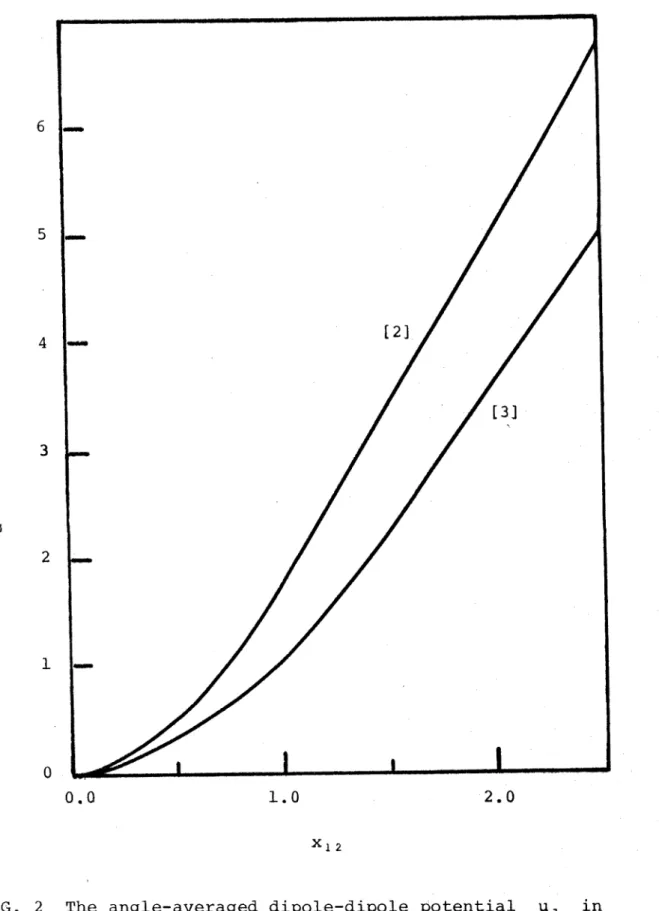
Figure 2 contains the plot of ud^ri2^
as a
function of the parameter x ^ *
We note that the
angle-averaged potential ud^ri2^
as attractive although the
dipole-dipole energy can be repulsive in some orientations.
(Ü)
RIGID DIPOLES IN THREE DIMENSIONS
When the dipoles are not coplanar two angles are
required to describe the orientation of the dipole moment u.
We will take these to be the conventional polar and azimuthal
angles
(0,<j)).
Since the angle-averaged potential is
laboratory frame and then integrating of the orientations of
/%
y^ and y2 relative to r ^ . 0ne ma¥ simplify the integral still further by taking y^ as the z axis of the
laboratory frame and r ^ in the xz plane. Then, instead of integrating over the orientations of y^ and y , one
integrates over the orientation of r and y . In this
^ X zl
z
axes system we will denote the orientations relative to y^ of
r
12 (0/0) and y^ by ^ 2 ' ^ 2 ^ ‘ T ^e dipole-dipoleinteraction energy (2.5) is then
u 2
u, (1,2) = — i— [cos 0 n - 3cosÖ cos y 0] (2.14)
Cl „ 3 Z Z
r 12
where
cos
=M
2 -?12cosö . cos0 + sin0 . sin0 cos6„
D D 2 (2.15)
Using the identities
cos 20 = 2cos"0 - 1
sin 20 = 2sin0 cos0
equation (2.14) becomes
ud (l,2)
2r
— [cos0„ + 3cosa]
3 2
12
where
cos a cosü^ cos2ü + sinö^ sin20 c o s ^ (2
The angle-averaged potential is then
0ud (r 12
1 r ^ ^ - ß U d ( 1 '2)
( 4 7T)
{ dr / d|j
2
'~12
J
12
(2
where
d r ^ ^ = 2tt d cos0
d y2 = d cos0 2 2
We have then from (2.16)
" ßUd (ri 2 )
, 1 1 2 TT
I dcosO
j
d c o s 0 . { dcf)0 -1 -1 3 0
x eX 12^C O S ^2 + ^cosa)
C
n +. v i +. • 5 2 , p . 4 4 5
We use the relation r
e~ cos3 - V (2n+l) i (z) P (cos0)
n=0 n n
C
where P (x) is the Legendre polynomial of order n5 2 , ] and in (z) is the modified spherical Bessel function5 2 ,
. 1 7 )
. 1 8 )
. 1 9 )
. 2 0)
i. 3 3 2
p . 4 4 3
T h e r e f o r e
2 it 3 x n ncosa
J d* _ e 12
2 7T
I
(2n+l) i (3x19) { P (cosa)d4>n=0 n 0
W e h a v e5 3, p . 3 2 5
V z)
P n (x)Pn (x ') + 2I
(±l)m i B Z E p .m= l ( n + m ) !
w h e r e
so that
Thus
(2.21)
x Pm (x) Pm ( x ' ) cos m<j)
n n (2.22)
xx' ± (l-xz ) ( l - x ‘2 ) COS<t> (2.23)
2 TT
J
P n (cosa) d(J>2 2 TT P (cos0~) P (cos20)n 2 n (2.24)
- 3 u
0° ^
j
^ (2n+l)i (3x 9 ) { P (cos20)d cos04 n=0 n -1 n
J
d c o s 0 ~ P (cos0~) e2 n 2
X12cos02
N o w
P^(c o s 2 0 ) - P ^ ( c o s 20 - s i n 20)
n
= P2 ( c o s 0 ) + 2 y
n
m = l
( -1) ( n - m ) 1
( n + m ) ! P ™ ( c o s 0 ) 2
(2.26)
u s i n g e q u a t i o n (2.22).
1
J
[ P ™ ( x ) ] 2dx-1
r, . , , , 3 , 0 . 3 2 8
We u s e the r e s u l t r
2 (n+m)l
2n+l ( n - m ) !
to o b t a i n
-{
P ^ ( c o s 2 0 )d c osO2 (-l)n
2n+l (2.27)
and
- ß u
1 E (-l)n i (3x,,) f d c o s 0 „ e
2 A n 12 4 2
n-0 -1
X 12C OS02
x P ^ ( c o s 0 2 ) (2.28)
A g a i n u s i n g the e x p a n s i o n (2.20) and the o r t h o g o n a l i t y of the
P (x) n
- ßU , *>
e
=I
(-1)n i (x. ,)i(3
x17)
(2.29)n=0 n 1 11
A f o r m w h i c h is v e r y s i m i l a r to its two d i m e n s i o n a l c o u n t e r p a r t .
T h e a s y m p t o t i c s of this f u n c t i o n w i l l be i n v e s t i g a t e d in
(
k
T
)
FIG. 2 The angle-averaged dipole-dipole potential
in
two and three-dimensions as a function of
of k i2 anc* a comP arison with its two-dimensional equivalent.
A g a i n we see that is always attractive although
Ud 1 2 ' ^1' ^2 ^ Can reP u ^-s:*-ve i-n some configurations.
(i i i ) DIPOLE INDUCED-DIPOLE INTERACTION
Consider two polarizable molecules, polarizability
which also carry a p e r m anent dipole moment. If y^ is the
dipole moment of m o lecule 1 and r ^ is the relative position
vector to molecule 2 then the interaction energy of the dipole
on 1 with the polarizable charge d i s t r i b u t i o n 2 is
2
u(l) = - (1 + 3 c o s 20 ) (2.30)
2 r 6 1
12
where
/\ /\
cosO-^ = P g ‘r]_2
Therefore the total dipol e - i n d u c e d dipole interaction energy
is
u i (1,2) = u (1) + u (2)
y 2g
12
3y 2g
2r
12
(cos2 0 ^
2 r 6
12 4r
2
I
6
12
5y a - (cos201 + c o s 2 0 2 ) (2.31)
' U i (r1 2 )
__I__
( 4 TT ) 2 U
-ßui (l,2)
e dw^dw^
e 10xi2/3 1 1
J J
1 "I
X 12 ^c o s2ö1+c o s202) e
x dcosö^ dcosö^
lOx-, 0/3
i z j 2
(2.32)
where
12
3p 2 g
4r 6
12
and
, 1 x , 2c o s20
I = ■=■ \ e dcosö
-1
Using the expansion (2.20) and the result (2.27) it follows that
I =
l
(-l)n i lx12>
n=0
(2.33)
Therefore
- 3 u . (r.0 ) lOx.. _/3
X ' 12' = e 12' ( (-1) n i (x )) 2
A I 1 ^
n=0
(2.34)
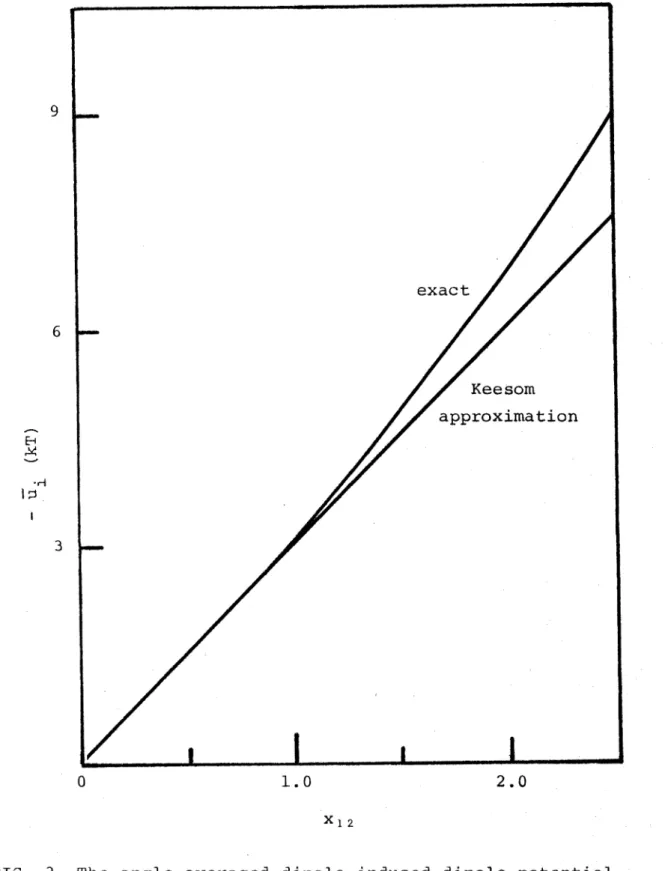
9
Keesom
approximation
Ehr*
■ H I P
I
1.0 2.0
12
FIG. 3 The
angle-averaged dipole-induced dipole potential
9 6
as a function of x 12 = 3p cx/4r12
and the
the d i p o l e - i n d u c e d dipole interaction. It is, of course,
always attractive.
S P IN-SPIN INTERACTION
A fourth a n g l e -dependent pair potential of interest
is the spin-spin interaction in three-dimensional space. We
will take the pair potential in the form
u s (1,2) = " f(r1 2 ) y i * if 2
= - M 2f(r1 2 ) cos012
where
(2.35)
c o s9 12 = cosQ^ c o s 0 2 + sin©^ s i n © 2 cosc^-cf^
and assume that o r i e n t a t i o n of the spins and y 2 is not
quantized. The angle-av e r a g e d potential is given by
-3u M s e
(r i + X ,oCOS0,0
1 rr 1Z 12
- -
r J J e
( 4 7T ) 2
d c o s 0 1d c o s 0 2d(J)1d(})2
(2.36)
where
x12 = ^
f(r12)
(2.37)Use of the expansion (2.20) and the o r t h o gonality of the
Pn (cos 0) in equation (2.36), yields
e
(
k
T
)
0.75
Keesom approximation
exact 0.50
0.25
The function is displayed in Figure 4 as a function of x g2* Again u g is always attractive although the pair potential can be repulsive in some configurations.
(iv) HARD DUMBELLS IN THREE DIMENSIONS
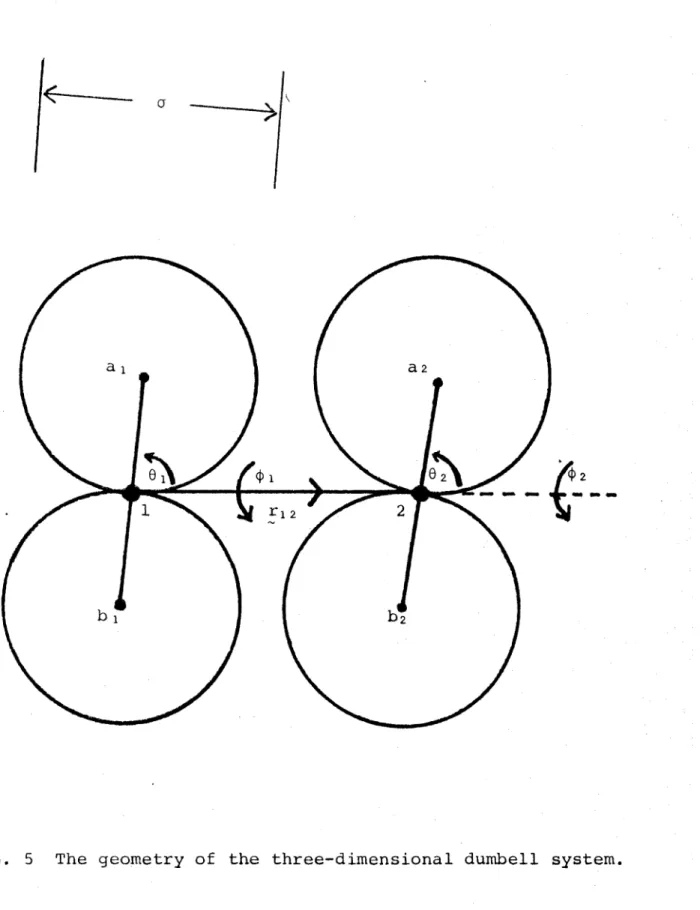
The angle-averaged potential for hard shape systems requires a little more analysis than the straight forward integration possible where the interaction potential has an explicit functional form. We consider two dumbells, (each consisting of two spheres of diameter a in contact with its origin at this p o i n t ) , at a distance r apart whose
orientations relative to this line of centres as z axis are
(ö 1 1) anb ^2^2^* See I?^9ure 5.
The Boltzmann factor $(1,2) is defined by
$ (1,2) = 1
= 0
if no overlap
if overlap
From Figure 5 we see that no overlap can occur if
a lci2 / a lb 2' b la 2* b lb 2
> a
Overlap occurs if any of these conditions is violated. From the definition (2.1) we have then for the angle-averaged potential
e-Bu(r)
— --- f f $(1,2) du),do0
(4 TT) 2 1 2
— -— ff dcosO-. dco s 0 o d4> dcj)
i a \ 2 J ' -L Z 1 Z
( 4 TT )
where the non-overlap domain Q(r)
is implicitly a function
of r.
Geometrical considerations show that the distance of
closest approach for two dumbells is a//2 when their long
axes are at right angles.
Thus
fz(r) = 0
for r
<_ a//2
Obviously no restriction of orientational space occurs when
r>2a
so that
p(r )
= (4
tt) 2
for r
>_ 2a
We may write immediately
e'ßu = 0
r < a//2~
= 1
r _> 2a
In the region a//2 £ r <_ 2a it is possible by simple analysis
to do the azimuthal angle integrations and the evaluation of
— ft \T
e J
is reduced to a two-dimensional quadrature for the
cosG^ and cosö^
integrals.
This is outlined in Appendix One.
In Figure 6 is plotted the angle-averaged Boltzmann
factor e '
v
y
as a function of r/o.
Thus, if u
is used
to model dumbell systems, the highly anisotropic dumbell-
dumbel.1 interaction is replaced by an effective hard sphere
(a*=a//2) interaction plus an isotropic repulsive interaction
1.0
.
8
. 6
Q 13
ca I
a
x
a)
.4. 2
FIG. 6 The angle-averaged Boltzmann factor exp(-ßuD )
for
the hard dumbell pair potential as a function of the
(c) THE K E E S Q M APPROX I M A T I O N
The canonical averaged pair potential
< u (r1 2)> is defined to be
< u (r 12 ) > = e
3u ( r 9 ) -ßu (r, 9 )
< u<r1 2 ,U l .u,2 ) e ^ >w ^
C2.39)
u (r. 0 ) + (3
a 12
3ua U 12)
aß
(2.40)Comparing this equation with the well known result of t h e r m o
dynamics
U F (2.41)
(where U and F are the internal and Helmholtz free energies
respectively) we see that <u > plays the role of an internal
a
energy and u acts as a free energy. It is for this reason
a
that u^ forms the c o r rect basis for perturb a t i o n theories of
non-simple liquids.
We are here interested in the approximate r e l a t i o n
ship between <u > and u which is sometimes used in
cl cl
37
perturbation theories . If ßu <<1 we can expand (2.39) and
a
perform the angular integrations to yield
<u >
correct to second order in ßu^. We have used the property that
J J u a ^ i 2 / a ) l / C U 2 ^ d ( J J l d u J 2 = ° (2.43)
which is true for almost all angle dependent potentials (the dipole-induced dipole potential is a counter-example).
Expanding the expression (2.1) for the angle-averaged potential we find
2 Ü :
1 / u a ( f l 2 ' t ü 1 ' ü ) 2 ) d “ l d t 0 2
(2.44)
to second order in ßu , where again (2.43) has been involved a
Comparing (2.42) and (2.44) we see that to this order in ßu
- 1
u ~ — <u >
a (2.45)
a result which further strengthens the free energy character
— 3 4
of u^. This point is discussed fully by Rowlinson . The approximate expression (2.44) we will denote as the Keesom
— 54
approximation to u (although Keesom did not realise the a
difference between <u > and u ).
a a
Using the asymptotic expressions for I (x)^
,
,2, p . 4 4 3 and i^(x)I (x)
n <!>
k=0
(x2/ 4 )
k !(n+k)! (2.46)
in (x)
0 0 / , . . , „ n + k , V n y (xy2) (n+k) ! 2
we expand the expressions (2.12), (2.29) , (2.34) , (2.38) for the angle-averaged potentials derived in the previous section to lowest order in ßu . We obtain
a
[2]
5 X12
2 E (2.48)
[3]
4 X 12
3 ß 12.49)
where
ßy
12
2r 3
12
A l s o ,
U i = * 3X12/B (2.50)
where
x 12 = 3p a/4r12 A g a i n ,
x l 2/ 6 (2.51)
where
x 12 = ßy f(r1 2 )
Equation (2.49) may be rewritten as
used in perturbation
which is the usual expression for u
t h e o r i e s ^ .
The utility of the Keesom approximation is shown in
Figures 3 ;
4, 7, 8 where the exact expression for u
is
a
plotted together with the appropriate Keesom approximation as
a function of x^9.
Each plot may be considered as illustra
ting the deviation of the Keesom approximation from the exact
u_
either as a function of r 0 given the relevant parameters
y , a, 3 are kept constant, or as a function of the smallest
value of
(the distance of closest approach or hard
sphere diameter) for various values of the parameters.
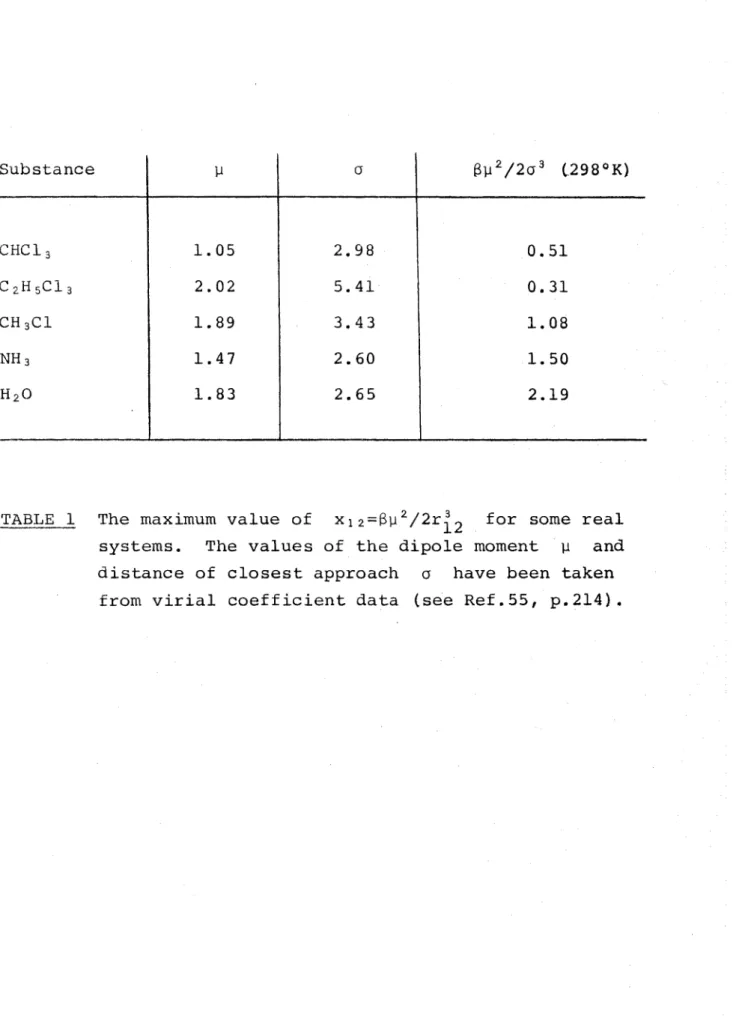
Table
1 shows values of dipole moment y,
hard sphere diameter g
and the maximum values of x^
2=ßu2/
2u3
for various real
55 o 214
systems calculated from virial coefficient data
'
These Vcilues of x ^ are marked on Figure 8 to illustrate the
maximum deviation of the Keesom approximation from the exact
angle-averaged dipole-dipole potential in three dimensions.
One can say quite generally that liquid systems with large
dipole moments and small diameters will show large deviations
from the exact u^ if the Keesom approximation is used.
This
deviation will become more pronounced as the density increases.
(2)
Figures 9 and 10 show the radial distribution function g
(r^)
for a system of hard spherical particles interacting via the
angle-averaged dipole-dipole potential (ßy2/2a3=1.43) at
(
k
T
)
Keesom
approximation
exact
FIG.
7
The angle-averaged coplanar, dipole-dipole potential
and its Keesom approximation as a function of
Substance y 0 ßy2/ 2 a 3 (29 8 0 K)
C H C 13 1.05 2.98 0.51
c 2h 5c i3 2.02 5.41 0.31
CH 3C1 1.89 3.43 1.08
n h3 1.47 2.60 1.50
h2o 1.83 2.65 2.19
TABLE I The maximum value of x 3 2 = ßy 2/2r.^2 f°r some real systems. The values of the dipole moment y and distance of closest approach a have been taken
Keesom
approximation
exact
CH 3 Cl
CHC1
0 1.0 2.0
X 12
FIG. 8 The angle-averaged [3] dipole - d i p o l e potential and
its Keesom a pproximation as a function of
x i 2 - 3u^/2r?2- The vertical lines show the maximum
FIG. 9 The radial d i s t r i b u t i o n function
(2)
g (r) c a lculated for the exact and
Keesora a p p r oximate angle-averaged
potentials for the hard sphere and
dipole system at p o J=0.50 and
1.43.
approximation
Keesom
a pproximation
exact a
(r/ a)
(2 )
FIG. 10 The radial d i s t r i b u t io n function g ‘ (r) calculated
for the exact and Keesom approximate angle-averaged
potentials for the hard sphere plus dipole system at
E X
0 o o cr>
t/i p 00 o
1—1 H 0) P ft •
no a) p ID <S\
a P " " mi to
0 CD
•H a* CD
p —i
no i p O
P CP -H
r
o
P P P 1 p
CP CD P ro 00
•H P P p m
p CD Pi u . •
p p lO r
-o
X u CD p 0 p . pE X rP
p O 0 lD o •H
Cfl cn u p
p (U P • • p
•H CD P rH I--1 w
p ml no •H
6 ms
p P
0 e rH
•H p
p P m3 •H
0 •H 1 p ms
•H E O o p
p p m p
•H
o
• fttn p F--1 CD
0 X PI
a , CD p
p
*H
m
. as
E X
o
o o
O 1---1 pm P CO <o
a)
CD P • • p
P (D P o o
as
U) ml P p
P p
•H ___________________ ■H
P ms
E
p P id CD
0
E
1 P ml•H in CN p
ml C p 00 ID
P u • • p
cr
E
p o Oo
<1) X
Q CD >i
p
p
P
• m
E X
0 0 ID CP <
W p m
Q) P • •
CD P r - CM
E ml P
P W
§ P
•H — CQ
p X <
0 P
ms
E 1 p
P o cn
Jp P p o ro
CP
w
u ••
*H P p p" ID
CD •H X
mi
p CDo m
ro in 00
Ö » •
Q . o o
(d) THE E X P A NSION OF THE BOLTZMANN FACTOR
factor
We develop here an expansion of the Boltzmann
$(1,2) = e (2.53)
in terms of the angle-averaged potential u (r 0 ) and discuss
a r z
the properties of this expansion w h i c h are relevant in the
sections 3 and 4. From (2.1)
( r 9 )
e — jj $ (1,2) dm dm (2.54)
ti2 2
The function f C r ^ 9 ,m^,m^) is defined by
$ (1/2) - eua (r12> (1 t ^ (2.55)
or
f (r
12 ~ 12 < V
ß(ua t l 2
'*V
'u a (r1 2 ))- 1
(2.56)
From (2.54) it follows immediately that
< f , 0 (r,0/m, ,m„) >
1 2 - 1 2 1 2 m ^ m ^
where we use the convention
<F> = h I F(m)dm
/ 1 \ \ ) J
(2.57)
Further properties of f^ 2 can de displayed most easily if the Boltzmann factor is expanded using a complete set of orthogonal functions of and w 9 . We write
*(1,2) =
IjL
(rj2) Pj, (t^) (u2 ) (2.59) £ -^ , £ 2 1 2 i 2where the P^,(o) are a dasis of the orientational space and the index £ is a set of numbers defining the particular member of the set. For example appropriate functions for molecules with an axial symmetry would be the spherical harmonics Y1^1 (0,4)) where the index £ would represent the pair (£,m). In general, where three orientational angles are necessary, the Wiqner D functions D™n (a,3,y) are required and the index £ represents the triple (£,m,n), Since the P (o) are a basis we require
X/
P n lSl) = — (2.60)
° /O'
/ Pj, (u) P £ , (to)doo
=
l
<2 -6 1 >and these properties imply that
j‘ P^(o)do = t A l 6 ^ Q (2.62)
Using the orthogonality condition (2.61) we have from (2.59) t h a t ,




![FIG. 8 The angle-averaged [3 ] dipole - d i p o l e potential and its Keesom a pproximation as a function of](https://thumb-us.123doks.com/thumbv2/123dok_us/1912971.149945/51.814.104.756.81.924/fig-angle-averaged-dipole-potential-keesom-pproximation-function.webp)
