This is a repository copy of
SQAP: A simple QoS supportive adaptive polling protocol for
wireless LANs
.
White Rose Research Online URL for this paper:
http://eprints.whiterose.ac.uk/116954/
Version: Accepted Version
Article:
Lagkas, T.D. orcid.org/0000-0002-0749-9794, Papadimitriou, G.I., Pomportsis, A.S. et al.
(1 more author) (2006) SQAP: A simple QoS supportive adaptive polling protocol for
wireless LANs. Computer Communications, 29 (8). pp. 934-937. ISSN 0140-3664
https://doi.org/10.1016/j.comcom.2005.06.013
Article available under the terms of the CC-BY-NC-ND licence
(https://creativecommons.org/licenses/by-nc-nd/4.0/
[email protected] https://eprints.whiterose.ac.uk/
Reuse
This article is distributed under the terms of the Creative Commons Attribution-NonCommercial-NoDerivs (CC BY-NC-ND) licence. This licence only allows you to download this work and share it with others as long as you credit the authors, but you can’t change the article in any way or use it commercially. More
information and the full terms of the licence here: https://creativecommons.org/licenses/
Takedown
If you consider content in White Rose Research Online to be in breach of UK law, please notify us by
This work appears in Elsevier Computer Communications, Volume 29, Issue 8, pp. 934-937, May 2006. DOI: 10.1016/j.comcom.2005.06.013
T. D. Lagkas
1, G. I. Papadimitriou
1,*, A. S. Pomportsis
1, and, M.S.Obaidat
21. Department of Informatics, Aristotle University, Box 888, Thessaloniki, Greece. 2. Department of Computer Science, Monmouth University, West Long Branch, NJ 07764, U.S.A.
* Corresponding Author. E-mail: [email protected]
Abstract— A Simple QoS supportive Adaptive Polling (SQAP) protocol for wireless LANs is introduced. SQAP operates under an infrastructure wireless LAN, where an Access Point (AP) polls the wireless nodes in order to grant them permission to transmit. The polled node sends data directly to the destination node. We consider bursty traffic conditions, under which the protocol operates effi-ciently. The polling scheme is based on an adaptive algorithm according to which it is most likely that an active node is polled. Also, SQAP takes into account packet priorities, so it supports QoS by means of the Highest Priority First packet buffer discipline and the priority distinctive polling scheme. Lastly, the protocol com-bines efficiency and fairness, since it prohibits a singe node to dominate the medium permanently. SQAP is compared to the effi-cient learning automata-based polling (LEAP) protocol, and is shown to have superior performance.
Index Terms—Wireless LANs, Adaptive Polling, Quality of Service, Simple QoS supportive Adaptive Polling
I.
I
NTRODUCTIONately, there has been a great interest in the wireless communication networks which support high quality services and combine asynchronous communication, such as file transfer, and time bounded communication, such as streaming video. In general, the wireless networks have some special characteristics, which make the design of an appropri-ate medium access control protocol rather difficult [1]–[4]. Generally, in a wireless network the links are not reliable, the bit-errors are more often, and the topology changes in a con-tinuous way. Furthermore, a modern wireless network needs QoS support.
In this paper, we propose Simple QoS supportive Adap-tive Polling (SQAP), a new WLAN protocol designed for bursty traffic that supports QoS. An adaptive polling algo-rithm tends to poll the nodes, which are actually active, with-out having direct feedback abwith-out their current status [5]. An infrastructure WLAN topology is considered, where there is an access point (AP) that is only responsible for polling the mobile nodes in order to give permission to transmit. The adaptive polling algorithm takes into account the priorities of the data packets that are broadcasted by the mobile stations, in order to decide which node to poll [6]. Furthermore, every node implements a Highest Priority First (HPF) packet buffer discipline, which contributes in the QoS support. It is shown that the introduced protocol manages bandwidth assignment in an effective and fair way.
The paper is organized as follows. Section II discusses other WLAN polling protocols emphasizing on the learning automata-based polling (LEAP) protocol. In Section III, the SQAP protocol is analyzed, and specifically the polling scheme is examined, the priority model of SQAP is pre-sented, and the node choice mechanism is analyzed. Section IV presents the simulation environment and the simulation results, which show the performance superiority of the SQAP protocol, comparing the proposed protocol and the LEAP protocol. Also, the QoS support of SQAP is revealed. Section V concludes the paper.
II.
W
LANP
OLLINGP
ROTOCOLSThe polling protocols are popular WLAN MAC protocols for infrastructure networks [7]. The Randomly Addressed Polling (RAP) protocol provides zero wrong polls, but it gives a rather increased overhead and high collision probabil-ity [8]. Apart from that, RAP supports no QoS at all. GRAP is an improvement of RAP [9]. It provides a minimum QoS support and performs better than the original RAP protocol, but the provided throughput and packet delay are still not satisfactory.
The LEAP protocol is also a wireless polling protocol, but it is based on a different concept [10]. It assumes a cellular topology as it was described above, however it considers direct communication between the mobile nodes (the AP is not a packet forwarder). This protocol defines that the AP chooses the node that will be given permission to transmit by using choice probabilities. Four control packets are used: POLL, NO_DATA, BUFF_DATA, and ACK, with duration tPOLL, tNO_DATA, tBUFF_DATA, and tACK, respectively. The
propa-gation delay is tPROP_DELAY, and a data packet transmission
lasts tDATA. According to this polling scheme, the maximum
polling cycle duration is tPOLL + tBUFF_DATA + tDATA + tACK +
4*tPROP_DELAY. When the AP detects that the polled node
transmits data then it is assumed that it is active, so its choice probability is increased. Respectively, when the polled node responds with a NO_DATA packet or the AP fails to receive feedback, then it is assumed inactive or that there is a bad link, so the node’s choice probability is decreased [11]. Ac-cording then to this protocol, the AP examines the feedback that gets during a polling cycle (j) in order to update the choice probabilities and select the node to poll at the next polling cycle (j + 1). When the choice probability of node k is
SQAP: A Simple QoS Supportive Adaptive
Pol-ling Protocol for Wireless LANs
2 increased, it becomes Pk(j + 1) = Pk(j) + L(1 – Pk(j)), and
when it is decreased it becomes Pk(j + 1) = Pk(j) – L(Pk(j) –
a), where L, a are constants. Finally, the choice probabilities
are normalized. LEAP is an efficient WLAN protocol and performs clearly better than RAP and GRAP, but the main drawback of the protocol, which is rather important, is that it does not support QoS.
III.
T
HES
QAPP
ROTOCOLSQAP also assumes a cellular topology where the AP polls the nodes in order to give them permission to transmit. The used polling scheme is similar to the polling scheme of LEAP, however it is more efficient due to the lower over-head. The SQAP protocol uses the control packets that were mentioned before, except from the BUFF_DATA packet, which schemes to be rather useless. The possible polling events are described below.
- The AP polls an inactive node: The node responds with a NO_DATA packet. If the AP successfully receives this pack-et, it proceeds to poll another node. Else if the AP has not successfully received the NO_DATA control packet, it polls another node. Either way, the node is considered inactive.
- The AP polls an active node: The node reacts by sending a data packet (DATA) directly to the destination node and waits for an ACK packet. The AP monitors the wireless me-dium during all that time. If it successfully receives at least one of these two packets (DATA, ACK), then it assumes that the polled node is active. At the end of the waiting time, the AP polls another node. In case the AP fails to receive one of the above packets, it assumes that there is a bad link between it and the mobile node, so the node is considered inactive.
- The AP fails to poll the node: When the node fails to re-ceive the POLL control packet, there can be no feedback for the AP. So, the latter has to wait before polling another node. Also, it assumes that there is a bad link between it and the mobile node, so the node is considered inactive.
It is obvious that this polling scheme reduces the overhead, since no BUFF_DATA control packet is considered. This results in shorter waiting times, and finally in a shorter pol-ling cycle. Specifically, the maximum duration of the polpol-ling cycle of SQAP is tBUFF_DATA + tPROP_DELAY shorter than the
polling cycle of LEAP. We must mention that there is no need for BUFF_DATA, because the AP is able to detect the polled node’s data broadcast. The above polling scheme, which is collision free, takes into account the bursty nature of the traffic, the bursty appearance of bit-errors, and the need for minimal overhead.
The SQAP protocol supports QoS by using packet priori-ties. The first utilization of the packet priorities takes place in the packet buffer. SQAP uses the Highest Priority First (HPF) buffer discipline, according to which the packets that carry the highest priorities are served first. Among the packets of the same priority we use First In First Out (FIFO) buffer discipline, based on the generation time of the packets.
The SQAP protocol updates the choice probabilities of the nodes according to their status (active or not) and their priori-ty. The priority of a node is equal to the priority of the last packet sent by that node. According to the “active node”
concept, it is clearly considered that under bursty traffic conditions it is most probable that a node (k) which transmits a data packet has more packets in the buffer [5]. So, this node is inserted in the set of the active nodes, which are more probable to be polled. If the AP assumes that the polled node transmitted no data, then it consider it to be inactive.
The relative probability of polling an inactive node (k) is
PC(k) = Qmax / 2 +1, where Qmax is the maximum possible
priority (the minimum priority is 0). If (k) is an active node, the relative probability of polling it is PC(k) = (q+1)*AF,
where q is the priority of the specific node and AF is the Active Factor. When AF is high, the active nodes are favored in a greater degree, and when AF is low, the protocol is fairer. It is obvious that the choice probability of an active node is proportional to its priority and AF times greater than the choice probability of an inactive node (when the active node is also assigned the mean priority level). The choice probabil-ities of all the nodes are calculated and then are normalized. So, the actual choice probability of node (k) is
∑
==
Π
Ni C
C
C
(
k
)
P
(
k
)
1P
(
i
)
, where N is the total numberof nodes. By choosing the appropriate AF value, this node choice mechanism provides high performance, QoS, and fairness.
IV. P
ERFORMANCEE
VALUATIONIn order to compare the SQAP protocol against LEAP, we developed a simulation program in C++. The bursty traffic was simulated as stated in [11]. When a packet is generated, it is assigned a packet priority (range [0, Qmax]). The packets of
the same burst are assigned the same random priority.
In the developed simulation environment, the condition of any wireless link was modeled using a finite-state machine with three states [12], [13]. State G is characterized by a small BER, while state B is characterized by increased BER. State H denotes that the pair of communication nodes is out of range of one another (hidden nodes). The time spent by a link in states G, B and H is exponentially distributed, but with different average values. The status of a link probabilistically changes between the three states, defined by the parameter Ph.
We also considered N = 10, L_LEAP = 0.1, a_LEAP = 0.03, the control packet size (cpSize) equal to 160 bits, the default data packet size (dpSize) equal to 6400 bits, and Qmax = 3
(that is four priority levels). We set AF = 10, since it was proved to be the optimal value. The simulation results pre-sented in this section are produced by a statistical analysis based on the “sequential simulation” method [14]. For this statistical analysis we used 95% confidence intervals. The relative statistical error threshold varies depending on the meaning of the metric and the magnitude of the produced value. However, this threshold was usually assumed to be lower than 2% and never exceeded 5%.
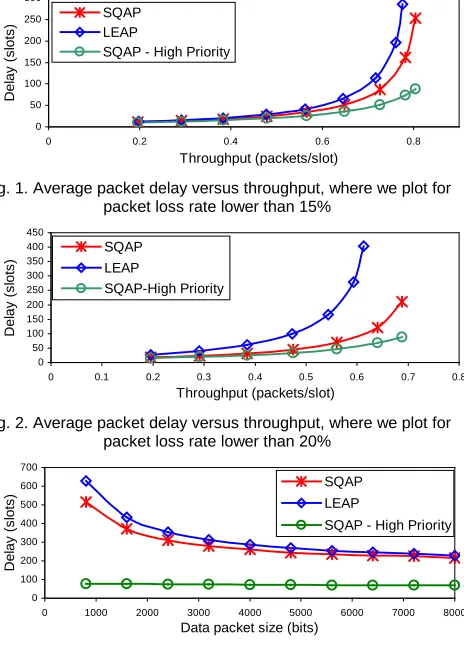
3 this, SQAP provides packet delays clearly lower than the
delays provided by LEAP. We assume that high priority packets are the packets which are assigned a priority higher than Qmax /2. The corresponding curve is a proof of the QoS
support.
When the data packet size gets small compared to the con-trol information, SQAP has great advantage, which is shown by the high throughout and the low packet delay. In Fig. 2, it is obvious that, for dpSize = 800, SQAP provides significant-ly lower packet delays than LEAP.
In Fig. 3, we assume almost “clean” network conditions and 100% load. It is shown that the delay of the high priority packets remains impressively stable, while the overhead alters. Specifically, we plot the average packet delay versus the dpSize, while keeping the cpSize stable.
Assuming the same network conditions, we plotted the high priority packet delay as percentage of the low priority packet delay. In Fig. 4, it is shown that the high priority packets are favored in a relatively greater degree under harsh network conditions, which means that the SQAP protocol ensures QoS support in any case.
0 50 100 150 200 250 300
0 0.2 0.4 0.6 0.8
Throughput (packets/slot) D el ay ( s lot s ) SQAP LEAP
SQAP - High Priority
Fig. 1. Average packet delay versus throughput, where we plot for packet loss rate lower than 15%
0 50 100 150 200 250 300 350 400 450
0 0.1 0.2 0.3 0.4 0.5 0.6 0.7 0.8
[image:4.612.322.564.54.149.2]Throughput (packets/slot) D el ay ( s lot s ) SQAP LEAP SQAP-High Priority
Fig. 2. Average packet delay versus throughput, where we plot for packet loss rate lower than 20%
0 100 200 300 400 500 600 700
0 1000 2000 3000 4000 5000 6000 7000 8000
Data packet size (bits)
D el ay ( s lot s ) SQAP LEAP
SQAP - High Priority
Fig. 3. Average packet delay versus data packet size, where we plot for any packet loss rate
0 0.2 0.4 0.6 0.8 1
0 0.2 0.4 0.6 0.8 1
[image:4.612.60.293.304.388.2]Throughput (packets/slot) H igh P ri or it y P ac k et D el ay ( per c ent age of low pr ior it y pac k et del ay ) SQAP
Fig. 4. High priority packet delay as a percentage of the low priority packet delay versus throughput
V. C
ONCLUSIONThis work proposed the Simple QoS supportive Adaptive Polling (SQAP) protocol for wireless LANs. The protocol is capable of operating efficiently under bursty traffic condi-tions. The SQAP protocol always performs superiorly than LEAP. The protocol is based on a self-adaptive polling algo-rithm [15], which decreases the number of wrong polls. The overhead is reduced and the polling scheme is generally optimized. SQAP is able to support different kinds of traffic, by using packet priorities. QoS is always supported. This model is not difficult to implement, since the polling scheme based on the active nodes and the node priorities is rather simple. Furthermore, no simultaneous transmissions take place. A more sophisticated WLAN polling protocol which is also based on the “active node” concept is presented in [16].
R
EFERENCES[1] P. Nicopolitidis, M. S. Obaidat, G. I. Papadimitriou, and A. S. Pomport-sis, Wireless Networks, New York : Wiley, 2003.
[2] P. Nicopolitidis, G. I. Papadimitriou, and A.S. Pomportsis, “Design alternatives for wireless local area networks,” Int. J. Commun. Syst., vol. 14, pp. 1-42, Feb. 2001.
[3] A.C.V. Gummalla and J.O. Limb, “Design of an access mechanism for a high speed distributed wireless LAN,” IEEE J. Select. Areas Commun., vol. 18, pp. 1740-1750, Sept. 2000.
[4] A. S. Tanenbaum, Computer Networks. Englewood Cliffs, NJ: Prentice-Hall, 2002.
[5] G. I. Papadimitriou, and A. S. Pomportsis, “Adaptive MAC protocols for broadcast networks with bursty traffic,” IEEE Trans. Commun., vol. 51, no. 4, April 2003.
[6] G. I. Papadimitriou, T. D. Lagkas, and A. S. Pomportsis, “HIPERSIM: A sense range distinctive simulation environment for HiperLAN systems”, J.
Simulation, vol. 79, no.8, pp.462-481,Aug. 2003.
[7] K.-C. Chen, “Medium access control of wireless LANs for mobile computing,” IEEE Network Mag., pp. 50-63, Sept./Oct. 1994.
[8] K.-C. Chen and C.-H. Lee, “RAP – a novel medium access-control protocol for wireless data networks,” in Proc. IEEE GLOBECOM, 1993, pp. 1713-1717.
[9] ___, “Group randomly addressed polling for wireless data networks,” in
Proc. IEEE ICC, 1994, pp. 1713-1717.
[10] P. Nicopolitidis and G. I. Papadimitriou, “Learning automata-based polling protocols for wireless LANs,” IEEE Trans. Commun., vol. 51, no. 3, March 2003.
[11] G. I. Papadimitriou, and A. S. Pomportsis, “Learning automata-based TDMA protocols for broadcast communication systems with bursty traffic,”
IEEE Commun. Letters, vol.4, no.3, March 2000.
[12] E. Gilbert, “Capacity of a burst noise channel,” Bell Syst. Tech. J., vol. 39, pp.1253-1265, Sept. 1960.
[13] M. Zorzi, R. R. Rao, and L. B. Milstein, “On the accuracy of a first-order Markov model for data transmission on fading channels,” in Proc.
ICUPC, Tokyo, Japan, Nov. 1995, pp. 211-215.
[image:4.612.62.294.307.632.2]
4 Telecommunication Networks”, IEEE Communications Magazine, January
2002.
[15] A. Farago, A. D. Myers, V. R. Syrotiuk, and G. V. Zaruba, “Meta-MAC protocols: automatic combination of MAC protocols to optimize perfor-mance for unknown conditions,” IEEE J. Select. Areas Commun., vol. 18, pp. 1670-1681, Sept. 2000.
[16] T. D. Lagkas, G. I. Papadimitriou, and A. S. Pomportsis, “A High Performance QoS Supportive Protocol for Wireless LANs,” in Proc. IEEE
MELECON, Dubrovnik, Croatia, May 2004, pp. 571-574.