Practical Uniform Interpolation and Forgetting for
ALC
TBoxes with Applications
to Logical Difference
Michel Ludwig
Institute for Theoretical Computer Science TU Dresden, Germany
Boris Konev
Department of Computer Science University of Liverpool, United Kingdom
Abstract
We develop a clausal resolution-based approach for comput-ing uniform interpolants of TBoxes formulated in the descrip-tion logic ALC when such uniform interpolants exist. We also present an experimental evaluation of our approach and of its application to the logical difference problem for real-life
ALContologies. Our results indicate that in many practical cases uniform interpolants exist and that they can be com-puted with the presented algorithm.
Introduction
OntologiesorTBoxesexpressed in Description Logics (DL) provide a common vocabulary for a domain of interest to-gether with a description of the meaning of the terms built from the vocabulary and of the relationships between them. Modern applications of ontologies, especially in the biolo-gical, medical, or healthcare domain, often demand large and complex ontologies; for example, the National Can-cer Institute ontology (NCI) consists of more than 60 000
term definitions. For developing, maintaining, and deploy-ing such large-scale ontologies it can be advantageous for ontology engineers to concentrate on specific parts of an on-tology and ignore or forget the rest. Ignoring parts of an ontology can be formalised with the help ofpredicate for-gettingand its dualuniform interpolation, which have both been extensively studied in the AI and DL literature (ten Cate et al. 2006; Eiter et al. 2006; Herzig and Mengin 2008; Konev, Walther, and Wolter 2009; Wang et al. 2008; 2010; Lutz and Wolter 2011; Wang et al. 2012).
Forgetting parts of an ontology can be used, for ex-ample, in the following practical scenarios.Exhibiting hid-den relations: in addition to the explicitly stated connec-tions between terms, additional relaconnec-tions can also be de-rived from ontologies with the help of reasoners. Such in-ferred connections are often harder to understand or debug. By forgetting everything but a handful of terms of interest, it then becomes possible to exhibit inferred relations that were hidden initially, potentially simplifying the understand-ing of the ontology structure.Ontology obfuscation: in soft-ware engineering, obfuscation (Collberg, Thomborson, and Low 1998) transforms a given program into a functionally
Copyright © 2014, Association for the Advancement of Artificial Intelligence (www.aaai.org). All rights reserved.
equivalent one that is more difficult to read and understand for humans for the purpose of preventing reverse engineer-ing. Forgetting can provide a similar function in the context of ontology engineering. Terms are often defined with the help of auxiliary terms which give structure to TBox inclu-sions. However, such a structure might be considered pro-prietary knowledge that should not be exposed, or it could simply be of little interest for ontology users. By forgetting these intermediate auxiliary terms, we obtain an ontology that is functionally equivalent, yet harder to read, under-stand, and modify by humans. Further applications of for-getting can be found in (Konev, Walther, and Wolter 2009; Lutz, Seylan, and Wolter 2012).
A promising and important application area of forgetting is the computation of thelogical differencebetween onto-logy versions. Determining whether two versions of a docu-ment have differences is a standard task in information tech-nology, and finding differences is particularly relevant for text processing and software development. Already in these areas, it is important to be able to identify which changes aresignificantand which are not (e.g., a software developer might want to ignore changes in the formatting style of the code such as the number of indentation spaces). Detecting significant changes is even more important in the setting of Knowledge Representation, where differences in the know-ledge captured by ontologies are often more relevant than syntactic changes. Arguably, one of the most important con-cerns of an ontology engineer when modifying an existing ontology is to ensure that the introduced changes do not interfere with the meaning of the terms outside the frag-ment under consideration. Notice that neither the version comparison based on the syntactic form of the documents representing ontologies (Conradi and Westfechtel 1998) nor methods based on the structural transformations of onto-logy statements (Noy and Musen 2002; Klein et al. 2002; Jim´enez-Ruiz et al. 2011) can be used to identify changes to the logical meaning of terms in every situation. However, such a correctness guarantee can be achieved by checking the equivalence of the ontologies resulting from forgetting the terms under consideration before and after the changes occurred.
all the consequences that do not make use of some given
concept names. Subsequently, we present an experimental evaluation of our approach which demonstrates that in many practical cases uniform interpolants exist and that they can be computed with our algorithm. We also apply our proto-type tool to compute the logical difference between versions of ontologies from the biomedical domain.
This is an updated and extended version of (Lud-wig and Konev 2013). All missing proofs can be found in the full version of this paper, which is available from http://lat.inf.tu-dresden.de/ ˜michel/kr14-ui-full.pdf
Related work. Until recently research on uniform inter-polation and forgetting in the setting of DL mainly has concentrated on theoretical foundations of forgetting. This could be partly explained by the high computational com-plexity of this task and by the fact that uniform interpolants do not always exist. The notion of forgetting has been in-troduced by Reiter and Lin (1994). (Konev, Walther, and Wolter 2009) prove tractability of uniform interpolation for ELTBoxes of a specific syntactic form. (Wang et al. 2008; 2010; 2012) have developed algorithms for forgetting in ex-pressive description logics. A tight 2-EXPTIME-complete bound on the complexity for deciding the existence of a Σ-uniform interpolant in ALC and a worst-case triple-exponential procedure for computing a Σ-uniform inter-polant if it exists, have been given in (Lutz and Wolter 2011). Koopmann and Schmidt (2013) have introduced a two-stage resolution-based algorithm for computing uni-form interpolants. As outcome of the first stage, a repres-entation of the uniform interpolant in a description logic with fixpoint operators is computed (such a representation always exists) Then in the second stage an attempt is made to eliminate the newly-introduced fixpoints (which may not succeed). In contrast to this approach, our algorithm has one stage and it can be guaranteed that a uniform interpolant of bounded depth is returned.
The notion of the logical difference has been introduced in (Konev, Walther, and Wolter 2008) as a way of capturing the difference in the meaning of terms that is independent of the representation of ontologies.
Preliminaries
We start with introducing the description logic ALC. Let NCandNRbe countably infinite and mutually disjoint sets
ofconcept namesandrole names.ALC-conceptsare built according to the following syntax rule
C::= A | > | ¬C | ∃r.C | CuD,
whereA ∈ NCandr ∈ NR. As usual, otherALCconcept
constructors are introduced as abbreviations: ⊥stands for ¬>,CtD stands for¬(¬Cu ¬D) and ∀r.C stands for ¬∃r.¬C. AnALC-TBoxT is a finite set ofALC-inclusions of the formC v D, whereC and D are ALC-concepts. A concept equationC ≡ D is an abbreviation for the two inclusionsCvDandD vC. AnALC-TBox isacyclicif all its inclusions are of the formAvCandA≡C, where A ∈ NC andC is an ALC-concept, such that no concept
name occurs more than once on the left-hand side and T contains no cycle in its definitions, that is, it does not contain inclusionsA1 ./ C1,. . . , Ak ./ Ck, where./ ∈ {v,≡},
such thatAi+1occurs inCi, fori= 1, . . . , k−1andAk=
A1.
A signatureΣis a finite subset ofNC∪NR. The signature
of a conceptC, denoted bysig(C), is the set of concept and role names that occur inC. Ifsig(C)⊆Σ, we callCaΣ -concept. We assume that the two previous definitions also apply to concept inclusions/equations C ./ D with ./ ∈ {v,≡} and to TBoxesT. The size of a concept C is the length of the string that represents it, where concept names and role names are considered to be of length one. The size of an inclusion/equationC ./ D with./ ∈ {v,≡}is the sum of the sizes ofCandDplus one. The size of a TBoxT is the sum of the sizes of its inclusions.
The semantics of ALC is given by interpretations I = (∆I,·I), where thedomain∆Iis a non-empty set, and·Iis a function mapping each concept nameAto a subsetAI of
∆I, each role namerto a binary relationrI ⊆∆I×∆I. TheextensionCIof a conceptCis defined by induction as follows:
>I := ∆I
(¬C)I := ∆I\CI
(∃r.C)I := {d∈∆I| ∃e∈CI: (d, e)∈rI}
(CuD)I := CI∩DI.
Then I satisfies a concept inclusion C v D, in symbols I |=CvD, ifCI⊆DI.
We say that an interpretationIis amodel of a TBoxT if I |=CvDfor allCvD∈ T. AnALC-inclusionCvD
follows from (or isentailed by) a TBoxT if every model ofT is a model ofC v D, in symbolsT |=C vD. We use|=CvDto denote thatCvDfollows from the empty TBox. Finally, a TBoxT0follows from(or isentailed by) a TBoxT if every model ofT is a model ofT0, in symbols T |=T0.
We now introduce the main notion that we study in this paper.
Definition 1. LetT be anALC-TBox and letΣ⊆sig(T) be a signature. We say that anALC-TBoxTΣis aΣ-uniform
interpolantof the TBoxT iffsig(TΣ)⊆Σ,T |=TΣ, and for
everyALCΣ-concept inclusionC vDwithT |=C vD
it holds thatTΣ|=CvD.
Uniform interpolation can be seen as the dual notion of
forgetting: a TBoxTΥis the result of forgetting about a
sig-natureΥin a TBoxT iffTΥis a uniform interpolant ofT
w.r.t. Σ = sig(T)\ Υ. As the following example shows, uniform interpolants ofALC-TBoxes do not always exist.
Example 2. Let T = {A v B, B v C u ∃r.B} and Σ = {A, C, r}. Then there does not exist aΣ-uniform in-terpolant ofT as (in particular) the infinite number of con-sequences of the formAv ∃r.C,Av ∃r.∃r.C, . . . cannot be captured by anALC-TBoxT0 withsig(T0)⊆Σ. On the
other hand, forT0 ={AvB, B vCu ∃r.B, D ≡B}
Uniform interpolation is also related to the notion of lo-gical difference between ontologies.
Definition 3. The Σ-logical difference between ALC -TBoxes T1 and T2 is the set DiffΣ(T1,T2) of all ALC
-concept inclusionsC v D such that sig(C v D) ⊆ Σ,
T1|=CvD, andT26|=CvD.
It is easy to see that DiffΣ(T1,T2) = ∅ if, and only if,
T2 |= T (Σ)
1 whereT (Σ)
1 is aΣ-uniform interpolant ofT1.
Moreover, ifT2 6|= T (Σ)
1 , every inclusionC vD ∈ T (Σ) 1
with T2 6|= C v D can be regarded as a witness of
DiffΣ(T1,T2).
With the exception of acyclic EL-TBoxes, checking whether the logical difference between two ontologies is nonempty is at least one exponential harder than reason-ing (Konev et al. 2012). Additionally, if the setDiffΣ(T1,T2)
is nonempty, it is typically infinite. Therefore, in practice, the notion of logical difference is primarily used as a theoret-ical underpinning of itsapproximationsthat limit the choice of inclusionsC v D in Definition 3 toΣ-inclusions con-structed according to some syntactic rules, see e.g. (Jim´enez-Ruiz et al. 2009), (Gonc¸alves, Parsia, and Sattler 2012a; 2012b).
Computing Uniform Interpolants by
ALC
-Resolution
The aim of our work is to investigate a practical approach for computing uniform interpolants when they exist. Note that the procedure given in (Lutz and Wolter 2011) is in-herently inefficient as it requires one to explicitly construct the double-exponential size internalisation CT of a given TBoxT.
Our approach is to introduce a resolution-like calculus for ALC that derives consequences of a TBox T such that a concept inclusionCvDis entailed byT iff a contradiction can be derived fromT andCu¬D. Similarly to (Herzig and Mengin 2008), we then show that any derivation can be re-structured in such a way that inferences on selected concept names always precede inferences on other concept names. Then, if the signatureΣis such thatsig(T)\Σonly contains concept names, we generate a set of Σ-consequences T0 of T by applying the inference rules in a forward chain-ing manner such that for an arbitrary Σ-inclusionC v D a contradiction can be derived fromT andC u ¬D iff a contradiction can be derived fromT0 andCu ¬D. Thus, if the forward-chaining process terminates,T0is aΣ -uniform-interpolant forT.
ALC-Resolution. ALC-resolution operates onALC for-mulae in conjunctive normal form defined according to the following grammar (this is similar to (Herzig and Mengin 2008)):
Literal ::= A | ¬A | ∀r.Clause | ∃r.CNF Clause ::= Literal | ClausetClause | ⊥
CNF ::= > | Clause | ClauseuCNF
To simplify the presentation, we assume that clauses are sets of literals and that CNF expressions are sets of clauses. Then ⊥corresponds to the empty clause and>to the empty set
of clauses. In the following, the calligraphic lettersC,D,E symbolise clauses andF,Grepresent sets of clauses. Simil-arly to first-order formulae, everyALCconcept can be trans-formed into an equivalent set ofALCclauses. The depth of a clauseC,Depth(C), is defined to be the maximal nesting depth of the quantifiers contained inC.
We additionally assume that every clause is assigned a
type. Clauses obtained from the clausification of TBox in-clusions are of the typeuniversal, and clauses resulting from the clausification of inclusions to be tested for entailment by the TBox are of the typeinitial. The type of a derived clause is determined by the types of the clauses from which it is derived and by the derivation rule that is used.
Example 4. The clausification ofT from Example 2 pro-duces three universal clauses:¬AtB, ¬BtC, ¬Bt∃r.B.
We now introduce the two resolution calculiT andTu. The former calculus assumes the TBox to be empty, whereas the latter takes TBox inclusions into account. Thus, T de-rives the empty clause from the set of initial clauses stem-ming from the clausification of an inclusion> v Cu ¬D iff|=CvD; andTuderives the empty clause from the
uni-versal clauses stemming from the clausification of a TBoxT and the initial clauses stemming from the clausification of an inclusion> vCu ¬DiffT |=CvD.
The calculusTis defined with the help of the relation⇒α
given in Fig. 1. For everyα∈ NC∪ {⊥}, the relation⇒α
associates with a set of clauses N a new clause C which can be ‘derived’ from the setN by ‘resolving’ onα.Tnow consists of the following two inference rules.
C
E (ifC ⇒αE)
C D
E (ifC,D ⇒αE),
whereC,D, andEare initial clauses.
The calculusTuoperates initial and universal clauses and
also consists of two rules: C
E (ifC ⇒αE)
C0 D E0 (ifC
0,D ⇒u αE0),
whereC,C0,Dare initial or universal clauses, andC0,D ⇒u α
E0 holds iff eitherC0,D ⇒
α E0, orDis a universal clause
and there exist role namesr1, . . . , rn ∈ NR (n ≥ 1) such
thatC0,∀r
1. . . .∀rn.D ⇒α E0. (Intuitively, the calculusTu
allows for inferences with universal clauses at arbitrary nest-ing levels of quantifiers, which the calculus T does not.) ThenE is a universal clause ifC is a universal clause, and an initial clause otherwise. Similarly,E0is a universal clause if bothC0 andDare universal clauses, and an initial clause otherwise.
We assume that every clauseE that results from aT- or
Tu-inference is implicitly simplified by exhaustively
remov-ing all occurrences of literals of the form∃r.(F,⊥). Example 5. For the universal clauses from Example 4, we have for instance,
¬AtB,¬Bt ∃r.B ⇒B ¬At ∃r.B by (ruleA).
So, the universal clause¬At ∃r.Bis derivable byTufrom
¬AtBand¬Bt ∃r.B. As¬BtCis a universal clause and
(rule⊥) C0
1t ∀r.⊥, C20 t ∃r.F =⇒⊥C10 t C20
(ruleA) C0
1tA, C20 t ¬A=⇒AC10 t C02
(rule∀∃) C0
1t ∀r.C1, C20 t ∃r.(C2,F) =⇒αC10 t C20 t ∃r.(C2,F,C3), ifC1,C2=⇒αC3
(rule∀∀) C0
1t ∀r.C1, C20 t ∀r.C2=⇒αC01t C20 t ∀r.C3, ifC1,C2=⇒αC3
(rule∃1) C0t ∃r.(C1,F) =⇒αC0t ∃r.(C1,F,C2), ifC1=⇒αC2
(rule∃2) C0t ∃r.(C1,C2,F) =⇒αC0t ∃r.(C1,C2,F,C3), ifC1,C2=⇒αC3
(rule∀) C0t ∀r.C
1=⇒αC0t ∀r.C2, ifC1=⇒αC2
Figure 1: Rules of=⇒α.
the universal clause¬Bt∃r.(B, C)is derivable byTufrom
¬Bt ∃r.Band¬BtC. By applying the inference rules to old and newly generated clauses, one can conclude that the universal clauses¬At ∃r.(B, C)and¬At ∃r.(B,∃r.B) are also derivable by Tu from N = {¬At B, ¬B t C, ¬Bt ∃r.B}.
Forx∈ {T,Tu}, ax-derivation (tree)∆built from a set of clausesNis a finite binary tree where each leaf is labelled with a clause fromN and each non-leaf nodenis labelled with a clauseC such thatC results from anx-inference on the parent(s) of n in∆. We say that ∆ is a derivation of a clause C if the root of ∆ is labelled with C. A deriva-tion of the empty clause is called a refutation. Every path n1, . . . , nmof nodes in∆wheren1is a leaf node andnmis
the root node induces aninference pathα2, . . . , αm, where
αi∈NC∪ {⊥}(2 ≤i≤m) denotes the concept name, or
⊥, which has been resolved upon to obtain the clause that is the label of the nodeni. For a signature Υ⊆ NC and a
strict total order ⊆Υ×Υ, a derivation∆is a(x,Υ,) -derivation if for every inference pathα1, . . . , αnof∆(with
αi∈NC∪ {⊥}for every1≤i≤n) there exists0≤k≤n
such that{α1, . . . , αk} ⊆Υ,αj αj+1orαj =αj+1for
every1≤j < k, andαj 6∈Υfor everyk < j≤n.
We prove that for every unsatisfiable set of initial clauses there always exists a(T,Υ,)-refutation by extending the results and proof methods of (Herzig and Mengin 2008). Theorem 6(T-Completeness). LetΥ⊆NC, let ⊆Υ×Υ
be a strict total order on Υ and let C and D be ALC
concepts. Then it holds that |= C v D iff there exists a (T,Υ,)-derivation of the empty clause from the initial clausesCls(Cu ¬D).
A weaker version of this result, stating that any derivation inTcan be reordered so that inferences on concept names fromΥalways precede inferences on other concept names, or⊥, has been previously announced in (Herzig and Mengin 2008); however, as we show in the full version of the paper, the proof appears to have some gaps.
To prove completeness forTu, we observe the following
link between derivations in T andTu. Let N be a set of
clauses and let
Univ0(N) =N;
Univi+1(N) = Univi(N)∪
S
r∈NR∩sig(N){ ∀r.C | C ∈Univi(N)}
andUniv(N) =S
i≥0Univi(N).
Theorem 7. Let M be a set of initial clauses and let
N be a set of universal clauses. Additionally, let∆ be a (T,Υ,)-refutation fromM ∪Univ(N)such that there ex-istsn∈NwithDepth(C)≤nfor everyC ∈Clauses(∆). Then there exists a (Tu,Υ,)-derivation ∆u of the empty clause from M ∪ N such that Depth(C) ≤ nfor every
C ∈Clauses(∆u).
We then use Theorems 6 and 7 and the fact that every ALC-TBox can be internalised. Notice that the actual TBox internalisationCT does not have to be computed as it is only used for the proof of completeness.
Corollary 8(Tu-Completeness). LetT be anALC-TBox, letΥ⊆NC, let ⊆Υ×Υbe a strict total order onΥand
letCandDbeALCconcepts. Then it holds thatT |=Cv Diff there exists a (Tu,Υ,)-derivation of the empty clause
from the universal clauses Cls(T) and the initial clauses Cls(Cu ¬D).
Computing Uniform Interpolants. The procedure
UNIFORMINTERPOLANTdepicted in Algorithm 1 takes as
input anALC-TBoxT, a signatureΣ ⊆ sig(T)such that
Σ∩NR=sig(T)∩NRand a strict total order ⊆Υ×Υ
overΥ =sig(T)\Σ. Following the outline of (Herzig and Mengin 2008), after the clausification ofT, the procedure iterates over the concept names contained inΥin descend-ing order accorddescend-ing to the relation. In each iteration the clause set N is expanded with all possible Tu-inferences
on the current concept nameA∈ Υ. Finally, after iterating over all the concept names from Υ = sig(T) \ Σ, the operator ‘Supp’ is applied on the resulting clauses, which replaces all occurrences ofΥconcept names in clauses with >and then simplifies the resulting CNF.
Example 9. For the clauses obtained in Example 5, Supp({B},¬AtC) =¬AtC,Supp({B},¬At ∃r.B) =
¬At ∃r.>,Supp({B},¬At ∃r.(B, C)) =¬At ∃r.C.
One can show that if Algorithm 1 terminates, for all ALC Σ-conceptsC, Dsuch that there exists a(Tu,Υ,) -refutation∆ufrom the universal clausesCls(T)and the
ini-tial clausesCls(Cu ¬D)it holds thatFΣ(T) |= C vD.
Algorithm 1
1: procedureUNIFORMINTERPOLANT(T,Σ,) 2: Υ :=sig(T)\Σ
3: N := Cls(T)
4: whileΥ6=∅do
5: A:= max(Υ)
6: N := Res∞Tu,{A}(N)
7: Υ := Υ\ {A}
8: end while
9: returnFΣ(T) = Supp(sig(T)\Σ,N)
10: end procedure
as the TBoxT from Example 2 is a subset of T0, and so
Cls(T)⊆Cls(T0), Algorithm 1 will derive, among others, the same clauses when it is applied on T0. Thus, in some cases Algorithm 1 does not terminate even though a uniform interpolant exists.
To guarantee termination on all inputs, we focus on the notion of depth-bounded uniform interpolation (related to the notion of ‘bounded forgetting’ (Zhou and Zhang 2011)). LetT be anALC-TBox and letΣ⊆sig(T)be a signature. We say that anALC-TBoxTΣis adepthn-bounded uniform
interpolant of the TBoxT w.r.t.Σiffsig(TΣ) ⊆ Σ,T |=
TΣ, and for everyALC Σ-concept inclusion C v D with
T |= C v D andmax{Depth(C),Depth(D)} ≤ n it holds that TΣ |= C v D. Let FΣ,m(T) be the outcome
of Algorithm 1 where in Step 6 only clauses up to depthm are generated. The following example shows that it might be necessary to consider intermediate clauses of a depthm > n in order to preserve all the Σ-consequences of depth n entailed byT.
Example 10. Let T = {A v ∃r.C, C v ∃s.>, ¬B v ∀s.⊥},Σ ={A, B, r, s},Υ ={C}and=∅. Then every (Tu,Υ,)-refutation from the universal clauses Cls(T)
and the initial clauses{A,∀r.¬B}derives the clause¬At ∃r.(C,∃s.>).
We establish, however, that by choosing the maximal depth of derived clauses appropriately, the procedure depic-ted in Algorithm 1 computes uniform interpolants that pre-serve consequences up to a specified depthn.
Theorem 11. LetT be anALC-TBox,Σ ⊆sig(T)a sig-nature such thatΣ∩NR=sig(T)∩NR, and letn≥0. Set
m=n+2|sub(Cls(T))|+1+max{Depth(C)| C ∈Cls(T)}, where sub(Cls(T)) is the set of subconcepts of Cls(T). Then it holds thatFΣ,m(T)is a depthn-bounded uniform
interpolant of the TBoxT w.r.t.Σ.
We can combine this result with the results of (Lutz and Wolter 2011): for any ALC-TBoxT and signatureΣ, if a
Σ-uniform interpolant ofT exists, then there exists a uni-form interpolant of depth bounded by 22|T |+1 + 1. Thus,
if Σ∩NR = sig(T)∩NR, there existsm, which can be
computed based on the bound in Theorem 11 and the res-ults of (Lutz and Wolter 2011), such thatFΣ,m(T)is aΣ
-uniform interpolant ofT.
The bound in Theorem 11 can be significantly improved if the TBox is acyclic. For an acyclic ALC-TBoxT we
defineExpansionDepth(T) = max{Depth(A[T])| A∈ sig(T)}, whereA[T]denotes the concept obtained by ex-haustively replacing every conceptBwithCBifBvCB∈
T orB≡CB∈ T.
Theorem 12. LetT be an acyclicALCTBox,Σ⊆sig(T)a signature such thatΣ∩NR=sig(T)∩NR, and letn≥0. Set
m= ExpansionDepth(T)+n. Then it holds thatFΣ,m(T)
is a uniform interpolant limited to consequence depthnof the TBoxT w.r.t.Σ.
Note that in the description logicEL(i.e. the fragment of ALC that does not allow⊥, negation, disjunction, or uni-versal quantification) the acyclicity of a TBox guarantees the existence of uniform interpolants (Konev, Walther, and Wolter 2009) for any signatureΣ. Interestingly, this is not true in the case ofALC. Moreover, as the following example shows, there exists an acyclicEL-TBoxT and a signature
Σfor which noALCΣ-uniform interpolant exists.
Example 13. Consider Σ = {A, A0, A1, A2, E, r} and
T = {A v ∃r.B,A0 v ∃r.(A1 uB),E ≡ A1uB u
∃r.(A2uB)}. Then for everyn≥0,T entails the inclusion
A0u n
l
i=1
∀r. . . .∀r.
| {z }
i
(Au ¬Eu(A1tA2))v ∃r. . . .∃r.
| {z }
n
A1.
This infinite sequence of ALC consequences of T cannot be captured by anyALCΣ-TBoxT0, which can be proved
formally using Theorem 9 in (Lutz and Wolter 2011).
Case Study
We have implemented a prototype of an inference compu-tation architecture using the calculus Tuand the inference
relation ⇒α in Java. It has turned out that our initial
im-plementation of Algorithm 1 did not perform well in prac-tice. This was in particular due to the fact that clauses can contain sets F of other clauses in existential literals∃r.F, which renders all the possible inferences on clauses fromF ‘explicit’. For example, if we resolve the universal clause which just consists of the existential literal∃r.(A)with the universal clauses ¬AtB1, . . . ,¬AtBn on the concept
nameA, then not only the clauses∃r.(A, B1),∃r.(A, B2),
∃r.(A, B3),. . . could be derived but all clauses of the form
∃r.(A,G), whereGis a subset of{B1, . . . , Bn}.
A common technique to reduce the number of inferences that have to be made is to use forward- and backward dele-tion of subsumed clauses (Bachmair and Ganzinger 2001). However, it is known (Auffray, Enjalbert, and H´ebrard 1990) that the subsumption lemma (stating that if a clauseE res-ults from an inference involving two clausesC andD, and if there exist clausesC0,D0such thatC0 subsumesCandD0 subsumes D, then either E is subsumed by one of C0,D0, or a clauseE0 can be derived from C0 andD0 such thatE0 subsumes E) does not hold even in the modal logic K for the standardminimal subsumption relation≤s(Auffray,
En-jalbert, and H´ebrard 1990) and⇒α. To be able to prove that
one can safely discard subsumed clauses, we have modified the inference relation⇒αby introducing the following
ad-ditional rule (rule∃f)
Uniform Interpolation Forgetting
|Σ∩NC|= 5 |Σ∩NC|= 10 |Υ|= 10 |Υ|= 15 |Υ|= 25
Success Avrg # Success Avrg # Success Avrg # Success Avrg # Success Avrg # Rate (%) Axioms Rate (%) Axioms Rate (%) axioms Rate (%) Axioms Rate (%) Axioms
AMINO-ACID v1.2 100 61.40 92 143.35 100 645.67 87 665.24 64 396.98
BHO v0.4 71 30.01 16 52.43 99 2374.73 99 2363.42 91 2383.96
CAO v1.4 100 279.02 100 283.33 100 369.54 100 369.22 10 366.07
CDAO 100 288.21 100 288.42 100 293.48 100 293.41 10 293.02
CHEMBIO v1.1 92 7 1.89 60 94.40 100 295.85 100 293.09 10 293.64
CPRO v0.85 100 585.08 100 533.82 100 307.76 100 309.46 10 316.31
DDI v0.9 100 249.80 100 259.41 100 276.27 100 278.55 10 276.61
DIKB v1.4 2 1591.50 0 - 97 622.67 83 689.44 56 816.39
GRO v0.5 0 - 0 - 94 959.85 91 940.03 79 997.59
IDO 0 - 0 - 94 1202.71 90 1203.78 80 1215.36
LIPRO v1.1 73 7.93 58 13.22 91 2287.24 58 2381.43 45 2297.37
NCI v08.10e 23 887.34 1 1397.00 97 100693.26 98 100611.60 99 100889.50
NEOMARK v4.1 31 19.45 14 27.28 100 338.52 100 333.26 10 324.86
OMRSE 100 485.00 100 485.00 100 485.00 100 485.00 10 485.00
OBIWS v1.1 100 112.56 100 118.70 100 189.66 100 187.71 10 184.13
ONTODM v1.1.1 0 - 0 - 98 1711.40 98 1704.67 93 1693.61
OPL 100 829.41 100 832.93 100 848.60 100 848.99 10 848.73
PROPREO v1.1 41 2.07 19 31.84 100 561.43 100 560.85 99 578.08
RNAO r113 100 355.86 100 362.83 100 439.64 100 439.10 10 439.71
SAO v1.2.4 0 - 0 - 99 2702.23 100 2700.85 98 2715.30
SITBAC v1.3 0 - 0 - 93 508.40 93 537.48 79 595.51
TOK v0.2.1 0 - 0 - 97 496.12 93 529.06 72 567.11
[image:6.612.55.570.59.400.2]VSO 0 - 0 - 83 348.87 79 397.65 50 371.38
Table 1: Uniform Interpolation and Forgetting for BioPortal Ontologies on Small Signatures.
We will denote the resulting inference relation by⇒f αwith
α ∈ NC ∪ {⊥,∃f}. One can then prove that a variant of
the subsumption lemma holds for the relations≤sand⇒fα,
which allows us to employ forward- and backward deletion of subsumed clauses in our implementation.
In order to further speed up computations, we first extract the locality-based>⊥∗Σ-module (Cuenca Grau et al. 2008; Sattler, Schneider, and Zakharyaschev 2009) for a given TBox T. The locality-based module entails the same Σ -inclusions as the TBoxT but it is often considerably smal-ler in size. We also rely on ontologies to have structure: if a concept name occurs in several inclusions, it is likely that it occurs in the same syntactic pattern. Thus,
1. if the clause set contains some clausesC1t DΥ, . . . ,Cmt
DΥsuch that for every1≤i≤mwe havesig(Ci)∩Υ =
∅, we rewrite them intoXtDΥ, whereX≡ C1u. . .uCm,
perform forgetting onΥsymbols and then replaceXwith its definition.
2. If the clause set contains a clauseC t ∃r.(FΥ,G1)t. . .t
∃r.(FΥ,Gm)wheresig(Gi)∩Υ =∅for every1≤i≤m,
we rewrite it intoC t ∃r.(FΥ, Y), whereY ≡ G1t. . .t
Gm, perform forgetting onΥand then replaceY with its
definition.
|Σ∩NC| Succes
rate (%)
Avrg # axioms
DIKB
5 85 7.482
10 60 14.033
15 44 25.114
NCI
5 82 1.62
10 64 2.65
50 65 21.369
100 56 41.089
150 41 63.146
Table 2: Computing Uniform Interpolants of DIKB v1.4 and of NCI v08.10e Limited to Expansion Depth 3.
[image:6.612.323.555.445.573.2]in-ComputingDiffΣ(Ti+1,Ti) ComputingDiffΣ(Ti,Ti+1) Successful/ Success Average # Successful/ Success Average # Total Runs Rate (%) of Witnesses Total Runs Rate (%) of Witnesses
BDO 3/5 60 12.33 5/5 100 211.40
CHEMINF 25/26 96 7.00 26/26 100 2.26
COGAT 4/4 100 272.00 3/4 75 4.00
JERM 8/13 61 7.00 9/13 69 9.33
NCI 101/108 93 787.10 105/108 97 906.20
NEMO 14/15 93 13.35 15/15 100 33.46
NPO 12/18 66 27.08 12/18 66 5.58
OMRSE 11/11 100 0.54 11/11 100 0.00
OPL 4/4 100 18.75 4/4 100 2.25
[image:7.612.104.505.57.220.2]SIO 18/35 51 0.00 19/35 54 0.00
Table 3: Computing the Logical Difference between Ontology Versions on their Common Signature.
clusions and then removed any remaining axiom which con-tained non-ALCconcept (or role) constructors to obtain the ALC-fragment ofT. We used Algorithm 1 to forget concept names one by one i.e. forsig(T)\Σ = {A1, . . . , An},
Al-gorithm 1 was applied iteratively onA1, . . . , An, and we did
notimpose a bound on the depth of clauses; so the computed clause sets contain depth n-bounded uniform interpolants for everyn >0. Thus, in all the experiments reported on in this section we computedtrueΣ-uniform interpolants(i.e. not a depth-bounded variant). The correctness of our exten-sions to Algorithm 1 can be shown by model-theoretic argu-ments.
Experiments with small signatures.We applied our uniform interpolation tool to compute uniform interpolants w.r.t. small concept signaturesΣ ⊆sig(T)withsig(T)∩NR =
Σ∩NRfor21small to medium size ontologies taken from
the BioPortal repository1. The number of axioms in the se-lected ontologies ranges from192(for theOntology of Med-ically Related Social Entries) to2702 (for theSubcellular Anatomy Ontology). To make the experiments more inter-esting, we also included version 08.10e of theNational Can-cer Institute Thesaurus(NCI). For each considered sample size xand terminology T we generated 100 signatures Σ
by randomly choosingxconcept names fromsig(T)and by adding all the role names fromsig(T)toΣ. The results that we obtained are shown in Table 1.
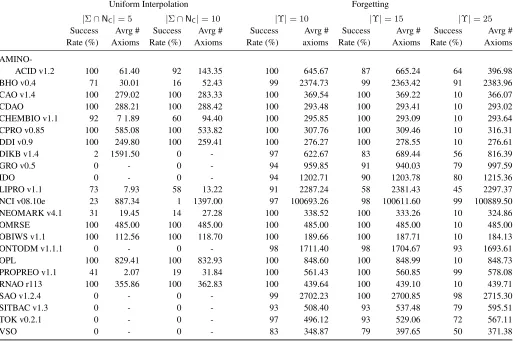
In the left half of Table 1 one can see that the number of successful computations decreased with increasing size of
Σ∩NC, which seems to be due to the fact that the >⊥∗
Σ-modules then contain more symbols that lead to a large number of inferences. Most uniform interpolants that we ob-tained are relatively small and contain a lot of expressions of the form∃r1. . .∃rn.>. In some cases the process of
for-getting certain intermediate concept names generated a few hundred clauses that were simplified or deleted in the re-maining computation steps. The success rate, however,
var-1
All ontologies used for the experiments reported on in this sec-tion can be accessed from the BioPortal repository,
http://bioportal.bioontology.org/ontologies
ied significantly from one ontology to another. To further investigate this phenomenon, we computed uniform inter-polants for a fragment of version 08.10e of NCI and for a fragment of version 1.4 of the Drug Interaction Know-ledge Base(DIKB) that are of expansion depth 3 (that is, we removed all the axioms from both ontologies that led to an expansion depth greater than 3). The resulting DIKB fragment is a small acyclic terminology that contains 120 concept names, 27 roles names, and 127 axioms. The NCI fragment is also an acyclic terminology with 53571 concept names, 78 role names and 62494 axioms (of which 2362 are of the formA≡C). The results obtained are shown in Table 2. Limiting the expansion depth drastically improved the performance of our prototype implementation with the success rate for signatures containing 5 randomly selected concept names rising from 2% to 85% in the case of DIKB and from 23% to 82% in the case of NCI. For NCI our tool is capable of handling signatures containing up to 150 ran-domly selected concept names.
As proof of concept for ontology obfuscation, we applied our uniform interpolation tool on (a fragment of) theLipid Ontology(LIPRO) to forget 45 concept names which are in-termediate concept names in the ontology’s induced concept hierarchy, i.e. those concept names group certain subcon-cepts together to give structure to the ontology. LIPRO is an acyclic terminology with 593 axioms, 574 concept names and one role name. The maximal size of an axiom is 50. It then took 192 CPU seconds to compute the uniform in-terpolant, which contains 3415 axioms that have a maximal size of 283. The uniform interpolant that we computed thus approximately contains 6 times more axioms than the ori-ginal ontology and the maximal axiom size has increased by a factor of 6 as well. Notice that most of the original struc-ture of the ontology has been destroyed while preserving all the consequences entailed by the retained concept names.
0 5000 10000 15000 20000 25000 30000 35000 40000 45000 50000
03.12 a 04.03n
04.05f 04.08b
04.11
a 04.12g 05.03d-‐C 05.05d
05.07d
05.09g 05.11f 06.01c 06.03d
06.05d 06.07d 06.09d 06.11d 07.01d 07.03d 07.05e 07.07c 07.09d
07.12
a 08.01d 08.03d 08.05d 08.07d 08.09d 08.10e 08.11d
09.01d 09.03d 09.05d 09.07e 09.09c 09.12d
10.02d
10.04f 10.06e 10.08e 10.10d
10.12c 11.02d
11.04d
11.06d
11.08e 11.10e 11.12e 12.02d
12.04e 12.06d
12.08d
Num
be
r of
diffe
re
nc
e witne
sse
s
0 2000 4000 6000 8000 10000 12000 14000
03.12 a
04.04j 04.06i
04.09
a 04.12g 05.03d-‐C 05.05d
05.07d
05.09g 05.11f 06.01c 06.03d
06.05d 06.07d 06.09d 06.11d 07.01d 07.03d 07.05e 07.07c 07.09d
07.12
a 08.01d 08.03d 08.05d 08.07d 08.09d 08.10e 08.11d
09.01d 09.03d 09.05d 09.07e 09.09c 09.12d
10.02d
10.04f 10.06e 10.10
a 10.11e 11.01e 11.03d
11.05e 11.08e 11.10e 11.12e 12.02d 12.04e 12.06d
12.08d 12.11d Num be
r of
diffe
re
nc
e witne
sse
[image:8.612.88.532.54.456.2]s
Figure 2: Logical Difference between NCI Versionsiandi+ 1(Top) and Versionsi+ 1andi(Bottom).
an ontology interferes with the meaning of the terms out-side the (typically small) fragment under conout-sideration in the context of computing the logical difference between two versions of an ontology.
Applications to Computing the Logical Difference. We selected10ontologies that have at least5submissions and whose expressivity is at leastALC, including 109 versions of the NCI Thesaurus, from the BioPortal repository.
For every pair of consecutive versions Ti and Ti+1,
where version i + 1 represents the more recent version, and every considered signature Σ, we computed both DiffΣ(Ti,Ti+1)andDiffΣ(Ti+1,Ti). We used the reasoner
FaCT++ v1.6.2 (Tsarkov and Horrocks 2006) to determ-ine whether any axiom C v D ∈ Ti(Σ) is a witness of DiffΣ(Ti,Ti+1), where T
(Σ)
i is the Σ-uniform interpolant
ofTicomputed with our tool (similarly forDiffΣ(Ti+1,Ti)).
Note that the results we obtained are not directly
compar-able with the logical difference computed for description lo-gics of the EL family (Konev, Walther, and Wolter 2008; Konev et al. 2012) as illustrated by Example 13.
In our first experiment we used Σ = (sig(Ti) ∩
sig(Ti+1))∪NR. This test captures any change to the
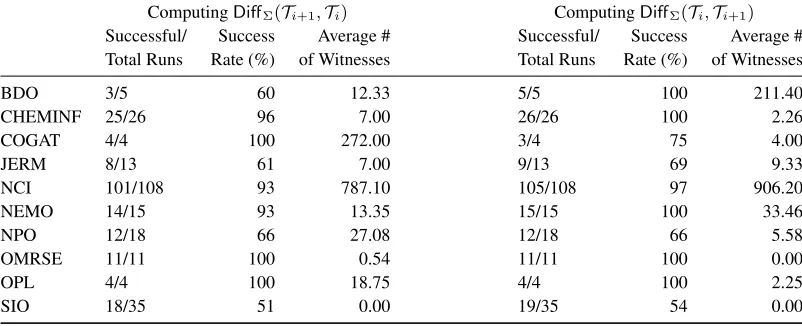
mean-ing of the terms common to both versions. The results of computing the logical difference are given in Table 3. No-tice that the success rate of computingDiffΣ(Ti,Ti+1)was
slightly higher than the one of the converse direction. This observation can probably be attributed to the fact that these cases correspond to knowledge contained in an older ver-sion being removed from a newer one, which does not seem to happen often.
DiffΣ(NCIv08.09d,NCI08.10e) DiffΣ(NCIv05.03d,NCI05.05d) DiffΣ(NCIv05.12f,NCI06.01c)
|(sig(T)\Σ) ∩NC|
Success rate (%)
Avrg # Witnesses
Success rate (%)
Avrg # Witnesses
Success rate (%)
Avrg # Witnesses 5 100 446.01 100 47 458.14 100 11 564.71 10 99 446.05 100 47 456.66 97 11 595.85 20 100 445.95 100 47 453.26 94 11 671.79 50 88 445.73 100 47 436.72 84 11 849.16 100 88 445.67 100 47 403.76 70 12 468.64
DiffΣ(NCI08.10e,NCIv08.09d) DiffΣ(NCI05.05d,NCIv05.03d) DiffΣ(NCI06.01c,NCIv05.12f)
|(sig(T)\Σ) ∩NC|
Success rate (%)
Avrg # Witnesses
Success rate (%)
Avrg # Witnesses
Success rate (%)
Avrg # Witnesses
5 98 2338.89 96 1347.92 99 13 704.29
10 98 2338.45 98 1348.47 100 13 788.15
20 97 2347.08 95 1348.66 95 13 841.52
50 92 2340.72 86 1351.56 87 14 062.52
[image:9.612.100.514.56.257.2]100 86 2385.88 74 1354.04 80 14 504.40
Table 4: Computing the Logical Difference between Versions of NCI.
gradually. Figure 2 depicts the number of witnesses that cor-respond to the logical difference between consecutive ver-sions of NCI on their common signature. Gonc¸alves, Parsia, and Sattler (2012b; 2012a) provide a comprehensive ana-lysis of the changes between 14 consecutive versions of NCI using various techniques, ranging from a manual inspection of the log files to approximations of the logical difference. Versions 06.01c, 06.08d and 05.12f were identified as hav-ing the highest number of differences. In our experiments, the highest number of logical difference witnesses were also present in NCI version 06.01c; the computations for versions 06.08d and 05.12f did not finish in time.
Furthermore, to make the experiments more challenging for the reasoner, we focused on comparing versioni with versioni+ 1, and vice versa, on the 2 pairs of NCI versions for which the highest number of difference witnesses was identified in the first experiment. We also included version 08.10e as this is the last acyclicALCTBox in the corpus. We performed tests on randomly generated large signaturesΣ
withΣ∩NR = sig(T)∩NR. In that way the computed
uniform interpolants remained rather large as well.
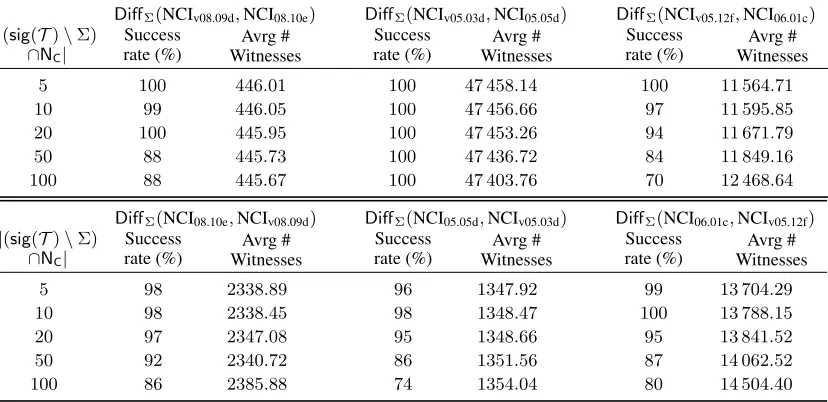
For each sample sizex∈ {5,10,20,50,100}we gener-ated 100 signatures by randomly choosing|sig(T)∩NC| −x
concept names from sig(T) and by including all the role names fromsig(T). The results that we obtained are now shown in Table 4.
One can observe that as size of sig(T)\Σ increased, i.e. more symbols had to be forgotten from the >⊥∗ Σ -modules, the success rate dropped slightly. Overall, the av-erage number of witnesses and the avav-erage maximal size of the witnesses remained comparable throughout the different sample sizes. Also, the axioms generated by the computa-tion of the uniform interpolant did not pose a problem for FaCT++ as computing the logical difference for a given sig-nature never took more than 20 seconds in our experiments.
Conclusion
In this paper we presented an approach based on clausal resolution for computing uniform interpolants of ALC-TBoxes T w.r.t. signatures Σ ⊆ sig(T) that contain all the role names present inT. We proved that whenever the saturation process underALC-resolution terminates, the al-gorithm computes a uniform interpolant. To guarantee ter-mination on all inputs, we introduced a depth-bounded ver-sion of our algorithm. We showed that by choosing an ap-propriate bound on the depth of clauses, one can axiomatise allΣ-inclusions implied by the given TBox up to a specified depth. Combined with a known bound on the size of uniform interpolants, our depth-bounded procedure always computes a uniform interpolant if it exists.
In the second part of this paper we investigated how of-ten our unrestricted resolution-based algorithm terminates with a uniform interpolant by applying our prototype imple-mentation on a number of case studies. Our findings suggest that despite a high computational complexity uniform inter-polants can be computed in many practical cases. The com-putation procedure could further benefit from better redund-ancy elimination techniques, which, together with extend-ing our approach to forgettextend-ing role names, constitutes future work. It would also be interesting to explore proof strategies for our resolution calculi that guarantee termination when uniform interpolants exist.
Acknowledgements. Michel Ludwig is supported by the German Research Foundation (DFG) within the Cluster of Excellence ‘Center for Advancing Electronics Dresden’ (cfAED). Boris Konev is supported by the EPSRC project EP/H043594/1.
References
Auto-mated Reasoning6(1):1–38.
Baader, F.; Calvanese, D.; McGuinness, D. L.; Nardi, D.; and Patel-Schneider, P. F., eds. 2007.The Description Logic Handbook. Cambridge University Press, 2nd edition edition. Baaz, M.; Egly, U.; and Leitsch, A. 2001. Normal form transformations. InHandbook of Automated Reasoning. El-sevier and MIT Press. 273–333.
Bachmair, L., and Ganzinger, H. 2001. Resolution theorem proving. InHandbook of automated reasoning, volume 1. Elsevier. chapter 2, 19–99.
Collberg, C. S.; Thomborson, C. D.; and Low, D. 1998. Manufacturing cheap, resilient, and stealthy opaque con-structs. In Proceedings of the 25th ACM SIGPLAN-SIGACT Symposium on Principles of Programming Lan-guages (POPL ’98), 184–196. ACM.
Conradi, R., and Westfechtel, B. 1998. Version models for software configuration management. ACM Computing Sur-veys (CSUR)30(2):232–282.
Cuenca Grau, B.; Horrocks, I.; Kazakov, Y.; and Sattler, U. 2008. Modular reuse of ontologies: theory and practice.
Journal of Artificial Intelligence Research (JAIR) 31:273– 318.
Eiter, T.; Ianni, G.; Schindlauer, R.; Tompits, H.; and Wang, K. 2006. Forgetting in managing rules and ontologies. In
Proceedings of the 2006 IEEE / WIC / ACM International Conference on Web Intelligence (WI 2006), 411–419. IEEE Computer Society.
Enjalbert, P., and del Cerro, L. F. 1989. Modal resolution in clausal form.Theoretical Computer Science65(1):1–33. Gonc¸alves, R. S.; Parsia, B.; and Sattler, U. 2012a. Concept-based semantic difference in expressive description logics. InDescription Logics, volume 846 ofCEUR Workshop Pro-ceedings. CEUR-WS.org.
Gonc¸alves, R. S.; Parsia, B.; and Sattler, U. 2012b. Concept-based semantic difference in expressive description logics. InInternational Semantic Web Conference (1), volume 7649 ofLecture Notes in Computer Science, 99–115. Springer. Herzig, A., and Mengin, J. 2008. Uniform interpolation by resolution in modal logic. In Proceedings of the 11th European Conference on Logics in Artificial Intelligence (JELIA 2008), volume 5293 ofLecture Notes in Computer Science, 219–231. Springer.
Jim´enez-Ruiz, E.; Grau, B. C.; Horrocks, I.; and Llavori, R. B. 2009. Contentcvs: A CVS-based collaborative on-tology engineering tool. InProceedings of the Workshop on Semantic Web Applications and Tools for Life Sciences, volume 559 of CEUR Workshop Proceedings. CEUR-WS.org.
Jim´enez-Ruiz, E.; Cuenca Grau, B.; Horrocks, I.; and Lla-vori, R. B. 2011. Supporting concurrent ontology develop-ment: Framework, algorithms and tool. Data & Knowledge Engineering70(1):146–164.
Klein, M. C. A.; Fensel, D.; Kiryakov, A.; and Ognyanov, D. 2002. Ontology versioning and change detection on the web. InKnowledge Engineering and Knowledge Manage-ment: Ontologies and the Semantic Web, volume 2473 of
Lecture Notes in Computer Science. Berlin/Heidelberg, Ger-many: Springer Verlag. 247–259.
Konev, B.; Ludwig, M.; Walther, D.; and Wolter, F. 2012. The logical difference for the lightweight description lo-gic EL. Journal of Artificial Intelligence Research (JAIR)
44:633–708.
Konev, B.; Walther, D.; and Wolter, F. 2008. The logical difference problem for description logic terminologies. In
Proceedings of the 4th International Joint Conference on Automated Reasoning (IJCAR 2008), volume 5195 of Lec-ture Notes in Computer Science, 259–274. Springer. Konev, B.; Walther, D.; and Wolter, F. 2009. Forgetting and uniform interpolation in large-scale description logic terminologies. InProceedings of the 21st International Joint Conference on Artificial Intelligence (IJCAI 2009), 830– 835.
Koopmann, P., and Schmidt, R. A. 2013. Uniform interpol-ation ofALC-ontologies using fixpoints. InProceedings of the 9th International Symposium on Frontiers of Combining Systems (FroCoS), volume 8152 ofLecture Notes in Com-puter Science. Springer.
Ludwig, M., and Konev, B. 2013. Towards practical uniform interpolation and forgetting forALCTBoxes. In Informal Proceedings of the 26th International Workshop on Descrip-tion Logics, volume 1014 ofCEUR Workshop Proceedings, 377–389. CEUR-WS.org.
Lutz, C., and Wolter, F. 2011. Foundations for uniform inter-polation and forgetting in expressive description logics. In Walsh, T., ed.,Proceedings of the 22nd International Joint Conference on Artificial Intelligence (IJCAI 2011), 989– 995.
Lutz, C.; Seylan, I.; and Wolter, F. 2012. An automata-theoretic approach to uniform interpolation and approxima-tion in the descripapproxima-tion logicEL. InProceedings of the Thir-teenth International Conference on Principles of Knowledge Representation and Reasoning (KR 2012). AAAI Press. Noy, N. F., and Musen, M. A. 2002. PromptDiff: A fixed-point algorithm for comparing ontology versions. In Pro-ceedings of the 18th national conference on Artificial intel-ligence, 744–750. Menlo Park, CA, USA: AAAI Press. Reiter, R., and Lin, F. 1994. Forget it! In Proceedings of AAAI Fall Symposium on Relevance, 154–159.
Sattler, U.; Schneider, T.; and Zakharyaschev, M. 2009. Which kind of module should I extract? In Proceedings of the 22nd International Workshop on Description Logics (DL 2009), volume 477 of CEUR Workshop Proceedings. CEUR-WS.org.
ten Cate, B.; Conradie, W.; Marx, M.; and Venema, Y. 2006. Definitorially complete description logics. InProceedings of the Tenth International Conference on Principles of Know-ledge Representation and Reasoning (KR 2006), 79–89. AAAI Press.
Reason-ing (IJCAR 2006), volume 4130 ofLecture Notes in Com-puter Science, 292–297. Springer.
Wang, Z.; Wang, K.; Topor, R.; and Pan, J. Z. 2008. For-getting Concepts in DL-Lite. In Proceedings of the 5th European Semantic Web Conference (ESWC2008), volume 5021 of Lecture Notes in Computer Science, 245–257. Springer.
Wang, Z.; Wang, K.; Topor, R. W.; and Zhang, X. 2010. Tableau-based forgetting in ALC ontologies. In Proceed-ings of the 19th European Conference on Artificial Intelli-gence (ECAI 2010), volume 215 ofFrontiers in Artificial Intelligence and Applications, 47–52.
Wang, K.; Wang, Z.; Topor, R.; Pan, J. Z.; and Antoniou, G. 2012. Eliminating concepts and roles from ontologies in expressive descriptive logics. Computational Intelligence. DOI: 10.1111/j.1467-8640.2012.00442.x.
The appendix is organised as follows. In Section B we give a proof of the refutational completeness with ordering constraints for the calculusT. We continue in Section C with establishing an important connection between the calculiTandTu, which
leads to a proof of the refutational completeness forTu. The aim of Section D is to establish the correctness of Algorithm 1,
which includes a proof the subsumption lemma forTf as well as some results regarding the application of theSupp-operator.
The correctness of the depth-bounded uniform interpolation algorithm is established in the sections E and F for the two cases of regular and acyclicALC-TBoxes. In Section G we address the correctness of the implementation by extending the subsumption lemma toTu,f.
A
Extended Definitions
In the following letRdenote the set of all sequencesr= (r1, . . . , rn)withri∈NRfor every1≤i≤n. The empty sequence
will be denoted by.
Forr= (r1, . . . , rn)∈ R, the expression∀r.C, whereCis a clause, denotes the clause∀r1. . . .∀rn.C.
The proof of the following lemma is a simple adaptation of CNF transformation for first-order formulae (Baaz, Egly, and Leitsch 2001).
Lemma 14(Clausification). LetCbe anALC-concept.
Then one can construct a set of clausesCls(C)fromCsuch that
• sig(Cls(C))⊆sig(C),
• max{Depth(C)| C ∈Cls(C)} ≤Depth(C), and • |=C≡d
C∈Cls(C)C.
The set of all clauses overNC∪NRwill be denoted by Clauses, whereas Clausesn(Υ)denotes the set of all clauses over the
signatureΥwhich are of depth at mostn. For a TBoxT we define that
Cls(T) ={Cls(¬CtD)|CvD∈ T } ∪ {Cls(¬CtD)|C≡D∈ T } ∪ {Cls(¬DtC)|C≡D∈ T }.
For a clauseC andr ∈sig(C), we defineC|∃r(C|∀r) to be the set of all the literals of the form∃r.F(∀r.D) contained inC.
Furthermore, for a clauseCletC|∃=Sr∈sig(C)C|∃randC|∀=Sr∈sig(C)C|∀r.
We define the set of subconcepts of a clauseC,sub(C), (or of a set of clausesF) inductively as follows: • for a clauseC, let
sub(C) ={C} ∪ C ∪ [ ∃r.F ∈C
sub(F)∪ [ ∀r.D∈C
sub(D)
• for a set of clausesF, letsub(F) =S
C∈Fsub(C).
In order to be able to prove completeness and reordering theorems, we need to be able to refer to individual inference rules ofTandTuby their name. We re-state the rules of the calculusTandTu. Then,Tconsists of two rules
C E1
(i1) C D
E2
(i2)
whereC,Dare initial clauses,C ⇒αE1, andC,D ⇒αE2.E1andE2are initial clauses.
The calculusTuconsists of two rules(i1)and(i2), and the following three inference rules:
C E1
(u1) C D
E2
(u2)
C0 D E0 (mix)
whereC,Dare universal clauses,C0is an initial clause or a universal clause,C ⇒
αE1,C,D ⇒αE2, and there existsr∈ R\{}
such thatC0,∀r.D ⇒
αE0.E1andE2are universal clauses, whereasE0is a universal clause ifC0is a universal clause andE0is
an initial clause otherwise. We also assume that every clauseE that results from aT- orTu-inference is implicitly simplified by exhaustively removing all occurrences of literals of the form∃r.(F,⊥).
In the following we also make use of two additional calculiTf andTu,f, which are defined analogously to the calculiT
andTu, respectively, except that they are based on the inference relation⇒f α.
Forx ∈ {T,Tf,Tu,Tu,f}andα ∈ N
C∪ {⊥,∃f}, we writeC(,D) `αx E if, and only if, the clause E results from an
x-inference onαfromC(andD).
Definition 15. LetΥbe a signature and letN be a set ofALCclauses. Forx∈ {T,Tu}, we define that
Resx,Υ,m(N) =N ∪ { C0| C1,C2∈ N,C1,C2`αx C
0, α∈ΥandDepth(C0)≤m}
∪ { C0| C1∈ N,C1`αx C
Additionally, forn∈N\ {0}, we define thatRes0x,Υ,m(N) =N, andRes n
x,Υ,m(N) = Resx,Υ,m(Resnx,Υ,m−1 (N)).
Finally, we set
Res∞x,Υ,m(N) = [
n∈N\{0}
Resnx,Υ,m−1 (N).
Definition 16(Derivation Tree). Letx∈ {T,Tu}. Ax-derivation tree∆built from a set of clausesN is a finite binary tree
∆ = (V, E, L)whereLis a labelling function which assigns to every nodenanALCclauseL(n)such that
(i) the leaves of∆are only assigned clauses fromN; and
(ii) for every noden∈V with immediate predecessorsn1(and potentiallyn2) it holds thatL(n)is the result of an inference
rule fromxapplied onL(n1)and potentiallyL(n2).
Aninference pathof∆is a sequence(α2, . . . , αm)where(n1, . . . , nm)is a path from a leafn1of∆to the rootnmand for
every2≤i≤m, the clauseL(ni)has been obtained through an⇒αiinference. The set of all inferences paths of∆is denoted
byInferencePath(∆). The set of all inferences that occur in∆, which is denoted byInferences(∆), is defined as follows:
Inferences(∆) = [
p=α2,...,αm∈InferencePath(∆)
{αi|2≤i≤m}
We will denote the set which contains all the leaves of∆byLeaves(∆), and we setNodes(∆) =V, Clauses(∆) ={L(n)| n∈Nodes(∆)}.
Definition 17((Υ,)-Path). A sequence(α1, . . . , αm)over(NC∪ {⊥})is a(Υ,)-path if, and only if,
• there exists0≤i≤msuch thatαj ∈Υfor every1≤j≤iandαiαi+1for every1≤j < i; and
• αj6∈Υfor everyi+ 1≤j≤m.
Definition 18(Υ-Derivation Tree). LetΥ⊆NCbe a set of concept names, letN be a set ofALCclauses, and letx∈ {T,Tu}.
A(x,Υ,)-derivation tree∆built from the setN is ax-derivation tree∆ = (V, E)such that every path(α1, . . . , αm)∈
InferencePath(∆)is a(Υ,)-path.
B
Proof of Refutational Completeness for
T
with Ordering Constraints on Inferences
In this section we prove refutational completeness ofT with ordering constraints. A weaker formulation of this result has already been announced in (Herzig and Mengin 2008); however, the proof given in (Herzig and Mengin 2008) does not seem to be correct. A pivotal for the method of (Herzig and Mengin 2008) is the following statement.CLAIM. [Lemma 1 of (Herzig and Mengin 2008)] Given clausesA,B,C,IandF, if there is anα-resolution fromA, possibly using side clauseB, giving clauseIand aβ-resolution fromI, possibly using side clauseC, giving clauseF, then there exist clausesI∗,F∗
1,. . . ,Fn∗(for somen≥0) andF∗such thatF∗subsumesFand there is aβ-resolution fromA, possibly using
side clauseC, giving clauseI∗, and a sequence ofα-resolutions fromI∗, possibly using side clauseB, giving successively F1∗,. . . ,FN∗,F
∗.
To observe where the claim falls short consider a clause setS ={∀r.A,∀r.¬A,∃r.C}. Then from∀r.Aand∀r.¬Awe can derive∀r.⊥, and then⊥using∃r.C, i.e. we first resolved onAand then on⊥. However, contrary to the claim above, it’s not possible to first resolve on⊥using clauses fromSonly. As the following (more involved) example demonstrates, the problem is not limited toβbeing⊥.
Example 19. Consider a set of clausesS0 ={C
1 =¬AtB,C2 =AtB,C3 =¬B}. By first resolving onAbetweenC1
andC2, one obtains the unit clauseB, from which one can derive the empty clause by resolving onB with C3. But by first
resolving onB betweenC1 andC3one obtains the unit clause¬A, which can be resolved withC2 onAto deriveB. But no
further inferences onAare possible andB≤s⊥does not hold. (This problem is caused by the implicit positive factorisation
built into the calculus of (Enjalbert and del Cerro 1989) and (Herzig and Mengin 2008).)
Additionally, for the proof of Proposition 1 in (Herzig and Mengin 2008) to work, it would be necessary to have proved the subsumption lemma already.
In our approach rather than restructuring a given proof we impose ordering constraints on derivations directly in the proof of completeness. Following (Enjalbert and del Cerro 1989), we start by introducing a variation of tableau forALCclauses and then show that an ordered derivation can be effectively constructed from the tableau.
Definition 20(Model Tree). LetT be a TBox and letN be a finite set ofALCclauses.
Amodel treeM = (V, E, L)for the TBoxT and the set of clausesN is a directed and labelled tree(V, E)with a node labelling functionL: V →℘(Clauses)that is constructed iteratively as follows fromV =E=∅:
• Additional children are constructed by alternating between the following two operations on leaf nodesn:
Operation 1: Repeat as long as possible
(i) choose a leafnand a clauseCinL(n)of the formC1t C2withC16=∅andC26=∅
(ii) append two childrenn1,n2tonsuch that:
L(n1) =n\ {C} ∪ {C1}andL(n2) =n\ {C} ∪ {C2}
Operation 2: For each leaf nodenofM,
• if{A,¬A} ⊆ L(n)for some concept nameA, or⊥ ∈L(n), or if there exists an ancestorn0withL(n0) =L(n), then do nothing;
• otherwise, asL(n)is a set of unit clauses, we can write
L(n) ={L1, . . . ,Lm} ∪ l
[
i=1
{∃ri.Fi} ∪ p
[
j=1
{∀sj.Cj},
where everyLi,1≤i≤mis either a concept names of the negation of a concept names.
Define childrennk (1≤k≤l) ofnsuch that:
L(nk) =Fk∪ { Cj |1≤j≤pandrk=sj} ∪Cls(T)
The nodenkis said to be anrk-successorofn.
Remark 21. AsL(n)⊆sub(N ∪Cls(T))holds forn=n0and for every noden∈V that results from Operation 2, and as
sub(N ∪Cls(T))is finite, one can see that every model tree forN w.r.t.T only contains finitely many nodes.
Lemma 22. In a model treeMforN w.r.t.T a node that containsA,¬Afor some concept nameAcannot have a type 2 descendant.
Proof. Follows immediately from the construction principles of model trees.
Definition 23. In a model treeMforN w.r.t.T
• a leaf nodenis said to beclosedif and only if{A,¬A} ⊆L(n)for some concept nameA, or⊥ ∈L(n); • for a nodenof type 1 with successors,nis said to be closed if and only if all of its children are closed; • for a nodenof type 2 with successors,nis said to be closed if and only if one of its childrenn0is closed. A nodenwhich is not closed is said to beopen.
The following lemma can easily be proved by induction on the size of a model tree. Lemma 24. Letnbe an open node in a model treeMforN w.r.t.T.
Then there exists a sub-treeSofMwith rootnsuch that
• every node ofSis open, and
• every node of type 1 has exactly one child, and
• the children of every noden0of type 2 inSare exactly the children ofn0inMofN w.r.tT.
The following proofs are variations/extensions of the proofs found in (Enjalbert and del Cerro 1989). Lemma 25. LetT be a TBox and letN be a finite set of clauses.
Then for every open model treeMforN w.r.t.T there exists a modelIofT such thatT
C∈NCI6⊆ ⊥I.
Proof. LetS= (V, E, L)be the sub-tree ofMforN w.r.tT, with rootn0that is obtained from Lemma 24. Additionally, letR
be the smallest equivalence relation containing(n, n0)for every nodenofSsuch thatn0is a type 1-child ofn. The equivalence class of a noden∈ Sw.r.t.Rwill be denoted by|n|.
We define the interpretationIas follows:
• ∆ ={ |n| |n∈E},
• for every atomic concept nameA:
AI={ |n| | ∃n0 ∈ |n|such thatA∈L(n0)},
• for every role namer:
rI ={(|n1|,|n2|)|(n1, n2)∈ Sandn2is anr-successor ofn1}
∪ {(|n1|,|n2|)| ∃n˜1such thatn˜1is an ancestor ofn1,
We now prove for every clauseCand for every nodenofSwithC ∈L(n)that|n| ∈ CIholds by induction on the structure ofC.
IfC=A, then|n| ∈AIholds for every nodenofSwithC ∈L(n)by definition of the interpretationI.
ForC =¬A, letnbe a node ofSwithC ∈L(n). It follows for every noden0 ∈ |n|thatA6∈n0 as every such noden0is open and as the presence ofAin a noden0of type 1 would imply thatAis also present in all of its type 1-children. Hence, we can infer that|n| 6∈AI, i.e.|n| ∈(¬A)Iholds.
In the case whereC=C1t C2, letnbe a node ofSwithC ∈L(n). We can infer that the nodenis of type 1, i.e. there exists a
type 1 descendantn0ofCsuch that eitherC1∈L(n0)orC2∈L(n0). It follows from the induction hypothesis that|n0| ∈(C1)I,
or|n0| ∈(C
2)I. We can conclude that|n|=|n0| ∈ CI.
ForC=∃r.F, letnbe a node ofSwithC ∈L(n). By construction ofSthere exists a noden0∈ |n|such that∃r.F ∈L(n0)
and such that all the clauses inL(n0)are unit clauses. Asn0is open, there hence exist nodesn˜0,n˜00∈Ssuch thatL(n0)⊆L(˜n0)
andn˜00is anr-successor of˜n0withF ⊆L(n00), i.e. eithern0= ˜n0orn˜0is an ancestor ofn0withL(n) =L(n0). It then follows from the induction hypothesis that|n˜00| ∈(d
D∈FD)I. As(|n0|,|˜n00|)∈rI, it follows that|n|=|n0| ∈ CI.
Finally, ifC=∀r.D, letnbe a node ofS withC ∈L(n)and let|n0| ∈∆such that(|n|,|n0|)∈rI. By construction ofS there exists a nodenu∈ |n|such that∀r.D ∈L(nu)and such that all the clauses inL(nu)are unit clauses. By definition ofrI
there hence exists a node˜ninSsuch thatL(nu) =L(˜n)and such that there exists a noden˜0which is ar-successor of˜nwith
|n˜0|=|n0|, i.e. we haveD ∈n˜0by construction ofS. Thus,|n0|=|n˜0| ∈ DIby the induction hypothesis. We can hence infer that|n| ∈ CIholds.
We can conclude now thatIis a model ofT as for every|n| ∈∆Ithere exists˜n∈ |n|withCls(T)⊆L(˜n), which implies that|n| =|n| ∈˜ T
D∈Cls(T)D
I. Finally, it remains to observe that asN ⊆L(n
0), we have|n0| ∈TC∈NCIand therefore,
T
C∈NCI6⊆ ⊥I.
We summarise the properties of the model trees in the following two lemmas, which can easily be proved by induction on the construction of the model tree.
Lemma 26. LetT be a TBox, letN be a finite set of clauses and letIbe a model ofT such thatT
C∈NCI 6⊆ ⊥I.
Then there exists an open model treeMforN w.r.t.T.
Lemma 27. Letnbe a closed node in a model treeMforN w.r.t.T.
Then there exists a finite treeT with rootnwhich is a sub-tree ofMand which only contains closed nodes.
Our next aim is to show that one can construct a(T,Υ,)-derivation out of the clauses contained in an arbitrary closed node in a model tree. We proceed by induction on the depth of a closed node. In order to do that we distinguish between whether the considered close node results from type 1 or type 2 expansion of the model tree, and we begin with showing that refutations can be constructed for closed type 1 nodes. The main result will be established in Lemma 41 by using the property that inferences can be reordered (Lemma 33). However, to avoid complications that can arise from implicit factoring as illustrated in Example 19 above we ‘split’ clauses using the following notion of a bipartite derivation. Then, when dealing with closed type 1 nodes and the associated unsatisfiable disjunction of the formD1t D2, refutations forDi, fori= 1,2belong
to different partitions and can, therefore, be treated independently.
Definition 28. For a clauseCand forx∈ {l, r}we denote by[C]xthe clause that results fromCby consistently replacing every
concept nameAwhich occurs inCwith the concept nameAxand every role namerwhich occurs inCwithrx. We assume that
A clauseCis said to bebipartiteif, and only if, there exist clausesDandE such thatC = [D]l∪[E]r. A bipartite clauseCis
also denoted by[C].
For a bipartite clauseC= [D]l∪[E]r,[C]ldenotes the clauseDand[C]rdenotes the clauseE.
Definition 29. AT-derivation∆from premisesN is said to bebipartiteif, and only if, the clauses inN are bipartite.
We establish properties of bipartite derivations. The following statement is a direct consequence of the bipartite derivation definition.
Lemma 30. Let∆be a bipartite derivation. Then it holds that every clause that occurs in∆is bipartite and for every derivation step[C](,[D])⇒α[E]in∆it holds that either
• [C]l(,[D]l)⇒α[E]land[E]r= [C]r∪[D]r, or
• [E]l= [C]l∪[D]land[C]r(,[D]r)⇒α[E]r.
Lemma 31. If[C1]l∪[C2]r(,[D1]l∪[D2]r)⇒[α]x [E1]l∪[E2]r, wherex∈ {l, r}, and[C 0
1]l∪[C20]r⊆[C1]l∪[C2]r,[D01]l∪[D02]r⊆
[D1]l∪[D2]r, then either
• [C0
1]l∪[C20]r⊆[E1]l∪[E2]r, or
• [D0
1]l∪[D20]r⊆[E1]l∪[E2]r, or
• [C0
1]l∪[C20]r(,[D10]l∪[D20]r)⇒[α]x [E 0
Proof. We distinguish between the following two cases.
IfC1(,D1)⇒αE1, letLC1andLD1 be the respective literals ofC1andD1that are resolved upon, i.e.LC1∈ C1,LD1 ∈ D1, andE1 = C1\ {LC1} t D1\ {LD1} t LwithLC1(,LD1) ⇒α L(L may be⊥). It also holds thatE2 = C2t D2. Now, if LC1 6∈ C
0
1, thenC10 ⊆ C1\ {LC1}and[C 0
1]l∪[C20]r⊆[E1]l∪[E2]rholds. Similarly, ifLD1 6∈ D 0
1, we haveD10 ⊆ D1\ {LD1}and
[D0
1]l∪[D02]r⊆[E1]l∪[E2]r. We can now assume thatLC1∈ C 0
1andLD1 ∈ D 0
1. It is then easy to see thatC10(,D10)⇒αE10with
E0
1=C10 \ {LC1} t D 0
1\ {LD1} t LandE 0
1⊆ E1. We can conclude that[E10]l∪[E20]r⊆[E1]l∪[E2]rholds asE20 =C20 ∪ D02⊆
C2∪ D2=E2.
The case forC2(,D2)⇒αE2can be proved analogously.
Lemma 32. If[C1]l∪[C2]r,[D1]l∪[D2]r⇒[α]x [E1]l∪[E2]randC ∗⊆ C
1∪ C2,D∗⊆ D1∪ D2, then either
• C∗⊆ E1∪ E2, or
• D∗⊆ E
1∪ E2, or
• C∗,(D∗)⇒
αE∗such thatE∗⊆ E1∪ E2.
Proof. We distinguish between the following two cases.
IfC1(,D1)⇒αE1, letLC1andLD1be the respective literals ofC1andD1that are resolved upon, i.e.E1=C1\ {LC1} t D1\ {LD1} t LwithLC1(,LD1)⇒αL(Lmay be⊥). It also holds thatE2=C2t D2. Now, ifLC1 6∈ C
∗, thenC∗⊆ C
1\ {LC1} ∪ C2 andC∗⊆ E
1∪ E2holds. Similarly, ifLD16∈ D
∗, we haveD∗⊆ D
1\ {LD1} ∪ D2andD ∗⊆ E
1∪ E2. We can now assume that
LC1 ∈ C
∗andLD 1 ∈ D
∗. It is then easy to see thatC∗(,D∗)⇒
αE∗with
E∗=C∗\ {L C1} t D
∗\ {L D1} t L
⊆ C1\ {LC1} t D1\ {LD1} t L t C2t D2
=E1∪ E2.
The case forC2(,D2)⇒αE2andE1=C1∪ D1can be proved analogously.
We now show that inferences acting on different partitions of a bipartite derivation can be reordered. In what follows, for x∈ {l, r}, we setx¯=r, wheneverx=l, andx¯=l, wheneverx=r.
Lemma 33. If[C](,[D])⇒[α]x [I]and[I](,[E])⇒[β]x [F], then it holds that there exists a clauseF
∗ such that[F∗]⊆[F]
and either
• [C](,[E])⇒[β]x [I
∗]and[I∗](,[D])⇒
[α]x [F ∗]; or
• [D](,[E])⇒[β]x [I
∗]and([C],)[I∗]⇒
[α]x [F ∗]; or
• [C],[E]⇒[β]x [I ∗
1]and[D],[E]⇒[β]x[I ∗
2]and[I1∗],[I2∗]⇒[α]x[F ∗].
Proof. LetLC∈[C]xandLD ∈[D]xsuch thatLC(,LD)⇒αL1,
[I]x= [C]x\ {LC} ∪[D]x\ {LD} ∪ L1
and[I]x= [C]x∪[D]x. Furthermore, letL ∈[I]x,LE ∈[E]xsuch thatL(,LE)⇒β L2and
[F]x= [I]x∪[E]x
= [C]x\ {LC} ∪[D]x\ {LD} ∪ {L1} ∪[E]x
and
[F]x= [I]x\ {L} ∪[E]x\ {LE} ∪ {L2}
= ([C]x∪[D]x)\ {L} ∪[E]x\ {LE} ∪ {L2}.
Now we distinguish between the following cases forL ∈[I]x= [C]x∪[D]xto hold.
IfL ∈[C]x∩[D]x, then there exist clauses[I1∗]and[I2∗]such that
[C]x(,[E]x)⇒[β]x [I ∗
1]x= [C]x\ {L} ∪[E]x\ {LE} ∪ {L2},
[I∗
1]x= [C]x∪[E]xand
[D]x(,[E]x)⇒[β]x [I ∗
2]x= [D]x\ {L} ∪[E]x\ {LE} ∪ {L2},
and[I∗
2]x= [D]x∪[E]x. Additionally, we can infer that there exists a clause[F∗]such that
[I1∗]x(,[I2∗]x)⇒[α]x [F ∗]
x= ([C]x∪[E]x)\ {LC} ∪([D]x∪[E]x)\ {LD} ∪ {L1}
and
[F∗]x= [I1∗]x∪[I2∗]x= [C]x\ {L} ∪[D]x\ {L} ∪[E]x\ {LE} ∪ {L2}.