This is a repository copy of Interaction between toothbrushes and toothpaste abrasive particles in simulated tooth cleaning.
White Rose Research Online URL for this paper: http://eprints.whiterose.ac.uk/744/
Article:
Lewis, R., Dwyer-Joyce, R.S. and Pickles, M.J. (2004) Interaction between toothbrushes and toothpaste abrasive particles in simulated tooth cleaning. Wear, 257 (3-4). pp. 368-376. ISSN 0043-1648
https://doi.org/10.1016/j.wear.2004.01.015
Reuse
Unless indicated otherwise, fulltext items are protected by copyright with all rights reserved. The copyright exception in section 29 of the Copyright, Designs and Patents Act 1988 allows the making of a single copy solely for the purpose of non-commercial research or private study within the limits of fair dealing. The publisher or other rights-holder may allow further reproduction and re-use of this version - refer to the White Rose Research Online record for this item. Where records identify the publisher as the copyright holder, users can verify any specific terms of use on the publisher’s website.
Takedown
If you consider content in White Rose Research Online to be in breach of UK law, please notify us by
White Rose Consortium ePrints Repository
http://eprints.whiterose.ac.uk/
This is an author produced version of a paper published in Wear. This paper has been peer-reviewed but does not include the final publisher proof-corrections or journal pagination.
White Rose Repository URL for this paper: http://eprints.whiterose.ac.uk/archive/00000744/
Citation for the published paper
Lewis, R. and Dwyer-Joyce, R.S. and Pickles, M.J. (2004) Interaction between
toothbrushes and toothpaste abrasive particles in simulated tooth cleaning. Wear, 257
(3-4). pp. 368-376.
Citation for this paper
To refer to the repository paper, the following format may be used:
Lewis, R. and Dwyer-Joyce, R.S. and Pickles, M.J. (2004) Interaction between
toothbrushes and toothpaste abrasive particles in simulated tooth cleaning. Author
manuscript available at: [http://eprints.whiterose.ac.uk/archive/00000744/] [Accessed:
date].
Published in final edited form as:
Lewis, R. and Dwyer-Joyce, R.S. and Pickles, M.J. (2004) Interaction between
toothbrushes and toothpaste abrasive particles in simulated tooth cleaning. Wear, 257
INTERACTION BETWEEN TOOTHBRUSHES AND
TOOTHPASTE ABRASIVE PARTICLES IN SIMULATED
TOOTH CLEANING
R. Lewis*,a, R.S. Dwyer-Joycea, M.J. Picklesb
a
Department of Mechanical Engineering, The University of Sheffield, Mappin Street,
Sheffield, S1 3JD
b
Unilever Oral Care, Quarry Road East, Bebington, Wirral, CH63 3JW
*Corresponding author. Tel. +44 (0) 114 2227838; Fax. +44 (0) 114 2227890
ABSTRACT
There are currently many toothbrush designs on the market incorporating different
filament configurations such as filaments at various angles and different lengths and
made from several different materials. In order to understand how the tooth cleaning
process occurs there is a need to investigate in detail how the abrasive particles in a
toothpaste interact with the filaments in a teeth cleaning contact and cause material removal from a plaque or stain layer.
The following describes the development of optical apparatus to enable the
visualisation of simulated teeth cleaning contacts. Studies have been carried out using
the apparatus to investigate particle entrainment into the contact and how it differs
with varying bristle configurations. The effects of filament stiffness and tip shape
were also investigated. Various types of electric toothbrushes were also tested.
The studies have shown how particles are trapped at the tips of toothbrush filaments.
Particles, suspended in fluid, approach the filament tips, as they pass through they
may become trapped. Greater particle entrainment into the filament tip contact occurs
with a reciprocating action at low filament loads and deflections than with a sliding
motion. Large particles are less likely to enter tip contacts and are trapped between
tips or under the filament bend at higher loads.
Whether the particles are likely to be trapped and how long they remain so depends
on the filament stiffness and degree of splay on loading and the filament
configuration. The direction the filaments point in, the number of filaments in a tuft,
flexible filaments that splayed out on loading as they present more of a barrier to
particle entry and exit from the tip region.
1 INTRODUCTION
Teeth are usually cleaned using a toothpaste, consisting of abrasive particles in a
carrier fluid, with a filament based toothbrush. Toothbrush and toothpaste
effectiveness is typically assessed using in vitro tests carried out on tooth brushing
simulators or by using in vivo tests. A number of different simulators have been
developed [1, 2, 3, 4]. Most of these simulators work by mechanically loading and moving a toothbrush head over a test specimen, which is typically made from dentine,
enamel or acrylic. The performance of a brush design is usually compared with that of
a standard brush using a standard toothpaste.
The effects of some key brushing parameters on abrasive cleaning have been studied
using both in vivo and in vitro testing. Brushing load and technique as well as
filament stiffness and orientation are thought to have an influence [1, 5, 6, 7, 8]. There
is, however, no clear understanding of why these parameters affect cleaning
effectiveness.
Brush designs are becoming more complex and may incorporate filaments at various
angles and different lengths and use several different materials. In order to understand
how the tooth cleaning process occurs there is a need to investigate in detail how the
abrasive particles in a toothpaste interact with the filaments in a teeth cleaning contact
and cause material removal from a plaque or stain layer. New testing techniques are
required to carry out such studies as current test methods, described above, are only
able to give the final result without giving information about mechanisms occurring in
the contact.
study particle entrainment into the contact and how it differs with varying toothbrush
bristle configurations. The effect of filament stiffness and tip shape were also
investigated. Particle entrainment with different electric toothbrushes was also investigated.
2 VISUALISATION APPARATUS
In tooth brushing two techniques are generally used; a short uni-directional stroke and
a reciprocating brushing motion. In order to study particle entrainment for various
brush designs, two rigs, one to simulate each type of motion, were developed.
2.1 Sliding Apparatus
Simple optical apparatus was used to enable the visualisation of a simulated teeth
cleaning contact using uni-directional sliding (shown in Figure 1). A toothbrush head
is loaded against a rotating glass disc using a hydraulic actuator. The toothbrush head
is located in a clip attached to the hydraulic actuator. Load was varied either by using
the actuator or by varying the displacement of the toothbrush head relative to the glass
disc (and hence the filament deflection) using spacers. The fluid/abrasive particle
mixture is applied either to the brush head prior to loading against the glass disc or
fed into the contact as the disc is rotating.
The contact region was observed using a positionable microscope attached to the rig.
2.2 High Frequency Reciprocating (HFR) Rig
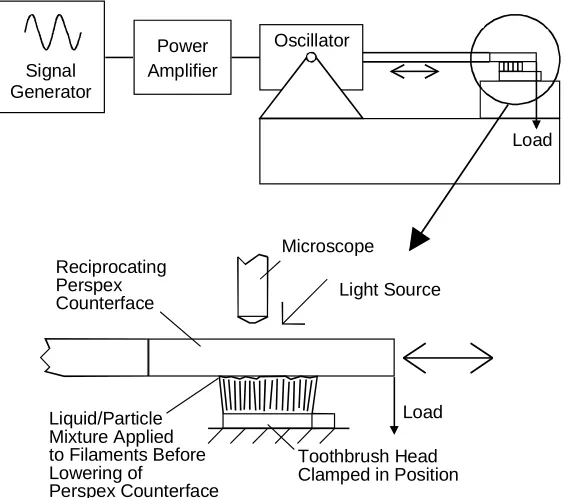
A high frequency reciprocating (HFR) rig was set-up as shown in Figure 2 in order to
enable visualisation of the cleaning contact. The toothbrush head is clamped in
position and the fluid/particle mixture was applied to the top of the filaments. A
colourless perspex counterface on the end of an arm attached to an oscillator is then
loaded against the toothbrush head. A power amplifier was used to control the frequency and amplitude of the reciprocating motion. The contact region was again
viewed through a microscope.
3 EXPERIMENTAL DETAILS
3.1 Specimens
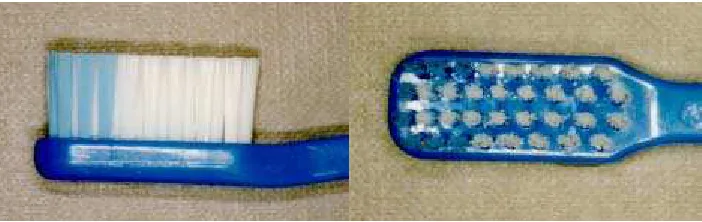
Standard toothbrushes consisting of equi-spaced tufts of filaments of equal length were used in the tests to study particle entrainment and the effect of fluid viscosity,
brushing load and speed (as shown in Figure 3).
Subsequent tests, to study the effect of filament configuration, length, angle and
stiffness on particle entrainment, used several different toothbrush head designs (as
shown in Figure 4).
Tests were also carried out using a toothbrush with a flexible head design. The brush
head consists of stiff and flexible regions intended to allow the filaments to adapt to
the contours of the teeth.
Tests were run using a brush with flat filament tips to provide a comparison with the
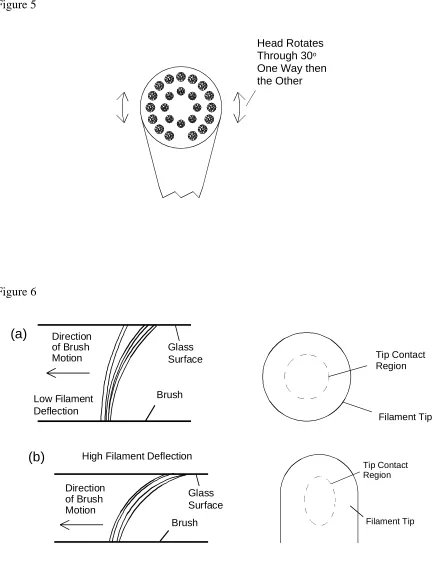
Two different types of electric toothbrush were tested. The first, shown in Figure 5,
has a rotary action and the other simply vibrates. The head of the rotary action brush
is circular and consists of two rings of filaments, the inner ring being slightly shorter
than the outer ring. The head rotates 15° either side of the central position. The
motion was frozen using a stroboscope. This indicated that the brush operates at 1600
rpm. The vibrating brush has a conventional toothbrush head.
Large (200-300µm) coloured silica particles were used in the initial tests because they
were easy to observe during motion. Later tests used ~10µm silica particles which are
typical of the abrasives used in many toothpastes. The fluids used were glycerol or
water. Particle/fluid mixtures were made up at 1% concentration by mass.
3.2 Operating Conditions
Loads and brushing speeds used in the tests were based on reported measurements
taken during in vivo experiments [5, 6]. Loads ranged from 250g to 900g and brushing
speeds from 3cm/s to 15cm/s.
In the reciprocating motion tests, amplitude and frequency were varied to establish
their effect on particle entrainment (amplitudes used were 0-2mm and frequencies
1-2Hz).
In all tests the particle/fluid mixture was applied to the filaments prior to the glass
4 RESULTS
4.1 Filament Deformation
As shown in Figure 6a, in the sliding motion tests the filaments all deflected in the
opposite direction to the brush motion on loading. As the filaments pressed against
the glass a contact point at each tip was visible (see Figure 6a). As the load was
increased the filaments deflected further and the contact point with the glass moved
down the filament, taking on an oval rather than round shape (see Figure 6b). As will
be described in subsequent sections, particles passed through the filament tips and
accumulated around the contact regions. Some entered these regions and became trapped between the tips and the glass disc.
When using equi-spaced tufts of straight filaments of graduated lengths the filaments
splayed in all directions on loading and few clumps of filaments formed (see Figure
7a). Tufts of angled filaments pointing in opposite directions deflected in whichever
direction they were angled on the brush head (see Figure 7b).
4.2 Particle Motion and Trapping
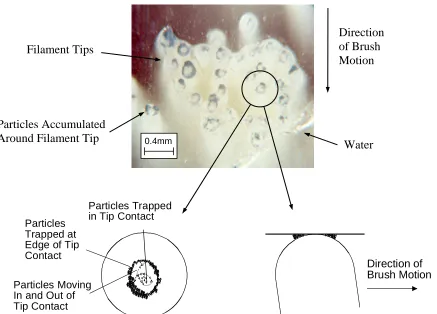
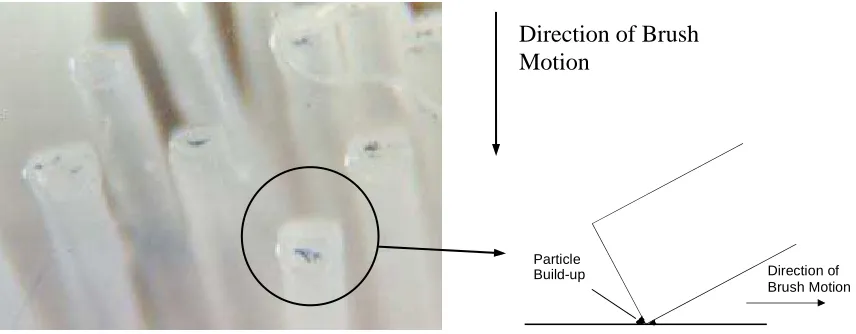
With sliding motion using the standard toothbrush design (see Figure 3), when the
disc rotation was started and the simulated sliding brush motion began, the fluid and
particle mixture moved around the filament tips pressed against the glass. When using
10µm silica particles mixed with water, particles were seen to accumulate evenly at
the edge of the filament tip contacts, as shown in Figure 8. During and after the
accumulation process particles were seen to pass from the edge of the accumulation
accumulation of particles (see Figure 8), while others remained in the tip contact.
Raising the brushing speed increased the particle motion.
When using a reciprocating motion, particles were trapped at the filament tip contacts as shown in Figure 9. Generally particles remained trapped as the frequency and
amplitude were increased and more water was applied, although a few particles were
seen to work their way in and out of the tip contact region. This differed from tests
run with sliding motion where particles were dragged though the filament tip contacts.
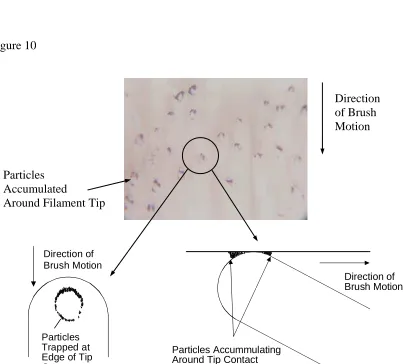
When using higher loads with a sliding motion the filaments deflected further moving
the contact region slightly down the filaments. When using 10µm silica particles
mixed with water the particles were again seen to gradually accumulate around the
edge of the filament tip contact, as shown in Figure 10. The particle formation took on
an oval shape due to the different contact geometry and greater numbers built-up
behind the tip contacts as if stagnation regions had formed. Less particles were
trapped overall than at lower loads.
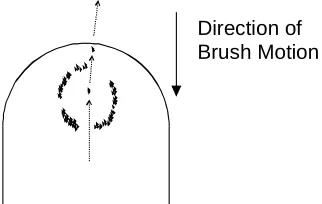
As the accumulation process was occurring, particles were seen to pass through the
filament tip contact as shown in Figure 11. Once the accumulation process had
finished, however, no particles were visible in the filament tip contact region.
When using equi-spaced tufts of straight filaments of graduated lengths with a sliding
motion the filaments splayed in all directions on loading (see Figure 7a). As a result
there were few filament clumps in which particles could become entrained and
particles were able to force their way through those that did form as they were so
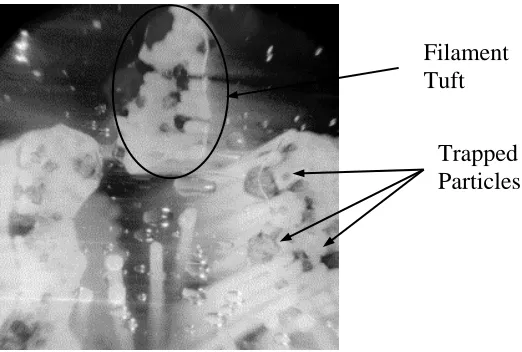
On loading, tufts of angled filaments were deflected further in whichever direction
they were angled on the brush head, but still remained clumped (see Figure 7a).
Particles entrained at the ends of these tufts remained so (see Figure 13).
4.3 Effect of Stiffness and Filament Tip Shape
The large tuft of relatively stiff filaments used to investigate whether filament stiffness played a role in particle entrainment deflected little on loading. It was found
that particles trapped initially remained lodged in their original positions (see Figure
14). More flexible filaments, under the same applied load, deflected more and splayed
out. Particles were therefore able to pass through the filament tips and less particle
trapping occurred (see Figure 14).
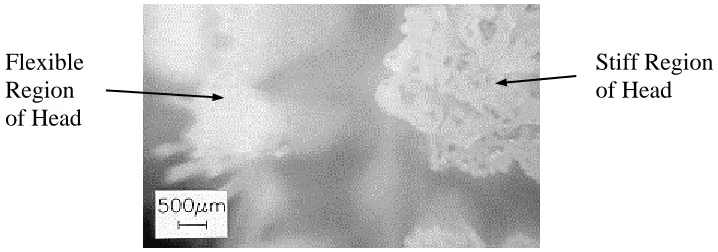
On loading the toothbrush with a flexible head design particles were observed to
move out of the filament tufts initially, especially in the flexible region of the head.
More particles were entrained in the tufts of filaments in the stiff region of the head
(see Figure 15). Increasing the velocity increased the particle movement. These
results are similar to those observed for the stiff and flexible filaments.
When using flat ended filaments at low load with a sliding motion, particles were
trapped under the filament tip where it made contact with the glass disc, as shown in
Figure 16. Particles were seen to move around under the rest of the filament tip
moving in and out of the tip contact region. This was different to the accumulation
seen with a rounded filament tip, as shown in Figure 8, where far more particles were
trapped.
glass disc (see Figure 17). It is unlikely these particles were under any load in this
position. No particles were trapped in the filament tip contact region. Again this
differs largely from the particle trapping for a rounded filament tip at higher load (see Figure 10).
4.4 Electric Toothbrushes
When using the rotary action brush, particle entrainment within the contact was very
different from tests run with a conventional brush. Particles were more easily able to
move through the filament tips. This was mainly because of the filament tuft
arrangement, but also because the filaments were moving relative to the counterface.
Trapped particles were agitated within their position (see Figure 18a), which was also
not observed with manual brushing simulations. Rotation of the glass disc increased
the particle motion. There was a flow of fluid around the edge of the outer ring of
filament tufts. This moved particles in and out of the edge of the filament tip region.
When using the vibrating brush “swirls” were visible indicating the path of the
filament tips against the glass disc (see Figure 18b). These indicated that the tips
followed an orbital path which was approximately twice the length of a filament
diameter (~0.4mm). Particle motion was highest in the filaments that were more
splayed out and particles were again agitated within their position. Rotation of the
glass disc promoted particle movement through the contact. Increasing the load
stopped the motion of the filaments.
DISCUSSION
The particle entrainment process in a model teeth cleaning contact occurs in the
following manner; Particles, suspended in fluid, approach the filament tips, as they
pass through they may become trapped. Where and how the particles are trapped
depends largely on the brushing action, the applied load to the filaments, and hence
the degree of filament deflection.
When using a sliding motion small particles build-up at the edge of the filament tip
contact and enter and circulate in the contact. Increasing the load changes the contact
geometry and leads to less particles remaining in the tip contact region. Larger
particles tend to be trapped between the filament tips with only a few entering the tip
contact region. At higher loads and hence deflections the particles are trapped under
the end of the filaments and none enter the contact regions.
When using a reciprocating motion far more particles are trapped in the tip contact
regions than with the sliding motion and they are only dislodged at high amplitudes or
frequencies.
Whether the particles are likely to be trapped and how long they remain so depends
on the filament stiffness, and hence degree of splay on loading and the filament
configuration.
The direction the filaments point in, the number of filaments in a tuft, the spacing of
the tufts and the way the filaments splay when deflected all have an influence on
entrainment of particles. Tufts with tightly packed stiff filaments which deflected
For all the tests carried out using the optical apparatus the toothbrush head was loaded
against the glass disc as shown in Figure 19 (i.e. initial brush configuration
perpendicular to the surface). Different brushing techniques, however, may cause the brush head to be used in different orientations, as shown in Figure 20. Clearly this
will influence the effect the filament configuration has on entrainment and filament
deflection will certainly not be uniform in the cleaning contact.
The tests carried out using the optical apparatus employed a flat counterface. In
reality the tooth surface is full of grooves and crevices. This will obviously affect
particle entrainment to a similar degree as toothbrush head orientation. It seems likely
that filaments that splay more will be more able to enter the grooves and crevices in a
real tooth surface.
Rounded filament tips have been recommended in the past as flat ended filaments
have been shown to cause soft tissue damage [9]. This was thought to be due to the
sharp edges present on the flat ends. This study has shown that flat ended filaments
entrain and trap less particles at the filament tip region than filaments with rounded
tips which implies that filaments with rounded tips should also give a higher cleaning
efficiency.
Electric toothbrushes increase the particle motion and agitate trapped particles. At
high loads, however, the filament motion is decreased.
CONCLUSIONS
Visualisation tests run using the apparatus to study particle entrainment into the
cleaning contact using various toothbrush designs, have shown that:
• With a sliding motion small particles accumulate around the edge of a filament tip
contact with some being entrained into the tip contact.
• With reciprocating motion more particles were trapped in the filament tip contacts
than with sliding motion.
• At higher load no particles were trapped in the filament tip contacts.
• With large particles there are two distinct particle trapping mechanisms depending
on the brushing load. At low load the particles are trapped in amongst the filament
tips with a few entering the tip contact regions, whereas at higher loads most
particles are all wedged under the bend in the filaments.
• Some brush designs were more effective at trapping abrasive particles than others,
in the apparatus described. Typically where filament tufts deformed and splayed
uniformly against the counterface good particle trapping was observed.
• Flat ended filament tips were less effective than rounded filament tips at
entraining and trapping particles.
• Electric brushes caused greater particle motion and agitated trapped particles.
ACKNOWLEDGEMENTS
R. Lewis and R.S. Dwyer-Joyce acknowledge the financial support of Unilever Oral
REFERENCES
1 R.S. Manly, Factors influencing tests on abrasion of dentin by brushing with
dentifrice, Journal of Dental Research 23 (1944) 59-72.
2 J.R. Heath, H.J. Wilson, Abrasion of restorative materials by toothpaste,
Journal of Oral Rehabilitation 3 (1976) 121-138.
3 E. Harrington, P.A. Jones, S.E. Fisher, H.J. Wilson, Toothbrush - dentifrice abrasion - a suggested standard method, British Dental Journal 153 (1982)
135-38.
4 J.R. Condon, J.F. Ferracane, A new multi-mode oral wear simulator, Dental
Materials 12 (1996) 218-26.
5 E.A. Phaneuf, J.H. Harrington, P.P Dale, G. Shklar, Automatic toothbrush: a
new reciprocating action, Journal of the American Dental Association 65
(1962) 12-25.
6 C.R. Allen, N.K. Hunsley, I.D.M. MacGregor, Development of a
force-sensing toothbrush using PIC micro-controller technology for dental hygiene,
Mechatronics 6 (2) (1996) 125-40.
7 A.D. Padbury, M.M. Ash, Abrasion caused by three methods of toothbrushing,
Journal of Periodontology 45 (6) (1974) 434-38.
8 J. Bergstrom, S. Lavestedt, An epidemiologic approach to toothbrushing and
dental abrasion, Community Dentistry and Oral Epidemiology, 7 (1979)
9 J.F. Alexander, A.J. Saffir, W. Gold, The measurement of the effect of
toothbrushes on soft tissue abrasion, Journal of Dental Research, 56 (7) (1977)
Figure Captions
Figure 1 Sliding Visualisation Apparatus Figure 2 Reciprocating Visualisation Set-up
Figure 3 Standard Toothbrush used During Visualisation Studies
Figure 4 Different Filament Configurations used during Visualisation Studies Figure 5 Rotary Action Electric Toothbrush Head
Figure 6 Deflected Filament and Tip Contact at: (a) Low and (b) High Loads Figure 7 Deflection of Filaments of Graduated Length (a) and Angled Filaments
(b)
Figure 8 Particle Trapping with Sliding Motion
Figure 9 Particles at a Filament Tip with Reciprocating Motion Figure 10 Particle Trapping with Sliding Motion at Higher Load Figure 11 Particle Entrained into a Filament Tip Contact
Figure 12 Filaments of Varying Length Under Load with Particles Entrained Figure 13 Angled Filaments Under Load with Particles Entrained
Figure 14 Particle Entrainment with Stiff and Flexible Filaments
Figure 15 Filaments in Flexible and Stiff Brush Head Regions Under Load with Particles Entrained
Figure 16 Particle Trapping with Flat Filament Tips
Figure 17 Particle Trapping with Flat Filament Tips at Higher Load
Figure 18 Particle Trapping and Agitation (a) and Filament Tip Motion (b) when using an Electric Toothbrush
Figure 1
Rotating Glass Disc
Microscope
Light Source
Toothbrush Head
Clip to Hold Toothbrush Head
[image:20.595.158.442.472.721.2]Liquid/Particle Mixture Applied to Filaments Before Attachment of Glass Disc Load Figure 2 Reciprocating Perspex Counterface Microscope Light Source Liquid/Particle Mixture Applied to Filaments Before Lowering of
Perspex Counterface
Figure 3
Figure 5
Head Rotates Through 30o
One Way then the Other Figure 6 Direction of Brush Motion Glass Surface Brush Low Filament Deflection
(a)
Tip Contact Region Filament Tip Glass Surface Brush High Filament DeflectionFigure 7 Direction of Brush Motion Glass Surface Brush
(a)
Direction of Brush Motion Glass Surface Brush(b)
Figure 8 Particles Trapped at Edge of Tip ContactParticles Trapped in Tip Contact
Direction of Brush Motion Direction of Brush Motion Filament Tips Particles Accumulated Around Filament Tip
Water
Figure 9
Direction of Brush Motion Particles Trapped
in and Around Tip Contact
Figure 10
Direction of Brush Motion
Particles Trapped at Edge of Tip Contact
Direction of Brush Motion
Particles Accummulating Around Tip Contact
Direction of Brush Motion
Particles Accumulated
[image:24.595.82.491.254.618.2]Figure 11
Direction of Brush Motion
Figure 12
Clump of
Filaments Filaments
Splayed Out
[image:25.595.93.497.401.598.2]Figure 13
Figure 14
Stiff Filaments Flexible Filaments
Figure 15
Figure 16
Direction of Brush Motion
Direction of Brush Motion
Flexible Region of Head
[image:27.595.127.486.110.236.2]Figure 17
Figure 18
(a)
Filament Tip
Path of Filament Tip
(b)
Particle
Build-up Direction of
Brush Motion Direction of Brush
Figure 20