This is a repository copy of
Association-rule Based Information Resource Selection
.
White Rose Research Online URL for this paper:
http://eprints.whiterose.ac.uk/110490/
Version: Accepted Version
Proceedings Paper:
Yang, H. orcid.org/0000-0002-3372-4801, Zhang, M. and Shi, Z. (2004) Association-rule
Based Information Resource Selection. In: Zhang, C., Guesgen, H.W. and Yeap, W-K.,
(eds.) PRICAI 2004: Trends in Artificial Intelligence. The 8th Pacific Rim International
Conference on Artificial Intelligence, August 9-13, 2004, Auckland, New Zealand. Lecture
Notes in Computer Science, 3157 . Springer, Berlin, Heidelberg , pp. 9-13.
https://doi.org/10.1007/978-3-540-28633-2_60
Reuse
Unless indicated otherwise, fulltext items are protected by copyright with all rights reserved. The copyright
exception in section 29 of the Copyright, Designs and Patents Act 1988 allows the making of a single copy
solely for the purpose of non-commercial research or private study within the limits of fair dealing. The
publisher or other rights-holder may allow further reproduction and re-use of this version - refer to the White
Rose Research Online record for this item. Where records identify the publisher as the copyright holder,
users can verify any specific terms of use on the publisher’s website.
Takedown
If you consider content in White Rose Research Online to be in breach of UK law, please notify us by
Association-rule Based Information Source Selection
+Hui Yang1, Minjie Zhang1, and Zhongzhi Shi2
1
School of IT and Computer Science, University of Wollongong, Wollongong, Australia {hy92, minjie}@uow.edu.au
2
Institute of Computing Technology, Chinese Academy of Science, Beijing, P.R.China [email protected]
Abstract: The proliferation of information sources available on the Wide World
Web has resulted in a need for database selection tools to locate the potential useful information sources with respect to the user’s information need. Current database selection tools always treat each database independently, ignoring the implicit, useful associations between distributed databases. To overcome this shortcoming, in this paper, we introduce a data-mining approach to assist the process of database selection by extracting potential interesting association rules between web databases from a collection of previous selection results. With a topic hierarchy, we exploit intraclass and interclass associations between distributed databases, and use the discovered knowledge on distributed data-bases to refine the original selection results. We present experimental results to demonstrate that this technique is useful in improving the effectiveness of data-base selection.
1 Introduction
With the explosive growth of information sources available on the Wide World Web, the web has become an enormous, distributed, and heterogeneous information space. To effectively and efficiently find interesting information from the huge amount of resource existing on the web, one of the important steps is to firstly select a subset of distributed collections which are most likely to contain relevant documents regarding the user query before extracting useful informa-tion in individual informainforma-tion sources. As a result, informainforma-tion source selecinforma-tion (or resource
discovery) problem is becoming an increasingly important research issue in the distributed
in-formation retrieval (DIR) area [4].
Nowadays, several database selection approaches have been introduced to help select the most relevant information sources from the Wide World Web and have received encouraging achievements [2, 3]. Unfortunately, these methods always treat each database independently, ignoring the implicit, useful associations between distributed databases. But the discovery and analysis of the useful information about the relations between the databases will be beneficial to the performance improvement of database selection.
Data mining, an important part of knowledge discovery, is concerned with the process of ex-tracting implicit, previously unknown, and potentially useful information from given data. Al-gorithms for data mining focus on the discovery of relevant and interesting patterns within large amounts of data. To the best of our knowledge, very little work has been done on the min-ing of association rules between distributed databases used for database selection in distributed
information retrieval (DIR). The work in this paper could be viewed as a step towards combin-ing data mincombin-ing techniques with the problem of database selection.
Given a collection of previous database-selection results, a data-mining algorithm is devel-oped to discover knowledge on the databases by extracting potential relations between distrib-uted databases with the use of a topic hierarchy. The discovered knowledge provides assistance in refine the relatively rough original results that are obtained from the database selection tools. Here, what is needed to emphasize is that the aim of this paper is not intended to propose an al-ternative database selection approach, but provide a subsidiary means to refine the final results on the basis of original selection results with the discovered associations between the databases so as to improve the effectiveness of database selection. Therefore, this association-rule ap-proach can be regarded as a step towards the post-processing of database selection. The contri-butions of this paper are summarized as follows:
(1) A new methodology for the problem of database selection is proposed from the viewpoint of data mining.
(2) In consideration of the diversity of topic contents of distributed web databases, a topic-based association-rule mining process is accomplished by a twofold approach: first, to generate associations between the databases within the same topic class (i.e., intraclass); and then to deduce the association rules between relevant topics (i.e., interclass) such as parent-child classes and sibling classes in the hierarchical structure.
The remainder of this paper is organized as follows: in the next section, we firstly introduce some background knowledge of our current work. In Section 3, the details of discovering asso-ciation rules between distributed databases using hierarchical topics are given. In the same sec-tion, we also discuss how association rule technique can be applied to the database-selection process. Experimental setup and experimental methodologies are given in Section 4. In Section 5, the performance study of the proposed approach is performed on the Reuters-21578 data set, and the results of the experiments are analyzed. Finally, Section 6 concludes the paper with a brief discussion of future work.
2 Background Knowledge of A Topic-based Database Selection
This paper is, in fact, the extension of our previous work on database selection. In [6], we pro-posed a topic-based database selection approach. We firstly partition multiple, distributed web databases based on their subject contents into a structured hierarchy of topics using a Bayesian network learning algorithm. Given a user query, the task of database selection is decomposed into two distinct stages: First, at the category-specific search stage, the system identifies one or more specific topic domains that best match the user’s information need. Second, at the term-specific search stage, the selection system computes the likelihood of the databases associated with the relevant topics chosen at the first stage, and selects the potential most appropriate da-tabases based on the ranking scores of the likelihood.
In our work, we utilize a topic hierarchy to assist in the discovery of association rules be-tween databases. Figure 1 shows an example of a simple topic hierarchy. Let C be a classifica-tion hierarchy on the topics, which organizes the relaclassifica-tionships between the topics in a tree form. Obviously, the relationships between different topics appearing in the structured hierarchy can be classified into three major types of relationships: parent-child, ancestor-descendant, and sib-ling. For example, in Figure 1, topic “software” is the parent of topic “database”, which is se-mantically more general and broader than topic “database”. Similarly, topic “computers” is the ancestor of topic “database”. Topic “programming” is one of the children of topic “software”, which is defined as a sibling to topic “database”. For each topic in a hierarchical structure, the system stores the knowledge of relationships between this topic and other topics in the hierar-chy including parent-child, ancestor-descendent, and sibling relations.
Computer
Hardware Software
Database Programming
Fig.1 A simple example of the topic hierarchical structure
3
The Discovery of Association Rules between Web Databases Using a
Topic Hierarchy
3.1 Association
Rules
Formally, as defined in [1], let I={i1,i2,L,im} be a set of binary attributes called items. Let
D be a collection of transactions, where each transaction T∈D is a set of items such that and it is given with a unique identification TID. Given an itemset , a transaction T is said to contain X if . An association rule is an implication of the form , where and X ∩ Y =∅; and X is called the antecedent of the rule and Y is called the conse-quence of the rule. The association rule holds in the transaction set D with support s if s% of transactions in D contain X and Y, and confidence c if c% of transactions in D that con-tain X also concon-tain Y:
I
T ⊆ X⊆I
T
X⊆ X⇒Y
I Y X, ⊆
Y X
c s,
⇒
Given a minimum support threshold called minsup and a minimum confidence threshold called minconf, the problem of discovering association rules from the transaction set D is to generate all association rules that have support and confidence greater than the specified mini-mum support minsup, and minimini-mum confidence minconf, respectively. These rules are called strong rules.
In general, the problem of association rule mining can be decomposed into two subprob-lems: first, find all the itemsets that have support above the specific minimum support, minsup. These itemsets are called large itemsets or frequent itemsets; second, generate the association rules from the above large itemsets that have found. Given a large itemset with size k, a k-itemset ζ, ζ =i1i2Lik, , the antecedent of the rule will be a subset X of ζ such that X has j ( ) items, and the consequence Y will be the itemset
2
≥
k
k j< ≤
1 ζ−X, if support (ζ) /support (X)
3.2
A Formal Model of Association Transactions for Database SelectionIn the context of distributed information retrieval (DIR), we need to adapt data mining tech-niques to database selection. The first issue to deal with is to develop a formal model of asso-ciation transactions for database selection.
Definition 1: A query transaction T in a topic-based DIR system is a 4-tuple T=<Q, C, S, D>
where
• Q is a user query that can be denoted as , where (1≤ i ≤ N) is a query term (word) occurring in the query Q.
} , , , {q1q2 qN
Q= L qi
• C is a set of appropriate topics with respect to the query, which can be denoted as , where (1≤ i ≤ M) is one topic in the topic hierarchy.
} , , , {c1 c2 cM
C= L ci
• S is a selected database set in the process of database selection. The database set S can be described as , where (1≤ j ≤ K) is a web database which is likely to contain relevant information for the user query.
} , , ,
{s1 s2 sK
S= L sj
• D is a set of retrieved documents that come from the selected database set S and sat-isfy the user query. Document set D can be defined as , where L is the total number of retrieved documents; and K is the number of the data-bases in the database set S; (1≤ i ≤ L, 1≤ j ≤ K) represents the ith web document which comes from database in the database set S.
} , , , ,
{d11 dij dLK
D= L L
ij
d
j
s
With the database set S and the topic categories C in the query transaction, we construct a topic-based database-selection transaction that represents a database-selection result. Unfortu-nately, this type of database-selection transactions focuses on the binary attribute of the data-base items, which is only concerned with whether a datadata-base appears in a transaction or not, but does not take the relevance degree of a database to the user query into account. For example, given a user query, the DIR system returns a query result of 7 relevant web documents. Among them, 5 documents come from database , and 2 documents comes from database . The da-tabase-selection transaction can only reflect the fact that the databases and are selected as the relevant databases to the query, which leads to the loss of important information about different relevance degrees of individual databases to the user query. To let the database-selection transactions express the information about the relevance degree of databases to the query, with fuzzy set theory, we extend the traditional association rule by assigning a weight to each database item in the transaction, to indicate the relevance (importance) degree of such a database.
1
s s2
1
s s2
Definition 2: A topic-based database-selection transaction τ is a 2-tuple τ=<C, S> where C is the same as Definition 1; and S is a set of weighted databases searched by the DIR system, which can be described as S={<s1,w1>,<s2,w2>,L,<sK,wK >}, where a pair is called a weighted database item (1≤ j ≤ K), and is a database item and is a weight as-sociated with database item .
> <s ,j wj
w j
s sj wj
j s
Obviously, a topic-based database-selection transaction T is the combination of topic items and weighted database items. A simple example of a database selection transaction is show as follows:
Transaction T1: T1={<c1,c2>,<s1,w1>,<s2,w2>}.
The membership value represents the degree of membership of an element in a given set [5]. A fuzzy set A in the database set S is defined as a set of ordered pairs:
} | )) ( ,
{(s u s s S
A= j A j j∈ (1)
where is called the membership function. The membership function maps each database in database set S to a membership grade between 0 and 1. The membership function
can be described as
) ( j A s
u
j
s
) ( j A s
u
∑∑
∑
= =
i t it i ij j
A j
d d s
u
w ( )
(2)
where (1≤ i ≤ L, 1≤ t≤ K) represents the ith retrieved document which appears in database in the database set S (recall Definition 1).
it
d
t
s
∑
idijdenotes the number of the documents
re-trieved from database . , the weight associated with database , is assigned by the mem-bership function , and (1≤ j ≤ K).
j
s wj sj
) ( j A s
u
∑
jwj =13.3
The Discovery of Fuzzy Association Rule with A Topic HierarchyIn this subsection, we will first give the definition of fuzzy association rule (FAR). Then we will discuss the issues and problems in the mining of intraclass association rules and interclass association rules, respectively.
3.3.1 Fuzzy Association Rule
We use the term weighted database itemset to represent a set of weighted database items with set membership value [0,1] in the database-selection transactions.
Definition 3: A weighted database k-itemset δ in a transaction is a set of weighted database items, , where (1≤ i ≤ k) is a weighted database item (recall Definition 2).
} , , ,
{1 2 w
k w w s s
s L
=
δ
wi
s
Definition 4: Item() is a database function which extracts the database set from a weighted da-tabase itemset δ.
For example, given a weighted database k-itemset δ, Item(δ)={s1,s2,L,sK}, where (1≤ i ≤ k) is a database item in the itemset δ.
i
s
Definition 5: Given a set of transactions T, an interesting fuzzy association rule (FAR) is
de-fined as an implication of the form , where X and Y are two weighted database itemsets, and item(X) ∩ item(Y) =∅. We said that the fuzzy association rule holds in the transaction set T with support s if s% of transactions in T contain item(X) and item(Y), confidence c if c% of transactions in T that contain item(X) also contain item(Y), and relevance
Y X
r c s ,,
⇒
] 1 , 0 [
∈
r if the weight of each item in the itemsets, item(X) and item(Y), is greater than the relevance threshold r.
itemsets which have the database items with higher weight in the transactions, hence discarding those trivial ones with low weight. This pruning saves both the memory for storing large item-sets and mining efforts. Intuitively, relevance parameter can be viewed as an indicator of the required relevance (importance) degree of each item in the large weighted database itemsets to a specific topic.
In sum, given a transaction set T, our objective is to discover a set of fuzzy association rules which have support, confidence and relevance satisfying the specific minimums, minsup, min-conf and minrele.
3.3.2 The Discovery of Intraclass Association Rules
As previously mentioned, the connections among the databases in the context of a topic hierar-chy can be grouped into two major types of association rules: one is intraclass association rules within the same topic class, the other is interclass association rules between relevant topic classes. Now, we first will discuss how to mine intraclass association rules between the data-bases on a specific topic. Here, we are only interested in a subset of transactions which are la-beled with the specific topic considered.
Definition 6: An interesting intraclass association rule is described as , where is the specific topic considered; and the parameters X, Y, s, c, r are the same as Definition 5.
i r c s
c C Y
X ⇒ | =
, ,
i
c
We present an Aprior-like algorithm to perform the generation of an intraclass association rule. The three major mining steps are described as follows:
(1) Generate all large database itemsets which have support greater than the specific mini-mum support minsup. For a database itemset ζ, if in the transaction set, the fraction of transactions containing the itemset ζ is greater than minsup s, we call ζ a large database itemset.
(2) For each of the above large database itemsets, the weight of each database item in a large database itemset ζ is calculated by first summing the weights of item in all the transactions containing the itemset δ, and then dividing it by the total number of the trans-actions containing the itemset ζ, which is defined as
i
w
s
ii
s
δ δ itemset the containing ions
transact the all of number total the
itemset the containing ons
transacti the
all in s item of weights the of
Sum i
=
i
w (3)
If the weights of all the database items in the itemset ζ are all greater than specified mini-mum relevance minrele r, the itemset ζ is called a large weighted database itemset. (3) Once all the large weight database itemsets are found, the potentially interesting
associa-tion rules can be derived from the large itemsets in a straightforward manner. For each large weight database itemset, all association rules that have greater than the specified minimum confidence miniconf will be derived. For example, for a large weighted data-base itemset ζ, and any X (X ⊂ζ), if support (item(ζ) ) / support (item (ζ) –item (X)) > minconf, the rule X ⇒ (ζ - X) will be derived.
It is important to note that for each intraclass association rule, it in fact contains two types of information: one is the information on the coourence between the databases, and the other is the information on different relevance degree of individual databases to the specific topic consid-ered. For example, there is an intraclass association rule, that is, Rule A: {< , 0.4>, < , 0.2>}⇒{< , 0.1>}|C=“software”, which indicates that for topic domain “software”, if the da-tabases , are chosen by a database-selection tool, then it is likely that database will also be selected; on the other hand, it implies that the content of database is more relevant to
1
s
s
23
s
1
s s2 s3
1
topic “software” than that of the databases and , since its potential relevance weight is 0.4, the biggest one among the three databases.
2
s s3
Intraclass association rules can be used to improve the performance of database selection. Consider such a scenario that assumes that a user is searching the information of topic “soft-ware” on the Internet. The original database-selection result by a database-selection tool is the databases and which are considered to contain the documents of interest. With Rule A, we can add database into the extended search space, because since the databases and have been chosen, and according to Rule A, database will be selected as a potentially useful database with respect to topic “software”. At the same time, among these three databases, we will rank database ahead of the databases and in the final result since database is more important than other two databases according to Rule A.
1
s s2
3
s
s
1 s23
s
1
s
s2 s3s
13.3.3 The Discovery of Interclass Association Rules
As described earlier, a database-selection transaction is probably labeled with multiple topics. It is necessary to identify the correlations among the databases in the context of the closely-related topics. In order to simplify the explanation, our work will be introduced based on the assumption that there are a pair of related topics in the topic hierarchy, which will be easily ex-tended to any number of related topics in the hierarchy.
Now we firstly introduce the notion of overlap factor. The overlap factor is the ratio of the transactions containing both topics , to the transactions that topic or topic appears in, which can be presented as
i
c cj ci cj
) ( ) ( ) ( ) ( j i j i c c c n transactio c n transactio c n transactio c n transactio oij
∪ ∩
= (4)
It is obvious that the overlap factor is an indicator of the correlation degree of topics and . When is greater than the specified overlap threshold minover, we treat the topics and as a “strong” correlated topic pair. Here, we try to discover some potentially interesting associations between “strong” correlated topic pairs.
i c j c j ic c
o
cij
c
Definition 7: An interesting interclass association rule is described as
threshold overlap o c c C Y
X i j cicj
r c s _ and , , | , , > > =< ⇒
where the relationship of the topic pair < , > is either parent-child or siblings, and topic and topic are “strong” correlated. The parameters X, Y, s, c, r are the same as Definition 5.
i
c
c
ic
ij
c
Once the “strong” correlated topic pairs are determined, the algorithm of mining association rules in each “strong” correlated topic pair will be the same as the one for the mining of intra-class association rules (recall Subsection 3.3.2).
4 Experimental
Design
As described previously, the goal of our work is considered as a step of the post-processing of database selection, which perfects the relative-rough original database-selection results from the database selection tool by using the potentially useful associations among the databases. Therefore, the objective of our experiments is to compare the selection performance of the re-fined results obtained by the association-rule approach with that of the original results. We conducted a series of experiments on 20 databases that consist of documents from the Reuters-21578 text dataset (Http://www.research.att.com/~lewis/ ~reutersReuters-21578. html) - a well-known text categorization dataset for database selection. Each database contains documents of several topic classes.
In this paper, we use the mean-squared root error metric, which is the variation of the well-known Mean Squared Error (MSE) [2]. The mean-squared root error of the collection ranking for a single query is calculated as:
∑
∈
− ⋅ =
C i
i i R O C
Error 2
) (
1
(5)
where: (1) is the position of database in the optimal relevance-based ranking given a query Q. The optimal ranking is produced based on the following two criteria: (a) the number of relevant topics in the databases. If database i has more classes than database , then i is ranked ahead of . That is, Rank ( i,Sj) = { , j}. (b) the number of relevant documents in the databases. If database has more documents associated with relevant classes than database Sj, then is ranked ahead of . That is, Rank ( , ) = { , j}. (2) is the position of database in the selection ranking result which is based on the likelihood scores of databases. The database with the largest value of likelihood is ranked 1, the database with sec-ond largest value is ranked 2, and so on; (3) C is the set of collections being ranked.
i
O Si OQ
Q O
S Sj
S Sj S Si S
i S
i
S Sj Si Sj Si S Ri
i S
5 Performance
Study
5.1
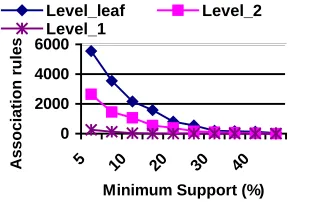
Analysis of Execution Time and The Number of Association RulesThis subsection discusses the effects of the variety of minimum support threshold on the execu-tion time and on the number of associaexecu-tion rules generated at different topic levels in the hier-archy. We vary the values of the minimum support threshold in wide range in order to observe all possible differences in the mining. In this manner, we can more clearly determine the effect of the support parameter on the execution time and the size of association rules.
most of the available memory space is occupied by the candidate itemsets and consequently less memory is used for the generation of association rules.
It is also easily noted that the effects of various minimum support thresholds on the execu-tion time and the number of associaexecu-tion rules vary at different topic levels in the hierarchy. The higher the topic level, the fewer the number of association rules generated and the less the exe-cution time should be taken. This is understandable that since the total number of the query transactions at the high level is much more than that of lower levels, the support threshold at the high level should be very smaller. Hence, we had to flexibly define the support thresholds at different topic levels in order to capture the interesting associations as many as possible.
0 2000 4000 6000
5 10 20 30 40
Minimum Support (%)
Asso
ci
ati
o
n
ru
le
s
Level_leaf Level_2
Level_1
0 50000 100000 150000
5 15 25 35 45 Minimum Support (%)
Execu
ti
o
n
T
ime
(sec)
[image:10.595.137.292.245.346.2]Level_leaf Level_2 Level_1
Fig. 2. The effect of different support thresholds Fig. 3. The effect of different support thresholds on the number of association rules on execution time
5.2
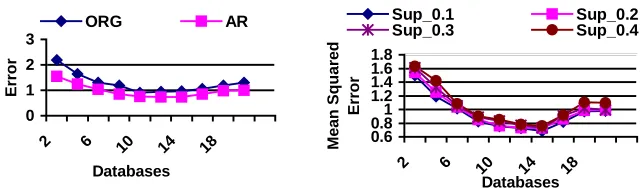
Comparison of Selection PerformanceComparing the original selection results by the database selection tool, we examine the selec-tion performance of the refined results obtained by the associaselec-tion-rule (AR) approach with dif-ferent minimum support thresholds. In Figure 4, we find that the selection performance of the refined results strongly outperforms that of the original ones in the Reuters_21578 dataset. This should not be surprising, because the AR approach provides a much better opportunity to dis-tinguish the relevant databases with the use of the discovered associations between the data-bases. From Figure 4, it clearly shows that with the AR approach, the mean-squared root error of the refined results is significantly reduced by 24.9% on average against that of the original results. This suggests that potential interesting association rules between the databases should be one of the key factors that affect the selection accuracy.
[image:10.595.183.462.248.348.2]0 1 2 3
2 6 10 14 18
Databases
Me
a
n
Squa
re
d
Erro
r
ORG AR
0.6 0.81 1.2 1.4 1.6 1.8
2 6 10 14 18 Databases
Me
a
n
Squa
re
d
Erro
r
Sup_0.1 Sup_0.2
[image:11.595.140.461.151.247.2]Sup_0.3 Sup_0.4
Fig. 4. The comparison of the refined selection results Fig. 5. Selection performance of the association by the association-rule approach (minsup=0.2) with rule approach with different support thresholds the original selection results
6
Conclusion and Future Works
Information retrieval researchers have developed some sophisticated database-selection tools to locate most relevant databases on the web for the users’ information needs. However, they al-ways overlook the potentially useful correlations between the databases at the process of data-base selection. This paper introduces the use of association rules for the problem of datadata-base selection. With the assistance of data mining tools, we extract patterns or associations between distributed databases from a collection of previous selection results, and the discovered knowl-edge on the databases is in turn used to refine the results from the database selection tools so as to further improve the accuracy of database selection. An association-rule mining approach is proposed to generate intraclass and interclass associations between the databases with the use of a topic hierarchy. We tested the effectiveness of our algorithm on the Reuters-21578 dataset and the experimental results are promising and show some potential in future study on database selection.
However, we view this work as a first step, with a number of interesting problems
remain-ing open and subjected to further research. For example, we are investigatremain-ing ways to develop more effective discovery algorithms. It appears possible to find other mining algorithms that could perform faster or better the discovery of association rules. Second, the interclass associa-tions described in this paper only involve adjacent topics such as parent-child classes and sib-ling classes in the hierarchy. Therefore, to discover associations between the child classes with different parent classes is another issue worth exploration. Finding such rules needs futureork. w
References
[1] Agrawal, R., Imielinski, T., and Swami, A.: Mining Association Rles between Sets of Items in Large Databases. Proceedings of the 1993 Acm Sigmod International Conference on Management of Data, (1993) 26-28.
[2] Callan, J. P., Lu, Z., and Croft, W. B.: Searching Distributed Collections with Inference Networks. Proceedings of the 19th Annual International Acm Sigir Conference on Research and Development in Information Retrieval, (1995) 21-29.
[3] Gravano, L., Garcia-Molina, H., and Tomasic, A.: Gloss: Text-Source Discovery over the Internet. ACM Transactions on Database Systems,Vol. 24 (2). (1999) 229-264.
[4] Hawking, D., and Thistlewaite, P.: Methods for Information Server Selection. ACM Transaction on Information System,Vol. 17 (1). (1999) 40-76.
[5] Kantardzic, M.: Data Mining-Concepts, Models, Methods, and Algorithms, New Jork: IEEE Press (2002).