White Rose Research Online URL for this paper: http://eprints.whiterose.ac.uk/72500/
Version: Published Version
Monograph:
Srivratanakul, Thitima, Clark, John Andrew orcid.org/0000-0002-9230-9739 and Polack, Fiona orcid.org/0000-0001-7954-6433 (2004) Writing Effective Security Abuse Cases. Report. York Computer Science Technical Report . Department of Computer Science, University of York
[email protected] https://eprints.whiterose.ac.uk/ Reuse
Items deposited in White Rose Research Online are protected by copyright, with all rights reserved unless indicated otherwise. They may be downloaded and/or printed for private study, or other acts as permitted by national copyright laws. The publisher or other rights holders may allow further reproduction and re-use of the full text version. This is indicated by the licence information on the White Rose Research Online record for the item.
Takedown
If you consider content in White Rose Research Online to be in breach of UK law, please notify us by
Writing Effective Security Abuse Cases
Thitima Srivatanakul, John A. Clark and Fiona Polack
University of York Technical Report YCS-2004-375
University of York
Department of Computer Science
Abstract
Table of Contents
1. Introduction...1
1.1 Motivation...1
1.2 Solutions from safety ...2
2. HAZOP: A rigorous approach to security analysis...4
2.1 HAZOP ...4
3. Use cases...7
4. Method procedures and guidelines ...9
4.1 The analysis process ...9
4.2 Use case elements and their security deviations ...9
4.3 HAZOP security guidewords...11
5. Deriving use case deviants...14
6. Example application...16
6.1 System description ...16
6.2 Analysis...18
6.3 The results...44
7. Discussion and conclusions ...46
7.1 Summary of major findings ...46
7.2 Conclusions...48
List of Figures
Figure 1: Fundamental use case elements....7
List of Tables
Table 1: HAZOP guide words [68]....5
Table 2: Example guide word interpretations for timing [68]....5
Table 3. The interpretations of guide words for an actor....12
Table 4. The interpretations of guide words for an association....12
Table 5. The interpretations of the guidewords for a use case....13
Table 6: Stakeholders-Interest list....17
Table 7: Actor-Goal list....17
Table 8: Analysis of ‘Browse Catalogue’ use case....25
Table 9: Analysis of ‘Register Customer’ use case....32
Table 10: Analysis of ‘Order Goods’ use case....40
1. Introduction
Computer security is increasingly problematic; threats to systems and the data stored on them grow as computer networking and computer literacy increase. Computers are now an obvious target for the disgruntled employee, the rejected partner, the disenfranchised constituent, and the fraudster. With increased opportunity, attacks become more novel, complex and unpredictable.
To make matters worse, the criticality of computer systems is increasing. Many organisations rely on stored data, business or management programs, internet connections and the web/email facilities that the internet supports. Security breaches have the potential to cause dramatic losses of money, confidence, reputation, or even of life.
To combat the increased number and severity of security risks, systems development needs to analyse security with particular care and rigour. Security analysis should be an essential part of all computer-related engineering practices. Although security was one of the first domains to embrace formal development techniques and processes, much security analysis remains informal. At the requirements level most analysis is informal; with the increased complexity of emerging systems there is a pressing need to add rigour to the process of engineering security requirements.
Some requirements may be expressed as ‘use cases’. This paper investigates the systematic use of a technique from the safety domain (HAZOPs) and shows how it can be applied to use cases to elicit and explore their security aspects.
1.1 Motivation
Research in security has emphasized particular aspects of security or technologies required to implement security mechanisms. Confidentiality properties, for example, have been analysed mathematically by many authors and there has been a vast amount of research into cryptography. However, these are only partial solutions to the security problem. Much security research has been sponsored by Governmental organisations and the research tends to reflect Governmental security concerns. Modern systems, over a range of application domains, have security issues. Reaching for pre-defined templates of what were relevant security problems and their solutions will often not suffice. Much more subtlety will be needed to determine in what security for a system should consist and how assurance can be gained that the developed system provides it.
generally not possessed by any one person. Furthermore, for modern complex systems we might question whether ‘expertise’ is really enough. Expertise depends on previous experience. Many modern systems give rise to new security concerns and experts have a hard time coping with novel systems. Commonly used analysis techniques (e.g. checklists/profiles) are too rigid to uncover new threats.
Integrating security with the design process is further complicated because developments are usually iterative and so security issues must be addressed iteratively (with all that entails). Furthermore, evolution of systems is a natural part of the lifecycle and presents significant challenges for secure systems. Maintaining rigour under change is hard and expensive; much more so if certification requires externally provided evidence, such as that provided by independent evaluation.
The above problems are not unique to security. Safety critical and safety related systems present similar problems, but safety analysis and development would appear more tightly integrated. Part of the reason for this, perhaps, is that the safety domain has developed many simple but effective analysis tools whose results are seen to affect the design process in a significant way. These tools are typically understood by non-safety experts (though their effective use requires skill), allowing various stakeholders to bring their knowledge to bear in the service of safety, or allowing experts to exercise their craft with increased rigour. Might such safety techniques usefully be applied to security?
1.2 Solutions from safety
The scale and scope of security risk in modern computer systems requires systematic, rigorous techniques that are part of standard development processes. Techniques applied in the development of safety-critical systems tend to be well-defined and systematic. They have proven effective over many years.
Safety and security have many similarities. Both are concerned with the management of risk. Safety typically concerns itself with reducing the risk of loss of life or environmental damage to tolerable levels. Security concerns itself with engineering acceptable levels of risk to various assets (and is most typically concerned with threats to the confidentiality, integrity, and availability of information, and threats to the supporting infrastructure). Development concepts and practices from one domain have found interpretation or direct application in the other. For example, notions of graded assurance were first seen in the security domain; the US DoD’s Trusted Computer Security Evaluation Criteria [65] (a.k.a. the ‘Orange Book’, due to the colour of its cover) required increased functionality and increased rigour in design to cope with various levels of system risk. The concept of graded assurance migrated to the safety domain, where functionality and assurance were separated (and so very simple functionality could be required to have high assurance). This separation of functionality and assurance has been adopted in recent security standards, such as the ‘Common Criteria’ [18]. Formal methods found application in the 1970s and 1980s primarily in security and subsequently became a mainstay of much safety-oriented research.
Perhaps the most important similarity is that rigorous arguments are generally required to justify the deployment of safe and secure systems. Systems must be
a rigorous, well-structured and understandable marshalling of evidence that a system is suitable to be deployed, i.e. is acceptably safe. Safety analysts already have numerous techniques at their disposal for generating and recording evidence and these can be adapted for security assurance evidence. Fault Tree Analysis (FTA) [58] has inspired security Threat Trees [2] and Attack Trees [62]. These approaches systematically decompose goals, representing the findings in a tree structure. MOAT [42] is a security argumentation technique that uses FTA notations to express its assurance arguments. More sophisticated argumentation [57] is available via derivatives of the Goal Structured Notation [39].
Techniques for the investigation of deviations (unintended or unexpected behaviour [59]), developed for safety critical systems, also appear in security work. The abuse case model [53][54] expresses deviation from normal system use by specific actors. This work takes as its starting point use cases, a requirements technique from the
Unified Modeling Language (UML) and related development methods. This clearly satisfies the need to integrate security analysis with conventional systems development; UML is increasingly the notation of choice in systems development. However, the technique again focuses on expressing the effect of known security threats; it is not capable of systematically seeking other possible threats. Systematic deviational techniques such as HAZOP [60][68], successfully used in safety critical systems, are little used in security. One doctoral study [31] applies HAZOP to protocol requirements analysis, to systematically investigate unknown threats and attacks on protocols.
We propose an extension of abuse cases, providing a more rigorous approach to analysing security. We apply the principles of HAZOP, tailored to a security perspective, to an existing functional requirements representation (i.e. use cases). The approach systematically mutates the model and its elements, thus prompting identification of a wide range of threats and other non-functional requirements.
2. HAZOP: A rigorous approach to security analysis
Security analysis must determine cost-effective controls to make a system’s assets secure against credible threats. These threats may include loss of confidentiality, integrity, availability etc. Damage may also include secondary damage, e.g. to reputation. The analysis must explore the vulnerability of the system to these threats, the probability that such vulnerabilities may be exploited to form attacks, and determine the potential impact of attacks. Cost-effective counter-measures are then sought. Clearly, efficient identification of threats is key to the development of secure systems. HAZOP is a technique widely used in safety; it presents a possible approach to systematic security threat identification.
2.1 HAZOP
HAZOP is the technique of Hazard and Operability Analysis (HAZOP). It is a qualitative technique, developed by chemical producers to systematically identify potential hazards and operability problems in designs for new chemical plants. Traditional approaches based on checklists and intuition were capable of checking, for example, the effects of a valve not opening or not closing; HAZOP guidewords encouraged other (more subtle) scenarios to be identified, such as the valve being part-open, or sluggish in its opening. A systematic description of the technique applied to safety in computer and other systems is given in [68][60].
The basic principle of HAZOP is that hazards arise due to deviations from normal or intended behaviours. Like identification of systems requirements, HAZOP is best conducted as a team analysis activity, ideally using people with various backgrounds. The team, led by a HAZOP leader, systematically investigates each of the system elements to identify deviations from the design intent. Each of the identified deviants is then further investigated to ascertain possible causes and effects. The identification of deviations is prompted by a set of guidewords/guidephrases, where each related guideword/guidephrase is applied to each attribute. A pipe in a chemical plant might have fluid flow as an attribute. The guideword “NO/NONE” prompts us to consider what would happen if no fluid flowed (for whatever reason). Similarly, for a petrol tank, with attribute content “petrol”, the guide phrase “OTHER THAN” prompts us to consider what would happen if the wrong kind of petrol were present (for example, use of leaded petrol in an engine designed for unleaded fuel might wreck that engine), or fluid other than petrol were used.
The technique is flexible. For example, it is possible to apply it to manual or automated procedures. A replacement procedure for an aircraft windscreen might have a step requiring the engineer to fasten the screen with identified bolts. What would happen if the wrong kind (“OTHER THAN”) of bolt were used, or even if the whole step were omitted (“NONE”) for a particular bolt? An aircraft engine maintenance procedure might require the level of oil to be checked in an engine with oil caps being securely replaced after the checks. What would happen if such caps were not replaced (use of ‘NOT’)? 1
1
The generic set of guidewords of HAZOP, as incorporated in UK Defence Standard OO-58 [68], is provided in Table 1.
Guidewords Meaning
NO or
NOT or NONE
None of the design intent is achieved
MORE Quantitative increase in a parameter
LESS Quantitative decrease in a parameter
AS WELL AS or MORE THAN
An additional activity occurs
PART OF Only some of the design intent is achieved
REVERSE Logical opposite of the design intention occurs
[image:11.595.106.536.138.271.2]OTHER THAN Complete substitution. Another activity takes place.
Table 1: HAZOP guide words [68].
A key part of HAZOP analysis is to interpret the guidewords for the context of interest. For example, Table 2 shows variations or interpretations of the guidewords for application to the timing of events or actions.
Guidewords Meaning Interpretation
NO Event/action never takes place.
EARLY Event/action takes place before it is expected.
LATE Event/action takes place after it is expected.
BEFORE Happens before another event or action that is expected to precede it.
Timing of Event or Action
[image:11.595.104.533.372.520.2]AFTER Happens after another event or action that is expected to come after it.
Table 2: Example guide word interpretations for timing [68].
HAZOP has gained wide acceptance: 00-58 [68] recommends HAZOP for hazard analysis in any safe system development; it has been successfully applied to the safety analysis and operation of chemical plants, aircraft, and many other products.
HAZOP has also been applied to the security domain. For example, Foster [31] has applied it to the generation and analysis of security protocols requirements. She stated that protocol development is relatively unstructured and as a consequence can produce protocols vulnerable to attack. The technique prompts the analyst to consider unknown threats and attacks on protocols.
3. Use cases
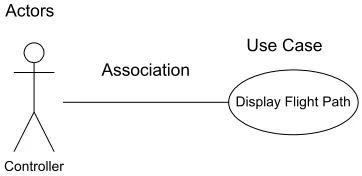
The use case technique, now popularised as part of the UML [61], was proposed by Jacobson [38] to describe behaviours of a system from a user’s perspective. Typically, a use case characterises interactions between an actor (usually a user, but possibly another system) and a system. There is a visual representation, the use case diagram, and a tabular format. Figure 1 depicts the fundamental elements of the use case in diagrammatic form. The actor (a stick-man) interacts (an association line) with a use case (an ellipse).
Controller
Display Flight Path
Actors
Association
[image:13.595.207.388.244.332.2]Use Case
Figure 1: Fundamental use case elements.
Actors represent external users or other systems that have an interaction or association with the system. An actor characterises the role that users or other external systems may have in relation to the system.
• Actors are everything that needs to exchange information with the system
[38]. Human and non-human interaction with the system can be expressed, and actors can represent individual or collective roles.
• Association lines connect an actor with the use case. This represents an interaction (communication) or association between the actor and that use case. The interaction may represent the exchange of information between the actor and the system or the invocation of the system’s operation by the actor and vice versa.
• Use cases represent the system’s behaviour from the external perspective, the task that the system must achieve on behalf of the actor(s) with which it interacts. Different authors document use cases in different ways. In general, the description comprises pre-condition, post-condition and sequences of actions (scenarios) including variants. The pre-condition defines the states that the system must be in for the use case to execute. The post-condition defines the state properties required after executing the use case.
The tabular form of a use case is a text description of how an interaction is accomplished. The different outcomes of a use case can be expressed using scenarios (action steps). There is little agreement as to what should be included in the tables.
interactions, in a simple form that is easily understood by the different parties involved. In the Unified Process [45], the expression of use cases is the foundation for subsequent development activities, as the captured requirements are fed into the specification and design process.
Recent work has applied use case modelling to requirements analyses other than the purely functional. Abuse and misuse cases are proposed as (intuitive) means to capture and analyse security requirements [53][54][63]. Sindre [63] notes that both security and safety requirements can be elicited from use case diagram and scenarios. Douglass [26] shows that use case modelling can be used to document some non-functional requirements, for example, by annotating each action in use case scenarios with its timing constraints. Work by Allenby et. al. [1] on the elicitation and analysis of safety requirements also uses HAZOP on use case scenarios. The analysis results in a tabular form describing the likely catastrophic failures, their causes and effects.
Use cases, like abuse or mis-use cases, are potentially useful in the analysis of security requirements. The system interfaces presented to an attacker may be characterised by use cases. The attacker may ‘stay within the rules’ (but do so in a particularly clever way), or may choose to deviate from what is intended as acceptable behaviour. Attacks may often be regarded as ‘exceptional flows’ in a use case. Existing abuse case approaches do not give any systematic way of generating such unusual deviations. In this report we show how HAZOPs can be used to generate alternative or exceptional behaviours in a systematic way.
4. Method procedures and guidelines
Our approach starts from system use cases. These might be taken from the initial phase of the system development. In normal usage, the use cases would model only high-level functional requirements. The aim of our approach is to systematically analyse the system to identify potential threats and security requirements.
Our technique applies the HAZOP guidewords, with suitable interpretations, to elements of the use case. The elements incorporated are those that could be subject to deviations leading to meaningful results.
4.1 The analysis process
The essential steps of the analysis process are as follows.
1. From a use case, identify and record: a. intent and capability of actors;
b. associations between actors and use cases;
c. components from use case description: pre-condition, main flow of events, alternative flows of events (i.e. normal but perhaps less likely and exceptional /error flow of events) and post-condition.
2. Apply HAZOP guidewords with the appropriate interpretation to each element identified in step 1, to suggest deviations.
3. Evaluate whether the identified deviations violate, or could violate, any stated security properties. Investigate possible causes of the deviations.
4. Identify consequences that may arise from the deviations (extract affected assets from the identified consequences.)
5. Categorise the deviations identified, and generalise each group.
6. Provide recommendations or requirements on the identified problems/threats.
4.2 Use case elements and their security deviations
A use case describes a sequence of events, typically expressed by scenarios. Actions are expressed under various conditions, responding to a request from one of the actors that has an association with it. We identify elements that are subject to deviations for each of the main elements of a use case.
Actors
(deviations from goals), whether intentional or accidental, can reveal new threats to the system. Sometimes, new malicious actors are also identified by considering intentional deviation from expected actor behaviour.
The deviation of actors needs to take notice of the different potential resources and skills of individuals (or systems) playing the roles represented as actors. For example, a cyber-terrorist network usually has more ability to cause attacks than an individual teenage hacker, in terms of access to resources and skills. In gambling or gaming environments, actors may have differing local computational capabilities. Similarly, most actors will not have supercomputing facilities, but in some cases this may make a difference. Actors may differ in their ability to screen incoming information (e.g. for email viruses). Actors may also differ in the protocols they are able to support etc. A network administrator is able to access many more files or programs than a normal user. For human actors, one person may play different roles in the system and the roles a person may possess can be limited or restricted. For example, the same person is not allowed to both process and approve a payment.
The intent of an actor is an interesting concept. An actor may obey all security policy rules and participate in a seemingly innocuous interaction. However, it may be that the real intent is to signal information via a covert channel.
Associations
An association of the actor with a use case models the external interactions with the system through the functionality modelled in the use case. The significance of restricting access to an operation to a particular group of users (an actor), and of assignment of access controls to a particular user or actor could be highlighted by this part of the analysis. In secure systems, access to functionality depends on actor roles. We need to have a clear idea of which actors should be able to access which use cases for which purposes. Such control may be enforced in several ways. For example, access controls may form an explicit part of the use case (i.e. suitable authorisation checks are made by the system), or else physical access to particular terminals may be restricted to authorised personnel. (Such alternative refinements of system goals are addressed in [56]).
Availability is now a security goal for many systems. HAZOP application to associations such as NO association might reveal potential causes such as simple equipment malfunctioning (e.g. a keyboard refusing to acknowledge particular key presses, or else network failure). Inappropriate configuration may also result in associations not being effected.
generally, consideration of unintended associations points to a need for issues of zonal analysis to be considered [64]. However, at this point we indicate a general opportunity to consider such matters at the use case level (even if only briefly, or to highlight the need for particular analyses later in the development).
Several associations may be current for an actor; the actor may indeed engage in parallel instance of the same use case. In on-line gambling, this may allow for instances of collusion. It is possible also that uses cases executed in quick succession may cause problems (e.g. in a distributed cash system it may be possible to carry out a second withdrawal before a central database has processed a successful confirmation of the first, leading to withdrawal limits being exceeded).
Use Cases
The use case pre- and post-condition both represent states of the system at certain sets of times. Deviations from these normally-reached states causes deviant interactions and could result in exceptions to the flow of events. We can address the variations from the normal behaviour, by considering the deviations of each step in the use case and investigating the causes.
4.3 HAZOP security guidewords
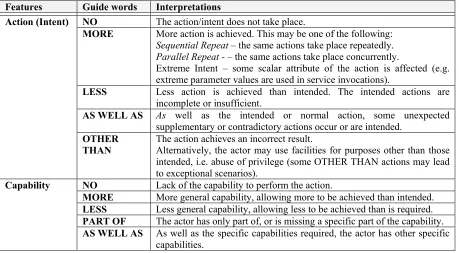
An actor has an action, representing an intent, and a capability, representing the skills and resources at their disposal.
Element: Actors
Features Guide words Interpretations
NO The action/intent does not take place.
MORE More action is achieved. This may be one of the following:
Sequential Repeat – the same actions take place repeatedly.
Parallel Repeat - – the same actions take place concurrently.
Extreme Intent – some scalar attribute of the action is affected (e.g. extreme parameter values are used in service invocations).
LESS Less action is achieved than intended. The intended actions are incomplete or insufficient.
AS WELL AS As well as the intended or normal action, some unexpected supplementary or contradictory actions occur or are intended.
Action (Intent)
OTHER THAN
The action achieves an incorrect result.
Alternatively, the actor may use facilities for purposes other than those intended, i.e. abuse of privilege (some OTHER THAN actions may lead to exceptional scenarios).
NO Lack of the capability to perform the action.
MORE More general capability, allowing more to be achieved than intended.
LESS Less general capability, allowing less to be achieved than is required.
PART OF The actor has only part of, or is missing a specific part of the capability.
Capability
[image:18.595.85.544.136.389.2]AS WELL AS As well as the specific capabilities required, the actor has other specific capabilities.
Table 3. The interpretations of guide words for an actor.
An association is not considered to have additional features. However, more guide words are appropriate:
Element: Association
Features Guide words Interpretations
NO Association does not/can not take place.
MORE Superfluous – Interface permits greater functionality to a particular actor than is required. More functionality is available. Association is not constrained as required. Further divisions are:
In-parallel with – More functionality is provided/occurs simultaneously with the permitted ones.
In- sequence with – More functionality provided/occurs before or after the permitted ones.
LESS Interface permits less functionality to a particular actor than is required. Association is over-constrained.
AS WELL AS Associations to a particular use case take place with other actors as well.
REVERSE Interaction takes place in the reverse direction.
Associations
OTHER THAN
Wrong association is defined.
Swapping roles – Swapping of associations between actors or individuals.
Table 4. The interpretations of guide words for an association.
[image:18.595.84.542.487.686.2]Element: Use Case Elements
Features Guide words Interpretations
NO The state or condition does not take place or is not detected.
AS WELL AS Additional conditions apply. This may mean that more stringent checks are made, or else a more restrictive state results than is strictly required. Errors of commission might be considered here.
PART OF Only a subset of the required conditions applies. This might for example, result from incomplete checks (e.g. access control checks or integrity checks), by incomplete implementation (a program doesn’t do all it should), or because the consequences of system behaviour are not fully understood.
State (defined in a pre-condition or a post- condition)
OTHER THAN
An incorrect condition applies. Perhaps the wrong data is used.
NO No action takes place.
MORE More action is achieved. A stronger post-condition is achieved. More actions could be carried out:
Repeat – the same actions take place repeatedly.
Superfluous – the system does different additional actions to those intended or required.
A Trojan horse usually implements more functionality than is apparent, for example. Additionally, an action may take place for longer than required.
LESS Less is achieved than intended. A weaker post-condition could result. For example, an action is incomplete, or an action takes place for a shorter time than required, or an action stopped earlier than expected.
Action
OTHER THAN
An incorrect action takes place. An action not intended or required takes place instead. For example, wrong detail is provided or a wrong button is pressed.
LESS Less is achieved than intended. For example, Drop – Miss one or more parts of action.
Additionally, a sequence of action takes place for a shorter time than required.
AS WELL AS The sequence does the intended actions plus others.
REVERSE The sequence of actions takes place in reverse order (and other out-of-order concepts).
EARLY The action sequence or its components takes place before it is expected (timing).
LATE The action sequence or its components takes place after it is expected (timing).
BEFORE The action sequence or its components happens before another action that is expected to precede it.
AFTER The action sequence or its components happens after another action that is expected to come after it.
Sequence of Actions
(scenarios)
OTHER THAN
An incorrect action sequence takes place.
5. Deriving use case deviants
The guidewords alone do not give a clear idea of how to derive deviants from use cases. This section provides additional guidance for performing the use-case-based security analysis, based on experience of applying the technique. Note that, in applying the guidewords, much repetition is expected. Analysts must ensure that any apparent repetition is indeed repetition and not a subtle variation of a previously-identified threat.
The derivation of deviants must consider at least the three fundamental security properties (i.e. confidentiality, integrity and availability). The emphasis will vary between applications. The guidance also includes high-level patterns of analysis.
Viewpoint considerations/Stakeholders’ interests
Stakeholders are individuals or organisations that have an interest in the system, even though they are not a direct part of the system, and may not directly interact with the system. One (partial) definition of a stakeholder is an authority (not a hacker!) that has an authorised ability to cause the system to cease to exist or cease to operate. Each stakeholder in a system has a viewpoint, representing his or her interest in the system. Stakeholders’ interests might be in conflict.
Security analysis must take account of different viewpoints, and of the seniority or importance of the stakeholders. For example, some stakeholders are concerned about the integrity of classified information; others may find confidentiality of personal data more important. Deviations from all stakeholder interests should be considered.
Role/actor mapping
Deviation analysis must consider the possibility of unexpected interactions through shared and multiple roles. A computer system is built to support the roles of humans or of machines. An actor characterises the role that the users or other external systems play in relation to the computer system. Individuals within roles are not distinguished, and an individual may play different roles at different times.
A multi-user role always has potential deviations in which the actual user within a role initiating some interaction is not the same as the actual user receiving a response.
Business Rules
A business rule defines a business aspects or constraint on a system. It consists of policy, some constraints and a validation audit. The business rule influences the way that the interactions with the system are specified.
Business rules should include statements of the required security policy (e.g. auditing, integrity or confidentiality of data). However, in practice, security policies are at best implicit. The use case analysis helps to make explicit the security policy, and the system requirements must then be modified so that the functional requirements respect these policies.
When deriving the deviations, it is essential to consider what sort of business rules the system does or should enforce.
Well-known sources of security violations
Although the systematic HAZOP approach is a significant improvement on earlier intuitive analyses, it is important not to ignore or neglect the “checklists” of accumulated wisdom in security. Three common sources of security violation are timing, HCI, and presentation.
• Timing information is not always explicit in use case diagrams and descriptions. However, whenever timing may be associated with events or actions, timing deviations must be taken into account. Typically, timing issues include response time (time between input to output) and repetition time (time between successive updates or outputs). Deviations from timing are events that occur later, earlier, sooner or longer than expected. In terms of security, this may leak information or encourage odd or unfortunate user actions.
• Poor HCI design, for example implicit system response or lack of acknowledgement message, may be misleading to users of a system. Security problems may also arise if the HCI functions overload the system, or if the users cannot understand how to use the system as intended. Use case analysis occurs too early in development to include a detailed study of the HCI and its security implications. However, the consideration of known HCI pitfalls may help to identify security “anti-requirement”: things that the system must not do if it is to be acceptably secure.
6. Example application
This section presents a simple case study. The use cases describing an apparently-innocuous web-ordering system are analysed to systematically reveal threats.
6.1 System description
A website hosts a company’s product catalogue that anyone using the internet can access and browse. A customer who are registered with the company can order goods via the website. To order goods, the registered customer must provide sufficient payment and delivery detail. If customers who are not registered but wish to purchase, the ordering facility provides an initial registration procedure.
Orders are processed by an operator, who logs on to the host system. The operator may change his/her login password when required.
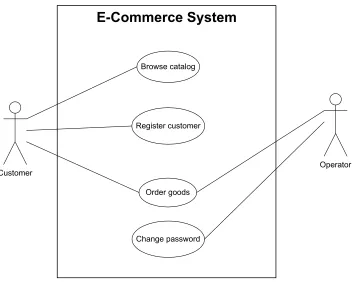
The use case diagram is shown in Figure 2.
Customer
E-Commerce System
Operator Browse catalog
Register customer
Order goods
[image:22.595.123.475.351.633.2]Change password
Figure 2: Simple e-commerce system use case diagram.
Stakeholders-Interests list
Stakeholders Interest
Company owner Profits and reputation of the company System manager System’s performance and operation of
staff.
[image:23.595.86.514.101.175.2]Developer Correct operation of the program.
[image:23.595.81.514.265.339.2]Table 6: Stakeholders-Interest list.
Table 7 summarises the intents of the use case actors.
Actor-Goal list
Actor Goal
Customer Browse catalogue
Register
Order goods
Operator Process order goods
Table 7: Actor-Goal list.
Use Case Descriptions
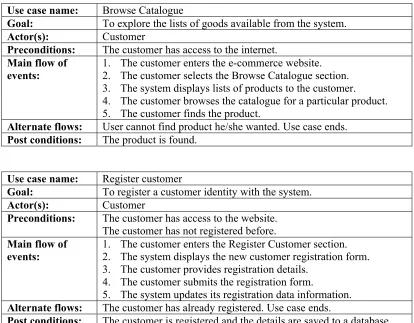
The following descriptions elaborate each use case in Figure 2.
Use case name: Browse Catalogue
Goal: To explore the lists of goods available from the system.
Actor(s): Customer
Preconditions: The customer has access to the internet.
Main flow of events:
1. The customer enters the e-commerce website. 2. The customer selects the Browse Catalogue section. 3. The system displays lists of products to the customer. 4. The customer browses the catalogue for a particular product. 5. The customer finds the product.
Alternate flows: User cannot find product he/she wanted. Use case ends.
Post conditions: The product is found.
Use case name: Register customer
Goal: To register a customer identity with the system.
Actor(s): Customer
Preconditions: The customer has access to the website. The customer has not registered before.
Main flow of events:
1. The customer enters the Register Customer section. 2. The system displays the new customer registration form. 3. The customer provides registration details.
4. The customer submits the registration form.
5. The system updates its registration data information.
Alternate flows: The customer has already registered. Use case ends.
[image:23.595.83.497.441.764.2]Use case name: Order goods
Goal: To order goods from the system.
Actor(s): Customer
Operator
Preconditions: The customer is registered to order goods.
The customer has entered registration details e.g. user name and password (the customer is logged on to the ordering section).
Main flow of events:
1. The customer enters Order Goods section.
2. The system displays the customer’s account detail.
3. For each product that the customer wishes to order, the customer enters its identity.
4. The customer provides delivery details.
5. The system calculates and displays the price of the goods ordered.
6. The customer submits payment details. 7. The system confirms the result of transaction. 8. The operator collects the detail of the order. 9. The operator processes the order.
Alternate flows:
Post conditions: The order and its detail are entered on the system and the order is processed.
Use case name: Change Password
Goal: Change the password for the login
Actor(s): Operator
Preconditions: The operator is logged in.
Main flow of events:
1. The operator enters his/her current password 2. The system validates the password.
3. The operator enters a new password, twice, as prompted by the system.
4. The operator confirms the change. 5. The system saves the new password.
Alternate flows: A1. If the operator’s old password is incorrect, an error message should be displayed and the password should not be changed. A2. If the two entries of the new passwords do not match, the operator is prompted to re-enter them.
Post conditions: The password of the operator is changed and updated in the database.
6.2 Analysis
Elements Guideword-Deviation Cause Effects Threats involved. Comments
Use Case: Browse Catalogue Actor
Customer’s Action –
Browse Catalogue
Not Relevant
NO – Customer does not have the ability to browse the catalogue.
• Physical – lack of computer system, lack of access to internet
• Knowledge - does not know the website, no knowledge of using an internet system.
The system misses opportunity for one potential customer.
• Steal computer set
• Block internet
account
• Provide wrong info about the website.
• Modify website URL
MORE – Customer has more ability than required.
• Access hidden links. Access of unwanted/ confidential information.
Any confidential
data must not be made available for public access. Customer’s Capability –
Browse Catalogue
LESS – Customer does not have much ability.
• Physical – lack of appropriate computer system, lack of access to internet
The system misses opportunity for one potential customer.
• Knowledge - does not know the website, no knowledge of using an internet system.
• Steal computer set
• Block internet access
Timeouts may come into force.
Associations
Association - Customer
and Browse Catalogue
NO – Customer does not have association with Browse Catalogue use case.
Elements Guideword-Deviation Cause Effects Threats involved. Comments
OTHER THAN – Other
people can browse the catalogue. Not of security relevance, any person is legitimate to browse the catalogue.
Use Case Elements
Pre-condition - The customer has access to the internet
NO - The customer cannot access to the internet.
• Loss of network and other physical equipment.
• Internet account expires.
• The system misses
opportunity for one potential customer.
• ISP not available
• Wrong configuration of network.
• Customer’s frustration Denial-of-service Strictly, this is a problem for the customer. Can make server side as flexible as possible.
NO – The customer cannot enter the system website.
• The e-commerce server is down (or malfunctioning in some way).
• Loss of network.
• The system is
blocked/overloaded
• Customer may get bored and may not want to access the site again.
• Local error
• Customer disappointment. • Block system.
• Interception of all info passed
• Denial-of-service attack
Step 1- The customer enters the e-commerce website.
MORE – applied to customer. More customers enter the web site.
• Possibly legitimate access by many interested users.
• Service may be severely impeded. User browsing sessions may be very slow or else not accepted.
• Massive simulated requests to enter the site by malicious processes.
• Inadvertent or deliberate overloading of system (denial of service attack)
This is tricky. We could make
Elements Guideword-Deviation Cause Effects Threats involved. Comments
OTHER THAN – the
customer attempts to enter the indicated web site but is directed to another (possibly spoof of the original)
• Malicious handling at local host.
• Domain squatting on addresses along the path.
• Use of similar names for company, leading to customers being misled (e.g. via search engine returns).
• Goes to wrong site
generally. Customer is simply engaging in a spoofed or plainly wrong interaction with obvious consequences.
• Spoofed sites have obvious problems. Reputation of company may (wrongly) be tarnished.
Manipulation of host or routing
Be on lookout for attempted
infringements of name.
Search for links with similar names to that of the company.
NO – The customer nnot enter to the
ion. ca sect
• Link is not available
• Firewall
• Link is available but there has been denial of service
• Customer’s disappointment
• Customer may get bored and may not want to access the site again.
Fabrication of website Step 2- The customer
enters to Browse Catalogue section.
OTHER THAN – The
customer enters a section other than Browse.
• Internal error on web site.
• Communications are altered in transit to reflect different request (but to same web site).
Various – ranging from annoyance and bewilderment through to accessing sensitive information the customer shouldn’t.
• Largely internal
system inconsistency.
• Manipulation of
communications.
Step 3- The system displays lists of products to the customer.
NO – The system was unable to display the products.
• The server is down (or part of system is down if distributed server).
• The system is blocked.
• Browser mismatches.
• Error in database.
Customer’s annoyance
Plus, the company is not able to advertise any products.
• Block system
• Virus/hacking
Elements Guideword-Deviation Cause Effects Threats involved. Comments
MORE – The system shows more than the lists of products than it is supposed to.
• Staff mistake.
• Data (status e.g. sale/not yet on sale) of the associated product is incorrect.
• Added product from the outsider (e.g. advertise on this website)
• Search filters not working appropriately.
• Data release may have unfortunate effects: product not on sale is being displayed, and will become unavailable when the customer orders it, leading to customer dissatisfaction. Product displayed with old price and old detail, which the company needs to sell at the price it advertises. The organisation’s reputation is effected if the product on sale is not suitable or illegal. Overloading with irrelevant information.
• Modification of message (communication channel).
This really illustrates the importance of having accurate information on a web-site. There are all manner of commercial /legal reasons to do so.
• Modification of website (file).
• Modification of the storage files of product.
What exactly is meant by “is supposed to”? Are there legal
constraints on what should be
displayed?
Elements Guideword-Deviation Cause Effects Threats involved. Comments
LESS – The system shows lists of products less than it is supposed to.
• Staff mistake.
• Data (status e.g. sale/not yet on sale) of the associated product is incorrect.
• Outsider’s fabrication
• Corruption of message passing.
• Supplier’s frustration
• Lose the opportunity to sell a particular product.
• Modification of message (communication channel).
Begs the question as to how lists are requested. At this stage it is not stated whether this is simply by hyperlinks or else by search criteria.
• Modification of website (file).
• Modification of the storage files of product.
REVERSE – The
system shows lists of product in a reverse or unusual order.
• Possible manipulation of communications but principal cause is simply deliberate action server side.
• A different (including reverse order) may influence selection to buy.
• Malicious server management/development .
Psychological issues must be taken into
consideration. Who are the customers who have products here – are some being favoured? Can we make money openly from this? Note – some producers may actually pay to appear on a web site.
OTHER THAN – The
system shows something else or incorrect data associated with products.
• Outsider’s fabrication
• Replacement or redirect to other fake website to obtain customer’s information.
• Customer may be misled by erroneous data. The server management may be legally obliged to sell at whatever price was advertised for example.
• Page not available (internal misconfiguration).
• Internal server data/configuration errors.
• Customer’s disappointment to see what is not expected.
• Fabrication of website
• Man-in-the-middle attack
• Incompetence interface design (threat).
• Internal configuration management error (accidental or deliberate).
Elements Guideword-Deviation Cause Effects Threats involved. Comments
AS WELL AS – details are supplied to customer but also to a third party.
• Comms monitoring
• Profiling activities server side.
• Possible breach of privacy. Passive monitoring on the net.
Active monitoring by server (without
knowledge of customer)
What is the policy on privacy? Most likely issue here is the storing of profile data. What are legal issues? Step 4– The customer
browses the catalogue for a particular product.
NO – N/A
NO – The customer cannot find the product he or she is looking for.
• The product is not available within the system (normal case).
• Information of the product was tampered with.
• Packet was
corrupted/or manipulated.
• Information sent is not complete
• Mismatch search
criteria
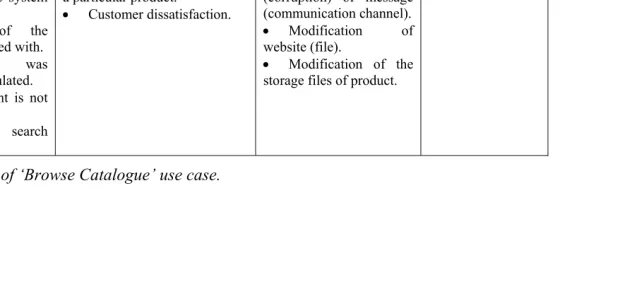
• Lose the opportunity to sell a particular product.
• Customer dissatisfaction.
• Modification
(corruption) of message (communication channel).
• Modification of
website (file).
• Modification of the storage files of product.
Provide search results on similar searched words. Step 5 – The customer
finds the product.
OTHER THAN – The
customer mistakes some other products for the product looking for.
• Unclear description of the product
• Trick the customer in choosing something different.
• The company must do more work if the product if returned and refund requested.
•
• Customer’s frustration when receive product that was not intentionally ordered for.
Distraction/manipulating the customer
Elements Guideword-Deviation Cause Effects Threats involved. Comments
Post-condition – The product/s is found.
NO – The product is not found.
• The product is not available within the system (normal case).
• Information of the product was tampered with.
• Packet was
corrupted/or manipulated.
• Information sent is not complete
• Mismatch search
criteria
• Lose the opportunity to sell a particular product.
• Customer dissatisfaction.
• Modification
(corruption) of message (communication channel).
• Modification of
website (file).
[image:31.595.273.776.89.236.2]• Modification of the storage files of product.
Elements Guideword-Deviation Cause Effects Threats involved. Comments
Use Case: Register customer Actor
NO – Register action did not take place. Fail to register.
• Interception by an intruder
• Loss of network/server is down
• Customer does not complete the registration by accident.
• Decline registration
• Customer losses trust in the company, if he has already submitted the detail but was not updated.
• Need to register again.
Interception of message passed through network.
This can make the customer lose trust in the company’s overall service and might not want to do more important service (e.g. purchasing the products) with the company.
MORE – Register
customer more than required.
• Repeated registrations (intentionally).
• Duplicated or replayed of the message.
• The system might not allow to change detail, so register again with different detail.
• Increase work load to the system, and may result in the unavailability of the service.
• Block other
communications with the system.
• Repeated registration (Flood system).
• Take advantage of “one per customer” offers.
• Replay of message. Should allow customer to change
detail after registration.
LESS – N/A Customer’s action –
Register customer
OTHER THAN –
Register someone other than oneself.
• Phantom user
registration.
Wrong user information received, resulting in inaccurate data gathered (e.g. number of customer interested in the product)
• Customer provides wrong information detail
• Customer registers on behalf of other person.
• Customer uses other person’s detail (steal info).
Obtain other person’s detail.
Elements Guideword-Deviation Cause Effects Threats involved. Comments
NO – Customer does not have ability to register customer.
• Physical –loss connection.
Not be able to process any order from the web-site.
• Does not have
registration information.
• Confusion in what information to fill in.
This is the problem of the customer to provide sufficient information.
The system could prompt required fields to be filled in, leaving others as optional.
MORE – Customer has more ability to register. (Register using different identities or addresses)
• Deviate some details such as names or addresses.
• Swap places of
surname and given name.
• Different phonetic spellings of non-English names.
• Profit loss for the company
• The customer can take advantage of ‘one-per-customer’ offers or ‘one-per-household’ offers.
Fraudulent multiple registrations.
There is a possible need to detect and
deal with fraudulent multiple
registration. Customer’s capability –
Register customer
LESS – Customer has less ability to register.
Duplicate of names in the database.
• Customer disappointment
• The company loses one potential customer.
This is an issue to
be further discussed on how
to distinguish people having the same names (possibly using emails).
Association
NO – Association with the particular customer does not take place.
• Connection is blocked.
•
• Customer disappointment
• The company loses one potential customer.
Block connection Flood system
NO – Associations with the customers do not take place.
• Loss of network and other physical equipment.
• Server is down
• Customer disappointment
• The company loses
potential customers.
Block connection Flood system Virus/hacking
MORE – N/A N/A
Association - Customer
and Register Customer
Elements Guideword-Deviation Cause Effects Threats involved. Comments
OTHER THAN –
Association with others (e.g. customer/or to an operator/or to an intruder)
Normal operation (any body can register)
This raises issues on registration policy. Can a company worker be a potential customer?
Use Case Element
NO – The customer cannot enter to the Register Customer section.
• The web page is corrupted/removed.
• Link is not available • Customer disappointment.
• Customer may get bored and may not want to access the site again.
Fabrication of website
MORE – The customer enters to the section more than once.
Keep refreshing or loading the same page.
Not a problem.
LESS – N/A Step 1 – The customer
enters to the Register Customer section.
OTHER THAN – The
customer enters to some other section rather than the Register Customer section.
• The page was replaced by an intruder.
• Incorrect configuration/update (accidentally or maliciously)
• Customer’s confusion
• Company’s reputation
• Confidential details can be revealed out, if the customer fills in the form which thought to be authentic.
• Modification of
website (file).
• Modification of the storage files of product.
NO –The new customer istration form is not splayed.
reg di
• Server is down
• Interception by intruder
• Wrong configuration/ naming.
• Company loses opportunity for new potential customer.
• Customer cannot register leading to customer dissatisfaction.
Interception Step 2 – The system
displays the new customer registration form.
MORE – More
information is displayed than intent on the form.
• Wrong form is displayed
• Confidential data is displayed
• Customer’s confusion
• Confidential data can be seen by other people passing by the monitor display.
Elements Guideword-Deviation Cause Effects Threats involved. Comments
LESS – Incomplete form is displayed.
• Interception
• Wrong form is
displayed
• Insufficient information received, may be useless or drop out from the registration resulting in customer’s dissatisfaction.
• Unauthorised
modification of related files
• Wrong information is kept in the system.
• Interception Enough
information should be displayed.
OTHER THAN – Other
form is displayed
• The page was replaced by an intruder.
• Redirect to a phantom web page.
• Mistake made by staff
• Customer’s confusion
• Company’s reputation
• Confidential details can be revealed out, if the customer fills in the form which thought to be authentic.
Unauthorised
modification of files /names
OTHER THAN – a
form is displayed by agent other than the system.
• Man in the middle attack. Or agent masquerading as the system.
• Minor problem if new info is offensive but real problem comes next.
Man in the middle attack.
NO – The registration tail is not provided. de
Customer inaction. • Delayed registration
• Failed registration
What happens if this is too late – a timeout?
MORE – More
registration detail is provided than required.
Not a problem. Step 3 – The customer
provides registration details.
LESS – Less registration detail is provided than required.
Customer is reluctant to provide real/enough information.
Insufficient information is registered.
Elements Guideword-Deviation Cause Effects Threats involved. Comments
OTHER THAN – The
customer provides some other detail.
Same as OTHER THAN in Customer’s action
Wrong user information received, resulting in inaccurate data gathered (e.g. number of customer interested in the product)
Using inappropriate identify i.e. right identity, wrong detail or wrong identity but right/wrong detail.
Potentially major problem.
What are the details?
What onus is there to check accuracy by other means? Age, address etc. Issues of faked identity?
Legal issues (data protection Act etc.)
NO – The customer does submit registration tails.
not de
• Customer inaction/ refuses/changes his mind.
No new registration detail is stored.
• Computer hangs
Distract or trick customer Minor
MORE – The customer submits more than once.
• Customer mistakenly presses twice (over-eager customer)
• Duplicate on network
• Replay of message.
• The same customer detail is updated twice.
• The system ignores the duplicate information.
Replay of message Issue here is really one of change. What is the policy on changing details once provided? This needs to be authenticated in some way otherwise A can have his/her details removed by B. This is connected with above. There is the possibility of user submitting multiple but different details. Step 4 – The customer
submits Registration details.
Elements Guideword-Deviation Cause Effects Threats involved. Comments
OTHER THAN – The
customer clicks on another button.
• Mistake other buttons for the ‘Register Button’
• Loss of information entered.
• Exposure of information to others.
Distract or trick customer. Minor.
OTHER THAN – The
customer submits detail to someone else.
• Interception by intruder • Disclosure of information Eavesdropping Interception
AS WELL AS – The
detail is sent while something else occurs
• Internet gets
disconnected.
• Interruption by an intruder
• Customer stops and wants to cancel
• Extra event is initiated by customer or an intruder
• Information may be stored in local buffer or else be retrievable by some means.
• Information is simply sent to an intruder
• Customer is not sure whether the detail is sent through or not.
• Customer sends the
information again if he/she still wants to carry out resulting in duplication of records.
• Intruder may get details
• Distract or trick customer.
A page displaying confirmation that the information is received would lessen worries from the customers.
NO – The information is not updated.
• Connection loss before sending information
• Interception
• Error in server side (programming error, physical loss, or from malicious actions)
• Customer is not sure whether the detail is sent through or not.
• Customer sends the
information again.
Interception Step 5 - The system
updates the information.
MORE – Th
information is updated more than once.
e • Error in server side
• Duplicated or replayed of the information
The same customer detail is updated twice.
• Replay of
information
• Unauthorised
Elements Guideword-Deviation Cause Effects Threats involved. Comments
LESS – N/A
OTHER THAN – The
system updates wrong information.
• Message is corrupted by an intruder.
• Error in the update program.
The system obtains wrong information
• Corrupt of message
• Unauthorised
modification of program on server side.
NO – Customer is not registered to database.
• Physical problems
• Software problems (e.g. database)
• Duplicate account registered
• Incomplete information provided.
• Message corruption
• Customer’s frustration.
• The company lose
opportunity to sell.
Maliciously attack physical or software components.
MORE – Customer is registered to database more than once.
• Update wrong by the program
• Duplicate message received
The same customer detail is updated twice.
• Unauthorised
modification of program on server side.
• Replay of message
Is there any policy against duplicate customers?
Post-conditions – The customer is registered and the details saved to a database.
OTHER THAN -
Incomplete information is registered to database.
• Update wrong by the program
• Wrong/incomplete information is received.
The system receives wrong information
• Unauthorised
modification of program on server side.
• Modification of
[image:38.595.72.700.89.370.2]message via network.
Elements Guideword-Deviation Cause Effects Threats involved. Comments
Use Case: Order goods Actor
NO – The customer does not order goods.
• Unsatisfied with the product selections/price
• Complicated interface
• Distraction by the company’s opponent advertisement
• Lose an opportunity to sell
• Customer’s disappointment
Hacking Provision of a
user-friendly interface design. Provision of security mechanism in preventing
unauthorised pop-up windows.
MORE – The customer excessively order goods
• Not the owner of the account/or card he’s using
• Prank order with fake account.
• The company sent order without getting paid later on.
• The owner of the payment becomes furious when finds out that the order was not initiated by him.
• Time wasted when verify payment detail with card company and turn out to be fake.
• Increase workload to the company staff
• Obtain password and card detail (steal, bribery, social engineering).
• Get access to other computer, while logging on to the system.
This raises the issues of whether the payment should be received before delivery or not. Customer’s action –
Order goods
AS WELL AS – The
customer provides insufficient/incorrect detail when submitting order.
• Detail not available
• Complicated interface
• Typing mistake
• Distraction
• Processing of payment would be unsuccessful.
• Customer’s disappointment
• Increase workload to the company staff.
• Steal/virus
• Distraction
Elements Guideword-Deviation Cause Effects Threats involved. Comments
OTHER THAN – The
customer intends to achieve something else rather than to order goods.
Malicious intents Wrong statistics data on the number of customer access Disruption on the service Increase workload
Flood/block the system Impersonating as customer
This raises the issues of whether to allow users to simultaneously log on using the same accounts.
Customer’s capability –
Order goods
NO – The customer has no ability to order goods.
• Physical – loss connection.
Company misses the opportunity for one potential customer.
• Does not have account/ payment information
• The customer has not been registered (registration detail not available)
• Disruption of connections
This raises the issues of what method of payment should there be available for the customers.
• Steal card/payment info.
NO – The operator does not process the order.
• Lack of responsibility in work
• Order does not come through to the operator.
• Order is lost/or has been modified.
• Customer waits definitely for the goods order.
• Customer’s disappointment
• Financial loss to the company
• Unauthorised
modification of the message via network
• Unauthorised deletion of order received.
Should inform the customer on the approximate
delivery date.
MORE – The operator processes the order more than require.
• Operator error
(accidentally e.g. operator’s misinterpretation)
• Software error
• Corrupt of the message (by an intruder or network)
• Greedy operator,
pretends that he/she has received the order more than it was sent.
• Financial loss e.g. the system sent out two orders but only get paid for one
• Customer needs to pay twice if the both payment transactions are processed.
• Corrupt the message.
• Intentionally make mistake by the operator. Operator’s action –
Process the order
![Table 1: HAZOP guide words [68].](https://thumb-us.123doks.com/thumbv2/123dok_us/8091209.231509/11.595.106.536.138.271/table-hazop-guide-words.webp)