Structure of the Water Molecule
Part II Perturbation-Variational Calculation of the Nuclear Spin-Spin Isotropic Coupling Constant in HD
Thesis by Soe Aung
In Partial Fulfillment of the Requirements For the Degree of
Doctor of Philosophy
California Institute of Technology Pasadena, California
1969
ii
ACKNOWLEDGMENTS
I would like to express my deep sense of gratitude to my research supervisors, Professor Sunney I. Chan and Professor
Russell M. Pitzer, for invaluable guidance and patient encouragement given me over the past four years. In particular, I am indebted to Professors Chan and Pitzer for supervising Part I of this thesis research, and to Professor Pitzer for supervising Part II. My
graduate education under their supervision covered an area far
broader than is evident in this thesis, however, and I shall take heed of the idealistic yet practical examples which each of them has set in his own way.
In connection with Part I of this thesis research, I am further indebted to the persons named below:
Dr. W. E. Palke, for wise counsel and various favours,
particularly in regard to the modifications of the molecular integral programs necessitated by the SCF calculations reported in Part I;
Professor W. A. Goddard, for encouragement and much
appreciated discussions given readily and unfailingly with contagious enthusiasm, as a teacher gives unto his own student;
Dr. D. Eisenberg, for stimulating discussions based on his encyclopaedic knowledge of the water molecule;
Mr. T. H. Dunning, for his adaptation of W. E. Palke 's electron density map program and for advice on its use.
iv
Professor R. M. Pitzer for permission to describe his perturbation-variational theory of nuclear spin-spin coupling constants in advance of publication.
In regard to my general education at Caltech, I would like to acknowledge my considerable debt to the following persons:
Professor Richard M. Badger, for much encouragement given very early in my period of graduate study, and for providing me with an idea of the essential qualities of a dedicated scientist and scholar; Professor V. McKoy, for advice and discussions given without reservation over the past years;
My colleagues, past and present, particularly Dr. L. C.-T. Lin, Dr. R. T. Iwamasa, Dr. T. E. Burke, and Mr. L. Lynds, for
advice and companionship;
Mr. Dana Roth, Chemistry Librarian, for numerous favours. Finally, I am greatly indebted to the California Institute of Technology, the U.S. Public Health Service, the National Science Foundation, and the IBM Corporation for financial support during my period of study at Caltech.
Abstract. Part I.
Several approximate Hartree-Fock SCF wavefunctions for the ground electronic state of the water molecule have been obtained using an increasing number of multicenter s, p, and d Slater-type atomic orbitals as basis sets. The predicted charge distribution has been extensively tested at each stage by calculating the electric dipole
moment, molecular quadrupole moment, diamagnetic shielding, Hellmann-Feynman forces, and electric field gradients at both the hydrogen and the oxygen nuclei. It was found that a carefully optimized minimal basis set suffices to describe the electronic charge distri-bution adequately except in the vicinity of the oxygen nucleus. Our calculations indicate, for example, that the correct prediction of the field gradient at this nucleus requires a more flexible linear combi-nation of p-orbitals centered on this nucleus than that in the minimal basis set. Theoretical values for the molecular octopole moment
vi
Abstract. Part II.
The perturbation-variational theory of R. M. Pitzer for nuclear spin-spin coupling constants is applied to the HD molecule. The zero-order molecular orbital is described in terms of a single ls Slater-type basis function centered on each nucleus. The first-order
molec-ular orbital is expressed in terms of these two functions plus one -r
singular basis function each of the types er and e-r ln r centered on one of the nuclei. The new kinds of molecular integrals were
evaluated to high accuracy using numerical and analytical means. The value of the HD spin-spin coupling constant calculated with this near-minimal set of basis functions is JHD = +96. 6 cps. This
TABLE OF CONTENTS
Part I: Approximate Hartree-Fock Wavefunctions, One-Electron Properties, and Electronic Structure of the Water Molecule
1. INTRODUCTION
L 1 Previous ab initio calculations on
the water molecule . 3 1. 2 Experimental measurements on the water molecule 71. 2. 1 Properties measured 7
1. 2. 2 Problems involved in some of the measure- 7 men ts
1. 3 Scope of this thesis research 2. HARTREE-FOCK THEORY
3. WAVEFUNCTIONS FOR THE WATER MOLECULE 3. 1 Computer programs
3. 2 Calculations
4. ELECTRONIC PROPERTIES
10
12
14
14
19
29 4. 1 Definitions and nature of one-electron properties 29 4. 2 Computation of one- electron properties 3 6 4. 3 Results and comparison with experiment 394. 4 Discussion of results 45
4. 4. 1 Energies 45
4. 4. 2 One-electron properties 47
viii
Page
4. 4. 2. 4 Diamagnetic shieldings 56
4. 4. 2. 5 Dipole, quadrupole, and octopole 57
moments
5. ELECTRONIC STRUCTURE
5. 1 Contour maps
5. 2 Nature of the chemical bond
6. CONCLUSION
59 59 59 67
APPENDIX Implication of Stevenson and Townes' 73
REFERENCES
Approximation concerning the 170 Effective Spin-Rotational Constant in HD170
TABLE OF CONTENTS
Part II: Perturbation-Variational Calculation of the Nuclear Spin-Spin Isotropic Coupling Constant in HD
1. INTRODUCTION
1. 1 Discovery of nuclear spin-spin isotropic coupling
1. 2 Origin of the coupling
1. 3 Theoretical calculations of the coupling constant 1. 4 Object of this thesis research
2. THE PERTURBATION-VARIATIONAL APPROACH OF R. M. PITZER
2.1 Basic idea
2.2 The equations for the first-order molecular orbital coefficients
2.3 Rationalization and treatment of divergent integrals
2.4 Cusp conditions on the first-order molecular orbitals
3. APPLICATION TO THE HD MOLECULE 3.1 Basis functions
3.2 Evaluation of integrals 3. 2. 1 Divergent integrals 3.2.2 Finite integrals 3.3 Results and discussion
x
4. CONCLUSION
APPENDIX A. The first-order wavefunction of the hydrogen atom perturbed by
Fermi-contact interaction APPENDIX B. The Laplacian of in r
APPENDIX C. The second-order self-coupling energy
in HD REFERENCES
PRO POSITIONS
Page 140 141
144 146
148
PART I
APPROXIMATE HARTREE-FOCK WAVEFUNCTIONS ONE-ELECTRON PROPERTIES AND ELECTRONIC
2
1. Introduction
For several decades now the structure of molecules and
crystals, meaning the arrangement of nuclear centers therein, have
been successfully elucidated by spectroscopic and other means. The determination of electronic density distributions, however, poses to this date a formidable experimental problem. One approach is the
extraction of the electronic density function from X-ray diffraction intensities.1 It appears, however, that the density function can be
determined far more accurately through theoretical calculation of the
electronic wavefunction than through any experimental means at the
present time. This then provides a motivation for the calculation of
molecular electronic wavefunctions.
The first part of this thesis is concerned with the calculation of
approximate Hartree-Fock wavefunctions and one-electron properties
of the water molecule in the ground electronic state. Such a
calcu-lation is particularly of interest for the following reasons: (i) water plays a fundamental role in chemistry and biology by virtue of its
unusual bulk properties; (ii) from a theoretical point of view, the
From the above considerations, it is not surprising that ab initio calculation of the electronic structure of the water molecule has received considerable attention. In the following subsection, the most well-known calculations are summarized.
1. 1 Previous ab initio calculations on the water molecule The first ab initio wavefunction calculation that took into
account all ten electrons in the water molecule is that of Ellison and Shull 2 who reported an approximate Hartree-Fock wavefunction for the molecule in the ground electronic state in 1955. Ellison and Shull 's wavefunction was based on inaccurate values for three-center integrals, however, and hence there would be no valid justification in discussing their results here.
The pioneering calculation on the water molecule appears to be that of Boys et al. 3 who evaluated all necessary integrals accurately. Employing eight Slater-type atomic orbitals as basis functions, they went beyond the Hartree-Fock approximation by including more than one Slater determinant in the wavefunction. The Slater-type basis functions used were not specified and no wavefunctions were tabu-lated. However, theoretical values for the dipole moment and
vibrational force constants were given and compared favourably with experimental values.
A later calculation by McWeeny and Ohno 4 also included configuration interaction but was based on Ellison and Shull 's
r::
inaccurate integral values. Merrifield,) pcrrornw<l a more accurate
4
evaluating molecular integrals; his work has not yet been completed,
however.
Although not yet reported in the literature, approximate
Hartree-Fock wavefunctions for several molecular geometries of the
water molecule have been obtained by Pitzer and Merrifield 6 using a
minimal basis set of Slater-type atomic orbitals with optimized
exponents. They calculated the dipole moment, the vibrational force
constants, and the equilibrium molecular geometry, finding good agreement with experiment.
Recently, calculation of the electric polarizability of the water
molecule using Hartree-Fock perturbation theory was reported by Arrighini, . Maestro, and Moccia. 7 A large number of multicenter
Slater-type basis functions were used. The calculations were based
on unpublished molecular wavefunctions and integral values obtained
by Salvetti and co-workers. The average polarizability calculated with their largest basis set agreed well with experiment.
All the foregoing calculations were based on multicenter Slater-type basis functions. Beginning in about 1964, a number of
investi-gators turned toward the use of gaussian basis functions. Krauss 8 was interested in determining the equilibrium molecular geometry. Employing a medium-sized set of gaussian basis functions, he
obtained a total molecular energy slightly superior to that obtained by Boys et al. who used eight Slater-type basis functions and included
Moskowitz and Harrison, 9 as well as Ritchie and King, lO obtained the lowest theoretical total energies so far reported in the literature for the water molecule by using large sets of gaussian basis functions. Of these two groups of workers, Moskowitz and Harrison obtained a slightly lower total molecular energy and also reported a calculated dipole moment in good agreement with experiment.
Very recently, a number of one-electron properties of the water molecule have been calculated by J. F. Harrison 11 using unpublished wavefunctions obtained by Fink, Whitten, and Allen.
The basis sets employed were small in size and consisted of gaussian lobe functions. The calculated dipole moment agreed rather poorly with experimental measurement.
In addition to the above multicenter calculations, several single-center wavefunctions for the water molecule have also been reported. Moccia 12 employed a large number of Slater orbitals centered on the oxygen nucleus while Bishop and Randie 13 used a smaller number of basis functions but included configuration interaction. Moccia
obtained better agreement with experiment for the calculated total
molecular energy, the equilibrium molecular geometry, and vibra-tional force constants. He also calculated the dipole moment,
report-ing good agreement with experiment.
6
Moccia.14 Such wavefunctions are expected to give a particularly
unreliable description of the molecular electronic charge distribution
in the vicinity of nuclei located away from the center of expansion.
The most appropriate basis functions to use in calculating molecular
electronic wavefunctions are therefore the multicenter functions.
From the results of previous calculations discussed in the foregoing
paragraphs, the number of individual multicenter gaussian and
Slater-type basis functions required to achieve the same variational
energy for the water molecule would be in the approximate ratio 4:1.
Thus, previous calculations on the ground electronic state of the
water molecule show that multicenter Slater-type basis functions
provide by far the most compact analytic representation of the
unperturbed molecular electronic wavefunction.
Finally, we mention two calculations which have been reported
on excited electronic states of the water molecule. The first
calcu-lation is by La Paglia 15 and the second by Lin and Duncan.16 Both
calculations were motivated by the known Rydberg term values of the
water molecule. The calculations are based on approximate
Hartree-Fock wavefunctions for the ground state molecule and assume that
excitation of the Rydberg electron does not affect the other electrons which thus remain in the ground state molecular orbitals. Useful
results were obtained. They are not quantitatively reliable, however,
since some approximations were made in the Hartree-Fock equation
for the Rydberg orbital. In addition, La Paglia based his calculations
while Lin and Duncan approximated the nuclear potential for the
Rydberg electron.
1. 2 Experimental measurements on the water molecule
After summarizing previous theoretical investigations of the
water molecule, a brief discussion will now be given on experimental
measurements since the verification of any theoretical calculation
ultimately depends on experimental observation.
1. 2. 1 Properties measured
Experimental data exists for a large number of bulk properties
of water in the liquid, vapour and solid states. These include the
heat capacity, 17 the dielectric constant, 18 the second and third virial
coefficients, 19 the Joule-Thompson coefficient, 20 the viscosity, 21
the Verdet constant, 22 and the surface tension in air. 23
These bulk properties depend on the properties of the individual
molecules and the intermolecular potential function via the theories
of statistical mechanics. Properties which are characteristic of the
individual water molecules and which have been measured to various
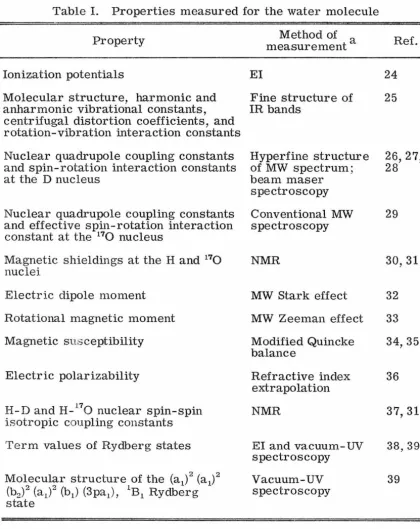
degrees of accuracy are listed in Table I together with the methods
used in the measurements.
1. 2. 2 Problems involved in some of the measurements
Measurement of the various molecular properties of water is
by no means an easy task. Specifically, we cite the problems
involved in measuring the 170 quadrupole coupling constants and the molecular quadrupole moment, thus pointing out the importance of
8
Table I. Properties measured for the water molecule
Property
Ionization potentials
Molecular structure, harmonic and anharmonic vibrational constants, centrifugal distortion coefficients, and rotation-vibration interaction constants Nuclear quadrupole coupling constants and spin-rotation interaction constants at the D nucleus
Nuclear quadrupole coupling constants and effective spin-rotation interaction constant at the 170 nucleus
Magnetic shieldings at the H and 170 nuclei
Electric dipole moment Rotational magnetic moment Magnetic susceptibility
Electric polarizability
H-D and H-170 nuclear spin-spin isotropic coupling constants Term values of Rydberg states
Molecular structure of the (a1)2 (a1)2
(b2)2 (a1)2 (b1 ) (3pa1), 1B1 Rydberg state
EI
Method of a measurement
Fine structure of IR bands
Hyperfine structure of MW spectrum; beam maser spectroscopy Conventional MW spectroscopy
NMR
MW Stark effect MW Zeeman effect Modified Quincke balance
Refractive index extrapolation NMR
EI and vacuum-UV spectroscopy Vacuum-UV spectroscopy
IR: infrared
Ref. 24 25 26, 27, 28 29 30,31 32 33 34,35 36 37,31 38,39 39
a EI: electron impact MW: microwave
The 17
0 quadrupole coupling constants were measured by using
a conventional microwave spectrometer. The 160 nucleus does not possess a quadrupole moment and the experiment was performed on
HOO vapour containing 170 isotopic species in low natural abundance. Furthermore, the water molecule is an asymmetric rotor and is not
easily subjected to study through microwave spectroscopy. The
measured 170 quadrupole coupling constants were based on the
220 - 221 rotational transition of HD170. The observed spectrum was poorly resolved. The derived 170 quadrupole coupling constants gave a value for the field gradient asymmetry parameter that
corres-ponds 29 to an unusually highs hybridization of 38% in the oxygen
bonding orbitals of water according to the Townes-Dailey theory. 40
This led the investigators to conclude that the structure of bonds
involving oxygen needs reexamination. From the foregoing consider- .
ations, there is clearly a need for an ab initio calculation of the field
gradient at the oxygen nucleus in the water molecule.
Measurement of the molecular quadrupole moment of water
would apparently be even more difficult than that of the 170 quadrupole coupling constants. The magnitudes and signs of molecular quadru
-pole moments can be measured directly by the electro-optical method
of Buckingham. 41 The quadrupole moment of a molecule with a
vanishing dipole moment is independent of coordinate origin. For a
dipolar molecule, Buckingham and Long1.iet-Higgins 42 have recently
shown that contrary to earlier expectations, the coordinate origin of
10
experiment it> not the molecular center of mass and, in fact, may not be easily determined, being dependent in a complicated manner on the optical frequency used in the measurement. Since knowledge of the coordinate origins, the signs, and the magnitudes of multipole
moments is needed in specifying molecular fields, the direct measure-ment of the higher multipole momeasure-ments of molecules must be regarded as an unsolved problem at the present time. Therefore, theoretical calculation of the molecular quadrupole and octopole moments of the water molecule is a timely step to pursue.
1. 3 Scope of this thesis research
With such a wealth of experimental data and also a lack of it in some cases, it is highly desirable for a theoretical investigation of the water molecule to emphasize the ab initio calculation of its mole c-ular properties. In section 1. 1, previous ab initio calculations on the water molecule were summarized. As stated therein, good total
molecular energies for the ground electronic state were obtained. However, few molecular properties were calculated. It has been pointed out 43 that a good total molecular energy does not necessarily imply a satisfactory description of the charge distribution in the molecule.
In the thesis research reported herein, several approximate Har tree- Fock self- consistent-field wa vefunctions for the ground electronic state of the water molecule have been obtained using an
molecular quadrupole moment, diamagnetic shielding,
Hellmann-Feynman forces, and electric field gradients at both the hydrogen and
the oxygen nuclei have been calculated and compared with available
experimental measurements. This comparison furnishes an extensive
quantitative test of the predicted charge distribution since the
one-electron properties calculated depend on different powers of the
electron coordinate ranging from r-3 to r3• Our calculated results
are also compared with those calculated by Neumann and Moskowitz 44
who independently investigated the water molecule using very large
sets of gaussian basis functions and whose work came to our attention
at the conclusion of our own investigation. As the final steps in our
research, the charge distribution predicted by our most elaborate
wavefunction is plotted out pictorially in the form of contour maps,
and the nature of the chemical bond in the water molecule is discussed
in terms of the Townes-Dailey theory of nuclear quadrupole
12
2. Hartree- Fock theory
We briefly describe here the elements of molecular
Hartree-Fock theory. 45
In molecular Hartree-Fock theory, the Born-Oppenheimer
separability of nuclear and electronic motions 46 is first assumed.
The many-electron wavefunction for a closed-shell system is then
taken to be an antisymmetrized product of one-electron molecular
spinorbitals which satisfies the Pauli Principle. The expectation
value of the electronic Hamiltonian is next obtained in terms of
spatial integrals of molecular orbitals after integrating trivially over
the spin factors. To this is applied the variational principle under
the constraint that the molecular orbitals remain orthonormal. The
resulting Hartree-Fock equations for the molecular orbitals are
F</>. = E. </>.
1 1 1 (2-1)
where F is a one-electron operator called the Hartree-Fock operator
and is effectively the one-electron Hamiltonian governing the motion
of an electron moving in the average field of all the other electrons.
The eigenvalue Ei is called the Hartree-Fock orbital energy
corres-ponding to the ith molecular orbital
<f
\·
In the approximate molecular Hartree-Fock theory first given
a rigorous mathematical framework by Roothaan, 45 each molecular
orbital <Pi is approximated by a finite linear combination of atomic
m
cf\
=
.6
cpi x..,
p=l p
(2-2)
The matrix Hartree- Fock equations that result are
FC = ESC (2-3)
where
f
x
*K. x_ dT=
LJ
ff
x
*(1) cp.(l) _!__ cp.*(2) x_(2) dT1 dT2 p i ·' l p i r 12 i ·'!and h is the Hamiltonian operator for an electron moving in the field of the bare nuclei.
The matrix C is solved for numerically by the method of trial ...,
14
3. Wavefunctions for the water molecule
3. 1 Computer programs
In the present thesis research, four approximate Hartree-Fock
SCF wavefunctions for the water molecule have been calculated using
an increasing number of multicenter s, p, and d Slater-type atomic
orbitals as basis sets. The computer programs written by R. M.
Pitzer, J. P. Wright, W. E. Palke, D. E. Ellis, and C. A. Christy47
have been employed after some modifications. The programs will
henceforth be referred to as the Cambridge programs. A few errors
in these extensive and painstakingly detailed programs were found
and corrected. These errors do not, however, affect any published
results based on the programs and therefore need not be elaborated
on any further.
Most of these programs compute multicenter integrals by
expanding each part of the integrand in terms of functions located on
one of the centers. The expansion is done in such a way that angular integrations reduce any multiple infinite series to a single infinite
series or to a finite number of terms. The systematic development
of this procedure hinges on four basic steps.
If unprimed coordinates refer to one right-handed coordinate
system while primed ones refer to another right-handed system
rotated from the first through the Eurelian angles a, {3, and y as
defined in Hirschfelder et al. , 48 then
where
and
with
n ?:- 0
= (sin e)n ( d ) £+n (cos
2
e -
1)£ 2£ .e. ! d cose
=
(
cosn<J>,
sin
n<f>
,
(J
=
0
naa' n+m
n:m
=
(-)
(£+n) (.Q-n) ! ! (£-m) !(£+m) !
2 - 0 mo
2
[
(-)a' S a(a) Sa'( ) d +
n m Y nm +
(3-1)
d1({3)nm is the unnormalized Jacobi polynomial in cos {3 as given by
16
If one or both coordinate systems have the polar axis reversed
in direction so that spherical harmonics in one or both systems are
now referred to a left-handed coordinate system, then the coefficient
Dlaa' in (3-1) must be multiplied by one or both of the factors nm
(-/ +n and (-) l+m since
By means of the rotation matrices, all molecular integrals
involving three centers or less can now be referred to the standard
coordinate systems of Figure 1 for which integrals are actually
computed.
The second basic step in the Cambridge programs for
multi-center integrals is the expansion of a real spherical harmonic on one
center in terms of real spherical harmonics referred to a new
coordinate system, obtained from the first by a translation along the
polar axis followed by an inversion of the polar axis:
l_
L
(
)k+m (1m1+£) ! Rl_-~;;: r k p lml (cose
)
s
a (¢) - (lml+k)! (.f-k)! A k A !ml k=lmlwhere R is the distance between centers A and B and r A' rB,
e
A' OB, and ¢ are spherical coordinates in the coordinate systems shown in Figure 2.The third step is the expansion of the radial part of a Slater orbital on one center in terms of zeta functions and Legendre poly-nomials on another center:51
oo -klr A -RI
-=
.e.~o
(2£+ 1) e tn,.e. (kr A' kR) P.e.
(cose
A) (3-3)where the notation is that of Figure 2.
The zeta functions In,.e.(kr A' kR) are identical to those of
Barnett and Coulson 51 except for a scale factor. They are generated by an improved procedure due to R. M. Pitzer. 52 In this procedure, all zeta functions are assembled directly from Bessel functions
without the use of recursion relations on the zeta functions themselves. This change in procedure gives improved accuracy particularly for the higher order zeta functions.
18
c
ZC
XA ..__ _ _ _ _ _ _ _ _ _
__J
XBA B
Figure 1. Actual coordinate system for which molecular integrals are computed. All three y axes point up
from the plane of the paper. Hence the coordinate systems on centers B and C are left-handed.
,,
,,
,, ,,
,, ,,
/
A ,, \
\ \
\
I rB\
\
\ XB
[image:28.559.125.420.54.299.2].eB>!
Figu.:1.·2 :;. Coordinate systems used in defining the change
[image:28.559.160.377.428.570.2]used for the expansion is 53
1
=
f.
2 LJ '>, (f.-m)! pf. m ,(cos el) p £. m (cos 82) •
m=l (f.+m)! cos m( </>1 - </>2 )
J
(3-4)
where r 12 is the distance between the two electrons and r <. and r >
are respectively the smaller and the greater of r1 and r2 • (r1 , 817 ¢1 ) and (r2 , 82 , </>2 ) are the spherical coordinates of electrons 1 and 2, respectively, referred to the same origin.
This expansion is also used for off-center nuclear attraction potentials, with a nucleus replacing one of the electrons.
3. 2 Calculations
In Hartree-Fock calculations, radial integrals by far take up most of the computing time. Each set of p or d atomic orbitals on each center have therefore been given the same exponent in this work. Clearly, several such sets of p or d atomic orbitals must be used in order to have much flexibility in describing non-spherical charge
distribution.
Throughout this work, the experimentally determined
equilib-...
rium OH bond length of 1. 8111 a. u. and HOH bond angle of 104 ° 2 7' for the water molecule 54 have been assumed. This same molecular
20
y, and z on all centers point in the directions shown in Figure 3.
H
0
Figure 3. Coordinate axes employed in the calculation of the wavefunctions and properties of the water
molecule. The z"axis is parallel to the
bisector of the OOH bond angle and the y axis points up from the plane of the molecule.
z
Values of the fundamental constants are taken from Cohen and Dul\l!.ond's recent work. 55
Four SCF electronic wavefunctions were calculated in this work.
The wavefunctions are labelled I, II, III, and IV in order of increasing
basis-set size (7, 10, 17, and 26 basis functions, respectively).
Wavefunction I is one of several obtained by Pitzer and Merrifield 6
[image:30.561.77.470.171.405.2]orbitals on the oxygen nucleus was included in wavefunction II. III differs from II by an additional ls orbital on each hydrogen nucleus, and a 2s and a set of 3d orbitals on the oxygen nucleus. Finally,
wavefunction IV included an additional set of 2p orbitals on each center. The evaluation of molecular integrals took approximately 4
minutes, 7~ minutes, 35 minutes, and 3 hours for wavefunctions I, II,
Ill, and IV, respectively. All computations were done on the IBM 7094 computer at Caltech. Orbital exponents were optimized in only the smaller wavefunctions I and II. It is interesting to note that only minor changes occur in optimal exponents of the oxygen orbitals from those of the free oxygen atom upon bond formation. This can be seen in Table II, where we compare the optimal exponents of the oxygen orbitals in wavefunctions I and II with those obtained using similar basis sets for the oxygen atom in the 3P ground state. The atomic results for the minimal basis set (set A) are from the work of Clementi and Raimondi. 56 Those of the more extensive set (set B) have been calculated in these laboratories using the Atomic SCF Program Number 3 of Roothaan and Bagus. 57
Table III lists the orbital exponents used for the atomic orbitals in wavefunctions III and IV. Several of these exponents were taken
from our optimized wavefunction II but, as a whole, they were based
on Cade and Huo's work on the OH radical 58 after scaling the opti-mized values in the OH wavefunction according to the ratio of the OH bond lengths. This procedure is probably justified since for Slater
22
Table II. Comparison of optimal orbital exponents of the oxygen orbitals in two similar approximate Hartree -Fock wa vefunctions for the 3P oxygen atom and in the water molecule.
Atom Molecule
Set A
ls 7.6579 7.66
2s 2.2458 2.25
2p 2.2266 2.21
Set B
ls 7.65 7.65
2s 2.26 2.26
2p 1. 66 1. 56
[image:32.563.81.425.103.462.2]used in wa vefunctions III and IV.
Wa vefunction III Wa vefunction
r:
OrbitalExponent Criterion Exponent Criterion
lsH 1. 33 C-Ha 1. 40 arbitrary
ls~ 2.47 C-H
2s8 2.33 C-H
2pH 1. 85 C-Hc
is0 7.65 II b 7.65 II
2s0 1. 74 C-H 1. 74 C-H
I
2s0 2. 90 C-H 2.90 C-H
2po 1. 56 II 1. 30 C-H
'
2po 3.60 II 2. 16 C-H
"
2po 3.81 C-H
3ct
0 1. 66 C-H 1. 66 C-H
a Cade and Huo's OH value multiplied by the bond length ratio
1.8342
1. 8111 = 1. 01275.
b Retained from wavefunction II.
c Based on the 7T2pH orbital exponent in Cade and Huo's OH
24
is inversely proportional to the orbital exponent. In any case, since
the OH bond lengths in water and the OH radical differ by less than
2%, the change in the orbital exponents is not expected to be large.
The futility of exponent optimization relative to increasing the
basis-set size has been well established. 58 For example, in our case,
for wavefunction II, exponent optimization took 5 hours of computer
time producing only a small change of 0. 014440 a. u. in energy.
Here, the optimal exponents in atomic wavefunction B above and a
hydrogen exponent of 1. 2 7 were used as starting point for the
optimi-zation. The two sets of oxygen 2p orbitals were found to be strongly
coupled together, necessitating double optimization of these two
exponents in addition to single optimization of the other exponents.
For wa vefunctions Ill and IV, multiple optimizations would be even
more important.
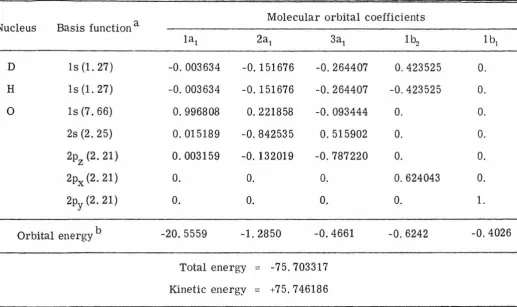
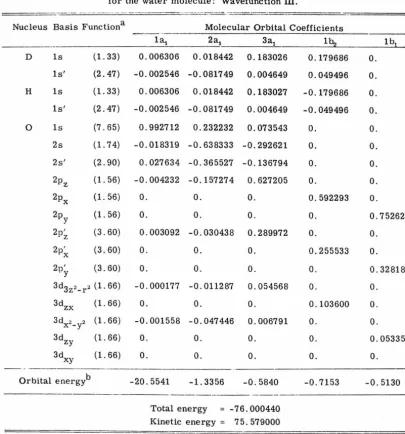
The basis functions, orbital exponents, molecular orbital
coefficients, orbital energies, and total energies for all four
wave-functions are given in Tables IV to VII. A total of 34, 266
non-vanish-ing integrals were needed in calculating wavefunction IV and it is
Basis function a
Molecular orbital coefficients Nucleus
1a1 2a1 3a1 1 b2 1 b,
D ls (1. 27) -0, 003634 -0. 151676 -0. 264407 0.423525 0.
H ls (1. 27) -0. 003634 -0. 151676 -0.264407 -0.423525 0.
0 ls (7. 66) 0.996808 0.221858 -0.093444 0. 0.
2s (2. 25) 0.015189 -0.842535 0. 515902 0. 0.
2pz (2. 21) 0.003159 -0. 132019 -0.787220 0. 0.
2px(2.21) 0. 0. 0. 0. 624043 0. ~
01
2py(2.21) 0. 0. 0. 0. 1.
-Orbital energy b -20. 5559 -1. 2850 -0.4661 -0.6242 -0. 4026
Total energy
=
-75.703317Kinetic energy
=
+75.746186a Orbital exponents are given in parentheses.
[image:35.727.106.624.99.406.2]26
TABLE V. Molecular orbital coefficients and energies for the water molecule: Wavefunction II.
--=-·-· --~~~~---
-Nucleus Basis Functiona Molecular Orbital Coefficients
1~ 2a1 3a 1
D ls (1. 50) 0.003658 -0.146790 0.160025
H ls ( 1. 50) 0.003658 -0.146790 0.160025
0 ls (7. 65) -0.996661 0.224840 0.083515
2s (2. 26) -0. 015427 -0. 857229 -0.410603
2pz ( 1. 56) -0.002251 -0.104478 0.641687
2px ( 1. 56) 0. 0. 0.
2py (1. 56) 0. 0. 0. 2 ,
Pz (3. 60) -0.001534 -0.060003 0.284225
2p~ (3. 60) 0. 0. 0.
2p~ (3. 60) 0. 0. 0.
Orbital energyb -20.5421 -1.3534 -0.5638
Total energy = -75. 969347 Kinetic energy = 75. 927858
aOrbital exponents are given in parentheses.
b All energies are in a. u.
1~
0.304599
-0.304599 0. 0. 0. 0.515880 0. 0. 0.270071 0. -0.7099
lb1
0. 0. 0. 0. 0. 0.
0. 753116 0.
0.
0.329345
[image:36.560.62.485.156.486.2]TABLE VI. Molecular orbital coefficients and energies for the water molecule: Wavefunction III.
- --- - -- --·
Nucleus Basis Functiona Molecular Orbital Coefficients
l~ 2a1
- - - 3a1 lb..i lb!
D ls (1.33) 0.006306 0.018442 0.183026 0. 179686 0.
ls' (2. 47) -0.002546 -0. 081749 0.004649 0.049496 0. H ls (1. 33) 0.006306 0.018442 0.183027 -0. 179686 0. ls' (2. 47) -0.002546 -0. 081749 0.004649 -0.049496 0.
0 ls (7. 65) 0.992712 0.232232 0.073543 0. 0. 2s ( 1. 7 4) -0.018319 -0.638333 -0.292621 0. 0.
2s' (2. 90) 0.027634 -0.365527 -0.136794 0. 0.
2pz (1. 56) -0.004232 -0. 157274 0.627205 0. 0. 2px (1. 56) 0. 0. 0. 0.592293 0. 2py (1. 56) 0. 0. 0. 0. 0. 752629
2p~ (3. 60) 0.003092 -0.030438 0.289972 0. 0.
2 Px ' (3. 60) 0. 0. 0. 0.255533 0.
2p' y (3. 60) 0. 0. 0. 0. 0.328185
3d3z2-r2 (1. 66) -0.000177 -0. 011287 0.054568 0. 0.
3dzx (1. 66) 0. 0. 0. 0.103600 0.
3dx2-y2 (1. 66) -0.001558 -0.047446 0.006791 0. 0. 3dzy (1. 66) 0. 0. 0. 0. 0.053350 3dxy (1. 66) 0. 0. 0. 0. 0.
Orbital energyb -20.5541 -1. 3356 -0.5840 -0. 7153 -0.5130
Total energy -76.000440 Kinetic energy = 75. 579000
aOrbital exponents are given in parentheses.
[image:37.563.76.482.122.556.2]28
TABLE VII. Molecular orbital coefficients and energies
for the water molecule: Wa ve!uncUon IV.
=---== --;-;.-:.----·----·· -·----
-Nucleus Basis Function a Molecular Orbital Coefficients
la 2a 3a lb, lb.,
D ls (1. 40) -0.002742 0.155823 0. 178079 -0. 288124 0.
2s (2. 33) 0.002204 -0.009612 0.018268 -0. 013111 0.
2pz (l. 85) -0. 001112 -0.020014 0.001162 0. 028743 0. 2px (1. 85) -0.001095 -0.027048 -0.022159 0.020212 0.
2py (1. 85) 0. 0. 0. 0. 0.026725
H ls (1. 40) -0. 002742 0.155823 0. 178079 0.288124 0. 2s (2. 33) 0.002204 -0.009612 0.018268 0. 013111 0.
2pz (1. 85) -0. 001112 -0.020014 0. 001162 -0. 028743 0.
2px (1. 85) 0.001095 0.027048 0.022159 0.020212 0.
2py (1. 85) 0. 0. 0. 0. 0.026725
0 ls (7. 65) -0. 993078 -0.239640 0.072220 0. 0.
2s (1. 74) 0.010528 0.447181 -0.320504 0. 0.
2s' (2. 90) -0. 025587 0.410713 -0.132111 0. 0.
2pz (1. 30) 0.001520 0.014437 0.364844 0. 0.
2px (1. 30) 0. 0. 0. -0.243358 0.
2py (1. 30) 0. 0. 0. 0. 0.469982
2p~ (2.16) -0.001052 0.080842 0.323899 0. 0.
2p~ (2.16) 0. 0. 0. -0. 338790 0.
2 Py ' (2 .16) 0. 0. 0. 0. 0. 354578
2p'~ (3. 81) -0.001637 0.025196 0.219726 0. 0.
2 Px " (3. 81) 0. 0. 0. -0. 190513 0.
2 Py " (3. 81) 0. 0. 0. 0. 0. 248775
3d3z'-r,(1. 66) 0.000238 0.007069 0.042325 0. 0.
3dzx (1. 66) 0. 0. 0. -0.058474 0.
3dx"-y' (1. 66) 0.000329 0. 018575 0.005437 0. 0.
3dzy (1. 66) 0. 0. 0. 0. 0.039069
3dxy (1. 66) 0. 0. 0. 0. 0.
- - --- --- -- - ·
Orbital energyb -20.5654 -1. 3392 -0. 5950 -0. 7283 -0.5211 - ----·-- --- -- -
-Total energy = -76.004682 Kinetic energy = 75.662145
=-=----;:.-:. . ...;;_.:
aOrbltal exponents are given In parentheses.
[image:38.566.116.454.96.596.2]4. Electronic properties
4. 1 Definitions and nature of one-electron properties
If P is a one-electron operator, then for a closed-shell system of 2n electrons, the expectation value of P according to a Hartree-Fock
f t. . . b 59 wave unc 10n is given y
n
<P>
= 2~
«t\IPI
<I\>
i=lwhere the molecular orbitals
</\
are defined in section 2 and the summation is over all occupied molecular orbitals.(4-1)
The definitions of the one-electron properties calculated in this thesis for the water molecule are as follows in atomic units:
(4-2)
Electronic contributions to the components of the Hellmann- Feynman force at nucleus N
(4-3)
Average diamagnetic shielding at nucleus N d
a (N) == (4-4)
Dipole moment
30
Molecular quadrupole moment tensor components
Molecular octopole moment tensor components
(4-7) Third moment tensor components
(4-8)
In the above definitions, Greek indices are used to denote cartesian
components of vectors and tensors. Thus, r a is a cartesian
compo-nent of the vector
r,
the integration variable, while rka is a cartesian coordinate of the position vector rk of nucleus k with charge zk.6 af3 is the Kronecka delta. e and m are respectively the electron
charge and mass while c is the velocity of light. qap is by convention 60
the second derivative of the electrostatic potential with respect to the
a and f3 position coordinates and hence -qa/3 is the corresponding field
gradient component. The coordinate origin of the field gradient,
Hellmann-Feynman force and average diamagnetic shielding operators
is to be taken at the specified nucleus, N, indicated in parentheses.
summation symbol indicates omission of the nucleus to which the
one-electron property is referred as origin.
The first non-vanishing multipole moment of the water molecule
is the dipole moment which is therefore independent of coordinate
origin. The quadrupole and octopole moments have been defined
according to Buckingham 41 and will be ref erred to the center of mass
of H2 16
0 as origin in the present calculations. Enough information
will, however, be provided in this thesis to allow a translation to any
other coordinate origin.
The nature of some of the one-electron properties will now be
discussed.
The electric field gradient tensor appears in the expression for
the energy of electrostatic interaction between electrons and a nucleus
possessing a nuclear quadrupole moment. The zero order energy is
that due to coulombic interaction between electrons and a point charge
nucleus. Higher order corrections appear in the multipole expansion
of the electron-nuclear electrostatic potential. 53 These corrections
arise physically from the finite spatial distribution of the nuclear
charge, the lowest order correction being the nuclear quadrupole
interaction energy. For the case of an asymmetric top molecule
containing a nucleus with a quadrupole moment, the expectation value
of the nuclear quadrupole interaction Hamiltonian in a given rotational
state may be reduced to the following convenient form: 60
l I e I qJ Q [ 3 ]
32
where jel is the proton charge, l the nuclear spin quantum number, and J the quantum number of total rotational angular momentum of the
molecule including nuclei and electrons. The remaining symbols have
the following meanings.
-C = F(F+ 1) - 1(1+ 1) -J(J+ 1); F
=
l + Jqaa [ / l) () (K+l) CJE()(/(K)]
qJ
=
J ,J + + E K(J +1) (2 J +3)
+
2qbb CJE(K)
(J +1)(2J +3) oK
qcc
l
oE(K) ]+ (J +1)(2J +3)
L
J(J +1) - E(K) + (K-1) ClKHere, qaa' qbb' and qcc are as defined in (4-2), a, b, and c being the principal axes of inertia of the molecule in order of decreasing
rotational constants, K is Ray's asymmetry parameter of the
asym-metric rotor 61 and E(K) the well documented reduced rotational energy of an asymmetric rotor with rotational constants 1, K, and
-1. 5
o,
62 E(K), and henceCJ.:r'
is a function of the rotational state.Q is called the nuclear quadrupole moment. p ( n r ) is the nuclear n charge density at the position rn referred to the nuclear charge
The separations between nuclear quadrupole interaction energy levels are generally of the order of microwave and radio frequencies and have therefore been quite commonly observed under various
degrees of spectroscopic resolution. Experimental results obtained via microwave spectroscopy are usually reported in terms of values for the quantities
I
eI
qaa Q,I
eI
qbb Q, etc. which are called the nuclear quadrupole coupling constants and are conventionally denoted as Xaa•~b' etc.
From the definitions, it can be seen that all field gradient
components will vanish for a spherical charge distribution. The field gradient at an atomic nucleus is therefore zero for s electrons and for a closed shell of p electrons. It will differ from zero when the
effective nurr.ber of p electrons around a nucleus is less than six. The relation (\f electric field gradient tensor components to hybridi-zatiou :1nd other aspects of chemical bonding in molecules is thus possible and forms an objective of the Townes-Dailey theory on which further discussion will be made in section 5. 2.
According to the Hellmann-Feynman theorem, 63 we have
(4-10)
34
energy terms, and A. is one of any number of parameters specifying nuclear positions in H, for example a nuclear position coordinate. The integration indicated in the right-hand-side expression is over the
electronic coordinates.
The force on a nucleus defined by an increase in the nuclear coordinate R is -
~~.
The actual evaluation of this quantity is based on the definition of a derivative as a limiting value and therefore the value of E at at least two neighbouring values of R must be known. This would involve the solution of Schrodinger's equation for the electronic wavefunction at at least two nuclear configurations. Application of the Hellmann-Feynman theorem, however, givesaE
1
aH
I- -
aR
= - (
t/I -
aR
t/I)
(4-11)showing that the same result can be obtained through knowledge of
t/I
at the single nuclear configuration of interest. The right-hand-side expression of (4-11) is called the Hellmann-Feynman force. It is identical to the expression for the electrostatic force that would be derived by assuming that the electronic charge distribution has the probability density
t/l*t/I.
The Hellmann-Feynman theorem holds for the exact Hartree-Fock wavefunction for a closed-shell system, as well as for the exact wavefunctiont/I.
within the molecule is given by 41
r/)(R)
=
2
+!e
3RaRJ3-oaf3R3 a(3 Rs
_ !
n
5 RaRJ3 Ry - R2 (o {3yRa + oyaR{3 + o a{3 R 1,)5 a{3y R7
+ --- (4-12)
where the multipole moments, defined earlier in this section, have the
same coordinate origin as the vector R. The indices
a,
(3, and ystand for cartesian components of vectors and tensors, and summation
is implied over repeated indices in accordance with the Einstein
t . t' 64
summa ion conven ion.
Given the multipole moments of two polar molecules, a major
contribution to the long-range intermolecular potential is in principle
determined. In the case of the water molecule, although the dipole
moment is large and the contributions of higher moments to the
molec-ular electric field decrease with the distance R, these higher moments
may not be negligible in the intermolecular potential function. For
example, the third virial coefficient of steam has been evaluated
taking dipole-dipole interaction into account. 65 Distinct disagreement
between calculated and experimental values was found and has been
attributed to the neglect of higher multipole moments, in particular
36
4. 2 Computation of one-electron _E!:_Operties
If the LCAO expansion (2-2) is used to approximate the
Hartree-Fock molecular orbitals in (4-1), the expectation value of a
one-electron operator P for a closed-shell system of 2n electrons becomes
(P)
m m
= 2 ~
6
c . c .
<x
I
PIx_
>p=l q=l pl q1 p .'1
=
2 Tr (Ct PC) "' "' "'where Qt is the transpose of the matrix C, P is the matrix with "'
(4-13)
elements P pq = ( xp
I
PI\i) ,
and Tr indicates the trace of a matrixproduct.
A computer program for calculating the multicenter matrix
elements P pq for the diamagnetic shielding, force and field gradient
operators between s and p Slater-type orbitals has been described
previously.66 We have added several subroutines, one due to W. E.
Palke, so that all necessary rotations and labelling can be done
completely automatically to minimize errors. For calculating
integrals of all the one-electron operators involving ct-orbitals, the
existing Cambridge computer program (see section 3. l) used in
calculating three- and two-center coulomb integrals was suitably
modified as explained below.
The three-center coulomb integral is defined as
AABC = ffA(l) A(l) _!_ B(2) C (2) dT 1 dT2
r i2
where, for example, A(l) denotes an atomic orbital of electron 1 centered on A, VA(2) is the result of integrating over the coordinates of electron 1 and represents the coulomb potential felt by electron 2,
and dT 1 , dT 2 are the volUJ.i'le elements of integration.
In the existing Cambridge program for calculating AABC, the integration over electron 2 is done in the A coordinate system by expanding B(2) and C(2) in terms of zeta functions and real spherical harmonics centered on A. Thus, AABC may be converted into a three-center one-electron integral by replacing the function VA with a one-electron operator. If the angular part of A(l) A(l) is a product of two real spherical harmonics of orders £1 and i.2 , then by using the
multipole expansion (3-4), VA(2) will be obtained as a linear combi-nation of real spherical harmonics of electron 2 with orders
I
£1 - ~Ito ( f1 + £2 ). The correct angular dependence of the different
one-electron operators is generated by the following values of l.1 and £2:
Ql £2 Operator
0 0 1/r
0 1 Hellmann-Feynman force and dipole moment 0 2 Electric field gradient and molecular quadrupole
moment (spherical tensor components)
1 1 Electric field gradient and molecular quadrupole moment (cartesian tensor components)
38
The conversion of AABC to an integral of a one-electron operator
can thus be effected by modifying essentially only the radial part of the
integration and the normalization constant. Two- and one-center
integrals were obtained by making some changes in the original
programs to make centers B and C collapsible onto A.
The computer program for two-center coulomb integrals AABB
was modified in a similar manner. By comparing values for integrals
of one-electron operators obtained with this program and those from
the modified AABC program, an internal check of the two original
programs as well as of the modified programs was obtained. This
check turned out to be a highly valuable one.
These modified programs of course also work for s and p orbitals.
An external check was thus possible by comparing integral values with
those obtained by the program of R. M. Pitzer. 66 Values were found
to agree to 10-6 a. u. or better.
To sum the slowly convergent infinite series encountered in the
three-center programs when the operator is on the molecular axis,
the non-linear sequence-to-sequence transformation described by
Petersson and McKoy 67 was indeed found to be effective and was used
after independent testing for accuracy. The dipole moment results
were checked with a program written independently by M. D. Newton
and F. P. Boer 68 for s and p orbitals, and integral values were found
4. 3 Results and comparison with experiment
Calculated values for the various electronic properties obtained
with all four wavefunctions are shown in Table VIII. Experimental values where available are given for comparison.
In Table VUI, V, and T stand for potential and kinetic energies,
respectively. Koopmans' Theorem 69 is invoked and the entries listed as calculated ionization potentials are just the negative of the three
highest orbital energies associated with each wavefunction.
Field gradient components (a. u.) at the D nucleus have been transformed to the coordinate system with axes parallel and
perpen-dicular to the OD bond (~, 1J in Figure 3) and converted into deuteron quadrupole coupling constants using the multiplication factor 70
e2Q(D) x 10-6
=
0 65713 M /. c a. u.
ha:
for comparison with the experimental values of Posener 26 and
Bluyssen et ai.27 a is the angle of rotation for diagonalization of the quadrupole coupling tensor at the deuteron (see Figure 3).
The field gradient components -qxx(O) and -qzz(O) at the oxygen nucleus were converted to values for the 170 quadrupole coupling constant
Xa.a
(170) using a value of Q(170) = -0. 024 barn for the 170
quadrupole moment for comparison with Stevenson and Townes' experimental value.29 The subscripts a, b, c refer to the principal inertial axes of HD170 (see Figure 3). 11(0) is defined as 29
TABLE Vlll. Calculated and experimental energies and one-electron properties of the water moleculea.
---;-:--_-:,_. -- ····-- -· . ~ --· -· --- -·
-n m IV Experiment Neumann-Moskowitzb
- - - --- - - -
-Total energy (hartrees) -75.703317 -75.969347 -76.000440 -76.004682 -76. 481 c -76.05936
-V/T 1.998868 2.001093 2. 011152 2.009054 2.ooooood 2.00066
Ionization potentials (a. u.) 0.4026 0. 5077 0.5130 0. 5211 0.463 ±0.004e 0.5069 0.4661 0. 5638 0.5840 0. 5950 0.533 ±0.0lle 0.5822 0.6242 0.7099 0. 7153 0. 7283 0.595 ±0.0lle 0. 7190
X~~(DJ (Mc/sec) 0.3437 0. 3888 o. 3595 0.3626 0. 3152 ± 0. 0077! 0. 3411 X~T/(D) (Mc/sec) -0.0204 -0. 0270 -0.0041 -0.0085 -0.0088 ± 0.0087! -0.0083
~(D) (Mc/sec) -0.1502 -0.1741 -0.1588 -0.1586 -0.1393 ± 0. 0070! -0.1478
a 2 °22' 2 °44' 0°27' 0°57' 1 "7' ± 1°10' f o• 58'
Xaa(110) (Mc/sec) -11. 584 -9.364 -9.072 -8.331 -8.13 ± 0. lg -8.34
TJ(O) 1. 547 1. 525 1. 550 1. 484 0. 7 ± O. lg 1.506
Xab(110) (Mc/sec) 3.896 3.196 3.045 2.923 4.33h 2.88
fz(D) (a.u.) -1. 4776 -1. 4586 -1. 4620 -1. 4975 -1. 4940i -1. 505 ~
0
fx(D) (a.u.) -1.9778 -1. 9401 -2.0136 -2.0482 -2. 0498i -2.081
fz(O) (a.u.) 0.1172 0.7946 2.6720 2.4261 2. 98801 2.928
a~D) (ppm) 103. 6 101.7 102.1 102.0 102. oi 102.9 ad(O) (ppm) 415.3 415.8 415.0 415.0 416. l
µ (Debyes) 1. 921 2.827 1.949 2.035 1. 85 ± o. o:f 1. 995
<~ro'k> (10-10 cm2
) 4. 940 5. 349 5.367 5.462 5.1 ± 0. 7l 5.371
6 zz (Io-•• esu. cm') -0.008 -0.123 -0. 053 -0.050 -0.108
eYY (lo-•• esu. cm') -1. 485 -2. 307 -2.496 -2.589 -2.422
nzzz (10-34
esu.cm3
) -1. 353 -1. 337
ozyy (10-34 esu.cm3) -1.136 -0.960
Rzxx (10-34 esu. cm3) 1. 325 1.191
---~ -
[image:50.725.108.623.78.437.2]-Footnotes for Table VIII.
a For explanation of notations, see text. For each property, the relevant nuclear center is indicated in parentheses.
b Calculated by Neumann and Moskowitz with their best gaussian basis wavefunction, Ref. 44. Note that the molecular geometry assumed by these workers differs slightly from ours.
cOxygen atomic energy (-75. 1101 a. u.) from Ref. 58.
Dissociation energies of 02 and H2 from P. Brix and G. Herzberg,
Can. J. Phys. 32, 110 (1954) and G. Herzberg, Spectra of Diatomic Molecules (D. Van Nostrand Company, Inc., Princeton, New Jersey, 1950). Heat of formation of H20 from Ref. 1 7. Zero-point energy of
H20 derived from data of Benedict, Gailar, and Plyler, Ref. 25.
d Exact value according to the virial theorem.
e Reference 24.
f References 26, 27.
a
0 Reference 29.
h Derived from the experimental values of "a.a (17
0) and 7](0).
i Nuclear contribution to the force as derived from the experimentally determined equilibrium molecular geometry.
j Based upon the spin-rotational constants of Ref. 28 and the
equilibrium molecular geometry.
k Reference 32. 1
42
derived from Stevenson and Townes' values for Xaa (170) and 77(0) using the symmetry relationship qzx(O)
=
0.The quadrupole moment of 170 adopted in this work is that due to Bessis et al. 71 A slightly different value has been reported by Kamper,
Lea and Lustig. 72 In the latter work, ( _!_) 2 and the quadrupole
r3 p
coupling constant were obtained from the e. s. r. spectrum of atomic
oxygen, and these quantities were combined to yield a value of
-0. 0265 barn for the 170 quadrupole moment after making allowance for the Sternheimer factor. 73 The value of Bess is et al. is based
upon the observed quadrupole coupling constant for the 3P2 state of atomic oxygen (-10. 44 Mc/sec) and the electric field gradient
calculated with their configuration-interaction wavefunction, without
correcting for the Sternheimer effect. The reliability of Bessis et al. 's
values of the quadrupole moment for the 170 nucleus clearly depends upon the accuracy of the electric field gradient calculated with their
configuration-interaction wavefunction. We have decided to use the
value of Bessis et al. since their wavefunction also yields a value for
(1/ r3)
2p which is in good agreement with experiment. In this
connec-tion, we have also computed (1/r3
)
2p and (P2
°
/r3
) for the 3P2 oxygen
atom using the limited basis-set function A due to Clementi and
Raimondi 56 and our atomic wavefunction B. The results of these
calculations are compared with the values of Bessis et al. and with
experiment in Table IX. It is interesting to note that while the
Tal>le IX. Calculated and experimental values of
1 P~ f 3 a
(-r3 ) 2p and (-r3 ) or the P2 oxygen atom.
Wavefunction Ab Wavefunction B Bessis et al. c Experimentd
(_!_) (1025cm -3)
r3 2p 2.48 3.26 3. 08 3. 10
p(l
<
-=->
(10r3
'..!5 ~
cm- ) -0.50 -0.65 -0.62 -0.62
Qcff(017) (barn) -0.030 -0. 023 -0. 024 -0. 024
a The effective quadrupole moment Qeff(017) is derived using the observed
quadrupole coupling constant of -10. 44 Mc/sec (Ref. 72, 74).
b Ref. 56.
c Ref. 71.
44
poor agreement with experiment, the results obtained with set B are
in reasonable agreement with the calculations of Bessis et al. and
with experiment. These results provide some indication of the
accuracy in the computed field gradient of Bessis et al. Finally, we
note that the paramagnetic resonance results of Kamper et al., 72 as
well as the more recent e. s. r. measurements of Harvey, 74 also yield
an effective 170 quadrupole moment of -0. 024 barn when their deduced 1
values of ( r3 >2p are combined with the observed 170 quadrupole
coupling constant.
The experimental value for fa(N), the a component of the
Hellmann-Feynman force exerted by all the electrons on nucleus N,
is obtained by considering the contribution to the force by the other
nuclei at the known experimental equilibrium geometry of the
mole-cule.
The experimental value of the diamagnetic shielding at the proton
is 102. 0 ppm, and was determined using the well-known expression 75
relating the nuclear magnetic shielding constant and the spin-rotation
interaction constants. The absolute proton shielding was obtained
from the absolute magnetic shielding 76 in H2 (26. 6 ppm) and from the
known chemical shift 3
o
(3. 60 ppm) of gaseous H20 relative to gaseousH2 • Several sets of spin-rotational constants for the proton in H20
and HOD have been reported in the literature. 77, 781 28 The best data
appear to be those of Bluyssen et al., 28 and we have used their
reported spin-rotational constants in the evaluation of the
No experimental value for the diamagnetic shielding at the oxygen nucleus is available.
The electric dipole moment µ is defined positive for
The sign has not been determined experimentally but is most certainly positive.
The quantity ( ~ r~k) is the mean square distance of the electrons K
160
from the center of mass of H2 • The quadrupole moment tensor E>,
the octopole moment tensor Q and the third moment tensor Rare all
referred to the center of mass of the H2160 molecule as origin.
In the last column of Table VIII, we have included for compari-son with our calculated properties the recently calculated values of Neumann and Moskowitz 44 (after necessary conversions). These values are based upon their best g;aussian wavefunction.
4. 4 Discussion of results
4. 4. 1 Energies
The best total energy obtained in this work is about 0. 47 a. u.
higher than the experimental value. The energy calculated by
Neumann and Moskowitz using their best gaussian wavefunction is
somewhat better than ours, their value being lower by 0. 05468 a. u.
An energy drop of as much as 0. 03 a. u. can be expected by including
an additional ls
46
The virial ratio - V /T should be exactly 2. 0 for an exact wave-function at the equilibrium molecular geometry as well as for an
exact Hartree-Fock wavefunction at the Hartree-Fock equilibrium
geometry. Both the lack of geometry variation and the lack of orbital
exponent variation in wavefunctions III and IV are certainly reasons for the deviations from the theoretical value in our results. The use of the virial theorem as a criterion for judging wavefunction accuracy has been critically discussed by Fraga and Ransil. 79
As first pointed out by Koopmans, 69 Hartree-Fock orbital energies should be good approximations to the vertical ionization potentials of a closed-shell atom or molecule. The vertical ionization potentials predicted for the water molecule in the present calculations using Koopmans' Theorem increase monotonically with basis-set size. This is hardly surprising since each time the molecular orbitals are
given more freedom, the wavefunction is varied to get a minimal
energy for the neutral molecule. However, the optimal molecular orbitals so determined are not necessarily optimal for the ionized molecule, whose energy therefore does not necessarily get lowered
each time. The difference in correlation energies in the neutral and
ionized molecules is independent of basis-set size. Thus an increas-ing gap between the two energy levels can be expected. In the case of water, because the ionization potentials predicted with the minimal
-basis-set wavefunction are already fairly close to the experimental
values, they tend to diverge from the latter values as more and more
and Shull 2 thirteen :vears ago. 4. 4. 2 One-electron properties
In Table VIII, it is seen that the minimal-basis-set wavefunction I describes the molecular electronic charge distribution well except
in the vicinity of the oxygen nucleus. The force and the field gradient at the oxygen nucleus are off, but other one-electron properties agree with experimental data. Wavefunction II has a total energy lower than that of the minimal-basis-set one by about 0. 27 a. u. (7 e. v.) but the
calculated properties did not improve much. The dipole moment in particular turns out to be far too high. The importance of a balanced basis set is clearly demonstrated here. From the results listed in the work of Arrighini, Maestro, and Moccia 7 on the water molecule, it is also clear that 3d functions on the oxygen nucleus can be impor-tant in predicting the dipole moment. This point has been discussed by Mulliken.43
4. 4. 2. 1 Oxygen field gradient
Agreement with the experimental value for the nuclear quad-rupole coupling constant Xaa for 170 was achieved only with wave-function IV. The biggest improvement in the calculated value for this quantity are seen to occur in going from I to II and from III to IV. This suggests that the correct prediction of field gradients at the 170 nucleus requires a flexible linear combination of p functions centered