Accessing the Learning Lifeworld: Transformative Student Learning Experiences in Regional Academic Travel at New York University Abu Dhabi
Thesis submitted in accordance with the requirements of the University of Liverpool for the degree of Doctor of Education
by Jason Seth Beckerman
Acknowledgements
First, I owe a great deal of thanks to Carol Brandt at NYU Abu Dhabi’s Office of Global Education for the inspiration she gave me for this project. Special thanks to Lynn Doiron from Global Education at NYUAD for helping me gather information, and always being there to provide necessary
information to complete this thesis.
Once the project was underway, and up until I wrote the last word of this thesis, I cannot express how grateful I am for the guidance and unceasing support provided by the best thesis supervisors. My primary supervisor, Dr. Peter Kahn, has been ever-present throughout the thesis process, challenging me to always think more deeply about my research. I am forever grateful to Peter for his direction, and I am happy to call him a good friend as a welcome result of this process. My secondary supervisor, Dr. Morag Gray, also served as my doctoral development advisor throughout the Ed.D. program. Morag has always been there for me during the doctoral journey, challenging me to think beyond my own preconceptions, and my perceived abilities.
I would also like to express my gratitude to the fourteen students who contributed their time to tell their stories that formed the backbone of this study. Each one of them has shown their maturity, their exceptional
intelligence, and their interest in working to positively change lives and make a lasting impact in the world.
Abstract
Accessing the Learning Lifeworld:
Transformative Student Learning Experiences in
Regional Academic Travel at New York University Abu Dhabi
Jason Seth Beckerman
This thesis investigates the learning experiences of students who participated in short-term study abroad trips (also known as regional
academic travel) offered by New York University Abu Dhabi’s Office of Global Education, with the objective of attaining an authentic account of these
experiences. This authentic account supports a better understanding of a student’s experience, and leads to a more in-depth understanding of learning, which for this research is called the learning lifeworld. Phenomenography is used to capture the qualitative variation of individual experiences leading to four categories of description placed in logical relationship to one another yielding an outcome space of four conceptions of learning experience. Phenomenography alone, while reflective in nature, has limitations on determining an authentic account of experience.
The findings of this research show that there were at least four qualitatively different ways students experienced regional academic travel trips. The categories developed through an analysis of student reflective accounts are: the regional academic travel experience complements and supplements classroom learning; develops academic skills; affects students’ future academic, personal, and professional endeavours; and offers students a chance to reflect on impacts they have made and can make in a community and the world. The results of this research make an original contribution to lifeworld theory, transformative learning, and short-term study abroad research by utilizing a unique combination of research approaches
(phenomenography and reflective judgment to inform lifeworld theory and transformative learning) in a novel setting (NYU Abu Dhabi regional academic travel). The design of this research could be used for future studies to
examine learning in an in-depth way, whilst assuring that the accounts given could be considered authentic. Finally, the results also led to
recommendations for improvement of future regional academic travel trips offered by The Office of Global Education.
Statement of Original Authorship
The work contained in this thesis has not been previously submitted to meet requirements for any other award or credit at this or any institution of higher education. To the best of my knowledge, the thesis is wholly original and all material or writing published or written by others and contained herein has been duly referenced and credited.
Signature: JSB
Table of Contents
Acknowledgements ... ii
Abstract ... iii
Statement of Original Authorship ... v
Table of Contents ... vi
List of Tables and Figures ... ix
Chapter 1 – Introduction to the Research ... 1
1.1 The Context of This Research ... 1
1.2 The Research Problem and Key Research Questions ... 4
1.3 Researcher Positioning ... 5
1.4 Overview of Research Approach ... 7
1.5 Key Concepts in This Research ... 8
1.5.1 Regional Academic Travel ... 8
1.5.2 Learning Experience ... 9
1.5.3 Authenticity ... 9
1.5.4 Learning Lifeworld ... 10
1.6 Overview of Thesis ... 11
Chapter 2 – Literature Review... 12
2.1 Research on Study Abroad ... 12
2.1.1 Overview of Study Abroad ... 12
2.1.2 Study Abroad and Program Duration ... 13
2.2 Research on Short-term Study Abroad ... 15
2.2.1 Key Themes of Short-term Study Abroad Research ... 15
2.3 Research on Transformative Learning ... 19
2.3.1 Transformative Learning Theory ... 20
2.4 Research on Lifeworld ... 26
2.4.1 Husserl’s “Lifeworld” ... 26
2.4.2 Habermas’ “Lifeworld” ... 27
2.4.3 The Learning Lifeworld ... 28
Chapter 3 – Research Methodology ... 32
3.1 Research Aims and Research Questions... 32
3.2 Research Paradigm ... 33
3.3 Research Methods Selected ... 34
3.3.1 Phenomenography ... 34
3.3.2 Reflective Judgment ... 39
3.3.3 Combining Phenomenography and Reflective Judgment Model ... 46
3.4 Research Design ... 46
3.4.1 Data Collection ... 46
3.5 Data Analysis ... 51
3.5.1 Phenomenographic Analysis ... 51
3.5.2 Reflective Judgment Interview Scoring ... 53
3.5.3 Comparing Reflective Judgement Interview Scores Against Conceptions ... 54
3.6 Validity and Reliability ... 54
3.6.1 Validity ... 55
3.6.2 Reliability ... 56
3.7 Ethical Considerations ... 57
Chapter 4 – Research Results ... 60
4.1 Results of Phenomenographic Analysis ... 60
4.1.1 Individual Profiles ... 60
4.1.2 Development of Themes ... 67
4.1.3 Categories of Description ... 69
4.1.4 Outcome Space ... 90
4.1.5 Summary ... 94
4.2 Reflective Judgment Interview Score Results ... 94
4.2.1 Stage 3 Reflective Thinking ... 95
4.2.2 Stage 4 Reflective Thinking ... 96
4.2.3 Stage 5 Reflective Thinking ... 97
4.2.4 Stage 6 Reflective Thinking ... 100
4.2.5 Summary ... 101
4.3 Comparing Conceptions and Reflective Judgement Scores ... 102
Chapter 5 – Discussion and Conclusions ... 109
5.1 Discussion of Findings ... 109
5.1.1 Learning Lifeworld ... 110
5.1.2 Transformative Learning Theory ... 113
5.1.3 Short-term Study Abroad ... 118
5.2 Practice Implications for NYU Abu Dhabi’s Office of Global Education ... 121
5.2.1 Structure and Assessment of Learning Activities ... 121
5.2.2. Diversity of Academic Major or Concentration ... 122
5.2.3 Destination Country Native Participants... 123
5.2.4 Destination Country Cultural Activity ... 124
5.2.5 Pre-Departure Field Research Skills Sessions ... 125
5.3 Significance of Research ... 126
5.3.1 Significance of Research to Theory ... 126
5.3.2 Significance of Research to Practice ... 127
5.3.3 Significance of Research to Research Approach ... 128
5.4 Limitations of This Research ... 129
5.4.1 Number And Type Of Regional Academic Travel Trips ... 130
5.4.2 Sample Size ... 130
5.4.3 My Choices As A Developing Practitioner-Researcher ... 131
5.5 Recommendations for Further Research ... 132
5.5.1 Phenomenography, Reflective Judgment, and the Learning Lifeworld ... 132
5.5.2 Transformative Learning ... 132
5.5.3 Further Research On Regional Academic Travel ... 133
5.6 Conclusions ... 133
References ... 136
Appendix A: Ethical Approval Forms, University of Liverpool ... 150
Appendix B: New York University Abu Dhabi IRB Approvals ... 152
Appendix C: Participant Information Sheet ... 154
List of Tables and Figures TABLES
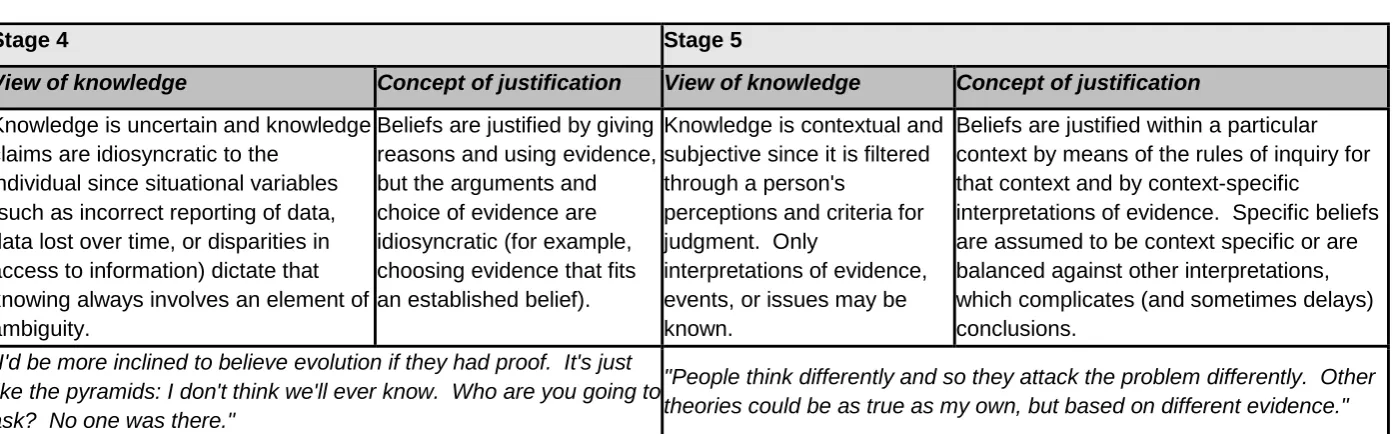
TABLE 3.1a: Reflective Judgment Stages 1, 2, & 3 ... 43
TABLE 3.1b: Reflective Judgment Stages 4 & 5 ... 44
TABLE 3.1c: Reflective Judgment Stages 6 & 7 ... 45
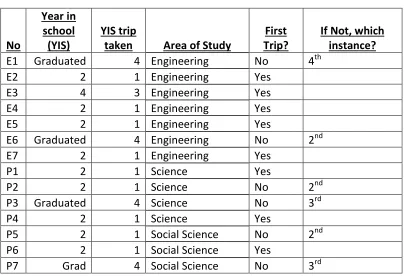
TABLE 4.1: Student Participant Profiles ... 61
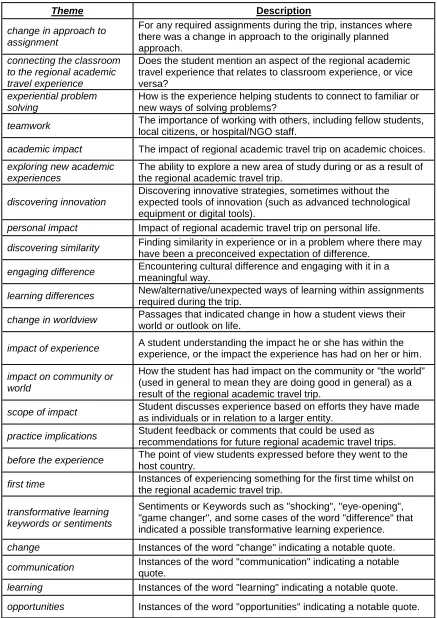
TABLE 4.2: Themes Developed from Descriptive Coding ... 68
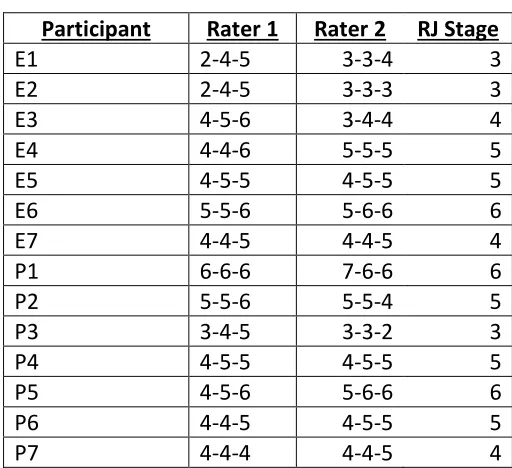
TABLE 4.3: Reflective Judgment Scores ... 95
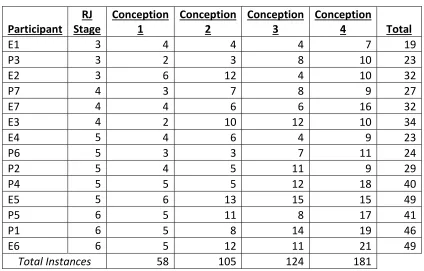
TABLE 4.4: Reflective Judgment Stage And Conceptions ... 103
FIGURES FIGURE 4.1: Category - Supplementing/Complementing Classroom Learning and Constituent Themes ... 70
FIGURE 4.2 : Category – Developing Academic Skills and Constituent Themes ... 74
FIGURE 4.3: Category – Affecting Students’ Future Endeavours and Constituent Themes ... 79
Chapter 1 – Introduction to the Research
This chapter introduces the context, key concepts, and organization of this thesis. This first chapter is divided into six sections. The first section sets the context for the research. Second, the research problem, along with the key research questions, are introduced to begin establish the framework for the rest of the thesis. The third section discusses researcher positioning, followed by the fourth section establishing the research approach chosen and the rationale for this research approach. The fifth section presents key
concepts central to the framework of this thesis. Finally, the last section of this chapter presents an overview of the organization of this thesis.
1.1 The Context of This Research
This research investigated student learning experiences during participation in a short-term study abroad (STSA) program offered by New York University Abu Dhabi (NYU Abu Dhabi or NYUAD) through its Office of Global Education. These STSA programs developed by the Office of Global Education – which are called regional academic travel trips – take place over the week of spring break, and offer students “first-hand experiences of the societies and issues they are studying at NYUAD” (New York University Abu Dhabi, n.d.). These experiences intensify student learning through an
experiential dimension not achieved by reading alone (Ibid.). Paige et al. (2010), in researching study abroad experiences across nearly 50 years, found that study abroad was among the most influential and impactful experiences of students’ academic career, and of their lives (p. 1).
This research took shape during a conversation in January 2014 with NYUAD’s Associate Vice Chancellor for Global Education. She had
regional academic travel. During the same conversation, she and I discussed the reflective judgment model, and she loaned me a copy of the King & Kitchener (1994) book on the subject. This gave way to the idea that phenomenography and reflective judgment could work together to better understand student learning experiences.
The concept of learning lifeworld came about from reading through phenomenographic research. I came across an article by Ashworth & Lucas (2000), which offered a practical guide to phenomenographic research, and discussed their research approach in the context of the student lifeworld, arguing that a focus on lifeworld theory would advance phenomenographic research with “a more rigorous consideration of how to engage with the student’s lived experience” (p. 295). This perceived lack of rigor in phenomenography opened up the possibility that a research approach
comprising phenomenography, reflective judgment, and lifeworld theory could lead to a better understanding of the student experience.
NYUAD’s Office of Global Education has sought to augment student classroom learning through regional academic travel trips to destinations such as Sri Lanka, Nepal, Cyprus, India, Ethiopia, and other destinations near the United Arab Emirates. Two of these trips, Engineers for Social Impact (EfSI) (a regional trip to Sri Lanka working with Habitat for Humanity to help build houses for local villagers) and public health (a regional trip to Ethiopia
interviewing and observing patients with Leprosy, clubfoot, and HIV/AIDS, and working at a social centre to understand how they provide services to the local community), were recommended as the objects of study because these two programs were developed directly by Global Education, offering full access to program information to use for this research.
The Engineers for Social Impact (or EfSI) trip was designed by the Office of Global Education in consultation with faculty leaders in NYUAD’s Engineering division. The purpose of the March 2014 weeklong field lab dubbed “engineers as ethnographers” involved working with Habitat for
focused on an issue important to the village. During the day, one member from each issue team would join a work team to help build houses. During the evening, students would re-join their issue teams to discuss what each of them learned about their issue during the day to help with a final oral
presentation to be given in Sri Lanka at the end of the week. The only other required assignment was a written team report to be submitted approximately one week after returning to Abu Dhabi from Sri Lanka. There were no other required assignments (New York University Abu Dhabi Office of Global Education, 2014a).
The public health program was designed, like EfSI, by The Office of Global Education, in consultation with a visiting NYUAD public health faculty member, and the head of NYUAD’s Health and Wellness Centre. This program had two parts: a February 2014 two-day trip to a hospital in Al Ain, United Arab Emirates, and a March 2014 weeklong trip to Addis Ababa,
Ethiopia. My research focused only on the Ethiopia portion of the public health trip in order to examine student experience from the trip that was most similar to the EfSI experience. Students were required to attend a public health lecture in November 2014, followed by a pre-departure information session to learn about travel information and other details about the experience. Once in Addis Ababa, students visited three locations: the ALERT hospital specialising in the treatment of leprosy, the CURE hospital specialising in clubfoot (foot deformity), and the Medhen Social Centre focused on helping people with HIV/AIDS get access to social services such as housing and healthcare. Students spent the majority of their time at Medhen, and would meet with clients to gather narratives in order to generate marketing information for Medhen to be able to share with prospective donors. Students worked in teams and were assigned to different departments of a social centre to gather information and help with their communication to funding agencies and
1.2 The Research Problem and Key Research Questions NYUAD’s Office of Global Education has not benefitted from any research into the impact on student learning of its programs. If the goal of Global Education is to augment learning, how can the office know if learning has been achieved? The Office has limited resources to run and monitor the quality of the execution of their programs. There are little to no resources available for researching outcomes of the trips they offer. Given the
congruence between regional academic travel and short-term study abroad trips, the Office could review current STSA research and utilize some of the recommendations presented in the literature, but it is unclear if these
recommendations could apply to the unique context of NYUAD. This could create a system of trial and error in which tools from other STSA programs are tried in the field. However, it would be much more effective to study regional academic travel at NYUAD itself, especially given the plethora of approaches, outcomes, and findings in current STSA research.
Research on STSA was an understudied subset of study abroad
research as recently as 10 years ago. A simple search on the term “short-term study abroad” in the University of Liverpool Electronic Library showed that nearly ninety per cent of research published on the subject has only been published in the past ten years. During the past decade, however, there have been hundreds of articles on STSA programs. These studies have involved large-scale surveys, case studies, and combinations of questionnaires and open-ended questions. Earlier studies such as those done by Medina Lopez Portillo (2004) and Chieffo & Griffiths (2004) measured quality of STSA programs based on duration. However, more recent research conducted by Antonakopoulou (2013) refuted the assertion that shorter duration equalled a lower impact of experience, perhaps suggesting that transformative learning during STSA programs was less likely because of duration. Factors other than duration, such as program structure, needed to be considered as a way to understand learning experiences during the EfSI and public health trips.
in the literature, led to the establishment of this research project, and the creation of the following key research questions to be investigated:
• What are the qualitatively different ways students experience particular regional academic travel trips at NYU Abu Dhabi? • How can these qualitatively different ways – manifested as
conceptions of learning experiences – be used in conjunction with an assessment of reflective thinking ability to yield deeper insight into the learning lifeworld?
• How can understanding of the learning lifeworld inform the transformative learning potential of particular regional academic travel experiences at NYU Abu Dhabi, and be used to inform and improve future regional academic travel offered by NYUAD’s Office of Global Education?
Responding to the above questions could lead to insights into understanding student learning experiences in regional academic travel, yielding better access to the learning lifeworld, and the transformative learning potential of these regional academic travel trips. The results of this research could help NYUAD’s Office of Global Education more effectively structure future regional academic travel trips, leading to a richer learning experience for future participants.
1.3 Researcher Positioning
presuppositions in phenomenographic research, especially in exploring the lifeworld of students. These presuppositions to be bracketed include: importing earlier research findings, assuming pre-given structures or
interpretations, assuming specific research techniques and assumptions built into those techniques, and the researcher attempting to uncover some kind of cause of experience. Researcher experience, not research expectations, should be declared (Ibid., p. 298).
During conversations with NYUAD’s Office of Global Education, different types of research were discussed that could be done on various programs offered by Global Education. My goal of researching variation in particular experiences (regional academic travel) led to my recommendation of keeping the sample size contained in order to delve more deeply into individual experience, on which we agreed. Global Education suggested examining student learning experiences in EfSI and public health regional academic travel trips. As a colleague, I wanted to support the head’s
enthusiasm for doing worthwhile research in her area, whilst also framing an achievable research project.
My position is also important in relation to the approach chosen for this research, which may reflect assumptions, biases, and experience I may bring to the research process. The broadest assumption I likely bring to this
students as the guide for developing interview questions, analysing data, and developing conclusions on the data.
Another declaration important for this study is my history as a student. I have a Bachelor of Arts and a Master of Arts degree from New York
University. Although I never participated in any study abroad trip during my studies in New York (mostly because I could not afford the cost), I have a great appreciation for those who had the opportunity to do so. My experience as a student at NYU could translate to empathy for interviewees, but it could also create a challenge if I did not bracket wishes and expectations from my own learning experience.
The above personal and professional declarations are an important part of this research. These reasons represent the key drivers behind my interest in studying this research. The possibility of learning about the
motivations behind my own interest compelled me to undertake this research, and I hoped this research would produce insights into how different people have been affected by certain types of academic travel.
1.4 Overview of Research Approach
This research used a phenomenographic methodology combined with the reflective judgment model (King & Kitchener, 1994) to attempt to access the student learning lifeworld. The phenomenographic methodology is rooted in the interpretive qualitative research paradigm, described as a combination of discovering and understanding a phenomenon, a process, perspective, and worldviews of people, where analysis is done inductively to seek patterns and themes across the data (Merriam, 2002). Marton (1986) described
phenomenography, a type of interpretive qualitative research, as “a research method adapted for mapping the qualitatively different ways in which people experience, conceptualise, perceive, and understand various aspects of, and phenomena in, the world around them” (p. 31). Students were asked
questions related to their experience during either the EfSI trip or the public health trip, followed by questions related to the presentation of an
critically reflective. Experiential variation was captured through the
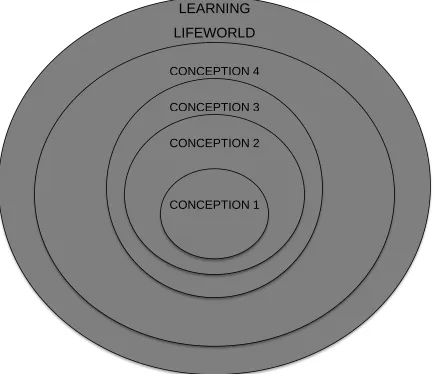
phenomenographic analysis of data leading to the establishment of themes from individual profiles, categories of description from groups of themes, and finally an outcome space that placed these categories of description in logical relationship to one another, yielding conceptions of learning experiences. Reflective thinking ability was assessed through scoring interview responses to a standard set of questions against the reflective judgment model to
determine individual student reflective thinking stage. Reflective thinking stage placement was then compared with conceptions of learning experiences to determine if there is notable connection between the two that could help lead to a better understanding of a student’s learning lifeworld. Additionally, the possibility of transformative learning – using Transformative Learning Theory (Mezirow, 2000) as the guiding theory – during the regional academic travel trip was also discussed based on the results of the research.
The objects of this research – the EfSI trip and the public health trip – touch upon three areas of inquiry: short-term study abroad, transformative learning, and lifeworld theory. These three areas are the focus of the literature review that takes place in the next chapter.
1.5 Key Concepts in This Research
This research has used certain terms and concepts that may have different connotations outside of this research. Therefore, this section seeks to briefly explain and define certain recurring concepts in the context of this research to help the reader better understand further discussions in this thesis.
1.5.1 Regional Academic Travel
combine experiential study, research, and intercultural exploration” (New York University Abu Dhabi, “Regional Academic Travel”, n.d.).
For this research, regional academic travel specifically refers to the two trips chosen for this study: the Engineers for Social Impact (EfSI) March 2014 trip to Sri Lanka, and the public health trip to Ethiopia in March 2014.
Throughout this thesis, regional academic travel refers to these two
experiences, but will be contextualized to mean the more general category of all regional academic travel experiences at NYUAD where appropriate. 1.5.2 Learning Experience
This research is interested in improving our understanding of students’ learning experiences. For the purposes of this research, the terms learning and experience are contextualized through the lens of phenomenography. The term learning is defined for the purposes of this research as “a change in the way the learner experiences the world, which means that the relevance of the task has to be seen to transcend the task in itself and have some personal meaning for the learner” (Booth, 1997, p. 137). The phenomenographic
meaning of experience is defined for this research as a way of
conceptualizing any aspect of the world (Marton, 1981, p. 188). Therefore, this study defines learning experience as a change in the way a learner conceptualizes any aspect of the world that transcends the aspect itself to have personal meaning to the learner. This means learning experiences can cover a wide range and allows learners to be participants in defining and determining their own learning experiences.
1.5.3 Authenticity
This research explored ways to enter the learning lifeworld through a qualitative measurement of students’ reflective thinking ability as related to conceptions of learning experiences. Mezirow (1998) connected critical reflection to higher levels of reflective thinking, specifically using King &
considered authentic. A central area of exploration of my research is how results of phenomenographic research can be determined to be more
authentic by determining a student’s reflective thinking ability. In other words, my research investigates whether higher reflective thinking increases the likelihood of a more authentic account of experience given by the student, thereby gaining access to a student’s learning lifeworld.
Jarvis (1992) linked authenticity to reflective learning stating that people need to develop autonomously and rationally as individuals within a social context, which best connects to lifeworld theory, a major pillar of this study. Furthermore, Heidegger (1962, as cited in Cranton & Roy, 2003) argued for critical participation, which means we need to know who we are and what we believe and then act on that. The establishment of authenticity as a communicative act supports the framework of this research by
connecting Heidegger’s critical participation with Habermas’ (1984, 1987) theory of communicative action.
1.5.4 Learning Lifeworld
An earlier section defined learning as a change in the way a person experiences the world that has personal meaning for them. A choice was made to rely on Habermas’ version of lifeworld as communicative action. One of the primary vehicles for learning is language, which supports the
1.6 Overview of Thesis
The remainder of this thesis is comprised of four further chapters. The second chapter reviews literature in the three broad areas of inquiry that contextualize this research – short-term study abroad, transformative learning, and lifeworld theory – and identifies the research gap addressed by this study. The third chapter details the research methodology used for this study,
Chapter 2 – Literature Review
This chapter begins with a review of literature related to study abroad, which broadly informs this research project. The general area of study abroad is then narrowed to the subset field of short-term study abroad (STSA). STSA literature is broken down into a focus on certain themes including intercultural development, cognitive learning, reflective awareness, and transformation, which are key themes of STSA that are pertinent to this research. The review will then look at the literature on transformational learning theory, with a specific focus on critical self-reflection, which serves as an entry point for a review of literature on the lifeworld, with an emphasis on how lifeworld theory is applicable to this research. The foundational concept of lifeworld by
Edmund Husserl (1936, as cited in Gross, 2010), defined in section 2.4.1, guides the review of the literature on lifeworld leading to a key distinction between Husserl’s lifeworld concept as an individual, inward endeavour, and Habermas’ (1984, 1987) concept of lifeworld as a communicative exercise, which relies on intersubjectivity and the establishment of a collective identity. STSA’s focus on intersubjectivity and the collective lifeworld will close out this chapter and serve to illuminate the research questions and justify the
methodological choices presented in Chapter 3.
2.1 Research on Study Abroad 2.1.1 Overview of Study Abroad
Literature on study abroad contains different key themes such as intercultural development, learning outcomes, and transformational learning that informs this research. According to the Institute of International Education (IIE) (2014) Open Doors report on international educational exchange, which includes data on U.S. student study abroad data, the number of U.S. study abroad students had doubled between 1998 and 2013. Additionally, over 46,000 students go abroad for their entire degree. These numbers may not include American universities overseas such as NYU Abu Dhabi, but IIE’s data show that students looking past their home country borders to explore academic programs are increasing in number. These explorations have
related to study abroad and the benefits of travel. Many of the qualitative studies reviewed had some notable student participant outcomes such as cross-cultural competence, cognitive learning, and knowledge and skills
building, among other attributes (p. 733-734). Paige and Fry (2010) conducted a longitudinal study spanning 50 years on study abroad and global
engagement (known as the SAGE project) comprised of a survey to former study abroad students (n=6,378) and non-study abroad students (n=5,924) that showed at least half of students who participated in some study abroad program are still engaged in a globally engaged mind-set in areas such as civic engagement, philanthropy, knowledge production, social
entrepreneurship, and a lifestyle that was environmentally conscious (p. 2). Much of the well-established research focuses on the U.S. as either a point from which students study abroad or the U.S. as a point to which
students from other countries come to study. There are other studies that use other countries as points of reference, including Brazilian students’ choice to study in the United Kingdom (Foster, 2014), factors that influenced New Zealand students to study abroad (Doyle et. al, 2010), and Chinese students’ choices in choosing universities outside of China (Gong and Huybers, 2015), however the research focused on U.S. study abroad remains more studied than other countries. Furthermore, there is virtually no literature on study abroad for U.S. universities based on study in a foreign country, including New York University Abu Dhabi.
2.1.2 Study Abroad and Program Duration
Study abroad program duration has been well researched, yet there are varying points of view on program duration and program impact.
Gudykunst (1979) argued that “contact of only a short duration does not allow enough time to establish attitudes to change. The short duration of the contact results in an incomplete psychological experience for the participants” (p. 4) In an attempt to classify study abroad programs based primarily on program duration, Engle and Engle (2003) developed levels of study abroad to
differentiate the expected outcomes based on the length of time of a program, even though they profess that the real aim of their classification system was to find an “encompassing vision of what study abroad is” (p. 19). Medina Lopez Portillo (2004) used Gudykunst’s assertions as a foundation to defend her research on the need for longer program duration to properly achieve intercultural sensitivity among participants of two different study abroad programs to Mexico.
In contrast, Antonakopoulou (2013), in a comparative study of students studying in Greece for three different program lengths (4 weeks, 3-month semester long, and 3-month semester long with formal instruction on learning and living abroad) found that there was a high level of sociocultural adaptation regardless of the program duration.
Duration may be a determinant of value in study abroad experiences when it is used as a heuristic for evaluating a program. However, the
contrasting results above show that the effects of program duration on study abroad, while well-researched, remains open and may depend on the framing of the experience and the expected outcomes of particular types of STSA rather than duration alone.
2.2 Research on Short-term Study Abroad
Using the premise that STSA has at least some impact and effect on students who participate, different types of STSA experiences can be explored. STSA research is a relatively new field relative to general study abroad research, with much of the research emerging in the past 10-20 years. A literature search in the University of Liverpool’s Electronic Library – which contains major research databases such as EBSCO, Scopus, and World of Science, among others – using the phrase “short-term study abroad” yielded only 518 results overall, with 515 of those results produced from the past 20 years, and 473 produced during the past 10 years. These numbers suggest that the field is still emerging and there are a number of opportunities to explore new avenues of research.
STSA studies utilize various methodologies and study designs to
measure effectiveness of learning outcomes, program design, and evaluation. Large-scale surveys – mostly quantitative in nature – are used to assess program trends and broader outcome categories in STSA programs (Chieffo & Griffiths, 2004; Anderson et. al, 2006; Jackson, 2008, Pedersen, 2009; Kurt, Olitsky & Geis, 2013); qualitative studies attempt to gain a deeper
understanding of the experience based on individual and varied responses (Brubaker, 2006; Vandersteen, Hall & Baillie, 2010; Streitweiser & Light, 2011; Mackenzie & Pritchard, 2013); and finally, a number of studies utilize a
combination of quantitative and qualitative methods to bring about both a broad and in-depth understanding of the STSA experience (Johnson & Battalio, 2008; Nam, 2011; Ching, Lien, & Chao, 2014).
2.2.1 Key Themes of Short-term Study Abroad Research
2.2.1.1 Short-term study abroad research on intercultural development. The term intercultural development comes from Bennett’s (1993) developmental model on intercultural sensitivity (DMIS), which is the basis for the Intercultural Development Inventory (IDI) survey instrument (Hammer, Bennett, & Wiseman, 2003), a tool used widely in STSA and study abroad research (see below for examples). The authors utilize the two terms intercultural sensitivity – defined as “the ability to discriminate and experience relevant cultural differences” – and intercultural competence – defined as “the ability to think and act in interculturally appropriate ways” – to form the
definition of intercultural development (p. 422). For the purposes of this review, the terms intercultural development and intercultural sensitivity are used interchangeably.
As mentioned above, the criteria for assessing STSA program effectiveness is often based on duration, and studies that utilize the IDI
instrument potentially fall into this trap relying on time to increase the chances of greater intercultural sensitivity. This may very well be true for measurement of intercultural sensitivity based on the premise of Bennett’s (1993) DMIS model and the IDI. However, a look at other themes illuminates the link between program duration and program effectiveness.
2.2.1.2 Short-term study abroad research on learning. Some STSA programs, like the ones highlighted above, focus on the intercultural
development of the student, and some look at this aspect alongside learning outcomes. Learning outcomes in STSA programs can vary considerably, and are highly dependent on creating the proper structure to ensure students achieve their own desired goals.
From a functional perspective, Sachau, Brasher, and Fee (2010) developed an informative model for designing STSA programs for business students. They first discuss educational goals, but soon fall prey to a reliance on program duration to determine goals and objectives, rather than a focus on learning goals no matter what the duration. McLaughlin & Johnson (2006) used constructivist learning theory – defined as learning that is developed or “constructed” by the learner (Merriam, Caffarella, & Baumgartner, 2007) – to assess a field-based science STSA program. A very helpful framework they use is from Wubbels and Girgus (1997) who stated “constructivist
Each of these approaches to understanding learning in STSA
programs shows not only a sample of the diversity of STSA programs, but the value of focusing on design, framing, delivery, and, in the case of some
programs, the importance of allowing the student to help construct their own experience thereby fostering a more meaningful learning experience
(McLaughlin & Johnson, 2006; Coryell, 2013).
2.2.1.3 Short-term study abroad research on transformational learning. Hulstrand (2006) reported that one of the keys to creating and maintaining a high-quality STSA program is students’ opportunity to reflect, both during the experience, and after they return. She continued on indicating that many people in the field are now focused on how educators can help students reflect more deeply when participating in STSA programs (Ibid, p. 52). Critical reflection – more specifically critical self-reflection – is a key component of transformative learning, and is a necessary condition in
Mezirow’s (2000) transformational learning theory, which involves the shifting of one’s frame(s) of reference and habits of mind. This theory will be
presented in greater detail in the next section of this chapter.
Blake-Campbell (2014), who wrote about an STSA program to Austria offered by an urban community college in the United States, pointed to STSA programs as a catalyst for transformative learning and a viable option for setting students on the pathway to being more globally-minded through the shaping of ideas of ethics, empathy, and engagement (p. 69). Rowan-Kenyon & Niehaus (2011) in their case study research on students (n=8) from an STSA program offered by a U.S. higher education institution to the Czech Republic one year after their return, concluded that like the study above, transformative learning is possible, but it is not expected to happen to
everyone. Additionally, the findings suggest that STSA programs can serve to transform students by acting as a gateway or divergent path toward
compared to Mezirow’s (2000) concept where transformative learning is based on a specific moment rather than incrementally over time (this will be discussed further in the next section). VeLure Roholt & Fisher (2013) summed up the broad aims of transformative STSA experiences:
Short-term study abroad courses must perform (at least) dual
functions: deliver course content in an international setting and support perspective transformation. The first receives much attention in the literature; we argue the second is equally imperative. These courses should deliver a strong academic curriculum and support a process of becoming culturally aware of how and why our presuppositions have come to constrain the way we perceive, understand and feel about the world. (p. 58)
The above sections reviewed samples of literature from short-term study abroad programs, showing that research on STSA can take on many structural forms, and have different themes – only a handful of which were illustrated above for the purposes of framing this research project. In sum, STSA programs, which encompass constructivist learning through critical reflection during and after the experience, could be a type of study abroad program less dependent on duration as an assessment of quality rather than framing of the program, and could be a space for transformative learning.
2.3 Research on Transformative Learning
Transformative (or transformational) learning (TL) covers a wide spectrum of research, from different theoretical strands to different contexts studied. Tisdell (2012) stated that there are many themes and variations of transformative learning, and she goes on to talk about three primary
experience as a resource for learning” (p. 523). Halx’s research posits that adult education theories and principles, including andragogy (the adult
education concept of autonomous and self-directed learning), critical thinking, and TL, along with learning modes such as service learning, can and should reshape traditional undergraduate education.
The following review will focus on Mezirow’s (1997, 2000) updated model of perspective transformation, which he terms transformative learning theory (or TLT), and is the most appropriate transformative learning model for this research as the other two types of TL shown above focus on
philosophical and social aspects of TL, whereas Mezirow’s work addresses TL more broadly. Mezirow’s TLT is a starting point for critique and a frame for beginning the discussion of outcomes later in this research, including more contemporary, holistic views of transformative learning, moving from the individual to the social (Cranton & Taylor, 2012, p. 12).
2.3.1 Transformative Learning Theory
Mezirow’s (1997) Transformative Learning Theory, originally termed as perspective transformation, describes shifts in one’s frame of reference
through “critical reflection on assumptions upon which our interpretations, beliefs, and habits of mind or points of view are based” (p. 7). TLT is heavily influenced by Freire’s concept of praxis – a process of action and reflection, which emancipates and transforms the learner by enabling one to reflect on the world and change it (Dirkx, 1998).
not moved on, he claims to have moved on and indeed in a different direction. This is an important critique because, as Baumgartner (2012) wrote, although Mezirow’s defence of his theory was valid according to her analysis, future shaping of TLT would be influenced by Collard and Law’s observations (p. 104).
Subsequent critiques of TLT involved the lack of a critical theory or postmodern focus (Clark & Wilson, 1991), decontextualizing action (Newman (1994), relying too much on modernism and not addressing the social context of transformation (Pietrykowski, 1996). The most important review of TLT was done by Taylor (1997), where thirty-nine studies on transformation were reviewed against the theory, and the researchers of these studies found that although Mezirow’s original theory was supported by the research, it often fell short of addressing a host of factors that also contribute to transformation, including affective learning, non-conscious learning, the importance of relationships, collective unconscious, and context. In discussion context, Taylor noted that studies that support context, “encourage a conception of learning, such as situated cognition, that is not bound by the narrow confines of the psychological to construction of knowledge that is situated personally and historically” (p. 54). Simply put, transformative learning must account for the social context as much as it accounts for the individual context. Mezirow (1998, 2000, 2003) took into account these critiques, whilst still maintaining the central tenets of transformative learning theory; meaning perspectives or
frames of reference, habits of mind, and critical reflection evolved, but
remained intact in their structure. Yet his writing on TLT evolved to include the role of emotions, context, and the movement from the rational to the reflective.
The inclusion of discussions on context and reflection are of particular note to my research, given the context of academic travel and its potential as a critically reflective, transformative experience. Ongoing critical research of TLT encompassing affect, cognition, and social context – are key to gaining a better understanding of the theory. Social context can be understood through the perspective of transformative learning as a group space (Schapiro,
2.3.1.2 Frames of reference. A frame of reference is a meaning perspective, with cognitive and affective dimensions, that provides context for making meaning and choosing how experiences are construed or
appropriated (Mezirow, 2000, p. 16). Frames of references can be individual through a single person experience, or develop into shared meanings (or paradigms) that, along with a critical reflection on assumptions, can help to solve, define, redefine, or reframe a problem or perspective. This process is primarily justified through discourse (Ibid., p. 20).
2.3.1.3 Habits of mind. Frames of reference consist of two parts: a habit of mind and resulting points of view. A habit of mind consists of a set of assumptions that can help to filter meanings in experiences (Ibid., p. 17). Habits of mind come in a number of different varieties, including:
• Sociolinguistic (ideologies, customs) • Moral-ethical (conscience, moral norms)
• Epistemic (learning styles, sensory preferences, focus on wholes of parts or on the concrete or abstract)
• Philosophical (religious doctrine, transcendental world view)
• Psychological (self-concept, personality traits or types, continuation of repressed feelings from childhood, emotional response patterns) • Aesthetic (values, tastes, attitudes, standards, judgments of beauty)
(Ibid.)
The addition of the habits of mind concept to TLT by Mezirow in 2000 signals a move to respond to critics that the theory would consider frames of reference beyond cognitive dimensions to a more holistic space. TLT could now be applied not just to rational forms of learning, but to emotions, affective responses, and ideologies.
of the field of study, or if the learning is in the emotional dimension (p. 127). Kreber (2012) identifies two levels of critical reflection: one that can be about testing and contesting assumptions within established discourses, or one testing and contesting the discourse itself (p. 328). Kreber’s descriptions are aligned with Mezirow’s (1998) taxonomy of two different levels of critical reflection – critical reflection on assumptions (CRA), and critical self-reflection on assumptions (CSRA), which he describes as objective reframing and subjective reframing, respectively. The following subsections will review critical reflection on assumptions and critical self-reflection on assumptions together, followed by the concept of reflective judgment (an important concept Mezirow uses in his discussion on critical reflection on assumptions), and a discussion of the link between these concepts and lifeworld theory.
2.3.1.4.1 Critical reflection on assumptions and critical
self-reflection on assumptions. Mezirow (1998) discussed CRA as central to adult learning, encompassing a number of theories, including TLT (p. 185). CRA, which Mezirow also called objective reframing (p. 192), is broken down into subcategories, including narrative CRA and action CRA. Narrative CRA involves the critical examination of observational items such as books (literary criticism and paintings (aesthetic judgment) that cause us to critically examine established theories and practices. (Ibid.). Action CRA involves pondering one’s own assumptions when solving a problem to help reframe the problem and improve performance.
A deeper version of CRA is called critical self-reflection on assumptions (CSRA), also known as subjective reframing, in which one’s psychological and conceptual limitations are critically analysed and is the process involved in major perspective transformations (Ibid., p. 193). CSRA is not just
reframing a problem; it is questioning the assumptions underlying the thoughts and feelings in how we come to frame our experiences. While not explicitly referenced in later works, some kinds of critical reflection on assumptions and critical self-reflection on assumptions helped to form
Mezirow’s (2000) habits of mind. In particular, epistemic CSRA (the ability for a learner to assess any assumptions and understand how they have come to know what they know) could be seen as a collection of many kinds of
“the reframing process [in epistemic CSRA] is not directed at solving an
immediate problem but on explicitly identifying one’s frames of reference, their sources, and implications for understanding the world” (p. 195). When
Mezirow arrived at the discussion of epistemic CSRA, he brought his argument full circle. In the beginning of his discussion of CRA, he uses empirical research on reflective judgment (defined and discussed below), which he argues as a foundation for CRA and offers a view congruent with TLT (p. 189-190). Brookfield (2000) also argued that epistemic CSRA is the basis for ideology critique, described as critical reflection on the power
structures that utilize norms of social structure of dialogue and social rules to govern conversation and difference (p. 136). In sum, epistemic CSRA
encompasses both reflective judgment and ideology critique. This thesis is focused on reflective judgment as a means to better understand how learners develop epistemic cognition – defined by Kitchener (1983) as a level of
cognition where “individuals reflect on the limits of knowing, the certainty of knowing, and the criteria for knowing” (p. 222) – rather than an assessment of their critical reflection of power relationships in learning.
2.3.1.4.2 Reflective judgment. The term epistemic CSRA is a very similar concept to the term reflective judgment (RJ), both of which seek to understand epistemic cognition by challenging taken-for-granted assumptions about learning. King & Kitchener (1994) wrote:
Reflective judgments are made by examining and evaluating relevant information, opinion, and available explanations (the process of reflective thinking), then constructing a plausible solution for the problem at hand, acknowledging that the solution itself is open to further evaluation and scrutiny. (p. 18)
Using this description of reflective thinking and reflective judgment, King and Kitchener developed the Reflective Judgment Model (RJM), a three-level, seven-stage sequential developmental model that assesses a person’s level of reflective thinking and self-management of epistemic assumptions; the higher the stage, the more reflective the thinking. RJM was developed from Dewey’s (1933, as cited in King & Kitchener, 1994) seminal work on reflective thinking, Perry’s (1968, as cited in King & Kitchener, 1994) positions on
epistemology. Both Perry’s model and Broughton’s model suggested a sequential development, yet fell short of clearly demarcating the relationship between epistemology and judgement at each point in the development sequence (King & Kitchener, 1994).
More recently, Pike (2011), in a review of the Reflective Judgment Interview (RJI), the instrument used by King and Kitchener to assess
reflective judgment, asserted that the RJI produces accurate and appropriate information about the ways in which students reason about complex,
ill-defined problems (p. 12). Additionally, studies utilizing RJM have confirmed its effectiveness. For instance, Friedman & Schoen (2009) used RJM in a case study (n=16) to recommend interventions in developing teacher learning and looked at ways these interventions could increase reflective judgment levels. In another example, Love and Guthrie (1999) concluded RJM was an effective tool for student affairs educators given the prevalence of ill-structured
problems in student life work.
Ten years from the original publishing of their book on RJM, King & Kitchener (2004) gave a status update on RJM, positing that the model was still as valid as it ever was, with educational attainment still the primary determinant of progression through the stages. This update from the original authors, and other research such as those discussed above, suggests that RJM is still applicable in the assessment of learner’s epistemic cognition.
2.3.1.4.3 Critical reflection, reflective judgment, and lifeworld.
Critical reflection on assumptions, critical self-reflection on assumptions, and reflective judgment relate to the extent to which a person utilizes critical reflection and reflective thinking in developing their epistemic cognition and potential for transformative learning. As a way of further contextualizing the place these concepts fit holistically, a discussion of the concept of lifeworld is one way to discuss placement of these learning concepts in the context of the whole person. Lifeworld can be defined simply as “the undivided unity
between a person and the world” (Ekebergh, 2009). Lifeworld can be
term adapted from the term “student lifeworld” used by Ashworth and Lucas (2000), that forms the conceptual framework for this research.
The preceding section presented TL and more specifically TLT, a dominant theory to better understand a kind of learning experience. Key components of contemporary TLT include frames of reference – constituting habits of mind and resulting points of view – and critical reflection, which can be broken down into critical reflection on assumptions (CRA) and critical self-reflection on assumptions (CSRA). One kind of CSRA, epistemic CSRA, can be linked to the learning concept of reflective judgement. Together, these concepts form part of the lifeworld, and more specifically the learning
lifeworld, which can be a space for exploring the research questions for this study.
2.4 Research on Lifeworld
In this final section of the literature review, literature on the lifeworld are presented and critiqued. In particular, an initial discussion of Lebenswelt, Edmund Husserl’s analysis of lifeworld, will be presented. Then, a different analysis of lifeworld will be offered through Jürgen Habermas’ concept of lifeworld, leading to literature on lifeworld and learning, and finally a discussion of the learning lifeworld, leading to an overall conclusion of the literature review.
2.4.1 Husserl’s “Lifeworld”
Edmund Husserl, a noted philosopher and founder of
phenomenological philosophy, first termed lifeworld (or Lebenswelt in the original German) in 1936 in a book entitled The Crisis of The European Sciences, in which he described the lifeworld as “the world that is constantly pre-given, valid constantly and in advance as existing” (Gross, 2010, p. 120). Gross continues to explain that Husserl’s lifeworld is inherently subjective, and at the same time intersubjective, and this intersubjectivity is universal through the shared horizon of a particular era in history, and a more universal lifeworld encompassing our shared experience on earth (Ibid.).
experience. The key tool of lifeworld theory is “disciplined reflection”, which involves accessing previous understanding and is the platform for starting and continuing the learning process (Ekebergh, 2009, p. 53-54). The primary component of Husserl’s lifeworld is what Gross (2010) called the sensible phenomenal world and includes certain cultural objects and properties (p. 120). Gross argued that the inclusion of cultural factors in lifeworld opens the door for movement from Husserl’s phenomenological structure of the theory to a more socially-oriented structure of lifeworld theory posited by Schütz and Habermas (Ibid.). Although Schütz is a very important figure in lifeworld theory, my research is much more interested in the work of Habermas. Schütz, similar to Husserl, framed his lifeworld theory in individual
consciousness, continuing the presupposition of the individual as the central focus of lifeworld theory (Ibid., p. 121). Habermas’ lifeworld theory is grounded in communicative action, one that relies more on intersubjectivity as the
primary working space rather than the individual, subjective consciousness, signalling a departure from Husserl and Schütz, opening the possibility of a lifeworld theory focused not on the individual, but on the social and the collective.
2.4.2 Habermas’ “Lifeworld”
Indeed, Habermas believes that whilst Husserl and Schütz were interested in a universal lifeworld, the need to go beyond generalisation of one’s own experience on the basis of individual consciousness is not
sufficient (Ibid.). Instead, the social lifeworld needs to stop being expressed as the amalgam of every possible individual lifeworld, and a lifeworld theory based on communicative action rather than individual consciousness, finding structure of individual lifeworlds through communication experienced in a social context (Ibid. p. 122).
In his two-volume work, Habermas (1984, 1987) proposes a theory of communicative action, which uses language as the fundamental component of society and is the process through which people form their identities. Communicative action signals a departure from the individual and the
of this lived experience (systems). For Habermas, there are three components of lifeworld: culture (implicitly known traditions, background assumptions of language embedded in everyday life), society (how people coordinate their actions through intersubjectively recognized norms), and the personal (internalizing value orientations and developing individual and social identities) (Crick & Joldersma, 2011, p. 79)
This shift from the individually-focused to the socially-focused is negotiated through the application of the lifeworld lens to the external lens of systems. In other words, we can rely on the variation of lifeworlds to help us better understand how the system is structured in its diversity of lived
experiences. Furthermore, a basis for how individuals live together in a
society is the need for critical reflection to become an inherent part of people’s lifeworld, which is supported by Habermas’ theory of communicative action (Kreber, 2012).
2.4.3 The Learning Lifeworld
Learning can be seen as a process of personal development and reflection (Ekebergh, 2009) and as a socially constructive process
(McLaughlin & Johnson, 2006; Merriam, Caffarella & Baumgartner, 2007). In looking at how learning interacts with lifeworld theory, the bulk of this research has been conducted by Peter Ashworth and his associates. Ashworth and Lucas (1998) advocated for the usage of the phenomenological concept of (Husserl’s) lifeworld in studies on student learning conceptions in a
phenomenographic study, directly linking lifeworld theory to the research approach of phenomenography. They wrote, “we use the fact that much of phenomenologically-based work has documented issues connected with the process of entering into the student life world; it is well for
phenomenographers to try and profit from this wealth of experience” (Ibid, p. 417). Ashworth (2004) posited learning (more specifically the learning
lifeworld) as an interpretive process where understanding is the end goal and best understood from the point of view of the learner. Whilst he notes that there is very little literature that supports this point of view, he offers the
research that is oriented toward experiential description” (p. 181) – as one source of looking at prior understanding in learning, but only to a certain extent.
Ashworth (2004) rejects the Husserlian notion of lifeworld manifesting through individual consciousness; rather, learning and the establishment of the learning lifeworld comes about through conversation, which supports the Habermasian lifeworld theory of communicative action, although Ashworth never directly points to this connection. This is a curious position to take given Ashworth and Lucas’s (1998) attempt to bring the concept of lifeworld to the phenomenographic approach to learning via Husserl. They argue that a bracketing of Husserl’s lifeworld theory can help to better understand presupposition.
2.4.3.1 Accessing the learning lifeworld. There appears to be a contradiction in Ashworth’s research. If conversation is indeed a key component for learning, then Habermas’ (1984, 1987) theory of communicative action, which uses language as the key ingredient for
understanding lifeworld, could lead to a better linkage for understanding the learning lifeworld. Understanding variation of learning experiences could produce a framework for access to learning lifeworlds. Greasley & Ashworth (2007) use a phenomenological approach to attempt entering university students’ lifeworlds, which they believe is the least constraining way to enter the unique individual student lifeworld. Phenomenology, according to Marton (1986), focuses on immediate experience, bracketing conceptual thought (p. 41), which may limit application of lifeworld theory to learning in a social context.
the social integration of lifeworlds, formed through collective narratives. This framework – lifeworld of individuals going through the same experience – can produce categories in this finite system, which helps capture variation in experience, and better understand the categorical ways these variations exist. This way of accessing can be done through the research orientation of
phenomenography. Phenomenography takes an approach to learning where “experience of the world is a relation between [the learner] and his world. Instead of two independent descriptions, and an assumed relationship between the two, we have one description which is of a relational character” (Marton & Svensson, 1979, p. 472). Therefore, access to the learning
lifeworld is achieved in the context of the social world around the learner. 2.4.3.2 The learning lifeworld as collective and reflective. If the inner world and the (controlled) social world of the learner are connected through a single, relational approach, and described in relation to other unique experiences of a given phenomenon, there is a collective dimension to this approach to the learning lifeworld. If phenomenography is a way to marry the inner dimension of the lifeworld and the external (social) dimension of
learning, these variations in experiences can be collectively captured through the phenomenographic unit of description, the conception, which comprises a referential aspect (particular meaning of an individual object) and a structural aspect (the combination of features discerned or focused upon by the
subjects) (Marton & Pong, 2005, p. 336). Conceptions are not unique to phenomenography. In the context of learning, Perry (1970, as cited in Entwistle and Peterson, 2004) introduced a comprehensive developmental model of students’ conceptions of knowledge and learning. Entwistle and Peterson (2004) argue that the work of phenomenography parallels Perry’s conceptions of knowledge.
aspect to learning, especially one in which we critically reflect on assumptions we hold. This reflective capacity can be determined using RJM as a means to better understand levels of reflective thinking. King & Kitchener (1994) also use Perry’s model as a basis for differentiating and developing RJM (p. 36-37). The link between phenomenography and reflective judgment can capture both the learning outcomes of an experience, and the ability for the
researcher to understand the capacity of the individual learner to show
epistemic cognition, and therefore could produce a more authentic account of the learning lifeworld.
2.5 Conclusion
This literature review has been a journey across various areas of inquiry important to this thesis. Short-term study abroad research was
discussed and critiqued, both structurally and topically, setting up the potential for STSA to be a transformative learning experience. Transformative Learning Theory and its components were presented with a particular focus on critical reflection and the connection between critical reflection in TLT and reflective judgment through epistemic critical self-reflection on assumptions. Lifeworld theory was then discussed broadly in relation to its original concepts offered by Husserl, followed by a different perspective on lifeworld theory by
Habermas, connecting TLT to lifeworld theory. Lifeworld theory was then framed for the purposes of this research in the context of learning. Learning lifeworld was then argued as a phenomenographic concept. Finally, learning lifeworlds were discussed as a collective concept through the
Chapter 3 – Research Methodology
This chapter presents the detailed description and rationale for the chosen research methodology, and is divided into seven sections. The first section is a restatement of the research aims and research questions from the first chapter. In the second section, the qualitative interpretive research
paradigm frames the choice combining phenomenography and reflective judgment research methods, followed in the third section by a specific discussion on each of these methods, including ontological and
epistemological assumptions, methods employed, critiques of each method, culminating in a final subsection on the combination of phenomenography and reflective judgment. The fourth and fifth sections outline the research design and data analysis procedures. Finally, the sixth and seventh sections will discuss validity, reliability, and ethical considerations.
3.1 Research Aims and Research Questions
Short-term student abroad programs offer students an opportunity to participate in study trips enabling students to connect their academic
(classroom-based) studies with on-the-ground experiential study, research, and intercultural exploration. STSA research is a relatively new field of inquiry compared to general study abroad research. Within STSA research, there is research assessing the value of STSA through broad measurements of outcomes, in-depth understanding of individual experience, and research which attempts to achieve both broad outcomes and in-depth understanding. STSA relies on general study abroad research as a starting point to assess effectiveness. Often, these studies have defaulted to program duration as a means to assess quality, relying less on the quality of the program framing as a way to assess learning. Existing STSA research also relies on study abroad research methods and paradigms, which have the potential to narrow
outcomes of STSA research. NYU Abu Dhabi has named these experiences regional academic travel, removing the durational moniker, allowing the opportunity to focus on how framing, not duration, impacts student learning.
offered by NYU Abu Dhabi’s Office of Global Education. The research aim focused on accessing the student lifeworld through the development of conceptions, which capture the unique variation and transformative potential of individual learning experiences. These individual learning experiences were categorized and yielded an outcome space comprising conceptions of
learning experiences. Whilst these conceptions have taken learning impact into account, they do not fully address the critically reflective dimension of learning, which is a necessary component in understanding the learning lifeworld of students. To address this gap, student reflective thinking can be determined using the Reflective Judgment Model (King & Kitchener, 1994) to measure reflective thinking abilities, and, used in conjunction with the
conceptions of learning experiences, can serve to assess the transformative learning potential of these regional academic travel trips, and to inform best practices at NYU Abu Dhabi’s Office of Global Education and similar
programs at other institutions. Based on these research aims, the research questions being investigated are:
• What are the qualitatively different ways students experience particular regional academic travel trips at NYU Abu Dhabi? • How can these qualitatively different ways – manifested as
conceptions of learning experiences – be used in conjunction with an assessment of reflective thinking ability to yield deeper insights into the learning lifeworld?
• How can understanding of the learning lifeworld inform the transformative learning potential of particular regional academic travel experiences at NYU Abu Dhabi, and be used to inform and improve future regional academic travel offered by NYUAD’s Office of Global Education?
3.2 Research Paradigm
the communicative nature of the external world. Lifeworld originally comes from a phenomenological research approach. Yet, as shown in the previous chapter (see page 28), there is a way for this concept to be used in
phenomenography as well. This research is rooted in the interpretive
qualitative research paradigm, described as a combination of discovering and understanding a phenomenon, a process, perspective and worldviews of people involved in the study are the possible foci of the research, where analysis is done inductively to seek patterns and themes across the data (Merriam, 2002, p. 6). One type of interpretive research approach is phenomenography, which Marton (1986) defined as “a research method adapted for mapping the qualitatively different ways in which people
experience, conceptualise, perceive, and understand various aspects of, and phenomena in, the world around them” (p. 31). Additionally, this research utilizes the Reflective Judgment Model (RJM) (King & Kitchener, 1994), which is meant to measure reflective thinking. RJM, like phenomenography, is supported by the interpretive research paradigm by seeking participants’ understanding, perspective, and meaning through the posing of questions to an ill-structured problem.
3.3 Research Methods Selected
This section will first present phenomenography as a research method, including ontological and epistemological assumptions, methods and
outcomes, and critiques. The following subsection on reflective judgment (RJ) is similarly organized to the section on phenomenography, starting with
ontological and epistemological assumptions, a presentation of the levels and stages of RJ, methods and outcomes, and finally critiques of the model. The final subsection will discuss the combination of phenomenography and RJ. 3.3.1 Phenomenography