Studying and Preparing of Basic Time for Piling
Works by Synthetic Equations
Wisoot Jiradamkerng
1,*, Supa Thongmai
2, and Naiyakeat Pongpatanasuegsa
31, 2Civil Engineering Department, College of Engineering, Rangsit University, 52/347 Muang Ake, Phaholyothin Rd., Lakhok, Pathumthani 12000, Thailand
3Industrial Management Department, Faculty of Business Administration, Rangsit University, 52/347 Muang Ake, Phaholyothin Rd., Lakhok, Pathumthani 12000, Thailand
E-mail: [email protected]*
Abstract. The objective of this research is to study and prepare basic time for piling works by synthetic equations. The time data of 7 work elements of piling works were collected from 10 different construction sites in Phuket Province of Thailand. The synthetic equations were derived with multiple regressions analysis method using statistic software package. These work elements consisted of pile driving work, moving piling rig left or right on supporting rails , moving supporting rails left or right, moving piling rig and supporting rails back or forth, joining of two-piece pile by welding, joining of two-piece pile by steel coupling , and pile driving with pushing post. These synthetic equations were used to determine the basic time, standard time, and productivity values for various types and sizes of square precast concrete pile. The researchers found that these productivity values were reliable compared to general practice, and could be applied in construction planning and scheduling in Phuket province or other area with similar geological conditions.
Keywords: Construction productivity, synthetic equations, multiple regressions.
ENGINEERING JOURNAL Volume 15 Issue 4 Received 16 June 2011
Accepted 20 July 2011 Published 1 October 2011
1. Introduction
The studying and preparing of basic time of construction works will yield out the construction productivity standard, which is necessary in construction management especially in terms of schedule and cost. However, these studies in Thailand are still quite limited [1].
Lacking of the construction productivity data makes professional engineer in Thailand turns to data from overseas, such as USA [2], even though it exist some errors according to variations of working condition. Nowadays, in Thailand, there is a good sign of growing number of research projects in this field, and this work is one of them.
2. Objectives
The objectives of this research are to study and prepare basic time, standard time, and productivity for piling works by synthetic equations [3].
3. Method
The study was carried out using time data from 10 construction sites in Phuket province of Thailand. The piling rig is drop-hammer type as shown in Fig. 1, driving the precast concrete pile with square section of 150mm x 150mm, 200mm x 200mm, 250mm x 250mm, 300mm x 300mm, and 350mm x 350mm. There are 3 different lengths of each pile section studied in this research, except for the 150mm x 150mm section which has only 6 meter length in construction site.
Fig.1. Drop-hammer piling rig with accessories.
Apart from pile sections and lengths, types of pile were classified into one-piece pile, two-piece pile jointed by welding and two-piece pile jointed by steel coupling.
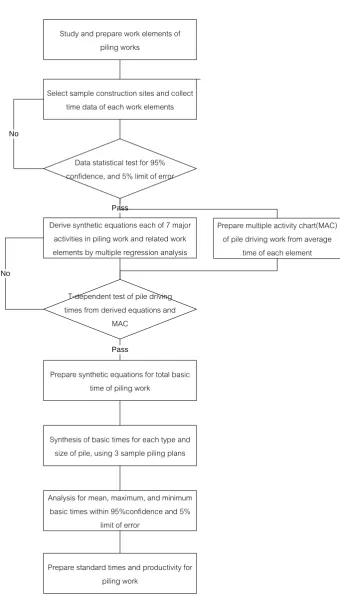
Study and prepare work elements of piling works
Select sample construction sites and collect time data of each work elements
Derive synthetic equations each of 7 major activities in piling work and related work elements by multiple regression analysis
Data statistical test for 95% confidence, and 5% limit of error
Prepare multiple activity chart(MAC) of pile driving work from average
time of each element
T-dependent test of pile driving times from derived equations and
MAC
Prepare synthetic equations for total basic time of piling work
Synthesis of basic times for each type and size of pile, using 3 sample piling plans
Analysis for mean, maximum, and minimum basic times within 95%confidence and 5%
limit of error
Prepare standard times and productivity for piling work
Pass
Pass No
No
[image:3.595.154.495.126.729.2]and 5% limit of error, with assumption that the sample sizes of time data were large enough to follow normal distribution.
Fig. 2. Research procedure.
account are work-related : piling rig height and the power of rig engine in horse-power(hp), pile length and weight. There were 7 equations for major work elements in piling works: 1) pile driving, 2) moving piling rig left or right on supporting rails, 3) moving piling rig and supporting rails back or forth, 4) sliding supporting rails left or right, 5) welding 2-piece pile, 6) coupling 2-piece pile, and 7) setting up and removing of pushing post.
The basic cycle time of pile driving work for various types and sizes of pile were synthesized using derived equations, and compared with that from Multiple Activity Chart creating from average time data. The comparison test by t-depentdent method was use to validate the equations.
After that, the synthetic equations for total basic time of piling work for various types of pile were prepared. These equations were used to synthesize total basic time required in piling works of 3 sample construction sites in Phuket area. The results were used to calculate for unit basic time or basictime per pile for further study.
The unit basic time from 3 sample construction sites were analyzed for mean, maximum, and minimum value within 95% confidence interval and 5% limit of error. Then, the relaxation allowances [6] and contingency allowances were added to prepare standard time and productivity for piling works.
4.
Results
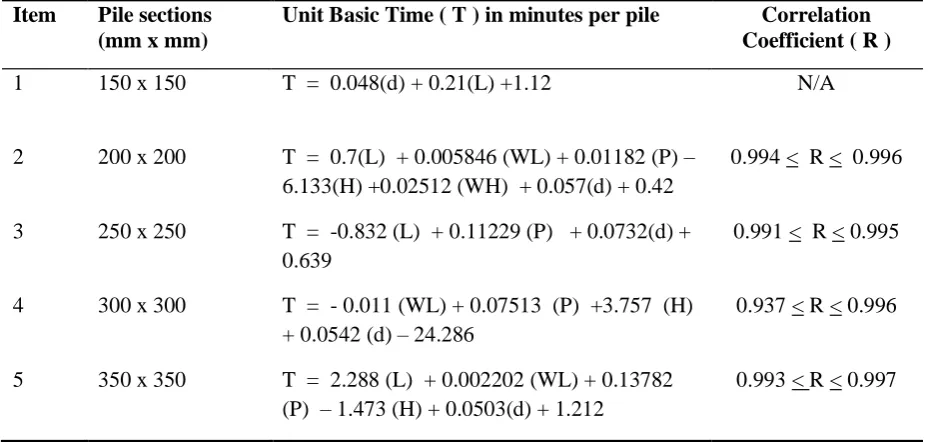
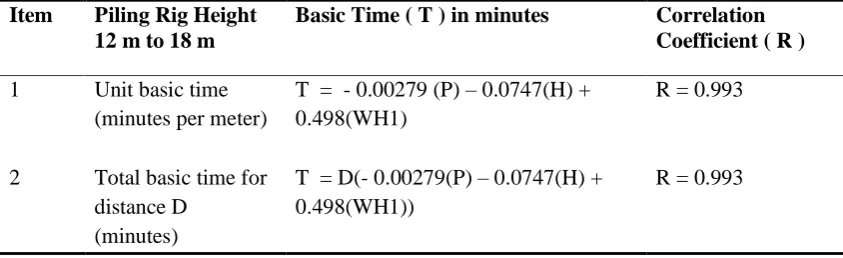
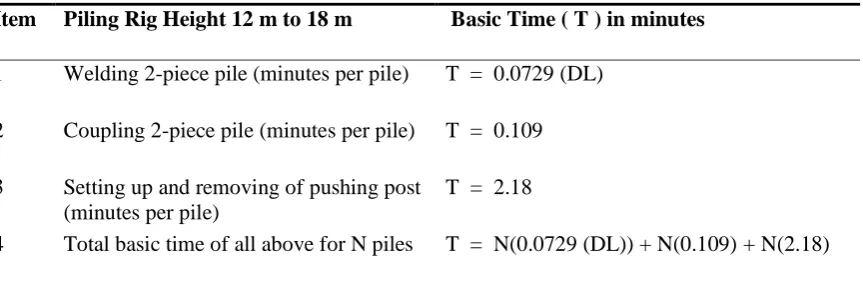
[image:4.595.67.534.391.612.2]The results of study yielded synthetic equations for 7 major activities: pile driving, moving piling rig left or right on supporting rails, moving piling rig and supporting rails back or forth, and sliding supporting rails left or right were shown in Table 1 to Table 4 respectively. The rest three activities: welding 2-piece pile, Coupling 2-piece pile, and Installing pushing post were summarized in Table 5.
Table 1. Synthetic equations for pile driving work (minutes per pile).
Item Pile sections
(mm x mm)
Unit Basic Time ( T ) in minutes per pile Correlation
Coefficient ( R )
1 150 x 150 T = 0.048(d) + 0.21(L) +1.12 N/A
2 200 x 200 T = 0.7(L) + 0.005846 (WL) + 0.01182 (P) – 6.133(H) +0.02512 (WH) + 0.057(d) + 0.42
0.994 < R < 0.996
3 250 x 250 T = -0.832 (L) + 0.11229 (P) + 0.0732(d) + 0.639
0.991 < R < 0.995
4 300 x 300 T = - 0.011 (WL) + 0.07513 (P) +3.757 (H) + 0.0542 (d) – 24.286
0.937 < R < 0.996
5 350 x 350 T = 2.288 (L) + 0.002202 (WL) + 0.13782 (P) – 1.473 (H) + 0.0503(d) + 1.212
0.993 < R < 0.997
Table 2. Synthetic equations for moving piling rig left or right on supporting rails.
Item Piling Rig Height 12 m to 18 m
Basic Time ( T ) in minutes Correlation
Coefficient ( R )
1 Unit basic time (minutes per meter)
T = - 0.00279 (P) – 0.0747(H) + 0.498(WH1)
R = 0.993
2 Total basic time for distance D
(minutes)
T = D(- 0.00279(P) – 0.0747(H) + 0.498(WH1))
[image:5.595.89.509.330.431.2]R = 0.993
Table 3. Synthetic equations for moving piling rig and supporting rails back or forth.
Item Piling Rig Height 12 m to 18 m Basic Time ( T )
1 Unit basic time for moving within 6 meters distance (minutes per cycle)
T = 30.78
[image:5.595.75.522.523.687.2]2 Total basic time for piling plan of R rows (minutes) T = (R-1)(30.78)
Table 4. Synthetic equations for sliding supporting rails left or right.
Item Piling Rig Height 12 m to 18 m
Basic Time ( T ) Correlation
Coefficient ( R )
1 Unit basic time for one cycle (minutes per cycle)
T = - 0.0878 (P) – 3.49 (H) + 22.701 ( WH 1 ) R = 0.999
2 Total basic time for each row with distance D between first and
last pile (minutes)
T
D
1
LR A
0.0878 P 3.49 H 22.701 WH 1
Table 5. Synthetic equations for welding and coupling two-piece pile, pushing post setting up and removing.
Item Piling Rig Height 12 m to 18 m Basic Time ( T ) in minutes
1 Welding 2-piece pile (minutes per pile) T = 0.0729 (DL)
2 Coupling 2-piece pile (minutes per pile) T = 0.109
3 Setting up and removing of pushing post (minutes per pile)
T = 2.18
4 Total basic time of all above for N piles T = N(0.0729 (DL)) + N(0.109) + N(2.18)
The variables in the equations above were piling works related parameters as followings:
Variables Stand for
A Width of piling rig base (m) B Depth of piling rig base (m)
d Distance from pile stock to piling rig (m)
D Distance between first and last pile in each row (m) DL Welded length (cm)
H Piling rig height (m) L Pile length (m)
LR Supporting rail length (m)
LS Depth of pile top from ground level, driven with pushing post (1.5 m) N Total number of piles
N 1 Total number of 2-piece pile jointed by welding (piles) N 2 Total number of 2-piece pile jointed by coupling (piles) N 3 Total number of piles driven with pushing post (piles) P Piling rig engine Horse Power (hp)
R Total number of rows in piling plan (rows) WH Hammer weight (kg)
WH 1 Hammer weight (ton) WL Pile weight (kg)
WLS Pushing post weight (kg)
The above synthetic equations were combined into total basic time equations of piling works for various types and sizes of piles, which could be applied in general site piling plan. For example, synthetic Eq. (1) below was for total basic time of one-piece precast concrete pile with 250mm x 250mm square section, and Eq. (2) was for two-piece type of the same section.
T1-250x250 = [N(-0.832 (L+LS) + 0.11229 (P) + 0.0732(d) + 0.639)] + [D(-0.00279(P) –
0.0747(H) + 0.498( WH1))] + [(R-1)(30.78)] + [N3(2.18)] + [((D / (LR – A) – 1)((-
0.0878(P) – 3.49(H) + 22.701(WH1)))]
(1)
T2-250x250 = [N((-0.832(L+Ls)/2 + 0.11229 (P) + 0.0732(d) + 0.639 )2)] + [D(-0.00279 (P) –
0.0747(H) + 0.498(WH1))] + [(R-1)(30.78)] + [N1(0.0729 (DL))] + [N2(0.109)] +
[N3(2.18) ] + [((D / (LR – A) – 1)((- 0.0878(P) – 3.49(H) + 22.701(WH1)))]
The synthetic equations for other pile types and sizes were prepared in the same way. After that, the researchers had synthesized total basic time of piling work using 3 selected site piling plans with different pile types and sizes. Then, the results were calculated for unit basic time or basic time per pile. The unit basic time of each type and size was analyzed to get mean, maximum, and minimum value within 95% confidence interval and 5% limit of error. The standard time of piling works were then derived by adding required time allowances [6] to the mean values of unit basic time.
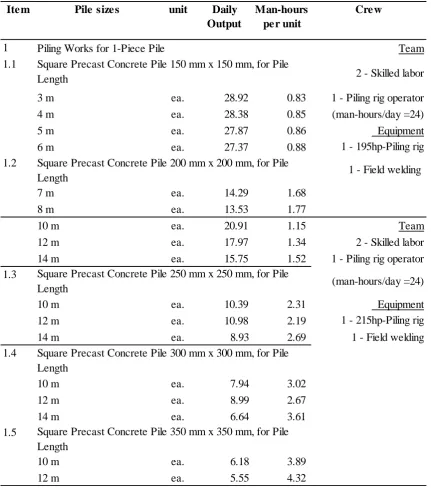
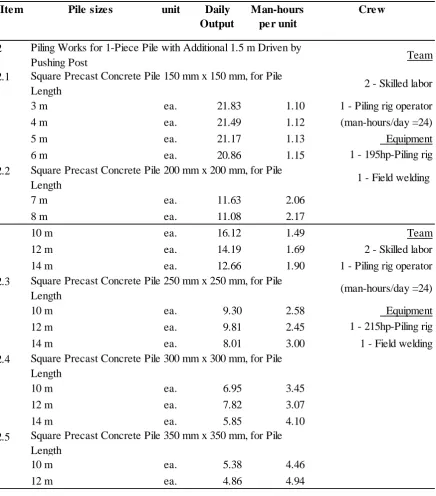
The resulted standard times were used in preparation of productivity standard for piling works in term of daily output with specified crew, and man-hours per unit required as sample shown in Table 6 for one-piece pile and Table 7 for one-piece pile with additional depth of 1.5 m. driven by pushing post. For two-piece pile with welding joint and coupling joint had been prepared in the same way but not been shown in this paper.
The additional depth driven by pushing post made the productivity to drop a little since it needed more time to setup the pushing post and drive the pile to 1.5 m. under ground level.
These productivity values derived were compared with general practice values of local piling contractor, and found to be close together. These results were very useful for construction planning and scheduling. In the same way, the data could be used as a baseline for productivity management of piling works.
As the productivity standard reflected the unit cost of construction, so management team could applied the data in unit cost analysis to prepared budgeted cost in cost control process.
5. Conclusion
The objective of this research was to study and prepare basic time of square precast concrete pile with various types and sizes by synthetic equations. The study was conducted in Phuket province of Thailand by collecting time data from 10 piling construction sites.
The synthetic equations of 7 work elements of piling works were derived from field time data by multiple regressions analysis with stepwise method. These equations were used for determination of basic times for piling works. After that, the standard times and productivity standard of piling works for each type and size of pile were calculated.
Table 6. Productivity standard for one-piece square precast concrete pile.
1 Piling Works for 1-Piece Pile Team
1.1
2 - Skilled labor
3 m ea. 28.92 0.83 1 - Piling rig operator
4 m ea. 28.38 0.85 (man-hours/day =24)
5 m ea. 27.87 0.86 Equipment
6 m ea. 27.37 0.88 1 - 195hp-Piling rig 1.2
1 - Field welding
7 m ea. 14.29 1.68 8 m ea. 13.53 1.77
10 m ea. 20.91 1.15 Team
12 m ea. 17.97 1.34 2 - Skilled labor
14 m ea. 15.75 1.52 1 - Piling rig operator 1.3
(man-hours/day =24)
10 m ea. 10.39 2.31 Equipment
12 m ea. 10.98 2.19 1 - 215hp-Piling rig
14 m ea. 8.93 2.69 1 - Field welding 1.4
10 m ea. 7.94 3.02 12 m ea. 8.99 2.67
14 m ea. 6.64 3.61 1.5
10 m ea. 6.18 3.89 12 m ea. 5.55 4.32 Square Precast Concrete Pile 350 mm x 350 mm, for Pile Length
Item Pile sizes unit Daily
Output
Man-hours per unit
Crew
Square Precast Concrete Pile 150 mm x 150 mm, for Pile Length
Square Precast Concrete Pile 200 mm x 200 mm, for Pile Length
Square Precast Concrete Pile 250 mm x 250 mm, for Pile Length
Table 7. Productivity standard for one-piece square precast concrete pile with additional 1.5m driven by pushing post.
2
Team
2.1
2 - Skilled labor
3 m ea. 21.83 1.10 1 - Piling rig operator
4 m ea. 21.49 1.12 (man-hours/day =24)
5 m ea. 21.17 1.13 Equipment
6 m ea. 20.86 1.15 1 - 195hp-Piling rig 2.2
1 - Field welding
7 m ea. 11.63 2.06
8 m ea. 11.08 2.17
10 m ea. 16.12 1.49 Team
12 m ea. 14.19 1.69 2 - Skilled labor
14 m ea. 12.66 1.90 1 - Piling rig operator 2.3
(man-hours/day =24)
10 m ea. 9.30 2.58 Equipment
12 m ea. 9.81 2.45 1 - 215hp-Piling rig
14 m ea. 8.01 3.00 1 - Field welding 2.4
10 m ea. 6.95 3.45
12 m ea. 7.82 3.07 14 m ea. 5.85 4.10 2.5
10 m ea. 5.38 4.46 12 m ea. 4.86 4.94 Square Precast Concrete Pile 150 mm x 150 mm, for Pile Length
Square Precast Concrete Pile 200 mm x 200 mm, for Pile Length
Square Precast Concrete Pile 250 mm x 250 mm, for Pile Length
Square Precast Concrete Pile 300 mm x 300 mm, for Pile Length
Square Precast Concrete Pile 350 mm x 350 mm, for Pile Length
Crew
Piling Works for 1-Piece Pile with Additional 1.5 m Driven by Pushing Post
Item Pile sizes unit Daily
Output