The Australian National University Institute of the Arts
Canberra School of Art
MASTER OF VISUAL ARTS 1999
Johnathon Schmuck
REPORT
Abstract
Acknowledgments
Australian-American Educational Foundation (The Fulbright Commission) Dr. John Lake
Klaus Moje Stephen Procter
Monica Larsson-Edmondson Scott Chaseling
Kirstie Rea Nigel Lendon Phil Spelman Aimee Frodsham Ben Sewell Claudia Borella Nola Payten Lindy Fisher Glen Fisher Nonie Lake Lani McGregor Tom Moore Nicole Chesney Craig the Cleaner
Stuart Hay, ANU Photography Lance at Sydney Stained Glass
Contents
List of Illustrations page 5 List of Inclusions page 5 Introduction page 7 Report
Topography and Geology page 9 Early Influences page 10 Colour page 14 The Blown-Vessel Form page 18 Process page 20 Landscape page 21 Conclusion page 22 Appendices
-Work Proposal 1999 page 37 -Fvilbright Proposal page 38 -Statement about the Work page 40 -Bibliography page 41 -Current CV page 42 Inclusions
List of Illustrations Figure 1 Figure 2 Figure 3 Figure 4 Figure 5 Figvire 6 Figure 7 Figure 8 Figure 9 FigurelO Figvire 11 Figure 12 Figure 13 Figure 14 Figure 15 Figure 16 Figure 17 Figure 18 Figure 19 Figure 20 Figure 21 Figure 22
'Mintease', 1998, found glass, wheel engraved, 15x7x7 cm eacii. 'Spongs', 1998, found objects, 10x20x21 cm.
Maya Lin, Untitled (Topographic Landscape), 1997, particle board, 24x216x198 inches, 'Art in America', 9/98, p. 88.
'Deluxe Arch Vase', 1998, blown glass, 23x18x9 cm.
Klaus Moje, 'Nijima series', 1999, Bullseye Roll ups, tallest 37cm. Folded strata, from Hills, Structural Geology, p 240.
Faulted strata, from Capitol Drive, NE of Parliament House, Canberra. Brecciated rock, from Geike, Geology, p 165.
Cross-bedding diagram, from Twidale, Geomorphology. p293. Geologic Map of the Canberra region (courtesy of AGSO).
Cross Section from the Geological Map of Canberra (courtesy of AGSO). Stratigraphic Column of the Geological Map of Canberra (courtesy of AGSO). Untitled painting, watercolor on paper, 34x43 cm, 1984.
David Hockney, 'A Bigger Grand Canyon', 1998, oil on canvas, 81 inches x 24 feet. Art Forum, 11/98, p. 111.
Karin Davie, 'Hvsteric', 1998, oil on canvas, 72x96 inches. Art in America, 9/98, p. 93.
Rebecca Morris, 'Chevron Pair', 1998, oil on canvas, 31x30 inches/each. New Art Examiner, July/August 1998, p 52.
Yoichi Ohira, Blue 'Mosaico' vase, 1997, 19 cm high, from Dorigato, O h i r a . Emily Kame Kngwarreye, 'Utopia Panels', 1996, synthetic polymer on canvas, 28Oxi0O cm, ed. Neal, Margo, Alhalkere. pp 136-7. '
Field sttidy area. Broken Hill, NSW, Australia, March 1999.
'Unconformable vases', 1999, Bullseye Roll ups, wheel carved, tallest 25 cm, 1999.
List of Illustrations
Figure 23 'Vertical strata over breccia', 1999, Bullseye Roll ups, wheel carved, 19x13x13 cm.
Figure 24 'Vertical bedding over breccia', 1999, Bullseye Roll ups, wheel carved, 22x12x12 cm.
Figure 25 'Crossbedding with brecciated intrusion', 1999, Bullseye Roll ups, wheel carved, 22x12x12 cm.
Figure 26 'Crossbedding in faulted strata', 1999, Bullseye Roll ups, wheel carved, 19x12x12 cm.
Figure 27 'Faulted strata in deformed bedding', 1999, Bullseye Roll ups, wheel carved, 24x12x12 cm.
Figvire 28 'Crossbedding over faults', 1999, Bullseye Roll ups, wheel carved, 20x10x10 cm. Figure 29 'Faulting with brecciated intrusion', 1999, Bullseye Roll ups, wheel carved,
23x13x13 cm.
Figure 30 'Vertical strata on faulting', 1999, Bullseye Roll ups, wheel carved, 24x13x13 cm.
Figure 31 'Vertical strata on faulting', 1999, Bullseye Roll ups, wheel carved, 17x8x8 cm.
Introduction
I came to Canberra in 1998, blessed with a Fulbright Scholarship, to study at the Glass Workshop of the Canberra School of Art. I also came with such rich and varied background that once I got here I ended up with too many ideas. I had to find the discipline to focus. This process took me througha number of bodies of work since I felt I had to pursue the best project I possible for my Fulbright research. My work here has taken me back to many of my former selves, lives that I'd lived before to get me to this one. Probably one of my most consistently favorite things to do is to that of going to the out of doors. For me, it is a place where I can make sense of the world and of myself. So in my undergraduate studies at the University of California, Santa Cruz, I took up a study of geology when I realized t h a t the field studies would take us out to many fascinating areas and that I would get many chances to be outdoors and figure about the rhyme and reason of everything. Geology bestowed a deeper understanding of the natural forces of the earth, and some of the greater cycles of life upon its surface. We visited some amazing places, but always ended up gathering detailed scientific data rather then just basking in the vast spectacle that surrounded us. Metaphysics and scientific inquiry never really met for me at this time, and soon the materials that I used for geology transformed into materials used for art.
My interests in creating art first took me to the Glass Department at San Jose State University, California, for part-time studies. And since then, glassmaking has taken me to many other places --New Mexico, Colorado, upstate --New York, Maine, Washington State, Tennessee, --New Zealand, Australia, Japan, Korea, and the island of Murano, Italy.
At the Rochester Institute of Technology, in upstate New York, for my Master's study I explored t h e effects of the landscape of the everyday, giving my creative impulse to producing objects in reaction to the dross of daily life. My postulate explored what would happen if this thing we know as 'glass art' became just another item that could be advertised cn the late-night television and later sold at h a l f price at someplace similar to 'Clint's Crazy Bargains' (Figures 1 and 2). Concurrently, I explored form by pushing holes through blown-glass vessels in the hot shop. Later during some travels in the southwest area of the United States I would see similar forms in the desert in arched-rock formations found there.
For me, the landscape is a place where the larger rhythms of the planet and the universe become apparent, and where the continuity of life, matter, and energy are manifest as interconnected and complete. I'd always been intrigued by relation that the Native Americans have to the land. I'd visited the petroglyphs outside of Galisteo, New Mexico, and those of Newspaper Rock in N e v a d a , and I'd been to the Anasazi cliff dwellings in southern Utah. The Native Americans knew their land well, yet most of the understanding about these cultures now is only in bits and pieces. The rest has been acculturated by the West. Some traditions and stories have remained, and their significance is finally being acknowledged. But so much has been lost. So it was to Australia that I have turned to see if t h e Aboriginal-Art movement, which has gained worldwide renown, could provide me with the insight about the indigenous people's relation to the land.
Figure 1 'Mintease'
T o p o g r a p h y a n d Geology
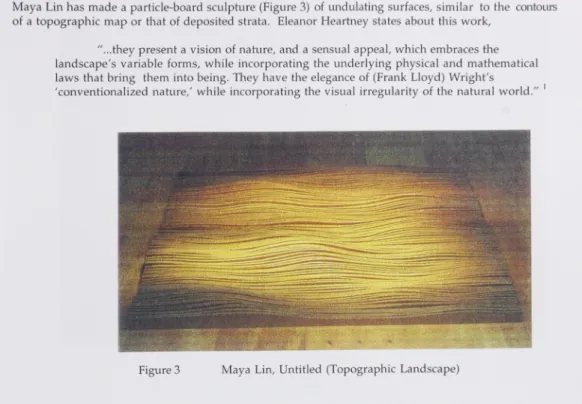
M a y a Lin h a s m a d e a particle-board s c u l p t u r e (Figure 3) of undulating surfaces, similar to the contours of a t o p o g r a p h i c m a p or that of deposited strata. Eleanor Heartney states about this w o r k ,
"...they p r e s e n t a vision of nature, and a sensual appeal, which embraces the l a n d s c a p e ' s variable forms, while incorporating the u n d e r l y i n g physical a n d m a t h e m a t i c a l laws that b r i n g them into being. They h a v e the elegance of (Frank Lloyd) W r i g h t ' s ' c o n v e n t i o n a l i z e d n a t u r e , ' while incorporating the visual irregularity of the n a t u r a l w o r l d . "
Figure 3 Maya Lin, Untitled (Topographic Landscape)
Geology deals with the deposition of strata and the results of the forces t h a t later act on t h e s e deposits. The 'underlying physical and m a t h e m a t i c a l laws' that form the landscape and the ' v i s u a l irregularity of the natural w o r l d ' are also t w o significant aspects of my o w n w o r k . I h a v e a t t e m p t e d to h a r n e s s the geologic forces that h a v e f o r m e d , and continue to shape, this planet b u t w i t h i n the confines of the glass w o r k s h o p .
Before my a r r i v a l here, I was m a k i n g work similar to the arched rock formations often seen in t h e desert. I blew thick glass forms with a hole going through the walls of the vessel, a s y m m e t r i c a l and a m o r p h o u s , w h i c h w o u l d b e n d distort light, playing with the notions of surface and vokune (Figure 4). T h e r e ' s a n aspect of topology, the mathematical sh.idy of curved spaces, in the w o r k which speaks of i t s p r o d u c t i o n using the molten and fluid nah.ire of glass. I would add color to accentuate the relation of t h e interior space to the outer surface, b u t color is w a s not essential for this work.
T h e new work is a close-up view of p a r t s of these rock formations, ie m a t e r i a l from w h i c h they a r e m a d e . Color, surface graphic, and texh.ire are essential elements of geologic strata. H e r e two bubbles of d i s t i n c t l y - d i f f e r e n t p a t t e r n e d glass are joined to form the unconformities. These vessels are ovoid in s h a p e , both open a n d closed forms, 16 to 28 cm tall. Each has two differing strata assemblages, s t a c k e d a t o p o n e another in the 'incalmo' technique, where t w o bubbles of hot glass are united to become one.
An unconformity is a place w h e r e geologic strata from dissimilar d e p o s i t i o n a l environments are in contact. It is a meeting b r o u g h t about by subterranean forces of the eARTh.
Figure 4 'Deluxe-Arch Vase'
Early Influences
I did not anticipate the work I would be finishing with when I commenced at the Canberra School of Art Glass Workshop in March 1998. At that time, I had no prediliction for Bullseye glass in any of my glassmaking. It was the good fortune of working with Klaus Moje, Scott Chaseling, and Kirstie Rea for the 'Lattitudes' demonstration in Japan in June 1998, that I first observed the 'Roll up' technique, specifically developed for Klaus' body of work, where a Bullseye fused tile is picked up o i a moil on a blowpipe and assembled into a vessel. And later, after seeing the stone-like qualities of the engraved and finished work, I decided to embark upcn my own research into blowing Bullseye fused tiles. I believed that the strip technique, where parallel thin strips are fused together, would begin to invoke geologic strata and structure. It was a combination of working with Klaus Moje and Scott Chaseling, in helping them make the 'Nijima series' (Figure 5) for the 'Lattitudes' Demonstration, watching Kirstie Rea shmiping her blown fusings throughout the 1998 school year, and receiving some Bullseye Glass scraps from Claudia Borella for experimentation in the latter half of 1998 that I finally realized I might be able to make geologic glassware.
Figure 5 Klaus Moje, 'Nijima series'
Figure 7 F a u l t e d s t r a t a
Figure 9 Cross bedding
Robert Smithson has stated. T h e actual d i s r u p t i o n of the earth's crust is at times very compelling, a n d seems to confirm H e r a c l i t u s ' Fragment 124, "The most beautiful world is like a h e a p of nibble tossed d o w n in confusion".'^
I also s o u g h t to use Frank Lloyd W r i g h t ' s notion of 'conventionalized nature', w h e r e n a t u r a l forms a r e s i m p l i f i e d to an essential geometry to express the 'soul' of these components of nature.^ I w a s able to produce a ' f a u l t e d ' p a t t e r n by fusing the strips of glass into thick ribbons cn the tiles w h i c h are t h e n cut, shifted, a n d re-fused. It is a process not dissimilar from that in nahire. 'Cross b e d d i n g ' (Figure 9) is a f u s i n g of parallel strips that, once twisted in the h o t s h o p , s h o w the d e v e l o p m e n t of l a y e r i n g s i m i l a r to t h a t found in sand dunes w h e r e the grains fall down a slope and layers d e v e l o p d i a g o n a l l y . 'Folding' is p r o d u c e d in s o m e of the strip fusings by twisting the fusings in d i f f e r e n t directions w h i l e cn the b l o w p i p e . 'Breccia' is c o m p o s e d of angular course f r a g m e n t s set into a matrix of d i f f e r e n t m a t e r i a l . It is the result of a process which occurs along faultlines w h e r e shear compression grinds and breaks iqj rocks a l o n g or n e a r the plane of the fault. Breccias are also f o u n d in lava flows, w h e r e non-melted rock is cracked by, a n d then filled with, a molten igneous m a g m a . This h a p p e n s w h e n a lava flow overruns cold surfacial rocks or w h e n the walls of the u n d e r g r o u n d m a g m a c h a m b e r fall into a semi-molten mass. The 'brecciated' rock is m a d e by cutting or breaking a sheet of glass, then fusing t h e s l i g h t l y - s e p a r a t e d pieces onto an u n b r o k e n underlying sheet.
Colour
The bold, almost Fauvist, usage of color of the geological map (Figure 10), which presents the surface rock classifications and the orientation of deformations in the strata, is a source from which I began my own compositions. These maps incorporate a ' C r o s s Section'(Figure 11), which is a profile view of t h e mapped area, presented as an interpretation of the data recorded on the map. The maps also includes a key to the stratigraphy, a 'Strat Column' (Figure 12), that shows the different rock classifications and the chronological sequence of the deposition of the different strata.
DEAKIN FAULT A C T O N FAULT
SuHivans Creek NORTHBOURNt
OAKES FAULT
Figure 11 Geological cross section
Neat and even shading with color pencils and clean inking with a rapidograph pen were an important aspect of the final maps in our geologic field studies. Alas, these maps were little more than color-by-numbers — igneous rocks were often red, and the outlines and final color patterns were often pleasing to look at than to interpret. My early investigations in art, as paintings, were colorful abstractions (Figure 13), which shared the qualities of painting and of mapmaking. I think it was fact that I could choose the pattern and the coloring scheme that painting held my interest in a way that mapmaking and geology could not.
Figure 13 Untitled painting
David Hockney has become a source of inspiration with his massive 'Grand Canyon' painting (Figure 14), which brims with color similar to the chromatic transformation that the geologist uses to h e l p distinguish the variety of strata in a region. During geological field studies, one needs to differentiate the underlying tones that made the browns and grays distinguishable from one another. These chromatic characterizations are a powerhil descriptive tool for field work. Hockney paints the w a y that a geologist can only try to describe in a filed book. The landscape is often a bold place, even in its subtleties, and Hockney is able to bring the Grand Canyon to the canvas with his balance of bright colors and nattiral forms.
I have also been swayed by the swirly, folded stripe paintings of Karin Davie (Figure 15) whose work has a close reference to folded strata found in geology. Her work fulfills the retinal stimulation of t h e undulations that occurin twisted and deformed rock outcrops, strata which might be classed as ' s i m i l a r folding with lateral compression' " by a geologist.
Figure 14 David Hockney, 'A Bigger G r a n d C a n y o n '
Figure 15 Karin Davie, ' H y s t e r i c '
Rebecca Morris paints a geologic deformation, chevron folding, in her piece 'Chevron Pairs' (Figure 13) while utilizing, as John Brunetti states, the tendency for 'pigments to pucker, ripple, and sag under its own weight, creating unsightly blemishes and crevices. It is this characteristic that gives her paintings the gritty pedestrian quality that prevents one from easily digesting them,' and eventually leads her work to be 'surrogates for blurred emotions.''
Figurel6 Rebecca Morris, 'Chevron Pair'
The Blown-Vessel Form
I chose to make a simple ovoid vessel form, a classical vase shape, as a way to investigate geological graphic, patterns, and colors as well as a way to form glass with some of these quite asymmetrical fused patterns. In utilizing the incalmo technique to join bubbles together to make the unconformities, I found that the fusings would often influence the form of the blown vessels. Each of the different fusings had a different working qualitv when a i the blowpipe. And soon it became apparent that the fusings, especially in combination, can have a significant influence the architecture of the vessel. And though this result is perhaps an interesting notion for some further research at a later date, my concem for this present body of work has been to achieve as much control over the combination of fusings.
The amazing work of Yoichi Ohira, as blown bv Maestro Livio Serena in Murano, Italy, is an example of the tight resolution that can be achieved with hising and blowing. The precision of the work helps to illustrate that the patterns and arrangements of the fused colors will influence the outcome of the blown form. Note, in Figure 17, how the blue and black stripes are carried upwards through the shoulder and into the neck without the small white dashes which are seen in the main body of the vessel The delicate neck, which is formed by utilizing the soft working qualities of the opaque blue a n d b l a c k g l a s s e s , would not be possible if the very stiff white had been included. Yoichi Ohira's work is achieved by designing the pattern of the pickup in concert with the form to be produced.
ra • ' r J
^
/
Figure 17 Yoichi Ohira, Blue 'Mosaico' vase
For m y w o r k t h o u g h , I desired to assemble my p a t t e r n s with some of the randomness found in n a t u r a l processes r a t h e r t h a n p u t t i n g the colors w h e r e they w o u l d be most useful for the s h a p i n g of the form. I w a s much more interested to involve the glass directly in the outcome of the work, even if it m e a n t abdicating a c o m p l e t e control over the final form - the b l o w i n g process became a conversation w i t h t h e glass. But w i t h the right sort of control, s o m e t h i n g quite close to a pleasing form can be a c h i e v e d w h i c h can later be refined by c o l d w o r k i n g .
A n d the b l o w i n g turned out to be the most troublesome area t h r o u g h o u t the w h o l e process. I d e v e l o p e d some s t r a t e g i e s to ease t h a t strain, but it w a s never as easy as blowing furnace glass. In my e a r l y a t t e m p t s at blowing Bullseye glass, I became subject to the quite differing viscosities of the colored glasses. I h a d to learn to utilize the viscosities to my a d v a n t a g e . Thus I e m b a r k e d upon a w h o l e new b o d y of k n o w l e d g e a b o u t glassworking. I also opened myself to the 'visual i r r e g u l a r i t y ' of the n a t u r a l w o r l d . ' ^ w i t h i n t h e context of my work, for not all the vessels are perfectly even or s y m m e t r i c a l just y e t .
D u r i n g this process, the flat tile, heated to 600' C (1112' F), is picked u p on a h o t moil (a collar of glass on the tip of a b l o w p i p e ) a n d this 'Roll u p ' is t u r n e d into a tube cn the b l o w p i p e . Then a neck is put in
this tube near the pipe, and the piece of glass knocked off as a cup, and anneailed. I've found with the great variety of colors and patterns which have been used here that the best method of forming the joined bubbles is with careful blowing technique, using low heat in the glory hole ,1165' C (2097' F), and spot heating crucial areas with a torch. Coldworking aips then can clean up such problems as ferro flakes, lip smoosh, and uneven wall thickness. Assembling the cups then is a much easier task. I bring them up overnight at 50' C (90' F) an hour. They are then soaked for an hour at 535' C (995' F) and picked up at 580' (1076' F), then assembled and blown.
The final finishing of the piece ocairs in the coldshop, where the piece is linished smooth and then wheel carved to complement the geologic patternation. The work is then rubbed with 400-grit sandpaper and 400 grit for a soft finish, which permits the eye to penetrate the interior depth of the work, where the solid thickness of the fused strips enhances the geological quality of strata.
I have learned the methodical nature of cutting from Stephen Procter, who has achieved a very significant mastery of this discipline, and I have been able to subtly achieve the geologic quality of the work with the carving. Each piece is different, and the carving is done only after careful consideration. And each of the different fusings in a piece each receive a different finish. Here again, the finishing of the work is also dependent on the outcome of the glass during blowing.
Process
This work employs processes that are standard within the history of glassmaking, but remarkably unexplored in their combination. The most notable aspect of this process is that it can be done without a furnace full of hot glass. All that is required here is a kiln, in which the Risings and some chunks of glass for the collar and the ptmty are brought up to heat in, a kiln in which to anneal in, and a glory hole in which to work the glass.
The basis of this work is to have compatible sheet glass in a range of colors. It was with the pioneering efforts of Klaus Moje in the 1970's, working with the Bullseye Glass Company, that the 'tested compatible' glass has come about. ' The sheets of compatible glass can be cut and fused with normal fusing techniques with no worries of breakage. The main deviation in the blowing is that of picking up a fully pre-fused piece of glass onto a collar on a blowpipe, rather than the modicum of unfused canes or murrinis that is within the normal tradition of glassmaking. The final cold finishing also uses standard techniques of carving, cutting, engraving, linishing, and flat bedding.
The process I vise involves cutting strips of glass, about 1 cm (3/8 inch) thick and 50 cm (20 inches) in length from a sheet, usually about, which I then assemble on some frax paper and brick borders with the edge of the strips aligned vertically. This method allows for the escape of air as the glass is heated. These strips are then fused, bringing the kiln up at 200' C (360' F) an hour to 820' C (1508' F) where it is held for 10 to 20 minutes. The kiln is then quickly, crashed and the work is annealed at 516' C (960' F) for an hour and brought down to the strain point, 370' C (698' F), at 30' C (54' F) an hour, and held there for an hour. The kiln is then turned off to cool naturally.
If it is a faulted fusing, the tile is then cut and the layers are slightly shifted. The whole thing is put back into the kiln again and re-fused. Afterwards the fusing is then coldworked - the edges of the fusing are linished, the two ends of the Hie that will be joined together (ie the seam) are flattened and bevelled inwards slightlv, and the bottom surface of the fusing, which was in contact with the frax paper and has picked up a texture, is wheel worked and sandblasted smooth.
The tile is measured to determine the final diameter of the moil, and bought up, at 200' C (360'F) an hour in a kiln on a ferro (covered thinly with ball clay or porcelain that has been cooked on at 400' C 752' F) to 600' C (1112' F). The tile is then picked up m a moil and the edges are joined and fused
together to form a cup. Two cups are then shjck together and formed into a single bubble. The piece is then carefully blown, and later annealled with the similar cycle to that which is used for the tiles, but with a longer initial soak (ie double the time), a slower ramp down rate -- 25' C (45' F) and hour, and a longer soak at the strain point (1.5 times the fusing soak). Afterwards, the piece is linished smooth at the join, wheel carved, engraved with lineations, and hand rubbed.
Landscape
My interests in finding the spiritual side of the landscape through Aboriginal art has concluded in an unanticipated manner, and I think I have met a spiritual side of myself instead. I had hoped to look to Aboriginal art as a way of understanding a relationship to the land; instead, I found myself with a new relation to art. It was at the Emily Kame Kngwarreye exhibition (Figure 17) at the National Gallery of Art in Canberra when I realized that I would never be able to have the same understanding with the landscape that a member of the Aboriginal culture would have. (And it was probably silly of me to have considered otherwise.) But then I realized that I would never have a true understanding of Aboriginal art, either. In fact, it seems like the whole notion of Aboriginal art, especially within the space of an art gallery, is truly just another western construct. While the art is not produced from a western perspective, it is made to address an non-indigenous audience, and to rely soley on the a western interpretation of the work would lead to only a partial understanding. Thus the work is both in and out of the western canon of art at the same time, and can be enjoyed for its pure retinal stimulation of patterns and colors or through an interpretation of its symbolic values. But the layers of meaning that the work may hold for an indigenous audience are only barely accessible for someone from another culture and without that background, I believe it is difficult to view this work in the same manner of other art. The viewer is then left with a rather purist sense of art, ie for retinal stimulation, and an appreciation for the irony of the worldwide success of this art in light of the current Australian governments' refusal, even now, to apologize for historical and current injustice. And my own take en this work has been as a return to the pure visual pleasure which initially sparked my interested in art.
Figure 18 Emily Kame Kngwarreye, 'Utopia Panels'
Conclusion
My year and one half at the Canberra School of Art has truly been eventful. I've had chance to blow glass in Murano, Italy, in Japan, in Korea, and in Australia because of the Workshop. And I've also been watching the rocks here in Australia. As the naturalist John Muir has said, "I asked the boulders I met whence they came and whither they were going". ^
I went on a geological field trip in Australia to Broken Hill in March of 1999 with some geology students from the Australian National University and the University of Canberra. I was hoping to see large outcrops and cliffs of strata with folds, faults, and distorted old stone as source material for my work. 'Patient observation and constant brooding above the rocks, lying upon them for years as the ice did, is the way to arrive at the truths which are graven so lavishly upcn them' is the method t h a t John M u i r recommends for geological studies. I came to realize that Broken Hill is old (Paleozoic in age or earlier, ie at least 250 million years old) and has been relatively undisturbed in recent times, leading to a much different landscape than I had anticipated (Figure 19).
Figure 19
Broken Hill is the largest silver, zinc, and lead ore body in the world. The Willyama Supergroup, as i t is called, is a vast uptvimed, twisted structure, roughly 1700 million years old, that has been metallic mineralized in some ancient heat. But on top it is covered in colluvium, ie recent sedimentation, a k a dirt. And it is the colluvium that is now being studied by the geologists to see how it relates to t h e subterranean features. Tlie last mine in Broken Hill is scheduled to close in 2006, and the geologists are using whatever means they can to locate more ore and keep the area economically viable. They hope to
' ed. Wolfe, Linnie M., The Unpublished loumals of lohn Muir, University of Wisconsin Press, 1938, p
gain a greater regional awareness of the region in areas such as the Mundi-Mundi plain where the outcrops of bedrock are non existent.
We also went to Mootwidgee National Park to look at vegetation -- plant distribution can be affected by soil types, and soils can indicate what's underneath. Geo-botany is a relatively new branch of geology, but scientific technology has allowed for the measurement of the most obscure and tiny things that could yield any sort of evidence. It does make the discussion much more detailed, complex, and subjective, especially since the science of geology is as much a conversation, a discourse, just as art is. And these have been some most interesting discourses for me. Probably the most startling aspect about my work is the fact that it seems to tell me what to do to complete it as I go along. I sometimes wonder if I am actually making the work or if it is making itself through me (Figures 20 to 32).
This work has allowed me to integrate some significant parts of my life, linking the many years of education that I've received and bridging the gap between my avocation and my recreational pursuits. I have a sense of clarity and purpose that had always eluded me before — something of which my previous works allude to with the big hollow spaces in the vessels and the irreverence of my thinking. Now there is only a desire to focus on what I've learned to do here.
My Fulbright Scholarship has been of great assistance in this regard. By bringing me to Australia, i t has allowed me to find a new perspective on myself and the rest of the world. I have come to the exact spot on the Earth at the exact time 1 needed to come to it. 1 believe it was much more than mere luck, something closer to destiny.
To close, a poem from The Book of Lies, by Aleister Crowley, who, at the turn of the century, was chastised by the British press as 'the wickedest man alive' (and he wasn't even a glassmaker!).
32
[Kappa-Epsilon-Phi-Alpha-Lambda-Eta Lambda-Beta] THE MOUNTAINEER
Consciousness is a symptom of disease All that moves well moves without will
All skillfulness, all strain, all intention is contrary to ease
Practice a thousand times, and it becomes difficult; a thousand thousand, and it becomes easy; a thousand thousand times a thousand thousand, and it is no longer Thou that doeth it, but It that doeth itself through thee. Not until then is that which is done well done. Thus spoke PRATER PERDUBADO as he leapt
from rock to rock of the moraine without ever casting his eyes upon the ground.
A P P E N D I X I W o r k P r o p o s a l 1999
The Plans
My proposal is to use my last semester at art school as a time to develop and finish the body of work for my show at Beaver Galleries in August. ! will be making works from my 'Unconformities' series, utilising fused Bullseye glass tiles which will then be stuck up on a blowpipe in the hot shop and formed into decorative blown-glass vessels. I will later carve the cold vessels with a variety of cold-working techniques to enhance the qualities of the outer surfaces.
The Designs
The source for my work comes from the ground in an odd blend of two disciplines — glassmaking and geologic mapping from field work. Tlie pieces I am making are my attempts at interpreting direct geological field observation, via sketches and photographs of the geologic aesthetic — strata, faulting, folded rock, deformations, and juxtapositions of bedding. I will also incorporate the already rendered, ie. geological maps and cross sections, as further source material. Additionally, I have a collection here of significant Australian rocks to draw from.
By setting the design, color, and graphic scheme in the initial fusing of the tile, I can then use these set qualities, the visual elements of the tile and the physical properties of the working of the hot glass piece, to help resolve the final form of the piece. I plan to stay within the realm of functionality in this body of work, utilizing a bulbous vessel form. I will be producing works that swell u p from the foot, growing in girth and volume. Some forms will be open and continue with the upward swell; other forms will be closed, with a small neck.
Cold finishing the blown piece will be used to enhance the textural qualities of geologic surfaces as well as to illuminate of the body of glass.
Some makers who have influenced my work are Klaus Moje, Richard Marquis, Yoichi Ohira in his collaborative work with Livio Serena, Aldo Nason, Vittorio Ferro, Maya Lin and here recent 'Landscape' work, Karin Davie's imdulating-stripe paintings, David Hockney's recent landscape paintings, and Emily Kame Kngwarreye's later work.
The Goals
Beyond the score of works for the Beaver Gallery show, I will also complete a assortment of pieces -some being variations of the differing compositions of works, as well as a good number of pieces that won't be for sale; they being the many explorations that I made in search of my desire to meld form, graphic, and color in this work.
APPENDIX II Fulbright Proposal
Glass is currently a very popular artistic material, but its own popularity is changing the nature of its use. My experience with hot glass has shown me that it is a medium best suited for the creation of vessels. The inherent form of a hot-glass bubble is a
container for the breath. One can argue almost inexhaustibly about vessels as metaphors of the body, of journeys and experiences, of traumas and joys. My work attempts no such metaphors; my vessels are actually what they appear to be - a vase, a bowl, a tumbler, an ashtray, etc. My glasswork presently has more emphasis on design and function than on conceptual concerns. W h a t ! seek to do is to develop some unique and astonishing forms for decorative, glass vessels. I've researched this premise to find some sort of seed for my explorations. Oddly enough, the source for my inspiration is not too far away, in the local antique store - namely the gaudy, thick, 1950's glass that no one respects. A small amount of this experimental artistry was Italian glass, with glass companies in Murano, such as Barovier andToso, Venini, AVEM, and Seguso, all producing imequalled glassware during this time, some of the antique-store stuff excepted.
The early 1950's saw the advent of hole being punched through the form of the vessels. For three years the Italian glass companies mentioned above explored these forms and achieved some very lively results, especially within the history of glassmaking. But suddenly, in 1953, they dropped these designs, stopping without concluding, and moving onto other, prettier work. It is these holed designs which I have taken for the seed of my own work. I have started to manipulate these forms, but I have reached no conclusion. Having spent eight years of my life immersed in hot glass, I feel an impetus to create a remarkable and lasting body of work, and I believe that the 'Holey Vessels' series is indeed the best design for this end, especially in these post-modern times.
It is a risk to take a departure like this from the staid world of contemporary glass vessels. Current glassmakers can be a rather conservarive lot, still desiring to remake the 16th-century goblet or copy the successful work of someone else. I prefer to take my own path, using s-common techniques of glassworking to create a new vision of design for glass vessels.
I am intrigued to studv in Australia for the lure of the shapes of the rocks found in the desert, which I could use as formal inspiration for my glasswork. The desert of Utah have been a treasure of forms, such as the grand spans of the rock arches in the Canyonlands of southeast Utah, for the development of the 'Holey Vessels'. I believe Australia's deserts to be vast and monumental, yet they are still somewhat unknown to me. Each desert is a completely different place - one can easily travel though many distinct types of desert in the American southwest, each with a different flora and fauna, rock and soil types, topography and climate. I am intrigued by the Australian desert and the lure of its living myths. The Anasazi and other 'Old Peoples' no longer exist in the American deserts, but after 40,000 years, the
Australian-Aboriginal people still live with the understanding of their land. Ayers Rock (Uluru), for example, in almost the exact geographic center of the Australian continent, is a site of great legends for the Australian-Aboriginal people; it is also the residence of the spirits in these legends. Uluru is a sacred place for these people; it has the quality of being holy in their mythology.
and assured their survival. Their outlook is seemingly antithetical to western values and too complex to be read about in a book. It needs to be experienced to be grasped. And the potential to integrate form and spirit is very compelling. 1 would not want to borrow their beliefs for my work; I would rather find inspiration for the creation of my own myths with my designs.
The issues of design are best addressed at the Australian National University at Canberra. The curriculum at the glass department favors decorative, functional ware. I have studied under a graduate from the Canberra School of Art, Ben Edols, who taught me to look to the 1950's for inspiration in this endeavor.
Present-day glass needs to be moving forward in its exploration of the vessel form. There are so few things that aren't directly derivative of something else - so one must either make one's mark in the details of the derivation or one must come up with the prototype for new designs. It is my plan to make these prototypes. I want my work to excite and incite others to try
something different. Glass is formed from very common raw materials, but it is the infusion of energy, as heat, which really produces the glass. Glass design needs to reflect this input of energy, and I reckon my work does. I expect Schmuck (which rhymes with book) to be synonymous with innovation in glass.
APPENDIX III Statement about the Work
My research is in the forces of nature which shape the planet -- heat, pressure, stone, water, air, and the interaction with life, and in using these forces to form glass within the workshop. This work consists of blown glass vessels, which emphasize the qualities of stone that are manifest over time periods exponentially longer than that of written history. An unconformity is a place where geologic strata from dissimilar depositional environments are in contact. It is a meeting brought about by subterranean forces of the eARTh. These vessels have a similar origin.
APPENDIX IV Bibliography
ed. Bargellesi, Guglielmo-Severi, Robert Smithson Slideworks. Carlo Frua, Verona, 1997, p 127.
Barovier, Rosa Maria, Maestri vetrai creatori di Murano del '900. Electa, Italy, 1995, pp. 59-16 (Aldo Nason), pp. 71-4 (Vittorio Ferro).
Barovier, Rosa Maria, T a g l i a p i e t r a . Vitmm, Dublin, 1998.
Bnmetti, John, 'Rebecca Morris', New Art Examiner, July/August 1998.
Crowley, Aleister, Tlie Book of Lies. Samula Weiser Inc, London, 1913.
Dictionary of Geological Terms. American Geological Institute, Anchor, New York, 1974.
Dorigato, Attilia, Vetri Veneziana OHIRA. Arsenate Editrice, Italy, 1998.
Edwards, Geoffrey, Klaus Moje Glass/Glas. National Gallery of Victoria, Australia, 1995.
Frantz, Susanne, Philip Baldwin and Monica Guggisberg. In Search of Clear Lines. Bentali, Beme, 1998.
Geikie, Sir Archibald, Class Book of Geology, Macmillan and Co., London, 1937.
Hainley, Lome, 'David Hockney' (Grand Canyon), Art Forum, November 1998.
Halem , Henry. Glassnotes. Franklin Mills Press, Ohio, 1996.
Heartney, Eleanor, 'Distillations of Landscape' (Maya Lin), Art in America, September 1998.
Hills, Sherbon, Elements of Structural Geology. Methuen and Co, Melbourne, 1963.
, 'Karin Davie', Art in America, September 1998.
ed. Lynngard, Finn, Klaus M o j e / D a l e Chihulv. Glasmuseum Ebeltoft, Denmark, 1991.
ed. Neal, Margo, Emily Kame Kngwarreyp - Alhalkere. Queensland Art Gallery, Macmillan, Australia, 1998.
Rutley, Frank, Mineralogy. Thomas Murby, London, 1900.
Twidale, C. R., Geomorphology. Nelson, Adelaide, 1968.
APPENDIX V CV
Johnathon Schmuck
Bom: 4 April, 1963; Los Gates, California, USA 32 Campbell Street, Ainslie ACT 2602, Australia phone: +61(02)6262 5489 home/+61(02)6249 5828 studio email: jtschmuck@hotmailxom
Education
1999 Master of Visual Arts (M.V.A.) in the Glass Workshop at the Canberra School of Art, with Stephen Proctor, Jane Bruce, & Kirstie Rea, Canberra, Australia 1997 Master of Fine Art (M.F.A.) in Glass with Michael Taylor,
Rochester Institvite of Technology, Rochester, New York Advanced Solid Glassworking with Pino Signoretto,
Pilchuck Glass School, Stanwood, Washington Ideas into Art with Gianni Toso,
The Studio at the Coming Museum of Glass, Coming, New York 1995 Mixed-Media and Glass with Therman Statom,
Haystack Moimtain School of Crafts, Deer Isle, Maine 1993 Advanced Glassblowing with Lino Tagliapietra,
Haystack Mountain School of Crafts, Deer Isle, Maine 1991 Solid, Hot-Glass Sculpture with Loredano Rosin,
Pilchuck Glass School, Stanwood, Washington Italian Lampworking Techniques with Cesare Toffolo Rossit,
Pilchuck Glass School, Stanwood, Washington 1990 Hot-Glass Surface Decoration with Dan Dailey,
Pilchuck Glass School, Stanwood, Washington 1989-91 Studied Glass with Mary White, San Jose State University,
San Jose, California
1986 Bachelor of Science (B.S.) in Earth Sciences, University of California, Santa Cruz, California
Awards
1998-9 Fulbright Scholarship for post-graduate study at the Canberra School of Art, Canberra, Australia
Niche Award Finalist, Niche Magazine
David Thomas Foundation Travel Grant, Australia
1996 New Glass Review #17, Coming Museum of Glass, Coming, New York Niche Student Award Finalist, Niche Magazine
1995-7 Graduate Tuition Scholarship, Rochester Institute of Technology (RIT), Rochester, New York
1993 Best Sculpture, New Mexico Glass Art Show XII - Expo '93, Albuquerque, New Mexico
Professional Experience
1999 The 'Dream Team' sessions to make the 'Nijima' series with Klaus Moje, Canberra, Australia
1998 'Lattitudes' demonstration with Klaus Moje, Glass Art Society (GAS) conference, Aichi University, Japan
1996-7 Board of Directors, Student Representative, GAS, Seattle, Washington
1996-7 Hot-shop Technician, RIT, Rochester, New York
Hot-shop Technician, Pilchuck Glass School, Stanwood, Washington 1995 Blowing Assistant, Chris Tedesco Glass, Santa Cruz, California
1992-4 Helped to Build and Start-up, Pipe Dreams Glassworks, Santa Fe, New Mexico 1992-3 Apprentice, Tesuque Glassworks, Tesuque, New Mexico
1991-2 Blowing Assistant, Flo Perkin's Glass-Cactus Studio, Santa Fe, New Mexico 1989-91 Blowing Assistant, Robert Hughes' Hall of Flame, Mountain View, California Teaching Experience
1999 Basic Glassblowing Seminar, Canberra School of Art, Canberra, Australia 1998 Basic Glassblowing Seminar, Canberra School of Art, Canberra, Australia 1997 Substitute for Mary White, San Jose State University, California
1995-7 Graduate Assistant to teach first-year, second-year, and elective glassblowing, RIT, Rochester, NY
1995 Teaching Assistant for Robin Winters & Randy Walker, Pilchuck Glass School, Stanwood, Washington 1994 Teaching Assistant for Flora Mace & Karen Willenbrink,
Haystack Mountain School of Crafts, Deer Isle, Maine 1991 Basic Glassblowing Seminar, taught with Mary White,
San Jose State University, San Jose, California Exhibitions
1999 Unconformities (solo). Beaver Galleries, Canberra, Australia
Essentially Canberra, Object Gallery, Custom's House, Sydney, Australia Essentially Canberra, Chappell Gallery, Boston, Massachusetts SOFA New York, Chappell Gallery Booth, New York, New York, USA
Niche Award Finalist Booth, Philadelphia Buyer's Market, Pennsylvania, USA Ausglass Student Show, Wagga Wagga City Gallery, Australia
1998 Venezia Aperto Vetro 1998, L'Instituto Statale D'Arte, Venice, Italy
CSA Drawing Prize, Foyer Gallery, Canberra School of Art, Canberra, Australia Canberra Goes to Venice, Strathnaim Gallery, Canberra Australia
GAS Student Show, Seto Civic Building, Seto, Japan
1997 KTEH- TV Auction 'Special Works', Triton Museum of Art, Santa Clara, California Pilchuck Auction, The Westin Hotel, Seattle, Washington
Pilchuck Staff Show, History of the World Gallery, Camano Island, Washington Pilchuck Staff Show, Foster-White Gallery, Seattle, Washington
New-Members Lab Space, Pyramid Art Center, Rochester, New York WXXI-TV Auction, Rochester, New York
Graduate Thesis Exhibition 1, Bevier Gallery, RIT, Rochester, New York GAS Student Show, J. Gross Gallery, University of Arizona, Tuscon, Arizona It's About Time, SPAS Gallery, RIT, Rochester, New York
Goblets '97, The Glasshouse, Seattle, Washington 1996 Pilchuck Auction, The Westin Hotel, Seattle, Washington
Pilchuck Staff Show, History of the World Gallery, Camano Island, Washmgton GAS Student Show, Massachusetts College of Art, Boston, Massachusetts Goblets 96, The Glasshouse, Seattle, Washington
Exhibitions
1996 32 Hours at the Gate, Village Gate, Rochester, New York
The Voices of Glass, Germanow-Coffey Gallery, Rochester, New York WXXI-TV Auction, Rochester, N e w York
The Guilford Biennial, Guilford Handcraft Center, Guilford, Connecticut 1995 In the Cabinet, Cafe 29, Los Gatos, California
Bare Essentials, Grohe Gallery/Signature, Boston, Massachusetts Pilchuck Auction, The Westin Hotel, Seattle, Washington 1994 K T E H - T V Auction, San Jose, California
Spring Glass Folly, Philabaum Sh.idio and Gallery, Tuscon, Arizona Make-a-Wish Foundation Auction, La Fonda Hotel, Santa Fe, New Mexico 1993 Valentine's Show, San Jose Institute of Contemporary Art, San Jose, California
Salon des Refuses, Gallery at the Repertory Theater, Santa Fe, New Mexico New Mexico Glass Art Show XII--Expo '93, Mirage Gallery,
Albuquerque, New Mexico
A Few Good Pieces, Tesuque Glassworks, Tesuque, New Mexico Barbie: A Trip to Santa Fe, Cafe Adevina, Santa Fe, New Mexico
Abstractionism in Glass '93, Northern Arizona University, Flagstaff, Arizona N e w Mexico Landscape: A Glass Invitational,
Garland Gallery, Santa Fe, New Mexico, & Mariposa Gallery, Albuquerque, New Mexico Self Portraits, Tesuque Glassworks, Tesuque, New Mexico
Valentine's Show, San Jose Institute of Contemporary Art, San Jose, California KTEH Auction 'Special Works', San Jose Museum of Art, San Jose, California Christmas Show, Lynn McAllister Gallery, Seattle, Washington
Glass, Herbert Saunder's Gallery, San Jose, California
Tempos ' 9 1 - B a y Area Arts & Crafts Guild, Rosecrucian Museum, San Jose, California
Goblet and Bud-Vase Show, Lynn McAllister Gallery, Seattle, Washington Valentine's Auction, San Jose Institute of Contemporary Art, San Jose, California G.A.S. Student Show, Coming, New York
1990 Fresh, Hot Glass, Herbert Saunder's Gallery, San Jose, California Annual SJICA Auction, San Jose Instihite of Contemporary Art,
San Jose, California
1989 From the Hot Shop, San Jose State University, San Jose, California 1988 Vitreous Visions, San Jose State University, San Jose, California 1992 1991
Publications
1999 1998 1997 1996 1987Hinchliffe, Meredith, 'Glasswork with geological links'. The Canberra Times, August 23,1999, p. 10.
Niche Magazine Award Winners, Niche Magazine, Winter 1999, p. 103.
'Venezia Aperto Vetro: International New Glass 1998', Electa, Milan, pp. 198, 204. 'Essentially Canberra', Published by the Glass Workshop,
Canberra School of Art, pp. 18-19, 69.
•Fulbright Scholarship Announced', The Crafts Report, October 1997, p 11. Arthur C. Danto, 'Juror's Statement for the New Glass Review #17',
Neues Glas, 2/96, pp 73-74.
•The Santa Cruz County Comic News', Local Stuff, Issue #25, p. 13.
Collections
Bullseye Glass Company, Portland, Oregon
Johnathon
Schmuck
recent glasswork
8 - 2 5 August 1999
JOHNATHON SCHMUCK
Unconformities
recent glasswork from a Fulbright Scholarship
at the Canberra School of Art Glass Workshop
Exhibition dates 8 - 2 5 August 1999
Join us for drinks with the artist
at the exhibition opening on
Sunday 8 August at 11am
by Dr John Lake
Executive Director, Australian-American
Educational Foundation (Fulbright Commission)
Photo: "Unconformable vases", blown Bullseye glass fuslngs, wheel carved, tallest 25cm (photographer: Stuart Hay)
I
beaver
•• > y
. • i V, / .
45
•
Johnathon Schmuck
Born 1963, Los Gatos, California. USA
Education
1998-99 Master's Candidate, ANU Canberra School of Art, Australia
1997 Master of Fine Art, Rocfiester Institute of Technology (HIT), Rochester. New York
1986 Bachelor of Science in Earth Sciences, University of California, Santa Cruz, California
Awards
1998-99 Fulbright Scholarship for Post-Graduate study at the ANU Canberra School of Art, Glass Workshop, Australia 1998 David Thomas Foundation Travel Grant,
Australia
1996 New Glass Review #17, Corning IVIuseum of Glass, Corning, New York
Selected Exfiibitions
1999 Unconformities (solo). Beaver Galleries, Canberra, Australia
Essentially Canberra, Chappell Gallery,
Boston, Massachusetts, USA 1998 Venezia Aperto Vetro 1998. L'Instituto
Statale D'Arte, Venice, Italy
Glass Art Society Annual Student Show,
Seto Civic Building, Seto, Japan 1997 Graduate Thesis Exhibition I Bevier
Gallery, BIT Rochester, New York
Pilchuck Auction, The Westin Hotel,
Seattle, Washington
1996 The Voices of Glass, Germanow-Coffey Gallery, Rochester, New York
Pilchuck Auction, The Westin Hotel,
Seattle, Washington 1995 Bare Essentials, Grohe Gallery/
Signature, Boston, Massachusetts
Pilchuck Auction, The Westin Hotel,
Seattle, Washington
1994 Spring Glass Folly, Philabaum Studio and Gallery, Tuscon, Arizona 1993 Abstractionism in Glass '93, Northern
Arizona University Flagstaff, Arizona 1992 Self Portraits, Tesuque Glassworks,
Tesuque, New Mexico 1991 Tempos 'S/—Bay Area Arts & Crafts
Guild, Rosecrucian Museum, San Jose, California
1990 Fresh, Hot Glass. Herbert Saunder's Gallery, San Jose, California 1989 From the Hot Shop San Jose State
University, San Jose, California 1988 Vitreous Visions. San Jose State
University, San Jose, California
Publications
1998
1997
1996
'Venezia Aperto Vetro: International New Glass 1998', Becfa, Milan, p 198,204. 'Fulbright Scholarship Announced'. The
Crafts Report. October 1997, p 11.
Arthur C. Danto. 'Juror's Statement for the New Glass Review #17', Neues
Glas.l/X.
The A N U Canberra School of Art Glass Workshop provides graduate and undergraduate courses and
facilities to prepare students for a career in the visual arts. In 1998, the Glass Workshop was selected from schools worldwide for the Aperto Vetro Exhibition in Venice, Italy, as an example of excellence in tertiary education in glass. www.anu.edu.au/ITA/CSA/Glass/Glass.Canberra/
The major objective of the Australian American Educational Foundation (Fulbright Commission) is to further mutual understanding between people of Australia and the United States through educational exchange. The Fulbright Program in Australia supports the exchange of graduate students, lecturers, researchers, people working in the arts, and practising professionals. 1999 marks the 50th anniversary of the Program, http://sunsite.anu.edu.au/education/fulbright
Acknowledgements— The Australian American Educational Foundation (Fulbright CommissionI, the Glass Workshop
of the ANU Canberra School of Art, Klaus Moje, Stephen Procter, Monica Larsson Edmundson, Nonie Lake, Scott Chaseling, Kirstie Rea, Glen Fisher, Ben Seweil, and Aimee Frodsham.
. Typesetting: Alison Munro 81 Dennison Street ^ Deakir. ACT 2600
Ph: 02 6282 5294 s 10am-5pm • Design: Johnathon Schmuck •
• Photography: Stuart Hay • Printed by 80ANNA PRINT
An unconformity is a place where geologic strata from dissimilar depositlonal environments are in contact. It is a meeting brought about by subterranean forces of the e(g)RTh. This glasswork has similar origins
Qa Smr
o
3
m
K
r J .r - '
'
W.'
s
J1
J " 1
t , I L f < '