An Information Systems Design Theory
for E-learning
David Thomas Jones
February 2011
Declaration
I certify that this thesis is my own original work. It does not contain any material previously published or written by another person without due reference in the text.
This work is licensed under the Creative Commons Attribution-ShareAlike 3.0 Unported License. To view a copy of this license, visit
http://creativecommons.org/licenses/by-sa/3.0/ or send a letter to Creative
Acknowledgments
The work described here has been made possible by thousands of people, literally. A number far too large to personally acknowledge within the space allowed here. Consequently, I start by offering gratitude to all, especially those that I have not mentioned below.
Perhaps most importantly are the tens of thousands of people who made use of the services provided by Webfuse. Thank you for your patience and suggestions. It was your diversity that drove home the importance of emergence and just how inflexible most institutional IT systems actually are.
Thanks also to those who disagreed with the ideas expressed here and embodied by the Webfuse information system. The difficulties you had with understanding these ideas provided the impetus to further understand, refine, and explain the ideas. On reflection, the fact that so many of you filled management or senior information technology positions within the organisation remains somewhat troubling. But this work would not be without you, thank you.
Also essential were those who helped enable the emergence of Webfuse. The project students and institutional IT staff who worked on or in support of
be made of Derek Jones, the last man standing in terms of Webfuse and a major influence on its latter development.
Special thanks must go to Mary Cranston. Her contributions were as important and immeasurable as they were generally unrecognised and self-effacing. That lack of recognition was by far the largest shortcoming of the organisation we worked for. I cannot thank Mary enough.
Webfuse and the work described here would not have happened without Stewart Marshall. Stewart was the Foundation Dean of the Faculty of Informatics and Communication and, as described in Chapter 5, remains the only senior manager in my experience to not only understand ateleological development but also publicly embrace it as a strategy for the organisation he was responsible. Without Stewart, Chapter 5 would never have happened.
From the research perspective, I am deeply indebted to the Very Respectable Professor Gregor. Without Shirley’s knowledge, connections, influence and most especially patience this work would have been much less than it is. Perhaps my largest regret from this thesis is that I was not in a position to do more with Shirley’s contribution. The same might be said about the folk I have co-written with over recent years. I would like to make special mention of Kieren Jamieson as someone who made significant and under utilised contributions to this and related work.
Abstract
This thesis seeks to offer an answer to the problem of how to design, implement and support information systems that effectively and efficiently support e-learning within universities. This problem is increasingly prevalent and important to the operation of universities. It is also a problem where existing solutions are limited in terms of variety, quality and explicit theoretical guidance. This thesis
formulates a specific Information Systems Design Theory (ISDT) – An
Information Systems Design Theory for Emergent University E-learning Systems
– as one answer to this problem.
The ISDT is formulated using an iterative action research cycle that encompasses the design, support and evolution of the Webfuse information system at Central Queensland University (CQU) from 1996 through 2009. The Webfuse system was used by tens of thousands of staff and students. It is the knowledge gained through this experience that, in two separate stages, is used to formulate design theory.
Table of contents
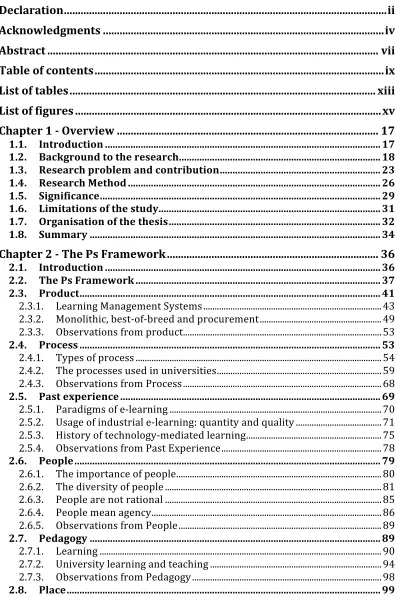
Declaration...ii
Acknowledgments ...iv
Abstract ... vii
Table of contents...ix
List of tables... xiii
List of figures ...xv
Chapter 1 - Overview ... 17
1.1. Introduction ... 17
1.2. Background to the research... 18
1.3. Research problem and contribution... 23
1.4. Research Method ... 26
1.5. Significance... 29
1.6. Limitations of the study... 31
1.7. Organisation of the thesis... 32
1.8. Summary ... 34
Chapter 2 - The Ps Framework... 36
2.1. Introduction ... 36
2.2. The Ps Framework ... 37
2.3. Product... 41
2.3.1. Learning Management Systems... 43
2.3.2. Monolithic, best-‐of-‐breed and procurement... 49
2.3.3. Observations from product... 53
2.4. Process ... 53
2.4.1. Types of process ... 54
2.4.2. The processes used in universities... 59
2.4.3. Observations from Process... 68
2.5. Past experience ... 69
2.5.1. Paradigms of e-‐learning ... 70
2.5.2. Usage of industrial e-‐learning: quantity and quality ... 71
2.5.3. History of technology-‐mediated learning... 75
2.5.4. Observations from Past Experience... 78
2.6. People... 79
2.6.1. The importance of people... 80
2.6.2. The diversity of people ... 81
2.6.3. People are not rational ... 85
2.6.4. People mean agency... 86
2.6.5. Observations from People... 89
2.7. Pedagogy ... 89
2.7.1. Learning ... 90
2.7.2. University learning and teaching ... 94
2.7.3. Observations from Pedagogy... 98
[image:9.595.129.525.170.785.2]2.8.1. Society ...99
2.8.2. Sector... 102
2.8.3. Institution ... 103
2.8.4. Observations from Place ... 110
2.9. Purpose ... 110
2.9.1. Purpose of universities ... 111
2.9.2. Purpose of learning within universities ... 113
2.9.3. Purpose of e-‐learning within universities ... 114
2.9.4. Observations from purpose ... 116
2.10. Conclusions ... 116
Chapter 3 - Research Method ... 119
3.1. Introduction ... 119
3.2. Paradigms and theory... 120
3.2.1. What is research? ... 121
3.2.2. The role of theory and method... 122
3.2.3. The role of research paradigms ... 125
3.3. Perspectives adopted in this research ... 130
3.3.1. Domain questions ... 131
3.3.2. Ontological questions ... 132
3.3.3. Epistemological questions... 141
3.3.4. Socio-‐political questions ... 148
3.4. Conclusions... 151
Chapter 4 - Build it and they will come? ... 154
4.1. Introduction ... 154
4.2. Problem definition ... 155
4.2.1. The institution ... 156
4.2.2. Use of e-‐learning... 163
4.2.3. Why build another system? ... 169
4.3. Requirements... 171
4.3.1. A Web publishing tool ... 172
4.3.2. An integrated online learning environment (OLE)... 173
4.3.3. Eclectic, yet integrated... 174
4.3.4. Flexible and support diversity... 175
4.3.5. Encourage adoption ... 178
4.4. Implementation... 179
4.4.1. Process, People and Technology... 180
4.4.2. A Web publishing tool ... 182
4.4.3. A comprehensive OLE ... 194
4.4.4. Eclectic, yet integrated... 198
4.4.5. Flexible and support diversity... 204
4.4.6. Encourage adoption ... 207
4.5. Evaluation ... 209
4.5.1. A Web publishing tool ... 210
4.5.2. A comprehensive OLE ... 211
4.5.3. Eclectic, yet integrated... 220
4.5.4. Flexible and support diversity... 222
4.5.5. Encourage adoption ... 224
4.6. An ISDT for Web-based learning systems ... 225
4.6.1. Purpose and scope... 227
4.6.2. Constructs... 227
4.6.3. Principles of form and function... 228
4.6.4. Justificatory knowledge... 230
4.6.6. Testable propositions... 234
4.6.7. Principles of implementation... 234
4.6.8. Expository instantiation... 235
4.7. Lessons learned ...235
4.8. Conclusions...240
Chapter 5 - Emergent development...242
5.1. Introduction ...242
5.2. Problem definition...243
5.2.1. Societal changes... 243
5.2.2. Institutional changes ... 247
5.2.3. Changes in Webfuse support... 253
5.3. Intervention ...255
5.3.1. Adopter focused development and diffusion theory... 256
5.3.2. Emergent and agile development ... 260
5.3.3. Object orientation and design patterns... 262
5.3.4. Wf Framework ... 264
5.3.5. Default course sites and wizards... 266
5.3.6. Workarounds ... 281
5.4. Evaluation ...293
5.4.1. A Web publishing tool... 295
5.4.2. A comprehensive OLE ... 297
5.4.3. Eclectic, yet integrated... 317
5.4.4. Flexible and support diversity... 320
5.4.5. Encourage adoption ... 326
5.5. Lessons learned ...334
5.6. An ISDT for emergent university e-learning systems ...340
5.6.1. Purpose and scope... 342
5.6.2. Constructs... 343
5.6.3. Principles of form and function ... 344
5.6.4. Principles of implementation... 354
5.6.5. Justificatory knowledge... 359
5.6.6. Artefact mutability... 365
5.6.7. Testable propositions... 366
5.6.8. Expository instantiation... 366
5.7. Conclusions...368
Chapter 6 - Reflections, contributions and conclusions ...370
6.1. Introduction ...370
6.2. Overview of findings...371
6.2.1. Analysis of current practice... 372
6.2.2. Representation of an ISDT ... 374
6.2.3. An ISDT for e-‐learning ... 375
6.3. Contributions to practice and research ...377
6.3.1. E-‐learning practitioners ... 378
6.3.2. IS and design researchers... 380
6.3.3. IS practitioners and teachers ... 384
6.4. Limitations...385
6.4.1. Lack of researcher impartiality... 385
6.4.2. Lack of discipline or rigor... 386
6.4.3. Consulting... 387
6.4.4. Context-‐dependency... 387
6.5. Further research...388
6.5.3. Further testing of the theory... 391
6.5.4. Responding to further changes and emergence ... 392
6.6. Concluding remarks... 392
List of tables
Table 1.1. An ISDT for emergent university e-learning systems... 25
Table 2.1. Comparison of major differences between ERP and BoB... 51
Table 2.2. Different authors and terms for the teleological/ateleological continuum of process... 55
Table 2.3. Attributes of teleological and ateleological design processes... 56
Table 2.4. How the requirements for effective teleological processes breakdown. ... 58
Table 2.5. Potential mismatch L&T strategy and requirements for a teleological process... 63
Table 2.6. Suggestions that instructional design does not satisfy Introna’s (1996) three necessary conditions for teleological processes... 66
Table 2.7. Five paradigms of university e-learning... 71
Table 2.8. Comparison of early adopters and early majority ... 85
Table 2.9. Connections between societal change and change within the higher education sector.... 105
Table 2.10. Some of the factors increasing diversity in the purpose of universities... 112
Table 2.11. Drivers behind the adoption of e-learning... 115
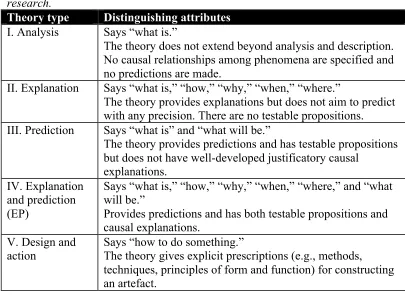
Table 3.1. Gregor’s (2006) taxonomy of theory types in Information Systems research.... 124
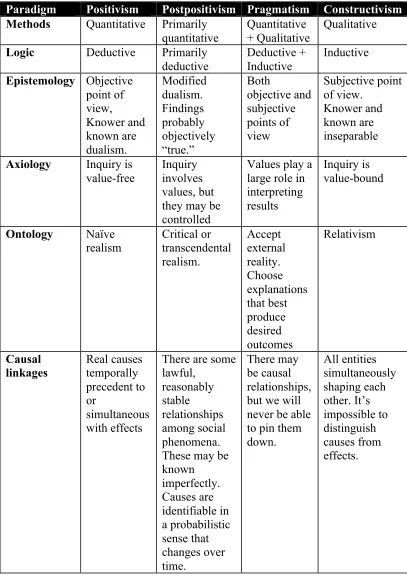
Table 3.2. Comparisons for four important paradigms used in the social and behavioural sciences.... 129
Table 3.3. Components of an Information System Design Theory (ISDT)... 137
Table 3.4. Hevener et al.’s (2004) mapping of design science research outputs with ISDT components.... 137
Table 3.5. Eight components of an Information Systems Design Theory (ISDT). ... 140
Table 3.6. Design research guidelines... 147
Table 3.7. Three ethical positions for design research... 150
Table 4.1. The stages of the Cole, Purao, Rossi and Sein (2005) synthesised research approach mapped to chapter sections.... 155
Table 4.2. Overview of CQU student numbers (1996–1999) by mode... 161
Table 4.3. Summary of Webfuse requirements. ... 172
Table 4.4. Summary of how the requirements (Section 4.3) were fulfilled in Webfuse... 180
Table 4.5. ACL abstractions as implemented in Webfuse... 191
Table 4.6. Example Webfuse permissions... 192
Table 4.7. Four functional requirements for online learning... 195
Table 4.8. Webfuse information distribution related page types by 1999... 196
Table 4.9. Webfuse communication page types by 1999... 197
Table 4.10. Webfuse assessment page types by 1999... 198
Table 4.11. Webfuse class management page types by 1999... 198
Table 4.12. Summary of evaluation of Webfuse (1996-1999)... 210
Table 4.14. Number of course sites managed by Webfuse: 1997-1999... 213
Table 4.15. Number of pages and page types in Webfuse course sites (1997- 1999).... 214
Table 4.16. Allocation of Webfuse page type (1996-1999) to Malikowski et al. (2007) categories.... 214
Table 4.17. Feature adoption in Webfuse courses (1997-1999)... 215
Table 4.18. Usage of Webfuse course sites: 1997-1999... 219
Table 4.19. Summary of the ISDT for Web-based learning systems... 226
Table 4.20. Definition of constructs for the ISDT... 227
Table 5.1. The stages of the Cole, Purao, Rossi & Sein (2005) synthesised research approach mapped to chapter sections.... 242
Table 5.2. Linkage between lessons and Webfuse interventions (2000–)... 256
Table 5.3. Changes in the Webfuse authentication system... 282
Table 5.4. Institutional information, sources and methods... 284
Table 5.5. Summary of Webfuse evaluation (2000–2009)... 295
Table 5.6. Infocom Web site categories, documents, and requests (2004)... 296
Table 5.7. Comparison between default course sites and real course sites (2002–2009).... 299
Table 5.8. Allocation of Webfuse page type (1996-1999) to Malikowski et al. (2007) categories.... 301
Table 5.9. Feature adoption in Webfuse course sites (1999-2004)... 303
Table 5.10. Hits on Webfuse course sites: 1997-2004. ... 310
Table 5.11. Modifications to course web sites by academic staff (1997-2009). ... 311
Table 5.12. Usage of Wf application: 2000-2009... 314
Table 5.13. % of students in Webfuse courses using Wf applications (2000-‐2009)... 329
Table 5.14. % of staff using Wf applications (2000-2009)... 330
Table 5.15. Percentage staff editing Webfuse course sites (2000-2009)... 332
Table 5.16. Summary of the ISDT for emergent university e-learning systems. ... 341
Table 5.17. Construct definitions for the ISDT... 344
Table 5.18. Summary of justificatory knowledge for principles of form and function.... 360
Table 5.19. Summary of justificatory knowledge for principles of implementation... 362
Table 5.20. Summary of evidence for Webfuse fulfilling ISDT design propositions... 368
Table 6.1. Overview of findings... 372
Table 6.2. Eight components of an Information Systems Design Theory (ISDT). ... 375
Table 6.3. An ISDT for emergent university e-learning systems... 376
List of figures
Figure 1.1. Iterative action research process for formulating an ISDT. Adapted from “A design theory for systems that support emergent knowledge processes”, by M. Markus et al., 2002, MIS Quarterly, 26(3), p. 207... 29 Figure 2.1. The Ps framework... 41 Figure 2.2. Model of LMS feature usage. Adapted from “A model for research
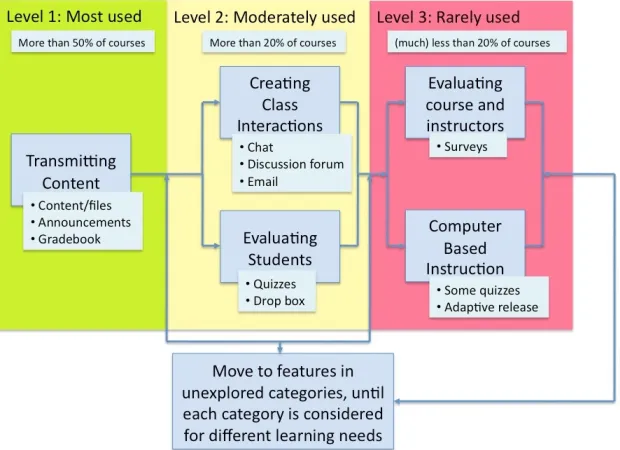
into course management systems: briding technology and learning theory”, by S. Malikowski et al., 2007, Journal of Educational
Computing Research, 36(2), p. 168. ... 74 Figure 2.3. Model of university teaching. Adapted from “Judging university
teaching”, by K. Trigwell, 2001, The International Journal for Academic Development, 6(1), p. 67... 95 Figure 2.4. A multiple-‐level categorisation model of conceptions of teaching.
Adapted from “A reconceptualisation of the research into university academics’ conceptions of teaching”, by D. Kember, 1997, Learning and Instruction, 7(3), p. 264... 96 Figure 2.5. Integrated model of teachers’ approaches to teaching, conceptions
of teaching, and perceptions of the teaching environment. Adapted from “Students’ approaches to learning and teachers’ approaches to teaching in higher education”, by J. Richardson, 2005, Educational Psychology, 25(6), p. 676... 97 Figure 3.1. Components of an Information Systems Design Theory. Adapted
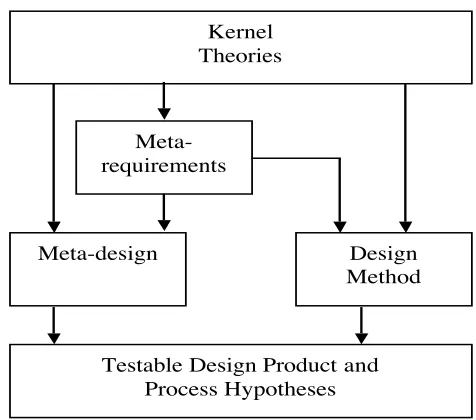
from “Assessing information system design theory in perspective: How useful was our 1992 initial rendition”, by J. Walls et al., 2004, Journal of Information Technology, Theory and Application, 6(2), p. 46. ... 136 Figure 3.2. Representation of Gregor and Jones (2007) anatomy of a design
theory. Adapted from “Shaping in the wild”. K. Lyytinen, Keynote at DESRIST’2008 Retrieved November 10, 2008, from
http://desrist2008.cis.gsu.edu/doc/speech/LyytinenDESRIST2008.pd f ... 141 Figure 3.3. Iterative action research process for formulating an ISDT. Adapted
from “A design theory for systems that support emergent knowledge processes”, by M. Markus et al., 2002, MIS Quarterly, 26(3), p. 207.. 144 Figure 4.1. A simple Web page produced by Webfuse... 185 Figure 4.2. Part of the page update form for the TableList page shown in
Figure 4.1... 186 Figure 4.3. A partial hierarchy of the Faculty of Applied Science web site in
1997... 189 Figure 4.4. The Units Web page for M&C for Term 2, 2007... 190 Figure 4.5. Guides Web page (Figure 4.1) with a different style ... 194 Figure 4.6. The Units Web page (text version) for M&C for Term 2, 2007. .. 207 Figure 4.7. Wayback machine archive (http://bit.ly/9iXAQq) of Brisbane
Broncos web site from 1998 (broken images not available from
Figure 4.8. Study schedule page for the 1999 offering of the course 85349 217
Figure 5.1. Structure of default course site... 270
Figure 5.2. Home page for a Webfuse default course site (July 2001)... 272
Figure 5.3. Home pages for default and real course site – MMST11002... 278
Figure 5.4. Web 2.0 Course site (2007). ... 280
Figure 5.5. MyCQU class list ordered by name. ... 290
Figure 5.6. MyCQU class list ordered by enrol date... 291
Figure 5.7. Webfuse discussion forum integrated into a Blackboard course site. ... 292
Figure 5.8. Page update process for CourseHome page type. ... 293
Figure 5.9. Percentage course sites adopting content transmission: Webfuse (solid), Blackboard (dashed), and Malikowski et al. (2007) (dotted range). ... 304
Figure 5.10. Percentage course sites adopting class interactions: Webfuse (solid), Blackboard (dashed), and Malikowski et al. (2007) (dotted range). ... 305
Figure 5.11. Percentage course sites adopting student assessment: Webfuse (solid), Blackboard (dashed), and Malikowski et al. (2007) (dotted range). ... 307
Figure 5.12. Percentage course sites adopting course evaluation: Webfuse (solid), Blackboard (dashed), and Malikowski et al. (2007) (dotted range). ... 308
Figure 5.13. Average usage – updates and hits – for Webfuse course sites 1997-‐2009. Note: Access logs for Jan through 24 April 2005 are unavailable... 312
Figure 5.14. Usage of individual Wf applications (2000-‐2009). Note: access logs for Jan through 24 April 2005 are unavailable... 315
Figure 5.15. Comparison of annual usage peaks for student portal, take quiz, and upload Wf applications in 2004. Note: Usage data from December not available. ... 322
Figure 5.16. EPG02 Default course site 2007... 324
Chapter 1 -
Overview
Theory without practice leads to an empty idealism, and action without
philosophical reflection leads to mindless activism. (Elias & Merriam,
1980)
1.1.
Introduction
This thesis describes the formulation and testing, over an extended period, of an
Information Systems Design Theory (ISDT) (Walls, Widmeyer, & El Sawy, 1992;
Gregor & Jones, 2007) for e-learning. In this thesis e-learning is defined as the
use of information and communications technology to support and enhance
learning and teaching in higher education institutions (HEIs) (OECD, 2005c). The
proposed ISDT developed in this thesis is titled: An ISDT for emergent university
e-learning systems. The ISDT provides guidance to practitioners and institutions on how to design and develop an e-learning information system that offers several
key advantages over current approaches. These advantages include greater variety
of features, flexibility in the choice of applications, integration with the
organisation, and staff and student usage (Jones & Gregor, 2004).
Unlike much design-science research where constructed artefacts are rarely
full-grown information systems that are used in practice (Hevner, March, Park, &
Ram, 2004), this e-learning ISDT is based on the design, development and
support of Webfuse (Jones, 1999b). Thousands of students and academic staff
have used Webfuse for e-learning. Work on Webfuse commenced in 1996 with
the intent to develop an integrated information system to enable use of Web-based
1996). In the years since 1996, an iterative, action-research process has been used
to evolve the system. Commencing in 2003, additional work was undertaken to
reflect upon and abstract the insights gained from Webfuse into an ISDT, which is
the focus of the thesis.
This chapter provides an overview and background to this thesis. It starts by
providing a brief background to the research (Section 1.2) including a justification
of the importance and relevance for the research. Drawing on this background the
chapter then outlines the particular research problem the thesis seeks to address
and the contribution it offers (Section 1.3). From there the research method is
described (Section 0), along with the significance of the problem and approach
(Section 1.5), and the limitations of the study (Section 1.6). The chapter closes
with a description of the structure of the thesis (Section 1.7) and a summary
(Section 1.8).
1.2.
Background to the research
Advanced industrial societies are currently undergoing a fundamental
transformation from capital- and labour-based economies into knowledge
economies (Burton-Jones, 2001). In such economies knowledge, education,
people and their ideas become the key strategic resource necessary for prosperity
(Duderstadt, Atkins, & Houweling, 2002, p. 7). This transition to a knowledge
economy is characterised by factors including globalisation, increasing
competition, knowledge sharing and transfer, and an information technology
revolution (Zhang & Nunamaker, 2003). This transition raises a number of issues
in the socio-economic landscape and provide the best educational opportunities
and outcomes (Knight, Knight, & Teghe, 2006).
Schools and universities will play increasingly important roles as society enters
this new age of knowledge and becomes increasingly dependent upon the social
institutions that create knowledge and educate people (Duderstadt et al., 2002, p.
7). Some believe that the university will be the central institution in post-industrial
society (Bok, 1990). A 2002 survey of 30 Organisation for Economic
Co-operation and Development (OECD) countries indicated that more people than
ever are completing tertiary education and that 1.9% of the combined GDP of
these countries was devoted to higher education (OECD, 2005b). A report on
education in the Group of Eight (G8) countries shows those countries spending
between 1% and 2.7% of gross-domestic product (GDP) on higher education
during the year 2000 (Sen, Partelow, Miller, & Owen, 2005, p. 17).
The dominant model of the University in use today continues to be the traditional
combination of teaching and academic research suggested by Wilhelm von
Humboldt in the 19th century (Tsichritzis, 1999). Universities are one of a very few institutions that have maintained their existence since the 1500s (Kerr, 1994,
pp. 45–46). Such consistency and longevity is often attributed to the ability of
universities to be change resistant (Green & Hayward, 1997, p. 4). Change arising
from e-learning is particularly difficult because, as the OECD (2005a) observes,
the nature of e-learning to some extent conflicts with the academic culture based
on autonomy and a reward system based on research. Subsequently, the growth of
e-learning has been incremental and has not fundamentally challenged the
The emergence of the knowledge economy and the increasing influence of
technology are not the only factors requiring change within higher education.
Indeed the last 30 years have seen a period of unprecedented change as higher
education institutions across the world are being shaped by similar problems and
forces (Green & Hayward, 1997, p. 3). These forces include: increased access and
growth in participation; reduction in public funding; increased costs; increased
calls for accountability in outcomes and subsequent arguments around autonomy;
the changing nature and growth of knowledge and disciplines; industrialisation
and industrial relations policy; and, internationalisation (Coaldrake & Stedman,
1999; Cunningham et al., 2000; Green & Hayward, 1997). The uncertainty about
the future generated by these changes highlights the importance of building
institutions that are responsive to change (CRHEFP, 1997). It is the institutions
that are able to continually adapt to these changes that will be successful (Huynh,
Umesh, & Valacich, 2003) and survive (Klor de Alva, 2000).
The increasing importance and impact of information and communication
technologies is seen as one of the major drivers behind the need for adaptability.
Zhang et al. (2004) observe that the knowledge economy shows a pervasive and
ever-increasing demand for innovative delivery of education, which has led to
dramatic changes in learning technology and organisations The new technological
possibilities as well as the new learning environments they enable are contributing
to an unavoidable pressure for change (Tsichritzis, 1999). The advancement of
computer and networking technologies are providing the means to support
changes to learning that make it more personalised, flexible, portable and
on-demand (Zhang et al., 2004). These new technologies have become a major
profound effects on the structure of higher education (Green & Hayward, 1997).
Some suggest that the rapidly evolving technology and emerging competition puts
the very survival of the current form of the university at risk (Duderstadt et al.,
2002, p. viii). For example, Peter Drucker suggests (Lenzer & Johnson, 1997)
Thirty years from now the big university campuses will be relics.
Universities won’t survive. It is as large a change as when we first got
the printed book.
Unlike previous periods of technology-driven social change the impact of
information technology affects the basic activities of a university – creating,
preserving, integrating, transmitting and applying knowledge – and more
fundamentally changing the relationship between people and knowledge
(Duderstadt et al., 2002, p. 8).The importance of e-learning in contemporary
universities cannot be denied (deFreitas & Oliver, 2005). Allen and Seaman
(2008) report on a 2007 survey of US higher education institutions that shows a
12.9% growth rate for online enrollments compared with 1.2% growth in the
overall student population. The questions about e-learning have moved from a
focus on use versus non-use to how, why and with what outcomes (Hitt &
Hartman, 2002).
Most universities are currently answering the “How to implement e-learning?”
question through the adoption of a Learning Management System (LMS). Other
names used for LMS include Course Management Systems (CMS) and Virtual
Learning Environment (VLE). LMS are software systems that are specifically
designed and marketed to educational institutions to support teaching and
assessment, presentation of study material and organisation of student activities
(Luck, Jones, McConachie, & Danaher, 2004). There is evidence to suggest,
however, that this strategy suffers from some flaws including: not being
particularly innovative; being limited in quality; and, limited in the ability to
integrate with other systems (Alexander, 2001; Paulsen, 2002). Even the most
advanced institutions report little more than 50% adoption by faculty (Sausner,
2005). With some exceptions universities have not employed technology to the
same degree, or as effectively as, the business community (Piccoli, Ahmad, &
Ives, 2000). Successful implementations of LMSs in the academic environment
are rather rare (Sarker & Nicholson, 2005). Early adoption of e-learning by
Australian universities during the 1990s was done without critical examination of
the merits and led to cases of wasted resources, unfulfilled expectations, and
project and organisational failure (Pratt, 2005). There is considerable evidence
that e-learning within universities struggles to engage a significant percentage of
students and staff. Furthermore, e-learning has limited success in moving
development beyond projects by innovators (Salmon, 2005). Van der Klink and
Jochems (2004) suggest that high-level ambitions with poor implementation is the
best description for e-learning implementation in most universities.
It is not all that surprising that the observed difficulties exist in the
implementation of e-learning within universities. The application of information
technology within universities is highly complex, confusing and raises issues that
are almost over-whelming in nature (Duderstadt et al., 2002, p. x). In addition, as
suggested by the OECD (2005a), e-learning remains a novel and immature
activity. The transformation promised, or threatened, by e-learning is in reality a
technology but involves people, organisations, and cultures that must be
addressed both systemically and ecologically (Duderstadt et al., 2002, p. 179).
Scholars in Information Systems can offer vision on structures and processes to
effectively implement technology-mediated learning initiatives (Alavi & Leidner,
2001). Keller (2005) agrees that perspectives from information systems research
and organisation theory can help better understand the implementation of
e-learning. Salmon (2005) has called for more research to develop theories,
principles, and methodologies of change related to the sustainability of e-learning
within universities. There appears to be a need for research that can provide
theoretical guidance to universities about how to effectively implement and
support e-learning information systems.
1.3.
Research problem and contribution
This thesis follows Alavi and Leidner (2001) in that it seeks to offer a vision on
the structures, processes and technology that can be drawn upon to implement
effectively technology-mediated learning within universities. The specific aim of
this thesis is to address the following research question:
How to design, implement and support an information system that
effectively and efficiently supports e-learning within an institution of
higher education?
The primary contribution this thesis offers is an Information Systems Design
Theory (ISDT) that answers the research question. An information systems design
theory is an example of theory for design and action; of how to do something
(Gregor, 2006). ISDTs, first explicated by Walls, Widmeyer and El Sawy (1992),
information system design problems (Markus, Majchrzak, & Gasser, 2002). For
practitioners, ISDTs are beneficial because they increase development reliability
and the likelihood of success by providing principles, derived from kernel
theories, that limit the range of system features and development activities to a
more manageable set (Markus et al., 2002). As a theory the principles generated
as part of an ISDT are also open to empirical testing and thus can form a basis for
further research.
The final ISDT offered by this thesis is titled “An ISDT for emergent university
e-learning systems” and is summarised inTable 1.1. The ISDT is formulated and explained in more detail in Chapter 5. Table 1.1 provides references to the
relevant sections in Chapter 5. More detail of the method used to develop and
Table 1.1. An ISDT for emergent university e-learning systems
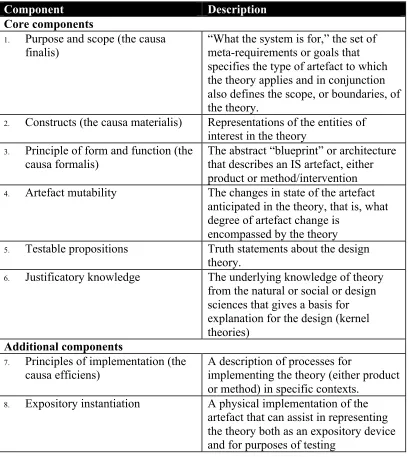
Component Description
Core components Purpose and scope (Section 5.6.1)
1. Provide ICT functionality to support learning and teaching within a university environment (e-learning). 2. Seek to provide context specific functionality that is
more likely to be adopted and integrated into everyday practice for staff and students.
3. Encourage and enable learning about how e-learning is used. Support and subsequently evolve the system based on that learning.
Constructs
(Section 5.6.2) A range of constructs summarised in Table 5.17. Principle of form and
function (Section 5.6.3)
13 principles in 3 groups including:
1. Comprehensive, integrated and independent services. 2. Adaptive and inclusive system architecture.
3. Scaffolding, context-sensitive conglomerations. Artefact mutability
(Section 5.6.6)
As an ISDT for emergent e-learning systems the ability to learn and evolve in response to system use is a key part of the purpose of this ISDT. It is actively supported by the principles of form and function, as well as the principles of implementation.
Testable propositions (Section 5.6.7)
The system:
1. provides the functionality and services necessary to support university e-learning
2. provides a set of functionality that is specific to the institutional context
3. over time shows greater levels of adoption by staff and students
4. enables and encourages the university, its e-learning information systems, and its staff and students to observe and respond to new learning about the design, support and use of university e-learning
5. provides a level of differentiation and competitive advantage to the host institution
Justificatory knowledge (Section 5.6.5)
A range of theories and knowledge from software engineering, information systems and the broader social sciences summarised in Table 5.18 and Table 5.19. Additional components
Principles of implementation (Section 5.6.4)
11 principles split into 3 groups, including:
1. Multi-skilled, integrated development and support team.
2. An adopter-focused, emergent development process. 3. A supportive organisational context
Expository instantiation
The scope of this work is made clear within the title of the ISDT, the Purpose and
scope component of the ISDT, and in the research question. This work seeks to
limit itself to the support of e-learning within universities and similarly
academic-focused higher education institutions. E-learning within commercial
organisations, non-profits and informal learning are beyond the scope of this
work. As argued in Chapter 2 (especially in Section 2.8.3), there remains diversity
between universities. This diversity is arguably sufficient to suggest value in
further limiting the scope of this work to specific types of university. The
perspective adopted here is that such a limitation is potentially premature given
the absence of a more general ISDT for university e-learning and the widespread
similarity of existing e-learning implementations at universities. While
recognising that there exists some level of similarity between different
institutions, this ISDT seeks to respond directly to institutional diversity. That
said, the work that informs the final ISDT was performed at a particular type of
university – a university with a significant history in distance education and a
subsequent complex evolution over recent years. As such, the ISDT has not been
tested within other types of university and care should be taken in generalising.
In addition, the thesis also offers the Ps Framework for understanding e-learning
practice (Jones, Vallack, & Fitzgerald-Hood, 2008) – which is used and described
in Chapter 2 – and, an improved representation of an ISDT (Gregor & Jones,
2007) – described in the following section and Chapter 3.
1.4.
Research Method
The main aim of research within the information systems discipline is to study the
(Keen, 1987). This work is an example of design research within the information
systems discipline. Design research aims to make use of existing knowledge and
theory to construct artefacts that improve some situation (Simon, 1996). In design
research it is still important for a theory to explain a phenomenon, but it is less
important than the instrumental use of a theory to build a system that is efficient
and effective in the eyes of the potential users of the information system (Lee,
2000). In the past, while information systems design research has had a long
history, it was not highly visible (Burstein & Gregor, 1999). More recently, there
has been an increase in interest in design research arising from the publication of
two prominent articles in the journal MISQ (Hevner et al., 2004; Markus et al.,
2002), the release of ISWorld’s design research Web site (Vaishnavi &
Kuechleer, 2004) and the creation of a design science department within the
Communications of the Association for Information Systems (Hevner & March,
2004). The formulation of ISDTs, the contribution of this work, is an example of
design research within the information systems discipline.
The extant design research literature describes a number of different potential
research methodologies (March & Smith, 1995; Markus et al., 2002; Nunamaker,
Chen, & Purdin, 1991) deemed suitable for design research. The approach used in
this work approximates best with the iterative, action-research-like process
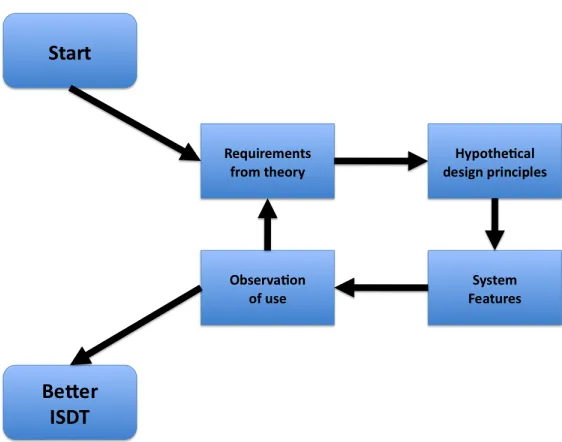
described by Markus et al. (2002) and shown in Figure 1.1. Action research is a
good fit for this work because as Cole et al. (2005) observe, the goal of action
research is both the resolution of a practical problem and a contribution to theory.
In the process shown in Figure 1.1, existing theory is used to assist in the
generation of design principles, which in turn are used to generate an information
the informing theory, informs possible revision of the underlying principles and
consequently the information system. Subsequent iteration around the cycle seeks
to further improve the principles underlying the ISDT and how they are expressed
within the information system.
The action-research like cycle underpinning this work commenced in 1996 with
the initial design of the Webfuse system (Jones & Buchanan, 1996) and its
implementation in late 1996/1997. From 1996 through 2009, the author has been
involved, along with others, in a series of action-research cycles to improve the
Webfuse e-learning system. Most of the individual cycles have been documented
in a wide array of peer-reviewed publications (see Behrens, Jamieson, Jones, &
Cranston, 2005; Danaher, Luck, Jones, & McConachie, 2004; Jones, 1999b, 2000,
2002, 2003a, 2003b, 2004; Jones & Behrens, 2003; Jones, Behrens, Jamieson, &
Tansley, 2004; Jones & Buchanan, 1996; Jones, Cranston, Behrens, & Jamieson,
2005; Jones, Jamieson, & Clark, 2003; Jones & Luck, 2009; Jones, Luck,
McConachie, & Danaher, 2005; Jones & Lynch, 1999; Jones, Lynch, & Jamieson,
2003; Jones & Muldoon, 2007; Jones & Stewart, 1999; Jones, Stewart, & Power,
Figure 1.1. Iterative action research process for formulating an ISDT. Adapted from “A design theory for systems that support emergent knowledge processes”, by M. Markus et al., 2002, MIS Quarterly, 26(3), p. 207
Beyond the on-going development of Webfuse, from 2002 additional work was
undertaken to reflect upon and abstract the knowledge and experience gained
during these cycles into an ISDT (for this doctoral thesis). Initially, this work
(Jones & Gregor, 2004, 2006; Jones, Gregor, & Lynch, 2003) used the ISDT
specification provided by Walls et al. (1992). It was through this experience and
reflection upon the completeness of the Walls et al. (1992) specification of an
ISDT that led to work which was aimed at formulating a more complete ISDT
representation (Gregor & Jones, 2004, 2007). It is this more complete
representation of an ISDT that is used in this thesis and summarised in Table 1.1.
1.5.
Significance
The significance of the ISDT for e-learning within Universities developed within
this thesis arises from three main factors: 1) e-learning is important; 2) research
into the organisational implementation of e-learning within universities is limited;
As outlined in Section 1.2 the implementation of e-learning in universities is
difficult, and yet there has been limited research into the problem. Alavi and
Leidner (2001) report that little or no research has been focused on the structures
and processes needed to encourage adoption of technology-mediated learning at
the organisational level. Tham and Werner (2005) assert that what existing work
there is, focuses on technology development and top-down policy aspirations. For
Tham and Werner (2005), there is limited focus on the human dimensions, on
scaling up and on the embedding of innovations as well as the associated
management of change. Kogan (2000) finds much of the research on higher
education as being more normative than empirical. Nichols (2003) argues that the
e-learning literature is practice-based and presented in descriptive formats which
limit the transferability to other institutions. More broadly, Hevner et al. (2004)
describe how the artefacts constructed within information systems design research
are rarely full-grown information systems that are used in practice.
This thesis makes two contributions towards understanding e-learning
implementation within universities: the Ps Framework and the proposed ISDT.
The Ps Framework arose out of the attempt in this thesis to understand existing
e-learning implementation and identify possible alternatives (Jones, 2004, 2008;
Jones et al., 2008). The Ps Framework is described and used in Chapter 2 to argue
that common e-learning implementation practices are somewhat mismatched with
the requirements of e-learning. The proposed ISDT – An ISDT for emergent
university e-learning systems – is presented in Chapter 5 and offers guidance for
e-learning implementation that brings a number of advantages. These
theoretical knowledge with empirical evidence arising from the design and
support of a successful e-learning system
Lastly, the thesis makes a contribution to the representation of ISDTs. Through
attempting to formulate an ISDT for e-learning, a variety of issues were found
with the then commonly accepted ISDT representation proposed by Walls et al.
(1992). In response, a new ISDT representation was proposed (Gregor & Jones,
2004, 2007), and is used in this thesis. This new ISDT representation has
generated interest within the information systems design research community 1.
1.6.
Limitations of the study
As with all research, the study described within this thesis has a number of
limitations that should be kept in mind when considering its findings. Through its
use of action research, this work suffers the same limitations, to varying degrees,
of all action research. Baskerville and Wood-Harper (1996) identify these
limitations as: (1) lack of impartiality of the researcher; (2) lack of discipline; (3)
mistaken for consulting; and (4) context-dependency leading to difficulty in
generalising findings. These limitations have been addressed within this study
through a variety of means including: peer-reviewed publications throughout the
process; use of objective data sources; the generation of theory; and an on-going
process of testing. The methods for addressing the limitations of this study are
described further in Chapter 6.
1 The paper (Gregor and Jones, 2007) presenting this new ISDT representation was recognised as
More broadly, the aim of this work is not to prove the resulting ISDT. Rather the
aim was to gather sufficient empirical and theoretical support to build and propose
a coherent and useful ISDT. The question of proof and further testing of the ISDT
in similar and different contexts provides – as in all research aiming to generate
theory – an avenue for future research.
A related issue is the question of additional, alternate ISDTs for e-learning in
universities. The ISDT presented here is designed to guide the development of
instantiations with a range of benefits including greater levels of adoption and use
of functionality that becomes more specific to the institutional context. While this
design has been tested, this work has not examined and makes no claims about
other system attributes or outcomes that may be thought desirable, such as low
initial and on-going cost, lack of dependence on specialised technical staff,
support for particular pedagogical practices, and so on. Further work could
examine these factors and perhaps lead to further development of this ISDT, or
the development of alternate ISDTs for e-learning implementation within
universities.
1.7.
Organisation of the thesis
The body of this thesis is organised into six chapters:
Chapter 1: Overview, provides a general overview of the study, some initial context to the research, the research problem, the research method
employed, the significance of the research, and its limitations.
implementation, requirements, and practice of e-learning within
universities. The chapter argues that there exists a significant mismatch
between the nature and requirements of e-learning within universities as
well as the characteristics of the dominant process and product models
currently used to implement e-learning.
Chapter 3: Research method, describes how and why this work used an iterative action research method to formulate an ISDT. This chapter
includes a brief outline of the improved specification of an ISDT (Gregor
& Jones, 2007) that arose from this work.
Chapter 4: Build it and they will come, describes the first action research phase of this work that lasted from 1996 through 1999. It offers a
definition of the initial problem or context, a description of the
intervention that was attempted, an evaluation of its performance, and
reflection on that experience. The reflection process leads to a formulation
of “An ISDT for e-learning within universities” – an initial ISDT for
e-learning – and a collection of lessons learned during this process.
Chapter 5: Better, faster, integration and adoption, describes the second action research phase that lasted from 2000 through 2009. It uses the same
structure as Chapter 4 to describe the initial problem and context, the
resulting interventions, an evaluation of that intervention, and reflection on
the experience. The main product of this chapter is the “ISDT for emergent
Chapter 6: Reflections, implications, and conclusions, reflects upon and summarises the research undertaken and outlines its contributions,
implications, limitations, conclusions and potential for future work.
1.8.
Summary
The use of information and communication technologies (ICTs) to enhance and
support learning and teaching (e-learning) within universities is attaining an
importance that cannot be denied (deFreitas & Oliver, 2005). It has been
suggested, however, that the best description for e-learning implementation within
universities is: high-level ambitions with poor implementation (Van der Klink &
Jochems, 2004). The application of ICTs in universities is highly complex,
confusing and raises issues that are almost over-whelming in their nature
(Duderstadt et al., 2002).
This study seeks to provide one answer to the difficult and important question of
how to design, build and support the information systems necessary for e-learning
within a university setting. It seeks – as suggested by Alavi and Leidner (2001) –
to provide a vision from information systems on the structures and processes
necessary to effectively implement e-learning. This vision is provided in the form
of an Information Systems Design Theory (ISDT): “An ISDT for emergent
university e-learning systems”. The ISDT was formulated by drawing on 14 years of action research aimed at designing, supporting and improving the Webfuse
information system. Webfuse was used to support e-learning at Central
Queensland University from 1997 to 2009.
This work is important because it offers a useful and different solution to a
within a university. It is important because there is little existing research in this
area. Moreover, there is evidence that existing practice is somewhat limited. The
work is also important because there is no evidence of similar work being
informed through the design and support of a long-term information system used
within a real organisation. The work also contributes an improved structure and
Chapter 2 -
The Ps Framework
2.1.
Introduction
This chapter provides a review of the literature relevant to the thesis topic, which
is the formulation of an Information Systems Design Theory (ISDT) for
e-learning within universities. This chapter seeks to examine critically the field of
e-learning, the requirements and constrains required by university e-learning, and
how universities are implementing the information systems to support e-learning.
The intent of this examination is to identify any limitations of previous work and
any issues worthy of research.
Perry (1998) suggests that the development and use of a new classification model
can show that a literature review has moved from the merely descriptive to the
constructively analytical. In this chapter, the Ps Framework is used to describe
and analyse what is known about e-learning in universities. The knowledge in the
Ps Framework was, and continues to be, informed by on-going work and research,
including the work described here. The Ps Framework has been used previously to
assist in understanding and identifying the limitations and issues around the extant
literature covering the practice of e-learning within higher education as well as
framing future possibilities (Jones, 2008; Jones et al., 2008).
The chapter begins (Section 2.2) with a brief explanation of the Ps framework and
its seven components. It then uses the Product (Section 2.3), Process (Section 2.4)
and Past Experience (Section 2.5) components of the Ps Framework to describe
and analyse the predominant, current approach to e-learning within higher
In addition, both the Product and Process sections will mention that there are
alternatives to the dominant approach. These sections will seek to identify the
“best-fit” situations for the alternatives. The Past Experience section presents
evidence of how effective current approaches have been and examines the earlier
as well as broader history of technology-mediated learning.
Having examined current practice, the chapter then seeks to analyse what is
known about the characteristics and requirements of university e-learning. The
examination of current practice is achieved through sections based on the
remaining four components of the Ps Framework: People (Section 2.6), Pedagogy
(Section 2.7), Place (Section 2.8), and Purpose (Section 2.9). The analysis in these
four sections will argue that, depending on the perceived purpose for e-learning,
there can be a significant mismatch between the requirements of e-learning within
universities and the characteristics of the current, dominant approach to fulfilling
those requirements. That mismatch may offer an explanation for the limited
quantity and quality of existing use. Furthermore, it may also offer indications of
how practice could be improved.
2.2.
The Ps Framework
This chapter uses the Ps Framework as a basis for the description and analysis of
the extant literature. It also seeks to identify any limitations around the problem of
designing and supporting information systems for university e-learning. The Ps
Framework has been informed by an earlier use of Alter’s (2002) Work Systems
Framework to describe conceptualisations of e-learning (Jones, 2004). The Ps
Framework has also been used to frame futures of university e-learning and
position taken in this thesis, and demonstrated in this chapter through the use of
the Ps Framework, is that the information technology associated with e-learning is
one of a number of components of an emergent process of change where the
outcomes are indeterminate because they are situationally and dynamically
contingent (Markus & Robey, 1988).
As a consequence of the particular stance adopted in this thesis, it is thought that
e-learning implementation can be improved through a more complete
understanding of all seven components of the Ps Framework.Only one of the
components of the Ps Framework – Product – specifically encompasses
information technology. The remaining six components seek to describe and
understand the complex and dynamic social context within which e-learning is
applied. The Ps Framework can be used at both a broad (e.g., all Australian
universities, or even all universities) or narrow (e.g., a specific university) level of
analysis depending on the purpose. It is understood that implementation of a
specific system would be best informed by a narrower analysis focusing on the
specifics of the individual organisation. For the purposes of this literature review;
however, the analysis is aimed at the broadest possible level.
The seven components of the Ps framework, and the types of questions they seek
to answer, are:
1. The Purpose
What is the reason for adopting e-learning, or changing how e-learning is
currently implemented? What is the aim or intent behind e-learning
2. Place
What social, political and other external factors must be recognised and
responded to by a University? What are the internal characteristics of
universities?
3. People
What type of people and roles (e.g., management, professional and
academic staff, students) exist within universities? What are the beliefs,
biases and cultures of these people and their associated roles?
4. Pedagogy
What conceptualisations about learning and teaching do people within the
university context bring to e-learning? What practices are being used to
learn and teach? What practices might they like to adopt? What are good
ways to teach and learn?
5. Past experience
What has occurred before with e-learning, both within and outside
universities? What worked and what did not?
6. Product
Are there common types of information systems being used to support
e-learning? What types of systems are being used? What are their
characteristics? What are the alternatives?
7. Process
those that impact e-learning implementation and support. What processes
are expected to be used when implementing e-learning?
One of potentially many explanations of the relationships between the seven
components starts with purpose. Some event, problem or factor arises requiring
the organisation to change the way in which it supports e-learning. Responding
appropriately to this event becomes the purpose underlying a process used by the
organisation to determine how (part of process) and what (product) it will
implement to achieve the stated purpose. This change will be influenced by a
range of factors including: characteristics of the organisation and its context
(place); the nature and conceptions of the individuals and cultures within it
(people); the conceptualisations of learning and teaching (pedagogy) held by the
people and the organisation; and the historical precedents both within and outside
the organisation (past experience). This is not to suggest that there exists a
simple linear, or even hierarchical, relationship between the components of the Ps
Framework. The context of implementing educational technology within a
university is far too complex for such a simple reductionist view (Jones et al.,
2008).
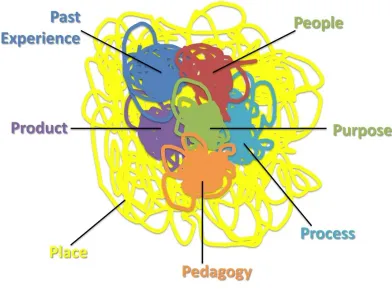
Figure 2.1 provides a representation of the seven components comprising the Ps
Framework for E-Learning. The situationally contingent nature of these
components is represented by the Place which encapsulates or underpins the
remaining six. The dynamically contingent nature and the complex
inter-relationship between each of the components is represented by the absence
of clear and neat boundaries for individual components. The representation also
representation is intended to suggest that each component can influence the other,
[image:41.595.129.521.141.430.2]and vice versa.
Figure 2.1. The Ps framework
This section has provided a brief overview and description of the Ps Framework.
Attention now turns to using the framework. In particular using the framework to
describe and analyse existing practice around the implementation and support of
information systems for e-learning within universities.
2.3.
Product
Technology is a tool and like all tools it should fit your hand when you
pick it up, you shouldn’t have to bio-re-engineer your hand to fit the
tool. – Dave Snowden
The purpose of this section is to examine the nature of the information and
universities. The examination of the product is essential to understanding
e-learning due to the fact that the almost universal university approach to
e-learning has involved the adoption of a particular type of system: a Learning
Management System (LMS) (Coates, James, & Baldwin, 2005; Feldstein &
Masson, 2006; Jones & Muldoon, 2007; Salmon, 2005; Stiles, 2007).
Learning Management Systems (LMS) are software systems that are specifically
designed and marketed to educational institutions to support their teaching and
learning and typically provide tools for communication, student assessment,
presentation of study material and organisation of student activities (Luck et al.,
2004). These systems are also referred to by a number of different terms including
virtual learning environments (VLE), course management systems (CMS),
learning support systems (LSS), and learning platforms (Mendoza, Perez,
Diaz-Anton, & Griman, 2006). The speed with which the adoption of an LMS has
spread through universities is surprising (West, Waddoups, & Graham, 2006). A
2004 survey of universities from OECD countries found that 73% had adopted an
institution-wide LMS, compared to 60% in 2002, with 90% expecting to make
such a claim within five years (OECD, 2005a, p. 127).
The examination of the product at the centre of the current practice of e-learning
within universities is also important due to the effects of that technology. Lian
(2000) argues that technology is not, of itself, liberating or empowering but serves
the goals of those who guide its design and use. Westera (2004) explains how the
tools themselves are never value-neutral but are replete with values and
potentialities which may cause unexpected responses. Coates et al. (2005) agree
suggesting that LMS are not pedagogically neutral technology. Instead, through
teachers’ imaginations, expectations and behaviours. So, while technology does
not unambiguously determine outcomes (Markus & Robey, 1988) systems do
have profound effects on the structuring of work as well as the forms of human
action they enable or constrain (Kallinikos, 2004).
The following sub-sections start by describing in more detail (Section 2.3.1) what
is known about Learning Management Systems (LMS) from the e-learning
literature, including their benefits and drawbacks. Next (Section 2.3.2), broader
insights from the information systems literature are used to examine the nature of
LMSs, identify appropriate contexts, and what alternative approaches exist.
Finally, some observations drawn from the examination of the Product component
are summarised in Section 2.3.3.
2.3.1.
Learning Management Systems
The current dominant form of university e-learning is based on the adoption of a
single, institution-wide Learning Management System (LMS). The LMS has
become the educational technology most widely used within universities, second
only to the Internet and common office software (West et al., 2006). This section
seeks to describe what is known about the origins and nature of the LMS.
Origins and evolution of the LMS
The earliest examples of LMS appeared between 1995 and 1997 (Stiles, 2007), as
tools to help those faculty who did not have the expertise, time or inclination to
develop the skills to develop e-learning services by hand (Fredrickson, 1999).
These were a diverse collection of solutions built and used by different schools,
faculties and research initiatives (Dron, 2006). They included such systems as