Collaborative approach for developing a more
effective regional planning framework in Egypt:
ecotourism development as case study
Thesis submitted in accordance with the requirements of the University of Liverpool for the degree of Doctor of Philosophy
By
Emad Hemdan Mahmoud Kenawy
May 2015
I
Abstract
In Egypt, as in most developing countries, highly technical plans are drawn up, but nobody puts them into practice. They always end up gathering dust on the shelves of national agencies or local government without being utilised to make improvements to local economic or environmental well-being. The main flaws in the current plan-making process are centred on central government’s monopoly in decision-making; fragmentation between government agencies leading to multiple and often conflicting spatial plans for the same location; and an absence of effective negotiation mechanisms between various stakeholders. These problems can be clearly demonstrated with reference to ecotourism planning. Such plans are being developed in highly sensitive regions, both environmentally and culturally, and there is a wide spectrum of stakeholders who are affected and influenced by any ecotourism development. Ecotourism development planning is a complex issue to the extent that it is beyond the capacity of any one stakeholder acting alone to resolve. These arguments are circular and very unlikely to be solved without effective collaboration between relevant stakeholders; such collaboration may avoid the costs of resolving long-running conflicts and improve the implementation rate of plans. The most appropriate starting point for this is focusing on the planning process by ensuring that development plans properly reflect stakeholder interests and deal with their conflicts through face-to-face dialogue. Therefore, the main aim of this thesis was ″To design a practical framework for operationalising a collaborative planning approach in regional planning using ecotourism development as a
case study″.
A case study approach was adopted to examine whether the formulated conceptual framework could be applied in practice. Evidence from the case studies was drawn from a critical documentary review of three Egyptian ecotourism planning initiatives, combined with observation and semi-structured interviews with 67 ecotourism experts and stakeholders. Gaps in operationalising stakeholder engagement in the current planning processes as well as the barriers which have hindered the efficiency of stakeholder participation were identified from this evaluation.
II
Acknowledgments
First and foremost, all thanks are to Allah, my God, to whom I devote this work. This work would not have been completed without God's will and great support from a number of people. I am using this opportunity to express my gratitude to those individuals. My thanks go first to my supervisor, Professor David Shaw, for his tremendous support, guidance, and patience from the outset to the conclusion. His insightful comments, discussions and suggestions enhanced the quality of the research considerably. His advice on both my research and my career has been priceless; I am privileged to have worked with him. And for that reason, I owe a particular debt to Professor David.
I am grateful to the Egyptian Ministry of Higher Education, Egyptian Cultural Bureau in London and Cairo University who generously sponsored this PhD work. Doing my PhD in the UK would not have been possible without their financial support.
I express my warm thanks to my friends and all the staff members in the Civic Design Department, University of Liverpool, particularly Dr. Olivier Sykes and Dr. Urmila Thakur, who gave me so much support throughout this research.
I would like to extend my appreciation to my colleagues in Egypt who facilitated and took part in the case study interviews, and so I am extremely grateful to all of those individuals who gave their time to speak to me, in particular Prof. Samy Amer, Tarek Wafik, Abbas Elzafarany, Aboulfetouh Shalaby, Assem Elgazar, Hesham El-Barmelgy, Hesham Hafez, Randa Galal, Ebtehal Ahmed and Dr.Mostafa Moneer, Mohie Shalaby, Abdel-Khalek Ibrahim, Rania Bayoumi and Walid Bayoumi. Thank you so much Eng. Mohamed El-Khatib and Amr Lashin, who facilitated connections with key interviewees and provided good documents and references. I cannot thank Hossam Tahoun enough; he was managing my affairs in my absence. Thanks also to Hatem Mostafa and Ayman Mansour.
Special thanks to my family. Words cannot express how grateful I am to my father, Hemdan, father-in-law, Youssef and brother, Momen, sisters, Wallaa, Rawia, Abeer, for all of the sacrifices that you have made on my behalf. Your prayer for me was what sustained me thus far.
III
I dedicate this study
To my beloved Mum,
My beloved mother-in-law
IV
Table of Contents
Part One: Introduction and conceptual framework Chapter One : Introduction to the research
1.1 The rationale of the research 1
1.1.1Why the research focuses on the process of making a development plan 1 1.1.2 The need for planning using a collaborative approach 3 1.1.3 Ecotourism planning as an appropriate case study 6
1.2 The research focus 13
1. 3 Research aims and objectives 14
1. 4 Research Methodology 16
1.5 The thesis structure 20
Chapter Two: Critical review of ecotourism development and the potential of collaborative planning to address its requirements
2.1 Critical review of ecotourism 25
2.1.1 Reviewing the key fundamentals of ecotourism 26
2.1.2 The ecotourism development system 34
2.1.3 The requirements of successful ecotourism development 41
2.2 Collaborative planning approach 44
2.2.1 Collaborative planning definition and main incentives for its use 44 2.2.2 Advantages and limitations of the collaborative approach 47
2.2.3 Collaborative planning process 49
2.2.4 Critical factors for successful stakeholder collaboration 55
2.3 Conclusion 59
Chapter Three: Developing the conceptual framework
3.1 Rationale of the conceptual framework 61
3.2 Stakeholder network building 64
3.2.1 The conveners of the network 66
3.2.2 Identifying and analysing the stakeholders 68
3.3 The stakeholder engagement in planning 75
3.3.1 Stakeholder roles and their level of participation throughout the planning
process 75
3.3.2 Stakeholder involvement methods 80
3.3.3 Stakeholder motivation for participation 86 3.3.4 Preparing the stakeholders for involvement in the planning process 90
3.4 The evaluation procedures 92
3.4.1 Evaluation framework 93
3.5 The obstacles to the stakeholder involvement and collaboration 95
3.6 Conclusion 98
Part Two: Evaluating ecotourism in practice Chapter Four: Egyptian context for ecotourism development planning
4.1 Egyptian perspective 100
4.1.1 Geographical features 100
4.1.2 Social and cultural characteristics 102
4.1.3 Administration system 106
4.1.4 Economic contexts 111
4.2 Tourism development in Egypt 113
V
4.2.3 Ecotourism development institutions 125
4.3 Planning system in Egypt 132
4.3.1 The planning approach evolution in Egypt 133
4.3.2 The current planning regulations 135
4.3.3 The institutions of the planning system 137
4.3.4 The planning system levels in Egypt 138
4.4 Conclusion 140
Chapter Five: Operationalising the research (case study design)
5.1 The research strategy 142
5.2 The case study procedures 153
5.3 The procedures of the case study selection 146
5.4 Case study template: data collection and analysis 152
5.4.1 Documentation 152
5.4.2 Observation 153
5.4.3 Interviews 154
5.4.4 Major challenges in collecting data 158
5.4.5 Ethical issues in data collection 159
5.4.6 Data analysis 160
5.5 Conclusion 161
Chapter Six: The Egyptian ecotourism initiatives
6.1 Fayoum Ecotourism Development Plan (FEDP) 162
6.1.1 The Governorate context 162
6.1.2 Opportunities and risks for ecotourism development 164
6.1.3 Ecotourism planning initiative 168
a) The historical context 168
b) The contemporary planning process 171
c) The stakeholder involvement activities during the planning process 178 6.2 The Red Sea Sustainable Tourism Initiative (RSSTI) 181
6.2.1 The Governorate context 181
6.2.2 Opportunities and risks for ecotourism development 183
6.2.3 Ecotourism planning initiative 187
a) The historical context 187
b) The contemporary planning process 190
c) The stakeholder involvement activities during the planning process 200 6.3 Ecotourism for Sustainable Development in the New Valley Governorate
(ESDNVG) 203
6.3.1 The Governorate context 203
6.3.2 Opportunities and risks for ecotourism development 204
6.3.3 Ecotourism planning initiative 208
a) The contemporary planning process 208
b) The stakeholder involvement activities during the planning process 213
6.4 Conclusion 217
Chapter Seven: Evaluation and analysis of Egyptian ecotourism planning initiatives
7.1 Stakeholder network building 218
7.1.1 The network conveners 219
VI
7.1.2.2 Analysing the internal stakeholders 235
7.1.2.3 The external stakeholder network 239
7.1.3 Dialogue between stakeholder representatives and their respective parent
bodies 241
7.1.4 Factors influencing the stakeholder networks 243 7.2 Stakeholder engagement in the planning process 250 7.2.1Stakeholder roles and level of participation throughout the planning process 250
7.2.2 Stakeholder involvement methods 258
7.2.3 Mechanisms used to motivate stakeholder participation 266 7.2.4 Procedures used to prepare stakeholders to be engaged in the planning
process 270
7.3 The evaluation procedures 277
7.4 The obstacles to the stakeholder involvement and collaboration 281
7.4.1 Deficiencies in the government 282
7.4.2 Deficiencies in the local communities and other stakeholders 290 7.4.3 Deficiencies in operationalising collaboration in the planning process 293
7.5 Conclusion 294
Part Three: Results and findings
Chapter Eight: Developing the practical framework for collaborative ecotourism planning
8.1 Evaluation findings 296
8.1.1 Deficiencies in operationalising the stakeholder engagement 399 8.1.2 Barriers that hindered effective stakeholder engagement 306
8.1.3 Political instability 308
8.2 Recommendations 310
8.3 Practical framework of CEP 328
8.4 Conclusion 332
Chapter Nine: Conclusions and future research
9.1 Evaluation of research objectives 334
9.2 Research contributions 340
9.3 Limitations of the research 341
9.4 The future research 342
Bibliography 344
Appendices
Appendix (1) The lists of interviewees a
Appendix (2) The Roundtable f
Appendix (3) Multiple and conflicting plans for the same area g
Appendix (4) Egyptian economic regions i
VII
List of Figures and Maps
Figure 1-1: The famous ESAs that are suitable for ecotourism development 9 Figure 1-2: Changing annual benefits from diving and snorkelling 11
Figure 1-3: The research methodology 20
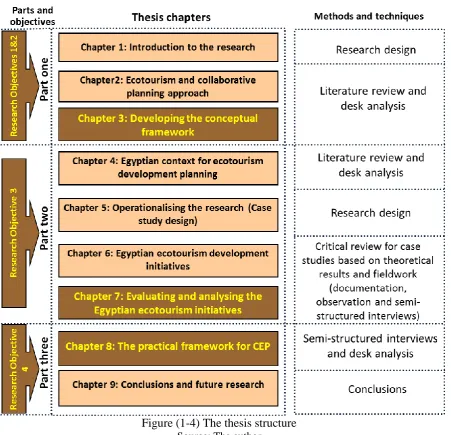
Figure 1-4: The thesis structure 24
Figure 2-1: Ecotourism components according to the IUCN definition 27
Figure 2-2: The concept of ecotourism 28
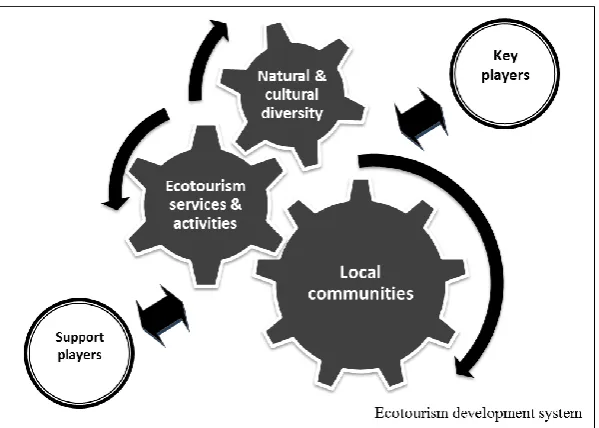
Figure 2-3: The components of an ecotourism development system 35 Figure 2-4: Ecotourism sub-systems’ interrelationships 36 Figure 2-5: Players (stakeholders) in the Ecotourism system 40 Figure 2-6: Stakeholders’ collaboration throughout the planning process for the
attainment of positive interrelationships within the ecotourism system 43
Figure 3-1: The conceptual framework 64
Figure 3-2: The steps in stakeholder network building 66
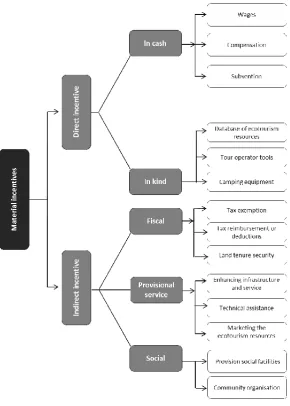
Figure 3-3: The material incentives 88
Figure 4-1: Egypt’s location on the world map 101
Figure 4-2: Egypt’s geographical features 101
Figure 4-3: Bedouin community structure 103
Figure 4-4: Example of Nubian houses and folklore 103 Figure 4-5: Executive Authorities’ functional structure 108
Figure 4-6: Local administration units 109
Figure 4-7: Egyptian Tourism Development Priority Zones 115 Figure 4-8: The fluctuation in tourism development as a result of internal and
external troubles 118
Figure 4-9: Desert ecosystem features 120
Figure 4-10: Examples of Red Sea coral reefs 121
Figure 4-11: Important Bird Areas (IBAs) and the migration routes of birds in Egypt 123 Figure 4-12: Existing and future protectorates networks in Egypt 124 Figure 4-13: Ecotourism development institutions in Egypt 125
Figure 5-1: The case study methodology 146
Figure 6-1: The Fayoum Governorate location 164
Figure 6-2: The levels of ecotourism attractions in the Fayoum 166
Figure 6-3: The conflict in land jurisdictions 167
Figure 6-4: The conflicts between the Fayoum initiatives’ products (different
proposals for land use for the same area) 170
Figure 6-5: The FEDP initiative location 171
Figure 6- 6: The FEDP phases of activities 174
Figure 6-7: The Visitor Experience Zones 177
Figure 6-8: The Ecotourism Development Plan 177
Figure 6-9: The RSG location 181
Figure 6-10: Ecological zones in the RSG 184
Figure 6-11: The levels of ecotourism attractions in the RSG 185
Figure 6-12: The RSSTI location 191
Figure 6-13: The RSSTI phases of activities 195
Figure 6-14: Ecotourism Development Plan 197
Figure 6-15: Detailed planning and design for ecolodge in Qulaan eco-model zone 198
VIII
Figure 6-17: The levels of ecotourism attractions in the NVG 206
Figure 6-18: The ESDNVG location 208
Figure 6-19: The ESDNVG phases of activities 210
Figure 6-20: Sample of proposed ecotourism itineraries 212 Figure 7-1: The convener’s role as connector between separate stakeholder groups
in FEDP and ESDNVG initiatives 237
Figure 8-1: The level of the stakeholder participation during the planning process 299
Figure 8-2: PLUM technique 313
Figure 8-3: The practical framework for CEP 332
List of Tables
Table 1-1: The key factors impeding the implementation of development plans in
Egypt 3
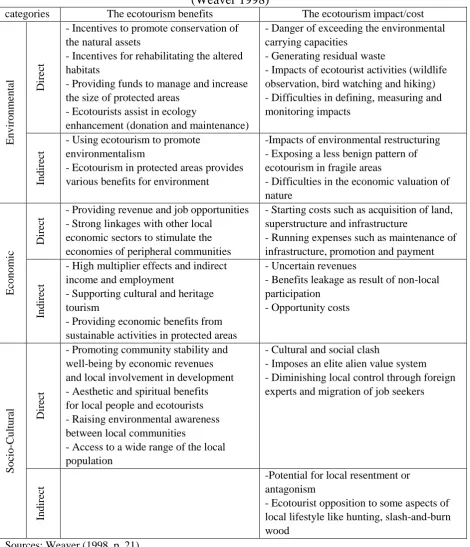
Table 2-1: Potential ecotourism benefits and impacts in developing countries 31 Table 2-2: Characteristics of Hard and Soft Ecotourism spectrum 34 Table 2-3: Chronological evolution of the collaborative planning approach 51 Table 2-4: Operational process for this research 52
Table 3-1: Different levels of participation 78
Table 3-2: Categorising the methods of stakeholder involvement in collaborative
ecotourism planning 82
Table 3-3: Categorising the techniques according to the collaborative phases 84
Table 3-4: The evaluation framework 94
Table 3-5: The critical factors for successful ecotourism collaborative planning 99 Table 4-1: The characteristics of the four main groups of Egyptian people 102 Table 4-2: Changes of the tourism sector as a result of the political turmoil 111 Table 4-3: The protected areas according to the international designation and their
appropriateness to ecotourism patterns 124
Table 4-4: The deficiency in governmental institutions’ responsibilities and
recommendations for activating them 131
Table 4-5: Planning approach evolution in Egypt 135 Table 5-1: The regional ecotourism development initiatives in Egypt 149 Table 5-2: Characteristics of planning approach continuum 151 Table 5-3: Classification of the interviewees in each stage 155 Table 5-4: Number of the interviewees in each case 155 Table 6-1: Stakeholder involvement activities during the FEDP planning process 180 Table 6-2: The implementation situation of the RSSTI ecotourism development plan 199 Table 6-3: Stakeholder involvement methods during the RSSTI planning process 202 Table 6-4: Stakeholder involvement methods during the ESDNVG process 216 Table 7-1: The stakeholder network building of Egyptian initiatives compared with
the conceptual framework 225
Table 7-2: The lists of stakeholder groups in Egyptian ecotourism initiatives 227 Table 7-3: Stakeholder roles and their level of participation during Egyptian
ecotourism initiatives 251
Table 7-4: The appropriateness and sufficiency of the stakeholder involvement
methods during the planning process 260
Table 7-5: The mechanism of the stakeholder motivation to participate in the
IX
Table 7-6: Awareness-raising events during the planning process of the case studies 276 Table 7-7: The procedures of the stakeholder preparation for engagement with the
planning process compared with the conceptual framework 277 Table 7-8: The evaluation procedures during the Egyptian initiatives compared with
the layers of the evaluation framework 281
Table 7-9: The gaps in the planning process and the barriers that have hindered the
efficiency of stakeholder participation in Egypt 295 Table 8-1: Performance of the Egyptian initiatives compared with the characteristics
of a more inclusive approach 298
Table 8-2: Inappropriate and insufficient methods at each phase of the process 304
Table 8-3: Influence and Stake Matrix 313
Table 8-4: The criteria of evaluation framework layers 319
List of acronyms and abbreviations
CEP Collaborative Ecotourism Planning
CISS Cooperation Internationale Süd-Süd
CoC Chamber of Commerce
CPA Collaborative Planning Approach
DANIDA Danish International Development Assistance
DTP Department of Tourism Promotion
EAC Ecotourism Advisory Committee
EDG Environmental Design Group Consultancy
EEAA Egyptian Environmental Affairs Agency
EEPP Egyptian Environment Policy Program
EHA Egyptian Hotels Association
EIA Environmental Impact Assessment
EMS Environmental Management System
EMUs Environmental Management Units
ESAs Environmentally Sensitive Areas
ESDNVG Ecotourism for Sustainable Development in the New Valley Governorate
ETA Egyptian Tourist Authority
ETF Egyptian Tourist Federation
FEDP Fayoum Ecotourism Development Plan
FG Fayoum Governorate
FTA Fayoum Tourism Authority
FURP Faculty of Urban and Regional Planning
GDP Gross Domestic Product
GIS Geographical Information System
GIZ Gesellschaft für Internationale Zusammenarbeit
X
GPS Global Positioning System
HEPCA Hurghada Environmental Protection and Conservation Association
IBAS Important Birds Areas
IDSC Information and Decision Support Centre
ISM Influence and Stake Matrix
ITDA Inter-ministerial Tourism Development Agency
IUCN International Union Conservation of Nature
IYE International Year of Ecotourism
LIFE Livelihood and Income From Environment
LSPs Local Spatial Plans
LTDC Local Tourism Data Centre
MED WET Mediterranean Wetland Initiative
MDGS Millennium Development Goals
MOT Ministry of Tourism
MLD Ministry of Local Development
MOA Ministry of Antiquites
MOE Ministry of Education
MPIC Ministry of Planning and International Cooperation
MS Mediterranean Sea
MSEA Ministry of State for Environmental Affairs
NCE Nature Conservation Egypt
NCPSLU National Centre for Planning State Lands Usage
NGOs Non -governmental organizations
NSCE North South Consultant Exchange
NSP National Spatial Planning
NTDC National Tourism Development Centre
NVTA New Valley Tourism Authority
PLCs Popular Local Councils
PPP private-public partnership
PLUM Power, Legitimacy and Urgency Model
RBOs Regional Branch Offices
RPCs Regional Planning Centres
RSG Red Sea Governorate
RSPs Regional Spatial Plans
RSSTI Red Sea Sustainable Tourism Initiative
RTDA Regional Tourism Development Agency
RTDC Regional Tourism Data Centre
SCPUD Supreme Council for Planning and Urban Development
XI
SPA Shores Protection Authority
SPS Social Problem Solving
SNA Stakeholder Network Analysis
SRSR Southern Red Sea Region
STE Sustainable Tourism Egypt Conference
SUPSC Strategic Urban Planning for Small Cities
SWOT Strengths, Weaknesses, Opportunities and Threats analysis
TDA Tourism Development Authority
TDC Tourism Data Centre
TIES The International Ecotourism society
TOR Terms Of Reference
UN United Nation
UNDP United Nations Development Programme
UNEP United Nations Environment Programme
UNESCO United Nations Educational, Scientific and Cultural Organization
UNTWO United Nations Tourism World Organisation
USAID United States Agency for International Development
WGNP Wadi El-Gimal National Park
Part One: Introduction and conceptual
framework
1
Chapter One
Introduction to the research
The purpose of this chapter is to provide a general introduction to the thesis. Firstly, the chapter introduces the rationale of the research problem, and sets out the research aims, objectives and questions. It states the research stages and gives a summary of the research strategy and methodology employed. Finally, the structure of the whole thesis is outlined.
1.1 The rationale of the research
The inadequacies of the traditional planning approach for such complex domains such as regional development, which requires dynamic collaboration and negotiation between the relevant stakeholders, are well known (Getz & Jamal 1994b). Such issues are even more acute in the Middle East and Egypt in particular, where regional plans are frequently and rationally prepared but rarely implemented. This thesis seeks to explore the reasons for such tensions using ecotourism planning as the lens through which such issues can be explored. There are three key perspectives that can explain the rationale for this work.
1.1.1 Why the research focuses on the process of making a development plan
2
with a plan with which the stakeholders were involved in developing. Their research concluded also that active engagement of a wide range of stakeholders in the planning process will increase the likelihood of successful implementation of a plan.
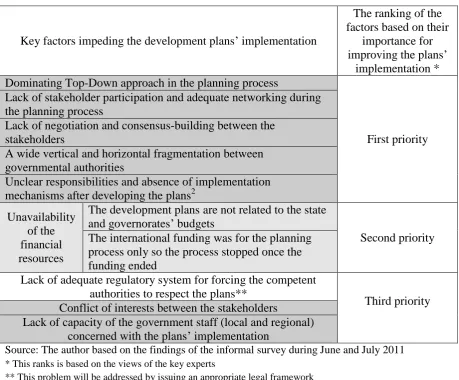
Further to this, the second reason for focusing on the planning process comes from the results of the informal survey1, which emphasised that there are ten factors impeding the implementation of the plans within the Egyptian context. Most of the interviewees emphasised the importance of enhancing the planning process through the participation and collaboration of the relevant stakeholders as being the key positive contribution that could be made for addressing seven of these factors, as Table (1-1) shows. This collaborative process also could help provide the financial resources for implementation from the stakeholders themselves or enable them to seek other resources to put into practice the plans that meet their interests.
The third reason is the background of the author and his experience in the development and spatial planning process when he graduated from the Faculty of Urban and Regional Planning (FURP), Cairo University, and then was working from 2000 to 2010 as a teaching assistant on several of the planning process courses in the FURP as well as being a team leader involved in the preparation of a significant number of the plans (local and regional levels).
1 The informal survey was conducted by the author with nine key Egyptian experts and consultants in
3
Table (1-1) The key factors impeding the implementation of development plans in Egypt
Key factors impeding the development plans’ implementation
The ranking of the factors based on their
importance for improving the plans’
implementation * Dominating Top-Down approach in the planning process
First priority Lack of stakeholder participation and adequate networking during
the planning process
Lack of negotiation and consensus-building between the stakeholders
A wide vertical and horizontal fragmentation between governmental authorities
Unclear responsibilities and absence of implementation mechanisms after developing the plans2
Unavailability of the financial resources
The development plans are not related to the state and governorates’ budgets
Second priority The international funding was for the planning
process only so the process stopped once the funding ended
Lack of adequate regulatory system for forcing the competent authorities to respect the plans**
Third priority Conflict of interests between the stakeholders
Lack of capacity of the government staff (local and regional) concerned with the plans’ implementation
Source: The author based on the findings of the informal survey during June and July 2011
* This ranks is based on the views of the key experts
** This problem will be addressed by issuing an appropriate legal framework
Problems that could be addressed by the stakeholders participating & collaborating during the planning process Problems that could be mitigated by the stakeholders participating & collaborating during the planning process
1.1.2 The need for planning using a collaborative approach
The failure of regional plans has come from the planning process not effectively engaging all relevant stakeholders or dealing with the tension and conflict between them. Without effective negotiations and the building of consensus between stakeholders this failure is not addressed, but, furthermore, many stakeholders may proactively resist the implementation of plans that do not meet their needs (Bonilla 2008). The best plans are built by stakeholder collaboration. Then they (the stakeholders) commit to implement them, even if they are not necessarily of the
2 Two of the interviewees highlighted that, after the planning process had been finished, the donors and planning
[image:17.595.67.527.87.467.2]4
highest technical quality (Albert, Gunton & Day 2003). Moreover, stakeholder participation is an essential pre-requisite for a good planning practice because it provides:
-Better understanding of complex issues such as regional development;
- Understanding and appreciation of the conflicts of interests of the stakeholders in the development, evolving to achieve the most appropriate balance between their interests (Gunton, Rutherford & Dickinson 2010); and - Enhancement of the stakeholders’ commitment to implementation because
the people care about what they are interested in, and will be committed when they feel their interest can be achieved (Imran, Alam & Beaumont 2011). Therefore this research seeks to build a framework for collaborative planning (CP) in Egypt:
To try to address the problems of the traditional planning approach
Although the traditional planning approach is not appropriate for such a complex domain as regional development, the Egyptian planning system is still based on a top-down process that suffers from centrality and a central government monopoly of decision-making in most of the steps (Shalaby 2012). The process of producing plans focuses on high technical quality, based on consultants’ experiences and successful case studies in other developing countries. But such plans rarely meet relevant stakeholders’ interests. Therefore they are not put into practice and end up gathering dust on the shelves (Bonilla 2008). The main flaws in the current plan-making process are centred on the main stakeholder groups not being involved during the process and the majority of the participants in the consultation workshops being governmental employees. The lack of negotiation between the relevant stakeholders with competing interests in the same location has also been an issue. These flaws have led to several problems such as:
5
elements were ignored; only the signage was designed and implemented for the protected area (TDA & SHSC 2006); or b) set up training programmes for the staff of the government authorities, like the spatial development plan for the Red Sea Governorate (RSG ) in 2008 (GOPP 2008).
-Conflict and overlap between different, often sectionally focused, development plans for the same area. There are multiple and frequent plans for the same place under different names and responsibilities, which has led to incongruous proposals for land use and failure of decisions about appropriate (type and scale) of development, and the subsequent degradation of environmental assets and a loss of potential economic benefits. For example, Fayoum Governorate is a typical development region that has fourteen development plans (as shown in Appendix 3): six plans prepared by the Tourism Development Authority (TDA), three plans prepared by each of General Organization for Physical Planning (GOPP) and Egyptian Environmental Affairs Agency (EEAA) and a plan prepared by each of MPIC and Governorate in association with Cairo University. Unfortunately, the majority of these agencies prepare plans without critically evaluating the previous or synchronous plans in order to build a new one based on their results which would therefore have added value.
To try to address the centralisation and fragmentation in the system of public
6
Kamarudin (2013) asserted that one way to overcome such problems would be by promoting communication and collaboration within and between institutions, as well as broadening the participation of the stakeholders during the planning process.
To try to address the importance of a collaborative approach in development
planning as an alternative Collaborative planning (CP) is a recent approach, which
has emerged since the 1990s, and could be one of the best methods to address fragmentation and highly centralised decision-making in developing countries such as Egypt (Monjardin 2004). It can resolve the conflicts between the stakeholders and produce more shared and more equitable solutions. It improves the legitimacy and quality of decision-making as well as building integration among, and between, governmental and non-governmental stakeholders through the processes of inclusiveness, communication, openness, trust and consensus building (Jarvis 2007).
Collaborative planning has been widely recognised as an essential ingredient for development planning for many reasons: a) stakeholder collaboration encourages sustainability of the resources by recognising the variety of stakeholder interests and negotiation takes place between them (Kim 2002); b) CP evolves power from the governmental agencies by providing stakeholders with responsibilities during both planning and implementation stages (Araujo 2000); c) it provides educational opportunities thereby improving stakeholder skills in dealing with planning issues (Lima 2008); d) CP offers continuous and open accountability between the stakeholders (Kim 2002); and e) the participation of multiple stakeholder groups provides broad support for the plans, thus enhancing the likelihood of successful implementation (Albert, Gunton & Day 2003). The importance of the collaborative planning process can therefore be summarised as follows “No single actor, public or private, has the knowledge and information required to solve complex, dynamic and diversified problems; no single actor has an overview sufficient to make the needed
instruments effective; no single actor has sufficient action potential to dominate
unilaterally” (Kooiman, 2000 cited in Jarvis 2007, p.2).
1.1.3 Ecotourism planning as an appropriate case study
7
achieving effective sustainable ecotourism development. This is because such plans are being developed in highly sensitive regions, both environmentally and culturally, and there is a wide spectrum of stakeholders who are affected and influenced by any ecotourism development (Preskill & Jones 2009). The next part will detail the main reasons for using ecotourism planning as a sectorial case study, with particular reference to Egypt.
Recently, tourists have begun seeking a new kind of experience that would allow them to escape the hustle and bustle of everyday life (Holden 2000). A growing proportion of the tourism market is searching for rich landscapes, scenic nature, unique fauna and flora, and a lifetime experience of getting to know indigenous cultures through direct contact with local communities (El-Barmelgy 2002). Such tourist experiences can be found through ecotourism. The International Ecotourism Society (TIES) defines ecotourism as “environmentally responsible travel to relatively undisturbed areas, to enjoy and appreciate nature and the accompanying cultural features” (Fennell 2008, p. 22).
At a global scale, ecotourism provides great positive contributions to the environmental, social, cultural and economic aspects of destinations and local communities, offering long-term solutions for protecting and promoting the natural and cultural diversity (Ceballos-Lascurain 1999; TIES 1990). This is consistent with the United Nations (UN) Millennium Development Goals which aim to alleviate poverty and achieve sustainable development (UN 2010; UNTWO 2013).
8
expenditure is over €70 or US $90, which is higher than the conventional tourist expenditure, which is €48 or US $62 (TIES 2006). Moreover, there is global demand for ecotourism; for instance, 53% of American and 95% of Swiss tourists prefer to enhance their tourism experience through learning as much as possible about local communities’ culture. Also, 87% of British travellers emphasised that their holiday should appreciate and not damage the environment (Cannas 2012). Consequently, ecotourism is increasing in popularity across the world. It has significant potential for developing countries, where it contributes to the needs of impoverished communities and neglected natural and cultural potentials.
9
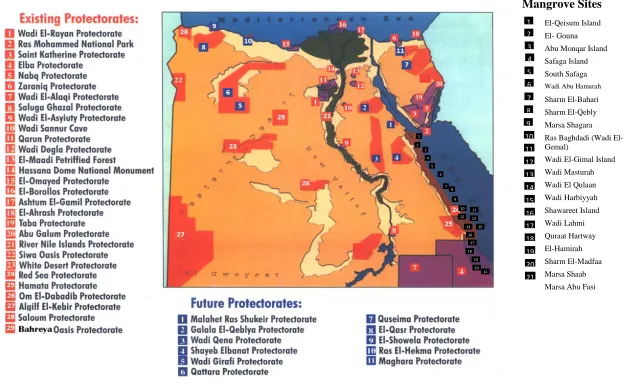
mangrovesites
El-Qeisum Island El- Gouna Abu Monqar Island Safaga Island South Safaga
Wadi Abu Hamarah
Sharm El-Bahari Sharm El-Qebly Marsa Shagara Ras Baghdadi (Wadi El-Gemal)
Wadi El-Gimal Island Wadi Masturah Wadi El Qulaan Wadi Harbiyyah Shawareet Island Wadi Lahmi Quraat Hartway El-Hamirah Sharm El-Madfaa Marsa Shaab Marsa Abu Fasi
4 1 2 3 4 5 6 7 8 9 10 11 12 13 14 15 16 17 18 19 20 21 1 2 3 4 5 6 7 8 9 10 11 12 13 14 15
16 17 18 19 20 21
Figure (1-1) The famous ESAs that are suitable for ecotourism development Source: The author based on EEAA and MSEA (2010); Ibrahim (2011)
[image:23.842.143.768.67.455.2]10
Current Egyptian tourism development is based on mass tourism to maximise the number of tourists3, irrespective of a site’s capacity. The first effects of such development were the adverse impact on the environment (destroying coral reefs, increasing marine pollution and flora and fauna extinction) and on socio-cultural potentials through cultural changing of local communities (Hilmi et al. 2012; NPI 2003). The second effect of the mass tourism strategy was the rapid deterioration in the quality of the tourists to Egyptian areas, which has thus affected the economic benefits yielded from their activities. Therefore the Egyptian tourism product is being perceived as low-price and low-quality (Chemonics 2006a).
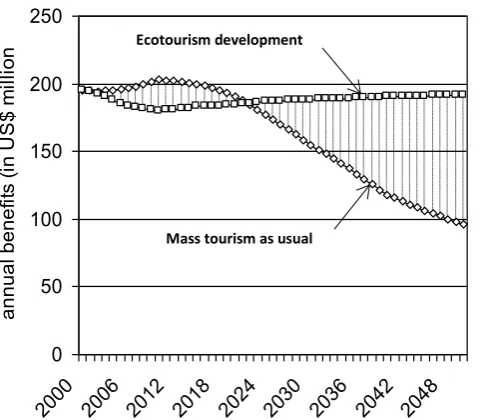
Furthermore, although the proponents of mass tourism considered that it is more profitable in gross terms than ecotourism, in fact ecotourism can be more lucrative in the long term. According to a study on the economic valuation of the coral reefs of Egypt in 2003, contemporary mass tourism development could keep on providing increasing economic benefits from diving and snorkelling in the short term (Cesar 2003). However, by 2012, the annual benefit would level off at US $200 million once the reef was no longer able to sustain the number of tourists and their impact. After this period, the value would start to drop continuously, to a low of US $100 million by 2050. However, in the case of ecotourism development the threats would be reduced and the annual benefits sustained over a long period of time at nearly US $200 million (Figure 1-2) (Cesar 2003). Consequently, the research argued ecotourism development in the long run could be more economically beneficial, as well as conserving and sustaining the natural environment and sustaining its socio-cultural resources. So, Egypt needs to endorse ecotourism development to mitigate the mass tourism issues and maximise its revenues(TDA, USAID & RSSTI 2004).
3 Egyptian mass-tourism strategy focuses on the quantitative indicators such as the total number of tourists and
11
Figure (1-2) Changing annual benefits from diving and snorkelling (for both development approaches) Source: Cesar (2003)
Thus, one of the targets of the Egyptian government, a couple of decades ago, was to increase its share of the tourism market through the development of coastal and historical mass tourism regions. However, the number of tourists in 20104 was only 14.1 million and the income from tourism did not exceed 15.8% of GDP, which was not commensurate with Egyptian environmental and socio-cultural potentials (CAPMAS 2014; WTTC 2011). Furthermore, several weakness in the Egyptian tourism offer could be identified, including poor tourism infrastructure (El-Barmelgy 2002) and a lack of diversification in the tourism products (Hilmi et al. 2012). There were also severe pressures on, and threats to, Egyptian tourism products because they were externally controlled by international tourism operators, and very vulnerable, not only to Egypt’s political and internal situation, but also to that of the entire Middle East region (CAPMAS 2014; Rady & TDA 2002).
These challenges impeded effective tourism development in Egypt and this, coupled with increased local competition which has started to attract part of the Middle Eastern and North African tourist market – such as Turkey, Tunisia, Morocco,
4 The research depended on statistics in 2010 which reflect the actual tourism demand before the unstable
political situation after the 25th January Revolution in 2011.
0 50 100 150 200 250
2000 2006 2012 2018 2024 2030 2036 2042 2048
an
nu
al
b
en
ef
its
(in
U
S
$
m
ill
io
n) Ecotourism development
[image:25.595.182.425.77.287.2]12
Israel and Lebanon – has already impacted on the Egyptian share of the tourism market (WEF 2011). Hence the Egyptian rank5 dropped from 58th out 124 in 2007 (WEF 2007) to 75th out 139 tourism countries all over the world in 20116 (WEF 2011). In other words, Egypt’s rank dropped 17 positions over only four years.
Consequently, Egypt needs to seek to mitigate these challenges and widen its share of the tourism market by:-
-Supporting traditional tourism products (JICA 2000).
-Developing ecotourism as a new tourism product (Rady & TDA 2002; TDA et al. 2009).
-Integrating ecotourism and traditional tourism products to supplement the characteristics of each one. For example, Nile cruise, historical archaeology of the Upper Nile Region and marine tourism in the Red Sea (RS) region could be better integrated to offer a mutual support and benefit to the three regions together (JICA 2000; TDA et al. 2009).
-Enhancing the planning approach: To produce effective tourism development through those three approaches outlined above there is a need for all stakeholders to be involved, with the state, in the planning and implementing process. A collaborative planning approach could create an effective partnership between the state and other tourism stakeholders (Bonilla 2008; EC-2 and EC-8)7.
The complexity of the ecotourism development Ecotourism has been depicted as a
system that includes organic interrelationships (Gunn, 1994a cited in Araujo 2000) between three sub-systems: ecotourism (services, activities and infrastructure), natural
5 This ranking is according to travel and tourism competitiveness reports published by the World Economic
Forum (WEF) every two years.
6 The effects of the political turmoil are not yet captured by the data discussed within this report because it was
completed by March 2011.
7 A reference to the interviewee/s: the acronyms refer to the interviewee groups: EC= Experts & Consultants in
13
and cultural diversity, and local communities. Furthermore, there are large numbers of relevant stakeholders who are interested in, affected and influenced by the ecotourism system, such as community organisations and individuals, tourism industry members, regional and national governmental agencies, private sector, NGOs and funders, etc. (Bonilla 2008). The ecotourism planning process has to consider this complexity and the variety of the stakeholder interests to achieve effective and sustainable development through effective participation and collaboration between all relevant stakeholders (Bonilla 2003).
Accordingly, through overlaying the results of the above points it is evident that there is a need to develop a practical framework for collaborative ecotourism planning (CEP) which will enhance the implementation of ecotourism in particular and more generic development plans.
1.2 The research focus
This research therefore seeks to develop a framework for operationalising the collaborative approach in regional planning using ecotourism as a case study. There are two main tasks in this research. First to develop an idealised conceptual framework for the successful operationalisation of collaborative ecotourism planning that emerges from the literature review and lessons learned from examples of international ecotourism planning. The second is concerned with examining and evaluating the planning process of Egyptian ecotourism initiatives through the lens of the conceptual framework.
The research will focus on the regional level of ecotourism development planningfor a number of reasons.
-The regionalisation approaches are the most appropriate for ecotourism development as ecotourists prefer to move around from site to site seeking different experiences during their ecotour (WWF, 1995).
14
-Regional planning is considered the best scale to take account of relationships between national and local planning priorities and policies, and also between various environmental, socio-cultural, economic, and political concerns. Therefore, ecotourism planning at the regional scale has high potential to combine local and national tourism plans together within a regional development context (Araujo 2000).
-It is important to implement regional ecotourism planning into national development, especially in large developing countries such as Egypt, because it is difficult for national/central planning to address the specific planning needs of the various regions in the country.
-Ecotourism is a multi-dimensional and fragmented activity; it encompasses varying types of small business industries and services for both ecotourists and the local population. Therefore, a regional planning approach for ecotourism is essential to ensure that all the dimensions of the ecotourism industry are developed and managed harmoniously to meet visitors and local residents’ needs in a particular ecotourism destination (Tosun & Jenkins 1996).
-Ecotourism planning at the regional scale is critical to alleviate the centralisation and lack of integration between the governmental authorities in developing countries (Jamal & Getz 1995a).
-Finally, in general it is considered more convenient for addressing the complex domains of certain countries (Araujo 2000).
1. 3 Research aims and objectives
The main aim of this research can be stated as:
To design a practical framework for operationalising a collaborative approach (CA) in regional planning using ecotourism development in Egypt as a case study.
15
How can the CA be merged and operationalised in the regional ecotourism planning process in Egypt within the context of government fragmentation and the multiplicity of stakeholder interests?
A number of research objectives can therefore be identified.
Objective one To critically review the requirements of ecotourism development, and the potential of the collaborative planning approach (CPA) to address these requirements. This objective requires an extensive literature review to cover the following questions:
-What are the key fundamentals of ecotourism?
-What is the ecotourism development system and what are the interrelationships between its sub-systems?
-What are the requirements of successful ecotourism development to enhance the plans’ implementation?
-What are the key fundamentals and process of the CPA? -What are the advantages and limitations of the CPA?
-What are the critical factors for successful stakeholder collaboration during the planning process?
Objective two To develop an idealised conceptual framework for successful collaborative ecotourism planning (CEP). This objective requires an extensive literature review to cover the following questions:
-How can the stakeholder network be built during the process?
-What are the methods of stakeholder involvement in the planning process? -What are the influential factors in stakeholder collaboration within the
planning process?
-How can the collaborative planning process and outcomes be evaluated? -What are the key challenges and barriers for operationalising the collaborative
16
Objective three To evaluate the planning process of Egyptian ecotourism initiatives through the lens of the conceptual framework (objective two) in order to identify the gaps in and the obstacles to stakeholder involvement. This objective requires a massive empirical fieldwork study to address the following questions:
-What is the existing process of ecotourism planning in Egyptian initiatives? -What are the gaps in operationalising stakeholder engagement in the current
planning process compared with the conceptual framework?
-What was the extent of the stakeholder collaboration during the planning process of the Egyptian initiatives?
-What are the barriers to applying CEP in Egypt?
Objective four To develop a practical framework for CEP to enhance the
implementation of the regional ecotourism development plans in Egypt. CEP will be built based on the theoretical conceptual framework (objective two) and evaluation of the contemporary Egyptian ecotourism initiatives (objective three). To achieve this objective requires answering the following questions:
-What are the recommendations to fill the gaps in operationalising stakeholder engagement in the current planning process and mitigate the barriers that have hindered an acceptable level of stakeholder engagement during this process? -What is the practical framework that could enhance the implementation of
regional development in general and ecotourism in particular?
1.4 Research Methodology
In order to address the research aim and objectives, the case study is the most appropriate research strategy for this thesis.
17
practical framework for collaborative ecotourism planning that could enhance the implementation of ecotourism in particular and, more generically, development plans.
According to the research objectives, the appropriate sources of case study evidence are: review of the documentation of regional development and Egyptian ecotourism planning initiatives combined with overt observations carried out in the focal government bodies before conducting interviews with ecotourism experts and stakeholders, which will be undertaken in two phases. These interviews are considered superior to other data-gathering methods (Kumar 2005), particularly for understanding and documenting the opinions and experiences of ecotourism planning experts and stakeholders, which will be essential for analysing and evaluating the planning process within specific initiatives before proposing a modified framework for Egypt. More details of the research data collection strategy will be explained and justified in Chapter Five. The following section provides a broad overview of the research strategy.
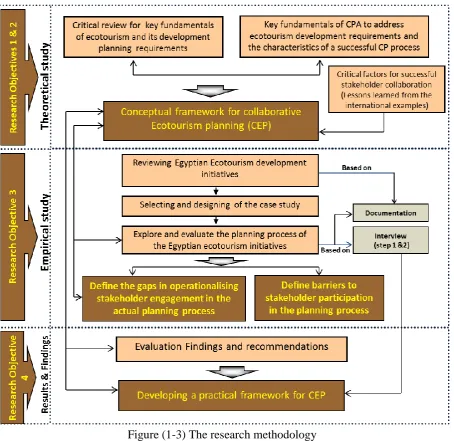
Figure (1-3) shows the stages that are to be applied to produce a practical framework for CEP. It will be a reference for ecotourism development planning in Egypt. The research plan consists of three main stages, each one designed to respond to a specific research objective and pave the way for the next stage. These stages are as follows:
Developing the conceptual and analytical framework This phase aims to
18
the prior part. This part includes reviewing the key fundamentals and process of the CPA as well as defining the characteristics of a successful planning process; and, finally, investigating how to get the active participation of all the stakeholders throughout the process. In the last part, the conceptual framework of CEP will be developed, based on the previous two parts. This framework is considered one of the most important outputs at this stage that could be used to evaluate the current Egyptian process and propose a new one.
Evaluating ecotourism in practice
This stage aims to achieve the third research objective and provide the base for developing the fourth. It will contain three main sections. The first section provides a critical review of the Egyptian context for ecotourism development planning. The section will further explore the evolution of Egyptian tourism strategies and the challenges in tourism development. The potential of ecotourism to mitigate these challenges will be outlined, including a brief description of ecotourism development institutions. This section also explores the evolution of the planning system, regulations and levels. The second section concerns the case study design. Case studies are used here to test and investigate the theoretical studies in a particular and practical context; relevant case studies will be selected based on: a) identifying ecotourism initiatives in Egypt, b) classifying the planning methodologies of these initiatives, and c) selecting the case study. The third section discusses the template for data collection and analysis that will be used in each of the case studies. This consists of:
1- Critical review of the document plan;
2- Review of the other documents or plans covering the initiatives’ geographical locations to explore their relationship with ecotourism plans; 3- Multiple visits to the governmental bodies (EEAA, TDA and the
19
the governmental bodies. These relationships are valuable to the logistics of setting up the fieldwork, such as nominating the interviewees and gaining access to potential documents; and iii) develop the questions of the interview using terms that make sense to the interviewees;
4- The first stage of the interview is designed to update knowledge on the development planning process in general and ecotourism in particular, as well as to identify the official story of the case studies. It will also be to define the main stakeholder groups that were involved in this process to map out an interviewee network of critical stakeholder groups in each case and examine who is involved and who is not, in order to interview members of both groups in the second interview stage;
5- Building the actual planning framework and the stakeholder involvement activities during this planning process in each case; and
6- The second stage of the interview will focus on evaluating the ecotourism planning process that was experienced in each case (outlined in the prior step) based on the idealised conceptual framework to identify the gaps in operationalising stakeholder engagement in the planning process. These interviews will also be concerned with the barriers that prevent an acceptable level of stakeholder participation during the planning process.
20
Figure (1-3) The research methodology Source: The author
1.5 The thesis structure
[image:34.595.75.530.90.531.2]21
Part One: Introduction and conceptual framework
This part is divided into three chapters and is designed to cover the first and second research objectives.
Chapter One: Introduction to the research
This chapter introduces the rationale of the research problem, and the research focus. It sets out the research aims, objectives and questions. It states the research stages and gives a summary of the research strategy and the methods employed, before finally outlining the structure of the thesis as a whole.
Chapter Two: Ecotourism and Collaborative planning approach
This chapter
is concerned with the key fundamentals of ecotourism and its development system as well as the requirements of successful ecotourism development. This chapter also covers the potentials of CPA to address the ecotourism development requirements to enhance the plans’ implementation. This chapter concludes by lessons learned from the international examples in defining the critical factors for successful stakeholder collaboration during the ecotourism planning process.
Chapter Three: Developing the conceptual framework
This chapter aims to
develop an idealised conceptual framework for CEP. This chapter is structured around two main parts: the first will be to investigate the rationale of the conceptual framework. The second will discuss, in detail, the components of a conceptual framework required for successful collaborative ecotourism planning. These components are: i) how can a stakeholder network be built; ii) how can the stakeholder engagement in the planning process be improved; iii) defining the evaluation procedures; and iv) defining the obstacles to the stakeholder involvement and collaboration during the process.
Part Two: Evaluating ecotourism in practice
22
Chapter Four: Egyptian context for ecotourism development planning
The
chapter aims to understand the Egyptian circumstances in order to pave the way
for evaluating specific initiatives. The Egyptian context can be explained
through three sections. The first provides an overview of Egypt in terms of its
geographical location, social and cultural characteristics, administrative system,
and economic context. The second section focuses on ecotourism development
through the evolution of Egyptian tourism strategies and the challenges in
tourism development. The potential of ecotourism development to mitigate
these challenges will also be outlined. The final section of the chapter explores
the evolution of the planning system, regulations and levels in Egypt.
Chapter Five: Operationalising the research
This chapter is concerned with the methodology the research has utilised to examine and evaluate specific Egyptian ecotourism planning initiatives. Operationalising the research discusses how and why the specific case studies will be chosen. It also describes the template for data collection and analysis that will be used in each of the case studies.
Chapter Six: Egyptian ecotourism initiatives
This chapter aims to provide the
context for the three case studies in order to provide the basis for understanding and analysis.
Chapter Seven: Evaluating and analysing the Egyptian initiatives This
chapter examines and evaluates three Egyptian ecotourism planning initiatives through the lens of the conceptual framework to identify the gaps in operationalising stakeholder engagement in the actual planning processes of these initiatives as well as the barriers that hindered an acceptable level of stakeholder participation in these processes.
Part Three: Results and findings
23
Chapter Eight: Developing the practical framework for CEP
This chapter
aims to develop a practical framework for operationalising CEP in Egypt. It is divided into three sections: the first summarises the findings of the Egyptian initiatives. The second section is designed to provide a number of recommendations to address the deficiencies in the planning procedures and mitigate the barriers to engagement of governmental and non-governmental stakeholders in order to pave the way for the third section, developing a practical framework for CEP in order to enhance the implementation of the ecotourism plans.
24
Figure (1-4) The thesis structure
[image:38.595.78.530.94.529.2]Chapter Two: Critical review of ecotourism development and the
25
Chapter Two
Critical review of ecotourism development and the
potential of collaborative planning to address its
requirements
The purpose of this chapter is to address the first objective of this research, which is concerned with critically reviewing the requirements of ecotourism development, and the potential of collaborative planning to address these requirements. This chapter is organised into two main parts. The first part (2.1) focuses on a critical review of ecotourism through three sections: 2.1.1 reviews the key fundamentals of ecotourism; section 2.1.2 discusses the ecotourism development system; and section 2.1.3 investigates the requirements of successful ecotourism development to enhance the plans implementation. The second part (2.2) discusses the theoretical key fundamentals and process of the collaborative planning approach (CPA) as well as defining the characteristics of a successful planning process. This is achieved through four sections: 2.2.1 discusses the collaborative planning (CP) definition and the main incentive for its use; 2.2.2 defines the advantages and limitations of the CPA; 2.2.3 discusses the collaborative planning process; and the final section, 2.2.4, investigates the critical factors for successful stakeholder collaboration during the planning process.
2.1 Critical review of ecotourism
26
prevent the issues and effects that result from conventional mass tourism (Yogi 2010). Its theoretical frame reflects eco-centric situations and supplies a philosophical basis that changes the focus of tourism to nature and local communities (Wearing and McDonald 2002 cited in Pipinos & Fokiali 2009). The first appearance of the term, around the 1970s, led to long scientific and academic argumentation about its exact conceptual definition. The next section reviews the key fundamentals of ecotourism in order to define it, the main differences compared with traditional forms of tourism, the potential benefit of ecotourism, and the patterns of ecotourism development.
2.1.1 Reviewing the key fundamentals of ecotourism
Definitions of ecotourism
Although there are a variety of ecotourism definitions in the literature, most have used terms such as: nature- and local culture-based, ecologically sustainable; concerned with natural and biodiversity conservation; and involving ecotourists and local residents in education (Chiutsi et al. 2011; Himoonde 2007), as well as ensuring that ecotourism should be beneficial to local communities (Buchsbaum 2004). This research adopts the International Union for Conservation of Nature (IUCN) definition as the operational one, because it is effective in capturing a comprehensive description of the essential ecotourism features that distinguish it from other tourism patterns. The IUCN defined ecotourism in 1996 as ‘environmentally responsible travel to relatively undisturbed natural areas, in order to enjoy and appreciate nature (and any
accompanying cultural features – both past and present) that promotes conservation,
27
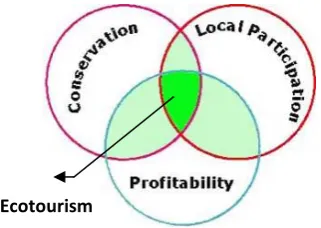
Figure (2-1) Ecotourism components according to the IUCN definition Source: Mader (2010)
- Promoting the conservation of the natural and cultural resources through: i) raising the awareness of both the local population and ecotourists in appreciating and conserving local natural and cultural assets (UNWTO 2002); and ii) creating economic justification for managing and minimising the negative impacts of ecotourism activities (Stone 2002).
- Profitable for local communities: ecotourism development provides the local people with social and economic benefits such as creating jobs and income opportunities as well as providing opportunities to improve infrastructures (Debnath 2011).
- Participation of local communities in running of the ecotourism activities. This is because they are more familiar with natural and cultural potentials than others who may come from outside of the region. Also, local communities are able to prevent abuse of these resources and activate appropriate monitoring systems (Mader 2010; TDA et al. 2003). In order to ensure that local communities benefit from ecotourism, they should be involved in all phases of planning and implementation. Unfortunately, most local people have rarely been a part of the planning process, nor are they asked about their vision for the region (Buchsbaum 2004).
Accordingly, it is suggested that successful ecotourism development requires the achievement of ecological sustainability through appreciating the components of the natural environment alongside social and economic sustainability, by providing economic benefits to local communities in both the planning and running of any ecotourism development. Chiutsi et al. (2011) have asserted that any successful
[image:42.595.226.387.70.184.2]28
ecotourism development has to find a favourable link between environmental and socio-cultural sustainability and financial viability.
What then is the relation between ecotourism and sustainable tourism? Wood (2002) emphasised that ecotourism is a sub-set of the sustainable tourism field (see Figure 2-2), which emphasises the way that ecotourism can be situated within several sustainable tourism forms. It also illustrates that ecotourism is primarily a sustainable version of nature-based tourism. At the same time, including rural and cultural tourism elements that are consistent with environmental, social and community values promotes cultural and environmental interaction. Additionally, ecotourism is concerned with the satisfaction of ecotourists by virtue of providing a distinct tourism experience (Western AsutraliaTourism 2006).
Figure (2-2) The concept of ecotourism Source: Wood (2002)
Ecotourism vs the traditional tourism forms
[image:43.595.141.459.315.517.2]29
mass tourism, particularly in developing countries (Yogi 2010). Mass tourism characteristics are the polar opposite to ecotourism features (Weaver 1998). For example:
- Mass tourism is 'large-scale', designed to maximise the income for tourist agencies without much concern for the impacts on the physical, social, and cultural environments. Ecotourism is usually considered 'small-scale', to minimise the environmental stress and impacts on the local environment as well as providing a high-quality experience to the ecotourists (Carballo-Sandoval 2001).
- Mass tourism is 'externally controlled’. It is dominated by international tourism companies and tour operators and so local communities do not benefit from it. Ecotourism is 'locally controlled’ by local NGOs or local tour operators that allow stronger economic linkages with other local economic sectors and minimise the leakage of benefits from the local communities (Weaver 1998). - Mass tourism is highly commercialised, using international styles of luxury
services and facilities which are not matched with the environment of the tourism areas. The accommodation is built at high density and is owned by large corporations. Ecotourism is moderately commercialised, with the service and facilities being complementary to the local environmental style. Ecotourism accommodation is low density, scattered throughout the area according to the carrying capacity of the receiving destination, and is owned by local people.
- Mass tourism has a high impact on the environment and local communities. Ecotourism is considered low-impact tourism because ecotourists are concerned with conserving the environment and respecting the culture and heritage of local communities (Carballo-Sandoval 2001).
30
cultural attractions, which leads to mass tourists searching for new destinations. The second reason is a dissatisfaction with mass tourism products and the growing demand for tourism activities based on respecting and conserving the natural and cultural resources, as a result of tourists increasing environmental awareness (Buchsbaum 2004).
However, there is no guarantee that ecotourism will necessarily be any more environment-friendly than mass tourism, unless appropriate planning and management of ecotourism development occurs, by involving the local community at the core of this process (El-Barmelgy 2002).
Ecotourism benefits and impacts