Pattern Formations with Discrete
Waves and Broadcasting
Sequences.
by
Thomas Nickson
A thesis submitted in partial fulfillment for the
degree of Doctor of Philosophy
in the
Faculty of Science and Engineering
Department of Computer Science
harsh – the very thought of it renews my fear!”
Abstract
Faculty of Science and Engineering Department of Computer Science
Doctor of Philosophy
byThomas Nickson
This thesis defines the Broadcasting Automata model as an intuitive and complete method of distributed pattern formation, partitioning and distributed geometric computation. The system is examined within the context of Swarm Robotics whereby large numbers of minimally complex robots may be deployed in a variety of circumstances and settings with goals as diverse as from toxic spill containment to geological survey. Accomplishing these tasks with such simplistic machines is complex and has been deconstructed in to sub-problems considered to be signif-icant because, when composed, they are able to solve much more complex tasks. Sub-problems have been identified, and studied as pattern formation, leader elec-tion, aggregaelec-tion, chain formaelec-tion, hole avoidance, foraging, path formaelec-tion, etc. The Broadcasting Automata draws inspiration from a variety of sources such as Ad-Hoc radio networks, cellular automata, neighbourhood sequences and nature, employing many of the same pattern forming methods that can be seen in the superposition of waves and resonance.
and generation. Results pertaining to the nodal patterns generated by arbitrary transmission radii on the plane are explored with a connection to broadcasting sequences and approximation of discrete metrics of which results are given for the approximation of astroids, a previously unachievable concave metric, through a novel application of the aggregation of waves via a number of explored functions.
I would like to thank, first and foremost, my supervisor, for always managing to make time and energy for me. My family for their vague interest, I couldn’t have asked for more. My friends for providing constant distractions and inspirations without which I doubt I would have made it.
Abstract ii
Acknowledgements iv
1 Introduction 1
1.1 Background and Motivation . . . 1
1.2 An Overview of the Thesis . . . 15
2 Broadcasting Automata and their Communication Primitives 18 2.1 Broadcasting Automata Model. . . 19
2.2 Variable Radius Broadcasting over Z2 . . . 34
2.3 Neighbourhood and Broadcasting Sequences . . . 41
3 Discrete Interference of Waves 44 3.1 Modelling Waves Using Broadcast Automata . . . 45
3.1.1 Distance Functions and Model Equivalence inZ2 . . . 56
3.2 Nodal Patterns of Discrete Interference inZ2 . . . 60
3.2.1 Nodal Patterns Resultant from Two Sources . . . 60
3.2.2 Nodal Patterns Resultant from One Source . . . 63
4 Distributed Algorithms in the Broadcasting Automata 67 4.1 Basic Algorithms . . . 68
4.1.1 Firing Squad Synchronisation Problem for BA . . . 68
4.1.1.1 Odd Case . . . 69
4.1.1.2 Even Case . . . 70
4.1.1.3 Firing State . . . 71
4.1.1.4 Correctness of the Algorithm . . . 71
4.1.2 Election of the Edges of BA in Zn . . . 71
4.1.3 Election of the Shortest Branch of a Tree . . . 73
4.2 Geometric Computations with BA. . . 75
4.2.1 Finding the Centre of a Discrete Disc . . . 75
4.2.2 An Algorithm for Locating the centre of a Digital Disk . . . 78
5 Transmission Radii and their Wave Formation in Z2 83 5.1 Geometrical Properties of Discrete Circles . . . 83
5.1.1 Chain coding . . . 84
5.1.2 Discrete Circles and their Chain Code representation . . . . 85
5.1.3 Line Segments . . . 89
6 Pattern Formation and Composition. 93 6.1 Composition . . . 94
6.2 r-neighbourhood Sequences and their Limitations . . . 101
6.3 Reducing Restrictions Through Aggregation . . . 103
6.4 Formation of Polygons Through Aggregation. . . 108
6.5 ApproximatingLp Metrics with Composed Broadcasting Automata 109 6.6 Pattern Formations and Periodic Structures in Z2 . . . 117
7 Conclusions 123 7.1 New Results . . . 123
7.2 Considerations for Further Work. . . 126
Introduction
1.1
Background and Motivation
In many cases it is deemed that large numbers of simple robots can achieve certain tasks with greater efficiency than a single complex robot. Without the reliance on a single automaton there is an increase in robustness, the ability of the system to function with partial failures or abnormal conditions; flexibility, the capability of the system to adapt to changes in the environment; scalability, being able to expand the size of the system without a significant impact on performance [1,2]. This leads to the question of how to co-ordinate these robots in their task whilst retaining their simplicity of design, function and the robustness that is inherent to distributed systems. Such robots may only have local information or minimal sensor range, small finite memory, minimal communication and restricted common knowledge such as coordinates, orientation and synchronicity [3, 4]. The body of work concerned with the design and analysis of systems with these properties and goals is commonly referred to as Swarm Robotics or more broadly distributive computations.
A variety of models have been suggested for this task including those from areas such as Multi Agent Systems, Engineering and Robotics, Cellular Automata (CA) and Distributed Algorithmics [5]. Problems currently being worked on are common
subdivisions of more complicated and pragmatic tasks which are found to tackle a large set of problems simply through the coordinated use of such sub problems. These are often, but not restricted to, pattern formation [6], leader election [7], aggregation [8], chain formation [9], self assembly [10], coordinated movement [11], hole avoidance [12], foraging [13], path formation [14], etc.
Not only are there many different problems that need to be tackled in order to develop swarms of robots that are capable, in real world terms, but there are many ways of solving such problems, each of which may need different computational powers, and concepts, to solve them. In a survey of mathematical models of swarm robotics [15] four main areas were identified,
• probabilistic models, mostly used for foraging, chain formation, stick pulling, aggregation, cooperation-transportation, clustering, sorting, nest building and flocking;
• automata theory (which covers the use of cellular automata), mostly used for collaborative mapping, unknown exploration, lattice formation, pattern formation and stick pulling;
• differential and partial differential equations, mostly used for mod-elling pheromone, trophallaxis, stigmergic studies, collective foraging, clus-tering, flocking, schooling and attraction, alignment and repulsion systems;
• dynamical systems are largely used for cohesion and stability analysis, beacon and odour localisation, bifurcation models, attraction, alignment and repulsion systems, aggregation and population dynamics in swarms.
as an alternative to models which attempt to express swarm behaviours as shown by ants, bees and other swarms of insects. Mobots are relatively powerful with enough memory to store individual identities of the other mobots and knows their own position in the environment which is modelled as a two dimensional grid. Foundational problems in this model are tackled such as assigning identities to robots based on location, coordinated motion and parallel sorting. It is also noted that such a model may simulate a mesh and, as such, mesh algorithms are also applicable. The model allows a good notion of complexity with all algorithms analysed accordingly and it is also noted that there are other similar models, all with complexity analysis, that have been used to solve problems such as dispersal, separation, freeze tag problem, involving waking up a collection of robots and aggregation.
The Broadcasting Automata model takes a similar direction to the models that take their cues from distributed systems. It is hoped that this model may be used to construct deterministic algorithms with measurable complexity that are able to construct a wide variety of geometric algorithms for swarm robotics. For example, the algorithm design for the pattern formation problem in swarm robotics can often be complex and, sometimes, even impossible when the problem must be solved from any arbitrary configuration in a swarm where no information about the initial configuration and topology is available. The emphasis of preceding works, when tackling problems in pattern formation, have mainly been with heuristic algorithms while rigorous proofs of the correctness of the algorithms have not always been given [17].
notion of swarm robotics adapted for this thesis lies on the side of decentralised this will form the focus of the overview of previous literature.
There are many differing models used within the pattern formation literature al-though not all follow the same lines as the philosophy adopted here. In [19] pattern formation is achieved via a series of algorithms for squares, circles, polygons, but all robots are required to know the global positions of all the other robots and the algorithm used only permits analysis via simulation. In [20, 21] a method employing a notion gleaned from nature in the form of crystallisation of molecules is used. The process is similar to molecular covalent bonding and robots are af-forded several bond sites, each with a particular marking, whereby varying the markings and the locations of such markings causes the generation of a variety of shapes. A similar process is suggested in [22] but in this case springs are used with the parameters of the virtual physics, which are noted to be difficult to dis-cover, generate the distinct patterns on the plane. Graph theoretic approaches have been suggested in [23,24] where they were used to construct control graphs which describes the control strategy (or behaviour) used by each robot, and the dependence of its trajectory on that of one or more of its neighbours. Pattern formation is determined by the construction of such control graphs and possible constructions for the graphs are given.
It is within all of these papers that some patterns emerge as to the limitations of such techniques. It is very complex to construct new shapes or describe the total set of all shapes that are generatable in these models. The models have unpredictable or convergent results which are shown through simulation. They require either complex reasoning and as such strong computational complexity for the robots, for example in the case of the spring simulation, or a complex set of sensors or both.
alternative approach for pattern formation. The problem of pattern formation can be solved in to two stages:
1. to apply heuristic algorithms for forming a regular grid
2. to design deterministic algorithms on a swarm with a regular topology and local, non-oriented interaction
The proposal put forward in this work is to introduce a specific Broadcasting Automata model which makes use of I/O Automata arranged in a square lattice topology where communication is defined by broadcast to all automata within a certain radius. The choice of model was initially motivated by previous algorithms for the generation of triangular, square and hexagonal lattices by a swarm of autonomous mobile robots with limited sensor ranges which were studied in [6, 17, 25]. By extending the work within the swarm robotics idiom the validity of the Broadcasting Automata model becomes immediately apparent as augmenting already possible arrangements with partitioning and pattern forming abilities.
Arranging robots into a regular grid structure has a number of benefits in terms of self organisation and efficient communication. The choice of a lattice network topology and broadcasting within a certain range allows for simplistic and efficient communication compared to random topologies [26] that can be seen employed in other models for swarm computations [2].
The Broadcasting Automata model is homogeneous in each cells use of the same update rules mapping the states of its neighbours to a new internal state which is again available to its neighbours. The homogeneity of the update rules, the massive parallelism and local interactions also give a clear analogy to physical laws that govern the natural world, again, parallelling the system of broadcasting waves that is proposed by this thesis. The translations of the CA algorithms, in this case the Firing Squad Synchronisation Problem, in to the Broadcasting Au-tomata model were not only for showing the links between the subject, but for the design of a specific algorithm to solve a geometrical problem in the Broadcasting Automata model. However, the fact that such a translation is possible illustrates that there is a close connection between the CA and BA models.
Cellular automata are notably employed as, powerful distributed computational engines, discrete dynamical system simulators, conceptual vehicles for studying pattern formation and complexity as well as original models of physics [28]. Cellu-lar automata all for efficient parallel implementations of lattice models in nature and so are ideal for the analysis of many concurrent dynamical processes in na-ture. They also are ideal for modelling the global dynamic behaviour of local rule interactions. They have been employed in the simulation of any number of natural phenomena such as dendritic crystal growth, spatial patterns formed by reaction diffusion equations, self organisation in neural networks, turbulence in hydrodynamical systems as well as many others. They are also treated as abstract dynamical systems that can be used to study the complexity of the whole class of continuous and discrete systems and the quantification of complexity as a system property. Cellular automata can also be used to generate original models of fun-damental physics based on local and digital processes which are computationally universal.
formulation of the complexity of dynamical systems [27] and is notable in the com-putation of patterns and their analysis. However, such systems can be difficult to construct from simplistic rules due to the nature of cellular automata to be highly complex, like most dynamical systems, largely exhibiting patterns or trajectories that appear to be effectively random, or show signs of complicated structure in the form of long-range correlations, and in the sense that the ensemble of allowed pat-terns may be very hard to describe. Such elements of cellular automata go against the notions that are developed in the Broadcasting Automata model whereby a simple set of rules distributed to all automata are able to generate stable patterns which have a simple and well defined nature that naturally affords the construc-tion of algorithms through the repeated applicaconstruc-tion of pattern forming procedures. The complexity is easily calculated and, for all algorithms presented here, linear in time. This makes Broadcasting Automata a much more attractive proposal for the control of swarms of robots and indeed the construction of discrete geometric algorithms than Cellular Automata.
In the Broadcasting Automata model local communication is based on non-oriented broadcasting of messages to all of the automata in range, of the broadcast, is a key component of the model. Such ‘blind’ broadcasting (non-oriented) reduces the complexity of the model. This reduction in complexity is due to the fact that the network topology does not need to be kept track of through some complicated distributed system in order to promote robustness. Topology of the network is relegated to the physical transmission systems and placement of the transmitters that would be used in the physical realisation of the system that is suggested in this thesis. The very placement of the transmitters in the physical world constructs a network topology that is efficient. This notion closely resembles the field of ad-hoc networks [29] where they allow decentralised, self organising networks without the need for any fixed infrastructure broadcasting using wireless transmissions and routing handled in a node to node basis.
dissemination of information using a variety of broadcasting radii over a variety of lattices. An algorithm to elect the centre of a discrete disc is given to illustrate the power of Broadcasting Automata, and how they may be used to construct useful and novel algorithms, and solve a key problem in distributed systems known as leader election. The solution is also given in a very minimal setting with regards to the non-oriented broadcasting that is used in Broadcasting Automata. Other problems and areas such as discrete geometry, image processing and pattern for-mation shall also be augmented along the way.
The construction of Broadcasting Automata allows many parallels to be drawn with other areas of both mathematics, which shall be presented in the following paragraphs, and computer science, as has already been seen with its connections to distributed algorithms and cellular automata. Such disciplines have been more rigorously studied in the construction of algorithms and methodology than the ad-hoc methodology used in engineering and robotics papers and as such leads some of the way to realising the initial concept of the system to enhance swarm robotics with this rigour. The following section will hope to elucidate some of these parallels that are formed with the use of more rigid structures of other areas of mathematics which have been drawn as inspiration and providing background and motivation for the work on Broadcasting Automata.
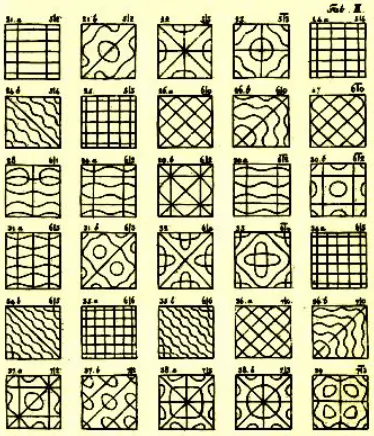
known as nodal lines. With sand, or flour as was originally used, sprinkled on the plate it groups in those areas where there is an absence of motion between the areas of vibration making them visible. It was thought that such a technique could be employed, simulated with automata transmissions across a structured topol-ogy to simulate the resonance that occurs in the rigid body, to solve a number of the common problems that occur in the construction of algorithms for swarms of robots such as leader election or the partitioning problem.
Figure 1.1: Showing a variety of modes present when varying the frequency
of the source through a rigid body
such that all nodes participate in the message passing. Though such subtasks may seem simplistic they are able to solve complex problems such as leader election, termination detection and mutual exclusion and are used as subroutines to solve more involved algorithms.
Wave algorithms do not wholly encompass the Broadcasting Automata model that shall be presented here, in this thesis. Indeed, Broadcasting Automata are more general and the wave algorithms can be seen as a specific case of a Broadcasting Automata configuration, though naturally not all of BA can be explained by wave algorithms. The following notions are applicable to wave algorithms:
• Algorithms of this type may be centralised or decentralised depending on
whether or not the algorithm is started by a single distinct node, known as a process, or can be started in all processes simultaneously.
• They may be designed for many prescribed topologies and may make use
of initial knowledge in terms of a unique process identifier, access to its neighbours unique identifier and a sense of direction; none of which are present in broadcast automata.
• Each process makes at most a single decision after completion and the
com-plexity may be measured in terms of the number of exchanged messages or bits for the computation.
The model for BA, which shall be presented in detail later in the chapter ad-dressing the model, also draws from sources such as Ad-Hoc Networks [29] which is originally a model used for wireless cellular communication networks. Ad-Hoc networks are generally formed in situations in which a particular fixed infrastruc-ture is not available. They are decentralised, self organising and capable of forming communication networks that do not rely on previously fixed structures. In this model nodes, elements within the network, are able to send and receive messages which are routed, in a decentralised fashion, through elements of the network from the node that generated the information to its recipient. Messages can be gen-erated for any node in the network by any node in the network which allows a message to be generated in one node to be passed to any node in the network realising complete connectivity for every node. Such network design is a response to the increasing ubiquity of mobile computing and has many advantages over standard networking practice in that it increases mobility and flexibility, elimi-nates the need for a fixed infrastructure, increases robustness and reduces power consumption.
nodes within the range R = r0(Pc 1
η), where r
0 is a reference distance determined through empirical measurements (for example for low-gain antennas around 1-2 GHz is chosen to be 1m indoor and 100 - 1000 meters in an outdoor environment), η is the pathloss exponent which indicates the rate of the decay of the signal over distance and crepresents the initial power of the transmission [32].
Using the above method, and varying R, the graph that represents the network can be dense or sparse, connected or disconnected. The area of transmission of any node in the network is exactly the circle that is defined by such a radius, R, and the probability of there being a connection between two nodes is exactly the probability of another node being within this circle of influence.
As introduced by Ad-Hoc networks in the geometric random graph model mes-sages may be passed, under certain circumstances, to all nodes up to a certain range, R. Such repeated transmission to nodes, within certain radii, applied to a certain network topology, or physical layout of nodes, in this case a number of geometric lattices, has been studied under the name, neighbourhood sequences (NS). Originally introduced in [33] under the notion of distance functions on digi-tal pictures the aims were to produce algorithms that would define digidigi-tal distance measures based on repeated applications of Moore and Von Neumann neighbour-hoods, where each point within either neighbourhood is at distance one from the centre, which could be done in parallel using only local operations on every ele-ment (pixel) that composed a digitisation of a picture and its neighbour. Such algorithms could be used to solve problems such as, cluster detection, elongated part detection and regularity detection. The pictures were considered to be arrays (representing pixels for a display), which can be considered a square lattice struc-ture underpinning the placement of wireless nodes, and the neighbourhoods were restricted to the Von Neumann and Moore neighbourhoods, which are equivalent to the digitisation of the circles of radii, 1 and √2, respectively, which naturally extends to the notion of R.
has found its main use in areas of indexing and segmenting images [34]. Exten-sions to the initial work include finding those distances which best approximate the euclidean distance [35–38] using both periodic and non-periodic sequences of the initial two neighbourhoods, Moore and Von Neumann, and their analogous extension to 3-dimensions [39–41]. From the exploration of such neighbourhoods the natural question of which of these form distance functions which adhere to the properties given to all metrics [42–44] has also been asked. Previous works have been extended to consider a variety of grids that extend the standard integer grid such as triangular [45, 46] and hexagonal grids [47–50]. In the analysis of the shapes that represent all of the possible digital discs (discretised discs that compose only integer points), an extension of the natural form of the neighbour-hoods that made up the original NS’s, they naturally form convex sets and as such may be combined using the Minkowski sum. In this way convex bodies and the Minkowski sum [51] are core parts of the analysis of Broadcasting Automata, as they give a method for composing convex sets in to new sets which are also convex, and as such derive the shapes of new Neighbourhood Sequences.
Much of the information derived from neighbourhood sequences is from observa-tion of the geometric shapes, such as how close an approximaobserva-tion to the euclidean distance the sequence is, that can be generated by the iteration or repeated trans-mission of the sequences. This is analogous to the Minkowski sum of the sequences constituent discrete discs. Naturally this makes the Minkowski sum very useful in exploring the results of the combinations of digital discs with varying radii when generalising Neighbourhood Sequences. The analysis of such discrete discs also makes use of a method of digitising the hulls of such objects known as chain cod-ing [52]. Chain codes for discrete discs can be constructed in a simple and efficient manor and, as will be proved, can make use of the notion of the Minkowski sum in their combination and manipulation to further the analysis of this extension to Neighbourhood Sequences.
superposition of the waves, modelled as non-oriented transmissions of symbols. As such the concepts and formalisms addressed in the analysis of moir´ephenomenon which concerns itself with the analysis of overlaid gratings and the resultant pat-terns that form from the alteration of the various parameters of both the gratings and the ways in which they are overlaid become increasingly useful in the analysis of the patterns resultant from Broadcasting Automata.
Moir´epatterns [53] are the result of repetitive structures (gratings, screens, grids) with differing sizes or angles being superposed on top of each other. Originally the term moir´e was derived from the common observation of the pattern in rip-pling water and its appearance in silk, which is itself essentially two orthogonal interlocking grids with varying and disparate distances between each strand. The patterns are as a result of the distribution of areas that are light or dark, analogous to the those areas that let light through or don’t in binary patterns created by a grating. For example, in a monochromatic pattern, which is overlaid on top of itself, the interactions introduce a new pattern where one such structure may have removed a section that may have been translucent in the other and vice versa. Moir´e phenomena has found use in a vast number of applications in a variety of different fields. In strain analysis moir´es are used for the detection of slight deflections or object deformations where as metrology finds use for them in the measurement of small angles, displacements or movements. Other fields of use include optical alignment, crystallography and document counterfeiting as well as simply the appreciation of the variety of shapes that can emerge for fun or art.
conclusions may be carried over. Analysis of moir´e lines looks at differing models of superposition both of which employ some form of functional composition for example either multiplicative or additive, where intensity of the light source is modelled by sine functions, and it is within this method that the model presented here is taken further than in the realms of physics.
Broadcast Automata allows an increasingly flexible way of generating composi-tions, indeed the only limit is the number of compositions that are possible given a finite set and even that restriction is self imposed. The two basic functional compositions are given a treatment here but also other forms of composition are as well. As every discrete disc is a convex polygon which is composed of edges that are all straight lines with rational gradients only the basicmoir´elines formed by such discrete objects need be considered but, as will be shown, this is a very powerful tool that can be used to relax many of the constraints on Neighbourhood Sequences.
1.2
An Overview of the Thesis
Here is presented a brief overview of the contents of the thesis.
In chapter 2 the model of Broadcasting Automata is introduced and the features and specifics are explored such as how and to whom messages shall be passed as well as an introduction to abstractions that concern such message passing. This chapter will prepare the ground work for the rest of the thesis presenting definitions of all the notions and notation present including a rigorous treatment of the connection to Neighbourhood Sequences as they are expanded to fit in with the work presented here and relabelled as Broadcasting Sequences. The main result in this section is the construction and definition of the model.
This chapter is the underpinning of all that follows it, giving an insight and eluci-dating what it is possible to accomplish with the model and how algorithms may be constructed. The results here are given as an exposition of what can be achieved with even the most basic components of the Broadcasting Automata model, the von Neumann and Moore neighbourhoods. There are a complete set of results on counting the number of distinct nodal patterns that result on the plane for 2-transmitter configurations and where waves are modelled as words.
Chapter 4 illustrates the power of the primitives further by showcasing a number of algorithms which can be performed in this model. Some of these algorithms are equivalents of algorithms found in a variety of other models such as Cellular Automata and distributed computing which here are the Firing Squad Synchro-nisation Problem, from the Cellular Automata problem set, and an algorithm for the election of centre of a circle which can be dually posed as a leader election algorithm, one of the most basic of problems from distributed algorithms as well as being posed as a distributed geometric problem. Also included in this chapter are a set of ‘helper’ algorithms which, algorithmically, extend the power of the model allowing the accomplishment of tasks that are thought to be common to a multitude of other algorithms that may be constructed. The main result of this chapter is the algorithm for the location of the centre of the digital disc where the initial transmitter is located on the edge of the disc. The algorithm uses all of the techniques discussed in the previous chapter, that utilise nodal patterns, to locate the centre of the disc through distributed, geometric computations.
The generalisation of Broadcasting Automata model, by varying the transmission radius, leads to the problem of the categorisation of digital discs. Results here include the form of the chain code of the discrete disc, how it may be generated and manipulated, and a restriction on their form. The structure of the discrete disc is of paramount importance, making up a large part of the potential power of the Broadcasting Automata model.
inherent structures of the discs. This is given along with their connection with Neighbourhood Sequences which Broadcasting Sequences aim to generalise. This chapter primarily builds on the previous categorisation of the discs themselves fo-cusing on how these structures may be composed and aggregated. Results include a notion of composability with a linear time algorithm such that any two discs, or indeed any two convex polygons that have been reduced to a chain code, may be composed to result in a single chain code that generates the new polygon. Further, the notion of composability that was first described as nodal patterns is explored with the resultant patterning of moir´e and anti moir´e functions categorised fully and many others shown experimentally. The aggregation of discs is then used to give experimental results on the approximation of the concave metric, the astroid, which was previously impossible to approximate with neighbourhood sequences.
Finally, chapter 7 presents the closing statements of the thesis.
Broadcasting Automata and their
Communication Primitives
Broadcasting automata connect many of the techniques contained in distributed algorithms, ad-hoc radio networks and Neighbourhood Sequences. Much like cel-lular automata with variably defined neighbourhoods Broadcasting Automata are defined usually on some form of grid or lattice structure and have a simple compu-tational power comparative to a finite state automata with the ability to receive and send messages both from and to those automata which are within its trans-mission radius. Neighbourhoods are defined in the same way as with an ad-hoc network, all those points within a certain transmission radius, r, receive the mes-sage from the sender. Algorithms are in the same vain as those encountered in distributed algorithms using a simple notion of waves, messages passed from au-tomata to auau-tomata throughout the topology, to construct computations. Wave algorithms are enhanced further with notions of composition of the information that is carried within each wave borrowed from the physical world and embellished with the new found computational power of the automata. The following sections shall solidify the notions that have been put forth here and give a concrete defini-tion of the framework used to reason about computadefini-tions constructed using waves, variable transmission radii and automata.
2.1
Broadcasting Automata Model
One of the fundamental models of computation is the automaton. The model can be used to explore the notion of the limitations and capabilities of computers and as such is useful in composing such models. They can be used to model digital devices that have very limited computational ability and limited memory. This makes automata a good starting point for the construction of a model for swarm robotics where limited computational power and memory are both aspirations of swarm robotics. Finite state automata take as input a word, which may in some instances be referred to as a tape, and output is limited to an accepting state which the automata is left in if it is said to accept the word. Traditionally automata used in cases where it is important to transform some input in to an output, beyond the use of a single state, is the use of Moore Machines. Such machines differ from finite state machines in that they are able to produce an output word from an input word.
Definition 2.1. A Moore machine [57] which is a 6-tuple,
A= (Q,Σ,Λ, δ,∆, q0),
where,
• Q is a finite set of states,
• Σ is the set of input symbols,
• Λ the set of output symbols,
• δ : Q×Σ → Q is the transition function mapping a state q ∈ Q and a
symbol, or set of symbols, σ∈Σ to a state q∈Q,
• ∆ :Q→ Λ is the output function which maps a state, q ∈Q, to an output
symbol, λ∈Λ, and
It is assumed that such a machine is connected to an input tape, or word, and an output tape, or word, where the result of the computation is read. In a situation, as is presented in distributed systems, whereby automata are connected to each other it is possible for the output of one automata to become the input of another automata. Such a model is known as a network of automata and connections from one automatons output to another’s input may be represented as a directed graph, where direction represents the output going to input from automaton to automaton.
Definition 2.2. A network of finite automata is represented by a triple,
(G, A, C0),
where,
• G = (V, E) is a directed graph, with vertices, V, and edges, E, which are ordered pairs of vertices,
• A, is a Moore machine, and
• C0 is an initial configuration which maps states, Q, of the automata, A, to
vertices,V, such that, C0 :V →Q.
In this model the topology is fixed as specified by the construction of the graph, G, which dictates the flow of inputs and outputs from the Moore machines. Such
symbols, where a symbol is part of the input/output word of the Moore machine, are generated as response to some input, by an automaton at vertex, v ∈V, and then sent to all of the adjacent vertices in the graph or to a particular adjacent vertex, G, where the automata that receive the symbols process them as they would their input word.
automata as may be seen in ad-hoc radio networks. Transmission strength may vary from round to round for any particular automaton in the space and is dic-tated by the state of the automaton. In this model the topology, or connectivity graph, of the network of automata is able to change at each time step based on the states of the automata.
In order to give a formal definition of the Broadcasting Automata model on a metric space it is first necessary to introduce the notion of a metric space and to modify the classical notion of the Moore machine.
Definition 2.3. A metric space is an ordered pair, (M, d), where M is a set and d is a metric on M such that d:M×M →R.
Here, (M, d), is any metric space, later the two dimensional euclidean space shall be used but this is not a necessity simply that a notion of the distance between two points is required.
Definition 2.4. The Broadcasting Automaton is represented by an 8-tuple
A= (Q,Σ,Λ, δ,∆, τ, q0, F).
This definition extends the Moore Machine by introducing a set of final states, F, along with a function, τ : Q → R, which maps the state to a real number and represents the radius of transmission for the output symbol and the output alphabet, Λ, is extended by adding an empty symbol, .
A network of Broadcasting Automata, which will also be referred to as the Broad-casting Automata model, can now be defined.
Definition 2.5. The Broadcasting Automata model is represented by a triple such that,
BA= ((M, d), A, C0),
where,
• A is a Broadcasting Automata,
• C0 is the initial configuration of the Broadcasting Automata model, it is a mapping from points, M, to states of the Broadcasting Automata, Q, such that, C0 :M →Q.
In some cases it may be that the input and output symbols are drawn from the same alphabet in which case, Σ = Λ.
The communication between automata is organised by message passing, where
messagesare symbols from the output alphabet, Λ, of the automata, A, to all of the automata within its transmission radius. Messages, symbols from the output alphabet, Λ, of the automata, A, are generated and passed instantaneously at discrete time steps, generation of message is given by the function, ∆, for the automata, A, resulting in synchronous steps. Those automata that have received a message, for the first time in the computation, are said to be activated.
If several messages are transmitted to an automaton, A, it will receive only a set of unique messages, i.e. for any multiset of transmitting messages, where the multiset represents a number of the same message being sent, received by A, over some number of rounds, the information about quantity of each type, within a single round, will be lost. This simply dictates that the automaton may not dictate a number of the same symbol in any transition, all transitions must operate upon a set of distinct symbols.
More formally the concept of computation and communication is captured in the concept of configurations of the Broadcasting Automata model and its semantics presented here.
Definition 2.6. The configuration of the Broadcasting Automata is given by the mapping,c:M →Q, from points in the metric space to states. It can be noted here that C0 is an initial configuration for the Broadcasting Automata model.
all other automata which have in their neighbourhood the automaton that is to be updated. Where here the neighbourhoods are formed by a combination of their position in M and the range of their transmission, dictated by τ(q) for all automata.
Definition 2.7. The set of messages received by the automaton at a point,u, v ∈
M, is expressed by the set Γu = {∆(c(v))|v ∈ M ∧d(u, v) ≤ τ(c(v))} for the
[image:30.596.115.519.265.560.2]metric space, (M, d).
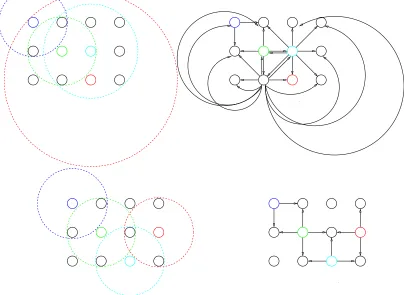
Figure 2.1: The above figures show the possible evolution over time of a
net-work of Broadcasting Automata. Each figure shows, on the left, the broadcast range for the automata, depicted by a dotted circle with the node at the centre,
on the right, the same connectivity is shown in graph form.
nodes that are within the broadcast range, where the range is dictated by the state, q ∈ Q and the function, τ(q) = r where r is the broadcasting radius. The construction of such a graph shows both the connection to the network au-tomata model, which operates on a similar premise but with a fixed graph, but also highlights how Definition. 2.7 is constructed. Incoming edges are generated by connecting nodes, with the arrow from transmitter to node, reachable from the transmitter. Naturally such a graph, in the Broadcasting Automata model, can change over time which is shown by images further down the page as increase time steps in Figure. 2.1.
It should be noted that this set of messages can be empty. The new state of the automaton at u is now given by applying the automaton’s transition function δu(Γu). This may be applied to all of the automata in the BA and as such
de-termines the global dynamics of the system. It can be seen that in one time step it is possible for configuration c to become configuration e where, for all v ∈ M, e(v) = δv(Γu). Such a function is called the global transition function. Theset of all configurations for BA is denoted asC.
Definition 2.8. The global transition function, G:C → C, represents the transi-tion of the system at discrete time steps such that for two configuratransi-tions, c ∈ C
and e ∈ C, where e is the configuration the time step directly after c such that, e=G(c).
Definition 2.9. A computation is defined as any series of applications of the func-tion, G, from an initial condition, C0, that leads to the set of all automata in the system being in one of their accepting states from the set, F, or the computation halts such that there exists no defined relation from the current configuration, c, under the global transition function G(c).
Here a notion of reachability is given.
G(c) = c0. It can also be stated, in a shorthand way, that where the sequence c→c0 →c00...→e exists reachability from cto e may be shown asc e.
With a concrete definition of a global transition function and a computation it is also possible to define what the computational complexity of an algorithm in the Broadcasting Automata model.
Definition 2.11. The time complexity of an algorithm is determined by the number of applications of the global transition function during the computation.
Whilst in general Broadcasting Automata may be used represent any of the com-mon network topologies (such as, linear array, ring, star, tree, near-neighbour mesh, systolic array, completely connected, chordal ring, 3-cubes and hyper-cubes [58, 59]), through varying the location and transmission radii of the automata in the space , a different model is employed. The model used throughout the thesis is a hybrid between the notion of transmission radius in the pathloss geometric random graph model and common network topologies. The method involves the physical placement of nodes on the Euclidean plane in a lattice structure such that the distances between points conform to the euclidean distance. Such regular lat-tices coincide with those structures that can be formed by previous works [6,17,25] giving the basis of the forms of lattice that can be studied. This thesis will strictly concern itself with the square grid lattice though it can be extended in to any of the other grid configurations such as the hexagonal or triangular lattices along with many others.
The locations of the points on the lattice allow the construction of the metric space, (M, d) as such the locations of the automata. Assuming a lattice structure for positioning of the automata and transmission radii, R, is in accordance with the principles of transmission used in the pathloss geometric random graph model put forth in Ad-Hoc networks.
the placement of automata on the plane according to the lattice here shown by the black lines. Neighbours are those within the dashed circle and the automata at the centre of the circle is the initial transmitter of any messages.
Figure 2.2: Showing three differing lattices and how their neighbourhoods
can be altered simply by varying the radii of the transmission neighbourhood which, here, is depicted as a dotted circle. All automata, shown as black dots, are able to receive messages from the automata at the centre of the circle.The
three lattices depicted are (left to right) square, hexagon and triangle.
The connectivity graph defined in ad-hoc radio networks denotes those that are able to send and receive messages with certainty however in distributed algorithms the possibility of communication errors is not ignored. In such models messages may be lost, duplicated, reordered or garbled where they must be detected and corrected by supplementary mechanisms which are mostly referred to as protocols for example the common network protocol of TCP. The Broadcasting Automata model sides with the former method of message passing. It is assumed that there will be no error in transmission, the receipt or sending of messages across the network is guaranteed however consideration is made to the synchronicity of the network due to the high sensitivity to the timing of message passing as will become clear later when discussing pattern formation with such protocols. Usually, though not a requirement of the model, structured sequences of messages are used such as a string where each of the symbols are indexed, here denoted as σi, showing that
it is theith message in such a structured string. This idea is explored fully later in the thesis, particularly chapter 3, and makes up a large body of the work exploring the variety of these strings and the constructs that they form in the system.
To this extent we consider two variants of Broadcasting Automata: synchronous
message is considered to be constant. It is this constant time that will afford synchronisation within the model. The two differing models are presented to show that there are possible complexity trade offs depending on how it is to be mea-sured. If the size of the alphabet is a priority, such that it must be minimised, then the synchronous model is best, however this comes at a penalty of time complexity, where the asynchronous model fairs better.
In theasynchronousmodel upon the receipt of a message, an input symbol (or set of symbols) σ ∈Σ, the automaton, A, becomes active. The automaton may only react to a non-empty set of messages, it may not make and epsilon transition. Once activated the automaton, A, reacts to the symbol(s), σ, according to the configuration of the automaton and responds with the transmission of an output symbol, λ ∈ Λ, to those in its transmission radius for the current state, q ∈ Q, τ(q). The processing of the input symbols by the automaton is done in one discrete time step which is the same period for all automata in the graph. Once active the automaton must wait for another message in order to change its state it is not allowed epsilon transitions.
The synchronous model has a singular alphabet and as such, Σ = Λ with the allowance of epsilon transitions. Upon the receipt of a message, an input symbol (or set of symbols) σ ∈ Σ, the automaton, A, becomes active. Once active the automaton is synchronised with the rest of the graph by repeated epsilon transi-tions that are representative of a constant transition via input symbol as in the asynchronous model. As each such transition is considered a change in configu-ration of the automaton it must take a single time step. As such this guarantees the synchronisation of system. However the multiple alphabet can be simulated by associating different symbols to different time steps as shall be seen later.
The following outlines, informally, the methodology of message passing used by the two differing constructions of automata, synchronous and asynchronous.
1. An automaton, A, receives a message from an activating source at time, t;
2. At time t+ 1, A sends a message to all automata within its transmission radius dependent on its state,q ∈Q,τ(q);
3. At time t+ 2, A ignores all incoming messages for this round.
In the asynchronous model the following rules can be applied:
1. An automaton, A, receives a message σi ∈ Σ from an activating source at
time t;
2. The automaton,A, broadcasts a messageσ(i+1) mod|Σ|to all automata within
its transmission radius, dependent upon its state, q∈Q, τ(q) at time t+ 1;
3. Ignore all incoming messages at time t+ 2.
In both models Step 3 prevents an automaton from receiving back the message that has just been passed to the automatons neighbours by ignoring all transmissions received the round after transmission and ensuring that the messages are always carried away from the initial source of transmission. In both cases this rejection of all messages may be modelled by the addition of a state that simply does not accept input in that state, where epsilon transitions apply, or that the transition is made to another equivalent state independent of input received, where from here it is possible to receive transmissions that once again affect the logic of the program.
Here a similar proposition is made with respects to establishing the equivalence of the two models of automata that are given here, synchronous and asynchronous. The global configuration function doesn’t change between the two models as the function shows only how messages are routed through the graph and how those messages cause the automata to update states.
In this case the differences between the two models are restricted to the con-struction of the automata themselves and a mapping between the two alphabets that differ in size. Automata in the asynchronous model are restricted to state changes only upon the receipt of a set of messages, as epsilon transitions are not allowed, and the size of the output alphabet, |Λ|, is unbounded. Automata in the synchronous model can make epsilon transitions, as such they may make state transitions without any input, but they only have an input and output alphabet of size one, |Σ|=|Λ|= 1.
Usually when equivalence must be shown for two automata it is done by showing that they accept the same language [60], however, this is not possible as the two alphabets are, by definition, different, due to their cardinality. It is for this reason that the definition of equivalence, via simulation, must be altered such that the construction using multiple additional states is able to simulate the outcome of an automata with multiple additional members of its alphabet. It must be shown that it is possible to map one language in to another using nothing more than extra transitions of the automatons transition function in the synchronous model. Having shown that there is a possible mapping from the language of the asynchronous model, on a symbol by symbol basis, to a series of computations in the synchronous model, simulating an input of the symbol in the asynchronous model, it will be possible to construct automata that, using the mapping from language to automata construct are equivalent in their computations.
Slightly more formally it can be said that for every transition of the asynchronous model, δa(qi, σi) =qj there exists a simulation, utilising epsilon transitions, such
that, δs(δs(δs(qi, ), )..., σ) = qj , where here σ is the only symbol in the
Proposition 2.12. Both the synchronous and asynchronous models are able to simulate the other.
Proof. The following proof considers the input and output alphabets to be the same and as such Σ = Λ
Any algorithm for broadcasting automata in the asynchronous model with a mes-sage alphabet of size|Σ|can be simulated by the synchronous model with a singular alphabet and |Σ| slowdown.
Broadcasting a message σi ∈ Σ, such that σi is the ith message in Σ, using the
reactive model with a message alphabet of size|Σ|can be simulated in synchronous model by introducing a number of states equal to |Σ|. Once the automaton is activated with the initial activation message (the synchronous model only has a single alphabet) at time t the initiating automata waits until time t+i, after whichiepsilon transitions have taken place and another message from the initiator indicates to stop epsilon transitions. The states are labelled such that the state after i epsilon transitions is equivalent to σi. Thus both end up in same state.
Such a construction allows simulation in both directions to occur.
q0 q1
q4
q0
q3 2
q
q1 q2
q4 q3
q’1 q’2
q’4 q’3
c d
b
a
[image:37.596.119.515.511.679.2]e
Figure 2.3: The above diagram depicts an equivalent, multi-alphabet,
achronous automaton and a single alphabet, with epsilon transitions, syn-chronous automaton. Symbols,a, b, c, dand e, the epsilon transition, are colour
An example of converting a basic construction in the asynchronous model in to a construction in the synchronous automata is depicted in Figure. 2.3. The au-tomaton on the left of the figure depicts the asynchronous multi-alphabet model, where as the automaton on the right depicts the equivalent construction in the syn-chronous model whereerepresents the epsilon transition. Both automata attempt to recognise the input of a single letter of the alphabet such that the automata should end up in a state depending on the letter of the alphabet, Σ =a, b, c, d, or the time the symbol is received. It is noted that the method of transmitting the symbol in the synchronous model must also be encoded with a time delay such that when the automata sending the message wishes for the automata to end up in state qi the sender must wait until the receiver is in state, qi0.
For simplicity all examples that follow shall use the asynchronous model but it is simple to construct the corresponding synchronous automaton.
the Firing Squad Synchronisation Problem still holds merit and should not be seen as a simple task such that any algorithm may find an equivalent in Broadcasting Automata.
Partial Vision
The broadcasting automata model is such that each element is only aware of its own state, and information about its neighbours is not directly observable which is, for example, contrary to the model of Cellular automata. However, it is possible to organise apartial visionwhich provides access to a set of distinct values of nodes from its neighbours via a non-oriented broadcast. In order to get this set of distinct values an automaton should send a special message (state request), λst ∈ Λ, to
all neighbours which, in return, will send their state in the form of a message on the next step. Such a message is implemented in the automata by a reflexive relation on all states that upon receipt of the state request causes a reiteration of the symbol contained in the state, ∆(q), for q∈Q. It is possible to structure the automata such that an iterative process of such requests propagates through the whole network of broadcasting automata where each automata will react to this information by transmitting the value of its own state which naturally cascades through the system. This method of transmission omits the usual quiescent, state implemented within the automata, such that an automata is always open to the receipt of messages. The automata may also be structured in such a way that they ignore the state request message, in the same way that the usual construction of the message passing protocol, either synchronous or asynchronous, is formed.
one after another, in order to solve a problem. In algorithms that are constructed in chapter four of the thesis state requests of the neighbourhood are generally used to indicate to the automata which section of the solution to the previous subproblem they are in and as such what further action they need to take. It is in this way that a notion of ‘programming’ becomes evident within the Broadcasting Automata paradigm, though much more thorough examples of this will be given throughout chapter four.
Such notion of partial vision may be built up over time which is a process of the automata making the relevant transitions in accord with the symbols received, as with any other method of processing messages given here. In this way there is nothing special about the processing or the reaction of the receipt of the messages that make up the partial vision of the neighbourhood. Only the way in which state requests are instantiated, using the special symbol and the construction of the automata to accommodate such a message, differ from any previous definition.
As an illustration of the notion of partial vision in the model an example is given and shown in the Figure2.4. Here the central vertex of the square will be consid-ered, the box that progresses through the square shows the motion of the iterative messages from the surrounding automata (though this motion may be in many other directions) at each time step and the states, {a, b, c} ∈ Λ, represent cat-egorisations of the neighbourhood. In Figure 2.4 the model that will be more thoroughly introduced later, in two dimensions and such that the automata are placed on the plane in the form a of a square lattice, is used along with the form of wave generate where all states broadcast at a radius of √2, τ(Q) =√2.
In the first figure, i), the transmission to the central vertex will be the set{a, b, c}
{c, d, a}. This constructs a set that is the neighbourhood of the vertex, in this
case {a, b, c, d}.
a b c d a b c c d a b c d a b c c d a b c d a b c c d
[image:41.596.234.398.130.197.2]i) ii) iii)
Figure 2.4: Showing three stages of neighbourhood recognition for the
au-tomata.
So far a complete account of the broadcasting and synchronisation properties has been addressed. The model described is weak (indeed it is shown to be the weak-est model studied here [63]) in the sense that neither input nor output ports are labelled (it is non-oriented) and all automata send the same message to all neigh-bours and only a set of messages is receivable in return. The automata are also homogeneous in the sense that they all run the same algorithm, represented by their states. Such considerations are made to fit with the domain of the problem, swarm robotics, as previously discussed. Now, more specific considerations will be addressed with respects to the set of problems tackled and explored by this thesis which is by no means a complete exploration of the model presented here.
2.2
Variable Radius Broadcasting over
Z
2Whilst the model provided here covers many configurations for the underlying communication graph this thesis shall only consider the following case where all automata are place in euclidean space according to a regular arrangement equiv-alent to that of a square lattice such that, using the Cartesian coordinate system, for any automata in the space its nearest neighbour is at distance 1 and its next nearest neighbour is at distance √2. This idea is illustrated for two dimensions in Figure. 2.5. This now leads to the model of Broadcasting Automata where (M, d) isM =Z×Zand where forρ= (ρ0, rho1) andρ0 = (ρ00, ρ
0
Figure 2.5: A variety of transmission radii are shown (l-r) squared radiir2=
{1,2,4,5,8,9,10,13,16}. Crosses represent the centre of the respective discrete disc.
Figure 2.6 shows as example the automata that receive a message when the eu-clidean space and square lattice are restricted to two dimensions but the radius of broadcast, τ(q) for q∈ Q, is varied. The automaton at point ρ∈ M which is the source of the transmission is shown as the circle at the centre of the surrounding automata on the plane, those that are black are within the transmission range τ(q) for q ∈ Q. Successive larger collections of automata coloured black show what happens when range can be changed to alter the automata that are included in the transmission radius, τ(q)∈ R. If the transmission radius, R, is equal to 1, as in Figure 2.6 diagram a) then only four of the eight automata can be reached. If the radius is made slightly larger and is equal to√2, it can encompass all eight automata in its neighbourhood as shown in diagram b). Such structures are iden-tical to the well studied neighbourhoods von Neumann and Moore respectively and as such here it shall be considered that such constructions of neighbourhoods are a generalisation of these two neighbourhoods. As we will show later, itera-tive broadcasting within von Neumann and Moore neighbourhoods can distribute messages in the form of a diamond wave and a square wave as shown in Figure2.6.
[image:42.596.250.383.559.626.2]a) b)
Figure 2.6: Diagram a) represents the propagation pattern for a diamond
wave (Von Neumann neighbourhood) and diagram b) shows the propagation
pattern for a square wave (Moore neighbourhood).
in Z whereas it becomes cumbersome to write out either the root of the integer or its decimal representation. For an explanation as to how these numbers relate to the distinct discrete discs it must be noted that distinct discs are constructed such that r2 contains a new solution in x and y. As it can be considered that the digital disc represents all of the maximal combinations of Pythagorean triples such that x2+y2 ≤ r2 then for one disc to differ from another there must be an increase ofr2 such that there exists a new, distinct, maximal solution forx, y ∈
Z.
Generating these in the inverse direction by choosing x, y ∈ Z such that it is a new maximal combination not contained in any of the previous, smaller discrete discs allows the construction of the list of r2 that defines the sequence of distinct discrete discs. This notion is illustrated in Figure. 2.7.
i)
ii)
a)
b)
c)
Figure 2.7: Showing two discrete discs iwhere r2 = 9 and ii where r2 = 10.
The dashed figures beside each discrete disc,aandb, represent the two maximal combinations of x and y that present themselves as the outline of the discrete disc. The combination ofa and b presents itself as c in order to highlight this fact and indeed show the resemblance of the outside of the discrete disc to the composition of these two Pythagorean triples. The solid square represents the
centre of the discrete disc.
and output alphabets will, necessarily, be the same, Σ = Λ. Such combinations of messages were modelled in an attempt to generate a form of discretised wave equation complete with nodal patterns on the two dimensional plane in much the same way as the Chladni plates.
As such, messages, and the automata constructed to generate, pass and process such messages, are mostly used to simulate the transmission of a wave. Waves are discretised by taking equidistantly spaced values from time steps along a sine wave, although naturally such waves can be permuted to represent a cosine wave or indeed a wave which holds any value at time t = 0. The waves modelled may be taken to be of any amplitude and frequency with any resolution (number of values that represent the discretised wave) though naturally these will all affect the way in which they interact under the model and the resultant effects of such combinations. The discretisations are represented more generally as words, W = w0w1w2w3...wn−1 where |W|= n (indicating the size of the word), such that any two values which are the same are represented by the same symbol drawn from, Σ = Λ, the input/output alphabets for the automata.
Automata are constructed in such a way that the words that represent waves are combined and processed in a way which may model waves, that is in this sense the addition function which represents superposition in the classical sense for waves in a physical setting [30]. Although the classical model of waves uses the addition function for the composition of waves later other functions shall be examined for their properties in the resultant pattern formation in the medium. In the Broadcasting Automata model such a method of wave passing is model via the use of automata and their input and output alphabet. In the asynchronous alphabet, to represent a wave of four values, as seen in Figure2.8 omitting fractional values (±0.5), it is necessary to construct an automata that is able to accept the preceding value in the series, for example if the wave is represented in the following series of integer values, 0,1,0,−1, and translated to a word such as, W = w0w1w2w3, then the automata must be able to construct upon receipt of the symbol, wi, the
next message in word, W, that makes up the wave, in this case, 0. Now that the automaton has received the symbol, w1, it must implement some method of combining this symbol with another symbol that represents superposition, in two dimensions a simple addition of the amplitude, here the combination of symbols from W. Such emissions of symbols are cyclical, just as a wave is, and as such in the case of W =w0w1w2w3 the next symbol to be emitted after a receipt of w3 is w0. More generally for any word W of size |W| = n the next symbol after wi is
w(i+1) modn.
Definition 2.13. A discretised wave is a word,W, such that each symbol,wi ∈W,
represents an amplitude, equidistant from the last, and such that within one wave-length for each equidistant division of amplitude,y, both positive and negative, all solutions forx(i.e sinx=y) are a new symbol in the word,W, where all symbols are ordered by their monotonically increasing, x, value. In this case time.
Such a method of combining symbols that represent fractions of waves may be implemented using states and additional output symbols that are relayed upon request, using the state request symbol, σst, so that neighbourhoods can be
about the history of the waves that they represent is more fully explored. Here, only an notion of how such constructions can be achieved is given.
Figure2.8gives an example of the digitisation of a wave showing where the equally spaced amplitudes occur on the sine wave. Here the wave is of amplitude one (and if time is to be considered and equal to one also then this would show a frequency of one hertz) and divided in to four equally spaced parts which give the following four values as time progresses positively from zero 0,0.5,1,0.5,0,−0.5,−1,−0.5. In some cases it may be beneficial to substitute the real values that represent the wave with symbols over a finite alphabet. Indeed this representation may be more in line with the definition of broadcasting automata that has been presented by the model. For example the points 0,0.5,1,0.5,0,−0.5,−1,−0.5 are now modelled as a word such thatW =w0w1w2w3w4w5w6w7w8w9, where, , and where wi ∈Σ = Λ
for all 0 ≤ i < |Σ|, W is a word over Σ. Depictions of three successive steps of broadcast where waves are modelled as waves and in the asynchronous model for bothr2 = 1 andr2 = 2 are given in Figure. 2.9.
1
0
−1 0.5
−0.5
Figure 2.8: Depicting an analogue wave digitised by taking values from it
that are equidistant in amplitude. Here, the x-axis depicts time where the
y-axis depicts amplitude.
v ∈M is the point in the Euclidean space, (M, d). In the example on the left in Figure. 2.8 all states of the automata, q ∈ Q, have the same transmission radius such that,τ(q) = 1. For all of the automata in the right example the transmission radius is, τ(q) = √2 for q ∈ Q. These choices of radius generate equivalent neighbourhoods for transmission as the Moore and Von Neumann neighbourhoods. When the automata at the centre, here denoted with its state, u0, here at some point v ∈M, transmits this symbol to its neighbours, they receive the symbol u0 and act accordingly, making the transition in to the state which has as its output symbol, u1, such that for all automata within distance of the transmission radius, d(v, v0)≤τ(q) = 1 for allv0 ∈M andq ∈Qthere is the transition,δ(q0, u0) = u1. The continuation of this process for all other automata generates the wave pattern that is shown on the left in Figure. 2.8 and with a replacement of all the states of the automata having a transmission radius of, τ(q) = √2, the computation on the right can be formed. The cyclical nature can be represented here, assuming that there are only a total of four messages that can be passed which represents four points of a discretised wave, by having a transition such that, δ(q0, u3) = q1 where ∆(q1) = u0.
u0 u1 2 u u3
u0 u1 2 u u3
Figure 2.9: Wave propagation with the asynchronous model is shown on the
square grid: Moore neighbourhood (left) and Von Neumann neighbourhood (right).
Squad Synchronisation Problem [66] and locating the centre of discrete disc which will be presented later on in the thesis.
2.3
Neighbourhood and Broadcasting Sequences
The idea of propagating a pattern of square (r2 = 2) or diamond waves (r2 = 1), generated by repeated application of Moore or Von Neumann waves respectively, in dimension two are commonly known as Neighbourhood Sequences. Neighbourhood Sequences are an abstraction used to study certain discrete distance metrics that are generated upon the repeated application of certain neighbourhoods to a lattice for example the Moore neighbourhood to a square lattice. As previously discussed such neighbourhoods as von Neumann and Moore are encompassed by the more general model used here whereby the transmission radius is varied on a square lattice the first two of such transmission radii to produce distinct objects equating to those of the von Neumann and Moore neighbourhoods.
Definitions and notation concerning neighbourhood sequences as considered in [35], and many other works, are now given with deviations considered in this thesis highlighted after the more traditional treatment here.
Let p∈Zn where n∈
N and such that the ith coordinate of p is given by P ri(p)
for 1≤i≤n.
Definition 2.14. For M ∈ Z where 0 ≤ M ≤ n the points p, q ∈ Zn are M −
N eighbours when the following two conditions hold:
• |P ri(p)−P ri(q)| ≤1 for (1≤i≤n)
• Pn
i=1|P ri(p)−P ri(q)| ≤M