
Cooperative Plans
Thesis submitted in accordance with the requirements of the University of Liverpool for the degree of
Doctor of Philosophy by
Angel Rolando Medellin Gasque
Abstract xiii
Acknowledgements xv
1 Introduction 1
1.1 Motivation and Objectives . . . 1
1.2 Research Questions . . . 2
1.3 Overview of the Topic . . . 2
1.3.1 The Problem . . . 2
1.3.2 Proposed solution . . . 3
1.4 Contribution and Evaluation . . . 4
1.5 Published Work . . . 4
1.6 Thesis Outline . . . 5
2 Literature Review 7 2.1 Agent Technology and Communication . . . 8
2.1.1 Agent Technology . . . 8
2.1.2 Multi-agent Systems . . . 10
2.1.3 Agent Communication . . . 10
2.2 Argumentation in Artificial Intelligence . . . 13
2.2.1 Argumentation Theory . . . 14
2.2.2 Computational Models of Argument . . . 16
2.2.2.1 Argumentation Frameworks . . . 16
2.2.2.2 Value-based Argumentation Frameworks . . . 21
2.2.2.3 Extended Argumentation Frameworks . . . 23
2.2.3 Agent Communication using Argumentation Principles . . . 25
2.2.3.1 Conversation Policies . . . 26
2.2.3.2 Social Commitments . . . 28
2.2.3.3 Dialogue Games . . . 28
2.2.3.4 Walton and Krabbe Dialogue Types . . . 31
2.2.3.5 Argumentation-based Dialogue Protocols . . . 34
2.2.3.6 Desiderata for Agent Communication Protocols . . . 36
2.3 Practical Reasoning and Argumentation . . . 38
2.3.1 Practical Reasoning . . . 38
2.3.2 Argumentation Schemes and Critical Questions . . . 40
2.3.4 Argumentation Schemes for Action Proposals . . . 44
2.3.5 Action State Semantics for Practical Reasoning . . . 46
2.3.5.1 Action-based Alternating Transition Systems . . . 46
2.3.5.2 Formalising Argumentation Schemes and Critical Ques-tions . . . 48
2.4 Dialogues and Planning . . . 50
2.4.1 Planning in Artificial Intelligence andMAS . . . 51
2.4.2 Cooperative Dialogues and Planning . . . 53
2.4.3 Argumentation-based Dialogues and Planning . . . 54
2.5 Chapter Summary . . . 56
3 A Framework for Plan Proposals 59 3.1 An Approach to Propose Cooperative Plans using Argumentation Schemes . . . 60
3.2 An Argumentation Scheme for Durative Action Proposals . . . 63
3.3 Multi-agent Plans and Concurrent Actions . . . 67
3.4 An Argumentation Scheme for Plan Proposals . . . 71
3.5 Critical Questions for Plan Proposals . . . 75
3.5.1 Overview of Critical Questions . . . 76
3.5.2 Layer 1. Critical Questions for Actions. . . 79
3.5.3 Layer 2. Critical Questions for the Timing of an Action . . . 83
3.5.4 Layer 3. Critical Questions for the way actions concur . . . 86
3.5.5 Layer 4. Critical Questions for the Plan Proposal . . . 89
3.5.6 Layer 5. Critical Questions for the Timing of the Plan . . . 92
3.5.7 Layer 6. Critical Questions for the Side Effects of the Plan. . . 93
3.5.8 Layer 7. Critical Questions inquiring about Alternative Options . 95 3.6 Chapter Summary . . . 96
4 A Planning Dialogue Game Protocol 97 4.1 PDGP: A Planning Dialogue Game Protocol . . . 98
4.1.1 PDGP Agent Roles and Stages . . . 99
4.1.2 PDGP Rules . . . 102
4.1.3 PDGP Syntax . . . 105
4.1.4 PDGP Semantics . . . 117
4.2 Protocol Evaluation . . . 127
4.3 Dialogue Examples . . . 129
4.4 Chapter Summary . . . 134
5 Strategies to Select Critical Questions 135 5.1 Strategies in Dialogues . . . 136
5.2 Strategy to Select Critical Questions in Dialogues about Plans . . . 138
5.2.1 Identifying relevant questions . . . 139
5.2.2 Critical Question Prioritisation . . . 141
5.3 Strategy preference . . . 146
5.4 Example . . . 147
6.1.1 TuCSoN and ReSpecT . . . 153
6.1.2 PDGP Syntax Specification in the Tuple Centre . . . 155
6.1.3 PDGP Semantics Specification in the Tuple Centre . . . 157
6.2 Agent and System Architecture . . . 165
6.3 Design of the Test Cases . . . 169
6.3.1 Journey Example . . . 169
6.4 Dialogue Runs . . . 174
6.5 Chapter Summary . . . 176
7 Evaluation and Analysis of Results 179 7.1 Dialogue Simulation Results . . . 179
7.1.1 Results from Dialogue Simulations of Test Case A . . . 180
7.1.2 Observations from Dialogue Simulations of Test Case B . . . 185
7.1.3 Observations from Dialogue Simulations of Test Case C . . . 188
7.1.4 Observations from Dialogue Simulations of Test Case D . . . 191
7.2 Summary of Results . . . 194
7.3 Chapter Summary . . . 195
8 Conclusions 197 8.1 Summary of Contributions . . . 197
8.2 Evaluation of Work in the Thesis . . . 200
8.2.1 Strengths . . . 200
8.2.2 Limitations . . . 200
8.3 Future Work . . . 201
8.3.1 Argumentation Scheme for Plan Proposals . . . 201
8.3.2 Planning Dialogue Game Protocol . . . 202
8.3.3 Strategies in dialogue . . . 202
8.4 Final Summary . . . 203
A NGO Force Example 205 A.1 Initial situation and goal . . . 206
A.2 Zones . . . 206
A.3 Routes . . . 208
A.4 Actions . . . 211
A.4.1 Action Elements . . . 213
A.4.2 Durative Actions Specification . . . 213
A.5 Values . . . 222
A.6 Plans . . . 224
A.6.1 NGO Agent Plans . . . 224
A.6.2 PKF Plans . . . 228
B PDGP semantics as ReSpecT reactions 231
C Dialogue Run B1, Paul Starts, Strategy s1 243
Bibliography 251
List of Figures
2.1 Graphical Representation of an Argument. Adapted from an example in
[176]. . . 15
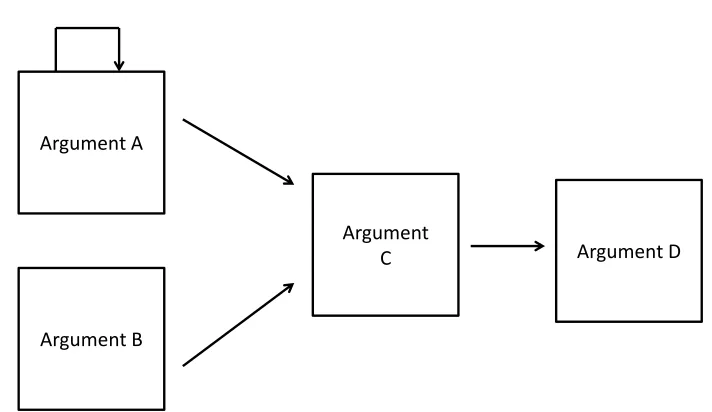
2.2 An Argumentation Framework with four arguments. Argument A is a self-attacking argument. . . 18
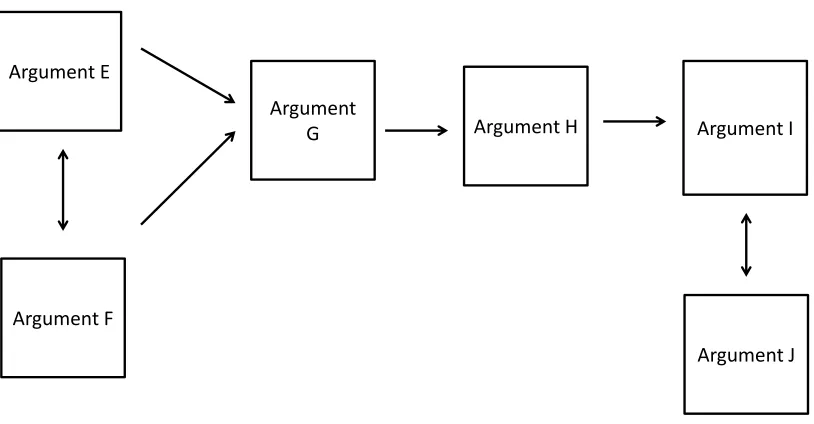
2.3 An Argumentation Framework with six arguments. Arguments E and F attack each other. . . 19
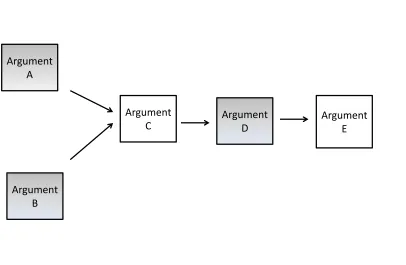
2.4 An Argumentation Framework with five arguments. The stable extension is arguments {A, B, D}. . . 20
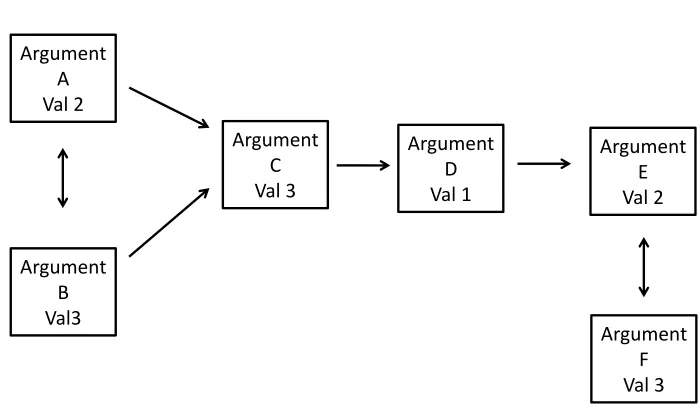
2.5 An Example of a Value-based Argumentation Framework . . . 23
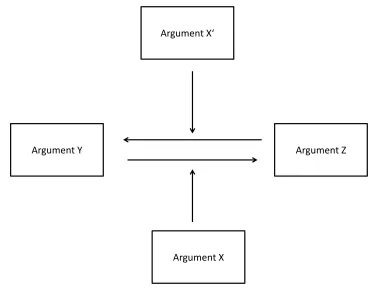
2.6 An Extended Argumentation Frameworks where preferences are represented by a second attack relation. X0 expresses that Y is preferred to Z because X’ attacks (Z, Y). . . 24
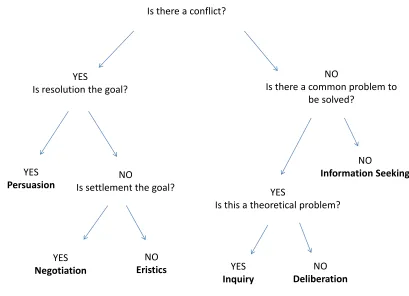
2.7 Determining the Type of Dialogue. Image taken from [190] pp.81 . . . 33
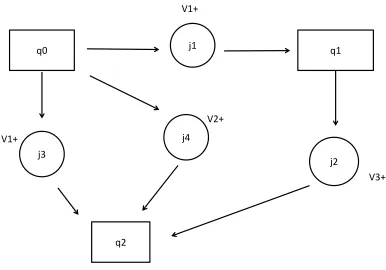
2.8 AATS Action State Semantics. Boxes represent states qn and circles repre-sent joint-actions jnlabelled by the promotion of some value vn. . . 50
2.9 Possible Dialogue Embeddings during Planning Tasks. Image taken from [58] pp.126. . . 55
3.1 A Distributed Artificial Intelligence Approach to Plan Creation. . . 61
3.2 Argumentative Approach to Plan Creation. . . 62
3.3 A PDDL 2.1 Durative Action Representation. . . 63
3.4 Examples of action combinations for theN GO Force example. . . 70
3.5 NGO multi-agent plan proposal P LD to reach Zone 14 from zone 6, cf. to Table A.18. . . 72
3.6 Critical Question Layers for the Argumentation Scheme ASP. . . 76
4.1 PDGP as a sequence of states. Boxes represent the dialogue stages, ‘*’ indicates iteration and ‘o’ indicates selection. . . 102
4.2 PDGP as a state transition diagram. Boxes represent the dialogue stages, arrows represent speech acts (theChange stage is omitted). . . 103
4.3 Change of stage locution flow to refine the plan inPDGP. . . 104
5.1 Strategys1 critical question priority. . . 144
6.1 Diagram of the tuple centre reaction to theopen locution . . . 158
6.2 A snapshot of the planningDialogue Tuple Centre inTuCSoN . . . 162
6.3 Protocol elements in theplanningDialogue Tuple Centre . . . 164
6.4 Agent and system architecture. . . 166
simulation. . . 177 6.8 Dialogue simulation pseudo-code. . . 178 A.1 AgentP KF complete view of the zones. A double circle represents the state
that needs to be reached. A star (*) represents a conflict. . . 208 A.2 AgentN GOcomplete view of the zones. In contrast with agentP KF,N GO
believes there is no route between zones 6 and 8 and believes that there is a route between zones 7 and 8. . . 210
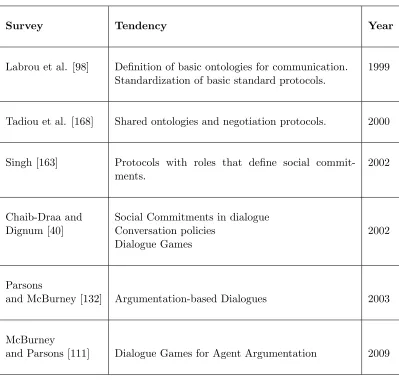
2.1 Summary of Agent Communication Surveys. . . 25
2.2 AS1: An Argumentation Scheme for Action Proposals. . . 45
2.3 AS2: Formal AATS representation of theAS1 Argumentation Scheme. . . . 49
3.1 Argumentation Scheme for Plan Proposals ASP . . . 74
4.1 Comparison of Protocol Stages . . . 100
4.2 Example Dialogue to reach zone 6 . . . 129
4.3 Example Dialogue to reach zone 6 (continuation) . . . 130
4.4 Example Dialogue to reach zone 14 . . . 132
4.5 Example Dialogue to reach zone 14 (continuation) . . . 133
5.1 Pseudo-code to identify questions regarding the beliefs of the agents. . . 141
5.2 Priority order in which questions are considered for both strategies. . . 145
5.3 Conflicting beliefs of agents related to elements in Plan P LE. . . 147
5.4 Questions identified by agent N GO related to PlanP KF’s planP LE. . . 148
5.5 Example priority order for questions in Table 5.4. . . 149
6.1 Some examples ofPDGP locutions and the correspondingReSpecT format. AgP RO is the proponent andAgRES is the respondent. . . 156
6.2 ReSpecT reaction pseudo-algorithm to theenter dialogue() locution. . . 159
6.3 ReSpecT reaction for the semantics of theenter dialogue() locution . . . 160
6.4 ReSpecT reaction for the semantics of thepropose() locution . . . 161
6.5 Critical Questions ReSpecT format . . . 163
6.6 Agents’ plans for the Journey Example . . . 171
6.7 Test case specifications . . . 173
6.8 Test cases preferences and the preferred plan for both agents. . . 174
7.1 Test case A when John starts the dialogue . . . 183
7.2 Test case A when Paul starts the dialogue . . . 184
7.3 Test case B when John starts the dialogue . . . 186
7.4 Test-case B when Paul starts the dialogue . . . 187
7.5 Test case C when John starts the dialogue . . . 189
7.6 Test case C when Paul starts the dialogue . . . 190
7.7 Test case D when John starts the dialogue . . . 192
7.8 Test-case D when Paul starts the dialogue . . . 193
A.1 Agent beliefs about zones . . . 207
A.2 Agent beliefs about routes . . . 209
A.3 Actions for Agent P KF . . . 211
A.4 Actions for Agent N GO . . . 212
A.5 Durative elements for the actionmove() for both agents. . . 214
A.8 Durative elements for the actionidle() . . . 217
A.9 Durative elements for the actioncontrol(). . . 217
A.10 Durative elements for the actionprotect() . . . 218
A.11 Durative elements for the actioncontrol(). . . 219
A.12 Durative action elements for actionsprepareResources(),prepareP ersonnel()219 A.13 Durative action elements for the actions help() . . . 220
A.14 Durative action elements for the actions checkW eapons . . . 221
A.15 Values for theN GO example. . . 222
A.16 Description of the values in the N GO force example. . . 223
A.17 N GO Plan P LB to reach zone 6 . . . 224
A.18 N GO planP LD to reach zone 14. . . 225
A.19 N GO Plan P LF to reach Zone 14 . . . 226
A.20 N GO Plan P LG1 to reach Zone 14 . . . 227
A.21 N GO planP LA to reach zone 6. . . 228
A.22 P KF planP LC to reach zone 6. . . 229
A.23 P KF PlanP LE to reach Zone 14 . . . 229
A.24 P KF PlanP LG to reach Zone 14 . . . 230
B.1 ReSpecT reaction for the semantics of theenter dialoguelocution . . . 231
B.2 ReSpecT reaction for the semantics of theopen dialoguelocution . . . 232
B.3 ReSpecT reaction for the semantics of thepropose() locution . . . 233
B.4 ReSpecT reaction for the semantics of thequestionlocution . . . 234
B.5 ReSpecT reaction for the semantics of theassert locution . . . 235
B.6 ReSpecT reaction for the semantics of theretractlocution . . . 236
B.7 ReSpecT reaction for the semantics of thechallengelocution . . . 237
B.8 ReSpecT reaction for the semantics of thejustif y locution . . . 238
B.9 ReSpecT reaction for the semantics of theacceptlocution . . . 239
B.10 ReSpecT reaction for the semantics of therejectlocution . . . 240
B.11 ReSpecT reaction for the semantics of theleave dialoguelocution . . . 241
Argumentation-based Dialogues over Cooperative Plans by Angel Rolando Medellin Gasque
If autonomous agents operating with other agents in open systems are to fulfil their goals and design objectives, the need to discuss and agree upon plans of action is imperative. In this thesis I present work covering both theoretical research and practical development related to the use of argumentation-based dialogues as a way to coordinate actions in multi-agent planning scenarios.
The necessity of coordination in multi-agent systems requires the development of mechanisms to propose, modify, share, monitor, and argue about plans. In this thesis I present an argumentation scheme to propose multi-agent plans and associated critical questions to critique the proposal. Such a detailed consideration of multi-agent plan composition contains the right characteristics to enable the justification of plans.This research builds upon research on practical reasoning for action proposals and considers multi-agent plan proposals where plans require several agents for their execution.
A dialogue game protocol is also presented which is based on proposal framework. The protocol allows agents to engage in dialogues toagree on and modify plans based on persuasion and deliberation protocols. The detail encompassed by the argumentation scheme and critical questions means that there is a large number of critical questions, and so dialogues may be very lengthy. To overcome this issue, I investigated the issue of strategies for use with this dialogue game in terms of the different possible orderings in which critiques can be posed. The thesis presents an implementation that realises the theoretical framework in terms of a agents engaging in simulated dialogues to share and agree on a plan. The experiments allow us to investigate the effects of such strategies in terms of the number of questions issued to reach an agreement.
Overall, the framework presented in this thesis allow agents to engage in dialogues over cooperative plan proposals in a structured way using well-founded argumentative principles.
Doing a Ph.D. is satisfactory and at times a lonely process. But there is always someone to interact and share ideas. It is not until now, that I realise how many people have directly or indirectly influenced in my research. I would like to thank them all here in a symbolic way.
Firstly, my PhD was funded by the Mexican council of Science and Technology CONACYT to whom I am deeply grateful.
I had the fortune to have not two but three supervisors. The support, patience and guidance of Prof. Peter McBurney, Dr. Katie Atkinson and Prof. Trevor Bench-Capon was always precise and motivating. I cannot thank you enough for all your time and advice. It has been a pleasure for me to work with you.
When I joined the Department of Computer Science at the University of Liverpool as an MSc student back in 2007 I was told it was one of the most important and influential CS departments in England. I have no doubt about it. I would like to thank in no particular order, people who helped me in almost five years in Liverpool. Thanks to: Prof. Frans Coenen, Dr. Ullrich Hustadat, Dr. Clare Dixon, Dr. Valentina Tamma, Dr. Floriana Grasso, Prof. Michael Wooldridge, Prof. Lesek Gasienec, Dr. Adam Wyner, Prof. Paul Dunne, Mr. Dave Shield, Mr. Ken Chan, Mr. Phil Jimmieson, Ms Helen Bradley, Dr. Alexei Lisitsa, Prof. Paul Goldberg, Dr. Irina Biktasheva and all the staff in general.
My colleagues at the office were always supportive and friendly all the way long: Dr Omar Baqueiro Espinoza, Dr Elissabetta Erriquez, Dr Dan Cartwright, Dr Ji Ruan, Dr. Maya Wardeh, Dr. Andy Dowell, Dr. Nico Troquard, Ali Bojapur, Matias Garcia, Stephanie Chua, Luke Riley, Anton Minion, Martyn Lloyd Kelly and many more I am sure I am forgetting.
The Argumentation Community which I had the opportunity to meet in confer-ences always was encouraging, thanks to Dr. Sanjay Modgil, Prof. Chris Reed, Prof. Guillermo Garcia Simari, Dr. Francesca Toni, Prof. Henry Prakken, Prof. Simon Par-sons, Dr. Vanina Garcia, Dr. Federico Cerutti, Dr. Nir Oren, Dr. Alice Toniolo, Dr. Xiyu Fan, Dr. Stella Heras, Prof. Michael Luck, Mr. Dionysios Kontarinis, Dr. Jodi Schenider.
I would like to thank my examiners Dr. Elizabeth Black and Prof. Wiebe van der Hoek. Their feedback and opinions on my work made me work even harder and I am nothing but grateful.
Mauricio, Samuel, Augusto, Alicja, Juansethi, Claudia, Miguel.
Thanks to my beautiful friends Lindsey and Antoinette. Without you, these years would have been much less fun. Thanks for all the beer, the Irish music and the after-noons cheering to the mighty Liverpool FC.
To my beautiful girlfriend, soon to be wife, Elisa, you have been amazingly loving and supportive. Te amo (tanto!).
Finally, my family has always been there for me since I took the decision to live in England. I missed you all. The Bravo family, my warrior cousins. My beautiful sisters Lizbeth and Marisol. I’m sorry I have been away all these years. I am proud of you. My nephews Miguel Angel, Daniel, I’m sorry I missed your childhood, my beautiful niece Pamela I missed you every single day. My grandparents Rolando, Lizbeth, Mary thanks for all the support and advice. To my father for all his hard work and to my beautiful mother. You taught me invaluable things in life and I’m proud to be your son.
Introduction
1.1
Motivation and Objectives
The demands of agent-based computing in uncertain and dynamic environments require planning agents to communicate and manage their plans and resources effectively [140]. The complexity of distributed systems limits the use of single-agent planning mechanisms in distributed scenarios because the local knowledge or capabilities of an agent are often not sufficient to generate a satisfactory plan. A common assumption in classical Artificial Intelligence (AI) planning is that the planner has accurate and complete knowledge of the world and the capabilities of other agents [63]. Since this assumption is rarely satisfied when using multi-agent systems, this thesis proposes the use of structured argumentation-based dialogues to coordinate theproposal, selection and refinement of multi-agent plans.
This thesis contributes to an area of AI research where the aim is to provide au-tonomous agents with mechanisms to communicate and cooperate when selecting and executing a plan in a non-deterministic environment [16, 128, 170, 174]. I present work related to the use of a structured argumentation-based dialogue based on an argumen-tation scheme for plan proposals and associated critical questions as a mechanism to support automated coordination in distributed planning scenarios. I will discuss the characteristics of such dialogues and examine some issues that present themselves when adapting existing work on practical reasoning for autonomous agents and argumenta-tion dialogues. In the approach suggested, agents coordinate their beliefs and intenargumenta-tions using a dialogue game based on an argumentation scheme and a related set of critical questions.
The complexity1of dialogues to agree and modify plans makes particularly appropri-ate the use of argumentation schemes and a dedicappropri-ated dialogue protocol. Argumentation schemes are suitable since they allow agents to engage in dialogues with the use prede-fined critical questions and present plans as a patterns of defeasible reasoning where the
1
I use the term complexity in the sense of large, non-trivial and intricate relation of elements in the dialogue not in the sense of computational complexity.
arguments in favour of the plan can be arranged as the elements of the plan. Addition-ally the use of a dialogue game protocol allow agents to coordinate their intentions and apply their preferences exchanging only information relevant to the plans.
1.2
Research Questions
The research questions considered by this thesis are the following:
• What planning elements or features are relevant when agents discuss multi agent temporal plans?
• What argumentation scheme is appropriate for agents in order to allow them to engage in a dialogue about multi-agent plans?
• Which critical questions match the argumentation scheme for plan proposals to argue about plans?
• What type of protocol would be adequate to allow agents to engage in a dialogue about the critique and modification of multi-agent plans?
• How can agents identify, prioritize, and choose a relevant critical question in a dialogue about plans?
• How effective are the different strategies for choosing critical questions?
1.3
Overview of the Topic
1.3.1 The Problem
Multi-agent planning concerns with the problem of constructing a plan where several agents need to participate to reach a goal. This particular problem includes situations where a machine aids a human in constructing a plan (automated planning assistants) or multiple autonomous agents coordinate their activities towards a common goal [67]. There is a large variety of approaches to multi-agent planning [49] including distributed versions of classical AI planning techniques like NOAH [46], partial planning techniques [62], techniques that exploit specific multi-agent systems attributes like joint intentions [100], shared plans [81], plan merging [66], model checking approaches [43, 179], auction based approaches [205] and the one that is explored in this thesis, the argumentation-based dialogue approach [132].
processes appropriately, so that the common planning goals are met, but conflicts can arise in complex domains so the intentions or actions of other agents need to be changed. With self-interested agents, cooperative behaviour cannot be taken for granted. Co-operation has to emerge as a result of the agent interactions.
In multi-agent scenarios, agents can engage in negotiation dialogues to reach their objectives, although it is not always the case; with auctions for example, goals can be reached without negotiation or dialogue. In order to argue or negotiate effectively, agents need to (a) represent and maintain belief models, (b) reason about other agents’ beliefs and goals, and (c) influence other agents’ beliefs and behaviour [167]. Since an agent cannot be sure of the extent to which the other agent is willing to cooperate, the planning information communicated cannot simply be its own high level plans. It needs to take into consideration explicitly the beliefs and intentions of the recipient agent.
1.3.2 Proposed solution
If agents communicate their beliefs, intentions and preferences in a structured way, are able to reason about another agent using their own models of that other agent and use this selectively to influence the other agent and agree on a course of action to take, this process can be abstracted into a persuasion-deliberation dialogue. The thesis describes a framework for plan proposals based on a defeasible 2 argumentation scheme and associated critical questions to allow agents to reason about plans and critiques.
The argumentation scheme for plan proposals and associated critical questions ap-propriate for discussing multi-agent plans. The argumentation scheme representation treats a plan proposal as a presumptive argument for a sequence of actions to be exe-cuted by a group of agents. The proposal comes with a set of critical questions whose answers may defeat the presumption at various levels and draw attention to potential inconsistencies in the proposal and other alternative ways of reaching the goal. I iden-tified critical questions (Section 3.5) related to the argumentation scheme where each question represents a way to question and/or attack the plan proposal. The scheme has a large number of elements, and consequently the set of critical questions is necessarily large. The large number of questions is necessary to cover the potentially many differing details that make planning such an intricate, fine-grained process.
I present also an argumentation-based protocol calledPDGP based on the argumen-tation scheme and critical questions that allows agents to propose plans to each other and evaluate them. In a planning scenario agents require a communication medium with flexibility. In principle, agents should be able to enter into several types of dialogues (negotiation, deliberation persuasion, information seeking, etc.) to agree on a plan [58]. I focus on a persuasion dialogue where agents acquire a role and evaluate the proposal according to their role. Furthermore, a deliberation dialogue could be used to modify a plan at a particular point.
2
Also a strategy to identify, prioritise and select questions is presented. Choosing an appropriate question in the dialogue becomes an important issue in terms of dialogue and cooperation efficiency. The critical questions are chosen in the context of a dialogue to lead agents to cooperate more effectively issuing as lees questions as possible.
I also implemented a simulated dialogue scenario, described in Chapter 6, in which two conversational agents propose, critique plans and agree on a plan. Agents share their plans and trying to agree on a plan to execute through dialogue. Conflict of course can occur given agents having different views of the world (different beliefs), different ways to achieve the goal, or different preferences with respect to sub-goals. Through the protocol rules agents are able to identify and resolve the conflicts identified.
When selecting questions agents should consider several factors, including the context in which the dialogue develops and the nature of the questions.
1.4
Contribution and Evaluation
The contribution of the thesis is a method that allow agents to select and evaluate plan proposals, more specifically:
• A novel argumentation scheme for plan proposals that allow agents to propose multi-agent plans that builds from an action proposal.
• A novel list of critical questions related to the argumentation scheme for plan proposals where questions are categorised according to the detail in which agents discuss the plan.
• A dialogue game protocol that enables plan proposals to be evaluated, critiqued and modified.
• A methodology to identify critical questions for a plan proposal and a strategy to prioritise and select critical questions in a dialogue about multi-agent plans.
• A computational implementation of the argumentation scheme and critical ques-tions, the dialogue protocol, the strategy to select critical questions and a simulated dialogue between two agents.
• An evaluation of the strategy to select questions using the implementation where strategies are evaluated regarding the number of questions needed to end the dia-logue.
1.5
Published Work
• The argumentation scheme for plan proposals presented in Chapter 3 builds on work undertaken with Peter McBurney, Katie Atkinson and Trevor Bench-Capon and was published as “Arguments over co-operative plans” in the First Inter-national Workshop on the Theory and Applications of Formal Argumentation, TAFA11 in Barcelona, Spain, 2011, [120].
• The Critical Question analysis builds on work undertaken with Peter McBurney and Katie Atkinson in 2010 and published as two technical reports in the Depart-ment of Computer Science in the University of Liverpool [116, 121].
• An early version of the PDGP dialogue game protocol of Chapter 4 is published as a technical report the Department of Computer Science in the University of Liverpool, 2012 [117].
• The strategy to select critical questions of Chapter 5 builds on work undertaken with Katie Atkinson and Trevor Bench-Capon, an abridged version was published as “Persuasion Strategies for Argumentation about Plans” in the proceedings of the Fourth International Conference on Computational Models of Argument (COMMA 2012) in Vienna, Austria, 2012 [119].
• A full version of the strategy to select critical questions that includes the imple-mentation and evaluation presented in chapters 6 and 7 builds on work undertaken with Katie Atkinson, Trevor Bench-Capon and Peter McBurney and was published in theJournal of Argument and Computation in March 2013 [118].
1.6
Thesis Outline
The thesis is structured in the following way:
Chapter 2 presents a literature review on the topics that are related to the re-search presented in this thesis. These topics include: an overview of agent technol-ogy and agent communication in Section 2.1, an introduction to Argumentation in AI and dialogue games based on Argumentation in Section 2.2, a review of practical reasoning for autonomous agents in Section 2.3, and approaches to argumentative dialogues for cooperative plans in Section 2.4.
Chapter 3presents a framework for plan proposals that consists of an argumen-tation scheme and its associated critical questions together with an analysis on durative actions.
Chapter 4presents a dialogue game protocol based on the argumentation scheme and critical questions of Chapter 3.
the dialogue. Here some of the factors that make questions relevant at different times in a dialogue are considered; these can be used to create sensible orderings for questions to be posed in a dialogue.
Chapter 6 presents an implementation of the concepts presented in Chapters 3, 4 and 5. To establish the relevance of our approach I implemented two agents that engage in a dialogue where agents have different views of the world and different preferences and use the strategies from Chapter 5 to select their critical questions. Chapter 7presents the evaluation of the experiments. The results show how crit-ical questions implemented in a dialogue game, together with a strategy to choose relevant questions, is beneficial both to the quality and efficiency of the dialogue and the plan which results from it. In contrast to existing work that is largely the-oretical, our novel implementation enables us to produce empirical results showing the benefits of our approach in teasing out the points of disagreement to come to an agreement on the best plan.
Literature Review
This chapter presents a survey of research related to the work developed in the thesis. To provide the basic concepts about Argumentation-based Dialogues about Cooperative Plans, this chapter presents research related to several disciplines including: Agent Technology, Agent Communications, Interaction Protocols, Practical Reasoning for Au-tonomous Agents, Argumentation, Computational Models of Argument and Dialogues about Plans.
As discussed in the previous chapter, the main purpose of this thesis is to present theories and mechanisms related to how agents should engage in a dialogue about co-operative plans. In order to put in context the research presented in this thesis, this chapter reviewing the literature is divided into four main sections 1:
1. Section 2.1 Agent Technology and Agent Communication
This section presents an overview of the Agent Technology scene focusing on Agent Communication. The section presents agent technology and multi-agent systems and discusses the importance of communication for autonomous agents.
2. Section 2.2 Argumentation in Artificial Intelligence
This section presents an overview of Argumentation in Artificial Intelligence and its importance for enabling agents to reason under uncertainty. Section 2.2.1 presents basic definitions from argumentation theory and continues with research on computational models of argument in Section 2.2.2. Section 2.3.2 presents con-cepts on Argumentation Schemes and Critical Questions, the basis of our proposal in Chapter 3. Section 2.2.2.1 presents Argumentation Frameworks, Value-based Argumentation Frameworks and Extended Argumentation Frameworks. Finally, Section 2.2.3 presents an overview of Dialogue Games for Agent Argumentation discussing the transition from Agent Communication Languages to the Protocol-based approach which has become dominant in recent years and has been used in this thesis. In Chapter 4, I will present a protocol that allows persuasion and deliberation based on theories from this section.
1This chapter discusses the background research on which the theoretical model developed is based.
The background research related to the implementation is presented Chapter 6.
3. Section 2.3 Practical Reasoning in Autonomous Agents
This section discusses practical reasoning for autonomous agents and an approach to practical reasoning using argumentation schemes for action proposals which is the basis of our plan proposal in Chapter 3.
4. Section 2.4 Dialogues and Plans
This section discusses the problem of coordinating multiple autonomous agents in relation to planning tasks and the communication issues involved. I present also a survey of existing approaches to overcome some AI planning limitations using argumentative dialogues.
The chapter concludes with Section 2.5 presenting a summary of the key concepts that will be relevant for the rest of the thesis.
2.1
Agent Technology and Communication
An overview of the agent technology in general and in particular agent communication is presented in this section.
2.1.1 Agent Technology
Computing currently is conceptualized as a social activity where a large number of heterogeneous computational nodes are able to communicate through networks. Social networks, e-business platforms, web services platforms, auction and trading websites are all examples. Software applications are no longer isolated and technologies supporting this social trend have been emerging since the nineties. This tendency is very likely to increase in the future with a higher degree of autonomy in software where computational nodes will be able to interact autonomously to reach particular goals [102]. Agent technology thus emerges as a promising paradigm to face the huge task to conceptualize, design and develop computer entities that can meet these requirements to interact in an autonomous and intelligent way, but for this to be accomplished, new characteristics and techniques need to be developed and implemented in computational entities.
“An agent is an encapsulated computer system that is situated in some environment and that is capable of flexible, autonomous action in that environment in order to meet its design objectives.”
Agent technologies have been a popular research topic in academia for the last twenty years [92, 102, 199], for example: agent architectures [151], software engineering techniques [101, 162, 197, 200], agent communication [40, 98, 163, 168], agent coor-dination theories and mechanisms [127, 195, 201] and agent programming languages [17, 31, 47, 87, 126].
Autonomy is probably the most important characteristic wanted for agents, since we want agents to react and pursue their goals without human intervention. Agents are defined asintelligent, to refer to their ability to: communicate with each other using an expressive communication language;work together cooperatively to accomplish complex goals; act and reason on their own initiative and use local information and knowledge to manage local resources andhandle requests from peer-agents [69]. Agent technology is grouped into three categories according to the scale at which it applies [102]:
• The Agent-level: involves procedures for individual agent reasoning, planning and learning.
• The Organization-level: covers issues related to agent societies; topics include: organizational structure, trust, norms and obligations, and self-organization in open agent societies.
• TheInteraction-level: concerns communication between agents. Topics include: communication languages, interaction protocols and resource allocation mecha-nisms. The goal is to develop computational theories and technologies for agent interaction, communication and decision making based on work from other dis-ciplines (economics, political science, philosophy) that have studied similar prob-lems.
More specifically, the interaction level can be divided into three main topics: Coor-dination, Negotiation and Communication [102]:
• Cooperationaims to ensure that actions of independent agents are coherent with respect to a common goal, in other words to align goals across agents with the use of commitments or contracts.
• Negotiation is concerned with the establishment of mechanisms to divide scarce resources between agents in a way acceptable to all parties, with each individual party aiming to maximize its share.
and dynamic environments where resources and information could be spread across different locations, agents need to cooperate, negotiate and interact efficiently to reach their goals.
An important issue of theinteraction level is how to design, develop and implement mechanisms to coordinate actions automatically between agents. Conflicts may arise because of conflicting goals and preferences and so mechanisms to negotiate are also important. Recent approaches drawn from economics, social choice theory and argu-mentation (discussed in the next section) provide means to enable richer interactions between agents.
2.1.2 Multi-agent Systems
Particularly complex or unpredictable problems can only be reasonably addressed by developing modular components or agents that are specialists at solving a particular problem aspect [200]. The emergence of the World Wide Web over the last twenty years has been probably the most important driving force for agent technology. Agent-based computing is a multidisciplinary field which is rooted in distributed Artificial Intelli-gence and distributed object technologies. Both benefits (vast resources available, tech-nologies for remote distribution of information) and difficulties (information gathering interoperability) present in the Web have contributed to the progress of agent technol-ogy. Distributed Artificial Intelligence evolved naturally into the field of Multi-Agent Systems (MAS).
MAS are systems that consists of a number of agents which interact with one another. Typically agents will be acting on behalf of users or owners with different goals or motivations in a cooperative environment. Agents therefore, should be designed to fulfil a specific purpose. If an agent performs too many tasks, the complexity of development and maintenance increases beyond acceptable level. If agents must perform several tasks, we can either increase their complexity, or distribute these tasks among specialized agents and make them work co-operatively and communicate effectively. Therefore the need of a formal and standard way to allow communication between agents arises.
2.1.3 Agent Communication
Communication among software agents is an essential property of agency [199]. Com-munication in this context concerns more than the act of exchanging messages in a certain format. The meaning of utterances, semantic verification and development of formal theories for language and protocol properties are necessary for a wider adoption of research findings in the communication area.
is why research in agent communication aims to create languages and protocols as stan-dards to be used in a wide range of agent-oriented implementations despite differences in their technologies.
An Agent Communication Language (ACL) is the medium through which the con-tent of messages (requests, queries, assertions) between agents is communicated. Several technologies have been developed to achieve the goal of exchange of information between applications, for example: Remote Method Invocation (RMI) [55] (a Java application programming interface for performing the object equivalent of remote procedure calls) and CORBA2 [182] (a middle-ware software that allows programmers to make program calls from one computer to another via a network). Distributed object technologies like CORBA [182], have provided a solid infrastructure to handle low-level inter-operation of heterogeneous distributed components.
What distinguishesACLs from such efforts are the objects of discourse and their se-mantic complexity. Agents also are autonomous unlike the objects in RMI and CORBA. Furthermore, agents should be able to exchange not just single utterances but more com-plex objects such as plans, goals or shared-experiences [98].
There are two basic approaches to designing an ACL. The first is procedural where communication is based on executable content. This approach presents limitations be-cause executable content is difficult to control, coordinate and merge, and all these characteristics are highly desirable for agent communication languages. The second approach is declarative where communication is based on illocutionary acts or perfor-matives (speech acts), such as requesting or commanding.
An illocutionary act [14] is a speech act made using an utterance that consists of the delivery of the propositional content of the utterance with a particular illocutionary force whereby the speaker asserts, suggests, demands, promises, vows, etc. The theory of speech acts was first introduced by philosopher John Austin [14] and greatly developed by John Searle [161].
The theory identifies performative verbs which correspond to speech acts. This theory of speech acts has been adapted for expressing interactions between agents in ACLs. The theory of rational action presented in [44] connects the theory of speech acts with rational processes. The rational action theory conceptualizes speech acts as intended actions performed by agents to satisfy their intentions.
One of the first and most important efforts to create an ACL was the Knowl-edge Query Manipulation Language (KQML) developed in the 1990s by the US-based DARPA-funded Knowledge Sharing Effort [137] (KSE). The KSE group started defin-ing propositional attitudes which are the basic concept for representdefin-ing formally a com-municative act. From there the KSE group identified key points to come up with a common-language (syntactic translation, semantic content and communication of com-plex attitudes).
2The Common Object Request Broker Architecture (CORBA) is a standard defined by the Object
Two of the most important grounds on which KQML was criticized were that its semantics were never rigorously defined3and that it lacks performatives by which agents make commitments to each another. Furthermore, whether an agent complies to the sincerity condition is impossible to verify in practice [198], since the use of propositional attitudes in the definition of the acts made it impossible for observers to determine if the performatives were being used properly and sincerely.
Criticism of the KQMLlanguage led to the development of improved languages like FIPA-ACL 4 [70]. FIPA defines specifications that deal mainly with: agent commu-nication, agent transport, agent management, abstract architecture and applications, agent communication being the core category of the model. Specifically, FIPA-ACL defines specifications that deal with:
• ACLmessages (i.e. structure, XML representation, etc.).
• Speech act theory-based communicative acts (the FIPA Communicative Act Li-brary Specification [70] defines twenty two performatives to communicate mes-sages).
• Operational semantics using speech act theory.
• Content language specifications.
The FIPA-ACL is similar toKQML in the sense that it defines an ‘outer’ language for messages. The semantics of FIPA-ACL were given with respect to the SL formal language that allows the representation of beliefs, desires and intentions as well as the actions that agents perform. Each ACL message is mapped to a formula that defines a constraint (feasibility condition) that the sender of the message must satisfy if it is to be considered as conforming to the FIPA-ACL standard. The key weakness of FIPA-ACLfrom the argumentative point of view is its limited support to change their position or self-transformation by participants [112], since its designers did not seek to embody a deliberative democratic view but a rational-choice view of agent society. Another critique in [138], discusses thesincerity condition in someFIPA-ACLlocutions as a disadvantage. The sincerity condition requires that an agent believe whatever it informs another agent. In self-interested agents with private goals sincerity may not be obligatory. Note that the semantics of FIPA, like KQML, are based on unobservable propositional attitudes.
In a review paper in 2000 [168], Tadiou et al. state that a generalizedcommunication framework should be characterized by the following set of principles:
1. Heterogeneity principle: the meaning of messages should be context independent and reflect a global perspective.
3Although KQMLhas been given some formal semantics by the original authors in [97] it was not
considered comprehensive by its critics.
4
2. Cooperation and Coordination principle: appropriate interaction protocols for a given task should exist.
3. Separation principle: message content, structure and transport mechanism should be handled separately.
4. Interoperability principle: agents should be able to inter-operate despite different architectures or programming languages.
5. Transparency principle: complexity of the underlyingACL should be shielded. 6. Extensibility principle: new communicative acts and interaction protocols should
work with existing ones.
7. Performance principle: an ACLshould be efficient, reliable, safe and secure. I continue the discussion of Agent Communication in section 2.2.3 where I present the transition from ACLs to conversation policies to the most recent approach using specific dialogue protocols. The next section presents concepts of Argumentation and its relation to Artificial Intelligence and research related to computational models of argument.
2.2
Argumentation in Artificial Intelligence
Argumentation is concerned primarily with reaching conclusions through reasoning with incomplete or inconsistent information, goals or preferences [180]. Argumentation in Artificial Intelligence is mainly used to design reasoning mechanisms for multi-agent systems under uncertainty. The characteristics of argumentation in the AI context such as: the definition of argument components and their interaction, the identification of rules describing argumentation processes and the use of semantics to identify legitimate systems, make argumentation particularly suitable to design reasoning mechanisms for multi-agent systems [23].
An argumentation system is a collection of “defeasible proofs” (arguments), that is partially ordered by a relation expressing the difference in conclusive force [183]. The development of argumentation systems has become an increasingly important research topic in Artificial Intelligence, and includes research activities such as developing theo-retical models, prototype implementations, and application studies.
In particular, argumentation provides a general framework for inference and decision making in the presence of inconsistent, uncertain or incomplete information or conflicting goals or preferences. A sound justification may be enough to resolve a discussion. Argu-mentation has a number of applications in Artificial Intelligence such as decision-making under uncertainty, the semantics of logic programming and defeasible reasoning.
argumentation and its role in human reasoning have been addressed by many researchers in different fields including philosophy, logic, legal theory and Artificial Intelligence.
Some of the research topics in argumentation related to Artificial Intelligence are [23]:
• The definition of the component parts of an argument: arguments in logical terms e.g.[27, 144] and the analysis and formalization argumentation schemes and critical questions, e.g. [11, 154, 186]
• Argumentation frameworks: the semantics and fundamental properties of abstract argumentation systems e.g., [20, 56, 123]
• Logic-based deductive Argumentation e.g.,[26]
• Assumption-based Frameworks e.g.,[30, 57]
• Argument and Dialogue: dialogue games, abstract dialogues set in argumentation frameworks, dialogue protocols e.g., [108, 111, 142, 153]
• Computational properties of argument systems e.g., [15, 59, 60, 183]
In the following subsections I present an overview of argumentation theories, and argumentation related to Artificial Intelligence.
2.2.1 Argumentation Theory
Argumentation is a process by which a human attempts to convince another of the truth or falsity of some state of affairs by generating arguments that others cannot object to [180] or convince another of the the desirability of an action e.g. [11]. Argumentation is useful in scenarios where proof cannot be used, such as in domains where informa-tion is uncertain or incomplete, and enables reasoning to proceed in a non-monotonic manner or where agents may legitimately have different goals and preferences [23]. But argumentation is also an activity of reason: when people put forward their arguments in argumentation they place their considerations within the realm of reason, thus argu-mentation is also used to convince others about the desirability of actions.
Elements from logic and formal deductive reasoning have provided basis for mod-elling argumentation in AI [42]. In [23], Bench-Capon and Dunne present issues when considering argumentation in computational models as following:
• Defining the component part of an argument and their interaction.
• Identifying rules and protocols describing argumentation processes.
• Distinguishing legitimate from invalid arguments.
In [176], Toumlin identifies key components that define the structure of an argument (see Figure 2.1). The example presented is not exhaustive, other theories of argumen-tation exists e.g. [185, 196].5
Argument components as in [176] are:
• Facts: information that is specific to a given context.
• Warrants: relates the facts to qualified claims
• Backing: justification of a warrant.
• Rebuttal: exceptions of a warrant.
• Qualified Claim: conclusion drawn if the warrant holds, and the confidence in that conclusion (possibly, typically, certainly)
F F W B W C Qualified Claim (C) e.g. Harry is a British
subject Facts (F)
e.g. Henry was born in Bermuda
Warrants (W) e.g. A man born inn
Bermuda will generally be a British
subject
Backing (B) e.g. On account of the following
statuses R
Rebuttal (R) e.g. Unless both parents
[image:31.596.120.505.319.587.2]were Aliens
Figure 2.1: Graphical Representation of an Argument. Adapted from an example in
[176].
Toumlin’s layout of arguments provides important layout to understand argument structure but lacks a comprehensive account on the logical underpinnings of argument and does not address how to construct arguments. I present now formal argumentation definitions taken from [27] that address arguments from the logical perspective.
5
An argument is a set of appropriate formulae Φ, that can be used to prove a claim α, together with that claim.
Definition 1. Anargument Ais a pair <Φ, α > such that: 1. Φ0⊥.
2. Φ`α.
3. Φ is a minimal subset of ∆ satisfying 2 where ∆ is a large repository of information from which arguments can be constructed.
IfA=<Φ, α >is an argument, we say that Ais an argument forα and we also say that Φ is a support for α. We call α the claim or the consequent of the argument, and Φ the support.
Definition 2. Adefeaterfor an argument<Φ, α >is an argument<Ψ, β >such thatβ ` ¬(φ1∧...∧φn) for some {φ1, ..., φn} ⊆Φ.
Definition 3. Anundercutfor an argument<Φ, α >is an argument<Ψ,¬(φ1∧ ...∧φn)>where{φ1, ..., φn} ⊆Φ i.e. some arguments directly oppose the support of others.
Definition 4. An argument <Ψ, β > is a rebuttal for an argument<Φ, α > iff β ↔ ¬α is a tautology i.e. when two arguments have opposite claims.
An alternative recursive definition of arguments in terms of trees of sub-arguments is given in [144]. In recent years there has been a rapid growth of interest in the use of mod-els of argumentation for modelling agent reasoning (agents can use argumentation-based models as a means of performing their own internal reasoning through the evaluation of arguments [56]) and dialogue.
2.2.2 Computational Models of Argument
2.2.2.1 Argumentation Frameworks
Abstract Argumentation focuses on arguments with no internal structure; other ap-proaches provide a formal analysis of the internal structure of arguments, e.g. [27, 144]. This section presents the Argumentation Framework (AF) of Dung [56] which is con-sidered the basis to study abstract argumentation6 AFs allow us to analyze a system of conflicting arguments in which arguments are abstracted and the role of arguments is determined solely by a single relation to other arguments normally called “defeat”. The idea of reasoning with AFs is to identify which arguments can be accepted in relation to the other arguments in the framework, given this defeat relation. In [56], Dung states:
6
“The understanding of the structure and acceptability of arguments is essential for a computer system to be able to engage in exchanges of arguments”.
In [56], Dung defines an AF as a finite set of arguments, and a binary relation between pairs of these arguments called anattack. Although referred as “attack” in [56] this relation is more accurately referred as “defeat”, as in much of the later work onAFs attacks can be successful (i.e. defeats) or unsuccessful. Arguments are viewed as atomic and no concern is given to the internal structure of the arguments or the nature of the attack relation. In [56] all arguments are of equal strength and every attack succeeds. Thus an argument can only be defended by defeating all its attackers. Argumentation Frameworks are often modelled as directed graphs showing which arguments attack one another.
A way to evaluate the status of an argument is to consider whether or not it can be defended against attack from other arguments by a subset of arguments. Sets of arguments can then be evaluated to determine whether or not they are acceptable, according to different types of semantics. AFs abstract many logical systems that have been used to formalize common-sense reasoning7or to give a meaning to logic programs. AFs provide a unifying tool for the study of several aspects of logical systems, notably their semantics [36, 54].
Formally, AFs are defined as a finite set of arguments AR, and a relation between pairs of arguments called an attack, AF =< AR, attacks >. An attack from A to B means that argument A defeats argument B. Figures 2.2 and 2.3 presents examples of two Argumentation frameworks as graphs.
The semantics of AFs are given in terms of subsets ofAR, called extensions, where each extension corresponds to a possible interpretation of the debate. Argument-based semantics can be seen as based on argument extensions or sets of arguments with special properties. Admissible sets provide the basic context for examining ideas of “maximally consistent sets of beliefs”. By applying some particular semantic rules on an Argu-mentation Framework, the output is one or more sets of arguments that survive the competition between all arguments. These extensions represent a defensible point of view or a position that supports a statement or an argument. To provide definitions of the extensions first I provide some definitions:
Definition 1: A set of arguments S is conflict free if there are no arguments A and B in S such thatA attacksB. Formally:
¬(∃x)(∃y)((x∈S) & (y∈S) &attacks(x, y))
Definition 2: An argument A ∈ ARis acceptable with respect to a set of argu-ments S, iff each attacker ofA is attacked by any argument inS. Formally: acceptable(x, S) if∀x((x∈AR) & (attacks(x, A)) =⇒ (∃y)(y ∈S) &attacks(y, x) 7The stable marriage problem [115] for example could be modelled and solved using Argumentation
Argument A
Argument C
Argument B
[image:34.596.105.461.140.346.2]Argument D
Figure 2.2: An Argumentation Framework with four arguments. Argument A is a
self-attacking argument.
Definition 3: Anadmissible set of arguments is a conflict free set in which every argument of S is acceptable with relation to S. Formally:
(∀x)(x∈S) =⇒ acceptable(x, S)
Definition 4: Reinstatement is defined as the act to restore a previous condition or position. Defeated arguments should be regarded as justified, as long as the arguments defeating them are themselves defeated [146]. The idea ofreinstatement derives from [56], through the concept ofacceptability. Let’s suppose, that a theory allows for the construction of three arguments A, B and C subject to the following defeat relations: Bdefeats A, and Cdefeats B. In such a case, , the argument C should be thought of as reinstating A, by defeating the only argument that defeats it, so that A itself is to be regarded as justified.
Argument E
Argument G
Argument F
Argument H Argument I
[image:35.596.124.531.128.340.2]Argument J
Figure 2.3: An Argumentation Framework with six arguments. Arguments E and F
attack each other.
APreferred Extension of an argument system is a maximal (with respect to set inclusion) admissible set of arguments inAF. This means that a preferred exten-sion is always admissible, conflict free and all the arguments in it are acceptable. In a preferred extension a set of argumentsSdefends every argument it contains, and is always the largest possible set of arguments that conforms to these properties, thus an argument system may have more than one preferred extension. Different preferred extensions arise from even cycles in the corresponding graph, which ne-cessitate a choice. An argument which is acceptable in all preferred extensions is said to be “sceptically” acceptable. One which is acceptable in at least one, but not all, is said to be “credulously” acceptable.
An argument is defensible if it appears in at least one preferred extension, and indefensible otherwise. The preferred extension for theAF in Figure 2.2 is{B, D}
and for theAF in Figure 2.3 extensions{E, H, J}whenEdefeatsF and{F, H, J}
whenF defeatsE. Note that becauseI is defeated byH, no choice betweenI and J is needed. Some interesting properties of preferred semantics are (taken from [184]):
– Multiple extensions give rise to richer acceptance classes, but this creates complications with interpretation.
– Every admissible set is contained in some preferred extension. – An AF without cycles has exactly one preferred extension. – Every grounded extension is a preferred extension.
A Stable Extension of an AF is defined as a conflict-free set of arguments S that attacks every argument which does not belong to S. An stable extension represents a set of arguments that attacks every other argument outside of it so that the point of view is stable providing counterarguments for every attack on their set. The stable extension for the AF in Figure 2.4 is {A, B, D}.
Argument A
Argument C
Argument B
Argument D
[image:36.596.119.525.312.577.2]Argument E
Figure 2.4: An Argumentation Framework with five arguments. Thestable extension
is arguments{A, B, D}.
2.2.2.2 Value-based Argumentation Frameworks
There are several ways to distinguish “attacks” from “successful attacks” (i.e. defeats) based on preferences over arguments. An early attempt was the definition of preference based frameworks in [4]. This thesis will mainly use Value-based Argumentation Frame-works (VAFs) as presented in [19, 20]. More recently, an account generalizing all these approaches has been given in [124].
VAFs provide an interpretation of multiple preferred extensions in a single argument system. Dung’s formalism is then extended to provide a semantics for distinguishing and choosing between consistent but incompatible belief sets through the use of argument values [19]. These values are interpreted as the social values promoted by the argument, and the strength of an argument for anaudience depends on how that audience orders these values.
VAFs make defeat dependent on the relative importance of the values the arguments advance or protect, an attack fails if the value of the attacked argument is preferred to that of the attacker. The process of determining if an argument is acceptable in VAFs is different, since the values of the arguments need to be considered. VAFs with two distinct values resolve the problem of cycles in AFs because the rule to determine if an argument defeats another is based on the value that both arguments have. If a cycle contains two or more distinct values, it has a unique, non-empty preferred extension.
The idea is to re-introduce an element which has been abstracted away in standard AFs, and which can be used to ground a rational choice between alternatives which are equally tenable from the more abstract point of view. In a VAF it may be possible to force rational acceptance of particular arguments irrespective of how the values are ranked [20]. A VAF is defined by a triple:
hH(X,A),V,ni
where:
- H(X,A) is an argument system, in which X is a finite set of arguments and
A ⊂ X × X is the attack relationship for H. - V ={v1, v2, ...vk} a set of kvalues, and
- n:X → V a mapping that associates a valuen(x)∈ V
- with each argument x∈ X.
and even length cycles are dilemmas giving rise to two preferred extensions; in VAFs they are resolved for a givenaudience according to its value preference.
An audience8 for a VAF hH(X,A),V,ni, is: - a binary relation R ⊂ V × V
- whose (irreflexive) transitive closure R∗,
- is asymmetric, i.e. at most one of < v, v0 >,< v0, v >are members ofR∗
- for any distinct v, v0 ∈ V,
- we say thatvi is preferred tovj in the audienceR, denotedviRvj, if< vi, vj >∈
R∗ and
- a specific audience α is compatible withRifα is a total ordering of V.
VAFs replace the concept of attacks in [56] and definessuccessful attacks with respect to an audienceRif: < x, y >∈ Aand it is not the case thatn(y) Rn(x), in that way, the concepts “argument acceptable to a set”, “conflict free”, “admissible set”, “preferred extension and “stable extension” are also applicable toVAFs with respect to audiences [23]. In VAFs, the relative ordering of different values promoted by distinct audiences results in arguments falling into one of three categories [21]:
C1. Arguments, x, that are in the preferred extension P(hH(X,A),V,ni, α) for some specific audiences compatible with R but not all. Such arguments being calledsubjectively acceptable with respect toR.
C2. Arguments, x, that are in the preferred extension P(hH(X,A),V,ni, α) for every specific audience compatible withR. Such arguments being calledobjectively acceptable with respect toR.
C3. Arguments, x, that are not in any preferred extension P(hH(X,A),V,ni, α) no matter which specific audience,α, compatible withRis used. Such arguments being calledindefensible with respect toR.
An example of a VAF is presented in Figure 2.5 where the preferred extension for the audience corresponding to the ordering v1 v2 v3 is {A, D, F}, the preferred extension for the audience v2 v3 v1 is {A, D, E} and the preferred extension for the audiencev3 v2 v1 is {B, D, F}. We can say that{D} is objectively acceptable,
{A, B, E, F} are subjectively acceptable while{C} is indefensible.
Argument A Val 2
Argument C Val 3
Argument B Val3
Argument D Val 1
Argument E Val 2
[image:39.596.136.486.140.342.2]Argument F Val 3
Figure 2.5: An Example of a Value-based Argumentation Framework 2.2.2.3 Extended Argumentation Frameworks
In [123], Modgil introduces the concept of Extended Argumentation Frameworks (EAFs). An EAF extends Dung’s framework to allow meta-level argumentation about prefer-ences. Preferences are expressed using a second attack relation that is characterized by attacking attacks between the arguments that are the subject of the preference claims. In this approach the acceptability of attacks is extended based on Dung’s semantics. In this way argumentation about preferences can be modelled in a richer and more expressive way with an extended framework.
Argument Y Argument Z
[image:40.596.97.468.97.392.2]Argument X Argument X‘
Figure 2.6: An Extended Argumentation Frameworks where preferences are
repre-sented by a second attack relation. X0 expresses that Y is preferred toZ becauseX’ attacks (Z, Y).
- Args is a set of arguments
- Ris a standard binary attack relation in a Dung framework andR ⊆Args×Args, - D ⊆Args× R.
- so, if (X,(Y, Z)),(X0,(Z, Y))∈ D then (X, X0),(X0, X)∈ R
2.2.3 Agent Communication using Argumentation Principles
In Section 2.1.3, I discussed the use of ACLs as a mechanism agents use to communi-cate. In this subsection I present other mechanisms agents use to communicate namely: Conversation Policies and, in more detail, Dialogue Games.
[image:41.596.109.508.227.608.2]Table 2.1 summarizes tendencies in agent communication from relevantACLs survey papers. With the use of the table we can see how argumentation-based dialogues based on commitments gained relevance as a popular mechanism for agents to communicate.
Table 2.1: Summary of Agent Communication Surveys.
Survey Tendency Year
Labrou et al. [98] Definition of basic ontologies for communication. 1999 Standardization of basic standard protocols.
Tadiou et al. [168] Shared ontologies and negotiation protocols. 2000
Singh [163] Protocols with roles that define social commit-ments.
2002
Chaib-Draa and Social Commitments in dialogue
Dignum [40] Conversation policies 2002
Dialogue Games
Parsons
and McBurney [132] Argumentation-based Dialogues 2003
McBurney
and Parsons [111] Dialogue Games for Agent Argumentation 2009
Agent communication interoperability is thought to rest on three main characteristics [78]:
1. Agents able to access a set of shared structural interoperability e.g. infrastructure services for registration, reliable message delivery, agent naming, etc.
2. Agents sharing a common content ontology, truth theory (i.e., there must be logical interoperability); and
As a practical matter, agents must also agree on the range of possible sequences and contents of messages when they are interpreted in the context of larger goal directed inter-agent dialogues, or conversations.
These issues rise to a significant ambiguity problem for agents that need to interact using a powerful ACL, which in [78] is called the Basic Problem: “Modern ACLs, espe-cially those based on logic, are frequently powerful enough to encompass several different semantically coherent ways to achieve the same communicative goal, and inversely, also powerful enough to achieve several different communicative goals with the same ACL message”.
As I discussed in Section 2.1.3 KQML and FIPA-ACL were criticized on various grounds. Essentially these languages have been designed for a very general purpose. Given this characteristic agents participating in conversations had too many choices of what to say causing a state-explosion problem, and the definitions had to be given in a very general manner to be applicable to every context in which they might be used.
From a practical point of view, the semantics of communicative acts is so rich that it is far too complex to determine the possible answers by just inferring others mental states, (there are too many semantically coherent dialogue continuations), furthermore agents must interpret context,of the dialogue its relevance, etc [104]
And from a theoretical point a view, mentalistic approaches assume agents mental states are verifiable and agents are sincere. Both hypotheses are problematic, especially in an open environment. The semantic conformance testing issue presented in [198], states that verifying that an agent respects the semantics of an agent communication language is in principle a verification problem focused on the specifications presented in the feasibility preconditions of utterances. But to solve this verification problem when the semantics involve internal propositional attitudes we need to access the mental states of other agents and it is not clear how this might be done. Even if we could access agents’ internal specifications we cannot completely verify conditions. This is the main reason not to use private semantics such as the ones inKQMLandFIPA-ACL. Two alternative approaches to the mental model of agency as a basis for communicative acts have been suggested:
• Conversation Policies e.g. [25, 78, 164].
• Semantics based on Dialogue Games and Social Commitments e.g. [91, 104, 111, 142].
2.2.3.1 Conversation Policies
locutions in the dialogue which could simplify the computational complexity of select-ing the message [40]. Dialogues are then much more viable because agents engagselect-ing in pre-planned conversations reduce the search space of possible agent responses while still being consistent with a semantics [104].
The concept of conversation policies is based on the fact that the use of language by an agent is no different from any other action that an agent might take [78]. Thus conversation policies use the theoretical framework of speech acts (and their intended perlocutionary effects) so every agent message is driven by a strategy to achieve the agents current goals.
The process of planning and goal satisfaction still may be a completely different process in for a particular agent, so an agent may be executing some pre-built procedure in the context of the dialogue and still performing an explicit deliberation process.
Examples of conversation policies that refer to common agent interactions and se-quencing constraints (which make up the traditional subject matter of a conversation policies) are: dialogue termination, synchrony (turn-taking, concurrency of messag-ing, interruption possibilities), uptake acknowledgment, exception handlmessag-ing, pragmatics (agreement on the preferred way to express a given communicative act), sequence poli-cies, conversation management polipoli-cies, specific goal achievement polipoli-cies, request for action policies, etc.
Form a high level perspective a request for action conversation policy could in the following way [104]:
• Conversation begins in the initial state by the request from speaker S.
• The dialogue can successfully be followed by: 1. the promise to realize the requested action,
2. come into a negotiation cycle with a counter-proposal 3. fail.
• at state (1), the addressee will signal that the task has been achieved, (leading to the final state
• or eventually decide to renege
![Figure 2.1: Graphical Representation of an Argument. Adapted from an example in[176].](https://thumb-us.123doks.com/thumbv2/123dok_us/8072662.227182/31.596.120.505.319.587/figure-graphical-representation-argument-adapted-example.webp)
![Figure 2.9: Possible Dialogue Embeddings during Planning Tasks. Image taken from[58] pp.126.](https://thumb-us.123doks.com/thumbv2/123dok_us/8072662.227182/71.596.122.524.115.377/figure-possible-dialogue-embeddings-planning-tasks-image-taken.webp)
