The social modulation of pain: others as predictive signals
of salience – a systematic review
Charlotte Krahé1, Anne Springer2, John A. Weinman1and Aikaterini Fotopoulou3*
1
Department of Psychology, Institute of Psychiatry, King’s College London, London, UK
2
Department of Sport and Exercise Psychology, University of Potsdam, Potsdam, Germany
3
Research Department of Clinical, Educational and Health Psychology, University College London, London, UK
Edited by:
Diana M. E. Torta, University of Turin, Italy
Reviewed by:
Stephanie D. Preston, University of Michigan, USA
Matthew R. Longo, Birkbeck University of London, UK *Correspondence:
Aikaterini Fotopoulou, Research Department of Clinical, Educational and Health Psychology, University College London, Gower Street, London WC1E 6BT, UK e-mail: [email protected]
Several studies in cognitive neuroscience have investigated the cognitive and affective modulation of pain. By contrast, fewer studies have focused on the social modulation of pain, despite a plethora of relevant clinical findings. Here we present the first review of experimental studies addressing how interpersonal factors, such as the presence, behav-ior, and spatial proximity of an observer, modulate pain. Based on a systematic literature search, we identified 26 studies on experimentally induced pain that manipulated differ-ent interpersonal variables and measured behavioral, physiological, and neural pain-related responses. We observed that the modulation of pain by interpersonal factors depended on (1) the degree to which the social partners were active or were perceived by the participants to possess possibility for action; (2) the degree to which participants could perceive the specific intentions of the social partners; (3) the type of pre-existing relationship between the social partner and the person in pain, and lastly, (4) individual differences in relating to others and coping styles. Based on these findings, we propose that the modulation of pain by social factors can be fruitfully understood in relation to a recent predictive coding model, the free energy framework, particularly as applied to interoception and social cog-nition. Specifically, we argue that interpersonal interactions during pain may function as social, predictive signals of contextual threat or safety and as such influence the salience of noxious stimuli. The perception of such interpersonal interactions may in turn depend on (a) prior beliefs about interpersonal relating and (b) the certainty or precision by which an interpersonal interaction may predict environmental threat or safety.
Keywords: pain, social modulation, social support, empathy, predictive coding, attachment, review
INTRODUCTION
Pain is a subjective psychological state which acts as an indicator of threat to the organism in association with actual or potential tissue damage (IASP, 1994). Pain is multidimensional, including unpleasant feelings (interoception; Craig, 2002) and sensations (nociception) about the state of the organism, as well as moti-vated behaviors, such as withdrawing from a noxious stimulus. Several studies in cognitive neuroscience have investigated the cog-nitive and affective modulation of pain (e.g.,Tracey et al., 2002). For example, attention (e.g.,Villemure and Bushnell, 2002), mood (e.g.,Yoshino et al., 2010), and cognitive appraisals (e.g.,Vlaeyen et al., 2009) have been found to modulate pain. By contrast, the modulation of pain by social factors has received far less exper-imental and neuroscientific attention to date. This is despite a plethora of clinical, correlational findings pointing to associations between pain and the social context in which it occurs (Leonard et al., 2006).
Close relationships are beneficial to both mental and physical health, including stress and pain. For example, a wealth of research has shown that support from others is linked to beneficial effects on physiological and psychological well-being (Uchino et al., 1996;
Blasi et al., 2001;Kikusui et al., 2006), while social isolation and poor quality relationships are detrimental to health (House et al.,
1988). However, support from others is not a panacea; rather, the effects of social support on health, such as stress and pain, depend on the facet of social support studied (e.g.,Schaefer et al., 1981;Barrera, 1986) and on factors such as gender or relationship characteristics (Kirschbaum et al., 1995;Hennessy et al., 2009).
paper aimed to provide a systematic review of studies that exper-imentally investigated the effects of interpersonal factors on pain with a focus on discovering the underlying causal mechanisms.
In addition, we aimed to use a framework from computa-tional neuroscience, namely the free energy framework as applied to interoception (Seth et al., 2012) and social cognition (Brown and Brüne, 2012), as the theoretical basis for the integration and understanding of the findings presented in this review. Several per-spectives exist which view pain (Sullivan et al., 2001;Craig, 2009a) and emotion more generally (Griffiths and Scarantino, 2009;Van Kleef, 2009;Coan, 2011) as embedded within a social context and posit mechanisms by which social partners affect an individual’s experience (e.g., by providing support or contextual informa-tion). Adding to these, we believe a predictive coding scheme, such as the free energy framework (see below), to be particu-larly promising because it provides a unifying, neurobiologically plausible account of the integration of different hierarchical lev-els of processing, from nociception to social cognition. It can thus shed light on the mechanisms by which interpersonal factors affect pain-related perceptions and actions. Furthermore, this frame-work places emphasis on how pre-existing mental models shape current perception and action at different time scales. This focus is consistent with the pain literature under consideration, which has long stressed the pivotal role influence of anticipatory cogni-tions and emocogni-tions on pain (e.g.,Wiech et al., 2010), as well as the corresponding social literature that has underlined the role of pre-learned social relating schemas in subsequent perceptions and reactions (Meredith et al., 2006).
Bayesian predictive coding models such as the free energy framework are powerful theoretical and neurobiological models of perception and action (Dayan and Hinton, 1996;Rao and Ballard, 1999;Schultz and Dickinson, 2000). The essence of these models is that neurobiological message-passing in the brain is achieved by coding potentially ambiguous (noisy) incoming information in light of prior expectations about the likely sensory causes of such information. Further, the related hypotheses (“generative models”) of the hidden causes of sensory input are constantly updated on the basis of mismatches between expectation and expe-rience (“prediction errors,” also conceptualized as free energy), and optimized so as to minimize prediction error. While the above describes perceptual inference, the free energy framework includes a parallel process of active inference, which entails act-ing on the environment to change sensory input and also leads to the optimization of prediction errors (Friston et al., 2012). In general terms, prediction errors are assumed to be conveyed by feed-forward connections from lower to higher neural levels to improve representations in the latter, and higher-order predic-tions are transferred via feedback connecpredic-tions that can suppress prediction errors in lower levels. The reciprocal but asymmetric characteristics of this hierarchy (see also Mesulam, 2012) allow for an optimization that makes every level accountable to the oth-ers, delivering an internally consistent re-representation of sensory causes at multiple levels of the neurocognitive hierarchy.
Unfortunately, most psychological models based on the free energy framework concern exteroception (the perception of the environment or the self via, e.g., vision and hearing) and propri-oception (the sense of the position of the body in space). Only
very recently, a predictive coding model of interoceptive aware-ness has been proposed, describing subjective feeling states as arising from predictive inferences on the causes of interoceptive signals (Seth et al., 2012). With regard to pain, such a model is highly relevant because pain has recently been re-classified as an interoceptive modality (Craig, 2002, 2009b). Interoception in this renewed sense does not refer only to visceral sensation but to the central processing of all homeostatic afferent activity that can reflect the various components of the physiological condition of the body. In this view, pain and all feelings from the body are processed peripherally and centrally by a recently discovered lam-ina I spinothalamocortical pathway that projects to the posterior granular and mid-dysgranular regions of the insular cortex (serv-ing as primary interoceptive cortex) via the brainstem parabrachial nucleus and posterior part of the ventromedial thalamic nuclei (Craig, 2003, 2009b). Primary interoceptive signals are thought to be represented in the mid/posterior insula, where they are also integrated with exteroceptive information coming from different brain areas. Further re-mappings within the anterior insula, the anterior cingulate cortex (ACC), and the orbitofrontal cortex are thought to consolidate body-state signals with social, motivational, and contextual information to ultimately give rise to the conscious experience of emotions, as well as to prepare the organism for the necessary action in the environment (Damasio et al., 2000;Craig, 2002, 2009b;Critchley, 2005).
A number of recent neuroimaging studies have included such areas and their observed functional connectivity in various hypothesized “salience networks” (Seeley et al., 2007;Medford and Critchley, 2010;Wiech et al., 2010;Legrain et al., 2011;Cauda et al., 2012). For instance, predictive signals from such a “salience net-work” process and integrate information about the significance of an impending noxious stimulus and determine whether or not such a stimulus will be consciously perceived as painful (Wiech et al., 2010), and indeed the insula cortex responds to interoceptive stimuli on the basis of expectations (Seth et al., 2012). Thus, the neural regions involved in interoception generate predictive signals of interoceptive salience. Pain can therefore constitute a process of perceptual inference about nociceptive signals on the basis of predictive, top-down signals about the homeostatic significance of such signals in the context of other synchronous biological, cognitive, and social conditions.
behaviors designed to ensure the organism is no longer under threat (Auvray et al., 2010;Wiech and Tracey, 2013). Hence, per-ceptual and motivational aspects of pain can be unified under the same optimization principle within a free energy framework. In particular, the motivational aspects of pain can be conceptualized as a process of active inference, where actions are performed to change nociceptive input and update predictions. In a social con-text, such actions may elicit help from others and change sensations via this social channel.
In the following, we explain the inclusion criteria and meth-ods applied to our review (see Method), present the results (see Results and their Organization) and place these findings in the broader context of the free energy framework introduced above (see Discussion) to illustrate how interpersonal interactions may be integrated at different neural levels to influence the perception of pain and related behavioral responses. Before turning to these sections, we briefly consider two other research traditions, namely studies on the social modulation of clinical chronic pain, and pain in animals. While these traditions fall outside the remit of this review, we consider it important to briefly summarize their main findings as an introduction to the potential psychological and neu-robiological mechanisms that may mediate the social modulation of pain in healthy human populations (see also, e.g.,Payne and Norfleet, 1986;Newton-John, 2002;Cano, 2004;Panksepp, 2006;
Cano et al., 2008;Mogil, 2009, respectively).
INSIGHTS FROM CLINICAL STUDIES
In clinical pain populations, a wealth of research has focused on the role of social support in chronic pain, and on the relation-ship between the pain patient and their partner (e.g.,Block, 1981;
Flor et al., 1987; Boothby et al., 2004;Cano et al., 2005). While some studies report correlations between perceived social sup-port and lower pain intensity (López-Martínez et al., 2008), others have found a positive association between social support and pain behaviors (e.g.,Gil et al., 1987), level of pain (Flor et al., 1987;Kerns et al., 1990), and disability (Romano et al., 1995). The majority of research has drawn on behavioral models to explain these asso-ciations, focusing strongly on operant conditioning (Cano and Williams, 2010). The operant conditioning perspective posits that repeated instances of social support serve to reward or punish pain behaviors, leading to positive or negative reinforcement of such behaviors. While this model has been broadly supported, also in an experimental study (Jolliffe and Nicholas, 2004), it does not include cognitive and affective factors and thus may not offer a complete picture of the complexity of social interactions ( Newton-John, 2002). Cognitive-behavioral models focusing more on pain appraisals have emerged. One prominent example is the com-munal coping model of pain catastrophizing (e.g.,Sullivan et al., 2001), which claims that individuals who tend to catastrophize – that is, exaggerate the threat value of pain and see themselves as unable to cope with pain themselves (Keefe et al., 2000) – might engage in more pain behaviors to attract support from others. Here, pain appraisals play a key role in the social context of pain. A further perspective integrating cognitive factors and placing them within a relationship context is the intimacy model (seeCano and Williams, 2010), in which communicating pain to a partner is viewed as an attempt to create and maintain an emotionally intimate relationship environment.
In sum, clinical pain studies, although correlational in nature, have led to the development of several models which have been adapted to experimental settings (e.g.,Sullivan et al., 2004). Fur-thermore, clinical studies investigate long-term pain, in which pain appraisals may be more strongly established than in the transient context of experimental settings. As many chronic pain stud-ies focus on the partner as supportive other, they also address the importance of the relationship between supportive other and pain patient. Thus, their findings are important in fostering our understanding of psychological mechanisms underlying the social modulation of pain in humans.
INSIGHTS FROM ANIMAL STUDIES AND IMPLICATIONS FOR HUMAN RESEARCH
Although direct comparisons between human and animal studies are not warranted, animal studies can provide tentative neurobi-ological insights into the social modulation of pain. Animals and particularly mammals are highly sociable, and many animals – including humans – rely on parental care for survival in early life. To regulate proximity to these critical caregivers, animals and humans possess an attachment system which manifests itself in the formation of close social bonds (Panksepp, 1998). Several studies have investigated whether such social bonds influence pain in ani-mals, typically by studying the behavior of mouse dyads while pain is induced in one dyad member. Langford and colleagues found that female mice approaching a dyad member in pain led to less writhing from the mouse in pain. Crucially, these benefi-cial effects of sobenefi-cial contact were seen only when the approaching mouse was a cagemate of the mouse in pain rather than a stranger (Langford et al., 2010). In this vein,D’Amato and Pavone (1993)
discovered that interacting with siblings reduced pain sensitivity in mice, whilst interacting with stranger mice did not. In addi-tion to establishing that close social relaaddi-tionships modulate pain in mice, these studies have also shed light on possible underly-ing neurobiological mechanisms. Specifically, endogenous opioids and oxytocin have been implicated, the former relating to rein-forcement of social emotions (D’Amato and Pavone, 1993) and the latter playing an important role in social bonding (for a review, see Campbell, 2010). Regarding endogenous opioids, D’Amato and Pavone found that their socially induced analgesic effects were blocked when mice received naloxone, an opioid antagonist, point-ing to a mediatpoint-ing role of endogenous opioids. Oxytocin has been linked to pain reductionper se(Yu et al., 2003) and interacts with opioid and also dopaminergic systems, with dopamine driving the motivation to affiliate and form social bonds (McCall and Singer, 2012). Furthermore, oxytocin exerts positive effects such as pre-venting the development of depressive-like behavior in socially isolated mice with nerve damage (Norman et al., 2010). There-fore, these proposed neurobiological mechanisms seem to relate both to social bonding and pain.
is built upon the foundations of the older pain system (includ-ing, e.g., the opioid system); thus, social loss or separation hurts. Though caution is necessary when making comparisons between animals and humans, the neural links between pain and the distress of social loss have been investigated in humans.
In humans, higher baseline pain sensitivity has been linked to greater distress following social rejection, and heightened levels of social distress have been associated with more pain unpleasantness on thermal pain induction following social rejection (Eisenberger et al., 2006). Functional neuroimaging studies have suggested that similar neural regions to those implicated in bodily pain are acti-vated during social pain (e.g., the dorsal ACC;Eisenberger et al., 2003;Eisenberger, 2012) though whether these regions are pain-specific is debated (e.g.,Legrain et al., 2011;Mouraux et al., 2011). Taken together, these studies propose tentative neural mechanisms involved in the social modulation of pain and social connection in animals and as well as humans and underline the importance of close attachment bonds.
METHOD
SELECTION OF STUDIES
We conducted a systematic search of the on-line databases Web of Knowledge, PubMed, PsycInfo, and Google Scholar, using combi-nations of the following keywords: “pain,”“interpersonal,”“empa-thy,”“attachment,”“social context,”“social interaction,”“social sup-port,”“social presence,” and “social modulation.” Reference lists of relevant articles were also searched. The results were assessed for inclusion using the publication title and abstract. No restrictions regarding publication dates were applied.
Studies were included if they conformed to the following five
a prioriinclusion and exclusion criteria. Firstly, we excluded wider societal (intergroup) influences. Naturally, pain is generally expe-rienced within the wider social world, and gender (e.g.,Levine and De Simone, 1991), ethnicity (e.g.,Weisse et al., 2005), and in-group/out-group influences (Buss and Portnoy, 1967), to name but a few, undoubtedly contribute to the social modulation of pain. However, we focused our review on experimental studies examining interpersonal influences rather than the larger social context of pain to advance our understanding of the causal inter-personal mechanisms that may shape an individual’s pain expe-rience. Specifically, we included those studies which manipulated an embodied or primed interpersonal exchange “between two or more individuals which is very largely determined by their individ-ual characteristics and the nature of the personal relations between them” (the interpersonal extreme,Tajfel, 1982, p.13) and excluded “interactions which are largely determined by group memberships of the participants and very little – if at all – by their personal rela-tions or individual characteristics” (the intergroup extreme,Tajfel, 1982, p.13). Hence, we excluded studies that varied, for example, experimenter gender or race, unless they also manipulated aspects of an interpersonal interaction. We also excluded social modeling studies in whichbothinteraction partners received pain (or were made to believe the other received pain). Consistent with the tra-dition of studies addressing social support, our focus was on how the person in pain was affected by interpersonal interactions with pain-free individuals.
Secondly, studies were included if they experimentally induced pain (e.g., by means of a coldpressor task) and excluded if they used
clinical procedures such as routine immunizations. We excluded clinical procedures because they differed from laboratory studies in the use of health-related procedures (which implicate additional variables such as illness perceptions, medical history etc.) and in the degree of experimental control (for a discussion, seeManimala et al., 2000). Thirdly, related to the previous point, studies were included if they examined thecausaleffects of interpersonal inter-actions on pain and were excluded if they merely correlated pain data with social variables. Fourthly, studies were included if they reported behavioral pain outcomes (e.g., pain intensity ratings, facial expressions) or pain-related physiological outcomes. To ren-der studies comparable, neuroimaging studies were only included if they also yielded behavioral or physiological data. Finally, studies were included if they were published in English.
RESULTS AND THEIR ORGANIZATION
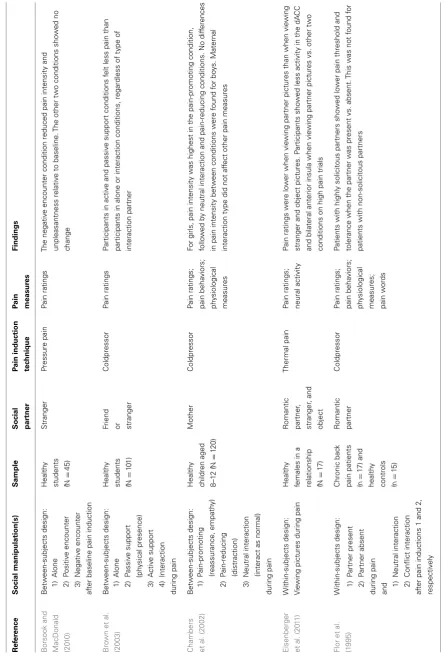
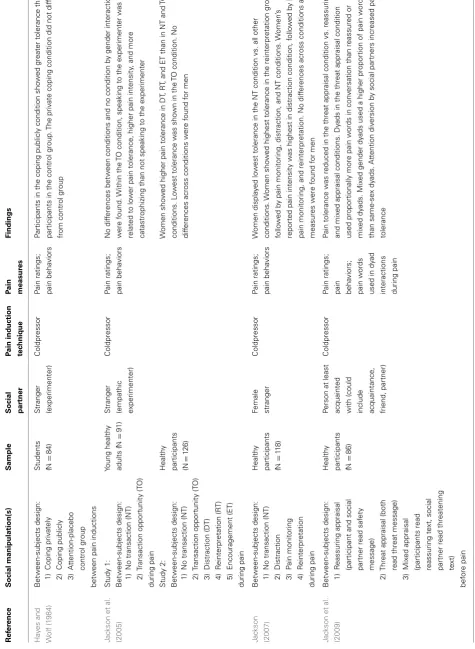
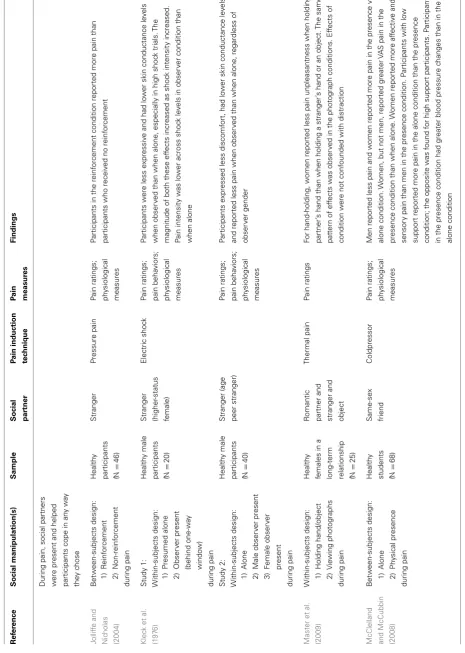
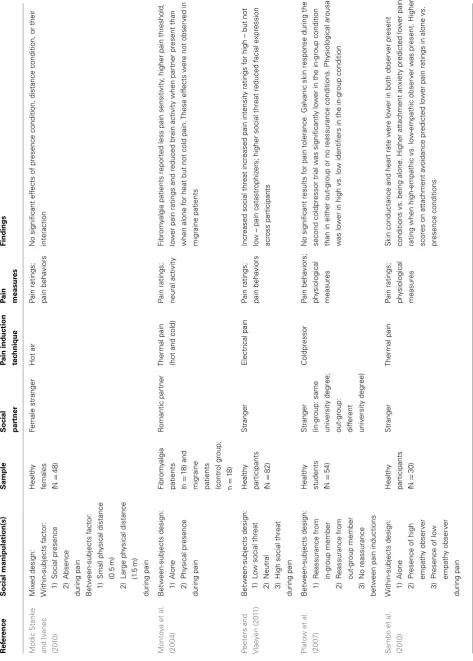
Twenty-six studies met the above five inclusion criteria. A sum-mary of included studies is presented in Table 1. The terms “participant” and “person in pain” refer to the individual receiv-ing pain, while “social partner” denotes the individual interactreceiv-ing with the person in pain, e.g., providing support. A variety of terms have been used in the literature in relation to the social mod-ulation of pain, including “social support,” “social interaction,” “interpersonal interaction,” “social presence,” “social influence,” and “social context.” Each of these terms appears to place a slightly different emphasis on the social partner; for example, “social sup-port” implies a directly caring attitude toward the person in pain compared to the broader term “social context.” For the purposes of our analysis, we used the term “social context” when dis-cussing the role of others generally and “interpersonal interaction” when discussing specific interactions between social partner and participant in pain as outlined above.
Due to the large variety in pain measures obtained across studies, we summarized and presented pain measures in five sub-categories in the table. (1) “Pain ratings” refers to participant-generated ratings, e.g., of pain intensity, unpleas-antness, or pain threshold; (2) “pain behaviors” denotes pain-related behaviors such as pain tolerance or facial expressions; (3) “pain words” refers to pain-related verbalizations to the social partner; (4) “physiological measures” pertains to mea-sures of heart rate, skin conductance levels, blood pressure, etc.; and (5) “neural activity” signifies magnetoencephalogra-phy (MEG), and blood-oxygen-level-dependent (BOLD) mea-sures obtained from functional magnetic resonance imaging (fMRI). Further, only findings relating to the above pain out-come measures were included in the table and additional vari-ables such as gender or catastrophizing were included only if they interacted with the social manipulation in affecting pain. We address methodological issues where relevant in the results section.
T able 1 | Ef fects of int er personal int er actions on pain: a summary of exper imental st udies to dat e. Ref er ence Social manipulation(s) Sample Social par tner P ain induction tec hnique P ain measur es Findings B orsook and MacDonald (20 1 0 ) B et w een-subjects design: Health y st udents ( N = 45) Stranger P ressure pain P ain ratings T he negativ e encounter condition reduced pain intensit y and unpleasantness relativ e to baseline. T he other tw o conditions sho w ed no change 1) Alone 2) P ositiv e encounter 3) Negativ e encounter af ter baseline pain induction Bro wn et al. (20 03 ) B et w een-subjects design: Health y st udents ( N = 1 0 1) F riend or stranger Coldpressor P ain ratings P articipants in activ e and passiv e support conditions felt less pain than participants in alone or interaction conditions, regardless of type of interaction partner 1) Alone 2) P assiv e support (ph y sical presence) 3) A ctiv e support 4) Interaction during pain Chambers et al. (20 02 ) B et w een-subjects design: Health y children aged 8–1 2 ( N = 1 20) Mother Coldpressor P ain ratings; pain beha viors; ph y siological measures F or girls, pain intensit y w as highest in the pain-promoting condition, follo w ed b y neutral interaction and pain-reducing conditions. No dif ferences in pain intensit y bet w een conditions w ere found for bo y s. Maternal interaction type did not af fect other pain measures 1) P ain-promoting (reassurance, empath y) 2) P ain-reducing (distraction) 3) Neutral interaction (interact as normal) during pain Eisenberger et al. (20 11 ) W ithin-subjects design: V ie wing pict ures during pain Health y females in a
relationship (N
= 1 7) R omantic partner , stranger , and object T hermal pain P ain ratings; neural activit y P ain ratings w ere lo w er when vie wing partner pict ures than when vie wing stranger and object pict ures. P articipants sho w ed less activit y in the dA CC and bilateral anterior insula when vie wing partner pict ures vs. other tw o conditions on high pain trials Flor et al. (1 995 ) W ithin-subjects design: Chronic bac k pain patients ( n = 1 7) and health y
controls (n
[image:5.595.74.520.57.718.2]T able 1 | Continued Ref er ence Social manipulation(s) Sample Social par tner P ain induction tec hnique P ain measur es Findings Ha y es and W olf (1 984 ) B et w een-subjects design: St udents ( N = 84)
Stranger (experimenter)
Coldpressor P ain ratings; pain beha viors P articipants in the coping publicly condition sho w ed greater tolerance than participants in the control group. T he priv ate coping condition did not dif fer from control group 1) Coping priv ately 2) Coping publicly 3) At tention-placebo control group bet w een pain inductions J ac kson et al. (20 05 ) St udy 1: B et w een-subjects design: Y oung health y adults ( N = 91)
Stranger (empathic experimenter)
Coldpressor P ain ratings; pain beha viors No dif ferences bet w een conditions and no condition b y gender interaction w ere found. W ithin the T O condition, speaking to the e xperimenter w as related to lo w er pain tolerance, higher pain intensit y, and more cat astrophizing than not speaking to the e xperimenter 1) No transaction (NT) 2) Transaction opport unit y (T O) during pain St udy 2: B et w een-subjects design: Health y participants (N = 1 26) W omen sho w ed higher pain tolerance in DT , R T, and E T than in NT and T O conditions. L o w est tolerance w as sho wn in the T O condition. No dif ferences across conditions w ere found for men 1) No transaction (NT) 2) Transaction opport unit y (T O) 3) Distraction (DT) 4) R einterpret ation (R T) 5) Encouragement (E T) during pain J ac kson (20 07 ) B et w een-subjects design: Health y
participants (N
= 11 8) F emale stranger Coldpressor P ain ratings; pain beha viors W omen displa y ed lo w est tolerance in the NT condition vs. all other conditions. W omen sho w ed highest tolerance in the reinterpret ation group, follo w ed b y pain monitoring , distraction, and NT conditions. W omen ’s reported pain intensit y w as highest in distraction condition, follo w ed b y NT , pain monitoring , and reinterpret ation. No dif ferences across conditions and measures w ere found for men 1) No transaction (NT) 2) Distraction 3) P ain monitoring 4) R einterpret ation during pain J ac kson et al. (20 09 ) B et w een-subjects design: Health y
participants (N
[image:6.595.61.537.67.717.2]T able 1 | Continued Ref er ence Social manipulation(s) Sample Social par tner P ain induction tec hnique P ain measur es Findings During pain, social partners w ere present and helped participants cope in an y w a y the y chose J ollif fe and Nic holas (20 04 ) B et w een-subjects design: Health y
participants (N
= 46) Stranger P ressure pain P ain ratings; ph y siological measures P articipants in the reinf orcement condition reported more pain than participants who receiv ed no reinf orcement 1) R einf orcement 2) Non-reinf orcement during pain Klec k et al. (1 97 6 ) St udy 1: W ithin-subjects design: Health y male
participants (N
= 20) Stranger (higher -st at us female) Electric shoc k P ain ratings; pain beha viors; ph y siological measures P articipants w ere less e xpressiv e and had lo w er skin conduct ance le v els when obser v ed than when alone, especially in high shoc k trials. T he magnit ude of both these ef fects increased as shoc k intensit y increased. P ain intensit y w as lo w er across shoc k le v els in obser v er condition than when alone 1) P resumed alone 2) Obser v er present (behind one-w a y windo w) during pain St udy 2: W ithin-subjects design: Health y male
participants (N
= 40) Stranger (age peer stranger) P ain ratings; pain beha viors; ph y siological measures P articipants e xpressed less discomf ort, had lo w er skin conduct ance le v els and reported less pain when obser v ed than when alone, regardless of obser v er gender 1) Alone 2) Male obser v er present 3) F emale obser v er present during pain Master et al. (20 09 ) W ithin-subjects design: Health y females in a
long-term relationship (N
[image:7.595.65.531.65.719.2]T able 1 | Continued Ref er ence Social manipulation(s) Sample Social par tner P ain induction tec hnique P ain measur es Findings Modic St ank e and Iv anec (20 1 0 ) Mix ed design: W ithin-subjects factor: Health y
females (N
= 48) F emale stranger Hot air P ain ratings; pain beha viors No significant ef fects of presence condition, dist ance condition, or their interaction 1) Social presence 2) Absence during pain B et w een-subjects factor: 1) Small ph y sical dist ance (0.5 m) 2) Large ph y sical dist ance (1 .5 m) during pain Monto y a et al. (20 04 ) B et w een-subjects design: Fibrom y algia
patients (n
=
1
8)
and
migraine patients (control
group; n = 1 8) R omantic partner T hermal pain (hot and cold) P ain ratings; neural activit y Fibrom y algia patients reported less pain sensitivit y, higher pain threshold, lo w er pain ratings and reduced brain activit y when partner present than when alone for heat but not cold pain. T hese ef fects w ere not obser v ed in migraine patients 1) Alone 2) Ph y sical presence during pain P eeters and Vlae y en (20 11 ) B et w een-subjects design: Health y
participants (N
= 82) Stranger Electrical pain P ain ratings; pain beha viors Increased social threat increased pain intensit y ratings for high – but not lo w – pain cat astrophiz ers; higher social threat reduced facial e xpression across participants 1) L o w social threat 2) Neutral 3) High social threat during pain Plato w et al. (20 07 ) B et w een-subjects design: Health y st udents ( N = 54) Stranger (in-group: same univ ersit y degree; out-group: dif ferent univ ersit y degree) Coldpressor P ain beha viors; ph y siological measures No significant results for pain tolerance. Galv anic skin response during the second coldpressor trial w as significantly lo w er in the in-group condition than in either out-group or no reassurance conditions. Ph y siological arousal w as lo w er in high vs. lo w identifiers in the in-group condition 1) R eassurance from in-group member 2) R eassurance from out-group member 3) No reassurance bet w een pain inductions Sambo et al. (20 1 0 ) W ithin-subjects design: Health y
participants (N
[image:8.595.64.538.56.718.2]T able 1 | Continued Ref er ence Social manipulation(s) Sample Social par tner P ain induction tec hnique P ain measur es Findings Sulliv an et al. (20 04 ) B et w een-subjects design: Health y st udents ( N = 64) Stranger Coldpressor P ain ratings; pain beha viors High cat astrophiz ers sho w ed communicativ e pain beha viors for a longer duration when obser v er present than when alone. T his ef fect w as not found for lo w cat astrophiz ers. W ithin the presence condition, high cat astrophiz ers reported more pain af ter the trial than lo w cat astrophiz ers 1) Alone 2) Obser v er present during pain V er v oort et al. (20 08 ) B et w een-subjects design: Health y children aged 9–1 5 y ears ( N = 84) P arent or stranger P ressure pain P ain ratings; pain beha viors L o w -cat astrophizing children e xpressed less pain when stranger present vs. when parent present. High cat astrophizing children e xpressed same amount of pain regardless of whether parent or stranger w as obser ving . T his pat tern w as not found for pain intensit y or anxiet y 1) P resence of parent obser v er 2) P resence of stranger obser v er during pain (c hildren could not see obser v er) V er v oort et al. (20 11 ) W ithin-subjects design: Health y children aged 1 0–1 8 y ears ( N = 38) P arent Coldpressor P ain ratings; pain beha viors L o w cat astrophiz ers displa y ed more pain when obser v ed than when presumed alone. High cat astrophizing children sho w ed same amount of pain when belie v ed alone as when obser v ed. R egardless of cat astrophizing , pain intensit y w as lo w er when parent obser v ed than when presumed alone. Higher le v els of parent al non-pain talk w ere related to increased facial e xpression and self-reports of pain only for high cat astrophizing children. F or lo w -cat astrophizing children, both measures of pain w ere independent of parent al pain talk 1) P resumed alone (told no one obser ving but parent w as obser ving from ne xt room) 2) 3-min interaction with parent bet w een CPT trials 3) P arent obser ving from ne xt room during pain Vlae y en et al. (20 09 ) B et w een-subjects design: Health y
participants (N
= 1 49) Stranger Coldpressor P ain ratings; pain beha viors P articipants in the threat condition e xperiencing pain alone reported more pain than participants in the other three conditions. In the threatening conte xt, the presence of a stranger inhibited pain facial e xpression during the pain induction. In the no threat conditions af ter the task, participants with an obser v er present displa y ed more pain e xpressions compared to participants who w ere alone 1) No threat/no obser v er 2) No threat/obser v er present 3) T hreat/no obser v er present 4) T hreat/obser v er present during pain W ilson and R uben (20 11 ) W ithin-subjects design: Interaction with partner bef ore and during pain Health y couples – w omen took part in pain
induction (N
[image:9.595.54.544.67.720.2]T
able
1
|
Continued
Ref
er
ence
Social
manipulation(s)
Sample
Social par
tner
P
ain
induction
tec
hnique
P
ain
measur
es
Findings
Y
ounger
et
al.
(20
1
0
)
W
ithin-subjects
design:
Health
y
st
udents
in
early
st
ages
of
romantic relationship (N
=
1
5)
R
omantic
partner
and
acquaint
ance
T
hermal
pain
P
ain
ratings;
neural
activit
y
P
artner
task
and
distraction
task
both
reduced
pain,
contrasted
with
vie
wing
acquaint
ance
photographs.
No
dif
ference
w
as
found
bet
w
een
partner
task
and
distraction
task.
P
ain
relief
in
the
partner
condition
w
as
positiv
ely
related
to
activ
ation
in
the
bilateral
caudate
head,
bilateral
nucleus
accumbens,
right
dorsolateral
prefront
al
corte
x,
right
superior
temporal
gyr
us,
bilateral
lateral
orbitofront
al
corte
x,
lef
t
am
y
gdala,
and
right
thalamus
(v
entral
anterior
nucleus),
and
negativ
ely
related
to
activit
y
in
the
right
superior
front
al
gyr
us,
lef
t
dorsal
anterior
cingulate
corte
x,
right
brainstem,
lef
t
anterior
insula,
right
put
amen,
lef
t
supplement
ar
y
motor
area,
and
lef
t
parahippocampal
area
1)
V
ie
wing
photographs
2)
Distraction
task
(w
ord-association
task)
during
pain
Moreover, the studies manipulated a variety of interpersonal factors including verbal interactions (e.g.,Chambers et al., 2002;
Jackson et al., 2005), non-verbal interactions (e.g., hand-holding;
Master et al., 2009), mere physical presence of the social partner (Brown et al., 2003;Vervoort et al., 2008), priming by photographs of partners (e.g.,Eisenberger et al., 2011) and manipulations of participants’ perception of the social partner (e.g.,Sambo et al., 2010;Peeters and Vlaeyen, 2011). Also, studies differed in terms of the characteristics of their sample, for instance participant and partner gender, and personality traits (e.g., pain catastro-phizing;Sullivan et al., 2004; or attachment style;Sambo et al., 2010; Wilson and Ruben, 2011). To review such heterogeneous data, and motivated by interactionist accounts of social cognition (e.g.,Bartz et al., 2011), we drew a distinction between studies in which social partners were perceived by the participants to be active or to possess possibility for action (see The Social Part-ner’s Possibility for Action), and studies in which social partners did not appear to have possibility for action (see No Perceived Possibility for Action). At the most apparent level, this involved distinguishing between on-line and off-line, or primed social con-texts. While the former included interactions in which the social partner was physically present, the latter used social stimuli (e.g., photographs) rather than interactions with a live social partner; thus, the two contexts differed in possibility for action by the social partner.
Secondly, independent of this “possibility for action” subdivi-sion, we distinguished between different types of relationships, according to whether the social partner was a stranger (e.g., Jack-son et al., 2005), a parent (e.g.,Vervoort et al., 2011), a friend (e.g.,McClelland and McCubbin, 2008), or the romantic partner (e.g.,Master et al., 2009) of the person in pain (see Relationship Between the Social Partner and the Person in Pain). We further particularly examined studies according to the interaction his-tory, contrasting rich interaction histories (parent, partner, and friend) with one-off interactions with strangers. Previous experi-ences with the social partner were considered to be important not only from an attachment perspective (see below) but also in terms of predictability of the other’s mental state, which we address in the discussion.
It is important to emphasize that while we organized the data around the categories of “possibility for action” and “type of relationship” separately, most aspects of interpersonal inter-actions are likely to interact in various dynamic ways to cre-ate the overall social context of pain. We point the reader to related sections as appropriate throughout the review and present an overall theoretical conceptualization (based on a free energy framework) of such dynamic patterns in the discussion.
THE SOCIAL PARTNER’S POSSIBILITY FOR ACTION
[image:10.595.97.253.89.711.2]Possibility for action and verbal interaction
In studies manipulating verbal interactions, the social partner was generally designed to act in a socially supportive role toward the person in pain. Social support is a complex construct, broadly con-ceptualized as “resources and interactions with others that help people cope with problems” (Masters et al., 2007, p. 11) and thus includes clear possibilities for action. Six studies (Chambers et al., 2002;Brown et al., 2003;Jackson et al., 2005,studies 1 and 2; Jack-son et al., 2009;Wilson and Ruben, 2011) included conditions in which the content of the interaction was unstructured (i.e., not pre-determined by the experimenters). InBrown et al.’s (2003)
study, this unstructured condition took the form of an “interac-tion” condition, in which the social partner was not instructed to behave in any particular way and the participant could shape the interaction. Three further conditions involved active support (explicitly supportive comments), passive support (presence with-out verbal interaction), and experiencing pain alone. Regardless of whether the social partner was a friend or a stranger, participants reported more pain in the unstructured interaction condition and when experiencing pain alone than they did in the active and pas-sive support conditions (Brown et al., 2003). Though the authors did not record the verbal content of the unstructured interaction condition, they suggested that the interaction could have included negative comments, which may have counteracted any benefits of social support. Similarly, Jackson and colleagues found in a first study that participants who spoke to an empathic exper-imenter (“transaction opportunity” condition) showed reduced pain tolerance and increased pain intensity compared to partici-pants who did not speak to the experimenter (Jackson et al., 2005,
study 1). This was mirrored in their second study (Jackson et al.,
2005,study 2), in which female participants displayed the lowest
pain tolerance in the transaction opportunity condition, compared to structured conditions, such as distraction and encouragement conditions. Lastly, Chambers and colleagues trained mothers to respond to their children’s pain in either pain-promoting ways (which included reassurance, empathy, mild criticism, and giving control to the child) or pain-reducing ways (which included dis-traction with an alternative task, humor, and “encouragement to use coping strategies”), or mother and child interacted as normal in an unstructured way. Girls reported highest pain intensity in the pain-promoting group, followed by the unstructured inter-action, and then the pain-reducing condition (Chambers et al., 2002). These effects were not present in boys, in accordance with other findings (Jackson et al., 2005,study 2;Jackson, 2007). As the pain-promoting condition included different social attitudes (e.g., empathy and mild criticism were included in the same interaction condition), it may have been more mixed than other structured conditions, in accordance with Brown et al.’s explanation regard-ing their unstructured condition. It thus seems that unstructured or mixed valence verbal interactions with an observer can worsen the experience of pain.
In addition,Wilson and Ruben (2011)discovered that adult attachment style moderated the relationship between unstruc-tured verbal interactions and pain. Attachment styles derive from attachment theory (Bowlby, 1977) and are individual differences in interpersonal relating formed in infancy over repeated interac-tions with a primary caregiver. These styles are relatively stable
across the lifespan (Main et al., 1985; Waters et al., 2000). In adulthood, attachment styles are generally classified as secure or insecure; the latter commonly being subdivided into anxious and avoidant styles (though attachment styles are also viewed dimen-sionally, e.g.,Fraley et al., 2000). In brief, securely attached adults are typically comfortable with closeness and depending on others, while anxious adults are preoccupied with the relationship and fear abandonment, and avoidant individuals are uncomfortable with closeness and lack trust in relationship partners (Hazan and Shaver, 1987). Wilson and Ruben found that in couples in which the woman received noxious stimuli, highest pain was reported when both members of the couple had higher levels of attachment anxiety. Further, avoidant women showed lower pain tolerance when the social partner was more anxiously attached, whereas securely attached women showed higher pain tolerance when the social partner was more anxiously attached (Wilson and Ruben, 2011).
In a related study examining the moderating role of attachment style, Sambo et al. (2010) manipulated the “perceived empa-thy” of a present social partner. While empathy predicts social support provision (Devoldre et al., 2010) and plays an impor-tant role in health care settings (Blasi et al., 2001; Tait, 2008), its effects on pain remain understudied in experimental con-texts, though some studies have included empathy as one element of a multifaceted manipulation (e.g.,Chambers et al., 2002; see above). “Perceived empathy” describes participants’ knowledge of the social partner’s level of understanding of their pain (Sambo et al., 2010). In a within-subject design, Sambo et al. informed participants prior to the administration of noxious stimuli that each of the experimenters present during each of two identi-cal blocks of noxious stimulation had either expressed high or low empathy for them during initial thresholding (determining a participant’s pain threshold). In a third condition, participants experienced pain alone. Although participant and social part-ner did not communicate during pain induction, the empathy manipulation was verbal, and is thus reviewed here. The per-ceived empathy manipulation interacted with the participants’ adult attachment style to affect pain, in that higher attachment anxiety predicted less pain in the high empathy compared to the low empathy condition. However, it should be noted that the manipulated facet of empathy was thus quite “cognitive” in nature and it is unclear how it may compare to natural social con-texts in which empathy is not only verbally but also behaviorally communicated.
Moreover, four experiments manipulated structured interper-sonal interactions, that is, instances of interperinterper-sonal interactions with set verbal elements (e.g., certain sentences the interaction partner always used) or a clear theme (e.g., supportive comments). Conditions such as distraction, reinterpretation, and encourage-ment (Jackson et al., 2005) and active support (Brown et al., 2003) all led to increased pain tolerance relative to transaction oppor-tunity conditions (see above). AlthoughChambers et al. (2002)
compared were quite varied, e.g., distraction vs. reinterpreting pain-related cognitions (Jackson et al., 2005) (see Discussion).
In summary, unstructured verbal interactions were found to increase pain and were influenced by adult attachment style. The effects of structured verbal interactions depended on the con-tent and valence of the interaction. While interactions with a clear theme positive valence, e.g., encouragement, reinterpreta-tion, and active emotional support, reduced certain pain mea-sures, interactions with mixed verbal content, and valence were pain-promoting, even when they included one of the above “positive” factors such as reassurance. Notably, the effects of verbal interactions on pain were mainly found in women but not men.
Possibility for action and non-verbal social presence
Thirteen studies manipulated social presence during pain with-out verbal communication. Manipulations ranged from the mere presence of a supportive other (e.g.,Flor et al., 1995) to varying the threat of the social partner (e.g.,Peeters and Vlaeyen, 2011) and interpersonal distance (Modic Stanke and Ivanec, 2010), to conditions using hand-holding (Master et al., 2009). While some manipulations did not involve any actual interaction between per-son in pain and observer, possibility for action by the social partner was salient as the social partner was physically present. Further, though several studies placed the social partner in an adjacent observation room (Kleck et al., 1976,studies 1 and 2;Vervoort et al., 2008, 2011), we considered that participants perceived their partners as capable of action because participants were aware that their social partner was observing themduringpain induction (as opposed to encounters prior to pain induction, see Social Partner without Perceived Possibility for Action during Pain). In addition, the results of these studies were comparable with the other studies in which the social partner was present in the same room, in that social manipulations influenced participants’ facial expressions, which portray a communicative intent (e.g.,Williams, 2002).
Kleck et al. (1976, studies 1 and 2) discovered that partici-pants showed reduced facial expressions and reported less pain when they were observed than when they were alone; this was also found for physiological measures (Sambo et al., 2010), pain rat-ings in participants who received passive support from a friend or a stranger (Brown et al., 2003) or reported having low levels of social support in general (McClelland and McCubbin, 2008); for participants with high levels of self-reported everyday social support, pain ratings were higher in the presence of a friend than alone (McClelland and McCubbin, 2008). In addition, participants with a solicitous spouse showed a reduced pain threshold and tol-erance in the presence of the spouse vs. alone (Flor et al., 1995). These latter findings fit within models of chronic pain positing that high social support may be positively reinforcing and ulti-mately lead to increased and prolonged pain (see Insights from Clinical Studies). Furthermore, in the aforementioned study on the role of perceived empathy on pain measures (Sambo et al., 2010), avoidant attachment was the only factor that moderated the relationship between social presence and pain report, such that higher attachment avoidance predicted more pain in the presence vs. alone condition, possibly because avoidant individuals prefer to cope on their own.
In addition to the above moderating factors, several studies which tested the communal coping model of pain catastrophizing (see Insights from Clinical Studies) reported that pain catastro-phizing moderated the effects of presence on pain. Unfortunately, the direction of such effects varied between studies: only high pain catastrophizers (Sullivan et al., 2004) vs. only low pain cat-astrophizers (Vervoort et al., 2011) were found to exhibit facial expressions for a longer time period in the presence of a social part-ner than when alone. In addition,Vervoort et al. (2008) demon-strated that low-catastrophizing children displayed less pain when a stranger rather than their parent was present. It is possible that a stranger may be perceived as more threatening than a parent, leading to the inhibition of facial expressions. Indeed, three studies varied perceived threat during the social situation. They found that the presence of a stranger during a threatening situation (Jackson et al., 2009;Vlaeyen et al., 2009), as well as the threat appraisal of the strangers themselves (Peeters and Vlaeyen, 2011) led to atten-uated facial expressions of pain (Vlaeyen et al., 2009;Peeters and Vlaeyen, 2011) and reduced pain tolerance (Jackson et al., 2009), i.e., increased pain sensations.
Lastly, we considered pain-modulatory effects of interpersonal distance between social partner/s and the person in pain. Interper-sonal distance can modulate intimacy between people (Sussman and Rosenfeld, 1982), and violations of personal space can increase aversion of the social partner (Sussman and Rosenfeld, 1978). Conversely, a sense of safety and intimacy provided by a trusted other might be diminished if they are physically distant and unable to help. However, only one study directly investigated the effects of physical distance on pain (Modic Stanke and Ivanec, 2010). In this study, the social partner was positioned either 0.5 or 1.5 m from the person receiving pain. No effects of distance on pain were found. However, both social partner and participants in pain were female. Women have been found to maintain smaller interpersonal distances (i.e., choose to sit closer together) and do not see close distances as violations of space compared to men (Sussman and Rosenfeld, 1978, 1982;Holland et al., 2004). Therefore, at present, we cannot draw any conclusions on the effects of interpersonal distance on pain.
Overall, social presence differentially impacts pain according to individual differences of the person in pain or of the social part-ner. Participants reporting higher levels of everyday social support and higher attachment avoidance, as well as participants with a solicitous spouse, had worse pain outcomes when a social partner was present than when they were alone, while participants with low levels of everyday social support showed the opposite effects. Unfortunately, the direction of the moderating effect of pain cata-strophizing remains unclear, while environmental threat seems to exacerbate pain.
computer-generated beeps did not differ across conditions). This finding is consistent with a study showing that unpleasantness ratings and neural responses to the threat of electric shocks were reduced when participants held their spouse’s hand as opposed to a stranger’s hand or no hand at all (Coan et al., 2006). Although the latter study assessed “threat of pain” and not painper se(and hence was not included in Table 1), taken together both these studies suggest that holding the hand of the romantic partner can reduce pain-related unpleasantness. However, a few methodolog-ical issues deserve mention. Hand squeezing was not measured in either study and holding a stranger’s hand may be a somewhat unusual and potential socially uncomfortable condition. Further, a condition without touch (i.e., holding no hand at all) arguably differs from the other two in terms of multisensory integration.
In conclusion, verbal and non-verbal interpersonal interac-tions with perceived possibility for action were found to be pain-reducing only when specific verbal behaviors with positive intention, such as supportive comments, reinterpretation, and dis-traction, or non-verbal interactions with a clear positive social meaning (e.g., holding one’s partner’s hand) were manipulated and participants had low levels of self-reported social support and attachment avoidance. By contrast, more unstructured, emotion-ally negative, varied, or vague social manipulations led to increases in pain, either directly (e.g., presence conditions with unstructured verbal content) or in interaction with variables linked to the per-ception of threat and anxiety, such as catastrophizing and threat manipulations.
NO PERCEIVED POSSIBILITY FOR ACTION
Studies with no possibility for action were defined by the absence of a social partner during pain induction. Here, social manipu-lations were classified according to two sub-categories. In a first set of three studies, interpersonal variables were manipulated by priming. Second, two studies involved a partner who was present
beforepain induction but notduringpain induction.
Primed interpersonal contexts
Three studies presented participants with photographs of their partner and either a stranger and an object (Master et al., 2009;
Eisenberger et al., 2011) or an acquaintance (Younger et al., 2010). All studies discovered that viewing pictures of the partner reduced pain relative to viewing stranger/acquaintance and object pictures. While such effects might be explained by distraction or familiar-ity of the partner, two studies assessed distraction (see Possibilfamiliar-ity for Action and Non-Verbal Social Presence for details onMaster et al., 2009) andYounger et al. (2010)included a word-association task condition. They also controlled for familiarity by compar-ing viewcompar-ing pictures of a partner with viewcompar-ing pictures of an equally attractive and familiar acquaintance. However, the other two studies cannot rule out possible familiarity effects (Master et al., 2009;Eisenberger et al., 2011) andEisenberger et al. (2011)
cannot exclude possible distraction effects.
Two of the three studies (Younger et al., 2010; Eisenberger et al., 2011) also employed functional neuroimaging techniques and reported neural activations during the different social con-ditions. Most notably, pain attenuation in the partner picture condition was positively linked to activation in areas associated
with safety-signaling (the ventromedial prefrontal cortex; Eisen-berger et al., 2011), and reward processing (e.g., the caudate head and nucleus accumbens;Younger et al., 2010). Based on this finding, two neurocognitive mechanisms potentially medi-ating the beneficial effects of viewing partner pictures were put forward. First, ventromedial prefrontal cortex activation was not only found during partner picture viewing but was further neg-atively correlated with both pain ratings and pain-related neural activity. Hence, it was claimed that viewing pictures of an attach-ment figure (i.e., the partner) signaled safety in the face of threat (pain), which contributed to pain attenuation (Eisenberger et al., 2011). The second proposed mediating mechanism concerned reward-related neural activation, which has previously been pos-itively associated with intense love (Aron et al., 2005). InYounger et al.’s (2010) study, viewing pictures of the partner and a dis-traction task both reduced pain, but only the partner condi-tion was associated with activacondi-tion in the bilateral caudate head, bilateral nucleus accumbens, amygdala, hypothalamus, pregen-ual ACC, and medial orbitofrontal cortex, which play a role in the processing of rewards (Aron et al., 2005). Reward process-ing has in turn been linked to pain attenuation (e.g., Wood, 2006) and placebo analgesia (e.g.,Scott et al., 2007). Such mech-anisms may explain why pain was not attenuated when viewing pictures of strangers or acquaintances, who are not involved in a pre-existing loving attachment relationship with the person in pain.
Taken together, showing participants photographs of their romantic partner may reduce pain by priming attachment or love themes and related brain networks. The role of distrac-tion and familiarity in some of these studies remains to be established.
Social partner without perceived possibility for action during pain Two studies employed a social partner who interacted with the participant before but was absent during pain induction (Platow et al., 2007; Borsook and MacDonald, 2010). The first investi-gated whether the effects of reassuring comments depended on in-group or out-group status of the social partner, while Borsook and MacDonald studied socially induced hypoalgesia (reduced pain in the face of a stimulus that is normally perceived as painful;
IASP, 1994) by negative vs. positive interpersonal interactions. Contrary to studies with perceived possibility for action (see The Social Partner’s Possibility for Action), both found that positive encountersbefore pain induction did not affect pain ratings or pain tolerance during pain induction, highlighting the impor-tance of possibility for action. However, reassurance from an in-group member did selectively reduce physiological arousal ( Pla-tow et al., 2007). Furthermore, negative interpersonal interactions preceding pain induction were associated with reductions in pain ratings, attributed to social harm induced hypoalgesia (Borsook and MacDonald, 2010).
RELATIONSHIP BETWEEN THE SOCIAL PARTNER AND THE PERSON IN PAIN
The reviewed studies differed in terms of the relationship between participant and social partner. Most commonly, the social part-ner was a stranger (18 studies), the partpart-ner (six studies), a parent (three studies), or a friend/acquaintance (four studies) of the par-ticipant1. In one study, the nature of the social partner was not specifically defined (had to be at least an acquaintance but could also be the partner,Jackson et al., 2009; counted as acquaintance above), and thus it was not possible to evaluate relationship effects in this study.
Perhaps due to partner manipulation studies coming from sim-ilar research backgrounds and being designed to be positive (e.g., supportive), these studies generally found that the romantic part-ner reduced pain, although this effect was moderated by adult attachment style (Wilson and Ruben, 2011) and spouse solici-tousness (Flor et al., 1995). Also, social manipulations were more homogeneous when the social partner was the romantic part-ner, presumably because they were constrained by the couple’s relationship history. For example, a very empathic partner being assigned to a high social threat condition in which they supposedly chose to administer a high number of pain trials to their partner (as inPeeters and Vlaeyen, 2011) might not seem believable to the person in pain. Likewise, certain social manipulations such as hand-holding may be inherently more suitable for pre-existing relationships.
The effects of interacting with strangers were most diverse, possibly due to the range of social manipulations, social mean-ings, and varying degrees of knowledge of the stranger’s mental state. For example, some studies gave participants no informa-tion about the stranger’s mental state (e.g.,Sullivan et al., 2004, stated that the stranger was present only to monitor the water temperature of the coldpressor), some presented personally irrel-evant information about the stranger’s mental state (e.g.,Vervoort et al., 2008, informed participants that the stranger present was a student observing the experimental session to learn about the pain procedure) and others gave participants personally relevant information regarding the stranger’s mental state, for example how much empathy the stranger had for the participant (Sambo et al., 2010). When interactions with different types of social partners were compared within the same experiment, with social manip-ulations remaining constant, partners were found to reduce pain more than strangers or acquaintances (Master et al., 2009;Younger et al., 2010; Eisenberger et al., 2011), but most of these studies did not control for familiarity effects. Parents did not differ from strangers in their impact on pain intensity but increased facial expressions of pain relative to strangers in low-catastrophizing children (Vervoort et al., 2008). Furthermore, interacting with a friend was found not to differ from interacting with a stranger in affecting pain (Brown et al., 2003).
Overall, it appears that the type of relationship between partic-ipant and social partner may moderate how interpersonal factors affect pain. In general, pain seems to be attenuated when the
1Note that the total number exceeds 26 because several studies included more than
one type of social partner.
participant is receptive to support (e.g., anxiously attached) and knows the partner is positively oriented toward them (but not highly solicitous), either due to a pre-existing relationship (e.g., between romantic partners), or experimental manipulation (e.g., empathy levels of previously unknown confederates are commu-nicated to the participant). Comparing different types of rela-tionships within the same experimental set-up to tease apart the relative influence of social manipulation and interpersonal rela-tionship on participants’ pain remains an ongoing issue for future research.
DISCUSSION
This paper aimed to provide a systematic review of experimental studies investigating how interpersonal factors influence pain per-ception and communication. We examined 26 studies with a focus on the type of social manipulations, individual difference char-acteristics, and the person in pain’s relationship with the social partner. Overall, we found that unambiguously positive verbal and non-verbal interactions or positive interpersonally relevant primed interactions reduced pain, while negative, mixed valence, or ambiguous interactions led to increases in pain-related mea-sures. These findings were moderated by individual differences of the person in pain and the social partner, such as adult attachment style.
INTERPERSONAL INTERACTIONS AS PRECISION MODULATION
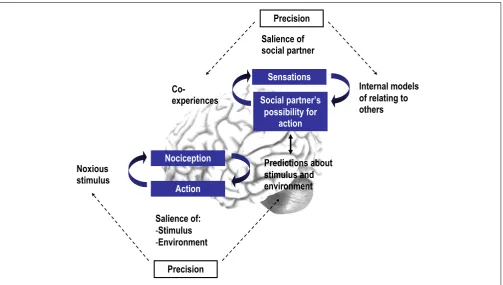
Based on the reviewed studies, we put forward that interpersonal interactions may affect the precision of an individual’s predictions and thus pain in at least two ways: (a) by signaling the safety or threat of noxious stimuli (interoceptive salience) or (b) by signal-ing the safety or threat of the environment in which stimuli occur (environmental salience).
Precision of predictions about an impending stimulus itself The present review revealed that certain interpersonal interac-tions may directly signal information about the safety or threat of an impending stimulus. Supportive interactions focusing on the painful sensations themselves increased pain tolerance, while interactions in which the threat of noxious stimuli was empha-sized reduced pain tolerance. Specifically, a social partner helping participants to re-interpret uncomfortable sensations as neutral or positive sensations increased pain tolerance scores (Jackson et al., 2005) and decreased pain intensity ratings (Jackson, 2007). The social partner signaling that the noxious stimulus was safe thus shaped participants’ prediction that the stimulus was safe, which in turn may have reduced the salience of the stimulus and thus pain. In contrast, both social partner and participant reading threaten-ing information about the noxious stimulus increased the number of pain words in their conversation during pain and decreased pain tolerance relative to other conditions (Jackson et al., 2009), possibly because the social partner amplified the threat and hence improved precision and salience.
Moreover, the present results showed that interpersonal inter-actions may influence the salience of noxious stimuli by modulat-ing the participant’s attention toward or away from the noxious stimulus. Verbal interactions directing the participant’s attention away from the noxious stimulus (e.g., Chambers et al., 2002;
Jackson, 2007), non-social distraction conditions (Younger et al., 2010), and conditions in which distraction could have been a factor (Eisenberger et al., 2011) generally found that diverting attention away from the noxious stimulus led to increased pain tolerance and reduced pain ratings. Therefore, distraction might attenuate pain by reducing the precision of top-down predictions, which in turn may have decreased the salience of the noxious stimulus and hence pain.
Precision of predictions about the environment
The reviewed studies highlighted that in addition to information about the impending stimulus itself, interpersonal interactions may signal safety or threat of the environment in which the stimu-lus will occur, and thus modulate pain. In particular, interactions with a clear content regarding the provision of safety or support, or the partner having the possibility to act to protect the person in pain might increase the perception of environmental safety and thus indirectly decrease the perceived threat of noxious stimuli. Indeed, explicitly supportive verbal (e.g.,Brown et al., 2003) and embodied (hand-holding;Master et al., 2009) interactions reduced pain, while pain-promoting and threatening conditions increased pain (Chambers et al., 2002; Jackson et al., 2009). By contrast, interactions without a clearly supportive content or possibility of supportive action may not increase the safety value of the envi-ronment. Indeed, the present review revealed that unstructured or
mixed verbal interactions led to more pain relative to structured verbal interactions with supportive content.
THE PERCEPTION OF INTERPERSONAL INTERACTIONSPER SE In addition to the influence of interpersonal interactions on pain, the perception of interpersonal interactions themselves may depend on (a) an individual’s prior beliefs about interpersonal relating and the meaning of related interactions, and (b) the cer-tainty or precision with which an interpersonal interaction may predict environmental threat or safety.
Prior beliefs about interpersonal relating
When examining the effects of interpersonal interactions on pain, it is vital to take into account “historicity”; that is, the back-drop of individual social development against which current social exchanges are placed (Schilbach et al., in press). In a free energy framework, such consideration entails examining not only how predictions are updated “on-line,” but also across the life span in slower time scales (Friston, 2009). In the reviewed studies (as well as in clinical studies on pain, see Insights from Clini-cal Studies), several individual characteristics were found to play a role in the perception of interpersonal interactions and how they influence pain. While the role of factors such as catastro-phizing and gender remains unclear, the application of attach-ment theory in pain research has generated some convincing results. Attachment theory posits that from early in life, attach-ment figures can serve as a “secure base” from which the infant explores the world (Bowlby, 1977). If a secure attachment bond is formed over repeated instances of responsive caregiving, the “secure base” signals safety to the infant, while insecure bonds lead to more ambivalent or even threatening signals from others. These bonds lead to the formation of attachment styles, which remain relatively stable into adulthood (see also section Possibility for Action and Verbal Interaction). In the clinical pain literature, insecure attachment styles have been proposed as crucial vul-nerability factors for developing chronic pain (Meredith et al., 2008).