This is a repository copy of
Approximate methods for the solution of quantum wires and
dots : Connection rules between pyramidal, cuboidal, and cubic dots
.
White Rose Research Online URL for this paper:
http://eprints.whiterose.ac.uk/1681/
Article:
Califano, M. and Harrison, P. (1999) Approximate methods for the solution of quantum
wires and dots : Connection rules between pyramidal, cuboidal, and cubic dots. Journal of
Applied Physics, 86 (9). pp. 5054-5059. ISSN 1089-7550
https://doi.org/10.1063/1.371478
[email protected] https://eprints.whiterose.ac.uk/ Reuse
See Attached
Takedown
If you consider content in White Rose Research Online to be in breach of UK law, please notify us by
Approximate methods for the solution of quantum wires and dots:
Connection rules between pyramidal, cuboidal, and cubic dots
M. Califanoa)and P. Harrison
Institute of Microwaves and Photonics, School of Electronic and Electrical Engineering, University of Leeds, LS2 9JT, United Kingdom
~Received 20 April 1999; accepted for publication 29 July 1999!
Energy eigenvalues of the electronic ground state are calculated for rectangular and triangular GaAs/Ga0.6Al0.4As quantum wires as well as for cuboidal and pyramidal quantum dots of the same
material. The wire ~dot! geometries are approximated by a superposition of perpendicular independent finite one-dimensional potential wells. A perturbation is added to the system to improve the approximation. Excellent agreement with more complex treatments is obtained. The method is applied to investigate the ground state energy dependence on volume and aspect ratio for finite barrier cubic, cuboidal, and pyramidal quantum dots. It is shown that the energy eigenvalues of cubes are equal to those of cuboids of the same volume and aspect ratio similar to one. In addition, a relationship has been found between the volumes of pyramidal quantum dots~often the result of self-assembling in strain layered epitaxy!and cuboidal dots with the same ground state energy and aspect ratios close to one. © 1999 American Institute of Physics.@S0021-8979~99!04721-0#
I. INTRODUCTION
While the long term interest in semiconductor quantum well heterostructures is beginning to yield a generation of electronic devices which exploit quantum mechanical properties,1attention is now turning towards solid state sys-tems with a higher degree of carrier confinement. The impe-tus at the moment is to understand the electronic and optical properties of these quantum wires and dots2–8 in order to evaluate their potential in the next generation of electronic and photonic devices.
The theoretical understanding of the basic properties of the two-dimensional electron ~or hole! systems in quantum wells is well developed. However the added degrees of quan-tum confinement exhibited in lower dimensional systems, i.e., one-dimensional ~1D! quantum wires and zero-dimensional~0D!quantum dots, produces a greatly increased complexity in the Schro¨dinger equation which is usually the cornerpiece of theoretical methods.
Approaches to developing theoretical models for the lower dimensional systems are often generalizations of quan-tum well methods. For example, the generalization of the empirical pseudopotential technique from a superlattice to a quantum wire or dot is straightforward and merely involves a change in the atomic base.9However, the compromise is that the standard computational implementation which is based around direct diagonalization of the Hamiltonian matrix is only solvable for several hundred atoms at most, because of the rapidly increasing base set required. Qualitatively sim-pler physical models such as the envelope function/effective mass approximations conversely produce highly complex multidimensional Schro¨dinger equations which need to be solved with finite element analysis10 or plane wave expansions.11
The purpose of this work is to introduce a simple, almost analytical, technique for approximating the solutions in both rectangular cross-section wires and cuboid quantum dots, as well as demonstrating possible routes to the more difficult triangular cross-section wires,12,13and strategically important pyramidal dot.3,4,7,10The approach is based upon construct-ing the required multidimensional solutions to Schro¨dconstruct-inger’s equation from combinations of decoupled one-dimensional quantum well solutions. These approximate solutions can be improved by the addition of an appropriate correction from perturbation theory.
II. THEORY
The starting point is the three-dimensional time-independent Schro¨dinger equation in the effective mass ap-proximation
F
2\2
2
S
¹ 1m*~x, y ,z!¹
D
1V~x, y ,z!G
C~x, y ,z!5EC~x, y ,z!, ~1!
where m* represents the effective mass of the carriers and the confinement system is specified by the spatial dependen-cies.
If V(x, y ,z) is a general potential energy there is no easy way to solve this equation, but great simplifications occur if it can be written as a sum of three independent potentials
V(x), V( y ), V(z), as is the case for a rectangular quantum
wire ~or a cuboidal quantum dot! surrounded by an infinite confining potential, which represents the N- ~two- or three-! dimensional analogy to the one-dimensional infinitely deep quantum well. For such a potential it is possible to separate the motion along the three coordinate axis and the three-dimensional Schro¨dinger equation decouples into N identical one-dimensional quantum well and 32N free particle
equa-a!Electronic mail: [email protected]
5054
tions. The 3D eigenfunction is therefore the product of three one-dimensional eigenfunctions, and the total energy is the sum of the individual components.
In the more realistic situation of a finite confining poten-tial it is no longer possible to write the potenpoten-tial V(x, y ,z) as a sum of independent terms, thus the motion cannot be sepa-rated into normal independent components.
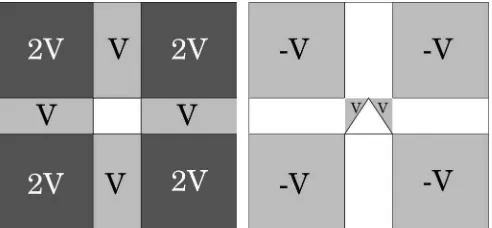
A very useful~even though rough!approximation, how-ever, could be to allow the motion in the finite case to be decoupled, thus considering the total potential V(x, y ,z) as a sum of N ~two for the wire, three for the dot!independent one-dimensional finite quantum wells, each with a depth equal to the real confining potential, as is sketched in Fig. 1 for the case of the wire ~the generalization to the dot is straightforward!.
The size of the barrier is so chosen that the wave func-tion is zero at the boundaries. The only difference with the real potential is in the corners in the barrier region outside the wire, where the two one-dimensional potentials overlap giving rise to a value of 2V ~for the dot we have outer re-gions where either two or three one-dimensional well tial overlap giving a value of 2V or 3V for the total poten-tial!.
Typical wires and dots have characteristic dimensions greater than 100 Å, a range where the penetration of the wave function into the barrier is small, thus the approxima-tion with this potential could be good.
We can account for this deviation from the real potential by adding to the Hamiltonian a perturbation V
8
which takes the value 2V (2V and22V for the dot! in these critical areas, restoring the correct value of V(x, y ,z)5Vevery-where. A sketch of this perturbation for N52 ~wire!is pre-sented in Fig. 1 ~with a further perturbation which restricts the motion in a triangular wire!. The problem of solving:
F
2\2
2
S
¹ 1m*~x, y ,z!¹
D
1V~x, y ,z!1V8
~x, y ,z!G
C~x, y ,z!5EC~x, y ,z!, ~2!
can now be treated by means of time-independent perturba-tion theory, since, although the perturbaperturba-tion is large com-pared to the energy eigenvalues of the system, it is weighted over regions where the eigenfunctions and hence the matrix elements
^
CjuV8
uCi&
are small.Therefore, the eigenfunctions are a product of N one-dimensional finite well solutions and the total energy E 5E(0)
1E(1)
1. . . , where E(0)is simply the sum of the
cor-responding finite well energies and the first order correction to the nth energy eigenvalue is
En (1)
5
^
CnuV8
uCn&
. ~3!We have found that it is not necessary to go further to higher perturbation orders, since the second order correction is al-ready negligible ~of the order of a few percent of the first order correction!.
III. RESULTS
Energy eigenvalues and eigenvectors were calculated for rectangular and triangular GaAs/Ga0.6Al0.4As quantum wires
as well as for cuboidal and pyramidal quantum dots of the same material. In the calculations the following parameters have been used:14 for electrons: mW50.0665m0, mB 50.0858m0, V5276 meV; for heavy holes: mW 50.3774m0, mB50.3865m0, V5184 meV. m0 is the free
electron mass. The one-dimensional wave function and ener-gies are then used to calculate numerically the matrix ele-ments of the perturbation and the total N-dimensional energy.
A. Rectangular cross-section quantum wires
Calculations have been made for different values of the base width b, ranging from 20 to 220 Å keeping the ratio between base width b and height h constant b/h520/14. The results are presented in Fig. 2. The graph on the left-hand side illustrates the total energy Egs5Egs
(0)
1Egs(1)of the elec-tronic ground state in the wire as a function of b. The energy FIG. 1. Confining potential for a rectangular wire, as assumed in our model:
[image:3.612.53.299.52.166.2]left-hand side. Perturbation used for the case of a triangular wire: right-hand side.
FIG. 2. Energy eigenvalues of rectan-gular quantum wires~barrier potential: dashed line!: left-hand side. First per-turbation order correction to the energy eigenvalues of rectangular quantum wires: right-hand side.
5055
[image:3.612.52.423.620.760.2]decreases, as expected, as the wire width increases, as a con-sequence of the inverse-of-the-well-width dependence of the one-dimensional unperturbed energies. The value of E is greater than the confining potential for a wire width of 20 Å showing that this state is not bound. This is in contrast with the theoretical prediction that 2D wells have always at least one bound state, however shallow or narrow the well,15 and could mean that our model is not suitable for very narrow wires with linear dimensions less than 40 Å. This inadequacy of the model to reproduce the behavior of narrow systems is also shown in Fig. 2~right-hand side!, where the first pertur-bation order correction is presented as a function of the base width b. The correction is large for b520 Å, whereas it very small for all the other base widths, constituting an a
poste-riori justification of our initial assumptions about the
appli-cability of the perturbative method to this particular case. This correction becomes negligible for b.140 Å as the value of the ground state wave function in the corners tends to zero.
B. Cuboidal quantum dots
The 3D quantum-confinement structure treated in this section is a cuboid with the dimensions Lx, Ly, and Lz, obtained starting from the rectangular wire configuraton of Sec. III A by adding along the direction z of the free motion, between2Lz/2 and Lz/2, a further one-dimensional well~
fi-nite! confining potential perpendicular to ~and of the same height of!the other two potential wells.
Since our method is a simple approach to the study of zero-dimensional systems, we wanted to avoid all the unnec-essary complications such as those deriving from the use of the degenerate perturbation theory: therefore we consider only dots of cuboidal shape ~i.e., with different dimensions
Lx, Ly, and Lz) and not regular cubes, the energy of the
one-dimensional well in each direction i (i5x, y, z) in
which the motion is decoupled depending only on the well width L ~the dimension Li in that direction!.
It has been reported16 that finite barrier cubic quantum dot energy eigenvalue calculations agree to within 3% of those for a sphere with a volume of (0.96)3times the volume of the cube.
Assuming a similar equivalence formula to hold for the cuboidal case, we have chosen the dimensions Liso that the
volume of the resulting cuboid was the same as that of a cube of side Lx, and the aspect ratio Qc~which in this case we define as the square root of the base surface divided by the height!was similar to one (Qc51.09!.
Although we are aware that the hole band structure com-plexity requires a more sophisticated approach to be treated properly, heavy holes energy eigenvalues have been calcu-lated within our simple model as well, by using the well and barrier effective masses and the confining potential value listed in Sec. III. It has been found16 that the effect of the nonparabolicity of the bands does not significantly affect the energy eigenvalues for the GaAs/Ga0.6Al0.4As system.
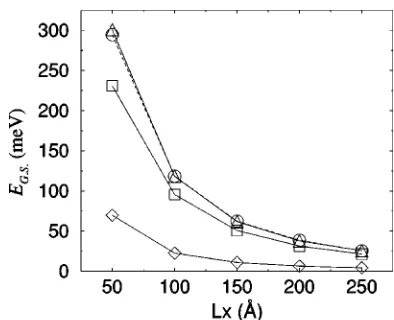
Electron and hole energy eigenvalues as well as the en-ergy shift are presented in Fig. 3, as a function of the Lx
dimension, together with the results obtained by
Gango-padhyay and Nag16 for the energy shift of electron-heavy-hole transitions for cubic dots of side Lx, by means of a
plane wave expansion of the envelope function ~ unfortu-nately experimental results are not available for this kind of 3D quantum-confinement structures with sharply defined in-terfaces!. Our calculated values are in excellent agreement ~to within less than 2% for Lx550 Å to less than 0.5% for
Lx5250 Å!with those relative to the cubic structure. Such an agreement, while not very surprising for dimensions greater than 90 Å ~where the calculated values differ from those obtained for the infinite-barrier model by about 2% in Ref. 16!, is striking for smaller structures, considering the simplicity of our method if compared to that used in Ref. 16, where the envelope function is expanded in terms of a com-plete orthonormal set of periodic functions and the energy eigenvalues derived by diagonalizing the resultant matrix equation. This proves the suitability of our perturbative method for the study of simple shaped 3D structures.
The first perturbation order correction to the ground state energy for electrons and heavy holes is presented in Fig. 4. As in the rectangular wire case, this correction for the elec-trons is less than 1% of the unperturbed energy for Lx 5100 Å ~for Lx550 Å it is less than 5%! and becomes
negligible for wider quantum boxes, where the penetration of the wave function into the barrier is smaller. This behavior is even more accentuated in the heavy holes case, where the heavier effective mass is responsible for the smaller value of the wave function in the classically excluded region.
The equivalence between the energy eigenvalues of cuboids and cubes of the same volume has been explored by performing further calculations for cuboids with differents aspect ratios over a wide range of volumes. As expected, the behavior of the energy as a function of the aspect ratio
E(Qc) is symmetrical with respect to E(1) in the range
in-vestigated@in other words E(Qc)'E(1/Qc), for Qc<3],
be-cause of the symmetry of the cube.
We have found the energy variation DE(Qc)5uE(Qc) 2E(1)u, between the energy of a cuboid of aspect ratio Qc
[image:4.612.337.534.48.208.2]and a cube of the same volume, to have some volume depen-dency. The energy has been found to be to within 3% of that of the cube for aspect ratios ranging from 0.67 to 1.5. for
~100 Å!3 cuboids. For~50 Å!3cuboids the same variation of
energy occurs over a wider range of Qc, i.e., from 0.526 to
1.9, whereas for ~250 Å!3 cuboids for 0.76
,Qc,1.3. In
other words for Qc in that range the ground state energy
levels of the cuboids are almost ~to within 3%! undistin-guishable from those of the cubes of the same volume.
C. Triangular cross-section quantum wires
The starting point is the rectangular wire of Sec. III A. To reproduce the triangular shape, we proceed as before and add to the Hamiltonian ~1! a perturbation Vpert(x, y ,z) 5V
8
(x, y ,z)1V9
(x,y ,z), where V8
is the same as before and accounts for the overlap of the one-dimensional well potentials, and V9
5V within the triangular shaded regions ofFig. 1 right-hand side, the boundaries being given by
y52xLL y x
1Ly, ~4!
y522xLy
Lx
1Ly. ~5!
We again try to solve the new Schro¨dinger equation
F
2\2
2
S
¹ 1m*~x, y ,z!¹
D
1V~x, y ,z!1Vpert~x, y ,z!
G
C~x, y ,z!5EC~x, y ,z!, ~6!using the perturbative method. In this case, however, the perturbation unlike the rectangular wire case covers an area inside the 2D well where the wave function is expected to assume high values, so that the matrix elements of V
9
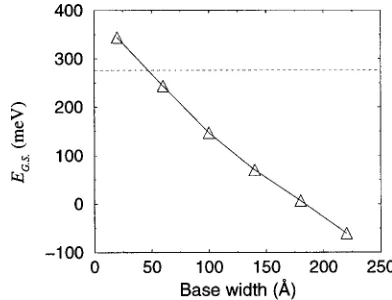
are not small compared to the energy eigenvalues. This, in principle, limits a priori the applicability of the perturbative method to medium sized wires and low energy states, where the wave functions should have the smallest value in the new barrier region. The results are shown in Figs. 5 and 6. The total ground state energyEgs5Egs(0)1E(1)gs1Egs(2), ~7!
is displayed in Fig. 5 as a function of the triangular wire base. The second order perturbation correction for base widths greater than 60 Å~since with b560 Å there are only two bound states in the one-dimensional well, which are not
enough to perform a proper second order calculation!have also been included. As expected, here we again find the un-bounded state for b,40 Å as in Fig. 2. A new feature of this graph is the behavior of the energy for base widths greater than 180 Å where it becomes negative.
As seen from Fig. 6 it is a consequence of the second order correction whose value is negative and higher, in modulus, than that of the sum of the unperturbed energy and the first order term. Figure 6 also shows the limitations of this perturbative approach for the wider triangular wires: the second order term diverges, rather than converging towards zero, as the base width becomes wider, and becomes pre-dominant compared to the unperturbed one.
[image:5.612.51.443.51.192.2]Furthermore, comparing Figs. 6 and 5 it is apparent that the first order correction becomes greater than ~or of the same order of magnitude as! the unperturbed energy for b ;100 Å. So, even if the first order terms seem to converge slowly towards zero as b increases, their values are too high to be considered just a small correction to the unperturbed energy, in other words the perturbation which has been in-troduced to produce the triangular shape cannot be consid-ered small, which is the essential feature for this approach to give accurate results. Nevertheless, the energy eigenvalues calculated for wire bases of 100 and 140 Å are in very good agreement with those obtained by Gangopadhyay and Nag12 ~unfortunately they do not provide data for base widths less than 100 Å!in their more sophisticated calculations using the eigenfunctions of an infinite-barrier triangular wire as basis functions for expanding the envelope function.
[image:5.612.336.532.582.732.2]FIG. 4. First order correction to the ground state energy of a quantum cuboid. Electrons: left-hand side heavy holes: right-hand side.
FIG. 5. Energy eigenvalues of triangular quantum wires. Barrier potential: dashed line.
5057
D. Pyramidal quantum dots
The quantum dot structure treated in this section is a pyramid with a rectangular base of dimensions Lx and Lz,
and height Ly obtained from the cuboid of Sec. III B by
adding a perturbing potential which further restricts the mo-tion in the pyramidal region.
Following the considerations about the results obtained for the triangular wire in Sec. III C we did not expect that the applicability of our model could be exploited further in the pyramidal case with satisfactory results for a wide range of base width. The limitations in this case should have been even more severe, due to the decreased dimensionality of the system. Therefore we have limited the range of the dimen-sion used around the value of 60 Å which had been found to be accessible by our aproach in the triangular wire case.
Since there are not enough bound states for a proper second order calculation to be performed for Lyvalues of 40 and 50 Å (E(2)is of the order of 10232, if the few available
bound states wave functions are used!, only the ground state energies of pyramids higher than 50 Å contain the second order correction. From the behavior of this correction for
Ly.50, however, we estimate the inaccuracy of the energy
eigenvalues for Ly<50 Å to be not greater than a few
per-cent of the total energy.
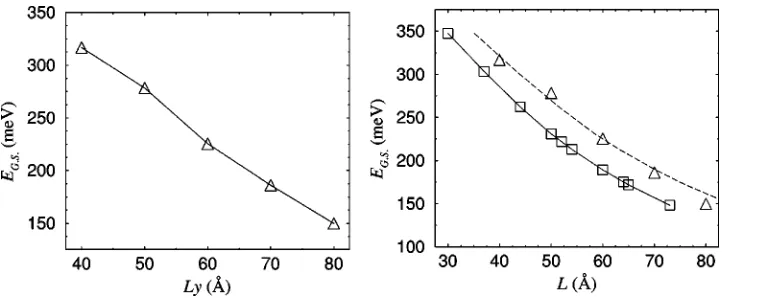
The results are shown in Fig. 7 ~left-hand side!, where we plot the electron energy eigenvalues as a function of the height Ly. The other dimensions are so chosen that the base
be nearly ~not exactly to avoid degenerate energy eigen-states! square ~the typical shape of self-organized quantum dots obtained by Stranski–Krastanov growth, see for ex-ample, Ref. 17 and reference therein!, and the volume of the
pyramid be the same as that of a cube with side Ly. The
resulting aspect ratio Qp~which we define for the pyramid as
Qp5
A
Ab/2h, where Ab is the base surface and h is theheight!is 0.86 for all the structures.
It is therefore possible to compare Fig. 7~left-hand side! with the electronic ground state energy of a cuboidal quan-tum dot, displayed in Fig. 3.
It is apparent that the relationship
Egscub~L!5Epyrgs~aL!, ~8!
holds between the ground state energies of the pyramidal and cuboidal dots considered. Our calculations show an agree-ment to within 3% for a value ofa51.17 for pyramidal dots heights between 40 and 70 Å. This provides confirmation that the perturbative theory has been applied correctly and gives an independent estimate of the accuracy of the energy eigenvalues derived and of the range of pyramid dimensions ~volumes and aspect ratios!for which that approach is suit-able.
[image:6.612.50.428.50.191.2]The agreement is poorer for the 80 Å height dot~about 7%!. This difference may be explained in terms of the re-duced accuracy to which its energy eigenvalue is known. In fact, when, as this is the case, the first order correction is much greater than the unperturbed energy ~in other words, when the perturbation cannot be regarded as small!, the per-turbative method becomes inaccurate. The electronic ener-gies of cuboids ~from Fig. 3! and pyramids ~from Fig. 7, left-hand side!, together with a fit fora51.17~dashed line!, are presented in Fig. 7 ~right-hand side! for the dimension range of interest (L is the side of the cube with the same volume!.
FIG. 6. Second ~left-hand side! and first~right-hand side!perturbation or-der correction to the energy eigenval-ues of triangular quantum wires.
FIG. 7. Ground state energy eigenval-ues of pyramidal quantum dots ~ left-hand side!. Comparison between pyra-midal ~triangles! and cuboidal
~squares, solid line!quantum dots en-ergy eigenvalues; dashed line: fit for
[image:6.612.51.434.610.759.2]A similar behavior as in the triangular wire case has been found for both first and second order corrections, the former seeming to converge for Lyvalues greater than 100 Å while the latter diverges in the same way as the triangular one.
As for the case of the cuboid, the behavior of the energy eigenvalues of pyramids of a given volume and differents aspect ratios has been explored by performing further calcu-lations over the range of volumes considered.
The behavior of the energy as a function of the aspect ratio E(Qp) is no longer symmetrical with respect to E(1),
but has a flat profile for low Qp, with a minimum at about
Qp50.4. For the~40 Å!3pyramid, for instance, it is constant
to within 1% of this value from Qp50.25 ~i.e., h52b) to
0.67 (h53b/4).
Again we have found a volume dependence in the en-ergy differenceDE(Qp). The energy has been found to be to
within 3% of E(Qp51) for aspect ratios 0.85,Qp,1.15 for
the volumes@up to~80 Å!3] range investigated. In this case
also there is an inverse-to-volume dependency: for ~40 Å!3
pyramids the same variation of energy occurs over a wider range of Qp, i.e., from 0.06 to 3.3.
IV. CONCLUSIONS
Eigenfunctions and eigenvalues of the finite one-dimensional potential well have been used to decouple the Schro¨dinger equation for 2- and 3D quantum confinement systems into N independent one-dimensional ones, by con-sidering the total finite potential V(x, y ,z) as a sum of N independent one-dimensional wells. The deviation of this re-sulting potential from the actual one has been accounted for by the use of a perturbative method.
A further perturbation has been added to obtain the tri-angular and pyramidal shape, starting from the recttri-angular wire and cuboidal dot.
It was found that limitations in the applicability of the method arise in the former cases, due to the large size of the perturbation matrix elements, leading to a severe restriction of the range of the system dimensions which can be treated successfully. Nevertheless, in this range, the calculated en-ergy eigenvalues are in good agreement with those obtained with more sophisticated calculations.
Results for the energy shift in electron-heavy-hole tran-sitions have been presented for the case of the cuboidal dot
with aspect ratio of 1.09, which are in excellent agreement with those calculated for cubic structures with the same vol-ume by means of a plane wave expansion of the envelope function and numerical diagonalization of the resulting ma-trix equation. This shows that an equivalence holds between the ground state energy eigenvalues of cubic and cuboidal structures of the same volume and aspect ratios similar to one~i.e., 0.76,Qc,1.3).
A similar equivalence has been found to hold between the ground state energies of cuboidal and pyramidal dots of aspect ratios similar to 1 ~i.e., 0.85,Qp,1.15), with the
side of the pyramid 1.17 times the side of a cuboid having the same volume.
ACKNOWLEDGMENTS
The authors ~M.C.! and~P.H.! would like to thank the School of Electronic and Electrical Engineering, the Faculty of Engineering and the University of Leeds for financial sup-port.
1M. J. Kelly, Low-Dimensional Semiconductors - Materials, Physics, Tech-nology, Devices~Oxford University Press, London, 1995!.
2H. Temkin, G. J. Dolan, M. B. Panish, and S. N. G. Chu, Appl. Phys. Lett.
50, 413~1987!.
3
Y. Nagamune, M. Nishioka, S. Tsukamoto, and Y. Arakawa, Appl. Phys. Lett. 64, 2495~1994!.
4Y. Arakawa, Solid-State Electron. 37, 513~1994!.
5Y. Nagamune, M. Nishioka, S. Tsukamoto, and Y. Arakawa, Solid-State
Electron. 37, 579~1994!.
6F. E. Prins, G. Lehr, M. Burkard, H. Schweizer, M. H. Pilkuhn, and G. W.
Smith, Appl. Phys. Lett. 62, 1365~1993!.
7S. Ruvimov, P. Werner, K. Scheerschmidt, U. Goesele, J. Heydenreich, U.
Richter, N. N. Ledentsof, M. Grundmann, D. Bimberg, V. M. Ustinov, A. Yu Egorov, P. S. Kop’ev, and Zh. I. Alferov, Phys. Rev. B 51, 14766
~1995!.
8R. Turton, The Quantum Dot - A Journey into the Future of Microelec-tronics~Freeman-Spektrum, Oxford, 1995!.
9
P. Harrison, Quantum Wells, Wires and Dots: Theoretical and Computa-tional Physics~Wiley, Chichester, 1999!.
10M. A. Cusack, P. R. Briddon, and M. Jaros, Phys. Rev. B 54, R2300 ~1996!.
11D. Gershoni, H. Temkin, G. J. Dolan, J. Dunsmuir, S. N. G. Chu, and M.
B. Panish, Appl. Phys. Lett. 53, 995~1988!.
12S. Gangopadhyay and B. R. Nag, J. Appl. Phys. 81, 7885~1997!. 13T. Inoshita and H. Sakaki, Appl. Phys. Lett. 79, 269~1996!. 14J. Shertzer and L. R. Ram-Mohan, Phys. Rev. B 41, 9994~1990!. 15
J. H. Davies The Physics of Low-Dimensional Semiconductors - An Intro-duction~Cambridge University Press, London, 1998!, p. 122.
16S. Gangopadhyay and B. R. Nag, Nanotechnology 8, 14~1996!. 17M. Grundmann, O. Stier, and D. Bimberg, Phys. Rev. B 52, 11969~1995!.
5059