Fish and People: Lesson Plan and Teacher’s Guide
Table of Contents
Introduction ... 2
Module 1: Plenty More Fish in the Sea: Are fish populations declining? ... 3
Key concepts ... 3
Important terms ... 4
Suggested learning activities ... 4
Module 2: Where Do Fish Come From? An introduction to the life cycles of fish and other marine animals ... 6
Key concepts ... 6
Important terms: ... 7
Suggested learning activities ... 8
Module 3: How to Make Fish: What controls the rate of increase of fish populations? ... 10
Key concepts ... 10
Important terms ... 11
Suggested learning activities ... 12
Module 4: Larval Lifeboats Near and Far: Scales of dispersal and scales of management. ... 16
Key concepts ... 16
Important terms ... 17
Suggested learning activities ... 17
Module 5: Fish and People, Today and Tomorrow: Human populations and fishery management ... 22
Key concepts ... 22
Important terms ... 23
Suggested learning activities ... 24
[image:1.595.130.464.125.309.2]Introduction
Welcome to the Fish and People Lesson Plan and Teacher’s Guide. This guide is designed to be used in conjunction with the Fish and People DVD resource. It has five sections, each of which is to be used with the corresponding module of the DVD. It provides an overview of the key concepts in each module, definitions for all key terms used, and one or more suggested learning activities. It also contains some extra scientific information about some aspects of the biology and ecology of marine animals that can facilitate class discussions of key points in the DVD modules.
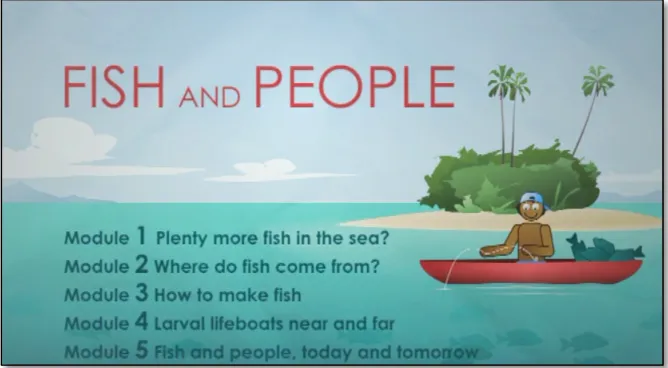
The modules of the DVD are (in order):
1. ‘Plenty more fish in the sea’ (explores that all marine fisheries have limits)
2. ‘Where do fish come from’ (explores the basics of the life cycle of marine animals)
3. ‘How to make more fish’ (explores biological and ecological features of marine animals that affect the way their populations respond to fishing)
4. ‘Larval lifeboats near and far’ (explores factors affecting dispersal distance of larvae of different marine animals and why this matters for fishery management)
5. ‘Fish and people, today and tomorrow’ (explores factors affecting human populations and fishing pressure)
There are many sources of free information available that complement the lessons in the Fish and People DVD. One excellent source is the Guide and information sheets for fishing communities created by the Secretariat of the Pacific Community (SPC). These can be downloaded here:
http://www.spc.int/coastfish/en/component/content/article/393-‐guide-‐and-‐ information-‐sheets-‐for-‐fishing-‐communities.html
The SPC’s Fish and Food Security policy brief is also useful and can be found here:
http://www.spc.int/sppu/index.php?option=com_content&task=view&id=25&It emid=83
These documents are also in the Resources Folder on the Fish and People DVD.
Module 1: Plenty More Fish in the Sea: Are fish populations
declining?
Key concepts
1. Most marine species of economic importance have declined in both abundance and size over the past 50 or so years.
2. Most elders can tell stories of when marine species, that are now scarce, were once abundant, and could be caught close to home and with little effort.
3. Improvements in fishing technology, combined with rapid increases in human populations and the demands of both domestic and export markets, mean that fishing pressure is much higher than in the past, and continues to increase, while the rate of ‘production’ of fisheries (i.e. the rate at which fisheries can be sustainably harvested) remains constant. This means that all fisheries will ultimately be over-‐harvested if they are not managed.
4. Marine fisheries have been over-‐harvested all over the world, and Melanesia is one of the few places where some fisheries are still in relatively good condition. This is largely due to low human population pressure compared to elsewhere, but this is changing as human populations increase.
5. It is possible to ‘collapse’ a fishery by over-‐harvesting it, after which it may never recover. It’s the equivalent of killing ‘the goose that laid the golden egg’.
6. An understanding of the biology and population dynamics of fished species is critical for good fishery management.
7. Fished populations can be monitored through time to objectively record changes. Two key methods are 1) visual census (often done by diving and counting fish along a transect) and 2) catch per unit effort (CPUE).
Important terms
Ecosystem – a biological community of interacting organisms and their physical environment.
Fishery – refers to the population of a species that is fished, and the people who do the fishing.
Fishery collapse – when a fished population has been reduced to such a small size, over a large area, that there are too few individuals remaining to reproduce successfully in order to rebuild the population.
Healthy – in this context refers to a population of a fished species that is capable of reproducing itself easily and sustainably. It may also refer to an ecosystem that is functioning normally and therefore capable of supporting productive fisheries (in contrast to one which is degraded through pollution or other types of destruction or degradation, such as blast fishing or heavy sedimentation).
Marine invertebrate – any species of marine animal without a backbone. The term is most commonly used in the context of fisheries to refer to species of subsistence or commercial importance, particularly crustaceans (crabs, lobsters) molluscs (snails, clams, squid and octopus) and echinoderms (sea cucumbers, urchins, starfish).
Over-‐harvesting – refers to the practice of removing individuals from a population at a rate faster than the population’s natural replacement rate. It inevitably leads to the collapse of a fishery.
Suggested learning activities
ORAL HISTORY EXERCISE
Tools and materials required
An elderly relative or friend who fished regularly in their youth, and is willing to talk.
Procedure
Students are to ask their elderly friend or relative the following questions: 1. What year were you born, and where did you live as a young person?
2. What were the main kinds of fish and marine invertebrates you used to catch or harvest as a young person?
4. What changes have you observed in the size and abundance of marine fish and invertebrates during your lifetime?
5. What are the causes of the changes (if any) that you have observed?
Students should report the answers to these questions back to the class the following day. Get them to reflect critically on their elders’ responses and discuss what they might mean in terms of different fisheries and their sustainability. Do their elders’ explanations of the cause of decline of fish abundance and sizes match with scientific explanations? If any of the students have done any fishing themselves they should comment on their own observations of size, abundance and effort required in relation to the responses of the elders to their questions.
Note: if all or most of the students are living away from home and do not have access to elderly relatives, perhaps the teacher could locate a knowledgeable elder in the local community, who could answer questions from the class during the lesson.
Assessment
Students should be assessed in terms of the diligence with which they solicited responses from their elders, and the extent to which they displayed critical thinking about the responses, particularly to question 5.
Module 2: Where Do Fish Come From? An introduction to the
life cycles of fish and other marine animals
Key concepts
1. An understanding of the life-‐cycle of marine fish and invertebrates is critical to understanding the connection between over-‐harvesting and the decline of fished populations, in extreme cases to the point of collapse.
2. Most marine fish and invertebrates have a larval stage that disperses in the plankton, and is capable of settling in a new location and becoming a juvenile. Ecologists refer to the process of settlement as recruitment.
3. The distance that larvae of different species disperse is determined by their biology and behaviour, and the prevailing currents. Some species have larvae that are capable of dispersing much greater distances than others.
4. Most fish and marine invertebrates reproduce by spawning – the
simultaneous release of gametes (sperm and eggs) into the water. Sperm then fertilise eggs and the fertilised egg becomes a zygote, which then undergoes cell division to form an embryo, which then develops into a larva. Some species have several (named) larval stages.
5. Eggs, sperm and larvae of most species are microscopic and are either invisible or difficult to see with the naked eye. Most sperm are very tiny and impossible to see individually with the naked eye, but when first released into the water they are usually visible collectively as a milky cloud. Most fish eggs are between 0.5mm and 1.5mm diameter (skipjack tuna eggs are 1mm diameter) and newly hatched fish larvae are similar in size to the egg.
6. The mortality rate (i.e. risk of death) is highest during the larval stage, and decreases as an individual grows. Most larvae die before reaching the juvenile stage.
7. As adults are removed from a population by fishing, so the rate of production of larvae declines, which in turn reduces the rate of recruitment, and
therefore the rate of replacement by juvenile fish. A sustainable rate of fishing removes fish at a slower rate than the rate of recruitment. Over-‐ fishing removes fish faster than they can be replaced, leading to population decline, further reductions in larval production and recruitment, and eventual collapse of the population.
Important terms:
Fishery collapse – a fishery collapses when there are no longer sufficient
numbers of mature adults remaining in the population to successfully reproduce. Once a fishery collapses, the only way to recovery is if larvae arrive from another reproducing population, or if reproductive adults are transplanted from another population.
Gamete – germ cell, usually either sperm (male) or egg (female) – the fundamental units of sexual reproduction. Gametes contain half as many
chromosomes as normal (somatic) cells. The process of fertilisation involves one sperm cell fusing with an egg, and the chromosomes of each cell combine to produce the full complement of genetic material required for growth of a new individual.
Larva (plural: larvae) – microscopic dispersive stage of most marine organisms. The larvae of most marine animals float near the surface of the sea and are transported by currents. Many larvae can swim to some extent, and most are capable of settling once ready, and after detecting appropriate habitat.
‘Settlement’ in some species (e.g. most invertebrates) means actually landing on the sea bed, and in others (e.g. most reef fish) it means swimming down to take up residence near the sea bed. Larvae of species that spend their whole life in the open sea (e.g. tuna) never really ‘settle’ – they just keep growing.
Metamorphosis – the dramatic physical transformation that some larvae undergo after settlement, particularly in species which become permanently attached to the substrate (e.g. corals, clams) or which crawl on the substrate (e.g. trochus, sea cucumbers, starfish). After metamorphosis, most organisms
resemble small adults, and are referred to as juveniles.
Mortality – death rate. Fisheries scientists calculate rates of mortality and use these in fisheries models. Mortality is extremely high for larvae of most species and declines as size increases.
Plankton – the small and microscopic organisms drifting or floating in the sea, including many species of single-‐celled and multi-‐celled plants and animals, bacteria, small crustaceans, and the eggs and larval stages of larger animals.
Recruitment – Ecological definition: the process of settling and becoming attached to, or resident at, a particular site or area of sea bed or reef. Fisheries definition: the entry of new individuals to a fishery – this refers to the process of growing to a fishable size, rather than settlement of juveniles.
Spawning – the simultaneous release of gametes into open water by males and females of a species to achieve external fertilisation of eggs.
Zygote – the cell resulting from the fusion of egg and sperm. The zygote then undergoes repeated cell division to become an embryo and then a larva.
Suggested learning activities
QUIZ ON SEXUAL REPRODUCTION IN MARINE ANIMALS
Tools and materials required
Module 2 of the Fish and People DVD
Procedure
After watching Module 2, set the following questions for the students: 1. What are gametes?
2. What is a zygote? 3. What are larvae?
4. What is the primary purpose of larvae?
5. What is the main mode of transport for larvae? 6. What is metamorphosis?
7. Name two groups of marine animals that do not reproduce by releasing gametes into open water
8. What is a spawning aggregation and what sorts of animals form spawning aggregations?
10. What happens if the recruitment rate falls below the rate of mortality of the remaining adults in the population?
Assessment
Answers:
1 – 3 – see definitions above, under ‘Important terms’. 4. Dispersal
5. Drifting on ocean currents (even though many larvae can swim, some more powerfully than others)
6. See definition above
7. Possible answers: Sharks, turtles, sea-‐snakes, dolphins and whales – these all copulate (engage in sexual intercourse) and lay eggs or give birth to live young; In some groups of fish, including damsel fish (family Pomacentridae), trigger fish (family Balistidae) and flying fish (family Exocetidae), the female attaches eggs to a solid object (usually the sea bed), and these are fertilised by a male after
attachment. In some cardinal fish (family Apogonidae), the male broods the eggs in its mouth after they are fertilised. When the larvae hatch from these attached or brooded eggs some may be dispersed by ocean currents, but typically not as far as larvae from eggs that are released in open water. Squid, octopus and cuttlefish copulate and then attach eggs to a substrate, or brood them. Crabs and crayfish copulate, then the female carries the eggs on its abdomen until they hatch and the larvae are dispersed by the currents.
8. Spawning aggregations occur when mature males and females of some species of fish migrate to a particular location (usually a reef passage) in large numbers, usually at a particular time of month, to spawn. Many species of groupers (family Serranidae) are commonly observed forming spawning aggregations, but several other families of fish also aggregate to spawn.
9. Overfishing reduces the rate of recruitment. 10. The population collapses.
Module 3: How to Make Fish: What controls the rate of
increase of fish populations?
Key concepts
This module is concerned with a number of important aspects of the biology of fish and other marine animals that affect the rate of increase of their populations. This information can give students a better understanding of why populations of some species increase more rapidly after they are reduced by fishing than others.
1. Growth rate, age at maturity, and life span vary greatly among different species of marine animals. Sardines and squid are well known to be fast growing and short-‐lived, while turtles, dugongs and some large species of fish are slow growing and long-‐lived.
2. Following depletion by fishing, the populations of short-‐lived and fast growing species can rebuild themselves much faster than populations of long-‐lived, slow growing species. Populations of the short-‐lived and fast-‐ growing species are regarded as being more resilient to overfishing. They are also regarded as having higher productivity.
4. Age at maturity determines how quickly a species can start reproducing. All species must grow for a time before they can accumulate the energy reserves to allocate to reproduction. Populations of species that are able to reproduce early and often tend to have high rates of increase. Knowing the size and/or age at maturity is also useful for setting minimum size limits for some species, so that they can be guaranteed an opportunity to reproduce before they are caught by fishers.
Important terms
Biology – the scientific study of living organisms. Biology in this context also refers to the features of a particular organism or class of organisms.
Egg brooding – this is when a parent fish (often the male) protects eggs that have been attached to a rock (by remaining near the eggs and defending them from other fish that try to eat them), or are stored inside the parent’s mouth. Brooding species tend to produce relatively few, large eggs. The Cardinal Fish (Apogonidae) and Damsel Fish (Pomacentridae) families have many species that brood their eggs. Brooding increases the chances of survival of each fertilised egg.
Fecundity – the measure of reproductive output. Highly fecund species produce many eggs. However high fecundity can be offset in some species by high
mortality at the egg or larval stage.
Fishing Mortality combined). Natural Mortality is extremely high for larvae of most species and declines as size increases. It also varies greatly for adults of different species. Short-‐lived species like squid or sardines have high rates of natural mortality because a large proportion of the population will die of natural causes within a year, compared to long-‐lived species like sharks or dugong.
Population – all of the individuals of a given species in a defined geographical area.
Resilience – the ability to withstand or recover quickly from difficult conditions (e.g. heavy fishing pressure).
Suggested learning activities
1. ORAL HISTORY EXERCISE
Tools and materials required
An elderly relative or friend who fished regularly in their youth, and is willing to talk. (Boarding schools could try to bring a local elder in to talk to the class).
Procedure
Students are to ask their elderly friend or relative the following questions:
1. Have you observed any changes in abundance of the following species in your lifetime?:
a. Dugong b. Turtle c. Sharks
d. Bump-‐head Parrotfish (Topa) e. Indian Mackerel (Roma) f. Scads (Buma)
g. Sardines (Katukatu) h. Squid (Nuto)
i. Green Snail j. Trochus
k. Sea cucumbers (beche-‐de-‐mer): sandfish, white teat, prickly redfish, lollyfish, and amberfish
2. Have some of these species declined more than others?
3. What is your explanation of any differences in the amount that populations of these different species have declined?
Ask the students to discuss any differences in the observations and explanations of their elders with the kinds of changes that the biological concepts in Module 3 would predict.
Note that some reported patterns may in fact diverge from what the biological rules would predict, as there are some factors that we cannot obtain information about. For example, the biology of sardines (Katukatu) suggests that they should still be quite abundant, even after heavy fishing pressure, but Abraham Baenasia and others report that Katukatu are now becoming scarce in Langalanga Lagoon. This could be because fishing pressure is extremely heavy, or there may be other reasons, such as changes in water quality or habitat that have affected the
abundance of this species.
Assessment
Students should be assessed in terms of the diligence with which they solicited responses from their elders, and the extent to which they displayed critical thinking about the responses. The relative resilience to overfishing of each species is given in the table below. (More information in Resources Folder)
Species Resilience level, and associated biological features
Dugong Low resilience – dugongs are long-lived (70 years), late-maturing (4-17), and have low fecundity (one live birth every 3 to 7 years).
Turtle Low resilience – turtles are long-lived (30-80 years), very late-maturing (20-40 years), and have low fecundity (a few dozen eggs laid on shore every 2 to 3 years).
Sharks Low resilience – sharks are long-lived (10-40 years), late-maturing (5+ years), and have low fecundity (usually less than 10 live young/year).
Bump-head parrotfish (Topa)
Low resilience – Bump-head parrotfish are long-lived (28 years), and late-maturing (6 years), but once mature can produce many eggs.
Indian mackerel (Roma)
High resilience – these fish grow fast, mature at 0.7 years, live for 3-4 years and produce many eggs.
Scads (Buma) High resilience – these fish grow fast, mature at 0.8 years, live for 3 years and produce many eggs.
Sardines (Katukatu)
High resilience – these fish grow fast, mature at 0.4 years, live for 1.4 years and produce many eggs.
Squid (Nuto) High resilience – squid grow fast, mature at 0.5 years, live for 8-12 months and produce on average about 700 eggs.
Green Snail Low resilience. The biology of Green Snails suggests they should have medium resilience – they mature at 3-4 years, live for perhaps 10-15 years, and large females can produce millions of eggs. However Green Snails have become almost extinct throughout much of the species’ range in Melanesia, suggesting the population has been heavily overfished, and may in fact have
collapsed. The relatively shallow depth range of this species (<20 metres) – which means that divers on breath-hold can easily collect most individuals of the population - may be one reason for its low resilience to overfishing. More information on Green Snail here:
http://www.spc.int/DigitalLibrary/Doc/FAME/Brochures/Anon_11_ISFC_16_GreenSnail.pdf Trochus Medium resilience – Trochus live for 10-15 years, mature at 2 years, and produce many eggs.
Trochus also have a shallow depth range, like Green Snail, but they are good at hiding. As a result, trochus fisheries have mostly not collapsed, though most are badly overfished. More information on trochus here:
http://www.spc.int/DigitalLibrary/Doc/FAME/Brochures/Anon_11_ISFC_11_Trochus.pdf Sea
cucumbers (Beche-de-mer)
Different species of sea cucumbers have different levels of resilience, and in addition to
longevity, age at maturity and fecundity, there are two other important factors affecting resilience – these are depth range and market price. Species with shallow depth range and high market price (e.g. Sandfish – Holothuria scabra) have been severely overfished. This is despite the fact that Sandfish is one of the faster growing species that reaches maturity at one year of age. Species which occur at depths beyond the range of divers (e.g. White Teat – Holothuria fuscogliva) are depleted, but patches of deep populations remain unfished. Low priced species are less heavily fished, even if they have shallow distributions. More details about beche-de-mer biology can be found here:
http://www.spc.int/DigitalLibrary/Doc/FAME/Brochures/Anon_11_ISFC_09_SeaCucumbers.pdf
2. EXPLORATION OF FISHBASE
Tools and materials required
A computer with access to the Internet, and (if available) a video/data projector that can enable the students to see the screen.
Procedure
This exercise involves exploring some of the information that is available about fish biology on www.fishbase.org
1. Navigate to the Fishbase home page: www.fishbase.org.
2. Type the scientific name of a long-‐lived fish in the genus and species search boxes (see example):
(NB Bolbometopon muricatum is the Bumphead Parrotfish, or Topa)
3. Click on the ‘search’ button – this should take you to the information page for this species.
4. Scroll down the page till you find the sub-‐heading ‘Tools’
5. Click on the ‘Life-‐history tool’ – this opens a new page which provides a large amount of biological information on this species, including:
a. Max length: 130cm TL (TL = total length) b. Life span (approx.): 28.8 years
c. Age at first maturity: 6.1 years
d. Fecundity (no value given for this species)
years (whichever is longer), the population is vulnerable to extinction. (Highly resilient species usually have a decline
threshold of 0.99. That means you have to reduce the population to 1% of it’s normal level for three generations or ten years before it becomes vulnerable to extinction).
Go back to the Fishbase search page and try searching on the names below, then investigating the information about each of them in the Life-‐history Tool:
Herklotsichthys quadrimaculatus (Sardine / Katukatu)
Selar crumenopthalmus (Scad / Buma)
Rastrelliger kanagurta (Indian mackerel / Roma)
Caranx melampygus (Blue-‐fin trevally / Mamula)
Katsuwonus pelamis (Skipjack tuna / Bonito)
Scomberomorus commerson (Spanish mackerel / Kingfish)
Carcharhinus melanopterus (Black-‐tip reef shark)
Plectropomus areolatus (Coral trout / ‘Open mouth’, Panjara)
Sphyraena barracuda (Barracuda)
The students could make a comparative table of the different life-‐history traits and discuss the differences between species, e.g.
Max length
(cm) Life span (yr) Age at 1
st
maturity (yr) Fecundity Resilience/ productivity Bolbometopon
muricatum 130 28.8 6.1 No Data Low / 0.85 Selar
crumenopthalmus 30 3.2 0.8 No Data High / 0.99 Caranx
melampygus
117 12.5 2.7 460,672 Medium / 0.95
Katsuwonus pelamis
110 6.1 1.3 400,000 High / 0.99
Carcharhinus melanopterus
200 17.1 3.3 Live-‐
bearer
Medium / 0.95
Sphyraena
barracuda 200 32.1 6.4 No Data Low / 0.85
Module 4: Larval Lifeboats Near and Far: Scales of dispersal
and scales of management.
Key concepts
In this module we build on some of the concepts introduced in Module 2, and look in greater detail at the process of larval dispersal and the biological attributes of larvae that affect how far they travel before settling and
transforming into juveniles. Concepts and important terms covered in Module 2 are not repeated here.
1. Larval biology – the length of time larvae must remain drifting in the plankton before they are capable of settling determines how far they are likely to disperse from where they were spawned. Larvae that are unable to feed while in the plankton must settle as soon as they have exhausted the energy supply they were born with (the yolk of their egg). Larvae that are able to feed (on microscopic organisms) while in the plankton are usually capable of dispersing greater distances. If food is abundant in the plankton they are also more likely to survive until they encounter a suitable place to settle.
2. Settlement cue – when larvae are ready to settle they often swim towards the smell of certain things, like red encrusting algae on a reef. They might also swim toward the sound of waves breaking. In some cases larvae swim towards something they see. These smells, sounds and sights that attract larvae are called settlement cues. They help larvae find
3. Connectivity – the study of how populations of marine animals are connected by larval dispersal is called connectivity. Knowledge of larval dispersal patterns is crucial for understanding how populations are replenished at different spatial scales (i.e. large or small distances from each other). Connectivity patterns depend on larval biology and
behaviour, and ocean currents, as well as the numbers and densities of reproducing adults in a population.
A breeding population in one location can supply larvae to replace adults removed by fishing in another location, but this depends on distance, larval biology and currents. Most larvae float just beneath the surface of the sea. This means their movement is mainly determined by surface currents. Surface currents are strongly influenced by the wind, but can also be influenced by tides, and by larger-‐scale current flows.
Important terms
All of the important terms for this section have already been provided in the material above for Modules 2 and 3.
Suggested learning activities
1. UNDERSTANDING OCEAN CURRENTS 1
Tools and materials required
can use dry coconuts to give us an idea of the movement of ocean currents, by deliberately putting them into the sea and following them for a day or more.
This exercise is only suitable for student with access to dry coconuts and may work best if a canoe or boat is available. It simply involves marking some coconuts and throwing them in the sea at a place where fish or other marine animals might be likely to spawn, and seeing where the coconuts end up.
Procedure
1. Get some dry coconuts, preferably small ones.
2. Find out which side floats uppermost and mark the centre of this surface. 3. Make a small flag out of a small stick and a piece of cloth or a coconut
leaflet or two. Sharpen the bottom end of the stick and drive it into the top side of the coconut husk so that it stands upright when the coconut is floating. If you have some bright paint handy (yellow or orange are best colours) you could paint the coconuts to make them more visible from a distance.
4. Take your coconuts with their flags and drop them in the sea, ideally not too close to shore.
5. Watch them for an hour or two and start tracking their movement. Plan to return after two or three more hours to see where they have ended up. If possible try to track them over a day or more.
6. One possible problem with this exercise is that part of the coconut sits a little out of the water, and may therefore be pushed by wind, in a different direction from the movement of the current. However if the wind is not too strong, currents should cause most of the movement of the coconuts. We need to remember that wind can also create surface currents,
depending on wind speed.
7. You may choose to make an alternative current tracker out of any other object that floats with most of its mass below the water, and which can be easily followed from a distance. Use your imagination.
Assessment
Ask students, based on their observations of the coconuts over the time available, to estimate the distance the coconuts are likely to travel. Remind them that much current movement is caused by tides and is therefore likely to reverse direction every six hours or so. However tidal currents often interact with other currents so it is actually quite difficult to know where floating objects are likely to end up.
2. UNDERSTANDING OCEAN CURRENTS 2
Tools and materials required
You will need a computer that is connected to, if possible, a large screen or a video projector.
Quicktime (http://www.apple.com/quicktime/download/) or
Realplayer (http://www.real.com.au/?mode=rp).
Procedure
The Resources Folder on the Fish and People DVD includes a folder titled ‘Dispersal Models’ which contains a number of short movies showing the simulated dispersal of fish eggs in ocean currents after they are released from a fixed point. These dispersal models depict maps of an area of ocean and show how non-‐swimming particles, such as fish eggs and early-‐stage larvae, are transported on ocean surface currents over a certain number of hours or days. The spatial scale of the maps, in kilometres, is shown on the edges. These movies can be stopped at any time to examine how far the particles have dispersed after a certain number of hours or days.
These dispersal models have been kindly provided by Professor Robert Warner of the University of California at Santa Barbara (USA), Dr Satoshi Mitarai, of the Okinawa Institute of Science and Technology (Japan) and Dr Kerry Black and Professor Michael Kingsford of James Cook University (Australia).
Model 1 (From Michael Kingsford)
This animation is based on real currents around real reefs. It shows the dispersal of passive (non-‐swimming) particles by currents over a total period of 194 hours (8 days and 2 hours), in three-‐hour steps, after being released at a single point off the northern edge of One Tree Reef in the southern Great Barrier Reef,
Australia. The density of the particles at each step is indicated by the colour – red is dense, blue is dispersed. The scale of the animation is marked in kilometres on the left side and at the bottom of the frame.
Model 2 (From Robert Warner and Satoshi Mitarai)
This model runs much faster than Model 1 and the spatial scale is also larger. It also runs for longer – an entire year. The location is the California coast around Santa Barbara. ‘Eggs’ (passive particles) are being continually released from the island at the top left of the picture. Each particle remains in the currents for a finite time – around 30 days – just like a fish larva. The most significant currents in this model are wind-‐driven surface currents. You can see that there are lots of
eddies (circular movements) in these currents.
Model 3 (From Robert Warner and Satoshi Mitarai)
released along the coast. As you can see many particles end up a long way out at sea. The model runs for 135 days, or four and a half months.
Assessment
After watching the animations, get the students to discuss the movement of the particles and estimate the likely range of distances travelled by larvae after 3 days (e.g. trochus: Trochus niloticus), 12 days (giant clam – Tridacna species), 25 days (coral trout – Plectropomus species), or one year (crayfish – Panulirus
species). The dispersal models can be stopped at any stage to closely examine the distance of particles from their point of origin after a certain amount of time. Each has a time indicator on the screen.
Module 5: Fish and People, Today and Tomorrow: Human
populations and fishery management
Key concepts
This module is primarily concerned with how we think about and measure
fishing pressure. Fishing pressure is a product of 1) human population size and density, 2) markets (domestic and export), and 3) technology (fishing gear). These are outlined in more detail below.
Human population size and density: large populations place more pressure on fisheries than small populations. Scientists estimate that in Solomon Islands, PNG and some other Pacific countries, human populations are growing so fast that by 2030 there will not be enough fish to feed everyone, even if fisheries are well managed. Before the 20th century, human populations all over the Pacific grew
very slowly. Infant mortality was high, maternal deaths in childbirth were high, and on average people lived much shorter lives. Malaria was a big factor in limiting human populations in the past (and still is in some places), but other diseases were also important. A wide range of modern medical interventions introduced in the 20th century have contributed greatly to increased life
expectancies, and increased human population growth. Traditional warfare also reduced populations to some extent, although its impact is hard to quantify.
At present, the population density of Solomon Islands is about 18 people per square kilometre (people/km2), and in PNG it is about 15 people/km2. Despite
rapid population growth in both countries over the past 50-‐100 years, populations are still far less dense than they are in, for example, Philippines where the density is over 300 people/km2. This means that fishing pressure in
Philippines is far higher than it is in Solomon Islands or PNG.
Markets: because people in regional towns, cities, and in other countries want to eat fish, and have money to pay for it, markets mean that local population
pressure is not the only thing to consider when we think about fishing pressure. Growing numbers of relatively wealthy people in countries such as China want to eat products like sea cucumbers, shark fins and live groupers. Because China is a country with a very large population (over 1 billion people), the pressure from its consumers on these fisheries is very great, and without good management, the fisheries will quickly become over-‐harvested. As fisheries become over-‐ harvested, the demand from buyers increases, and the price increases. This creates added incentive for fishers to keep fishing, which increases damage to the fishery from over-‐harvesting, and increases the time needed for recovery of the fisheries once fishing stops.
Technology: 100 years ago the tools for catching fish were significantly less effective than they are now. Modern fishing tools include high quality diving masks, flippers, air compressors, Global Positioning System (GPS) devices, long lines with thousands of hooks, and free floating Fish Aggregating Devices (FADs) fitted with computer buoys that can communicate with fishing vessels from thousands of kilometres away and tell the ship exactly where they are and how many tuna are underneath them. Fish and other marine animals can now be obtained more quickly and easily thanks to these technologies. That means they can also be over-‐harvested more quickly and easily.
Important terms
Demography: the study of the structure of human populations using statistics relating to births, deaths, wealth, disease, etc. In the context of the Fish and People DVD, the aspect of demography we are most interested in is human
Food Security: when people are not able to regularly access and consume a nutritious and balanced diet, they no longer have food security. Because fish is an important part of a balanced and nutritious diet, declining access to a regular supply of fish represents a threat to food security. The decline of fishery
production due to bad management, combined with growing human populations, can threaten the food security of populations whose main source of dietary protein is fish.
Suggested learning activities
ORAL HISTORY EXERCISE
Tools and materials required
Elders (the older the better) who grew up in a rural village.
Procedure
Get the students to go home and ask their grandparents or other elderly relatives the following questions:
1. How many families lived in their home village when they were small? Then ask how many families live there now? Ask the students to get their elders to comment on whether populations have grown much since they were small, and if so, what are the main reasons?
2. What species were sold for export and domestic markets when their elders were young? Has anything changed in terms of what species are sold for cash, either to domestic or export markets, since they were young? How have prices changed? What was the abundance of export fishery species then compared to now?
Get the students to discuss the responses of their elders in class, and comment on whether their elders’ views agree or disagree with the material presented in Module 5 of the Fish and People DVD.
Note: if all or most of the students are living away from home and do not have access to elderly relatives, perhaps the teacher could locate a knowledgeable elder in the local community, who could answer questions from the class during the lesson.
Assessment
Assess the students on the thought they put into critically assessing the responses provided by their elders, particularly in the light of the key points made in Module 5.
-‐-‐-‐-‐-‐-‐-‐-‐-‐-‐-‐-‐-‐-‐-‐-‐-‐-‐-‐-‐-‐-‐-‐-‐-‐-‐-‐-‐-‐-‐-‐-‐-‐-‐-‐-‐-‐-‐-‐-‐-‐-‐-‐-‐-‐-‐
Acknowledgements
Thanks to Catherine Black for contributing ideas for ‘Understanding Ocean Currents 1’ and for invaluable help with editing and improving this Lesson Plan, and to Professors Mike Kingsford and Bob Warner for supplying the dispersal models associated with ‘Understanding Ocean Currents 2’ in Module 4.