Children’s Social Care Innovation Programme Evaluation Report 10
KEEP Standard
evaluation
Research report
October 2016
2
Contents
List of Figures 5
List of Tables 6
Executive summary 7
Brief contextual summary of project and evaluation 7
Key findings 8
Implications and recommendations for policy and practice 9
Overview of project 11
Intended outcomes 11
Approach to achieve intended outcomes 11
Relevant existing research relating to this innovation 13
Changes to the intended outcomes or project activities 14
Context 14
Overview of the evaluation 15
Evaluation questions 15
Methodology used to address these questions 15
Measures 15
Changes to evaluation methodology from original design 17
Randomised controlled trial 17
Follow-up data 17
Sample size 18
Qualitative interviews 19
Key Findings 20
How far the innovation has achieved its intended outcomes 20
Findings from matching 20
Parenting Scale 21
Findings from interviews with carers 23
Initial views about KEEP Standard 23
Importance of an open and collaborative environment 24
Changes in carers’ skills and well-being 25
3
Effects on the likelihood of placement change 26
The role of trainers as facilitators rather than lecturers 27
Findings from the cost-effectiveness analysis 27
Cost of the KEEP Standard training 27
Reducing placement breakdowns 28
Remaining in foster care rather than entering residential care or going out and
back into care 29
Reducing the need to recruit new carers 29
Conclusion of cost-effectiveness analysis 29
Evidence of impact on the Innovation Programme’s objectives and areas of focus 30 The lives of children, young people and families & better life chances for
children receiving help from the social care system 30
The perception of children, young people and families of service quality 31
Professional practice and methods in social care & organisational and workforce
culture in social care 31
Local leadership and governance including systems and processes in children’s
social care 32
National systemic conditions e.g. legislative frameworks 32
Value for money across children’s social care 32
Stronger incentives and mechanisms for innovation, experimentation and
replication of successful new approaches 33
Barriers to this innovation 33
Data collection and communication with sites 33
Management changes in local authorities 34
Management and system changes in Oregon 34
Facilitators to this innovation 34
Manualised programme and established data collection 34
Relationship with facilitators 34
Limitations of the evaluation and future evaluation 35
Limitations of the evaluation and key findings 35
Appropriateness of evaluative approach for this innovation 36
Capacity built for future evaluation and the sustainability of the evaluation 37
4
Implications and recommendations for policy and practice 39
Evaluative evidence for capacity and sustainability of the innovation 39
Conditions necessary for this innovation to be embedded 39
Consideration of future development of the innovation and wider application 40
References 41
5
List of Figures
Figure 1: Logic model describing the pathways to intended outcomes... 12
Figure 2: Changes in average SDQ total score and sub-scale scores between baseline and follow-up. ... 21
6
List of Tables
Table 1: SDQ data table ... 43
Table 2: Parenting Scale data table ... 45
7
Executive summary
Brief contextual summary of project and evaluation
The KEEP (Keeping Foster and Kinship Carers Supported) Standard programme is a group training programme for foster and kinship carers with a child aged 5-12 in placement, which aims to improve the skills and confidence of foster and kinship carers when responding to children's difficult behaviour and thus improve child behaviour and carer well-being. It is delivered in groups of 5 to 10 carers with one 90-minute discussion-based session each week for 16 weeks and weekly telephone calls between the facilitator and carers to collect information on behaviours exhibited by the child in placement and the level of carer stress.
KEEP Standard was developed by the Oregon Social Learning Center (OSLC) in the USA in 1996 and has since been evaluated in several of its states with positive findings regarding its effectiveness. The programme became available in England in 2009 through the National Implementation Service (NIS), who have since collected outcome data and monitored the programme. The NIS has a business partnership agreement with OSLC Developments, Inc. to oversee the implementation of KEEP in the UK. This is the first independent evaluation of KEEP to be completed in England, and given that the children’s social care system in the UK differs substantially from that of the USA, conducting an evaluation within the UK context was deemed highly relevant. This evaluation included data from 12 KEEP Standard groups from 10 of the 20 local authorities in England that have delivered KEEP Standard since 2009. The aim of the evaluation was to examine whether carers who completed the KEEP Standard training benefitted from improved outcomes compared with a control group of carers who did not complete the training. The outcomes of interest included the parenting skills and well-being of carers; child behaviour problems, and the
occurrence of positive placements, such as the continuation of the current placement; reunification with the birth family; or a move to long-term fostering or adoption. In line with the Innovation Programme’s objectives, the evaluation sought to identify whether KEEP Standard improves the life chances of children receiving help from the social care system and whether it provides value for money within children’s social care.
A matching methodology was applied to compare baseline (September to November 2015) and follow-up (January to March 2016) data from carers who received KEEP training and carers who did not. Measurements included the Strengths and
8
Key findings
59 carers who participated in KEEP Standard (the intervention group) completed the measures before and immediately after the training and 26 carers who did not
participate in KEEP Standard (the control group) completed these measures with a similar time-lapse between baseline and follow-up. As mentioned throughout this report, the evaluation findings must be interpreted with caution due to the small sample size and limited timeframe - the findings of this evaluation provide initial indications of the positive effects of KEEP Standard within the UK context in the short-term. Further, due to small sample sizes, no additional analyses controlling for demographic variables were conducted on any of the scales.
The following outcomes were observed across the measures:
• Strengths and Difficulties Questionnaire (SDQ): The total SDQ scores for both
the intervention and control group improved slightly from baseline to follow-up, but these changes did not differ significantly between the 2 groups. However, sub-scale analysis shows statistically significant differences: for the emotional distress sub-scale and prosocial behaviour sub-scale, the follow-up scores of the intervention group decreased while those of the control group increased. No statistically significant differences were found on sub-scales relating to conduct problems, hyperactivity, or peer relationship problems.
• Parenting Scale: Improvements in parenting were observed for both the
intervention and control groups; however, the intervention group showed
significantly greater improvements compared with the control group at follow-up. This was seen in the total Parenting Scale score as well as on sub-scale scores regarding carers’ verbosity (overly long reprimands or resilience on talking) and laxness (permissive discipline, lenient). Although both the intervention and control groups improved from baseline to follow-up on the over-reactivity sub-scale, with fewer displays of authoritarian discipline, anger, meanness and irritability, these improvements were not significantly different between the 2 groups.
• Warwick-Edinburgh Mental Well-being Scale (WEMWBS): Although the
intervention group showed greater improvements in carer well-being compared with the control group, no statistically significant difference between the groups was found. Fewer carers completed the WEMWBS. This, coupled with the high degree of variation in carers’ WEMWBS scores, is likely to be contributing to the non-significant finding as it increases the size of the standard errors.
Taken together, the analysis of quantitative measures found that carers who
9
In addition to the measures above, 15 carers participating in KEEP Standard were interviewed, with 6 carers before the training and 9 after the training. From interviews with carers who have completed KEEP, the main themes emerging were concerned with: i) the importance of an open and collaborative environment; ii) changes in carer skills and well-being; iii) perceived changes in child behaviour; iv) the effects on the likelihood of placement change; and v) the role of trainers as facilitators rather than lecturers.
Although the sample of carers and data on placement stability was too small to provide a statistical analysis of child outcomes and associated cost savings, loose inferences can be made based on qualitative interviews. For example, a number of carers assumed that the child would not be in placement anymore if it had not been for the training they received. Others said that the child would still be in placement; however, support would have been sought elsewhere, which would likely be
associated with costs to the local authority. With regard to positive changes, better engagement between a carer and the child’s school, due to strategies learnt on the programme, are likely to have positive effects on the carers, the child and their education. The extent to which positive changes can be maintained would need to be established in a longer term evaluation.
Implications and recommendations for policy and practice
Findings suggested that KEEP Standard had an impact on a number of theInnovation Programme’s objectives and areas of focus. In particular, interviews with carers pointed to the positive effect KEEP Standard had on their confidence and well-being as well as their ability to respond to challenging behaviours. In turn, carers felt this benefited the child in placement and placement stability. Similarly, there were significant improvements on the Parenting Scale for carers who completed KEEP Standard, and improvements on the SDQ scores regarding children’s emotional distress and prosocial behaviours.
Despite the robust methodology used, the evaluation findings must be interpreted with caution due to the small sample size and limited time frame - the findings of this evaluation provide initial indications of the positive effects of KEEP Standard within the UK context in the short-term.
As KEEP Standard had already been implemented in the participating sites, there were no perceived difficulties in running the training course. Further, the
standardised measures and procedures used to monitor outcomes were well-established prior to the evaluation. This will allow NIS to continue to collect and analyse data trends across the KEEP sites, particularly any differences from
baseline to follow-up. A recommendation for the programme’s future implementation is to streamline the transfer of data from local authorities to NIS to make data
10
Some barriers to the running of KEEP resulted from management changes, either specifically related to the programme and its developers in Oregon or to changes at the local authority level. In some cases, these barriers led to limitations for the evaluation, such as the delays to start dates, while groups no longer running the
programme reduced the evaluation sample size.Such barriers are inevitable as
events within children’s social care can frequently change and are often
unpredictable. This has implications not only for the running of the programme but also in the planning and design for future evaluations.
11
Overview of project
Intended outcomes
The KEEP Standard programme is a group training programme for foster and kinship carers with a child in placement aged 5-12 years old. The aim of KEEP Standard is to improve the skills and confidence of foster and kinship carers when responding to children's difficult behaviour and thus improve child behaviour and carer well-being.
Evidence suggests that child behaviour problems are strongly linked to placement changes (Newton et al., 2000; Chamberlain et al., 2006; Price et al., 2008) while parenting skills and the level of experience of carers are linked to placement stability (Rock et al., 2015). Frequent moves, both planned or unplanned, are associated with negative outcomes, for example poorer educational attainment (Sebba et al., 2015) and increased mental health costs (Rubin et al., 2004), but 1 in 3 children in care experiences more than one placement in a given year (DfE, 2013). KEEP Standard also aims to reduce placement disruption and improve positive placements, such as a successful reunification with birth parents, long-term fostering, or adoption.
Approach to achieve intended outcomes
The KEEP Standard programme is a 16-week course with one 90-minute session
each week. The training is delivered to a group of eight to 10 carers1 at the same
location and at the same time every week, providing consistency throughout the course. The programme has a set manual and is delivered by 2 facilitators. KEEP facilitators are required to receive weekly consultation (with the programme
implementers) until the point of accreditation. All sites participating in this study have an accredited lead facilitator. The co-facilitator role is fulfilled either by another accredited facilitator or a facilitator receiving consultation. The National
Implementation Service (NIS) is responsible for the implementation and monitoring, including the provision of consultation to facilitators, for all KEEP programmes in the UK, which also includes KEEP Prevention (KEEP P) for carers of children aged 3-6 years old and KEEP Safe for carers with adolescents aged 12-17 years old. OSLC Developments, Inc. is responsible for facilitator accreditation and post-accreditation fidelity reviews.
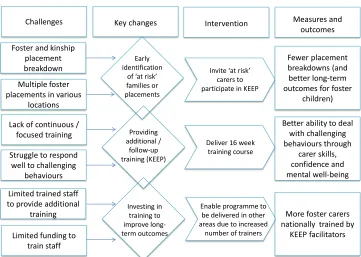
During the planning stage, the evaluation team developed a logic model to outline the steps to achieve intended programme outcomes (see Figure 1). As a crucial starting point, local authorities, typically through supervising social workers, identify children aged 5-12 with behaviours that are challenging for carers to manage and are at risk of placement breakdown; plus carers with support or professional development needs, and those carers are invited onto the next available KEEP
1 Although each group should ideally have between 8 to 10 carers, some recent groups have been smaller as
12
Standard course. Prior to the course, a facilitator visits each carer at home to explain the purpose and set-up of the programme. During this initial home visit, the facilitator completes the intake form, including background questions about the carer and the child currently in placement, as well as quantitative measures, including the
[image:12.595.117.478.196.453.2]Strengths and Difficulties Questionnaire (SDQ), Parenting Scale, and Parent Daily Report (PDR).
Figure 1: Logic model describing the pathways to intended outcomes.
The first session begins with carer introductions and an overview of what will be covered each week. It is an opportunity to have any questions answered and to form initial relationships within the group. In subsequent weeks, each session tends to cover a different topic, including the importance of cooperation; using charts and incentives, privilege removal and work chores; promoting school success, and stress. Although the manual outlines the topic to be covered each week there is a degree of flexibility so that facilitators can tailor the session to the needs of their group of carers.
KEEP Standard involves active engagement by carers both during the weekly sessions and at home. Group discussions that are positive, supportive and relevant to carers’ experiences are central to the weekly sessions. Additionally, carers are expected to do ‘homework’: to practice the skill or technique which has been taught with the child in placement each week, for example using behaviour charts and rewards, if it is appropriate and feasible to do so. Finally, KEEP facilitators telephone each carer once a week to complete the Parent Daily Report (PDR) Checklist. The PDR asks carers whether or not the child has displayed specific behaviours during the past 24 hours and how the carer would rate their stress level in response to each behaviour.
Key changes Intervention Measures and outcomes Challenges
Multiple foster placements in various
locations Foster and kinship
placement breakdown
Lack of continuous / focused training
Struggle to respond well to challenging
behaviours Limited trained staff to provide additional
training
Limited funding to train staff
Early identification
of ‘at risk’ families or placements Providing additional / follow-up training (KEEP) Investing in training to improve long-term outcomes
Invite ‘at risk’ carers to participate in KEEP
Deliver 16 week training course
Enable programme to be delivered in other areas due to increased
number of trainers
Fewer placement breakdowns (and better long-term outcomes for foster
children)
Better ability to deal with challenging behaviours through
carer skills, confidence and mental well-being
More foster carers nationally trained by
13
Relevant existing research relating to this innovation
KEEP Standard was developed based on the Treatment Foster Care Oregon (TFCO) model, formerly Multidimensional Treatment Foster Care (MTFC). KEEP Standard incorporates a number of evidence-based parenting techniques tailored to the needs of foster and kinship carers.A previous large-scale randomised controlled trial (RCT) was conducted with 700 foster and kinship families who received a new child, aged 5 to 12 years old, between 1999 and 2004 from the San Diego County child welfare system
(Chamberlain et al., 2008). The foster and kinship carers were randomly assigned to the intervention group who completed KEEP Standard training (n=359) or a control group who received caseworker services as usual (n=341). Overall, the intervention group exhibited an increase in carers’ ‘proportion positive reinforcement’ (the extent to which positive reinforcement methods increased in proportion to discipline rates) and a decrease in child behaviour problems compared with the control group.
Further analyses suggested that child behaviour problems were partially mediated by changes in specific parenting practices of carers, showing that increases in
proportion positive reinforcement by carers yielded greater improvements in child behaviours. This mediation effect was especially true for high-risk children who displayed more than 6 behaviour problems per day at baseline. A further quasi-experimental study similarly found that KEEP Standard reduced child behaviour problems when delivered by paraprofessionals as part of a community agency, suggesting the programme is amenable to adaptation and scaling up (Price et al., 2012).
Findings from this trial also demonstrated that KEEP Standard had a positive impact on placement changes (Price et al., 2008). KEEP Standard increased the likelihood of positive placement changes, such as re-unification with birth families or adoption, and the intervention group demonstrated fewer negative placement changes
compared with the control group. Moreover, while a higher number of previous placements predicted the likelihood of a negative placement change, KEEP Standard appeared to mitigate this risk.
The RCT showed high retention rates: 81% of the 700 foster or kinship families who provided baseline data provided data at the end of the programme. Furthermore, 81% completed at least 75% of group sessions and 75% completed at least 88% of group sessions.
The US study collected data using Parent Daily Report (PDR) Checklist and
14
the original evaluation trial in the US2 such that carers have shown improvements
from baseline to follow-up. However, NIS have not collected data from a control group, making this evaluation a timely addition to the UK evidence base.
Changes to the intended outcomes or project activities
As KEEP Standard is an established programme with well-defined goals, there were no changes to the intended outcomes during the evaluation period. However, project activities changed due to local authorities not running the training or delaying the autumn 2015 training course. This included a charity previously providing KEEP Standard going into administration, high-level management changes in Oregon, changes in the system and software for collecting PDR data and video recording sessions, and management changes within local authorities. These changes are further described in the section on barriers to this innovation.Context
Although KEEP originated at the Oregon Social Learning Center (OSLC), USA in 1996, the programme became available in England in 2009 and is provided by NIS who maintain strong ties with the programme developers in Oregon. Over the years, KEEP Standard has been implemented across 20 local authorities in England. With only minor adaptations to make the materials more relevant within the UK context, the programme very much retains its original design. However, the children’s social care system in the UK differs substantially from that of the USA, making an
evaluation within the UK context highly relevant.
The 10 local authorities participating in the evaluation are geographically spread and have varying rates of looked after children. An analysis of outcomes at local authority level is not possible due to small numbers of participants in each area; therefore, transferability of findings cannot be based on features of particular local authorities. Across local authorities, facilitators prepared for this wave of KEEP Standard in the late summer and the programme started between September and November 2015, running until January or February 2016. KEEP facilitators highlighted that the time period around Christmas could be particularly difficult for looked after children and that maintaining stability is a major concern for carers. With this in mind, it is possible that both the intervention and control group carers may have experienced additional difficulties during this time.
15
Overview of the evaluation
Evaluation questions
The aim of the evaluation was to examine whether carers who completed the KEEP Standard training benefitted from improved outcomes compared with a control group of carers who did not complete the training. As outlined in the original evaluation plan, the evaluation team sought to answer the following questions:
• Are the outcomes for KEEP Standard intervention carers significantly better
post-training compared with baseline and compared with carers in the control group?
• Are placements more likely to have remained stable in the KEEP Standard
intervention, or have children been successfully reunited with birth families, compared with carers in the control group?
• Is the programme a good investment based on a cost-effectiveness analysis?
Methodology used to address these questions
A matching methodology was used following the scoping phase in which it transpired that a randomised controlled trial (RCT) would not be feasible (see page 13). The following quantitative measures were collected at baseline and follow-up from both control and intervention groups, asking carers to focus on the same child at both times, to examine any statistically significant differences between them.
Measures
Strengths and Difficulties Questionnaire (SDQ):
The SDQ (Goodman, 1997) is a 25-item measure concerned with the carers’ view of the child’s behaviour. With the child’s behaviours in mind, the carer scores each item as either ‘Not true’, ‘Somewhat true’ or ‘Certainly true’. Scores are derived for 5 sub-scales with 5 items each: Emotional distress (“Many worries, often seems worried”); Conduct problems (“Often has temper tantrums or hot tempers”); Hyperactivity (“Constantly fidgeting or squirming”); Peer problems (“Picked on or bullied by other children”); and Prosocial (“Kind to younger children”) sub-scales.
16
The evaluation team received the SDQ data from NIS, anonymised but matched using carers’ initials.
Parenting Scale:
The 30-item Parenting Scale questionnaire (Arnold, 1993) measures 3 parenting discipline styles related to child behavioural difficulties on a total score and sub-scales scores for Laxness (permissive discipline), Over-reactivity (authoritarian discipline, displays of anger, meanness and irritability) and Verbosity (overly long reprimands or reliance on talking). This can be used as a proxy for perceived parenting skills of carers, indicating any decline or improvement.
Each item is rated on a 7-point scale. For example, an item from the Laxness sub-scale states, “When my child doesn’t do what I ask…”, the carer chooses a point on the 7-point scale that ranges from, “I often let it go or end up doing it myself” to “I take some other action”. In this example, “I often let it go or end up doing it myself” would be rated as a 7, representing an ineffective parenting strategy, while “I take some other action” would be rated a 1. As an example from the Verbosity sub-scale, the carer responds to, “Before I do something about a problem…”, by rating between “I give my child several reminders and warnings” (7) and “I use only one reminder or warning” (1). Finally, the Over-reactivity sub-scale includes the item, “After there’s been a problem with my child…”, which is rated from “I often hold a grudge” (7) to “Things get back to normal quickly” (1). The scores for each item are averaged together to generate the total Parenting Scale and its sub-scale totals, which all also range from 1-7.
The evaluation team received the Parenting Scale data from NIS, anonymised but matched to demographic information using carers’ initials.
Warwick-Edinburgh Mental Well-being Scale (WEMWBS)
The WEMWBS (Tennant et al, 2006, Tennant et al, 2007) is a positively worded 14-item 5-point scale assessing mental well-being. It is chosen due to its items focusing on well-being and strength (e.g. ‘I’ve been feeling useful’, ‘I’ve been feeling good about myself’) rather than illness or weaknesses. Moreover, this scale can be used as a proxy for perceived confidence and resilience of carers, indicating any decline or improvement. The scale also includes statements indicative of the carer’s stress such as, “I’ve been feeling relaxed” and “I’ve been dealing with problems well”. Both the SDQ and Parenting Scale data are routinely collected by KEEP facilitators and sent to NIS, thus the only measure added to their usual practice was the WEMWBS. The WEMWBS data was collected directly from KEEP sites.
The matching was achieved by taking each outcome variable in turn (i.e. SDQ, PS, WEMWBS) and dividing the intervention sample into 3 equal groups using baseline score tertiles for that outcome. The comparison sample was then split into 3 groups, but these were also based on the tertile baseline scores from the intervention
17
3 groups in the comparison sample were not equal in size as the distributions of baseline scores in the comparison sample differed to those in the intervention sample.
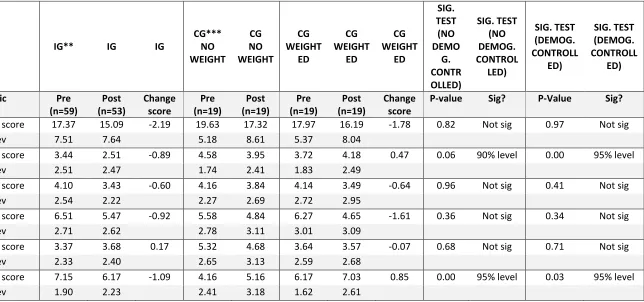
A weight was generated that, when applied to the comparison sample, made the distribution of the comparison sample equal across the 3 groups, i.e. weighting to make the profile of the comparison sample match that of the intervention sample on the grouped baseline score. This was done separately for each outcome. The weights bring the baseline profiles of outcomes of the comparison closer to those of the intervention sample for that outcome. This is demonstrated in the tables in the appendices, which show the baseline score (the pre-score) for the intervention group, along with the baseline score for the comparison group before and after the weights are applied. The change scores for each outcome measure were then calculated (i.e. pre/ post difference score) and the mean change score for the
intervention group was compared with the mean for the weighted comparison group. Further, a cost-effectiveness analysis highlights costs associated with the set-up of running KEEP Standard for the first time in local authorities, as well as ongoing costs, which better reflect the situations of local authorities taking part in this
evaluation. In addition, costs for outcomes which the programme seeks to avoid are presented, such as placement change and carers de-registering from foster caring.
Changes to evaluation methodology from original design
Randomised controlled trial
The original evaluation plan suggested conducting a randomised controlled trial, based on the assumption that the 2 waves of KEEP training planned within the evaluation period would be running in parallel rather than staggered. After an initial consultation with programme sites, it became apparent that running both waves in parallel was not feasible, and sites were unwilling to randomly allocate carers as this would prohibit their processes for identifying ‘at risk’ families and placements as displayed in the logic model.
Instead, we had intended to use a matching methodology: a quasi-experimental, robust method would overcome the logistical difficulties of conducting an RCT. The resulting sample size (see below) meant this method could not be used. The small sample size meant a robust logistic regression model could not be built to generate the score. A quasi-experimental approach was still used but it involved an alternative approach to matching, as described above.
Follow-up data
18
the carer groups. Thus the start dates were staggered throughout September, October and November 2015 and the training finished at different times throughout January and February 2016 (the training lasted for more than 16 weeks due to holiday periods). Therefore, only immediate follow-up data is included in the
evaluation. As part of their usual monitoring, NIS will collect follow-up data from the KEEP Standard group at 6 and 12 months post-training.
Sample size
In the original evaluation plan, it was anticipated that the training would be delivered twice within the evaluation period in 17 local authorities and by one charity with 7-10 carers in each group. However, only 10 sites and one wave of the programme were included in the analysis. The remaining sites were either discontinuing KEEP
Standard in their local authority; delaying the start date, or unable to participate in the evaluation due to management changes.
The number of carers who consented to be included in the evaluation varied between 4 and 10 participants across 12 KEEP Standard groups in 10 local authorities, resulting in baseline and follow-up data from 59 intervention group
carers. However, the sample size for WEMWBS data collected was smaller as some local authorities were unable to collect this measure before the first session.
In order to reach foster carers with a child in placement aged 5-12 years but who were not attending KEEP training (the control group), the measures in the KEEP Standard intake forms and demographic questions were disseminated via the
Fostering Network, who placed the survey link on their Twitter and Facebook pages. It was also passed to control group foster carers via 2 local authorities, either during foster carer meetings or by a supervising social worker.
The control group survey was available online and a £10 high street voucher incentive was offered to those completing each survey. At baseline, 39 carers
completed the survey, and 26completed the follow-up surveys3. These carers
continued to receive their usual support; however, the evaluation did not test whether this included carer support groups, positive reinforcement training or any other
elements akin to the KEEP Standard training.
The evaluation findings must be interpreted with caution due to the small sample size and limited timeframe - the findings of this evaluation provide initial indications of the positive effects of KEEP Standard within the UK context in the short-term.
3 19 control respondents fully completed the SDQ section; the remaining 7 missed SDQ scores for some
19
Qualitative interviews
In order to provide a contextual understanding of the KEEP Standard training, the evaluation team conducted 15 qualitative interviews with carers before (6 interviews) and after they participated in KEEP Standard (9 interviews).
These interviews were conducted either in person or over the telephone with carers from 4 different local authorities. The local authorities were chosen based on their number of looked-after children compared with the national average, and their geographic location, in order to achieve a heterogeneous spread as far as possible. Carers who participated in interviews were given a £10 high street shopping voucher as a token of appreciation for their time.
For interviews with carers prior to the training, carers’ expectations for KEEP Standard and their reasons for signing up were explored. These interviews also sought to understand how they learned about KEEP, the process of signing up to the course and whether they foresaw any expected challenges in attending.
20
Key Findings
How far the innovation has achieved its intended
outcomes
The intended outcomes of KEEP Standard include:
• Improved parenting skills of carers
• Improved well-being of carers
• Improved child behaviour
• Decreased likelihood of negative placement changes
Findings from matching
To answer the question of whether the outcomes for KEEP intervention carers significantly improved compared with the outcomes for carers in the control group, the evaluation examined whether the changes from baseline to follow-up measures differed significantly between carers who completed KEEP Standard and carers who did not.
Strengths and Difficulties Questionnaire (SDQ)
The average total SDQ score, which could range from 0-40, observed at baseline for
the intervention group (T1intervention=17.37) and control group (T1control=17.97) were
very similar, suggesting effective matching and weighting. At follow-up, there were reductions to the average total SDQ score for both the intervention group
(T2intervention=15.09) and control group (T2control=16.19), suggesting improvements in
both groups. However, the changes in total SDQ scores did not differ significantly between the 2 groups (p=0.97). See Appendix A for change scores.
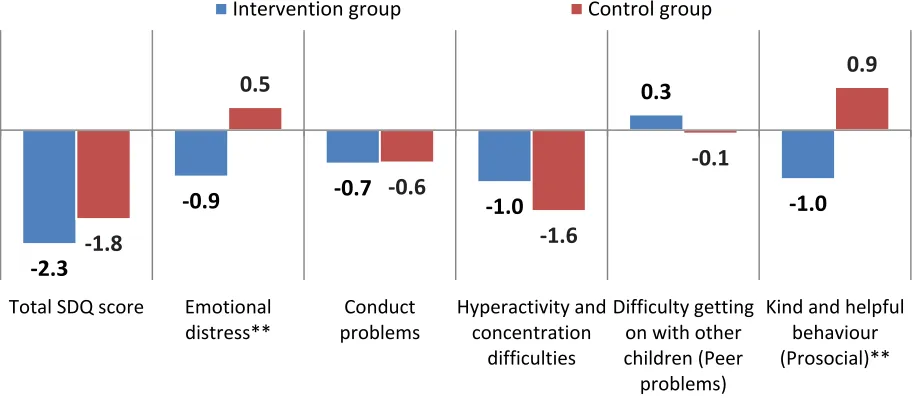
However, further analysis of the changes from baseline to follow-up on sub-scale scores found statistical significance in favour of the KEEP Standard intervention for both the emotional distress sub-scale and prosocial sub-scale. In both cases, the follow-up scores of the intervention group decreased while those of the control group increased, and these differences were statistically significant (p<0.05).
No statistically significant differences between the intervention group and control group were found on sub-scales relating to conduct problems, hyperactivity, or peer problems. The changes from baseline to follow-up are shown in Figure 2, with detailed tables found in Appendix A.
21
placement and the child's age. Given that the results remained stable after
[image:21.595.76.534.198.397.2]controlling for demographic variables, the observed outcomes were unlikely to have been strongly influenced by differences in these demographic variables. For this reason, and due to the small sample sizes, no analyses were conducted for different groups such as kinship or foster carers on SDQ measures.
Figure 2: Changes in average SDQ total score and sub-scale scores between baseline and follow-up.
**p<0.05 (95% sig)
Base: Intervention group (n=53), control group (n=19)4
Parenting Scale
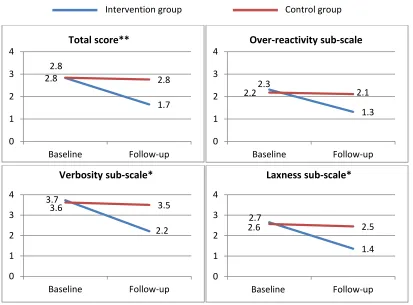
Improvements in parenting skills were observed for both the intervention and control groups; however, the intervention group showed statistically significant
improvements compared with the control group, as displayed in Figure 3. This was seen in the overall score as well as on sub-scale scores for Verbosity (overly long reprimands or resilience on talking) and Laxness (permissive discipline, lenient). Although both groups improved over time on the over-reactivity sub-scale
(authoritarian discipline, displays of anger, meanness and irritability), the difference in improvements was not statistically significant between the 2 groups. Detailed data tables for Parenting Scale outcomes can be found in Appendix B.
As significant differences were found in an initial comparison that did not control for demographic variables, a second comparison included these variables and
confirmed the results, once again suggesting negligible influence due to any demographic differences.
4 Base sizes for analysis may be different compared with the total number of participants who provided data
(p.14) as a result of the matching process.
-2.3
-0.9 -0.7 -1.0
0.3
-1.0
-1.8
0.5
-0.6
-1.6
-0.1
0.9
Total SDQ score Emotional
distress** problemsConduct Hyperactivity andconcentration difficulties
Difficulty getting on with other children (Peer problems)
22
Figure 3: Parenting Scale total and sub-scale scores for intervention and control groups at baseline and follow-up.
*p<0.10 (90% sig); **p<0.05 (95% sig)
Base: Intervention group (n=59), control group (n=21)
Warwick-Edinburgh Mental Well-being Scale (WEMWBS)
Both the intervention and control groups showed slight improvements from baseline to follow-up in carer well-being as measured by the WEMWBS. Although the
intervention group showed greater improvements, no statistically significant difference between the groups was found (p=0.25). Detailed data tables can be found in Appendix C.
Compared with the previous measures, the sample size for WEMWBS was smaller for the intervention group (n=28) as it was not possible to collect WEMWBS at
baseline in several local authorities. This, coupled with the high degree of variation in carers’ WEMWBS scores, is likely to be contributing to the non-significant finding as it increases the size of the standard errors. As the difference was non-significant, no further analyses controlling for demographic variables were conducted.
Placement Changes
Out of 23 intervention group carers for whom placement stability data were available, 19 (83%) still had a child in placement at the end of the KEEP Standard training. Two of the placement changes were planned moves, one into adoption and one into
2.8 1.7 2.8 2.8 0 1 2 3 4 Baseline Follow-up Total score** 2.3 1.3
2.2 2.1
0 1 2 3 4 Baseline Follow-up Over-reactivity sub-scale 3.7 2.2
3.6 3.5
0 1 2 3 4 Baseline Follow-up Verbosity sub-scale* 2.7 1.4
2.6 2.5
0 1 2 3 4 Baseline Follow-up Laxness sub-scale*
23
permanent foster care. Of the unplanned moves, both due to placement breakdown, one young person moved into another foster placement, the other into children's residential care.
For the control group of 25 carers who provided placement stability data, 20 (80%) young people were still in placement at follow-up, and 5 had moved on.
Given the small sample size and the minor difference between the 2 groups (80% and 83%), no short-term effect on placement stability was observed.
Findings from interviews with carers
In order to contextualise the quantitative findings we interviewed a sample of 15 carers (13 females and 2 males) in 4 local authorities. Six interviews were conducted with carers before they started KEEP Standard and 9 were conducted with carers
after they completed the course5, findings of which are outlined below.
Initial views about KEEP Standard
Interviewed carers first heard about the KEEP Standard programme through their supervising social worker or had seen it advertised in an email or an online training website. However, among those carers who had heard of KEEP through an email or training platform, they did not seem to seriously consider participating in the
programme until their supervising social worker encouraged it.
The primary reason carers signed up for the programme was to help them better manage their child’s challenging behaviour. In some cases, this coincided with particularly negative circumstances, such as the child’s behaviour being extremely challenging, the carer being overwhelmed and the placement being unstable. While one carer with over 10 years of experience signed up for KEEP Standard for further professional development, a special guardian described KEEP Standard as
somewhere to start gaining experience and receive more support. Previous training was also more common among foster carers compared with kinship carers and special guardians. Some of the foster carers with many years of experience expected KEEP to be the “same old, same old”, - these carers quite quickly noted that KEEP Standard was different from other training they had received:
After the first session, it was like, ‘Oh, that’s going to be different’ because
the first thing they said was ‘We’re not going to preach things to you. The ideas are going to come from the group’… [Foster carer, after KEEP]
5 Separate groups of carers were interviewed either before or after the KEEP Standard training i.e., no
24
Some carers reacted reluctantly to the length of the training, thinking it was a
substantial time investment and were unsure whether they would be able to commit to this. However, carers confirmed that they appreciated the length of the training and have actively made future plans to continue meeting with carers from the group.
Importance of an open and collaborative environment
Carers expressed the importance of being in an environment where their experience of looking after children in care was understood (rather than being a biological parent of a child). Responding to what they hoped to get out of the training, one carer said:
…Knowing you're not doing it alone, … have a chat about the same things with people who are not judging you. Generally, other parents or people
judge, but other foster carers understand where you're coming from, …It's a
great relief to talk to be able to someone who knows how you feel. [Special guardian, before KEEP]
Indeed, carers who had completed KEEP Standard described this as a key benefit of the training. Some carers described how they felt exhausted and unable to manage the child’s challenging behaviours when first attending the KEEP training. Carers repeatedly expressed the inherent value of the group of carers coming together:
What we say about how we feel about [the possibility of the child moving on] is very, very similar and just to hear someone almost putting into words what I
feel about it – well, you couldn’t get that anywhere else really. [Foster
carer, after KEEP]
There was an emphasis on a give-and-take relationship between carers, where those who had overcome a given difficult behaviour were able to provide practical advice to those currently struggling with it, perhaps empowering the carer by reaffirming their own strategies.
All of the foster carers interviewed knew of other foster carer meetings or forums taking place in their local authorities, but only a couple of the carers reported attending these regularly. They were either reluctant to attend these based on
negative perceptions of who would attend these meetings, or unable to attend due to time constraints or conflicts. On the other hand, special guardians were less likely to know about other foster meetings but expressed interest in attending meetings, particularly those directed towards kinship carers or special guardians.
25
themselves to. When carers spoke of negative experiences, problems or concerns, these were met with suggestions and strategies to help:
They let us have quite a free reign - they weren’t stifling our thoughts or views. They were very supportive, and they were always very positive. So even if
you spoke about something negative, they would always spin it around to
end in a positive. [Foster carer, after KEEP]
After the conclusion of the 16-week training course, carers described how they planned to stay in touch with the group. One site had created a WhatsApp group for carers to stay in touch as well as meeting up in a café on a regular basis to uphold the social as well as supportive connection. Carers from other sites described similar ways of maintaining the network through social media and regular get-togethers. These new-found support networks were deemed as a major benefit of taking part in the course. When carers who completed the course were asked whether they would recommend it to others, all carers responded with a resounding yes.
Changes in carers’ skills and well-being
Strategies that seemed to resonate with carers most included time-outs,
pre-teaching, behaviour charts and rewards. Further, the importance of praising the child for what might otherwise been overlooked was a new insight for many carers.
Many of the carers had already used some of these strategies but KEEP Standard seemed to revitalise them by suggesting new ways to implement them. For example, although most of the carers had used time-out with their child before, now instead of seeing it as a punitive measure, carers transformed it into a positive one by re-naming it ‘time-in’ or designating a place for time-out as the ‘chill-out zone’. While being taught skills that they were already using reaffirmed their abilities and improved their confidence, the fresh perspective on ways to implement them and new suggestions seemingly revived carers’ initiative:
It was quite good because it was just clarifying that the way you work is
right, but because they were also telling us slightly different ways of doing things, it did make you think to perhaps make changes or little adjustments to how you were doing things. [Foster carer, after KEEP]
When asked about how the different strategies worked when tried at home, the common response was that some strategies worked for them while others were not as effective. However, because this was explained by facilitators as to be expected, carers accepted that not everything would work, depending on each situation:
26
Avoiding power struggles with the young person through newly learned techniques was another positive outcome many carers had achieved through the training. Carers often referred to ‘not going to every argument you’re invited to’ and walking away to prevent escalating and unproductive communication with the child. One carer described this strategy as a means to manage their stress better. Looking after oneself and one’s well-being reportedly was not a priority for many carers prior to going on the training. Some carers described the PDR calls as a helpful way to reflect on how behaviours affected their stress levels and to develop an
understanding of what triggers their stress and how they handled it and would like to handle it in the future. However, it is important to note that many carers described that they still experience similar amounts of stress but are able to handle it better. All carers were adamant that the KEEP training had made a difference to their ability to manage challenging behaviours and their own well-being. Many carers thought that the training also had a positive effect on other family members, as well as the child in their care at home and at school.
Perceived changes in child behaviour
The changes in child behaviour observed by carers varied. For most, there was a general belief that their child’s behaviour had improved, and some carers described specific examples of how the behaviour has changed as a result of new strategies used. When new techniques were paired with small rewards, carers saw positive results in behaviour. In some cases, schools, churches or other family members also noticed changes in both the carer’s and child’s behaviour.
When asked about whether they thought these improvements would last over time, carers were reluctant to answer with certainty. This is perhaps unsurprising given previous experience or knowledge of how quickly a placement can unravel and break down. However, most carers felt that any improvements were important and that their skills would benefit any future placements as well.
Effects on the likelihood of placement change
Responses on whether the young person would still be in placement without KEEP Standard training varied from definitely yes to definitely no; however, for those who thought that placement breakdown could have been a serious possibility, carers expressed concerns that they would likely be struggling or that they would be seeking more support elsewhere:
No. I know he wouldn’t. I know he wouldn’t because I’ve seen a massive
change from where he was to where he is now. Like I said, he’s still got a few issues, but things are better. [Foster carer, after KEEP]
Yes, I think she would, yes. I might be different, but I think she’d still be with us…I might have been feeling more at the end of my tether… it’s certainly
27
We would have been looking for more support somewhere. … KEEP gave us
the tools to deal with those problems and if it hadn’t, we would’ve had to try to get them from somewhere else…I don’t think we would’ve given up on the placements, but the stress would probably be very high … [Foster carer, after KEEP]
The role of trainers as facilitators rather than lecturers
Initial home visits prior to the training were considered positive and a good rapport was built with facilitators from the outset. The approach of facilitating the group as a conversation rather than a lecture was welcome by carers, as they felt their
individual experiences were valued and incorporated into the training programme: … It wasn’t about just preaching to us. I was quite surprised. [Foster carer, after KEEP]
The facilitators were able to create a relaxed environment with fun activities,
including role-plays which not all carers were fond of, but which, however, they found useful. Several carers described that they felt they could call their KEEP facilitator at any time to seek advice, even after the programme ended.
Where PDR calls did take place, carers appreciated that facilitators had taken time to reflect on the problems they had discussed, presented potential avenues to resolve them and included the particular issue in a wider discussion.
Findings from the cost-effectiveness analysis
One of the aims of the KEEP Standard training is to provide value for money across children’s social care, in particular with regard to foster and kinship care. It intends to do this by keeping looked after children in placements, thus reducing the costs associated with placement changes, especially children entering residential care, and retaining foster carers in their roles, thus avoiding costs of carer recruitment. A long-term cost saving associated with placement stability is improved educational and life outcomes of young people in care.
Cost of the KEEP Standard training
The cost-effectiveness analysis is based on cost incurred by sites who took part in the evaluation. The facilitators in all bar one site are fully accredited; hence costs to the sites in the evaluation are lower than if a new site was to commence providing KEEP Standard. Cost assumptions are based on a site with 2 fully accredited facilitators running a 16-week group.
Figures provided by the NIS show that the cost of initially implementing the 16-week
KEEP Standard programme is £30,000,including a feasibility process,
28
3 staff, weekly consultation on KEEP group (weekly review of group recording, website data, Facilitator Adherence Rating and one hour call), NIS support (includes link work, Networking (KEEP-Up) days 2 per year with up to 4 staff places per site, audit data collection, 2 project reports, access to the members’ area of UK KEEP hub) and access to FIDO, the Fidelity Tracking System (for up to 5 groups). This cost does not include the staff cost of the local authority employing staff to deliver or a location to host the training. Staff costs for the first year are estimated to be £16,700, including attending KEEP Training over 5 days for 3 staff, FIDO set up and training,
home visits, PDR calls,group facilitation based on 1 day to include consultation,
reviews, upload for 2x facilitators, additional tasks- prep/calls from carers. The total
cost for implementing and running KEEP Standard in the first year is £46,700.
The ongoing minimum running cost after the 1st year package outlined above is
£20,540, which is the case for the local authorities in the current sample. Based on this sample, assuming an average of 8 carers per group, the cost of running KEEP
would be £2,567 per carer (£20,540/8 carers), excluding staff costs to deliver the
training.
Below we outline the areas of potential cost-saving through reducing placement breakdowns, keeping young people in foster care, and retaining foster carers rather than recruiting new carers. This, however, was not measured as part of the
evaluation.
Reducing placement breakdowns
Foster placement breakdowns can have negative effects on carers and young people, and are costly to the local authority. The number of unplanned endings at the request of the foster carer have increased by 1,070 from 2,325 in 2013/14 to 3,395 in 2014/15. Unplanned foster care placements ending for other reasons have increased by 2,055 from 1,800 to 3,855 in the same period (Ofsted, 2015a).
In 2014/15 there were fewer foster carer de-registrations in LA registered
households (55% of all de-registrations) compared with just under two thirds (63%) de-registered from LAs in 2013/14 (Ofsted, 2015b). Of these, there were more foster carer initiated de-registrations in 2014/15 compared with 2013/14 (4,520 and 4,050 respectively) (Ofsted, 2015b).
Pertinent to the areas of stress which KEEP Standard seeks to address, the most frequently stated reasons for de-registration, as reported by Triseliotis, Borland and Hill (2000) were: dissatisfaction with the service (26%); children’s behaviour (17%); impact on own family (12%); stress and no respite (10%); as well as
29
Sinclair and colleagues (2004) found that foster carers under the age of 35 were twice as likely (albeit not statistically significantly) to cease fostering in the research period compared with those aged over 35.
Remaining in foster care rather than entering residential care or
going out and back into care
The estimated cost to a local authority of supporting a foster placement is £45,982
per year, including all social care activity to support the placement for one year including care plans and reviews, as well as placement fees/ allowances. This is in
stark contrast with the estimated cost of a residential care placement being
£140,814, including all social care activity to support the placement for one year, including care plans and reviews as well as fees (Ward, Holmes and Soper (2008), in Holmes (2014)). If children can be placed back with their birth families
successfully, the cost of supporting them is estimated to be £14,304, a £31,680 saving compared with remaining in foster care. This saving can, however, only be considered worthwhile if the child remains with the birth family, as re-entry into care is estimated to cost £61,614, not including the negative psychological consequences for children and their families. Almost half (47%) of children who return to birth
families from care re-enter the care system (Holmes et al., 2014).
Reducing the need to recruit new carers
The cost of recruiting a new foster carer has been estimated to be £11,500
(Tapsfield & Collier, 2005), a figure said to be likely to have increased since 2005. Between March 2014 and March 2015 there was a one percent decrease in fostering households (leaving 36,890 fostering households), but, a 6 percent increase in family and friends foster care households (rising to 4,145 households).
According to Ofsted figures (2015a), in 2014/15, 1,550 fewer foster care applications were approved than in the previous year (down to 5,620 from 7,170).
Conclusion of cost-effectiveness analysis
The sample of carers and data on placement stability is too small to provide a
statistical analysis6 of child outcomes and associated cost savings, therefore, only
speculative inferences can be made based on qualitative interviews. For example, a number of carers assumed that the child would not be in placement anymore if it had not been for the training they received. Others said that the child would still be in placement, however, support would have been sought elsewhere, which would likely be associated with costs to the local authority. In one case better engagement
between a carer and the child’s school, due to strategies learnt on the programme, are likely to have positive effects on the carers, the child and their education. The
6 Of the 59 consented carers who completed KEEP Standard, placement stability data at the end of the course
30
extent to which positive changes are significant as a result of KEEP and can be maintained over time would need to be established in a longer term evaluation, as well as a larger population.
Evidence of impact on the Innovation Programme’s
objectives and areas of focus
The overarching aim of KEEP Standard is to improve the lives of children and young people in foster care as well as those of their foster, kinship and birth families. As such, KEEP Standard sits within the Innovation Programme’s objective to improve the life chances of children receiving help from the social care system. More specifically, KEEP Standard seeks to do this by improving the quality of services through better trained, supported and equipped foster carers.
The following section describes the ways in which this evaluation informs the Innovation Programme’s objectives and areas of focus.
The lives of children, young people and families & better life
chances for children receiving help from the social care system
Foster or kinship care is the preferred placement choice compared with placements in residential children’s homes in England (unless residential care is the best option for a given child). It is, therefore, vital for these services to provide the best possible care to the children within the system. Evidence suggests that higher numbers of placement changes are linked to a range of negative outcomes. Behavioural problems (as measured here by the SDQ) are often associated with placement disruption or breakdown, not least due to carers’ inability to cope. Correspondingly, carers’ parenting skills and level of experience are linked to placement stability. Findings from this evaluation suggest that KEEP Standard improved carers’parenting skills and capacity to respond to children’s difficult behaviours, evidenced by their significantly improved Parenting Scale scores compared with the control group. Furthermore, children in placements with carers who completed KEEP Standard showed improvements relating to their emotional distress and prosocial behaviour. These findings were echoed in interviews with carers, which suggested that KEEP Standard might have helped improve carers’ response to challenging behaviours and as a consequence, improved child behaviour in some cases.
Although this evaluation cannot provide evidence regarding the long-term outcomes of placement stability and changes, it can be hypothesised based on previous
research that these improvements (i.e., carers responding more effectively to difficult behaviours and children displaying fewer behaviour problems) may enhance the likelihood that placements remain stable and reduce the number of unplanned
31
The perception of children, young people and families of service
quality
With improved life chances for children and young people in foster or kinship care placements as well as improved support and training for their carers, foster care may gain a more positive reputation and increase the recruitment and retention of carers. Evidence from this evaluation suggests that KEEP Standard may improve how carers perceive the service support provided to them. Interviews with carers
highlighted that KEEP Standard provided them with substantial support in addition to normal services. Special guardians and kinship carers often described a lack of support and training compared with foster carers. For one of the special guardians interviewed, KEEP Standard provided some of the first substantial support they had received. Other carers discussed how the programme helped fill any gaps in support from their social workers - for example, one carer who had not yet started KEEP described their current struggles that were not being met with the support needed because both their own social worker and that of the child were changing. Both this carer and others described their coming on the programme as timely in their current situations.
In addition, carers interviewed who had completed the programme perceived KEEP Standard as different from previous training and foster carer gatherings they
attended. For them, the programme provided new support and connections, not only from the KEEP facilitators but also in building a network of other carers in their local area. Moreover, carers felt this support would last into the future, either by feeling comfortable calling their KEEP facilitator to seek advice or by staying in touch with other carers from the group.
Professional practice and methods in social care & organisational
and workforce culture in social care
With improved skills and, confidence and wider, more relevant support networks, placements may be more likely to be stable and foster carers may be more likely to remain carers of young people with challenging behaviours.
Evidence that carers benefitted from improved parenting skills compared with the control group highlights KEEP Standard’s contribution to the professional
development of carers. Carers described that much of the material was familiar to them, or that they were already using similar strategies, but that KEEP facilitators would sometimes suggest minor revisions to carers’ practices. It seemed that one of the major benefits described by carers was KEEP Standard’s influence on their outlook in response to events. This change in disposition, especially in response to negative experiences, appeared to facilitate improved parenting practices.
KEEP Standard has been rolled out extensively in some local authorities – in some cases, nearly all of the carers in the local authority have been trained. As the
32
it is possible that the benefits of KEEP Standard, if shown in future evaluations to be sustained over longer periods, could enhance the overall workforce skills and well-being of foster and kinship carers as well as the outcomes for children in placements with foster and kinship carers.
Local leadership and governance including systems and processes
in children’s social care
KEEP Standard is integrated into a local authority’s services in partnership with NIS. In some local authorities, the KEEP facilitators have roles beyond coordinating KEEP Standard while in others, the facilitators main responsibility is running KEEP
programmes. The staff necessary to run KEEP Standard is, therefore, very much based on existing staff roles rather than bringing in external staff.
At a national level, the implementation and monitoring of KEEP Standard is overseen by NIS. NIS develop partnerships with local authorities to deliver the programme at the local level. NIS provides training and consultation for KEEP facilitators, who deliver the intervention and collect data (e.g., SDQs, PDRs). A system is in place for the data to be sent to NIS in an anonymous format, allowing for analysis whilst maintaining confidentiality. Although not explicitly measured by the evaluation, the evaluation team witnessed very successful partnerships between NIS and local authorities, with positive communication and established processes in place (e.g., transferring data from local authorities to NIS).
National systemic conditions e.g. legislative frameworks
Statements by carers who completed the KEEP training expressed the view that the programme should be compulsory for both new as well as experienced carers. For 2 carers, this was the case as the special guardian court order required their
participation in KEEP Standard.
Value for money across children’s social care
Recruiting and retaining foster carers is both time and resource intensive. Retention of approved and experienced foster carers is therefore of high importance. Carers who understand and can apply strategies to look after their own well-being may be more likely to remain carers even after the breakdown of a challenging placement. The cost-saving to local authorities can be substantial, especially if children can be placed with foster carers rather than in children’s residential homes.
Due to the small sample size and short-term evaluation, it was not possible to provide conclusive quantitative evidence about the value for money of KEEP
Standard to local authorities. However, qualitative findings suggested that placement changes may have been more likely or that carers would have sought more support elsewhere had they not done KEEP Standard, thus avoiding potential costs
33
evaluation, however, the extent to which these outcomes impact overall cost savings is unknown.
Stronger incentives and mechanisms for innovation,
experimentation and replication of successful new approaches
This evaluation produced initial findings suggesting the positive effects of KEEP Standard on both carer and child outcomes. Training for foster carers is not a novel concept, and many carers who participated in this evaluation had previouslyparticipated in other training. However, interviews with carers suggested that KEEP Standard had an added value compared with other training and foster carer forums and support groups. As such, it would appear that KEEP Standard was able to meet the unmet needs of some carers thus encouraging its implementation and
evaluation.
Barriers to this innovation
Data collection and communication with sites
It was noted during the evaluation period that there was a lag between data
collection in the local authorities, for example when facilitators collected the intake forms during the initial home visits, and the receipt and usability of such data by NIS. Through communications with local authorities and NIS, several reasons for this often prolonged process emerged, including:
• Data collection methods vary by local authority, including who collects,
collates, and sends the data, particularly when this is done by a part-time staff member;
• Data is posted from the local authority to NIS in paper format, which is then
inputted into electronic format to allow analyses by NIS;
• KEEP Standard programmes are not running as often because some local
authorities have trained most of their carers or because they are running other KEEP programmes with limited resources. Some local authorities run KEEP standard only once per year, perhaps reducing the impetus to quickly collect, collate and post the forms before the next group.
34
Management changes in local authorities
In some local authorities, there were delays to the implementation of KEEP Standard as a result of senior management changes or external influences that prevented the course from running during the evaluation period. Site closures in one local authority and one charity, which partnered with 6 local authorities to deliver KEEP Standard, meant they were no longer running KEEP Standard. This raises questions regarding the unknown effects for carers waiting to go on the course, which this evaluation was unable to examine.
Management and system changes in Oregon
During the evaluation period, there were changes in senior programme staff as well as the IT systems used by programme developers in Oregon. This required a
change in the software used to collect PDR data and record and review sessions. In one local authority, the running of KEEP Standard had to be postponed as data security of the new system needed to be cleared.
Facilitators to this innovation
Manualised programme and established data collection
As KEEP Standard had already been implemented in the participating sites, there were no perceived difficulties in running the training course other than in those local authorities experiencing the barriers described above. Supervision of facilitators and the requirement to run at least one course per calendar year to maintain
accreditation helps to ensure fidelity to the programme model and any updated standards and expectations.
Further, the standardised measures and procedures used to monitor outcomes and programme fidelity were well established prior to the evaluation. This continues to allow NIS to collect and analyse data trends across the KEEP sites, particularly any differences from baseline to follow-up.
Relationship with facilitators
NIS have close relationships with at least one facilitator in each local authority. These are maintained through bi-annual KEEP Up events that bring together facilitators across local authorities to discuss any changes to the system, for
example, the change in software for uploading PDR data and session recordings that occurred during the evaluation period. Undoubtedly, this helps to overcome barriers, such as any lack of clarity in data collection, through effective and positive
35
Limitations of the evaluation and future evaluation
Limitations of the evaluation and key findings
Many of the evaluation’s limitations resulted from the barriers listed above. With several sites no longer running the programme during the evaluation period and the pushback of start dates, the sample size originally expected was not feasible. In several instances, the evaluation team also had to work closely with NIS to
understand discrepancies in the data - for example, to understand why some carers were listed at baseline but not follow-up, and vice versa.
Some further limitations of the evaluation included:
• The