0022-538X/11/$12.00 doi:10.1128/JVI.01594-10
Copyright © 2011, American Society for Microbiology. All Rights Reserved.
Hypervariable Region 1 Differentially Impacts Viability of Hepatitis C
Virus Strains of Genotypes 1 to 6 and Impairs Virus Neutralization
䌤
Jannick Prentoe,
1Tanja B. Jensen,
1Philip Meuleman,
2Ste
´phanie B. N. Serre,
1Troels K. H. Scheel,
1Geert Leroux-Roels,
2Judith M. Gottwein,
1and Jens Bukh
1,3*
Copenhagen Hepatitis C Program (CO-HEP), Department of Infectious Diseases and Clinical Research Centre, Copenhagen University Hospital, Hvidovre, and Department of International Health, Immunology and
Microbiology, Faculty of Health Sciences, University of Copenhagen, Copenhagen, Denmark1;
Center for Vaccinology, Ghent University and Hospital, Ghent, Belgium2; and
Hepatitis Viruses Section, Laboratory of Infectious Diseases, National Institute of Allergy and Infectious Diseases,
National Institutes of Health, Bethesda, Maryland 208923
Received 30 July 2010/Accepted 17 November 2010
Hypervariable region 1 (HVR1) of hepatitis C virus (HCV) E2 envelope glycoprotein has been implicated in virus neutralization and persistence. We deleted HVR1 from JFH1-based HCV recombinants expressing Core/E1/E2/p7/NS2 of genotypes 1 to 6, previously found to grow efficiently in human hepatoma Huh7.5 cells. The 2a⌬HVR1, 5a⌬HVR1, and 6a⌬HVR1 Core-NS2 recombinants retained viability in Huh7.5 cells, whereas
1a⌬HVR1, 1b⌬HVR1, 2b⌬HVR1, 3a⌬HVR1, and 4a⌬HVR1recombinants were severely attenuated. However, except
for recombinant 4a⌬HVR1, viruses eventually spread, and reverse genetics studies revealed adaptive envelope
mutations that rescued the infectivity of 1a⌬HVR1, 1b⌬HVR1, 2b⌬HVR1, and 3a⌬HVR1recombinants. Thus, HVR1
might have distinct functional roles for different HCV isolates. Ultracentrifugation studies showed that deletion of HVR1 did not alter HCV RNA density distribution, whereas infectious particle density changed from a range of 1.0 to 1.1 g/ml to a single peak at⬃1.1 g/ml, suggesting that HVR1 was critical for low-density HCV particle infectivity. Using chronic-phase HCV patient sera, we found three distinct neutralization profiles for the original viruses with these genotypes. In contrast, all HVR1-deleted viruses were highly sensitive with similar neutralization profiles.In vivorelevance for the role of HVR1 in protecting HCV from neutralization was demonstrated byex vivoneutralization of 2a and 2a⌬HVR1produced in human liver chimeric mice. Due to
the high density and neutralization susceptibility of HVR1-deleted viruses, we investigated whether a corre-lation existed between density and neutralization susceptibility for the original viruses with genotypes 1 to 6. Only the 2a virus displayed such a correlation. Our findings indicate that HVR1 of HCV shields important conserved neutralization epitopes with implications for viral persistence, immunotherapy, and vaccine development.
Approximately 180 million people are chronically infected with hepatitis C virus (HCV) with increased risk of developing liver cirrhosis and hepatocellular carcinoma (1). HCV is an enveloped positive-strand RNA virus of theFlaviviridaefamily. The 9.6-kb genome consists of 5⬘and 3⬘untranslated regions (5⬘ and 3⬘ UTRs) flanking the open reading frame (ORF) encoding a single polyprotein, which is processed into struc-tural proteins (Core and envelope [E] glycoproteins 1 and 2), p7, and nonstructural proteins (NS2, NS3, NS4A, NS4B, NS5A, and NS5B) (15). Seven HCV genotypes and multiple subtypes exist, differing at the amino acid (aa) level by⬃30% and⬃20%, respectively (15). Genotype-specific differences in response to alpha interferon-based therapy, in the risk of de-veloping liver steatosis, and possibly in viral persistence have been reported (2, 15).
HCV immune evasion mechanisms underlying viral
persis-tence are poorly understood, but it has been suggested that these mechanisms rely on rapid virus evolution, mediating es-cape from humoral and cellular adaptive immunity (9). Studies of virus neutralization were facilitated by development of HCV culture systems producing pseudoparticles (HCVpp) (5) and
JFH1-based cell culture infectious viruses (HCVcc) (22, 33). Select sera from chronically infected patients were shown to contain cross-genotype-reactive neutralizing serum antibodies (18, 20, 25, 29), although their neutralization efficacy varied greatly depending on the virus genotype. The failure of these antibodies to control the virusin vivo might be linked to the emergence of escape mutants (32). However, in acutely in-fected HCV patients, the occurrence of neutralizing antibodies was associated with viral clearance (11, 27).
The envelope motif hypervariable region 1 (HVR1) has the highest sequence variability of the HCV genome. HVR1 was classified as the 26 or 27 N-terminal amino acids of E2 and is identifiable by cross-genotypic conserved residues (7). Varia-tion in HVR1 is believed to arise from antibody-driven im-mune selection, as HVR1 contains at least one neutralization epitope (12) and does not evolve in IgG-deficient patients (21). HVR1 may act as an immunological decoy, diverting the
im-* Corresponding author. Mailing address: Department of Infectious Diseases, Copenhagen University Hospital, Hvidovre, Kettegaards alle´ 30, DK-2650 Hvidovre, Denmark. Phone: 45 38626380. Fax: 45 36474979. E-mail: [email protected].
䌤Published ahead of print on 1 December 2010.
2224
on November 7, 2019 by guest
http://jvi.asm.org/
mune system from targeting more-conserved neutralization epitopes (28). However, several studies showed that an acute-phase immune response against HVR1 was associated with viral clearance (11, 13, 36), and although HVR1-deleted ge-notype 1a virus was attenuated in experimentally infected chimpanzees, it adapted to produce a robust acute infection and establish persistent infection (14).
Recently, anin vitrostudy with a single JFH1-based recom-binant Jc1, in which Core-p7 and the N-terminal part of NS2 is encoded by J6CF (35), showed that HVR1 deletion caused viral attenuation with a 10-fold decrease in infectivity. The HVR1-deleted 2a virus was found to have higher density and increased neutralization susceptibility (4). However, the study did not addressin vivorelevance of these findings, and the Jc1 virus has not been shown to be infectiousin vivo. Also, the focus on a single isolate raised the question of whether re-ported observations were representative of HCV in general. In independent studies, we compared the viability of HVR1-de-leted viruses across HCV genotypes by deleting HVR1 from JFH1-based 2a recombinant J6/JFH1, in which the entire Core-NS2 is encoded by J6CF, as well as from viruses of genotypes 1 to 6 of the recently developed panel of JFH1-based viruses with genotype-specific Core-NS2 (18). This panel of HCV with and without HVR1 allowed us to perform density analysis and patient serum neutralization comparing virus with and without HVR1 across genotypes. In addition, by infecting human liver chimeric mice with 2a virus with and without HVR1, we observed similar rises in HCV RNA titers andin vitroinfectivity titers of infected animal samples. Thesein vivo
infections allowed us to verify ourin vitroneutralization find-ings usingin vivo-produced viruses with and without HVR1. Taken together, our data showed differential dependency of HVR1 and that HVR1 is probably protecting HCV from neu-tralizationin vivoby shielding cross-genotype conserved neu-tralization epitopes, thereby substantiating previous reports of
involvement of HVR1 in establishment of chronic infections in human patients and in chimpanzees (11, 12).
MATERIALS AND METHODS
Plasmids.We used inter- and intragenotypic HCV recombinants with Core-NS2 of genotype 1 to 6 isolates (17, 18, 20, 22, 29) and UTRs as well as NS3-NS5B of JFH1, most of which contained cell culture-adaptive mutations (Table 1) (17, 18, 20, 29). Plasmids with HVR1 deletions and/or point mutations were made by conventional cloning techniques, and the HCV sequence of final maxipreps was confirmed in all cases as described previously (17, 18, 20, 29). For an alignment of E1 and E2 sequences of genotypes 1a to 6a, see Meunier et al. (25).
In vitrostudies in Huh7.5 cells. Culturing, transfection, and infection of Huh7.5 cells were done as described previously (17), and cultures were evaluated every 2 or 3 days by HCV-specific immunostaining against either HCV Core or NS5A proteins (17). Infectivity titers were determined by inoculating
superna-tant sample dilutions on 6⫻103cells/well plated the day before on
poly-D
-lysine-coated 96-well plates (Nunc). The cells were fixed and analyzed with HCV-specific NS5A immunostaining (17, 18). The effect of using undiluted samples was tested by including a minimum dilution of 1:2 in focus-forming units (FFUs)
or 50% tissue culture infectious dose (TCID50) assays. Manual FFU counting
was done on wells with 5 to 100 FFUs/well. In some assays, FFU counting was automated using an ImmunoSpot series 5 UV analyzer (CTL Europe GmbH) (16). In automated counting, background was defined as the mean FFU count of at least six replicates without virus and subtracted from assay values (this mean
never exceeded 15 FFUs/well). The lower cutoff was set at 3⫹background⫹3⫻
standard deviation of the background, and the upper cutoff was set at 200 FFUs/well, based on the linear range of a test dilution series. Infectivity titer calculations used three independent virus dilutions, unless otherwise stated.
TCID50/ml calculations used the standard Reed-Muench limiting dilution
for-mula (28a) applied to 10-fold dilution series with six replicates. Supernatant HCV RNA titers were measured by an in-house reverse transcription (RT)-quantitative PCR (qPCR) (17). HCV ORF sequencing from culture superna-tants was done by RT-nested PCR procedures, as described previously (15, 17, 18, 20, 29).
[image:2.585.44.542.90.227.2]Equilibrium density gradient centrifugation.Step gradients were made by layering 2.5 ml each of 40%, 30%, 20%, and 10% OptiPrep (iodixanol; Axis-Shield) on top of each other. The four iodixanol solutions were prepared by dilution with phosphate-buffered saline (PBS) from the 60% stock. The step gradients were left upright 24 h at 4°C for formation of semicontinuous gradi-ents. Amicon centrifugation filters (Millipore) were used to concentrate virus
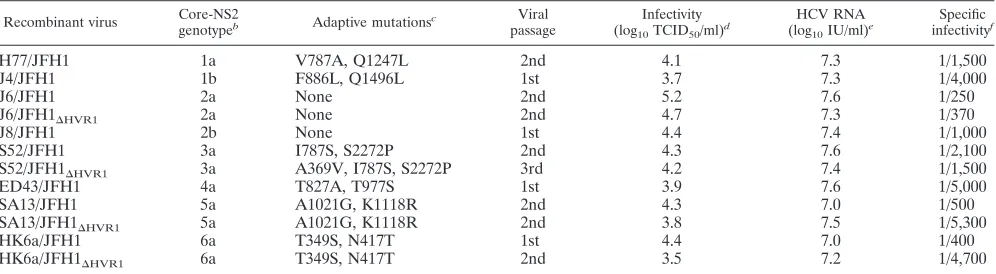
TABLE 1. Virus stocks of JFH1-based HCV recombinants with genotype-specific Core-NS2 used for density analysis andin vitro neutralizationa
Recombinant virus Core-NS2
genotypeb Adaptive mutationsc Viral
passage
Infectivity
(log10TCID50/ml)
d HCV RNA
(log10IU/ml)
e Specific
infectivityf
H77/JFH1 1a V787A, Q1247L 2nd 4.1 7.3 1/1,500
J4/JFH1 1b F886L, Q1496L 1st 3.7 7.3 1/4,000
J6/JFH1 2a None 2nd 5.2 7.6 1/250
J6/JFH1⌬HVR1 2a None 2nd 4.7 7.3 1/370
J8/JFH1 2b None 1st 4.4 7.4 1/1,000
S52/JFH1 3a I787S, S2272P 2nd 4.3 7.6 1/2,100
S52/JFH1⌬HVR1 3a A369V, I787S, S2272P 3rd 4.2 7.4 1/1,500
ED43/JFH1 4a T827A, T977S 1st 3.9 7.6 1/5,000
SA13/JFH1 5a A1021G, K1118R 2nd 4.3 7.0 1/500
SA13/JFH1⌬HVR1 5a A1021G, K1118R 2nd 3.8 7.5 1/5,300
HK6a/JFH1 6a T349S, N417T 1st 4.4 7.0 1/400
HK6a/JFH1⌬HVR1 6a T349S, N417T 2nd 3.5 7.2 1/4,700
a
The ORF sequences of all virus stocks were verified. b
NS3-NS5B and 5⬘and 3⬘UTRs of the recombinant viruses are of the genotype 2a isolate JFH1.
c
Mutations are annotated based on the H77 reference sequence (GenBank accession no. AF009606). All mutations, except for the A369V mutation for the 3a⌬HVR1
recombinant, are adapting the intergenotypic recombinant viruses to cell culture (17, 18, 20, 29). d
Virus titers are the averages of at least two six-replicate TCID50determinations with a standard error of the mean (SEM) of⬍0.3.
e
HCV RNA titers are from a single determination by TaqMan RT-qPCR. f
Specific infectivity was calculated as TCID50/IU. HVR1-deleted ED43/JFH1T827A,T977Swas found to be nonviable. HVR1-deleted H77/JFH1V787A,Q1247L, J4/
JFH1F886L,Q1496L, and J8/JFH1 could be adapted to the HVR1 deletion (Fig. 2), but the infectivity titers of adapted recombinant viruses in passages were about 10 3
FFUs/ml and hence too low for the generation of high-titer virus stocks.
on November 7, 2019 by guest
http://jvi.asm.org/
stock samples (Table 1), retaining⬃250l. The samples were spun at 35,000 rpm
(⬃151,000⫻relative centrifugal force [RCF]) for 18 h at 4°C using a Beckman
SW-41 rotor mounted in a Beckman XL-70 ultracentrifuge. After centrifugation,
⬃550-l gradient fractions were harvested from the bottom of the tube, and
400-l portions were weighed (model SI-114; Denver Instruments) to calculate
fraction densities. The fractions were titrated for HCV infectivity and HCV RNA at 1:10 dilutions as described above.
HCV neutralization.For neutralization studies, we used chronic-phase HCV sera of genotype 1a (H06 [29]), 4a (AA [29]), and 5a (SA3 [20]). IgG was purified
from H06 and SA3 sera as described previously (20). We plated 6⫻103Huh7.5
cells/well into poly-D-lysine-coated 96-well plates (Nunc). On the following day,
50 to 400 TCID50s of HCV was incubated for 1 h at 37°C with 2-fold dilutions of
heat-inactivated (56°C for 30 min) serum or 4-fold dilutions of purified serum IgG (20) and subsequently incubated with cells for 3 h. After 48 h, cells were immunostained for NS5A (17). Neutralization was done in three replicate sam-ples. Percent neutralization was calculated by relating FFU counts to the mean of six replicate samples incubated with virus only. Neutralization data were analyzed as variable-slope dose-response curves using GraphPad Prism 4.0. The
50% inhibitory concentration (IC50) and 90% inhibitory concentration (IC90)
were approximated as the first serum dilution with greater than 50% and 90% neutralization, respectively.
Human liver chimeric mouse infections and ex vivo neutralization.HCV infections of urokinase-type plasminogen activator, severe combined immune deficiency (uPA-SCID) mice engrafted with human hepatocytes were performed at Ghent University Hospital, with protocols approved by the hospital’s Ethical Committee and Animals Ethics Committee. Animals were infected with HCV by
intraperitoneal injections of 104
TCID50s. Animal care and sampling were done
as described previously (23). Mouse liver repopulation by human hepatocytes
was confirmed 2 days preinfection by human plasma albumin levels of⬎3.2
mg/ml. Sequencing HCV envelope sequences of viruses recovered from plasma or serum samples was performed as described above. However, in certain cases, random hexamers were used in reverse transcription with Superscript II (Invitro-gen). HCV RNA titers were determined with Roche HCV TaqMan 48 or by in-house qPCR (17). Cell culture experiments using mouse plasma were done with 5 IU/ml heparin. To avoid cytotoxic effects of mouse plasma and serum in ex vivoneutralization experiments, a virus dose of 10 TCID50s per well was used
to infect cultures in 96-well plates. Experiments were done with 24 replicate samples and scored by manual FFU counting. The remaining procedure was
performed as described above. Two-tailedttests were performed comparing
infections in the presence or absence of neutralizing antibody-containing serum
samples by using GraphPad Prism 4.0 with a significance threshold ofP⫽0.05.
RESULTS
Differential effect of HVR1 deletion on the viability of HCV strains of genotypes 1 to 6. We investigated the viability of HVR1 deletion mutants of the recently developed panel of cell culture-adapted JFH1-based recombinants with Core-NS2 of genotypes 1a, 1b, 2a, 2b, 3a, 4a, 5a, and 6a (17, 18, 20, 29) (Table 1, recombinants referred to by the Core-NS2 genotype). We deleted the entire HVR1 motif from the eight Core-NS2 genotype recombinants (corresponding to nucleotide [nt] 1491 to 1571 for all recombinants except for recombinant 6a for which it corresponded to nt 1494 to 1571; nucleotide and amino acid positions in this study relate to the H77 reference sequence with GenBank accession no. AF009606). After HCV RNA transfection of Huh7.5 cells, all HVR1-deleted recom-binants replicated efficiently, as NS5A immunostainings of transfected cells on day 1 revealed similar percentages of brightly fluorescent cells. The 2a⌬HVR1, 5a⌬HVR1, and 6a⌬HVR1 recombinants exhibited efficient viral spread and were only slightly attenuated with relatively high infectivity titers (Fig. 1A to C). The similar infectivities of 2a and 2a⌬HVR1viruses after
transfection were further characterized by a kinetic infection experiment with three different multiplicities of infection (MOIs) showing highly similar degrees of virus spread, along with similar HCV RNA and infectivity titers of collected
su-pernatants (data not shown). Susu-pernatants from cell culture infections of 2nd passage 2a⌬HVR1, 1st passage 5a⌬HVR1, and 2nd passage 6a⌬HVR1recombinants had peak HCV RNA titers of approximately 107.5IU/ml and peak HCV infectivity titers of
104.7, 103.8, and 103.5TCID
50s/ml, respectively (Table 1).
Se-quencing of the full ORFs of genomes recovered from these peak infections confirmed the HVR1 deletion and revealed no nucleotide changes. Thus, viability of the 2a, 5a, and 6a viruses lacking HVR1 did not require cell culture adaptation.
[image:3.585.318.524.71.443.2]In contrast, the 1a⌬HVR1, 1b⌬HVR1, 2b⌬HVR1, 3a⌬HVR1, and 4a⌬HVR1 recombinants were severely attenuated in Huh7.5 cells, displaying inefficient or nonexistent spread and low in-fectivity titers following HCV RNA transfection (Fig. 2A to E).
FIG. 1. Intergenotypic JFH1-based recombinant HCV with Core-NS2 of genotypes 2a, 5a, and 6a were infection competent following HVR1-deletion. (A to C) Comparing HVR1-deleted virus to the orig-inal virus for genotypes 2a, 5a, and 6a revealed similar spread kinetics and supernatant infectivity titers following HCV RNA transfection of Huh7.5 cells. The percentage of infected cells was monitored by HCV-specific immunostaining and HCV supernatant infectivity titers were monitored by FFU assay, shown as the mean of three replicate samples with the standard deviation (SD) (error bar) (the lower cutoff was 500 FFUs/ml for genotype 2a, and it was 100 FFUs/ml for genotypes 5a and 6a). The original virus is shown in black, and the HVR1-deleted virus is shown in purple.
on November 7, 2019 by guest
http://jvi.asm.org/
With the exception of the 4a⌬HVR1recombinant, they all even-tually spread, and we identified coding mutations by ORF sequencing of virus from culture supernatants upon spread to at least 80% of cells. We mainly observed envelope mutations and therefore focused on the effects of coding envelope mu-tations for the adaptation of attenuated HVR1-deleted viruses. Multiple transfections were performed, and the observed cod-ing changes in the envelope genes are summarized in Table 2. For the 1a⌬HVR1recombinant, the number of HCV antigen-positive cells decreased following transfection and was nearly undetectable 30 days after transfection (not shown). Two ad-ditional transfections of Huh7.5 cells with the 1a⌬HVR1
recom-binant confirmed this attenuation. However, after 40 days, these two transfected cell cultures displayed virus spread and at least 80% of cells were HCV antigen positive on day 56, suggesting viral adaptation. ORF sequencing of HCV genomes recovered from supernatants confirmed HVR1 deletion and revealed several mutations (Table 2). In reverse genetics stud-ies, we found that substitutions H261R (nucleotide change A1123G; E1) with Q444R (nucleotide change A1672G; E2), as well as N476D (nucleotide change A1767G; E2) with S733F (nucleotide change C2539T; E2), restored infectivity of the HVR1-deleted 1a virus (Fig. 2A). Infectivity titers of these adapted recombinants were⬃10-fold lower than those of the original 1a virus, but ORF sequencing of 1st passage viruses revealed no dominant nucleotide changes. Genotype 3a⌬HVR1 developed only one coding mutation following transfection of Huh7.5 cells, A369V (nucleotide change C1447T; E1) (Table 2), which was shown in reverse genetics studies to fully restore 3a⌬HVR1infectivity (Fig. 2D). Supernatants from cell culture
infection of 3rd passage 3a⌬HVR1,A369V recombinant had a peak HCV RNA titer of 107.4IU/ml and a peak HCV
infec-tivity titer of 104.2 TCID
50s/ml (Table 1). Sequencing of the
complete ORFs of recovered genomes revealed no nucleotide changes. Finally, we demonstrated that the combination of S363F (nucleotide change C1429T; E1), T435P (nucleotide change A1644C; E2), and V710L (nucleotide change G2469C; E2) for the 1b⌬HVR1 recombinant and Y412N (nucleotide
change T1575A; E2) for the 2b⌬HVR1recombinant resulted in adaptation of these viruses and efficient virus spread (Fig. 2B and C). Sequencing of the ORFs of these viruses at different viral passages did not reveal nucleotide changes, and we con-sistently observed infectivity titers of about 103 FFUs/ml in
[image:4.585.60.268.64.681.2]viral passages. Although the difference in viability of HVR1-deleted 2a and 2b recombinants indicated that HVR1 depen-dence was not genotype specific, our observations showed that dependency on this region varied greatly among different HCV isolates.
FIG. 2. Intergenotypic JFH1-based recombinant HCV with Core-NS2 of genotypes 1a, 1b, 2b, 3a, and 4a were infection impaired upon HVR1 deletion, but the infectivity of most viruses could be rescued by envelope mutations. The spread of viruses (genotypes 1a, 1b, 2b, 3a, and 4a) following HCV RNA transfection of Huh7.5 cells was
moni-tored by determining the percentage of infected cells by HCV-specific immunostaining and HCV supernatant infectivity titers by FFU assay, shown as the mean of three replicates with SD (the lower cutoff was 100 FFUs/ml). The original virus is shown by black squares, deleted virus is shown by purple triangles pointing up, and HVR1-deleted virus with one or more HVR1 deletion adaptive envelope mutations is shown by green triangles pointing down or by orange diamonds. All mutations are annotated based on the H77 reference sequence (GenBank accession no. AF009606). n.d., not detected.
on November 7, 2019 by guest
http://jvi.asm.org/
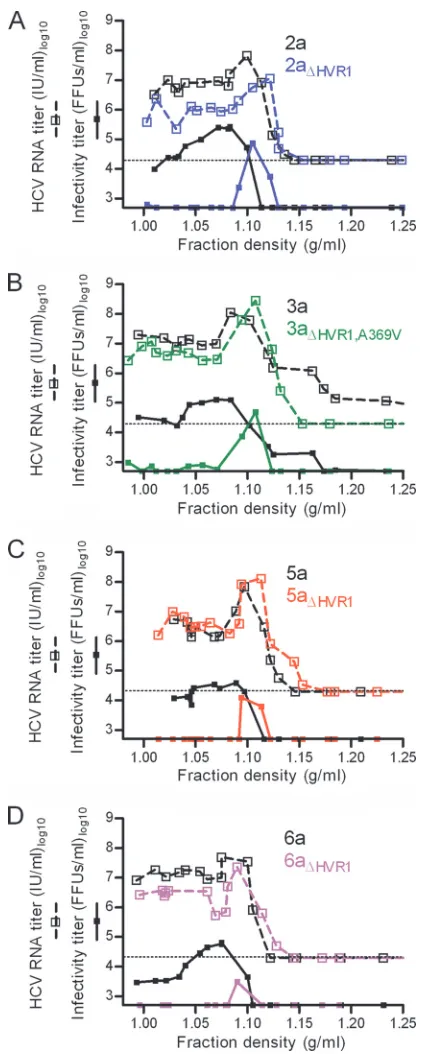
Deletion of HVR1 from HCV recombinants increased den-sity and decreased structural heterogeneity of infectious par-ticles irrespective of the HCV genotype.We used virus stocks of genotypes 2a, 3a, 5a, and 6a with and without HVR1 (Table 1) to investigate changes in physicochemical properties. Per-forming equilibrium buoyant density centrifugation in iodixa-nol gradients, we found similar HCV RNA titers at densities between 1.0 and 1.15 g/ml for all genotypes both with and without HVR1 (Fig. 3A to D). However, the density of infec-tious HCV invariably changed from a range of 1.0 to 1.1 g/ml for the original recombinants to a single peak at ⬃1.1 g/ml upon HVR1 deletion (Fig. 3A to D). This finding indicated that HVR1 deletion caused increased density and decreased heterogeneity of the infectious virus population irrespective of genotype.
Deletion of HVR1 resulted in greatly increased neutraliza-tion susceptibility to chronic-phase HCV serum antibodies for most HCV genotypes, resulting in similar neutralization pro-files across genotypes.To further evaluate the effect of HVR1 deletion on different HCV genotypes, we compared the sus-ceptibility of genotypes 1a, 2a, 3a, 5a, and 6a with and without HVR1 to neutralization with chronic-phase H06 serum. This HCV chronic-phase serum is known to contain cross-reactive neutralizing antibodies with varying potency against the origi-nal recombinants of different genotypes used to generate the HVR1-deleted viruses (18, 20, 29). We observed three distinct neutralization profiles for original viruses of genotypes 1a, 2a, 3a, 5a, and 6a (Fig. 4A to C). In contrast, HVR1-deleted viruses were all highly sensitive to neutralization. The original 6a virus was efficiently neutralized at high H06 dilutions, and HVR1-deleted virus displayed only a small increase in neutral-ization susceptibility (Fig. 4A and Table 3). The original 1a and 5a viruses showed less steep dose-response curves, requiring a large increase in serum antibodies for a small increase in neu-tralization. In contrast, the HVR1-deleted viruses of both ge-notypes were neutralized completely at high H06 dilutions, and no difference was observed between 1a⌬HVR1viruses harboring different HVR1 deletion adaptive mutations in the envelope genes, suggesting that the relevant neutralization epitopes were unaltered (Fig. 4B and Table 3). The original 2a and 3a viruses showed a two-population dynamic with half the virus population seemingly being neutralization resistant, while the HVR1-deleted viruses were neutralized completely at high H06 dilutions (Fig. 4C and Table 3). The 50% and 90% neu-tralization titers of H06 against the HVR1-deleted viruses of the different genotypes were similar, with the highest titer against 6a⌬HVR1(Table 3).
We verified the increased neutralization susceptibility of HVR1-deleted viruses by additional neutralization experi-ments of genotype 2a and 5a viruses with and without HVR1 using dilutions of chronic-phase patient HCV sera AA (geno-type 4a) and SA3 (geno(geno-type 5a), both of which have been shown to contain cross-genotype reactive neutralizing antibod-ies against HCV (20, 29). Both sera neutralized the HVR1-deleted viruses with high efficiency but had minimal effect against the corresponding original viruses (Table 3). To ad-dress the possibility of serum-specific IgG-independent effects, we attempted to neutralize 2a and 5a viruses with and without HVR1 using two HCV negative-control sera at 1:50, 1:500, 1:5,000, and 1:50,000 dilutions. We did not observe any effect
TABLE 2. Coding envelope mutations observed by full ORF sequencing of transfections and infections with HVR1-deleted HCV recombinants with Core-NS 2 of genotypes 1a, 1b, 2b, and 3a a HCV recombinant Amino acid change at the following amino acid reference position b HCV envelope protein 1 HCV envelope protein 2 261 299 361 363 367 369 411 411 412 414 430 435 438 444 476 532 576 580 629 682 710 733 1a⌬ HVR1 H 3 R ● Y 3 H ●● ● ● ● ● ● N 3 D ●● Q 3 R N 3 D ●● ● ● L 3 Q ● S 3 F 1b ⌬ HVR1 ● E 3 G ● S 3 FN 3 H ●● ● ● ● ● T 3 P ●● ● ● N 3 DI 3 TV 3 I ● V 3 L ● 2b ⌬ HVR1 ●●● ● ● ● L 3 VL 3 R Y 3 N I 3 V ●● M 3 L ●● N 3 T ●● ● ● ● ● 3a⌬ HVR1 ●●● ● ● A 3 V ● ● ● ● ● ● ● ● ●●● ● ● ● ● ● aThe original HCV recombinants are described in greater detail in Table 1. The data were compiled from sequencing multiple transfection/infection OR Fs (genotype 1a, 9 ORFs; genotype 1b, 3 ORFs; genotype 2b, 4 ORFs; genotype 3a, 2 ORFs). bAmino acid change at the amino acid reference positions for HVR1-deleted JFH1 recombinants with genotype-specific Core-NS2 genes. The amino acid ref erence positions are for H77 reference strain (GenBank accession no. AF0096060). Only coding envelope mutations are shown. A mutation observed in more than one ORF is shown in boldface type. A mutation test ed by reverse genetics and found to increase the infectivity of the HVR1-deleted recombinant virus is shown on a gray background. A small solid circle indicates that there was no change for this recombinant.
on November 7, 2019 by guest
http://jvi.asm.org/
[image:5.585.109.196.77.738.2]of either serum against any of the tested viruses at 1:500 or higher dilutions, and we observed only a slight effect of about 50% neutralization against the two HVR1-deleted viruses at the 1:50 dilution (data not shown). Thus, the chronic-phase patient sera 50% neutralization titers for HVR1-deleted vi-ruses of at least 1:12,800 (Table 3) were caused by HCV-specific serum antibodies. Finally, we confirmed that chronic-phase patient serum neutralization was caused specifically by serum IgG by performing neutralization of 2a, 2a⌬HVR1, 5a,
[image:6.585.57.269.77.604.2]FIG. 3. HVR1 was critical for infectivity of low-density HCVcc ir-respective of genotype. Equilibrium gradient density centrifugation was done in iodixanol comparing a single JFH1-based Core-NS2 ge-notype virus with and without HVR1 (Table 1) (gege-notypes 2a, 3a, 5a, and 6a). After centrifugation,⬃550-l gradient fractions were har-vested from the bottom of the tube, and 400-l portions were weighed to calculate fraction densities. HCV RNA titration (the lower cutoff was 20,000 IU/ml and is shown as a dotted line in each graph) and infectivity titration (the lower cutoff was 500 FFUs/ml) was performed for each fraction (samples were diluted at least 1:10). Mutations are annotated based on the H77 reference sequence (GenBank accession no. AF009606).
FIG. 4. HVR1 deletion from JFH1-based viruses with Core-NS2 of different genotypes resulted in increased sensitivity to neutralizing antibodies. Viruses of genotypes 1a, 2a, 3a, 5a, and 6a with HVR1 (closed symbols) and without HVR1 (open symbols) (Table 1) were neutralized by incubation for 1 h at 37°C with heat-inactivated chronic-phase patient serum H06 (genotype 1a virus-infected patient H) pre-viously shown to contain cross-genotype-reactive neutralizing antibod-ies (18, 29). The number of FFUs/well was visualized following 48 h of infection by HCV-specific immunostaining. Neutralization data are shown as the means of three replicates with the standard error of the mean (SEM) (error bars) related to the mean of 6 replicates with virus only. Variable-slope dose-response curve regression was used to fit the data points. Due to the relatively low infectious titer of the 1a⌬HVR1,H261R,Q444Rrecombinant, this virus was concentrated ⬃ 50-fold using Amicon centrifugation columns. Mutations are annotated based on the H77 reference sequence (GenBank accession no. AF009606).
on November 7, 2019 by guest
http://jvi.asm.org/
and 5a⌬HVR1recombinants, using IgG purified from H06 and SA3 sera (data not shown). In conclusion, our findings showed that HVR1 deletion caused viruses to become highly neutral-ization susceptible, resulting in similar neutralneutral-ization profiles across HCV genotypes.
A relationship between virus density and neutralization sus-ceptibility was observed only for genotype 2a.Since we had observed increased density and increased neutralization sus-ceptibility of HVR1-deleted viruses, we wanted to investigate whether a direct correlation between density and
[image:7.585.43.543.89.268.2]neutraliza-FIG. 5. When comparing neutralization susceptibility with virus density for JFH1-based viruses with Core-NS2 of genotypes 1a to 6a, only 2a virus displayed increased neutralization at higher densities. JFH1-based viruses with Core-NS2 of genotypes 1 to 6 (virus with genotypes 1a, 2a, 3a, 4a, 5a, and 6a) from centrifugation fractions with different densities were neutralized with four dilutions of H06 serum as described in Materials and Methods. Neutralization data are shown as the means of three replicates with the SEM related to mean of 6 replicates of virus only.
TABLE 3. Reciprocal titers of neutralizing antibodies in chronic-phase patient sera against recombinant viruses with genotype-specific Core-NS2 of genotypes 1a, 2a, 3a, 5a, and 6a with and without HVR1a
Virus genotype (Core-NS2)
Reciprocal serum neutralization titerb
90% 50%
H06 (1a) AA (4a) SA3 (5a) H06 (1a) AA (4a) SA3 (5a)
Original virus
1a ⬍50 ● ● 800 ● ●
2a ⬍50 ⬍50 ⬍50 50–51,200c ⬍50 ⬍50
3a ⬍50 ● ● 50–51,200c ● ●
5a 50 ⬍50 ⬍50 3,200 200 100
6a 6,400 ● ● 51,200 ● ●
Virus lacking HVR1
1a⌬HVR1,H261R,Q444R 6,400 ● ● 51,200 ● ●
1a⌬HVR1,N476D,S733F 6,400 ● ● 25,600 ● ●
2a⌬HVR1 12,800 6,400 1,600 51,200 51,200 12,800
3a⌬HVR1,A369V 6,400 ● ● 51,200 ● ●
5a⌬HVR1 6,400 3,200 1,600 25,600 25,600 12,800
6a⌬HVR1 51,200 ● ● 204,800 ● ●
a
Fifty to 400 TCID50s of virus stocks with genotype-specific Core-NS2 were incubated in 3 replicates with H06, AA, or SA3 sera in 2-fold dilution series and tested
in Huh7.5 cell infections as described in Materials and Methods. b
Reciprocal neutralization titers are indicated as the highest dilution of H06 (genotype 1a), AA (genotype 4a), or SA3 (genotype 5a) sera leading to a reduction of FFU counts of at least 90% or 50% compared to the mean of 6 replicates of virus only. The small solid black circles indicate that no data was obtained for that virus. Mutations are annotated based on the H77 reference sequence (GenBank accession no. AF009606).
c
For original viruses 2a and 3a, around half the virus population was neutralized at H06 serum dilutions 50 to 51,200 (Fig. 4B).
on November 7, 2019 by guest
http://jvi.asm.org/
[image:7.585.41.542.421.686.2]tion susceptibility existed for the original Core-NS2 recombi-nant viruses. Using genotype 1 to 6 virus-containing fractions from gradient centrifugations, we performed neutralization tests with four different dilutions of H06 serum (Fig. 5A to F). When comparing the neutralization susceptibility of noncen-trifuged viruses (Fig. 4) with that of cennoncen-trifuged viruses (Fig. 5), it seemed that the overall neutralization susceptibility was increased by the centrifugation procedure. This is in spite of the fact that iodixanol gradients have been shown to be supe-rior for virus structure preservation in ultracentrifugation (26). Furthermore, a correlation between a higher density and higher neutralization susceptibility was observed only for the genotype 2a viruses. To investigate whether this effect on ge-notype 2a was reproducible, we repeated the experiment for the 2a recombinant gradient viruses using the H06, AA, and SA3 sera (Fig. 6A to C). This experiment confirmed the cor-relation between neutralization susceptibility and density of 2a
virus particles for neutralizing antibodies from patients in-fected with HCV genotypes 1a (H06), 4a (AA), and 5a (SA3).
In vivo-produced HVR1-deleted virus had increased neutral-ization susceptibility similar to observations forin vitro -pro-duced HVR1-deleted virus.To investigate whether the increase in neutralization susceptibility for HVR1-deleted virus was an
in vitrophenomenon, we neutralized 2a and 2a⌬HVR1viruses producedin vivoin native human hepatocytes of human liver chimeric mice. We used samples from two chimeric mice orig-inally inoculated with 104 TCID
50culture-derived 2a viruses
with HVR1 (mouse B156) and without HVR1 (mouse B150R). Both animals were robustly infected, as evidenced by at least two HCV RNA titers above 106.5 IU/ml for samples taken
during weeks 2 to 4. Furthermore, the samples had relatively high HCV infectivity titers in culture displaying similar specific infectivities of 1/79 and 1/63 for mouse B156 (2a infected) and mouse B150R (2a⌬HVR1infected), respectively. By sequencing the envelope genes, we found that viruses derived from the B156 and B150R mice did not have envelope mutations, and we elected to test neutralization susceptibility ofin vivo -pro-duced 2a virus on the week 3 sample from mouse B156 and of thein vivo-produced 2a⌬HVR1virus on the week 4 sample from
mouse B150R.
The limited amount of mouse plasma/serum samples as well as the potential cytotoxicity necessitated using a different neu-tralization protocol with a single serum antibody dilution with many replicates infected at low viral doses. We initially chose to use the SA3 serum at a dilution of 1:200, which was found to have minimal effect against in vitro-produced original 2a virus and which completely neutralized the 2a⌬HVR1 recombi-nant. In vivo-produced virus was preincubated for 1 h with either medium or a 1:200 dilution of the SA3 serum prior to infection of 24 wells with an inoculum of 10 TCID50s/well. We observed complete neutralization of the HVR1-deleted virus and no significant effect against the original 2a virus (Fig. 7A). We next investigated whether the neutralization susceptibility was similar forin vitro- andin vivo-produced viruses. We did an analogous experiment using an SA3 dilution of 1:4,000, which has been shown to neutralize in vitro-produced 2a⌬HVR1 at about 70%. Here we observed similar neutralization ofin vivo -andin vitro-produced HVR1-deleted 2a virus of 70 to 80% and no significant effect against the original viruses (Fig. 7B and C). Thus, we demonstrated increased neutralization susceptibility of the HVR1-deleted virus produced in vivocomparable to what was observed for thein vitro-produced virus, indicating that the protective role of HVR1 against neutralization by HCV patient sera was not anin vitroartifact.
DISCUSSION
In the present study, we found that deletion of HVR1 had a differential impact on the viability of different HCV genotype isolates, which suggests that HVR1 plays a significant role in the viral life cycle, the importance of which varies for different isolates. Comparing density distributions of infectious HCV particles and HCV RNA of the original and HVR1-deleted viruses, we found that the infectivity of low-density HCV de-pended on HVR1, irrespective of the virus genotype. In addi-tion, we demonstrated that bothin vitro- and in vivo-derived HVR1-deleted HCV had greatly increased neutralization
sus-FIG. 6. Neutralization susceptibility of the JFH1-based Core-NS2 genotype 2a recombinant increased with virus density for the three neutralizing antibody-containing sera H06, AA, and SA3. The neutral-ization susceptibilities of ultracentrifugation fractions with different densities of original genotype 2a virus were examined using three sera, H06 (A), AA (B), and SA3 (C). Neutralization was carried out at four different serum dilutions as indicated in each graph and performed as described in Materials and Methods. Neutralization data are shown as the means of three replicates with the SEM related to the mean of 6 replicates of virus only.
on November 7, 2019 by guest
http://jvi.asm.org/
[image:8.585.91.237.70.414.2]ceptibility to chronic-phase patient serum antibodies com-pared to the original unmodified viruses.
We deleted HVR1 of the E2 glycoprotein from a recently developed panel of JFH1-based viruses with genotype 1 to 6 Core-NS2 gene sequences (18, 20, 29). Interestingly, although all HVR1-deleted viruses replicated upon transfection of Huh7.5 cells, HVR1 deletion had a differential impact on HCV viability. The deletion of HVR1 from the 2a recombinant J6/ JFH1 resulted in minimal viral attenuation in vitro, whereas others reported a 10-fold decrease in infectivity when HVR1 was deleted from the closely related 2a recombinant, Jc1 (4). Jc1 is known to produce higher titers in culture than J6/JFH1. This difference is likely related to the different location of the downstream J6CF/JFH1 junction, which might affect viral rep-lication and/or assembly and possibly impact HVR1 depen-dence. HVR1 deletion from genotypes 5a and 6a resulted in noticeable decreases in viral infectivity titers, but they still exhibited efficient viral spread and genetic stability. However, severely attenuated infections were observed for 1a⌬HVR1, 1b⌬HVR1, 2b⌬HVR1, and 3a⌬HVR1recombinants; the 4a⌬HVR1
recombinant was nonviable. Adaptive envelope mutations res-cuing viral viability were identified for the 1a⌬HVR1, 1b⌬HVR1,
2b⌬HVR1, and 3a⌬HVR1 viruses. The high viability of the 2a⌬HVR1 recombinant and the low viability of the 2b⌬HVR1
recombinant indicated that the differential effect of HVR1 deletion was not genotype specific.
A comprehensive analysis of the positions of the adaptive envelope mutations is made difficult by the absence of an X-ray or nuclear magnetic resonance structure of the E1/E2 het-erodimer. However, it is noteworthy that three out of the five HVR1 deletion-adapted viruses tested had mutations in the transmembrane domain of either E1 or E2 shown to be im-portant for E1/E2 heterodimerization (8). These adaptive mu-tations were S733F (E2) for the 1a⌬HVR1virus, S363F (E1) for the 1b⌬HVR1virus, and A369V (E1) for the 3a⌬HVR1virus, the latter being sufficient for restoring full viability. It is also inter-esting that adapted 1a⌬HVR1 virus had mutations in either HVR2 (E2; N476D) or HVR3 (E2; Q444R), which suggests that these regions play a role in HVR1 deletion adaptation. Furthermore, it is intriguing that the HVR2 mutation removed a glycosylation site possibly exposing parts of the virus enve-lope. The E1, E2, NS3, and NS5B genes have been shown to acquire coding mutations in full-length H77C⌬HVR1infections of chimpanzees (14). The Core-NS2 sequence of the 1a⌬HVR1
virus used in the present study was of the H77C isolate, and we observed a need for adaptive mutations in the envelope genes
in vitro. Further studies should investigate the functions ofin vitro- and in vivo-derived H77C envelope mutations in re-sponse to HVR1 deletion. On the basis of these highly diver-gent phenotypes of HVR1-deleted HCV genotype isolates, it would appear that HVR1 plays an unknown role in the virus life cycle, the importance of which varies between isolates or subtypes. This role could relate to a differential interaction of isolates with early entry factors, such as the proposed interac-tion of HVR1 with scavenger receptor BI (SR-BI) (6), which should be the subject of further studies.
[image:9.585.79.246.85.499.2]Using HVR1-deleted viruses of genotypes 2a, 3a, 5a, and 6a, we found that HVR1 deletion caused a shift in density of infectious HCV from a range of 1.0 to 1.1 g/ml to a single peak at⬃1.1 g/ml. Most enveloped viruses have densities of ⬃1.2
FIG. 7.In vivo-produced 2a⌬HVR1virus displayed greatly increased neutralization susceptibility resembling that of in vitro-produced 2a⌬HVR1virus.In vivo-produced viruses used were without dominant envelope mutations; 2a virus was from mouse B156 serum, and 2a⌬HVR1virus was from mouse B150R plasma. A virus dose of 10 TCID50s/well was used. Mouse-derived 2a and 2a⌬HVR1viruses were incubated in 24 replicates for 1 h at 37°C with either medium or a dilution of SA3 serum prior to infection of Huh7.5 cells. The number of FFUs/well was visualized following 48 h of infection by HCV-specific immunostaining. The number of FFUs/well was normalized to the virus-only infection without serum and is shown with the SEM. The asterisk for 2a⌬HVR1virus and SA3 serum diluted 1:200 indicates that no infected cells were observed. Values that were significantly different (P⬍0.0001) are indicated by a bar and three asterisks. Values that were not significantly different at a significance level ofP⫽0.05 are indicated by a bar and ns. (A)In vivo-produced 2a and 2a⌬HVR1viruses subjected to neutralization with a 1:200 dilution of SA3 serum showed no neutralization of 2a and complete neutralization of 2a⌬HVR1as observed forin vitro-produced viruses (Table 3). (B and C)In vivo-and
in vitro-produced 2a⌬HVR1subjected to neutralization with a 1:4,000
dilution of SA3 serum displayed statistically significant and similar neutralization of about 70 to 80%, whereas the original 2a viruses producedin vivoandin vitrowere not neutralized.
on November 7, 2019 by guest
http://jvi.asm.org/
g/ml (24, 34), but HCV seems to employ the very-low-density lipoprotein (VLDL) release machinery of the hepatocyte dur-ing virus assembly and is apparently released as lipo-viro par-ticles (3). This might explain the relatively low density of virus derived from patients (3), animals (23), and cell culture (19). This result corroborates a recent finding using HVR1-deleted Jc1 (4) and indicates that infectivity of low-density HCV par-ticles depends on HVR1 irrespective of the virus genotype.
Serum from patient H was shown to prevent H77C (geno-type 1a) infection in vivo (31) and exhibited cross-genotype neutralizationin vitro(20, 29). Therefore, we chose H06 serum to investigate susceptibility to neutralization of viruses with genotypes 1a, 2a, 3a, 5a, and 6a with and without HVR1. All viruses, viruses with different degrees of resistance against neu-tralizing antibodies, became significantly more susceptible when HVR1 was deleted. An exception to this was the original genotype 6a virus, which was highly susceptible to neutraliza-tion and which showed only a small increase in susceptibility when HVR1 was deleted. This showed that HVR1 was not the only factor determining neutralization susceptibility as corrob-orated by others (19, 30). It should be noted that the original 6a virus was the only recombinant with cell culture-adaptive mutations in the envelope genes (Table 1), one of which is in a known neutralization epitope (18). However, susceptibility to neutralization with H06 in vivo has been observed for the unaltered 6a virus (24a). The observation that HVR1 deletion resulted in increased neutralization susceptibility to serum an-tibodies could not be explained by different susceptibilities to the infection enhancing effects of serum between original and HVR1-deleted viruses. Interestingly, variation in neutraliza-tion profiles for viruses with the different genotypes disap-peared upon HVR1 deletion, suggesting that HVR1 shielded cross-genotype conserved epitopes, which is corroborated by the finding that the conserved CD81 binding domains of the Jc1 virus was exposed by HVR1 deletion (4). It also suggests that sera from HCV patients with very little neutralization activity might still contain high titers of cross-genotype-reactive neutralizing antibodies, if the HVR1-dependent shielding could be overcome.
Another important difference between the different geno-type viruses retaining HVR1 was that only genogeno-type 2a dis-played a correlation between higher density and increased neutralization susceptibility as described by others for a related genotype 2a virus (19). In contrast, we were not able to show such a correlation for the original viruses of genotype 1a, 3a, 4a, 5a, and 6a. Thus, our findings suggest that increased virion density does not represent the only mechanism for the in-creased neutralization susceptibility of HVR1-deleted viruses. The variation across genotype isolates observed in this study affirms the importance of considering the genetic heterogene-ity of HCV.
The study that initially reported that the 2a recombinant J6/JFH1 was fully infectious in human liver chimeric mice did not sequence viruses derived from the plasma samples of mice (23). Importantly, we observed no apparent attenuation of HVR1-deleted virus upon infection of human liver chimeric mice within vitro-produced 2a and 2a⌬HVR1viruses. Further-more, we sequencedin vivo-derived viruses with and without HVR1 and found that these viruses did not depend on devel-oping envelope mutations. Using viruses without envelope
mu-tations, we then compared neutralization susceptibility of in vivo-produced 2a virus with and without HVR1. We found that
in vivo-produced HVR1-deleted virus had greatly increased neutralization sensitivity, which is similar to what was observed for HVR1-deletedin vitro-produced virus. This indicated that one of the roles of HVR1in vivomight in fact be related to shielding epitopes highly sensitive to neutralization. Thus, our findings might be of relevance for previous reports that HVR1 plays a role in the establishment of chronic infection (10, 11). It is possible that the viability of 2a⌬HVR1virus in human liver chimeric mice is influenced by the absence of an adaptive immune system in this model. Addressing this by experimental infections of chimpanzees would be of interest.
The present study provides important new insight into the role of the E2 HVR1 motif of HCV. This is the first demon-stration of a differential importance of a specific sequence motif for different HCV isolates. Our data suggest that in the absence of HVR1, the virus exposes conserved envelope re-gionsin vitroandin vivo, because HVR1 deletion greatly in-creased susceptibility to neutralization with chronic-phase HCV serum antibodies. The shift in density caused by HVR1 deletion might be a consequence of such an exposure, suggest-ing that it depends on a decreased association with low-density moieties, such as lipids. Although the neutralization protection of HVR1 is incomplete, it is likely an important contributor to viral persistence and might help explain why HVR1 evolution has been linked to chronic disease progression (11). Such a role for HVR1 implies a need to focus on thein vivo availabil-ity of targeted neutralization epitopes when designing anti-body-mediated treatments or vaccines against HCV and sug-gests that overcoming this HVR1-dependent epitope shielding would render the virus more vulnerable to the host immune response. Thus, our study has important implications for the development of effective antibody-based vaccines and thera-peutics.
ACKNOWLEDGMENTS
We are grateful to Anna-Louise Sørensen, Lotte Mikkelsen, Lubna Ghanem (CO-HEP) and Lieven Verhoye (University of Ghent) for technical assistance, to Steen Ladelund for statistical advice, to Jens Ole Nielsen, Ove Andersen, and Kristian Schønning (Copenhagen University Hospital, Hvidovre, Denmark) for their support of the project, and to Robert Purcell (NIH), Harvey Alter (NIH), David Thomas (John Hopkins University School of Medicine), Michael Kew (University of the Witwatersrand), Charles Rice (Rockefeller Univer-sity), and Takaji Wakita (National Institute of Infectious Diseases) for providing reagents.
This study was supported by Ph.D. stipends from the Faculty of Health Sciences, University of Copenhagen (J.P., T.B.J., and T.K.H.S.), by research grants from the Lundbeck Foundation (J.B.), The Danish Cancer Society (J.M.G. and J.B.), the Novo Nordisk Foun-dation (J.M.G. and J.B.), The Danish Medical Research Council (J.B.), A. P. Moeller and the Chastine Mc-Kinney Moeller Foundation (T.K.H.S., J.M.G., and J.B.), the Leo Nielsen and Karen Margrethe Nielsen Foundation (J.P. and J.B.), and Copenhagen University Hos-pital, Hvidovre, Denmark (T.B.J., T.K.H.S., J.M.G., and J.B.), by a Concerted Action Grant (01G00507) from Ghent University, and by the Belgian State via the Interuniversity Attraction Poles Program (P6/36-HEPRO). P.M. is a postdoctoral fellow supported by The Re-search Foundation–Flanders (FWO-Vlaanderen; project 31500910).
REFERENCES
1.Alter, H. J., and L. B. Seeff.2000. Recovery, persistence, and sequelae in hepatitis C virus infection: a perspective on long-term outcome. Semin. Liver
Dis.20:17–35.
on November 7, 2019 by guest
http://jvi.asm.org/
2.Amoroso, P., et al.1998. Correlation between virus genotype and chronicity
rate in acute hepatitis C. J. Hepatol.28:939–944.
3.Andre, P., et al.2002. Characterization of low- and very-low-density hepatitis
C virus RNA-containing particles. J. Virol.76:6919–6928.
4.Bankwitz, D., et al.2010. Hepatitis C virus hypervariable region 1 modulates receptor interactions, conceals the CD81 binding site, and protects
con-served neutralizing epitopes. J. Virol.84:5751–5763.
5.Bartosch, B., J. Dubuisson, and F. L. Cosset.2003. Infectious hepatitis C virus pseudo-particles containing functional E1-E2 envelope protein
com-plexes. J. Exp. Med.197:633–642.
6.Bartosch, B., et al.2005. An interplay between hypervariable region 1 of the hepatitis C virus E2 glycoprotein, the scavenger receptor BI, and high-density lipoprotein promotes both enhancement of infection and protection
against neutralizing antibodies. J. Virol.79:8217–8229.
7.Bukh, J., et al.2000. Analysis of the hypervariable region 1 of hepatitis C
virus, p. 330–335.InH. S. Margolis, M. J. Alter, T. J. Liang, and J. L.
Dienstag (ed.), Viral hepatitis and liver diseases. Proceedings of the 10th International Symposium on Viral Hepatitis and Liver Disease. Interna-tional Medical Press, Atlanta, GA.
8.Ciczora, Y., N. Callens, F. Penin, E. I. Pecheur, and J. Dubuisson.2007. Transmembrane domains of hepatitis C virus envelope glycoproteins: resi-dues involved in E1E2 heterodimerization and involvement of these domains
in virus entry. J. Virol.81:2372–2381.
9.Dustin, L. B., and C. M. Rice.2007. Flying under the radar: the
immunobi-ology of hepatitis C. Annu. Rev. Immunol.25:71–99.
10.Farci, P., et al.1994. Prevention of hepatitis C virus infection in chimpanzees after antibody-mediated in vitro neutralization. Proc. Natl. Acad. Sci.
U. S. A.91:7792–7796.
11.Farci, P., et al.2000. The outcome of acute hepatitis C predicted by the
evolution of the viral quasispecies. Science288:339–344.
12.Farci, P., et al.1996. Prevention of hepatitis C virus infection in chimpanzees by hyperimmune serum against the hypervariable region 1 of the envelope 2
protein. Proc. Natl. Acad. Sci. U. S. A.93:15394–15399.
13.Fernandez, J., et al.2004. Long-term persistence of infection in chimpanzees inoculated with an infectious hepatitis C virus clone is associated with a decrease in the viral amino acid substitution rate and low levels of
hetero-geneity. J. Virol.78:9782–9789.
14.Forns, X., et al.2000. Hepatitis C virus lacking the hypervariable region 1 of the second envelope protein is infectious and causes acute resolving or
persistent infection in chimpanzees. Proc. Natl. Acad. Sci. U. S. A.97:13318–
13323.
15.Gottwein, J. M., and J. Bukh.2008. Cutting the Gordian knot—development and biological relevance of hepatitis C virus cell culture systems. Adv. Virus
Res.71:51–133.
16.Gottwein, J. M., et al.2010. Novel infectious cDNA clones of hepatitis C virus genotype 3a (strain S52) and 4a (strain ED43): genetic analyses and in
vivo pathogenesis studies. J. Virol.84:5277–5293.
17.Gottwein, J. M., et al.2007. Robust hepatitis C genotype 3a cell culture releasing adapted intergenotypic 3a/2a (S52/JFH1) viruses.
Gastroenterol-ogy133:1614–1626.
18.Gottwein, J. M., et al.2009. Development and characterization of hepatitis C virus genotype 1–7 cell culture systems: role of CD81 and scavenger
receptor class B type I and effect of antiviral drugs. Hepatology49:364–377.
19.Grove, J., et al.2008. Identification of a residue in hepatitis C virus E2 glycoprotein that determines scavenger receptor BI and CD81 receptor
dependency and sensitivity to neutralizing antibodies. J. Virol.82:12020–
12029.
20.Jensen, T. B., et al.2008. Highly efficient JFH1-based cell-culture system for hepatitis C virus genotype 5a: failure of homologous neutralizing-antibody
treatment to control infection. J. Infect. Dis.198:1756–1765.
21.Kumar, U., J. Monjardino, and H. C. Thomas.1994. Hypervariable region of hepatitis C virus envelope glycoprotein (E2/NS1) in an agammaglobulinemic
patient. Gastroenterology106:1072–1075.
22.Lindenbach, B. D., et al.2005. Complete replication of hepatitis C virus in
cell culture. Science309:623–626.
23.Lindenbach, B. D., et al.2006. Cell culture-grown hepatitis C virus is infec-tious in vivo and can be recultured in vitro. Proc. Natl. Acad. Sci. U. S. A.
103:3805–3809.
24.Liu, W. T., et al.1991. Isolation of dengue virus with a human promonocyte
cell line. Am. J. Trop. Med. Hyg.44:494–499.
24a.Meuleman, P., et al.In vivo evaluation of the cross-genotype neutralizing activity of polyclonal antibodies against hepatitis C virus. Hepatology, in press.
25.Meunier, J. C., et al.2005. Evidence for cross-genotype neutralization of hepatitis C virus pseudo-particles and enhancement of infectivity by
apolipo-protein C1. Proc. Natl. Acad. Sci. U. S. A.102:4560–4565.
26.Nielsen, S. U., et al.2006. Association between hepatitis C virus and very-low-density lipoprotein (VLDL)/LDL analyzed in iodixanol density
gradi-ents. J. Virol.80:2418–2428.
27.Pestka, J. M., et al.2007. Rapid induction of virus-neutralizing antibodies and viral clearance in a single-source outbreak of hepatitis C. Proc. Natl.
Acad. Sci. U. S. A.104:6025–6030.
28.Ray, S. C., et al.1999. Acute hepatitis C virus structural gene sequences as predictors of persistent viremia: hypervariable region 1 as a decoy. J. Virol.
73:2938–2946.
28a.Reed, L. J., and H. Muench.1938. A simple method of estimating fifty
percent endpoints. Am. J. Hyg.27:493–497.
29.Scheel, T. K., et al.2008. Development of JFH1-based cell culture systems for hepatitis C virus genotype 4a and evidence for cross-genotype
neutral-ization. Proc. Natl. Acad. Sci. U. S. A.105:997–1002.
30.Tao, W., et al.2009. A single point mutation in E2 enhances hepatitis C virus
infectivity and alters lipoprotein association of viral particles. Virology395:
67–76.
31.Vanwolleghem, T., et al.2008. Polyclonal immunoglobulins from a chronic hepatitis C virus patient protect human liver-chimeric mice from infection
with a homologous hepatitis C virus strain. Hepatology47:1846–1855.
32.von Hahn, T., et al. 2007. Hepatitis C virus continuously escapes from neutralizing antibody and T-cell responses during chronic infection in vivo.
Gastroenterology132:667–678.
33.Wakita, T., et al.2005. Production of infectious hepatitis C virus in tissue
culture from a cloned viral genome. Nat. Med.11:791–796.
34.Wang, C. T., and E. Barklis.1993. Assembly, processing, and infectivity of
human immunodeficiency virus type 1 gag mutants. J. Virol.67:4264–4273.
35.Yanagi, M., R. H. Purcell, S. U. Emerson, and J. Bukh.1999. Hepatitis C virus: an infectious molecular clone of a second major genotype (2a) and lack
of viability of intertypic 1a and 2a chimeras. Virology262:250–263.
36.Zibert, A., et al.1997. Early antibody response against hypervariable region 1 is associated with acute self-limiting infections of hepatitis C virus.
Hepa-tology25:1245–1249.