Developing and Supporting
the Curriculum
Developing and Supporting the Curriculum:
Summary Report
Professor Terry Mayes, Emeritus Professor,
Glasgow Caledonian University
Executive summary
1 Introduction
This report offers a synthesis of the work of the Scottish Higher Education Enhancement Theme Developing and Supporting the Curriculum (DSC) which has extended over the three academic years from 2011 to 2014. The Enhancement Themes are a key component of the Scottish Quality Enhancement Framework and DSC has been the ninth such Theme in the series which began in 2003.1 The Theme has been managed by QAA Scotland through a Steering Committee on which
all Scottish higher education institutions have been represented.
2
Aims
The previous Enhancement Theme - Graduates for the 21st Century - considered those attributes that students should possess on graduation. In DSC the overarching aim was to examine critically how they arrive at that point. Three broad questions framed the work of DSC:
• How is the curriculum, in its broadest sense, shaped and delivered? • Who are our students and for whom is the curriculum designed? • What support is required for staff?
3
The Enhancement Theme process: three phases
The DSC Theme has proceeded through three phases. In Phase 1 the institutions reported on their current concerns, progress and plans around curriculum development. To support early institutional work and to encourage discussion, papers were commissioned on a range of topics. In Phase 2 opportunities were generated for the sharing of practice and ideas. DSC featured strongly in the International Conference in June 2013.2 Three focus topic projects were
commissioned. These were: Curriculum for Excellence (CfE) and its impact on higher education; Staff: enhancing teaching; the Flexible Curriculum. In Phase 3 institutional activity was drawn together, reflected on and disseminated.3
1 See 10 years of the Scottish higher education Enhancement Themes 2003-13, available at: www.enhancementthemes.ac.uk/sheec/10-years-of-the-enhancement-themes
2 Details of the International Conference 2013 are available at: www.enhancementthemes.ac.uk/events/previous-conference
4
Key points/main outcomes
The institutions have reported a high level of engagement with this Theme and have shared details of their enhancement practice in a variety of outputs and events reported on the Enhancement Themes website. The materials now accessible through this website represent a valuable resource on curriculum development throughout the sector.
The main activity under the Theme is summarised as follows.
4.1 Outcomes in curriculum design
Across the sector work focused on the embedding of graduate attributes, which had been a focus of the previous Theme, Graduates for the 21st Century.4 This has been achieved both through
more flexible curriculum structures and through a new focus on embedding the attributes in learning outcomes across programmes. Programme design methods have been enhanced and a Flexible Curriculum toolkit produced through one of the topic projects.
4.2 Outcomes in curriculum support
Several of the issues from previous Themes, particularly around personalisation, guidance, feedback and peer support, have continued to feature strongly in DSC. New pedagogies that underpin active learning and student engagement have been developed and shared across the sector. In the topic work on Curriculum for Excellence there were collaborations across sectors examining the support needs of students who will enter higher education having experienced curricula with a new emphasis on the processes of learning.
4.3 Enhancing the role of students
An increased level of student involvement has emerged, both in the DSC Theme itself, and in the way many institutions are developing new kinds of partnership arrangements with students. Partnership is reflected in working with student representatives for the joint development of policy, and in joint attempts to improve aspects of the student experience. In the DSC Theme there have been several examples across the sector of students as change agents.
4.4 Support for staff
A snapshot of university teaching has been obtained at an important point of transition as the new UK Professional Standards Framework for learning and teaching is introduced.5 A high degree of
commitment to enhancing teaching is reported by both institutions and staff but there is a tension between this commitment and the pressure on academic staff from competing responsibilities. One suggestion was that CPD for staff should be designed into the curriculum as a necessary component of curriculum support.
5
Continuity across Enhancement Themes
Partly as a result of the work in the Curriculum for Excellence project, the DSC Theme has helped to identify student transitions as the focus of the next Theme. In DSC there has been an emphasis throughout on extending the reach of the higher education curriculum both backwards and forwards in the learner's journey. The topic of transition will bring back into focus many of the outputs from previous Themes.
4 Information on the Graduate for the 21st Century Theme is available at: www.enhancementthemes.ac.uk/ enhancement-themes/completed-enhancement-themes/graduates-for-the-21st-century
1. Why a Theme on curriculum development?
For three years prior to the start of this Enhancement Theme each institution worked on deepening its understanding of requirements for change through the Graduates for the 21st Century (G21C) Theme. This, which sought to integrate all the previous Themes, addressed the fundamental question of the desired outcomes for graduates in each institution, through the description of graduate attributes. Every institution considered this question in its own context and decided on a generic set of attributes that was appropriate for that institution. It seemed logical that the next Theme should focus on the challenges - in both policy and practice - that every institution now faced in curriculum development. Even within the very diverse contexts of institutions with different missions, and of disciplines aiming at very different kinds of knowledge and skill, the overarching need for curriculum development that will make the acquisition of desired graduate attributes more probable represented the key rationale for the new Theme. So that it was not limited to developments solely in curriculum architecture, the ways in which a curriculum can be supported were explicitly included, and thus an Enhancement Theme called Developing and Supporting the Curriculum (DSC) was launched in March 2011.
2. The Enhancement Theme process: three phases
Using the approach developed in G21C, each institution appointed a Steering Group member, supported within the institution by an enhancement team whose main task was to encourage wide engagement with the Theme, and to steer institutional activity under the Theme. Each institution was awarded some modest funding to support this engagement. At a sectoral level there was an annual Enhancement Theme Conference, together with specially arranged workshops and road shows. During the second year of DSC the first International Conference was held, partly in celebration of the 10 years since the Themes were initiated.
Curriculum development in Scottish higher education did not, of course, commence solely at the start of the DSC Theme. Such development is continuous and during the first year of DSC most institutions reported on their ongoing activity, providing a wide range of examples. In many cases the developments were at the level of particular disciplines, though there were a few examples of institution-wide curriculum change - a new approach to first year in one example, and a redesign of a specialist institution's defining programmes in another. This kind of institutionally-driven change was referred to as curriculum reform.6
Phase 1: Scoping the issues (March 2011-June 2012)
The first phase of DSC generated a debate about the fundamentals, framed by three questions. • How is the curriculum, in its broadest sense, shaped and delivered?
• Who are our students and for whom is the curriculum designed? • What support is required for staff?
A helpful analytical framework for the Theme was provided in a commissioned paper that distinguished curriculum-as-product from curriculum-as-process and modelled curriculum as a dynamic space in which variables impact on the 'implied student' at the centre.7
6 See Pegg, A (2013) ‘We think that’s the future’: curriculum reform initiatives in higher education, HEA, available at: www.heacademy.ac.uk/resources/detail/Research/curriculum_reform_initiatives. This report offers three influential case studies of curriculum reform, one of which is the Royal Conservatoire of Scotland.
7 See Fotheringham, J, Strickland, K, and Aitchison, K (2012) Developing and Supporting the Curriculum: Directions,
decisions and debate, available at:
The essential nature of the higher education curriculum - especially in its capacity to meet changing requirements - was examined in terms of structures, scope, delivery methods, forms of assessment, and pedagogy. A key question involved the extent to which a generic curriculum can allow a personalised individual learning experience, and flexible learner journeys. We can detect an increasing interest in putting students more in control of their own learning. As a consequence, new kinds of learning and assessment tasks have emerged, beyond those normally experienced. Several institutions reported that they had begun to trial methods of expanding the traditional boundary of curriculum beyond formal learning, into areas previously thought of as co-curriculum or extra-curriculum. In fact, one of the clearest conclusions to emerge from the first year of DSC was the need to focus more effort in understanding the changing characteristics of students, their changing expectations and role in the delivery of the curriculum. This implies an attempt to examine curriculum development critically in terms of the student experience. Similarly, the impact of curriculum change - in flexible delivery, new pedagogy, changing expectations - on teaching and support staff was a central concern for all institutions. The professional development of staff should, it was argued, be treated as an integral part of curriculum support, designed within the curriculum development process.
Phase 2: Project focus (July 2012- July 2013)
The institutions' submitted plans for the second, implementation, phase of DSC highlighted all of the above issues and the Steering Group decided to identify three areas for particular focus.
Curriculum for Excellence (CfE)
The launch of the new Scottish 3-18 curriculum was a topic of urgent interest across the entire sector. Given that much of the educational underpinning of CfE resonated strongly with G21C, that curriculum development must be based on students' prior experiences of study, and that the first school cohort taking CfE was reaching the stage of thinking about higher education, it was decided that the implications of this for higher education should become a priority issue within DSC.
The Flexible Curriculum
The importance of understanding the opportunities offered by flexibility in the curriculum, as well as the constraints which limit these possibilities, had become central to the DSC Theme. There was much interest in finding more effective ways of highlighting the opportunities of flexible delivery at the critical point of course design/review. It was also timely to refresh the earlier Theme on Flexible Delivery.
Staff: Enhancing Teaching
It was decided that DSC would explore the topic, complementary to that of graduate attributes, of the required support needed for a lecturer (or support staff member) to be fully equipped for a modern teaching role. This topic would focus on the way staff roles are changing, along with the culture and values of higher education teaching, the incentives for high performance in teaching, and particularly on the methods for professional development. It was an area that had been acknowledged as central in G21C, but had been outside its scope.
Phase 3: Drawing together institutional outcomes
(August 2013-July 2014)
The aim of the third phase was to invite institutions to consolidate their DSC activity, reflect on their progress and to share their ideas more widely across the sector. Thus, the focus of the Theme at this point was to identify overarching outcomes of DSC in institutional and topic work, and to share practice through Theme events and the Annual Conference. This phase also contributed to identifying emerging areas for the next Theme.
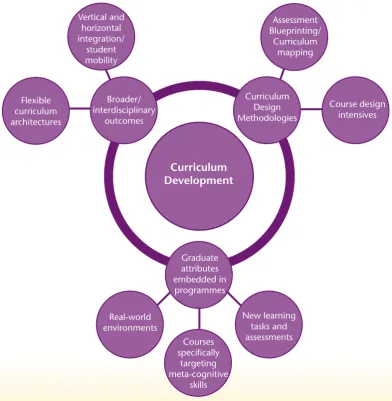
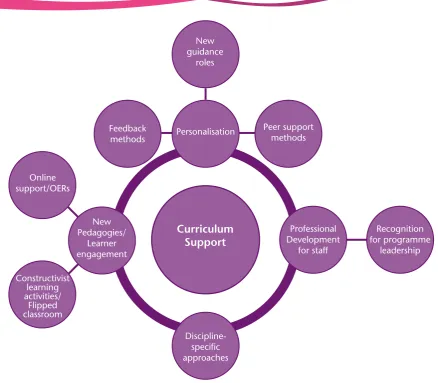
Indicative approaches across the sector are summarised through two diagrams below.
[image:5.595.98.491.329.731.2]Taken together, these represent a graphical summary of the work reported by institutions under the Theme.
Figure 1 summarises approaches to curriculum development while Figure 2 shows the main approaches taken to curriculum support. The various outcomes are discussed in sections 3-5. The discussion is structured around the three framing questions.
Fig.1: Indicative approaches for curriculum development
Curriculum Design Methodologies
Curriculum Development
Assessment Blueprinting/ Curriculum mapping
Course design intensives
Real-world environments
Graduate attributes embedded in programmes
Courses specifically
targeting meta-cognitive
skills
New learning tasks and assessments Broader/
interdisciplinary outcomes Vertical and
horizontal integration/
student mobility
Fig.2: Indicative outcomes for curriculum support
3. How is the curriculum, in its broadest sense,
shaped and delivered?
During the DSC Theme many institutions have produced a new learning and teaching strategy, and almost all of these reflect the discourse about curriculum development for graduate attributes that has emerged across G21C and DSC. The tendency has been for these strategies to describe enhancement principles at a high level, then to delegate detailed approaches to schools/faculties. In a number of institutions the DSC Theme has provided a guiding framework for a bottom-up process of bidding from schools/faculties for pilot projects aimed at specific enhancements. Figure 1 summarises the three broad approaches to curriculum development emphasised by institutions during DSC. The first involves various attempts to enhance the effectiveness of the curriculum design process itself. Most of these involve ramping up the resource and effort devoted to the process, recognising that it is typically in course validation and review procedures that we can raise timely awareness of innovative methods of support and flexibilities in delivery.8
The method known as Assessment Blueprinting and Curriculum Mapping became highlighted through DSC work. This method specifically ensures that relevant graduate attributes are addressed through appropriate forms of assessment distributed across each programme. The
8 An example is the trialling of 'Course Design Intensives'. See https://wiki.brookes.ac.uk/display/CDIs/Home Professional
Development for staff
Curriculum Support
Recognition for programme
leadership Online
support/OERs
New Pedagogies/
Learner engagement
Constructivist learning activities/
Flipped classroom
Personalisation New guidance
roles
Feedback methods
Discipline-specific approaches
methodology has been developed further within the Theme and is being trialled in a number of institutions in Scotland and beyond.
The second approach develops the curriculum by targeting graduate attributes directly. An obvious way of tackling this is through the design of specialist modules aimed at graduate attributes and offering these as an option across many programmes. More often, though, the approach involved introducing a broader range of learning tasks and types of assessment across existing modules. Thus, courses have been redesigned to ensure that students can demonstrate how to share and apply their acquired knowledge, communicate it to others, and continue to develop it in ways consistent with the needs of the external environment such as around the employability and citizenship agendas.
The third approach is to design flexible pathways for broader outcomes. This approach encourages interdisciplinary learning and allows students studying a STEM programme, say, to study a second language, or for humanities students to include science or maths modules. One development here is through 'vertically-integrated' project work, allowing students to collaborate across years of study and disciplines. Indeed, personalised pathways can also extend to co-curriculum activities, and more extensive use of methods involving the recognition of prior learning. In addition to this increased breadth through interdisciplinarity, however, many institutions have reported a shift of focus onto programmes rather than modules. The result, it is argued, provides a more coherent and integrated learner experience while still achieving breadth and flexibility. A frequent activity during DSC has been the adoption of 20 credit modules.
The commissioned project around the Flexible Curriculum has built upon the concept of the flexibility continuum explored in the Flexible Delivery Enhancement Theme (2004-06). The project has developed a practical tool that staff at all levels can use to consider approaches to flexibility in the curriculum and then plan how to implement any changes. The tool itself is based on the Viewpoints card methodology for curriculum design.9 Each themed card expresses a principle of
good practice along with relevant prompts. There are four key themes: • external engagement and partnerships
• anytime, anywhere learning
• entry, transition, progression and exit
• learning model, personalisation and learner engagement.
Each card links to a specially designed website which includes case studies and further resources. The toolkit is currently being trialled across a number of institutions.
4. Who are our students and for whom is the
curriculum designed?
During DSC the institutions have continued to become more attuned to the diversity of the student body in Scottish higher education and to the extent to which educational capital varies. High on the agenda is the support for international students, for those studying in Scotland, those attending overseas campuses, or those taking courses entirely online. Several institutions have developed new guidance methods, including personal tutor systems, and some have explored new methods of peer support, often devised in partnership with student associations.
Each successive Theme has seen institutions making more explicit efforts to involve students in the enhancement process. In DSC each institution has nominated a student representative who has acted as a member of the Student Network for the Theme, managed by QAA Scotland with
support from sparqs. In addition to this many institutions are developing new kinds of partnership arrangements with their students. Student partnership is reflected in working with student
representatives for the joint development of policy, and in joint attempts to improve aspects of the student experience. In the DSC Theme there have also been several striking examples across the sector of students as change agents. Many enhancement projects have been led by student interns or involved students as team members. School/faculty student officers have been appointed not just to amplify the student voice, but to play a partnership role in development projects. In a number of these we have seen student involvement in trialling a range of methods for enhancing the way feedback to students is provided and acted on.
The Theme has proceeded in the context of rapidly advancing technology. During the course of DSC, many students (though, crucially, not all) have come to expect that in their studies, as in almost all aspects of their lives, they would be able to take full advantage of their mobile devices. Almost all delivery across the sector now employs an advanced virtual learning environment, and in some cases we see the early development of personal learning environments that allow the individual student to integrate information related to study with that used in social and other aspects of their lives. Equally important has been the significant rise of high-quality open educational resources (OERs), now helping to shift the emphasis from the delivery of content to the support of active, engaged learning.
Throughout the DSC Theme participants have developed a discourse around the concept of the student experience. An emergent view is that this concept should be seen primarily in terms of personalisation, rather than through the provision of generic resources that impact more on the rating of student satisfaction than on actual student learning.
It seems clear that the higher education sector is now more explicitly interested in the student journey, both before and after the higher education experience. Many institutions are pursuing the goal of a joined-up regional provision across school, college and university. In DSC this interest has been reflected in the Curriculum for Excellence (CfE) project. While institutions have necessarily focused first on admissions policies in order to take account of the new examinations and differing learner journeys, the project has been more concerned with cross-sectoral collaborations. Institutions are engaging in a wide variety of collaborative projects that de-mystify higher education as well as informing it about CfE and its students. These include instances where school pupils study within a higher education environment. Notable features of these projects are the focus on interdisciplinary and collaborative learning, and on encouraging active and participatory learning.
5. What support is required for staff?
How are staff (academic, academic-related, support staff) in teaching roles, including part-time, supported, formally and informally, to develop their teaching? How are staff supported at different stages in their careers? What recognition and reward is there for teaching staff? How is it known that staff are developing their teaching, and how is practice shared?
a minority of more experienced staff. The revised UK Professional Standards Framework seems to be acting as a catalyst for new developments in initial professional development and in continuing development frameworks.
Staff who begin their career with the Postgraduate Certificate (PgC) form a growing community of higher education teachers with interest and expertise in the practice and scholarship of learning and teaching. There is support across the sector for further development of communities of
practice and an ongoing debate about the most effective ways to achieve this. Overall there is a direction of travel from a concentration on supporting the development of new staff to one that looks at career long development. The study calls for a raising of the bar for professional development, research into the role played by the PgC, and for significantly better support for digital literacy.10 There is also a case made for the approach known as 'Learning Design',11 which
offers a practical grounding in how to map detailed pedagogical methods onto learning outcomes. It is suggested that this kind of approach could play a much more important role in the early and continuing development of all staff with teaching responsibilities.
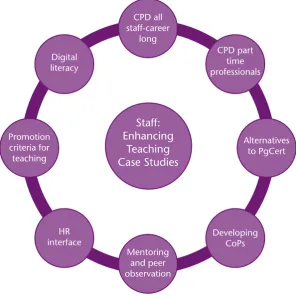
[image:9.595.149.446.351.649.2]This project has collated a number of case studies, available on the Enhancement Themes website, setting the issues within real contexts of practice. These are indicated in Figure 3.
Figure 3: Case studies produced by the staff: enhancing teaching project
A further discourse that has persisted through DSC has been centred on ways in which institutions can support leadership in teaching. The renewed focus on programmes should lead to the
recognition of programme leadership as a key element in a team-based enhancement culture.
Promotion criteria for teaching
CPD all staff-career
long
CPD part time professionals
Developing CoPs Digital
literacy
HR interface
Alternatives to PgCert
Mentoring and peer observation
Staff: Enhancing
Teaching Case Studies
10 See Goodfellow, Robin and Lea, Mary R. (eds.) (2013) Literacy in the Digital University: Critical Perspectives on
learning, scholarship, and technology. Society for Research into Higher Education, Abingdon: Routledge. 11 Laurillard, Diana (2012), Teaching as a Design Science: Building Pedagogical Patterns for Learning and Technology,
6. Continuity across Enhancement Themes
In the enhancement culture now rooted in Scottish higher education some fundamental issues roll forward, continuing to stretch all institutions. Any particular Theme reflects all previous Themes to some degree. The enhancement process involves continuously trying to examine these pervasive challenges from a different angle, while not losing sight of the bigger picture.
If we were to try to summarise in a single sound-bite the key challenge DSC has faced it would be something like 'starting to move Scottish higher education to a "process curriculum" while still meeting the needs of qualifications based on discipline knowledge'. Much of the current report testifies to the impressive response that many institutions have already made to that challenge. The sector has been looking hard at how this can be achieved in the face of increased diversity in the student body, and rapid technological and cultural change. It has been considering the need for flexibility in the educational offering, and looking at the implications for higher education staff. However, the commissioned project on Curriculum for Excellence has revealed the extent to which all the issues are inter-related. For example, while there is general higher education enthusiasm for Curriculum for Excellence outcomes to produce higher levels of meta-cognitive skills, some respondents from schools and colleges stress that the individual learning and pastoral needs of some learners will need better methods of personalisation. Back into focus come the previous Theme outputs on, for example, the first year, personal development planning, integrative assessment and student support. Out of the current Theme, therefore, transition has emerged as a vehicle not just for taking forward curriculum development and support, but also as a way of energising and focusing the enhancement work institutions are pursuing across the board. It will also be shaped by an external evaluation of the Theme process itself.
Additional DSC resources and further reading
Institutional overview reports
Written overview reports are available from Scottish higher education institutions at: www.enhancementthemes.ac.uk/enhancement-themes/current-enhancement-theme/2014-institutional-overview-reports
Each also includes a multimedia element, accessible at:
www.enhancementthemes.ac.uk/resources/videos-multimedia/2014-institutional-overview-videos
Overview reports and multimedia elements for each institution
University of Aberdeen:www.enhancementthemes.ac.uk/pages/docdetail/docs/report/dsc-final-report---university-of-aberdeen
www.enhancementthemes.ac.uk/resources/videos-multimedia/2014-institutional-overview-videos/ videos/overview-reports/overview-of-work-carried-out-over-the-dsc-theme
Abertay University:
www.enhancementthemes.ac.uk/pages/docdetail/docs/report/dsc-final-report---abertay-university www.enhancementthemes.ac.uk/resources/videos-multimedia/2014-institutional-overview-videos/ videos/overview-reports/abertay-university-developing-and-supporting-the-curriculum-2014
University of Dundee:
www.enhancementthemes.ac.uk/pages/docdetail/docs/report/dsc-final-report---university-of-dundee
www.enhancementthemes.ac.uk/resources/videos-multimedia/2014-institutional-overview-videos/ videos/overview-reports/dsc@uod-learners-at-the-centre-of-the-curriculum
University of Edinburgh:
www.enhancementthemes.ac.uk/pages/docdetail/docs/report/dsc-final-report---university-of-edinburgh
Edinburgh Napier University:
www.enhancementthemes.ac.uk/pages/docdetail/docs/report/dsc-final-report---edinburgh-napier-university
www.enhancementthemes.ac.uk/resources/videos-multimedia/2014-institutional-overview-videos/ videos/overview-reports/edinburgh-napier-university-end-of-the-dsc-theme-review
University of Glasgow:
www.enhancementthemes.ac.uk/pages/docdetail/docs/report/dsc-final-report--university-of-glasgow
www.enhancementthemes.ac.uk/resources/videos-multimedia/2014-institutional-overview-videos/ videos/overview-reports/developing-and-supporting-the-curriculum-at-university-of-glasgow
Glasgow Caledonian University:
www.enhancementthemes.ac.uk/pages/docdetail/docs/report/dsc-final-report---glasgow-caledonian-university
www.enhancementthemes.ac.uk/resources/videos-multimedia/2014-institutional-overview-videos/ videos/overview-reports/college-connect-strategy-2013-2020
Glasgow School of Art:
www.enhancementthemes.ac.uk/pages/docdetail/docs/report/dsc-final-report---glasgow-school-of-art
www.enhancementthemes.ac.uk/resources/videos-multimedia/2014-institutional-overview-videos/ videos/overview-reports/developing-and-supporting-the-curriculum-a-journey-of-enhancement!
Heriot-Watt University:
www.enhancementthemes.ac.uk/pages/docdetail/docs/report/dsc-final-report---heriot-watt-university
www.enhancementthemes.ac.uk/resources/videos-multimedia/2014-institutional-overview-videos/ videos/overview-reports/qaa-enhancement-project-developing-and-supporting-the-curriculum
University of the Highlands and Islands:
www.enhancementthemes.ac.uk/pages/docdetail/docs/report/dsc-final-report---university-of-the-highlands-and-islands
Open University in Scotland:
www.enhancementthemes.ac.uk/pages/docdetail/docs/report/dsc-final-report---the-open-university-in-scotland
www.enhancementthemes.ac.uk/resources/videos-multimedia/2014-institutional-overview-videos/ videos/overview-reports/developing-and-supporting-the-curriculum-insights-from-the-open-university
Queen Margaret University:
www.enhancementthemes.ac.uk/pages/docdetail/docs/report/dsc-final-report---queen-margaret-university
www.enhancementthemes.ac.uk/resources/videos-multimedia/2014-institutional-overview-videos/ videos/overview-reports/a-bricolage-approach-developing-and-enhancing-the-curriculum-theme
Robert Gordon University:
www.enhancementthemes.ac.uk/pages/docdetail/docs/report/dsc-final-report---robert-gordon-university
www.enhancementthemes.ac.uk/resources/videos-multimedia/2014-institutional-overview-videos/ videos/overview-reports/interdisciplinary-approaches-to-curriculum-design-and-development
Royal Conservatoire of Scotland:
www.enhancementthemes.ac.uk/pages/docdetail/docs/report/dsc-final-report---royal-conservatoire-of-scotland
www.enhancementthemes.ac.uk/resources/videos-multimedia/2014-institutional-overview-videos/ videos/overview-reports/curriculum-reform-at-the-royal-conservatoire-of-scotland
Scotland’s Rural College:
www.enhancementthemes.ac.uk/pages/docdetail/docs/report/dsc-final-report---scotland-s-rural-college
www.enhancementthemes.ac.uk/resources/videos-multimedia/2014-institutional-overview-videos/ videos/overview-reports/scotland-s-rural-college-supporting-transitions
University of St Andrews:
www.enhancementthemes.ac.uk/pages/docdetail/docs/report/dsc-final-report---university-of-st-andrews
University of Stirling:
www.enhancementthemes.ac.uk/pages/docdetail/docs/report/dsc-final-report---university-of-stirling
www.enhancementthemes.ac.uk/resources/videos-multimedia/2014-institutional-overview-videos/ videos/overview-reports/the-university-of-stirling-a-collaborative-learning-community
University of Strathclyde:
www.enhancementthemes.ac.uk/pages/docdetail/docs/report/dsc-final-report---university-of-strathclyde
www.enhancementthemes.ac.uk/resources/videos-multimedia/2014-institutional-overview-videos/ videos/overview-reports/developing-and-supporting-the-curriculum-student-engagement
University of the West of Scotland:
www.enhancementthemes.ac.uk/pages/docdetail/docs/report/dsc-final-report---university-of-the-west-of-scotland
www.enhancementthemes.ac.uk/docs/presentation/dsc-what-did-we-do-and-what-have-we-learnt. pptx?sfvrsn=8
Briefing papers
www.enhancementthemes.ac.uk/enhancement-themes/current-enhancement-theme/overview
Project papers
Curriculum for Excellence and its impact on higher education:
www.enhancementthemes.ac.uk/enhancement-themes/current-enhancement-theme/curriculum-for-excellence-and-its-impact-on-higher-education
The flexible curriculum:
www.enhancementthemes.ac.uk/enhancement-themes/current-enhancement-theme/the-flexible-curriculum
Staff: enhancing teaching:
Synthesis papers for years 1 and 2
Synthesis of the first year of DSC:
www.enhancementthemes.ac.uk/pages/docdetail/docs/publications/a-synthesis-of-the-first-year-of-the-enhancement-theme-2011-12-and-some-options-for-2012-14
Synthesis of the second year of DSC:
www.enhancementthemes.ac.uk/pages/docdetail/docs/publications/a-synthesis-of-the-second-year-of-the-enhancement-theme-2012-13-and-emergent-issues
Papers commissioned during Phase 1
Curriculum: Directions, decisions and debate:
www.enhancementthemes.ac.uk/pages/docdetail/docs/publications/curriculum-directions-decisions-and-debate
Student perspectives on the changes and developments in higher education:
www.enhancementthemes.ac.uk/pages/docdetail/docs/publications/student-perspectives-on-the-changes-and-developments-in-he
Challenges and changes for staff:
www.enhancementthemes.ac.uk/pages/docdetail/docs/publications/developing-and-supporting-the-curriculum-challenges-and-changes-for-staff
National and international policy developments in higher education:
QAA Scotland 183 St Vincent St Glasgow G2 5QD
All Enhancement Themes publications are available online at: www.enhancementthemes.ac.uk
© The Quality Assurance Agency for Higher Education 2014 Tel 0141 572 3420 Fax 0141 572 3421