The Development of Low-Order Models for the Study of
Fluid-Structure Interactions
Thesis by
Andrew A. Tchieu
In Partial Fulfillment of the Requirements
for the Degree of
Doctor of Philosophy
California Institute of Technology
Pasadena, California
2010
c 2010 Andrew A. Tchieu
Acknowledgments
First and foremost, I would like to thank my advisor, Professor Anthony Leonard. He is a beacon
of kindness, has always been very supportive through all my endeavors, and genuinely cares for my
overall wellbeing. I can say without any doubt that his guidance and encouragement helped me
through many difficult times during my life. For that I am immensely indebted to him. It has been
an honor to be his student and a part of him will forever be instilled in me.
I would also like to express gratitude to my thesis committee members, Professors Beverley
McKeon, Tim Colonius, and Dale Pullin. I have had the pleasure to take courses from each one of
them and all have had an important part in my academic development.
I also want to thank several Professors associated with Caltech. Professor John Dabiri has been
inspiring and has taken the time to play on the Aero basketball team together with me among
other things. Professors Hans Hornung and Joe Shepherd have always been very interactive with
the members of our lab, constantly checking in to see how we are doing. In particular, I have
had the privilege to play tennis with a great tennis player in Professor Hornung, who consistently
outdueled me. Undoubtedly, he would have been a great tennis player if someone had not convinced
him to study fluid mechanics. Thanks to Professor Darren Crowdy who gave me several ideas that
contributed to the fourth chapter of this thesis. His enthusiasm for teaching has been contagious
and I hope one day to replicate his passion in the classroom.
I am also grateful to have interacted with all members of the Iris and Puckett Laboratories. In
particular, I met Hans Jonas as a visiting student in our lab, and he has been a great friend over
the past few years.
school and life in this perspective. Jeff Hanna has been the person that I possibly spend the most
time with here at Caltech, whether it be eating a lot of good food, drinking beer, or doing outdoor
activities (mainly running or biking). Emily McDowell has been a very good friend and I cherish
the dinners we have had talking about various things, both important and inconsequential. Dominic
Rizzo has been a constant source of humor and entertainment. Thanks to all my other friends at
Caltech, especially John Meier and Chris Kovalchick who I have had the pleasure of interacting with
on and off campus, whether it be biking or just having a meal. I would also like to thank Francis
Castillo and Kent Chau, who are two of my best friends from high school, for their support and
friendship. You are all good friends and have shaped me to be who I am today, and I thank you
from the bottom of my heart for being in my life.
I would also like to thank my girlfriend and best friend of all, Nancy Diep. I am the luckiest
man in the world to have found my soul mate. She has been exceptionally supportive through all
my mood swings while researching and writing my thesis. I will do everything in my power to make
you the happiest woman in the world.
Last, but not least, I would like to thank my mom, dad, brother, and sister. They, above all,
have been the most supportive throughout my whole education. When the times were rough, they
were the ones constantly listening and comforting me while I was complaining and being dramatic.
Abstract
In this work, several low-order models are derived to describe and simulate fluid-structure interaction
problems with rigid bodies at a modest computational cost. The models are based on the inviscid
flow assumption such that potential theory can be used with, in some cases, point vortices in the
flow. Three general areas of application are considered. First, a thin airfoil undergoing small-scale
unsteady motions in the presence of a freestream flow is investigated. The low-order model that is
developed has only one ordinary differential equation for the fluid dynamic variables. This model is
used to briefly investigate vortex-induced flutter in the attached-flow regime and control of a
free-flying airfoil using synthetic jet actuators. Second, the vortex-induced vibrations of an arbitrary
bluff body in the presence of vortices, with or without a freestream flow, are considered. Several
examples of the canonical mass-spring-damper system for a circular cylinder and a flat plate are
given to demonstrate the use of the vortex-based model for these applications. Finally, the
two-body problem in a potential flow is addressed. A relatively simple solution specific to the doubly
connected domain is determined and its resulting force and moment are coupled to the rigid bodies
to investigate the mutual interactions between the two bodies. Aspects of drafting behind a forced
body, the role of the fluid in elastic collision, and flapping flight are discussed in this context.
Although a few specific examples and applications are given for each chapter, the main purpose of
Contents
1 Introduction 1
1.1 Motivation and background . . . 1
1.2 Thesis outline . . . 7
2 A simple discrete-vortex model for the non-uniform motion and control of a thin airfoil 9 2.1 Introduction . . . 9
2.2 Aerodynamic model formulation . . . 11
2.2.1 Assumptions . . . 12
2.2.2 Bound vortex circulation . . . 14
2.2.3 Quasi-steady bound circulation . . . 16
2.2.4 Wake vortex dynamics . . . 17
2.2.5 Aerodynamic lift and moment . . . 19
2.2.6 Integration in time . . . 22
2.2.7 Quasi-steady camber and thickness corrections . . . 23
2.2.8 Summary of the low-order model . . . 24
2.3 Validation of the low-order model . . . 25
2.3.1 Comparison with experiments . . . 25
2.3.2 Comparison with delayed detached-eddy numerical simulatons . . . 28
2.4 Vortex-induced flutter of a simple two degree of freedom system . . . 30
2.5.1 Setup . . . 35
2.5.2 Modeling ZMF synthetic jet actuators . . . 36
2.5.3 Static fitting for the shift in Kutta condition and trapped vortex strength . . 40
2.5.4 Comparison between experiments . . . 42
2.5.5 Simple feedback for reduction of vortex induced oscillations . . . 43
2.6 Conclusions . . . 44
3 An inviscid low-order model for the vortex-induced vibration of bluff bodies 47 3.1 Introduction . . . 47
3.2 General formulation . . . 50
3.2.1 Conformal map . . . 50
3.2.2 Boundary conditions and associated potentials . . . 50
3.2.3 Definition of the velocity . . . 52
3.2.4 Equation of motion for vortices . . . 53
3.2.5 Force . . . 54
3.2.6 Torque . . . 56
3.2.7 Coupled equations of motion . . . 57
3.3 Vortex-induced vibrations of a circular cylinder . . . 57
3.3.1 Equations of motion . . . 58
3.3.2 Results . . . 60
3.4 Vortex-induced vibration of a flat plate at high angles of attack . . . 65
3.4.1 Equations of motion . . . 66
3.4.2 Separation model and the Kutta condition . . . 67
3.4.3 Results . . . 71
3.5 Conclusion . . . 73
4.3 Hydrodynamic coupling . . . 83
4.3.1 Hydrodynamic forces and moment . . . 83
4.3.2 Coupled fluid-structure interactions . . . 85
4.4 Two interacting circular cylinders . . . 85
4.4.1 Conformal map . . . 86
4.4.2 Complex potential solution . . . 86
4.4.3 Forces induced from inline impact of two circular cylinders . . . 87
4.4.4 Coupled dynamics of two circular cylinders . . . 90
4.5 A pair of flapping parallel plates . . . 99
4.5.1 Conformal map . . . 99
4.5.2 Sinusoidal flapping and pitching . . . 100
4.6 Conclusion . . . 103
5 Conclusion and future directions 106 5.1 Conclusions . . . 106
5.2 Future directions . . . 108
Appendix A Simulink models of the experimental apparatus 110 Appendix B Vortex model based adaptive flight control using synthetic jets 112 B.1 Introduction . . . 112
B.2 Control formulation . . . 115
B.2.1 A simplified control design model . . . 115
B.2.2 Linear control algorithm . . . 117
B.2.3 Augmenting output feedback adaptive control . . . 121
B.3 Model and control design validation . . . 126
B.3.1 Regulating control vortex strength . . . 126
B.3.2 Experimental results . . . 127
B.4 Conclusion . . . 130
Appendix C Example translation and rotation potentials 133
List of Figures
2.1 Schematic of the unsteady vortex dynamics model . . . 11
2.2 Schematic of the quasi one-dimensional simplification . . . 12
2.3 Summary of the low-order model . . . 24
2.4 Schematics of the NACA 4415 airfoil model and its free-flight test bed . . . 25
2.5 Comparison with experimental results for pure pitching . . . 27
2.6 Comparison with numerical simulations in pure pitch . . . 28
2.7 Vorticity field from DDES simulation demonstrating small-scale vortices shed off the non-sharp trailing edge (Lopez, 2009). . . 29
2.8 Comparison with numerical simulations in pure plunge . . . 30
2.9 Schematic for the vortex-induced flutter of a flat plate airfoil . . . 31
2.10 Various simulations of vortex-induced fluttering . . . 33
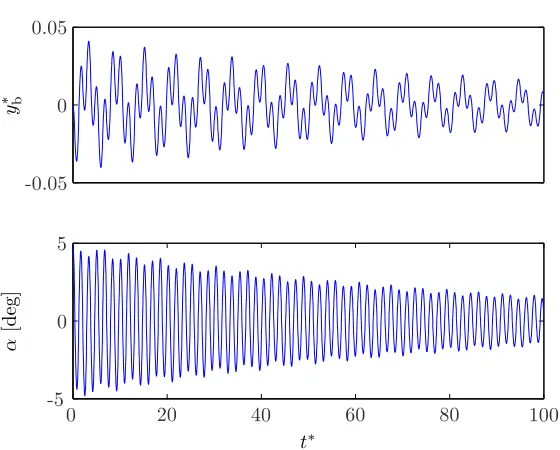
2.11 Case (e), a multi-modal response of a fluttering airfoil . . . 34
2.12 FFT of the response in Figure 2.11 plotted versus non-dimensional frequency . . . 35
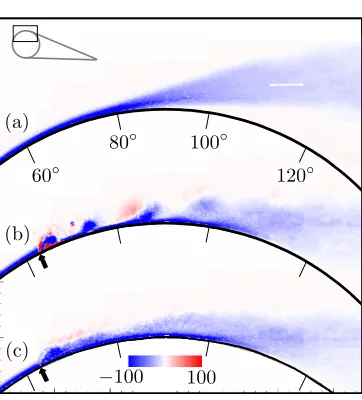
2.13 Normalized vorticity plots of synthetic jets over a modified airfoil . . . 37
2.14 Numerical and theoretical evidence for shift in Kutta condition . . . 38
2.15 Change in lift versus change in moment due to control . . . 40
2.16 Relationship between ΓC,uC, andα . . . 41
2.17 Comparison of test bed simulation with experimental results . . . 42
2.18 Simple feedback is used to reduce induced vibrations . . . 44
3.2 Schematic of the application of Cauchy’s theorem to deform∂D0 . . . 55
3.3 Schematic of the vortex-induced vibration for a circular cylinder in cross flow . . . 58
3.4 Response of the system forz1(t= 0)/D= 0.930 with kz= 1 andbz= 0 att= 500 . . 61
3.5 Maximum amplitude versus vortex separation distance,z1/D . . . 62
3.6 Response of the system forz1(t= 0)/D= 1.275 andz2(t= 0)/D= 1.275iwithkz= 1 andbz= 0 att= 100 . . . 63
3.7 Schematic defining the parameters in the vortex street . . . 63
3.8 Max displacement versus Strouhal frequency of incoming vortex street . . . 64
3.9 Displacement versus time for St = 0.25 . . . 64
3.10 Schematic of the vortex-induced vibration for a flat plate in cross flow . . . 65
3.11 Schematic showing the instantaneous stagnation streamline at various instants of time 69 3.12 Streamlines at various instants in time for separated flow off of a plate at angle of attack 72 3.13 Evolution ofθ in vortex-induced vibration of a plate. . . 73
4.1 Two arbitrarily shaped objects in thez-plane mapped to the annulus in theζ-plane . 79 4.2 Instantaneous streamlines due to a cylinder approaching a fixed cylinder from the right at constant velocity. . . 88
[image:11.612.105.539.60.725.2]4.3 Force coefficientCxwhen a cylinder moves toward a stationary cylinder as depicted in Figure 4.2 . . . 89
4.4 Instantaneous streamlines due to two cylinders approaching each other inline at con-stant velocity. . . 89
4.5 Magnitude of the force coefficient|Cx|when two cylinders move toward each other at constant velocity as depicted in Figure 4.4 . . . 90
4.6 Convergence of|aj|2 versusj . . . 91
4.7 Several example paths of an aft cylinder following the forced motion of a forward cylinder 92 4.8 Contour plots for the force on an aft cylinder drafting behind another cylinder of equal radius . . . 93
with the second cylinder initially at rest . . . 98
4.12 Cylinder paths for a near-collision event . . . 99
4.13 Geometric quantities defining the configuration of two parallel plates inz-plane. . . . 100
4.14 Instantaneous streamlines for the flapping motion of two parallel plates with motion prescribed by Equation (4.33) . . . 101
4.15 Individual and total force and moment coefficients versus non-dimensinal time t∗ = t/(2π) of two plates undergoing motion prescribed by Equation (4.33) for one cycle . 102 A.1 Simulink model for the simulation of the experimental apparatus . . . 110
A.2 Block diagram model for the wing aerodynamics . . . 111
A.3 Block diagram model for the torque motor . . . 111
B.1 Robust servo LQR with feed-forward element and added control signal . . . 120
B.2 Control hedging diagram . . . 125
B.3 ΓCwith control voltage saturation limits . . . 127
B.4 Diagram illustrating how the spring system interfaces to the wind tunnel model . . . 129
B.5 Verification that the static model models response with torque motor accurately . . . 130
B.6 Comparison between the vortex model and static model when the static model assump-tion fails . . . 131
List of Tables
2.1 Legend and list of parameters for various cases presented in figures 2.10 and 2.11. . . 32
Chapter 1
Introduction
1.1
Motivation and background
Research of fluid-structure interaction (FSI) has been an increasing area of active research, especially
with the ever-growing computational power of computers. Historically, the study of fluid dynamics
and structural dynamics, except for isolated examples, have remained partitioned. Methods involving
the study of fluid dynamics have relied on approaches where the fluid is treated without regard to
the dynamics of the structure such that walls or boundaries are fixed or moving with a prescribed
motion. Likewise, the study of structural dynamics has been, for the most part, studied without
coupling to a fluid although all terrestrial structures are submersed in a fluid. Although, some
information can be inferred using partitioned approaches, such as acquiring steady forces that a fluid
applies on a structure and subsequently determining the structure’s response, a coupled approach
may be necessary to accurately describe, simulate, and analyze the FSI problem. When the fluid
and structure are coupled through their mutual boundary conditions, the problem at hand becomes
increasingly difficult and the resulting fluid and structural motion may not be obvious.
FSI is ubiquitous in nature and daily life. The fluid-structure coupling between many of these
situations becomes crucial for the understanding of the phenomena and few examples are given here.
The quintessential example of coupled FSI is the induced instability resulting in the collapse of the
Tacoma Narrows Bridge in 1940. In this instance, von K´arm´an determined that the structural
governor of Washington to halt reconstruction in favor of redesigning of the bridge (von K´arm´an
and Edson, 1967). It can be claimed that this event itself paved the path for the advent of new
fields of study that include bridge aerodynamics and vortex-induced vibrations, which continue to
be extremely active areas of research. Perhaps the oldest and most well studied FSI problem, the
fluttering of airfoils has been studied for nearly a century due to the emergence of powered flight. Its
stability boundaries have been determined based on assumptions of periodic response and potential
flow assumptions (Theodorsen, 1935) yet there are still many more avenues for research.
In addition, FSI is important for a variety biological and naturally occurring situations. The
fluttering of flags and falling cards/leaves have been a source of constant interest (Michelin et al.,
2008, Eloy et al., 2007). In internal biological flows, the FSI of bi-leaflet mechanical heart valves is
studied to show that aorta geometry has a drastic effect on the opening and closing of the leaflets
(Borazjani et al., 2010, Eldredge and Pisani, 2008). Fluid-structure interactions have also been
essential in the study of locomotion of various genus such as fish, insects, and birds to name a few
(e.g. Triantafyllou and Triantafyllou, 1995). Moreover, the interactions of several bodies in proximity
have been studied in an effort to understand coordinated motion and passive locomotion (Nair and
Kanso, 2007, Kanso and Newton, 2009).
Since fluid-structure interactions are pervasive in everyday life, it is essential to distinguish when
the coupling of fluid and solid motions is important for the solution of the problem. When the
fluid and structure problems can be separated, the problem is drastically simplified which leads to
computational savings. Consider a fluid-structure problem where a deformable structure is immersed
in a fluid. There are time scales associated with the internal dynamics of the structure (e.g. elastic
waves), the motion of the structure (e.g. period of a flutter oscillation), and motion of the fluid
(e.g. vortex turnover time or convective time). If the time scale associated with internal dynamics is
much smaller than both the time scales of the motions of the structure and the fluid, then the elastic
effects of the structure can be neglected and the body can be modeled as being a rigid structure.
Although the study of flexible structures is a major interest in general, this thesis is restricted to
such that the unsteady motion of the fluid can be neglected because its effect is nearly instantaneous.
In this case, quasi-steady approximations can be used to determine forces and moments on the body
or bodies in place of solving the entire unsteady motion of the fluid in detail. The goal of this thesis
is to look at situations where this approximation cannot be made and thus the coupled problem of
the fluid and structure must be explicitly treated and solved with an unsteady model.
In many instances described above an incompressible assumption can be made without loss of
generality. Additionally, we can assume that the fluid is Newtonian so that the equations of motion
for the FSI problem forK rigid bodies can be written as
∂u
∂t +u· ∇u=−∇p+
1
Re∇
2u (1.1a)
∇ ·u= 0 (1.1b)
d2x k
dt2 =Fk+Fe,k (1.1c)
d2θ k
dt2 =Tk+Te,k (1.1d)
for each body k = 1,2, . . . , K where u is the velocity, pis the pressure, and Re is the Reynolds
number for the fluid. Each rigid body motion is completely chracterized by the location xk and
orientationθk. Fk,Tk,Fe,k, andTe,k are the force and torque due to the fluid (pressure and shear)
and external forcing, respectively. Fk and Tk are not only functions of the fluid variables but are
also implicitly functions of the solid variables themselves. The boundary conditions for rigid body
motion are
u(x) =dxk
dt +
dθk
dt ×(x−xk), forx∈∂Dk. (1.2)
The most accurate method of predicting FSI of rigid bodies is to numerically solve equations
equations, two specific computational methods have been rather successful in the context of FSI. The
first uses body fitted grids to determine the fluid motion. In the case of rigid body motion, the flow
can be solved in a moving/rotating frame of reference for a single body (Wang, 2000). This cannot
be said with the introduction of several bodies. The second method to solve for the flow is to use
immersed boundary methods. Here a Lagrangian grid of the body is overlaid on top of the Eulerian
grid that is used for the solution for the fluid motion. The boundary conditions are interpolated
from the flow to the Lagrangian points and consequently a boundary forcing is required on the body
and is essentially diffused to the fluid in order to enforce the boundary conditions. Although initially
pioneered by Peskin (1972) there now exist various manifestations of this method (see Mittal and
Iaccarino, 2005, Taira and Colonius, 2007, for a review of various methods). To simulate FSI for rigid
bodies, both methods use a separate solver for the rigid body dynamics to partition the problem
into two distinct parts for each time step. Due to this fact, an iterative method is used to ensure
that the accelerations of the fluid and body are consistent, thus making the solution to the FSI
problem prohibitively expensive. When the mass ratio of the body compared to the same mass of
the displaced fluid is high, the numerical solutions of the fluid and rigid body dynamics can nearly
decouple from each other such that the iterative solver is unnecessary and an explicit solver can be
used in its place at a more modest computational expense. One must be careful about the strict
stability requirements on the time step in this case (Alben, 2008). When mass-ratios are low (or even
vanishing) however, special considerations are required to accelerate the iterative solver (Borazjani
et al., 2008). These low mass-ratio cases are extremely important for the study of vortex-induced
vibration of marine structures.
There are also several simplifications that can be made to reduce the computational expense that
seems to limit the effectiveness of simulating FSI at higher Re. For high Re, the viscous effects can be
neglected and thus equations (1.1) reduce to the incompressible Euler equations. This is equivalent
to interpreting that the increasing Re essentially confines the boundary layer to an infinitesimally
thin layer on the surfaces of the rigid bodies. Additionally, for structures with a long spanwise
in complex variables as determining an analytic complex potential,W = Φ +iΨ, such thatu=∇Φ,
whereusatisfies the zero normal-velocity boundary conditions. Φ and Ψ are known as the velocity
potential and streamfunction, respectively. This greatly simplifies the problem to using the linear
superposition principle to add together individual elements of the flow. In the absence of vortex-like
structures, the solution can be determined without the need of solving any ordinary differential
equations. The most simple of these models is to use the potential to determine added-masses for
the treatment of a single accelerating body (Lamb, 1945, Newman, 1977). The treatment of the
FSI problem for this case in essence reduces to solving the rigid body dynamics equations with an
“added” mass that modifies the accelerations of the body. In the single rigid body case, the
added-mass is not time dependent. For several bodies, the coefficients are dependent on the instantaneous
configuration with respect to each other and thus are a function of time and are considerably more
difficult to treat (Kanso et al., 2005). A special case of the multiple body problem is studied in
Chapter 4.
Additionally, quasi-steady models have been proposed in place of determining the unsteady flow
around the bodies. The most prominent example of this is the use of the Kutta-Joukowski theorem
to predict that the unsteady forces, F, on a single body will be ρfUΓ0 where ρf is defined as the
density of the fluid, U is the velocity associated with the body, and Γ0 is the circulation around
the body. The circulation itself must be determined either by applying a Kutta condition or using
some empirical information. For example Lighthill (1973) predicts the lift due to the Weis-Fogh
mechanism in insect flight using quasi-steady values of Γ0.
However, one of the shortcomings of this method is that it does not capture the required
un-steadiness in myriad situations where vortex-body interactions and vortex shedding are important
phenomena. Ideal point vortices (i.e. point singularities of vorticity) provide an ample
representation. They can be easily added to the potential and in general require a solution of an
or-dinary differential equation to determine its motion. Even with the added complexity of introducing
point vortices, the equations that represent the fluid in (1.1) are reduced to the solution of a finite
number of ordinary differential equations as opposed to solving a partial differential equation as in
the higher order methods presented above. Several studies have considered the body-vortex
interac-tion in the context of dynamical systems and the transiinterac-tion to chaos (Borisov et al., 2005, Roenby
and Aref, 2010). Shashikanth (2005) even reduced the general N-vortex, single-body problem to
become Hamiltonian in structure under special circumstances.
In cases involving viscous separation a sufficient model must be developed to capture its salient
features. For bodies with sharp edges, a quite natural model is to have the fictitious boundary
layer separate from the edge and form a sheet-like structure of concentrated vorticity. The vortex
sheet representation is first used by Clements (1973) to model flow separating from a square-based
section. The method is more rigorously pursued recently by Jones (2003) and Shukla and Eldredge
(2007) for fixed and flexible plates with prescribed motion. Unfortunately, the solution for the sheet
strength usually involves a non-trivial solution to an integro-differential equation which for FSI must
then be coupled to the equations of motion for the bodies (e.g. using the Birkhoff-Rott equations,
see Saffman, 1992, Pullin, 1978). A more simple model that is conducive to limiting the number of
fluid variables was previously proposed by Edwards (1954) and Brown and Michael (1954), among
others, where the entire vortex sheet is fundamentally rolled into a single vortex. After several years,
this method is then diligently employed to study and control some aspects of flow separation off a
semi-infinite and finite plate (Cortelezzi and Leonard, 1993, Cortelezzi et al., 1994, Cortelezzi, 1995,
1996). Many of these techniques are also adopted and extended by Michelin and Smith (2009b) for
use in several aspects of FSI.
The reduction of the problem to the use of discrete point vortices reduces the problem to solving
several ordinary differential equations with algebraic constraints (e.g. Kutta condition, conservation
of circulation). Because of the simple mathematical representation of the problem using discrete
This thesis focuses on introducing several low-order methods for the FSI with rigid bodies that
can be further used in a more rigorous manner to analyze and understand the stability and non-linear
behavior of the system. For now, a few examples are given along with the methods to demonstrate
the use of these techniques. The goal is to develop low-order models that describe several aspects of
FSI but at very modest computational cost. For example, these methods are ideal for use in rapid
prediction, optimization, and model-based feedback control design.
1.2
Thesis outline
This thesis is divided into three main chapters, each covering a distinctly different FSI situation
with a specific low-order potential model to combat the problem. To this end, Chapters 2-4 can
stand individually with little reference to one another. Although the author has made a modest
attempt to keep the notation consistent between all chapters, there may be small discrepancies that
may occur between them.
In Chapter 2 we derive a low-order model for a thin airfoil undergoing small-scale unsteady
motions in the presence of a freestream flow. The method is additionally coupled to the rigid body
dynamics and used to characterize some aspects of vortex-induced flutter. In addition, the model is
extended to account for synthetic jet actuators to control the free flight of the airfoil.
Chapter 3 discusses the development of a model for the vortex-induced interactions of an arbitrary
solid body with vortices either generated or pre-existing in the flow. This is specifically applied to
interactions of bluff bodies in the presence of freestream. Two specific examples are given in the
context of canonical vortex-induced vibration.
In Chapter 4 a method to handle the doubly connected two-body problem in a potential flow is
derived. The method is then coupled with the motion of the bodies. This method is used to analyze
example of two flat plates flapping is presented to demonstrate some aspects of unsteady bi-wing
flight.
Finally, in Chapter 5 we offer some concluding remarks and reiterate the main contributions of
this thesis. Several future directions of research are discussed for each specific model presented in
Chapter 2
A simple discrete-vortex model for
the non-uniform motion and
control of a thin airfoil
2.1
Introduction
Two-dimensional unsteady airfoil theory for incompressible flows has had a history that spans nearly
a century. The primary motivation for this work stems from a long interest in the prediction of
unsteady forces and moments for the control of aircraft and aeroelastic phenomena, for example the
flutter of aircraft wings. Although two-dimensional potential theory is a major simplification over
actual aerodynamics of thin bodies, it nevertheless gives insight into the underlying aerodynamic
mechanism of unsteady aerodynamics. The simplifications in complexity lead to a tractable problem
that can usually be handled by standard mathematical approaches and limited computing resources.
Because of the simplicity in two-dimensional potential theory, pioneering work was conducted
by Wagner (1925) to predict the initial response of an airfoil impulsively started from rest. This
work was extended by Glauert (1929) for predicting the force and moment on an oscillating airfoil,
but was left unfinished until it was first published with a complete solution by Theodorsen (1935).
Part of the general solution to the oscillatory problem is given by an analytical expression that
relates the effect of wake circulation on an airfoil lift in the frequency domain by the aptly called,
Theodorsen function. Similarly, several European researchers developed theories (K¨ussner, 1936,
to the Theodorsen function through a Fourier transform. Jones (1938) soon developed an operational
treatment for general airfoil motions in the Laplace plane based on on Fourier-integral superposition
of linear results for simple harmonic motion. Concurrently, von K´arm´an and Sears (1938) also
developed a more consistent method based on the integral equations resulting from a continuous
vortex sheet and Sears (1941) applied the method to several applications. An effective and thorough
review of the theories of Wagner, Theodorsen, Jones, and von K´arm´an theories can be found in
Bisplinghoff et al. (1955).
More recently there has been renewed interest centered on using finite approximations of
Wag-ner and Theodorsen functions. In particular, Edwards et al. (1979) derived geWag-neralized Theodorsen
functions relating motions of the circulatory part of the airloads to the motion of the airfoil and
ap-plied it to subcritical and supercritical flutter conditions. Peters (2008) gives additional information
on several finite state models predicting forces and moments in the frequency domain although one
major drawback of these methods is that they cannot be integrated in a fully coupled simulation of
the FSI. In addition, the models are rather mathematically complicated and in most cases are only
manageable for prescribed or assumed oscillatory motions.
The goal of this chapter is to create a low-order model for arbitrary thin airfoil motion and show
its efficacy in applications to various fluid-structure phenomena. Furthermore, this study addresses
the introduction of synthetic jet actuators for which a new model can be implemented for the control
of an airfoil. Because of this, it is chosen to use discrete vortices to model the mean effect of the
actuators. First, a tractable and simple aerodynamic model is presented to predict the forces and
moment on a thin airfoil undergoing arbitrary motions in the absence of any actuation. This model
is reduced to the solution of a single non-linear ODE and is validated with both experimental results
and detached-eddy simulation numerical testing. Next, using this simple model, the onset of
vortex-induced flutter of plunging and pitching airfoils is examined. Specifically, several examples are
given including one showing a multi-modal transient response. Lastly, the control of an airfoil with
synthetic jet actuators is investigated more closely. An actuator model is created and compared to
x
−a −c
2
Γi
. . .
Γ2
c
2 z1 α
z2
zi
Figure 2.1: Schematic of the unsteady vortex dynamics model of an airfoil undergoing arbitrary
motion in the presence of a freestream velocity. We note that the vortex strenghts Γi will have
alternating sign although here they are depicted to clarify the convention that positive circulation results in a vortex that rotates in the counter-clockwise sense.
feedback scheme is then used to control the aforementioned vortex-induced vibrations highlighting
one of many potential uses for the low-order model.
2.2
Aerodynamic model formulation
Here a model that is capable of predicting the forces and moments on a two-dimensional airfoil in
motion is developed. The work in von K´arm´an and Sears (1938) lays the foundation of non-uniform
motion of a thin airfoil by using the basic concepts of vortex theory available to an aeronautical
engi-neer without much of the “unnecessary mathematical complications” that are commonly associated
with the theories derived in the works of Theodorsen (1935) and Wagner (1925) among others. The
theory presented here has been generalized to account forany airfoil motion as long as it remains
small amplitude, as explained in Section 2.2.1, but closely follows the theory outlined in von K´arm´an
and Sears (1938) to make it as concise and clear as possible.
Consider the incompressible flow around a thin airfoil of chord lengthcin a free-stream with an
upstream velocity U∞ that flows from left to right. The airfoil undergoes an arbitrary motion in
both plunge and pitch defined by the body variablesyb andα, respectively. The pivot point for the
Nascent Vortex M(a)
x Γ2 . . . Γi
−a . . .
−c
2
Γ1
Constant Strength Vortices Vortex Sheet,γ(x)
U
xi
x2 y
x1 α
˙ yb
c
2
Figure 2.2: Schematic of the quasi one-dimensional simplification of Figure 2.2 after the application of assumptions given in Section 2.2.1.
motion of the airfoil by allowing the shear layer to separate into the wake as discrete and singular
elements of vorticity with circulation strength Γj at locationzj= (xj, yj).
2.2.1
Assumptions
Several assumptions are made so that a simple, closed-form, low-order model can be created to
predict the forces and moment on a thin airfoil. The assumptions are listed and explained as
follows:
1. The flow is considered high Reynolds number flow so that the boundary layer is sufficiently
thin and the viscous effects can be neglected. Furthermore, it is reasonable to assume that
the fluid remains irrotational except at the discrete points zj. This allows us to use the
potential flow description for the fluid. However, this leads to a conundrum since it is well
known that forces and moments depend largely on the vortex-like structures that arise from
viscous separation. Another view of the problem is to model the viscous boundary layer as
an infinitesimally thin vortex layer, which is still a solution to the Euler equations, and allow
this layer to separate into the flow at one or several discrete points (the details of separation
are discussed in Section 2.2.4). This pseudo-viscous mechanism allows us to introduce inviscid
2. Motions of the thin airfoil are considered small-amplitude so that the leading-edge separation
does not occur. This means that the characteristic motions must be h/c1 and ˙h/U∞1
where h is a characteristic length of the maneuver (in pitch this translates to α 1 and
˙
αc/U∞1 where the over-dot represents taking the time derivative of the quantity of
inter-est). Even when this is not the case, evidence in Lewin and Haj-Hariri (2005) suggests that for
a range of high frequency parameters (say with reduced frequencyk >5, wherek= 2πcf /U∞
and f is the frequency of oscillation) the leading edge separation, although present, becomes
reabsorbed into the boundary layer and subsequently separates off the trailing edge. The
lead-ing edge separation in these instances does not affect the lift and moment characteristics as
severely as the trailing edge separation. In addition, the small-amplitude assumption allows
another drastic reduction in complexity. For small-amplitude motions, the departure of any
wake vortex elements in the transverse direction are considered small and thus the effect of
its transverse motion can be justifiably neglected. Thus the wake vortex dynamics can be
sufficiently restricted to their advection in a single dimension and the bound vorticity can be
adequately restricted to lie on thex-axis.
3. It is assumed that the leading-order unsteadiness of the thin airfoil can be modeled by the
motion of a flat plate. To take into account the effects of thickness and camber, the lift and
moment are modified in a quasi-steady fashion, that is, steady characteristics versus angle
of attack (AOA) are superimposed on the unsteady results for non-ideal airfoil shapes. This
allows a general theory that is applicable to the entire class of thin airfoils with very minor
modification using tabulated data, for instance, from Abbott and Deonhoff (1959).
These assumptions allow us to solve the drastically simplified problem depicted in Figure 2.2
x-axis. The schematic given in Figure 2.2 is not entirely one-dimensional because the boundary condition is applied on the vertical velocity such that the bound circulation reads
1 2π
Z c
2 −c
2 γ(s)
x−sds=vb(x) +vv(x), on
c 2 < x <
c
2 (2.1)
where the functionvb is the apparent vertical velocity due to the body motion and instantaneous
AOA and vv is the velocity induced by any shed vortices. Note that the integral equations for
the sheet strength are evaluated in the principal value sense. Furthermore, if there are N discrete
vortices in the wake at any time, the bound circulation can be decomposed into
γ(x) =
N
X
j
γj(x) +γ0,t(x) +γ0,r(x) (2.2)
so thatγi(x) satisfies the boundary condition for an individual vortex in the wake, γ0,t(x) satisfies
the boundary condition due to plunging motion and the free-stream, andγ0,r(x) satisfies the
bound-ary condition solely due to rotation around its mid-chord, x = 0. It is also understood that the
distributions are all functions of time since the problem is unsteady at heart. We have elected to
drop the time dependence from the expressions for the bound circulation strengths understanding
that they are indeed a function of time.
2.2.2
Bound vortex circulation
Consider a discrete wake vortex that has separated from the plate with circulation Γj located at
x=xj. The details of its creation will be addressed later in Section 2.2.4. From assumption 2 in
Section 2.2.1, the vortex remains forever on the x-axis and only convects in the x-direction. The
influence of this wake vortex on the airfoil will result in the creation of a distribution of circulation
around the airfoil,γj(x), to satisfy the boundary condition that no flow penetrates the plate, i.e.
1 2π
Z c
2 −c
2 γj(s)
x−sds= Γj
2π(x−xj)
, on c 2 < x <
c
application of the Kutta condition forces
γj
x= c
2
= 0 (2.4)
and uniquely determinesγj(x).
The formula for the bound circulation density on the surface of the airfoil that satisfies both the
boundary condition (2.3) and the Kutta condition (2.4) is found in von K´arm´an and Sears (1938)
and is given as
γj(x) =
Γj
π(xj−x)
sc
2−x c 2+x
xj+2c
xj−2c
. (2.5)
Equation (2.5) is derived by using conformal mapping and using the fact that the vortex lies on the
x-axis. The amount of circulation bound to the airfoil due to this distribution is
Z c
2 −c
2
γj(x) dx= Γj
s xj−2c
xj+2c −
1 !
. (2.6)
Note that the circulation of both the vortex and its bound circulation gives a net circulation due to
the enforcement of the Kutta condition. In comparison to other proposed methods, such as those
given in Graham (1983), Cortelezzi (1996), and Michelin and Smith (2009b), the bound circulation
presented here changes with position of the wake vortex. In these specific cases, the Milne-Thomson
(1968) circle theorem is used to model the separation and this produces an exact opposite bound
vortex on the body. When using the circle theorem, the strength of the nascent vortex is most easily
determined by the explicit application of the Kutta condition since the conservation of circulation is
automatically satisfied. Here we have chosen to model the separation such that each element satisfies
strength of the nascent vortex. This is just another example of the non-uniqueness in the treatment
of potential flow problems. With the application of both the Kutta condition and conservation of
circulation (discussed in Section 2.2.4) all approaches should yield identical results under the same
assumptions.
2.2.3
Quasi-steady bound circulation
Airfoil translation and rotation lead to an additional term that is deemed the quasi-steady bound
circulation about the airfoil. These circulation distributions due to airfoil motion are denotedγ0,t(x)
andγ0,r(x) for “translation” and rotation, respectively, and represent associated circulation densities
in the absence of wake vortices. For the “translational” term, a non-zero vertical velocity of the
airfoil measured from the mid-chord, ˙y−aα˙−U∞sinα, must be matched by an equal fluid velocity
to satisfy the no through-flow condition. Here the term “translational” is used loosely because the
terms that have no x-dependence have been lumped together. In this specific boundary condition
the free-stream component and additional rotational component are added, so that γ0,r(x) results
from a pure rotational motion at the half chord, x= 0. Assuming the small angle approximation
sinα≈α, we requireγ0,t(x) to satisfy
1 2π
Z c
2 −c
2 γ0,t(s)
x−sds= ˙y−aα˙−U∞α, on− c 2 < x <
c
2 (2.7)
where the integral is taken using principal-value integration. We find thatγ0,t(x), satisfying (2.7)
and the Kutta condition, is
γ0,t(x) = 2 ( ˙y−aα˙−U∞α) sc
2−x c 2+x
(2.8)
from which we obtain the circulation moments
Γ0,t= Z c
2 −c
2
Similarly, airfoil rotation about the mid-chord produces an airfoil velocity−αx˙ to be matched by a
velocity induced by the circulation distributionγ0,r(x). Thus it is required that
1 2π
Z c
2 −c
2 γ0,r(s)
x−sds=−αx,˙ on− c 2 < x <
c
2. (2.10)
The solution satisfying (2.10) and the Kutta condition is
γ0,r(x) =−2 ˙α r
c2
4 −x
2 (2.11)
from which we obtain the moments
Γ0,r= Z c
2 −c
2
γ0,r(x) dx=−
πc2α˙
4 (2.12a)
Z c
2 −c
2
xγ0,r(x) dx= 0 (2.12b)
Z c
2 −c
2
x2γ0,r(x) dx=
c2
16Γ0,r. (2.12c)
The total bound quasi-steady circulation can be found by adding (2.9a) and (2.12a) to obtain
Γ0= Γ0,t+ Γ0,r=πc
˙ yb−
a+c
4
˙
α−U∞α
. (2.13)
2.2.4
Wake vortex dynamics
A few physical laws govern the wake vortex dynamics. First, the system must obey the conservation
zero circulation) therefore we have
Γ0+
N
X
j=1
Γj
s xj+2c
xj−2c
= 0. (2.14)
We recall that the total circulation due to a separated vortex and its associated bound circulation
is not zero and therefore contributes the second term in 2.14.
Next, in point-vortex dynamics, the convection velocity of each vortex depends on the mutual
influence of other vortices in addition to the influence of the body. Since the amplitudes of the
motions are assumed to be small and at a low reduced frequency, the convection of a free vortex
can be assumed to not be modified by the presence of other vortices. To first order this assumption
leads us to model the motion of all but the most recent of the free vortices to move with speedU∞,
i.e.
dxj
dt =U∞, forj≥2. (2.15)
The vortex nearest to the body (always indexedj= 1) is being fed circulation and moves with speed
dx1
dt =U∞−
x2 1−c
2
4
x1Γ1 !
dΓ1
dt (2.16)
where we have used a conservation of impulse argument to correct its motion due to the change
in its circulation. This is much like the corrections that have been used in Brown and Michael
(1954), Cheng (1954), Rott (1956), and more recently Cortelezzi (1992) and Michelin (2009), but in
this one-dimensional analogue the correction gives an initial lift characteristic that agrees well with
Wagner’s impulsive start solution.
Naturally, since the flow is at high Reynolds number, the strength of the vortices can be assumed
i.e. Γjremains constant once it is released from the trailing edge. The strength of the nascent vortex
is determined by the conservation of circulation. Therefore, from (2.14)
Γ1=−
s x1−c2
x1+c2 Γ0+
N
X
j=2
Γj
s xj+c2
xj−c2
. (2.18)
This now begs the question: when does a vortex become a free vortex? Since a vortex cannot
“unwind,” the magnitude of its circulation strength cannot ever decrease. This means that a vortex
only gets stronger or equivalently that ˙Γ1 does not change sign while the vortex is being fed
circu-lation from the trailing edge. Say the rate ˙Γ1changes sign att=te, then we model the physics by
introducing a new vortex such that the discrete vortices get re-indexed as Γj+1(t+e) = Γ1(t−e) and
xj+1(t+e) =x1(t−e) after which the nascent vortex gets reinitialized as Γ1(t+e) = 0 and x1(t+e) = c2.
2.2.5
Aerodynamic lift and moment
We derive the lift and moment from using the conservation of linear and angular impulse. The total
fluid impulse in they-direction,Iy, is given by
Iy =−ρf Z c 2 −c 2
xγ(x) dx+
N
X
j=1
Γjxj
(2.19)
where γ(x) =γj(x) +γ0,t(x) +γ0,r(x) is the total distribution of circulation about the airfoil and
ρf is the fluid density. Using (2.5), (2.19) becomes
Iy=−ρf Z c 2 −c 2
xγ0(x) dx+
N X j=1 Γj r x2 j− c2 4
The lift on the airfoil is defined as
L=−dIy dt
=ρf
d dt Z c 2 −c 2
xγ0(x) dx−ρfU∞Γ0−
ρfU∞c 2 N X j=1 Γj q x2
j−c
2
4
(2.21)
where we have used Equations (2.14)-(2.16) to remove time derivatives on Γj andxj. The first term
on the right-hand side of (2.21) leads to the so-called added mass terms due to airfoil acceleration,
the second term is the quasi-steady lift, and the remaining sum represents the lift due to vortices in
the near wake. In the absence of body motion, the lift due to the wake is a weakly decaying function
that goes like O(1/t) as time increases. Upon substitution of (2.9), (2.12), and (2.13), Equation
(2.21) becomes
L=ρfπ
−c
2
4y¨b−U∞cy˙b+ ac2
4 α¨+U∞c
a+c
4
˙
α+U∞2cα
−ρfU2∞c
N X j=1 Γj q x2
j−c
2
4
. (2.22)
Similarly, to derive an expression for the moment acting on the airfoil, the conservation of angular
impulse is employed. The total angular impulse,A(s), at a distancesupstream of the mid-chord of
the airfoil is given by
A(s) =−ρf
2 Z c 2 −c 2
(x+s)2γ(x) dx+
N
X
j=1
Γj(s+xj)2
. (2.23)
The counter-clockwise moment on the airfoil, M(a), about the pivot point distancea upstream of
the mid-chord is given by dA(s)/dt evaluated at s = a, where one must take into account that
ds/dt=−U∞. Thus we find that
M(a) = ρf
2 d dt Z c 2 −c 2
x2γ(x) dx+
N
X
j=1
Γjx2j
+U∞Iy+aL. (2.24)
Equa-+ρfU∞c 2 8 N X j=1 Γj q x2
j−c
2
4
−ρ2f
x2 1−c
2 4 3 2 x1 dΓ1 dt
. (2.25)
It is recommended to neglect the last term of this expression above to agree with the classical
result that the lift force due to wake vorticity acts at the quarter-chord point of the airfoil with
no additional moment. Recall that the conservation of impulse is used to derive the velocity of the
nascent vortex. There are simply not enough variables to satisfy the conservation ofy component
of linear impulse, conservation of angular impulse, and the Kutta condition with the adjustment
of a single vortex (three governing equations and two variables, Γ1, x1). Since we do not conserve
the angular impulse we choose to ignore this last term to correct this oversight. Further applying
Equations (2.9) and (2.12) to (2.25) yields
M(a) =aL+ρfπ
U
∞c2
4 y˙b+
c4
128α¨−
U∞ac2
4 α˙−
U2
∞c2
4 α
+ρfU∞c
2 8 N X j=1 Γj q x2
j−c
2
4
. (2.26)
Upon non-dimensionalizing Equations (2.22) and (2.26) the lift coefficientCL= 2L/(ρfU∞2c) is
CL=π
−2Uc2
∞ ¨ yb− 2
U∞y˙b+ ac
2U2
∞ ¨
α+2a+c U∞ α˙ + 2α
−U1
∞ N X j=1 Γj q x2
j−c
2
4
(2.27)
and the standard moment coefficient (with pitch up being positive)CM =−2M(a)/(ρfU∞2c2) is
CM(a) =−a
cCL+π
−2U1 ∞y˙b−
c2
64U2
∞ ¨ α+ a
2U∞α˙ +
1
2α
−4U1
∞ N X j=1 Γj q x2
j−c
2
4
. (2.28)
Note well that when all time derivatives are negligible, we recover two classical results for steady
aerodynamic theory. From the Equation (2.27) the steady state lift reduces to CL,∞ = 2πα.
Fur-thermore, if the moment is measured about the quarter-chord, i.e. a = c
moment reduces toCM,∞ a= c4
= 0.
2.2.6
Integration in time
One may notice that the integration of (2.16) and (2.18) is not straightforward due to the inherent
singularity att=te, the time at which a new nascent vortex is formed. To circumvent this problem,
we outline a new strategy to determinexj and Γj with no approximations. From the conservation
of total circulation (2.14) we define a new variable
G(t)≡Γ1 s
x1+2c
x1−2c
=−Γ0−
N
X
j=2
Γj
s xj+c2
xj−c2
(2.29)
that can be considered known up to timet. In addition, (2.16) can be rearranged as
d
dt Γ1
r x2
1−
c2
4 !
= qx1Γ1U∞ x2
1−c
2
4
= x1GU∞
x1+2c . (2.30)
Defining
H(t) = Γ1
r x2
1−
c2
4 (2.31)
Equation (2.30) can be written as
dH
dt =
2H+cG
2(H+cG)GU∞ (2.32)
where (2.29) and (2.31) are used to rewrite
x1=
2H+cG
Integrating (2.32) in place of (2.16) numerically is now straightforward. At every time step we check
to see whether ˙Γ1changes sign, and if a creation event occurs, the integration returns to the previous
timet=t−e and creates a new vortex as described in Section 2.2.4.
2.2.7
Quasi-steady camber and thickness corrections
For non-idealized airfoils, Equations (2.27) and (2.28) must be adjusted to take into account the
effects of a finite thickness and/or camber. These corrections can be modeled to be quasi-steady in
the sense that the main source of unsteadiness originates from the fluid dynamics for a flat plate-like
airfoil. For instance, in numerical experiments performed with a more sophisticated discrete vortex
model the wake structure is nearly independent of the shape of the airfoil as long as the separation
occurs at the trailing edge.
From experimental evidence, the steady state lift for a thin cambered airfoil is nearlyCL≈2πα
in the attached flow regime (for several examples see the database in Abbott and Deonhoff (1959),
pg. 449-670). As a result, the coefficient of lift is simply adjusted by itsα= 0 lift,CL,0 to read
CL0 =CL,0+CL.
As for the moment, since the aerodynamic center is near the quarter-chord for thin airfoils, it can
be assumed that the moment coefficient has no direct dependence on the AOA and therefore the
coefficient of moment can simply be adjusted by its quarter-chord value to read
CM,0 c
4 =CM,0+CM,
c
4
whereCM,c
4 =CM(a=
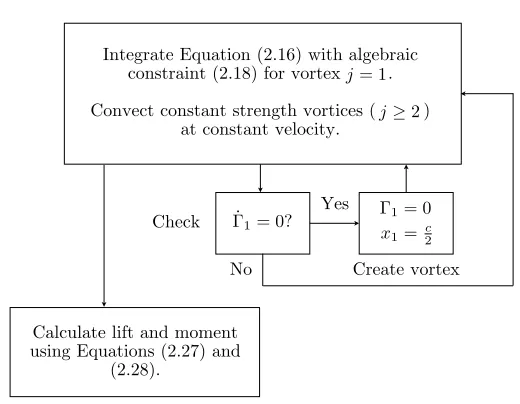
Integrate Equation (2.16) with algebraic constraint (2.18) for vortex .
Convect constant strength vortices ( ) at constant velocity.
Create vortex Yes
No
Check ˙Γ1= 0?
Γ1= 0
x1= c2
Calculate lift and moment using Equations (2.27) and
(2.28).
j≥2
[image:37.612.193.453.66.268.2]j= 1
Figure 2.3: A block diagram summarizing the low-order model.
In what follows, the prime notation is dropped with understanding that we are dealing with the
corrected values of lift and moment as presented above.
2.2.8
Summary of the low-order model
A block diagram summarizing the model is given in figure 2.3. To numerically simulate the model,
only one ordinary differential equation for the nascent vortex velocity, (2.16), must be integrated
with the constraint given by the conservation of circulation, (2.18). Equation (2.16) is replaced by
(2.32) to circumvent the singularity resulting from the introduction of a new vortex at the trailing
edge of the flat plate airfoil. All free vortices convect with constant strength and at the freestream
velocity therefore the locations of these vortices are determined analytically. At every time step, one
must check whether a new vortex is created based on the shedding criteria ˙Γ1 = 0. If ˙Γ1 changes
sign, then a new vortex is formed, the simulation is reinitialized to account for the formation of
a new vortex, and the simulation resumes. At any instant in time, the force and moment can be
determined from Equations (2.27) and (2.28). If necessary, the lift and moment are modified to
(a) (b)
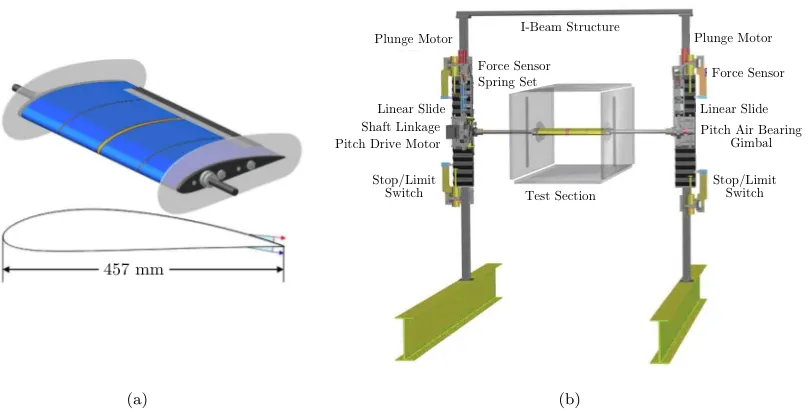
Figure 2.4: Depicted in (a) is the experimental model of the airfoil with modular synthetic jets attached and (b) is the experimental setup to allow for plunge and pitch control in an open-return wind tunnel facility at GTRI. Image is adapted from Muse et al. (2009).
2.3
Validation of the low-order model
The low-order model is compared to experimental results and numerical results of a NACA 4415
airfoil undergoing impulsive and sinusoidal pitch and plunge. This airfoil has been chosen primarily
due to its use at Georgia Technical Research Institute (GTRI) in Atlanta as the test bed for current
and future flow control experiments. The nominal values used here areCL,0= 0.4 andCM,0=−0.1.
2.3.1
Comparison with experiments
The experiments are conducted in an open-return low-speed wind tunnel having a square test section
measuring 1 m on each side using a modular airfoil fitted with endplates to limit its three-dimensional
effects. The airfoil model is depicted in Figure 2.4(a) and has a chord length of c= 0.457 m. The
wind tunnel model executes commanded flight maneuvers in two-degrees of freedom (pitch about
the quarter chord, a = 0.25c, and plunge) that can either be controlled by the combination of a
torque motor and linear vertical slides as schematically drawn in Figure 2.4(b) or by synthetic jet
actuators (as discussed in Section 2.5). Furthermore, the setup and control algorithms effectively
experimental setup and its control strategy can be found in Muse et al. (2008b) and Muse et al.
(2009).
For steady state measurements, the moment and lift are given by the torque motor and linear
slide load cells. When steady, measurements of the moment and lift are accurate with less than
1% error. An extension to the unsteady case is made for accurate estimation of the instantaneous
aerodynamic pitching moment and lift force during dynamic maneuvering. The moment is estimated
by using the dynamics equation
M =Iα¨− Te (2.35)
whereIis the measured moment of inertia andTe =Kmumis the commanded motor torque withKm
andumbeing the motor torque gain and command input to the controller, respectively. The moment
of inertia is identified experimentally with less than 10% error. Angular acceleration ¨αis measured
with an angular accelerometer and its accuracy degrades with increasing pitching frequency and
therefore limiting the pitching frequency tofpitch<1 Hz. Estimation of the aerodynamic lift can be
done in a similar fashion but due to the several factors in the experimental design, the lift force is
much less accurately measured and, like the moment, its accuracy degrades with increasing plunge
frequency,fplunge. Because of this, the plunge mechanism is locked to remove the effects of inertia
and the lift force is measured directly from the load cell.
For the experimental test, the airfoil is pitched near quarter-chord at a free-stream Reynolds
number, Re = 9×10⁵, with a prescribed trajectory,
α=αmaxsin
kpitchU∞ c t
(2.36)
where the amplitude, αmax, and reduced frequency, kpitch = 2πcfU∞pitch, are both functions of time.
As seen in Figure 2.5(a), a sinusoidal chirp signal is fed into the experiment such that the reduced
frequencies spanned range from 0.057 < kpitch < 0.068 (0.60 Hz < fpitch <0.71 Hz). The angular
speed of the airfoil is kept constant. Given in Figure 2.5(b) is the comparison of lift and moment
experimen-θ
˙θ
¨θ
U t/c
0 500 1000
0 500 1000
0 500 1000
-10 0 10 -1 0 1 -0.5 0 0.5
α
˙
α
¨
α
Friday, July 2, 2010
(a)
CL
CM
U t/c
0 500 1000
0 500 1000
-0.1 -0.05 -5 0 5
[image:40.612.175.432.126.578.2](b)
Figure 2.5: Comparison with experimental results for lift and moment for a NACA 4415 airfoil
pitching about its quarter chord. (a) Input data (in radians) from experiment (dotted, unfiltered ¨α).
Frequencies range from 0.057< kpitch <0.068 (0.60 Hz< fpitch <0.71 Hz). (b) Experimental and
model response: current model; experiments. Experimental results forCM were filtered
with a Butterworth filter to remove high frequency noise. Experimental results forCL are nearly
CL
CM
U t/c
2 4 6 8 10
2 4 6 8 10
[image:41.612.180.435.57.273.2]-0.15 -0.1 -0.05 0 0.5 1
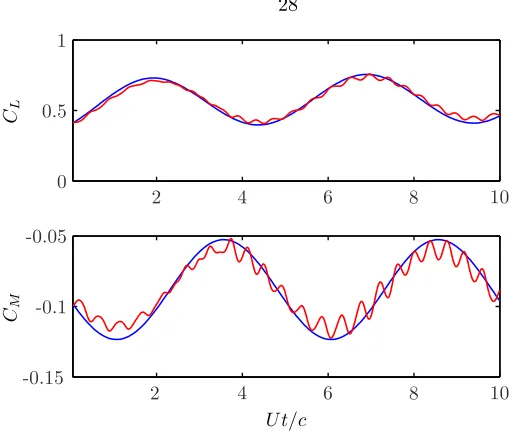
Figure 2.6: Comparison with high fidelity numerical simulations for lift and moment for a NACA
4415 airfoil purely pitching about its quarter chord with kpitch = 1.256 and 0◦ < α < 2◦: ,
current model; , DDES.
tal measured lift and the model lift is excellent. The experimentally measured moment (low-pass
filtered), shows slight departures from the model although the magnitude, frequency, and phase of
the dominant mode of oscillation is very well predicted. The differences between the two might
possible originate from the excessive noise in measuring the angular acceleration and using these
results in Equation (2.35). The agreement seen here is typical for frequenciesfpitch<1Hz.
2.3.2
Comparison with delayed detached-eddy numerical simulatons
Due to the limitations of the experimental facilities, numerical simulations are used to validate
models in situations not realizable by experimentation. In particular, higher pitch and plunge rates
are investigated. The numerical simulations presented here are computed at the University of Texas
at Austin using delayed detached-eddy simulations (DDES) by Lopez (2009). The DDES scheme
is a hybrid non-zonal Reynolds-averaged Navier-Stokes and large-eddy simulation scheme based
on the detached-eddy simulation model. For more information on the simulation, see Lopez (2009).
Simulations are run at a free-stream Reynolds number, Re = 9×10⁵, closely matching the conditions
of the experiment.
Figure 4.7: Eddy viscosity (top) and vorticity field (bottom) atRe = 9×10⁵ and
α= 0◦. (modified NACA4415)
tions the slope is slightly negative. In this caseCdresults are in very good agreement
with experiments.
Figure 4.11 shows a comparison of the computational results between the
un-modified and un-modified NACA4415 profile. While theClcurve slope is not strongly
influenced by the geometrical modification of the airfoil profile, there is a radical
change to theCm curve slope. Changes in ∂C∂αm have been observed experimentally
by De Salvo et al [37] with similar actuators but on a different airfoil section. An
important numerical parameter that can be computed from these results is∂Cm
∂Cl at low
angle of attack, which is related to the location of the aerodynamic center of the wing
81
Figure 2.7: Vorticity field from DDES simulation demonstrating small-scale vortices shed off the non-sharp trailing edge (Lopez, 2009).
pitching sinusoidally at a fixed frequency,kpitch= 1.256, which is more than two orders of magnitude
higher than the experimental case. The agreement here is acceptable given the simplifications made.
We notice that the simple low-order model cannot capture the small-scale oscillations that lie on
top of the gross lift and moment signatures. These high frequency oscillations can be explained by
vortex shedding off the non-sharp trailing edge in both the numerical simulations and the experiments
(although the sensors lack the resolution to resolve this) as seen in Figure 2.7. This causes small
amplitude von K´arm´an street to be shed from the trailing edge for all our operating conditions and
typically introduces a small asymmetry in the small-scale waveform due to its turbulent nature. Of
course, the low-order model cannot capture such an effect because of the prior assumptions made
in Section 2.2.1, but the model does capture the salient features, primarily reproducing the lift and
moment amplitudes, phase, and phase shift at the dominant frequency. The small-scale oscillations
in this case are considered negligible because under the standard operating conditions, the variations
in lift and moment due to the von K´arm´an street are |∆CL| < 0.05 and |∆CM| < 0.01 and at a
frequency that is to high to garner a response when coupling with the fluid-structure interaction of
the rigid structure.
Figure 2.8 similarly shows the comparison for a fixed plunge angular frequency where the airfoil
heaves sinusoidally with an amplitude h= yb,max
c = 0.2. Again, the same trend is seen where we
have the small scale von K´arm´an shedding producing a small scale, high frequency signature in the
lift and moment. The results are still quite satisfactory in producing the essential characteristics in
CL
CM
U t/c
5 10 15
5 10 15
[image:43.612.175.443.57.281.2]-0.2 -0.1 0 -1 0 1
Figure 2.8: Comparison with high fidelity numerical simulations for lift and moment for a NACA
4415 airfoil purely pitching about its quarter chord withkplunge = 1.256 and h= 0.2: , current
model; , DDES.
2.4
Vortex-induced flutter of a simple two degree of freedom
system
Consider a spring supported flat-plate wing section shown in Figure 2.9 with the a spring and damper
acting in the y-direction (ky, by) as well as in the angular direction (kα, bα). The model presented
above is applied to simulate the onset of vortex-induced flutter in the attached flow regime. The
dynamics of the system are modeled as
m∗by¨b∗+Sx∗α¨+by∗y˙b∗+k∗yy∗b=CL (2.37a)
Iα∗α¨+Sx∗y¨∗b+b∗αα˙ +k∗αα=CM(a) (2.37b)
where the equations of motion are non-dimensionalized following Leonard and Roshko (2001) with
yb∗=
yb
c , t
∗= tU∞ c , m
∗
b=
mb 1 2ρfc2
, Iα∗ =
Iα 1 2ρfc4
, S∗x=
Sx 1 2ρfc3
,
b∗y=
by 1 2ρfU∞c
, k∗y=
ky 1 2ρfU∞2
, b∗α=
bα 1 2ρfU∞c3
, k∗α=
kα 1 2ρfU∞2c2
k
αb
αU
Monday, September 13, 2010
Figure 2.9: Schematic of the vortex-induced flutter of a flat plate airfoil. The point at which the spring-damper is attached is also the pitching axis (refer to Figure 2.2).
The static imbalance, Sx, results from a body not pitching about its center of mass and for a
flat-plate wing section this can be reduced toSx =mbaassuming that the center of mass is near the
mid-chord (Naudascher and Rockwell, 1994). Additionally, for a flat plate, the mass moment of
iner-tia can also be analytically expressed asIα=mb
a2+c2
12
. It is noted that non-dimensionalization
in this fashion is different from the traditional formulation (for example see Williamson and
Go-vardhan, 2004) but as explained in Klamo (2007) the non-dimensionalization with fluid dynamic
parameters are compatible with the traditional formulation. In what follows the (∗) is dropped with
the understanding that all values are in their non-dimensional form.
Upon substitution of (2.21) and (2.26) into Equations (2.38) and (2.39), the motion of the airfoil
is dictated by two additional ordinary differential equations
mb+π
2
¨
yb+ (by+ 2π) ˙yb+kyyb+
Sx−aπ
2c ¨ α +
1 +2a
c
πα˙ + 2πα=−U1
∞ N X j=1 Γj q x2
j−c
2
4
(2.38)
Sx−
aπ 2c
¨ yb+
c −4a
2c
πy˙b+
Iα+π
1 64+ a2 2c2 ¨ α+ bα+
aπ(4a+ 3c)
2c2 ˙ α +
kα+
π(4a+c) 2c
α=− 1
4U∞ N X j=1 Γj q x2
j−c
2
4
. (2.39)
CASE mb a/c Iα ky kα
(a) 10 0.50 3.33 1 1
(b) 10 0.25 1.46 1 1
(c) 10 0.00 0.83 1 1
(d) 10 -0.25 1.46 1 1
(e) 1 0.25 1.46 1 1
(f) 100 0.25 1.46 1 1
[image:45.612.231.418.57.171.2](e) 100 0.50 33.33 100 100
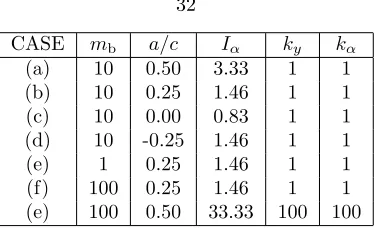
Table 2.1: Legend and list of parameters for various cases presented in figures 2.10 and 2.11.
response of the system.
Although many studies revolve around determining the general stability of the system (e.g. the
lowestU∞= ˜U∞ such that the airfoil remains flutter free), due to the large parameter space, it is
nearly impossible to come to any general conclusion. In particular, Bisplinghoff et al. (1955) could
only draw a few generalizations after conducting several parametric studies using a fully periodic
response assumption. In addition, the highly non-linear behavior of the wake vortices makes it
difficult to determine a closed form solution to the problem such that a definitive stability analysis
can be performed. Instead, the focus here is to look at a few key responses to highlight the transient
and multi-modal behavior of vortex-induced flutter.
We take a look at undamped structures such that both by and bα are set to zero. Typical
aircraft structures have mass ratios mb = O(10−100) and stiffnesses, kα = O(0.1 −100) and
ky=O(0.1−100).
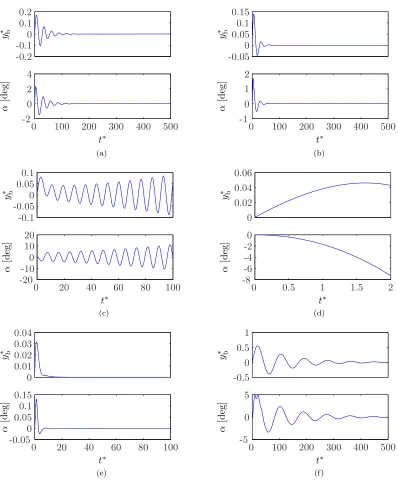
Figure 2.10 gives several responses due to artificially induced gust in they-direction with a list
of parameters for these cases given in Table 2.1. The gust is modeled in the simulation by setting
the initial condition ˙yb= 0.05, i.e. 5% of the free-stream velocity.
In cases (a)-(d), the pitching axis is gradually moved from the leading edge towards the trailing
edge, thus also changing its mass moment of inertia,Iα. It is observed in 2.10(a) when held at the
leading edge, the vibrations in the structure are stable for this set of parameters. As one moves
back towards the quarter-chord, Figure 2.10(b), the oscillations are further suppressed. When the
pitching axis is moved to the mid-chord and further, Figure 2.1