VALUE DELIVERANCE IN VIRTUAL WORLD ENVIRONMENTS
John Hamilton, Faculty Law Business and Creative Arts, James Cook University, McGregor Road, Smithfield, Cairns, Qld., Australia 4878 +61-7-4042-1091, [email protected]
Colin Lemmon, School of Business (Information Technology), James Cook University, McGregor Road, Smithfield, Cairns, Qld., Australia 4878 +61-7-4042-1016, Colin. [email protected]
Carrie Lui, School of Business (Information Technology), James Cook University, McGregor Road, Smithfield, Cairns, Qld., Australia 4878 +61-7-4042-1016, [email protected]
Singwhat Tee, School of Business, James Cook University, McGregor Road, Smithfield, Cairns, Qld., Australia 4878 +61-7-4042-1494, [email protected]
ABSTRACT
This study unlocks a multi-team approach to building virtual worlds (VWs) gamified software solutions for business. It merges psychology, marketing, management, social and information technology approaches, and adopts a design science research methodology (DSRM) macro approach with embedded iterative feedback actioning framed around a time-lined value-deliverance artifact. This approach ensures a consistency in consumer focus, whilst delivering the business-specific project requirements, within reality-framed, gamified, experiential learning situations and changeable environment components.
INTRODUCTION
Virtual worlds (VWs) are 3D, interactive, graphical and physical spaces, where consumers (as participant avatars) personally engage across their permitted human computer interface (HCI) domains when activated by enabling technologies and embedded intelligent gamification software [16].
As business applications VWs are typically purpose-built onto unique value-deliverance platforms. They offer real-time, inventive opportunities and can expose new knowledge horizons for business like new product scenario variants, new corporate systems, and consistent learning systems [1]. In such VW’s consumers operate across unconstrained sensory, interactive, real-world, learn-by-doing, knowledge imprinting environments [11]. Provided business action flows are delivered logically consumers may move into telepresence and/or rapid knowledge acquisition [14].
Virtual world (VW) environments can also iteratively assist the business consumer to upskill [7] and learn in these experiential and in failure-permitted environments. VW situations link these specific business environments, and over-time, build added-value within the consumer or employee.
Past consumer VW experiences, plus current VW expectations, frame their pre-event VW conceptions of the values they are about to receive when engaging with a VW. These per-event conceptions set the at-event motives of what to consume. Throughout consumer at-event interactions, a raft of values perceptions is positively (or negatively) absorbed, and internalized. These VW consumer interactions are post-event gauged by business using consumer satisfaction reflections and trust decisions of the VW, and from these decisions a loyalty determination can then ensue.
VALUE DELIVERANCE IN VIRTUAL WORLD
The measurement (and understanding) of knowledge transfer pathways across the HCI motivate this study. Interacting consumers seek different personal value solutions from business. In VW’s, if a consumer (or avatar) engages and exceeds their internalized degree of value acquisitions, then higher levels of VW post-event consumer satisfaction, trust and loyalty likely result, and vice-versa.
To date, mechanisms of value-deliverance are inconsistently interpreted. Retailers see value as consumer acquisitions. Managers see value as part of their economic reward. Manufacturers see value as component conversion to value-added quality and performance products. Marketers see value as a services and sales proposition. Psychologists see value as hedonic and/or utilitarian motivations that are motivation and consumption-related. Information technologists see value as a usefulness result. Consumers see value as a combination of behavioral perception aspects. Hence, consumer value warrants investigation – first from an overarching perspective, and second from a refined assessment of each specific consumer group’s perspective. The business-related literary domain also identifies a need for a measurable approach to value analysis. In VW’s this study adopts a value analysis artifact, and assess the build of VW interactive environments within a business specific context.
METHODOLOGY
This study uses a design science research (DSR) approach [4] (incorporating iterative feedback auctioning) to design and development our VW environment solutions. Design science research is a research paradigm where a designer answers questions relevant to human problems via the creation of innovative artifacts, thereby contributing new knowledge to the body of scientific evidence. The designed artifact(s)remains both useful and fundamental in the understanding of that problem [4].
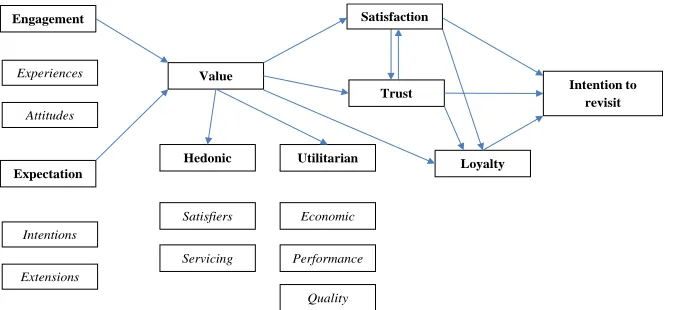
[image:2.612.54.396.480.635.2]Our technologies-based value-deliverance solution (artifact) Figure 1 is developed from information systems. Our artifact models the interrelated constructs that deliver an instantiation of concrete evidence in support of our proposed general principle around the concept of value. This study moves the information technologists’ views of value from a usefulness result into a value co-creation assessment. Using teams, this study constructs different VW business value-deliverance systems, and then allows the engaging consumers to establish differing mixes of personal value.
Figure 1. Value-deliverance system (artifact)
Our corporate, governmental and educational VW gamification scenarios are derived through five contributing teams – with each R&D area treated as a value deliverance system (converting a pre-value expectations position through to a post-value acquisition acceptance) based on Figure 1 (artifact). This
Engagement
Expectation
Value
Trust Intention to
revisit
Loyalty Hedonic Utilitarian
Intentions
Extensions
Economic
Performance
Quality Satisfiers
Servicing Experiences
Attitudes
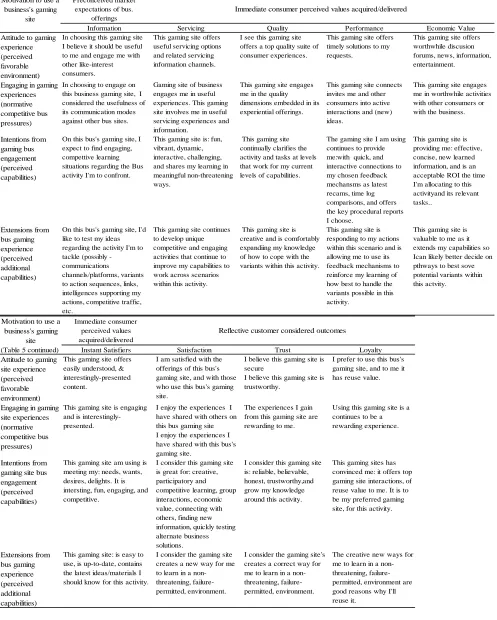
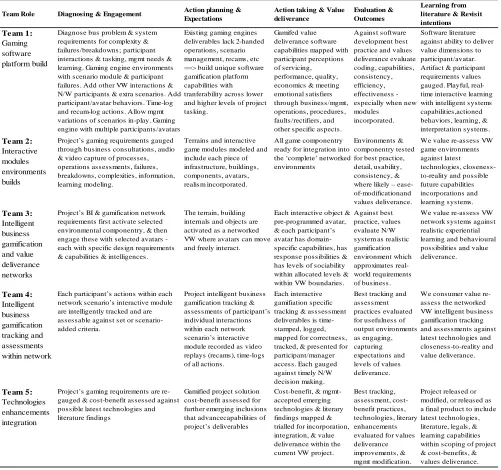
study first frames Table 1 – the artifact and its deliverance components, and then tests the VW for its at-event consumer interaction-behaviors, and post-at-event learned-evaluations – as shown in Table 2.
Teams
Team1 develops a highly-intelligent efficient interactive VW software platform through multi-cycle feedback builds that dynamically refine/expand the platform’s capabilities/efficiencies. Team2 develops specific interactive modules and network environments. Team3 and Team4 deliver gamifications (game thinking/mechanics) into adaptive, networked, business scenario situations – where consumers pursue, track, refine their solutions to problems). Team5 experiments with latest technologies – determining relevant interactive-devices (or ideas) for application (or integration) inclusions. Combining this base, this study trials, builds, and assesses suites of corporate training requirements as gamified, participant-active, scenarios (each built for dynamic value-deliverance experiences within very specific business VW environments). This study explores these scenarios for value-deliverance using pre-event [5], at-event [5] [13] [15], and post-at-event [5] [9] considerations.
VALUE DELIVERANCE
Engagement across this HCI is first leveraged through the consumer’s beliefs about past personal engagement capabilities, and as to whether this forthcoming engagement is likely to be of personal benefit. Consumer pre-event assessment considerations establish the degree of VW sharing with other participants. Consumer attitude also critiques the usefulness of the VW in moving them towards a personal goal or providing beneficial/useful materials-of-interest. Specifically a consumer pursues pre-event VW expectations to achieve a set of preconceived intentions. Consumers expect useful communications (information, new items/ideas, experiences, discussions/debates), explorations (possible changes/sourcing and solutions), experiments and exploitations. Their intention to interact increases (or lessens) depending on extra (extension) features that outperform prior pre-event views. These expectations prior engagement considerations are Figure1’s pre-event artifact inputs.
At-event value-deliverance occurs as the consumer interacts across the HCI, and continually acquires (and collectively grows) perceptions regarding the value components experienced. Sheth et al. [13] elucidate four value dimensions (including an emotive dimension), Roig et al. [10] show five dimensions. Some subdivide consumers under hedonic or utilitarian groupings. This study captures value as five dimensions (servicing, performance, quality, economic value and emotive satisfiers). Servicing covers HCI sharing (clarification, technologies, information). Performance rates perceptions of offerings (activities, support, alternatives, feedback). Quality (reliable, assured, accurate, responsive, empathetic, acceptable) captures delivered content aspects (design, information, security, and technology). Economic value is economic worth (pricing location/determination, value-for-money). Emotive satisfiers deliver fun, interest, knowledge-required, imagination, enjoyment and a continual recognition-of-relevance.
The post-event stage of value-deliverance is reflective. Satisfaction (worth my time, of usage, performs well, is quality, offers services) and trust (reliable, non-disappointing interaction), and then loyalty plus revisit-intention gauge the artifact’s success as a time-flow from left-to-right across Figure 1.
Table 1. VWs value deliverance system (for informative consumer engagement)
Motivation to use a business's gaming
site
Preconceived market expectations of bus.
offerings
Information Servicing Quality Performance Economic Value
Attitude to gaming experience (perceived favorable environment)
In choosing this gaming site I believe it should be useful to me and engage me with other like-interest consumers.
This gaming site offers useful servicing options and related servicing information channels.
I see this gaming site offers a top quality suite of consumer experiences.
This gaming site offers timely solutions to my requests.
This gaming site offers worthwhile discusion forums, news, information, entertainment.
Engaging in gaming experiences (normative competitive bus pressures)
In choosing to engage on this business gaming site, I considered the usefulness of its communication modes against other bus sites.
Gaming site of business engages me in useful experiences. This gaming site involves me in useful servicing experiences and information.
This gaming site engages me in the quality dimensions embedded in its experiential offerings.
This gaming site connects invites me and other consumers into active interactions and (new) ideas.
This gaming site engages me in worthwhile activities with other consumers or with the business.
Intentions from gaming bus engagement (perceived capabilities)
On this bus's gaming site, I expect to find engaging, compettive learning situations regarding the Bus activity I'm to confront.
This gaming site is: fun, vibrant, dynamic, interactive, challenging, and shares my learning in meaningful non-threatening ways.
This gaming site continually clarifies the activity and tasks at levels that work for my current levels of capabilities.
The gaming site I am using continues to provide me:with quick, and interactive connections to my chosen feedback mechansms as latest recams, time log comparisons, and offers the key procedural reports I choose.
This gaming site is providing me: effective, concise, new learned information, and is an acceptable ROI the time I'm allocating to this activityand its relevant tasks.. Extensions from bus gaming experience (perceived additional capabilities)
On this bus's gaming site, I'd like to test my ideas regarding the activity I'm to tackle (possibly -communications
channels/platforms, variants to action sequences, links, intelligences supporting my actions, competitive traffic, etc.
This gaming site continues to develop unique competitive and engaging activities that continue to improve my capabilities to work across scenarios within this activity.
This gaming site is creative and is comfortably expandiing my knowledge of how to cope with the variants within this activity.
This gaming site is responding to my actions within this scenario and is allowing me to use its feedback mechanisms to reinforce my learning of how best to handle the variants possible in this activity.
This gaming site is valuable to me as it extends my capabilities so Ican likely better decide on pthways to best sove potential variants within this actvity.
Immediate consumer perceived values acquired/delivered
Motivation to use a business's gaming
site
Immediate consumer perceived values acquired/delivered
(Table 5 continued) Instant Satisfiers Satisfaction Trust Loyalty
Attitude to gaming site experience (perceived favorable environment)
This gaming site offers easily understood, & interestingly-presented content.
I am satisfied with the offerings of this bus's gaming site, and with those who use this bus's gaming site.
I believe this gaming site is secure I believe this gaming site is trustworthy.
I prefer to use this bus's gaming site, and to me it has reuse value.
Engaging in gaming site experiences (normative competitive bus pressures)
This gaming site is engaging and is interestingly-presented.
I enjoy the experiences I have shared with others on this bus gaming site I enjoy the experiences I have shared with this bus's gaming site.
The experiences I gain from this gaming site are rewarding to me.
Using this gaming site is a continues to be a rewarding experience.
Intentions from gaming site bus engagement (perceived capabilities)
This gaming site am using is meeting my: needs, wants, desires, delights. It is intersting, fun, engaging, and competitive.
I consider this gaming site is great for: creative, participatory and competitive learning, group interactions, economic value, connecting with others, finding new information, quickly testing alternate business solutions.
I consider this gaming site is: reliable, believable, honest, trustworthy,and grow my knowledge around this activity.
This gaming sites has convinced me: it offers top gaming site interactions, of reuse value to me. It is to be my preferred gaming site, for this activity.
Extensions from bus gaming experience (perceived additional capabilities)
This gaming site: is easy to use, is up-to-date, contains the latest ideas/materials I should know for this activity.
I consider the gaming site creates a new way for me to learn in a non-threatening, failure-permitted, environment.
I consider the gaming site's creates a correct way for me to learn in a non-threatening, failure-permitted, environment.
The creative new ways for me to learn in a non-threatening, failure-permitted, environment are good reasons why I'll reuse it.
DESIGN SCIENCE: STUDY APPROACH
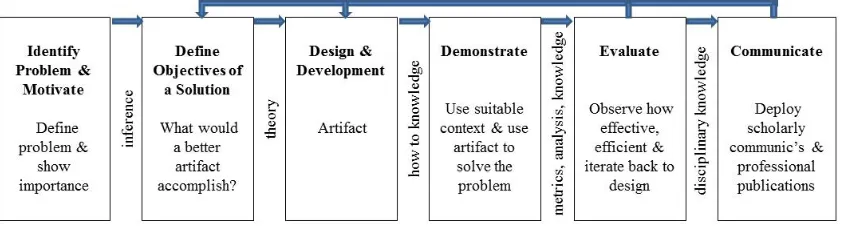
[image:5.612.55.476.208.323.2]Our artifact embeds motivational pre-event behaviors [3] into the consumptive at-event behaviors [12] of Table 1, and the artifact time-flows across the value deliverance system and engages iterative feedback actioning. First, project diagnosing frames the engagement setting. Second, planning modularizes and develops perceived action situations and learning for each aspect/task. Third, by conjointly engaging these two stages our value deliverance approach is embedded into the full gamified system solution. Fourth, scenario outcomes assessment against scope is gauged against: satisfaction, trust, loyalty and revisiters; learning; and latest literature/software. Thus the artifact moves development across the six step ‘design science research methodology’ (DSRM) approach [8], as per Figure 2.
Figure 2. DSRM approach: Value-deliverance applied in VW’s (adapted from Peffers et al. [8])
DSRM problem solves and guides each solution-focused VWs project [2]. Activities 1 and 2 identify the problem and build literature and software project scoping across current knowledge gaps like real-time scenario considerations. Activity 2 repeats if iterative feedback auctioning adds new requirements. Activity 3 frames the artifact as the VW problem solver [2]. Activities 4 and 5 engage participants and test (or retest iterative feedback auctioning modifications to) the artifact [2] for value deliverance [8], as shown in Table 2. Activity 6 communicates the resultant VWs findings.
Thus, a consistent and focused value deliverance developmental approach is ensured across the scenario component builds. This approach applies throughout the related multi-team software development cycles. Thus, all teams remain on track, and ultimately an efficient and effective value deliverance final VWs solution package is passed to the contracting business.
DISCUSSION
This study unlocks a new value deliverance approach to building VW software solutions for business, and enables managers to monitor progress of VW participants and software system learning. The value deliverance artifact (Figure 1) moves the artefact (Table 1 and its key measurement framing foci into Table 2’s iterative feedback actioning considerations. With each iteration, these Table 2 gamified software development measures adapt until a suitable product solution emerges.
This study expands scoped VW projects using DSRM, and links: psychology, social/marketing/management, and information technology into one value deliverance artefact (scoped for specific business application(s)). Iterative feedback actioning yields a dynamic, interlocking focus across the teams, and builds faster, synergistic software development.
Table 2. Team’s iterative feedback actioning research from DSRM activity stages 4 and 5
Team Role Diagnosing & Engagement Action planning & Expectations
Action taking & Value deliverance
Evaluation & Outcomes
Learning from literature & Revisit intentions
Te am 1:
Gaming software platform build
Diagnose bus problem & system requirements for complexity & failures/breakdowns; participant interactions & tasking, mgmt needs & learning. Gaming engine environments with scenario module & participant failures. Add other VW interactions & N/W participants & extra scenarios. Add participant/avatar behaviors. Time-log and recam-log actions. Allow mgmt variations of scenarios in-play. Gaming engine with multiple participants/avatars
Existing gaming engines deliverables lack 2-handed operations, scenario management, recams, etc ==> build unique software gamification platform capabilities with tranferability across lower and higher levels of project tasking.
Gamifed value deliverance software capabilities mapped with participant perceptions of servicing, performance, quality, economics & meeting emotional satisfiers through business/mgmt, operations, procedures, faults/rectifiers, and other specific aspects.
Against software development best practice and values deliverance evaluate coding, capabilities, consistency, efficiency, effectiveness - especially when new modules
incorporated.
Software literature against ability to deliver value dimensions to participant/avatar. Artifact & participant requirements values gauged. Playful, real-time interactive learning with intelligent systems capabilities,actioned behaviors, learning, & interpretation systems.
Te am 2:
Interactive modules environments builds
Project’s gaming requirements gauged through business consultations, audio & video capture of processes, operations assessments, failures, breakdowns, complexities, information, learning modeling.
Terrains and interactive game modules modeled and include each piece of infrastructure, buildings, components, avatars, realism incorporated.
All game componentry ready for integration into the ‘complete’ networked environments
Environments & componentry tested for best practice, detail, usability, consistency, & where likely – ease-of-modificationand values deliverance.
We value re-assess VW game environments against latest technologies, closeness-to-reality and possible future capabilities incorporations and learning systems.
Te am 3:
Intelligent business gamification and value deliverance networks
Project’s BI & gamification network requirements first activate selected environmental componentry, & then engage these with selected avatars - each with specific design requirements & capabilities & intelligences.
The terrain, building internals and objects are activated as a networked VW where avatars can move and freely interact.
Each interactive object & pre-programmed avatar, & each participant’s avatar has domain-specific capabilities, has response possibilities & has levels of sociability within allocated levels & within VW boundaries.
Against best practice, values evaluate N/W system as realistic gamification environment which approximates real-world requirements of business.
We value re-assess VW network systems against realistic experiential learning and behavioural possibilities and value deliverance.
Te am 4:
Intelligent business gamification tracking and assessments within network
Each participant’s actions within each network scenario’s interactive module are intelligently tracked and are assessable against set or scenario-added criteria.
Project intelligent business gamification tracking & assessments of participant’s individual interactions within each network scenario’s interactive module recorded as video replays (recams), time-logs of all actions.
Each interactive gamifiation specific tracking & asssessment deliverables is time-stamped, logged, mapped for correctness, tracked, & presented for participant/manager access. Each gauged against timely N/W decision making.
Best tracking and assessment practices evaluated for usefulness of output environments as engaging, capturing expectations and levels of values deliverance.
We consumer value re-assess the networked VW intelligent business gamification tracking and assessments against latest technologies and closeness-to-reality and value deliverance.
Te am 5:
Technologies enhancements integration
Project’s gaming requirements are re-gauged & cost-benefit assessed against possible latest technologies and literature findings
Gamified project solution cost-benefit assessed for further emerging inclusions that advancecapabilities of project’s deliverables
Cost-benefit, & mgmt-accepted emerging technologies & literary findings mapped & trialled for incorporation, integration, & value deliverance within the current VW project.
Best tracking, assessment, cost-benefit practices, technologies, literary enhancements evaluated for values deliverance improvements, & mgmt modification.
Project released or modified, or released as a final product to include latest technologies, literature, legals, & learning capabilities within scoping of project & cost-benefits, & values deliverance.
CONCLUSION
The growing use of VWs solutions in business is further advanced when improved channels of collaboration and communication emerge with the virtually-engaging consumer. This study unlocks a multi-team approach to building VWs gamified business software. It merges psychology, marketing, management, social and information technology approaches, and adopts a DSRM macro approach with embedded iterative feedback actioning framed around a time-lined value deliverance artifact. This study’s value deliverance artefact ensures a consistency in consumer focus, whilst delivering the business-specific project requirements, within reality-framed, gamified, experiential learning situations and with changeable environment components.
behaviors) via iterative feedback auctioning changes, and applied across specific time-lined aspects of the developing project scenarios and/or tasks. Scant relevant communication and interaction theory exists on how VWs consumers are best drawn into business-specific virtual learning environments, but under DRSM we observe when VWs gamified learning is operationalized, our developed experiential engagement conditions generate higher student learning outcomes (skills, understanding and knowledge acquisition).
REFERENCES
[1] Biggs, J. Teaching for quality learning at university (2nd ed). Berkshire, UK, Open University Press, 2003.
[2] Gregor, S. & Hevner, A.R. Positioning and presenting design science research for maximum impact. MIS Quarterly, 2013, 37 (2), 337-355.
[3] Heinonen, K. Consumer activity in social media: Managerial approaches to consumers’ social media behavior. Journal of Consumer Behaviour, 2011, 10 (6), 356-364.
[4] Hevner, A. & Chatterjee, S. (eds). Design research in information systems: Theory and practice. Dordrecht, Springer, 2010.
[5] Kim, H-W, Gupta, S. & Koh, J. Investigating the intention to purchase digital items in social networking communities: A customer value perspective. Information & Management, 2011, 48 (6), 228–234.
[6] Kohler, T., Fueller, J., Matzler, K. & Stieger, D. Co-creation in virtual worlds: The design of the user experience. MIS Quarterly, 2011, 35 (3), 773-788.
[7] Ondreijka, C. Collapsing geography Second Life, innovation, and the future of national power. Innovations: Technology, Governance, Globalization, 2007, 2 (3), 27-54.
[8] Peffers, K., Tuunanen, T., Rothenberger, M. & Chatterjee, S. A design science research methodology for information systems research. Journal of Management Information Systems, 2007, 24 (3), 45-77.
[9] Pöyry, E., Petri Parvinen, P. & Tuuli Malmivaara, T. Can we get from liking to buying? Behavioral differences in hedonic and utilitarian Facebook usage. Electronic Commerce Research and Applications, 2013, 12 (4), 224-235.
[10] Roig, J.C., Sánchez, J. & Moliner, M.A. Customer perceived value in banking services. International Journal of Bank Marketing, 2006, 24 (5), 266-283.
[11] Sellick, M.K., Delaney, R. & Brownlee, K. The deconstruction of professional knowledge: Accountability without authority. Families in Society: The Journal of Contemporary Social Services, 2002, 83 (5), 493-498.
[12] Shao, G. Understanding the appeal of user- generated media: A users and gratification perspective. Internet Research 2009, 19 (1), 17-25.
[13] Sheth, J., Newman, B. & Gross, B. Why we buy what we buy: A theory of consumption values. Journal of Business Research, 1991, 22 (2), 159-170.
[14] Suh, K-S. & Chang, S. User interfaces and consumer perceptions of online stores: The role of telepresence. Behaviour & Information Technology, 2006, 25 (2), 99-113.
[15] Sweeney, J.C. & Soutar, G.N. Consumer perceived value: The development of a multiple item scale. Journal of Retailing, 2001, 77 (2), 203-220.