This is the author-created version of the following work:
Bruce, Christine, and Stoodley, Ian (2013)
Experiencing higher degree research
supervision as teaching.
Studies in Higher Education, 38 (2) pp. 226-241.
Access to this file is available from:
https://researchonline.jcu.edu.au/55433/
Copyright 2011 Taylor and Francis
Nine
pedagogies
of
higher
degree
research
supervision
Christine Bruce
and Ian Stoodley
Faculty of Science and Technology, Queensland University of Technology, Brisbane, Australia
Abstract
This article describes research higher degree supervisors’ experiences of supervision as a
teaching and learning practice. While research education is considered central to the HDR
experience, comparatively little is known to date of the pedagogical lenses adopted by
supervisors as they go about their supervision. We worked with 35 supervisors engaged in
discipline‐specific and interdisciplinary research across architectural design, science,
engineering, computer science, information systems and librarianship. Several of these
supervisors conducted projects which interfaced with the social sciences and humanities.
The pedagogies, constructed through the discussions and phenomenographic analysis, offer
a picture of supervisors’ collective awareness of supervision as a teaching and learning
practice. Supervision as a teaching and learning practice was experienced as: Promoting the
supervisor’s development, Imparting academic expertise, Upholding academic standards,
Promoting learning to research, Drawing upon student expertise, Enabling student
development, Venturing into unexplored territory, Forming productive communities, and
Contributing to society.
Keywords: higher degree research; supervision; pedagogy; experience; phenomenography
Nine
pedagogies
of
research
higher
degree
supervision
Christine Bruce1
and Ian Stoodley
Faculty of Science and Technology, Queensland University of Technology, Brisbane, Australia
Introduction
This paper introduces nine different ways in which research supervisors experience their
supervision, from a teaching and learning perspective2. We have called these the 9 Pedagogies of
Higher Degree Supervision. The pedagogies were developed as part of a framework for thinking
about supervision through a teaching lens (Bruce and Stoodley 2010). While the framework draws
together a wide range of aspects of teaching practice, this paper only reports the research
underpinning the development of the 9 Pedagogies. The 9 Pedagogies represent supervisors’
awareness of their engagement with higher degree supervision as teaching.
The nine pedagogies described in this paper elaborate the different stances adopted by supervisors
when discussing what it means to teach and to bring about learning in supervision. They provide
supervisors with a range of options from which to select as they engage with students. The
pedagogies may be used by individuals and groups to:
support less experienced supervisors looking for options in their approach to supervision as
teaching;
support experienced supervisors in mentoring junior colleagues;
support experienced supervisors in refreshing their own supervision; and
1
Corresponding author. Email [email protected]
2 As we share the view that the purpose of teaching is to bring about learning, in what follows we abbreviate
support facilitators of workshops and other development opportunities focused on
supervisory pedagogy.
Literature Review
Research supervision is an integral, but often neglected, component of the teaching‐research nexus.
Researchers are used to:
researching their teaching;
teaching their research;
thinking about teaching (mostly at the undergraduate and honours levels) as a site of
research practice, that is a space where students engage in research; and
thinking about teaching as a pathway to research, where students might become involved in
the research process.
Here we focus on a dimension of the teaching‐research nexus different from those listed above ‐
research supervision as a site of teaching. The concept of research supervision as being about
teaching, or ‘research education’, is being constructed internationally (Boud and Lee 2008; Brew
2001; Bruce, Stoodley and Pham 2009; Green and Lee 1999; Kiley and Wisker 2009; Manathunga,
Lant and Mellick 2006). ‘Critical to how supervisors think about what they are doing when they
supervise is whether they think of supervision as a teaching or as a research practice’ (Brew and
Peseta 2008, p. 134). Considering supervision as being about teaching, for example, acknowledges
the role of the research student, or candidate, as a learner in the research sphere as well as being a
contributing member of the research community.
Presently, complementary approaches to supervision are emerging, with their attendant
implications for pedagogy. A completions focus, exemplified by the work of Sinclair (2004), reflects a
higher degree research climate with pedagogies attending to project structuring and planning. A
and often culminates in the development of frameworks such as those proposed by Willison and
O’Regan (2007). A social practice focus is embodied in the views of Boud and Lee (2008) who
suggest that the scope of supervision research needs to be extended ‘to encompass a wide range of
actors within the field’ (p. 5). The role of a supervisor focus (Deuchar 2008) has been given
extensive attention and pedagogically attends to the development of models, such as master‐
apprentice, facilitator or critical‐friend. An expanding awareness focus suggests that bringing about
learning involves widening the experience of students as they learn to become researchers; with
work conducted across disciplines (Brew 2001; Bills 2004; Åkerlind 2005, 2008; Wright, Murray and
Geale 2007; Kiley and Mullins, 2005) including in specific discipline contexts (for example Bruce,
Pham and Stoodley 2004; Pham, Bruce and Stoodley 2005; Wood, 2006). Adopting a learning
outcomes focus, Kiley and Wisker (2009) explore the idea of threshold concepts in the context of
research supervision. Threshold concepts transform learners, enabling them to achieve more
advanced research as they attain qualitatively different views of the content being learned, learning
experiences or themselves as learners (p. 432).
Of considerable importance to the growing focus on research education are warnings that mandated
change can harm organisational cultures. For research supervision this is likely to mean
‘programmes that will yield better supervisory practices will be ones which incorporate reflexive,
pedagogically‐sound, collegial activities where supervisors draw upon and share the best of
postgraduate supervision’ (Edwards 2002). This line of thought reflects the focus on narrative and
the availability of case studies for supervisors, for example at the University of Sydney
(http://www.itl.usyd.edu.au/supervision/casestudies/search.cfm?25785443) and the Queensland
University of Technology, Brisbane (Bruce and Stoodley 2010).
The study reported here complements the growing set of insights into the varying experience of
from the experience of supervisors themselves, which can be adopted to encourage supervisors to
reflect individually or together on their own experience and the value of alternative pedagogies.
Research Aim
The investigation reported here focussed on variation in supervisors’ awareness of supervision as a
form of teaching, exploring with them what they intended students to learn and how they might
bring about that learning. We aimed to reveal variation in their experience of pedagogy as they
engaged in supervision.
Method – Developing the pedagogies
Phenomenography (Marton and Booth 1997; Bowden and Green 2005; Bowden and Walsh 2000)
was the point of departure for our exploration of supervisory pedagogy. Phenomenography has
previously been used to deepen our understanding of research and research supervision (Åkerlind
2008; Baillie, Emanuelsson, and Marton 2001; Brew 2001; Ingerman and Booth 2003; Kiley and
Mullins 2005; Wood 2006). The phenomenon under exploration in this study was the experience of
supervision as teaching
In the phenomenographic approach, knowledge is understood to be constituted in the varying
relations between people and the world. The ‘world is not constructed by the learner, nor is it
imposed upon her; it is constituted as an internal relation between them’ (Marton and Booth 1997,
p. 13). The different ways of constituting aspects of the world, in this case supervision as a teaching
practice, are known as experiences. In phenomenography, the description of experience is achieved
through an interpretive process, beginning with conversations with participants and involving
interpreting these conversations in the light of each other. Thus, a picture is built of the collective
Participants
All participants were practicing supervisors, see Table 1. Their experience of supervision ranged
from early career with no completions, through to very experienced with many completions. Our
categorisation of experience in terms of completions is based on Hammond, et al.’s (2009)
conceptualisation of levels of supervisory experience. Participants represented a breadth of
architectural design, science, engineering, computer science, information systems and librarianship
research interests, and included research leaders (for example, assistant deans and research
coordinators).
[Insert Table 1 here]
As our purpose was to reflect pedagogical experience as broadly as possible, supervisors from all
academic levels of appointment, and with a variety of experience, participated. While precise details
of student backgrounds are not available, it was evident that these supervisors were working with
male and female, international, as well as small and large cohorts of students.
Talking with supervisors about their experience
The data was gathered through semi‐structured interviews and workshops. In order to understand
their experience of supervision as a teaching practice, supervisors contributing through one to one
conversations were invited to describe and provide examples of a) their approaches to HDR
supervision, b) their expectations about what students would learn throughout the period of study,
c) their (the supervisor’s) role in the process, and d) helps and barriers to making it possible for
students to learn.
Supervisors participating in workshops were invited to identify a) supervisory strategies that work
for them and how they are implemented, b) what they expect students to gain and other benefits of
the strategy, c) how they know students benefit, d) the most important thing they want their
students to learn, and e) helps and barriers to their students’ learning. All interview conversations
Forming descriptions of the pedagogies
We explored participants’ contributions to develop an understanding of the different ways in which
supervision is experienced as a teaching practice. Nine categories of description evolved from the
analysis. They were formed through an iterative cycle of tentative categorisation, return to the data
and re‐formation of the categories. The participants’ own words were central to this process. We
sought to discern both the meaning and structure of these categories from the data, including for
each category a theme, thematic field, margin and dimensions of variation (Marton and Booth
1997). As the structure was explored, meanings shifted, which in turn influenced the discernment of
structure, reflecting the iterative nature of phenomenographic analysis. Descriptions of participants’
experience eventually stabilised.
In
the
final
descriptions,
e
ach category includes three structural elements:(1) The theme: those things which supervisors’ awareness is directed towards.
(2) The thematic field: those things which supervisors consider relevant to the experience.
(3) The margin: those things which supervisors consider less relevant.
Each also includes the following dimensions that vary across the categories:
(1) Supervisors’ views of research; and
(2) Supervisors’ views of learning to research.
In forming the categories, we adjusted our language over time, moving away from formal
phenomenographic terminology as we strove to communicate clearly with supervisors. The changes
in language, for example, from ‘thematise’, to ‘direct attention towards’, are presented in Table 2.
This shift in vocabulary is mirrored in the category descriptions in this account.
The 9 Pedagogies
Nine pedagogies, or ways of experiencing supervision as teaching, were identified:
(1) Promoting the supervisor’s development ‐ Pursuing the supervisor’s established objectives
(2) Imparting academic expertise ‐ Conveying expertise in research processes
(3) Upholding academic standards ‐ Meeting the discipline and institutional communities’
expectations
(4) Promoting learning to research ‐ Meeting students’ learning needs
(5) Drawing upon student expertise ‐ Building from existing student abilities
(6) Enabling student development ‐ Seeking students’ academic and professional maturity
(7) Venturing into unexplored territory ‐ Discovering the research agenda together
(8) Forming productive communities ‐ Drawing key stakeholders together
(9) Contributing to society ‐ Having social impact
The outcome space: representing interrelationships between the categories
Central to phenomenography is the representation in an outcome space of the relationships
between the different experiences. The relationships are typically expressed in terms of expanding
awareness (Marton and Booth 1997). Such expansion can be perceived in Table 3 – progression
down the rows moves in groups of three categories, from supervisors adopting an orientation
towards themselves, through supervisors adopting an orientation towards students, to supervisors
adopting an orientation towards the wider community. The vocabulary used to describe the theme
of each experience reflects this progression. Such changes of perspective are understood to indicate
a broadening of awareness on the part of the supervisor, from their immediate environment to the
wider community.
The first three categories, representing a supervisor orientation, identify elements of the
they may see themselves as the key source of knowledge relevant to the candidature or they may be
seen as the guardian of standards pertaining to their own (academic) environment.
The second three categories, representing a student orientation, identify aspects of the candidate’s
journey as central to pedagogy. The student’s learning determines the activities engaged in, they
are valued as a key source of knowledge or their maturity is the goal of the candidacy.
The final three categories representing a community orientation identify aspects of the wider
community as central to the pedagogy. The community significantly influences the direction of the
research endeavour, an extensive network of collaborators is seen as a key source of knowledge or
meeting the community’s needs is the goal.
The outcome space is a succinct means of representing such changes in awareness.
[Insert Table 3 here]
The relationships between categories may also be represented in terms of the content, intentions
and strategies of supervision (Table 4). Aspects of supervision as teaching are indicated in the
columns and a widening orientation is shown in the rows. In the columns, ‘Content’ refers to what
supervisors see as the substance of the material to be imparted to the student, ‘Intention’ refers to
supervisors’ motivations behind imparting that content and ‘Strategy’ refers to how supervisors
engage students with the content.
[Insert Table 4 here]
Category 1: Promoting the supervisor’s development
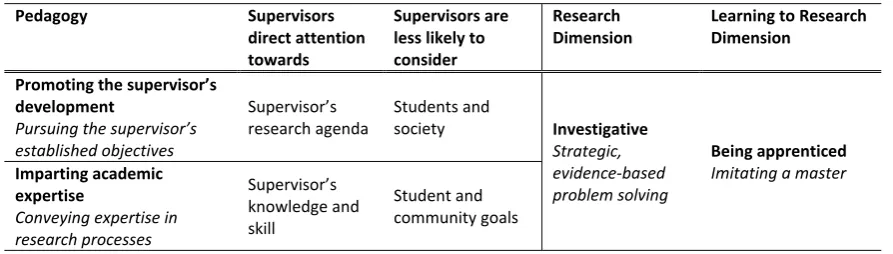
Supervisory pedagogy may be experienced as promoting the supervisor’s development. Table 5
depicts the key elements of this category. When supervisors experience teaching research students
this way, they direct their attention towards their established research objectives, determined by
established agendas, the existing network, leveraging past work, personal survival and the
hierarchy’s expectations of supervisory load. They are less likely to consider students or society.
The way I work with students is, during the first year they are working as a research assistant,
learning the ropes. ‘This is what you have to do, you have to do the literature review and this is
the kind of program you will have to write and this is how we are going to test it’, etc. (I1)3
I do like them to do some safe, well defined work early. It’s a lot of money and if they are not
performing in a project it is quite stressful... you also wonder if it’s going to ruin your career
because you have to get the publications out or you won’t get more funding. (SI3)
Category 2: Imparting academic expertise
Supervisory pedagogy may be experienced as imparting academic expertise. Table 5 depicts the key
elements of this category. When supervisors experience teaching research students this way, they
direct their attention towards their expertise in the knowledge and skills needed for research. They
are likely to consider relevant to supervision their area of interest and expertise, the institution’s
facilities, and control over the candidacy. They are less likely to consider student and community
goals.
What I expect them to learn... is how to conduct research... using my approach… because I
consider myself quite a successful researcher; I believe that the way I do it works. (I1)
...my approach is to lead the student to a path that they find successful by using, as much as
possible, my experience on one side and their desire to succeed on the other side. I mean, I
always give to the students a certain basis of what I know. (I4)
Dimensions
When supervisors experience supervision as Promoting the supervisor’s development or as Imparting
academic expertise, they primarily see research as investigative. Research is about strategic,
evidence‐based problem solving. Key ideas associated with this view include: problem‐solving
techniques, persistence, being systematic, strategies for understanding, obtaining relevant resources
and being evidence‐based.
Because we work in science… they have to learn a scientific method of research. So, trial and
error, to try a certain experiment, see if the experiment Is successful, if it is not successful try to
find answers. (I4)
When supervisors experience supervision in this way, they primarily see learning to research as
being apprenticed. Learning to research is about imitating a master. Key ideas associated with this
view include: imitation, apprenticeship, following a model, walking alongside a researcher (initially),
following expert advice, and understanding process and standards.
I guess it is the master‐apprentice approach, where you basically teach them how you do it. (I1)
[Insert Table 5 here]
Category 3: Upholding academic standards
Supervisory pedagogy may be experienced as upholding academic standards. Table 6 depicts the
key elements of this category. When supervisors experience teaching research students this way,
they direct their attention towards the expectations of the academic community (both discipline and
institutional), concerning the standard of work produced and the time within which it is produced.
They are likely to consider relevant to supervision graduate capabilities, external examiners,
timelines, the thesis as a deliverable, journals and conferences. They are less likely to consider the
Something I’ve said to students for many years now is that they should be the world's foremost
authority in the narrow area of their research by the time they complete… If they are going to be
rigorous enough and deep enough, then they have to be relatively narrow and it's not a stretch to
assume that they will be the world's foremost authority in that narrow area. (I12‐1)
The first six months I spend quite a lot of time… doing all the usual boring things, the
Confirmation, etc. (I22)
Dimensions
When supervisors experience supervision as Upholding academic standards, they primarily see
research as substantial. Research is working rigorously on difficult problems, resulting in important
breakthroughs. Key ideas associated with this view include: tackling difficult problems, finding
solutions, arriving at an informed view, sound methodology, rigor, hard work and disciplining the
mind.
...they've got to learn the rigours, that badly done research is pointless; and so if they are
working with an engineer and it frustrates them that they have to spend so much time designing
an experiment or a technique, that they understand this is valuable at the end of the day. If
you're going to do it, you've got to do it properly. (I5)
When supervisors experience supervision in this way, they primarily see students learning to
research as accepting constraints. Learning to research is about disciplined application of basic skills
to new areas. Key ideas associated with this view include: developing habits, applying basic skills,
disciplining the mind, grasping fundamentals, constructing an argument, interrogating existing
research and seeking out resources.
Science is 99% perspiration and 1% inspiration, it’s so repetitive. However, there is the possibility
of branching out to pursue their vision as well. They have to be able to accept the mundane tasks
[Insert Table 6 here]
Category 4: Promoting learning to research
Supervisory pedagogy may be experienced as promoting learning to research. Table 7 depicts the
key elements of this category. When supervisors experience teaching research students this way,
they direct their attention towards the needs of the student, in order to enable the student to reach
the end goal of their candidacy. They are likely to consider relevant to supervision ideas such as
student’s mental, physical and emotional well‐being, and institutional support structures. They are
less likely to consider people other than the student.
As they say, ‘Every child is different’, so every student is different. So, each one is a new learning
in how to do it… I try to work in detail with the students. (I16)
There's a big difference between the beginning and the end of the PhD. They should be
independent... at the end... By the time they get to the end it is really being done mainly by
themselves. (I20)
Category 5: Drawing upon student expertise
Supervisory pedagogy may be experienced as drawing upon student expertise. Table 7 depicts the
key elements of this category. When supervisors experience teaching research students this way,
they direct their attention towards existing student abilities and interests in order to pursue a
mutually defined question. They are likely to consider relevant to supervision student interests and
expertise, student insights, the student as a source of knowledge, and student control. They are less
likely to consider community goals.
...the most important thing I think is to actually get the student to work their way into the topic
It's a research partnership… I’ve learned an awful lot from PhD students and from Masters
students. Some of the suggestions you hear… are excellent. So, I learn a lot from the students
themselves. (I8)
Dimensions
When supervisors experience supervision as Promoting learning to research or Drawing upon
student expertise, they primarily see research as meaning‐making. Research is seeking meaning
through the synthesis of complex data or knowledge. Key ideas associated with this view include:
gaining insight and finding solutions.
I expect them to learn how to think, to critically analyse the problem, to come up with a variety of
solutions and to narrow that down. (I13)
When supervisors experience supervision in this way, they primarily see learning to research as
focussing. Learning to research is about pursuing mature, world‐class expertise. Key ideas
associated with this view include: pursuing a passion, aiming to be the world’s expert, embodying
research, shouldering responsibility for the research and ‘hitting a gear’.
Something I’ve said to students for many years now is that they should be the world's foremost
authority in the narrow area of their research by the time they complete. (I12‐1)
[Insert Table 7 here]
Category 6: Enabling student development
Supervisory pedagogy may be experienced as enabling student development. Table 8 depicts the
key elements of this category. When supervisors experience teaching research students this way,
they direct their attention towards student growth into academic and professional maturity. They
are likely to consider relevant to supervision student weaknesses and strengths, student ambitions
Basically, an independent researcher so they can do all the things that they need to do. They can
do their lit review, come up with a variety of solutions and then work on it. So, they will develop
a level of independence. (I13)
...one day they'll be known as ‘Doctor Somebody’ and… I still think that society tends to look at it
in some certain way. They need to think about what this means socially and ethically to them.
(I22)
Dimensions
When supervisors experience supervision as Enabling student development, they primarily see
research as deepening. Research is about increasing self awareness through an iterative process.
Key ideas associated with this view include: narrowing focus, deepening self and understanding your
own contribution.
To work their way into the topic and to identify what they think are the key issues that they need
to resolve (I3)
When supervisors experience supervision in this way, they primarily see learning to research as
journeying. Learning to research is about self‐discovery by trial and error, towards independence.
Key ideas associated with this view include: learning about self, learning to choose focus, climbing by
yourself, being self‐starting and self‐monitoring, linking broad and deep knowledge, tolerating
rejection and learning from it, and learning to choose which advice to listen to.
There's a big difference between the beginning and the end of the PhD... I expect them to take
more and more responsibility as they go along… by the end the student should be functioning like
we do as colleagues. (I20)
Category 7: Venturing into unexplored territory
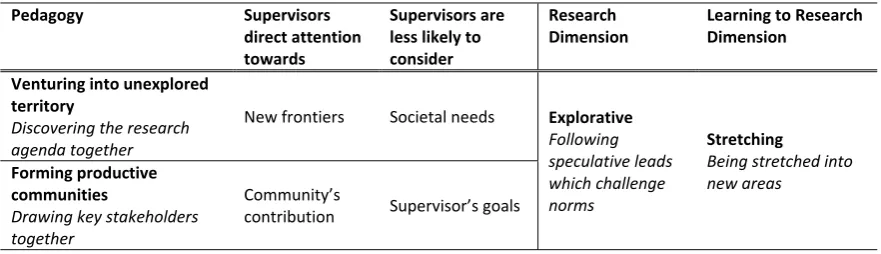
Supervisory pedagogy may be experienced as venturing into unexplored territory. Table 9 depicts
the key elements of this category. When supervisors experience teaching research students this
way, they direct their attention towards forming a research team whose members work together to
discover the research agenda. They are likely to consider relevant to supervision inter‐relations,
team’s strengths and weaknesses, new insights, and non‐standard approaches. They are less likely
to consider needs in the wider society.
I expect them to learn about how to ask questions and think in a creative and expansive way that
is not limited by what other people have said or done. (I9)
It's the esoteric thoughts that you really need in research. You need the wacky thoughts, ‘Why
don't we try looking at it this way?’... If you are going to bother doing research, you may as well
not make it incremental. (I13)
Category 8: Forming productive communities
Supervisory pedagogy may be experienced as forming productive communities. Table 9 depicts the
key elements of this category. When supervisors experience teaching research students this way,
they direct their attention towards drawing key stakeholders together into an active network of
contributors to the research endeavour. They are likely to consider relevant to supervision networks
(of students, supervisors and industry partners) in order to introduce alternative points of view,
multiple interactions, communication, exploration of possibilities, and relinquishment of central
control. They are less likely to consider their own goals.
...you create a bidirectional flow whereby you have a team or this organization has a very dense
network in itself. You have all these dots, but all these dots are very well connected. I want that
there is a maximum density in this network. (I12‐2)
Dimensions
When supervisors experience supervision as Venturing into unexplored territory or Forming
productive communities, they primarily see research as explorative. Research is about following
speculative leads which challenge norms. Key ideas associated with this view include: newness,
following leads, thinking outside the square, big risks leading to big steps, exploring esoteric
thoughts, asking big questions and questioning norms.
To have the courage to approach things from unorthodox ways… So, a kind of independence of
thought and not being afraid to go out on a limb, but to do that responsibly. Of course… you
become part of a field and that field has its own norms but still to be aware that you are not to
be trapped by that. (I16)
When supervisors experience supervision in this way, they primarily see learning to research as
stretching. Learning to research is about being extended into new areas. Key ideas associated with
this view include: expanding into new areas, big changes and cutting edge.
It's the esoteric thoughts that you really need in research. You need the wacky thoughts, ‘Why
don't we try looking at it this way?’ If you're not comfortable, you're only going to say things that
are safe. If you are going to bother doing research, you may as well not make it incremental.
(I13)
[Insert Table 9 here]
Category 9: Contributing to society
Supervisory pedagogy may be experienced as contributing to society. Table 10 depicts the key
elements of this category. When supervisors experience teaching research students this way, they
direct their attention towards society’s needs and work towards having positive social impact. They
relevance to industry and the potential to commercialise. They are less likely to consider personal
and student goals.
To create ground‐breaking systems that help other people. (W2)
Dimensions
When supervisors experience supervision as Contributing to society, they primarily see research as
productive. Research is about usefully satisfying a range of stakeholders. Key ideas associated with
this view include: usefulness to industry, satisfying stakeholders and commercial value.
Some of them have industry sponsors... and I say, ‘It is your responsibility to ensure that this
sponsor organization gets value for what you are doing.’ (I12‐1)
When supervisors experience supervision in this way, they primarily see learning to research as
contributing. Learning to research is about exploring positive impact on others. Key ideas associated
with this view include: coming to understand the impact of research on society.
...the ability to reflect very effectively, on their processes to improve them, to be able to
contribute better to society. (I2)
[Insert Table 10 here]
Discussion
The 9 pedagogies represent supervisors’ collective awareness of their supervision as a teaching
practice. The categories are constructs intended to inform supervisors, and provide a vehicle for self
reflection and the identification of pedagogical options for supervision. The outcome space
represents collective awareness through revealing the interrelationships between the pedagogies.
While the study reported here explores conceptions of supervision as a teaching practice, it
contributes to a line of research and scholarship associated with variation in the experience of
also extends our understanding of variation in the academic experience of teaching into the
supervision arena. Here, there are expanding orientations towards the teacher, towards students,
and towards the broader context of learning which at least partially reflect the experience of
teaching in academic coursework contexts.
Other aspects of the pedagogies are also supported by previous work. Recent attention to threshold
concepts in higher degree research (Kiley and Wisker, 2009), identifies questioning and research
design as conceptual thresholds which indicate that an appropriate level of work is being done for
postgraduate study. Such thresholds particularly support the Promoting learning to research and
Enabling student development pedagogies, as they relate to the increasing independence and
maturity of research students.
Brew (2001, p. 440) identifes in her ‘Domino conception’ that research may be experienced as
separate linked elements, which need to be mastered and synthesised, this is an idea which appears
in our Imparting academic expertise category, where research is seen in terms of individual skills to
be learned and implemented. Brew’s ‘Journey conception’ involves an awareness of the influence of
research on society, as does the pedagogy here described as Contributing to society.
Supervisors’ conceptions of research have also been found to reflect a university/non‐university
dichotomy where university research is assigned legitimacy (Bills, 2004). Legitimate research is thus
understood as involving rigour (excluding, in the eyes of some, qualitative research), order, ability to
advance knowledge and conformity to a research tradition. These views influence industry
collaboration and the perceived legitimacy of researchers in the industry context. What Bills (2004)
found to define legitimate research reflects only a small part of supervisors’ collective pedagogical
awareness, aligning mostly with one category, Upholding academic standards.
Wright, Murray and Geale (2007) studied doctoral supervisors’ experience of supervision and how
themselves as quality assurers, supportive guides, research trainers, mentors and knowledge
enthusiasts. Whilst they did not specifically explore views of pedagogy, their ‘Quality assurer’
category shares elements of meaning with our Upholding academic standards; their ‘Supportive
guide’ with our Promoting learning to research; their ‘Research trainer’ with our Enabling student
development; their ‘Mentor’ with our Drawing upon student expertise; and their ‘Knowledge
enthusiast’ with our Venturing in to unexplored territory. The four remaining pedagogies reported
here are not reflected in their descriptions of supervisory experience.
The broadening awareness of supervisors from their own concerns, to the needs of students, to
community also reflects an emerging pattern in the literature focussed on the collective awareness
of research, study and supervision. Brew’s (2001) conceptions of research, for example, represent
expanding awareness from the components of the research process to impact on society. Similarly,
Åkerlind (2005, 2008), reporting the experience of research and being a researcher, describes an
expanding awareness from the application to specific skills to meet academic, disciplinary or
institutional requirements, to benefitting their immediate or wider communities. Bruce, Pham and
Stoodley (2004), focussing on researchers’ experience of significance in research, report expanding
awareness from the individual, through their immediate context, to the wider world (Bruce,
Stoodley and Pham, 2009), which reveals expansion from a technical focus to a focus on benefitting
people.
What do the pedagogies mean for the HDR community?
Research is the highest form of learning (Marton and Bowden, 1998). From this point of departure
we can propose that the purpose of HDR supervision must therefore be to bring about learning of
the highest form. In this context, the categories and the associated outcome space become tools for
illuminating different experiences and promoting conversations about supervision as a teaching
practice. They may be used to reveal to supervisors their current pedagogical lenses and possible
Focus on the teaching aspects of research supervision could enhance supervision practice by making
supervisors aware that
(1) supervisors experience supervision as a teaching practice in multiple ways, which result in
different supervisory relationships, practices and learning outcomes being emphasised;
(2) different pedagogies may be more or less appropriate at any one time, influenced by the
student, the stage of the candidacy, external factors and the supervisor; and
(3) the more pedagogical lenses a supervisor is aware of, the more options they have to choose
from, and the more they are likely to be able to adapt their pedagogies to the needs of their
students.
Supervisory communities may also be invited to explore the influence of their environments,
research cultures, and the history of their institutions, on the pedagogies they choose to adopt; or to
explore the extent to which their personal research paradigms might influence their chosen
pedagogies and other supervisory processes.
Such conversations and opportunities are vital in communities where teaching and learning are not
commonly associated with research and supervision processes. In our project, while supervisors
willingly engaged in conversations around the pedagogical aspects of supervision, they frequently
expressed the opinion that words like ‘learning’ and ‘pedagogy’ did not belong within the sphere of
higher degree research supervision. It is possible that this reflects their views of teaching and
learning in other aspects of their academic life. Establishing development processes to widen
academic views of teaching generally, and as they pertain to supervision, becomes increasingly
important as doctoral education falls under more intense scrutiny.
Conclusions
The 9 Pedagogies are the outcome of a phenomenographic investigation of supervisors conducting
adopted in order to communicate the key ideas as faithfully to their way of thinking as possible. It is
noteworthy that the resulting ideas are not overtly discipline‐specific, and that the outcomes are
conceivably applicable across disciplines. This may be because the supervisors largely worked in
cross‐disciplinary projects representing social science and humanities, as well as science and
technology domains.
Supervision as a pedagogic practice continues to be an under‐researched aspect of the higher
degree research community. The 9 Pedagogies provide a platform through which it may be possible
to a) promote pedagogical excellence in supervision as a vital component of research education, b)
promote conversation and communication about supervision as a teaching practice, c) create
development opportunities for supervisors with various levels of experience, and d) continue
research into the pedagogy of supervision.
Acknowledgements
The research underpinning this paper was conducted as part of an Australian Learning and Teaching
Council Fellowship program undertaken by Christine Bruce, 2008‐2009, and further supported by the
Queensland University of Technology (QUT) Student Research Centre, the QUT Faculty of Built
Environment and Engineering , the QUT Faculty of Information Technology, and the QUT Faculty of
Science and Technology. The authors recognise the contribution of the many supervisors who
participated in interviews, workshops and other conversations around this material. QUT Ethics
clearance was obtained for this project, clearance number 1000000202.
References
Åkerlind, G.S. 2005. Ways of experiencing being a university researcher. In Doing developmental
phenomenography, ed. J. Bowden and P. Green, 145–55. Melbourne: RMIT Press.
Åkerlind, G.S. 2008. An academic perspective on the nature of research: A review and empirical extension of the literature. Studies in Higher Education 33, no. 1: 17–31.
Baillie, C., J. Emanuelsson, and F. Marton, F. 2001. Building knowledge about the interface. Composites Part A:
Applied Science and Manufacturing 32, nos 3–4: 305–12.
Bills, D. 2004. Supervisors’ conceptions of research and the implications for supervisor development.
Boud, D. and A. Lee. eds. 2008. Changing Practices of Doctoral Education. London: Routledge.
Bowden, J.A. and P. Green. eds. 2005. Doing developmental phenomenography. Melbourne: RMIT University
Press.
Bowden, J.A. and E. Walsh. eds. 2000. Phenomenography. Melbourne: RMIT University Press.
Brew, A. 2001. Conceptions of research: A phenomenographic study. Studies in Higher Education 26, no. 3: 271–285.
Brew, A. and T. Peseta. 2008. Supervision development and recognition in a reflexive space, in Changing
Practices of Doctoral Education, ed. D. Boud and A. Lee, 126‐140. London: Routledge.
Bruce, C., B. Pham, and I. Stoodley. 2004. Constituting the significance and value of research: Views from Information Technology academics and industry professionals. Studies in Higher Education 29, no. 2: 219– 39.
Bruce, C. and I. Stoodley. 2010. Science and technology supervision resource and cases. Brisbane: QUT.
Available from http://eprints.qut.edu.au
Bruce, C., I. Stoodley, and B. Pham. 2009. Doctoral student's experience of information technology research.
Studies in Higher Education 34, no. 2: 203‐222. [Available from http://eprints.qut.edu.au/20580/]
Craswell, G.C. (2007) Deconstructing the skills training debate in doctoral education. Higher Education
Research and Development 26, no. 4, 377‐392.
Deuchar, R. (2008) Facilitator, director or critical friend? Contradiction and congruence in doctoral supervision
styles. Teaching in Higher Education 13, no. 4, 489‐500.
Edwards, B. 2002. Postgraduate supervision: Is having a PhD enough? Paper presented at the Australian
Association for Research in Education Conference, 1‐5 December, Brisbane, Australia.
Green, B. and A. Lee. 1999. Educational research, disciplinarity and postgraduate pedagogy: On the subject of
supervision. Review of Australian Research in Education 5: 95‐111.
Hammond, J., K. Ryland, M. Tennant and D. Boud. 2010. Building research supervision and training across
Australian Universities. Strawberry Hills, NSW: Australian Learning and Teaching Council. Retrieved October
11, 2010, from http://www.first.edu.au/public/ALTC/ALTC_building_supervisory_practice.pdf
Ingerman, A., and S. Booth. (2003) Expounding on physics: A phenomenographic study of physicists talking of their physics. International Journal of Science Education 25, no. 12: 1489–508.
Kiley, M. & G. Mullins. (2005) Supervisors’ conceptions of research: what are they? Scandinavian Journal of
Educational Research 49, no. 3: 245‐262.
Kiley, M. and G. Wisker 2009. Threshold concepts in research education and evidence of threshold crossing.
Higher Education Research and Development 28, no. 4: 431‐441.
Manathunga, C., P. Lant, and G. Mellick. 2006. Imagining an interdisciplinary doctoral pedagogy. Teaching in
Higher Education 11, no. 3: 365‐379.
Marton, F., and S. Booth. 1997. Learning and awareness. Mahwah, NJ: Lawrence Erlbaum.
Pham, B., C. Bruce, and I. Stoodley. 2005. Constituting information technology research: The experience of IT
researchers. Higher Education Research and Development 24, no. 3: 215‐232.
Sinclair, M. (2004) The pedagogy of good PhD supervision: A national cross‐disciplinary investigation of PhD
supervision. Retrieved March 14, 2007, from http://www.dest.gov.au/sectors/higher_education/
publications_resources/summaries_brochures/the_pedagogy_of_good_phd_supervision.htm
Willison, J. & K. O’Regan. (2007) Commonly known, commonly not known, totally unknown: A framework for
students becoming researchers. Higher Education Research and Development 26, no. 4, 393‐410.
Wood, K. 2006. Changing as a person: The experience of learning to research in the social sciences. Higher
Education Research and Development 25, no. 1: 53–66.
Wright, A., J.P. Murray, and P. Geale. 2007. A phenomenographic study of what it means to supervise doctoral
students. Academy of Management Learning and Education 6, no. 4: 458‐474.
Words: 7569
Tables
Table 1 Participant profile
Gender Appointment level Principal
completions
Associate completions
Students
M F A B C D E 0 1‐5 >5 0 1‐5 >5 1‐5 6‐10 >10
Eng. X X X X X X X X X ‐ X X ‐ X X X
IT X X ‐ X X X X X X X X X X X X X
Sci. X X X ‐ X X X X X X X X X X X X
Organisational areas: Eng. = Engineering (including Architecture), IT = Information Technology (including Information
Systems, Computer Science and Librarianship), Sci. = Science; X = represented, ‐ = not represented; Principal/Associate = as
principal/associate supervisor
Table 2 Terminology used to communicate to supervisors
Formal phenomenographic terminology More communicative terminology for supervisors
When supervisors experience teaching research
students as upholding academic standards, they
thematise the expectations of the academic
community…
When supervisors experience teaching research students
as upholding academic standards, they direct their
attention towards the expectations of the academic
community…
The thematic field of this experience includes… They are likely to consider relevant to supervision…
Considerations which lie in the margin of their
experience are …
They are less likely to consider…
Table 3 Outcome space for the 9 Pedagogies of Supervision
Orientation
PedagogySupervisors see teaching
research students as
Theme Supervisors
direct attention
towards
Margin Supervisors are
less likely to
consider
Research
Dimension
Supervisors
primarily see
research as
Learning to Research Dimension Supervisors
primarily see
students learning
to research as
Supervisors
Promoting the supervisor’s development
Pursuing the supervisor’s
established objectives
Supervisor’s
research agenda
Students and
society Investigative
Strategic, evidence‐
based problem
solving
Being apprenticed Imitating a master
Imparting academic expertise
Conveying expertise in
research processes
Supervisor’s
knowledge and
skills
Student and
community goals
Upholding academic standards
Meeting the discipline and
institutional communities’
expectations
Supervisor’s
discipline’s
standards
Students and
others
Substantial Working rigorously
on difficult
problems, resulting
in important
breakthroughs
Accepting constraints Disciplined
application of basic
skills to new areas
Students
Promoting learning to research
Meeting students’ learning
needs
Students’
learning needs
Others beyond the
student Meaning‐making
Seeking meaning
through the
synthesis of complex
data or knowledge
Focussing Pursuing mature,
world‐class
expertise
Drawing upon student expertise
Building from existing
student abilities
Student’s
[image:25.595.86.517.120.189.2] [image:25.595.80.518.265.359.2] [image:25.595.65.531.412.743.2]Orientation
PedagogySupervisors see teaching
research students as
Theme Supervisors
direct attention
towards
Margin Supervisors are
less likely to
consider
Research
Dimension
Supervisors
primarily see
research as
Learning to Research Dimension Supervisors
primarily see
students learning
to research as
Enabling student development
Seeking students’ academic
and professional maturity
Student maturity Societal needs
Deepening Increasing self
awareness through
an iterative process
Journeying Self‐discovery by
trial and error,
towards
independence
Community
Venturing into unexplored territory
Discovering the research
agenda together
New frontiers Societal needs Explorative Following
speculative leads
which challenge
norms
Stretching Being stretched
into new areas
Forming productive communities
Drawing key stakeholders
together
Community’s
contribution Supervisor’s goals
Contributing to society
Having social impact Society’s needs
Personal and
student goals
Productive Usefully satisfying a
range of
stakeholders
Contributing Exploring positive
impact on others
Table 4 Supervisors’ ways of thinking about teaching in the research context
Orientation Content Supervisor’s intention Supervisor’s strategy
Teaching in the research context is viewed as:
Supervisor
perspective
Upholding
academic standards
Promoting the supervisor’s
development
Imparting
academic expertise
Student
perspective
Promoting
learning to research
Enabling
student development
Drawing upon
student expertise
Wider
community
perspective
Venturing into unexplored
territory
Contributing
to society
Forming
productive communities
Table 5 Promoting the supervisor’s development and Imparting academic expertise
Pedagogy
Supervisors direct attention towards
Supervisors are less likely to consider
Research Dimension
Learning to Research Dimension
Promoting the supervisor’s development
Pursuing the supervisor’s
established objectives
Supervisor’s
research agenda
Students and
society Investigative
Strategic,
evidence‐based
problem solving
Being apprenticed Imitating a master
Imparting academic expertise
Conveying expertise in
Supervisor’s
knowledge and Student and
[image:26.595.130.511.397.551.2] [image:26.595.76.523.643.770.2]
Table 6 Upholding academic standards
Pedagogy
Supervisors direct attention towards
Supervisors are less likely to consider
Research Dimension
Learning to Research Dimension
Upholding academic standards
Meeting the discipline and
institutional communities’
expectations
Established
academic
standards
Students and
others
Substantial Working
rigorously on
difficult problems,
resulting in
important
breakthroughs
Accepting constraints Disciplined
application of basic
skills to new areas
Table 7 Promoting learning to research and Drawing upon student expertise
Pedagogy Supervisors
direct attention towards
Supervisors are less likely to consider
Research Dimension
Learning to Research Dimension
Promoting learning to research
Meeting students’ learning
needs
Students’
learning needs
Others beyond the
student
Meaning‐making Seeking meaning
through the
synthesis of
complex data or
knowledge
Focussing Pursuing mature,
world‐class expertise Drawing upon student
expertise
Building from existing
student abilities
Student’s
contribution Community goals
Table 8 Enabling student development
Pedagogy Supervisors
direct attention towards
Supervisors are less likely to consider
Research Dimension
Learning to Research Dimension
Enabling student development
Seeking students’ academic
and professional maturity
Student
maturity Societal needs
Deepening Increasing self
awareness
through an
iterative process
Journeying
Self‐discovery by trial
and error, towards
independence
Table 9 Venturing into unexplored territory and Forming productive communities
Pedagogy Supervisors
direct attention towards
Supervisors are less likely to consider
Research Dimension
Learning to Research Dimension
Venturing into unexplored territory
Discovering the research
agenda together
New frontiers Societal needs Explorative Following
speculative leads
which challenge
norms
Stretching Being stretched into
new areas
Forming productive communities
Drawing key stakeholders
together
Community’s
contribution Supervisor’s goals
[image:27.595.83.518.129.244.2] [image:27.595.82.521.299.427.2] [image:27.595.82.518.480.574.2] [image:27.595.78.519.629.756.2]
Table 10 Contributing to society
Pedagogy Supervisors
direct attention towards
Supervisors are less likely to consider
Research Dimension
Learning to Research Dimension
Contributing to society
Having social impact Society’s needs
Personal and
student goals
Productive Usefully satisfying
a range of
stakeholders
Contributing Exploring positive
impact on others
[image:28.595.76.520.130.210.2]