White Rose Research Online URL for this paper:
http://eprints.whiterose.ac.uk/81124/
Version: Accepted Version
Proceedings Paper:
Fotios, S., Uttley, J. and Cheal, C. (2012) What is the right light level for residential roads?
In: Proceedings of the 7th Lux Pacific. The 7th Lux Pacifica 2013, Cultural Lighting, 6-8
March 2013, Bangkok, Thailand. , 256 - 259.
[email protected] https://eprints.whiterose.ac.uk/
Reuse
Unless indicated otherwise, fulltext items are protected by copyright with all rights reserved. The copyright exception in section 29 of the Copyright, Designs and Patents Act 1988 allows the making of a single copy solely for the purpose of non-commercial research or private study within the limits of fair dealing. The publisher or other rights-holder may allow further reproduction and re-use of this version - refer to the White Rose Research Online record for this item. Where records identify the publisher as the copyright holder, users can verify any specific terms of use on the publisher’s website.
Takedown
If you consider content in White Rose Research Online to be in breach of UK law, please notify us by
1
What Is The Right Light Level For Residential Roads?
Steve FOTIOS, James UTTLEY, Chris CHEAL (University of Sheffield, UK)
ABSTRACT
This article discusses the basis of light levels recommended for roads, in particular, that the evidence upon which these are based has little basis in visual tasks or cost-benefit analysis. Eye-tracking studies have been carried out to identify the critical tasks, and performance of these tasks has been interpreted to identify threshold illuminances: these are a step towards better evidence for design criteria.
Keywords : road lighting, pedestrians,
illuminance, visual task
1. INTRODUCTION
Lighting in subsidiary and residential streets is designed to meet the needs of pedestrians 1) and usually targets a minimum average horizontal illuminance. The UK currently uses the S-series of six lighting classes which includes average horizontal illuminances in the range of 2.0 lux to 15.0 lux.2) However, there appears to be little justification for the ranges of illuminance specified in guidance documents nor for the criteria by which a particular light level is selected 3) and this was confirmed during a workshop at the CIE 2012 conference in Hangzhou.4) For example, British Standard BS5489-1:2003 5) identifies three levels of crime risk and suggests a higher light level be used with a higher crime risk. While a higher illuminance may increase feelings of safety 6) there are no data to show that higher illuminance addresses higher crime; it may be that the lower illuminance is already sufficient to address risk of crime.
Illuminance recommendations are not based on visual needs alone but are subject to practical, financial and emotional forces.7) These forces are dynamic: at present in the UK there is a trend to switch off road lighting at certain times as an energy saving measure, with subsequent accidents or crimes blamed on the absence of lighting,8) so it is useful to understand what lighting is needed to contribute to the balance. Approaches that might be used to set appropriate illuminances for pedestrian lighting include cost-benefit analysis and meeting visual needs. This article reports investigations seeking to establish lighting needed to meet visual tasks.
2. BASIS OF PAST STANDARDS
The S-series is an amalgamation of the lighting classes used in Europe prior to 2003. The UK had previously used three classes of lighting for subsidiary streets, with minimum average illuminances of 3.5, 6.0 and 10.0 lux.9) These illuminances were based on two surveys of road lighting by Simons et al.10) In the first survey (London) 13 observers rated their satisfaction with the lighting in 12 streets using a rating scale, and this was followed by a second survey (Milton Keynes) of 12 streets by 20 observers. In both cases the average horizontal illuminances ranged from about 1.0 lux to 12.0 lux. A 9-point rating scale was used, with points labeled very poor (1), poor (3), adequate (5), good (7) and very good (9) and the items rated included an overall impression and levels of lighting on the road and footpath. The results suggest that higher illuminances lead to higher ratings of overall impression. Horizontal illuminances of 10.0 lux, 5.0 lux and 2.5 lux were subsequently proposed, as these corresponded to ratings of good (7), adequate (5) and poor-to-adequate (4) respectively. When observers are asked to make judgements about a range of sensory stimuli they tend to rate the stimuli against each other rather than against a consistent reference stimulus. If a different range of illuminances had been surveyed, then a different set of average horizontal illuminances would have been proposed. This can be seen from De Boer 11,12) who report a study carried out in 70 real streets. A 9-point rating scale was used, with points labeled bad (1), inadequate (3), fair (5), good (7) and excellent (9), similar but not identical to the scale subsequently used by Simons et al, and the items rated included level of lighting on the road. The road luminances ranged from approximately 0.06 cd/m2 to 5.0 cd/m2 which is an illuminance range of approximately 0.9 to 71 lux assuming an average luminance coefficient (Q0) of 0.07. The ratings display a positive
correlation with luminance: the low luminance roads are placed near the bottom of the rating scale, while the high luminance roads are placed near the top of the rating scale.
2
same categories as did Simons et al (ratings of good (7), adequate (5) and poor-to-adequate (4)), and assuming Q0=0.07, these suggest
illuminances of 21, 5.7 and 3.4 lux (Table 1). While the lower illuminances of the two studies were similar, de Boer had an upper illuminance that was greater than in Simons et al, leading ratings of Good lighting to be allocated to higher illuminances in the De Boer study than in Simons et al. These data confirm stimulus
range bias: the different ranges of light level lead to different estimates of what constitutes good or fair lighting. If Good lighting was related to a particular magnitude of light, this would have resulted in the same illuminance in both studies. This suggests that the three light classes recommended in BS5489-3:1992, and any subsequent standard which included these classes, are based on inappropriate data.
Table 1. Comparison of illuminances corresponding to ratings of overall impression from Simons et al10) and de Boer.11) De Boer reported road surface
luminances: illuminances were calculated assuming Q0=0.07.
Rating point 1 2 3 4 5 6 7 8 9
Category labels
Simons
et al very poor poor adequate good
very good de Boer
bad inadequate fair good excellent
Mean illuminance of key rating points
Simons
et al 2.5 lx 5.0 lx 10 lx
de Boer 3.4 lx 5.7 lx 21 lx
3. CRITICAL TASKS
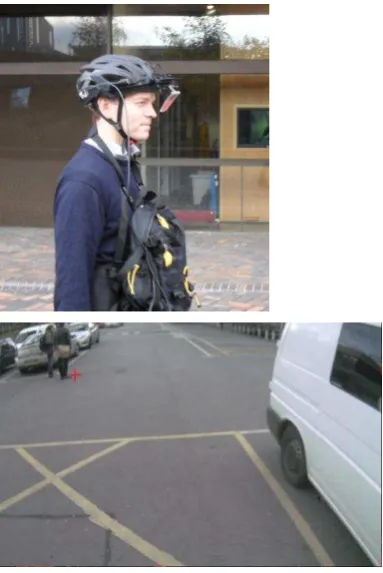
One approach to setting appropriate light levels is to identify the critical visual tasks, investigate how the performance of these tasks varies with lighting and thus interpret a minimum level of lighting. It has long been assumed that the primary functions requirements of lighting for pedestrians were to enhance brightness (a proxy for perceived safety), obstacle detection and the recognition of the intent and/or identity of other road users. These were adopted following Caminada and van Bommel.13) What is not yet known is whether these tasks are indeed appropriate for characterising lighting, whether there are other essential visual tasks that need to be considered, and the relative importance of each task. New research is on-going through the EPSRC-funded MERLIN project (Sheffield University, UCL and City University) to better understand what is important for pedestrians. Davoudian and Raynham 14) used eye-tracking to identify the targets observed by pedestrians at night time (Figure 1). Test participants wearing an eye tracker were asked to walk three different residential routes, with five participants in daytime and 15 participants at night. It was found that they spent between 40% and 50% of the time looking at the footpath. Looking at other people is thought to be important to pedestrians but during this study the amount of time fixated on other people was very small, and that may be because there were few other people to look at during these trials. What these results recorded is where the test
participants were looking: what it did not do is identify whether these observation points were of importance. Walking along a street is not a cognitively taxing task and it is unlikely that all
of a pedestrian’s fixations relate to this task.
Furthermore, the object or area that a person fixates does not always reflect where their attention is focused: it is possible to attend to areas in our peripheral vision 15) as well as to things unrelated to the visual environment. To address this a follow-up study is being planned which will use eye-tracking within a dual-task paradigm. The dual task is a simple cognitive task designed to occupy a part of the
test participants’ cognitive processing ability
3 Figure 1. Eye-tracking apparatus and an example of the record – the red cross indicates fixation.
The rationale for using a dual-task is that attentional resources are finite. Introducing additional tasks that use up attentional capacity can reduce task-unrelated thoughts and the effects of visual distractors that draw our visual attention away from the task in hand. A concurrent auditory task has been shown to affect the allocation of resources to the primary visual search task.16) Our attention may be less likely to be captured by task-irrelevant things when attentional capacity is decreased through a dual task. This finding relates to external distracters but research has also shown attentional capacity is important in determining the presence of internal distractors, e.g. task-unrelated thoughts (mind-wandering). Using up attentional capacity in task-relevant processing can reduce instances of task-unrelated thoughts.17)
The dual task used in this experiment is an auditory reaction. Whilst walking, participants hear a series of beeps at random, irregular intervals, between 0.5 and 3.0s, and are asked to respond as quickly as possible each time they hear a beep by pressing a handheld button. Reaction times (RT) to the beeps will be recorded and RTs longer than the baseline indicate that attention has been drawn towards something important. Cross-referencing with the video recording from the eye tracker will
identify critical objects. Pilot work in preparation for this experiment demonstrated that RT to auditory beeps is sensitive to visual distractions, in a dual-task setting.
4. VISUAL TASKS
Results from two studies have been interpreted to yield threshold illuminances.
Fotios and Cheal 18) investigated how the peripheral detection of pavement obstacles is affected by illuminance, lamp type and age. These data can be used to identify an appropriate illuminance in two ways. The first follows observation of the plateau-escarpment relationship between illuminance and light level; the knee in this curve identifies an appropriate illuminance because higher levels offer little benefit in improved detection but lower levels offer rapid decrease in peripheral detection. This method suggested an illuminance of 2.0 lux for a 95% detection probability and that age and lamp type have little significance. The second approach sought to identify expectations of the end user, which in this case is the local authority providing the lighting which needs to be able to show that it has taken reasonable steps to protect against trip hazards. For an obstacle of height 25mm at a distance of 6m, subtending a visual arc of 13.5 minutes, an illuminance of 0.62 lux is required for a 95% probability of detection by young people under HPS lighting.
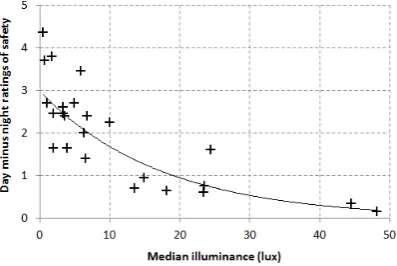
Boyce et al 7) carried out field surveys of 24 car parks in urban and suburban areas in the US to investigate how the amount and SPD of light affected the perception of safety at night. Test participants were transported to the sites in four vehicles and these visited the sites in different orders at both daytime and night-time. The car parks had mean horizontal illuminances of up to 50 lux. At each site they were asked to walk around and then describe lighting using questionnaires comprising a series of semantic differential ratings scales and open questions. One question sought ratings of perceived safety when walking alone. As illuminances increased, the difference in ratings of perceived safety for daytime and night-time tended to decrease (Figure 2) with a non-linear relationship. At low illuminances (0-10 lux) a small increase in illuminance produced a large increase in
perceived safety; at high illuminances (≥50 lux)
4
therefore suggests a minimum illuminance of approximately 10 lux: higher illuminances lie on the plateau and therefore do not bring any benefit in terms of improvement in perceived safety, while illuminances lower than 10 lux are on the escarpment and may lead to a significant reduction in perceived safety. Further work on perceived safety is being carried out to examine whether this conclusion is appropriate for residential roads in the UK.19)
Figure 2. Difference in daytime and night-time ratings of perceived safety plotted against the median illuminance of 24 car parks in which the ratings were given.6)
5. CONCLUSION
This article questions the basis of current road lighting design standards and suggests possible routes to establish better evidence. The results of two studies investigating lighting for pedestrians can be interpreted to provide such data. Further research is needed, and is underway, to provide a wider body of data from which to interpret appropriate illuminances.
ACKNOWLEDGEMENTS
This work was carried out through funding received from the Engineering and Physical Sciences Research Council (EPSRC) grant number EP/H050817.
REFERENCES
1) Commission Internationale de l’Éclairage, Lighting of Roads for Motor and Pedestrian Traffic. CIE 115:2010. Vienna: CIE.
2) British Standards Institution BS EN 13201-2:2003, Road lighting - Part 2: Performance requirements. 2003. London: BSI. 3) Fotios S, Goodman T. Proposed UK Guidance for Lighting in Residential Roads. Lighting Res. Technol. 44(1); 69-83 (2012) 4) Fotios S. Street Lighting – are the currently recommended lighting levels right? Workshop. CIE 2012 conference, Hangzhou, China. 19-21 September 2012. pp516.
5) British Standards Institution BS5489-1:2003,
Code of practice for the design of road lighting
—Part 1: Lighting of roads and public amenity areas. 2003. London: BSI.
6) Boyce PR, Eklund NH, Hamilton BJ, Bruno LD. Perceptions of safety at night in different lighting conditions. Lighting Res. Technol. 32(2); 79-91 (2000)
7) Boyce PR. Illuminance selection based on visual performance—and other fairy stories, J Illum. Eng. Soc.25(2); 41-49 (1996)
8) Letters. Lighting Journal; 2012; 77(1); 4-5. 9) British Standards Institution BS5489, Road Lighting: Part 3, Code of practice for lighting for subsidiary roads and associated pedestrian areas. 1992. London: BSI.
10) Simons RH, Hargroves RA, Pollard NE, Simpson MD. Lighting criteria for residential roads and areas. CIE, Venice, 1987; 274-277. 11) de Boer JB, The application of sodium lamps to public lighting, Illum. Eng., 56(4); 293-312 (1961)
12) de Boer JB, Burghout F, van Heemskerck Veeckens JFT. Appraisal of the quality of public lighting based on road surface luminance and glare. CIE Session, Brussels, 529-538 (1959) 13) Caminada JF, van Bommel W. New lighting considerations for residential areas. International Lighting Review, 3; 69-75 (1980) 14) Davoudian N and Raynham P. What do pedestrians look at at night? Lighting Res. Technol. First published online 08/02/2012. DOI: 10.1177/1477153512437157
15) Yantis, S. Control of visual attention. In H. Pashler (Ed.), Attention (pp. 223-256). East Sussex, UK: Psychology Press (1998).
16) Boot, W.R., Brockmole, J.R., Simons, D.J. Attention capture is modulated in dual-task conditions. Psychonomic Bulletin and Review, 12(4), 662-668. (2005)
17) Forster, S., Lavie, N. Harnessing the wandering mind: The role of perceptual load. Cognition, 111, 345-355. (2009).
18) Fotios S, Cheal C. Using obstacle detection to identify appropriate illuminances for lighting in residential roads. Lighting Res. Technol. first published online 20/04/2012. doi:10.1177/1477153512444112
19) Unwin J, Fotios S. Does lighting contribute to the reassurance of pedestrians at night-time in residential roads? Ingineria Iluminatului, 13(2); 29-44 (2011)
Steve FOTIOS
University of Sheffield, School of Architecture Sheffield, S10 2TN, UK
Phone: +44-114-222-0371
[image:5.595.95.294.205.338.2]