SUPERVISOR VERIFICATION
―I hereby declare that I have read this thesis and in my opinion this thesis is sufficient in terms of scope and quality for the award of the degree of Bachelor of Technology
Management (Technology Innovation)‖
Signature:
Name of Supervisor: Prof. Madya Dr. Md Nor Hayati Bin Tahir Date:
Signature:
EXPLORING PROTON CUSTOMERS‘ TECHNICAL
SATISFACTION
ULFAH LINA BINTI JASRI
Partial fulfillment of the requirements for the award of
Bachelor of Technology Management and Technopreneurship with honour (Technology Innovation)
Faculty of Technology Management and Technopreneurship Universiti Teknikal Malaysia Melaka
ii
DECLARATION
―Hereby, I declare that this thesis entitled “Exploring Proton Customers’ Technical
Satisfaction” is the result of my own research except as cited in the references. The
thesis has not been accepted for any degree and is not concurrently submitted in candidature of any other degree.
Signature :
iii
DEDICATION
Infinite thanks to
my precious Umi and Abah, without those prayers, I will never be here
PM Dr Md Nor, your patience is virtue
and my only best friend that always stay by me during my ups and downs
iv
ACKNOWLEDGEMENT
I would like to thank you my supervisor Prof. Madya Dr. Md Nor Hayati Bin Tahir for giving assistant to complete this project successfully. He had given me a lot of guidance and support to make sure the project finish as planned.
I also want to say thank you to my beloved parents who constantly giving me support and motivation until the end of my project. To my siblings and cousins, never fail to bright my days, thank you.
Not to forget, million thanks to all respondents that contributed to this research, without them, this research is hardly completed.
v
ABSTRACT
vi
ABSTRAK
vii
TABLES OF CONTENTS
CHAPTER CONTENT PAGE
TITLE i
DECLARATION ii
DEDICATION iii
ACKOWLEDGEMENT iv
ABSTRACT v
ABSTRAK vi
TABLE OF CONTENTS vii
LIST OF TABLES xi
LIST OF FIGURES xii
LIST OF APPENDIXES xiii
CHAPTER 1 INTRODUCTION 1
1.0 Introduction 1 1.1 Background of Study 2 1.2 Problem Statement 6 1.3 Research Question 11 1.4 Research Objective 12
1.5 Scope 12
1.6 Limitation 12 1.7 Significance of the Project 13
viii
CHAPTER CONTENT PAGE
CHAPTER 2 LITERATURE REVIEW 15
2.0 Introduction 15 2.1 Review of the Literature 16 2.1.1 Customer Satisfaction 16 2.1.2 Customer Expectation 18 2.1.3 The Key Features (selected
Proton‘s model 22 2.2 Review on Relevant Theoretical Model 24 2.3 Review of Developed Hypotheses 26 2.4 Conclusion 26
CHAPTER 3 RESEARCH METHODOLOGY 27
ix
CHAPTER CONTENT PAGE
CHAPTER 4 FINDING AND DISCUSSION 35
4.0 Introduction 35 4.1 Results Dissemination Questionnaire 36 4.2 Respondent Characteristics 37
4.2.1 Gender 37
4.2.2 Age 38
4.2.3 Employment Status 39 4.2.4 Income Level 40 4.2.5 Living State 41 4.3 Respondents‘ General Technical
Specification 42
4.3.1 Model of Proton‘s Car 42 4.3.2 Engine Capacity 43 4.3.3 Running Transmission 44 4.3.4 Duration of Use Proton‘s car 45 4.4 Reliability 46 4.4.1 Reliability Test 47 4.5 Correlation Coefficient 48 4.6 Testing Hypothesis with Simple Linear
Regression 50
4.6.1 Hypothesis 1 –There is a positive significant relationship between
Proton‘s technical criteria towards customers‘ technical satisfaction
52
4.6.2 Hypothesis 2 –There is a positive significant relationship between the customer‘s expectations towards customers‘ technical satisfaction
54
x
CHAPTER CONTENT PAGE
CHAPTER 5 DISCUSSION AND CONCLUSION 57 5.0 Introduction 57 5.1 Summary of the Research Findings 58
5.1.1 Research Objective 1: To investigate the relationship between consumer‘s technical satisfaction and Proton‘s technical criteria
59
5.1.2 Research Objective 2: To explore Proton‘s customer technical satisfaction through their expectation
60
5.2 Recommendation 61
5.3 Conclusion 62
REFERENCE 63
xi
LIST OF TABLES
TABLE TITLE PAGE
3.1 Advantages and disadvantages of the chosen modes. 29
3.2 Gantt Chart PSM I 33
3.3 Gantt Chart PSM II 34 4.1 Results Dissemination Questionnaire 36 4.2 Respondents by Gender 37 4.3 Respondents by Age 38 4.4 Respondents by Employment Status 39 4.5 Respondents by Income Level 40 4.6 Respondents by Living State 41 4.7 Model of Proton‘s Car used by Respondents 42 4.8 Respondents by Engine Capacity 43 4.9 Respondents by Running Transmission 44 4.10 Respondents by how long they used the Proton‘s car 45 4.11 Cronbach‘s Alpha and Internal Consistency 47 4.12 Reliability Test Result 47 4.13 Correlation Coefficient 49 4.14 Result for Correlation Coefficient of the Variables 49
4.15 Value of R 51
4.16 (a) Model Summary 52
4.16 (b) ANOVAa 52
4.16 (c) Coefficientsa 52
4.17 (a) Model Summary 54
4.17 (b) ANOVAa 54
4.17 (c) Coefficientsa 54
xii
LIST OF FIGURES
FIGURE TITLE PAGE
1.1(a) 2013 Malaysia SSI Ranking (J.D Power Asia Pacific) 6 1.1(b) Factors Contributing to Overall SSI (J.D Power Asia
Pacific)
7
1.2(a) 2013 Malaysia CSI Ranking (J.D Power Asia Pacific) 8 1.2(b) Factors Contributing to Overall CSI (J.D Power Asia
Pacific) 9
xiii
LIST OF APPENDICES
APPENDICES TITLE PAGE
1
CHAPTER 1
INTRODUCTION
1.0 Introduction
2
1.1 Background of Study
Starting in the late 1700's, European engineers began tinkering with motor powered vehicles. Steam, combustion, and electrical motors had all been attempted by the mid 1800's. Automotive production on a commercial scale started in France in 1890. Commercial production in the United States began at the beginning of the 1900's and was equal to that of Europe's. In those days, the European industry consisted of small independent firms that would turn out a few cars by means of precise engineering and handicraft methods.
The first automobile produced for the masses in the US was the three-horsepower, curved-dash Oldsmobile; 425 of them were sold in 1901 and 5,000 in 1904--this model is still prized by collectors. At the beginning of the century the automobile entered the transportation market as a toy for the rich.
However, it became increasingly popular among the general population because it gave travelers the freedom to travel when they wanted to and where they wanted. As a result, in North America and Europe the automobile became cheaper and more accessible to the middle class.
Popularity of the automobile has consistently moved with the state of the economy, growing during the boom period after World War I and dropping abruptly during the Great Depression, when unemployment was high. World War II saw a large increase in mass transit because employment was high and automobiles were scarce.
3
Before the automobile, people both lived in the city and worked in the city, or lived in the country and worked on a farm. Because of the automobile, the growth of suburbs has allowed people to live on the outskirts of the city and be able to work in the city by commuting. New jobs due to the impact of the automobile such as fast food, city/highway construction, state patrol/police, convenience stores, gas stations, auto repair shops, auto shops, etc. allow more employment for the world's growing population including Malaysia. Yet, the effect on city life has been, if anything, more prominent than the effect on the farms like at Ulu Kinta for Bijih Timah. The automobile has radically changed city life by accelerating the outward expansion of population into the suburbs.
Meanwhile people nowadays got reasons why they want to buy cars. Survey at Wiki website said that people buy cars mainly are for transportation. Other reasons mainly are for transportation. Other reasons given by the respondents are for fun, personal impressions or even just to fit in to the crowd. In the same website, the percentage of people who buy cars about 75% of people in the USA buy and drive cars. That number do not actually apply to all countries due to the difference of gas, what cars are around and if people like them or not.
Proton Holding Berhad is Malaysia‘s first manufacturing automobile and this Malaysia‘s car brand called PROTON that stands for Malay short form of ‗Perusahaan
Otomobil Nasional Sendirian Berhad‘. Between 1985 and early 2000s Proton was a largely manufacturer of badge engineered vehicles from Mitsubishi Motors. In that time between, this company already export lot of cars to several number of country worldwide. Back then, Proton was owned by the Malaysia government‘s investment holding arm, Khazanah Nasional. PROTON‘s privatization was started at January 2012, during DRB-HICOM‘s taking over (Proton).
4
segment. Proton maintained a majority market share in the following years, which peaked in 1993 at 74% with over 94,100 units sold. Automobile sales in Malaysia plunged from 404,000 units in 1997 to 163,851 in 1998 due to the 1997 Asian Financial Crisis. Proton's revenue and profits were severely affected, but a majority market share was still maintained into the early 2000s.
The mid-2000s witnessed a sharp decline in Proton's revenues and sales. In 2006, Proton's market share was 32%, down from 40% in 2005. Proton lost its majority domestic market share for the first time in 20 years to Perodua, the second Malaysian automobile manufacturer. Factors which contributed to the fall of Proton included the revision of the National Automotive Policy (NAP), Proton's newer indigenously designed models (i.e. the Proton Waja, Gen-2 and Savvy) which were poorly designed and manufactured compared to the former Mitsubishi-based Protons and stronger competitors, specifically Perodua with their best-selling Myvi which launched in 2005. Both Proton's total sales volume and market share failed to recover to its pre-2002 figures and Perodua remained the domestic market leader from 2006 onwards.
5
Proton's decline in market share has stabilized as of 2013. In the first half of this year, Proton sold 64,782 cars, representing 20.7% of the market share. Perodua and Toyota sold 96,873 and 43,747 units with 30.9% and 14.0% market shares respectively. In July 2013, Proton sold around 16,600 cars, which accounted for 25% in market share during that specific month. Perodua on the other hand sold 19,200 or 2,600 more cars than Proton in July 2013. The rise in Proton's sales were attributed to the launch of the Proton Saga SV, a cheaper variant of the second best-selling car in Malaysia.
6
1.2 Problem Statement
In this section, the researcher wants to state the real problem that all cars‘ consumer will be faced after they get their car and pay for it. So basically, the researcher wants to find out the worthiness of the price paid by Proton‘s customer for their cars.
The problem statement that can lead to this research is;
Does Proton‘s car worth the price paid by customer? Does any of Proton‘s cars (in this research case using only selected model) on the road one value for money?
Hence, these problem statements are the reason why the researcher wants and needs to explore the issues on customer satisfaction.
[image:20.612.184.470.356.683.2]
7
J.D Power Asia Pacific released a statistics that shows Sales Satisfaction Index on choices of automobile available in Malaysia year 2013. The points in the graph bar based on a 1000-point scale. Automobile company that clearly wins Malaysians‘ heart is Toyota with highest point gain, 826 and followed by Nissan and Suzuki with point of 823 and 821 respectively. Those top three car brands are from Japan. Malaysia car brand, Perodua, Kia and Proton gain points 790, 784, and 776 respectively. Meanwhile, the industry average point is 798. This graph shows that Protons‘ Sales Satisfaction Index is below average and just above the last ranking in this bar graph, Mitsubishi with point of 773.
[image:21.612.186.480.280.599.2]8
J.D Asia Power Pacific released a statistics that shows Factors Contributing to Overall Satisfaction Sales Satisfaction Index on choices of automobile available in Malaysia year 2013. Every Bar Poll in Satisfaction Sales Satisfaction Index was effected by these six factors. Deal 10%, Delivery Process 20%, Sales Initiation 17%, Salesperson 15%, Paperwork 15%, Deliver Timing 13%, and Dealer Facility 11%. Protons‘ Satisfaction Sales Satisfaction Index was effect by all of these factors as well.
[image:22.612.175.475.345.633.2]9
J.D Asia Power Pacific released a statistics that shows Customer Service Index on choices of automobile available in Malaysia year 2013. The points in the graph bar based on a 1000-point scale. Automobile company that clearly wins Malaysians‘ heart is BMW with highest point gain, 817 and followed by Volkswagen and Honda with point of 793 and 786 respectively. Those top three car brands are from Germany and Japan. Malaysia car brand, Perodua, Proton and Naza gain points 755, 743, and 741 respectively. Meanwhile, the industry average point is 758. This graph shows that Protons‘ Customer Service Index is below average and just above the last ranking in this bar graph, Naza with 2 points difference.
[image:23.612.153.511.270.671.2]10
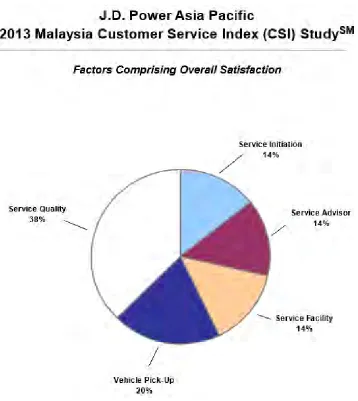
J.D Asia Power Pacific released a statistics that shows Factors Comprising Overall Customer Service Index on choices of automobile available in Malaysia year 2013. Every Bar Poll in Customer Service Index was effect by these five factors. Vehicle Pick-Up 20%, Service Facilities 14%, Sales Initiation 14%, Service Advisor 14%, and Service Quality 38%. Protons‘ Customer Service Index was effect by all of these factors as well.
Protons’ Market Share
Naveen Victor, editor of Malaysia‘s famous motors magazine, Motor Trader Malaysia, wrote an article ‗Is Proton Still Relevant to Malaysians?‘ on August 13th,
2013.
“No matter how you look at them, the numbers make for some pretty grim reading. Despite having 28 years of history behind it Proton is still heavily reliant on the Malaysian car buyer, as export numbers remain tiny. In 2012 only about 20,000 Protons were sold outside of Malaysia in 55 countries, which makes them a tiny niche brand in
most markets.” He said.
This article questioning that Malaysia‘s national carmaker is finding increasingly difficult to attract local buyers but does it mean they‘re (Proton) in permanent decline? Many Malaysians have a colorful history with Proton and it has to be said not all of it‘s bad. When the original Proton Saga was launched on 9th July 1985 the feeling of national pride was palpable throughout the country. Malaysia had become a car-producing nation and it would be our springboard towards becoming an industrialized nation. Where are those dreams now?