• No results found

The Council Estate: Representation, space and the potential for performance

N/A
N/A
Protected

Academic year: 2019

Share "The Council Estate: Representation, space and the potential for performance"

Copied!
17
0
0

Loading.... (view fulltext now)

Full text

(1)

White Rose Research Online [email protected]

Universities of Leeds, Sheffield and York

http://eprints.whiterose.ac.uk/

This is an author produced version of a paper published in Research in Drama Education.

White Rose Research Online URL for this paper:

http://eprints.whiterose.ac.uk/78355/

Paper:

Beswick, KA (2011) The Council Estate: Representation, space and the potential for performance. Research in Drama Education, 16 (3). 421 - 435 (14).

(2)

1

This is an Author's Original Manuscript of an article submitted for consideration in the Research in

Drama Education: The Journal of Applied Theatre and Performance [copyright Taylor & Francis];

published in issue 16, volume three available online at

http://www.tandfonline.com/doi/pdf/10.1080/13569783.2011.589999

The Council Estate: Representation, Space and the Potential for Performance

Katie Beswick

Department of Performance and Cultural Industries, University of Leeds, Leeds, England

The image of the archetypal housing estate is often used in popular representation, from documentary and television to music video, to symbolise the urban ‘grit’ of contemporary inner city life. In the theatre, urban political and ‘working class’ drama has been set on or around estates in attempts to deconstruct or expose the impact of life on these estates, or to examine what such places denote in contemporary society. The performance analysis provided in this paper has emerged from a period of study of the representation of estates in various performance practices, as a researcher, facilitator, and audience member. This article is part a larger research project investigating the practices and processes of performances which engage with the space of the council estate. Using one specific performance event, this piece engages with the council estate in performance by drawing on Lefebvre’s model of social space. By considering the various ‘fragments’ of spatial experience, and analysing the history of common narratives of estate spaces, the paper seeks to uncover potential for applied performance in the production of contested spaces. In an analysis of SPID theatre company’s play 23176, I suggest this work as exemplifying a kind of spatialised critical resistance to the dominant narratives of the council estate, which might offer potential for alternative perceptions of existence for those who inhabit such marginalised places.

Council estates provide an iconic architectural legacy of Britain’s twentieth century

social housing experiment, are an important socio-cultural and historical feature of

(3)

2

built between 1919 and the late 1970s and owned by local councils1. These estates were initially intended to provide housing for Britain’s large working classes. In the

late twentieth and throughout the beginning of twenty first century, however, as the political landscape of social housing has changed – with many tenants buying their properties under the 1980s’ Right to Buy policy, and subsequent governments

implementing shifting policies on social housing provisions - these spaces have become additionally contentious and complex.

Alison Ravetz has emphasised the importance of the council estate in the British psyche, noting that ‘there can be few British people unable to recognize what is or is not a council estate.’ (2001, 177). This statement refers to the importance that

council estates have played in the evolution of twentieth century UK urban space, and to the central role that the development of council housing has played in British housing policy over the last century. However, Ravetz’s statement also acknowledges the physical differences between the ‘council estate’ and other types

of homes (Ravetz, 2001). The archetypal council estate of popular representation is often depicted in the Brutalist design of estates such as Robin Hood Gardens in Poplar, East London or Ernő Goldfinger’s Trelleck Tower in North Kensington (see,

for example, http://lovelondoncouncilhousing.blogspot.com). In reality, however, many types of design principles contributed to the architecture of estates of the twentieth century (including most notably the Garden City principle which influenced the design of many pre-war estates2). The council estate appears in many differing architectural forms, then, and despite the fact that they are identifiable within the urban landscape, it is difficult to pinpoint a uniformity of design which would apply to every estate in Britain. Nonetheless, Ravetz’s statement suggests there is a

1 However, these dates oversimplify a rather complex picture. The introduction of estates to the UK

was a gradual process, which Alison Ravetz (2000) traces from the mid 1840s. Indeed, state

subsidised housing projects continue to the present day, although these contemporary examples tend to differ from the 20th Century projects in that they are often implemented and managed by private companies, who are offered subsidies to include social rented properties in mixed tenure buildings.

2

(4)

3

definable quality, some essential feature of estateness, which contributes to their reputation and continued presence in political and social consciousness.

Contentions in and around council estates have been confronted by artists and practitioners attempting to engage with such issues as poverty, ethnicity and the postmodern condition in contemporary Britain. A prevalence of the council estate in performance quite possibly builds upon a tradition of working class, political plays, which emerged as part of the post world war two political theatre movement (see, for example, John Arden’s Live Like Pigs (1961) or Edward Bond’s Saved (1965) ). Such plays attempted to engage with the concerns of the disenfranchised and under-represented. London’s Royal Court Theatre’s production of Bola Agbaje's Off the Endz (2010), where the estate served as the problematic home space of a recently released criminal, is one example of such work in the mainstream. Although contemporary performance builds on this tradition of working class drama, it has also

expanded the form – using the conceptual performative mediums which emerged in the late twentieth century (such as live art, installation and site-specific theatre) to more locatedly privilege the subject matter. A site specific installation on a Southwark estate prepared for demolition which attempted to trouble notions of beauty, architecture and materiality by filling a disused flat with copper sulphate, Roger Hiorn’s Seizure (2008) is such an example of an attempt to engage with the

council estate in a less traditional performance medium.

Using Henri Lefebvre’s model of social space to underpin the analysis, this paper

seeks to explore the ways in which performance contributes to the production of estate space. The paper will critique deterministic theories of the relationship between home and the practice of space, and consider how these theories have fed into performances set on or around council estates. It will consider the applied work of SPID (Specially Produced Innovatively Directed) Theatre Company, focussing on their December 2008 performance 23176. In particular, it will examine the ways in which this performance offered new possibilities for the users of such places to engage in a form of critical resistance which uses the space of performance to subvert and critique dominant representations of the estate environment.

(5)

4

Lefebvre’s book The Production of Space (1991 [1974]), moved away from the

dominant historical and cultural narratives of social production and gave one of the first spatial analyses of the production of society. Central to his thesis was the model of social space, which he sets out in the introduction to The Production of Space; here Lefebvre describes a triad of categories through which spatial activity might be seen to function. It is this model which will be used as a method for the analysis of the production of the space of the council estate throughout this paper. However, adding an extra dynamic to the model, here the production of space as it manifests in performance will be the primary concern.

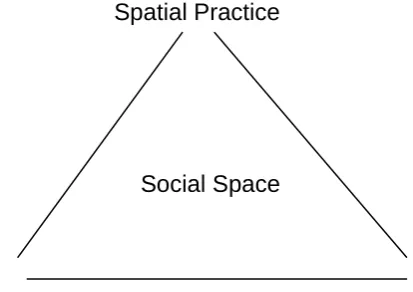
Lefebvre’s model of a spatial ‘trialectic’ (Soja 1996) supposes a relationship between

the perceived, the conceived and the lived. Although Lefebvre did not necessarily intend nor propose these categories of space as a dogmatic theoretical model (rather as ‘approximations’ (Soja 1996), or ways of seeing) they nonetheless provide

an interesting framework for considering the ways in which performance functions socio-spatially. Below (fig 1) is a diagrammatic approximation of Lefebvre’s model, in

which the central triangle represents social space.

Spatial Practice

Social Space

[image:5.595.195.402.435.581.2]

Representations of Space Representational Spaces

Fig 1: Lefebvre’s model of social space

Within this model, the category of ‘spatial practice’ is most closely aligned with the everyday practice of lived space. In a definition pertinent to this study Lefebvre states that: ‘spatial practice might thus be defined…by the daily life of the tenant in a

(6)

5

artificial construction (for example in the work of urban planners, architects or artists). The third category, ‘representational spaces’ is a less tangible notion. It is a ‘thirding’ (Soja 1996) which offers a coming together of practice and conception, a

layering of experience which may reveal itself in the imagination, or between the real and the imaginary. Central to this paper, representational spaces as they are manifest in performance, are not just frivolous sites in which ideas are played out, but an important and dynamic facet of spatial experience.

As Silvija Jestrovic notes, the central power of performative representations lies in the function of performance as central to the formation of spatial meaning, which in turn shapes and alters the production of future spaces:

Just as the reality and instability of a historical space influence and alter the meaning of its theatrical renderings, the theatricalization of an actual space reshapes its future meaning in cultural memory.

(2005, 358)

The real/imagined spaces of performance then, offer the possibility for intervention and change through a coming together of practice and conception, where the imaginative potential of places (such as the council estate) are embodied and realised in lived space.

A note on analysis

The method of analysis presented in this paper attempts to unpack Lefebvre’s model of spatial production, considering his different spatial categories as ‘fragments’ of

spatial experience. The explanation below traces a rationale for the analytical methods employed here in order to illuminate the thinking which has structured this research.

The word ‘fragment’ is often bound up with notions of reduction – of the distillation of

(7)

6

understanding spatial economy, and suggested that a ‘truth of space’ would

necessitate a reversal of ‘the dominant trend towards fragmentation’ (Lefebvre: 1991: 9). However, whilst echoing Lefebvre’s caution, Edward Soja (1996), notes that Lefebvre’s model necessitates a complex approach to written analyses - which

often leads to a lack of clarity in the exegesis of spatial practices. Instead, Soja proposes that spatial experiences might be considered in isolation, and only understood once the fragments are overlaid so that the complexity of social space can begin to be unpacked. Drawing on Soja’s argument, this paper attempts to ‘fragment’ spatial experience in such a way. The proposed method is to analyse Lefebvre’s categories (in the context of the council estate performance) of

representation and practice in isolation and draw them together through an analysis of performance practice, which here provides a ‘representational space’ (the coming

together of the practiced and the represented to create new possibilities). It is intended that the deliberate ‘fragmentation’ of various types of spatial activity will

lead to a discussion which more completely represents the holistic experience of spatial economy. This is necessary in order to move towards an analysis which can more clearly approximate the way that performance might function within the production of space.

Representations of Space: The Council estate

As Ravetz’s assertion (above) suggests, to speak - or write - the term ‘council estate’

in contemporary Britain creates a representation of space. The word in itself has become loaded with a specific conceptual meaning, tied up with a history of social and political tension. The contention surrounding the term ‘council estate’ and indeed

its accuracy in describing these places (which are as discussed above, variously owner occupied, privately rented or managed by a variety of registered social landlords) must be acknowledged, as must the negative stereotypes and perceptions with which the council estate is often associated. Representations of such places in performance, television and the media tend to foreground them as centres of poverty, criminality and the anti-social behaviour of the ‘other’. In reality though, the

multiple spaces of the council estate are as varied, fragmentary, and complex as any other set of typified ‘places’, and in the subjective experiencing of space the estate

(8)

7

In performance, representations of the council estate tend to engage with the place as home-space; the notion of dwelling in such places provides a particular dramatic tension, which often highlights the class divide and domestic struggle faced by many estate residents. Mainstream theatrical productions set on council estates are consistently presented in a brutal style which suggests a gritty urban ‘realism’, where

the estate serves as the catalyst for dramatic tension. In such representations residents are often portrayed as passive actors in a fatalistic narrative - victims of a social experiment who find it difficult to break out of the bounded perceptions of society and history which contribute to the production of self. Such narratives are exemplified by performances such as the Royal Court’s Off the Endz, which followed the attempted rehabilitation of a criminal recently released from prison. Despite the character’s attempts to forge an honest life for himself, his return to the estate is

followed by a seemingly inevitable spiral into drugs and violence.

In a similarly fatalistic narrative, the National Youth Theatre’s recent production of Tarkan Cetinkaya’s The Block (2010), a multi-cultural play exploring the

dysfunctional lives of a variety of residents in a fictional nine storey high-rise block in South London, suggests that characters’ behaviour is determined by the

environment of the estate. The Block, which follows the racial tensions within an estate community, has two endings. In the first, Daffy, a young black boy, attempts to shoot the racist and mentally disturbed Baz who has injured his sister. As he fires the gun, his sister runs to stop him and he shoots her instead. In the second ending, a mysterious character ‘X’ has turned back time and attempts to change the course of

events by persuading the characters to behave differently. However, it seems that even ‘X’ does not believe he can free the block’s residents from their destructive nature, as he removes the bullets from Daffy’s gun at the start of the scene, and it is

this, rather than any change in behaviour on the part of other characters, which eventually saves the life of Daffy’s sister.

Although many of the representations as outlined above do draw on social problems which are very real, the value of these representations is questionable. A recent report on two estates in Bradford found that ‘many residents felt regarded as the lowest of the low, with society moralising and blaming them for their problems.’

(9)

8

tenancy. If popular representation offers no alternative narrative which gives residents the chance to conceptualise the varied potentials of their home-space, then the representation of space in this context seems to provide a limited way forward in terms of intervention in the production of these spaces.

Spatial Practice: the Fatalistic Narrative

The practicing of the Council estate happens both within and outside of the various performative representations of such places; but in reference to the fragmentary analytical approach set out earlier in the paper, it might be pertinent here to consider the practice of space in isolation from its representation, before layering the analysis within performance practice.

In the practice of space, the experience of the body is central, as Lefebvre himself noted: ‘social practice presupposes the use of the body’ (1991, 40). Indeed, in the

last half-century, academics concerned with the experience of space have increasingly foregrounded the ‘haptic’ or ‘tacit’, and noted the centrality of the body in

spatial experience (see for example Merleau-Ponty 1962; Tuan 1977; Decker 1994;). In particular Juhani Palasmaa (2005) has pointed to the body as the fundamental tool through which we come to know and understand specific places. This centralising of the body is an acknowledgement that subjective experience is formed somewhere between the ‘internal’ (personal) and ‘external’ (shared) spaces of

spatial interaction. There is no binary definition proposed here; indeed these seemingly oppositional definitions should be seen as sub-categories of the holistic experiencing of space. The distinction between internal and external is intended to highlight the importance of the individual human body in spatial experience: it is through the body that one comes to know the world.

(10)

9

human behaviour and psychology which took place in the 1970s. These deterministic theories influence contemporary perceptions of the relationship between the practice of the home and the identity and practice of the individuals within it.

Architects Bloomer and Moore argue that the home is central to the construction of self and that thus the way we interrelate with what I will refer to as the ‘home-space’

has a significant impact upon our notions of self and our relations in social space (1977). Central to their argument is the ‘body image’ theory which sees a person’s ‘body-image’ – that is their internal, shifting perceptions of self and the body - bound

up with experiences of and feelings about lived space (1977, 38). In Bloomer and Moore’s model the home provides a physical structure for the body’s extension. The

body image is expanded to include the home and is affected by it. It is through the body – but more importantly, through the body in the home, that we come to know ourselves. As such the home-space can be seen as a kind of lived metaphor for the

body.

Simply put, the ‘body-image theory’ sees the physical body extended psychologically into the fabric of the home in order to create a protective ‘psychological barrier’; the

strength of these barriers has a significant impact on well being. Most obviously the strength of these barriers might be manifest in the way that the home is practiced – for example locks might be bolted or curtains closed to increase the resident’s sense

of security (Bloomer and Moore 1977, 46), but so too might the barrier be expressed by actions outside of the home-space. Psychologist Seymour Fisher has pointed out the possible correlation between weak-barrier persons (i.e.: those who have a weak sense of the psychological boundary between themselves and the world), and poor mental health. The suggestion is that those with strong barriers are more able to cope with, navigate and ‘express’ their environments than weak-barrier persons

(Fisher in Bloomer and Moore 1977, 38).

Extending their body-image argument, Bloomer and Moore point to the destructive psychological effect that living in a building without the ‘dynamic outer edges’ of the

traditional family home (such as a shared block) may have on family life:

(11)

10

household may also be impaired by the jamming of its doors and windows. The architectural boundary exists to encourage and ritualize activities which are sacred to the family, and its destruction or exaggeration can sap the vitality of both the family and the public domain in which it resides. (1977, 47)

The findings of sociologist Pearl Jephcott’s (1971) study Homes in High Flats, supports Bloomer and Moore’s supposition, suggesting that living in a high-rise

building tended to produce extremes in family behaviours. Jephcott showed that there was evidence that children raised in tower-blocks tend to demonstrate an overreliance on the home or a sense of detachment from it. Such 1970s’ concerns still appear to underpin popular perceptions about the types of people who live on council estates, and suggest fatalism in the production of social space and by extension the production of the communities and individuals who emerge from these spaces.

The ideas expressed by Bloomer and Moore and Jephcott above, exemplify an important strand of deterministic psychological and behavioural analysis from the 1970s. It is not difficult to see a link between the determinism which imbued much of the psychological and sociological narratives of this period and contemporary representations of estate residents. The ideas outlined above directly relate to

perceptions of council estates as undesirable residences, and perhaps contributed to the shift in political ideals which led to a reduction in the building of local authority

homes in the UK after the 1970s. Many of the ideas expressed in such arguments relate to the practice and perceptions of estates in dominant representation, and the links between these kinds of ideas and the way that these deterministic frameworks filter into contemporary performance are noteworthy.

As discussed previously, contemporary representations of the Council estate still frequently draw upon the supposition that such places serve as problematic home-spaces. Indeed the familiar image of the tower block as iconic of the problem or ‘sink’

estate has been echoed in contemporary theatrical representations. The plot of Ché Walker’s Fleshwound (2003) set in Dalefoot Towers, a fictional block on Camden’s Ampthill Estate (London), suggested the inevitability that the protagonist Vincent’s

(12)

11

the family’s history on it cast the home space as a significant factor in the downfall of

the character.

In order to move away from the kind of determinism which underpins much of the mainstream representation of the council estate, it is useful to actively consider the ways in which these deterministic frameworks feed into the daily practice of residents themselves. Applied theatre work offers an ideal forum for this kind of intervention. Specifically, the applied practices of SPID Theatre Company offer residents the possibility of creating an actualised space of embodied confrontation with the popular and often negative perceptions they see of themselves elsewhere. It is here that the power of performance in the production of space is perhaps most politically potent.

SPID: Representational Space

The interplay between represented and practiced space is interesting in SPID’s

work. The company are a permanent artistic collective based in the community rooms on the Kensal House estate in Ladbroke Grove, London. They work with both professional performers and young people from the estate in order to create site specific work in and around the Kensal House area.

The estate was built in the 1930s and designed by Maxwell Fry, who drew on modernist principles in an attempt to create a functional and community based living space for residents. As with many estates of the time, the community rooms were initially intended as a space for residents to socialise and as a focus for community activity. However, by 2005 when SPID gave their first performance, the rooms were in a state of disrepair. Part of SPID’s initial funding bid was to secure the future of the

(13)

12

Lefebvre’s ‘representational space’, the coming together of the perceived and the conceived, is clearly visible in SPID’s work. Indeed the relationship between the real and the imagined often provides a physical vocabulary for SPID’s performances,

which also attempt to demonstrate and deconstruct the embodied experiences of the people living in Kensal House. This interplay also attempts to interfere with and trouble the audiences’ own practice and perception of the site, however. For

example in the 2009 production Sixteen, when audience members entered the estate they were immediately disoriented – dislocated from a theatre space and re-located to an ‘other’ space - by abuse shouted at them by young people, who

attempted to intimidate and frighten them by asserting their own physical and territorial ownership of the space. This interaction was intended as a deliberate physical metaphor, immediately highlighting the space as ‘other’ and reconfirming a

representational stereotype. The legitimacy of this confrontation is questionable, because it problematises the issue of image and identity. Of course such tactics

draw attention to dominant representational stereotypes, but at the same time they might also serve to underpin and reinforce the notions they attempt to confront. If the ‘young people’ are representing themselves in the ways in which they resent being

perceived, then where does an intervention which deconstructs or re-frames popular representations take place?

SPID’s 2009 production 23176 attempted to tackle some of the questions regarding

representation, behaviour and identity raised in this paper. 23176 was the result of a six month project in which a performance piece was devised, a collaboration between professionals and young people which centred on the experience of life as a young person on an estate. Inside the community rooms, the playing space recreated a local bus stop framed by graffiti covered walls, while recorded projections from scenes set inside a flat interspersed the outside ‘shared’ action with

a more private view of life inside a home on the estate. This gave an interesting juxtaposition to the narrative, which saw the (live) ‘outside’ space dominated by young people, while the (recorded) ‘inside’ space was the domestic kitchen space of

the adult females. The women in the kitchen were trapped in the domestic space, drinking tea and ruminating on their fear of the young people who lurked outside.

(14)

13

relationship between this performance and mainstream performance set in similar spaces. The suggestion, underpinned by the use of projection onto cinema-like screens, was that this performance was attempting to confront popular representations of estate space in both theatre and other forms (such as cinema and television).

The bodily practice of space, and the centrality of the body as both representational and experiential vessel, was central to the performance. The piece also attempted to confront the power which young people on the estate had to break away from the life imposed on them by deterministic representations, and to change the environment of the space they call home. The title itself refers to the number of sexual assaults recorded in the UK in 2008 – directly acknowledging the perceived relationship between estates and violence. The performers in the piece parodied physical representations of themselves - physical acts of anger, aggression and tenderness

were played out in a sexual assault scene. The young people who provided a chorus to the action played up their ‘represented stereotypes’, swaggering in pseudo

gangster style, with hooded jackets covering their faces and school uniforms. This parodied machismo, along with the youth of the performers, pointed to the satirical nature of the representation; however, it also set a tone for the performance – suggesting that a traditional ‘estate’ narrative would be followed. It seemed that the

swaggering youth were destined to fall into a cycle of violence and anti-social behaviour with the estate as a backdrop to (and suggested cause of) their ills. The traditional narrative was subverted, however, when later in the play the young people took control of their own space, intervening in gang violence and comforting an older resident who had been sexually assaulted. The young people confronted the violence on their estate and moved to actively change their environment. Although not necessarily a ground breaking turn of events in terms of plot development, this narrative technique breaks away from traditional representations (as seen in The Block and Fleshwound for example) and offers the young performers an opportunity to engage with their imaginations in practice. This is where the performative and transformative power of the ‘representational space’ comes into play, allowing the

performers to re-imagine and produce a space which is hopeful, and which moves

(15)

14

The obvious discomfort with what the young people saw as popular stereotypes was confronted directly in a section of the performance during which they discussed how they felt they were identified by the wider world. This section was pre-recorded, in what appeared to be a school, in ‘documentary’ style. The scene evoked television

and filmic documentaries – perhaps again underpinning the participants’ discomfort with popular representation. In the filmed discussions the young people referred to the ‘media’ and its demonising of estate residents, and attempted to reclaim their

own identities by describing both how they saw themselves now and their visions of themselves in the future. One pertinent factor here, in terms of body-image and self identity, was the discussion’s emphasis on race. Although the majority of the core

performance group appeared to be of Afro-Caribbean descent, the group was referred to as black – despite the fact that there were members of the performance collective from non-black ethnic groups. This group identity based on ethnicity was revealing; it demonstrated a sense of shared identity, despite a clear dislike of

external labels, and reflected the need that these young people had for some way to position and identify themselves within a specific group. The fact that this was based on race points to a need for both a physical and a cultural identity, as well as perhaps referring to the ‘Othering’ of estate residents within mainstream representation. The re-imagining of self demonstrated within the discussion section of the piece may have been more powerful and ‘empowering’ if it had been enacted

rather than dialogued. Allowing the performers to physically change the practiced space through the body, encouraging them to use the body to at once represent and revise the space, may have been one way in which this performance could begin to move away from the (albeit powerful) stylistic referencing, and overlay practice and representation in order to consciously alter social space and produce possibilities beyond a fatalistic narrative.

Representational Space: A Place of Critical Resistance

SPID’s work exemplifies some of the ways in which the coming together of the real

and the imagined in the representational space of performance provides possibilities for intervention and transformation in spatial production. Their performance practices

(16)

15

available to them within their home-space. More radically, SPID’s practices also demonstrate the way in which applied theatre might give participants an opportunity to engage in a critical dialogue.

The subversion of dominant narratives, reference to screen media, and parody of popular stereotypes that characterise 23176 demonstrate a form of spatial critique. I propose that the work demonstrates a located, spatialised form of critical resistance to the dominant discourse of the council estate space. This kind of spatial critique is a potentially powerful tool, giving those who are often excluded from the academic and social discourses which create perceptions of their environments and behaviour (often as ‘Other’) - and thus feed into their daily lives - the potential to deconstruct

and contribute to these discourses. In confronting the various fragments of the estate space, SPID manage both to offer alternative perceptions, and to analyse and question the ways in which estate space is produced through representation.

Lefebvre notes that:

The area where ideology and knowledge are barely distinguishable is subsumed under the broader notion of representation, which thus supplements the concept of ideology and becomes a serviceable (operational) tool for the analysis of spaces, as of those societies that have given rise to them and recognised themselves in them.

(1991, 45)

It is here, in this area between ideology and knowledge, that theatre - and in particular applied theatre - fits into the dialectic of social space and offers possibilities for an alternative production of spaces. The limits of a written spatial critique are central to, and evident in, both Lefebvre and Soja’s spatial thesis. A

spatialised spatial critique, undertaken in the moment of performance, has the potential to extend the ‘serviceable tool’ which Lefebvre offers to the participants of

(17)

16

References

Bloomer, K. C and C. W. Moore. 1977. Body, Memory, and Architecture: New Haven and London: Yale University Press.

Decker, T. 1994. Tacity and Imagination: Considerations of Aesthetic Experience in Architecture. In Philosophy and Architecture, ed M.H Mitias, 203-219. Amsterdam and Atlanta, Rodopi B.V.

Jephcott, P with H. Robinson. 1971. Homes in High Flats. Edinburgh. Oliver and Boyd.

Jestrovic, S. 2005. The Theatrical Memory of Space: from Piscator and Brecht to Belgrade. New Theatre Quarterly 21: 358-366.

Lefebvre, H. 1991 [1974]. The Production of Space. trans: D. Nicholson-Smith. Oxford. Basil Blackwell.

Merleau-Ponty, M. 1962. The Phenomenology of Perception. Trans C.Smith. Oxon and New York: Routledge.

Pallasasmaa, J. 2005. The Eyes of the Skin: Architecture and the Senses: Chichester: John Wiley.

Pearce, J. and E.J. Milne. 2010. Participation and community on Bradford’s traditionally white estates: Findings: Informing Change. York. Joseph Rowntree Foundation.

Ravetz, A. 2001. Council Housing and Culture: The History of a Social Experiment: Oxon and New York. Routledge.

Reeves, P. 2005. 2nd Edition An Introduction to Social Housing: Oxford and Burlington: Elsevier Butterworth-Heinmann.

Soja, E.1996. Thirdspace: Journeys to Los Angeles and other real-imagined places. Oxford, Maldon and Victoria, Blackwell Publishing.

Figure

Fig 1: Lefebvre’s model of social space

References

Related documents

The paper discusses the implementation of paint draw- ing on computer screen in real time using a vision based method, where touch-enabled device is not required.. Here hand finger

Proprietary Schools are referred to as those classified nonpublic, which sell or offer for sale mostly post- secondary instruction which leads to an occupation..

Currently, National Instruments leads the 5G Test & Measurement market, being “responsible for making the hardware and software for testing and measuring … 5G, … carrier

Looking at the developments in 2013, the mobile revenue generated per device remained constant, but shows an interesting turn in early 2014: While all devices are increasing

[r]

Second, it is essential to investigate where processes of executive functioning of dual- task scheduling (modulated in accordance with the different context requirements) are exactly

The corona radiata consists of one or more layers of follicular cells that surround the zona pellucida, the polar body, and the secondary oocyte.. The corona radiata is dispersed

multidimensional analysis between learner and professionally-written texts could be performed using data collected at data point 2 (the first assessed written task) and the