This is a repository copy of
Performance modelling of magnetohydrodynamics codes
.
White Rose Research Online URL for this paper:
http://eprints.whiterose.ac.uk/136614/
Version: Accepted Version
Proceedings Paper:
Bird, R. F., Wright, S. A. orcid.org/0000-0001-7133-8533, Beckingsale, D. A. et al. (1 more
author) (2013) Performance modelling of magnetohydrodynamics codes. In: Computer
Performance Engineering - 9th European Workshop, EPEW 2012, Revised Selected
Papers. 9th European Performance Engineering Workshop, EPEW 2012, 30 Jul 2012
Lecture Notes in Computer Science (including subseries Lecture Notes in Artificial
Intelligence and Lecture Notes in Bioinformatics) . , pp. 197-209.
https://doi.org/10.1007/978-3-642-36781-6_14
[email protected] https://eprints.whiterose.ac.uk/ Reuse
Items deposited in White Rose Research Online are protected by copyright, with all rights reserved unless indicated otherwise. They may be downloaded and/or printed for private study, or other acts as permitted by national copyright laws. The publisher or other rights holders may allow further reproduction and re-use of the full text version. This is indicated by the licence information on the White Rose Research Online record for the item.
Takedown
If you consider content in White Rose Research Online to be in breach of UK law, please notify us by
Performance Modelling of
Magnetohydrodynamics Codes
R. F. Bird, S. A. Wright, D. A. Beckingsale and S. A. Jarvis
Performance Computing and Visualisation Department of Computer Science
University of Warwick, UK
Abstract. Performance modelling is an important tool utilised by the High Performance Computing industry to accurately predict the run-time of science applications on a variety of different architectures. Per-formance models aid in procurement decisions and help to highlight areas for possible code optimisations. This paper presents a performance model for a magnetohydrodynamics physics application, Lare. We demonstrate that this model is capable of accurately predicting the run-time of Lare across multiple platforms with an accuracy of 90% (for both strong and weak scaled problems). We then utilise this model to evaluate the perfor-mance of future optimisations. The model is generated using SST/macro, the machine level component of the Structural Simulation Toolkit (SST) from Sandia National Laboratories, and is validated on both a com-modity cluster located at the University of Warwick and a large scale capability resource located at Lawrence Livermore National Laboratory.
1
Introduction
Increasing compute performance and maximising supercomputer utilisation has long been a major goal within the High Performance Computing (HPC) indus-try. Users of these supercomputers are building increasingly more complex and computationally intensive applications, furthering research in a wide variety of science and engineering areas.
In order to predict run-time performance, we need to capture the run-time behaviour of the application and the performance characteristics of the target system. We can then infer information from this data. This process is known as performance modelling. In this paper we describe the development of a per-formance model for the 2-dimensional variant of Lare, a representative plasma physics application. Lare is a Lagrangian remap code, used for solving magneto-hydrodynamics (MHD) equations [4], and is being developed at the University of Warwick.
Specifically we make the following contributions:
– We develop a performance model for Lare. This is the first known predictive performance model for Lare and allows for the prediction of run-time on a variety of current and future architectures based on a minimal number of input parameters. It has been developed such that any future changes or optimisations in the code base can be readily incorporated into the model;
– We validate this performance model on two HPC systems: a commodity cluster located at the University of Warwick and a 260 TFLOP/s capability resource located at Lawrence Livermore National Laboratory (LLNL). We demonstrate an accuracy of greater than 90% for both weak and strong scaled problems;
– Finally, we use our model to provide an evaluation of possible optimisations to Lare. Specifically we perform an investigation into the potential improve-ments that can be gained from a move towards an Arbitrary Lagrangian-Eulerian (ALE) code in which a more expensive remap step can be applied less frequently.
The remainder of the paper is organised as follows: Section 2 provides a summary of related work; Section 3 provides a background to performance modelling and the operation of Lare; Section 4 discusses the approach taken in developing the performance model; Section 5 provides a validation of the accuracy of the model; Section 6 uses the model to detail potential gains from future optimisations. Finally Section 7 concludes this paper.
2
Related Work
Performance models are a vital tool used by the HPC industry in order to pre-dict the run-times of an application. These prepre-dictions can then be used to aid procurement decisions, identify optimisation opportunities, or to predict the behaviour of an application running on a hypothetical future architecture at scale [5].
be more valuable than the information obtained from small scale benchmarks. In [7], Herdman et al. use a performance model of an industry strength hydrody-namics benchmark to provide guidance for the procurement of future systems. The authors use their performance model to generate a range of predicted values for comparison, spanning multiple architectures and compiler configurations.
In addition to allowing us to assess current architectures, performance mod-elling also plays a vital role in enabling us to look at the performance of applica-tions on future architectures at scale. Pennycook et al. [8] show how performance modelling can be used to provide an insight into how applications will perform on a variety on architectures, highlighting the potential benefits of using many-core architectures. Finally, in [9] it is shown that performance modelling can be applied to emerging distributed memory heterogeneous systems to provide an analysis of the performance characteristics and to accurately predict run-times for an application [10].
In [11] a model of parallel computation, LogGP, based on the LogP [12] model, is introduced. It extends the predictive performance of LogP by including the ability to accurately predict communication performance for small messages. This in turn forms the basis on which plug-and-play models can be built, as shown in [13]. The authors show that a model can be built that is able to accurately predict the run-time of an application on a variety of architectures, whilst taking a minimal set of input parameters. This approach has successfully been used by others, including Davis et al. [14] and Sundaram-Stukel et al. [15], and is the basis of the approach taken in this paper.
The previous methods of developing an analytical performance model have been purely mathematically based, but as levels of concurrency and message passing continue to climb this is becoming increasingly difficult to do accu-rately. By instead simulating the topologies of machines, and message passing behaviour of applications, we can hope to gain increased accuracy. This simula-tion of hardware can be done using an abstracsimula-tion of the machine, using both virtual processors and interconnect. By providing values for the specifications of the processors and the interconnect, we can then reproduce the communications performed by the application. By having this closeness between software and hardware it allows for greater performance optimisation of both, as seen in the co-design approach that is being used to move us towards exascale [16–18].
3
Background
3.1 Lare
To solve MHD equations, Lare uses an approach based on control volume av-eraging using a staggered grid. This approach is extended to include complex components such as magnetic fields and shock forces. Lare is run on a fixed size grid for a set number of iterations, an outline of which is shown in Figure 1. The grid used in Lare is 2-dimensional with its width (Nx) and height (Ny) set at
run time. This grid is then decomposed in two dimensions (Px×Py) such that
each processor receivesnx×ny cells, wherenx=Nx/Pxandny=Ny/Py.
1 DO
2 . . .
3 CALL l a g r a n g i a n s t e p 4 CALL e u l e r i a n r e m a p ( i )
5 . . .
6 END DO
Fig. 1: The main compute loop of Lare, operated over for a fixed number of iterations.
The main area of computation in Lare is represented by two key steps, each executed once per iteration: theLagrangian step; and theLagrangian remap. The Lagrangian step contains the majority of the computationally intensive physics, representing a significant proportion of the run-time. During this step the grid on which the calculations are performed gets distorted. The gridding scheme used in Lare cannot tolerate large distortions of the computational domain without frequent remapping operations. And thus, some work must be done to correct the grid before computation can continue. TheLagrangian remap reforms the grid to its proper coordinates, and involves a significant amount of computation and a series of near-neighbour exchanges are required, which ensures neighbouring cells hold the appropriate values.
3.2 Performance Modelling
The general run-time of a parallel application can be described by Equation 1, which states that the total run-time is the combined total of the compute and communication times.
Ttotal=Tcompute+Tcomms (1)
Ttotal=Tcompute (2)
This compute term can then be broken down further, to describe the run-time at a function level. This is shown in Equation 3, wherewgis refered to as the ‘grind
time’, and both nx and ny represent the decomposed grid size in the relevant direction.
Tcompute=
X
wg×(nx×ny) (3)
The term grind time is used to describe the per-cell cost of a function. To obtain these values the code can be instrumented with timers. This can either be done using a profiler such asgprof orscalasca, alternatively the instrumentation can be done manually. Once these grind times have been found they can be put back into Equation 3 to calculate the total compute time.
4
Developing a Performance Model
In order to fully understand the run-time characteristics of Lare, the code was profiled for both serial and parallel runs. This quantifies the time spent in each subroutine, allowing us to focus our efforts when building our simulation.
In order to construct a model using SST/macro, a skeleton of the code has to be constructed that includes the main areas of compute and communication. As the generation of a comprehensive skeleton application can be a non-trivial process, a small tool was written to facilitate this. The tool performs static analysis on the Fortran source code, and transforms this information into a SST/macro skeleton model. The tool parses the Fortran source code line by line, splitting the line into tokens based on whitespace. These tokens are then matched against an in-built list of keywords, identifying key areas such as subroutine declarations and invocations. Once a keyword is matched, the line is processed. Subroutine declarations are parsed and replicated in the skeleton code. These subroutines are then populated by any function calls made within them. One of the key benefits of the tool is that it identifies MPI communications and is able to flag these to the user and input them into the skeleton. The tool is able to auto-complete much of the information about the MPI call, leaving only the size of the communication buffer to be provided by the user.
In addition to the skeleton, SST/macro requires machine specific details to be specified, such as: topology, network bandwidth and on-node and off-node latencies. These values are obtained using a series of micro-benchmarks.
In order to accurately populate the skeleton application, the main contribu-tors of run-time need to be identified. By profiling Lare and combining this with our existing understanding, it is clear that the two most significant contributors are the Lagrangian step and the Lagrangian remap as previously discussed.
Ttotal=
iterationsX
i=0
(tlagrangian step+tremap) (4)
In order to make use of this equation, an incremental approach to building a model was taken, starting with the construction of a serial model.
4.1 Serial Model
For a serial run of Lare, there is no inter-process communication – the run-time is singularly representative of the compute, allowing us to apply Equation 2.
This equation can be decomposed further. The term Tcompute can further
be broken up into its subcomponents, as shown in Equation 3. A table of the relevant grind times for Lare can be found in Table 1.
File Name Subroutine wg Term
diagnostics.f90 energy account wenergy account
lagran.f90 lagrangian step wlagrangian step
lagran.f90 predictor corrector step wpredictor corrector
xremap.f90 remap x wremap x
yremap.f90 remap y wremap y
zremap.f90 remap z wremap z
remap.f90 eulerian remap wremap remainder
diagnostics.f90 set dt wset dt
Table 1: A table depicting the grind times used in modeling Lare, along with their relative location in the source code.
We are able to derive values of the relevant wg times by running a version of
Lare instrumented with timers. Using these values we are able to develop a model that can predict serial run-time to an exceptionally high level of accuracy, using Equation 4.
4.2 Parallel Model
Once a serial model was developed, a parallel model could then be considered in the form shown in Equation 1.
The communication in Lare is dominated by two MPI functions, send-receives and all reduces. The send-receive functions are used to swap neighbour cells, whilst the all reduces collate data. By summing the times taken by these oper-ations, we can represent the communications time as:
Tcomms=
X
tSendrecv+
X
During the point-to-point communications, the amount of data sent is dependent on the grid size set at compile time. The grid undergoes a coarse decomposition in two dimensions, and is distributed among the processors. This method of de-composition is performed with the aim of minimising the surface-area-to-volume ratio, which in turn increases the ratio of computation to communication. This decomposition strategy is replicated in the model, with SST/macro simulating an exact copy of the communications. Once all the required terms have been identified, they can be incorporated into the model. In order for SST/macro to accurately simulate communications, it requires values for the latency and band-width of the target system. These values can be found experimentally with a set of micro-benchmarks that are distributed with SST/macro.
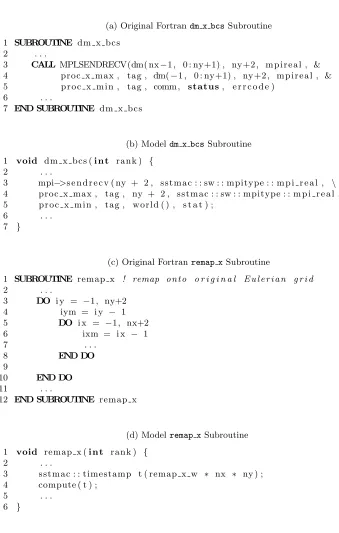
Figure 2 shows elements of both the model and original Lare source code for two methods,dm x bcs andremap x. It compares the original source to the equivalent representation in the model. In (a) we see the dm x bcs subroutine that features an MPI Sendrecv. In (b) we can see this has been translated to the equivalent SST/macro MPI call, to be dealt with by the simulated network. Similarly (c) shows an area of compute performed by the original source, this is then replaced by awg based calculation in (d).
5
Validation
In order to validate our model, we compare application run times with simulation times for a variety of grid sizes and processor counts on 2 different machines.
5.1 Machines
The two machines used in the validation of the model were the resident super-computer at the University of Warwick, Minerva, and a large scale capability resource, Sierra, located at LLNL. The specification of the two machines used in this study are summarised in Table 2.
Sierra Minerva
Processor Intel Xeon 5660 Intel Xeon 5650
Processor Speed 2.8 GHz 2.66 GHz
Cores/Node 12 12
Nodes 1849 258
Memory/Node 24 GB 24 GB
Interconnect QLogic TrueScale 4X QDR InfiniBand
Compilers Intel 12.0 Intel 12.0
MPI MVAPICH2 1.7 OpenMPI 1.4.3
(a) Original Fortrandm x bcsSubroutine
1 SUBROUTINE dm x bcs
2 . . .
3 CALL MPI SENDRECV(dm( nx−1 , 0 : ny+1) , ny+2 , m p i r e a l , & 4 proc x max , tag , dm(−1 , 0 : ny+1) , ny+2 , m p i r e a l , & 5 p r o c x m i n , tag , comm, status, e r r c o d e )
6 . . .
7 END SUBROUTINE dm x bcs
(b) Modeldm x bcsSubroutine
1 void dm x bcs (i n t rank ) {
2 . . .
3 mpi−>s e n d r e c v ( ny + 2 , sstmac : : sw : : mpitype : : m p i r e a l , \ 4 proc x max , tag , ny + 2 , sstmac : : sw : : mpitype : : m p i r e a l , \ 5 p r o c x m i n , tag , world ( ) , s t a t ) ;
6 . . .
7 }
(c) Original Fortranremap xSubroutine
1 SUBROUTINE remap x ! remap o n t o o r i g i n a l E u l e r i a n g r i d
2 . . .
3 DO i y = −1, ny+2
4 iym = i y − 1
5 DO i x = −1, nx+2
6 ixm = i x − 1
7 . . .
8 END DO
9
10 END DO
11 . . .
12 END SUBROUTINE remap x
(d) Modelremap xSubroutine
1 void remap x (i n t rank ) {
2 . . .
3 sstmac : : timestamp t ( remap x w ∗ nx ∗ ny ) ; 4 compute ( t ) ;
5 . . .
[image:9.612.119.458.94.627.2]6 }
5.2 Weak Scaled Problem
For a weak scaled problem, the grid size is increased with the processor count with the aim of keeping the compute per processor fixed. This is the approach taken for solving increasingly difficult problems in a fixed amount of time. As the processor count increases, more communication between grid cells is required, leading to a general increase in communication time. As the compute per pro-cessor remains the same throughout, we expect that our wg will not change,
allowing us to be confident of the predictions for compute time. Table 3 presents a comparison of the experimental run-times against predicated run-times for a weak scaled problem with 3,000,000 cells per core, running for 100 iterations.
(a) Minerva
Nodes Grid Size Time (s) Prediction (s) Error (%)
1 6000 543.10 527.03 -3.05
4 12000 554.90 528.57 -4.98
9 18000 560.63 541.55 -3.52
16 24000 569.41 549.06 -3.71
21 30000 570.08 551.14 -3.44
36 36000 578.24 558.15 -3.60
(b) Sierra
Nodes Grid Size Time (s) Prediction (s) Error (%)
1 6000 480.70 465.46 -3.29
4 12000 485.26 466.17 -4.10
9 18000 493.59 466.83 -5.73
16 24000 498.32 476.30 -4.62
21 30000 499.07 478.43 -4.31
36 36000 499.01 480.49 -3.85
49 42000 499.47 481.98 -3.63
64 48000 499.15 483.68 -3.20
81 54000 499.31 487.22 -2.48
100 60000 499.58 488.59 -2.25
121 66000 500.00 490.12 -2.02
144 72000 500.57 491.54 -1.84
169 78000 500.29 492.91 -1.50
196 84000 500.27 495.44 -0.98
225 90000 500.85 496.88 -0.80
[image:10.612.182.432.275.564.2]256 96000 500.29 499.44 -0.17
Table 3: A table comparing the run-times to simulation times of Lare for Minerva and Sierra.
small percentage of the run time behaviour not being incorporated in the pre-diction, such as the set up costs, which are not captured by the model.
5.3 Strong Scaled Problem
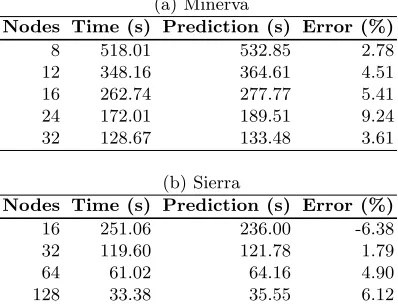
Strong scaling describes the process of solving a fixed problem size with an increasing number of processors. As the processor count increases the aim is to decrease the run-time. A comparison between experimental run-time and predicted run-time is shown in Table 4 for a 16,800 × 16,800 strong scaled problem, running for 100 iterations. This problem size was chosen to give a sufficiently long run time, but still fit in the available memory.
(a) Minerva
Nodes Time (s) Prediction (s) Error (%)
8 518.01 532.85 2.78
12 348.16 364.61 4.51
16 262.74 277.77 5.41
24 172.01 189.51 9.24
32 128.67 133.48 3.61
(b) Sierra
Nodes Time (s) Prediction (s) Error (%)
16 251.06 236.00 -6.38
32 119.60 121.78 1.79
64 61.02 64.16 4.90
[image:11.612.207.406.284.436.2]128 33.38 35.55 6.12
Table 4: A table comparing the run-times to simulation times of Lare for Minerva and Sierra fora strong scaled problem.
The performance model was able predict the run-time to an accuracy of greater than 90% for a range of core counts.
6
Evaluation of Future Optimisations
An Arbitrary Lagrangian Eulerian (ALE) generalisation of Lare is under devel-opment. This would mean the requirement to remap each iteration will no longer hold, and instead a move to ALE would allow the remap step to only be done once the grid becomes sufficiently deformed. By performing an investigation into the expected performance of an hypothetical ALE variant of Lare we can gain valuable insight into the potential performance gains.
but initial indications show that remapping will be required, on average, once every tenth iteration (Fr = 0.1) over the course of the simulation. By varying
the frequency of the remap, the code will be affected in two main ways. Firstly, it will significantly reduce the general cost per iteration in terms of compute, as the remap step will no longer be present. Secondly, reducing the frequency of the remap step reduces the frequency of inter-process communication. In changing the code in this way, the total cost is no longer as described in Equation 4, but instead includes a term to denote the new remap, as in Equation 6.
Ttotal=Tlagrangian step+Tremap new (6)
This equation can then be reduced further, as shown in Equation 7.
Ttotal=
iterationsX
i=0
(tlagrangian step) +
iterations/FX r
j=0
tremap new (7)
In order to express the new total cost, relative to the old, we can extend Equation 4 to include terms for the relative costs. This is shown in Equation 8.
Ttotal new= (Tlagrangian step×Clagrangian step) +
(Tlagrangian remap×Cremap new×Fr) (8)
If we assume no change to the cost of the Lagrangian step (Clagrangian step= 1),
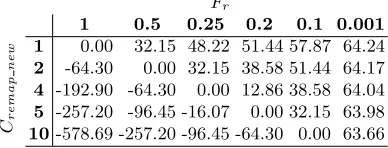
we can perform an investigation into how the frequency of remap and the cost of remap affect the overall performance. Table 5 shows the percentage decrease in run-time obtained for different values of Fr and Cremap new for a 8,192 square
problem on 36 processors performing 100 iterations, in which the remap step contributes just under 65% of the run-time.
Fr
1 0.5 0.25 0.2 0.1 0.001
Cr
em
a
p
n
ew 1 0.00 32.15 48.22 51.44 57.87 64.24 2 -64.30 0.00 32.15 38.58 51.44 64.17
4 -192.90 -64.30 0.00 12.86 38.58 64.04
5 -257.20 -96.45 -16.07 0.00 32.15 63.98
[image:12.612.213.407.479.553.2]10-578.69 -257.20 -96.45 -64.30 0.00 63.66
Table 5: A table showing the percent decrease in run-time for different values ofFrand Cremap newfor a 8,192 square problem on 36 processors performing 100 iterations.
From Table 5 we can clearly see that reducing the remap frequency offers large performance gains as the remap frequency decreases for reasonable values of
Cremap new. Optimistic projections for this optimised code hope that it will have
is around twice as large (Cremap new= 2) and allow the remap to be performed
on average every ten steps (Fr= 0.1). From Table 5 we can see this may offer a
speed-up greater than 50%.
7
Conclusion
In this paper we have presented a predictive performance model for Lare, a MHD code developed by, and maintained at, the University of Warwick. This model allows us to predict the run-time of Lare accurately on a variety of platforms. We have validated the accuracy of the model to 90% on two clusters, a commodity cluster located at the University of Warwick and a 360 TFLOP/s capability resource located at LLNL.
The model was shown to perform well for both weak and strong scaling over a wide range of core counts. We have also used our model to provide a forward look at possible optimisations in the Lare code base, with an evaluation of the gains that may be expected. We also plan to extend the model to the 3-dimensional version of Lare and develop predictive performance models for similar physics codes with the aim of drawing comparisons between these and Lare.
Acknowledgements
We would like to thank Todd Gamblin and Scott Futral for their invaluable help in utilising Sierra and the other Open Compute Facility resources at Lawrence Livermore National Laboratory. This work is supported by the EPSRC grant: A Radiation-Hydrodynamic ALE Code for Laser Fusion Energy (EP/I029117/1).
References
1. Pang, B., li Pen, U., Perrone, M.: Magnetohydrodynamics on Heterogeneous ar-chitectures: a performance comparison. CoRRabs/1004.1680(2010)
2. Ryoo, S., Rodrigues, C.I., Baghsorkhi, S.S., Stone, S.S., Kirk, D.B., Hwu, W.m.W.: Optimization principles and application performance evaluation of a multithreaded GPU using CUDA. In: Proceedings of the 13th ACM SIGPLAN Symposium on Principles and practice of parallel programming. PPoPP ’08, New York, NY, USA, ACM (2008) 73–82
3. Griebel, M., Zaspel, P.: A multi-GPU accelerated solver for the three-dimensional two-phase incompressible Navier-Stokes equations. Computer Science - Research and Development25(2010) 65–73 10.1007/s00450-010-0111-7.
4. Arber, T., Longbottom., A., Gerrard, C., Milne, A.: A Staggered Grid, Lagrangian-Eulerian Remap Code for 3-D MHD Simulations. Journal of Computational Physics171(1) (2001)
5. Kerbyson, D., Hoisie, A., Wasserman, H.: Modelling the performance of large-scale systems. IEE Proceedings – Software150(4) (2003) 214
7. Herdman, J.A., Gaudin, W.P., Turland, D., Hammond, S.D.: Benchmarking and Modelling of POWER-7, Westmere, BG/P, and GPUs: An Industry Case Study. ACM SIGMETRICS Performance Evaluation Review38(4) (2011)
8. Pennycook, S.J., Hammond, S.D., Mudalige, G.R., Wright, S.A., Jarvis, S.A.: On the Acceleration of Wavefront Applications using Distributed Many-Core Archi-tectures . The Computer Journal55(2) (2011) 138–153
9. Mudalige, G.R., Giles, M.B., Bertolli, C., Kelly, P.H.: Predictive modeling and analysis of OP2 on distributed memory GPU clusters. In: Proceedings of the second international workshop on Performance modeling, benchmarking and simulation of high performance computing systems. PMBS ’11, New York, NY, USA, ACM (2011) 3–4
10. Giles, M.B., Mudalige, G.R., Sharif, Z., Markall, G., Kelly, P.H.: Performance anal-ysis of the OP2 framework on many-core architectures. SIGMETRICS Perform. Eval. Rev.38(4) (2011) 9–15
11. Alexandrov, A., Ionescu, M.F., Schauser, K.E., Scheiman, C.: LogGP: incorporat-ing long messages into the LogP model - One step closer towards a realistic model for parallel computation. In: Proceedings of the seventh annual ACM symposium on Parallel algorithms and architectures. SPAA ’95, New York, NY, USA, ACM (1995) 95–105
12. Culler, D., Karp, R., Patterson, D., Sahay, A., Schauser, K.E., Santos, E., Subra-monian, R., von Eicken, T.: LogP: towards a realistic model of parallel computa-tion. In: Proceedings of the fourth ACM SIGPLAN symposium on Principles and practice of parallel programming. PPOPP ’93, New York, NY, USA, ACM (1993) 1–12
13. Mudalige, G.R., Vernon, M.K., Jarvis, S.A.: A Plug-and-Play Model for Evaluating Wavefront Computations on Parallel Architectures. In: 22nd IEEE International Parallel and Distributed Processing Symposium (IPDPS08). (2008)
14. Davis, J.A., Mudalige, G.R., Hammond, S.D., Herdman, J., Miller, I., Jarvis, S.A.: Predictive Analysis of a Hydrodynamics Application on Large-Scale CMP Clusters. In: International Supercomputing Conference (ISC11). Volume 26 of Lecture Notes in Computer Science (R&D). Springer, Hamburg, Germany (2011) 175–185 15. Sundaram-Stukel, D., Vernon, M.K.: Predictive analysis of a wavefront application
using LogGP. SIGPLAN Not.34(8) (1999) 141–150
16. Hammond, S.D., Mudalige, G.R., Smith, J.A., Jarvis, S.A., Herdman, J.A., Vadgama, A.: WARPP: A Toolkit for Simulating High Performance Parallel Scien-tific Codes. In: 2nd International Conference on Simulation Tools and Techniques (SIMUTools09). (2009)
17. Janssen, C.L., Adalsteinsson, H., Kenny, J.P.: Using simulation to design ex-tremescale applications and architectures: programming model exploration. SIG-METRICS Perform. Eval. Rev.38(4) (2011) 4–8