promoting access to White Rose research papers
White Rose Research Online
[email protected]
Universities of Leeds, Sheffield and York
http://eprints.whiterose.ac.uk/
This is an author produced version of a paper published in
Journal of
Computer-Aided Molecular Design
.
White Rose Research Online URL for this paper:
Published paper
Willett, P. (2012)
The Journal of Computer-Aided Molecular Design: a
bibliometric note
, Journal of Computer-Aided Molecular Design, 26 (1), pp.
153-157
The
Journal of Computer-Aided Molecular Design
: A
Bibliometric Note
Peter Willett
Information School, University of Sheffield, 211 Portobello Street,
Sheffield S1 4DP, UK
Abstract Summarizes the articles in, and the citations to, volumes 2-24 of the Journal of Computer-Aided Molecular Design. The citations to the journal come from almost 2000 different sources that span a very wide range of academic subjects, with the most heavily cited articles being descriptions of software systems and of computational methods.
Introduction
The editorial of the very first issue of the Journal of Computer-Aided Molecular Design (hereafter JCAMD) stated that “a new discipline has emerged which has invaded almost all aspects of the study of molecular structure and recognition. Its applications range through modern medicinal chemistry, protein engineering, catalytic design, polymer studies and many other facets of organic, inorganic, physical and biological chemistry” [1]. The journal was established to provide a mechanism for research findings in this new discipline, and it has done this with conspicuous success for a quarter of a century. The first volume appeared in 1987 with this and the subsequent three volumes all containing four issues. The journal moved to having six issues a volume in 1991, to eight in 2000, and to its current monthly publication in the following year following its merger with the closely related review journal Perspectives in Drug Discovery and Design. The steady growth in the number of issues (and, consequently, in the number of articles, with 22 in the first volume and 91 in the most recently completed volume for 2010) demonstrates that the journal is successfully meeting the needs of an increasingly widespread academic community.
contains the publications in, and the citations to, ca. 10,000 of the world’s leading academic journals and ca. 110,000 conference proceedings. It also contains tools that allow very rapid processing of large volumes of publication and citation data from the database, enabling analyses to be carried out in a few hours that would previously have taken many weeks of effort. The Web of Science has covered JCAMD since the start of volume 2 in 1988, and the analyses below are based on the articles that have appeared from then till the end of 2010 (i.e., up to and including volume 24). After excluding editorials, reviews, letters etc. a total of 1175 articles appeared in these 23 volumes, and this corpus formed the basis for the discussion below.
Publications in the journal
The articles were the work of 4081 authors, with these including many of the leading workers in the field of computer-aided drug discovery. Eleven authors each contributed ten or more articles, these comprising the following: Clark, Dean (the most productive with no less than 28 contributions), Gasteiger, Höltje, Jain, Kuntz, Marshall, Murray, Oprea, Orozco, and Willett. Conversely, no less than 3829 individuals made two or less contributions to the journal: this highly skewed distribution is known as Lotka’s Law and is apparent in very many bibliometric analyses of publication data.
A skewed distribution is also apparent when one considers the 55 countries represented by the authors, where three countries dominate. These are the USA, the UK and Germany with 417, 217 and 132 contributions, respectively; taken together, these countries represent 64.8% of the total country data for the period. However, significant changes are taking place in the international organization of science. Thus, if one sub-divides the country data into the periods 1987-2000 and 2001-2010, then the first four countries are USA, UK, Germany and Spain (in that order) for both periods, with France, Italy, Sweden and Switzerland also appearing in the ten most productive countries for both periods. However, the dominance of the USA is far more pronounced in this century, and China and India have moved from joint-27th and joint-22nd positions to fifth and sixth positions, respectively. In addition to such expected countries, the journal’s international scope is demonstrated by contributions from countries as diverse as Lithuania, Uruguay and Uzbekistan.
the latter now defunct following the many mergers that have taken place in the pharmaceutical industry over the last few years (e.g., SmithKline Beecham, Wellcome and Wyeth Ayerst).
Citations to the journal
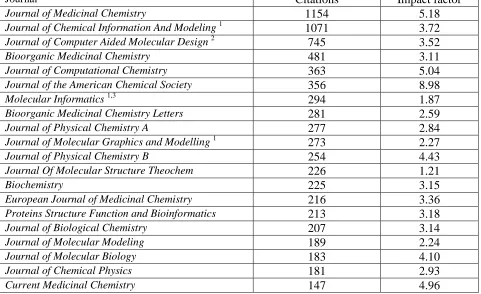
The articles attracted a total of 31262 citations (as of late-September 2011) with an h-index of 71, i.e., 71 of the articles had attracted at least 71 citations [8]. JCAMD’s impact is widespread with the citations coming from a total of 19468 articles in 1944 different sources (overwhelmingly academic journals). The 20 journals that provided the greatest numbers of citations are listed in Table 1. Very crudely, one can divide the papers in JCAMD into two broad (albeit often overlapping) categories. The first category includes articles that describe a method of some sort (e.g., a matching algorithm for molecular alignments, or a novel criterion for evaluating the predictive power of a QSAR method) or a computer (normally software) system that has been developed to carry out some particular modelling task (e.g., identifying the hot-spots in a protein binding site, or computing melting points). The second category comprises articles that describe the practical use of a method or a system in a molecular design project (e.g., a QSAR analysis of a set of Factor Xa inhibitors, or the development of a pharmacophore model for a set of dopamine D4 receptor antagonists).
It will be seen that Table 1 contains both chemoinformatics journals, which are likely to provide many of the citations to method/system articles, and more general chemical journals (albeit with the expected preponderance of medicinal and biological chemistry), which are likely to provide many of the citations to applications articles; both types of journal are likely to make extensive reference to the many system-description articles published in JCAMD if the “standard” reference (see below) is cited. The 5-year journal impact figures (i.e., the number of times that a typical article in a particular journal has been cited in a particular time-frame) are also listed in Table 1. This data comes from the Thomson Reuters Journal Citation Reports database, and demonstrates clearly the scientific quality of the journals that are drawing on work published in JCAMD.
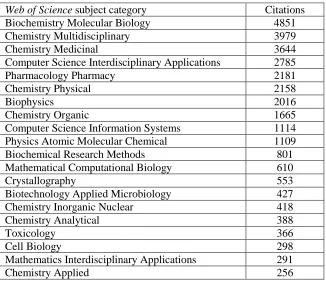
different from that of the cited article then the citation can be regarded as an example of an export process. Viewed in this light, JCAMD can be seen to be exporting successfully to a range of other subject areas, hence increasing the visibility of the journal and of the discipline that it describes.
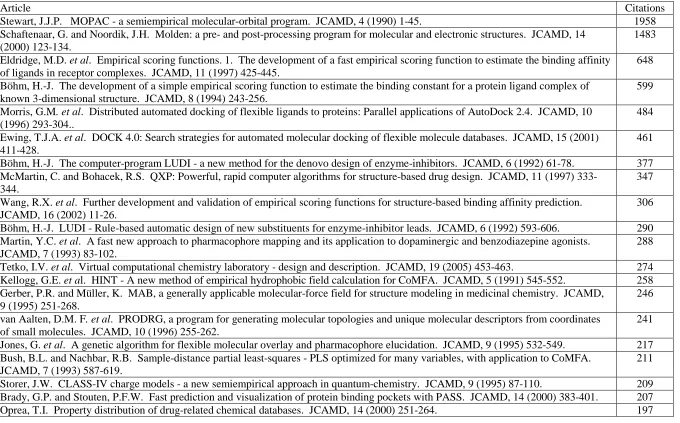
On average, each JCAMD article attracts 26.6 citations, but this is again a very skewed distribution in which just a few articles attract a very large amount of interest. The 20 most highly cited articles are listed in Table 2, and readers of this journal, whatever their specific area of research, are likely to be familiar with at least some of these. In all, the 20 articles attracted 9301 citations, i.e., 29.8% of the total number of citations to the journal. As has been noted in previous studies [5, 7], descriptions of chemoinformatics methods or systems can rapidly attract very large numbers of citations if an article becomes the “standard” reference, i.e., the one that is normally cited when a particular algorithm or piece of software is used in a project. This is again the case here, with descriptions of DISCO, DOCK, GASP, LUDI, MOLDEN and MOPAC appearing amongst the 20 most-cited JCAMD articles that are listed in Table 1; descriptions of CAVEAT, CoMSIA, IsoStar and SPROUT inter alia appear as one moves further down the list of highly-cited articles. The extensive citation of method/system articles is hardly surprising since a method/system may have wide applicability both within and without the general modeling area, thus enabling it to attract citations from a wide range of disciplines. Interest in an applications article, conversely, is likely to be principally of interest to the molecular design community (or some part thereof), and such articles hence tend to have relatively lower citations rates.
Method/system articles may continue to be cited over a considerable period, even when new versions become available in the case of operational systems; for example, Stewart’s MOPAC article was first published over two decades ago, in 1990, but has still attracted an average of over 50 citations per annum
71% respectively of them were applications articles, as reflected by mention in the title of a specific class of structures and/or of a specific biological activity (these percentages are after excluding perspectives and special-issue articles).
Conclusions
In conclusion, the publication and citation data presented here demonstrate very clearly that JCAMD has met fully the objectives that the founding editors set themselves when the journal was established in 1987. The journal attracts high-quality articles that are of relevance not only to the international molecular modeling community but also more broadly across the chemical sciences and beyond. This is especially the case with articles describing computational methods and software systems, these complementing the applications studies that form the principal component of the journal.
References
[1] Marshall GR, Vinter JG, Höltje H-D (1987) The Tower of Babel. J Comput-Aid Mol Design 1:1-2.
[2] Bar-Ilan J (2008) Informetrics at the start of the 21st century – a review. J Informet 2:1-52. [3] Nicolaisen J (2007) Citation analysis. Ann Rev Inf Sci Technol 41:609-641.
[4] Anyi KWU, Zainab AN, Anuar NB (2009) Bibliometric studies on single journals: a review. Malay J Library Inf Sci 14:17-55.
[5] Willett P (2007) A bibliometric analysis of the Journal of Molecular Graphics and Modelling. J Mol GraphModel 26:602-606.
[6] Willett P (2009) A bibliometric analysis of Quantitative Structure-Activity Relationships and QSAR & Combinatorial Science. QSAR Combin Sci 28:1231-1236.
[7] Al Jishi R, Willett P (2010) The Journal of Chemical Documentation and the Journal of Chemical Information and Computer Science: Publication and citation statistics. J Chem Inf Model 50:1915-1923.
[8] Hirsch JE (2005) An index to quantify an individual’s scientific research output. Proc Nat Acad Sci USA 102:16569-16572.
Journal
Citations
Impact factor
Journal of Medicinal Chemistry
1154
5.18
Journal of Chemical Information And Modeling 1
1071
3.72
Journal of Computer Aided Molecular Design 2
745
3.52
Bioorganic Medicinal Chemistry
481
3.11
Journal of Computational Chemistry
363
5.04
Journal of the American Chemical Society
356
8.98
Molecular Informatics 1,3
294
1.87
Bioorganic Medicinal Chemistry Letters
281
2.59
Journal of Physical Chemistry A
277
2.84
Journal of Molecular Graphics and Modelling 1
273
2.27
Journal of Physical Chemistry B
254
4.43
Journal Of Molecular Structure Theochem
226
1.21
Biochemistry
225
3.15
European Journal of Medicinal Chemistry
216
3.36
Proteins Structure Function and Bioinformatics
213
3.18
Journal of Biological Chemistry
207
3.14
Journal of Molecular Modeling
189
2.24
Journal of Molecular Biology
183
4.10
Journal of Chemical Physics
181
2.93
[image:7.612.67.548.96.390.2]Current Medicinal Chemistry
147
4.96
Table 1
. The 20 journals that cite
Journal of Computer-Aided Molecular Design
most
frequently.
1
The totals for
Journal of Chemical Information and Modeling
,
Journal of Molecular Graphics
and Modelling
and
Molecular Informatics
include citations from their predecessor journals, i.e.,
Journal of Chemical Information and Computer Sciences
,
Journal of Molecular Graphics
, and
both
QSAR
and
QSAR and Combinatorial Science
, respectively.
2
The total for
Journal of Computer-Aided Molecular Design
includes citations from
Perspectives in Drug Discovery and Design.
3Web of Science subject category Citations Biochemistry Molecular Biology 4851 Chemistry Multidisciplinary 3979 Chemistry Medicinal 3644 Computer Science Interdisciplinary Applications 2785 Pharmacology Pharmacy 2181 Chemistry Physical 2158
Biophysics 2016
Chemistry Organic 1665 Computer Science Information Systems 1114 Physics Atomic Molecular Chemical 1109 Biochemical Research Methods 801 Mathematical Computational Biology 610
Crystallography 553
Biotechnology Applied Microbiology 427 Chemistry Inorganic Nuclear 418 Chemistry Analytical 388
Toxicology 366
Cell Biology 298
[image:8.612.67.393.101.382.2]Mathematics Interdisciplinary Applications 291 Chemistry Applied 256
Article Citations Stewart, J.J.P. MOPAC - a semiempirical molecular-orbital program. JCAMD, 4 (1990) 1-45. 1958 Schaftenaar, G. and Noordik, J.H. Molden: a pre- and post-processing program for molecular and electronic structures. JCAMD, 14
(2000) 123-134.
1483 Eldridge, M.D. et al. Empirical scoring functions. 1. The development of a fast empirical scoring function to estimate the binding affinity
of ligands in receptor complexes. JCAMD, 11 (1997) 425-445.
648 Böhm, H.-J. The development of a simple empirical scoring function to estimate the binding constant for a protein ligand complex of
known 3-dimensional structure. JCAMD, 8 (1994) 243-256.
599 Morris, G.M. et al. Distributed automated docking of flexible ligands to proteins: Parallel applications of AutoDock 2.4. JCAMD, 10
(1996) 293-304..
484 Ewing, T.J.A. et al. DOCK 4.0: Search strategies for automated molecular docking of flexible molecule databases. JCAMD, 15 (2001)
411-428.
461 Böhm, H.-J. The computer-program LUDI - a new method for the denovo design of enzyme-inhibitors. JCAMD, 6 (1992) 61-78. 377 McMartin, C. and Bohacek, R.S. QXP: Powerful, rapid computer algorithms for structure-based drug design. JCAMD, 11 (1997)
333-344.
347 Wang, R.X. et al. Further development and validation of empirical scoring functions for structure-based binding affinity prediction.
JCAMD, 16 (2002) 11-26.
306 Böhm, H.-J. LUDI - Rule-based automatic design of new substituents for enzyme-inhibitor leads. JCAMD, 6 (1992) 593-606. 290 Martin, Y.C. et al. A fast new approach to pharmacophore mapping and its application to dopaminergic and benzodiazepine agonists.
JCAMD, 7 (1993) 83-102.
288 Tetko, I.V. et al. Virtual computational chemistry laboratory - design and description. JCAMD, 19 (2005) 453-463. 274 Kellogg, G.E. et al. HINT - A new method of empirical hydrophobic field calculation for CoMFA. JCAMD, 5 (1991) 545-552. 258 Gerber, P.R. and Müller, K. MAB, a generally applicable molecular-force field for structure modeling in medicinal chemistry. JCAMD,
9 (1995) 251-268.
246 van Aalten, D.M. F. et al. PRODRG, a program for generating molecular topologies and unique molecular descriptors from coordinates
of small molecules. JCAMD, 10 (1996) 255-262.
241 Jones, G. et al. A genetic algorithm for flexible molecular overlay and pharmacophore elucidation. JCAMD, 9 (1995) 532-549. 217 Bush, B.L. and Nachbar, R.B. Sample-distance partial least-squares - PLS optimized for many variables, with application to CoMFA.
JCAMD, 7 (1993) 587-619.
[image:9.792.72.752.71.494.2]211 Storer, J.W. CLASS-IV charge models - a new semiempirical approach in quantum-chemistry. JCAMD, 9 (1995) 87-110. 209 Brady, G.P. and Stouten, P.F.W. Fast prediction and visualization of protein binding pockets with PASS. JCAMD, 14 (2000) 383-401. 207 Oprea, T.I. Property distribution of drug-related chemical databases. JCAMD, 14 (2000) 251-264. 197