A twist in the tail: SHAPE mapping of long-range
interactions and structural rearrangements of RNA
elements involved in HCV replication
Andrew Tuplin
1, Madeleine Struthers
1, Peter Simmonds
2and David J. Evans
1,*
1
School of Life Sciences, University of Warwick, Gibbet Hill Road, Coventry CV4 7AL and 2Infection and Immunity Division, Roslin Institute, University of Edinburgh, Easter Bush, Edinburgh EH25 9RG, UK
Received August 30, 2011; Revised and Accepted April 11, 2012
ABSTRACT
The RNA structure and long-range interactions of the SL9266cis-acting replication element located within the NS5B coding region of hepatitis C virus (HCV) were determined using selective 20-hydroxyl acylation analysed by primer extension. Marked differences were found in the long-range interactions of SL9266 when the two widely used genotype 2a JFH-1 (HCVcc) and genotype 1b Con1b sub-genomic replicon systems were compared. In both genomes, there was evidence for interaction of the sub-terminal bulge loop of SL9266 and sequences around nucleo-tide 9110, though the replication phenotype of genomes bearing mutations that disrupted this inter-action was fundamentally different. In contrast, a ‘kissing loop’ interaction between the terminal loop of SL9266 and sequences in the 30-untranslated X-tail was only detectable in JFH-1-based genomes. In the latter, where both long-range interactions are present, they were independent, implying that SL9266 forms the core of an extended pseudoknot. The presence of the ‘kissing loop’ interaction inhibited the formation of SL9571 in the 30-X-tail, an RNA struc-ture implicated in genome replication. We propose that, SL9266 may contribute a switch function that modulates the mutually incompatible translation and replication events that must occur for replication of the positive-strand RNA genome of HCV.
INTRODUCTION
The positive-sense single-stranded RNA genome of hepa-titis C virus (HCV), a flavivirus of the genusHepacivirus that infects greater than 130 million people worldwide (1), is a template for two processes essential for virus propagation. First, following cell infection, the 9.6 kb
genome functions as a template for translation, a process initiated at the internal ribosome entry site (IRES) in the 50-non-coding region (50-NCR), yielding a
single polyprotein which is co- and post-translationally processed to yield the proteins necessary for genome rep-lication and particle formation. Secondly, the genome is a template for replication, initially by synthesis of a comple-mentary negative-strand and consequent formation of a double-stranded replicative intermediate, and then by the synthesis of new positive-sense genomes (2). RNA viruses have evolved a multitude of mechanisms to control these key events in their replication cycle, often involving genomic RNA secondary or higher-order struc-tures (3–5). These provide binding sites for viral or cellular proteins which, together with RNA–RNA interactions, influence the temporal and spatial control of replication. The identification and functional analysis of RNA second-ary structures is therefore of particular interest to our understanding of viral replication.
Two types of RNA secondary structure have been described in HCV. The first, designated genome-scale ordered RNA structure, extends throughout the genome and has an as-yet poorly understood role in virus persist-ence (6,7). In addition, there are a series of well-defined phylogenetically conserved structures, predominantly occupying the 50and 30extremities of the genome,
extend-ing from the untranslated regions into the open readextend-ing frame (ORF) (8–12). Although our understanding of these is incomplete, several are critical for genome replication and infectivity and so constitute cis-acting replication elements (CRE). At the 50 end of the genome, the IRES
contains four stem–loops (designated domains I–IV) totalling 340 nt with functions in ribosome recruitment, translation initiation and genome replication (13). The HCV IRES extends into the ORF, with recent studies sug-gesting that highly conserved structures (domains V and VI) in the region encoding the core protein are important for translation (10,14). The observed suppression of syn-onymous sequence variation and phylogenetic analysis of
*To whom correspondence should be addressed. Tel: +44 2476 574183; Fax: +44 2476 523701; Email: [email protected]
ßThe Author(s) 2012. Published by Oxford University Press.
thermodynamically predicted RNA structure supports the presence of at least two additional stem–loop elements within the core-coding region, though functions for these have yet to be determined (9).
The200 nt HCV 30-NCR is also extensively structured.
Three discrete stem–loops (previously designated SLI–III, numbered from the 30end) together form the X-tail and are
separated from the polyprotein-coding region by a hypervariable domain and pyrimidine-rich tract of variable length and sequence. Deletion and mutagenesis analysis shows the 30NCR has roles in genome replication
and virion infectivity (12,15–17). The region 50proximal to
the 30 NCR, encoding the NS5B RNA-dependent RNA
polymerase (RdRp) contains five additional phylogenetic-ally conserved RNA stem–loop structures (8,9,11,18) designated, by the position of the 50 nt in the H77
complete genome sequence (GenBank accession # AF011753), as SL9033, SL9132, SL9217, SL9266 and SL9324 (19 and see 0Materials and Methods’ section). Of
these, SL9266 (elsewhere designated 5BSL3.2 or SL-V) forms a hairpin, topped by a 12-nt terminal loop and inter-rupted on the 30side by an 8-nt bulge loop. Both unpaired
loop regions of SL9266 are phylogenetically conserved and exhibit low levels of synonymous site sequence variation between divergent HCV genotypes, implying likely functional constraints on the evolution of these sequences out with their protein coding function (see Figure 4 in 11). Reverse genetic analysis, using either sub-genomic repli-cons or the JFH-1 replicating virus system, demonstrate that disruption (by synonymous substitution) of either the upper or lower duplex of SL9266 inhibits replica-tion—SL9266 is therefore a CRE. SL9266 occupies a central position in a cruciform structure (3BSL3) involving the adjacent SL9217 (5BSL3.1) and SL9324 (5BSL3.3) stem–loops (11,17,18). However, mutagenesis or biophys-ical analyses have yet to demonstrate the existence of this higher-order structure, or to define SL9217 and SL9324 as CREs. SL9266 does not function in isolation; the structure forms at least two long-range RNA–RNA interactions which are critical for replication. Sequences in the apical loop of SL9266 are complementary to the terminal loop of the central stem–loop structure SL9571 (SLII) of the X-tail, and genetic studies confirm that this ‘kissing loop’ inter-action is necessary for genome replication (17,20,21). More recently, we have used bioinformatic and reverse-genetic analysis to demonstrate a long-range interaction of the sub-terminal bulge loop of SL9266 with complementary sequences centred around nucleotide 9110, an unusually unstructured region of the genome flanked by conserved stem–loops (SL9033, SL9132) of untested function (22). Our study could not distinguish between the simultaneous or mutually exclusive interaction of SL9266 with the upstream and X-tail regions, or, considering the relatively weak bioinformatic prediction of SL9266 per se (8,22), a situation in which the simultaneous interaction with the 50
and 30sequences resulted in the partial or complete
unfold-ing of SL9266. Of these, we favoured the former and proposed that SL9266 formed the core of an extended pseudoknot which we designated SL9266/PK (22). The possible interactions of SL9266 have recently been further complicated by the demonstration that the sub-terminal
bulge loop may bind sequences in domain IIId of the HCV IRES in biophysical assays (23).
The dissection of HCV replication was initially hampered by the inability to reproducibly grow the virus in cell culture. The development of culture-adapted sub-genomic replicon systems (24) in which genome repli-cation confers a selectable advantage (e.g. antibiotic resist-ance), or allowed the quantifiable expression of a reporter gene (e.g. luciferase), enabled the reverse genetic analysis of HCV replication. More recently, the availability of genomes derived from the JFH-1 virus isolate has enabled the entire replication cycle to be analysed (25). Determining the phenotypic consequences of modification of the proposed SL9266/PK structure in our previous analysis was undertaken in a genotype 1b sub-genomic replicon (22,24). In this study, we have extended this analysis to JFH-1-based genomes.
In addition to genetic studies, previous NMR analysis (17) and RNA–RNA binding studies (23) have inves-tigated the long-range interactions of SL9266 in trans (e.g. by seeding reactions with separate molecules contain-ing the interactcontain-ing 50and 30sequences). We reasoned that
this situation was, at least for the genome that initiated cell infection, not representative and that the interactions observed may not reflect events in the cell due to the absence of other regions of the highly structured virus genome. We have therefore analysed the interplay of these regions by biophysical mapping of SL9266 using selective 20-hydroxyl acylation analysed by primer
exten-sion (SHAPE) analysis (26). Our results support the long-range interaction we predicted bioinformatically in the Con1b-based replicon system. In addition, they dem-onstrate similar interactions occur in JFH-1, although the relative contributions of the 50and 30sequences differ. We
extended this study to analyse the steady-state RNA struc-ture of mutants that are known, or could be predicted, to influence RNA–RNA interactions of SL9266, and investigated the phenotype conferred by these mutations in the JFH-1 system.
We demonstrate that there are fundamental differences in the RNA–RNA interactions of SL9266 between the two virus genotypes. Additionally, we show that the phenotype caused by identical mutations in the two replication systems may also differ. Significantly, we show that the interactions with SL9266 directly influence the folding structure of parts of the X-tail region. We propose that long-range interactions of SL9266 determine the structure of cis-acting replication determinants in the X-tail and that the previously reported ‘kissing loop’ interaction may form a temporal switch required for the control of virus replication. These studies have implications for our understanding of HCV replication and for the identifica-tion of therapeutic targets to which novel anti-virals could be directed.
MATERIALS AND METHODS
Stem–loop nomenclature
Stem–loops are designated by the position of the first 50
to the H77 complete genome sequence (GenBank Accession #AF011753), this standardized naming scheme facilitates reference to structures in coding or non-coding regions, is independent of higher-order structures and can be logically extended as additional structures are discovered. Of relevance to this report, stem–loop structures named 5BSL3.1–3.3 (11), SLIV–VII (18) or SL8828, SL8926, SL9011, SL9061 and SL9118 (8,9,11,18,22) are designated here SL9033, SL9132, SL9217, SL9266 and SL9324, respectively. Likewise, the 50 NCR stem–loop IIId (27,28)
is SL253 and the three structures that together form the X-tail [50-SLIII, SLII and SLI30; (29)] are SL9548,
SL9571 and SL9601. The same naming scheme was used in our previous report of an extended pseudoknot contain-ing SL9266 (22).
Cell culture
Monolayers of the human hepatoma cell line Huh 7.5 (a generous gift from Charlie Rice) were maintained in Dulbecco’s modified minimal essential medium supple-mented with 10% (v/v) fetal bovine serum (Invitrogen), 1% non-essential amino acids, 2 mM L-glutamine and
100 U penicillin/100mg streptomycin/ml (DMEM P/S). Cells were passaged after trypsin/EDTA treatment and seeded at dilutions of 1:3 to 1:5.
HCV cDNA plasmids and mutagenesis
The parental firefly luciferase-encoding Con1b replicon, designated pFKnt341-sp-P1-lucEI3420-9605/5.1 (for con-venience designated here as Con1b-luc-rep) was a generous gift from Ralf Bartenschlager and has been described previously (13). Mutations were introduced, using the Stratagene QuikChangeTM system, to the unique SpeI–XhoI [nucleotide 5611–8031 (numbering refers to plasmid sequence, not that of the H77 reference virus, as some positions are within the vector backbone.)] sub-fragment of this plasmid cloned into pBluescript II SK (+) (Stratagene), their presence confirmed by DNA sequencing, and rebuilt into the parental plasmid. The HCVcc pFK-J6/JFH-1-C-846 (for convenience designated here as J6/JFH-1; generously provided by Takaji Wakita and NIH) full-length cDNA has previously been fully described (30). Mutations were introduced to the unique HindIII–SspI (nucleotides 8208–10128) fragment sub-cloned into pUC18, confirmed by DNA sequencing and the modified region rebuilt into the parental cDNA on a HindIII–MluI fragment (nucleotides 8208–9903). Replication-incompetent derivatives of both the replicon and HCVcc systems were generated by a GDD>GND substitution, within the active site of the NS5B polymerase as described previously (22).
In vitroRNA transcription
One microgram of either J6/JFH-1 plasmid cDNA, which includes a 30 cis-acting ribozyme, or ScaI-linearized
Con1b–luc–rep cDNA was used as template for the pro-duction of RNA in vitro using a T7 MEGAscript kit (Ambion), according to the manufacturers’ instructions. After transcription, the DNA template was removed by DNase 1 (Ambion) treatment and the RNA purified with
an RNeasy mini-kit column (Qiagen). RNA integrity was confirmed by denaturing agarose gel electrophoresis and quantified by NanoDrop spectroscopy.
RNA modification for SHAPE
Templates for SHAPE reactions, either 40 pmol of a sub-genomic RNA transcript (nucleotide 9005 to the 30
terminus) or 10 pmol of full-length J6/JFH-1 or Con1b– luc–rep RNA transcripts in 10ml 0.5 Tris–EDTA (pH8.0) (TE), were denatured at 95C for 3 min, incubated
for 3 min on ice before addition of 6ml of folding buffer [330 mM HEPES (pH 8.0), 20 mM MgCl2and 330 mM
NaCl] and allowed to refold at 37C for 20 min. Samples
were then divided in half and incubated with either 1ml of 100 mM N-methylisatoic anhydride (NMIA) dissolved in DMSO or 1ml of DMSO for 45 min at 37C. Each
reaction was terminated by ethanol precipitation follow-ing the addition of 100ml of EDTA (100 mM), 4ml of NaCl (5 M) and 2ml of glycogen (20 mg/ml). Samples were re-suspended in 0.5 TE containing RNA secure (Ambion) and heated to 65C for 10 min before use in
the primer extension reaction.
50-[32P]-primer labelling
A total of 60mM of primer (Invitrogen) was incubated with 10 units of T4 polynucleotide kinase (New England Biolabs), 2ml of supplied 10buffer and 12.5ml g -[32p]-CTP (PerkinElmer) at 37C for 20 min and stopped by
incubation at 65C for 20 min. Radiolabelled primers
were purified through a 20% PAGE gel (7 M urea) and passively eluted from a gel slice overnight into water, ethanol precipitated and re-suspended in 100ml 1 mM HEPES (pH 8.0) before use.
Primer extension reactions for SHAPE
NMIA- or control DMSO-treated RNA was mixed with 3ml of 30mM radiolabelled primer, denatured at 95C for
5 min, annealed at 35C for 5 min and chilled on ice for
2 min. About 6ml of RT mix was added (5Superscript III buffer, 17 mM DTT and 1.7 mM dNTPs; Invitrogen), the sample incubated at 55C for 1 min before the addition
of 1ml of Superscript III (Invitrogen) and a further incu-bation at 55C for 30 min. The DNA template was
degraded with 1ml of 4 M NaOH and incubation at 95C for 5 min before the addition of 29ml of acid stop
mix (160 mM un-buffered Tris–HCl, 73% formamide, 0.43 TBE, 43 mM EDTA [pH 8.0], bromophenol blue and xylene cyanol tracking dyes) followed by a further 5 min incubation at 95C. Dideoxynucleotide triphosphate
TotalLab 1-D gel analysis software. Data was analysed as recently described (31). Briefly, after subtraction of the signal from the DMSO-control reaction, band intensity in the reaction was ranked, the top 2% discarded as being outliers and the total reactivity was normalized to the average of the next 8% of products.
Replicon analysis, virus recovery and quantification Huh 7.5 cells were transfected by electroporation. Briefly, trypsinized and washed Huh 7.5 cells were re-suspended in phosphate buffered saline (PBS) at 3107cells/ml, mixed with 5mg of in vitro transcribed RNA in a pre-chilled 4 mm cuvette, pulsed once (square wave pulse, 250 V for 25 ms) using a Bio-Rad Gene Pulser Xcell unit, before incubation on ice for 5 min and final resuspension in 10 ml of DMEM-P/S.
Luciferase expression by the Con1b–luc–rep replicon was determined at 4, 24, 48 and 72 h post-transfection from 2.5 ml of the transfected re-suspended cells trans-ferred to a six-well plate, washed twice with PBS, lysed with 0.5 ml Glo-Lysis Buffer (Promega) and stored frozen prior to analysis using Bright-Glo luciferase substrate (Promega) and a Turner TL-20 luminometer.
The infectivity of J6/JFH-1 cDNA was determined with or without passage. Briefly, transfected Huh 7.5 cells (90% transfection efficiency) were incubated in a T75 flask until they reached90% confluence at which point passage zero (p0) supernatant media was harvested, clarified by centrifugation and filtered through a 0.20mM filter. The remaining cell monolayer was split 1:3, incubated for a further 3 days and the passage one (p1) supernatant harvested as previously. Virus in a 10-fold dilution series of the clarified, filtered, supernatant was quantified by immunofluorescence 2 days after infec-tion of fresh Huh 7.5 monolayers in six-well plates. Monolayers were washed twice with PBS, fixed with 1 ml 4% paraformaldehyde for 20 min and washed twice again in PBS before permeabilization with 0.1% Triton PBS for 7 min with constant agitation. After a subsequent PBS wash infected cells were detected using a polyclonal sheep antibody to NS5A (aNS5A; generously supplied by Mark Harris) diluted 1:5000 in 10% foetal bovine serum (FBS). After incubation for 1 h, the primary antibody was detected using an AlexaFluor594-conjugated secondary anti-sheep antibody (1:500 in 10% FBS; Invitrogen), washed in PBS and stored under PBS containing 0.1% VECTASHIELD DAPI (Vector Laboratories) before analysis by UV micro-scopy. Virus titre was expressed in focus forming units per millilitre of supernatant (ffu/ml).
RESULTS
SHAPE analysis uses chemical modification of the unpaired bases in a folded RNA molecule to render them uncopyable during a primer extension reaction (26). As a consequence, by judicious choice of primer-binding sites, it is possible to map both local and long-range interactions in an RNA molecule. Additionally, by analysis of individual or compensatory point mutations, it is possible to determine the influence on RNA structure of mutations
that, in a replicating genome, exert a phenotypic effect. SHAPE offers two distinct advantages over more trad-itional methods of RNA structure mapping, such as the V1 and T1 single- or double-strand specific ribonucleases, we have previously used to analyse HCV RNA structures (9). The resolution with which unpaired bases are targeted is improved, usually with sequential ‘hits’ on single-stranded regions, and the relative exposure of a nucleotide can be quantified by comparison of chemically treated and, untreated samples. Together this enables the fine-mapping of unpaired regions of RNA structure and, by analysis of sequence variants, allows the structural alterations underlying phenotypic changes to be determined.
SHAPE mapping of SL9266
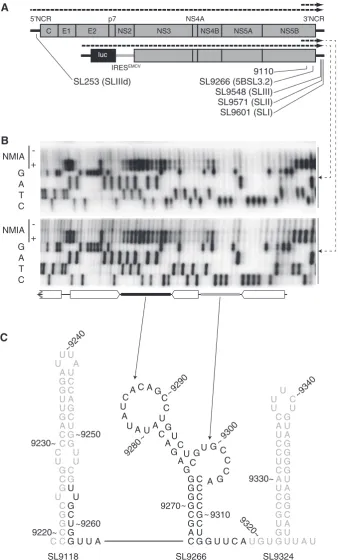
We investigated the structure of SL9266 by SHAPE analysis of RNA transcripts derived from Con1b–luc– rep or J6/JFH-1. In all cases, two different positive-sense transcripts were used; a full-length transcript generated from the bacteriophage T7 polymerase promoter in the plasmid vector or a sub-genomic transcript generated from a PCR product spanning nucleotide9005 to the extreme 30end of the genome (Figure 1A). Without
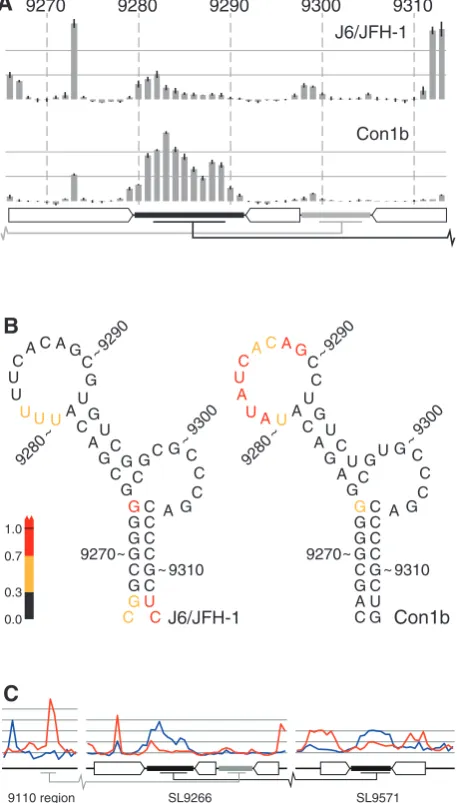
excep-tion, for either Con1b–luc–rep (Figure 1B) or J6/JFH-1 (Supplementary Figure S1) templates, the results obtained were highly reproducible and were indistinguishable within the regions analysed (Figure 2A). This implied that RNA structures present in the shorter NS5B-30NCR
template were not fundamentally influenced by sequences elsewhere in the virus genome.
In Con1b–luc–rep, with the exception of G9273, the
predicted duplexed stem regions of SL9266 exhibited little reactivity with the acylating agent NMIA, correlating well with the expected structure of the CRE (Figure 1B and C). Similarly, the reactivity of nucleotides forming the flanking stem–loops, SL9118 and SL9324, agreed well with the bioinformatically predicted structures (data not shown and Figure 1C). In SL9266, G9273 located opposite the
sub-terminal bulge-loop and forming the closing nucleotide of the predicted lower duplex, exhibited considerable NMIA reactivity despite the fact that the nucleotide it is predicted to pair with (C9306) was not accessible to NMIA
(Figure 1B and C). The predicted sub-terminal bulge loop of Con1b–luc–rep, nucleotides 9298–9305, showed little reactivity to NMIA. In contrast, the terminal loop, nt 9280–9291, exhibited considerable reactivity with the chemical modifier (Figure 1B). Since the SHAPE-mapped template also contained the X-tail sequences implicated in the genetically defined ‘kissing loop’ interaction (17), we were surprised that our analysis indicated that this region was predominantly unpaired. This prompted us to under-take a comparative analysis with SL9266 of J6/JFH-1 and to investigate the influence of mutations in these regions on the RNA structure.
p7 NS4A
C E1 E2 NS2 NS3 NS4B NS5A NS5B
IRESEMCV luc 5’NCR 3’NCR SL9266 (5BSL3.2) 9110 SL253 (SLIIId) SL9601 (SLI) SL9571 (SLII) SL9548 (SLIII) G A T C NMIA + -G A T C NMIA + -U G U G C U G C U G C U G C U G C U G C U G C U G C U G C U G C A U G C A U G C A U G C A
UUA
U U C A A A G A C C U U A A U G G G C C C C U U G C C C A A G G 9270 9280 9290 9300 9310 ~ ~ ~ ~ ~ U G C C C C C G C G G G C G G A
G UUC AU GU A
U U U U C C A A U U U U G G G C C C C C A A A U U U G G G G G G G C
U U U
9220~ 9230~ ~9250 ~9260 9320~ 9330~ ~9340 ~9240
SL9118 SL9266 SL9324
A
B
[image:5.612.131.470.67.628.2]C
SL9266. The nucleotides contributing to the base of the lower duplex of SL9266 in J6/JFH-1 (in particular,
UC9312–9313) were highly NMIA reactive, in agreement
with the absence of a Watson–Crick base pair between C9266 and C9313 and the relatively weak pairing between
G9267 and U9312. Second, the reactivity of the terminal
loop of SL9266 in J6/JFH-1 was markedly reduced when compared with Con1b–luc–rep (Figure 2A and B). In contrast, with the exception of a low signal from nucleo-tides 9298/9299, sequences within the sub-terminal bulge
loop exhibited little NMIA reactivity in either the genotype 1b or 2a templates (Figure 2A). Therefore, comparison of SL9266 structure in J6/JFH-1 and Con1b–luc–rep suggested there were differences between the two genotypes. Since the RNA templates contained distal sequences involved in the long-range interactions of SL9266, these differences prompted us to also investi-gate the NMIA exposure of these proposed interacting regions as well. Initial comparison of the SHAPE reactiv-ity of the 50 and 30 interacting regions of Con1b–luc–rep
and J6/JFH-1 templates highlighted further differences between the two genotypes (shown in blue and red lines respectively in Figure 2C). In addition to the differences in exposure of the terminal loop of SL9266, there were obvious discrepancies between the NMIA accessibility of nucleotides in both the 9110 and SL9571 regions (Figure 2C). In particular, the latter region was strikingly divergent in reactivity, only exhibiting a profile consistent with a stem–loop structure (NMIA-unreactive duplexed stem and -reactive terminal loop) in the Con1b–luc–rep template. We therefore undertook a detailed analysis of sequence changes that disrupt the documented inter-actions between SL9266 and these distal regions.
SHAPE mapping of mutants that influence the interactions of SL9266
Alone or in combination, we investigated the influence of Four nucleotide substitutions on the SHAPE-mapped structure of SL9266 and its predicted interacting regions. The mutations (all synonymous if coding), were in the terminal (C9287U) and sub-terminal (C9302A) loops of
SL9266, in the upstream region centred on nucleotide 9110 (G9110U) and in the terminal loop of SL9571 in the
X-tail region (G9583A). These mutations were selected as
there is genetic evidence supporting the pairing of G9110to
C9302 (22) and, indirectly, C9287 and G9583 (17,20,21).
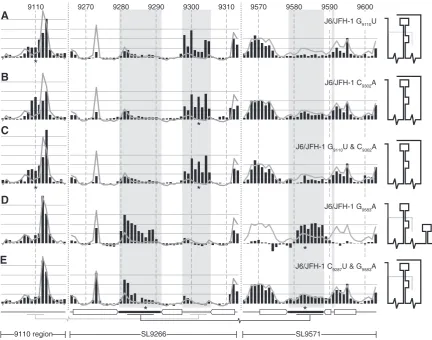
Additionally, the sequence identity in these regions of J6/JFH-1 and Con1b–luc–rep meant, we could compare the influence of the same substitutions in two different genotypes. Results are presented in Figures 3 and 4 which show the SHAPE reactivity of mutants in SL9266, SL9571 and the 9110 region as bar graphs, with the re-activity of an unmodified template superimposed as a line graph. A schematic representation of the predicted struc-ture and interactions of the regions is shown alongside to aid interpretation of the data.
Con1b–luc–rep SHAPE mapping
In Con1b–luc–rep, the G9110U or C9302A substitutions
caused four obvious changes in NMIA reactivity. Exposure of the 9110 region markedly increased (Figure 3A and B) as did exposure of the CUG9311–9313
at the 30 base of the lower stem of SL9266. In addition,
exposure of the sub-terminal bulge loop also increased, though this was most marked in the GUG9298–9301
triplet, and exposure of G9103was much reduced. Within
SL9571 in the 30 X-tail, there was very little change in
NMIA reactivity; nucleotides forming the duplexed stem of SL9571 exhibited much lower reactivity than the pre-dicted terminal loop, entirely consistent with it forming a
G C U
G GC
A C C C C U U A U A U G G G C G G G G G G C C C U G C C C C C C U U G C C C A A G G 9270 9280 9290 9300 9310 ~ ~ ~ ~ ~ U U C A A A G A C C C U U A A U G G G C G G G G G C C C U G C C C C C C U U G C C C A A G G 9270 9280 9290 9300 9310 ~ ~ ~ ~ ~ G A 9300 9290 9280 9310 9270 J6/JFH-1 Con1b J6/JFH-1 Con1b 0.0 0.3 0.7 1.0
9110 region SL9266 SL9571
A
B
[image:6.612.66.295.73.475.2]C
simple stem–loop structure, albeit one in which the terminal loop is not paired elsewhere. The simultaneous presence of G9110U and C9302A restored NMIA reactivity
of SL9266 to levels seen in the unmodified template, had little if any effect on sequences within SL9571 and reduced exposure of sequences in the 9110 region to undetectable levels (Figure 3C). In this double mutant, only G9103
differed markedly in exposure when compared with the unmodified template. The NMIA reactivity of the terminal loops of SL9266 and SL9571 were very similar to the native Con1b–luc–rep template whether G9110U,
C9302A or both covariant mutations were present. These
results support our bioinformatic prediction of an inter-action between the 9110 region with the sub-terminal bulge loop of SL9266. In addition, they provide biophys-ical support that mutations associated with replication defects in Con1b-based replicons cause disruption of this long-range RNA–RNA interaction (22).
Mutations introduced to disrupt/restore the proposed ‘kissing loop’ interaction in Con1b–luc–rep caused only
very subtle alteration of the RNA structure (Figure 3D and E). Since the predicted interacting sequences, the terminal loops of SL9266 (Figure 1B) and SL9571, were already largely exposed any further increase was inevitably difficult to quantify. Indeed, SHAPE analysis of the SL9266 region in isolation, provides little support for a stable ‘kissing loop’ interaction in Con1b–luc–rep. However, within the X-tail, the G9583A substitution did
subtly decrease the reactivity of the sequences that form the duplexed stem of SL9571, though this was not restored by inclusion of the complementary C9287U substitution. It
should be noted that we did not investigate the structure of C9287U alone as it would still be predicted to pair with
G9583.
J6/JFH-1 SHAPE mapping
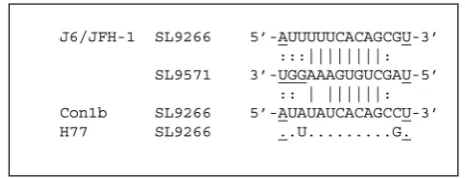
In J6/JFH-1 substitutions introduced to disrupt the two proposed long-range interactions generally had a more pronounced influence on the SHAPE-mapped RNA struc-ture. The independent substitution of G9110U or C9302A
9110 9270 9280 9290 9300 9310 9570 9580 9590 9600
*
*
*
*
*
Con1b G9110U
Con1b C9287U & G9583A Con1b G9110U & C9302A
Con1b G9583A Con1b C9302A
9110 region
*
*
SL9266 SL9571
A
[image:7.612.61.544.67.426.2]E D C B
Figure 3. SHAPE analysis of mutagenized Con1b–luc–rep templates. (A) Con1b–luc–rep G9110U, (B) Con1b–luc–rep C9302A, (C) Con1b-luc-rep
G9110U and C9302A, (D) Con1b-luc-rep G9583A and (E) Con1b-luc-rep C9287U and G9583A. Black bars show the normalized reactivity of
markedly increased the exposure of the sub-terminal bulge loop of SL9266 while also altering, though to a lesser extent, the profile of exposed nucleotides in the region around nucleotide 9110. For example, in the latter region, the exposure of GG9109–9110 increased when
compared to the unmodified template. The other marked change was the reduction in the NMIA reactivity of G9273.
The reactivity of the remaining duplexed regions of SL9266 and across SL9571 was predominantly unaltered (Figure 4A and B) implying there were no gross changes in RNA structure. However, in contrast to the situation with Con1b–luc–rep, introduction of G9110U and C9302A
together did not restore the structure of SL9266 or the 9110 region to the situation seen in the unmodified template. Instead, NMIA reactivity in the 9110- and SL9266 regions was almost indistinguishable from that seen with either mutation individually. As before, there was no change in the reactivity of sequences in SL9571 (Figure 4C) implying that the interactions of SL9266 are largely independent.
Substitution of G9583A in J6/JFH-1 caused two very clear
alterations to the NMIA reactivity of the RNA template
(Figure 4D). First, sequences forming the terminal loops of SL9266 and SL9571 became exposed and highly NMIA reactive. This reactivity extended through the entire unpaired regions of the terminal loops. Secondly, the NMIA reactivity of sequences that form the duplexed stem of SL9571 was strikingly reduced (Figure 4D). These alterations of NMIA reactivity are consistent with profound structural changes in which an unfolded sequence in the X-tail, paired to SL9266, simultaneously adopts a stem–loop conformation and dissociates from SL9266. The covariant substitution of C9287U and G9583A
restored the structure of the SL9571 region to that seen in the unmodified template. The exposure of nucleotides forming the terminal loop of SL9571 (9579–9588) was reduced as the exposure of the flanking sequences increased (Figure 4E). At the same time, the NMIA reactivity of the complementary sequences in the terminal loop of SL9266 were reduced, although the flanking U-rich region remained more exposed than the corresponding region in the unmodified template.
In summary, SHAPE mapping of sequences involved in forming the extended pseudoknot around SL9266 (22)
9110 9270 9280 9290 9300 9310 9570 9580 9590 9600
*
*
*
*
*
A
E
D
C
B
9110 region SL9266 SL9571
*
J6/JFH-1 G9110U
J6/JFH-1 C9287U & G9583A
J6/JFH-1 G9110U & C9302A
J6/JFH-1 G9583A
J6/JFH-1 C9302A
[image:8.612.96.529.66.406.2]*
Figure 4. SHAPE analysis of mutagenized J6/JFH-1 templates. (A) J6/JFH-1 G9110U, (B) J6/JFH-1 C9302A, (C) J6/JFH-1 G9110U and C9302A,
(D) J6/JFH-1 G9583A and (E) J6/JFH-1 C9287U and G9583A. Black bars show the normalized reactivity of SHAPE mapped templates bearing the
supported the proposed RNA structure but also demonstrated fundamental differences, both in the native structures between J6/JFH-1 and Con1b–luc–rep, and in the structural perturbations resulting from muta-genesis of the region.
Phenotypic consequences of mutagenesis of the SL9266 pseudoknot
The interaction of the sub-terminal bulge loop of SL9266 was predicted bioinformatically and supported with genetic studies using Con1b-based sub-genomic replicons (22). The predicted interacting sequences are identical in the genotype 2a J6/JFH-1 genome and SHAPE analysis of G9110U and C9302A mutants demonstrated that either
sub-stitution increased the exposure of the complementary regions (Figure 4A and B). We extended this analysis by investigating the replication phenotype of J6/JFH-1 with mutations that were known or predicted to modify these interacting RNA structures.
The J6/JFH-1 genome was modified by introduction of substitutions of G9110U, C9302A or both covariant
muta-tions together.In vitrotranscribed RNA was transfected into Huh-7.5 cells and supernatant virus was harvested and quantified 72 h later and after passage (Figure 5, dark and light bars, respectively). In these studies, the control unmodified J6/JFH-1 genome generated 105 focus forming units per ml (ffu/ml), whereas a negative
control genome bearing a well-characterized mutation (GND) within the active site of the NS5B polymerase did not replicate and generated no progeny virus, even after passage. Genomes with the G9110U substitution
replicated indistinguishably from the parental virus. Genomes carrying single substitution of C9302A, or the
double substitutions of C9302A and C9303G or G9110U
and C9302A all yielded approximately 0.5 log10 less virus
than the positive control. The virus yield did not increase with further passage of cells transfected with these RNA genomes.
Due to the striking divergence of the observed virus phenotype from those expected from our genotype 1b replicon-based studies (22), we then investigated the phenotypes resulting from mutagenesis of the core struc-ture of J6/JFH-1 SL9266, or the structurally mapped substitutions involved in the ‘kissing-loop’ interaction with SL9571. The double substitution of C9275G and
G9293A, both of which disrupt the upper duplex of
SL9266, did not yield detectable virus upon RNA trans-fection but, with further passage, generated 102ffu/ml presumably reflecting the selection of revertant or covari-ant genomes with a restored ability to replicate. The in-clusion of additional substitutions of C9278U and G9296C
to a genome already bearing C9275G and G9293A, thereby
restoring the integrity of the upper duplex of SL9266, completely restored the ability to replicate at parental J6/JFH-1 levels. Finally, the single point mutation of G9583A in the terminal loop of SL9571 significantly
reduced virus yield which was only restored to a limited extent with further passage. The addition of the covariant substitutions of C9287U and G9583A restored replication to
wild-type levels, in agreement with published studies (17). We additionally investigated the phenotype of Con1b– luc–rep replicons bearing the G9583A or combined C9287U
and G9583A mutations as these had not previously been
tested. Alone, the G9583A substitution prevented
replica-tion and yielded a phenotype indistinguishable from a control sub-genomic replicon with an inactive RdRp. In contrast, addition of the C9287U covariant substitution
restored replication of the sub-genomic replicon to levels seen with an unmodified template (Supplementary Figure S2).
DISCUSSION
An improved understanding of HCV replication is required if novel viral or cellular targets for therapeutic intervention are to be identified. In turn, this necessitates the study of systems that allow the replication processes of the virus to be dissected. Genotype 1b sub-genomic repli-cons (24,32–37) and the genotype 2a JFH-1 (or chimeric derivatives thereof) HCVcc system (25,30,38) have been widely used for HCV replication studies. Notwithstanding certain differences in adaptive mutations or the ability to generate progeny virions, the underlying assumption has been that the basic mechanism(s) of genome replication, and by extension the CRE structures and functions involved, are broadly conserved in these systems. This is supported by analysis of chimeras used to map the
100 101 102 103 104 105 106
Vir
us titre (f
ocus f
o
rming units/ml)
G9110 U
G9583 A
C9303 G C9302 A
G9296 C G9293
A C
9287 U
C9278 U C9275
G WT GND
C9302 A
G9110 U
C9302
A C
9275 G
G9293
A G
9583 A
Figure 5. Recovery and infectivity in Huh 7.5 cells of J6/JFH-1 bearing mutations in SL9266 and interacting regions. RNA generatedin vitro
determinants that confer the full replication phenotype to JFH-1-based genomes (20,21). It underpinned the bioinformatic prediction of phylogenetically conserved RNA structures in the genome (8,9,29,39–41) and is further supported by studies that demonstrated the absolute requirement for the structural integrity of the X-tail and the polypyrimidine tract located adjacent and 50 to the X-tail (12,15,42) in both systems. Additional
commonality is a requirement for a ‘kissing loop’ inter-action between the central stem–loop of the X-tail (SL9571) and SL9266, a CRE located within the NS5B-coding region. Disruption of this interaction abrogates replication, but is restored by the introduction or selection of compensatory covariant substitutions (17,20,21). SL9266 is also involved in a further long-range interaction with sequences located 200nt upstream between the conserved stem–loops SL9033 and SL9132, the prediction of which is supported by genetic studies in the Con1b-based replicon system (9,22). These studies could not distinguish whether the 50 and 30 long-range
inter-actions of SL9266 were mutually exclusive, in which case the SL9266 CRE could form a ‘switch’ alternating between two conformations. Alternatively, if both long-range interactions occurred simultaneously, it would place SL9266 at the core of an extended pseudoknot, a possibility we favoured and so designated the element SL9266/PK (22). In this study, we define the structure and long-range interactions of native and mutagenized SL9266 by RNA SHAPE mapping of Con1b and J6/JFH-1 templates. In addition, we also investigated the phenotype of J6/JFH-1 genomes bearing mutations that influenced the structure and interactions of SL9266.
The core structure of SL9266 of both Con1b and J6/ JFH-1 was well supported by SHAPE mapping (Figures 1B,C and 2). This structure was also in agreement with published studies that analysed the structure/function using reverse genetic approaches (11,18,22,43). Minor dif-ferences between the two systems were apparent in the exposure of the G9273, which may be related to the
inter-actions of the sub-terminal bulge loop of SL9266 (see below), and the NMIA reactivity of nucleotides at the base of the lower duplex (Figure 2B). The structure of SL9266 was not influenced by the length of the template used in the SHAPE analysis (Figures 1A and 2B; Supplementary Figure S1) implying that the shorter template, spanning from nucleotide 9005 to the end of the genome, is likely to contain all the sequences that influ-ence the structure of this element.
Despite the similarities in the duplexed core structure of SL9266, there were striking differences in the interactions exhibited by the terminal and sub-terminal loops when the two genotypes were compared. These were very obvious in the analysis of unmodified templates (Figure 2C) and were subsequently supported by mutagenesis of the interacting regions (Figures 3 and 4). In addition, the phenotypic consequences of disrupting these long-range interactions differed markedly when tested in the context of the two experimental systems. These results indicate that there are significant differences in the structure and function
of cis-acting replication elements of the two widely used HCV model replication systems.
The existence of an upstream interaction between the sub-terminal bulge loop of SL9266 and the region around nucleotide 9110 was at least partially supported in both Con1b and J6/JFH-1. In the former, mutations of G9110U
or C9302A were almost indistinguishable by SHAPE
mapping (Figure 3A and B), with increased exposure of sequences centred around both mutations but little or no influence on the remainder of SL9266 or the other regions analysed. Together, the covariant mutations restored NMIA reactivity to levels seen in the unmodified template (Figure 3C). With our previous analysis of similarly modified replicon templates (22), we conclude that replication of Con1b requires an interaction between the sub-terminal bulge loop of SL9266 and the region centred on nucleotide 9110.
In J6/JFH-1 substitution of G9110U or C9302A again
produced similar structural changes to SL9266; the sub-terminal bulge loop became more NMIA reactive and was paralleled by a reduction in exposure of G9273
(Figure 4A and B). Since exposure of C9306 (which is
predicted to pair with G9273) was unchanged, we interpret
the decreased reactivity of G9273 may reflect subtle
con-formational alterations at the top of the lower duplex, occluding G9273, that result from the increased exposure
of the bulge loop. In contrast to Con1b, we did not observe markedly increased exposure of the region around 9110 in J6/JFH-1, though the profile of reactivity of nucleotides 9108–9113 did change. Introduction of both covariant substitutions at G9110U and C9302A did not
restore the structure of SL9266 to that seen in the unmodi-fied template (Figure 4C). We interpret this as indicating a minor or weak interaction between the sub-terminal bulge loop of SL9266 and the 9110 region in J6/JFH-1, but that replacement of G9110/C9302with a UA pair was
incompat-ible with restoration of the interaction. Whether this is due to alterations in localized base stacking or the reduction in the number of hydrogen bonds remains to be determined. Analysis of sequenced HCV genomes suggests there is an absolute selection against purines at position 9302. In an alignment of 76 representative HCV sequences of seven genotypes (available at http://www.hcvdb.org/msa.asp), only G-C (63%), A-U (36%) and G-U (1%) pairings are present between 9110 and 9302, a distribution in broad agreement with the C (89%) and U (11%) reported at position 9302 in 208 unspecified aligned HCV sequences (11). Despite this apparent bias for pyrimidine at position 9302 it is notable that, in the Con1b replicon, we have previously demonstrated that, as long as covariant substi-tutions are also present at nucleotide 9110, purines are fully compatible with genome replication [Figure 7 (22)] whereas the non-Watson–Crick base pair of G9110–U9302
was not tolerated.
The relatively high exposure of the 9110 region in an unmodified J6/JFH-1 template might argue for an inter-action of the SL9266 bulge loop with a region elsewhere in the template. However, we conclude that since G9110U
mutations exhibited near wild-type virus yields (Figure 5), indicating that, in marked contrast to the situation in Con1b (22), the upstream pairing is not critical for replication.
Further differences between J6/JFH-1 and Con1b systems were obvious when the proposed ‘kissing loop’ between SL9266 and SL9571 was analysed. The terminal loop of Con1b SL9266 was predominantly exposed in the native template (Figure 2A and C) as were the comple-mentary sequences in SL9571 (Figure 2C). In contrast, sequences predicted to form the stem of SL9571 exhibited only weak NMIA reactivity in Con1b, indicating they were largely paired. We interpret this as indicating that the favoured structure in Con1b–luc–rep templates is one in which SL9266 and SL9571 form discrete and inde-pendent stem–loop structures. In J6/JFH-1 templates, the situation was very different. In this instance, the terminal loop of SL9266 and the complementary sequences in the X-tail were poorly exposed. In contrast, in the latter region, the sequences that should form the duplexed stem region of SL9571 exhibited high levels of NMIA reactivity, incompatible with them being paired. This situation was reversed by the introduction of the G9583A
mutation. Therefore, in contrast to the Con1b templates, we propose that the native structure in J6/JFH-1 involves a relatively stable ‘kissing loop’ pairing between eight residues in the terminal loop of SL9266 (nucleotides 9282–9289) and the X-tail (nucleotides 9581–9588; Figure 6), supporting previous genetic studies of this inter-action (17,20,21). Furthermore, we interpret the data as indicating that SL9571 sequences do not form a stem–loop structure when paired, via the ‘kissing loop’ interaction, with SL9266.
These results suggest that in J6/JFH-1, SL9266 forms the core of an extended pseudoknot in which both long-range interactions occur simultaneously [as previously proposed and designated SL9266/PK (22)]. Furthermore, the long-range interactions in this extended structure appear mutually independent; disruption of one does not signifi-cantly influence the other (Figures 3 and 4). In contrast, the structure that predominates in Con1b–luc–rep is one in which the ‘kissing loop’ interaction between SL9266 and the X-tail is largely absent, though it remains necessary for replication [Supplementary Figure S2 and (17)]. Other
than the differences between the steady-state native struc-tures in the two genotypes, we noted that the absence of the ‘kissing loop’ interaction, either in the native Con1b template or in the presence of G9583A mutation in J6/
JFH-1, appears to be a pre-requisite for the formation of a stem–loop structure by SL9571 in the X-tail. When con-ventionally paired, the SL9571 stem–loop resembles that determined by NMR analysis (17). It is not clear why the adoption of a stem–loop conformation by SL9571 is incom-patible with formation of the ‘kissing loop’, a conclusion in agreement with the previous NMR analysis where no inter-action was detected between SL9266- and SL9571-derived templates seeded in trans (17). Although the potential region of complementarity between SL9266 and SL9571 covers 12 contiguous nucleotides in J6/JFH-1 (Figure 6), our SHAPE mapping indicates that the G9583A substitution
increases exposure of only eight of these in the X-tail region (nucleotides 9581–9588; Figure 4D). Specifically, exposure of GGU9589–9591 does not increase indicating that the
pairing does not extend into the top of the 30 duplex of
SL9571; the SL9266 and SL9571 structures are not de facto mutually exclusive. One possibility is that there are steric incompatibilities in the structure of the terminal loop of SL9571 that prevent pairing with SL9266. Although previous studies have proposed that the ‘kissing loop’ inter-action may be mediated by a protein, possibly the viral NS5B (17), it is detectable in the absence of both cellular or viral proteins (Figures 3 and 4). We have additionally repeated the SHAPE mapping in the presence of extracts from J6/JFH-1 infected Huh-7.5 cells and detected no differences in the mapped structures (data not shown).
Although outside the primary focus of this study, we also investigated the NMIA reactivity of domain IIId [designated SL253 (19)] of the 50 NCR which is
proposed to interact with the bulge loop of SL9266 and mediate genome cyclization and translational control (23,44). Our SHAPE mapping was unable to detect this proposed interaction; the NMIA reactivity of the comple-mentary sequences in SL253 (nt 254–279) remained unchanged when comparing either the native full-length J6/JFH-1 or Con1b HCV template, or templates bearing a C9302A substitution (or indeed any of the mutants used in
our studies in the presence or absence of Huh 7.5 cell extracts; data not shown). Although the Romero-Lo´pez and Berzal-Herranz study used truncated RNA transcripts that omitted the 9110 region (23), the presence of the latter in our template does not explain the failure to observe the interaction with SL253; templates bearing a G9110U
mutation, demonstrated to prevent the interaction with SL9266 (Figure 3A), also exhibited no change in NMIA reactivity within SL253 when compared with the unmodi-fied template. We therefore have no evidence for steady-state binding in genome-length templates between these regions of SL9266 and the 50 NCR, though we
cannot exclude the possibility of a transient or temporal interaction.
[image:11.612.49.282.581.670.2]In a preliminary attempt to determine whether the structural differences, we observe are genotype-specific, or whether either the Con1b- or JFH-1-like structures are more typical, we also mapped the structure of SL9266 in the genotype 1a H77 strain of HCV. This was Figure 6. The ‘kissing loop’ interaction. The sequence of the terminal
essentially indistinguishable from Con1b–luc–rep (data not shown). With exception of the pairing of nucleotides 9287 and 9587 [Figure 6; (20,21)], the complementary sequences forming the long-range interactions in JFH-1, Con1b and H77 are conserved, as is the entirety of SL9571, and further studies will be required to determine whether this alone accounts for the structural differences. An unresolved aspect of this study is why mutations that disrupt the upstream interaction in Con1b and J6/JFH-1 (Figures 3a, b and 4a, b) exert markedly differ-ent phenotypes in the two replication systems (Figure 5) (22). We suspect that this may reflect differences in the overall integrity of the extended pseudoknot structure, in which the upstream interaction in Con1b is required to stabilise SL9266 in a conformation compatible with func-tion, for example, that allows the ‘kissing loop’ interaction to form as required. Although the overall stability of SL9266 is similar in Con1b and JFH-1 (G of 20.0 and 20.5 for Con1b and J6/JFH-1, respectively), the contribution of the upper and lower duplexes, as determined by Loop Free-Energy composition analysis using MFOLD or UNAfold (45,46), differs. J6/JFH-1 exhibits a more stable upper helix (dG =13.9, cf. 11.2 in Con1b) and a less stable lower helix (dG =17.8, cf. 19.9 for Con1b). To this end, it is notable that introduction of G9110U or C9302A
substitu-tions to J6/JFH-1 had little impact on the NMIA exposure of nucleotides in the duplexed regions of SL9266, whereas either substitution in the Con1b template increased the NMIA reactivity of nucleotides contributing to the upper duplex of SL9266 (nucleotides 9274–9279 and 9292–9297) and to nucleotides 9311–9313 at the 30 base
of the lower duplex (Figure 3a and b). Despite the differ-ences in phenotype, and the inability of covariant substi-tutions to restore pairing to J6/JFH-1 (Figure 4c), the striking phylogenetic conservation of the interacting sequences (22) suggests there are functional constraints operating on both these regions.
Of course, speculation regarding differences between RNA structures in HCV genotypes provides little insight into the functional roles these fulfil in genome replication. There is compelling genetic data supporting the import-ance of the ‘kissing loop’ interaction for HCV replication (17,20–22). However, we demonstrate that this interaction is incompatible with SL9571 forming a stem–loop structure. The integrity of the stem region of SL9571 is required to bind the pyrimidine tract binding protein (PTB) which may be involved in alleviating translational repression mediated by PTB binding to the 50 NCR
(47,48). SL9571 stem integrity, and possibly the primary sequence as well, also appears critical for HCV replication (42). Considering the differences in structure of SL9571 in the presence or absence of a ‘kissing loop’ interaction, we propose that SL9266 may contribute a switch function that modulates the mutually incompatible translation and replication events that must occur for replication of the positive-strand RNA genome of HCV. Precedents already exist for the involvement of RNA structures, including pseudoknots, in temporal control of the termination of translation and initiation of genome repli-cation. In most well-characterized examples, a feedback
mechanism operates where translation is repressed in response to the accumulation, directly or indirectly, of an interacting viral or cellular protein. For example, a cloverleaf structure at the 50 terminus of the poliovirus
genome interacts with cellular poly(rC) binding protein (PCBP), an interaction that enhances translation. The subsequent accumulation of the viral 3CD protein, which also binds the 50cloverleaf structure, inhibits
trans-lation and is a pre-requisite for negative-strand synthesis (49). Similarly, turnip yellow mosaic virus possesses a pseudoknot, designated the tRNA-like structure, which competitively binds newly synthesized viral polymerase to mediate the switch between genome translation and replication (50–52). It should be noted that recent studies have also suggested a role for SL9266 in transla-tional control (44), though our SHAPE mapping did not support the proposed interaction of the sub-terminal bulge loop of SL9266 and the 50 NCR (see above).
There is evidence that HCV NS5B binds sequences within the 30 end of the virus genome (18,53) though our
preliminary studies have been unable to demonstrate a specific interaction with SL9266 (unpublished results). Further studies will therefore be required to determine whether the binding of cellular or viral proteins is involved in modifying the interactions of SL9266 to initiate replication events dependent upon SL9571 forming a stem–loop. The demonstration that the two widely used systems for HCV replication studies exhibit strikingly different functional RNA structures provides valuable comparative information that will contribute to both defining the function and determining whether the interactions of SL9266/PK forms a tractable target for therapeutic intervention.
SUPPLEMENTARY DATA
Supplementary Data are available at NAR Online: Supplementary Figures 1 and 2.
ACKNOWLEDGEMENTS
We gratefully acknowledge Ralf Bartenschlager, Mark Harris, Charlie Rice, Takaji Wakita and NIH for the generous provision of reagents used in this study.
FUNDING
UK Medical Research Council [G08901197 to D.J.E. and P.S.]. Funding for open access charge: Medical Research Council.
Conflict of interest statement. None declared.
REFERENCES
1. Wasley,A. and Alter,M.J. (2000) Epidemiology of hepatitis C: geographic differences and temporal trends.Semin. Liver. Dis.,
20, 1–16.
2. Bartenschlager,R., Frese,M. and Pietschmann,T. (2004) Novel insights into hepatitis C virus replication and persistence.
3. Gesteland,R., Cech,T. and Atkins,J. (2006)The RNA World, 3rd edn. Cold Spring Harbor Laboratory Press, Cold Spring Harbor, NY.
4. Liu,Y., Wimmer,E. and Paul,A.V. (2009) Cis-acting RNA elements in human and animal plus-strand RNA viruses.
Biochim. Biophys. Acta Gene Regul. Mech.,1789, 495–517. 5. Tuplin,A., Evans,D.J., Buckley,A., Jones,I.M., Gould,E.A. and
Gritsun,T.S. (2011) Replication enhancer elements within the open reading frame of tick-borne encephalitis virus and their evolution within the Flavivirus genus.Nucleic Acids Res.,39, 7034–7048.
6. Davis,M., Sagan,S., Pezacki,J., Evans,D. and Simmonds,P. (2008) Bioinformatic and physical characterizations of genome-scale ordered RNA structure in mammalian RNA viruses.J. Virol.,82, 11824–11836.
7. Simmonds,P., Tuplin,A. and Evans,D. (2004) Detection of genome-scale ordered RNA structure (GORS) in genomes of positive-stranded RNA viruses: implications for virus evolution and host persistence.RNA,10, 1337–1351.
8. Tuplin,A., Wood,J., Evans,D., Patel,A. and Simmonds,P. (2002) Thermodynamic and phylogenetic prediction of RNA secondary structures in the coding region of hepatitis C virus.RNA,8, 824–841.
9. Tuplin,A., Evans,D. and Simmonds,P. (2004) Detailed mapping of RNA secondary structures in core and NS5B-encoding region sequences of hepatitis C virus by RNase cleavage and novel bioinformatic prediction methods.J. Gen. Virol.,85, 3037–3047. 10. McMullan,L.K., Grakoui,A., Evans,M.J., Mihalik,K., Puig,M.,
Branch,A.D., Feinstone,S.M. and Rice,C.M. (2007) Evidence for a functional RNA element in the hepatitis C virus core gene.
Proc. Natl Acad. Sci. USA,104, 2879–2884.
11. You,S., Stump,D.D., Branch,A.D. and Rice,C.M. (2004) A cis-acting replication element in the sequence encoding the NS5B RNA-dependent RNA polymerase is required for hepatitis C virus RNA replication.J. Virol.,78, 1352–1366.
12. You,S. and Rice,C.M. (2008) 30 RNA elements in hepatitis
C virus replication: kissing partners and long poly(U).J. Virol.,
82, 184–195.
13. Friebe,P., Lohmann,V., Krieger,N. and Bartenschlager,R. (2001) Sequences in the 50 nontranslated region of hepatitis C virus
required for RNA replication.J. Virol.,75, 12047–12057. 14. Wang,T.H., Rijnbrand,R.C. and Lemon,S.M. (2000) Core
protein-coding sequence, but not core protein, modulates the efficiency of cap-independent translation directed by the internal ribosome entry site of hepatitis C virus.J. Virol.,74,
11347–11358.
15. Friebe,P. and Bartenschlager,R. (2002) Genetic analysis of sequences in the 30 nontranslated region of hepatitis C virus that
are important for RNA replication.J. Virol.,76, 5326–5338. 16. Song,Y., Friebe,P., Tzima,E., Junemann,C., Bartenschlager,R. and
Niepmann,M. (2006) The hepatitis C virus RNA 30-untranslated
region strongly enhances translation directed by the internal ribosome entry site.J. Virol.,80, 11579–11588.
17. Friebe,P., Boudet,J., Simorre,J.P. and Bartenschlager,R. (2005) Kissing-loop interaction in the 30 end of the hepatitis C virus
genome essential for RNA replication.J. Virol.,79, 380–392. 18. Lee,H., Shin,H., Wimmer,E. and Paul,A.V. (2004) cis-acting RNA
signals in the NS5B C-terminal coding sequence of the hepatitis C virus genome.J. Virol.,78, 10865–10877.
19. Kuiken,C., Combet,C., Bukh,J., Shin-I,T., Deleage,G., Mizokami,M., Richardson,R., Sablon,E., Yusim,K., Pawlotsky,J.M.et al. (2006) A comprehensive system for consistent numbering of HCV sequences, proteins and epitopes.
Hepatology,44, 1355–1361.
20. Murayama,A., Weng,L., Date,T., Akazawa,D., Tian,X., Suzuki,T., Kato,T., Tanaka,Y., Mizokami,M., Wakita,T.et al. (2010) RNA polymerase activity and specific RNA structure are required for efficient HCV replication in cultured cells.PLoS Pathog.,6, e1000885.
21. Schmitt,M., Scrima,N., Radujkovic,D., Caillet-Saguy,C., Simister,P.C., Friebe,P., Wicht,O., Klein,R., Bartenschlager,R., Lohmann,V.et al. (2011) A comprehensive structure-function comparison of hepatitis C virus strain JFH1 and J6 polymerases
reveals a key residue stimulating replication in cell culture across genotypes.J. Virol.,85, 2565–2581.
22. Diviney,S., Tuplin,A., Struthers,M., Armstrong,V., Elliott,R., Simmonds,P. and Evans,D. (2008) A hepatitis C virus cis-acting replication element forms a long-range RNA-RNA interaction with upstream RNA sequences in NS5B.J. Virol.,82, 9008–9022. 23. Romero-Lo´pez,C. and Berzal-Herranz,A. (2009) A long-range
RNA-RNA interaction between the 50and 30 ends of the HCV
genome.RNA,15, 1740–1752.
24. Lohmann,V., Ko¨rner,F., Koch,J., Herian,U., Theilmann,L. and Bartenschlager,R. (1999) Replication of subgenomic hepatitis C virus RNAs in a hepatoma cell line.Science,285, 110–113. 25. Wakita,T., Pietschmann,T., Kato,T., Date,T., Miyamoto,M.,
Zhao,Z., Murthy,K., Habermann,A., Krausslich,H.G., Mizokami,M.et al. (2005) Production of infectious hepatitis C virus in tissue culture from a cloned viral genome.Nat. Med.,
11, 791–796.
26. Wilkinson,K.A., Merino,E.J. and Weeks,K.M. (2006) Selective 20-hydroxyl acylation analyzed by primer extension (SHAPE):
quantitative RNA structure analysis at single nucleotide resolution.Nat. Protoc.,1, 1610–1616.
27. Jubin,R., Vantuno,N.E., Kieft,J.S., Murray,M.G., Doudna,J.A., Lau,J.Y. and Baroudy,B.M. (2000) Hepatitis C virus internal ribosome entry site (IRES) stem loop IIId contains a
phylogenetically conserved GGG triplet essential for translation and IRES folding.J. Virol.,74, 10430–10437.
28. Klinck,R., Westhof,E., Walker,S., Afshar,M., Collier,A. and Aboul-Ela,F. (2000) A potential RNA drug target in the hepatitis C virus internal ribosomal entry site.RNA,6, 1423–1431. 29. Blight,K.J. and Rice,C.M. (1997) Secondary structure
determination of the conserved 98-base sequence at the 30
terminus of hepatitis C virus genome RNA.J. Virol.,71, 7345–7352.
30. Lindenbach,B.D., Evans,M.J., Syder,A.J., Wolk,B., Tellinghuisen,T.L., Liu,C.C., Maruyama,T., Hynes,R.O., Burton,D.R., McKeating,J.A.et al. (2005) Complete replication of hepatitis C virus in cell culture.Science,309, 623–626. 31. Pang,P.S., Elazar,M., Pham,E.A. and Glenn,J.S. (2011) Simplified
RNA secondary structure mapping by automation of SHAPE data analysis.Nucleic Acids Res.,39, e151.
32. Lohmann,V., Ko¨rner,F., Dobierzewska,A. and Bartenschlager,R. (2001) Mutations in hepatitis C virus RNAs conferring cell culture adaptation.J. Virol.,75, 1437–1449.
33. Blight,K.J., Kolykhalov,A.A. and Rice,C.M. (2000) Efficient initiation of HCV RNA replication in cell culture.Science,290, 1972–1974.
34. Lohmann,V., Hoffmann,S., Herian,U., Penin,F. and Bartenschlager,R. (2003) Viral and Cellular determinants of hepatitis C virus RNA replication in cell culture.J. Virol.,77, 3007–3019.
35. Bukh,J., Pietschmann,T., Lohmann,V., Krieger,N., Faulk,K., Engle,R.E., Govindarajan,S., Shapiro,M., St Claire,M. and Bartenschlager,R. (2002) Mutations that permit efficient replication of hepatitis C virus RNA in Huh-7 cells prevent productive replication in chimpanzees.Proc. Natl Acad. Sci. USA,
99, 14416–14421.
36. Pietschmann,T., Lohmann,V., Kaul,A., Krieger,N., Rinck,G., Rutter,G., Strand,D. and Bartenschlager,R. (2002) Persistent and transient replication of full-length hepatitis C virus genomes in cell culture.J. Virol.,76, 4008–4021.
37. Ikeda,M., Yi,M., Li,K. and Lemon,S.M. (2002) Selectable subgenomic and genome-length dicistronic RNAs derived from an infectious molecular clone of the HCV-N strain of hepatitis C virus replicate efficiently in cultured Huh7 cells.J. Virol.,76, 2997–3006.
38. Zhong,J., Gastaminza,P., Cheng,G., Kapadia,S., Kato,T., Burton,D.R., Wieland,S.F., Uprichard,S.L., Wakita,T. and Chisari,F.V. (2005) Robust hepatitis C virus infection in vitro.
Proc. Natl Acad. Sci. USA,102, 9294–9299.
39. Zhao,W.D. and Wimmer,E. (2001) Genetic analysis of a poliovirus/hepatitis C virus chimera: new structure for domain II of the internal ribosomal entry site of hepatitis C virus.J. Virol.,
40. Brown,E.A., Zhang,H., Ping,L.H. and Lemon,S.M. (1992) Secondary structure of the 50nontranslated regions of hepatitis
C virus and pestivirus genomic RNAs.Nucleic Acids Res.,20, 5041–5045.
41. Wang,C., Le,S.Y., Ali,N. and Siddiqui,A. (1995) An RNA pseudoknot is an essential structural element of the internal ribosome entry site located within the hepatitis C virus 50
noncoding region.RNA,1, 526–537.
42. Yi,M. and Lemon,S.M. (2003) 30 nontranslated RNA signals
required for replication of hepatitis C virus RNA.J. Virol.,77, 3557–3568.
43. Yang,Y., Yi,M., Evans,D., Simmonds,P. and Lemon,S. (2008) Identification of a conserved RNA replication element (cre) within the 3Dpol-coding sequence of hepatoviruses.J. Virol.,82, 10118–10128.
44. Romero-Lo´pez,C. and Berzal-Herranz,A. (2012) The functional RNA domain 5BSL3.2 within the NS5B coding sequence influences hepatitis C virus IRES-mediated translation.
Cell Mol. Life Sci.,69, 103–113.
45. Markham,N.R. and Zuker,M. (2008) UNAFold: software for nucleic acid folding and hybridization.Methods Mol. Biol.,453, 3–31. 46. Zuker,M. (1989) On finding all suboptimal foldings of an RNA
molecule.Science,244, 48–52.
47. Ito,T. and Lai,M.M. (1997) Determination of the secondary structure of and cellular protein binding to the 30-untranslated
region of the hepatitis C virus RNA genome.J. Virol., 71, 8698–8706.
48. Ito,T. and Lai,M.M. (1999) An internal polypyrimidine-tract-binding protein-binding site in the hepatitis C virus RNA attenuates translation, which is relieved by the 30-untranslated
sequence.Virology,254, 288–296.
49. Gamarnik,A.V. and Andino,R. (1998) Switch from translation to RNA replication in a positive-stranded RNA virus.Genes Dev.,
12, 2293–2304.
50. Matsuda,D., Yoshinari,S. and Dreher,T.W. (2004) eEF1A binding to aminoacylated viral RNA represses minus strand synthesis by TYMV RNA-dependent RNA polymerase.Virology,321, 47–56. 51. Matsuda,D. and Dreher,T.W. (2004) The tRNA-like structure of Turnip yellow mosaic virus RNA is a 30-translational enhancer.
Virology,321, 36–46.
52. Giege´,R. (1996) Interplay of tRNA-like structures from plant viral RNAs with partners of the translation and replication machineries.Proc. Natl Acad. Sci. USA,93, 12078–12081. 53. Cheng,J.C., Chang,M.F. and Chang,S.C. (1999) Specific