This is a repository copy of
Contracts in CML
.
White Rose Research Online URL for this paper:
http://eprints.whiterose.ac.uk/106540/
Version: Accepted Version
Proceedings Paper:
Woodcock, J. C. P. orcid.org/0000-0001-7955-2702, Cavalcanti, A. L. C.
orcid.org/0000-0002-0831-1976, Fitzgerald, J. et al. (2 more authors) (2014) Contracts in
CML. In: 6th International Symposium On Leveraging Applications of Formal Methods,
Verification and Validation. Lecture Notes in Computer Science . SPRINGER , pp. 54-73.
https://doi.org/10.1007/978-3-662-45231-8_5
Reuse
Items deposited in White Rose Research Online are protected by copyright, with all rights reserved unless indicated otherwise. They may be downloaded and/or printed for private study, or other acts as permitted by national copyright laws. The publisher or other rights holders may allow further reproduction and re-use of the full text version. This is indicated by the licence information on the White Rose Research Online record for the item.
Takedown
If you consider content in White Rose Research Online to be in breach of UK law, please notify us by
Contracts in CML
Jim Woodcock1, Ana Cavalcanti1, John Fitzgerald2, Simon Foster1, and Peter Gorm Larsen3
1
University of York 2
Newcastle University 3
Aarhus University
Abstract. We describe the COMPASS Modelling Language (CML), which is used to model large-scale Systems of Systems and the con-tracts that bind them together. The language can be used to document the interfaces to constituent systems using formal, precise, and veri-able specications including preconditions, postconditions, and invari-ants. The semantics of CML directly supports the use of these contracts for all language constructs, including the use of communication chan-nels, parallel processes, and processes that run forever. Every process construct in CML has an associated contract, allowing clients and sup-pliers to check that the implementations of constituent systems conform to their interface specications.
1 Introduction
The COMPASS Modelling Language (CML) is a formal language for describing Systems of Systems [29] (SoS). An SoS is a collaboration of smaller indepen-dent systems to achieve a goal that cannot be readily achieved by any of these constituents. Typical SoSs include trac management systems, emergency re-sponse systems, and home automation systems, all of which include constituent systems over which there is no overall control. To achieve synergy, contracts must be negotiated to dene the behaviour of the SoS and impose constraints on the constituents, which are otherwise free to behave independently. If such an SoS is to be dependable, it is necessary to ensure that all the constituents are capable of fullling their guarantees. We give a mathematically rigorous account of contracts and system models, so that we can verify their conformance.
The design-by-contract paradigm was originally by Meyer [33], and it needs adaptation to express SoS contracts. For SoSs, constituent system designers need to dene formal, precise, and veriable interface specications for constituents with preconditions, postconditions, and invariants. The postcondition answers the question, What can the client expect? The precondition answers the ques-tion, What can the supplier assume? The invariant answers the quesques-tion, What is persistent? These specications can then act as contracts which inform the conditions and obligations imposed on a given constituent system.
terminate to be considered (totally) correct; an extension of this is partial cor-rectness, where it is only required that, if the program terminates, then the an-swer is correct; but many programs are designed to run indenitelyspecically reactive systems and particularly SoS. Parnas draws the conclusion that the as-sertional technique is currently inadequate and that we need to nd a good way to represent normal nontermination in correctness arguments.
CML extends the notion of a contract to language constructs not often dealt with in the design-by-contract paradigm, including the use of communication channels, parallel processes, and processes that run forever (addressing Parnas's concerns directly). In fact, every process construct in CML has an associated contract, and this allows clients and suppliers to check that dynamic behaviour conforms to interface specications.
In the COMPASS project, CML is central to our approach to SoS engi-neering [17]. We base the approach on a combination of the Systems Modelling Language (SysML) with CML. The former brings facilities for describing sys-tem architecture and functionality in a largely graphical, multi-view modelling environment where contracts between constituent systems can be specied at a high-level of abstraction [5]. CML provides a formal basis for analysing SoS models based on SysML abstractions, and adds the rich description of data, functionality, and communication. The loose coupling between SysML and CML has enabled the use of well-established tools to construct CML models; these are translated to a CML version that can be subjected to static and dynamic analy-sis using the Symphony platform and its plug-ins. The viability of the approach has been demonstrated in diverse ways. For example, in COMPASS, SysML and CML, and tools supporting them, have been successfully deployed together to tackle complex problems in, applications such as home automation [4]. Patterns and proles have been dened to aid SoS modelling for specic problems such as fault modelling [1].
Our contribution in this paper is to formalise an approach to modelling of contracts in CML, drawing on Meyer's approach to design by contract. In Sec-tion 2, we give an overview of CML. In SecSec-tion 3, we describe the method used to dene CML's semantics, Hoare and He's Unifying Theories of Programming, a framework for formalisation of heterogeneous semantics which has a mecha-nised foundation in Isabelle [18]. In Section 4, we go on to give an overview of CML's semantic domains. In Section 5, we give a series of examples of interface contracts for small fragments of CML processes. In Section 6, we give a complete example of a system in which contracts are used to specify emergent properties. Finally, in Section 7 we reect on what has been achieved.
2 The COMPASS Modelling Language
systems composed of independent constituent systems [46]4. CML is based on a combination of VDM [28,16] and CSP [24,42], in the spirit of Circus [44,35,36].
A CML model consists of a collection of types, functions, channels, and pro-cesses. The type system of CML is taken directly from VDM and includes sup-port for numeric types, nite sets, nite maps, and records, all of which can be further constrained through type invariants. Functions are pure mathemati-cal mappings between inputs and outputs, which can be specied explicitly via λ-calculus, or implicitly using pre and postconditions. In general we adopt the syntax of VDM-SL [14] for the functional and imperative parts of the language, whilst using Circus style syntax for the concurrent and reactive parts.
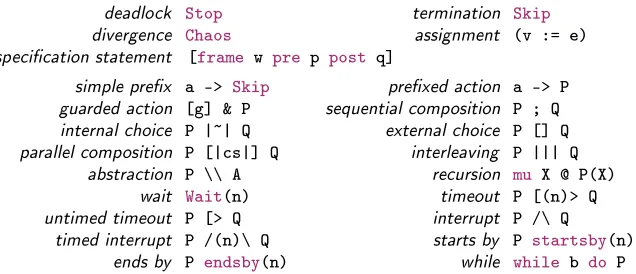
Channels and processes are used to model SoSs, their constituent systems, and the components of these systems. A channel is a medium though which pro-cesses can communicate with each other, optionally carrying data of a certain type. Each process encapsulates a number of local state variables, VDM style operations acting on the state (explicit or implicitly specied), and actions which specify the reactive behaviour. Actions are dened using CSP style process con-structs, which enable a process to interact with its environment via synchronous communications. The main action constructs of the basic CML language with state, concurrency, and timing are described in Table 1. In addition to the stan-dard CSP operators, such as prex a?v -> P and external choiceP [] Q, CML includes support for modelling real-time behaviour such as timeout P [(n)> Q which will behave likeQafter ntime units ifPdoes not rst interrupt.
deadlock Stop termination Skip
divergence Chaos assignment (v := e) specication statement [frame w pre p post q]
simple prex a -> Skip prexed action a -> P guarded action [g] & P sequential composition P ; Q internal choice P |~| Q external choice P [] Q parallel composition P [|cs|] Q interleaving P ||| Q
abstraction P \\ A recursion mu X @ P(X) wait Wait(n) timeout P [(n)> Q untimed timeout P [> Q interrupt P /\ Q
[image:4.612.148.466.398.535.2]timed interrupt P /(n)\ Q starts by P startsby(n) ends by P endsby(n) while while b do P
Table 1. The core of the CML language.
An example CML process is shown in Figure 1, which models a stack. We rst dene theElement type for stacks, which in this case are integers constrained to values between 0 and 255 (i.e. bytes) through a type invariant. Next we dene ve channels with which to communicate with the stack, including an initialisation channel (init), channels which indicate whether the stack is empty or not (empty, nonempty), and nally channels to push and pop, which carry elements.
The actualStack process consists of a single state variable stack storing a sequence of elements. We dene two operations, Pushand Pop, contractually in terms of their pre and postconditions, which respectively add and remove an element from the stack. Push has no precondition, and has the postcondition that the new stack must have the pushed value at its head, and the previous value of the stack (denoted by a tilde) at its tail.Poprequires that that the stack be nonempty, returns the head of the stack, and suitably updates the state. We also dene a simple function to check for emptiness of the stack.
types
Element = int inv x == x >= 0 and x <= 255
channels
init, empty, nonempty push, pop : Element
process Stack =
begin
state stack : seq of Element
operations
Push(e : Element)
post hd(stack) = e and tl(stack) = stack~
Pop() e : Element
pre stack <> []
post stack = tl(stack~) and e = hd(stack)
functions
isEmpty : seq of Element -> bool isEmpty(s) == s = []
actions
Cycle =
( push?e -> Push(e) [] [not isEmpty(stack)] &
(dcl v : Element @ v := Pop() ; pop!v -> Skip) [] [isEmpty(stack)] & empty -> Skip
[] [not isEmpty(stack)] & nonempty -> Skip ) ; Cycle
@ init -> stack := []; Cycle
end
Fig. 1. CML model of a stack
wait for input over the pushchannel, and then call thePushoperation; if the stack is not empty, create a local variable v, pop the top of the stack
and assign it tov, and then oer this value over thepop channel; if the stack is empty, oer communication on theemptychannel; if the stack is not empty, oer communication on the nonemptychannel.
After each of these behaviours,Cyclerecurses. The top-level behaviour of the process is then given by the main action, dened after the @ symbol. It waits for an input oninit, empties the stack, and then entersCycle.
Development of CML models is facilitated through Symphony5, an Eclipse-based integrated development environment. Symphony provides a parser, type checker, simulator, model checker, and theorem prover for CML, all of which have been implemented based on a common semantic basis in the UTP.
The semantics of CML is specication oriented: there is a natural notion of contract for every process language construct and an intuitive renement ordering. We next describe both notions and give examples of their use.
3 Unifying Theories of Programming
The semantics of CML is dened in Hoare & He's Unifying Theories of Program-ming (UTP), which is a long-term research agenda for computer science and soft-ware engineering [25,11,45]. It can be described as follows: researchers propose programming theories and practitioners use pragmatic programming paradigms; what is the relationship between them? UTP, based on predicative program-ming [23], gives three principal ways to study such relationships: (i) by com-putational paradigm, identifying common concepts; (ii) by level of abstraction, from requirements, through architectures and components, to platform-specic implementation technologies; and (iii) by method of presentationnamely, de-notational, algebraic, and operational semanticsand their mutual embeddings. UTP presents a theoretical foundation for understanding software and sys-tems engineering. In its original presentation, it describes nondeterministic se-quential programming, the renement calculus, the algebra of programming, compilation of high-level languages, concurrency, communication, reactive pro-cesses, and higher-order programming [25]. Subsequently, it has been exploited in a diversity of areas such as component-based systems [49], hardware verica-tion [40,39], and hardware/software co-design [2].
UTP can also be used in a more active way for constructing domain-specic languages, especially ones with heterogeneous semantics. Examples include the semantics for Circus [35,36,44] and Safety-Critical Java (SCJ) [8,10,9], both of which have been composed from individual, reusable theories of sequential and concurrent programming. SCJ additionally has real-time tasking and a sophis-ticated model of memory usage. The analogy for these kinds of compositional semantics is of a theory supermarket, where you shop for exactly those features you need, whilst being condent that the theories plug-and-play nicely together.
The semantic metalanguage for UTP is an alphabetised version of Tarski's relational calculus, presented in a pointwise predicative style that is reminiscent of the schema calculus in the Z notation [47]. Each programming construct is formalised as a relation between an initial and an intermediate or nal observa-tion. The collection of these relations forms a theory of a paradigm that contains three essential parts: an alphabet, a signature, and some healthiness conditions. The alphabet is a set of variable names that gives the vocabulary for the theory being studied: names are chosen for any relevant external observations of behaviour. For instance, programming variables x, y, and z are normally part of the alphabet. Theories for particular programming paradigms require the observation of extra information. Some examples from existing theories are: a ag that says whether the program has started (ok); the current time (clock); the number of available resources (res); a trace of the events in the life of the program (tr); a set of refused events (ref ); or a ag that says whether the program is waiting for interaction with its environment (wait).
The signature gives syntactic rules for denoting objects of the theory. Finally, healthiness conditions identify properties that characterise the predicates of the theory. They are often expressed in terms of a functionφthat makes a program healthy. There is no point in applyingφtwice, since we cannot make a healthy program even healthier, soφmust be idempotent: P=φ(φ(P)). The xed-points
of this equation are the healthy predicates of the theory.
An alphabetised predicate (P,Q, . . . ,true) is an alphabet-predicate pair, such that the predicate's free variables are all members of the alphabet. Re-lations are predicates in which the alphabet comprises plain variables (x, y, z, . . . ) and dashed variables (x′, a′, . . . ); the former represent initial observations, and the latter, intermediate or nal observations. The alphabet of P is denoted αP. A condition (b,c,d, . . . ,true) has no dashed variables. Predicate calculus operators combine predicates in the obvious way, but with specied restrictions on the alphabets of the operands and specied resulting alphabet. For example, the alphabet of a conjunction is the union of the alphabets of its components, and disjunction is dened only for predicates with the same alphabet.
A distinguishing feature of UTP is the central role played by program correct-ness, which is dened in the same way in every programming paradigm in [25]. Informally, it is required that, in every state, the behaviour of an implementation implies its specication. If we suppose that for a predicate P,αP ={a,b,a′,b′}, then the universal closure of P is∀a,b,a′,b′•P, denoted[P]. P is correct with respect to a specication S providing every observation of P is also an observa-tion of S:[P ⇒S]; this is described by S⊑P (read S is rened by P).
UTP has an inx syntax for the conditional, P
⊳
b⊲
Q, and it is dened as(b ∧ P) ∨ (¬ b ∧ Q), if αb ⊆ αP = αQ. Sequence is modelled as relational
composition: two relations may be composed, providing that their alphabets match: P(v′) ; Q(v) =b ∃v0 • P(v0) ∧ Q(v0), if outαP = inαQ′ = {v′}. If A={x,y, . . . ,z}andαe⊆A, then the assignment x :=Ae dened below, with expression vector e and variable vector x, changes only x's value.
There is a degenerate form of assignment that changes no variable; it is called skip dened as IIA = (b v′=v), if A={v}. Nondeterminism can arise in one of two ways: either as the result of runtime factors, such as distributed processing or as the under-specication of implementation choices. Either way, nondeter-minism is modelled by choice; the semantics is disjunction: P ⊓Q =b P∨Q.
The set of alphabetised predicates with a particular alphabet A forms a complete lattice under the renement ordering (which is a partial order). The bottom element is denoted ⊥A, and is the weakest predicate true; this is the
program that aborts, and behaves quite arbitrarily. The top element is denoted
⊤A, and is the strongest predicate false; this is the program that performs
miracles and implements every specication. Since alphabetised relations form a complete lattice, every construction dened solely using monotonic operators has a complete lattice of xed points. The weakest xed-point of the function F is denoted byµF , and is simply the greatest lower bound (the weakest) of all the xed-points of F . This is dened: µF =b
⊓
{X |F(X)⊑X}. The strongestxed-pointνF is the dual of the weakest xed-point.
4 CML Semantics
Currently, CML contains several language paradigms. These are all presented through formalisation as UTP theories.
State-based description. The theory of designs provides a nondeterministic programming language with precondition and postcondition specications as contracts, written P ⊢Q, for precondition P and postcondition Q. The
concrete realisation is VDM.
Concurrency and communication. The theory of reactive processes pro-vides process networks communicating by message passing. The concrete realisation is CSPM with its rich collection of process combinators.
Object orientation. This theory is built on designs with state-based descrip-tions structured by sub-typing, inheritance, and dynamic binding, with ob-ject creation, type testing and casting, and state-component access [7]. References. The theory of heap storage and its manipulations supports a
reference semantics based on separation logic.
Time. The theory of timed traces in UTP supports the observation of events in discrete time. It is used in a theory of Timed CSP.
this trace increases monotonically: this ensures that once an event has taken place it cannot be retractedeven when the process aborts.
Another mapping counteracts R: it is called H, and it is the function that characterises what it is to be a design. H puts requirements on the use of the observations ok and ok′, and it is the former that concerns us here. It states that, until the operation has started properly (ok is true), no observation can be made of the operation's behaviour. So, if the operation's predecessor has aborted, nothing can be said about any of the operation's variables, not even the trace observation variable. This destroys the requirement of R that restricts the trace so that it only ever increases monotonically, even when ok is false.
This pair of mappings forms a Galois connection [13], and such pairs exist between all of CML's semantic domains. One purpose of a Galois connection is to embed one theory within another, and this is what gives the compositional avour of UTP and CML, since Galois connections compose to form other Galois connections. For example, if we establish a Galois connection between reactive processes and timed reactive processes, then we can compose the connection between designs and reactive processes with this new Galois connection to form a connection between designs and timed reactive processes.
The possibly obscure mathematical fact that there is a Galois connection be-tween designs and reactive processes is of great practical value. One of the most important features of designs is assertional reasoning based on preconditions and postconditions, including the use of Hoare logic and weakest precondition calculus. Assertional reasoning, as dened in the theory of designs, can be in-corporated into the theory of reactive processes by means of the mapping R.
In the theory of designs, a Hoare triple {p}Q{r}, where p is a
precondi-tion, r is a postcondiprecondi-tion, and Q is a reactive process, is given the meaning
(R(p⊢r′)⊑Q), which is a renement assertion. In the specication R(p⊢r′) the precondition p and the postcondition r are assembled into a design, with r as a condition on the after-state; this design is then translated into a reactive pro-cess using R. The semantics of the Hoare triple requires that this reactive speci-cation is implemented correctly by the reactive process Q. Thus, reasoning with preconditions and postconditions is, in this way, extended from the state-based operations of the theory of designs to cover all operators of the reactive language, including non-terminating processes, concurrency, and communication.
This is the foundation of the contractual approach used in COMPASS: pre-conditions and postpre-conditions (designs) are embedded in each of the semantic domains and this brings uniformity through a familiar reasoning technique.
5 Contracts in CML
In this section, we give a series of examples of the use of contracts in CML. Example 1 (Single shot). The CML action a →Skip will perform one a event
and the trace is unchanged (tr′=tr), but it is also not refusing to perform the a event: a∈/ref′, where ref′is the refusal set. Otherwise, it has performed exactly one a event (tr′=trahai). This precondition-postcondition pair forms a design that gives the contract for the action; of course, the contract must also insist on R-healthiness. In full, the contract is as follows.
R(true⊢(tr′=tr ∧a∈/ref′)
⊳
wait′⊲
tr′=trahai)We notice the use of observational variables: ok, ok′, wait, wait′, tr, tr′, ref , and ref′. These are ghost variables, not code; that is, they are part of the underlying semantic model and cannot be manipulated at run time. Ghost variables provide a convenient way of forming contracts by allowing us explicitly to restrict possible reactive behaviours.
There is a technicality about any assertion involving the ghost variable ref′. If an action may refuse a set s, then it may refuse any subset of s. That is, if an action refuses the set {a,b}, then it will also refuse the sets{a} and ∅, for example. For this reason, an assertion such as a ∈ref′ is unsatisable. So if we really did want to assert that a is always refused, then we would instead say that it never occurs: it never appears in the trace, rather than restrict refusals. The precise form of a CML contract is derived from the fact that every CML action can be expressed in the form R(P ⊢ Q). We saw the syntactic form of
a design above; its semantics depends on the two observations mentioned in Section 4, ok and ok′: if the design is started (ok is true) in a state in which the precondition holds (P is true), then it must terminate (ok′will be true) and when it does, the postcondition must hold (Q must be true). This justies the denition P⊢Q = ok ∧P ⇒ok′∧Q for designs.
Example 2 (Chocolate vending machine). We consider a grossly simplied model of a vending machine VM. A complete transaction with the machine involves inserting a coin and extracting a chocolate; the machine repeatedly engages in such transactions as specied by the action below.
VM = coin -> choc -> VM
This is a CML action, but what is the contract? We notice that there is no state, so the contract must be entirely in terms of the ghost variables ok, ok′, wait, wait′, tr, tr′, ref , and ref′. A reasonable contract for the machine comes in two parts: a requirement on the user and a requirement on the machine itself.
The machine should not lose money: every chocolate must be paid for. NOLOSS = freq(choc,tr'-tr) <= freq(coin,tr'-tr)
The machine should be fair: the machine should not build up too much credit. FAIR = freq(coin,tr'-tr) <= freq(choc,tr'-tr) + 1
VMSPEC = NOLOSS and FAIR
The VDM (and, therefore, CML) denition offreqis as follows.
freq: Event * (seq of Event) -> nat
freq(e,s) =
if s = [] then
0
else
if hd(s) = e then
1 + freq(e,tl(s))
else
freq(e,tl(s))
How can we check that VM satises this specication? There are four principal ways, two using theorem proving and two using model checking:
1. prove that[VM ⇒VMSPEC],
2. use the assertional technique (that is, Hoare logic), 3. use a renement model checker, or
4. use a temporal logic model checker.
(1), (2), and (3) are essentially the same: they check the renement relation. We may regard (1) as a full-frontal attack on the problem using a theorem prover. On the other hand, (2) is more subtle, using inference rules to match the structure of the implementationVMand check the assertionVMSPEC. For (3), the specication must be captured as a nite state CML action, just like the implementation. A model checker (such as [21] or [31]) is then used to check that the observable behaviours of the implementation are all behaviours of the specication.
For (4), the specication must be captured as an expression in temporal logic; LTL is commonly used [3], with its operators such as eventually and henceforth. A model checker, such as PAT [31] or the CML model checker [34], is then used to test whether the system satises the temporal logic specication. Roscoe [43] and Lowe [32] have each studied the relationship between renement-based checking and temporal-logic checking. An account of that in the UTP can justify its use for CML.
To illustrate the use of the renement model checker, we construct actions to embody the two parts of the specication. First, for NOLOSS, we construct an action parametrised by the number of coins and chocolates already dispensed. NOLOSS is always willing to accept further coins, since that cannot contribute to a nancial loss, but dispenses a chocolate only if there is outstanding credit.
NoLossProc =
coins, chocs: nat @
coin -> NoLossProc(coins+1,chocs) []
The action embodyingFAIRcomplementsNOLOSS: it is always willing to dispense chocolates, since that cannot be unfair to a customer, but accepts a coin only if at least as many chocolates have been dispensed as paid for.
FairProc = coins, chocs: nat @
[coins <= chocs] & coin -> NoLossProc(coins+1,chocs) []
choc -> FairProc(coins,chocs+1)
A vending machine that does nothing makes no loss and is trivially fair, so NOLOSS and FAIR is not a very good specication; so how do we say something stronger? There is a liveness aspect to fairness: if the customer has paid for a chocolate, then the machine should not refuse to dispense it.
FAIR1 = (freq(choc,tr'-tr) < freq(coin,tr'-tr) => choc not in ref')
Similarly, there is a liveness aspect to prot making: if every chocolate that has been paid for has been dispensed, then the machine should not refuse a coin.
PROFIT1 = (freq(choc,tr'-tr) = freq(coin,tr'-tr) => coin not in ref')
The two actions embodying our specication already have these two properties. Specications involving ref′ can be used to assert deadlock freedom. If the event alphabet for an action is A, then deadlock freedom can be specied as NONSTOP = ref' <> A. This states that the action can never reject, that is, refuse, the entire alphabet of events, and so is never deadlocked.
When checking with a model checker such as FDR6, it is sucient to check satisfaction of each part of the specication independently. So to check that the vending machine does not make a loss and that it is fair to its customers, we can use the two separate assertions below.
assert NoLossProc [= VM
assert FairProc [= VM
Equivalently, we can check the two properties simultaneously. To do this, we need to assemble theNoLossProcandFairProcactions in parallel, synchronising on the chocandcoinevents as shown below.
assert NoLossProc [|{choc, coin}|] FairProc [= VM
The process Chaos misbehaves badly, like your worst nightmare: it melts down the reactor; it switches o the in-ight computer; it transfers all your funds into my bank account. The next examples illustrate its use.
Example 3 (Deferred chaos). Consider the process: a -> Chaos
This process is perfectly safe, providing its environment never engages in the event a. So what is the contract? The precondition must record the assumption that the a event never occurs, which it does as a relation: ¬(tr ahai ≤tr′). The precondition is describing a protocol in terms of the trace, a kind of rely-condition in the sense of Jones [27]. Now, if we assume that the prerely-condition holds, then the postcondition is straightforward: the action is forever waiting (wait′), and the trace never changes (tr′=tr), but a is not refused (a∈/ref′).
R(¬(trahai ≤tr′)⊢wait′ ∧tr′=tr ∧a∈/ ref′)
Example 4 (Badly behaved vending machine). We now consider the following badly-behaved vending machineVMC.
VMC =
in2 -> ( large -> VMC []
small -> out1 -> VMC ) []
in1 -> ( small -> VMC []
in1 -> ( large -> VMC []
in1 -> Chaos ) )
Initially, VMC is prepared to accept either a ¿1 coin or a ¿2 coin. If the ¿2 coin is inserted, then the customer has a choice between a large and a small chocolate bar. If the small bar is selected, then the machine oers change of ¿1. Alternatively, if the ¿1 coin is inserted, then a choice is oered between extracting a small chocolate bar or inserting a further ¿1 coin. If another ¿1 coin is inserted, the choice then becomes between extracting a large chocolate bar or inserting yet another ¿1 coin, whereupon the machine behaves chaotically. The precondition here is, therefore,¬(tra[in1,in1,in1]≤tr′).
6 Mini-Mondex
Mondex7 is an electronic purse hosted on a smart card and developed about fteen years ago to the high-assurance standard ITSEC Level E6 [26] by a con-sortium led by NatWest, a UK high-street bank. Eight years ago, a community eort was launched to mechanically verify the original models of Mondex in a variety of dierent notations, in order to compare and contrast their eective-ness [48,41,22,6,30,20,19]; the problem has now become a benchmark for formal verication. In this section, we describe a simplied version of the problem: mini-Mondex, where we ignore faulty behaviour and focus on specifying functional requirements.
Purses interact using a communications device, and strong guarantees are needed that transactions are secure in spite of power failures and mischievous attacks. These guarantees ensure that electronic cash cannot be counterfeited, although transactions are completely distributed. There is no centralised con-trol: all security measures are locally implemented, with no real-time external audit logging or monitoring; key properties emerge from local behaviour.
Our model of Mondex has the following constant values: N, the number of cards in the system;V, the maximum value that may be held by a card; and M, the total money supply. These are specied in CML as follows.
values
N: nat = 10 V: nat = 10 M: nat = N*V
There are two types related to these constants: theIndexset for cards; and the Money. The relationship with NandMis made explicit through two invariants.
types
Index = nat
inv i == i in set {1,...,N}
Money = nat
inv m == m in set {0,...,M}
We also specify three functions which are needed for our contract. initseq(n) builds a sequence of numbers from 0 to n. subtseq(xs, i, n) subtracts n from the ith item of sequence xs. addseq(xs, i, n)adds n to the ith item of xs.
functions
initseq: nat -> seq of nat
initseq(n) == [i | i in set {0,...,n}]
subtseq: seq of nat * nat * nat -> seq of nat
subtseq(xs, i, n) == xs ++ {i |-> xs(i) - n}
pre len(xs) > i and xs(i) >= n
addseq: seq of nat * nat * nat -> seq of nat
addseq(xs, i, n) == xs ++ {i |-> xs(i) + n}
pre len(xs) > i
There are a number of channels that connect cards with each other and with the environment. A user can instruct one card to pay another with the event pay.i.j.n, which corresponds to instructing card ito pay card j the sum ofn money units. The attempted transfer of money is made between cards using the transfer channel. The transaction may beaccepted orrejected.
channels
Each card is modelled by an indexed CML process with its encapsulated state. Thestateof the process consists of a single componentvalue, which is a natural number recording the balance in the purse. There are three operations: (i)Init, which sets the initial value toV; (ii) Credit, which increments the valueby the parameter n; (iii) and Debit, which decrements thevalue by the parameter n. There are also three actions: (i) Transfer accepts a pay communication and analyses it to see if there are sucient funds to honour the debit, replying ap-propriately with anacceptorrejectcommunication; if there are sucient funds, then atransfer message is sent to the receiving card and debits its local state. (ii)Receive accepts areceive message and credits its local state appropriately. (iii) Cycle repeatedly oers the Transfer and Receive actions. The @-symbol marks the main action for the process.
process Card = val i: Index @
begin
state value: nat operations
Init: () ==> () Init() == value := V
Credit: nat ==> ()
Credit(n) == value := value + n
Debit: nat ==> ()
Debit(n) == value := value - n
pre n <= value
actions
Transfer = pay.i?j?n ->
( [n > value] & reject!i -> Skip
[]
[n <= value] & transfer.i.j!n -> accept!i -> Debit(n) )
Receive = transfer?j.i?n -> Credit(n)
Cycle = ( Transfer [] Receive ); Cycle @
Init(); Cycle
end
The network is dened by the parallel composition of all the indexed cards. We need to specify the interface for each card to specify its interaction with the rest of the network. As dened above,Card(i)participates in the following events.
Every event of the formpay.i.j.n, for any cardjand amountn.
Every event of the formtransfer.j.i.n, for any cardjand amountn. These represent the money entering the card.
The events accept.iandreject.i.
In the construction of the network, we identify this alphabet of events for each of theCard(i)processes, and assemble theNcards in parallel.
process Cards =
|| i in set {1,...,N} @
[{| pay.i,transfer.i,accept.i, reject.i|} union
{| transfer.j.i.n | j in set {1,...,N}, n in set {0,...,M}|} ] Card(i)
Cards that share the same event in their alphabet need to synchronise on that event. The network, therefore, ensures that transfers between cards iandjare achieved when both cards cooperate.
Finally, we need to hide the internal channels that connect the cards: these do not form part of the extensional behaviour of the network:
process Network = Cards \ {|transfer|}
We identify the following properties that are required of mini-Mondex.
No counterfeiting: There must be no increase in the total value in the system. Fairness: There must be no loss of value.
Usefulness: If we demand a transfer from a card that has the required funds, then the transfer should take place.
We notice that the rst two properties above are emergent global properties, but the system has only local behaviour. In what follows, we describe these properties using the CML contract Specbelow.
This contract models the network as a single process with an Olympian view of the state of all cards; it has only one state component, valueseq, which is a sequence of numbers, indexed by card indexes. An invariant requires there to be an element in the sequence for every card. The valueseq is initialised to correspond with the initialisation of each card: each containing the valueV.
process Spec =
begin state
valueseq: seq of nat inv
len(valueseq) = N
operations
Init: () ==> ()
Init() == valueseq := initseq(N)
pay.i.j.n. Following this, there is an analysis of whether the card paying the amount can aord it. If it cannot, then the transaction is rejected. If it can, then the payer's and payee's values are updated accordingly to reect the transfer of money, and the transaction is accepted.
The second action is a repetitive cycle; on each step, a nondeterministic choice is made of a payer, a payee, and an amount to be paid. Thus, Cyclerepresents all possible nancially correct transactions.
actions
Pay = i,j: Index, n: Money @ pay.i.j.n ->
if n > valueseq(i) then
reject.i -> Skip else
( valueseq := subtseq(valueseq,i,n); valueseq := addseq(valueseq,j,n); accept.i -> Skip )
Cycle =
( |~| i,j: Index, n: Money @ Pay(i,j,n) ); Cycle
@ Cycle
end
Specgives us an arena in which to specify the correctness of mini-Mondex. The properties identied above can be described as follows.
No increase in value: sum(valueseq) <= M. (sum returns the sum of the ele-ments in a sequence.)
No loss in value: sum(valueseq) >= M.
Usefulness If we demand a transfer, and we have got the funds, then the trans-fer should take place:
forall i, j: Index; n: Money @
tr'-tr <> []
and last(tr'-tr) = transfer.i.j.n
and n >= valueseq(i) =>
accept.i not in ref'
Finally, we need an invariant that relates the stored state,valueseq, to the history of transactions. For cardi, the communicationstransfer.i.jrepresent outgoing payments; the communicationstransfer.j.irepresent incoming payments; and the valueV represents the initial value in the card.
V + transum((tr'-tr) filter { transfer.i.j | j in set {1,...,N} }) + transum((tr'-tr) filter { transfer.j.i | j in set {1,...,N} }) where
transum(s) =
if s = [] then
0
else
amount(hd(s)) + transum(tl(s))
forall i, j: Index; n: Money @ amount(transum.i.j.n) = n
7 Conclusions
We have presented a series of examples of the use of contracts in CML. It is based on the semantic embedding of a theory of total correctness based on pre-conditions and postpre-conditions into the theory that denes the semantic model of CML. With that, we have a characterisation of preconditions and postconditions of reactive constructs, including communication, choice, and parallelism.
De Boer describes the postconditions of nonterminating processes as equiva-lent to false [15], since he considers their states to be unobservable; this is of little use in reasoning about reactive processes that run forever. As we mentioned in Section 1, Parnas calls for the development of assertional techniques to handle the normal nontermination of reactive processes [38]. Our work explicitly consid-ers stable intermediate states (those satisfying the ghost expression ok′∧wait′), and provides these states with postconditions.
Jones has dened rely and guarantee conditions for assertional reasoning [27] in the presence of concurrency. These conditions are concerned with properties of interleaved atomic steps: guarantee conditions describe postconditions for atomic steps of the process, and rely conditions describe postconditions for atomic steps of the environment. Both rely and guarantee conditions are relations and, there-fore, regarded as postconditions. Our postconditions are analogous to guarantee conditions, except that they relate initial states to intermediate states, rather than describing the postcondition of an arbitrary atomic step. Similarly, our preconditions are relational and are analogous to Jones's rely conditions, except that, again, they relate initial and intermediate states, rather than describing the postcondition of an atomic step of the environment.
Future work includes exploring the relationship between our contractual tech-niques and Jones's atomic-step semantics for rely and guarantee thinking. The development of tools to support assertional reasoning in CML is also essential for its practical relevance and scalability. Symphony does not yet support ghost variables.
formal verication of contracts as shown in this paper. We have already used Is-abelle/UTP to construct a CML theorem prover [12], and a verication-condition generator is a natural next step in this eort. Moreover we are currently work-ing on a renement tool for Symphony which provides calculational support for the CML renement calculus, building on previous work [37]. This will provide tool support for showing conformance between a given CML contract and an underlying SoS, such as the Mondex example.
References
1. Z. Andrews, J. Fitzgerald, R. Payne, and A. Romanovsky. Fault Modelling for Systems of Systems. In Proceedings of the 11th International Symposium on Au-tonomous Decentralised Systems (ISADS 2013), pages 5966, March 2013. 2. A. Beg and A. Buttereld. Linking a state-rich process algebra to a state-free
algebra to verify software/hardware implementation. In FIT '10, 8th Intl Conf. on Frontiers of Information Technology, Islamabad, page 47. ACM, 2010.
3. M. Ben-Ari, Z. Manna, and A. Pnueli. The temporal logic of branching time. In J. White, R. J. Lipton, and P. C. Goldberg, editors, 8th Ann. ACM Symp. on Principles of Programming Languages, Williamsburg, pages 164176. ACM Press, 1981.
4. J. Bryans, J. Fitzgerald, R. Payne, and K. Kristensen. Maintaining emergence in systems of systems integration: a contractual approach using SysML. In INCOSE International Symposium, 2014. To appear.
5. J. Bryans, J. Fitzgerald, R. Payne, A. Miyazawa, and K. Kristensen. SysML Con-tracts for Systems of Systems. In 9th Intl Conf. on Systems of Systems Engineering (SoSE). IEEE, June 2014.
6. M. Butler and D. Yadav. An incremental development of the Mondex system in Event-B. Formal Asp. Comput., 20(1):6177, 2008.
7. A. Cavalcanti, A. Sampaio, and J. Woodcock. Unifying classes and processes. Software and System Modeling, 4(3):277296, 2005.
8. A. Cavalcanti, A. J. Wellings, and J. Woodcock. The Safety-Critical Java memory model: A formal account. In M. Butler and W. Schulte, editors, FM 2011: Formal Methods17th Intl Symp. on Formal Methods, Limerick, volume 6664 of LNCS, pages 246261. Springer, 2011.
9. A. Cavalcanti, A. J. Wellings, and J. Woodcock. The Safety-Critical Java memory model formalised. Formal Asp. Comput., 25(1):3757, 2013.
10. A. Cavalcanti, A. J. Wellings, J. Woodcock, K. Wei, and F. Zeyda. Safety-critical Java in Circus. In A. J. Wellings and A. P. Ravn, editors, The 9th Intl Workshop on Java Technologies for Real-time and Embedded Systems, JTRES '11, York, pages 2029. ACM, 2011.
11. A. Cavalcanti and J. Woodcock. A tutorial introduction to CSP in Unifying The-ories of Programming. In Ana Cavalcanti, Augusto Sampaio, and Jim Woodcock, editors, Renement Techniques in Software Engineering, First Pernambuco Sum-mer School on Software Engineering, PSSE 2004, volume 3167 of LNCS, pages 220268. Springer, 2006.
13. B. A. Davey and H. A. Priestley. Introduction to Lattices and Order (2nd ed.). Cambridge University Press, 2002.
14. John Dawes. The VDM-SL Reference Guide. Pitman, 1991. ISBN 0-273-03151-1. 15. F. S. de Boer, U. Hannemann, and W. P. de Roever. Hoare-style compositional proof systems for reactive shared variable concurency. In S. Ramesh and G. Sivaku-mar, editors, Foundations of Software Technology and Theoretical Computer Sci-ence, 17th ConferSci-ence, Kharagpur, India, volume 1346 of LNCS, pages 267283. Springer, 1997.
16. J. Fitzgerald, P. G. Larsen, P. Mukherjee, N. Plat, and M. Verhoef. Validated Designs for Object-oriented Systems. Springer, 2005.
17. J. Fitzgerald, P. G. Larsen, and J. Woodcock. Foundations for Model-based En-gineering of Systems of Systems. In M. Aiguier et al., editor, Complex Systems Design and Management, pages 119. Springer, January 2014.
18. S. Foster, F. Zeyda, and J. Woodcock. Isabelle/UTP: A mechanised theory en-gineering framework. In 5th International Symposium on Unifying Theories of Programming (To appear), 2014.
19. L. Freitas and J. Woodcock. Mechanising Mondex with Z/Eves. Formal Asp. Comput., 20(1):117139, 2008.
20. C. George and A. E. Haxthausen. Specication, proof, and model checking of the Mondex electronic purse using RAISE. Formal Asp. Comput., 20(1):101116, 2008. 21. T. Gibson-Robinson, P. J. Armstrong, A. Boulgakov, and A. W. Roscoe. FDR3 a modern renement checker for CSP. In E. Ábrahám and K. Havelund, editors, Tools and Algorithms for the Construction and Analysis of Systems20th Intl Conf., TACAS 2014, Grenoble, volume 8413 of LNCS, pages 187201. Springer, 2014.
22. D. Haneberg, G. Schellhorn, H. Grandy, and W. Reif. Verication of Mondex electronic purses with KIV: from transactions to a security protocol. Formal Asp. Comput., 20(1):4159, 2008.
23. E. C. R. Hehner. Retrospective and prospective for Unifying Theories of Program-ming. In S. Dunne and B. Stoddart, editors, Unifying Theories of Programming, First International Symposium, UTP 2006, Walworth Castle, February 57, 2006, volume 4010 of LNCS, pages 117. Springer, 2006.
24. C. A. R. Hoare. Communicating Sequential Processes. Prentice-Hall., 1985. 25. C. A. R. Hoare and J. He. Unifying Theories of Programming. Prentice Hall, 1998. 26. ITSEC. Information Technology Security Evaluation Criteria (ITSEC): Prelimi-nary harmonised criteria. Technical Report Document COM(90) 314, Version 1.2, Commission of the European Communities, 1991.
27. C. B. Jones. Specication and design of (parallel) programs. In IFIP Congress, pages 321332, 1983.
28. C. B. Jones. Systematic Software Development using VDM. Prentice Hall Inter-national, second edition, 1990.
29. H. Kopetz. System-of-Systems complexity. In Proc. 1st Workshop on Advances in Systems of Systems, pages 3539, 2013.
30. M. Kuhlmann and M. Gogolla. Modeling and validating Mondex scenarios de-scribed in UML and OCL with USE. Formal Asp. Comput., 20(1):79100, 2008. 31. Y. Liu, J. Sun, and J. S. Dong. PAT 3: An extensible architecture for building
multi-domain model checkers. In Tadashi Dohi and Bojan Cukic, editors, IEEE 22nd Intl Symp. on Software Reliability Engineering, ISSRE 2011, Hiroshima, pages 190199. IEEE, 2011.
33. B. Meyer. Applying "design by contract". IEEE Computer, 25(10):4051, 1992. 34. A. Mota, A. Farias, A. Didier, and J. Woodcock. Rapid prototying of a
semanti-cally correct Circus model checker. In Software Engineering and Formal Methods (SEFM), LNCS. Springer, September 2014.
35. M. Oliveira, A. Cavalcanti, and J. Woodcock. A denotational semantics for Circus. Electr. Notes Theor. Comput. Sci., 187:107123, 2007.
36. M. Oliveira, A. Cavalcanti, and J. Woodcock. A UTP semantics for Circus. Formal Asp. Comput., 21(12):332, 2009.
37. M. Oliveira, A. C. Gurgel, and C. G. Castro. CRene: Support for the Circus re-nement calculus. In 6th Intl. Conf. on Software Engineering and Formal Methods, (SEFM 2008)., pages 281290. IEEE Computer Society, Nov 2008.
38. D. L. Parnas. Really rethinking 'formal methods'. IEEE Computer, 43(1):2834, 2010.
39. J. I. Perna and J. Woodcock. Mechanised wire-wise verication of Handel-C syn-thesis. Sci. Comput. Program., 77(4):424443, 2012.
40. J. I. Perna, J. Woodcock, A. Sampaio, and J. Iyoda. Correct hardware synthesis an algebraic approach. Acta Inf., 48(78):363396, 2011.
41. T. Ramananandro. Mondex, an electronic purse: specication and renement checks with the Alloy model-nding method. Formal Asp. Comput., 20(1):2139, 2008.
42. A. W. Roscoe. The Theory and Practice of Concurrency. Prentice Hall Interna-tional, 1997.
43. A. W. Roscoe. On the expressive power of CSP renement. Formal Asp. Comput., 17(2):93112, 2005.
44. J. Woodcock and A. Cavalcanti. The semantics of Circus. In D. Bert, J. P. Bowen, M. C. Henson, and K. Robinson, editors, ZB 2002: Formal Specication and Development in Z and B, 2nd Intl Conf. of B and Z Users, Grenoble, volume 2272 of LNCS, pages 184203. Springer, 2002.
45. J. Woodcock and A. Cavalcanti. A tutorial introduction to designs in Unifying Theories of Programming. In Eerke A. Boiten, John Derrick, and Graeme Smith, editors, Integrated Formal Methods, 4th International Conference, IFM 2004, Can-terbury, 4-7 April 2004, volume 2999 of Lecture Notes in Computer Science, pages 4066. Springer, 2004.
46. J. Woodcock, A. Cavalcanti, J. S. Fitzgerald, P. G. Larsen, A. Miyazawa, and S. Perry. Features of CML: A formal modelling language for systems of systems. In 7th Intl Conf. on Systems of Systems Engineering, SoSE 2012, Genova, pages 445450. IEEE, 2012.
47. J. Woodcock and J. Davies. Using Z: Specication, Renement, and Proof. Prentice-Hall, Inc., 1996.
48. J. Woodcock, S. Stepney, D. Cooper, J. A. Clark, and J. Jacob. The certication of the Mondex electronic purse to ITSEC Level E6. Formal Asp. Comput., 20(1):519, 2008.