1 Evidence-based practice: Evaluating our collections and services
Paper presented at the 33rd Australian and New Zealand Theological Libraries Association conference, Friday July 13, 2018 at Australian Catholic University, Banyo, Queensland.
Introduction
Over the past two decades, evidence-based practice and its application to library and information science has been an evolving focus of discussion, experimentation and application among researchers and practitioners. This paper will discuss
opportunities for theological libraries to apply evidence-based practice in evaluating collections and services in order to better demonstrate value to stakeholders, gain a deeper understanding of client needs and experiences, promote robust decision-making and improve service delivery.
Defining evidence-based practice in library and information science
Evidence-based librarianship first appeared as a term two decades ago (Eldredge, 2000) emerging from the experiences of health librarians who were providing services to clinicians practising evidence-based medicine. As a decision-making framework, it evolved and was applied to a variety of library and information services. Many other disciplines have also adopted the ‘evidence-based’ tag,
including health care, management, executive coaching, career development, public policy and education (Miller, Partridge, Bruce, Yates, & Howlett, 2017). Evidence-based library and information services was adopted early on as a more inclusive description of library and information services and practices in all their diverse forms. What evidence-based practice is not is perhaps easier to define that what it is.
2 performance indicators in annual reports. It is not just about one-off events or
decision-making. Rather, it is an approach to continuous service improvement and professional practice that is ongoing, iterative and reflective in nature. Evidence-based practice is a structured process of articulating questions or problems,
collecting, interpreting and applying valid and reliable evidence to support decision making and continuous service improvement in professional practice (Howlett & Thorpe, 2018). In libraries, it is a structured and deliberate way of improving professional practice by individuals, in organisations and more widely across the profession.
To understand evidence-based practice in libraries, research shifted a decade ago to explore what it means to be an evidence based librarian. Kougiannakis and Brettle (2016) argued that evidence-based practice is more than just “doing”, it is a way of being. By being evidenced-based, librarians can question their practice, gather or create evidence and use evidence wisely to make and inform decisions about value and impact. Other perspectives from research reveal that evidence-based practice is:
• Not always straight-forward or linear (messy)
• Holistic
• Deliberate or unintended (serendipitous) • Used immediately or filed away for future use
3 (Booth, 2002; Gillespie, 2014; Gillespie, Miller, Partridge, Bruce & Howlett, 2017; Howlett & Howard, 2015; Koufogiannakis, 2015; Partridge, Edwards, & Thorpe, 2010)
There is no one right way to do or be evidence-based. The way evidence-based practice is applied in a library is up to the individual library professional. Whether it is reactive or proactive, whether it is continuous, ad hoc or as required. The right way to be evidence based is to focus on and be relevant to your library’s context.
Evidence-based practice is relevant to all sizes of libraries and may be even more applicable to libraries staffed by one person. The Special Libraries Association (2018) lists a number of diverse responsibilities of information professionals, all of which incorporate aspects of evidence-based practice. Lewis and Wilson (2015) argue that solo librarians can “fly under the radar” to apply evidence-based principles and to apply their professional expertise, research evidence and user experiences to decision making and service improvement activities.
Sources of evidence
Early discussion around evidence-based librarianship promoted, and focused on research evidence or literature as the only type of evidence (Koufogiannakis, 2013) with a strong reliance on systematic reviews and critical appraisal tools. Over the past decade, understanding evidence-based practice in the library practitioners’ context has evolved to a broader view of what constitutes as ‘evidence’. In particular, research identified an appreciation of the complexities that impact on the
4 identify and use a variety of evidence types, beyond the research literature and often combine different types, to inform their daily practice. Koufogiannakis (2011c)
identified two other types of evidence that are valid as important and contextual sources of evidence for library and information service practitioners – local evidence and professional knowledge. Combined with research evidence, these three sources provide a range of tools and methods that library professionals can use in applying and being evidence-based. The three different sources of evidence are equally valid; no one type of evidence stands along. Indeed the type of evidence used may
depend on the task and the need for information (Jamali, 2018). The mix of evidence selected depends on the task, the availability of data, the intended outcome and the time available. For theological librarians and solo practitioners, evidence-based practice offers a way and opportunity to engage with stakeholders; to better
understand client’s experiences and expectation of collections, spaces and services; and to build a backpack full of stories and statistics that can be used as a tool for advocacy with authority and conviction (Bell, Moss, Thomas, & McLeod, 2017)
Putting evidence-based practice into practice
Evidence-based practice is not just about defining measures and undertaking data analysis; nor does it end with gathering and reporting data. Rather, evidence-based practice promotes applied approach that is ongoing and reflective, in which library staff position themselves to respond to challenges and leverage opportunities within their library’s local context. Measures are the means through which service is
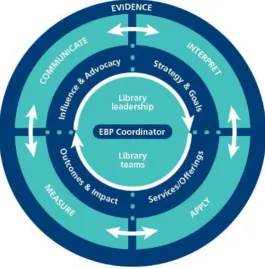
5 To understand evidence-based practice in practice, University of Southern
[image:5.595.165.431.320.590.2]Queensland Library has adopted a framework or “lens” (Figure 1) that explains our approach to working as an evidence-based library. The framework can be applied to an individual situation, team plans or at an organisational level. It is used to explain and apply evidence-based practice in our day-to-day work. The lens is particularly applicable to libraries that have a parent organisation or are accountable to a broader purpose. It recognises the realities of daily professional practice and experience (Howlett & Thorpe, 2018).
Figure 1: A lens for understanding the evidence-based library (Howlett and Thorpe, 2018)
6 influence the sources and types of evidence chosen. The choice of evidence should be tied to the mission of the specific institution (Tenopir, 2013). Once strategic goals are identified, service improvements and decisions can be applied and implemented based on the evidence. By applying outcome-driven services based on strategic priorities, evidence-based practitioners have the opportunity to create and design service offerings in a way that generates bespoke evidence (Grieves, 2017).
Measures of outcomes and impact are the means of gathering and understanding evidence. Data must be interpreted and imbued with meaning; combining
quantitative and qualitative data to form analytics and insights (Grieves, 2017). Libraries must move beyond “tombstone statistics”, such as titles or volumes held, gate counts, classes taught, as they provide an incomplete picture of the library’s impact and may be incomprehensible to stakeholders. (Springmier, Edwards, & Bass, 2018). Non-traditional and emerging methods of evidence gathering, such as techniques from user experience and design thinking methodologies, can
complement statistics, enrich interpretation and add meaning. Appendix 1 identifies a range of methods and measures that can be used to evaluate information services, spaces and collections.
Communicating for influence and advocacy is the element, that if all others are done effectively, generates influence and advocates for what the library is, and what it achieves for the parent organisation, its clients and stakeholders (Howlett & Thorpe, 2018). There is a need to create and communicate a compelling vision of the
7 stakeholder community and the institution as a whole (Pinfield, Cox, & Rutter, 2017). Through these four elements, evidence-based practice can become a conscious and deliberate process of how an organisation operates.
Stakeholder engagement
The role of stakeholders within evidence-based practice is critical, not just as a group to be influenced but also as a source of evidence. Abbott (2006) describes a
research project within which the involvement of stakeholders was an essential feature as their input resulted in an increased understanding of the library’s role in providing an engaging learning environment. In relation to strategic planning, emerging research is exploring how university libraries and library directors use a variety of evidence sources to demonstrate the library’s value, including a focus on methods that involve library stakeholders in the process (Lembinen, 2018; Newton Miller, 2018). By developing a proactive approach that includes seeking, interpreting and using the input of staff, students and community, evidence-based practice approaches can clearly articulate the value of your library (Arizona State University Library, 2017).
Conclusion
Being evidence-based creates a healthy service culture in libraries and information services. By building capacity in evidence-based practice, library professionals can:
• demonstrate value to stakeholders,
• gain a deeper understanding of client needs and experiences,
• promote robust decision making, and
8 Evidence-based practice can be empowering, proving what you know or suspect about your work, your clients and services, and building a platform from which you can convincingly demonstrate your worth to your parent institution, to your clients, and to your industry. An evidence-based culture in your library can be the first of many stepping-stones to a sustainable future (Bell, Moss, Thomas, & McLeod, 2017).
References
Abbott, W. A. (2006). Persuasive Evidence: Improving Customer Service through Evidence Based Librarianship. Evidence Based Library & Information
Practice, 1(1), 11. doi:10.18438/B8H59J
Arizona State University Library. (2017). The future of the academic library print
collection: A space for engagement. Retrieved from
https://lib.asu.edu/sites/default/files/marketing/ASU%20Whitepaper%20-%20Which%20Books.pdf
Bell, N., Moss, M., Thomas, D., & McLeod, J. (2017). Developing an evidence based
culture for documentary heritage collections. Paper presented at the 12th
International Conference on Performance Measurement in Libraries, Oxford. https://northumbria12.exordo.com/files/papers/84/final_draft/Bell_et_al_Oxfor d.pdf
Booth, A. (2002). From EBM to EBL. Medical Reference Services Quarterly, 21(3), 51-64. doi:10.1300/J115v21n03_04
Eldredge, J. D. (2000). Evidence-based librarianship: an overview. Bulletin of the
9 Gillespie, A. (2014). Untangling the evidence: introducting an empirical model for
evidence-based library and information practice. Information Research, 19(3). Retrieved from http://www.informationr.net/ir/19-3/paper632.html
Gillespie, A., Miller, F., Partridge, H., Bruce, C., & Howlett, A. (2017). What do Australian library and information professionals experience as evidence?
Evidence Based Library & Information Practice, 12(41). Retrieved from
doi:10.18438/B8R645
Grieves, K. (2017). Generating bespoke value and impact evidence to inform a
thought-leadership approach to service engagement. Paper presented at the
12th International Conference on Performance Measurement in Libraries, Oxford.
http://programme.exordo.com/northumbria12/delegates/presentation/24/ Howlett, A., & Howard, Z. (2015). Exploring the use of evidence in practice by
Australian special librarians. Information Research, 20(1).
Howlett, A., & Thorpe, C. (2018). "It's what we do here": Embedding evidence-based
practice at USQ library. Paper presented at the Asia Pacific Library and
Information Conference, Gold Coast.
https://aplic.alia.org.au/sites/default/files/AHowlett%20CThorpe_embedding% 20EBP%20at%20USQ%20Library_FINAL.pdf
Jamali, H. R. (2018). Use of research by librarians and information professionals.
Library Philosophy and Practice, 10.
http://digitalcommons.unl.edu/libphilprac/1733
10
Research, 35(111), 18.
http://www.lirgjournal.org.uk/lir/ojs/index.php/lir/article/view/486/527
Koufogiannakis, D. (2011b). Evidence Based Practice: Science? Or Art? Evidence
Based Library & Information Practice, 6, 1-2. doi:10.18438/B8P902
Koufogiannakis, D. (2011c). What is Evidence? Evidence Based Library and
Information Practice, 6(2), 3. doi:10.18438/B8TW52
Koufogiannakis, D. (2012). Academic Librarians' Conception and Use of Evidence Sources in Practice. Evidence Based Library and Information Practice, 7(4), 20. doi:10.18438/B8JC8J
Koufogiannakis, D. (2013). Academic Librarians Use Evidence for Convincing: A Qualitative Study. SAGE Open, 3(2), 12. doi:10.1177/2158244013490708 Koufogiannakis, D. (2015). Determinants of Evidence Use in Academic Librarian
Decision Making. College & Research Libraries, 76(1), 100-114. doi:10.5860/crl.76.1.100
Koufogiannakis, D., & Brettle, A. (Eds.). (2016). Being evidence based in library and
information practice. London: Facet Publishing.
Lembinen, L. (2018). Aademic Library Directors' Strategic Decision-Making Process.
LIBER Quarterly, 27(2), 1-21. doi: 10.18352/lq.10224
Lewis, S., & Wilson, V. (2015). Being a solo EBLIP practitioner. Evidence Based
Library & Information Practice, 10(4), 132-135. doi: 10.18438/B84594
Luo, L. (2018). Experiencing Evidence-Based Library and Information Practice (EBLIP): Academic Librarians' Perspective. College & Research Libraries, 79(4). Retrieved from doi:10.5860/crl.79.4.554
11
Library & Information Science Research, 39(2), 124-130.
doi:10.1016/j.lisr.2017.04.003
Newton Miller, L. (2018). University Community Engagement and the Strategic Planning Process. Evidence Based Library & Information Practice, 13(1), 4-17. doi:10.18438/eblip29351
Partridge, H., Edwards, S. L., & Thorpe, C. (2010). Evidence-based practice :
information professionals' experience of information literacy in the workplace. In A. Lloyd & S. Talja (Eds.), Practising information literacy : bringing theories
of learning, practice and information literacy together. Wagga Wagga, New
South Wales: Centre for Information Studies.
Pinfield, S., Cox, A. M., & Rutter, S. (2017). Mapping the future of academic libraries:
a report for SCONUL. Retrieved from
https://sconul.ac.uk/sites/default/files/documents/SCONUL%20Report%20Ma pping%20the%20Future%20of%20Academic%20Libraries.pdf
Special Libraries Association. (2018). About information professionals. Retrieved from https://www.sla.org/career-center/about-information-professionals/ Springmier, K., Edwards, E., & Bass, M. B. (2018). Sharing Success: A review of
strategic planning, annual reports and publicly available information from academic libraries. Evidence Based Library & Information Practice, 13(2), 70-82. doi:10.8438/eblip29316
Tenopir, C. (2013). Building Evidence of the Value and Impact of Library and Information Services: Methods, Metrics and ROI. Evidence Based Library &
12 Thomas, S., & Wallace, N. (2018). Chatting while you work: Understanding chat
reference user needs based on chat reference origin. Reference Services
13 Appendix 1: Methods for evidence-based practice in libraries
Information
Services
Print collections Electronic/Digital
Collections
Spaces
• Mystery shoppers • Observations of
clients & staff • Statistics • Chat transcripts • Client feedback • Surveys &
evaluations • Focus groups,
interviews, personas
• Anecdotes/stories • Heuristic
• Usage & holdings data – borrowing and ILL statistics, stocktakes • Return on
investment - item usage plus cost of housing the item (current and future value) • Large scale
collection review • Significance
assessment – for a single, group or cluster of items (uniqueness, rarity)
• Accessibility, readability, discoverability
• Usage and non-usage (turnaway) data from vendors & discovery layers • Duplication,
currency (embargoes), accuracy & completeness • Patron driven
acquisition • Search logs • Webpage
analytics
• Vendor support & supply – pricing models, access rights, trials, training • Functionality,
accessibility, ease of use
• Technical feasibility, integration with other
technologies, • Security & privacy
• Observations • Journey maps • Occupancy
counts
• Seating surveys • Gate counts • Wi-fi heat maps • Client feedback &
surveys
14
Clare Thorpe is the Associate Director (Library Quality and Planning) at University of
Southern Queensland. She has worked in academic and state libraries since 2001,
using evidence-based approaches to develop and apply best practices in collection
management, user experiences, staff management, and information literacy design.
Clare’s professional achievements include qualifying for the Australian Library and
Information Association’s Distinguished Certified Professional status in 2016, the
Metcalfe Award for early career achievement (2005) and the Queensland Library
Achiever of the Year (2016).
Contact details:
P.O Box 4393
RACEVIEW QUEENSLAND 4305
Email: [email protected]
Twitter @thorpe_clare