The Parliament of the Commonwealth of Australia
Smart farming
Inquiry into agricultural innovation
House of Representatives
Standing Committee on Agriculture and Industry
© Commonwealth of Australia 2016
ISBN 978-1-74366-514-5 (Printed version) ISBN 978-1-74366-515-2 (HTML version)
This work is licensed under the Creative Commons Attribution-NonCommercial-NoDerivs 3.0 Australia License.
Contents
Foreword ... vii
Membership of the Committee ... ix
Terms of reference ... xi
List of abbreviations ... xiii
List of recommendations ... xv
THE REPORT
1 Introduction ... 1
Background to the inquiry... 1
Conduct of the inquiry ... 1
Structure of the report ... 2
2 Australian agriculture and productivity ... 5
The Australian agricultural sector ... 5
Department of Agriculture and Water Resources ... 5
Agricultural Competitiveness White Paper ... 6
The National Primary Industries Research, Development and Extension Framework ... 7
CSIRO ... 7
State government agencies ... 7
Research and development corporations ... 8
Cooperative Research Centres ... 10
History of innovation and productivity performance ... 11
Trends and variability ... 12
Productivity growth and improvement: case studies ... 15
Wheat ... 15
Cotton ... 15
Dairy ... 18
Slowdown of productivity growth ... 19
Scope for future improvements ... 21
Reaching full potential of existing technology... 21
Transformational change ... 23
Outlook and predicted growth ... 23
3 Emerging technologies in agriculture ... 27
Trends ... 28
Biological science ... 29
Materials science ... 31
Seasonal forecasting ... 31
Digital science ... 32
Adoption of emerging technologies ... 34
The enabling environment ... 35
Committee comment ... 37
4 Telecommunications and data services ... 39
Role of telecommunications and data ... 39
Access to telecommunications infrastructure ... 41
Internet access and the National Broadband Network ... 43
Mobile networks ... 44
Satellite services ... 47
Adoption of data services ... 49
Data standards ... 50
Data ownership and access ... 50
Security and privacy ... 51
Committee comment ... 52
5 Human capital ... 57
Access to leaders ... 57
Access to skilled labour ... 59
Geography ... 60
Access to unskilled labour ... 61
Access to skills ... 62
Researchers ... 64
Extension and adoption ... 68
Extension ... 69
Adoption ... 72
Committee comment ... 75
6 A coordinated approach to research and development ... 79
Collaboration in research and development ... 80
Industry collaboration ... 80
Cross-sectoral collaboration ... 84
Committee comment ... 87
A partnership approach ... 89
A case study: Cotton ... 90
A case study: GRDC and Bayer partnership ... 91
Committee comment ... 92
National research and development priorities ... 92
Committee comment ... 95
7 Regulation ... 97
Overview of existing regulatory framework ... 97
Productivity Commission review into Regulation of Agriculture ... 98
Agricultural and veterinary chemicals ... 99
Product registration ... 100
Product labelling ... 102
Committee comment ... 102
Gene technology ... 104
Lack of national regulatory consistency ... 106
Regulation of low-level presence ... 108
Committee comment ... 110
Drones ... 112
Regulatory issues ... 114
Committee comment ... 116
APPENDICES
Appendix A: List of submissions ... 119
Appendix B: List of exhibits ... 125
Appendix C: List of public hearings ... 127
Foreword
Australia has always been a world leader in agricultural innovation. Our farmers, supported by researchers, industry groups and other stakeholders, remain at the global forefront of the invention and adoption of technologies. This enthusiasm for change and innovation has helped Australian agriculture to retain its competitive edge over other producers.
Technological advances will be even more important to the future of Australian agriculture. The sector is a part of the broader boom in innovation across the Australian economy. Meanwhile, new technologies will support farm businesses to tackle heightened regional competition, growing resource scarcity, and other challenges.
The agriculture sector must be able to make the most of the innovation boom in order to support productivity growth and to maintain its competitiveness. At the core of the agricultural innovation boom are individual farm businesses that make decisions to adopt new technologies. If the Government wishes to support
innovation and growth, it must support these businesses in technology adoption. In this light, the Committee agreed to conduct an inquiry into emerging
agricultural technologies, key barriers to their adoption, and what the Government may do to remove or reduce these barriers.
The Committee was pleased to hear of the vast scope and potential of emerging technologies in agriculture. These technologies will be different from those that have come before. They will perform ever more complex and varied tasks; they will collect and share greater volumes of data; and they will be more integrated across farms and along supply chains.
It became clear that these complex new technologies will bring their own challenges to farm businesses seeking to adopt them. Some of these barriers to successful adoption stem from the demands on internet, cloud and other physical infrastructure. In other cases, some regulations may unfairly impede the use of new technologies.
innovation system and into the hands of the end user. There needs to be more collaboration between the organisations in the R&D process. There also needs to be a surge in the skilled researchers and workers supporting the sector.
The Government has already taken strong steps to support innovators in tackling the agriculture sector’s challenges, such as through the ongoing rollout of the National Broadband Network.
In other cases, the Committee’s recommendations have supported the tailoring of existing programs to the needs of the sector as it undergoes technological
transformation. Regulation of technologies like unmanned aerial vehicles, and strategies in areas such as STEM education, may be helpfully adjusted to improve the capabilities of the agriculture sector to adopt new technologies.
These recommendations of the Committee have focussed on ensuring that the Government is responsive to the needs of farm businesses seeking to adopt
innovation. The Committee has also recommended ways to support other players in the agricultural innovation system to do the same, for example through
continued use of the successful Cooperative Research Centre program.
The Committee would like to express its appreciation to all who have contributed their valuable time and wisdom throughout the course of the inquiry.
Membership of the Committee
Chair Mr Rowan Ramsey MP
Deputy Chair Ms Clare O’Neil MP
Members The Hon. Joel Fitzgibbon MP Ms Melissa Price MP
Ms Michelle Landry MP Mr Dan Tehan MP (to 11/2/2016) Ms Nola Marino MP (from 11/2/2016) Mr Rick Wilson MP
Committee Secretariat
Secretary Ms Peggy Danaee
Inquiry Secretaries Mr Anthony Overs
Mrs Renee Toy (from 9/12/15)
Research Officers Ms Sarah Codrington
Dr Ashley Stephens
Ms Georgina Horsburgh (from 1/2/16)
Office Manager Ms Morana Kavgic
Terms of reference
The Committee will inquire into and report on the role of technology in increasing agricultural productivity in Australia. The inquiry will have particular regard to:
improvements in the efficiency of agricultural practices due to new
technology, and the scope for further improvements;
emerging technology relevant to the agricultural sector, in areas
including but not limited to telecommunications, remote monitoring and drones, plant genomics, and agricultural chemicals; and
List of abbreviations
ABARES Australian Bureau of Agricultural and Resource Economics and Sciences
ACFR Australian Centre for Field Robotics ACOLA Australian Council of Learned Academies ADF-DA Australian Dairy Farmers and Dairy Australia AIA Ag Institute Australia
ATSE Australian Academy of Technological Sciences and Engineering
APVMA Australian Pesticides and Veterinary Medicines Authority AusBiotech Australia’s Biotechnology Organisation
AWiA Australian Women in Agriculture CASA Civil Aviation Safety Authority CBA Cotton Breeding Australia
CC-SC-ALFA Cattle Council, Sheepmeat Council and Australian Lot Feeders Association
CRC Cooperative Research Centre
CRDC Cotton Research and Develop Corporation
DAWR Department of Agriculture and Water Resources (Cth) GHS Globally Harmonised System of Classification and Labelling
of Chemicals
GM genetically modified GPS Global Positioning System
GRDC Grains Research and Development Corporation GTR Gene Technology Regulator
NBN National Broadband Network
NHMRC National Health and Medical Research Council NRWC National Rural Women’s Coalition
PBCRC Plant Biosecurity Cooperative Research Centre
PIRSA Department of Primary Industries and Regions South Australia
R&D research and development
RD&E research, development and extension RDC Research and Development Corporation RFID Radio frequency identification
RIRDC Rural Industries Research and Development Corporation STEM science, technology, engineering and mathematics
TAFE Technical And Further Education institutions
List of recommendations
4 Telecommunications and data services
Recommendation 1The Committee recommends that the Commonwealth Scientific and Industrial Research Organisation, in cooperation with industry,
undertake a technical study to identify cost-effective approaches to using satellite services as backhaul for local wireless networks for agricultural applications.
Recommendation 2
The Committee recommends that the Australian Government commit to the continuation of the Mobile Black Spot Programme beyond the second round, and that the Department of Communications and the Arts
consider changes or additions to the selection criteria to capture the telecommunications requirements of agricultural activity.
Recommendation 3
The Committee recommends that the Australian Government, in
consultation with industry stakeholders, investigate incentives for mobile network operators to provide roaming services in rural and remote areas. Recommendation 4
The Committee recommends that the Department of Agriculture of Water Resources, in conjunction with public and private infrastructure providers, publish consolidated information about the availability of telecommunications services in rural and remote agricultural areas. Recommendation 5
5 Human capital
Recommendation 6The Committee recommends that the Australian Government ensure that rural women’s groups are included in future government-led policy-building activities and inquiries.
Recommendation 7
The Committee recommends that the Australian Government target funding for the development of innovative education strategies for agriculture, within the current science, technology, engineering and mathematics funding program.
Recommendation 8
The Committee recommends that the Australian Government provide assistance and support to farmers’ groups to pursue farming
benchmarking and support the development of national data sets.
6 A coordinated approach to research and development
Recommendation 9
The Committee recommends that the Department of Agriculture and Water Resources, in conjunction with the Department of Industry, Innovation and Science, investigate establishing appropriate incentives for the greater allocation of resources from rural Research and
Development Corporations to relevant Cooperative Research Centres. Recommendation 10
The Committee recommends that the Australian Research Council review its programs for funding research, with a view to increasing the duration of grants to be at least five years.
Recommendation 11
The Committee recommends that the Australian Government develop a national working group on agricultural innovation, focused on improved functionality of the agrifood/fibre innovation system. This working group should be developed as part of a wider strategy of cross-sectoral agricultural innovation, within the National Primary Industries RD&E Framework.
7 Regulation
Recommendation 12
Australian Pesticides and Veterinary Medicines Authority to use the decisions of trusted and comparable international regulators as a basis for product registration.
Recommendation 13
The Committee recommends that the Australian Government, through the Council of Australian Governments, pursue reform options to ensure national consistency in the regulation of gene technology.
Recommendation 14
The Committee recommends that the Australian Government commission an independent review of the implementation and effectiveness of the Gene Technology Agreement with particular reference to the impact of moratoria invoked by state and territory governments under the Recognition of Designated Areas Principle. Recommendation 15
The Committee recommends that the Department of Agriculture and Water Resources, in cooperation with Standards Australia, update the National Standard for Organic and Bio-Dynamic Produce to introduce a threshold for approved genetically-modified material consistent with comparable international standards.
Recommendation 16
The Committee recommends that the Department of Agriculture and Water Resources and the Civil Aviation Safety Authority develop appropriate extension materials promoting the appropriate use of unmanned aerial vehicles in the Australian agricultural sector. Recommendation 17
1
Introduction
Background to the inquiry
1.1 On 11 August 2015, the Minister for Agriculture, the Hon. Barnaby Joyce MP, wrote to the Committee requesting that it inquire into and report on the role of technology in increasing agricultural productivity in Australia. 1.2 On 13 August 2015, the Committee adopted the terms of reference referred
by the Minister and commenced its inquiry into agricultural innovation. In accordance with the terms of reference, particular regard was given to:
improvements in the efficiency of agricultural practices due to new
technology, and the scope for further improvements;
emerging technology relevant to the agricultural sector, in areas
including but not limited to telecommunications, remote monitoring and drones, plant genomics, and agricultural chemicals; and
barriers to the adoption of emerging technology.
Conduct of the inquiry
1.3 The inquiry was advertised on 13 August 2015. Submissions were invited from state governments, a range of Australian Government departments, researchers and research bodies, and industry groups.
1.4 The Committee received 116 submissions and 16 supplementary submissions. A full list of submissions can be found in Appendix A. In addition, 12 exhibits were presented to the committee, which are listed in Appendix B.
New South Wales (Armidale and Sydney). A wide range of witnesses gave evidence to this inquiry, and their names and organisations are listed in Appendix C.
1.6 Three site inspections were also conducted during the inquiry. In January, the Committee visited the Alpine Valleys Dairy Pathways Project in the Kiewa Valley where it met with the representatives of the Project and members of the local community. In April, the Committee visited the University of New England’s Kirby SMART Farm in Armidale, and the Australian Centre for Field Robotics at the University of Sydney.
1.7 The Committee wishes to thanks to all those who facilitated its site inspections. Having the opportunity to visit these hubs of agricultural innovation in person made a valuable contribution to the Committee’s inquiry.
1.8 The Committee also expresses its appreciation to all stakeholders who made written submissions to the inquiry or who took the time to meet with the Committee. The Committee acknowledges their significant contribution to the inquiry overall.
Structure of the report
1.9 The report consists of six chapters and four appendices.
1.10 Chapter 2 provides an overview of the structure of the Australian agriculture industry, including a brief summary of the roles of
government and industry bodies. The chapter also addresses the first term of reference, providing some background information and case studies in relation to agricultural productivity improvements made in the past, and describes the current state of the agriculture sector in relation to
productivity.
1.11 Chapter 3 addresses the second term of reference, by describing emerging technologies the Committee had heard about, and highlighting their potential to improve agricultural productivity into the future.
1.12 The remainder of the report—Chapters 4 to 7—addresses the inquiry’s final term of reference: barriers to the adoption of emerging technology. Each chapter focuses on a different set of barriers identified by evidence to the inquiry, and makes recommendations for government action targeted at overcoming these barriers.
relating to access to mobile and internet services, and factors impeding the adoption of data services in agriculture.
1.14 Chapter 5 addresses a range of barriers to innovation as they pertain to human capital, including workforce issues in agriculture, access to
appropriate education for future members of the sector, and ensuring the industry is able to attract and retain the expertise required to drive
research in agricultural innovation.
1.15 Chapter 6 focuses on the relationships between different stakeholders in the sector, and industry collaboration with government. It establishes the need for better cooperation and partnerships across the sector, and looks at the establishment of national priorities for research, development and extension in agriculture.
1.16 The final chapter of this report addresses the regulatory framework within which agricultural innovation takes place. Specifically, Chapter 7
considers some of the regulatory barriers to the development and adoption of innovation in agriculture, and makes recommendations for changes.
1.17 Throughout the report, readers will find references to a range of inter-related terms used to denote the process of innovation, encompassing education, research, development, extension and adoption. For example, while the term ‘research and development’ (R&D) has been used
traditionally, more recently the trend has been to use alternatives which specifically acknowledge other important parts of the innovation process, such as ‘research, development and extension’ (RD&E).
1.18 In this report, such terms are used interchangeably, in acknowledgment of the fact that, while different stakeholders will wish to emphasise different parts of the innovation process, the entire process is relevant to the
Committee’s consideration of agricultural innovation.
1.19 Where references are made to evidence received by the Committee, the report will generally use the terminology offered by each witness. Otherwise, for the sake of simplicity and brevity, the report gives
preference to ‘R&D’ being used to refer to the innovation process, while acknowledging that this process encompasses much more than simply ‘research’ or ‘development’.
1.20 The majority of submissions to the inquiry focused on land-based food and fibre production. Deakin University considered agriculture to include fishing and aquaculture,1 as did the National Rural Women’s Coalition.2
1 Deakin University, Submission 28, p. 2.
2
Australian agriculture and productivity
2.1 This chapter of the report briefly outlines the structure of the Australian agriculture industry and examines efficiency improvements in Australian agricultural practices due to new technology, with reference to several case studies.
2.2 The chapter then discusses slowdown of productivity growth in recent years in the agriculture sector. The chapter concludes with discussion on the scope for further productivity growth in the industry.
The Australian agricultural sector
2.3 This section of the chapter outlines the existing policy and research
structures within the Australian agricultural sector. First, Commonwealth contributions are outlined, including those of the Department of
Agriculture and Water Resources; the Agricultural Competitiveness White Paper; the National Primary Industries Research, Development and Extension Framework; and the Commonwealth Scientific and Industrial Research Organisation (CSIRO). Contributions by state governments, industry and research bodies are also discussed.
Department of Agriculture and Water Resources
2.4 The Australian Government Department of Agriculture and Water
Resources (DAWR) develops policy and provides services to improve the productivity, competitiveness and sustainability of Australian agriculture, fisheries, forestry and related industries. DAWR also supports farmers in times of hardship and assists with risk management and planning.1
2.5 Several submissions touched on the role that government should play in providing funding for agricultural research, development and extension.2
2.6 Submissions to the inquiry suggested that DAWR should have:
a clear role in setting research priorities and supporting research that
underpins discovery.3
a consultative role in facilitating collaborations.4
a role in promoting leadership within the sector by implementing
research priorities through the Rural Research and Development (R&D) for Profit Programme.5
Agricultural Competitiveness White Paper
2.7 The Agricultural Competitiveness White Paper (the White Paper), released in 2015, outlines the Australian Government’s five key priorities for the agricultural sector.6
2.8 These priorities include: ensuring a fairer go for farm businesses; building the infrastructure of the 21st century; strengthening the approach to
drought and risk management; and promoting access to premium markets. The final area of focus, ‘farming smarter’, is the priority area most relevant to the present inquiry.7 In particular, the farming smarter
chapter of the White Paper emphasises the need for access to advanced technologies and practices, including better research and development and access to skilled workers.8
2 Council of Rural Research and Development Corporations, Submission 90, p. 5; Cattle Council of Australia, Sheepmeat Council of Australia and Australian Lot Feeders Association,
Submission 84, pp. 10, 17; The University of Queensland, Submission 2, p. 1; AusBiotech,
Submission 33, pp. 3, 6, 16.
3 Grain Trade Australia, Submission 21, p. 2; Murdoch University, Submission 37, p. 3. 4 Murdoch University, Submission 37, p. 3.
5 Mr Paul Morris, Acting Deputy Secretary, Department of Agriculture and Water Resources,
Committee Hansard, Canberra, 17 March 2016, p. 1.
6 DAWR, Submission 88, p. 4; Council of Rural Research and Development Corporations,
Submission 90, p. 10.
7 DAWR, ‘Agricultural Competitiveness White Paper: at a glance2015’ <agwhitepaper. agriculture.gov.au/white-paper/white-paper-at-a-glance> viewed 1 April 2016. 8 DAWR, ‘Agricultural Competitiveness White Paper 2015’ <agwhitepaper.agriculture.
The National Primary Industries Research, Development and
Extension Framework
2.9 The National Primary Industries Research, Development and Extension Framework was created in 2005, through the then Primary Industries Ministerial Council. The framework was endorsed by primary industries ministers and brings together Commonwealth, state and territory
governments, the rural research and development corporations (RDCs), CSIRO, the Bureau of Meteorology, and the university sector through the Australian Council of Deans of Agriculture. The Framework seeks to deliver a more coordinated and collaborative approach to research, development and extension (RD&E) for rural industries in Australia.9
2.10 The framework has facilitated a process through which national RD&E capacity can be more effectively focused and efficiently deployed through strategies for 14 primary industry sectors, and addressing eight cross-sectoral issues. The process allows RDCs to work with research providers to identify potentially useful emerging technologies and then to
strategically invest as and where needed along the pathway to adoption.10
CSIRO
2.11 CSIRO is Australia’s leading agricultural research entity, and aims to help Australian farming businesses and industry improve productivity and sustainability across the agriculture sector.
2.12 CSIRO’s agricultural research arm concentrates on animal science, aquaculture, plant science, digital agriculture, food security and sustainable farm management.11
State government agencies
2.13 State government agriculture departments play a key role in the Australian agriculture industry. However, there has been a significant reduction in funding support and extension delivery in the past decade. This is discussed further in Chapter 5.
2.14 The South Australian Government’s lead agency, Primary Industries and Regions South Australia (PIRSA), is involved in many activities which accelerate the adoption of new and more efficient agricultural practices.12
9 Council of Rural RDCs, Submission 80, p. 8. See also, National Primary Industries RD&E Framework <www.npirdef.org> viewed 16 April 2016.
10 Council of Rural RDCs, Submission 80, p. 8. See also, National Primary Industries RD&E Framework <www.npirdef.org> viewed 16 April 2016.
2.15 The research and development arm of PIRSA seeks to deliver robust scientific solutions to support sustainable and internationally competitive primary industries.13
2.16 The PIRSA submission to the inquiry noted that these activities are usually conducted through partnerships with South Australian industry, the Australian Government and other research organisations such as universities or CSIRO.14
2.17 The Tasmanian Government also recognises the importance of investing in agricultural research, development and extension at the state level, which it does in partnership with the University of Tasmania.15
2.18 The Tasmanian Government’s Cultivating Prosperity in Agriculture policy sets out its vision to increase the annual farm gate value of Tasmanian agriculture tenfold to $10 billion per year by 2050.16
2.19 The Tasmanian Government is setting out to achieve this vision through co-investment in irrigation infrastructure, strategic investment in research, development and extension activities and supporting better skills
pathways.17
Research and development corporations
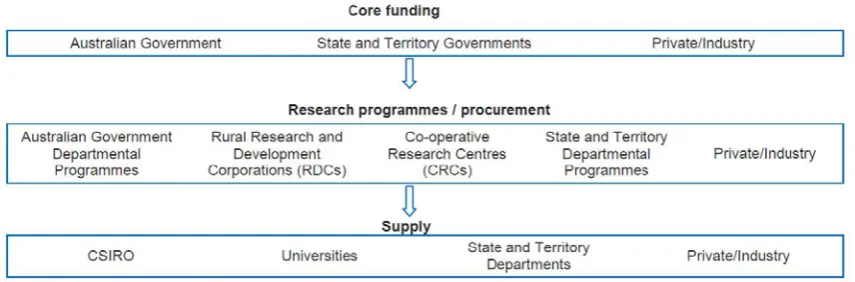
2.20 The 15 rural research and development corporations, which are
established partnerships between government and industry, play a key role in the agricultural innovation system.18
2.21 The RDCs were created with the objective of sharing funding and setting the strategic direction for investment in R&D. The RDCs also have a role in extension; that is, ensuring new technologies are able to be
implemented by farming businesses.
2.22 The roles of the RDCs include prioritising and funding the research, development and extension of new technologies that can improve the economic, environmental and social performance of Australia’s rural industries.19
2.23 The Council of Rural Research and Development Corporations (Council of Rural RDCs) represents all of the 15 rural RDCs, and exists to support and
13 PIRSA, Submission 19, p. 3. 14 PIRSA, Submission 19, p. 3.
15 Tasmanian Government, Submission 58, p. 2. 16 Tasmanian Government, Submission 58, p. 1. 17 Tasmanian Government, Submission 58, p. 1.
18 Dr Daniel Walker, Research Director, Agriculture, CSIRO, Committee Hansard, Canberra, 26 November 2015, p. 1.
facilitate the RDCs to fulfil their broad purpose where action by any of the individual organisations would be impossible, impractical, inefficient or ineffective.20 The Council of Rural RDCs provides a mechanism for RDCs
to combine their resources and networks to share information, amplify and disseminate messages, and engage with common stakeholders.21
2.24 The Council of Rural RDCs explained that RDCs ensure industry has sufficient and appropriate levels of information to determine whether a technology is suitable and under what circumstances, what benefits it offers, and what risks may need to be managed should it be adopted.22
2.25 The R&D innovation structure and associated issues related to the operation of RDCs are further examined in Chapter 6 of this report.
Levy system
2.26 Contributions to research and development investment from the agricultural industry are made through levies on production. The
Australian Government collects levies on behalf of the industries, and also provides a matching contribution on a dollar-for-dollar basis, up to a capped limit.23
2.27 Agricultural levies are an important source of funding for agricultural R&D for many commodities.24 The levy system ensures that both
industries and the Commonwealth contribute to research with public and private benefits.25 It also ensures adequate investment in industry
initiatives, as individual farmers and producers acting in isolation may not obtain a return on individual investments.26
2.28 The establishment of a new levy would generally come about through an industry body identifying the need for a levy to address an issue requiring collective industry funding. The organisation would then put a levy
proposal to its members, possibly in consultation with DAWR.27
2.29 The availability of ‘matched industry money’ as a result of levies gives confidence to investors—including state governments and universities—to
20 Council of Rural RDCs, Submission 90, p. 3. 21 Council of Rural RDCs, Submission 90, p. 3. 22 Council of Rural RDCs, Submission 90, p. 2.
23 Council of Rural RDCs, ‘The Rural RDC Model – funding arrangements’ <www.ruralrdc. com.au/rural-innovation-in-australia/#rural-rdc-model > viewed 13 April 2016.
24 Council of Veterinary Deans of Australia and New Zealand, Submission 46, p. 1; Mr Anthony Battaglene, Winemakers’ Federation of Australia, Committee Hansard, Canberra, 4 February 2016, p. 1.
25 Council of Veterinary Deans of Australia and New Zealand, Submission 46, p. 1. 26 Australian Pork Limited, Submission 70, p. 4.
invest in the most significant areas of RD&E.28 Money, effort and
confidence are leveraged into the priority innovation areas.29
Rural Research and Development for Profit Programme
2.30 The Rural R&D for Profit Programme is a $200 million competitive grants program which encourages RDC collaboration for innovation. Grants are provided to RDCs and partners for collaborative research which enhances farm-gate profitability and supports the continued innovation of
Australia’s primary industries.30
2.31 One of the conditions of grants under the program is that applicants must be RDCs collaborating with other RDCs.31
2.32 The program began in 2014–15 as a four year program and was due to conclude in 2017–18. However, the Australian Government has committed to extend the programme by a further four years, with additional
funding.32 This program is discussed further in Chapter 6.
Cooperative Research Centres
2.33 Cooperative Research Centres (CRCs) are structures through which participants within the research system, particularly at the provider end, come together to work on a specific problem within a defined period.33
2.34 Mr Tim Lester, from the Council of Rural RDCs, suggested that CRCs are important mechanisms to drive collaboration, however their role is different to that of RDCs, being both time bound and limited in scope.34
2.35 The Committee was told that one of the jobs of RDCs was to position the role of a particular CRC within the strategic priorities of the industry with which they work, and the broader context of the rural innovation system.35
2.36 Professor James Rowe, Chief Executive of the CRC for Sheep Industry Innovation, noted that RDCs were research investors, in contrast to CRCs, which were ‘research doers’.36
28 Council of Veterinary Deans of Australia and New Zealand, Submission 46, p. 1. 29 Council of Veterinary Deans of Australia and New Zealand, Submission 46, p. 1. 30 DAWR, Submission 88, p. 5.
31 DAWR, ‘Rural Research and Development for Profit’ <www.agriculture.gov.au/ag-farm-food/innovation/rural-research-development-for-profit> viewed 6 April 2015.
32 DAWR, Submission 88, p. 5.
33 Mr Tim Lester, Operations Manager, Council of Rural RDCs, Committee Hansard, Canberra, 25 February 2016, p. 2.
34 Mr Tim Lester, Operations Manager, Council of Rural RDCs, Committee Hansard, Canberra, 25 February 2016, p. 2.
History of innovation and productivity performance
2.37 Submissions to the inquiry discussed at length the growth in productivity in the Australian agricultural industry over the last several decades. Each of those submissions explained that productivity growth has been
underpinned by advances in technology.
2.38 PIRSA argued that agriculture is one of the most efficient industries in Australia due to a long history of adopting new technological
innovation.37 PIRSA stated that, from 1989–90 to 2013–14, multifactor
productivity in agriculture had been increasing annually at 2.7 per cent, which is considerably higher than the market sector average.38
2.39 Australian Bureau of Agricultural and Resource Economics and Sciences (ABARES) research reports support the commonly held notion that past growth has been underpinned by adoption of technology.39 In particular,
adoption of new technologies has been responsible for such growth over and above changes in the scale of farms.
2.40 The Ag Institute Australia (AIA) stated that productivity and efficiency gains have been derived from a mix of transformational and incremental innovations, with the source of these innovations being varied and unpredictable.40
2.41 The AIA submission explained that all productivity and efficiency gains have depended on strong strategic investment in public sector and private sector research, effective collaboration between the sectors and close engagement with producers.41
2.42 The submission added that, in many cases, the transformational
technologies have been created in the public sector—often at universities, CSIRO and state government agriculture departments—and have
subsequently been developed and commercialised by the private sector and embraced by primary producers.42
36 Professor James Rowe, CEO, CRC for Sheep Industry Innovation, Committee Hansard,
Armidale, 13 April 2016, p. 30. 37 PIRSA, Submission 19, p. 3. 38 PIRSA, Submission 19, p. 3.
39 Sheng, Y., Gray, E.M., Mullen, J.D. and Davidson, A. (2011) Public investment in agricultural R&D and extension: an analysis of the static and dynamic effects on Australian broadacre productivity. ABARES research report 11.7, Canberra; Gray, E.M., Oss-Emer, M. and Sheng, Y. (2014)
Australian agricultural productivity growth: past reforms and future opportunities. ABARES research report 14.2, Canberra.
2.43 The submission from Southern Farming Systems and the Australian Controlled Traffic Farming Association discussed increased productivity performance and a key reason behind that improvement:
Australian agricultural productivity has increased steadily by about two per cent per year since the 1950s and much of this can be attributed to improvements in cultivars, agronomy, farming systems and technologies brought about through structured research and development conducted either directly or indirectly through Australia’s Rural Research and Development
Corporations.43
2.44 A 2011 research report produced by ABARES provided evidence of the important contribution of public research and development to broadacre total factor productivity in Australia.44 The report found that:
… over the past 50 years, knowledge and technology accumulated from past public investments in [research, development and extension] in Australia and overseas have accounted for almost two thirds of average annual broadacre productivity growth.45
2.45 ABARES, in its analysis for the report, calculated that every $1 in public investment in research, development and extension produces $12 in benefits to farmers in the long term.46
Trends and variability
2.46 Several inquiry stakeholders noted that there is variability in productivity growth across different sectors of the agricultural industry, and across different periods of time. Furthermore, productivity growth can be driven by different factors in different sectors.
2.47 For example, the AIA noted that cotton industry productivity gains have exceeded 1.5 per cent per annum, while productivity gains in grains and sugar have been less than one per cent per annum over the same period.47
43 Southern Farming Systems and the Australian Controlled Traffic Farming Association,
Submission 61, p. 2.
44 Sheng, Y., Gray, E.M., Mullen, J.D. and Davidson, A. (2011) Public investment in agricultural R&D and extension: an analysis of the static and dynamic effects on Australian broadacre productivity. ABARES research report 11.7, Canberra.
45 DAWR, Submission 88, p. 10. 46 DAWR, Submission 88, p. 10.
Sheng, Y., Gray, E.M., Mullen, J.D. and Davidson, A. (2011) Public investment in agricultural R&D and extension: an analysis of the static and dynamic effects on Australian broadacre productivity. ABARES research report 11.7, Canberra.
2.48 Similarly, the Cattle Council of Australia, Sheepmeat Council of Australia and Australian Lot Feeders Association stated that, over the long term, beef enterprises were maintaining productivity growth at 0.9 per cent per annum, while sheep enterprises grew at 0.5 per cent per annum.48
2.49 A 2014 research report produced by ABARES stated that average productivity growth across all broadacre agriculture (non-irrigated
cropping and extensive livestock industries) has been around one per cent per annum for more than three decades. The report explained that this has largely been due to reduced input use rather than output growth.49
2.50 The AIA added that, in the grains, sugar and animal production
industries, gains in the efficiency of water use and labour efficiency have been substantial, relating these gains directly to innovation.50
2.51 The ABARES report explained that trends among individual broadacre industries varied markedly over time:
Productivity growth of cropping specialists averaged 1.5 per cent a year between 1977–78 and 2010–11, higher than the rate observed over the same period on farms in the beef (0.9 per cent) and sheep (0.0 per cent) industries. However, following the dismantling of the wool reserve price scheme in 1991, sheep industry productivity has increased at an average rate of 1.4 per cent a year since the mid-1990s … The dairy industry has realised average annual productivity growth of around 1.6 per cent since the late 1970s.51
2.52 The report also stated that productivity growth varies considerably across farms, industries and regions.52
Technological advances in agriculture
2.53 The Warren Centre for Advanced Engineering explained that agriculture has historically benefitted from technology adoption, with the industrial age bringing mechanisation and synthetic fertilisers, and the technology
48 Cattle Council of Australia, Sheepmeat Council of Australia and Australian Lot Feeders Association, Submission 84, p. 7.
49 Gray, E.M., Oss-Emer, M. and Sheng, Y. (2014) Australian agricultural productivity growth: past reforms and future opportunities. ABARES research report 14.2, Canberra, p. 9.
50 Ag Institute Australia, Submission 73, p. 1.
51 Gray, E.M., Oss-Emer, M. and Sheng, Y. (2014) Australian agricultural productivity growth: past reforms and future opportunities. ABARES research report 14.2, Canberra, p. 10.
age delivering genetic engineering and automation.53 The Warren Centre
added that the information age brings the potential for integrating technology advances into a precision agriculture that drives growth and productivity.54
2.54 The University of Sydney considers that new technologies encompass new physical instruments and products along with new knowledge, skills and management techniques. Its submission explained that the latter are essential for the former to succeed.55
2.55 The Rural Industries Research and Development Corporation (RIRDC) submission stated that agricultural productivity gains have been driven by technology:
Since the 1960s, agriculture has benefited from increased use of agrochemicals, advances in crop and animal genetics, agricultural mechanisation and improved management practices. These technologies have driven productivity increases and will continue to provide future incremental improvements.56
2.56 The Charles Sturt University submission provided examples of large-step changes and incremental changes that have contributed to productivity growth in agriculture:
Notable examples of large step-changes include the introduction of no-till farming (facilitated by the availability of new herbicides), which greatly reduced input costs, retained more soil moisture and improved crop yields; and the introduction of subterranean clover in southern Australian livestock systems which improved soil fertility and increased livestock growth rates and carrying capacity. Incremental improvements (through plant and animal breeding, improved management practices) have built on these large changes to result in further production gains through improved water use efficiency, stress tolerance (e.g. disease and frost), feed conversion efficiency and product quality.57
53 Warren Centre for Advanced Engineering, Submission 43, p. 2, referencing Whelan, B. M. (1997). The Impact of Precision Agriculture. Proceedings of the ABARE Outlook Conference, ‘The Future of Cropping in NW NSW’, p. 5. Moree, UK.
54 Warren Centre for Advanced Engineering, Submission 43, p. 2, referencing Zhang, N. M. (2002). Precision agriculture - a worldwide overview. Computers and Electronics in Agriculture, 113-132.
55 University of Sydney, Submission 40, p. 4.
2.57 Submissions to the inquiry provided examples of advances in technology that have benefited agriculture in Australia. The examples were extensive and quite comprehensive. A list of examples can be found in Appendix D.
Productivity growth and improvement: case studies
Wheat
2.58 The CSIRO submission to the inquiry provided details on the historical improvement in wheat yields in Australia:
… yield progress has been characterised by phases of gain interspersed with ‘plateau periods’ where progress slows. The intermittent periods of rapid yield improvement occurred where packages of improved management combined to allow the underlying improvements in genetic yield potential to be realised.58
2.59 The submission further explained that, according to the history of progress in wheat yields, there is no single technology that has contributed to jumps in yield.59
Cotton
2.60 The Committee heard that the Australian cotton industry is an exemplar for productivity growth in Australian agriculture. The CSIRO submission stated that the Australian cotton industry is worth $2.5 billion per annum in exports, supports up to 10,000 jobs,60 and relies heavily on science-based
innovation.61
2.61 Cotton Australia explained that the Australian cotton industry is recognised internationally as innovative and dynamic, largely due to industry investment in RD&E:
Australian cotton is world leading for yield and quality and is underpinned by a world-class best management practice system that aligns with global initiatives for delivery of responsibly produced cotton. This success is due to industry investment in world-class research and rapid adoption of emerging science, innovations and technology to drive profitability.62
58 CSIRO, Submission 55, p. 8. 59 CSIRO, Submission 55, p. 8.
60 Cotton Australia, Submission 72, p. 1. 61 CSIRO, Submission 55, p. 14.
2.62 Mr Adam Kay, Chief Executive Officer of Cotton Australia, described the rise of the Australian cotton industry over the last two or three decades:
… we are now the number one country for yield around the
world, so we produce about three times the global average in yield of cotton, and we are up there as the highest quality of cotton out there, which means that Australian cotton is in demand.63
2.63 Mr Kay explained that the cotton industry is recognised for innovation, being open to change and being prepared to take risks with technology.64
He discussed some of the reductions in water and pesticide use in the cotton industry, due to the adoption of new technologies:
… we have been able in the last 20 years to reduce the amount of pesticide we use in the Australian cotton industry by 92 per cent. That is moving from back in the days of a dozen insecticide sprays onto a crop down to sometimes one these days—there are a lot of growers with none. We have been able to increase our water use efficiency in the last decade by 40 per cent.65
2.64 Mr Kay also explained that a key development has been a significant improvement in land use efficiency, producing twice the amount of fibre from the same area of land.66
2.65 The Cotton Research and Development Corporation (CRDC) outlined benefits of the introduction of biotechnology to the cotton industry, the environment, and society more broadly:
increased populations of beneficial insects and wildlife in
cotton fields;
reduced pesticide run off;
improved farm worker and neighbour safety; a decrease in labour and fuel usage;
improved soil quality; reduced production costs; increased yield;
reduced risks; and
further opportunities to grow cotton in areas of high pest
infestation.67
63 Mr Adam Kay, Chief Executive Officer, Cotton Australia, Committee Hansard, Canberra, 29 February 2016, p. 7.
64 Mr Adam Kay, Chief Executive Officer, Cotton Australia, Committee Hansard, Canberra, 29 February 2016, p. 7.
65 Mr Adam Kay, Chief Executive Officer, Cotton Australia, Committee Hansard, Canberra, 29 February 2016, p. 7.
2.66 The CSIRO submission stated that productivity growth in the Australian cotton industry has continued, with yields improving at two per cent per annum, which is greater than in any other agricultural sector in Australia.68 CSIRO added that 45 per cent of the improvement is due to
better cotton varieties, and 55 per cent due to better management.69
2.67 When asked if the significant reduction in pesticide use was solely down to genetically modified cotton breeds, Mr Kay explained that integrated pest management programs play a significant role:
Yes, the Bt cotton handles a couple of the pests, but there are still other pests there and our growers are using integrated pest management as well as some area-wide management techniques. It is all part of a package.70
2.68 Similarly, when asked about water use efficiency improvements being a result of the genetics of the crop, Mr Kay explained that it is a part of a better farming system:
With water-use efficiency, part of it is the genetics but part of it is a whole lot of infrastructure things like the scheduling and the delivery to the farm. There were a lot of losses, so I think a lot of the infrastructure upgrades and the like have been critical there. It is a combination, and some of it is genetics. There is ongoing work in getting more water-use efficient varieties.71
2.69 Mr Kay emphasised the role of the research and development system in taking the Australian cotton industry to world leader status.
I do not think we can highlight enough how the R&D system has helped this industry move to a world-leading industry. It is all on the back of R&D. Yes, we have innovative farmers who are prepared to pick up the R&D and run with it, but it has been the R&D that has allowed us to address some of these key issues: the pesticide-use issues and the water-use issues were things that were impacting on our social licence in our own communities, let alone state and nationally. We have been able to address them effectively, and doing that has given us global recognition.72
67 Cotton Research and Development Corporation, Submission 49, p. 1.
68 CSIRO, Submission 55, p. 14. 69 CSIRO, Submission 55, p. 14.
70 Mr Adam Kay, Chief Executive Officer, Cotton Australia, Committee Hansard, Canberra, 29 February 2016, p. 8.
71 Mr Adam Kay, Chief Executive Officer, Cotton Australia, Committee Hansard, Canberra, 29 February 2016, p. 8.
Dairy
2.70 Submissions from Australian Dairy Farmers and Dairy Australia (ADF-DA) and DAWR summarised an ABARES publication that examined productivity in the Australian dairy industry.
2.71 ABARES conducted a comprehensive assessment of Australian dairy farm performance.73 The research report found that, on average, productivity
growth in the Australian dairy industry has been 1.6 per cent per annum, for the period 1978–79 to 2010–11.74
2.72 The report noted that rates of productivity growth differ across regions, reflecting relative differences in regional industry structures, the extent of uptake of new technologies, and the characteristics of each region that affect the types of farming systems used.75
2.73 The report explains that two key drivers of the observed growth in dairy farm productivity have been the exit of relatively less efficient farms from the industry, and the widespread adoption of new technologies and management practices that have allowed dairy farmers to reduce the quantity of inputs required to produce a given quantity of output.76
2.74 A 2011 report commissioned by Dairy Australia and the Victorian Department of Primary Industries also provided a comprehensive assessment of the impact of innovation for dairy.77
2.75 ADF-DA provided details from the 2011 report, explaining that major increases in on-farm production are estimated to have increased Victorian dairy farm profitability by around $10 billion over the three decades from 1980 to 2010.78
2.76 The report found that nearly half of the increase could be attributed to on-farm innovation; it was estimated to have increased on-farmers’ profitability by around $7.7 billion in net present value terms, whilst only costing approximately $2.3 billion in net present value terms. That represents an estimated cost-benefit ratio of $3.30 economic benefit for each dollar invested in R&D.79
73 Ashton, D., Cuevas‐Cubria, C., Leith, R. and Jackson, T. (2014) Productivity in the Australian dairy industry: pursuing new sources of growth. ABARES research report 14.11, Canberra. 74 Australian Dairy Farmers and Dairy Australia, Submission 65, p. 2; DAWR, Submission 88,
p. 12.
75 DAWR, Submission 88, p. 12. 76 DAWR, Submission 88, p. 12.
77 Centre for International Economics (2011) The impact of innovation on the dairy industry over the last 30 years Evaluating the contribution of industry and government investment in pre farm gate RD&E. Prepared for Dairy Australia and the Victorian Department of Primary Industries. 78 ADF-DA, Submission 65, p. 2; DAWR, Submission 88, p. 12.
2.77 The report discusses some of the factors that drove the recorded increases in productivity:
… increased pasture production and utilisation, increased
supplementary feeding, and more efficient cows, all of which have been—and remain—key areas of focus for the dairy industry’s RD&E program.80
2.78 The report explains that milk production in Victoria more than doubled despite cow numbers remaining the same, and with a 35 per cent
reduction in effective grazing area. Milk yield per cow almost doubled and production per hectare increased by 192 per cent.81
Slowdown of productivity growth
2.79 Several submissions to the inquiry stated that agricultural productivity growth has stalled in recent years.
2.80 CSIRO stated that rates of productivity increase for broadacre agriculture, as a whole, have stalled in the last 20 years. It did acknowledge notable exceptions, including cotton, dairy and large grain farms.82
2.81 CSIRO discussed some of the possible reasons for the stalling productivity growth, including declining investment in R&D (in absolute and research intensity terms); the relatively low contribution of private sector R&D; the notable lack of public-private partnerships compared to countries such as Israel, the Netherlands, and Denmark; and the inability of various
industries to adapt to a drying and warming climate, reduced irrigation supplies, and soil management issues.83
2.82 The Australian Farm Institute stated that broadacre agriculture has experienced a marked slowdown in annual productivity growth rates since 1997.84 Further, the Institute concurred that the slowdown is due to a
number of different factors, with an important one being the level of investment in agricultural R&D in Australia.85
2.83 Similarly, the ABARES research report from 2014 also suggested that growth has slowed in the broadacre industries, particularly the cropping and mixed crop livestock industries, and the agriculture sector more
80 ADF-DA, Submission 65, p. 2; DAWR, Submission 88, p. 12. 81 ADF-DA, Submission 65, p. 2; DAWR, Submission 88, p. 12. 82 CSIRO, Submission 55, p. 7.
83 CSIRO, Submission 55, p. 7.
broadly. The report stated that slower growth has been largely attributed to a combination of adverse seasonal conditions and stagnating
investment in public agricultural R&D.86
2.84 The Charles Sturt University submission reflected on the ABARES 2014 report, providing thoughts on total factor productivity (TFP) gains and the more recent slowdown:
It can be argued that much of the large TFP gains in cropping in the 1977-1988 period cited in this report were attributable to the R&D investment that allowed no-till cropping to become widespread, combined with largely good seasonal conditions allowing crops to approach their yield potentials. Much slower TFP growth in the 1999-2010 period coincided with the
millennium drought and reduced public expenditure on R&D … 87
2.85 The Charles Sturt University submission added that slower growth in the most recent decade has refocussed R&D efforts towards breeding more drought tolerant varieties, conservation of soil moisture, and practices to improve risk management.88
2.86 The ADF-DA submission noted that, despite favourable productivity increases, in the last decade productivity growth has slowed and the dairy industry has struggled to compete with the productivity gains of its major international competitor, New Zealand.89
2.87 The DAWR submission referred to workshops conducted by ABARES and the Grains Research and Development Corporation (GRDC), where
productivity slowdown in the grains industry was discussed. The main causes of productivity slowdown were considered to be:
drought;
slower spread and adoption of new technologies; smaller advances in farming systems and technologies; knowledge constraints; and
shifts in research priorities away from productivity.90
2.88 R&D funding issues are discussed in Chapter 5 of this report.
86 Gray, E.M., Oss-Emer, M. and Sheng, Y. (2014) Australian agricultural productivity growth: past reforms and future opportunities. ABARES research report 14.2, Canberra, p. 10.
87 Charles Sturt University, Submission 17, p. 2. 88 Charles Sturt University, Submission 17, p. 2.
Scope for future improvements
2.89 This section of the chapter examines the uptake of the current technology, transformational change in technology and innovation, and predicted productivity growth for the agricultural sector.
Reaching full potential of existing technology
2.90 CSIRO suggested that there is scope for improvements in farm production through better application or wider adoption of existing technology.91 The
Tasmanian Institute of Agriculture also suggested that there are many technologies to which farming businesses have access, however little adoption has occurred in many instances.92
2.91 Deakin University pointed out that most innovation does not result from a new invention, but rather from the adoption of existing technology
applied differently.93 Consistent with this view, Soil Science Australia
suggested that the present inquiry focus not only on the potential of emerging and new technologies, but also the need to raise the adoption rate of proven technologies.94
2.92 The GRDC noted that adoption is hampered by the fact that:
… we only truly understand benefits and costs at the regional level whereas growers require data and exposure to technology at the sub-regional and local levels to make an informed decision on adoption.95
2.93 CSIRO stated that there are considerable opportunities for productivity gains through better adoption of current technology:
Recent work by CSIRO and GRDC has shown that current national average yields for grain crops are at about 50 per cent of what is potentially possible with current technology. We know that potential yields are possible because studies with elite farmers show that they are at this frontier now.96
2.94 Deakin University also noted opportunities presented by high performing farmers who use existing technology with excellent results:
Such farmers are often significantly more productive than their peers. The obvious opportunity is to identify who they are,
91 CSIRO, Submission 55, p. 5.
92 Tasmanian Institute of Agriculture, Submission 44, p. 2. 93 Deakin University, Submission 28, p. 3.
94 Soil Science Australia, Submission 41, p. 1. 95 GRDC, Submission 87, p. 15.
understand what makes their enterprises so productive, and replicate their practice into the broader industry.97
2.95 The CSIRO submission explained that the adoption of new technology is influenced by its complexity, ease of use, and readily identifiable
benefits.98
2.96 The CSIRO submission noted the variability in the adoption of
technologies across the grain growing sector, with some technologies being widely adopted (for example, 90 per cent adoption of autosteer and guidance on farm vehicles) while other technologies are less widespread (for example, 10 per cent adoption of the use of decision support systems for risk management). CSIRO also noted that a ‘significant cluster of technologies’, currently with an adoption rate of approximately 30 per cent, could have their adoption rate increased to 70 per cent or more.99
2.97 CSIRO added that there is a distinct lack of yield gap studies for many industries and a greater focus on this would highlight the scope for improvement.100
2.98 The Australian Academy of Technological Sciences and Engineering (ATSE), however, explained that simply improving the uptake of best practice and current technologies is an insufficient strategy for ongoing progress, and that sound investment in new research was also required to produce the next generation of improvements.101 Indeed, the ATSE stated
that investment in the fundamental research which enables new
technologies must be recognised as the key to future growth in Australia’s agricultural sector.102
Transformational change
2.99 The University of Queensland stated that the majority of Australian farmers are operating close to the limits of technical efficiency.103 It added
that the next step-change of improvement will come from longer term transformational research, which is usually a very long term investment, with higher risk but producing very high returns.104
97 Deakin University, Submission 28, p. 2. 98 CSIRO, Submission 55, p. 8.
99 CSIRO, Submission 55, p. 8. 100 CSIRO, Submission 55, p. 15.
101 Australian Academy of Technological Sciences and Engineering, Submission 56, p. 6. 102 ATSE, Submission 56, p. 6.
2.100 Similarly, the University of Sydney stated that technology will bring about innovation-driven increases in efficiency and productivity and the
development of new and more attractive markets.105
2.101 Professor Stewart Lockie suggested that the complexity of agricultural systems will ensure no single technology holds the key to transformative change.106 Professor Lockie added that technologies must be embedded
within a holistic understanding of the landscape-scale ecological and hydrological processes in which agriculture is situated.107 Professor Lockie
concluded that innovation in ‘systems management’ at higher scales is as important as—and must be integrated with—innovation at the genetic, field, and enterprise scales.108
2.102 Transformative technologies are examined in further detail in Chapter 3 of this report.
Outlook and predicted growth
2.103 The CSIRO submission to the inquiry stated that Australia’s agricultural food and fibre sector is poised for significant growth, with a doubling in demand in key export markets and significant domestic market growth over the next 30 years.109
2.104 The ABARES Outlook 2016 Conference110 reported complex facts and
figures, revealing mostly good news for the Australian agricultural industry. Some of the key findings include:
farm production will be worth $60.3 billion in 2016–17, a three per cent
increase on this financial year;
farm export earnings will be steady at around $45 billion for 2016–17; domestic prices for livestock will keep growing as conditions improve; gross value of all Australian crop production will increase four per cent
next year, as long as seasonal conditions continue to improve; and
Australian milk production is expected to increase by two per cent to
9.8 billion litres next year, reversing a one per cent decline in
105 University of Sydney, Submission 40, p. 1. 106 Professor Stewart Lockie, Submission 100, p. 3. 107 Professor Stewart Lockie, Submission 100, p. 3. 108 Professor Stewart Lockie, Submission 100, p. 3. 109 CSIRO, Submission 55, p. 5.
production for 2015–16 due to dry conditions in the major milk producing states of Tasmania, Victoria and South Australia.111
2.105 A 2015 report from the Australian Council of Learned Academies (ACOLA), entitled Australia’s Agricultural Future, suggested that the outlook for Australian agriculture is very positive.112 It highlighted some
of the circumstances that will support agricultural productivity growth, including the end of the mining boom, more favourable exchange rates, fewer rural labour shortages, and rising demand for food exports. The report added that improvements in productivity growth through
increasing technological inputs and technical efficiency are necessary to increase production and profitability.113
2.106 The ACOLA report’s major conclusions for Australia’s agricultural future included:
Australia’s agricultural sector has a comparative advantage in the
export of bulk commodities and opportunities presented by the growth in demand for high-value products domestically and in Asia;
Australia’s reputation for ‘safe, clean and green’ food is a major
comparative advantage;
to meet increased demand, the sector will need to efficiently manage its
soil and water resources;
the sector will need to attract capital and skilled labour in competition
with other sectors of the Australian economy;
accelerating the uptake of advanced technologies, communications and
knowledge systems, and integrated workflows for decision making and planning, are critical for success along the whole value chain;
ongoing investment in R&D, both private and public, is vital to
underpin this uptake; and
a range of community concerns with regulatory, social and political
implications important to the future development of agriculture need to be acknowledged and managed sensitively.114
111 ABC Rural News, ‘Value of Australian agricultural production tipped to pass $60 billion for the first time next year: ABARES’ <www.abc.net.au/news/2016-03-01/abares-outlook-2016/7209506> viewed 4 April 2016.
112 Daly, J., Anderson, K., Ankeny, R., Harch, B., Hastings, A., Rolfe, J. and Waterhouse, R (2015)
Australia’s Agricultural Future. Report for the Australian Council of Learned Academies, www.acola.org.au.
113 Daly, J., Anderson, K., Ankeny, R., Harch, B., Hastings, A., Rolfe, J. and Waterhouse, R (2015)
Australia’s Agricultural Future. Report for the Australian Council of Learned Academies, p. 18. 114 Daly, J., Anderson, K., Ankeny, R., Harch, B., Hastings, A., Rolfe, J. and Waterhouse, R (2015)
3
Emerging technologies in agriculture
3.1 As discussed in the previous chapter, the need for technology to drive advances in agricultural productivity is well understood by governments, researchers, industry, and farmers.1
3.2 The Committee heard that emerging technologies, such as those driven by the biological revolution, the digital revolution, materials science and seasonal climate forecasting, would all have a role to play in promoting ongoing productivity in agriculture.2
3.3 The Commonwealth Scientific and Industrial Research Organisation
(CSIRO) noted, however, that no one technology would be a ‘silver bullet’. Rather, each technology would need to be progressed as part of a broader effort to innovate across value chains and commodities, and in concert with other enabling technologies.3
3.4 For farmers to capitalise on potential productivity gains arising from these technologies, an enabling environment, including suitable infrastructure, systems, regulatory structure and market operating environment, must be in place.4
3.5 This chapter discusses some of the technologies emerging in the above areas, relevant to the agricultural sector. Barriers to the further
development and adoption of these technologies will be discussed in later chapters.
1 Rural Industries Research and Development Corporation, Submission 74, p. 2.
2 Dr Michael Robertson, Science Director, Agriculture, CSIRO, Committee Hansard, Canberra, 26 November 2015, p. 1.
3 Dr Michael Robertson, Science Director, Agriculture, CSIRO, Committee Hansard, Canberra, 26 November 2015, p. 1.
Trends
3.6 The Rural Industries Research and Development Corporation (RIRDC), in partnership with CSIRO, reported into the five megatrends that are
envisaged to impact Australian agriculture over the next 15 to 20 years, one of which is transformative technologies.5
3.7 Transformative technologies—defined as advances in digital technology, genetic science and synthetics—have the potential to change the way food and fibre products are made and transported, such as in the following ways:
farming and fishing enterprises would increasingly have sophisticated
tools to assist with decision-making;
farming would be a more transparent activity; many new business models would develop; and
the concept of farming would be expanded to non-food land use as new
markets and opportunities for land-based products emerge.6
3.8 The Committee was told that technologies relevant to the sector were emerging in areas beyond those captured in the terms of reference—that is, beyond the areas of telecommunications, remote monitoring and drones, plant genomics, and agricultural chemicals.7
3.9 Adjunct Professor Tony Sorensen, of the University of New England, submitted:
… we are on the verge of a huge and accelerating surge in
technological capacity that will rewrite dramatically nearly every aspect of economy and society within as little as ten or twenty years: products and services; their production methods; machinery and equipment; range of inputs and their sources, including especially energy; downstream processing; market destinations; and logistics.8
3.10 Professor Sorensen considered that under these conditions, just about every aspect of farm production could experience radical transformation
5 See RIRDC, Rural Industries Futures, July 2015, p. 6. 6 RIRDC, Submission 74, p. 3.
7 See CSIRO, Submission 55, p. 9. See also, Adjunct Professor Tony Sorensen, School of
Behavioural and Cognitive and Social Sciences (BCSS), University of New England, Submission 114, p. 1; Entrevators Pty Ltd, Submission 62, pp. 2-4.